

Problem of Evil.
Official Syllabus: Paper II, Section B, Unit 3
Indian philosophy met the problem of evil in a different shape. Most Indian systems hold that souls are beginningless and that every being’s joys and sorrows are the fruit of its own past actions (karma). So the question “why does God allow evil?” becomes the question “how is God related to the karma of souls?” — and many schools, Buddhist, Jaina, Mīmāṃsā and Sāṃkhya, used the fact of suffering as an argument that there is no creator God at all. This article explains the karma theory as an account of suffering, the famous Brahmasūtra reply to the charge that God is partial and cruel, the views of Nyāya, Advaita, Rāmānuja, Madhva and Aurobindo, the critics of a creator, the strengths and weaknesses of the karma theodicy, and a full Indian–Western comparison.
In simple words
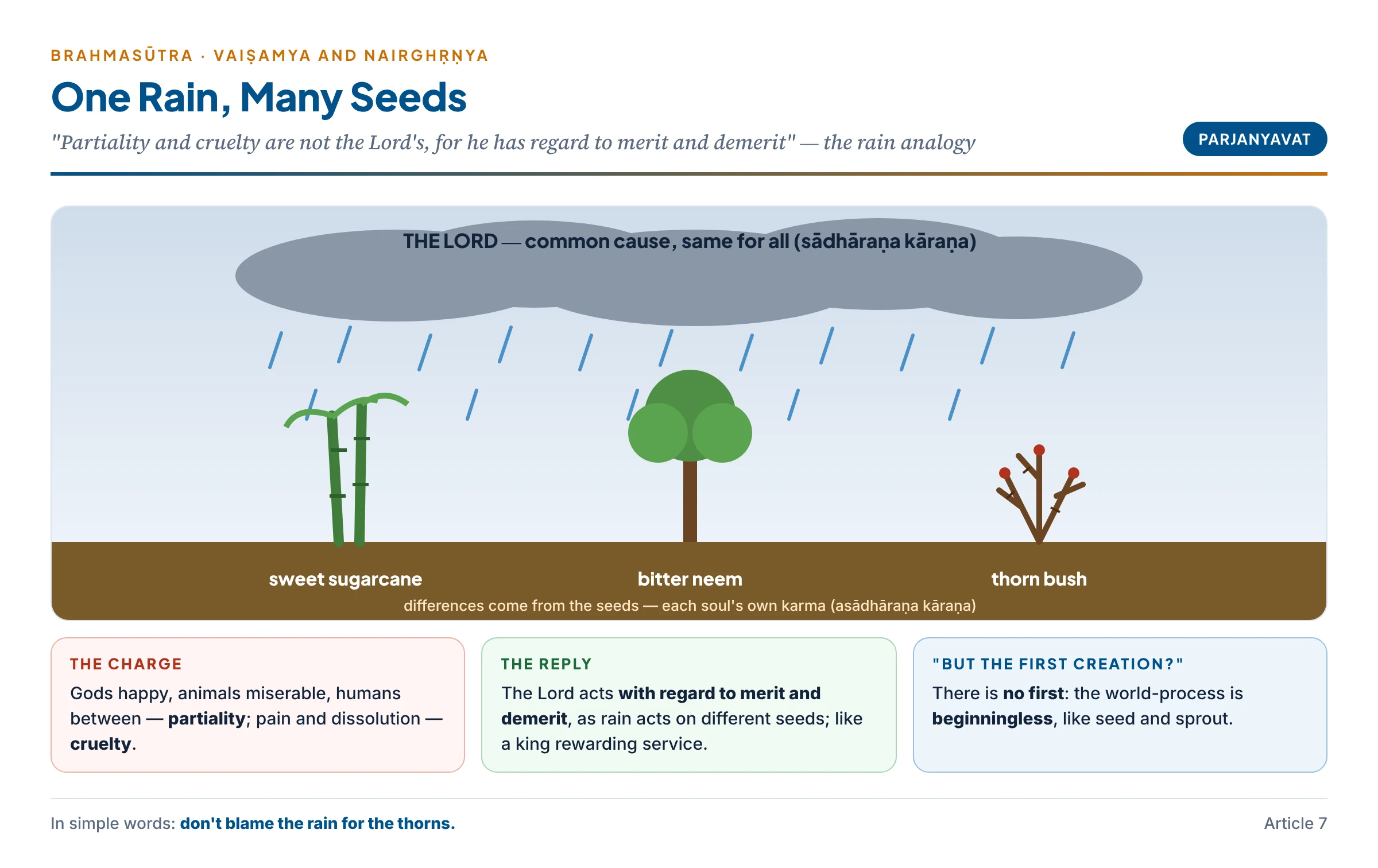
The same rain falls on a whole field. From one seed comes sweet sugarcane, from another bitter neem, from a third a thorn bush. No one blames the rain for the thorns — the difference lies in the seeds. The Vedāntins say God is like the rain: he gives every soul the same power to grow; what each becomes, in joy or sorrow, depends on the seeds of its own past actions.
Context & Problem
Why the Problem Took a Different Shape in India
- Beginningless world-process (anādi saṃsāra) — there was no first moment at which God created innocent souls from nothing; souls and their actions have always existed in cycles of creation and dissolution.
- The law of karma — every intentional action produces a corresponding result for the doer; suffering is therefore never arbitrary.
- Many systems without a creator — Cārvāka, Buddhism, Jainism, Sāṃkhya and Pūrva Mīmāṃsā do not accept a creator God; for them there is nothing to justify.
- Liberation as the goal — Indian thought asks less “why does God allow suffering?” and more “how can I be free from suffering?” (mokṣa, nirvāṇa, kaivalya).
- Max Weber called the karma doctrine “the most consistent theodicy ever produced by history” — it leaves no suffering unexplained.
Common confusion
Is it true that Indian philosophy “never had” a problem of evil? Only in part. India never developed the agonised Western form, because karma and beginningless souls remove the idea of innocent creatures made from nothing. But the problem was argued keenly: the Brahmasūtra raises the charge of God’s partiality and cruelty; Buddhist, Jaina, Mīmāṃsā and Sāṃkhya thinkers used misery as a reason to reject a creator; and Vedāntins debated how a perfect Brahman relates to an imperfect world. India had the problem — it answered it differently.
Core Doctrine
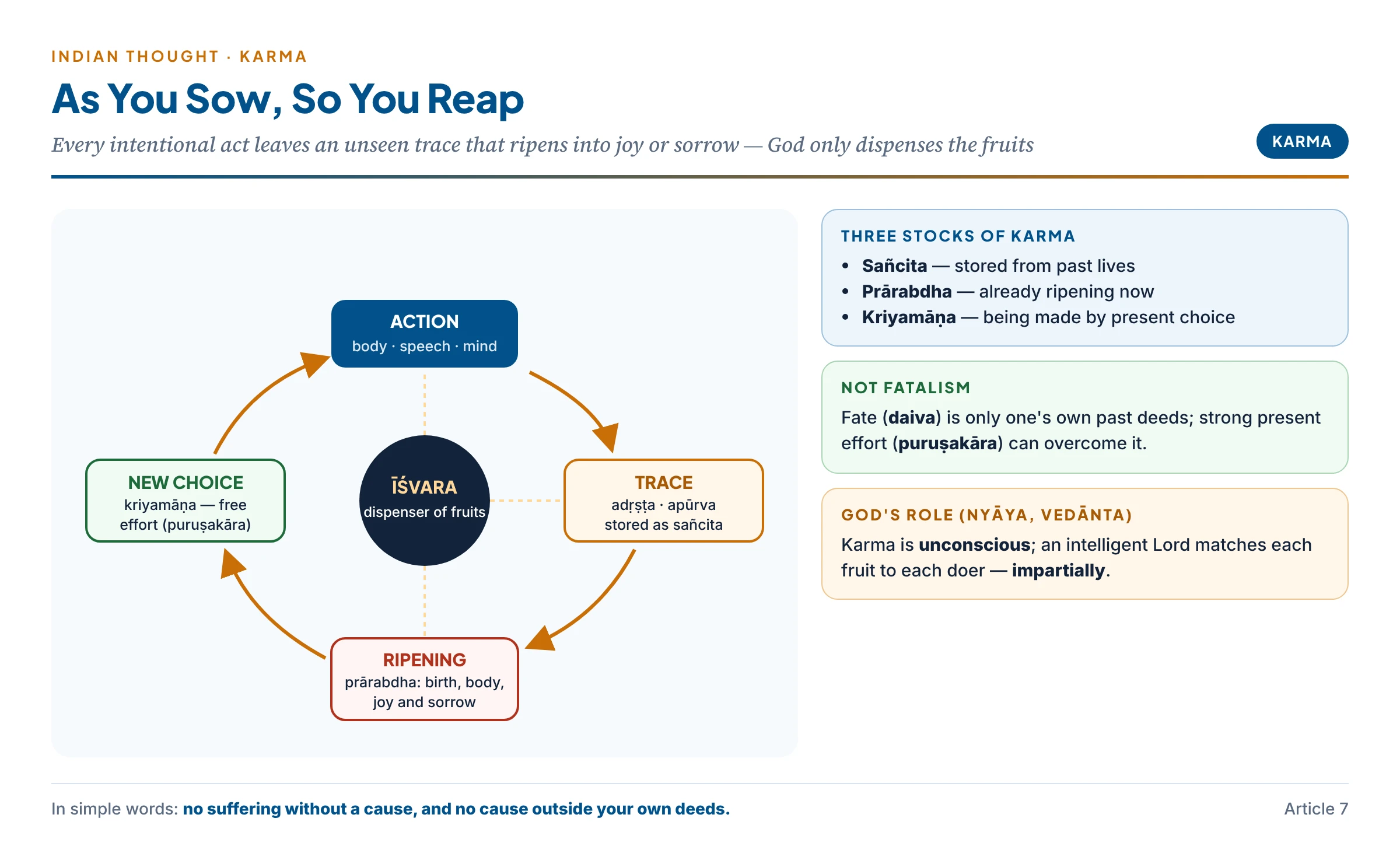
The Law of Karma as an Account of Suffering
- Action leaves a trace: every intentional action — of body, speech or mind — leaves an unseen moral potency: adṛṣṭa (Nyāya–Vaiśeṣika), apūrva (Mīmāṃsā), saṃskāra and vāsanā (impressions and tendencies). The Bṛhadāraṇyaka Upaniṣad: “a man becomes good by good work, bad by bad work.”
- Fruit follows act: meritorious action (puṇya) yields happiness (sukha); sinful action (pāpa) yields suffering (duḥkha) — “as one sows, so one reaps”.
- Three stocks of karma:
- Sañcita — the accumulated store from countless past lives, not yet fruiting.
- Prārabdha — the portion that has begun to bear fruit in this life (it determines one’s birth, body, life-span and major experiences).
- Kriyamāṇa / āgāmi — the new karma being created now, which will bear fruit in future.
- Ripening (vipāka): a child born blind or into poverty is experiencing the ripening of its prārabdha — not God’s whim, not inherited guilt.
- Collective karma: some later texts speak of shared karma (sādhāraṇa karma) to explain disasters that strike many together.
- Not fatalism: Chatterjee and Datta stress that karma is faith in an eternal moral order; one’s present lot (daiva, fate) is only the collective force of one’s own past deeds, and it can be overcome by strong present effort (puruṣakāra), just as old habits can be overcome by new ones. Karma makes man “the master of his own destiny“.
Karma and Freedom of Will
- The worry: if every experience is the fruit of past karma, and past karma shapes our tendencies, are present choices free?
- The Indian answer:
- Karma determines what happens to us (circumstances, body, opportunities) and creates tendencies, but not what we do with them; present will is free to follow or resist tendencies.
- The Gītā (and the Yoga tradition) teaches that by discipline, discrimination and devotion one can burn old impressions and act without creating new bondage (niṣkāma karma).
- The very purpose of scriptural injunctions — “do this, avoid that” — presupposes that the agent is free to obey or disobey (the Brahmasūtra’s argument that the Lord acts with regard to the soul’s effort).
- Remaining tension: if tendencies come from karma and karma from earlier choices, the first free choice is pushed back into a beginningless past — freedom is real now, but its origin is never reached.
The Brahmasūtra Reply: God Is Neither Partial Nor Cruel
- The objection (raised in the Brahmasūtra so that it can be answered): if the Lord is the cause of the world, he is guilty of
- Partiality (vaiṣamya) — he makes gods supremely happy, animals supremely unhappy and humans in between; such unequal treatment would show passion and malice;
- Cruelty (nairghṛṇya) — he inflicts pain and finally destroys all creatures in the dissolution (pralaya), a cruelty abhorred “even by low people”.
- The sūtra: “Partiality and cruelty are not (attributable to the Lord), because he has regard (to merit and demerit); for so scripture declares” (vaiṣamya-nairghṛṇye na, sāpekṣatvāt, tathā hi darśayati).
- Śaṅkara’s explanation:
- If the Lord produced inequality on his own account, he would deserve blame; but in creating he takes into account the merit and demerit of living beings.
- The rain analogy (parjanya): rain is the common cause (sādhāraṇa kāraṇa) of rice, barley and other plants; their differences come from the special potentialities in each seed (asādhāraṇa kāraṇa). So the Lord is the common cause of gods, humans and animals; their differences come from their own karma.
- The king analogy: a king who rewards servants according to their service is not partial, and is not made dependent by doing so.
- Scriptural support: “A man becomes good by good work, bad by bad work” (Bṛhadāraṇyaka); “In whatever way people approach me, so do I reward them” (Gītā).
- The second objection (next sūtra): before the first creation there were no deeds to distinguish souls — so the first inequality must be God’s doing. Reply: there is no first creation; the world-process is beginningless (anāditvāt), like the cycle of seed and sprout. Souls have always had previous existences and deeds.
- Why beginninglessness is reasonable (the following sūtra): if souls began without any karma, then (a) beings would enjoy or suffer without cause — effects without causes; (b) even liberated souls might be dragged back; and (c) ignorance, being one, could not by itself explain the diversity of conditions. Scripture too says the creator fashioned the sun and moon “as before” (yathāpūrvam).
- Why God creates at all (an earlier sūtra): not from need — the Lord is complete — but “as sport (līlā), as in the world“, as a king might play though he lacks nothing.
Indian Connect — Indian Connect — the Gītā on God’s impartiality
- “I am the same to all beings; none is hateful or dear to me” (samo’haṃ sarva-bhūteṣu).
- “The Lord does not take on anyone’s sin or merit; knowledge is veiled by ignorance — that is why creatures are deluded.” The Lord neither creates people’s agency nor their actions nor the link of action and fruit; it is nature (svabhāva) that acts.
- And yet “whenever dharma declines… I come forth, to protect the good and destroy the wicked” — God is impartial in dispensing fruits, but not indifferent to evil.
Nyāya–Vaiśeṣika: God as Dispenser of Fruits
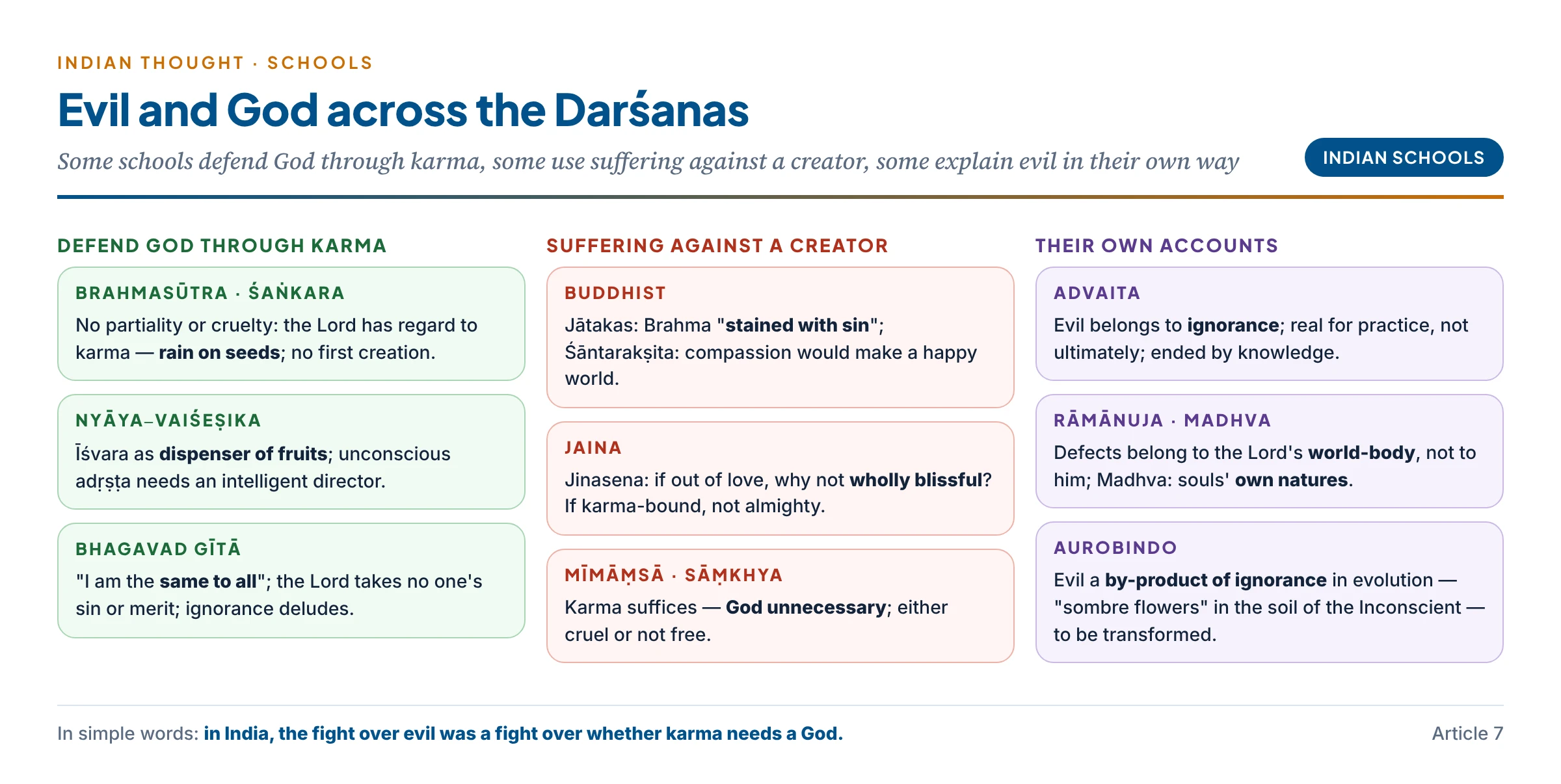
- God as moral governor: Īśvara is the impartial dispenser of the fruits of actions (karmaphala-dātā), the overseer of karma (karmādhyakṣa) and the supreme arbiter of our joys and sorrows.
- Directive cause: the human being is the efficient instrumental cause of his actions; God is their efficient directive cause (prayojaka kartā) — like a wise and benevolent father who directs his son according to his gifts, capacities and past conduct.
- Why karma needs God (Udayana): adṛṣṭa — the merit and demerit of souls — is unconscious; an unconscious force cannot by itself match each fruit to each doer at the right time and place. It needs an intelligent supervisor — God.
- Moral argument: if God is creator and morally perfect, it is reasonable that good actions produce good effects and bad actions bad effects; God rewards and punishes justly.
- Result for evil: God is not the author of suffering; he only administers its just distribution.
The Critics: Evil as an Argument against a Creator
Buddhist critics
- Bhūridatta Jātaka — the Bodhisattva asks:
“If his wide power no limit can restrain, why is his hand so rarely spread to bless? Why are his creatures all condemned to pain? Why does he not to all give happiness? Why do fraud, lies, and ignorance prevail? Why triumphs falsehood — truth and justice fail? I count your Brahma one th’unjust among, who made a world in which to shelter wrong.“
- Mahābodhi Jātaka — “If there exists some Lord all-powerful to fulfil in every creature bliss or woe, and action good or ill, that Lord is stained with sin. Man does but work his will.“
- The Buddha’s rejection of three views: the Buddha rejected the views that everything a person feels is due to (1) the creation of a supreme deity, (2) past action alone, or (3) no cause — because each removes the motive and effort to do good now. He also taught that not every feeling comes from past karma: some come from bile, phlegm, wind, their combination, the seasons, careless conduct, or assault — only some from karma.
- Vasubandhu and later Buddhist logicians extended these objections into formal arguments disproving a creator, much as Western critics argue from evil against God.
- Śāntarakṣita, Kamalaśīla and Dharmakīrti: if God created out of compassion, he should have made the world wholly happy, not full of misery, poverty and grief — and before creation there was no one to pity; if he is guided by the karma of beings, he is not free; if he creates in sport, he depends on his playful impulse; a creator would also need a cause, leading to infinite regress.
Jaina critics
- Jinasena (Mahāpurāṇa): “If out of love for living beings and need of them he made the world, why did he not make creation wholly blissful, free from misfortune?” If he created because of the karma of beings, “he is not the Almighty Lord, but subordinate to something else“; if he created in sport, “it was the sport of a foolish child, leading to trouble“; and if he slays only to destroy evil beings, “why did he create such beings in the first place?“
- Hemacandra: “This universe is not created nor sustained by anyone; it is self-sustaining.”
Mīmāṃsā critics (Kumārila)
- If God created out of compassion, he would have created only happy beings; before creation there were no suffering beings to pity; if he created in sport, he is not perfect. And since the unseen force (apūrva) of actions by itself brings their fruits, God is unnecessary. (Max Müller noted that rejecting a creator is not necessarily rejecting God — the Mīmāṃsakas wished to avoid ascribing cruelty and partiality to the divine.)
Sāṃkhya critics
- If God is moved by selfish motives, he is not free; if he is free and good, he would not create a world of pain and misery. “Either God is unjust and cruel, or he is not free and all-powerful.” If he is governed by karma, he is not free; if not, he is a tyrant.
In simple words
Imagine a judge accused of being harsh: “You sent this man to prison and freed that one!” The judge replies, “I only applied the law to their own deeds.” The critic answers: “Then the law does the work — why do we need you? And if you can set the law aside, why don’t you show mercy?” That is the whole Indian debate in miniature: the Vedāntin judge, and the Buddhist, Jaina and Mīmāṃsā critics.
Replies to the Critics
- Karma needs an intelligent agent: Nyāya and Śaṅkara argue that karma is insentient; an insentient force cannot by itself deliver the right fruit to the right person after long intervals; the fruits come from the Lord, who knows all karma. So God is not redundant.
- Being bound by karma is not a limitation: God acting according to the moral law is like a just king acting according to just laws — an expression of his justice, not a loss of power.
- Beginninglessness answers “why not a happy world?”: there never was a blank start at which God could have created only happy beings; he always works with souls who already have histories.
- Līlā: creation is not for God’s gain but the free overflow of a complete being; the critics’ dilemma (need or folly) does not fit a being who acts from fullness.
Advaita Vedānta: Two Standpoints
- Empirical standpoint (vyāvahārika): the world, souls, Īśvara and karma are real for practical purposes; here Śaṅkara answers the problem exactly as above — karma and the rain analogy.
- Ultimate standpoint (pāramārthika): only Brahman — pure being, consciousness and bliss — is real; creation and its good and evil belong to the world of ignorance (avidyā, māyā). Suffering arises from superimposing the not-Self on the Self (adhyāsa) — identifying with body and mind.
- The remedy is not a theodicy but knowledge (jñāna): when the Self is known, the sufferer discovers that he never was the body that suffered.
- “Beyond good and evil”: the liberated person (jīvanmukta) goes beyond good and evil — not by becoming immoral, but because the ego that acts and suffers has dissolved; actions belong to nature (prakṛti), and morality, valid at the level of duality, ceases where there is no “other” to whom good or ill could be done.
- Criticism: even Śaṅkara must treat evil as empirically real and reconcile it with Īśvara; calling it mithyā from the highest standpoint does not lessen it for the sufferer, and the origin of ignorance itself remains unexplained (anirvacanīya).
Rāmānuja: The Perfect Lord and an Imperfect Body
- The world is real — it is the body of Brahman (śarīra), and souls and matter are his modes.
- No defect touches the Lord: Brahman is “opposed to every imperfection” (akhila-heya-pratyanīka); just as a person’s self is not made old or sick by changes in the body, the defects of the world-body (suffering, change, sin) belong to souls and matter, not to the Lord who indwells them.
- Karma and grace: souls suffer according to their karma; the Lord gives consent (anumati) to the soul’s own effort; but through devotion and surrender (prapatti) his grace can cut through karma.
- The devotee “beyond good and evil”: in the state of surrender, the devotee feels that God alone acts — Śrī Ramakṛṣṇa: “I am the machine, and Thou, O Lord, art the Operator” — and becomes so pure that only holy acts flow from him.
Madhva: Souls by Nature
- Three classes of souls: by their intrinsic nature (svarūpa-yogyatā) souls are fit for liberation (mukti-yogya), for eternal transmigration (nitya-saṃsārin) or for eternal darkness (tamo-yogya).
- God and evil: the Lord is wholly independent (svatantra) and the souls dependent; but he activates each soul according to its own nature; good and evil express that nature, not God’s partiality.
- Criticism: who gave the souls these natures? If no one (they are eternal), God is limited by them; and eternal damnation raises the same moral objection as Augustine’s hell and predestination (Article 3).
Aurobindo: Evil as a By-product of Ignorance in Evolution
- No root in the Divine: falsehood and evil “have no direct root in the supreme Reality“; they are creations of the Ignorance and the Inconscient, not native to the Divine.
- No absolute evil: “There can therefore be no absolute of falsehood, no absolute of evil; these things are a by-product of the world-movement: the sombre flowers of falsehood and suffering and evil have their root in the black soil of the Inconscient.“
- Light and shadow: good and evil are not equal opposites; “a shadow depends on light for its existence, but light does not depend for its existence on the shadow“.
- Origin in the ego: the separative ego, needed to individualise consciousness in evolution, affirms itself against others; the resulting discord and disharmony is what we call wrong and evil. Pain arises from an insufficient consciousness-force unable to harmonise with the universal energy.
- Function and remedy: evil is a necessary circumstance of an evolution from the Inconscient; nature uses both good and evil, and also gives man the sense of good and evil so that he may move beyond both into an eternal Good. With the evolution of Supermind, ignorance and therefore evil will be transformed.
Gandhi, Tagore and Other Indian Voices
- Gandhi and Tagore on the Bihar earthquake (1934): Gandhi read it as divine chastisement for untouchability and a call to self-purification; Tagore replied that physical catastrophes have physical causes and must not be tied to ethics (Article 4).
- Vivekananda: the world is “a great moral gymnasium” in which souls grow strong (Article 5) — a Vedāntic soul-making view.
- Sikh thought: human beings live under the sway of five evil impulses — lust, anger, greed, attachment and pride — which devotion to God helps one overcome by cultivating self-control, forgiveness, contentment, love of God and humility.
Critical Evaluation
Strengths of the Karma Theodicy
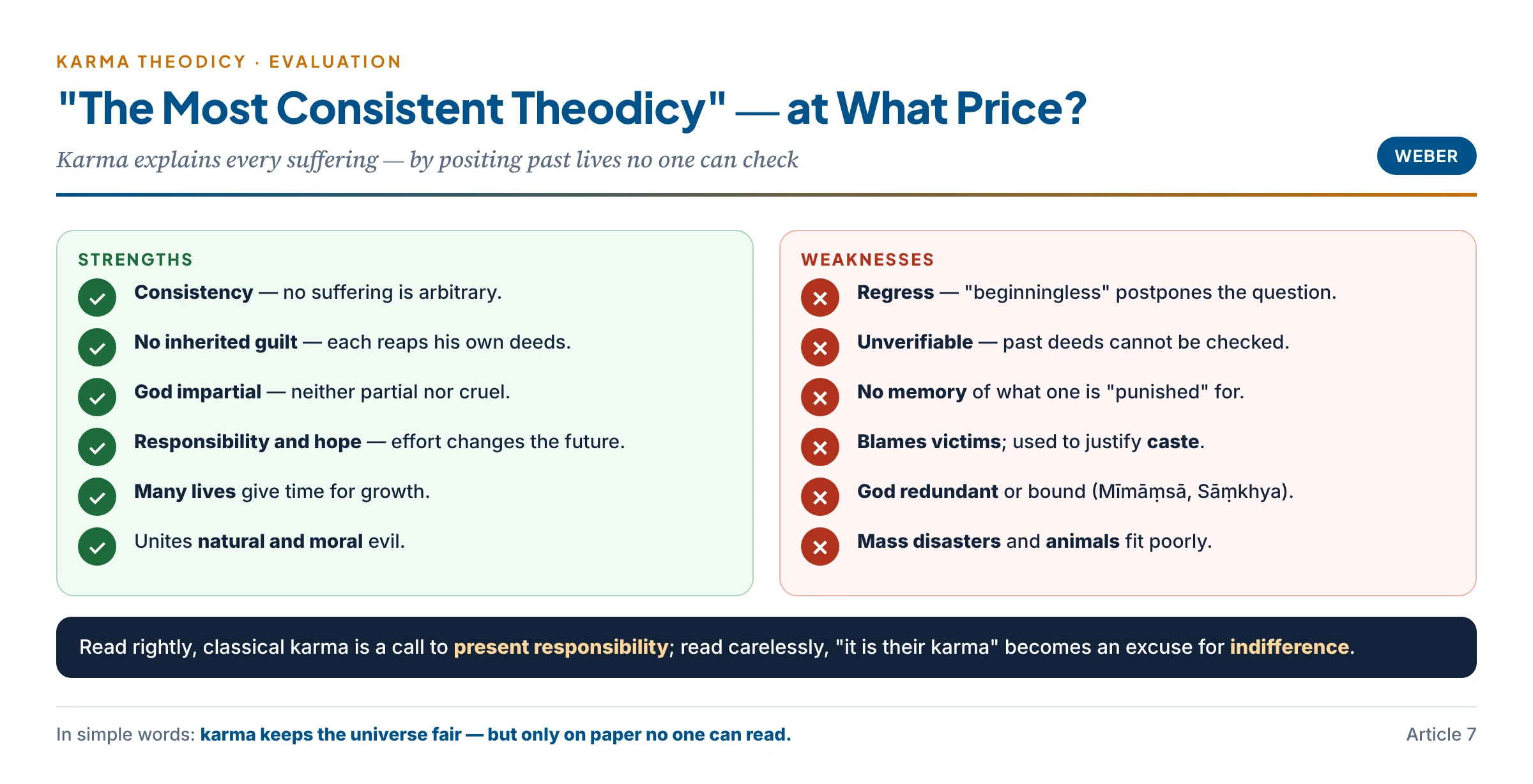
- Consistency: every suffering has a moral cause; no one suffers arbitrarily — Weber’s “most consistent theodicy”.
- No inherited guilt: unlike Augustine, no one bears another’s sin; each reaps his own deeds (Article 3).
- God exonerated: God is impartial; partiality and cruelty belong to the pattern of deeds, not to the dispenser.
- Responsibility and hope: present effort can change the future; karma motivates moral action and is compatible with grace.
- Many lives for growth: rebirth gives the time that soul-making needs (Article 5).
- Natural and moral evil unified: both are fruits of moral causes.
Weaknesses of the Karma Theodicy
- Infinite regress: “beginningless” merely postpones the question; a beginningless chain of causes does not explain why the chain exists at all or why God allows a world of suffering to continue without end.
- Unverifiable: no one can check past-life deeds; the theory cannot be falsified — any suffering can be explained after the fact.
- No memory, no justice?: punishment is just and reformative only if one knows what one is punished for; souls do not remember past lives. (Reply: memory is not needed for a natural consequence, as a smoker’s disease does not need memory of each cigarette.)
- Blames the victim: the theory implies that the abused child, the disabled infant or the famine victim deserved it — a morally disturbing conclusion.
- Justifies social hierarchy: karma was used to justify caste: the low-born “deserve” their station (Weber; Ambedkar’s critique — Socio-Political Unit 10).
- Fatalism and passivity: in popular practice it can breed resignation to injustice (“it is their karma”), though the classical texts reject fatalism.
- God redundant or limited: if karma works automatically, God is unnecessary (Mīmāṃsā, Jaina); if God is bound by it, he is not supreme (Sāṃkhya).
- Collective and natural disasters: when an earthquake kills thousands at once, did each deserve exactly that? Science explains such events physically.
- Animals: insects, birds and beasts are said to suffer for past deeds — but they cannot learn or choose better, so the moral purpose is unclear.
Critics and Defenders
Criticism — Critics of the Indian theistic answer
- Buddhists (Jātakas, Śāntarakṣita): a creator who made this world would be unjust.
- Jainas (Jinasena): if out of love, why not a wholly blissful world?
- Mīmāṃsā: karma suffices — God is unnecessary.
- Sāṃkhya: either cruel or not free; karma-bound or a tyrant.
- Modern critics: karma is unfalsifiable, blames victims and has justified caste.
- Against Advaita: evil called mithyā still hurts; the origin of ignorance is unexplained.
Defence — Defenders of the Indian theistic answer
- Brahmasūtra and Śaṅkara: God has regard to karma — like rain on seeds; no partiality, no cruelty.
- Beginninglessness: there was never a first, innocent creation.
- Nyāya and Śaṅkara: insentient karma needs an intelligent dispenser.
- Gītā: the Lord is the same to all; ignorance, not God, deludes beings.
- Rāmānuja: the world’s defects belong to its body, not to the indwelling Lord; grace can overcome karma.
- Aurobindo: evil is a by-product of ignorance, to be transformed by evolution.
Cross-Tradition Comparison
| Dimension | Western classical theodicy | Indian theistic answer |
|---|---|---|
| Source of the problem | Omnipotent, good God creating souls out of nothing | Beginningless souls and karma; God as dispenser |
| Origin of evil | Misuse of free will (Augustine); friction needed for growth (Hick) | Beginningless ignorance (avidyā) and selfish action (desire, anger) |
| Natural evil | Fall of angels and humans; lawful world; soul-making | Ripening of individual and collective adṛṣṭa; nature as a moral stage |
| God’s responsibility | A constant difficulty (Mackie’s triad, Rowe’s fawn) | God exonerated — the impartial overseer (karmādhyakṣa) |
| Inherited guilt | Original sin (Augustine) | None — each reaps his own deeds |
| Final resolution | Heaven, salvation (for Hick, of all) | Mokṣa, nirvāṇa, kaivalya — end of rebirth |
| Key image | Shadows in a painting; vale of soul-making | Rain on seeds; seed and sprout |
| Western thinker | Indian parallel |
|---|---|
| Augustine — evil as privation | Advaita — evil belongs to ignorance, not to Brahman |
| Plantinga — free creatures responsible | Brahmasūtra — the Lord acts with regard to the soul’s effort |
| Hick — vale of soul-making | Vivekananda — moral gymnasium; rebirth as a longer school |
| Process theology — God limited by the world’s creativity | Nyāya God working with eternal atoms, souls and karma |
| Epicurus–Hume dilemma | Bhūridatta Jātaka, Jinasena |
| Hume–Mackie: God unnecessary | Mīmāṃsā: karma suffices |
| Whitehead — fellow-sufferer | Avatāra sharing human suffering |
Indian Connect — Indian Connect — two questions, one concern
- The Western theodicy asks: is God guilty? The Indian karma theory answers: no one is innocent and no one is abandoned — each reaps his own deeds, and liberation is open to all.
- Both share one concern: to keep the universe morally intelligible. India pays for it with beginningless lives that cannot be checked; the West with a Fall or an afterlife that cannot be checked.
Synthesis (Siddhānta)
- In India the problem of evil took the form: how is God related to the karma of beginningless souls? The karma theory makes every joy and sorrow the fruit of one’s own deeds — stored (sañcita), ripening (prārabdha) and new (kriyamāṇa) — while leaving room for present effort (puruṣakāra).
- The Brahmasūtra answers the charge of partiality and cruelty: the Lord acts with regard to merit and demerit, as rain acts on different seeds; there is no first creation; creation is līlā. Nyāya makes God the intelligent dispenser of unconscious karma; the Gītā declares him the same to all.
- Buddhists, Jainas, Mīmāṃsakas and Sāṃkhya turned the fact of misery against a creator: a loving God would have made the world wholly happy; a karma-bound God is not free; karma alone suffices.
- Advaita places evil in the realm of ignorance and ends it by knowledge; Rāmānuja keeps the Lord untouched by the defects of his world-body; Madhva grounds evil in souls’ eternal natures; Aurobindo sees evil as a by-product of ignorance in evolution, to be transformed.
- The karma theodicy is consistent and avoids inherited guilt, but it is unverifiable, can blame victims and justify hierarchy, and only postpones the question of origins.
- Overall: the Indian answer shows that the problem of evil is indeed an offshoot of how God is conceived (Article 1); its lasting gifts are the insistence on moral responsibility, the hope of liberation for all, and — in Aurobindo and Vivekananda — a vision of suffering as part of the growth of consciousness.
- Contemporary relevance: careless use of “it is their karma” can excuse injustice and indifference; classical karma, read rightly, is a call to present responsibility and compassion, not to resignation.
“Partiality and cruelty cannot be ascribed to the Lord, because he has regard to merit and demerit; for so scripture declares.” — Brahmasūtra
Previous Year Questions
- 2024“The problem of evil is a direct offshoot of how God is conceptualised in a system.” Critically discuss.
- 2009If evil and sufferings are the real experiences of individual self, what role do they play in realising self-transcendence?
- 2007Explain the doctrine of the law of karma. Is it compatible with the freedom of will? Discuss.
- 2006Explain the doctrine of the law of karma. Is it compatible with the freedom of will? Discuss.