

Soul: Immortality; Rebirth and Liberation.
Official Syllabus: Paper II, Section B, Unit 4
The soul (Greek psychē, Latin anima, Sanskrit ātman or jīva) is the name philosophers and religions give to the non-physical core of a person — that in me which knows, feels, wills and says “I”, and which, many traditions hold, is not destroyed when the body dies. Every question in this unit — Is the soul immortal? Is there rebirth? What is liberation? — depends on a prior question: what kind of thing is the soul? A materialist, a Platonist, a Buddhist and an Advaitin give four different answers, and so they describe life after death in four different ways. This article sets out the major conceptions of the soul in the West and in India, the debate on whether man is a soul or has one, and two classic comparisons: Indian jīvātmā vs Plato’s soul and the Christian soul vs the Gītā’s ātman.
In simple words
Think of a mobile phone. The handset is made of glass, metal and chips; the “phone” you talk to — your contacts, photos, habits, voice assistant — seems to be something more. When the handset breaks, is everything gone, or can it be restored on a new handset? Some say the data is nothing but the chips (materialism). Some say the data is stored somewhere else and only uses the handset (dualism). Some say there was never a single fixed “file”, only a stream of updates (Buddhism). And some say the whole network is one, and each phone only seems separate (Advaita). The soul debate asks the same question about you.
Context & Problem
Why the Notion of Soul Comes First
- The meaning of immortality, rebirth and liberation changes with the meaning of soul:
- If the soul is an immaterial substance, immortality means its continued existence after the body (Plato, Descartes, Nyāya).
- If the soul is the form of the body, survival needs some body — hence resurrection (Aristotle, Aquinas, Semitic religions).
- If there is no permanent soul, rebirth must be the continuation of a causal stream (Buddhism).
- If the true self is Brahman, liberation is realising what one already is (Advaita).
- If the “soul” is only the conscious living body, death is total annihilation (Cārvāka, physicalism).
- So the soul question is the foundation stone of religious eschatology (eschaton = “the last things”: death, judgement, afterlife, final destiny).
Soul, Self, Mind and Person
- Soul: the non-physical essence of the individual. Many Indian systems hold it to be distinct from the mind (manas), intellect (buddhi), ego (ahaṃkāra), body and senses — these belong to the knowable world, the soul is the knower.
- Self: the subject of experience — the “I” that thinks and acts. Not every theory of self is a theory of soul (Hume and the Buddha give a self without a soul-substance).
- Mind: the faculty or set of mental activities — thinking, feeling, perceiving. Descartes identifies soul and mind; Indian systems usually do not.
- Person: a being who can be identified, held responsible and addressed — Locke’s “thinking intelligent being that can consider itself as itself in different times and places”.
Common confusion
Is the soul the same as the mind? Not in Indian philosophy. For Sāṃkhya, Yoga and Vedānta, mind, intellect and ego are subtle matter (parts of prakṛti or of the subtle body); the soul (puruṣa / ātman) is pure consciousness that witnesses them. Descartes, by contrast, makes the soul a thinking thing — soul and mind become one. Every comparison of Indian and Western views of the soul turns on this difference.
Core Doctrine
Origins of the Idea
- Very old: the way the earliest human skeletons were buried with food and tools suggests a belief that something of the person continues.
- Possible sources suggested by anthropologists: dreams of the dead, memories of them, one’s reflection in water, the breath that leaves at death (Greek psychē and Sanskrit ātman are both linked to breath), and religious rites around death.
- Homeric Greece: the psychē of the dead is a pale shade in Hades — a ghost, not a full person.
- Orphics and Pythagoreans: the soul is divine, imprisoned in the body, and passes through many bodies (transmigration). Plato inherits this.
- Vedic and Upaniṣadic India: from early hopes of heaven with the ancestors to the Upaniṣadic discovery that the inner self (ātman) is one with the ground of the universe (Brahman).
The Four Major Views (and a Fifth)
Historically, East and West hold four major views of the self — dualism, materialism, monistic pantheism and the Buddhist no-self — and a fifth, hylomorphism, sits between dualism and materialism.
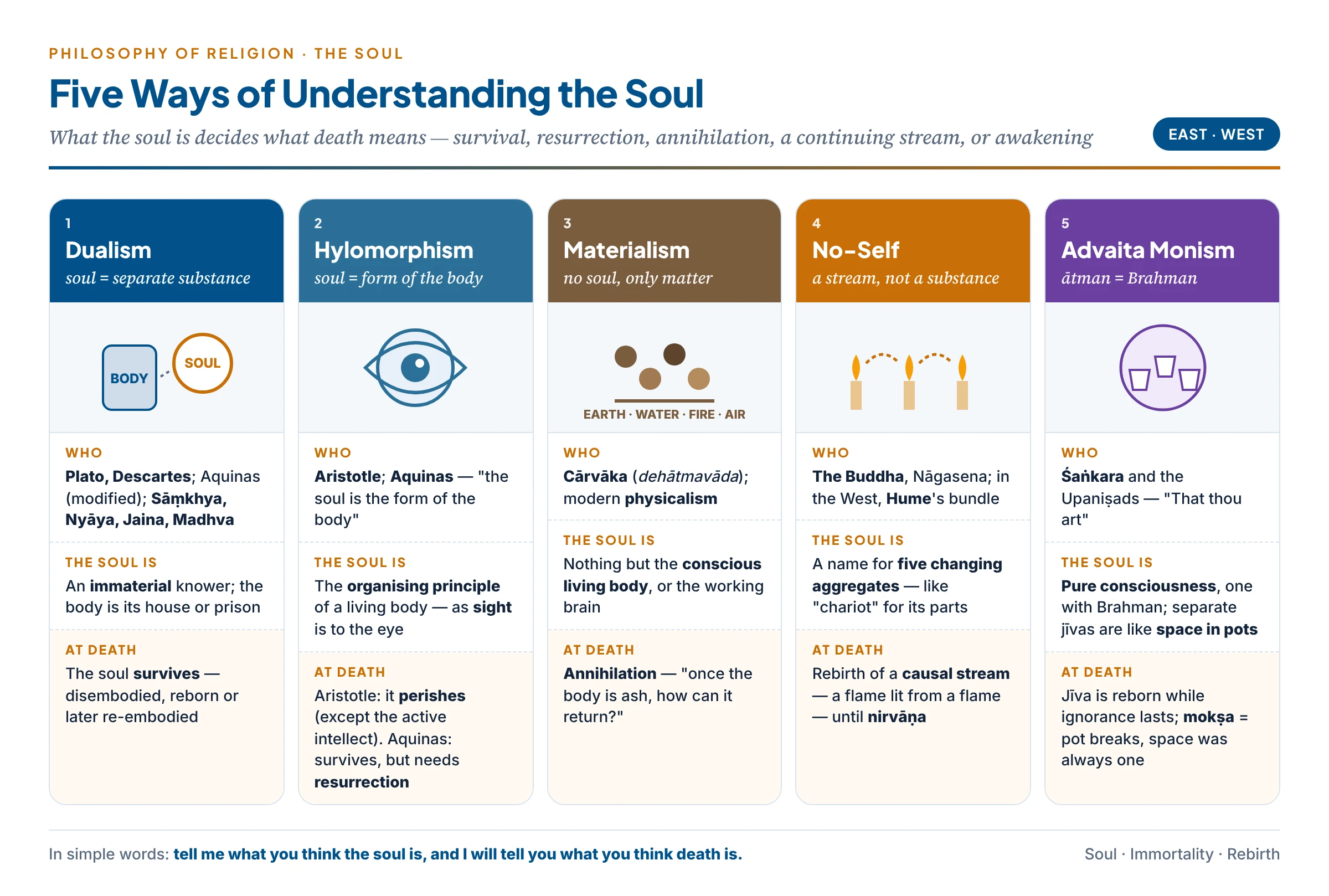
1. Dualism — the soul as a separate substance
- Meaning: the person is made of two different kinds of reality — an immaterial soul and a material body. The soul is the real self; the body is its house, instrument or prison.
- Western dualists: Plato, Aquinas (in a modified form), Descartes.
- Indian dualists: Sāṃkhya–Yoga (puruṣa vs prakṛti), Nyāya–Vaiśeṣika, Jainism (jīva vs ajīva), and the theistic Vedānta of Madhva.
- Afterlife: most dualists, religious and non-religious, affirm life after death, in one of three forms:
- Resurrection — an embodied state again (Jewish, Christian and Islamic views of the resurrection of the body).
- Reincarnation — another physical life, perhaps as an animal or another person.
- Disembodied existence — the soul forever separated from any physical existence.
2. Hylomorphism — the soul as the form of the body
- Meaning: hylē = matter, morphē = form. Aristotle says the soul is the form of a living body — its organising principle, not a separate thing. “If the eye were an animal, sight would be its soul.”
- Levels of soul: nutritive (plants), sensitive (animals), rational (humans).
- Fate at death: since a form cannot exist without its matter, the individual soul perishes with the body — except, perhaps, the active intellect (nous poiētikos), which Aristotle calls “separable, deathless and eternal”, though it is unclear whether it is personal.
- Aquinas baptised this view: the soul is the form of the body (anima forma corporis), but the rational soul is subsistent — it can exist after death, though incomplete without a body. Hence Christian hope for the resurrection of the body.
3. Materialism — no soul at all
- Meaning: there is no immaterial aspect of the self — no soul, no immaterial mind. Consciousness is a product or function of matter.
- Cārvāka: consciousness arises from the four elements (earth, water, fire, air) combined in a body (bhūtacaitanyavāda), as the intoxicating power arises from fermented ingredients that separately lack it, or the red colour from betel leaf, nut and lime chewed together. The self is nothing but the conscious living body (dehātmavāda): we say “I am fat“, “I am lame“, “I am fair“.
- Modern physicalism: mental states are brain states (identity theory); the “self” is what the brain does.
- Afterlife: for most materialists, none — “once the body is reduced to ashes, how can it return?” (bhasmībhūtasya dehasya punarāgamanaṃ kutaḥ). But some Christian materialists hold that God can raise the body, so resurrection is possible without an immaterial soul.
4. Monistic pantheism — Advaita Vedānta
- Monism: reality is one; pantheism: all is divine.
- Brahman is undifferentiated consciousness, beyond all qualities including personhood. The universe appears through māyā, the illusory power from which apparent differentiation and individuality emerge.
- Individual selfhood is an illusion, a product of māyā; the true self, ātman, is Brahman (“That thou art”, tat tvam asi).
- Afterlife: the individual soul (jīva) transmigrates while ignorance lasts; liberation is the realisation of oneness with Brahman — the jīva’s separateness ends, the self does not.
5. The Buddhist doctrine of no-self (anātmavāda / nairātmyavāda)
- Meaning: there is no substantial, permanent ātman. This follows from dependent origination (pratītyasamutpāda — “this being, that arises”): everything is conditioned and changing.
- Like Advaita, Buddhism says the individual self as a fixed entity is an illusion. Unlike Advaita, it says the experiences, desires, feelings and cravings are real — they are a flux, not a mask over one eternal self.
- Five aggregates (pañcaskandha): form (rūpa), feeling (vedanā), perception (saṃjñā), mental formations (saṃskāra), consciousness (vijñāna). The person is a name for this changing bundle (nāmarūpa — name and form).
- Chariot analogy (Nāgasena to King Milinda): the chariot is not the pole, the axle, the wheels or the frame; not all the parts taken together; nor something other than the parts. “Chariot” is only a convenient name. So too “Nāgasena”.
- Afterlife: rebirth without a transmigrating soul — like a flame lit from a flame. Grasping the no-self teaching is hard; it may take many lives of working off karma.
In simple words
A river like the Ganga is never the same water for two seconds, yet we call it “the Ganga” for thousands of years. The dualist says there is a permanent river-spirit behind the water. The materialist says “Ganga” is only the water. The Buddhist says “Ganga” is a useful name for a continuous flow, with nothing permanent inside. The Advaitin says all rivers are the one ocean appearing in different channels.
Plato: The Soul as the Prisoner and Pilot of the Body
- Immaterial, simple, rational: the soul is akin to the eternal Forms it knows; the body belongs to the changing world of the senses.
- Pre-existence: the soul existed before birth and knew the Forms; learning is recollection (anamnēsis).
- Body as prison and tomb: “the body (sōma) is a tomb (sēma)” — an Orphic play on words Plato repeats. Philosophy is “practice for dying” — learning to live by reason, detached from bodily desire.
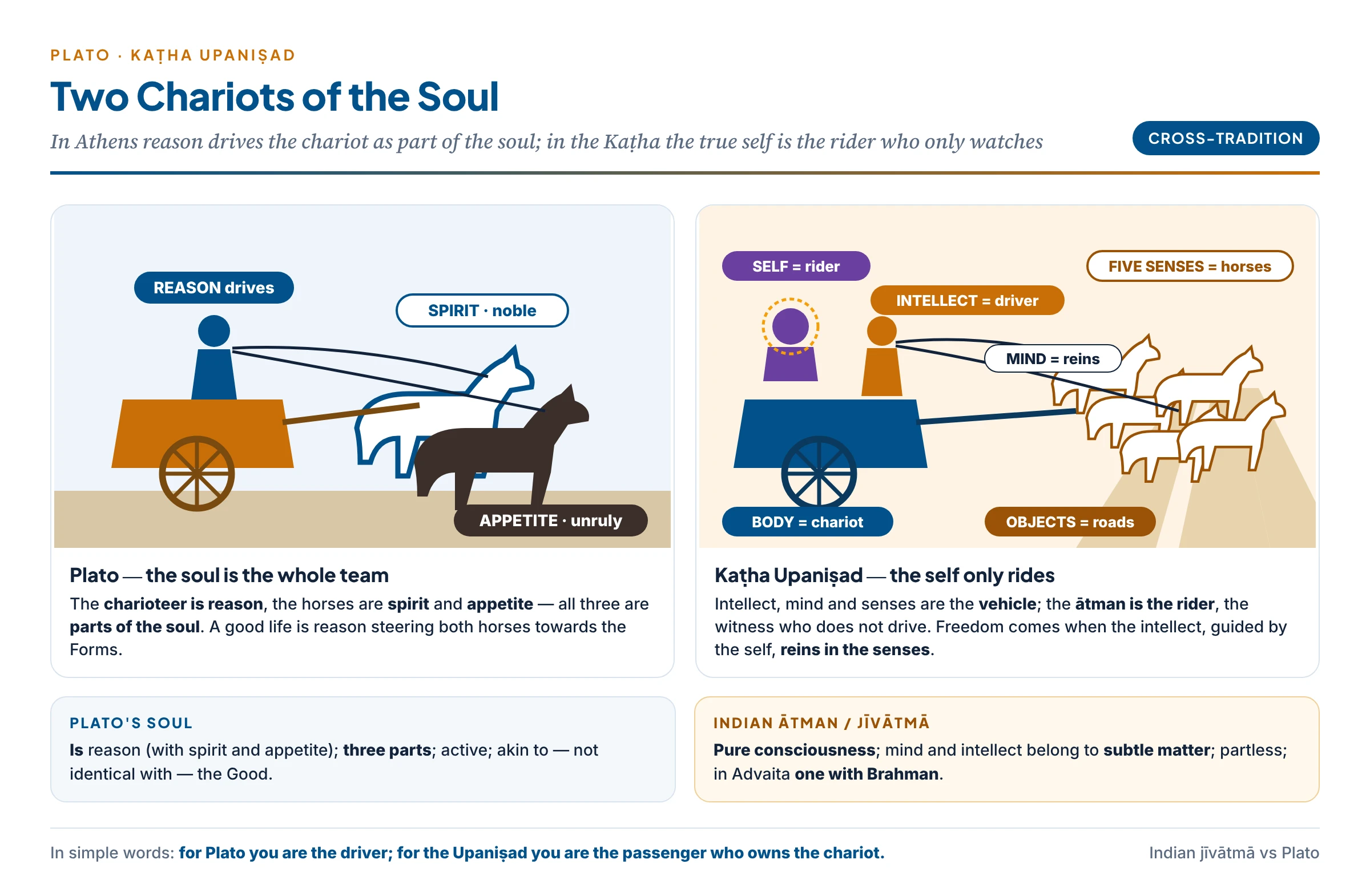
- Three parts of the soul (in the Republic and Phaedrus): reason (logistikon), spirit (thumoeides), appetite (epithumētikon) — pictured as a charioteer driving two horses, one noble and obedient, the other unruly.
- Destiny: the purified soul returns to the realm of the Forms; others are reborn according to their lives — the Myth of Er at the end of the Republic describes souls choosing their next lives.
- Socrates at his death: when Crito asks how to bury him, Socrates laughs: “However you wish — if you can catch me.” He is not the corpse they will see; he is the one now talking.
Descartes: The Soul as a Thinking Thing
- Res cogitans vs res extensa: the soul is a thinking thing, unextended and indivisible; the body is an extended thing, divisible.
- Arguments: (1) I can doubt that I have a body, but not that I exist; (2) the body is always divisible, the mind is utterly indivisible; (3) I have a clear and distinct idea of myself as thinking and not extended.
- Interaction through the pineal gland.
- Fate at death: the soul is not destroyed by bodily dissolution — it is naturally immortal, though Descartes left the final proof to God’s power.
Other Western Conceptions
- Leibniz: the soul is a monad — a simple, windowless substance. Being simple, it cannot perish naturally; only God could annihilate it.
- Spinoza: the mind is the idea of the body; yet “we feel and know by experience that we are eternal” — the part of the mind that knows things “under the form of eternity” is eternal.
- Locke: a person is a matter of consciousness and memory, not of soul-substance — the soul of a prince entering the body of a cobbler would make the cobbler-body the prince.
- Hume: when I look inward I find only perceptions, never a self — the self is a “bundle or collection of different perceptions”.
- Kant: the “I think” that accompanies all my thoughts is a formal unity (transcendental apperception), not the perception of a soul-substance; the soul is an Idea of Reason, useful as a guide but never known.
- Ryle: Cartesian dualism is the “dogma of the ghost in the machine“, a category mistake.
- Strawson: the concept of a person is primitive — the same thing has both mental and bodily features.
- Hebrew view: the person is a unity of body and life; for the ancient Hebrews “the body is the soul in its outward form”. This is why the Bible speaks of resurrection, not of a soul escaping the body.
Semitic and Indian Views Compared
- Semitic religions (Judaism, Christianity, Islam): the body is essential for the soul, and immortality comes through a resurrected body; a “pure”, bodiless soul is not the final state; only human beings have souls (in the usual teaching).
- Hinduism: all living creatures possess souls; a soul may be born as a human, an animal or a plant.
- Jainism goes further: even earth, water, fire and air bodies contain souls in which consciousness lies dormant.
- Buddhists and Cārvākas reject a permanent soul; the other schools accept a soul that can exist apart from the gross body, though they differ about its nature.
“Is Man a Soul or Has He a Soul?”
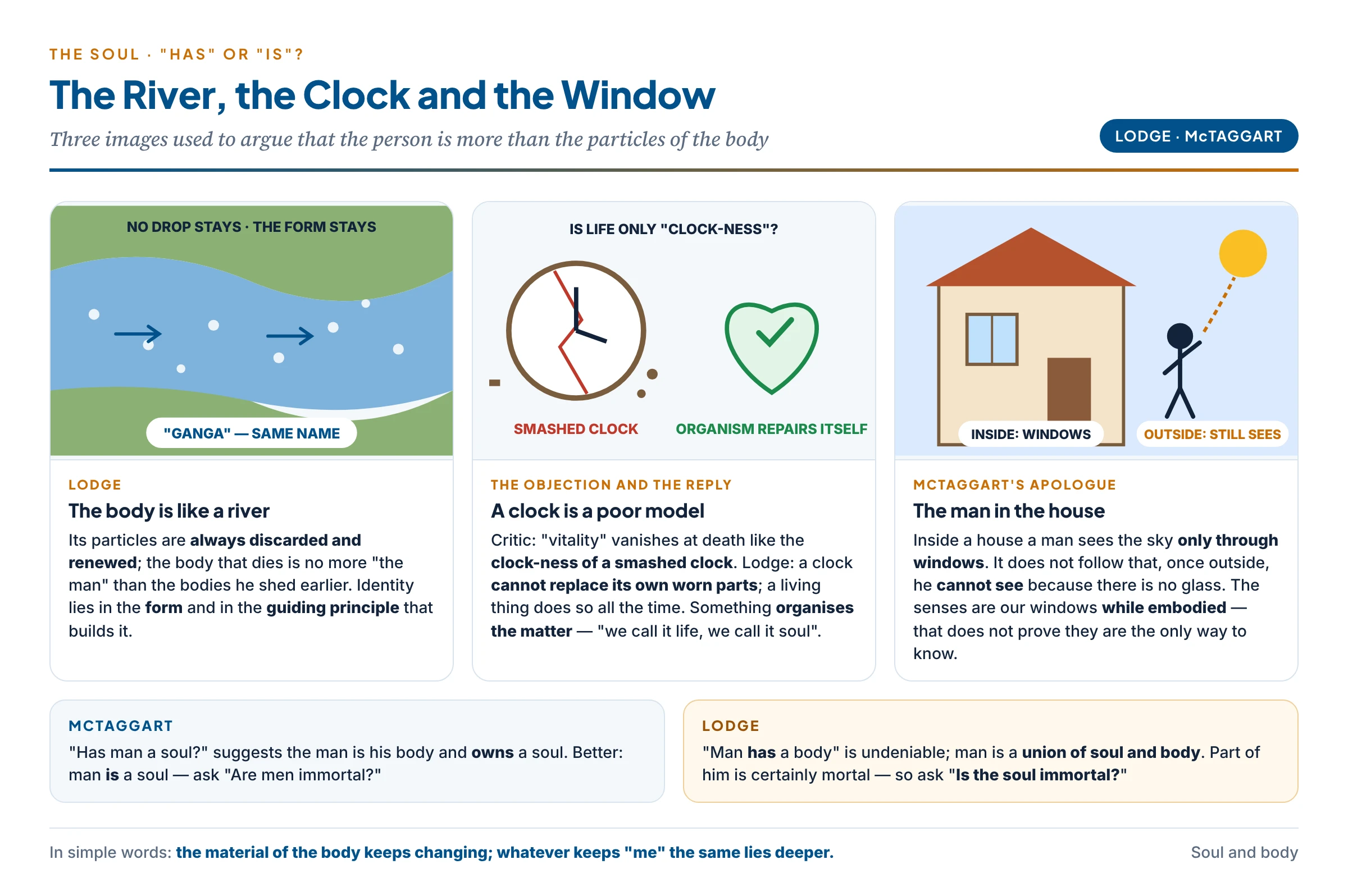
- McTaggart held that the question “Has man an immortal soul?” is badly framed: the word “has” suggests that the man is his body and owns a soul that is set free at death. He preferred “Are men immortal?” — man is a soul.
- Oliver Lodge (physicist and psychical researcher) replied:
- “Man has a body” is an undeniable truth; but a man is a union of soul and body. Without either he is incomplete — a corpse is no longer “a man”.
- So the better question is the old one: “Is the soul immortal?” — because part of human nature is certainly mortal.
- By “soul” we must mean that part of man which is dissociated from the body at death — what distinguishes a living man from a corpse.
- “Vitality” vs “life”: Lodge calls the relation between body and soul vitality, and the unknown entity that organises matter life. A critic says vitality vanishes at death like the “clock-ness” of a clock smashed by a hammer. Lodge replies:
- A clock cannot replace its own worn parts; an organism does so all the time.
- The body is in constant flux — its particles are continually discarded and renewed; the body that finally dies is no more “the man” than the many bodies he has already shed.
- A river is the closer analogy: the Tiber, the Ganges and the Nile keep their identity though no drop stays. Identity lies in the form, not in the material.
- Even the most durable human body lasts only about a thousand months — a mere instant in the history of the planet.
- Lodge’s definition: the soul is “that controlling and guiding principle which is responsible for our personal expression and for the construction of the body“; in its higher development it includes feeling, intelligence and will. The body is its instrument or organ. When the body is impaired, only the instrument of manifestation is damaged — not the soul itself. The soul is the link between spirit and matter.
In simple words
McTaggart’s apologue (moral story): a man shut up in a house can see the sky only through transparent windows. It would be foolish to conclude that if he walked out of the house he could not see the sky because there was no glass left to look through. The senses are like windows: they are the way we see while we are inside the body — that does not prove we can see only through them.
Indian Conceptions of the Soul (Ātman / Jīva)
Almost all Indian schools except Cārvāka and Buddhism accept a permanent soul; they differ on whether consciousness is its essence or an accident, on its size, its number, and its relation to God.
Upaniṣads and the layered self
- Five sheaths (pañcakośa, Taittirīya Upaniṣad): food (annamaya), vital breath (prāṇamaya), mind (manomaya), intellect (vijñānamaya) and bliss (ānandamaya). The ātman is beyond all five, as the sword is inside its scabbards.
- Three bodies: gross (sthūla), subtle (sūkṣma or liṅga) and causal (kāraṇa).
- Four states: waking, dream, deep sleep and the fourth (turīya) — the witness present in all three (Māṇḍūkya Upaniṣad).
- “Not this, not this” (neti neti): the self cannot be grasped as an object because it is the seer of every object.
- The Kaṭha chariot: “Know the self as the rider, the body as the chariot, the intellect as the charioteer, the mind as the reins; the senses are the horses, and their objects the roads.”
School by school
| School | What the soul is | Consciousness | Size and number | After death / liberation |
|---|---|---|---|---|
| Cārvāka | The conscious body (dehātmavāda) | A product of elements | One body, one “self” | Annihilation |
| Jainism | Jīva: conscious, active, knower, doer, enjoyer | Essential (cetanā-lakṣaṇa) | Body-sized (expands and contracts like a lamp’s light); infinite in number | Rebirth by karmic matter; liberated soul rises with infinite knowledge, bliss, power |
| Buddhism | No permanent self; five aggregates | Momentary stream | — | Rebirth of a stream; nirvāṇa |
| Nyāya–Vaiśeṣika | Substance (dravya) that has cognition, desire, effort | Adventitious (arises when soul, mind, senses and objects meet) | All-pervading (vibhu); many | Rebirth; in apavarga the soul is without consciousness |
| Sāṃkhya–Yoga | Puruṣa: pure consciousness, inactive witness | Essence | All-pervading; many | Only the subtle body transmigrates; kaivalya = isolation |
| Mīmāṃsā | Eternal self, agent and enjoyer of ritual fruit | Kumārila: both conscious and unconscious; Prabhākara: revealed as subject in every cognition | All-pervading; many | Heaven (svarga); later, release |
| Advaita | Ātman = Brahman; jīva is ātman limited by adjuncts | Pure consciousness, self-luminous | One in reality; many only in appearance | Mokṣa: realising non-difference |
| Viśiṣṭādvaita | Jīva is a real mode or “body” of Brahman | Essential; has attributive knowledge (dharmabhūtajñāna) | Atomic (aṇu); many | Lives in Vaikuṇṭha, like God in bliss, distinct |
| Dvaita | Jīva eternally distinct from God and from other jīvas | Essential (bliss, knowledge) | Atomic; three classes of souls | Graded bliss in liberation, by Viṣṇu’s grace |
- Nyāya’s six marks of the self: desire, aversion, effort, pleasure, pain and cognition cannot belong to the body, senses or mind — they need a substance in which they inhere.
- Sāṃkhya’s proofs of puruṣa (in summary): assemblages exist for another (a bed is for a sleeper; the body–mind complex is for a conscious enjoyer); there must be a controller, an experiencer, a witness, and a being who seeks release.
- Advaita’s argument: the self cannot be denied, because the one who denies it is the self. Everything else can be doubted; the doubter cannot.
- Jaina proofs of jīva: self-awareness (“I am happy”), the body moves purposefully like a chariot that needs a driver, the senses need a user, and doubt itself proves a doubter.
Indian Connect — Indian Connect — the chariot in Athens and in the Kaṭha
- Plato and the Kaṭha Upaniṣad, centuries apart, both picture the human being as a chariot.
- In Plato, the charioteer is reason, a part of the soul itself; the horses are spirit and appetite, also parts of the soul.
- In the Kaṭha, the intellect (buddhi) is only the charioteer, the mind the reins, the senses the horses — and the true self is the rider, who does not drive at all but witnesses. Reason belongs to the vehicle, not to the self.
- This one image shows the central difference: Plato’s soul is reason; the Indian ātman is pure consciousness beyond reason.
Indian Jīvātmā vs Plato’s Soul
Similarities
- Both hold the soul to be immaterial, distinct from the body, and eternal — it exists before birth and after death.
- Both accept transmigration governed by the moral quality of one’s life (Plato’s souls choose new lives; the jīva is reborn by karma).
- Both see embodiment as bondage and the highest goal as release from the body’s pull (Plato’s return to the Forms; mokṣa).
- Both make knowledge the means of release: Plato’s philosophy, Advaita’s jñāna.
Differences
| Point | Plato’s soul | Indian jīvātmā (especially Sāṃkhya and Vedānta) |
|---|---|---|
| Essence | Reason — the soul thinks | Pure consciousness — reason (buddhi) belongs to subtle matter |
| Structure | Three parts (reason, spirit, appetite) | Partless; mind, intellect, ego are coverings, not parts |
| Activity | Active: thinks, desires, rules | Sāṃkhya: inactive witness; Advaita: actor only through adjuncts |
| Relation to the highest | Akin to the Forms, not identical with the Good | Advaita: identical with Brahman; Viśiṣṭādvaita: its mode |
| What transmigrates | The soul itself | Often the subtle body carrying impressions (saṃskāras); the self only appears to move |
| Cause of bondage | The body’s desires; forgetting the Forms | Ignorance (avidyā), non-discrimination (aviveka), karma |
| Means of release | Dialectic, philosophic life | Knowledge, devotion, action, meditation — and in theistic schools, grace |
| Scope | Human (and animal) souls | All living beings; Jainism even elements |
| Proof | A priori (simplicity, recollection, Form of Life) | Śruti plus reasoning; the self as indubitable witness |
Common confusion
Did Plato think the whole soul was immortal? In the Phaedo he argues for the soul’s immortality as a simple thing akin to the Forms; in the Republic and Phaedrus he describes the soul as three-part. Many readers take the rational part to be the immortal core and the lower parts to belong to embodiment. The Indian parallel is close: what survives and is finally freed is the conscious self, not the mind and senses.
The Christian Soul vs the Gītā’s Ātman
Christian doctrine of the soul and its immortality
- The soul is created by God at (or near) conception — it did not exist before this life.
- Each person lives one earthly life, followed by judgement, then heaven or hell (with purgatory in Catholic teaching).
- The soul survives death but waits for the resurrection of the body; the full person is body and soul.
- Immortality is a gift of God’s grace, not the soul’s own nature (many Christian thinkers; some even hold conditional immortality — only the saved live for ever).
- The goal is personal fellowship with God — the person remains a distinct individual.
The Gītā’s ātman
- The self is “never born and never dies; having been, it does not cease to be; unborn, eternal, everlasting, ancient, it is not slain when the body is slain.”
- “Weapons do not cut it, fire does not burn it, water does not wet it, wind does not dry it.“
- “As a man casts off worn-out garments and puts on new ones, so the embodied self casts off worn-out bodies and enters new ones.”
- “As the embodied one passes in this body through childhood, youth and old age, so it passes on to another body; the wise are not deluded by this.”
- “For the born, death is certain; for the dead, birth is certain.”
- The self existed before birth (beginningless) and passes through many lives governed by karma; the goal is release from rebirth through knowledge, selfless action and devotion — and, at the end of the Gītā, by surrender to Kṛṣṇa and his grace.
| Point | Christian soul | Gītā’s ātman |
|---|---|---|
| Origin | Created by God; has a beginning | Unborn, beginningless |
| Nature of immortality | Gift of God (or natural, but sustained by God) | Inherent — the self cannot be destroyed |
| Number of lives | One | Many (saṃsāra) |
| Role of body | Body is part of the person; resurrection | Body is a garment; discarded and changed |
| What decides destiny | God’s judgement and grace | Karma, and Kṛṣṇa’s grace for the devoted |
| Final state | Personal communion with God; resurrected body | Release from birth and death; union or nearness with the Divine |
| Personal identity | Strongly preserved | The empirical personality is shed; the self remains |
Are they compatible?
- Points of agreement: both affirm that death is not the end, that the moral quality of life matters for destiny, that the self is more than the body, and that the divine (God, Kṛṣṇa) is the final refuge. Both teach grace at the highest level — the Gītā’s final call to surrender is close to Christian faith.
- Points of conflict: pre-existence and rebirth vs one created life; inherent vs gifted immortality; body as garment vs body as part of the person; Christian eternal hell vs Indian repeated chances.
- Bridges: Christian thinkers like Origen believed in the soul’s pre-existence; some modern theologians (Hick) propose many lives in other worlds; and Rāmānuja’s Vedānta, which keeps the soul’s individuality in liberation, is close to Christian personal immortality.
- Verdict: they are compatible in spirit (immortal, morally responsible self returning to God) but incompatible in their detailed metaphysics (creation vs beginninglessness, one life vs many).
“He is not born, nor does he ever die… he is not slain when the body is slain.” — Bhagavad Gītā
Jainism: The Soul and Its Bondage
- Nature of the jīva: consciousness is its essence; it has infinite knowledge, infinite perception, infinite bliss and infinite power (ananta-catuṣṭaya) in its pure state.
- Kinds: liberated (mukta) and worldly (saṃsārin); worldly souls are classified by the number of senses — one-sensed (earth, water, fire, air, plants) up to five-sensed (animals, humans, gods, hell-beings); also mobile and immobile.
- Size: the soul fills the body it occupies — like the light of a lamp that fills a small room or a large hall.
- Bondage (bandha): because of the passions (kaṣāya — anger, pride, deceit, greed), the soul attracts subtle karmic matter (āsrava) which sticks to it, as dust sticks to an oiled body. This karmic matter veils the soul’s infinite qualities and binds it to rebirth.
- Two kinds of bondage: psychic bondage (bhāva-bandha — the passions and wrong attitudes) and material bondage (dravya-bandha — the actual union of karmic matter with the soul).
- Release: stop the inflow (saṃvara), wear off the existing karma (nirjarā), through the three jewels — right faith, right knowledge, right conduct (details in Article 7).
In simple words
Picture a bright lamp covered with layers of soot. The light is still fully there, but the room is dim. Jainism says the soul is that lamp: its infinite knowledge and bliss are intact, but karmic dust, attracted by anger, pride, deceit and greed, has covered it. Liberation is not adding light — it is cleaning the glass so the light shines out.
Critical Evaluation
Arguments for a Soul — and Their Problems
- From self-awareness (Descartes, Advaita, Jaina): I cannot doubt that I exist — but this shows that thinking exists, not that a separate substance thinks (Kant, Hume).
- From the unity of consciousness (Nyāya, Kant’s opponents): many experiences are united in one subject — but unity may be a function of the brain or a formal feature of thought, not a simple thing.
- From memory and recognition (Nyāya: “I who saw this yesterday now touch it”): a persisting knower is needed — but a stream with causal links (Buddhism) or psychological continuity (Locke) may do the same work.
- From the purposive body (Jaina, Sāṃkhya): the body acts for someone — but biology explains purposive behaviour by evolution and the nervous system.
- From irreducible subjectivity: the felt quality of experience — what it is like to taste or to see red — has not been explained by brain science (the “hard problem”). This is the strongest modern support for some non-physical aspect of mind.
Arguments against a Soul
- Cārvāka: perception alone gives knowledge; the soul is never perceived; consciousness rises and falls with the body.
- Buddhism: everything is momentary and conditioned; a permanent self is a source of craving and suffering.
- Hume: introspection finds only perceptions.
- Ryle: the soul is a ghost in the machine — a category mistake.
- Neuroscience: brain damage changes memory, personality and moral character (the famous case of Phineas Gage, whose personality changed after an iron rod passed through his brain in 1848); anaesthesia switches consciousness off.
Critics and Defenders
Criticism — The critics of the soul
- Cārvāka: the self is the conscious body; when the body goes, the self goes.
- The Buddha: no permanent self — only five changing aggregates and a convenient name.
- Hume: the self is a bundle of perceptions; no impression of a simple soul.
- Kant: the “I think” is a formal unity, not knowledge of a substance.
- Ryle and the physicalists: mind is behaviour or brain process; dualism is a category mistake.
Defence — What the defenders reply
- Advaita: the self is the witness of body, mind and their changes — it cannot be denied without being presupposed.
- Nyāya: desire, effort, pleasure, pain and memory require a persisting subject.
- Plato and Descartes: thought is unextended and indivisible, unlike matter.
- Lodge: damage to the instrument is not damage to the player; the body’s flux shows identity lies deeper than matter.
- Modern dualists: subjective experience is not reducible to brain processes (the hard problem).
Cross-Tradition Comparison
| Western view | Indian parallel | Shared idea | Key difference |
|---|---|---|---|
| Plato’s dualism | Sāṃkhya puruṣa–prakṛti | Soul distinct from body, eternal, many | Plato’s soul thinks; puruṣa only witnesses |
| Descartes’ thinking thing | Nyāya ātman as substance | Soul as substance with mental qualities | Nyāya’s consciousness is adventitious; Descartes’ is the essence |
| Aristotle’s form of the body | Viśiṣṭādvaita (soul as body of God, inseparable relation) — loosely | Inseparable relation (apṛthaksiddhi) | Rāmānuja’s jīva is eternal; Aristotle’s soul perishes |
| Hume’s bundle | Buddhist pañcaskandha | No substantial self; flux | Buddhism uses no-self for liberation |
| Spinoza’s one substance | Advaita | Individuality not ultimate | Spinoza’s God is Nature; Brahman is pure consciousness |
| Materialism | Cārvāka | Consciousness from matter | Cārvāka’s elements vs modern brain |
Indian Connect — Indian Connect — consciousness: essence or accident?
- Indian schools split on one key question: is consciousness the essence of the soul?
- Yes: Jainism, Sāṃkhya–Yoga, Advaita, Viśiṣṭādvaita, Dvaita.
- No — it is an accident that arises with the body: Nyāya–Vaiśeṣika and Prabhākara Mīmāṃsā — which is why their liberated soul is unconscious, “like a stone”.
- In the West, Descartes says yes (thought is the essence); Locke and the empiricists doubt we know the essence at all.
Synthesis (Siddhānta)
- The soul is understood in five great ways — as a separate substance (dualism), the form of the body (hylomorphism), nothing but matter (materialism), a changing stream (Buddhism) or one with the Absolute (Advaita). Each yields a different picture of death and destiny.
- Indian thought is distinctive in separating the self from the mind: the ātman or puruṣa is pure consciousness, while mind, intellect and ego are subtle matter. Plato keeps reason inside the soul; this is the root of every Plato–jīvātmā comparison.
- The Christian soul and the Gītā’s ātman agree that the self is more than the body and morally accountable, but differ on creation vs beginninglessness and one life vs many.
- Contemporary relevance:
- Neuroscience has shown how closely mind depends on brain, but the hard problem of consciousness keeps the question open.
- Artificial intelligence raises the old question in new form: can a machine have a self, or only process information?
- Debates on brain death, coma and organ donation depend on what we take a person to be.
- A balanced view: whether or not a soul-substance exists, the human being is a self-aware, valuing, responsible subject — and that is what every theory of the soul is trying to explain.
“Know the self as the rider, and the body as the chariot.” — Kaṭha Upaniṣad
Previous Year Questions
- 2022Discuss the nature of Soul and Bondage according to Jainism.
- 2010Distinguish between Indian concept of jivatma and Plato’s concept of soul.
- 2005Is Christian doctrine of the immortality of soul compatible with the Gita’s doctrine of atman? Discuss.