

Soul: Immortality; Rebirth and Liberation.
Official Syllabus: Paper II, Section B, Unit 4
Immortality of the soul is the belief that something essential in a person is not destroyed by death and continues to exist — for ever. It is one of the oldest and most widely held religious convictions, defended by Eastern and Western philosophers alike, and it shapes a believer’s whole attitude to life and the world. Philosophers have tried to prove it in several ways. This article explains what immortality means, its different kinds, and the oldest and most famous group of proofs — the metaphysical (a priori) arguments of Plato, and the simplicity argument of Aquinas, Descartes, Mendelssohn and Butler — together with the criticisms of Kant, Hume and modern philosophers. The moral, theistic and empirical arguments, and the Hindu tradition, follow in Article 3; the critiques as a whole and the place of immortality in religion in Article 4.
In simple words
Two ways to show that a lamp will never go out. One way is to study the lamp itself: “This lamp has no fuel to run out of and no parts to break, so it cannot go out.” The other way is to look at what happens around it: “People keep seeing its light in other rooms.” Plato’s metaphysical proofs are of the first kind — they try to show, from the very nature of the soul, that it cannot die, without waiting for any evidence from experience.
Context & Problem
What Does “Immortality of the Soul” Mean?
- Literal meaning: im-mortal = not subject to death. Sanskrit amṛta / amṛtatva = “deathless”, “deathlessness”.
- Two things are implied when religions speak of immortality:
- Continued existence — the presence of the soul in a future life, after the body dies.
- A higher and perfect life — a state of truth, beauty and happiness, not merely “more of the same”.
- The theist’s sense: the endless duration of the personal existence of the individual, with the prospect of infinite enrichment of personality. Two claims are packed into this:
- The individual personality, with its present memory and purposes, continues.
- This endless duration offers opportunities for better realising the higher purposes of human life.
- Immortality vs survival: survival means only that a person continues for some time after death; immortality means continuing without end. A ghost that fades after a hundred years has survived, but is not immortal.
- Everlasting vs eternal: everlasting = existing at all times (endless time); eternal = outside time altogether (timeless). Plato’s Forms and the Upaniṣadic ātman are eternal in the second sense.
Why the Question Matters
- Personal: every human being faces death; the question “Is death the end?” decides how one lives.
- Moral: if there is no future life, injustice in this world may never be corrected; if there is, moral effort has a longer horizon (Kant’s argument, Article 3).
- Religious: immortality underpins heaven and hell, resurrection, rebirth, karma and liberation (Articles 4–8).
- Philosophical: it tests our theories of mind and body, personal identity and the limits of reason.
Common confusion
Does “immortality of the soul” always mean that I, with my name and memories, live for ever? No. Personal immortality keeps the individual with memory and character (the usual Christian, Islamic and Dvaita view). Impersonal immortality keeps something — the pure self, life-force, influence or value — but not the individual personality (Advaita’s merging in Brahman, Aristotle’s active intellect, “living on” in one’s children or works). Many arguments prove, at best, the second kind — while the believer usually wants the first.
Core Doctrine
Kinds of Immortality
Immortality is spoken of in many senses. They can be sorted into pairs:
| Pair | First kind | Second kind |
|---|---|---|
| Personal vs impersonal | The individual person survives with memory and character | Something survives, but not the individual (merging in Brahman; life-force; influence) |
| Physical vs non-physical | Survival in a body — resurrection (Semitic religions) or reincarnation | Disembodied survival of the soul (Plato, Descartes) |
| Unconditional vs conditional | All souls are immortal by nature | Only some (the righteous, the saved) are granted immortality; the wicked are extinguished |
| Soul vs biological / social | The soul itself continues | One “lives on” in offspring, memory, works or fame |
| Non-Nirvāṇist vs Nirvāṇist | Timeless eternity that the soul already possesses by nature (Plato’s metaphysical immortality) | Eternity won within time, in this life, by realisation — nirvāṇa, jīvanmukti, Spinoza’s eternal life |
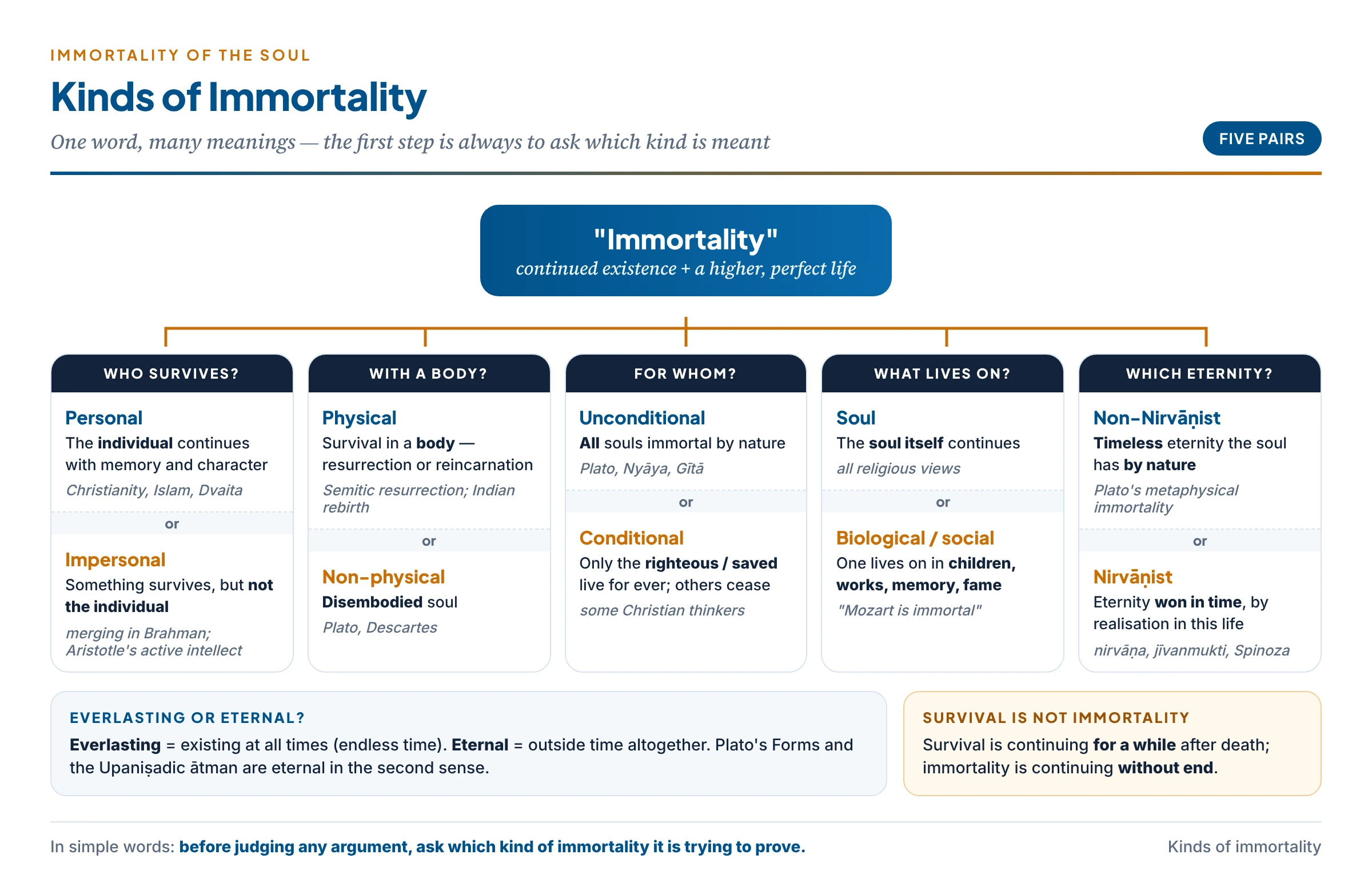
- Non-Nirvāṇist (metaphysical) immortality: the soul is eternal because of what it is — eternal, timeless, above the risk of change. Plato’s proofs belong here.
- Nirvāṇist immortality: eternity that has been realised through and in time, by an adventure of self-creation — like a great work of art, which took time to make but, once made, is a “thing of beauty for ever” (details in Article 4).
In simple words
“Mozart is immortal.” In one sense this is biological or social immortality — his music lives on, though Mozart the man died in 1791. In another, a believer may mean that Mozart’s soul still exists. And a Vedāntin might say that the self in Mozart was never born and never dies. The same word “immortal” covers all three — so the first step in any answer is to ask which kind is meant.
The Arguments for Immortality — an Overview
Arguments for the immortality of the soul fall into four families:
- Metaphysical / a priori — from the nature of the soul: simplicity, life, kinship with the eternal, self-motion (Plato, Aquinas, Descartes, Leibniz, Mendelssohn, Butler). This article.
- Epistemological — from knowledge: the soul knows eternal truths it could not have learned in this life (Plato’s recollection). This article.
- Moral and theistic — from morality, justice and God’s goodness (Kant‘s postulate; the argument from God’s purpose). Article 3.
- Empirical and other — from psychical research, conservation of energy, conservation of values, the law of karma, the teleology of human powers, and the pragmatic benefits of belief. Article 3.
A shorter list found in many notes names six arguments: Plato’s metaphysical argument, Plato’s epistemological argument, Kant’s moral argument, the parapsychological argument, the argument from conservation of energy, and the argument from conservation of values.
Plato: The Setting of the Phaedo
- The Phaedo describes Socrates’ last day in prison before he drinks the hemlock. His friends are grieving; Socrates is calm and even cheerful.
- Philosophy as practice for dying: the philosopher spends his life separating the soul from bodily desires to know the truth by pure reason. Death is simply the complete separation of soul from body — so the philosopher should welcome it.
- Moral seriousness: at his trial (in the Apology) Socrates had already said: “The difficulty, my friends, is not to avoid death, but to avoid unrighteousness; for that runs faster than death.” In the Phaedo too, immortality is joined to a qualitative point — the soul’s real danger is injustice, not dying.
- “If you can catch me”: when Crito asks how to bury him, Socrates laughs that Crito thinks he is the corpse he will soon see, not the Socrates who is now talking.
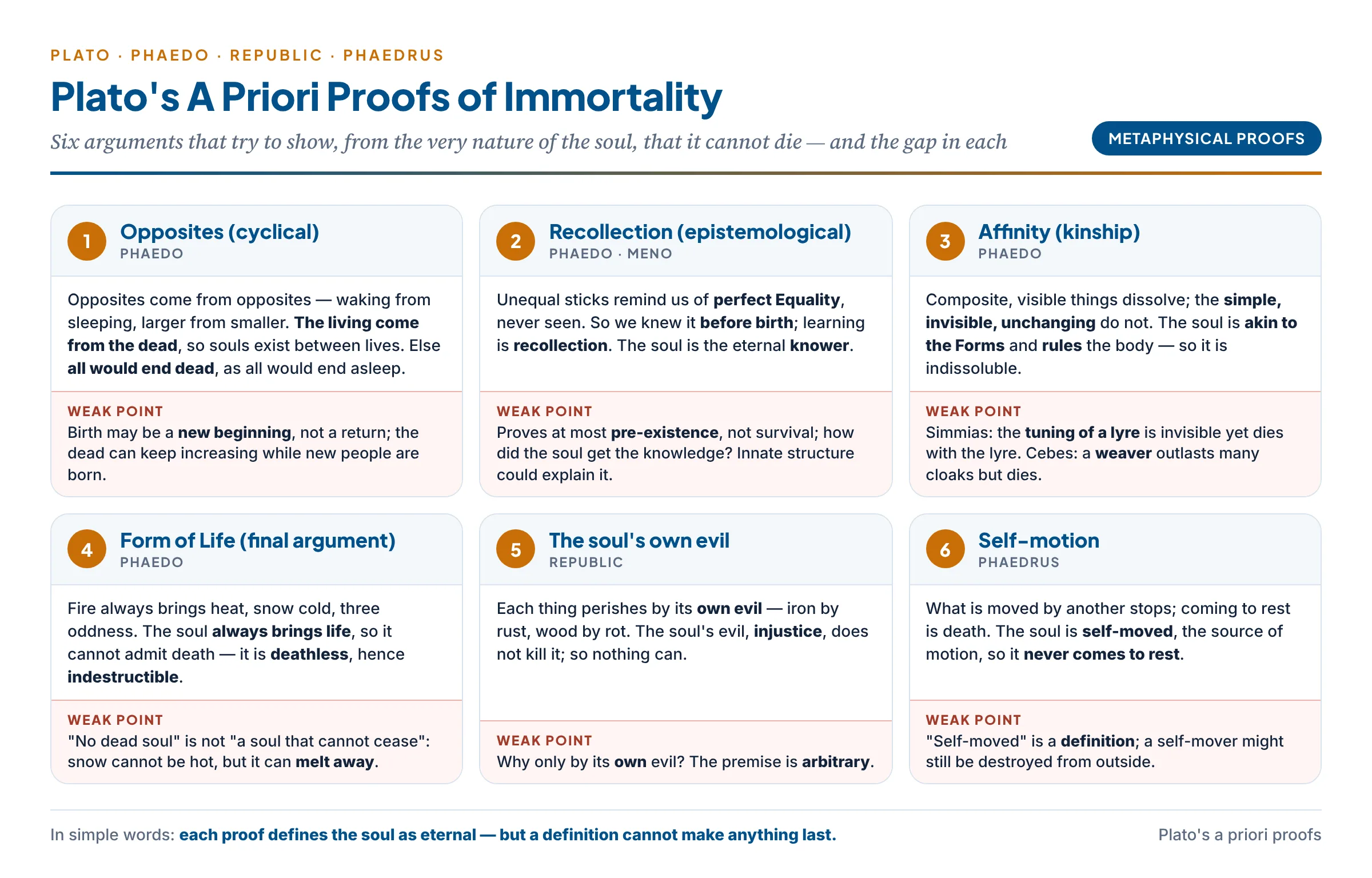
- Plato then gives four arguments in the Phaedo, and further arguments in the Republic and the Phaedrus. They are called a priori because they try to prove the soul’s eternity from the definition and nature of the soul, not from observation.
1. The Argument from Opposites (Cyclical Argument)
- Things that have an opposite come to be from their opposite: the larger from the smaller, the weaker from the stronger, the waking from the sleeping and the sleeping from the waking.
- Living and dead are opposites.
- So the dead come from the living, and the living come from the dead.
- If the living came from the dead, the souls of the dead must exist somewhere (in Hades) before returning.
- Supporting point: if everything that died stayed dead, everything would end up dead — as, if no one who fell asleep ever woke, all would end asleep. Nature must balance the two processes.
- Criticisms:
- Not everything comes from its opposite: a thing may come into existence without having existed in an opposite state. Birth may be the beginning of a living being, not the return of a soul that was dead.
- The argument treats “alive” as a quality a pre-existing soul acquires — which assumes what it is trying to prove.
- The sleep analogy fails: though everyone who has died is dead, it does not follow that everyone must end dead — the number of the dead can keep growing while new people are born.
2. The Argument from Recollection (Epistemological Argument)
- The soul is the knower, the base of knowledge.
- We know eternal and universal truths — for example Equality itself. Two sticks are never perfectly equal; yet seeing them reminds us of perfect Equality, which we never saw with our eyes.
- So we must have known Equality before we used our senses — that is, before birth.
- Learning is therefore recollection (anamnēsis): sense-experience only awakens knowledge already in the soul. (In the Meno, an untaught slave-boy, by questioning alone, “recollects” a geometrical truth.)
- Hence the soul existed before birth, independently of the body — and only an eternal, conscious element could be the ground of eternal knowledge.
- Criticisms:
- How did the soul attain all this knowledge in the first place? Plato does not explain.
- At most it shows pre-existence, not survival after death (Cebes’ objection) — Plato has to combine it with the argument from opposites.
- Knowledge of necessary truths may be explained without pre-existence — by the mind’s innate structure (Kant’s a priori forms), by abstraction from experience (Aristotle, empiricists), or by language.
3. The Argument from Affinity (Kinship)
- There are two kinds of things: the visible, composite and changing (bodies) and the invisible, simple and unchanging (the Forms).
- Composite things can be broken up and dissolve; what is simple and unchanging cannot.
- The soul resembles the invisible, divine and unchanging: it is invisible, it grasps the eternal Forms, and it rules the body as the divine rules the mortal.
- The body resembles the visible and perishable.
- So the soul is indissoluble, or nearly so — when the body dies, the pure soul goes to the divine and eternal to which it is akin.
- Two famous objections in the Phaedo:
- Simmias’ attunement (harmony) objection: the soul may be like the attunement of a lyre — invisible, beautiful, “divine” — yet it is destroyed when the lyre is broken. Invisibility does not prove independence.
- Cebes’ weaver objection: a weaver wears out many cloaks in his lifetime, but the last cloak outlives the weaver. The soul may outlast many bodies and still finally wear out.
- Socrates’ replies to Simmias: (a) the soul pre-exists the body (by recollection), but an attunement cannot exist before its lyre; (b) the soul opposes and rules the body’s desires, whereas an attunement follows its instrument; (c) attunements admit degrees, but one soul is not more a soul than another.
4. The Final Argument — from the Form of Life
- Some things always bring a certain Form with them: fire always brings heat, snow always brings cold, the number three always brings oddness.
- Such things cannot admit the opposite of what they bring: snow, when heat approaches, withdraws or perishes — it never becomes hot snow; three can never be even.
- The soul always brings life to whatever it occupies — it is the source of life.
- So the soul cannot admit death, the opposite of life: it is deathless (athanatos).
- What is deathless is also indestructible; so when death approaches a man, his mortal part dies, but the soul withdraws, safe and undestroyed.
- In simpler form (as in many notes): the very nature of the soul is life, the nature of the body is death; life is incompatible with death; so the soul never dies — it is the body that dies.
- Criticisms:
- “Deathless” may only mean that the soul cannot be a dead soul while it exists — just as snow cannot be warm snow. It does not follow that the soul cannot cease to exist; snow, after all, can melt away. Plato simply assumes that the deathless cannot perish.
- How do life and death co-exist in one being — the soul and the body together? Plato does not explain.
- The argument depends on the theory of Forms, which itself needs proof.
5. The Republic — the Soul Is Not Destroyed by Its Own Evil
- Each thing is destroyed only by its own peculiar evil: iron by rust, wood by rot, the body by disease.
- The soul’s own evils are injustice, cowardice, ignorance and intemperance.
- But injustice does not kill the soul — the wicked go on living, often vigorously.
- If a thing is not destroyed by its own evil, it cannot be destroyed by another’s evil (the body’s disease).
- So the soul is indestructible.
- Criticism: the premise that a thing can be destroyed only by its own evil is arbitrary; and it is not clear that the soul’s “evils” are like rust.
6. The Phaedrus — the Argument from Self-Motion
- What moves itself is the source of motion; what is moved by another stops when the outside push stops.
- Coming to rest is death; only what receives motion from outside comes to rest.
- The soul is self-moved — it is the very principle of life and movement.
- So the soul can never come to rest: it is without beginning and without end.
- Criticism: “self-motion” is a definition, not a discovered fact; and a self-moving thing could still be destroyed from outside.
General Criticism of Plato’s Proofs
- All a priori: they prove the soul’s eternity from the definition of “soul”. But one cannot define something into existence or into permanence.
- A disembodied soul is assumed: Plato treats the soul wholly apart from the body, whereas the only soul we know is an embodied soul. The seed of the mind–body dualism later seen in Descartes is here.
- Dependence on the theory of Forms: a modern reader who does not share Plato’s metaphysics will not find these arguments compelling. Plato painted a picture of “haunting beauty and persuasiveness”, but not a proof for a modern person.
- Value vs duration: Plato’s real concern is the quality of the soul’s life — its justice and wisdom. The eternity of truth, beauty and goodness is easily confused with the endlessness of the individual.
In simple words
Plato’s final argument is like saying: “A fire is always hot, so a fire can never be cold.” True — a cold fire is impossible. But that does not mean a fire can never go out. It may still be extinguished. In the same way, a “dead soul” may be impossible — and yet the soul might still cease to exist. That gap is the weakest point of the whole proof.
The Simplicity Argument after Plato
The argument from simplicity became the standard metaphysical proof in later philosophy and theology. In formal shape:
- Destruction of anything means the dissolution, decomposition or separation of its parts.
- The soul is immaterial and simple — it has no extension, no spatial parts, no physical composition.
- What has no parts cannot be broken up.
- Therefore the soul cannot be destroyed by physical death; it is of itself incorruptible.
Aquinas
- The human soul is the form of the body, but its highest act — understanding universal truths — is done without a bodily organ. A power that works without the body can exist without the body: the soul is a subsistent form.
- Being immaterial and not composed of parts, it cannot be corrupted by itself (per se); it would perish only if God annihilated it.
- A modern Catholic restatement: a spiritual soul “cannot be corrupted, since it possesses no matter; it cannot be disintegrated, since it has no substantial parts; it cannot lose its individual unity, since it is self-subsisting, nor its internal energy, since it contains within itself all the sources of its energies.“
- Yet the separated soul is incomplete — hence the need for resurrection (Article 5).
Descartes
- The body is always divisible; the mind is utterly indivisible — I cannot distinguish any parts in myself as a thinking thing.
- So the mind is really distinct from the body and not destroyed by the body’s decay.
Leibniz
- Souls are monads — simple substances without parts. Things with parts perish by decomposition; monads can begin only by creation and end only by annihilation — both acts of God. Naturally, they are imperishable.
Moses Mendelssohn
- In his own Phaedon (1767), a modern version of Plato’s dialogue, Mendelssohn argued that a simple soul cannot perish gradually (it has no parts to lose one by one) and cannot perish suddenly, since nature makes no leaps from being to nothing. So it cannot perish at all.
Joseph Butler
- In The Analogy of Religion (1736), Butler argued from the analogy of nature:
- We pass through enormous bodily changes — from embryo to old age — yet remain the same persons.
- Insects pass from worm to winged creature; birds break out of the egg into a new world. Death may be such a change, not an end.
- We may lose limbs and organs without losing ourselves; so the body is not essential to the self — even the destruction of the whole body need not destroy the living agent.
- Since we have no proof that death destroys our living powers, the presumption is that they continue.
In simple words
A caterpillar that could think might fear the cocoon as the end of everything — its legs dissolve, its body breaks down. Yet a butterfly comes out. Butler asks: since nature is full of such transformations that look like endings, why assume that death is the one change that really is an end? Kant’s reply is that a soul could still dim slowly like a fading lamp — it need not be cut into pieces to go out.
Indian Connect — Indian Connect — the “partless” argument in Nyāya and the Gītā
- Nyāya–Vaiśeṣika gives exactly the simplicity argument: whatever is partless (niravayava) and not produced is eternal — like the atoms and the ātman. Composite things perish because their parts separate; the self has no parts.
- The Gītā says of the self: “Weapons do not cut it, fire does not burn it, water does not wet it, wind does not dry it” — it is uncuttable, unburnable, “eternal, all-pervading, stable, immovable“. This is the same intuition: what is not made of parts cannot be taken apart.
- Nyāya’s recollection argument: a newborn child shows joy, fear and grief, and seeks the mother’s breast without being taught. Such responses need memory of past experience — so the soul existed in a previous life. This is India’s parallel to Plato’s recollection, used to prove rebirth.
Kant’s Refutation of the Metaphysical Proof
- The paralogisms: in the Critique of Pure Reason, Kant shows that “rational psychology” commits four fallacies (paralogisms) when it argues from the bare “I think” to a soul that is a substance, simple, identical over time and independent of the body.
- The paralogism of simplicity: the logical unity of thought — the fact that all my thoughts are united as mine (the transcendental unity of apperception) — is confused with the ontological simplicity of an immaterial substance. The “I think” is a formal condition of all knowledge, not an observation of an indestructible thing.
- Refutation of Mendelssohn: even if the soul is simple and cannot lose parts, it can lose degree. Consciousness has an intensive magnitude — it can be more or less vivid — and could fade gradually to zero (Kant calls this “elanguescence”, a gradual languishing), as a light dims without being cut into pieces.
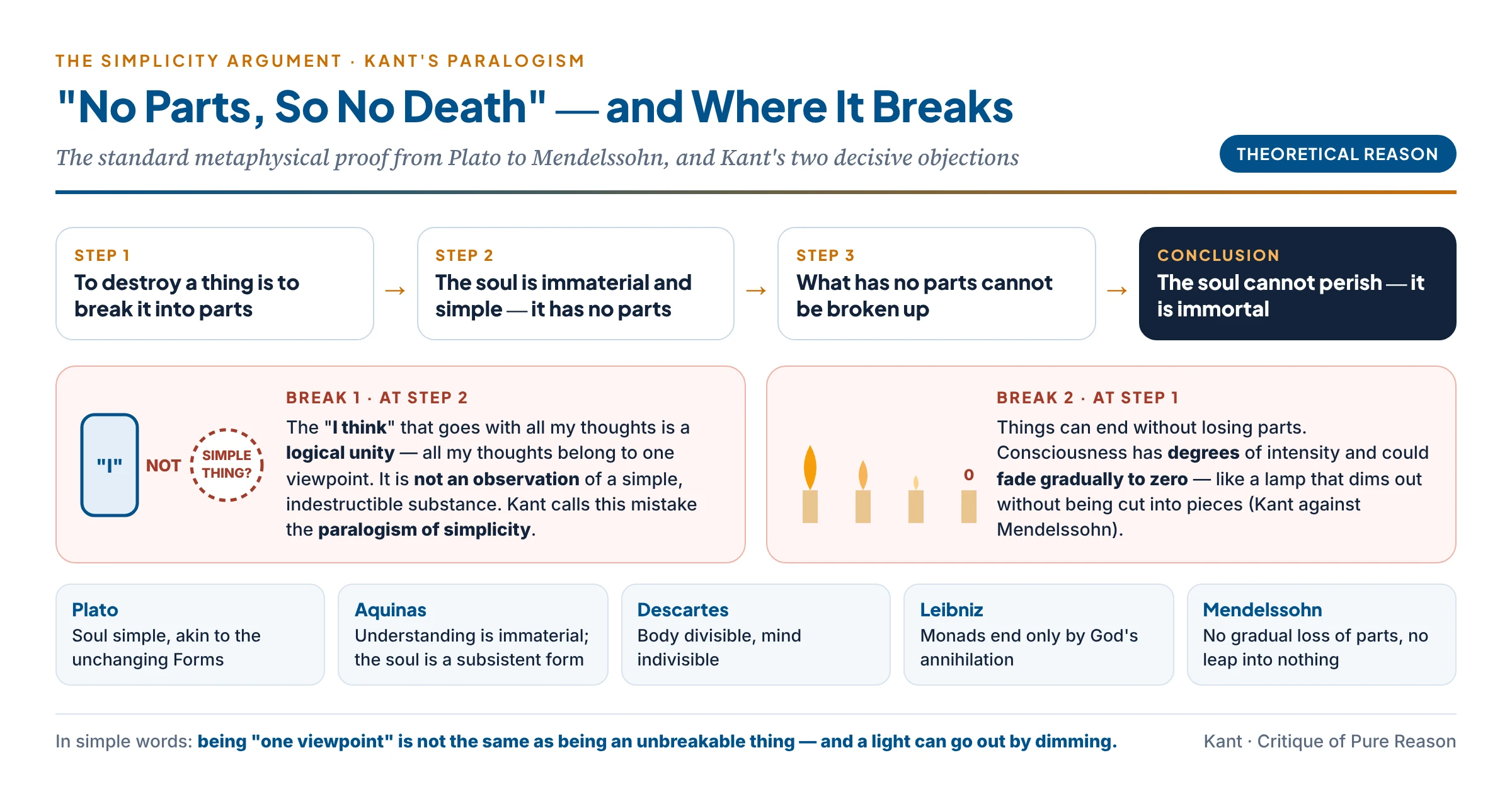
- Conclusion: theoretical reason can never prove the immortality of the soul. It can be accepted only as a postulate of practical (moral) reason — Kant’s own moral argument (Article 3).
Other Criticisms of the Simplicity Argument
- Hume: the notion of substance is “wholly confused and imperfect”; matter and spirit are equally unknown, and “we cannot determine what qualities may inhere in the one or in the other”. Experience alone decides whether matter, by its structure, may be the cause of thought. Even if a spiritual substance exists, nature may use it “as a kind of paste or clay“, forming and dissolving individual minds as it forms and dissolves bodies — so the substance might be immortal while our consciousness is not. And “what is incorruptible must also be ingenerable“: an immortal soul must have existed before birth — and if that former state did not concern us, neither will the latter.
- Modern psychology: the mind seems to be a structure of only relative unity — normally integrated but capable, under stress, of division and dissolution (multiple personality, split-brain cases). The claim that the soul is simple is not an observation but a metaphysical theory, so it cannot ground a general proof.
- Destruction need not be decomposition: things usually perish by some physical deterioration, but nothing entitles us to claim with certainty that a thing can cease to exist only by losing parts, or only by being acted upon physically.
- Against Descartes’ arguments:
- Divisibility: Descartes cannot distinguish parts in himself — but what he can or cannot distinguish does not show what he is; if someone takes an axe to “him”, how does he know he will not be divided?
- Doubt: “I can doubt that I have a body, but not that I exist, so I am not a body” is invalid — “Fred can doubt that he is a professor of philosophy but cannot doubt that he exists; so Fred is not a professor” does not follow. Turned around, the same form would “prove” that I am not a thinking thing (I can doubt there is a being whose essence is to think, but not that I exist) — Descartes is “hoist with his own petard“.
Critical Evaluation
Strengths of the Metaphysical Approach
- It takes seriously the difference between thought and matter — the unity of consciousness, the grasp of necessary truths, the felt “I” — which no materialist theory has fully explained.
- It ties immortality to moral and intellectual excellence: for Plato the soul’s health (justice, wisdom) matters more than mere continuation.
- Its intuitions are shared across traditions — Nyāya’s partless self, the Gītā’s uncuttable ātman — suggesting a deep human insight.
Weaknesses
- It moves from concepts to existence — from the definition of soul to the fact of its endless being.
- It assumes dualism, which modern philosophy of mind largely rejects.
- At best it proves an impersonal continuation (an indestructible “something”), not the survival of this person with memory and character.
- It ignores the strong empirical correlation of mind and brain (Article 4).
Critics and Defenders
Criticism — The critics of the metaphysical proofs
- Kant: the logical unity of “I think” is not a simple substance; consciousness can fade to zero without losing parts.
- Hume: substance unknown; matter might think; an immortal soul must be ingenerable too.
- Modern psychology: the mind has only relative unity and can split.
- Analytic critics: opposites need not generate each other; “deathless” does not mean “imperishable”; Descartes’ doubt argument is invalid.
- General: a priori arguments define the soul as eternal instead of showing it.
Defence — What the defenders reply
- Plato: knowledge of perfect Forms (Equality) cannot come from imperfect sense-objects — something in us is akin to the eternal.
- Aquinas: understanding universals is an immaterial act, so its subject is subsistent.
- Butler: we survive vast bodily change; no proof shows death destroys our living powers — the presumption is continuance.
- Nyāya and the Gītā: what is partless and unproduced cannot perish.
- Modern dualists: subjective experience remains irreducible — the “hard problem” leaves room for a non-physical self.
Cross-Tradition Comparison
| Point | Plato and the Western metaphysical proofs | Indian parallels |
|---|---|---|
| Main idea | The soul is simple, akin to the eternal, and is the principle of life | The self is partless, unborn, eternal (Nyāya, Gītā, Upaniṣads) |
| Pre-existence | Proved by recollection of Forms | Proved by the newborn’s instincts (Nyāya); assumed by all rebirth schools |
| What survives | The rational soul | The pure self (and, in rebirth, the subtle body) |
| Nature of proof | A priori reasoning | Śruti (scripture) plus reasoning and yogic experience |
| Main critic | Kant (paralogisms), Hume | Cārvāka (no perception of soul), Buddhists (no permanent self) |
| Goal | Return to the realm of Forms | Liberation from rebirth |
Indian Connect — Indian Connect — eternal by nature, not by proof
- Indian systems rarely rest immortality on a single proof. The self’s eternity is first revealed (śruti: “the knowing self is not born, nor does it die” — Kaṭha Upaniṣad), then defended by reasoning, and finally realised in experience (anubhava).
- So the Indian answer to Kant would be: theoretical reason may not prove the self, but the self is the witness presupposed by every proof — known not as an object but as oneself.
Synthesis (Siddhānta)
- Immortality means both continued existence and a higher, perfect life; it may be personal or impersonal, embodied or disembodied, conditional or unconditional, and either a timeless eternity possessed by nature or an eternity won in time.
- Plato’s a priori proofs — from opposites, recollection, affinity, the Form of Life, the soul’s own evil and self-motion — are the first systematic attempt to prove immortality. Each contains a real insight (the soul’s kinship with truth, its role as source of life), but each has a logical gap: pre-existence is not survival; “deathless” is not “imperishable”; resemblance is not identity.
- The simplicity argument of Aquinas, Descartes, Leibniz, Mendelssohn and Butler fails before Kant’s point that unity of thought is not a simple substance, and that consciousness may fade rather than break.
- Contemporary relevance: the hard problem of consciousness keeps the dualist intuition alive; psychology of dissociation and split-brain studies weaken the claim of absolute simplicity.
- Balanced view: metaphysical arguments do not prove immortality, but they show that the idea is not absurd — and they shift the question to the moral and experiential grounds examined next.
“The difficulty is not to avoid death, but to avoid unrighteousness; for that runs faster than death.” — Socrates, in Plato’s Apology
Previous Year Questions
- 2023Critically examine Plato’s a-priori proofs for the immortality of the soul.
- 2014What are the arguments given in favour of immortality of soul?
- 2000Immortality of Soul. (Short Notes)