

- A slum is a densely built urban area of poor-quality, overcrowded housing with inadequate water, sanitation and services, and often insecure tenure.
- Slums are a by-product of rapid, unplanned urbanisation: cities grow faster than land, housing, jobs and services can be supplied to the poor.
- In 2022, 1.12 billion people (24.8% of the world’s urban population) lived in slums or informal settlements. In India, Census 2011 counted 6.55 crore slum dwellers, about one in six urban Indians.
Slums: Definition, Concept and Characteristics

Definitions
- UN-Habitat defines a slum household as one lacking one or more of five conditions:
- Safe drinking water.
- Improved sanitation: a private toilet or one shared by a reasonable number of people.
- Sufficient living area: not more than three persons per room.
- Durable housing that protects against weather and hazards.
- Secure tenure: legal protection against eviction.
- India, legal definition:
- The Slum Areas (Improvement and Clearance) Act, 1956 lets governments declare as slums areas whose buildings are unfit for human habitation.
- The causes may be dilapidation, overcrowding, faulty arrangement and design, narrow or faulty streets, or lack of ventilation, light and sanitation, where these are detrimental to safety, health or morals.
- Census of India (2011) recognises three types in all statutory towns:
| Type | Basis | Population, 2011 |
|---|---|---|
| Notified slums | Notified as slums by a State, UT or local government under any Act | 2.25 crore |
| Recognised slums | Recognised by government or a housing/slum board but not formally notified | 2.01 crore |
| Identified slums | A compact area of at least 300 people or 60–70 households of poorly built, congested tenements in an unhygienic environment with inadequate infrastructure, identified by census officers | 2.28 crore |
- The National Sample Survey also counts non-notified slums: compact clusters of at least 20 households of poorly built, crowded tenements.
Slum, Squatter Settlement and Shanty Town
- A slum is defined by its condition: poor housing and services. It is usually older and more stable, and is often found in the inner city.
- A squatter settlement is defined by its legal status: dwellings built without permission on land not owned by the builders. Squatter settlements are often newer and on the periphery, along railway lines or on vacant public land. They grow by overnight invasion or by gradual accretion.
- A shanty town is defined by its fabric: makeshift huts of cardboard, tin, sacking and scrap. It is typical of mass rural–urban migration in the developing world.
- In practice the three overlap: many squatter settlements become consolidated brick slums over a generation.
- Local names:
- In India: bustee (Kolkata), jhuggi-jhopri (Delhi), chawl and jhopadpatti (Mumbai), cheri (Chennai).
- Abroad: favela (Brazil), barriada (Peru), kampung (Indonesia), gecekondu (Turkey), bidonville (French-speaking North Africa).
Characteristics
- Physical:
- Unplanned, informal growth on marginal land.
- Very high densities, with one- or two-room homes and narrow lanes.
- Walls of mud or brick and low roofs of corrugated sheet, tin, polythene or thatch, often with no windows, so ventilation and light are poor.
- Environmental:
- Open drains, stagnant pools, heaps of waste and few open spaces.
- Shallow hand-pumps draw groundwater fouled by seeping waste, bringing dysentery, diarrhoea, typhoid and jaundice.
- Shallow pit latrines overflow, and nullahs used as open toilets breed flies and mosquitoes.
- Services:
- Shared taps and community toilets.
- Irregular electricity, and poor schools, health care and transport.
- Economic:
- Mostly informal work: construction, domestic service, vending, home-based manufacture, recycling.
- Low and irregular incomes.
- Many slums are also production centres, such as Dharavi with its leather, pottery, garment and recycling units.
- Social:
- Largely migrants and their descendants, often grouped by caste, region or religion.
- A sex ratio of 928 females per 1,000 males in 2011, close to urban India’s 929 (national 943). Literacy was 77.7%, against 84.1% in urban India.
- Strong informal networks, but stigma and exclusion from the formal city.
- Legal: insecure or no tenure, with constant fear of eviction.
Types of Slums
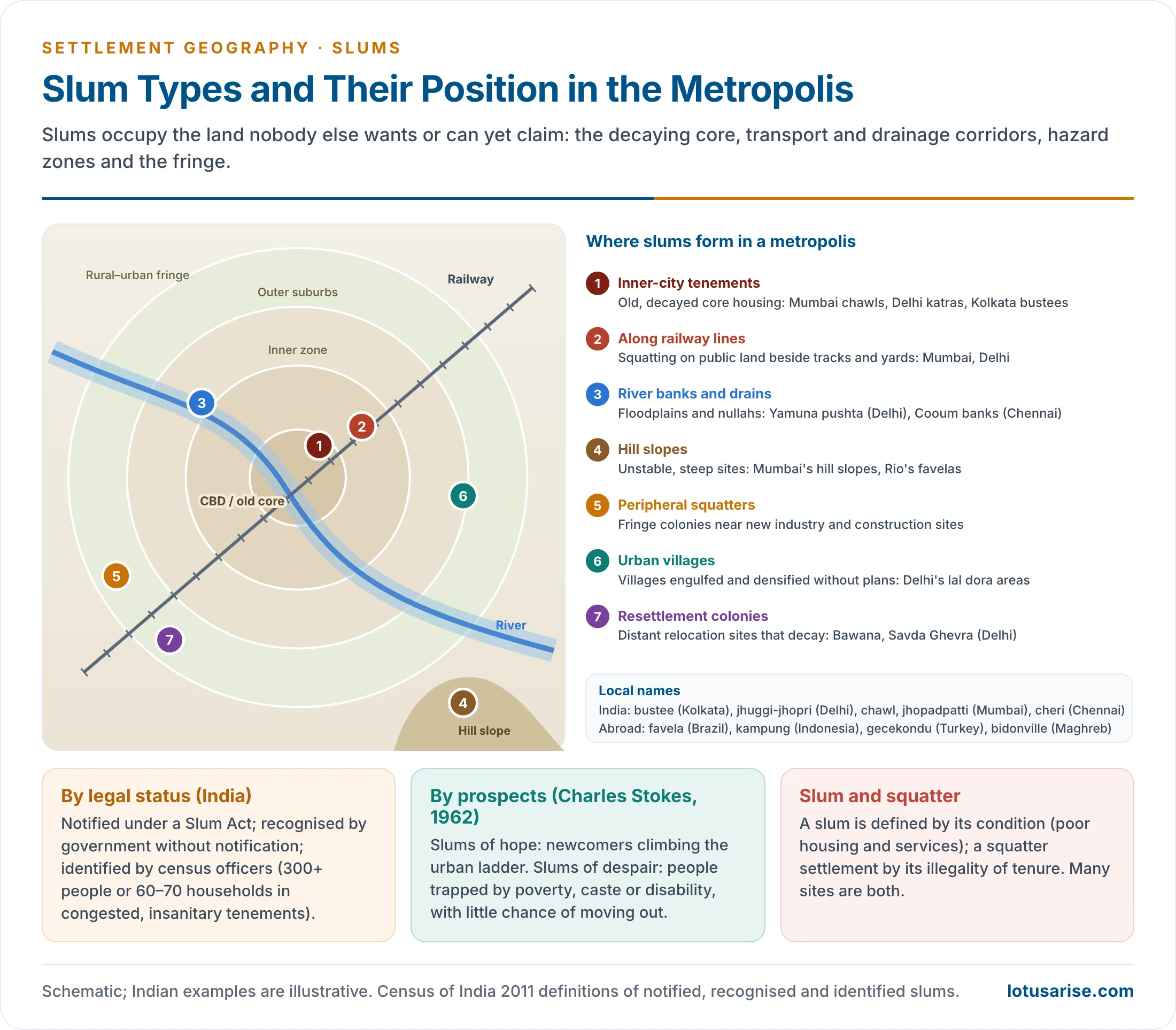
- By location in the metropolis:
- Inner-city tenements: Mumbai’s chawls, Delhi’s katras in the walled city, Kolkata’s bustees.
- Corridor slums along railway lines and nullahs.
- Riverbank and floodplain slums: the Yamuna pushta in Delhi, the Cooum in Chennai.
- Hill-slope slums in Mumbai and on Rio’s favela hillsides.
- Peripheral squatter colonies near new industry and construction.
- Urban villages: Delhi’s lal dora areas.
- Resettlement colonies that decay into slums: Bawana and Savda Ghevra in Delhi.
- By prospects (Charles Stokes, 1962):
- Slums of hope: newcomers on their way up the urban ladder, improving their homes over time.
- Slums of despair: people trapped by poverty, caste, disability or age, with deteriorating conditions.
- By legal status: notified, recognised and identified (India); authorised and unauthorised.
Slums in the Indian Context
- In India, slums are closely tied to informal housing and unauthorised construction, the result of fast urban population growth and slow provision of land and infrastructure.
- Many are decades old, with second- and third-generation residents, brick houses, shops and workshops.
How Slums Develop
- John F. C. Turner (1968) showed that migrants first choose location over quality. “Bridgeheaders” want cheap rooms near jobs in the inner city. Later “consolidators” want ownership and space, and move to the periphery to build.
- A slum typically passes through these stages:
- Arrival and occupation: families rent rooms in old inner-city tenements, or squat on vacant public land.
- Consolidation: huts of plastic and tin are rebuilt in brick. A rental market appears as early settlers let rooms to newcomers.
- Densification and vertical growth: upper floors are added, open spaces are built over and lanes narrow. Densities rise steeply.
- Recognition: the slum is notified or recognised, often before elections. Taps, toilets, lights and paved lanes follow.
- Upgrading, redevelopment or eviction: depending on land value and politics, the slum is improved in place, rebuilt as towers, or cleared.
- Slums on high-value central land face the strongest pressure for redevelopment. Those on hazardous or low-value land tend to persist without services.
Slums in Numbers
The World
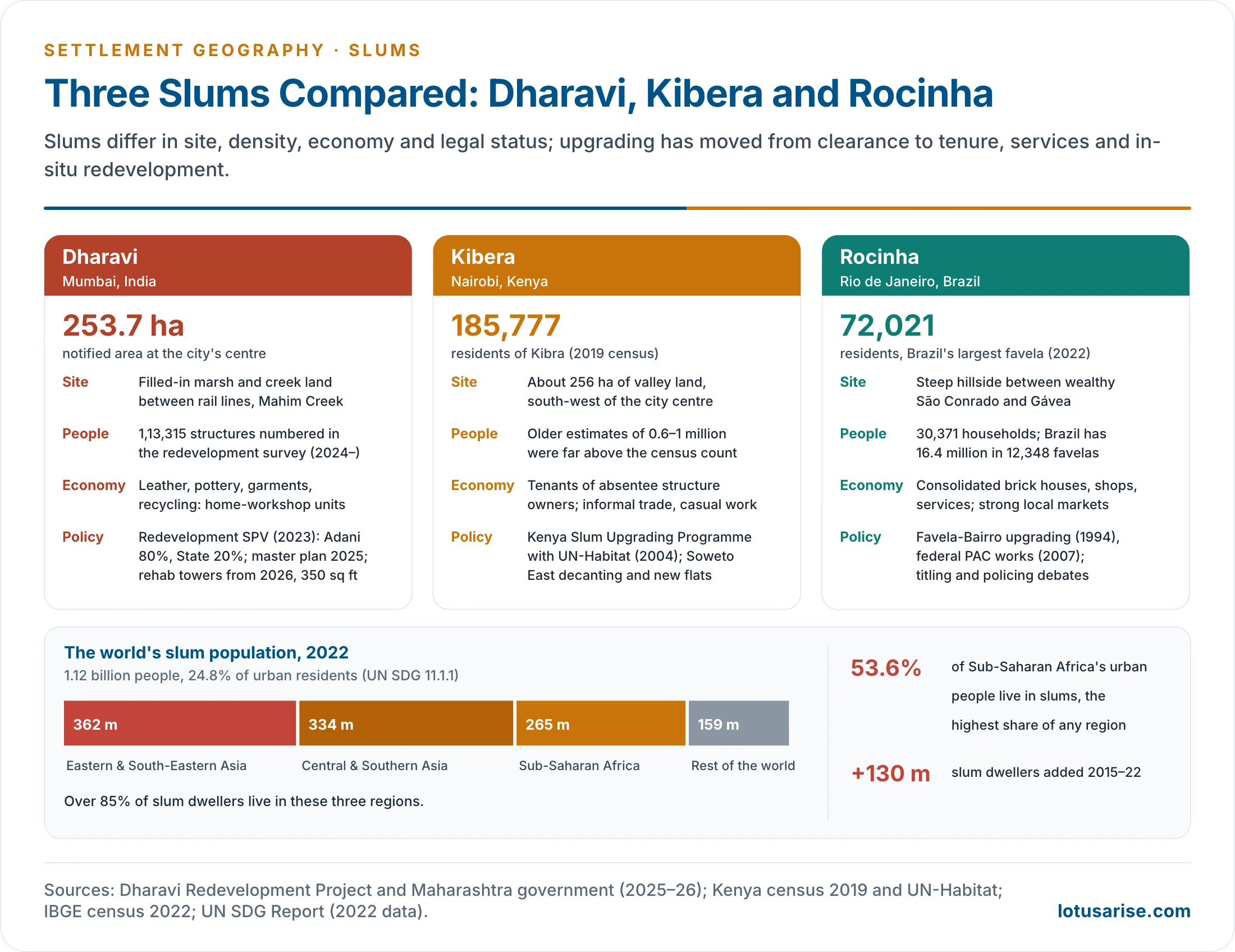
- The 2022 total of 1.12 billion slum dwellers (UN-Habitat) was 130 million more than in 2015.
- Over 85% live in three regions:
- Eastern and South-Eastern Asia (362 million).
- Central and Southern Asia (334 million).
- Sub-Saharan Africa (265 million), where 53.6% of urban people live in slums, the highest share of any region.
India
- Census 2011:
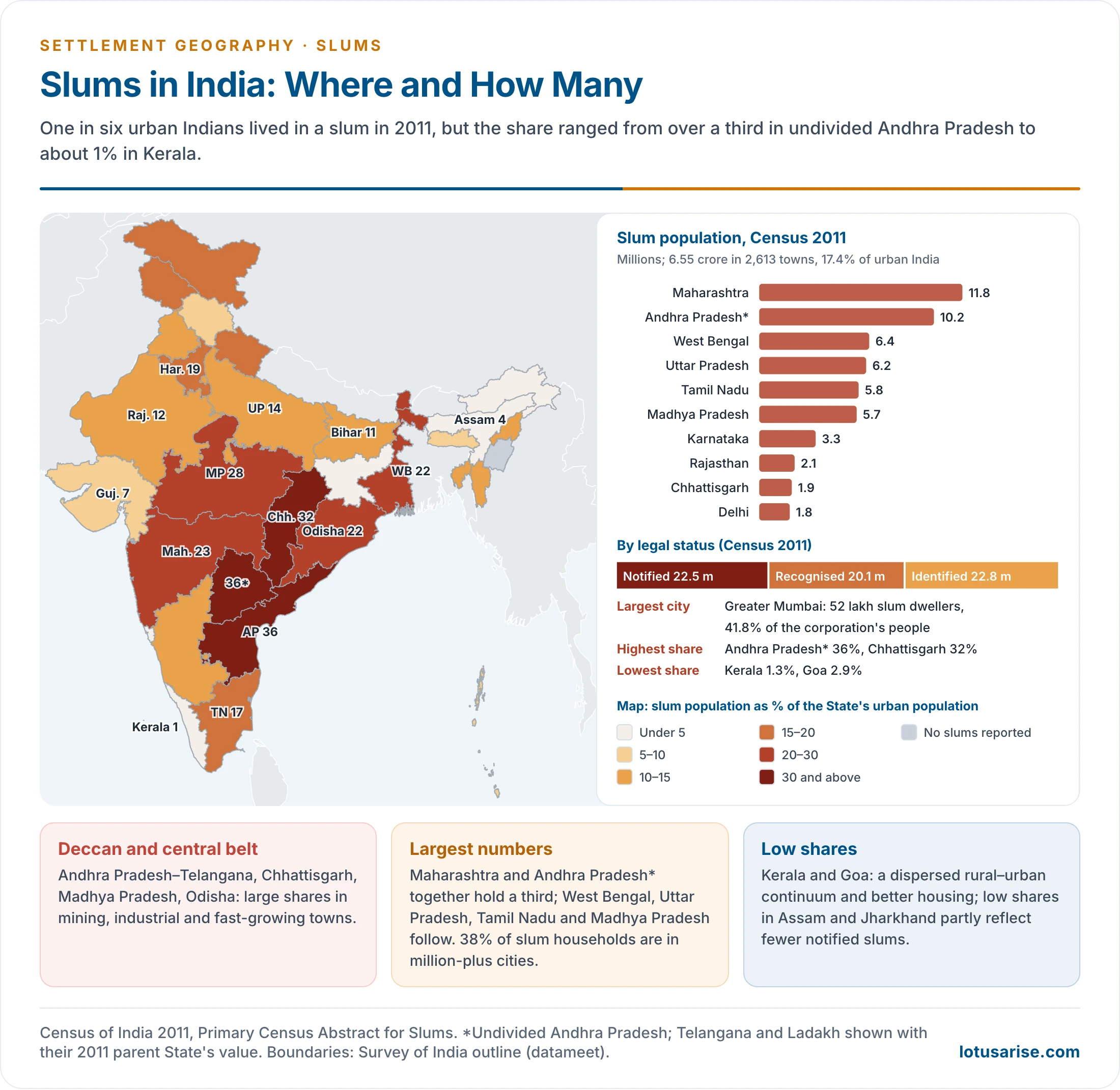
- 6.55 crore people in 1.39 crore households lived in slums in 2,613 towns, out of 4,041 statutory towns.
- That was 17.4% of India’s urban population and 5.4% of all Indians.
- States: Maharashtra (1.18 crore) and undivided Andhra Pradesh (1.02 crore) held a third of all slum dwellers, followed by West Bengal, Uttar Pradesh, Tamil Nadu and Madhya Pradesh.
- Share of the urban population was highest in undivided Andhra Pradesh (36.1%), Chhattisgarh (32.0%) and Madhya Pradesh (28.4%), and lowest in Keralam (Kerala) (1.3%), Goa (2.9%), Assam (4.5%) and Jharkhand (4.7%).
- Cities: Greater Mumbai had the largest number, 52 lakh slum dwellers or 41.8% of its corporation’s population.
- Hyderabad, Kolkata, Delhi and Chennai each had roughly 15–25 lakh.
- 38% of slum households were in the 46 million-plus cities.
- Trend:
- Census 2001 gave the first detailed slum data: 5.24 crore people in 1,743 towns.
- A government committee projected 10.4 crore by 2017, far above the census count.
- Amenities, Census 2011:
| Amenity | Slum households (%) | All urban households (%) |
|---|---|---|
| Tap drinking water | 74.0 | 70.6 |
| Electricity | 90.5 | 92.7 |
| Latrine within premises | 66.0 | 81.4 |
| Closed drainage | 36.9 | 44.5 |
| Permanent house | 77.7 | 84.3 |
| Owned house | 70.2 | 69.2 |
| Television | 69.6 | 76.7 |
| Mobile phone only | 63.5 | 64.3 |
- Slums came close to the rest of the city on water and power, but lagged on toilets and drainage. Television and phones had spread faster than sanitation.
- Data gap: no slum count has been made since 2011. The next census, with enumeration referenced to 1 March 2027, will give the first update.
Factors Contributing to Slum Formation
- Rapid urbanisation and rural–urban migration:
- Migrants arrive faster than cities can house them, so they settle near work in informal settlements.
- Push: small holdings, agrarian distress, landlessness, caste oppression, floods and droughts.
- Pull: jobs, wages, education and health care in the metropolis.
- Migrants without savings or documents cannot enter the formal housing market.
- Housing shortage and lack of affordable housing:
- India’s urban housing shortage was estimated at 18.78 million units (2012), 96% of it in the economically weaker and low-income groups.
- High construction costs, private builders’ focus on the high-end market, and small, slow public housing leave the poor with little option but unauthorised land.
- High land prices and vertical growth:
- Land is scarce in the centre, and prices rise with demand, speculation and low permitted floor space. IT-led and industrial growth in Bengaluru, Hyderabad and Pune has sharply raised demand.
- Vertical growth of offices and high-income towers pushes land values beyond the reach of the poor. They are left with marginal land and peri-urban or interstitial spaces, often without services, or they crowd into existing slums, which then grow upwards.
- Market-led redevelopment with extra floor space can create “vertical slums” of poorly maintained rehabilitation towers.
- Planning and governance failures:
- Outdated master plans that ignore the poor and fail to reserve land for them.
- Weak enforcement, institutional fragmentation and corruption.
- Urban poverty and inequality:
- Informal, low-wage work and no social security mean even long-term residents cannot afford planned housing.
- The slum is a survival strategy: cheap rent close to jobs.
- Natural increase within slums: high fertility and a young age structure add to growth and densification.
- Political economy:
- Slums are vote banks. Regularisation before elections encourages more encroachment.
- Real-estate interests, disputes over land ownership and fears of displacement delay redevelopment.
- Industrial location: factories, ports and construction sites attract labour without providing housing. Slums grew in the industrial States and mining towns of the Deccan and central India.
- Lack of balanced regional development: stagnant rural regions keep sending surplus labour to a few metros.
Associated Problems of Slums
Health
- Communicable diseases thrive with poor sanitation, open drains and contaminated water: cholera, typhoid, diarrhoea, hepatitis, tuberculosis, malaria and dengue.
- Overcrowding speeds the spread of respiratory infections.
- Malnutrition and higher infant and maternal mortality follow from poor diets and limited health care.
- Pandemics: COVID-19 (2020) showed the risk of density plus shared facilities.
- Social distancing and handwashing are hard where one toilet seat serves dozens of people. A 2014 study of Mumbai’s slums found about one seat per 81 persons.
- Dharavi contained its first wave through intensive tracing, testing and isolation, using community health workers and local leaders.
- The lockdown destroyed informal livelihoods and triggered mass reverse migration.
Environment
- Encroachment on fragile land: riverbanks, wetlands, floodplains, mangroves, hill slopes and forest edges.
- Pollution:
- Untreated sewage and solid waste pollute drains, rivers and groundwater.
- Slums along the Yamuna in Delhi, the Mithi in Mumbai and the Cooum in Chennai both suffer from and add to river pollution.
- Air pollution: indoor smoke from biomass and kerosene cooking, and toxic emissions where slums adjoin industry or dumpsites.
- Fire and hazard risk from crowded, flammable structures.
Basic Amenities and Infrastructure
- Chronic shortages of water, sanitation, electricity, paved lanes, drainage and transport, and overloaded networks that break down often.
Economic
- Informal, insecure work with low wages and no social security.
- No access to formal credit or insurance, so dependence on moneylenders and debt traps.
- Evictions destroy homes, businesses and the links between home and work, and limited skills restrict mobility.
Social
- Stigma and exclusion in housing, jobs and services, with stress and poor mental health from insecurity.
- Crime, substance abuse, domestic violence and juvenile delinquency, linked to poverty and overcrowding.
- Vulnerability of women and children: trafficking, child labour, abuse, and lack of safe toilets.
Legal and Governance
- Insecure tenure brings exploitation by land mafias and speculators, and the threat of eviction.
- Lack of formal recognition cuts residents off from services and welfare: identified and non-notified slums often get no municipal services at all.
- Weak enforcement and corruption allow slums to expand.
Location-Based Risk
- Flood-prone and landslide-prone sites: Mumbai’s hill-slope slums suffer monsoon landslides, and Chennai’s riverbank slums flooded in 2015.
- Heat stress under tin roofs, while climate change concentrates disaster losses on the urban poor.
Are Slums an Urban Menace?
- The case for “menace”:
- Disease, pollution and crime.
- Encroachment on public land and on flood channels, such as the Mithi in Mumbai and the Cooum in Chennai.
- Strain on services, and an unsightly city image.
- The case against:
- Slums are the city’s affordable housing and its labour reserve, home to the workers that formal housing ignores.
- Many are economic hubs, Dharavi’s workshops among them.
- Slums of hope are stepping stones for migrants.
- The “menace” is a failure of land, housing and planning policy, not of slum dwellers.
- Most researchers and UN-Habitat now favour upgrading and inclusion over clearance.
Government Initiatives for Slums in India
Phases of Policy
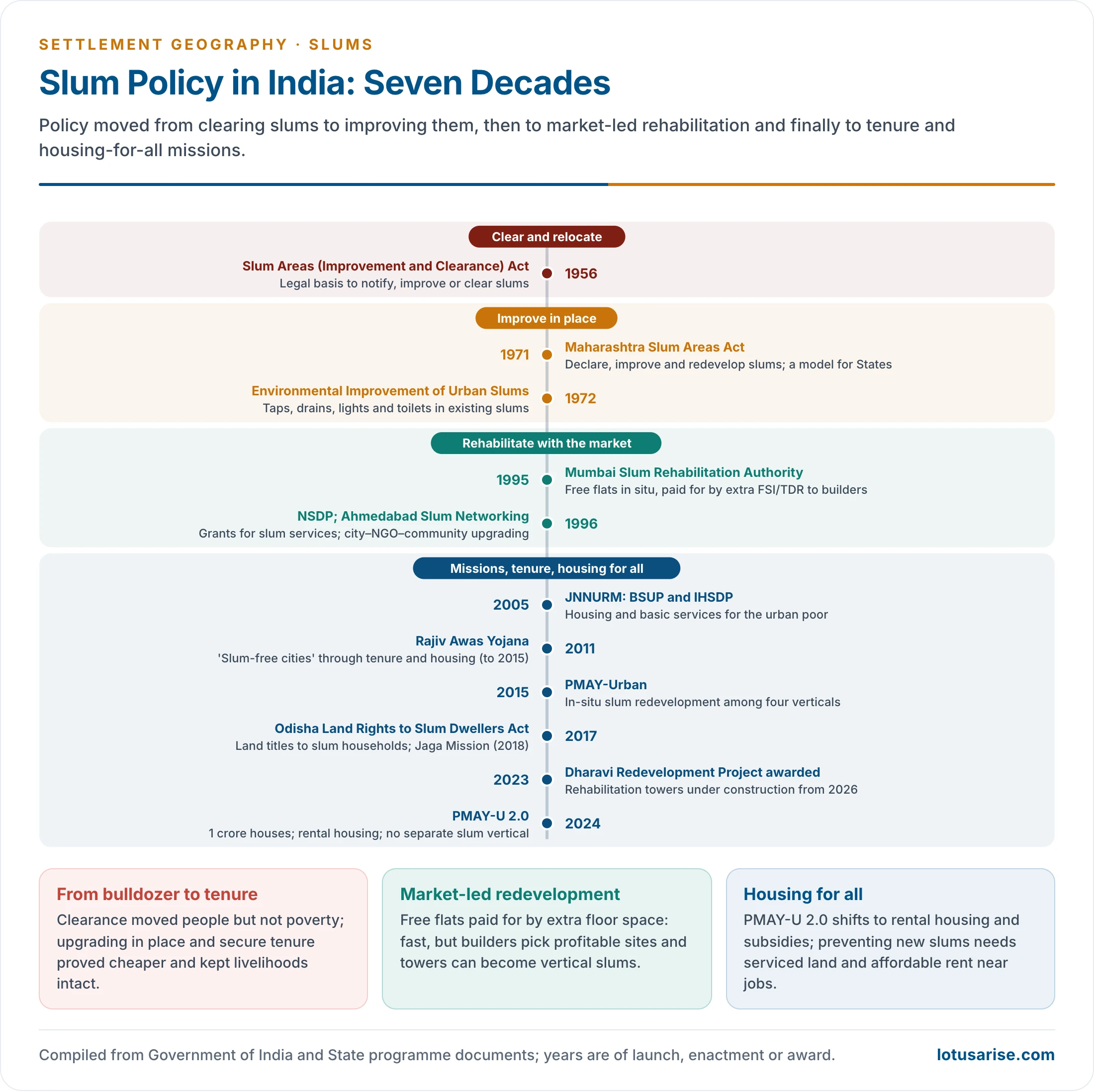
- Clearance and relocation (1950s–1960s):
- The Slum Areas (Improvement and Clearance) Act, 1956 gave the legal basis to identify, notify, improve or clear slums, first in the Union Territories.
- Relocation to the periphery often moved poverty without ending it.
- Improvement in place (1970s–1990s):
- State Slum Acts: the Maharashtra Slum Areas Act of 1971 allowed slums to be declared, improved and redeveloped.
- Environmental Improvement of Urban Slums (1972): taps, drains, street lights and toilets.
- Urban Basic Services for the Poor (1990): community-based services for slum dwellers.
- The National Slum Development Programme (1996) gave central assistance to States in proportion to their slum population.
- Rehabilitation with the market (1990s–2000s):
- Mumbai’s Slum Rehabilitation Scheme (1995) under the Slum Rehabilitation Authority.
- Eligible families get free flats in situ. Developers are paid in extra floor space (FSI) and transferable development rights (TDR).
- Valmiki Ambedkar Awas Yojana (2001): shelter, with community toilets under its Nirmal Bharat Abhiyan component.
- Mumbai’s Slum Rehabilitation Scheme (1995) under the Slum Rehabilitation Authority.
- Mission era (since 2005):
- JNNURM (2005): Basic Services to the Urban Poor (BSUP) in the mission cities, and the Integrated Housing and Slum Development Programme (IHSDP) in smaller towns, which merged the earlier NSDP and VAMBAY.
- Rajiv Awas Yojana (2011): “slum-free cities” through slum mapping, property rights and in-situ redevelopment. It was subsumed in PMAY-U in 2015.
- PMAY-Urban (2015): “Housing for All” through four verticals: in-situ slum redevelopment, credit-linked subsidy, affordable housing in partnership and beneficiary-led construction.
- Affordable Rental Housing Complexes (2020) for migrants were added after COVID-19.
- PMAY-U 2.0 (2024): 1 crore more houses over five years with ₹2.30 lakh crore of central assistance.
- Its four verticals are beneficiary-led construction, affordable housing in partnership, affordable rental housing and an interest subsidy. There is no separate slum vertical, but landless beneficiaries can be given land rights (pattas).
- By August 2026 the two phases together had sanctioned over 1.25 crore houses and completed over 1 crore.
- Supporting missions reach slums indirectly: AMRUT 2.0 (2021) for water taps and sewers, SBM-Urban 2.0 (2021) for toilets and waste, HRIDAY (2015) in old inner-city quarters with slum pockets, and DAY-NULM for livelihoods and shelters for the homeless.
- State tenure reforms: the Odisha Land Rights to Slum Dwellers Act, 2017 and its Jaga Mission gave land-right certificates and upgraded slums with drone-based mapping.
Redevelopment in the Megacities
| City | Agency or scheme | Approach |
|---|---|---|
| Mumbai | Slum Rehabilitation Authority (1995); Dharavi project | Free in-situ flats funded by extra FSI and TDR; township-scale PPP for Dharavi |
| Delhi | DDA in-situ rehabilitation (“Jahan Jhuggi Wahan Makaan”) | Flats built on or near the cluster site; 3,024 flats at Kalkaji (2022) |
| Kolkata | Bustee improvement since the 1970s; Thika Tenancy Act (2001) | Services and paving in bustees; tenancy reform, little demolition |
| Chennai | Slum Clearance Board (1970), now Urban Habitat Development Board | Tenements, then large resettlement estates at the edge (Perumbakkam) |
| Hyderabad | 2BHK Dignity Housing (2015) | Free two-bedroom flats in large colonies |
| Bengaluru | Karnataka Slum Development Board | Notification, upgrading and housing under PMAY |
- Common lessons: in-situ schemes keep jobs and networks; peripheral resettlement estates (Perumbakkam, Savda Ghevra) cut people off from work and services.
Challenges in Implementation and Redevelopment
- Demand side:
- Affordability: the poorest cannot pay even subsidised prices or EMIs.
- Access to finance: no income proof, credit history or collateral.
- Supply side:
- Land scarcity: India’s urban population is projected to reach about 675 million by 2035 (UN-Habitat), while stringent land-use controls, fragmented ownership and opaque land records restrict supply.
- Rising construction costs, which make affordable projects less viable.
- Regulatory delays: many clearances from local bodies, State departments and environmental authorities.
- Tenure disputes over encroached, railway, port or defence land, litigation and political resistance, and disputes over eligibility cut-off dates that exclude many residents.
- Quality and maintenance: rehabilitation towers with poor light, ventilation and upkeep, and overburdened services as densities rise.
- Misuse: illegal subletting or sale of allotted units, and the re-emergence of slums.
- Programme delivery: delays, weak coordination between agencies, financial constraints, dependence on private developers, limited coverage of select cities, and little community participation.
Suggestions for Improvement
- Upgrade in situ wherever the site is safe. Relocate only from hazardous sites, nearby and with livelihoods planned.
- Fit the model to the place: let local demographic, social and spatial conditions shape each scheme.
- Secure tenure first: land rights or long leases, as in Odisha, lead families to invest in their own homes.
- Supply land and housing ahead of demand: sites-and-services schemes, inclusionary zoning, rental housing for migrants, and land reserved for the economically weaker sections in master plans.
- Community participation and partnership: Ahmedabad’s slum networking and the community toilets built in Pune and Mumbai by NGOs with slum women’s groups.
- Decentralised services: community-managed toilets, small sewage and waste plants, and solar power.
- Finance: flexible subsidies, microfinance and self-help group credit, and cross-subsidy from land value capture.
- Curb misuse of allotted flats through post-allotment monitoring.
- Livelihoods and skills: mixed-use rehabilitation that keeps workshops and shops.
- Data: GIS and drone mapping of every slum, and a census update.
- Prevent new slums: balanced regional development, growth of small towns, and rural employment.
Case Studies
India
- Dharavi Redevelopment Project, Mumbai:
- A notified area of about 254 ha on filled-in marshland between railway lines and Mahim Creek, long called Asia’s largest slum (Orangi in Karachi is now often placed ahead of it).
- The project was awarded in 2023 to a special purpose vehicle (Adani group 80%, Maharashtra 20% through the Slum Rehabilitation Authority). This public–private partnership cross-subsidises rehabilitation housing through commercial development.
- Over 1.13 lakh structures were numbered in the eligibility survey, and the master plan was approved in 2025.
- Rehabilitation towers (10,432 flats of 350 sq ft) began on railway land at Matunga in 2026. Completion is targeted for 2032.
- Issues: eligibility of upper-floor and post-cut-off residents (the ineligible go to distant sites), survival of Dharavi’s informal industries, and land transfers and litigation.
- Mumbai Slum Rehabilitation Scheme (1995): its free in-situ flats, paid for by extra floor space, produced many units but also vertical slums, poor construction, exclusion errors and loss of workshops.
- Ahmedabad Slum Networking Programme (mid-1990s): in-situ upgrading (water, sewerage, drainage, paved lanes, lights, waste collection) by the municipal corporation, NGOs and residents sharing the cost, which improved health, school attendance and security of tenure.
- Odisha’s Jaga Mission: land-rights certificates under the 2017 Act, given early in Bhubaneswar, cut the risk of eviction and became the base for residents’ own investment.
Abroad
- Kibera, Nairobi:
- About 256 ha, with 185,777 people in Kibra in the 2019 census, far below the older claims of 0.6–1 million.
- Most residents rent from structure owners on government land.
- The Kenya Slum Upgrading Programme with UN-Habitat (2004) moved Soweto East residents to decanting sites and new flats.
- Rocinha and the favelas, Rio de Janeiro:
- Brazil’s largest favela (72,021 people in the 2022 census), a consolidated hillside settlement.
- Upgrading under Favela-Bairro (1994) and federal PAC works (2007), with debates over titling and policing.
- Orangi Pilot Project, Karachi (1980):
- Founded by Akhtar Hameed Khan, it had residents build and pay for their own lane sewers with technical help, a model of low-cost, community-led sanitation.
- The lesson of the cases: success came with tenure, participation, services and livelihoods kept together. Clearance or towers alone recreated slums elsewhere.
Previous Year Questions
1990Write short note: Growth of urban slums and problems associated with them.1993Distinguishing features of an urban slum and its position in metropolitan area.1994Write short note: Slums and squatter settlements.1996Factors for the growth of slums in the metropolitan cities of India.2000Discuss the environmental impact of the growth of slums in Indian cities.2004How do slums develop? Give concrete suggestions for their improvement.2007“Slums are urban menace.” Elucidate with India cities as examples.2009How do the ‘push’ and ‘pull’ factors operate for the emergence of slums in the metropolises of India.2013Define slums and explain their problems.2016How do slums develop? Give concrete suggestions for their improvement.2019Correlate the price of land, vertical growth of cities and the growth of slums in large cities of India.2022Examine the role of high population concentration in Indian slums in making them more vulnerable during pandemic conditions like the COVID-19.2026Explain the government initiatives for the redevelopment of slum areas in the mega cities of India.





Best consolidated notes. Thank you.