Liberation from Colonial Rule: Latin America-Bolivar; Arab World-Egypt; Africa-Apartheid to Democracy; South-East Asia-Vietnam
Liberation from Colonial Rule covers anti-colonial movements in the Arab world, Africa and Asia. UPSC has set 32 questions on it between 1985 and 2025, and it has appeared in nine of the last ten papers. It is the World History unit most directly comparable with India’s own freedom struggle, and the examiner increasingly treats it that way.
Every question the Commission has asked on this topic is listed below, newest first, with a written model answer linked against each one.
| Questions asked (1985–2025) | 32 |
| Appeared in | 9 of the last 10 papers |
| Paper | Paper II, Section B (World History) |
| Usual mark value | 10, 15 or 20 marks |
| Model answers available | 32 of 32 |
PYQs: Liberation from Colonial Rule [1985-2026]

| Year | Question | Answer |
|---|---|---|
| 2025 | Why did the non-communist Vietnamese leaders fail to provide successful leadership for Indo-China's anti-colonial struggle? Discuss. | View answer |
| 2024 | The nature of apartheid regime undermined South Africa’s claim of being a democratic polity. | View answer |
| 2024 | How did Ho Chi Minh emerge as the central figure in the Vietnamese independence movement? | View answer |
| 2023 | Arab nationalism was not only a cultural movement, but also an anti-colonial struggle. Comment. | View answer |
| 2023 | The historical causes for the rise of anti-colonial movement in South-East Asia were cultural differences, spread of western education and the emergence of Communist ideas. Discuss. | View answer |
| 2022 | Why was the apartheid policy introduced in South Africa ? What were its main features? | View answer |
| 2022 | Do you feel that the Vietnamese fought the 20th century's longest and bloodiest was for their liberation and integration of their country? Analyse. | View answer |
| 2021 | Critically examine the following statement in about 150 words: The Arab countries looked up to Nasser as a leader who could withstand the pressure exerted by Western countries on Egypt to make peace with Israel. | View answer |
| 2021 | The white-minority government of South Africa treated the natives very badly by denying them fundamental rights and made Apartheid as official policy. How were the people able to end Apartheid policy and establish a transitional rule? | View answer |
| 2020 | “The British were slated to withdraw from Palestine in May 1948, and both sides prepared for that day. Violence between Arabs and Jews, already endemic, escalated." | View answer |
| 2020 | Discuss the circumstances leading to the French exit from Algeria in 1962. | View answer |
| 2019 | Analyse the role of Egypt after the Second World War in bringing about Arab unity. | View answer |
| 2018 | Explain the features of Apartheid in South Africa. | View answer |
| 2017 | Examine why Bolivar's failed to fructify in bringing about united stand of the Latin Americans. | View answer |
| 2016 | Trace the significant role played by Ho Chi Minh in Vietnam's struggle for freedom. | View answer |
| 2016 | Trace the growth of Arab nationalism after the First World War. How far was it a reaction to Oil imperialism? | View answer |
| 2013 | "There must be an end to white monopoly on political power, and a fundamental restructuring of our political and economic systems to ensure that the inequalities of apartheid are addressed and our society thoroughly democratized." Discuss. | View answer |
| 2012 | “The Arab nationalism had a peculiar character. It stood for national independence for separate Arab States as well as for the unity of all Arabs irrespective of their state boundaries. – Examine. | View answer |
| 2009 | “Arab nationalism and oil-there were the principal factors in complicating the relations of middle eastern countries with the outside world." Comment. | View answer |
| 2009 | Why did Vietnam go through thirty years of war after the second world war? | View answer |
| 2006 | Give a brief account of the struggle against ‘Apartheid’ in South Africa. | View answer |
| 2001 | Discuss the aims of the establishment of the Arab League and assess it role in safeguarding the interests of the Arab nations. | View answer |
| 1996 | Turkish renaissance guided by Kemal Pasha revolutionised the Turkish life at many levels. Amplify. | View answer |
| 1994 | “The countries in the Middle East became, after 1919, the scene of constant effervescence and some striking changes.” Comment. | View answer |
| 1994 | "Asian Nationalism is just a product of Western impact on the Asian intelligentsia in the last decades of the nineteenth century." Comment. | View answer |
| 1993 | Arab Nationalism and Oil-these were the principal factors complicating the relations of the West Asian countries with the outside world. Do you agree? | View answer |
| 1990 | How did the Japanese occupation of South East Asian countries during the Second World War give a boost to nationalise in the regions? Explain with examples. | View answer |
| 1989 | Trace the growth of Arab nationalism after the First World War. How far was it a reaction to oil imperialism? | View answer |
| 1988 | “… the European nations in emphasizing their solidarity, their Europeanness in dealing with Asian countries inevitably gave rise to a feeling of Asianness.” Comment in about 200 words. | View answer |
| 1987 | 'One of the last strongholds of oil imperialism and European colonialism, it (Middle East) cultivates a fiery nationalism as a weapon against foreign oppression.’ Comment in about 200 words. | View answer |
| 1986 | ‘Under Mustafa Kemal’s dictatorship, Turkey was rapidly nationalized.’ Comment in about 200 words. | View answer |
| 1985 | “Mohammad Ali combined ambition with perspicacity to a greater degree than any other Oriental ruler of the nineteenth century.” Comment in about 200 words. | View answer |
What UPSC keeps asking about Liberation from Colonial Rule
Thirty-two questions fall into four regional threads. Three regions — the Arab world, South Africa and Vietnam — carry almost the whole unit.
1. Arab nationalism, oil and the Middle East (1985, 1987, 1989, 1993, 1994, 2001, 2009, 2012, 2016, 2019, 2020, 2021, 2023)
- Thirteen questions — the largest thread.
- “Arab nationalism and oil” as the complicating factors has been set twice (1993, 2009); the growth of Arab nationalism after 1919 twice more (1989, 2016).
- Egypt after 1945 (2019), the end of the Palestine mandate (2020), the Arab League (2001), and Arab nationalism as both cultural and anti-colonial (2023). Prepare Nasser and Suez as the central case.
2. Apartheid and South Africa (2006, 2013, 2018, 2021, 2022, 2024)
- Six questions, five since 2013. Its features (2018), why it was introduced (2022), the treatment of the majority (2021), and whether South Africa could claim to be a democracy (2024).
- Prepare the legislation by name — the Population Registration Act, the Group Areas Act, the Bantustans — and the stages of resistance from the ANC’s Defiance Campaign to Mandela’s release.
3. Vietnam and Southeast Asia (1990, 2009, 2016, 2022, 2023, 2024, 2025)
- Why thirty years of war followed 1945 (2009, 2022), Ho Chi Minh’s central role (2016, 2024), and why non-communist leaders failed (2025).
- The Japanese occupation as catalyst (1990) and the causes of anti-colonial movements in Southeast Asia (2023). The recent questions make Vietnam the most active single case in the unit.
4. Kemal Atatürk, Algeria, Latin America and Asian nationalism (1986, 1988, 1994, 1996, 2017, 2020)
- Kemalist Turkey (1986, 1996), the French exit from Algeria (2020), and why Bolívar’s vision of united states failed (2017).
- 1994 asked whether Asian nationalism was merely a product of Western impact — the broadest question in the unit, and one to prepare as a comparative essay.
Every question above, already answered
Knowing the questions is half the work. The other half is seeing what a full-mark answer to each one looks like — not a hint or a bullet outline, but a complete answer at the mark and the word limit, with the historians named inside the argument.
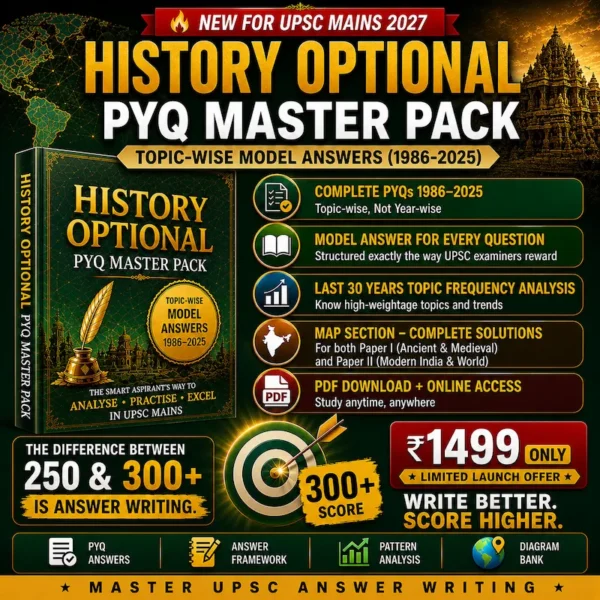
The History Optional PYQ Master Pack carries the same for every question the Commission has set since 1985, across the whole syllabus.
- PYQs 1985–2025, arranged topic-wise — revise a theme and see every way it has been asked
- Model answers with historiography — the debate cited where it belongs, not bolted on
- Map sections solved — the full 50-mark section, every year
- PDF plus online access — any device, permanently, no subscription
₹1,499 (regular ₹2,500). One-time payment, instant access.
How to use this topic list
Reading a question list feels like preparation and is not. Three sittings turn it into marks.
Sitting 1 — sort before you read (30 minutes)
- Copy the questions above into the threads identified in the previous section.
- Note which thread has gone longest without being asked — that is your priority, not the one you find most interesting.
Sitting 2 — write three answers cold (45 minutes)
- Pick the most recent question from three different threads.
- Seven minutes for a 10-marker, fifteen for a 20-marker. Stop when the time is up, even mid-sentence.
- Mark every place you wanted a historian’s name and could not produce one.
Sitting 3 — compare, then rewrite (45 minutes)
- Put your script beside the model answer for the same question.
- Compare structure first: opening claim, evidence, counter-view, judgement.
- Rewrite your weakest answer using that structure and no new content. Most candidates gain four to six marks from structure alone.
Two ways to prepare this optional
Two routes, depending on what is actually missing.
| PYQ Master Pack | Mains Master Kit 2027 | |
| Best when | Your notes are done; answer-writing is the gap | You are still building the subject |
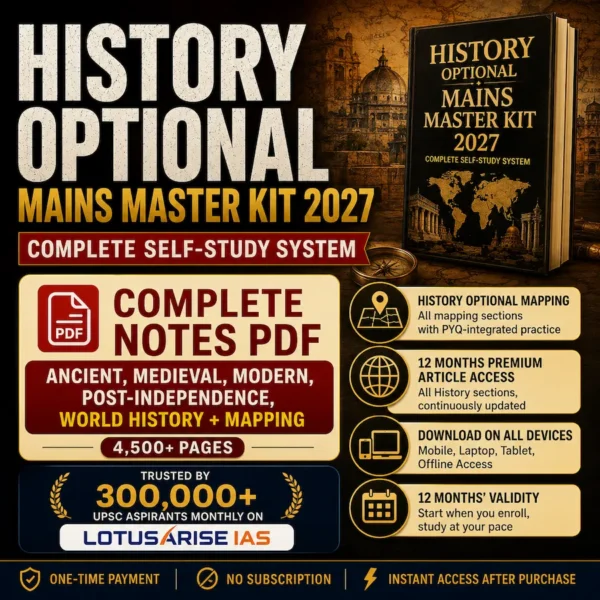
| What you get | Model answers to every question since 1985, topic-wise, map sections included | 4,500+ pages of notes, full mapping coverage, 12 months of article access |
| Price | ₹1,499 (reg. ₹2,500) | ₹1,770 (reg. ₹5,000) |
Frequently asked questions
Related topics
This unit connects to:
- Imperialism and Colonialism
- Decolonization and Underdevelopment
- The World after World War II
- Nationalism under Gandhi’s Leadership
- All topics — History Optional PYQs, topic-wise
Prefer to work year by year?
The complete papers, with both papers in full, unit-wise analysis and the official PDFs:
- History Optional Question Paper 2026
- History Optional Question Paper 2025
- History Optional Question Paper 2024
- History Optional Question Paper 2023
- History Optional Question Paper 2022
- History Optional Question Paper 2021
- History Optional Question Paper 2020
- UPSC History Optional Map Solutions (2013–2025)