Caste and Ethnicity after 1947; Backward castes and tribes In postcolonial electoral politics; Dalit movements.
Caste and Ethnicity after 1947 is one of the smaller units on this list — nine questions between 2008 and 2025, appearing in four of the last ten papers. The sample is small, but it is unusually focused: seven of the nine questions are about Dalit assertion and tribal policy, and the unit only entered the paper in 2008.
Every question the Commission has asked on this topic is listed below, newest first, with a written model answer linked against each one.
| Questions asked (2008–2025) | 9 |
| Appeared in | 4 of the last 10 papers |
| Paper | Paper II, Section A (India after Independence) |
| Usual mark value | 10, 15 or 20 marks |
| Model answers available | 9 of 9 |
PYQs: Caste and Ethnicity after 1947 [1985-2026]

| Year | Question | Answer |
|---|---|---|
| 2025 | Discuss the major initiatives taken by the Government of India for the removal of caste injustice and inequality after 1947. | View answer |
| 2023 | How did the factionalised Dalit leadership in Hyderabad undergo a period of intense reorganization between 1948 and 1953? | View answer |
| 2021 | Discuss the changing nature of Dalit assertion in India in the twentieth century. | View answer |
| 2018 | Analyse various trends in Dalit Movements in various parts of post-independent India. | View answer |
| 2014 | "Dalit Movements for empowerment in independent India have essentially been for carving out political space through electoral politics.” Discuss. | View answer |
| 2013 | "Notwithstanding the quest for modernity and the antagonism that guided Nehru’s attitude towards the inequalities inherent in the social structure in rural India, the Congress Party did not carry out a concerted campaign against discrimination based on caste. Nehru’s own perception was that industrial growth was bound to break the stanglehold of this feudal remnant. This, however, did not happen in India." Examine. | View answer |
| 2012 | “Nehru favoured the policy of integrating the traibal people in Indian society, of making them an integral part of the Indian nation even while maintaining their distinct identity and culture.”- Elaborate with special reference to Northeastern India. | View answer |
| 2010 | Discuss the factors that led to the growth of Dalit consciousness and mention the major movements aimed at their empowerment. | View answer |
| 2008 | “In exercising its exclusive power, the Parliament additionally enacted the Untouchability (Offences) Act in 1955.” Comment. | View answer |
What UPSC keeps asking about Caste and Ethnicity after 1947
Nine questions are too few to call a firm rotation, so these two threads describe what the questions share. Both ask about movements and their changing character, not about policy alone.
1. Dalit movements and their changing character (2010, 2014, 2018, 2021, 2023)
- Five of the nine questions. The growth of Dalit consciousness (2010), regional trends after independence (2018), changing forms of assertion across the twentieth century (2021), and factionalised leadership in Hyderabad (2023).
- 2014 argued that Dalit movements for empowerment were essentially movements for identity. The strong answer tests that against the evidence — the Republican Party, the Dalit Panthers, the rise of the BSP — and presents both the identity and the material-empowerment readings fairly.
- Gail Omvedt, Eleanor Zelliot and Christophe Jaffrelot are the historians to know.
2. Tribal policy and the state (2008, 2012, 2013, 2025)
- Nehru’s integrationist approach to tribal communities (2012, 2013) — the Panchsheel for tribal affairs drawn from Verrier Elwin, set against assimilation and isolation.
- Parliamentary powers under the Fifth and Sixth Schedules (2008) and government initiatives to remove untouchability (2025).
- With so few questions, prepare each of these as a self-contained answer rather than expecting a pattern.
Every question above, already answered
Knowing the questions is half the work. The other half is seeing what a full-mark answer to each one looks like — not a hint or a bullet outline, but a complete answer at the mark and the word limit, with the historians named inside the argument.
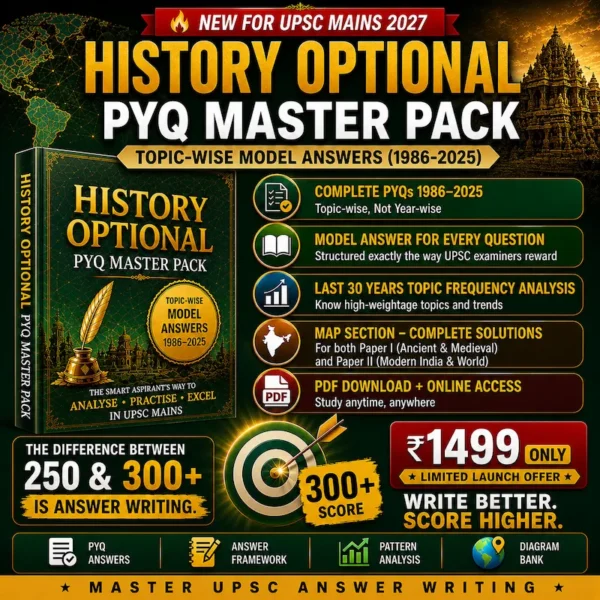
The History Optional PYQ Master Pack carries the same for every question the Commission has set since 1985, across the whole syllabus.
- PYQs 1985–2025, arranged topic-wise — revise a theme and see every way it has been asked
- Model answers with historiography — the debate cited where it belongs, not bolted on
- Map sections solved — the full 50-mark section, every year
- PDF plus online access — any device, permanently, no subscription
₹1,499 (regular ₹2,500). One-time payment, instant access.
How to use this topic list
Reading a question list feels like preparation and is not. Three sittings turn it into marks.
Sitting 1 — sort before you read (30 minutes)
- Copy the questions above into the threads identified in the previous section.
- Note which thread has gone longest without being asked — that is your priority, not the one you find most interesting.
Sitting 2 — write three answers cold (45 minutes)
- Pick the most recent question from three different threads.
- Seven minutes for a 10-marker, fifteen for a 20-marker. Stop when the time is up, even mid-sentence.
- Mark every place you wanted a historian’s name and could not produce one.
Sitting 3 — compare, then rewrite (45 minutes)
- Put your script beside the model answer for the same question.
- Compare structure first: opening claim, evidence, counter-view, judgement.
- Rewrite your weakest answer using that structure and no new content. Most candidates gain four to six marks from structure alone.
Two ways to prepare this optional
Two routes, depending on what is actually missing.
| PYQ Master Pack | Mains Master Kit 2027 | |
| Best when | Your notes are done; answer-writing is the gap | You are still building the subject |
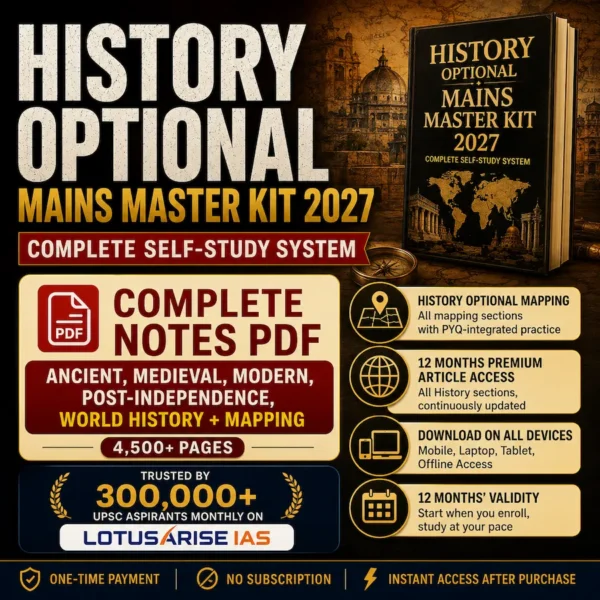
| What you get | Model answers to every question since 1985, topic-wise, map sections included | 4,500+ pages of notes, full mapping coverage, 12 months of article access |
| Price | ₹1,499 (reg. ₹2,500) | ₹1,770 (reg. ₹5,000) |
Frequently asked questions
Related topics
This unit connects to:
- Consolidation as a Nation
- Economic Development and Political Change
- Nationalism under Gandhi’s Leadership
- Indian Response to British Rule
- All topics — History Optional PYQs, topic-wise
Prefer to work year by year?
The complete papers, with both papers in full, unit-wise analysis and the official PDFs:
- History Optional Question Paper 2026
- History Optional Question Paper 2025
- History Optional Question Paper 2024
- History Optional Question Paper 2023
- History Optional Question Paper 2022
- History Optional Question Paper 2021
- History Optional Question Paper 2020
- UPSC History Optional Map Solutions (2013–2025)