- India is a prominent regional power, a nuclear power, an emerging global power and, in much commentary, a potential superpower, with a growing voice in global affairs.
- Its standing rests on military spending, armed strength and economic size, and those ranks move from year to year. The table sets the figures long quoted for India beside the latest published ones.
| Measure | Figure long quoted | Latest figure | Date and source |
|---|---|---|---|
| Military spending | Third largest (US$ 72.9 billion, 2020) | Fifth, US$ 92.1 billion | 2025; SIPRI, April 2026 |
| Armed forces | Fourth largest | Second by active personnel, about 1.5 million | Military Balance 2026 |
| GDP, nominal | Fifth | Sixth, about US$ 4.06 trillion, behind Japan and the UK; projected to pass both and rank fourth in 2027 | 2026; IMF, October 2026 |
| GDP, purchasing power | Third | Third, about US$ 19.2 trillion | 2026; IMF, October 2026 |
| UN peacekeepers | Fifth (June 2020) | Fourth, about 5,165 personnel | UN ranking, 31 October 2025 |
| Overseas Indians | 44 million | 37.28 million: 19.52 million of Indian origin, 17.76 million non-resident | January 2026; Ministry of External Affairs |
India in World Bodies
Commonwealth and Non-Alignment
- Commonwealth of Nations: as a former British colony, India is a member and keeps up ties with the other member countries.
- The London Declaration of 1949 let republican India stay in. Ahmedabad was awarded the 2030 Commonwealth Games on 26 November 2025.
- Since independence from Britain in 1947: India is now classed as a newly industrialised country and has built an extensive network of foreign relations.
- Non-Aligned Movement: India exerts influence as a founding member.
- It grew out of Bandung (1955) and first met as a summit at Belgrade (1961), with Jawaharlal Nehru among its leading figures. Its 19th summit met at Kampala in January 2024.
Global Bodies
| Body | India’s place | Start | Latest dated point |
|---|---|---|---|
| United Nations | Founding member | 1945 | Campaign for 2028-29 Security Council seat launched 14 July 2026 |
| International Monetary Fund | Founding member | 1945 | Quota reform pressed in BRICS text, September 2026 |
| World Trade Organization | Founding member | 1995 | Restoring dispute settlement pressed in BRICS text, September 2026 |
| Asian Development Bank | Founding member | 1966 | Among the largest shareholders |
| G20 | Founding member | 1999 | Presidency 2023; US presidency 2026, Miami summit December 2026 |
| BRICS | Founding member | 2009 | India in the chair 2026; New Delhi summit 12–13 September |
| New Development Bank | Founding member | Signed Fortaleza 15 July 2014; in force 3 July 2015 | Founded by the BRICS five |
| Asian Infrastructure Investment Bank | Founding member; second-largest shareholder | January 2016 | Voting share about 7.6% (2025) |
| G7 outreach | Invited partner | G8+5 of the 2000s; G7 since Russia’s suspension in 2014 | 13th participation, Evian, 16–17 June 2026 |
- Membership of BRICS: a grouping of emerging major economies, first Brazil, Russia, India and China, with South Africa added.
- Egypt, Ethiopia, Iran and the UAE joined from January 2024 and Indonesia from January 2025. Saudi Arabia was invited but has yet to formally accept full membership (September 2026).
- G20: it is widely seen as the main economic forum of developed and emerging nations.
Regional and Issue-Based Groups
- Neighbourhood and the East: India’s more expansive foreign policy pairs a neighbourhood-first policy with the Look East policy, which sought wider economic and strategic ties with East Asia.
- Look East dates from the early 1990s and became Act East, announced on 13 November 2014 at Nay Pyi Taw.
- Neighbourhood First was long embodied by SAARC, which has held no summit since 2014, so BIMSTEC now carries more of this work, and the geopolitics of South Asia and the Indian Ocean turns on both.
| Group | Partners | Start | Latest dated point |
|---|---|---|---|
| East Asia Summit | ASEAN and eight partners | December 2005 | Platform for Act East (2014) and the Indo-Pacific Oceans Initiative (2019) |
| IBSA Dialogue Forum | India, Brazil, South Africa | June 2003 | Trilateral forum of three southern democracies |
| Shanghai Cooperation Organisation | Eurasian states, with Pakistan | India a full member 9 June 2017 | Bishkek summit 31 August–1 September 2026; Pakistan chairs next |
| Quad | USA, Japan, Australia | Revived November 2017 | Last leaders’ summit Wilmington, 21 September 2024; foreign ministers met in New Delhi, 26 May 2026; leaders’ summit in India still pending at that date |
| I2U2 | Israel, UAE, USA | First summit July 2022 | Food and clean energy focus |
| India-Middle East-Europe Corridor | Gulf states, EU members, USA | Launched at the G20, September 2023 | Overland links incomplete; West Asian conflict has slowed it (2026) |
| Indian Ocean Rim Association | 22 others | 1997 | India in the chair from November 2025 |
Security Council and Peacekeeping
- Security Council: India seeks a permanent seat, along with the other G4 nations: Brazil, Germany and Japan.
- Reform talks: in January 2026 the G4 presented a model for early action at the Intergovernmental Negotiations. Pakistan is the main opponent, and China has never endorsed India’s bid.
- Elected terms: eight so far, in 1950-51, 1967-68, 1972-73, 1977-78, 1984-85, 1991-92, 2011-12 and 2021-22.
- Next: India is contesting the Asia-Pacific seat for 2028-29 against Tajikistan, with the vote due in June 2027.
- Peacekeeping: India has taken part in many UN missions and is a major contributor of forces.
- Over time: nearly 300,000 troops across more than 50 missions, on India’s own UN statement.
- Ranks shift: fifth in June 2020 and fourth at the end of October 2025, behind Nepal, Rwanda and Bangladesh.
Diaspora
- Overseas Indians live and work abroad and form an important link with the mother country. A figure of 44 million was long quoted, and the official count for January 2026 is 37.28 million.
- Their welfare and wellbeing, within the laws of the country where they live, is an important task of India’s foreign policy.
India’s Roles on the World Stage
- India has the capability and responsibility to play a major part in several ways:
- Balancing power between major global powers.
- Security provider to smaller countries.
- India is the regional power in South Asia, and it describes its approach to neighbours as one of non-interference and non-use of force.
- Sri Lanka: a large effort for peace and stability, including the Indian Peace Keeping Force of 1987–90.
- Seychelles and the Maldives: in the 1980s India acted to restore the legitimate government, through a naval deployment off the Seychelles in 1986 and paratroops in the Maldives in 1988. Both came at the request of those governments.
- Major contributor of peacekeeping forces to the United Nations.
- Supporter of a free and open ocean for all, a position set out in the Indo-Pacific Oceans Initiative of 2019.
- Opponent of neo-colonialism.
- Advocate of a clear definition of terrorism and of a global effort against it.
- Balancer among many organisations, as a member of BRICS, G20, SCO and the Quad at once.
Stands at Recent Summits
| Summit | Date | India’s stand or result |
|---|---|---|
| G20, New Delhi | 9–10 September 2023 | Consensus declaration; African Union made a permanent member; theme “One Earth, One Family, One Future” |
| Quad, Wilmington | 21 September 2024 | Free and open Indo-Pacific; India to host next |
| G7, Evian | 16–17 June 2026 | Partner country, while chairing BRICS |
| SCO, Bishkek | 31 August–1 September 2026 | Call to dismantle the “entire ecosystem of terrorism”; signed the Bishkek Declaration |
| BRICS, New Delhi | 12–13 September 2026 | Host; consensus declaration backing UN reform, with India and Brazil for wider UN roles, and opposing unilateral sanctions; foreign ministers had failed to agree a joint text in May over West Asia |
South China Sea
- Interest: India’s trade with East Asia crosses this sea, so freedom of navigation concerns it directly. It rests its case on the Law of the Sea Convention, under which a tribunal ruled on 12 July 2016 against China’s claims in the case brought by the Philippines.
- Energy: ONGC Videsh holds an interest in Block 128 off Vietnam, and China has objected to the work there.
- Defence ties: India delivered its first BrahMos missiles to the Philippines in April 2024, under a deal of US$ 374 million.
India’s Role in Multilateralism
From Non-Alignment to Multi-Alignment
- After the Cold War, India moved from non-alignment (neutrality between the US and USSR blocs) to multi-alignment (friendly relations with almost all great powers and the developing world).
- Multi-alignment is the essence of India’s foreign and economic policy today.
- Within 2026 alone, India hosted Quad foreign ministers in May, attended the G7 as a partner in June and the SCO at Bishkek at the turn of September, and chaired BRICS.
- This opens the way for India to act as a global mediator and help build frameworks on global issues.
International Activism
- India is a key member of the G20, with a long tradition of international activism and support for rule-based multilateralism.
- Its foreign policy draws on the ethos of “Vasudhaiva Kutumbakam” and of the Good Samaritan. In this spirit:
- UN reform: India’s commitment to multilateralism shows in its call to reform the UN system.
- Multilateral initiatives:
- International Solar Alliance: launched in Paris on 30 November 2015, it counted 125 member and signatory countries in January 2026.
- Comprehensive Convention on International Terrorism (CCIT): proposed by India in 1996 and still unadopted, held up by differences over how to define terrorism.
- Asia-Africa Growth Corridor: announced with Japan at Gandhinagar in May 2017, it has remained mainly a vision and framework.
- Pharmacy to the world: India is the largest supplier of generic medicines, with about 20% of global supply. It ranks third by volume and 11th by value in pharmaceuticals, and exports to 191 countries (2024-25).
Working with Like-Minded Countries
- Coalitions: a group drawn from developed and developing countries can amplify India’s voice.
- Alliance for Multilateralism: launched by Germany and France, announced in April 2019 and launched at the United Nations on 26 September 2019. India attended its preparatory meeting, and it offers a way to shape the reform agenda.
- Internet governance: India has backed a multi-stakeholder model since 2015, asking for a larger developing-country voice. Its input to the WSIS+20 review of 2025 kept that position, and it pursues this with partners such as the USA.
Decoupling from China
- China as the world’s factory: global investors have sought a gradual decoupling, because of the rising cost of production and a trust deficit after the Covid-19 pandemic.
- The opportunity: this could make India a manufacturing hub and a stable economic power, which would help it assume leadership roles and steady the global economic system.
- Policy: Production Linked Incentive schemes began in 2020, and now cover 14 sectors with an outlay of about ₹1.97 lakh crore.
- Trade deals: India and the EU concluded their talks in January 2026, and India and the USA released an interim framework in February 2026.
- The limit: India’s trade gap with China was US$ 112.16 billion in 2025-26, its largest with any partner.
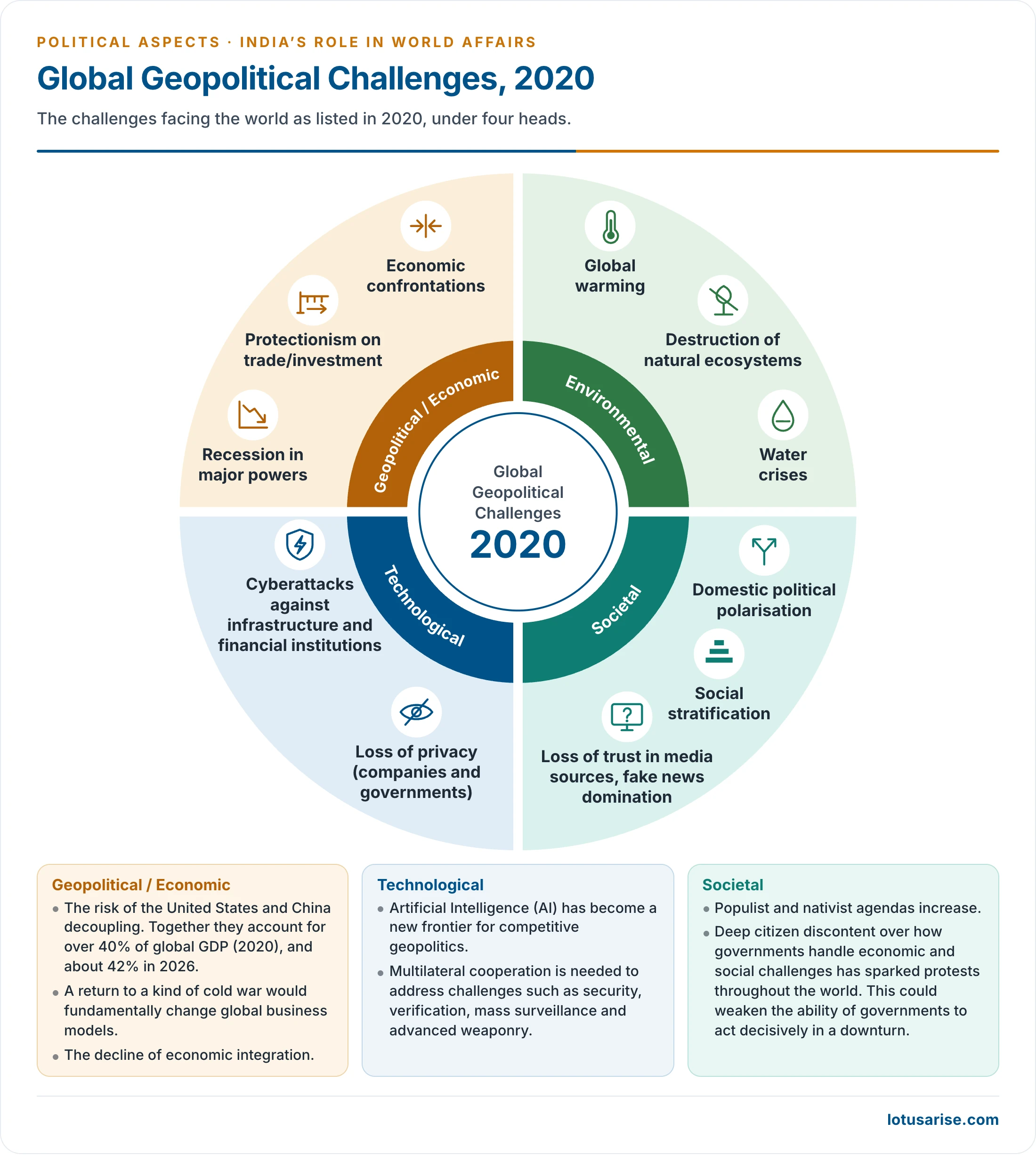
- Together, the USA and China stand at about 42% of global GDP in 2026 (IMF, October 2026).