

- An industrial complex is a set of linked industries in one place, where the output of one unit feeds another. A corridor extends the same idea along a main transport artery.
- Complexes began as tools of planned growth, and SEZs, technology parks and hardware parks are their newer forms.
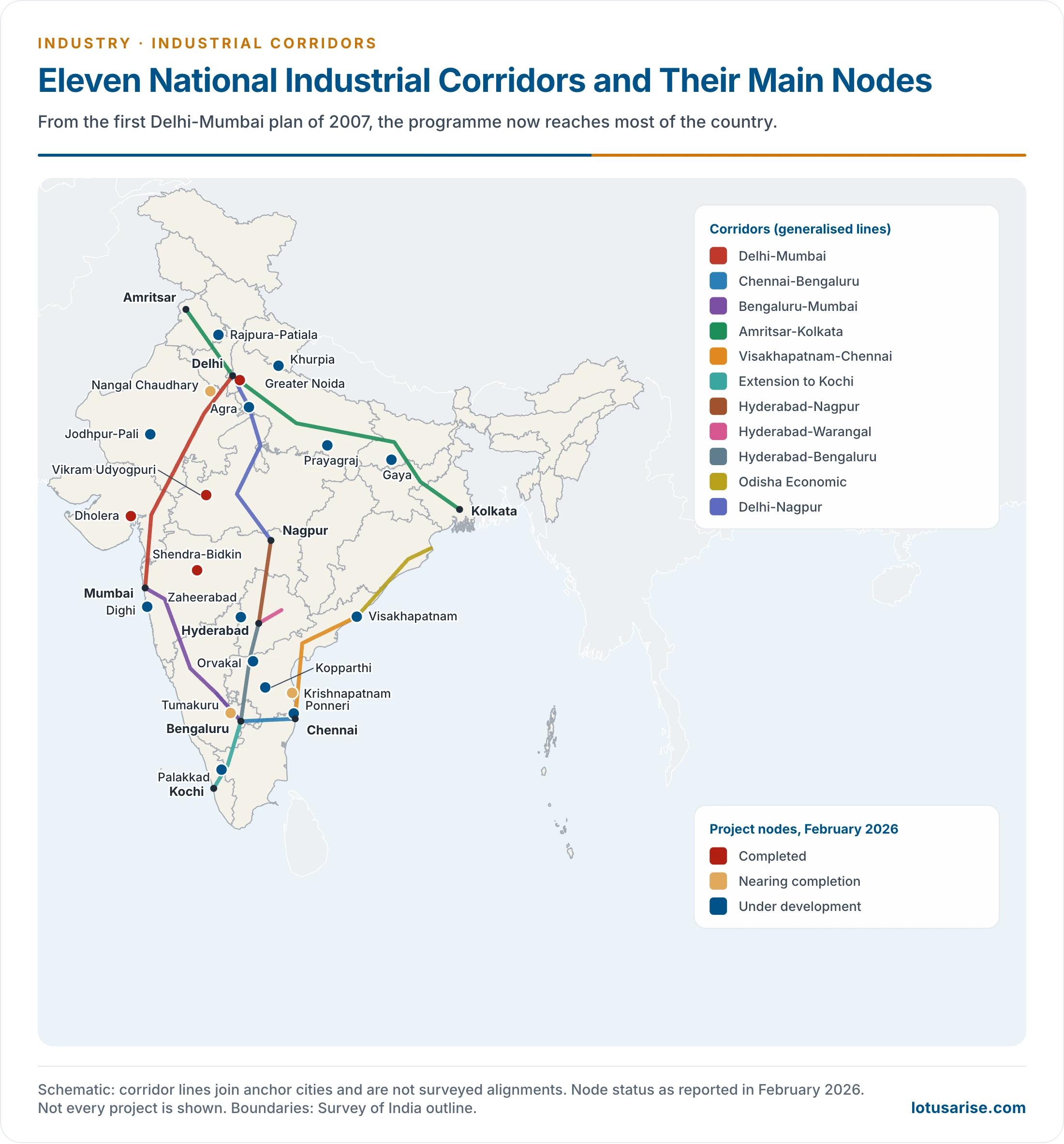
- The national programme now has 11 corridors. By February 2026, 4 projects were complete and 4 nearly complete.
Industrial Complexes
Meaning
- In the geographer’s sense: a set of specific industries bound by production, marketing and other links, each strengthened by the others’ presence.
- As a planning tool in India: small or medium towns given well-developed industrial infrastructure to draw entrepreneurs, so spreading industry and raising resource-use efficiency, as at Jamshedpur.
- Origins of the idea:
- It gained currency in the former USSR under planned industrialisation, and connects with the growth pole of François Perroux (1955) and the growth centre of Jacques-Raoul Boudeville (1966) under growth pole theory.
- Walter Isard, with Eugene Schooler and Thomas Vietorisz (1959), developed industrial complex analysis, using input-output and comparative cost analysis to choose the mix of industries that best suits a region.
- How it works: one unit’s finished product is another’s raw material, as with automobile plants and their ancillaries. Trade among units assures quality and cuts transport cost, and growth spreads through spillover, multiplier and trickle-down effects.
Features of an Industrial Complex
- Infrastructure: links to main railway lines and National Highways, assured power from the grid or from oil and gas pipelines, enough good freshwater, and optical fibre links to the metros and financial markets.
- Services and incentives: banking, common marketing and publicity, and tax incentives and subsidies, which let complexes form in small and medium towns.
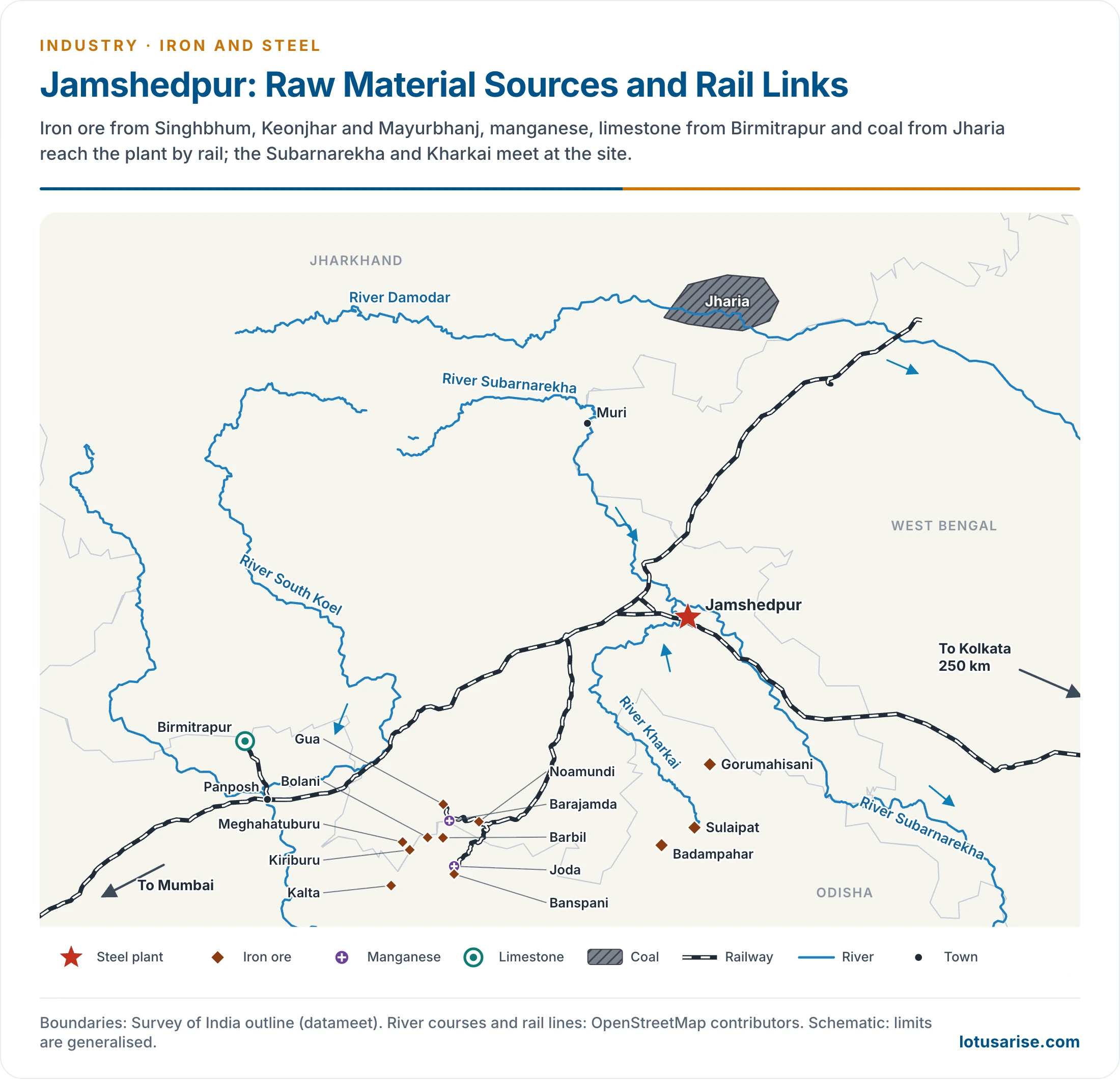
- A lead industry, perhaps a public sector unit, builds strong forward and backward linkages. TISCO at Jamshedpur has backward links to the coal mines of Jharia and Raniganj, and forward links to automobile industries at Jamshedpur and Kharagpur.
- Local advantages shape each type: steel at Jamshedpur, Durgapur, Bhilai, Rourkela and Bhadravati; chemicals at Sindri and Vadodara and refining at Mathura and Haldia; engineering and defence at Bhopal, Ranchi, Avadi and Perambur; electronics at Bengaluru and Hyderabad; light industry at Faridabad, Noida and Kota; and coal chemicals at Korba and Dhanbad.
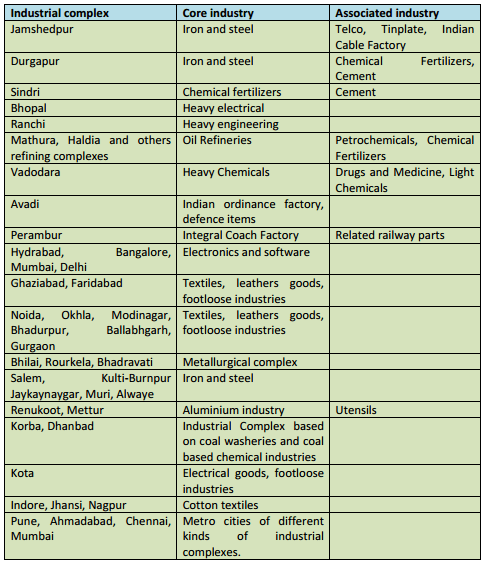
- In this table, Jaykaynagar, Muri and Alwaye are aluminium centres and belong with Renukoot and Mettur. “Telco” is now Tata Motors.
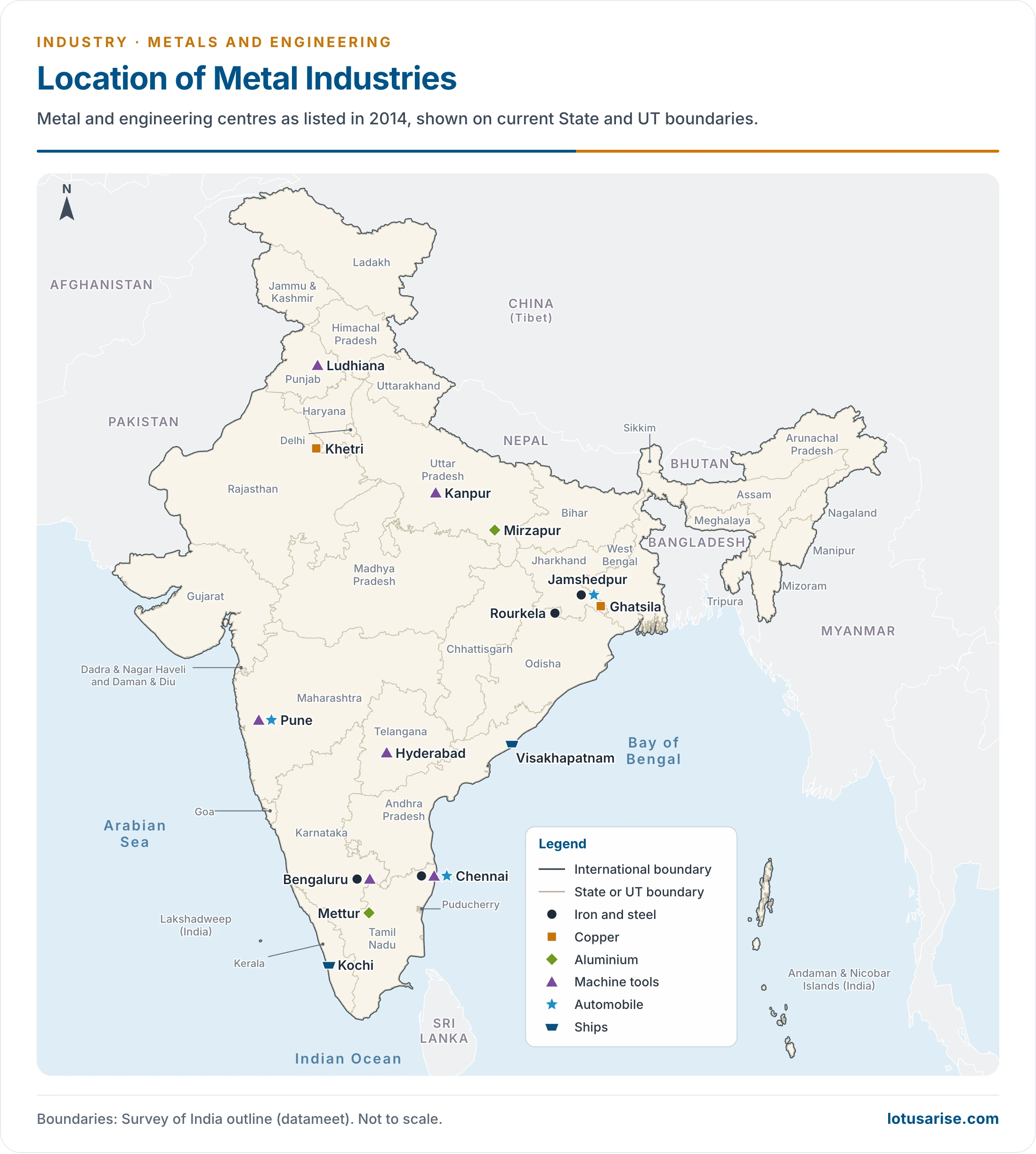
Complexes in India
- Metro complexes of many kinds stand at Pune, Ahmedabad, Chennai and Mumbai, and thousands of complexes have grown within India’s major and minor industrial regions.
- After the 1991 reforms, the Centre and the States promoted newer forms: Export Processing Zones, today’s Special Economic Zones, and technology, hardware and biotechnology parks.
- Petroleum, Chemicals and Petrochemicals Investment Regions (PCPIRs): Dahej (Gujarat), Visakhapatnam–Kakinada (Andhra Pradesh) and Paradip (Odisha) are working, with ₹3,49,192 crore of reported investment, while Cuddalore–Nagapattinam in Tamil Nadu has lagged.
Example of Tamil Nadu
- Tamil Nadu has built a series of complexes for small and medium units: the Sriperumbudur and Cheyyur industrial parks, and the Pudukkottai, Cuddalore and Ranipet complexes.

Complexes of Western India
| Complex | Core and associated industries |
|---|---|
| Mumbai–Thane–Navi Mumbai | Engineering, chemicals, pharmaceuticals, refining at Trombay, data centres |
| Pune–Chakan–Nashik | Automobiles and components, engineering |
| Vadodara–Bharuch–Dahej | Refining at Koyali, petrochemicals, drugs, heavy chemicals |
| Jamnagar | Large private refineries and petrochemicals |
| Surat–Hazira | Synthetic textiles, diamonds, gas, fertilizer, steel |
| Ahmedabad–Sanand–Dholera | Textiles, automobiles, semiconductors |
- Why they cluster here: ports, refineries, a chemical base, rich domestic markets, entrepreneurship and active State support.
- Salient characteristics: most are port- and feedstock-based, along the coast or the Delhi–Mumbai freight route. They join refining and heavy chemicals with automobiles, textiles and diamonds, and private capital leads, as at Jamnagar.
- Impact of SEZ policy:
- Gujarat led SEZ exports in 2025-26 with about ₹4.06 lakh crore, through zones such as Kandla, Mundra, Dahej and GIFT City.
- Port-based zones such as Mundra drew logistics, power and engineering units, and GIFT City added financial services.
- The gains are unevenly shared, and many zones work as enclaves with weak local links. Land acquisition and the loss of mangroves and fishing grounds around Mundra cause most friction.
Problems of Industrial Complexes
- A propulsive unit that attracts auxiliaries is hard to choose, and a wrong choice of growth poles and growth centres leaves a complex weak.
- Broken linkages: many Indian textile and paper units stand alone.
- Weak infrastructure (power above all), a lopsided domestic market, and poor support for imports and exports.
- Short skills, late finance, and labour laws that the Labour Codes of 2025 aim to ease.
Difference between an Industrial Complex and an Industrial Region
- The two terms are often used interchangeably. A region is an areal unit, while a complex is a functional group of linked industries, usually lying inside a region.
| Point | Industrial region | Industrial complex |
|---|---|---|
| Concept | Spatial: an areal unit | Functional: how raw materials become products |
| Diversity | Greater; several basic industries with ancillary, complementary and parasitic units (cutlery on steel, tyres on automobiles, wine-making on sugarcane). Hugli has cotton, jute and refining | Less diversified, more specialised: one heavy basic industry and its relatives, as at Jamshedpur |
| Scale | Diversified manufacturing, processing and fabrication, for national and international sale | A sub-unit of a region, with greater specialisation |
| Growth | Agglomeration effect, with high infrastructure drawing more firms | Acquired or cumulative advantages, with some tendency to agglomerate |
| Land and workers | Much larger area; private and government investment; rural land mixed in, with mines and raw material sources; primary, secondary and tertiary workers | Urban land use, more market-based, and no primary workers as such |
| Forces | Centrifugal: it outgrows and diversifies | Centripetal: greater functional rigidity |
| Management | No single authority | A management authority monitors production, marketing and other affairs |
Case Study: Jamshedpur Industrial Complex
- Jamshedpur, in East Singhbhum district of Jharkhand, is among India’s oldest and finest complexes (1907), at the confluence of the Subarnarekha and Kharkai on the site of the tribal settlement of Sakchi.
- Why the site was chosen:
- Weight-losing raw materials lay close by: iron ore at Noamundi and coking coal at Jharia and Raniganj.
- The Kolkata–Mumbai rail route brought in machinery and carried goods to markets.
- The confluence gave space, sand and freshwater, Damodar valley coal gave thermal power, and labour was cheap.
- Structure:
- 11 major units, with many small, demand-based units around them, scattered for want of space and linked by rail.
- Except for Ramdas oil mills, all depend directly or indirectly on TISCO (Tata Steel): among them TELCO (Tata Motors), Indian Tin Plate Company, Indian Cable Factory, Tatanagar Foundry and Indian Steel and Wire Factory.
- Problems:
- Population growth: planned for about 3 lakh people, its urban agglomeration counted about 13 lakh in 2011, with slums and weak public services.
- Modernisation of old technology needs heavy investment, and retirements under it have caused union tension.
- Coking coal: Raniganj is nearly exhausted and Jharia will not last long, so imports, mainly from Australia, raise costs.
- Transport and environment: wagons and free tracks run short, and the Subarnarekha is badly polluted, with acid rain and suspended particulates around the city.
- Prospects: coking coal is the only real raw-material shortage, its products have a recognised global market, and as a wholly private complex it suits a liberalised economy.
Case Study: Bokaro
- Bokaro is the classic public sector example of an industrial complex.
- Origin: Bokaro Steel Ltd. dates from 1964, a Soviet-aided project at the meeting of the Bokaro and Damodar rivers. Production began in 1972, and it merged into SAIL in 1978.
- Lead industry: one integrated plant binds coke ovens, blast furnaces, steel melting shops and rolling mills on a single site, making flat products.
- Backward links: coal from Jharia, iron ore from Kiriburu, limestone from Palamu, and Damodar Valley Corporation water and power.
- Forward links: its steel feeds ancillary and engineering units in a planned industrial area, and blast-furnace slag goes to cement making.
- Township: a planned steel city houses the workforce, under the same management as the plant.
- Bokaro lies within the belt of the Amritsar–Kolkata corridor, though the corridor’s Jharkhand node is at Barhi.
Public Sector Undertakings
- A public sector undertaking is a unit in which 51% or more of the paid-up capital is held by the Centre, a State or both. The 1956 policy gave such units a strategic role, with balanced regional development among their aims.
- Role in complexes: Durgapur, Rourkela, Bhilai and Bokaro, HMT, and locomotive works at Chittaranjan and Varanasi built heavy industry in backward regions.
- Central public enterprises grew from 5 units in 1951 to 220 in 2011, and their losses and delays later turned public sector reforms towards autonomy and disinvestment.
Industrial Corridors
- An industrial corridor is a route of multi-modal transport services that runs through States as a main artery.
- Rail and road feeders link it to industrial clusters and National Investment and Manufacturing Zones up to 100–150 km on either side, which lowers logistics costs.
- Corridors integrate industry with infrastructure: fast road and rail, ports, airports, logistics parks, knowledge parks and smart cities for the new workforce.
- Manufacturing is the driver. The target was to raise its share of output from about 16% to 25% by 2025.
- That date has passed. The share stood at 14.8% of gross value added in 2025-26 on the revised series, and the roadmap now runs to 2035.
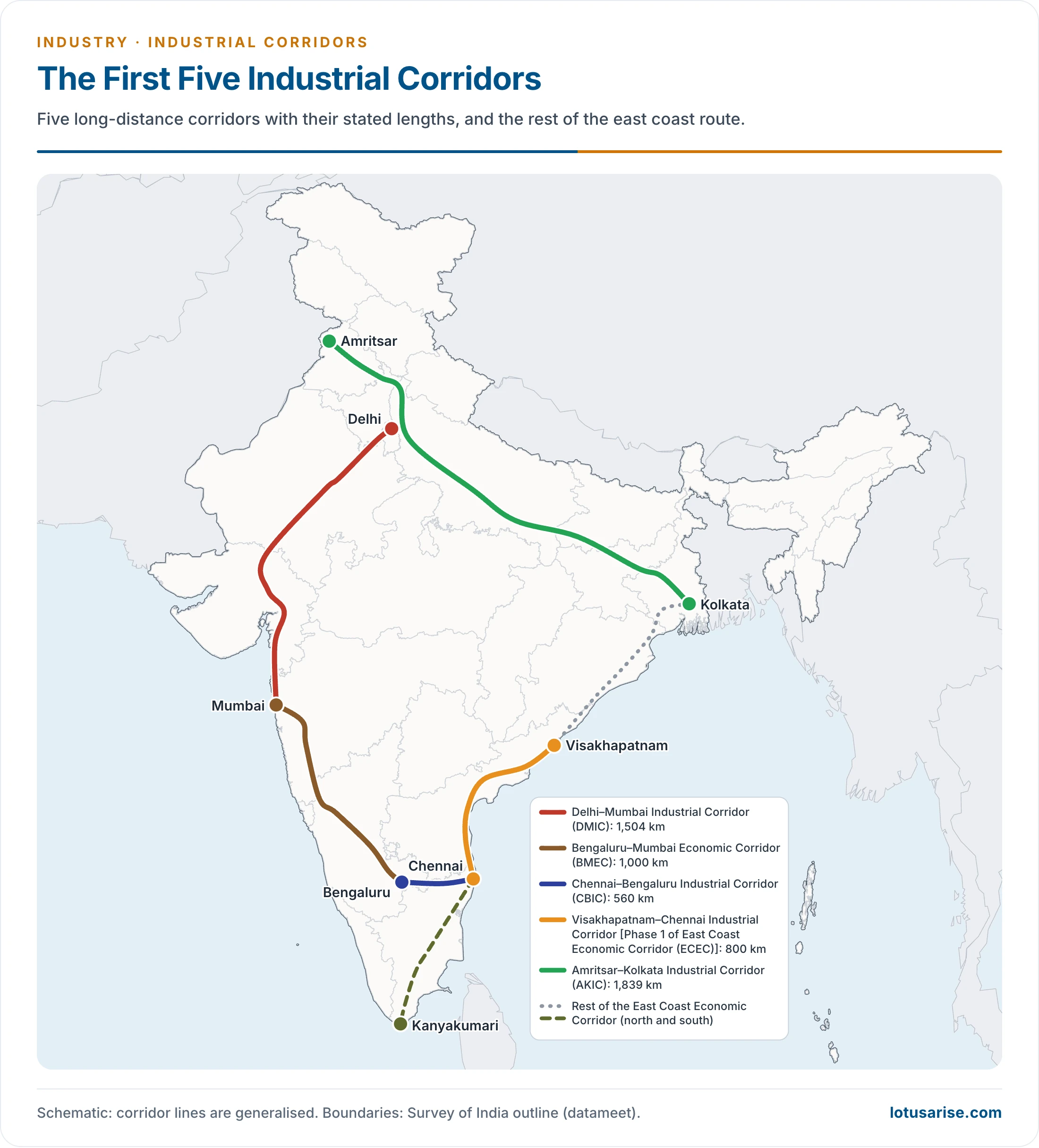
The First Five Corridors
Delhi–Mumbai Industrial Corridor (DMIC)
- Covers Uttar Pradesh, Haryana, Rajasthan, Madhya Pradesh, Gujarat and Maharashtra, with Delhi and the Union Territory of Dadra and Nagar Haveli and Daman and Diu. Length: 1,483 km.
- Approved in principle in August 2007. The Delhi Mumbai Industrial Corridor Development Corporation was set up on 7 January 2008.
- Funding: about US$ 90–100 billion, from the Government of India, Japanese loans and Japanese firms.
- Backbone: the Western Dedicated Freight Corridor (1,506 km), mostly in Rajasthan (39%) and Gujarat (38%).
- Scale as planned: about 4.36 lakh sq km, 13.8% of India’s land and 17% of its people, with 24 manufacturing cities and about 30 lakh jobs.
Chennai–Bengaluru Industrial Corridor (CBIC)
- Covers Tamil Nadu, Andhra Pradesh and Karnataka, over about 560 km to Chitradurga, with help from the Japan International Cooperation Agency.
- Target industries: steel, cement, food processing, IT, automobiles, garments, petroleum and chemicals.
- Extended southwards towards Kochi through Coimbatore.
Bengaluru–Mumbai Economic Corridor (BMEC)
- Covers Maharashtra and Karnataka over about 1,000 km, along the Mumbai–Pune–Bengaluru highway (NH-48), with nodes at Dharwad and Satara. It was agreed in February 2013.
- Developed with Britain’s help, with the Delhi Mumbai Industrial Corridor Development Corporation and UK Trade and Investment as nodal agencies.
- Characteristics:
- It joins two of India’s largest urban economies, Mumbai and Bengaluru, through Pune, Satara, Kolhapur, Belagavi, Hubballi–Dharwad, Davanagere, Chitradurga and Tumakuru.
- Its base is varied: automobiles and engineering at Pune, foundries, sugar and textiles around Kolhapur and Belagavi, and IT, electronics and aerospace at Bengaluru.
- Much of the route crosses the drought-prone Deccan, so water is a constraint, and progress has lagged the DMIC.
Amritsar–Kolkata Industrial Corridor (AKIC)
- Covers Punjab, Haryana, Uttarakhand, Uttar Pradesh, Bihar, Jharkhand and West Bengal, a belt with about 40% of India’s people, from Amritsar to Dankuni for 1,839 km.
- Backbone: the Eastern Dedicated Freight Corridor, whose 1,337 km Ludhiana–Sonnagar line is in service, with the National Waterway on the Ganga alongside.
East Coast Economic Corridor (ECEC)
- Covers West Bengal, Odisha, Andhra Pradesh and Tamil Nadu. The Visakhapatnam–Chennai Industrial Corridor, about 800 km along the Andhra Pradesh coast, is Phase 1 and India’s first coastal economic corridor.
- It is aligned with the Golden Quadrilateral and supports the Act East Policy. The Asian Development Bank approved US$ 631 million of loans and grants in September 2016.
- Budget 2026-27 announced an integrated East Coast Industrial Corridor with a node at Durgapur.
The Corridor Programme Today
- A national body: the Delhi Mumbai trust and company became the National Industrial Corridor Development and Implementation Trust (December 2016) and the National Industrial Corridor Development Corporation (February 2020).
- 11 corridors: the first five (with the Vizag–Chennai line) plus Chennai–Bengaluru’s extension to Kochi, Hyderabad–Nagpur, Hyderabad–Warangal, Hyderabad–Bengaluru, Odisha Economic and Delhi–Nagpur.
- Completed (February 2026): Dholera, Shendra–Bidkin, and the townships at Greater Noida and Vikram Udyogpuri, with 350 plots allotted and ₹2.02 lakh crore of investment attracted (Economic Survey 2025-26).
- Dholera is the largest DMIC node, at 920 sq km, and is billed as India’s first semiconductor city.
- Nearing completion: Tumakuru, Krishnapatnam, the logistics hub at Nangal Chaudhary, and the logistics and transport hubs near Greater Noida.
- August 2024: the Cabinet approved 12 more projects worth ₹28,602 crore in 10 States, among them Khurpia, Rajpura–Patiala, Dighi, Palakkad, Agra, Prayagraj, Gaya, Zaheerabad and Jodhpur–Pali, expected to give about 10 lakh direct and 30 lakh indirect jobs.
- Defence industrial corridors run separately, with six nodes in Uttar Pradesh and five in Tamil Nadu.
Significance of Industrial Corridors
- Economic: lower logistics costs make Indian goods more competitive in exports, logistics infrastructure brings economies of scale and lower inventory costs, and jobs close to home limit distress migration.
- Environmental: spreading units along a corridor avoids piling them on one site beyond its carrying capacity.
- Socio-economic: industrial townships, schools and hospitals raise human development.
Challenges Associated with Industrial Corridors
- Land: acquisition has been slow along such long stretches, with legal hurdles and compensation disputes, and projects can bring displacement and loss of fertile farmland.
- Investment climate: gaps in technology call for higher FDI caps, and foreign investors want clear tax rules, a stable exchange rate and contract certainty under Bilateral Investment Treaties, after disputes such as Antrix–Devas.
- Viability: nodes need investors and anchor tenants, and those completed in 2026 were planned in 2007.
- Rural–urban gap: there is fear of a wider gap in human development and living standards.
Outlook
- Success needs India to join Industrial Revolution 4.0 (smart robotics, lighter and tougher materials, 3D printing and analytics), and effective execution could bring a major leap in development.
Previous Year Questions
2022Discuss the salient characteristics of industrial complexes of Western India. Examine the impact of SEZ policy on the region.2021Identify the major industrial corridors of India and discuss the characteristics of the Bengaluru-Mumbai Corridor.2016“The Bokaro Iron and Steel Plant is an example of an industrial complex.” Explain.





nice compilation and great job sir
Keep Reading
Very clear and worth content, thank you so much team.
Only site which provide holistic coverage of any topic thank you
very easy to understand and even had points not covered in material books like Dr. Khullar & Majid Hussain