

- Iron and steel ranks as the foundation industry of any modern economy. Modern industrialisation is closely identified with it, because machinery of every kind is made from steel.
- A country’s level of industrial growth is commonly read from its per capita consumption of steel. Once machine production gathers momentum, the pace of industrialisation rises with it.
- India ranks second in the world for crude steel, with 164.9 million tonnes in 2025, behind China (960.8) and ahead of the USA (81.9) and Japan (80.7).
- The industry turns iron ore and coal from the Gondwana fields into metal, so its map follows those minerals and, more and more, its markets and ports.
Iron and Steel Industry
Why the Industry Matters
- Index of modernity: its growth runs closely with the development of a country.
- Backbone of physical infrastructure: bridges, dams, rail tracks and buildings depend on it.
- Forward and backward linkages: few industries tie so many others together, upstream to mining and downstream to engineering.
- Regional development: it transforms the area around a plant, as at Jamshedpur, Bhilai and Rourkela.
- Parent of other industries: the automobile industry, locomotives, shipbuilding and machine building all use its products.
- Employment: it has created very large numbers of jobs, especially in the backward areas where plants stand.
- Transport: it has given a boost to road, rail, air and water transport, both as a supplier and as a heavy user.
- Research and development: it supports metallurgical and engineering research in India.
- Why iron leads among metals: it is hard, strong and durable, easily cast and shaped, and cheap to make. It drove the Industrial Revolution of the late 18th and early 19th centuries, and steel is now one of the most global of industries, with upswings and downswings in one region reaching all others.
Output, Trade and Consumption
- India passed Japan in January 2019 to become the second largest producer, with 111.2 million tonnes counted for 2019.
- Output rose 10.4% in 2025, while China’s and Japan’s fell. The domestic availability of iron ore and cost-effective labour have driven this growth, and steel has become a major part of manufacturing output.
- The older figures for 2020-21 were 102.49 million tonnes of crude steel, 94.66 of finished steel and 93.43 of consumption. The crude figure now stands at 103.54.
- A projection for 2021-22 by CARE Ratings was 112–114 million tonnes (8–9% up). The actual figure was 120.29.
| Year | Crude steel | Finished steel | Finished steel consumed | Finished steel exports | Finished steel imports |
|---|---|---|---|---|---|
| 2020-21 | 103.54 | 94.66 | 93.43 | 10.79 | 4.75 |
| 2021-22 | 120.29 | 113.60 | 105.75 | 13.49 | 4.67 |
| 2022-23 | 127.20 | 123.20 | 119.89 | 6.72 | 6.02 |
| 2023-24 | 144.30 | 139.15 | 136.29 | 7.49 | 8.32 |
| 2024-25 | 152.18 | 146.69 | 152.13 | 4.86 | 9.55 |
| 2025-26 | 170.15 | 162.47 | 164.36 | 6.60 | 6.52 |
- All figures are in million tonnes (Joint Plant Committee).
- Trade swings:
- Exports rose 121.6% year on year in April 2021, against a low base. Exports had been 8.24 million tonnes in 2019-20.
- India was a net exporter from 2020-21 to 2022-23, a net importer in 2023-24 and 2024-25, and a narrow net exporter again in 2025-26.
- An earlier peak of imports was 10.97 million tonnes in 2012-13. A short stockpile in 1974–77 had even allowed some exports, before shortages returned.
- Imports are typically rolled coils, semis and scrap, along with grades needed in quantities too small to justify home capacity. Exports lean to coated and galvanised sheets, hot and cold rolled coils and pig iron.
- Capacity: crude steel capacity grew from 143.9 million tonnes in 2020-21 to 220.4 in 2025-26.
- Who produces: the private sector made 104.5 of the 124.6 million tonnes of crude steel in April–December 2025.
- Other products, 2025-26: sponge iron 60.49 million tonnes, in which India is the world’s largest producer, and pig iron 8.44.
- Per capita consumption of finished steel:
| Date | India | World | Others |
|---|---|---|---|
| Older count | 29 kg | 150 kg | – |
| Early 2010s | 20 kg | 143 kg | Russia 420, UK 422, Japan 620, USA 700, Sweden 734 |
| 2025-26 (India), 2025 (others) | 115.7 kg | 209 kg | China 562.1 |
- The modern industry has state-of-the-art mills beside older plants that are repeatedly modernised for energy efficiency.
Growth and Development
- Early skill: Indians smelted iron long before modern industry, as the Mehrauli iron pillar of the Gupta period shows.
- Porto Novo (now Parangipettai), Tamil Nadu, 1830: the first unit on modern lines, founded by Josiah Marshall Heath. It failed. The works closed in 1864.
- Other attempts in the 19th century met the same fate. The Bengal Iron Works at Kulti began in 1870 and passed through several hands.
- Tata Iron and Steel Company (TISCO), 1907: the real beginning, at the confluence of the Subarnarekha and Kharkai.
- Indian Iron and Steel Company (IISCO): incorporated in 1918, with its works at Hirapur, in what is now Burnpur.
- Mysore Iron Works, Bhadravati, 1923: later the Visvesvaraya Iron and Steel Plant.
- After Independence:
- Pig iron output was just 16.9 lakh tonnes in 1950-51.
- First Plan: a steel programme was envisaged, but no integrated plant was started.
- Second Plan: three integrated plants began under Hindustan Steel Limited, at Bhilai (with Soviet technical and financial support), Rourkela (West Germany) and Durgapur (UK). Each was first sized at 10 lakh tonnes.
- Third Plan: those plants were expanded, and Bokaro was started. It produced from 1972.
- Fourth Plan: three more plants were planned to meet demand, at Salem, Visakhapatnam and Vijayanagar (Hospet area, Karnataka).
- Steel Authority of India Ltd (SAIL), 1973:
- A government undertaking managing Bhilai, Durgapur, Rourkela, Bokaro and Burnpur, along with Durgapur’s alloy plant and the works at Salem.
- IISCO: the government took over its management on 14 July 1972 and acquired the company in 1976. It became a SAIL subsidiary and merged into SAIL in 2006.
- Maharashtra Elektrosmelt, a small plant at Chandrapur, came to SAIL in January 1986. It is now the Chandrapur Ferro Alloy Plant.
- Visvesvaraya Iron and Steel Ltd was taken over in August 1989.
- Liberalisation:
- The Industrial Policy of 1991 took iron and steel off the list reserved for the public sector and ended compulsory licensing, apart from a location rule near large cities.
- Price control ended on 16 January 1992. Steel is now a deregulated sector, with government as facilitator.
- Essar, Ispat and Jindal then built large private plants.
- SAIL shed about 40,000 jobs in five years and improved its working norms.
- Progress of output (million tonnes):
| Year | Hot metal, with pig iron | Crude steel | Finished steel, with secondary producers |
|---|---|---|---|
| 1950-51 | 1.7 | 1.5 | 1.0 |
| 1960-61 | 4.3 | 3.5 | 2.4 |
| 1970-71 | 7.0 | 6.1 | 4.6 |
| 1980-81 | 9.6 | 10.3 | 6.8 |
| 2000-01 | 22.6 | 30.6 | 32.3 |
| 2011-12 | 42.5 | 73.8 | 73.3 |
| 2025-26 | – | 170.15 | 162.47 |
- Three phases of growth are usually drawn:
- Slow growth (1950–60): the new public plants had not yet started, capital was short, installed capacity was small, and weak infrastructure kept demand low.
- Exponential growth (1960 to the mid-1990s): Bhilai, Durgapur and Rourkela came up and existing plants expanded. Heavy industry spread, and incomes rose.
- Plateau (after liberalisation): the tertiary sector gained a fillip, public sector losses mounted, and foreign competition arrived.
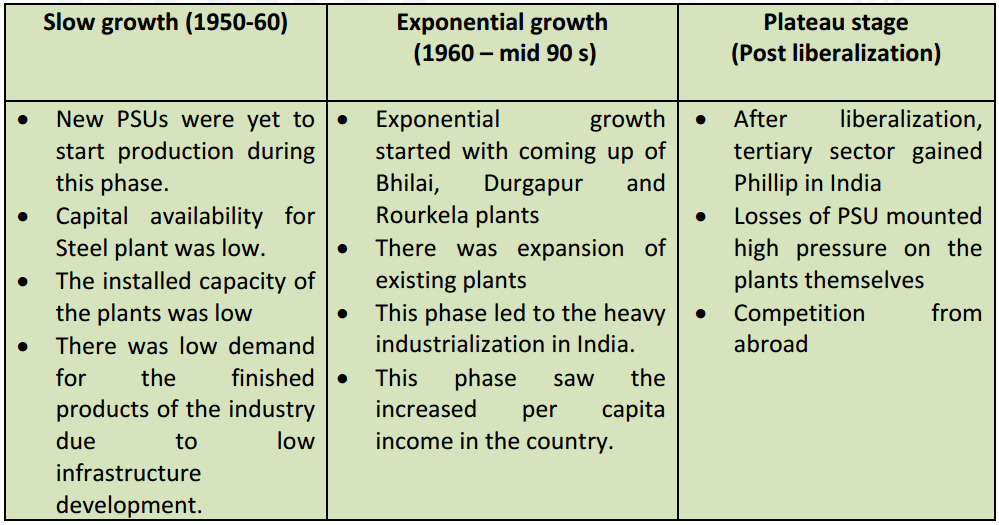
- On this chart, “Phillip” should read fillip. The plateau describes the first years after 1991, for crude steel has since more than doubled, from 73.8 million tonnes in 2011-12 to 170.15 in 2025-26.
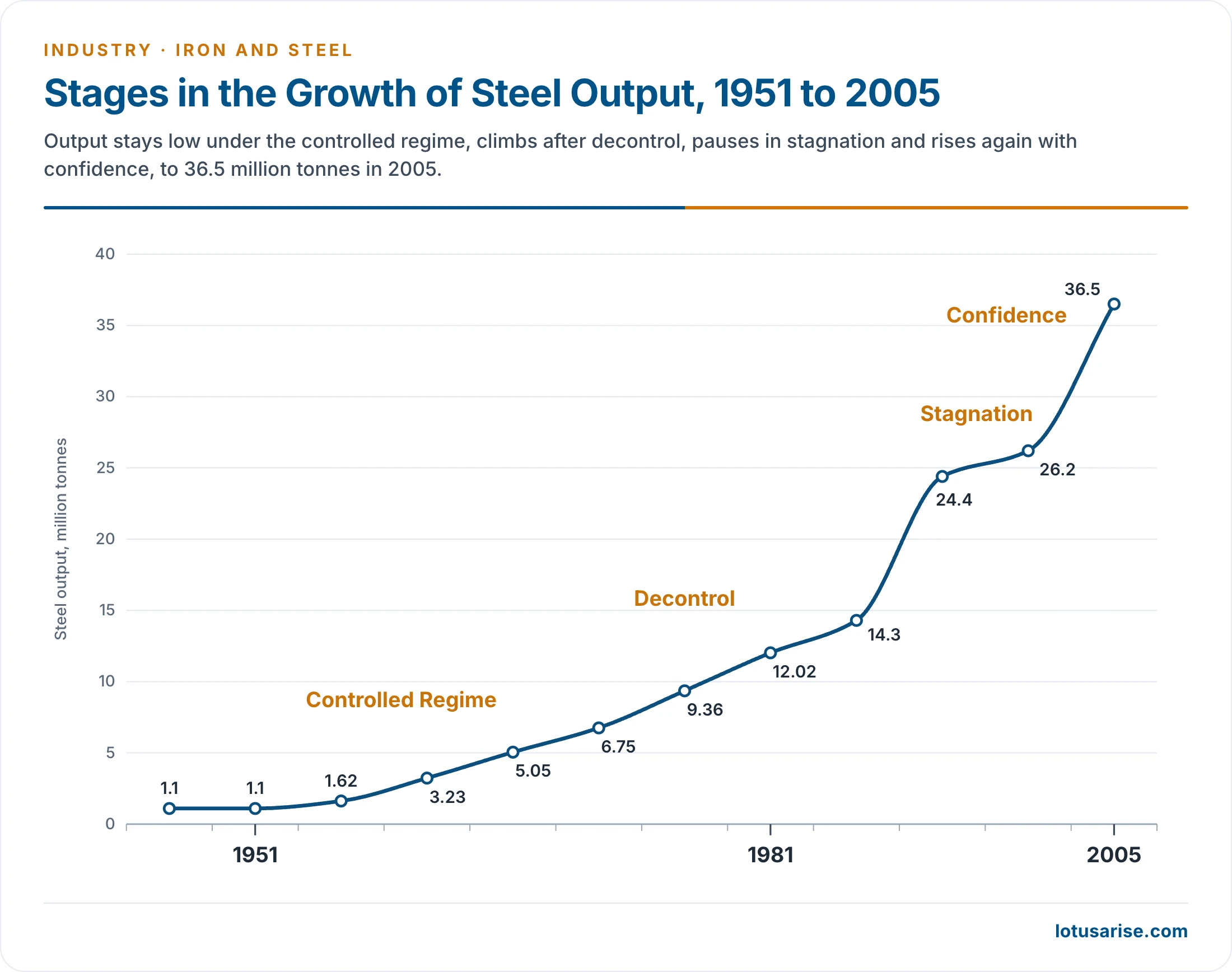
- This curve stops at 36.5 in 2005, with the labels Controlled Regime, Decontrol, Stagnation and Confidence marking its stages.
Location Factors
- Coal and iron ore are heavy and lose much weight in processing, so raw materials controlled the older pattern of location. Plants on the minimum transport cost rule stand in one of three places:
- near coalfields;
- near iron ore mines;
- between the two.
- Coal, ore and market now carry almost equal weight. Where any two of them coincide, a site is usually settled. A seaport enters when inputs are imported or steel is exported.
Raw Material
- Six big plants, Jamshedpur, Burnpur, Durgapur, Rourkela, Bhilai and Bokaro, cluster in the coal and ore States of the east: Jharkhand, West Bengal, Odisha and Chhattisgarh. Those States mine both minerals in quantity.
- Bhadravati is the great exception, far from the main coalfields. It began on local charcoal and later turned to hydroelectricity from the Sharavati project.
- Manganese, limestone, dolomite, chromite and silica are used in small quantities and move easily, so they do little to fix location. Manganese ore and limestone are mined in the same mineral belts.
Market
- Steel products are bulky. Moving a tonne of steel one kilometre has been estimated at about three times the cost for coal or iron ore, which pulls many centres towards their buyers.
- The automobile industry, a major consumer, itself prefers a market location, and this adds to the pull.
- Scrap gives the market a double attraction. About half the metal melted in the world’s furnaces was scrap on one older estimate, and industrial areas both consume steel and generate scrap.
- Large-scale scrap use was slow to pick up in India. The electric furnace route has since grown, and a Steel Scrap Recycling Policy followed in 2019.
Transport
- Both raw materials and finished goods are bulky, and they need large-scale transport.
- The best-cost balance between hauling inputs in and products out shapes the site.
- Large integrated plants have in turn pulled road and rail into their regions.
Technology
- Scrap first became an important input with the open-hearth process, and it supplied about one-third of the world’s raw material. Scrap is easier to move than ore.
- The open hearth has now given way to the electric furnace, which is the main user of scrap.
- Recent developments in transport, scrap use and agglomeration economies have made market locations more attractive than ever.
- Process routes in India, 2024-25: basic oxygen furnace 41.1%, induction furnace 38.2% and electric arc furnace 20.8%. In 2020-21 the shares were 43.5%, 28.1% and 28.4%.
Port Location
- Ports offer easy and cheap transport, for importing raw materials and exporting finished steel.
- Visakhapatnam is the leading example. Older plans also favoured Mangalore and Ratnagiri for the same reason, and Hazira, Dolvi and Dhamra later followed this logic.
Government Policy
- Balanced regional development is a State responsibility, and heavy public investment went into backward areas such as Jharkhand, Odisha and Chhattisgarh.
- This follows the trickle-down reasoning of the growth pole and growth centre idea of François Perroux.
- Political lobbying, opposition and strategic needs also affect the choice. Bhadravati’s special steels have been tied to defence use.
Labour
- The industry needs cheap and abundant labour, which favoured West Bengal and the neighbouring tribal and densely settled tracts.
Locational Inputs by Plant
| Plant | Iron ore | Coal or power | Water | Links |
|---|---|---|---|---|
| Tata Steel, Jamshedpur | Noamundi, Singhbhum (Jharkhand); Gorumahisani (Odisha) | Jharia, Raniganj | Subarnarekha | Kolkata port; old NH-6 |
| IISCO, Burnpur | Gua, Singhbhum (Jharkhand) | Jharia; DVC power | Damodar | Kolkata port; old NH-2 |
| Bhadravati | Kemmangundi, Chikmagalur | Sharavati power | Bhadra | Mangalore port; old NH-4 |
| Bhilai | Dalli-Rajhara | Korba, Kargali; Korba thermal power | Mahanadi basin | Kolkata–Nagpur rail; old NH-6 |
| Rourkela | Sundargarh, Keonjhar | Jharia, Talcher; Hirakud power | Sankh, South Koel | Kolkata–Nagpur rail; old NH-6 |
| Durgapur | Bolani, Mayurbhanj | Jharia, Raniganj; DVC power | Damodar | Kolkata port and rail; old NH-2 |
| Salem | Local ore in older plans | Mettur dam power | Mettur | Highways to Puducherry and Coimbatore |
| Visakhapatnam | Bailadila, Chhattisgarh | Imported coal; Damodar | – | Own port; old NH-5 |
| Vijayanagar | Hospet area | Singareni; Kanhan valley | Tungabhadra dam | Near Hospet |
| Bokaro | Kiriburu | Jharia; DVC power | Bokaro, Damodar | Kolkata port; old NH-2 |
- National highways were renumbered in 2010. Old NH-2 between Agra and Kolkata is now NH-19, old NH-5 is now largely NH-16, and old NH-4 is largely NH-48.
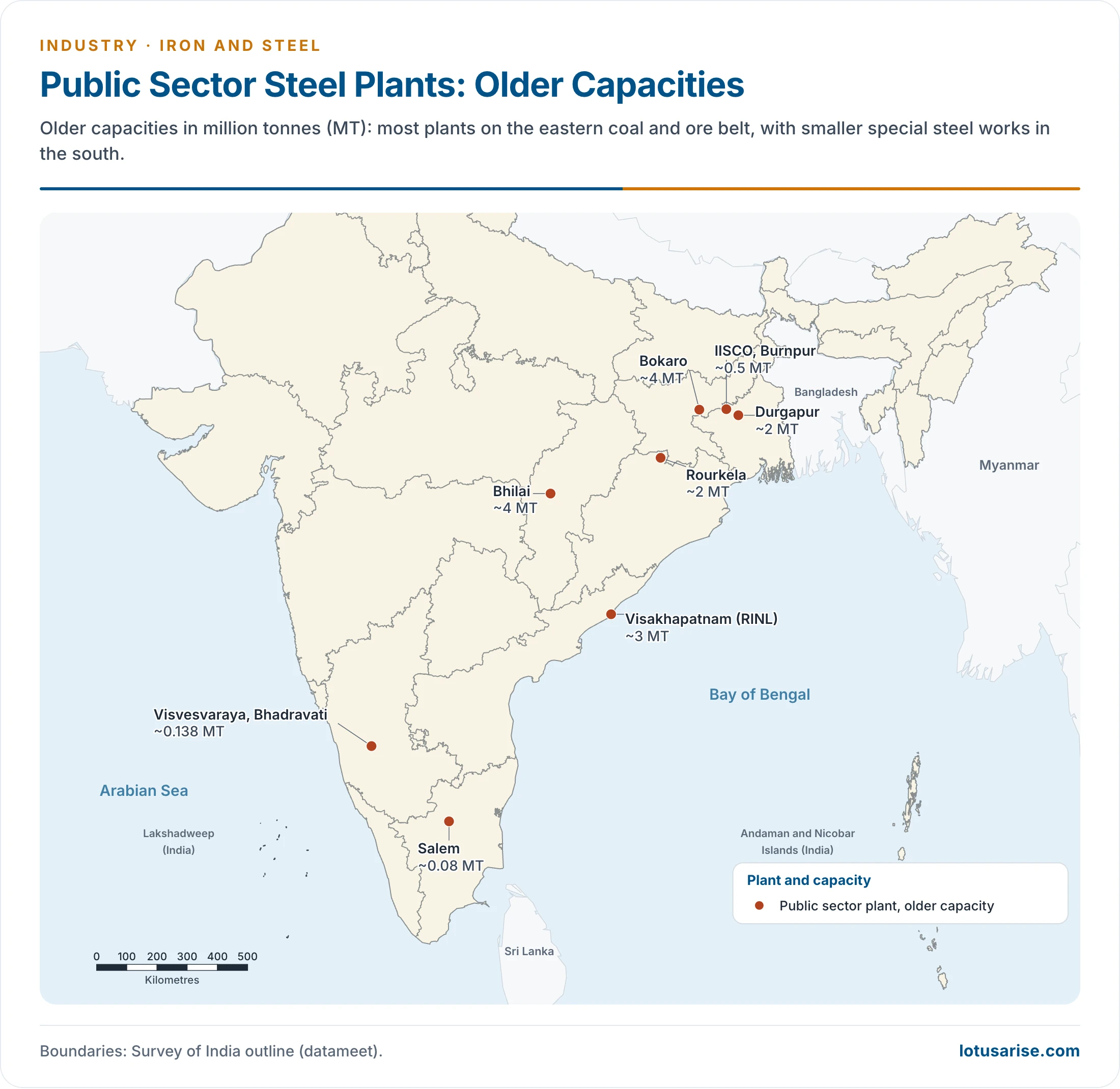
- The tonnages on this map are older capacities, and it shows only public sector plants. Bhilai, for one, now has about 7 million tonnes against the 4 shown.
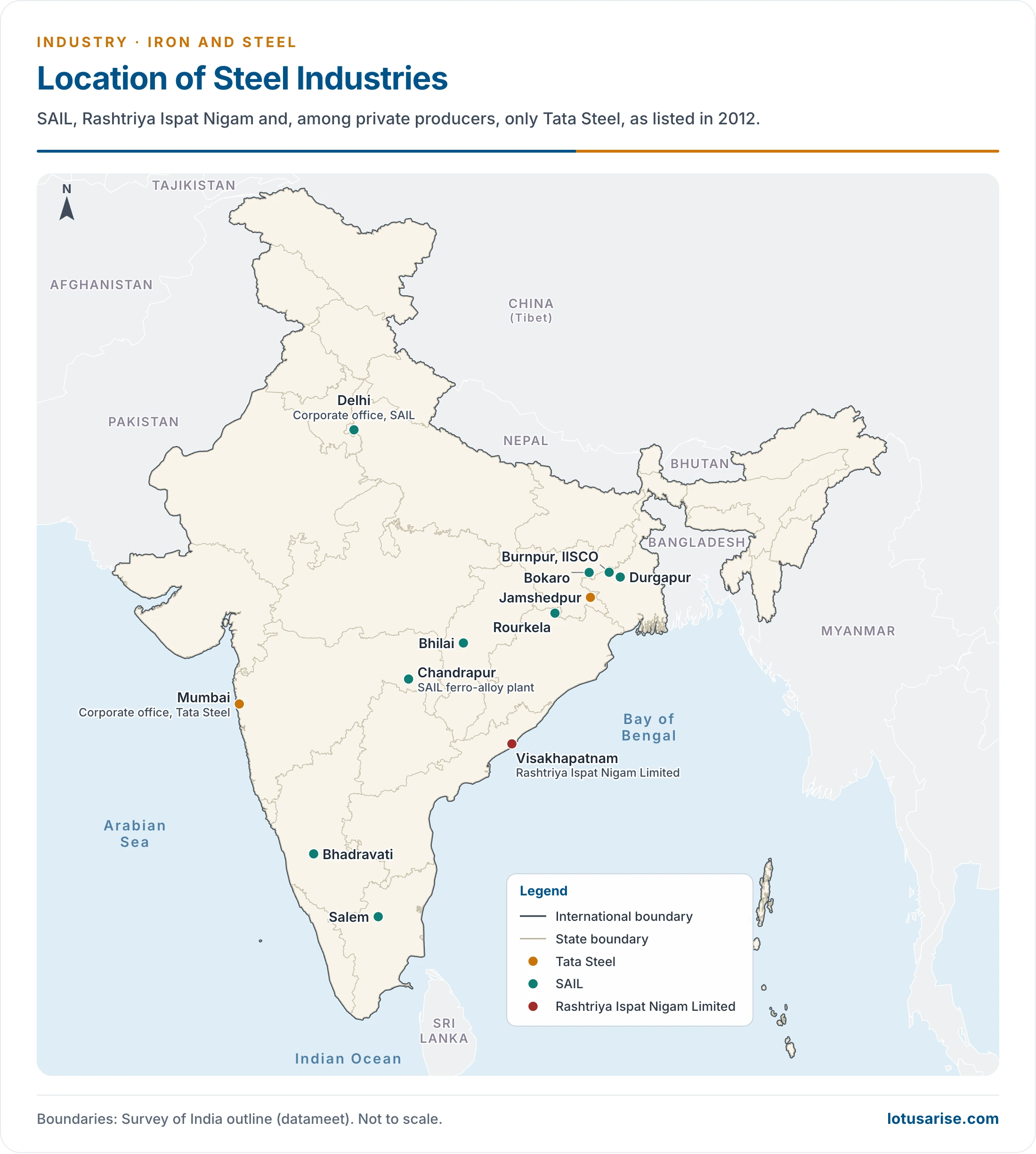
Major Steel Plants of India
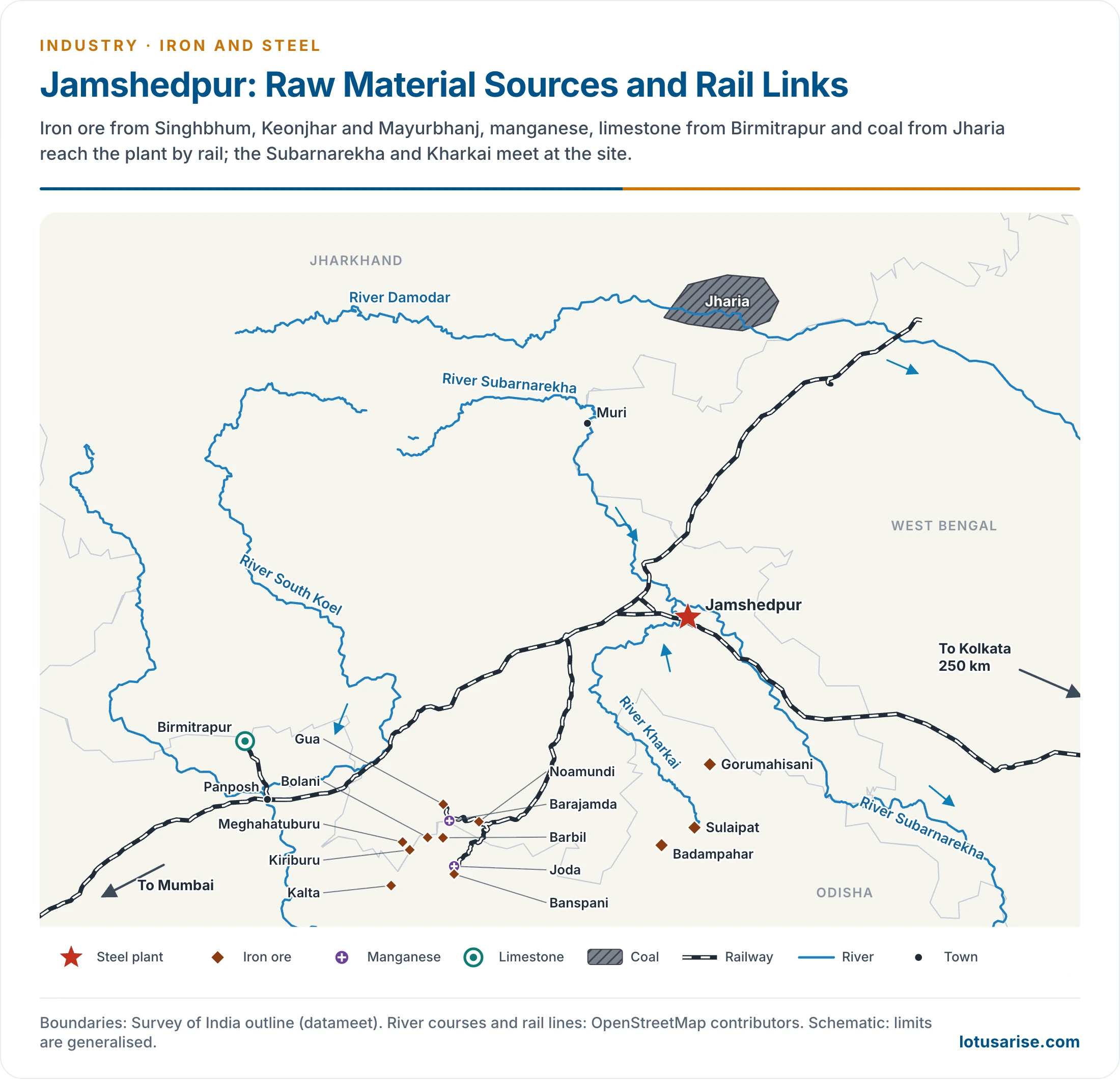
Tata Steel (TISCO), Jamshedpur
- India’s earliest modern steel centre, and always in private hands.
- Established in 1907 under Sir Dorabji Tata, carrying out the plan of his father Jamsetji Tata (died 1904), at Sakchi in Singhbhum, Jharkhand.
- Sakchi was renamed Jamshedpur in 1919, after Jamsetji.
- Pig iron came in 1911, and steel in 1912.
- Raw material decided the site. Transport, labour, the Kolkata port and the market helped it grow later.
- Capacity: older accounts give about 3 million tonnes of saleable steel. Tata Steel’s Indian plants at Jamshedpur, Kalinganagar and elsewhere now total 26.6 million tonnes.
- Advantages:
- Haematite: high grade, from Noamundi (Singhbhum, Jharkhand) and Gorumahisani (Mayurbhanj, Odisha), 75–100 km away.
- Coal: Jharia (Jharkhand) and Raniganj (West Bengal), 160–200 km away. Tata Steel now has collieries at Jharia and West Bokaro.
- Manganese: Joda, in Keonjhar, Odisha.
- Flux: dolomite, limestone and fire clay from Sundargarh, Odisha.
- Kolkata: 250 km away, giving a port and an industrial hinterland as market.
- Water: the Subarnarekha for cooling, with a storage dam on the Kharkai.
- Labour: cheap labour from Jharkhand, Bihar and Odisha, much of it from the tribal Chotanagpur plateau.
- Transport: road and rail links to Kolkata, Mumbai and Chennai. Old NH-6, the Mumbai–Kolkata route, runs to the south.
- A second site: shortage of space led Tata Steel to buy land near Gopalpur in Odisha in 1997, for its coast, its nearby ore belt and thinly settled land. Slow port development and local resistance ended the plan.
IISCO, Kulti, Hirapur and Burnpur
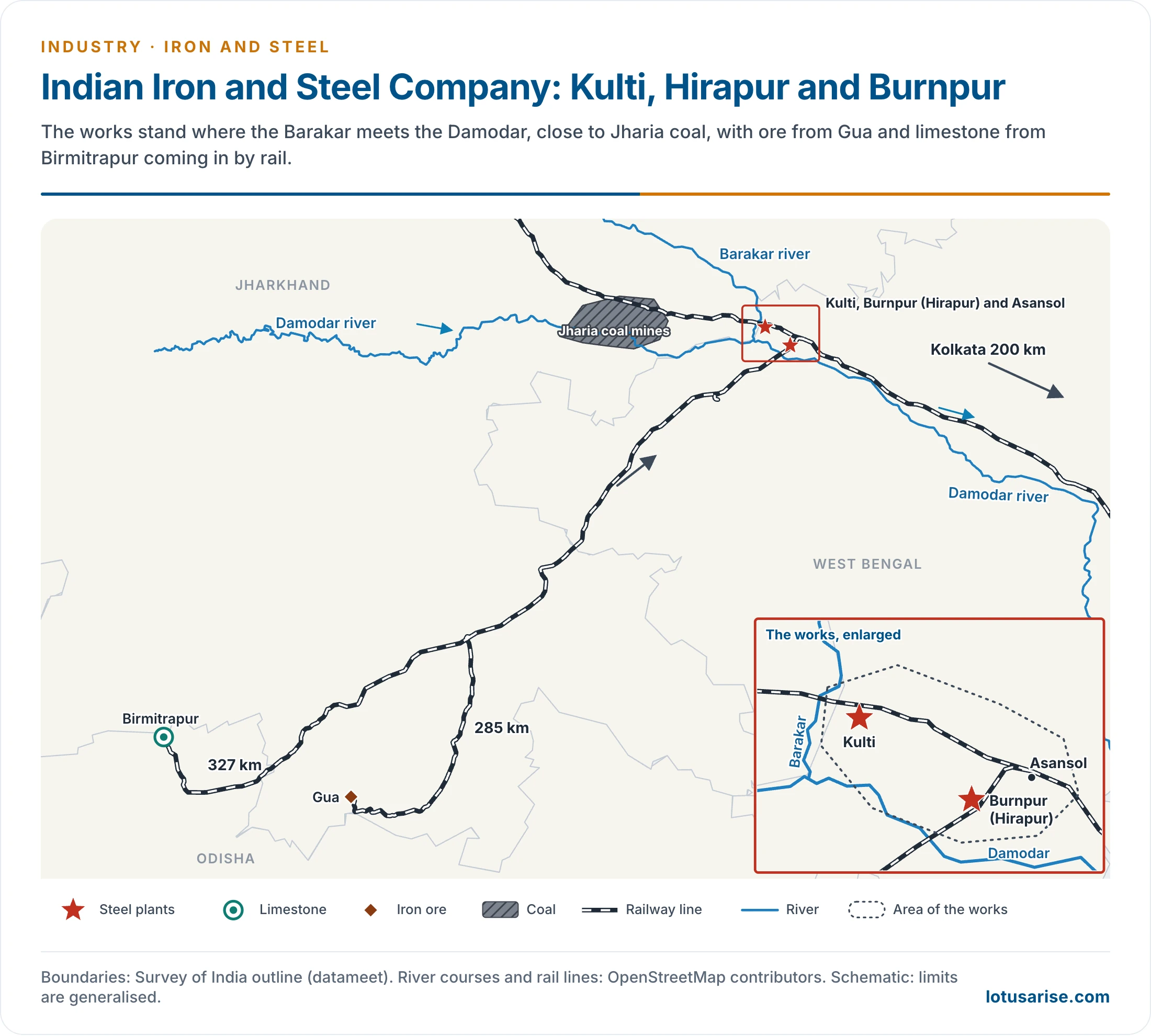
- Three works in West Bengal grew separately and later merged:
- Kulti: Bengal Iron Works, 1870.
- Hirapur: Indian Iron and Steel Company, 1918.
- Burnpur: Steel Corporation of Bengal, 1937.
- Division of work in the classical pattern: Hirapur made pig iron, sent to Kulti for steel, with rolling mills at Burnpur. The Kolkata–Asansol railway links the three.
- The government took over management in July 1972.
- Capacity: older accounts give 10 lakh tonnes of steel, with output of about 4 lakh tonnes of pig iron, 3.5 lakh of crude steel and 3.8 lakh of saleable steel. The modernised IISCO Steel Plant at Burnpur has 2.5 million tonnes, and it opened in May 2015.
- Kulti is now a separate SAIL unit, the Growth Division.
- Advantages:
- Iron ore: Gua in Singhbhum, Jharkhand, 285 km away, with some from Mayurbhanj.
- Flux: dolomite and limestone from Sundargarh, 327 km away. Limestone also comes from Gangpur and Paraghat in Odisha.
- Coal and power: Jharia, 137 km away, and now extensive use of Damodar Valley Corporation (DVC) power.
- Kolkata: 200 km from Hirapur, for port and market.
- Labour and transport: cheap labour from West Bengal and adjoining areas, with national highway links to the port.
Visvesvaraya Iron and Steel Plant, Bhadravati
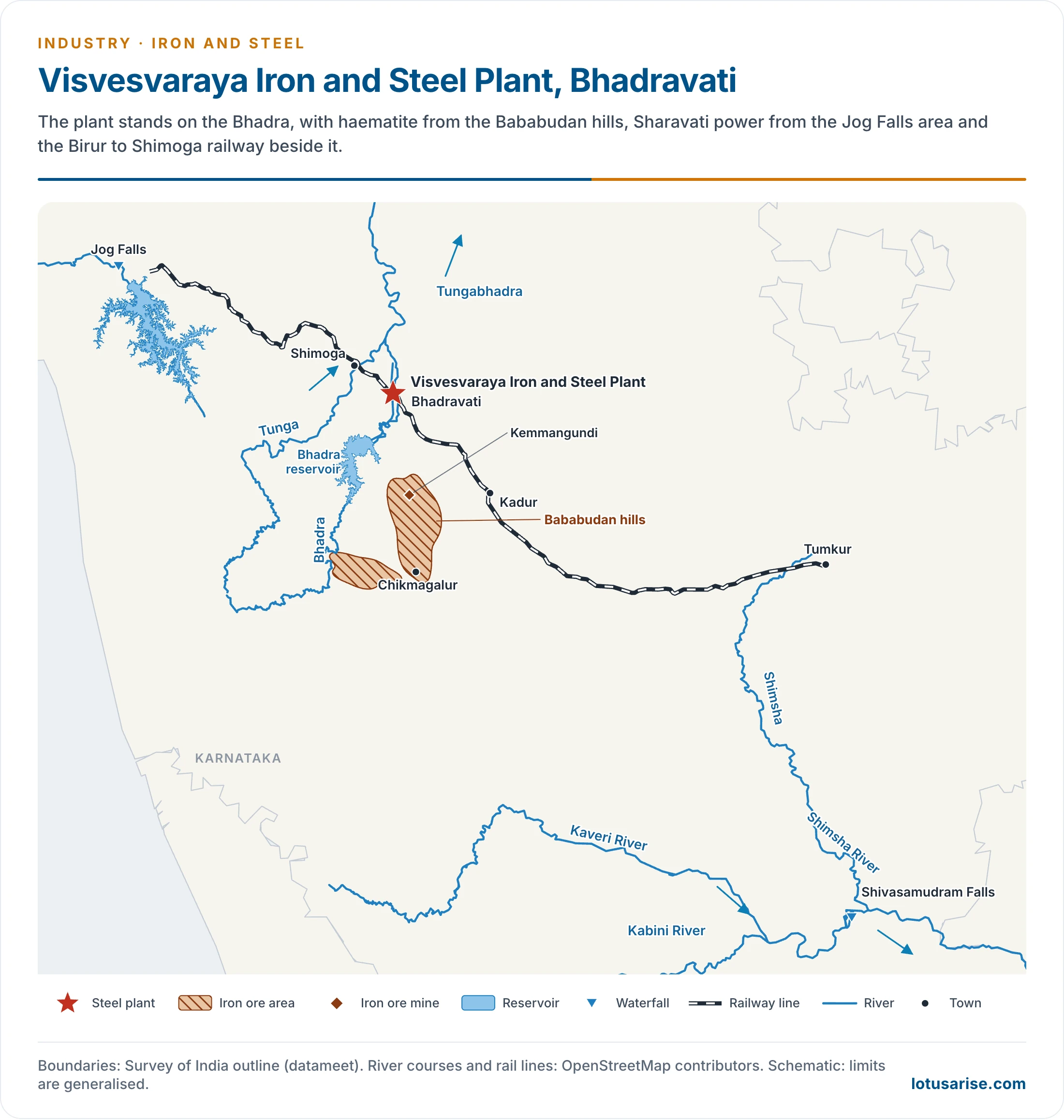
- Founded as the Mysore Iron Works in 1923 by the former State of Mysore, on the Bhadra river in Shimoga district, Karnataka.
- 1962: it became a government company, Mysore Iron and Steel Ltd, under joint Central and State ownership.
- 1975: it was renamed after the engineer Sir Mokshagundam Visvesvaraya. SAIL took it over in 1989.
- Capacity: 1.38 lakh tonnes of steel, with plans for two lakh tonnes.
- Status: the closure process began after disinvestment bids fell through, and the plant still appears on SAIL’s list. The Union Steel Minister reviewed revival plans in November 2025.
- Advantages:
- Land: the Bhadra valley, 13 km wide, gives ample space.
- Iron ore: high-grade haematite from Kemmangundi in Chikmagalur, just 40 km away.
- Fuel: charcoal from forest wood in 1923, when no coal was within reach, and now Sharavati hydropower.
- Manganese: Shimoga and Chitradurga, about 50 km away.
- Limestone, dolomite, chromite: Bhundiguda and other sources within about 50 km.
- Transport: on the Birur–Shimoga railway, with a link to Mangalore port. Old NH-4, on the Golden Quadrilateral, passes to the east.
- Output: alloy and special steels, used among others for defence.
Bhilai Steel Plant
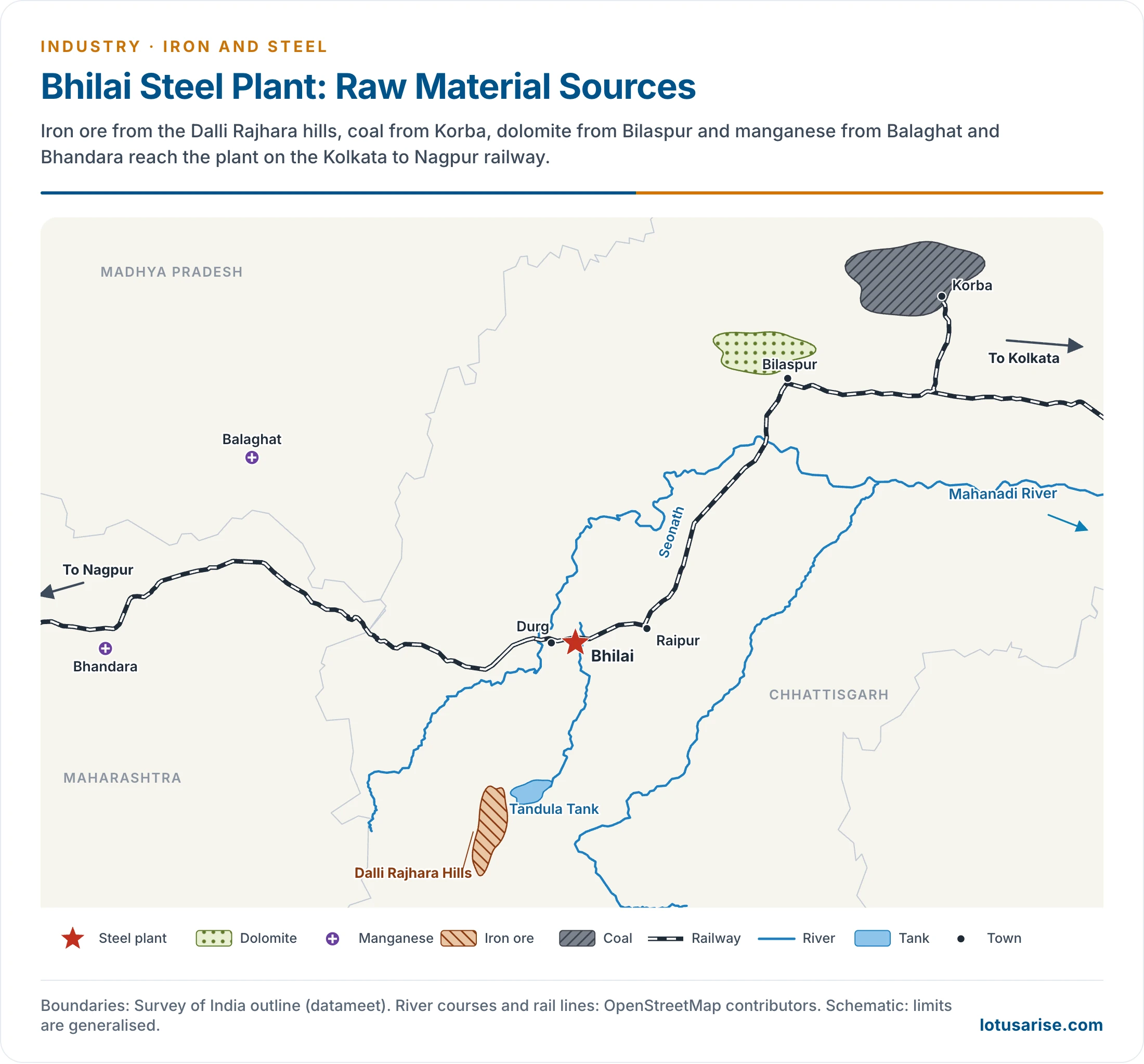
- Set up in Durg district, Chhattisgarh, in 1957, with Soviet technical and financial support. Durg was a backward area, and bringing it prosperity was part of the aim.
- It started production in 1959.
- Capacity: 10 lakh tonnes at first, then 52 lakh, and now about 70 lakh tonnes (7 million) of crude steel.
- Output in 1996-97: 41.87 lakh tonnes of crude steel, 38.32 lakh of saleable steel and 2.43 lakh of pig iron.
- Product: India’s main rail maker, with long rails of up to 260 m.
- Advantages:
- Iron ore: rich haematite from the Dalli-Rajhara range, 80 km south.
- Coal: Korba (Chhattisgarh) and Kargali (Jharkhand), with Korba about 225 km away. Bokaro and Jharia, 720 km away, also supply coal.
- Limestone, manganese, dolomite: Nandini mines, 24 km away; Bhandara (Maharashtra) and Balaghat (Madhya Pradesh); and Bilaspur.
- Power: the Korba thermal station.
- Water: the Chhattisgarh basin, drained by the Mahanadi and its tributaries, with the Tandula tank close by.
- Transport: the Kolkata–Nagpur railway and old NH-6.
- Labour: cheap labour from the surrounding tribal population.
Rourkela Steel Plant
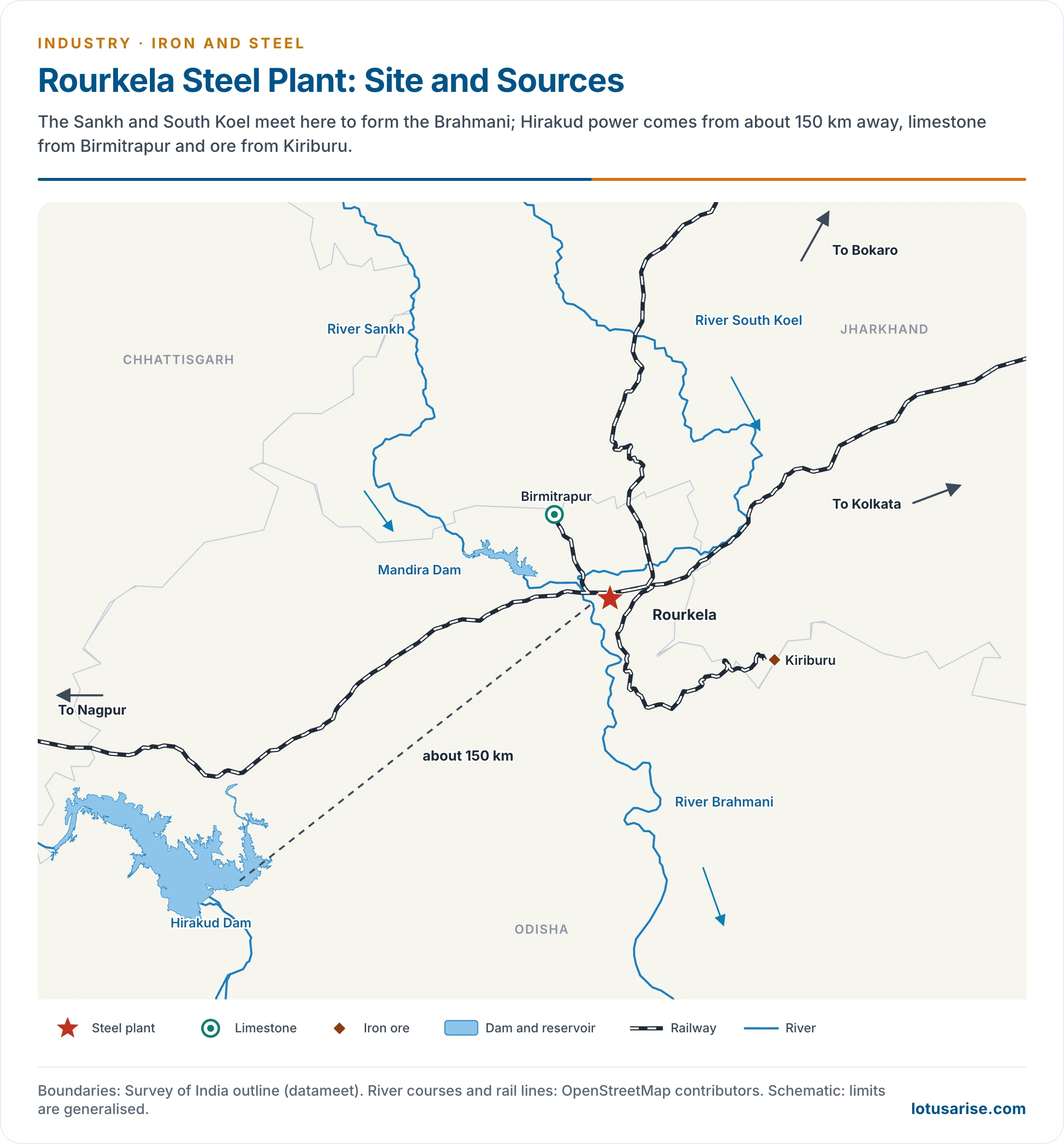
- This Hindustan Steel Limited plant stands in Sundargarh district, Odisha. The West German firms Krupp and Demag helped build it during the Second Plan. Germany reunited in 1990.
- It became operative in 1959.
- Output in 1996-97: 12.40 lakh tonnes of crude steel, 11.80 lakh of saleable steel and 0.54 lakh of pig iron.
- Capacity: 4.2 million tonnes of crude steel. Its products are mainly flat: coils, plates and pipes.
- Advantages:
- Iron ore: Sundargarh and Keonjhar, within 77 km.
- Coal: Jharia, 225 km away, and Talcher, 169 km away.
- Power: Hirakud, 150 km away.
- Flux and manganese: Barajamda for manganese, Baradwar for dolomite and Purnapani for limestone, all inside 222 km.
- Water: the Sankh and South Koel, which meet here to form the Brahmani.
- Transport: old NH-6 to the south, and the main Nagpur–Kolkata railway.
- Kolkata: port facilities, with its hinterland as market.
Durgapur Steel Plant
- This Hindustan Steel plant at Durgapur, in the former Bardhaman district of West Bengal, was built with British help.
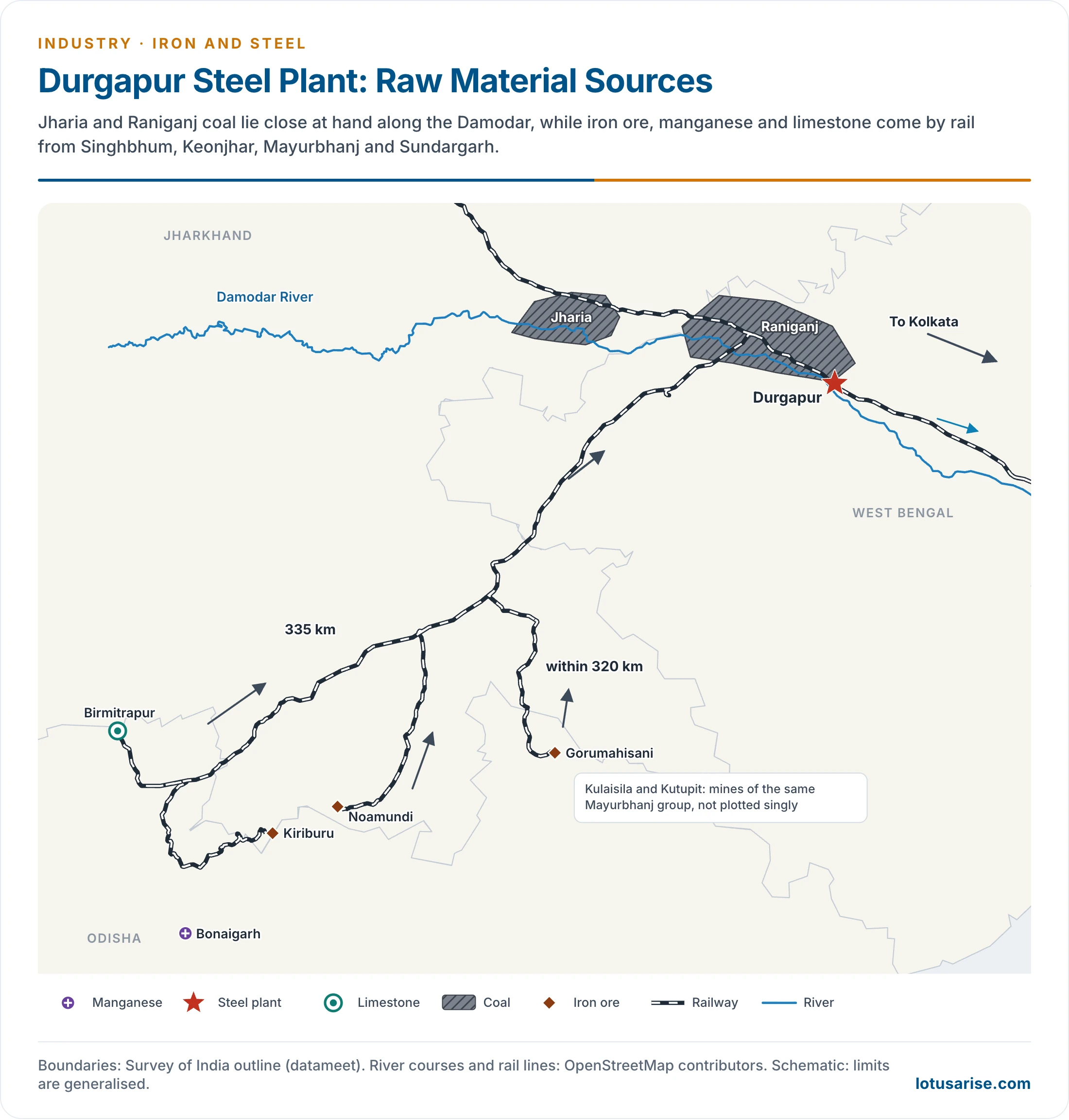
- Its first blast furnace was commissioned in December 1959, its first ingot was cast in April 1960, and its merchant mill opened in January 1962.
- Capacity: first one million tonnes, then 1.6 million by 1969, and now 2.2 million tonnes of crude steel. Older lists credit it with 35 lakh tonnes in all.
- Output in 1996-97: crude steel 12.45 lakh tonnes, saleable steel 10.93 lakh, saleable pig iron 1.14 lakh.
- Product: notably wheels and axles for the railways.
- Alloy Steel Plant, Durgapur: first sized at 1.6 lakh tonnes as ingots, and later at 2.6 lakh tonnes as crude steel.
- Advantages:
- Iron ore: Bolani and Mayurbhanj, within 320 km.
- Coal: Jharia and Raniganj, close at hand.
- Limestone and dolomite: Birmitrapur in Sundargarh. Manganese comes from Keonjhar.
- Power and water: DVC hydroelectricity, with plentiful water from the Durgapur Barrage on the Damodar.
- Transport: old NH-2 (Delhi–Kolkata) and the Kolkata–Asansol railway.
- Labour and market: a dense population, and the nearby Kolkata port and hinterland.
Bokaro Steel Plant
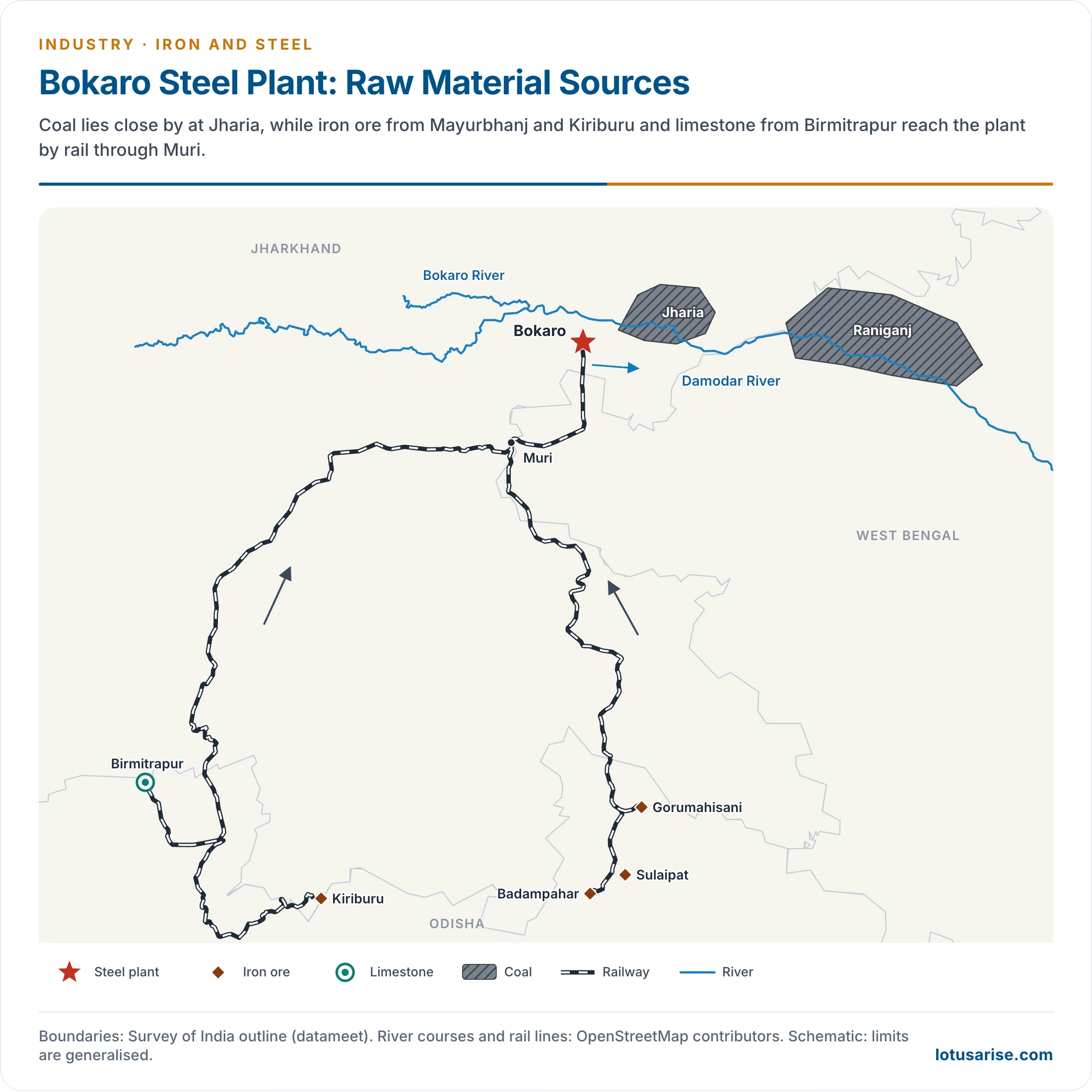
- A public company, Bokaro Steel Ltd, came into being in 1964, to build a plant with Soviet help where the Bokaro river joins the Damodar. The site then lay in Hazaribagh district and is now in Bokaro district, Jharkhand.
- It is the second plant built with Soviet help. Its first blast furnace came in October 1972.
- Capacity: 10 lakh tonnes at first, then 40 lakh. Plans once spoke of 100 lakh tonnes, which would have made it India’s largest. It now stands at about 4.6 million tonnes, and SAIL approved expansion to 7.25 million in January 2025.
- Output in 1996-97: 36.44 lakh tonnes of crude steel, 30.46 lakh of saleable steel and 2.6 lakh of pig iron.
- Product: a flat products plant, making hot and cold rolled coils, sheets and plates. Rails come from Bhilai.
- Advantages:
- Iron ore: the Kiriburu mine on the Jharkhand–Odisha border.
- Coal: Jharia, 65 km away.
- Limestone: Palamu, Jharkhand.
- Water and power: the two rivers at its site, and DVC hydroelectricity.
- Port and road: Kolkata is about 300 km away, and old NH-2 passes just to the north.
- Labour: cheap labour from the adjoining tribal areas.
- Bokaro as an industrial complex: the integrated plant binds coke ovens, blast furnaces, steel melting and rolling mills on one site, and draws in a planned township and ancillary units. Its by-products and slag also find other users. This makes it a clear case of an industrial complex, where linked units share one site.
Salem Steel Plant
- Set up in Salem district, Tamil Nadu, with commercial production from 1982.
- Location logic in early plans: nearby iron ore and limestone, cheap power, charcoal and a wide market. The local ore is low in sulphur and phosphorus, which suits special grades.
- Working today: the plant makes stainless steel by melting and rolling, using slabs from its own melting shop and supplies from the Durgapur alloy plant. It does not smelt the local ore.
- Capacity history: 32,000 tonnes of stainless sheet at first, doubled in 1991, and 80,000 tonnes in 1995-96. A blanking line for mint coinage came in 1993, and a hot rolling mill in 1995.
- Advantages:
- Power: hydroelectricity from the nearby Mettur dam.
- Transport: highways to Puducherry and Coimbatore.
- Exports: world-class stainless steel to the USA, Mexico, Australia and South-East Asia.
- Technology: modern and automated, so it needs little labour.
Visakhapatnam Steel Plant
- India’s first shore-based integrated plant, with a site on the seaport itself.
- Foundation stone: January 1971. Real construction began only after Rashtriya Ispat Nigam Limited (RINL) was incorporated in February 1982, as a public sector company.
- Commissioned in 1992, with 1993-94 as its first full year of integrated working.
- Capacity: first 3 million tonnes, then 6.3 million in 2015 and 7.3 million tonnes of liquid steel by 2017.
- Standing: older accounts ranked it the second largest producer in India, which no longer holds. It has run at losses, and the Cabinet approved a ₹11,440 crore revival plan in January 2025.
- Energy plan: the management once looked to Krishna-Godavari gas, some one billion cubic metres a year, through talks with the Reliance Group, along with technology and skills upgrades. This was meant to cut the cost of imported coal.
- Advantages:
- Most sophisticated technology when built.
- Port location: imports and exports are easy, and it is a major export-oriented plant.
- Iron ore: high-quality ore from Bailadila, Chhattisgarh. It has no captive mines for ore or coking coal, and buys mainly from NMDC.
- Coal: imported coking coal, mainly bought abroad and long from Australia, which eases pressure on Indian mines. It also has links to the Damodar valley fields.
- Flux: limestone, dolomite and manganese from Chhattisgarh, Madhya Pradesh and Odisha, and now also from RINL’s own mines in Andhra Pradesh and Telangana.
- Transport: old NH-5, the Chennai–Kolkata road.
Vijayanagar Steel Plant
- At Toranagallu near Hospet, in Bellary district, Karnataka. It was planned as a public plant in the Fourth Plan and was built by the private Jindal group from the 1990s. It is now JSW Steel’s main works.
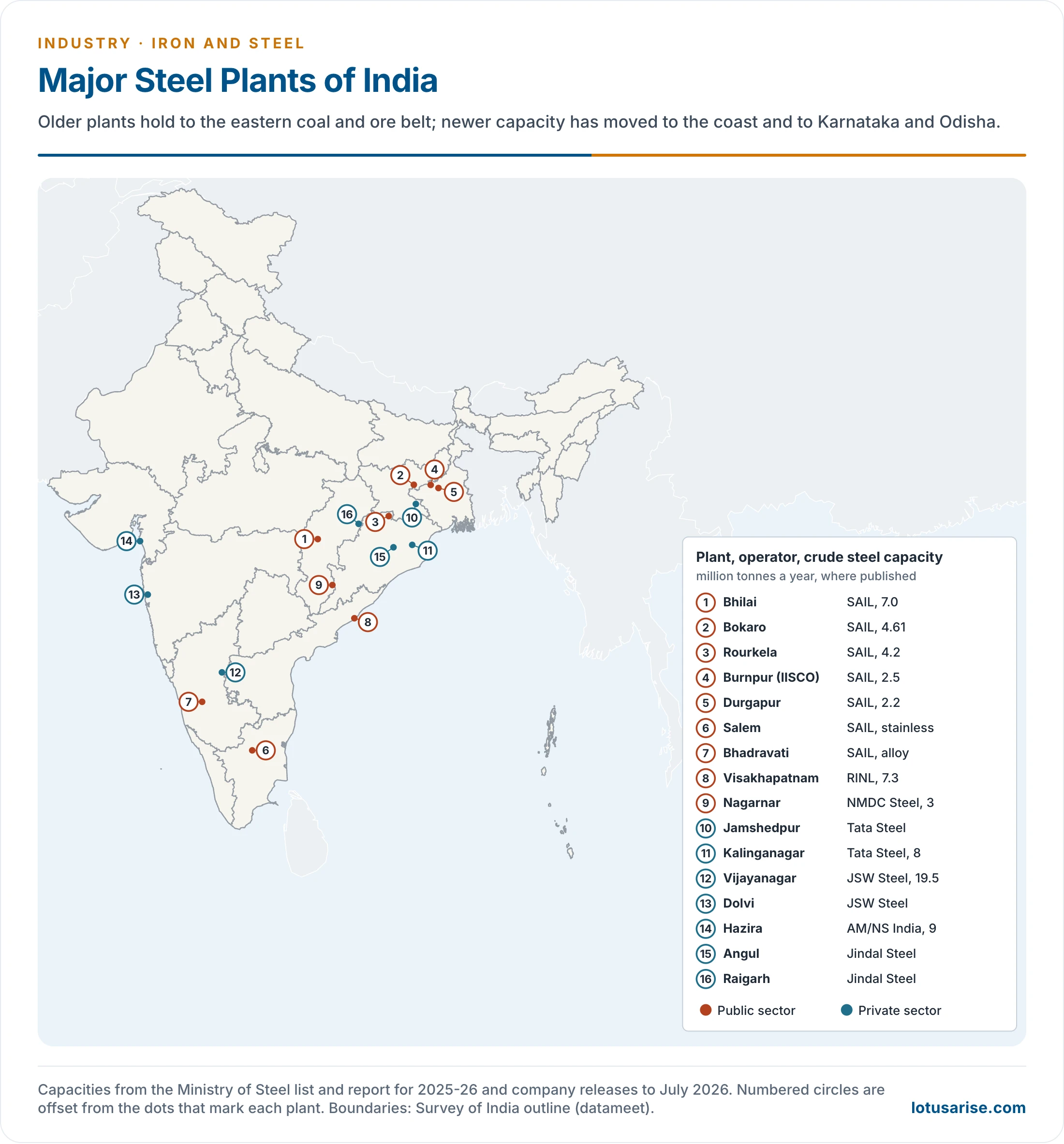
- Capacity: 30 lakh tonnes in older accounts, with mild steel as its feature. The company now gives 19.5 million tonnes (July 2026), the largest at one site in India, and plans about 25 million by 2029-30.
- Advantages:
- Iron ore: the Hospet region, close by.
- Coal: Singareni (now in Telangana) and the Kanhan valley.
- Limestone and dolomite: about 200 km away.
- Power and water: the Tungabhadra dam, about 36 km away.
Newer and Planned Private Plants
- Tata Steel Kalinganagar, Odisha: planned as a 6 million tonne site at Dubari, with a first phase of 3 million and the port at Dhamra. Phase II took it from 3 to 8 million tonnes in 2025.
- Dolvi, Maharashtra: built by Ispat Industries as a 3 million tonne hot rolled coil plant, with low energy and space needs. It is now part of JSW Steel.
- Hazira, Gujarat: the former Essar plant, now ArcelorMittal Nippon Steel India, with 9 million tonnes rising to 15 million.
- Angul and Raigarh: Jindal Steel’s main works.
- Nagarnar, Chhattisgarh: the 3 million tonne NMDC Steel plant, the newest large public plant.
- Daitari, Odisha: an older plan of 2.6 million tonnes, first with British and South Korean partners and then with the Tata group.
- POSCO, Paradip:
- South Korea’s Pohang Steel signed with Odisha for a 12 million tonne plant in Jagatsinghpur district, at ₹51,000 crore, then billed as India’s largest foreign investment. It was to be ready by 2016 and to draw on 600 million tonnes of ore.
- Farmers resisted the land acquisition of 4,004 acres, and POSCO withdrew in 2017. Part of the land later went to JSW.
- Multinationals such as ArcelorMittal entered Indian steel mainly by buying existing plants.
Mini Steel Plants
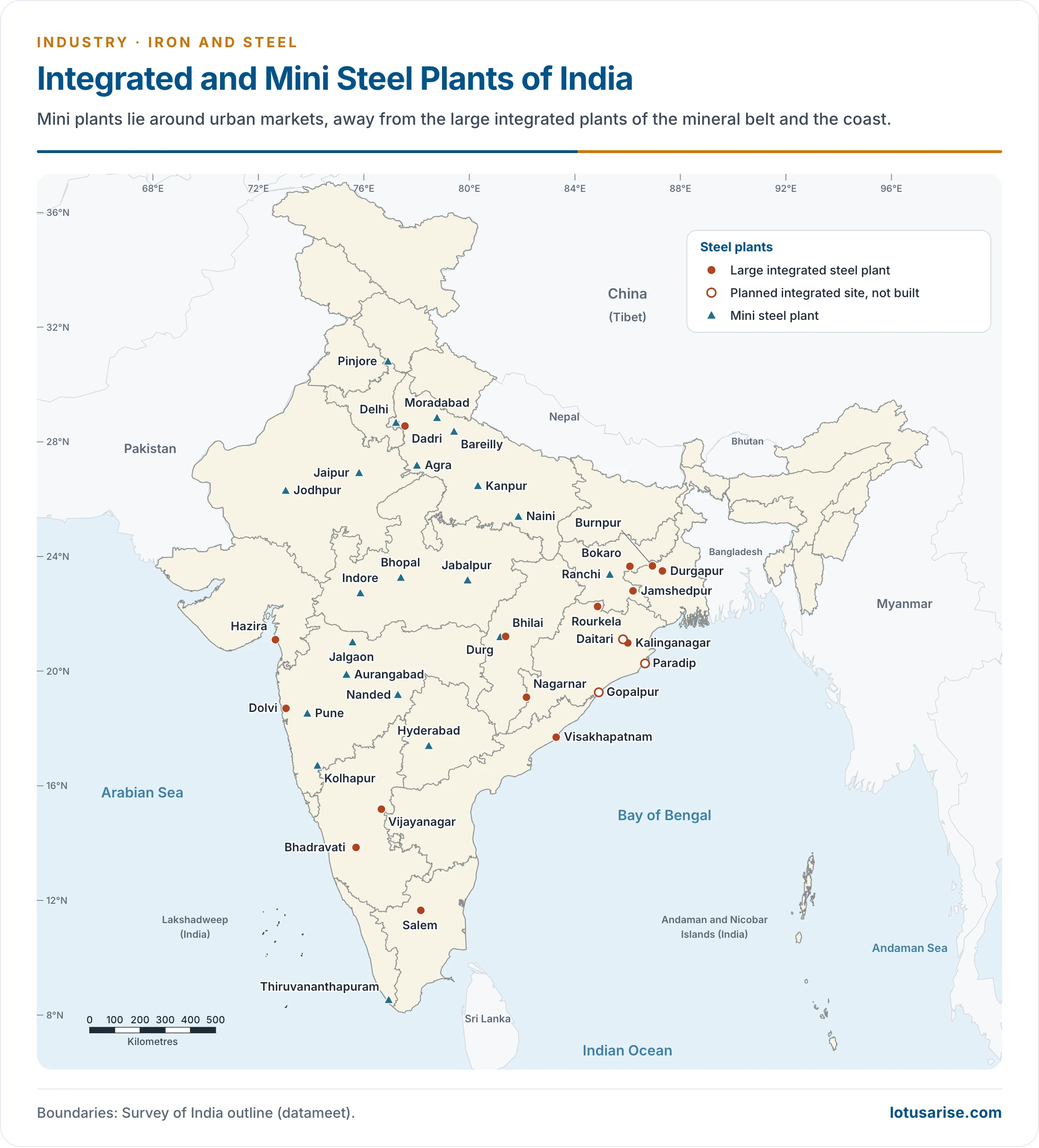
- A mini steel plant is a small, decentralised secondary unit that melts steel scrap, pig iron or sponge iron in electric arc or induction furnaces.
- Size: between 10,000 and 5 lakh tonnes a year. One older count had about 200 units and 12 million tonnes of capacity, and another over 225 units.
- Location: away from the integrated plants, mainly around urban areas near their markets, so they meet local demand.
- Products: mild steel, alloy steel and stainless steel. Integrated plants mainly make mild steel in bulk.
- Growth: rapid in the 1970s and largely stagnant in the 1980s. The norms were then liberalised, under the 1991 policy.
- Now: the electric and induction furnace routes together made 59% of India’s crude steel in 2024-25. About 85% of sponge iron is coal-based, from units in the mineral States.
Merits of Mini Steel Plants
- Low cost of establishment: they need far less capital than large plants.
- Short gestation period: quick to build and quick to produce, which makes them competitive.
- Flexible operation: the charge already contains steel, so output and grades can change easily.
- Decentralised industrialisation: low capital needs let them spread into urban and semi-urban areas, which helps balanced regional growth.
- Meeting local needs: they serve utensil makers, construction steel rod buyers and similar demand quickly.
- Local inputs: using materials available nearby has decentralised transport and distribution.
- Low-cost mild steel: scrap and pig iron cut processing costs.
- Small infrastructure needs: less land, power and rail support than an integrated works.
Problems of Mini Steel Plants
- Capital: though small by comparison, the sum is still hard for small entrepreneurs to raise.
- Electric furnaces use much power: costly power cancels the raw material advantage, and power shortages stop work.
- Costly scrap: imported scrap makes plants uneconomic, and a higher import duty on scrap hurt profits further.
- Closures: about 75% of plants were reported shut at one stage, with poor prospects of upgrading.
Problems of the Iron and Steel Industry
- Capital: a large plant takes huge investment. Many public plants were built with foreign aid.
- Technology:
- Technical efficiency was high until the oil crisis of the mid-1970s, using Western technology. Costs then rose steeply, margins fell, and investment in technology dropped.
- Efficiency suffered in most plants, with Bokaro and Visakhapatnam as the exceptions.
- Material use: India needed about 1.2 tonnes of crude steel per tonne of saleable steel, against under 1.1 in Japan and Korea and 1.05 in several developed countries.
- R&D: an older count puts it at about ₹200 crore, or 0.15–0.25% of turnover.
- Outdated processes: such as the open hearth, which wasted energy.
- Low productivity:
- About 90–100 tonnes per worker a year, among the world’s lowest, against 600–700 tonnes in Japan and Korea.
- Gallatin Steel, a US mini mill, ran on under 300 workers for 1.2 million tonnes of coil, where a similar Indian unit had 5,000.
- Too many workers per unit of output calls for retraining and redeployment.
- Inefficient public units: heavy social overheads, poor labour relations, weak management and idle capacity.
- Low capacity use: rarely above 80%, and about 50% at Durgapur in one older count, owing to strikes, lockouts, raw material scarcity, energy shortages, weak management, infrastructure bottlenecks and political influence.
- Heavy demand and imports: demand keeps rising, so steel and raw materials such as coal are imported at a cost in foreign exchange. Higher output and exports would save it.
- Coking coal:
- Most domestic coking coal has a very high ash content, and good coking coal is limited.
- Imports were 57.07 million tonnes in 2024-25, mostly from Australia.
- Low blast furnace productivity: Indian ore has high alumina and an adverse silica-alumina ratio, and Western furnaces work best with higher silica. The resource profile and the technology do not match.
- Taxes and costs: heavy taxation and high input costs have made Indian steel expensive.
- Inferior products: weak technology and infrastructure have made steelmaking slow and costly, and forced imports of better grades.
- Controlled prices: older accounts blame them for thin margins. They ended in 1992.
- Rival materials: carbon fibres, composites and reinforced plastics compete with steel, and so do foreign producers.
Steel Plants Today
| Steel plant | Location | Operator |
|---|---|---|
| Alloy Steel Plant | Durgapur, West Bengal | SAIL |
| Bhilai Steel Plant | Bhilai, Chhattisgarh | SAIL |
| Bokaro Steel Plant | Bokaro, Jharkhand | SAIL |
| Chandrapur Ferro Alloy Plant | Chandrapur, Maharashtra | SAIL |
| Durgapur Steel Plant | Durgapur, West Bengal | SAIL |
| AM/NS India (formerly Essar Steel India Limited) | Hazira, Gujarat | ArcelorMittal and Nippon Steel |
| IISCO Steel Plant | Asansol, West Bengal | SAIL |
| Jindal Steel and Power Limited | Raigarh, Chhattisgarh | Jindal Steel |
| Jindal Steel and Power Limited | Angul, Odisha | Jindal Steel |
| JSW Steel | Hospet, Bellary, Karnataka | JSW Steel |
| JSW Steel | Tarapur, Boisar, Maharashtra | JSW Steel |
| JSW Steel | Dharamtar, Maharashtra | JSW Steel |
| NMDC Steel | Nagarnar, Chhattisgarh | NMDC Steel Limited |
| Rourkela Steel Plant | Rourkela, Odisha | SAIL |
| Salem Steel Plant | Salem, Tamil Nadu | SAIL |
| Tata Steel Limited | Jamshedpur, Jharkhand | Tata Steel |
| Tata Steel Limited | Kalinganagar, Odisha | Tata Steel |
| Visakhapatnam Steel Plant | Visakhapatnam, Andhra Pradesh | Rashtriya Ispat Nigam Limited |
| Visvesvaraya Iron and Steel Plant | Bhadravati, Karnataka | SAIL |
- Crude steel capacity by producer (million tonnes a year):
| Producer | Capacity | Date or basis |
|---|---|---|
| Tata Steel, India | 26.6 | Ministry of Steel report, 2025-26 |
| JSW Steel, with its joint venture | 37.9 | Company release, July 2026 |
| SAIL | about 20 | Ministry of Steel report, 2025-26; to about 35 by 2030-31 |
| Bhilai 7.0, Bokaro 4.61, Rourkela 4.2, IISCO 2.5, Durgapur 2.2 | – | Ministry of Steel list, after modernisation |
| Jindal Steel | 12.6 | Ministry of Steel report, 2025-26 |
| AM/NS India, Hazira | 9 | Ministry of Steel report, 2025-26 |
| RINL, Visakhapatnam | 7.3 | Liquid steel, 2025-26 |
| NMDC Steel, Nagarnar | 3 | Ministry of Steel report, 2025-26 |
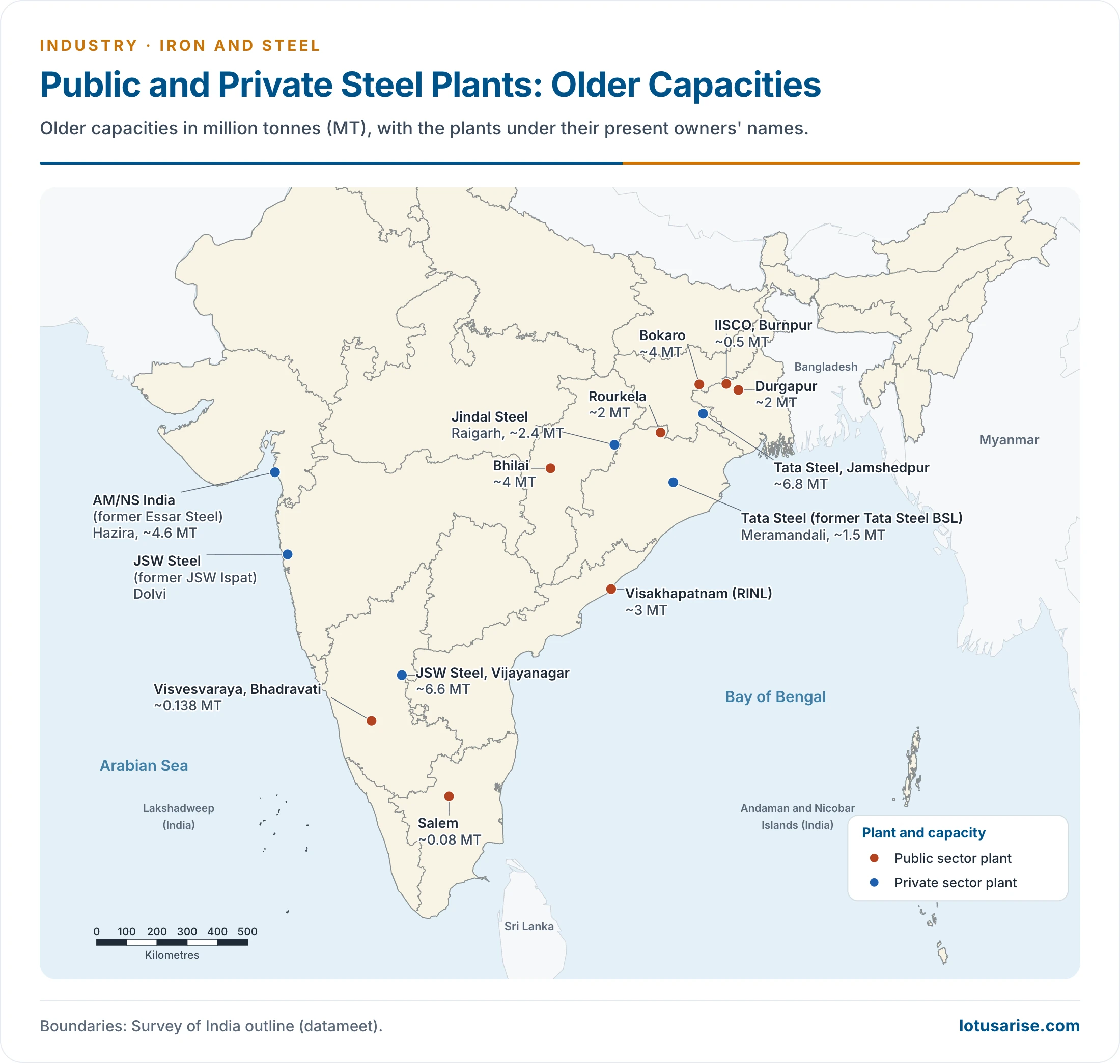
- These tonnages are older figures. Tata Steel BSL has merged into Tata Steel, and Vijayanagar alone now exceeds the 6.6 shown for JSW.
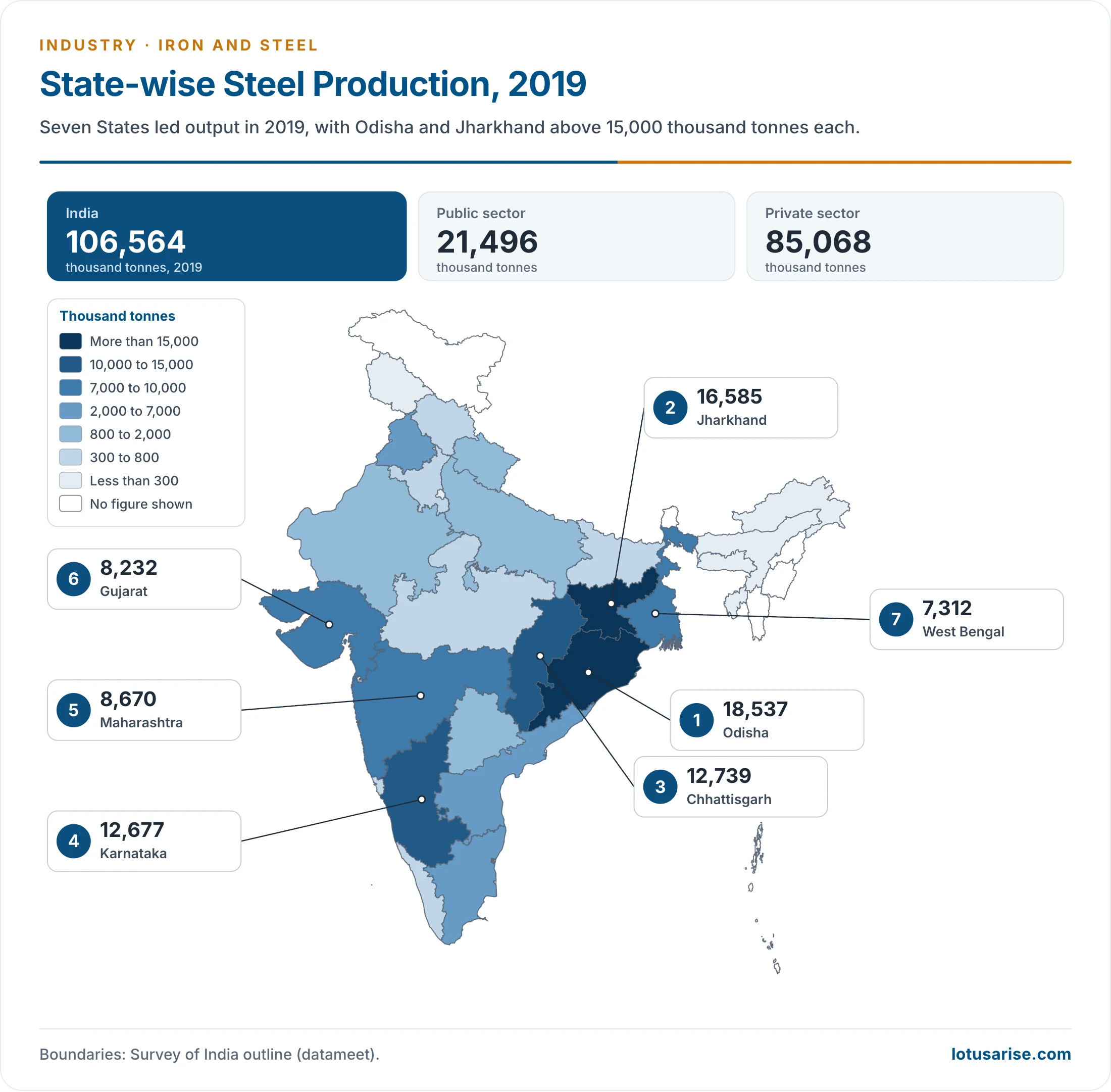
- This State ranking is for 2019, when output on this chart’s count was 106.56 million tonnes and the private sector made 85.07 of it. Odisha led (18.54), followed by Jharkhand, Chhattisgarh, Karnataka, Maharashtra, Gujarat and West Bengal.
Future Prospects and Policy
- The room for growth is large, because consumption per head remains well below the world average.
- The older arithmetic: at 29 kg against a world average of 150 kg, with over a billion people, India would need about 150 million tonnes against consumption of 29 million.
- Output has since passed that mark, with 152.18 million tonnes of crude steel in 2024-25. Consumption is still 115.7 kg against 209 kg.
- Demand depends on the health of other sectors: roads, power, railways, ports, drinking water, housing and manufacturing.
- New projects as an opportunity (from older plans):
- About 10,000 km of road to be four-laned.
- Greenfield capacity in the coming years.
- About 3,500 km of railway track renewal, with more high-speed trains, coaches, wagons and underground railways.
- National Steel Policy, 2017: targets for 2030-31 are 300 million tonnes of capacity, 255 million tonnes of output and 158 kg per head.
- Draft National Steel Policy Vision 2047 (October 2026): proposes 604 million tonnes of capacity and 302 kg per head.
- Production Linked Incentive for specialty steel: ₹6,322 crore, approved on 29 July 2021, with a third round in November 2025.
- Green steel:
- The Taxonomy of Green Steel (12 December 2024) treats steel as green below 2.2 tonnes of carbon dioxide equivalent per tonne of finished steel, with star ratings.
- By 31 December 2025, 58 units had certification, covering 9.1 million tonnes.
- Trade defence: a three-year safeguard duty on flat steel runs from 21 April 2025, at 12%, then 11.5%, then 11%.
- Quality: the Steel Quality Control Order bars sub-standard steel. The Steel Import Monitoring System tracks imports.





Thanks very well composed.
thanx
What a erticle
thank you so much sir for your efforts in providing such detailed information.
Too good sir ,,,,u r helping poor students thankyou sir
Superb content.
Thank you very much
well described
very informative .thanks for publishing this kind of valuable notes
The inclusion of information on the National Steel Policy and the challenges faced by the sector adds depth to the discussion, offering a well-rounded perspective for examination preparation. Overall, the content serves as a valuable resource for understanding the complexities of India’s iron and steel industry.We started small with a team of five professionals in 2010 but have earned the trust and respect of our clients that has led to long-standing associations. visit our site:https://www.brainstorminfotech.co.in/