

- The pulp and paper industry covers firms that turn wood and other cellulose into pulp, paper, paperboard and related products.
- It is classed as a forest-based industry, since much of its raw material still comes from forests. Some treat it as a chemical industry for its process, and others as agro-based for its use of crop residues.
- Paper consumption per head is a measure of literacy, education, industrial culture and general well-being.
Paper in the World and in India
World Picture
- One of the world’s largest industries, led by North America, Northern Europe and East Asia, with some output in Latin America and Australasia.
- World output of paper and paperboard was about 420 million tonnes in 2023, well short of an older forecast of 490 million tonnes by 2020.
- Packaging now leads, at about 265 million tonnes in 2022, while graphic papers fell to 84 million tonnes in 2023, their lowest since 1987.
Indian Standing
| Measure | Older figure | Recent figure |
|---|---|---|
| Mills | 17 (1950-51); 759 (2012-13), 652 of them working | Over 900, of which 526 working (2025) |
| Capacity | 1.37 lakh tonnes (1950-51); 12.7 million tonnes (2012-13) | About 25 million tonnes (2025) |
| Consumption per head | About 2 kg, then 5.5 kg | About 15 kg (2025) |
| World average per head | Nearly 50 kg | 58 kg (2025) |
| Revenue | Rs 16,000 crore | Rs 80,000 crore (2023-24) |
| Imports of paper and board | 55.6 thousand tonnes (1960-61); 2.76 million tonnes with manufactures (2013-14) | 2.05 million tonnes of paper and paperboard (2024-25) |
- Rank: India is about the 15th-largest producer, with about 5% of the world market, and the fastest-growing major paper market.
- Consumption elsewhere (2025): USA about 320 kg, European Union 129 kg, China 75 kg and Asia 45 kg.
- An increase of 1 kg per head adds about 1 million tonnes to Indian demand.
- Policy: licensing ended in July 1997, and foreign investment of up to 100% needs no prior approval.
Growth and Development
- Handmade beginnings: papermaking in India goes back to about the 10th century, under Muslim rulers, as a cottage craft of traditional makers called kagzis, who worked with rags, ropes and old gunny.
- Factory paper later crushed most of this craft, though many small units still make handmade paper.
- Early factories: a factory near Chennai (1816) failed, and William Carey’s mission press at Serampore on the Hugli, which made its own paper from about 1812-13 and took up a machine in 1832, did not last as a modern industry either.
- The first lasting effort was Royal Bengal Paper Mills at Ballygunge near Kolkata (1870).
- Later mills: Lucknow (1879), Titagarh (1882), Deccan Paper Mills at Pune (1887), Bengal Paper Mills at Raniganj (1892), Kankinara (1892) and Naihati (1918), with another early unit at Shyamnagar (Indian Paper Pulp).
- Protection and war: preferential treatment and tariff protection helped the young industry, and World War II gave it fresh life. Progress stayed sluggish until Independence.
- Planned development: growth came fast after 1951, from the 17 mills of 1950-51. By 2012-13, though, 107 units stood shut, mostly over pollution.
- Rise of the small sector:
- It came to hold about 50% of capacity and output in older accounts.
- During the paper famine of the early 1970s, the government saw the worth of small units.
- Short gestation period
- Cheap second-hand machinery, readily available from abroad
- Non-conventional raw materials: rice and wheat straw, bagasse and jute stalks
- Freedom to set up in almost any part of the country
- Liberal incentives brought these units into production and averted the crisis.
| Mill class (2012-13) | Scale (tonnes a day) | Mills | Share of capacity |
|---|---|---|---|
| Large | 100–1,100 | 119 | 36% |
| Medium | 50–100 | 117 | 29% |
| Small | 5–50 | 523 | 35% |
- Current market by grade: packaging paper and board about 57–65%, printing and writing about 23–30%, newsprint about 8% and specialty paper about 5%.
- E-commerce and the move away from single-use plastic drive packaging.
Foreign Trade
- Imports: output has fallen short of demand, so paperboard and better grades (insulation, parchment and tissue paper) come from Sweden, Canada, Japan and the USA, and pulp and waste paper from Norway, Sweden, Canada and the Netherlands.
- About 25% of wood pulp needs were imported in 2024, from countries such as Brazil and Indonesia.
- New competition: cheaper paper from China and ASEAN countries, helped by free trade agreements, has hurt home producers. The industry association has asked for a duty of 25% in place of 10%.
- Exports of printing and writing paper, kraft paper, paperboard and wrapping paper go to the Middle East, East Africa and South-East Asia.
Manufacture, Raw Materials and Location
Manufacturing
- Paper is made in two stages:
- First stage: pulp is extracted from cellulose. This needs gross raw material, so pulp units sit amid cellulose-producing areas.
- Second stage: pulp is pressed into paper. Pulp is now the raw material, so paper units can locate near urban markets.
- Pulp comes from wood, bamboo, sabai grass, bagasse and crop straw, which explains the industry’s wide distribution.
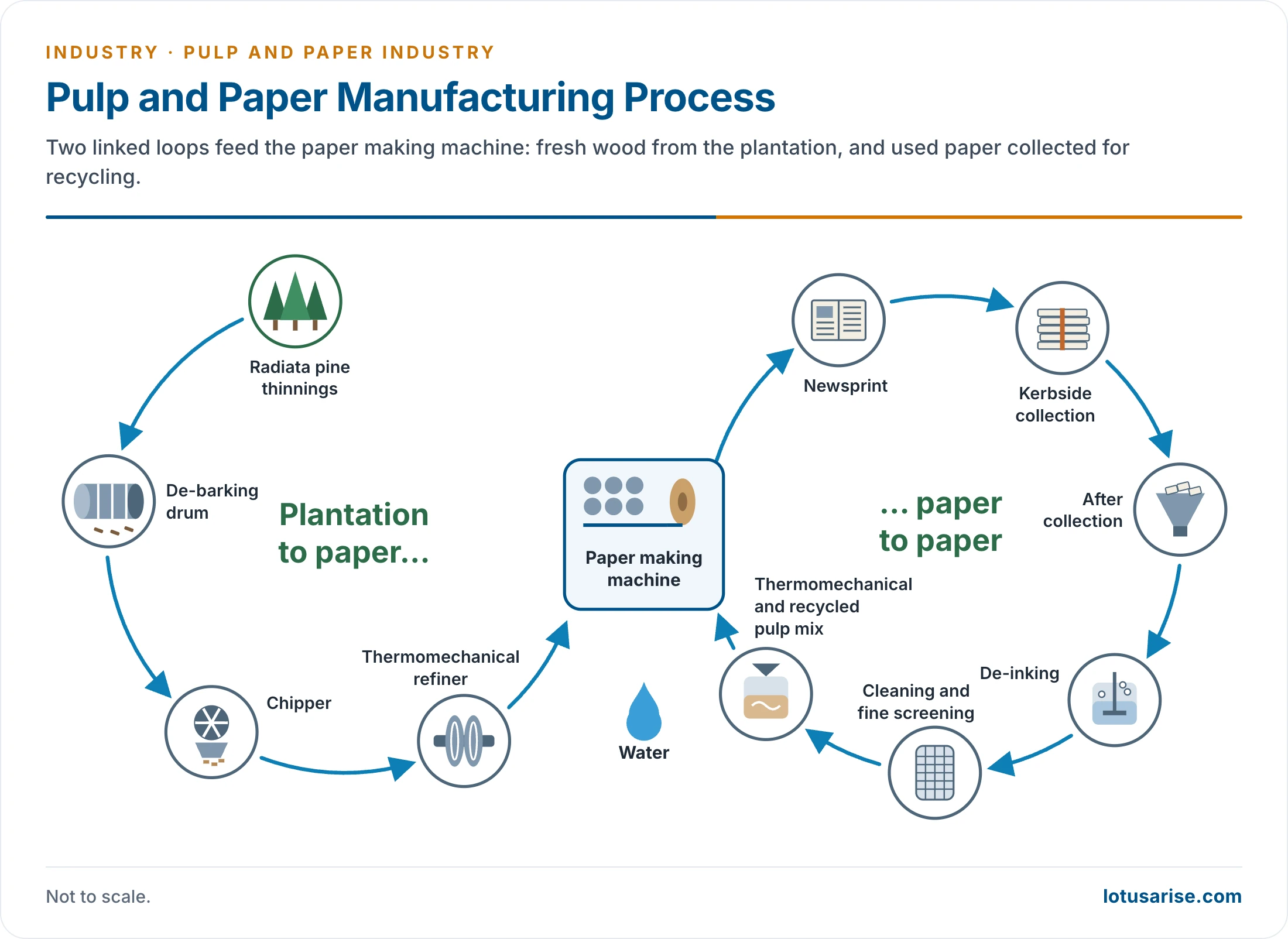
- This cycle is a general one, showing softwood thinnings and recycled newsprint. Indian mills add bamboo, hardwood plantation timber and crop residues.
Raw Materials
- The balance has shifted away from forests. Wood made up about 80% of the raw material in the 1980s; the current base is recycled paper 52%, wood fibre 28% and agro-residues 20% (2025).
- Raw materials make up 45–50% of the cost of production.
- Bamboo:
- About 2.3–2.4 tonnes make one tonne of paper.
- It was long the main material, at 60–70% of cellulosic needs in older accounts.
- Strengths: long fibre, dense stands and quick regrowth. It matures in 2–3 years, which gives a continuous, renewable flow.
- Limit: stocks may be depleted if cutting outruns regrowth. Supply was estimated at 20–30 lakh tonnes a year.
- Producing States: Assam, Odisha, Andhra Pradesh, Telangana, Madhya Pradesh, Tamil Nadu, Karnataka and Maharashtra.
- Botanically a grass, it counts in law as minor forest produce, and a 2017 amendment freed bamboo grown outside forests from felling and transit permits.
- Sabai grass:
- Until bamboo took over, it was the chief raw material. Its share has shrunk to 7–9% of the cellulosic total.
- Strength: long fibre, and little need for chemicals.
- Weakness: it grows in tufts mixed with other plants, so impurities are hard to remove, and its supply is much smaller than that of bamboo.
- With allied grasses, it gives roughly a million tonnes yearly, gathered in the Shiwaliks and the Tarai.
- Bagasse:
- The fibrous residue of crushed cane, mainly from sugar mills.
- About 96–97% of bagasse is now burnt for steam in sugar mills, by a 2025 estimate.
- Salai wood: widely used for newsprint, as at Nepanagar.
- Others: waste paper, rags, rice and wheat straw, jute sticks, and soft wood from eucalyptus, pine, wattle and mulberry.
- Recycled fibre:
- About 70–75% of paper and board used in India is of recycled grade, which needs about 20 million tonnes of waste paper a year.
- India’s waste paper recovery is only 43%, against 55–60% worldwide, and collection remains fragmented.
- Gujarat and Uttar Pradesh hold about 22% and 18% of national recycling.
- Other inputs: chemicals such as caustic soda, soda ash, chlorine, sulphuric acid, lime and clay; about 3.5–4.1 tonnes of coal for each tonne of paper; and soft water in large quantity.
Location Factors
- Nearness to raw material: bamboo and softwood fix many mills, for example in South Gujarat, Odisha and Madhya Pradesh.
- Abundant coal: energy needs and the cost of hauling coal can outweigh a lack of raw material.
- Nearness to market: some mills sit near large markets with cheap labour, as around Kolkata.
- Water supply: mills need clean water free of chemicals and pollutants. This is one reason they are set up near forests, away from polluted rivers.
The Weight-Loss Logic
- It is a raw material-intensive, weight-losing industry. In Alfred Weber’s terms, the ratio of raw material to product is about 4:1 and the material index is above 1.
- In its early stage, the industry therefore gains by locating near raw material.
- Bamboo and coal are both heavy and weight-losing, so the best site serves both.
- Chemicals are needed in small amounts and travel easily.
- Forest belts: mills tend to cluster near the forests of the Western Ghats, Eastern Ghats and central India, and in the Tarai–Bhabar at the Himalayan foothills.
- Himalayan softwoods are vast, but rugged terrain and poor transport keep them out of reach, so the Himalayan region itself has no paper mill based on them. Units at Barotiwala and Kala Amb stand only in the foothills.
How the Pattern Has Shifted
- The Bengal start: when sabai and other grasses were the main material, they travelled long distances to Bengal from Uttar Pradesh, Punjab, Bihar and Nepal.
- The Hugli riverine tract kept the mills despite this, for two reasons: coal in large quantity and a large market nearby.
- The bamboo shift: bamboo improved Bengal’s position, as supplies lay near the Hugli tract alongside coal and consumers, and more and more plants moved to it.
- Paper can be made wholly from bamboo, without any wood pulp, though it lacks strength, which limits its use for some printing and writing grades.
- Uttar Pradesh and Haryana: mills depended on sabai and murj grass. Lucknow and Saharanpur have excellent transport links for both raw materials and markets.
- Hardwood: a method of making paper from hardwood brought a revolution, and new mills in Madhya Pradesh were set up to use it.
- Dispersal: raw materials and chemicals are available in most parts of the country, so mills are now widely dispersed.
Distribution
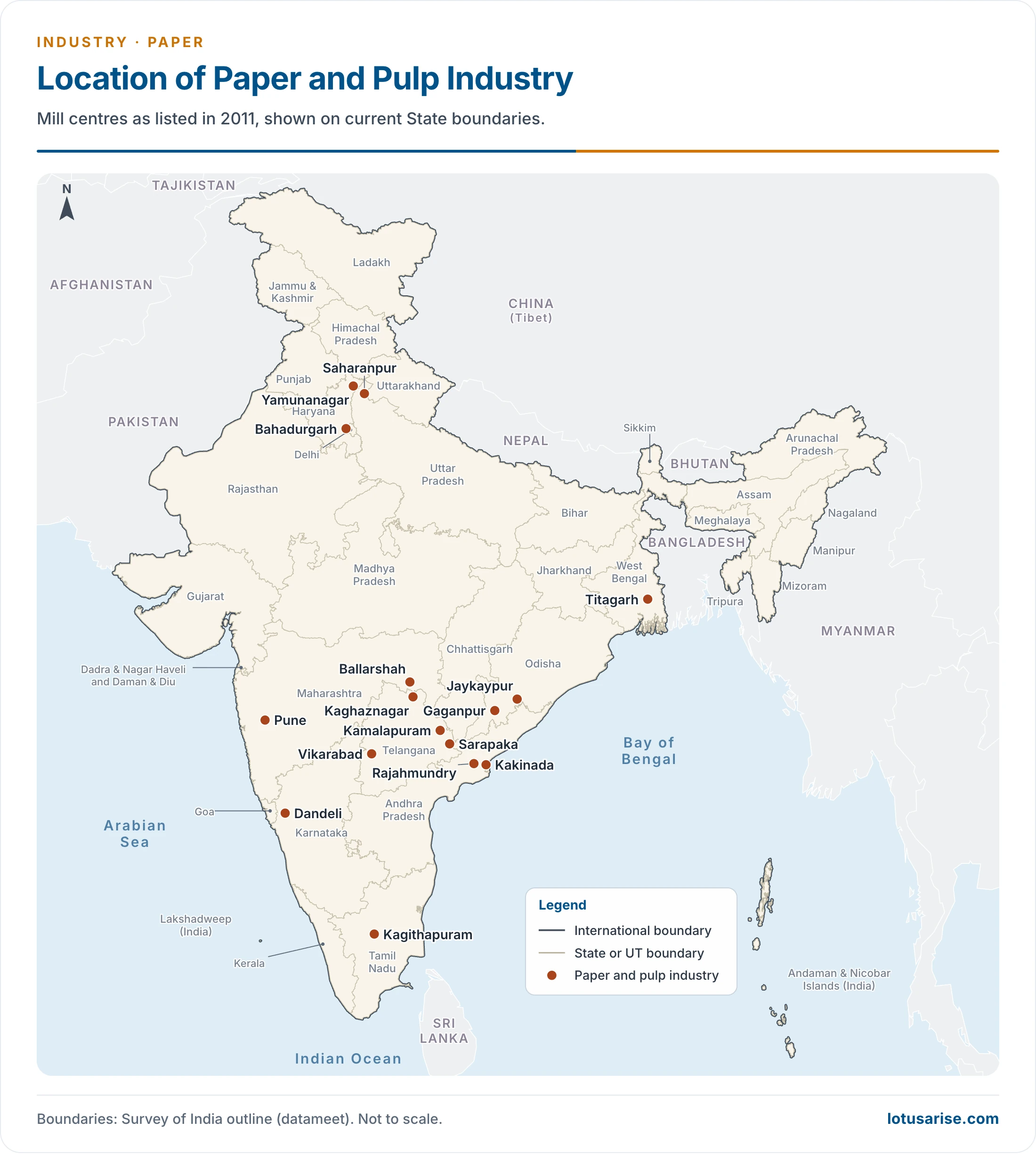
- Older shares: West Bengal, Odisha, Madhya Pradesh, Andhra Pradesh, Maharashtra and Karnataka once held nearly 65% of capacity.
- Current specialisation (2025 estimate):
- Packaging grades: Gujarat and Tamil Nadu
- Specialty papers: Andhra Pradesh and Odisha, the former with clonal plantation programmes
- Printing paper: Uttarakhand, around Kashipur
- Newsprint and commercial printing: Maharashtra and West Bengal
- Wood fibre and agro-forestry: Tamil Nadu
- Bagasse and recycling: Uttar Pradesh
Major States
- West Bengal: the pioneer, it led until the mid-1980s, then slid to fifth place with 22 mills and about 7% of capacity.
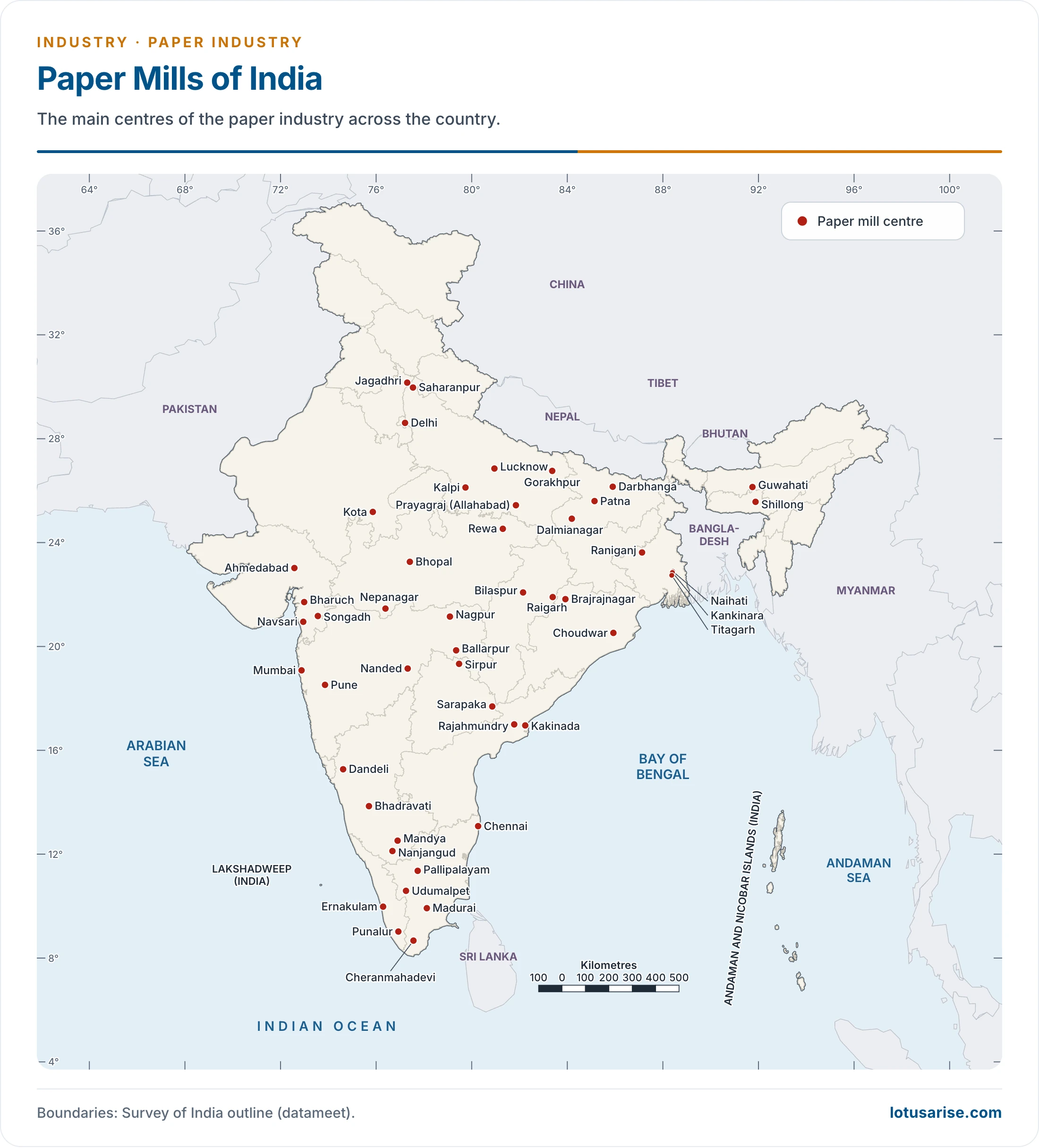
- Mills line the Hugli, on bamboo from Assam, Odisha and Jharkhand, sabai from Chhattisgarh and Madhya Pradesh, and coal from Jharia and Raniganj. Centres: Titagarh, Tribeni, Kankinara, Naihati and Raniganj.
- Maharashtra: it rose from fourth in the mid-1980s to first by 1996, with 63 mills, 16.52% of capacity and 18% of output in older counts, though many older mills are worn out.
- Short of raw material and coal, it uses rags, waste paper and pulp from Sweden and Canada, with hydroelectricity in place of coal. Centres: Ballarpur (the largest mill), Kalyan, Khopoli, Pune and Kamptee.
- Andhra Pradesh and Telangana: abundant bamboo and State incentives drew new units with modern machines, and the undivided State overtook West Bengal in the early 1990s, with 19 mills, 11.3% of capacity and 13% of output in older counts.
- Centres: Rajahmundry, Kakinada, Tirupati and Kurnool in Andhra Pradesh; Sirpur (Kagaznagar), Sarapaka near Bhadrachalam and Bodhan in Telangana.
- Madhya Pradesh: bamboo, sabai and eucalyptus give a solid base, with 18 mills and 6.62% of capacity in older counts. Centres: Nepanagar, Amlai (Shahdol), Rewa and Bhopal.
- Odisha: vast forests and cheap hydel power suit the industry, and mills use Eastern Ghats bamboo, about five lakh tonnes a year.
- Mills stand at Brajrajnagar, Rayagada and Choudwar. A later count gave 8 large mills and over 6% of capacity, a share that slipped as bamboo declined.
- Uttar Pradesh: the largest number of mills, 68, but small ones, with no more than 9% of capacity.
- Saharanpur has a large mill; the large mill at Lalkuan has been in Uttarakhand since the State was formed. Other centres: Meerut, Muzaffarnagar, Lucknow, Gorakhpur and Kalpi.
| State | Older position | Raw material | Centres |
|---|---|---|---|
| Gujarat | 55 mills; share rose from 3% to 10% (mid-1980s to mid-1990s) | Bagasse, eucalyptus | Vapi, Songadh, Bharuch, Surat |
| Tamil Nadu | 24 small mills; 5.74% of capacity | Local bamboo | Cheranmahadevi, Pallipalayam, Udumalpet, Chennai, Madurai |
| Karnataka | 17 mills; 5.48% of capacity | Local bamboo, bagasse | Dandeli, Bhadravati, Nanjangud, Mandya |
| Punjab | 23 small mills; a little over 5% | Hoshiarpur, Sangrur, Saila Khurd, Rajpura | |
| Assam | Large bamboo areas; greatest potential by older estimates | Bamboo | Nagaon, Guwahati, Cachar, Lumding |
| Haryana | 18 mills | Imported pulp, eucalyptus | Yamunanagar, Faridabad, Dharuhera, Jagadhri |
| Bihar | 6 mills | Dalmianagar, Patna, Darbhanga, Samastipur | |
| Others | Himachal Pradesh (Barotiwala, Kala Amb), Keralam (Punalur, Ernakulam, Mavoor, Kozhikode), Rajasthan (Kota), Meghalaya (Shillong), Nagaland (Mokokchung) |
- Assam today: the Hindustan Paper Corporation mills at Cachar and Nagaon have produced nothing since 2015 and 2016 respectively, despite the State’s bamboo.
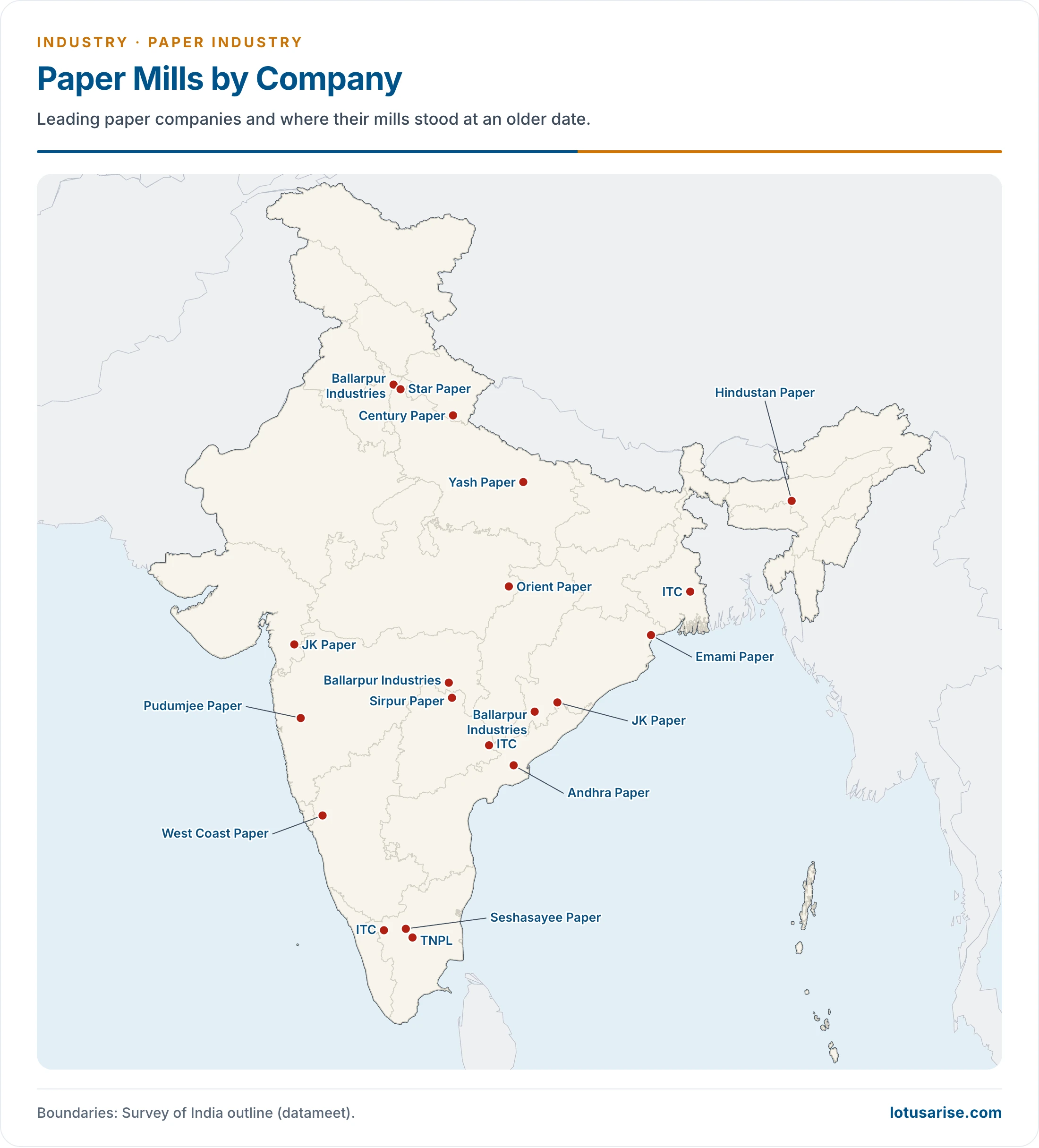
- This map shows mills by company at an older date.
Newsprint
- National Newsprint and Paper Mills (NEPA) at Nepanagar, Burhanpur district, Madhya Pradesh, began commercial production in 1956, and remained the sole producer until 1980.
- It makes pulp from salai wood, with pulp imported from Canada and Scandinavia. It stopped in 2016 and was revived about six years later.
- Later entrants:
- Mysore Paper Mills, Bhadravati (1981): 75,000 tonnes. Production has long stopped, and Karnataka has been weighing a private lease.
- Hindustan Newsprint, Velloor near Kottayam (1982): 80,000 tonnes.
- Tamil Nadu Newsprint and Papers, Pugalur (1985): 50,000 tonnes.
- India still imports more newsprint than it makes: about 5.04 lakh tonnes of output against imports of 6.65 lakh tonnes in 2023-24.
Problems and Prospects
Problems of the Industry
- Shortage of raw material: sabai and bamboo supply is often interrupted, forests are dwindling, and the industry long had no plantations of its own. Growing concern for forests and biodiversity cuts supply further.
- Unconventional materials such as eucalyptus, wheat bran and rice straw need new processes and new equipment.
- High cost of production: capital equipment is costly at international prices, power and coal costs rose steeply, bulky raw material brings heavy transport costs, and dearer imported pulp and waste paper, set against poor selling prices, have closed many mills.
- Royalties and lease: many governments raised royalties on leased forest land to meet current spending, some by 5–6 times in 5–6 years, and royalties on bamboo and hardwood rose by 70% in one decade. Policy here needs to be stable and long-term.
- Over-capacity and under-use: 180 mills came up between 1974 and 1984 under active encouragement. Even with utilisation of 72%, 7 large and 13 small units lay idle for years.
- Effluents: suitable treatment is beyond small units, and the cost forced many to close. Environmentalists object to effluents released into drains, rivulets and rivers.
- Lack of research: new processes, pulp grades and equipment are needed, and the technology for unconventional materials is costly for a developing country.
- Small and sick mills: average size was under 10,000 tonnes, against 50,000 tonnes for South-East Asia and 85,000 tonnes for the Asia-Pacific. Small size blocks new technology, and many mini plants run on worn-out machinery.
- High investment costs, low returns, scarce coal and rising electricity and water charges left small units unable to compete with large ones.
Future Prospects and Suggestions
- Raw material strategies: a shift from bamboo to eucalyptus, wattle and mulberry, and more recycled fibre, which also makes production cleaner and saves energy.
- Eucalyptus has been discouraged in the east of the country, since it draws heavily on sub-soil water.
- Plantations: bamboo cultivation has turned uneconomic, so mills need plantation forestry around them, which the large pool of rural workers can raise. More thrust on social and farm forestry has begun to ease supply.
- Technology: modernisation is a must, but it needs heavy capital, which private firms do not always find easy to raise.
- Bagasse: since much is burnt as fuel, sugar mills could move to coal-fired boilers and release bagasse for paper, and India’s large cane crop gives this great potential.
- Outlook: a growth rate of 6–7% a year is projected over the next five years, with revenue of about Rs 1,00,000 crore by 2027-28.
- India needs to add about 1 million tonnes a year of integrated capacity to keep pace.
Advantages of the Indian Paper Industry
- Growth cycle: tropical plantations are ready in 6–7 years, whereas western conifers and other softwood forests take about 50–60 years to regrow.
- Wages: labour is cheap compared with the West.
- Skills: a workforce well trained at all levels makes good-quality paper at low manpower cost.





Superbly amazing analysis of paper industry in India 🙏
Keep reading & Happy Learning.
geography will become easy subject when you visit lotus arise