

- An industry settles at a place through many decisions taken at various levels. Some rest on geographical factors; others fall outside geography altogether.
- A factor’s weight changes with time and place. Raw materials, power, water, labour, markets and transport each matter differently from one industry to another.
- Historical, human, political and economic forces now tend to outweigh purely geographical advantages.
Locational Factors
- The factors fall into two broad categories:
- Geographical factors
- Non-geographical factors
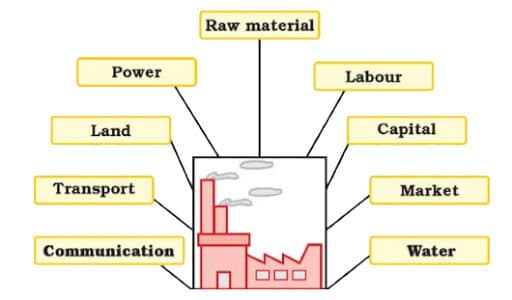
| Pull | Why the industry goes there | Indian examples |
|---|---|---|
| Raw material | Weight-losing or perishable inputs | Jute in West Bengal, sugar in Uttar Pradesh, steel at Jamshedpur |
| Power | Cheap, heavy energy use | Aluminium at Korba and Renukoot, fertilizer at Nangal |
| Market | Weight-gaining, fragile or perishable goods | Light industry around Delhi, cotton mills inland |
| Labour | Labour-intensive light goods | Agro-based and light consumer industries, large towns |
| Footloose | Light inputs and outputs, skilled people | Watches, electronics |
| Policy | Dispersal, backward areas | Mathura refinery, Kapurthala coach factory |
Geographical Factors
1. Raw Materials
- Raw material is fundamental to manufacturing, and at times its site alone fixes where a plant goes. Modern industry is complex and draws on a wide range of materials.
- One industry’s product is another’s input. Pig iron from the smelting industry is the raw material of steel-making.
- Heavy, bulky materials used in large quantities at the first stage of processing pull a plant towards their source. This applies in three cases:
- Materials that lose weight during manufacture.
- Materials that cannot bear high transport costs.
- Perishable materials that cannot travel far.
- This logic goes back to 1909, when Alfred Weber published his theory of the location of industry.
- Indian cases:
- Close to their materials: West Bengal’s jute mills, Uttar Pradesh’s sugar mills, and the cotton mills of Maharashtra and Gujarat.
- Iron and steel consumes coal and ore in huge amounts and loses much weight, so plants lie near coal and iron ore.
- Footloose industries: watch-making and electronics use many light materials, so the pull of any one of them weakens.
- Such plants can ignore raw materials in choosing a site, and almost any populous area will serve.
- Their wider traits appear with the classes of industry.
- Raw-material pull differs along the chain of processing:
- Sugar: cane loses most of its weight in crushing and spoils quickly after harvest, so mills stay within the cane belt.
- Aluminium: alumina refineries lie near bauxite, and smelters go wherever power is cheap.
- Cement stays near limestone, and paper once stayed near bamboo and softwood forests.
- Cotton textiles are the contrast. Cotton loses little weight and travels as easily as cloth, so mills spread to market towns far from the fields.
- Imported materials change the pull. Steel plants at Visakhapatnam, Hazira, Dolvi and Paradip work on the coast because ports bring in coking coal and ship out the product.
2. Power
- A regular power supply is a precondition for industry to localise. Coal, mineral oil and hydroelectricity are the three main conventional sources, and most industries gather near a source.
- Iron and steel, with its heavy use of coking coal, is often tied to coalfields.
- Electro-metallurgical and electro-chemical industries, heavy users of cheap hydropower, classically sit near hydel sites. Aluminium is the standard case, though Indian smelters now lean largely on captive coal-fired power.
- Oil moves by pipeline and electricity by wire, so industry can spread over a wider area.
- Industry reached the southern States only when hydropower was developed in those coal-poor areas.
- Large, heavy industry often goes wherever it gains the best economic advantage in getting both power and raw materials.
- Examples near both power and materials: the Tata plant at Jamshedpur, aluminium at Korba (Chhattisgarh) and Renukoot (Uttar Pradesh), copper at Khetri (Rajasthan) and fertilizer at Nangal (Punjab). Other factors played a part too.
- Energy now reaches further. A synchronous national grid and gas pipelines let fertilizer and power-hungry units run far from fuel.
- Data centres are the new power-tied industry, gathering at Navi Mumbai and Chennai, where reliable electricity, water and undersea cable landings meet.
3. Labour
- An existing labour force attracts industry unless strong reasons point the other way.
- Labour supply matters in two respects:
- Numbers: many plants need large workforces.
- Skill: trained and technically able people are also wanted.
- Robert C. Estall and R. Ogilvie Buchanan (1961) showed how far labour’s share of cost can vary: 62% in clothing and related trades, 43% in fabricated metal products and 29% in chemicals.
- Indian modern industry still needs many workers despite rising mechanisation.
- Unskilled labour is easy to find in large urban centres.
- Each unit weighs all its factors together, though labour-hungry lines are mostly light consumer goods and agro-processing.
- Skill pools hold specialised work in place. Examples are diamond cutting at Surat, knitwear at Tiruppur, powerlooms at Bhiwandi and software at Bengaluru.
- Migrant labour eases shortages, so workers from Bihar, Odisha and eastern Uttar Pradesh have long fed the mills of Kolkata, Mumbai and Surat.
- Labour law also shapes location. The four Labour Codes in force from 21 November 2025 replaced 29 central laws, and States still differ in their rules.
4. Transport
- Land or water transport is needed to bring in raw materials and to market finished goods.
- Railways joining port towns to their hinterlands drew much early industry to Kolkata, Mumbai and Chennai.
- Industry also improves transport in its turn, so it is hard to say how much a given industry owes to the transport it started with.
- Current networks: the Eastern Dedicated Freight Corridor (1,337 km, Ludhiana to Sonnagar) and Western Dedicated Freight Corridor (1,506 km, Dadri to Jawaharlal Nehru Port) give corridor sites an edge.
- Port-led sites such as Mundra, Haldia and Visakhapatnam gain where inputs or outputs cross the sea.
- Lower transport costs reduce the pull of raw materials and widen the choice of site.
5. Market
- Manufacturing has no purpose until goods reach the market. Nearness speeds disposal, cuts transport cost and lowers the price to the consumer.
- Industries increasingly seek sites as close to markets as possible. Market location is now widely treated as the normal choice, and a site elsewhere needs strong justification.
- A ready market matters most for perishable and heavy goods.
- Where manufacture adds weight, bulk or fragility, the industry tends to be market-oriented.
- Indian cases:
- After 1921, railways into the Peninsula let cotton mills spread to Coimbatore, Madurai, Bengaluru, Nagpur, Indore, Solapur and Vadodara, nearer to both cotton and buyers.
- The Gurugram–Delhi–Meerut belt lies far from minerals and is sustained by light, market-oriented goods.
- Automobile assembly stays close to buyers, ports and suppliers, as at Gurugram, Pune and Chennai.
6. Water
- Water is another key need, so many plants stand near rivers, canals or lakes.
- Iron and steel, textiles and chemicals need it in large quantities.
- Used water often returns polluted, so it is lost to other users.
- Plant sites show this: Jamshedpur stands where the Subarnarekha and Kharkai meet, and Durgapur and Bokaro draw on the Damodar.
- Water stress and effluent rules now weigh on location, notably for dyeing units at Tiruppur on the Noyyal.
- Classical water needs (litres per tonne of product):
| Industry | Water |
|---|---|
| Rayon | 10,00,000 |
| Steel | 3,00,000 |
| Sulphite paper | 2,90,000 |
| Paper from wood | 1,73,000 |
| Oil refining | 25,600 |
7. Site
- Site needs are considerable. Land should be flat, well served by transport and large enough for factories.
- Urban land has grown costly, so units are now tending to move to rural areas.
- Getting land can decide a project. After protests at Singur in West Bengal, Tata Motors moved its small-car plant to Sanand in Gujarat in 2008.
- Planned sites answer this problem. Dholera in Gujarat is a greenfield node of 920 sq km on flat coastal land.
8. Climate
- A harsh climate does not suit industry, and little can develop in extreme heat, humidity, dryness or cold.
- The extreme climate of north-west India holds back industry.
- The moderate climate of the west coast favours it.
- Maharashtra and Gujarat together were credited in older accounts with about 24% of modern industries and 30% of industrial labour.
- In 2024-25 they held 22.65% of factories and 26.07% of persons engaged in the registered sector, and 30.02% of gross value added.
- Cotton textiles need humidity, because thread snaps in dry air.
- This helped concentrate mills in Maharashtra and Gujarat.
- Artificial humidifiers now serve dry areas, at a higher cost of production.
Non-Geographical Factors
- Alternative raw materials have come with science and technology. Wider electricity supply and more mobile labour have also reduced geography’s hold.
- Non-geographical factors are economic, political, historical and social, and they now influence modern industry strongly.
1. Capital
- Setting up a plant takes large capital, because modern industry is capital-intensive.
- Capital and capitalists are concentrated in urban centres. This is one reason Mumbai, Kolkata, Delhi and Chennai are big industrial centres.
- Business communities gave early capital a local base. Parsi and Gujarati traders financed Mumbai and Ahmedabad, and Marwari firms moved into Kolkata’s jute after the British.
- Personal choice sometimes founded towns, as at Modinagar and Kirloskarvadi.
2. Government Policies
- Planning the future spread of industry has become a major locational force. The State acts to reduce regional disparities, curb pollution of air and water, and prevent heavy clustering in big cities.
- Grouping industry on one site is a growing trend, so units share water and power and supply one another.
- An example is the spread of industrial estates across India, even for small-scale units.
- Five Year Plans: public sector plants became new nuclei in south India, and policy spread suitable industries to backward areas with potential.
- State decisions placed many fertilizer factories, steel plants, engineering and machine tool works in the planning era, along with railway, shipping, aircraft and defence units and refineries.
- A favourable geographical point no longer explains location by itself.
- The oil refinery at Mathura, the coach factory at Kapurthala and the fertilizer plant at Jagdishpur all reflect government decisions.
- Public sector siting pursued balance. Durgapur, Rourkela and Bhilai were placed partly to lift industrially backward regions, and tax packages later drew pharmaceutical units to Baddi in Himachal Pradesh and factories to Pantnagar and Haridwar in Uttarakhand.
- Politics can override economics. Splitting the MiG aircraft project between Nashik and Koraput is the classic instance of a decision shaped by regional claims.
- Environmental zoning also limits location, as with the Doon Valley Notification of 1989, and the rule keeping red category industries out of fragile areas.
- Current instruments: Special Economic Zones, industrial corridors and Production Linked Incentives now steer new investment.
3. Industrial Inertia
- Industrial inertia is the tendency of firms to stay put even when changed economic conditions would otherwise push them to leave.
- Industries keep developing where they first started, though the original cause may have gone. The effect is also called geographical inertia.
- The lock industry of Aligarh is the usual Indian example.
- Moving fixed capital and labour often costs far more than adapting to changed conditions at the old site.
- The Hugli jute mills show inertia at scale. Partition cut them off from most of the jute tract, yet they stayed, and India grew more jute instead.
- Skills, suppliers, buyers and reputation all add to this hold, as with brassware at Moradabad.
4. Efficient Organisation
- Efficient, enterprising management is essential to run modern industry.
- Poor management can waste capital and end in financial trouble or ruin.
- It also mishandles labour, leading to unrest, strikes and lock-outs, and even closures.
- Effective organisation is therefore a real factor in where and how long an industry survives.
5. Banking Facilities
- Banking and insurance favour the places that have them.
- Early banks in the port cities helped those cities keep their lead.
- Running a plant means moving crores of rupees daily, which needs a working bank network.
6. Insurance
- As conditions shift, insurance protects the industrial set-up against events that could jeopardise it.
- Workers, machinery and stock all face risk of damage, so cover is a practical need.
Agglomeration and Linkages
- Agglomeration adds a further pull. Firms gather to share skilled labour, suppliers, repair services and buyers, which cuts costs for each of them.
- Backward and forward linkages tie units together, as with steel feeding engineering and automobiles at Jamshedpur.
- These gains create industrial regions and complexes.
- Limits appear when land costs, congestion and pollution outweigh the gains. Dispersal then begins.
Factors Compared Across Industries
- No single factor decides. Plants choose the point of lowest total cost, and the choice shifts as technology, policy and markets change.
- Direction of change:
- Geography dominated when transport was slow and materials heavy.
- Power grids, pipelines and containers have weakened it.
- Policy, skills, connectivity and clusters now carry more weight, especially for high-value goods.
Shifts in Metropolitan Location
- Rising land cost, congestion and pollution control push manufacturing out of metropolitan cores and into their fringes, while skilled services and offices stay.
- Examples: the fall of Mumbai’s textile mills and the growth of Pune and Nashik, and the spread of Delhi’s industry to Gurugram, Manesar, Noida and Faridabad.
- Footloose units gain most, because low transport costs let them weigh skills, connectivity and environment over materials.
Consequences of Partition on Indian Industries
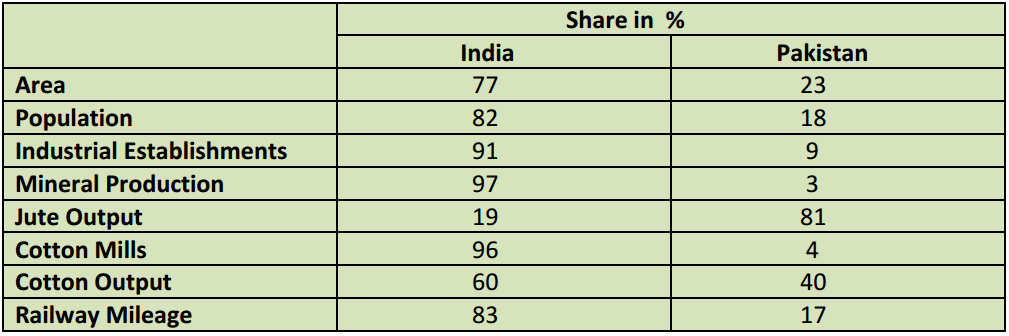
- Industrial units largely stayed with India. Pakistan’s share was negligible: 91% of industrial establishments and 93% of industrial workers came to India.
- Jute, paper, iron and steel plants stayed entirely on the Indian side.
- Pakistan’s share was also small in cotton textiles, sugar, cement, matches, soap, glass, chemicals, woollen and silk mills.
- Partition hurt in other ways, because India was the manufacturer and Pakistan the raw material supplier.
- More than 70% of East Pakistan’s raw jute went to the jute mills of Kolkata.
- Much of the long and medium staple cotton of Sind and west Punjab fed the mills of Mumbai, Kanpur and Ahmedabad.
- The paper mills of Kolkata drew their bamboo from East Pakistan’s forests.
- In exchange, areas now in Pakistan took sugar, cotton textiles, iron and steel goods, leather, paper, cigarettes and coal. Partition broke this free flow.
- Agro-processing industries came to depend on imported cotton, jute, oilseeds and wool.
- Their power to compete in foreign markets fell, and so did their room to expand.
- Demand fell as well, since Pakistan turned to other suppliers.
- Migration of Muslim artisans and skilled workers struck cottage and small-scale work: glass, metal works, woollen and hosiery concerns of Punjab, Delhi, Rajasthan and Uttar Pradesh.
- Displaced persons from Pakistan could not fill the gap at once, and it took time to train new workers.
- The location pattern changed. With relations strained, border provinces and even Kolkata looked unsafe, and factories began to move to the interior.
- The table below sums up the impact. Pakistan took 40% of cotton and 81% of jute output, with only 23% of the area and 18% of the population.





thanks
thank u for the info