

Tribal Areas (Tribal belt)

- India’s tribal belt refers to contiguous areas of settlement of Tribal people of India, that is, groups or tribes that remained genetically homogenous as opposed to other population groups that mixed widely within the Indian subcontinent.
- The tribal population in India, though a numerically small minority, represents an enormous diversity of groups.
- They vary among themselves in respect of language and linguistic traits, ecological settings in which they live, physical features, size of the population, the extent of acculturation, dominant modes of making a livelihood, level of development and social stratification.
- While tribes have a distinct culture and history, they also share commonalities with other marginalised sections of Indian society, such as the lack of adequate political representation, economic deprivation and cultural discrimination.
- However, tribal society must be appreciated and it must be recognised that non-tribal people have much to learn from the richness of tribal cultures and systems of knowledge.
- The category of ‘tribe’ entails a social and cultural dimension but the Scheduled Tribe category has politico-administrative implications.
- A majority of the Scheduled Tribe population is concentrated in the eastern, central and western belt covering the Nine States of Odisha, Madhya Pradesh, Chhattisgarh, Jharkhand, Maharashtra, Gujarat, Rajasthan, Andhra Pradesh and West Bengal.
- About 12 per cent inhabit the North-eastern region, about five per cent in the Southern region and about three per cent in the Northern States.
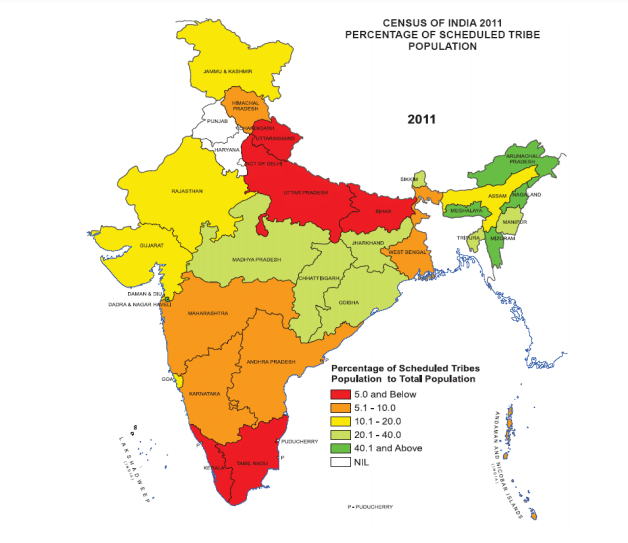
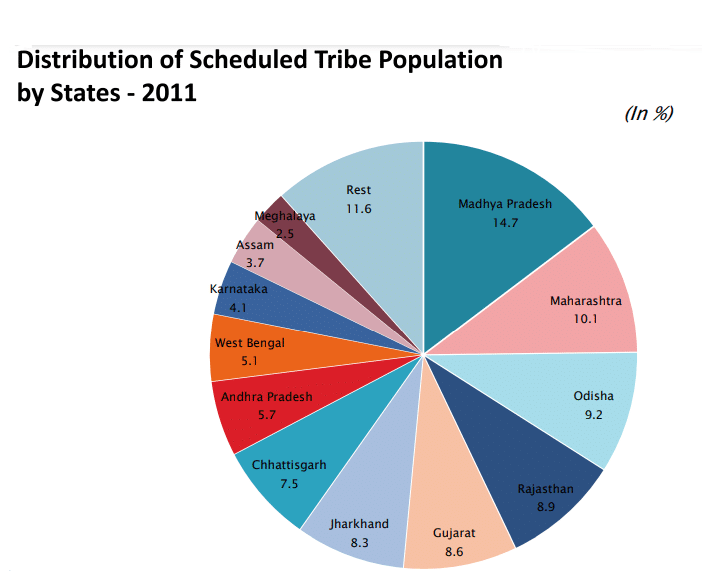
Distribution of Tribes
- The Scheduled Tribes are notified in 30 States/UTs, and the number of individual ethnic groups, etc., notified as Scheduled Tribes is 705.
- The tribal population of the country, as per the 2011 census, is 10.43 crore, constituting 8.6% of the total population.
- 89.97% of them live in rural areas and 10.03% in urban areas.
- The decadal population growth of the tribal’s from Census 2001 to 2011 has been 23.66% against the 17.69% of the entire population.
- The sex ratio for the overall population is 940 females per 1000 males, and that of the Scheduled Tribes is 990 females per thousand males.
- Broadly the STs inhabit two distinct geographical areas – Central India and the North- Eastern Area.
- More than half of the Scheduled Tribe population is concentrated in Central India, i.e., Madhya Pradesh (14.69%), Chhattisgarh (7.5%), Jharkhand (8.29%), Andhra Pradesh (5.7%), Maharashtra (10.08%), Orissa (9.2%), Gujarat (8.55%) and Rajasthan (8.86%).
- The other distinct area is the North East (Assam, Nagaland, Mizoram, Manipur, Meghalaya, Tripura, Sikkim, and Arunachal Pradesh).
- More than two-thirds of the ST population is concentrated only in the seven states of the country, viz. Madhya Pradesh, Maharashtra, Orissa, Gujarat, Rajasthan, Jharkhand, and Chhattisgarh.
- There is no ST population in 3 States (Delhi NCR, Punjab, and Haryana) and 2 UTs (Puducherry and Chandigarh), as no Scheduled Tribe is notified.
Scheduled Areas (Fifth Schedule)
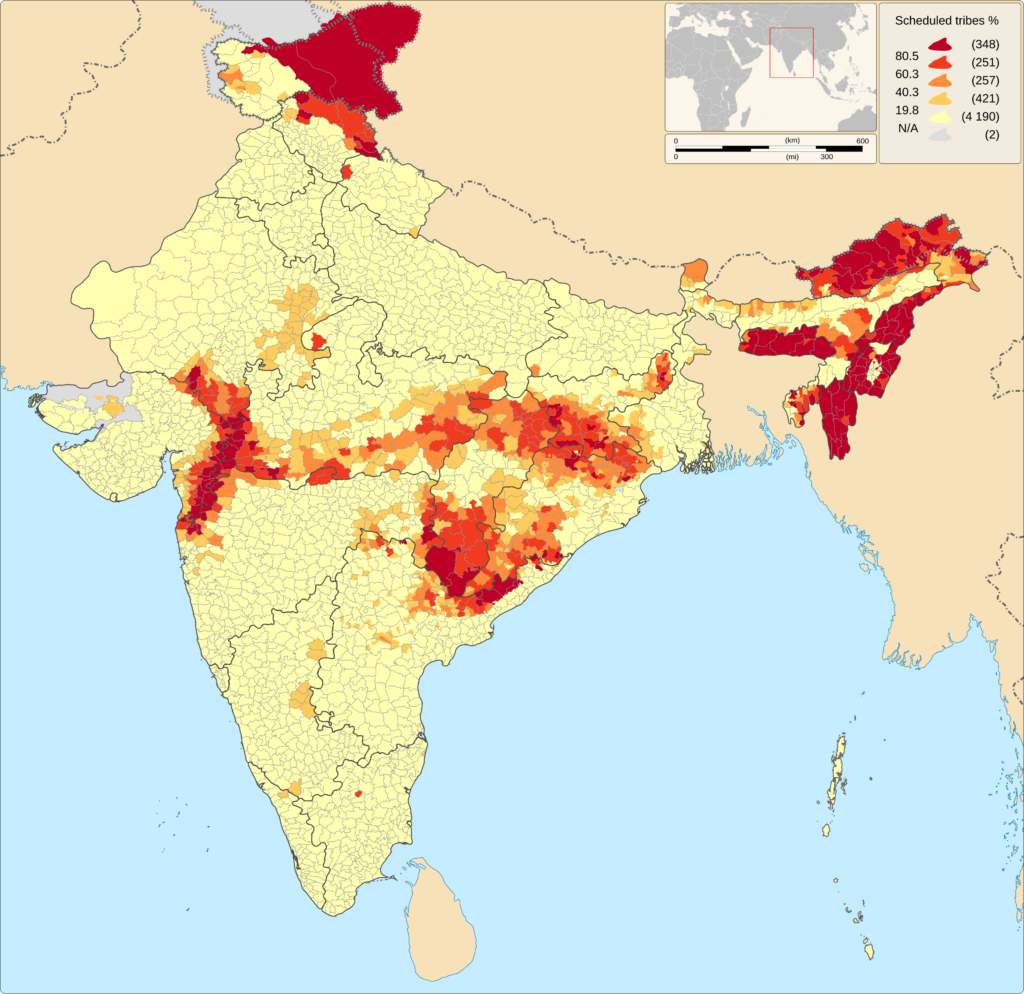
- Scheduled Areas (under the Fifth Schedule of the Constitution) is “such areas as the President may by order declare to be Scheduled Areas”.
- At present, 10 States, namely Andhra Pradesh, Chhattisgarh, Gujarat, Himachal Pradesh, Jharkhand, Madhya Pradesh, Maharashtra, Odisha, Rajasthan, and Telangana have Fifth Schedule Areas.
- Scheduled Areas represent regions covering 11.3% of India’s land area, inhabited by various ST communities comprising 8.6% of the country’s population.
Sixth Schedule
- It protects tribal populations and provides autonomy to the communities through the creation of autonomous development councils that can frame laws on land, public health, agriculture, and others.
- The Sixth Schedule applies to certain tribal areas of the States of Assam, Meghalaya, Tripura, and Mizoram.
- The Sixth Schedule provides for the creation of Autonomous District and Regional Councils and accords a host of legislative, executive, and judicial powers to these autonomous bodies.
- As of now, 10 autonomous councils exist in Assam, Meghalaya, Tripura and Mizoram.
- This special provision is provided under Article 244(2) and Article 275(1) of the Constitution.
Problems of Tribal People
- Tribes are generally backward, economically as well as educationally. The situation is not uniform in all parts of India. In the northeast, the situation has been disturbed for several years, whereas in the mainland (central India), problems related to poverty, unemployment, indebtedness, backwardness, and ignorance are acute.
- The tribes of the northeast have a high level of politicisation, literacy, and a high standard of living compared to their counterparts in other parts. The tribes were alienated from their own lands. The landlords and moneylenders of the plains gradually replaced the tribal landowners.
- The survey done by B. K. Roy Burman (1972) shows that the tribals are the most backward because of their low literacy and primitive economy.
- Since tribal people are at different social, political, economic, and ecological levels, their problems also differ in degree from each other. These differences can be seen in terms of hill tribes and plainsmen; between those who are engaged in forest-based economic pursuits and the ones who are employed as settled agriculturists; or between those who are Hinduised or converted to Christianity, and those who are adhering to an unadulterated tribal way of life.
- Despite these distinctions, some common problems of the tribal people are:
- Poverty and exploitation.
- Economic and technological backwardness.
- Socio-cultural handicaps.
- Problems of assimilation with the non-tribal population.
- S.M. Dube’s five-fold classification of the Indian tribes provides a clear picture of the problem of tribes in India. Dube (1982) mentions –
- aboriginals living in seclusion;
- tribal groups having an association with the neighboring non-tribal society and also maintaining their distinctiveness;
- tribals living in the village along with caste groups, sects, and religious groups and maintaining their identity;
- tribals who have been degraded to the status of untouchables;
- tribals who enjoy high social, economic, and political status.
- Such a classification is based on the nature of cultural contacts of tribals with non-tribals.
Social Problems of Tribal People
(A) High Incidence of Illiteracy and Educational Deprivation
- Tribal communities continue to face significant educational backwardness, though improvements have been recorded over time:
- As per Census 1991, nearly 70% of tribals were illiterate, indicating deep-rooted educational exclusion
- Even in Census 2011, ST literacy (~59%) remained well below the national average (~73%), highlighting persistent gaps
- Multiple structural and cultural factors inhibit educational progress:
- Extreme poverty, forcing children into wage labour
- Nomadic or semi-nomadic lifestyle of certain tribes
- Language barriers, as education is often imparted in non-tribal languages
- Irrelevant curriculum, disconnected from tribal life and ecology
- Lack of schools, trained teachers, and infrastructure in remote tribal regions
- Persistence of superstitions, prejudices, and low awareness about formal education
- Geographical insight: Educational backwardness is highest in remote, forested, and hilly regions, reflecting spatial isolation.
| 1961 | 1971 | 1981 | 1991 | 2001 | 2011 | |
|---|---|---|---|---|---|---|
| Total literate population | 24 % | 29.4 % | 36.2 % | 52.2 % | 64.84% | 73.00 % |
| Scheduled Tribes (STs) population | 8.5 % | 11.3 % | 16.3 % | 29.6 % | 47.10% | 59.00% |
| Total female population | 12.9 % | 18.6 % | 29.8 % | 39.3 % | 53.67% | 64.60% |
| Total Scheduled Tribes (STs) female population | 3.2 % | 4.8 % | 8.0 % | 18.2 % | 34.76% | 49.40 % |
(B) Gender Gap and Educational Inequality
- Tribal women face dual marginalization—as members of tribal communities and as women:
- Female literacy rates are significantly lower than male literacy rates
- Higher dropout rates among girls due to:
- Household responsibilities
- Early marriage
- Lack of access to schools and sanitation facilities
- However, in some tribal societies, women traditionally enjoyed better social status compared to caste societies, but modernization has altered this balance
(C) High Mortality and Poor Health Indicators
- Tribal populations show poorer health outcomes compared to other social groups, including:
- High Infant Mortality Rate (IMR) and Child Mortality Rate (CMR)
- High levels of malnutrition and anemia, especially among women and children
- Contributing factors include:
- Lack of access to healthcare facilities in remote areas
- Poor nutrition and food insecurity
- Low awareness of hygiene and preventive healthcare
- Continued reliance on traditional healing practices without integration with modern medicine
- NFHS data indicates that:
- ST populations have higher prevalence of undernutrition compared to national averages
(D) Gender Issues and Changing Socio-Economic Roles
- Environmental degradation and economic transformation have significantly impacted tribal women:
- Deforestation and shrinking forest resources have increased women’s workload (fuelwood, water collection)
- Entry of market forces (mining, industries, commercialization) has led to:
- Commodification of labour and, in some cases, exploitation of women
- Exposure to consumerism and changing value systems
- Traditional gender roles are being disrupted, often without adequate support systems
(E) Problems of Assimilation with Non-Tribal Population
- Tribal communities have increasingly come under the influence of dominant cultural and economic systems, leading to:
- Cultural assimilation and loss of traditional practices
- Emergence of internal stratification within tribal society
- Uneven benefits from development, creating intra-tribal inequalities
- Historical roots of these issues include:
- Colonial policies
- Unequal integration into market economy
- Differential exposure to modernization
- A major concern is that:
- Tribals displaced from traditional lands are not adequately absorbed into modern economic systems, leading to:
- Pauperization
- Loss of livelihood and social support structures
- Tribals displaced from traditional lands are not adequately absorbed into modern economic systems, leading to:
(F) Erosion of Tribal Identity and Cultural Crisis
- Increasing interaction with mainstream society has led to:
- Decline of traditional institutions (customary laws, governance systems)
- Loss of indigenous knowledge systems and cultural practices
- Language loss is a major concern:
- Many tribal dialects are endangered, reflecting erosion of identity
- Conflict between:
- Traditional systems vs modern legal-administrative frameworks
creates insecurity among tribal communities
- Traditional systems vs modern legal-administrative frameworks
(G) Substance Abuse and Health Risks
- Consumption of alcohol has traditionally been part of tribal rituals and social life, but its pattern has changed:
- According to surveys:
- Around 51% of Scheduled Tribe men consume alcohol, compared to ~30% among non-ST men
- According to surveys:
- Regional variations show higher prevalence in:
- Eastern states such as Assam (~70%), West Bengal (~70%), Odisha (~69%), Jharkhand (~67%)
- Emerging concerns include:
- Shift from traditional mild brews to commercial alcohol
- Increased health risks, domestic violence, and economic drain
- In some states (e.g., Sikkim, Manipur, Maharashtra), urban tribal populations show higher alcohol consumption, indicating changing lifestyles
Economic Problems of Tribal People
(A) Loss of Control over Natural Resources
- Traditionally, tribal communities enjoyed customary rights over land, forests, water, wildlife, and other natural resources, which formed the backbone of their subsistence economy and cultural identity.
- With the advent of colonial forest policies (e.g., Indian Forest Acts) and later post-independence development, these rights were gradually curtailed:
- State control replaced community-based ownership and management systems
- Introduction of reserved/protected forests restricted access to forest produce
- Post-independence industrialization intensified this process:
- Discovery of minerals in tribal regions (Jharkhand, Odisha, Chhattisgarh) led to resource extraction by external agencies
- Increasing pressure on land due to population growth and development projects
- Consequences:
- Loss of livelihood security
- Uprooting from traditional ecological systems
- Breakdown of tribal economy and cultural linkages with nature
- Legislative response (value addition):
- Forest Rights Act (FRA), 2006 aims to restore rights over forest land, but implementation gaps remain
(B) Poverty and Exploitation
- Tribal communities face high levels of both absolute and relative poverty, reflected in:
- Limited access to food, healthcare, education, and housing
- Low income and consumption levels
- Poverty measurement (BPL framework):
- Based on multiple deprivation indicators such as:
- Landholding, housing, food security, sanitation, literacy, employment, indebtedness, etc.
- Based on multiple deprivation indicators such as:
- Key causes of poverty:
- Land alienation and displacement
- Dependence on low-productivity subsistence economy
- Exploitation by moneylenders, traders, and contractors
- Many tribal districts fall under:
- Aspirational districts with low HDI indicators, indicating structural poverty
(C) Land Alienation
- Land alienation remains one of the most serious economic problems:
- Transfer of tribal land to non-tribals through:
- Debt traps
- Manipulation of land records
- Illegal encroachment
- Transfer of tribal land to non-tribals through:
- Despite protective laws (e.g., PESA Act 1996, Land Transfer Regulations):
- Implementation remains weak
- Tribals continue to lose land rights
- Impact:
- Loss of economic independence
- Transformation into landless labourers
(D) Displacement and Rehabilitation Issues
- Post-independence development strategy focused on heavy industries, dams, mining, and infrastructure, many of which are located in tribal areas:
- Examples:
- Chhotanagpur Plateau (Jharkhand)
- Odisha mining belt
- Central India (MP, Chhattisgarh)
- Examples:
- Consequences:
- Large-scale displacement of tribal populations
- Tribals account for ~40% of total displaced population despite being a small percentage of total population
- Rehabilitation issues:
- Inadequate compensation and poor utilization of cash compensation
- Lack of proper resettlement in project areas
- Migration to urban areas as unskilled labourers
- Social consequences:
- Psychological stress and cultural dislocation
- Transition from self-sufficient communities to marginalized urban poor
(E) Lack of Awareness and Institutional Exclusion
- Despite numerous government schemes, tribal communities face:
- Low awareness about welfare programmes
- Administrative barriers and poor outreach
- Key schemes include:
- Scholarships (Pre-matric, Post-matric)
- Eklavya Model Residential Schools
- NSTFDC self-employment schemes
- Tribal Sub-Plan (TSP) programmes
- FRA 2006 and PESA 1996
- Ground reality:
- Many tribals lack BPL cards, job cards (MGNREGA), and bank accounts
- Financial exclusion persists:
- More than 70% tribal households in some regions lack access to banking
- Governance issues:
- Bureaucratic inefficiency
- Lack of accountability and awareness campaigns
(F) Subsistence Economy and Low Productivity
- Tribal economy is predominantly subsistence-oriented, characterized by:
- Hunting, gathering, fishing, and shifting cultivation
- Small-scale agriculture with minimal surplus
- Features:
- Simple technology and tools
- Limited capital investment
- Low productivity and income
- Major limitations:
- Heavy dependence on natural conditions
- Vulnerability to crop failure and environmental shocks
- Lack of diversification into modern economic sectors
- Transition challenge:
- Difficulty in shifting from subsistence to market-oriented economy
(G) Unemployment and Underemployment
- Tribal regions suffer from:
- Seasonal unemployment (especially in agriculture)
- Lack of industrial and service sector opportunities
- Migration patterns:
- Distress migration to cities as unskilled labourers
- Employment in informal sectors with poor wages and job security
- Structural causes:
- Low education and skill levels
- Geographic isolation
- Lack of infrastructure and investment
(H) Health and Nutrition Problems (Economic Dimension)
- Poor economic conditions directly affect health and nutrition:
- High prevalence of:
- Malnutrition
- Diseases like malaria, tuberculosis, anemia
- High prevalence of:
- Historical context:
- Even during colonial times, tribal labourers suffered from high mortality due to poor health conditions
- Present challenges:
- Limited access to modern healthcare
- Dependence on traditional healers (Ojha, Kabiraj) due to:
- Lack of medical infrastructure
- Economic constraints
- Economic implication:
- Poor health reduces productivity and earning capacity, reinforcing poverty
Environmental Problems of Tribal People
(A) Human–Animal Conflict (Man–Animal Conflict)
- Traditionally, tribal communities lived in close harmony with forests and wildlife, maintaining a balanced coexistence through customary practices and ecological knowledge.
- However, in recent decades, human–animal conflict has increased sharply due to multiple geographical and developmental factors:
- Deforestation and habitat degradation have reduced wildlife habitats, forcing animals to move into human settlements
- Fragmentation of ecosystems due to:
- Infrastructure development (roads, railways, highways)
- Expansion of agriculture and plantations (e.g., tea estates in Dooars, Assam)
- Mining and industrial activities
- Population growth and land-use transformation, leading to encroachment into forest areas
- Conservation success (increase in wildlife population) without adequate habitat expansion
- Growth of ecotourism, increasing human interference in wildlife zones
- Specific geographical factors contributing to conflict:
- Road widening and railway expansion disrupting animal corridors
- Construction of embankments altering river systems
- Mining activities (e.g., dolomite deposition in Himalayan foothill rivers) affecting ecosystems
- Consequences:
- Crop damage and livestock loss
- Threat to human life and property
- Retaliatory killing of wildlife
- Breakdown of traditional man–nature equilibrium
- Key regions affected:
- North-East India, Dooars region, Central India, Western Ghats
(B) Habitat Degradation and Ecological Imbalance
- Tribal regions, often located in ecologically fragile zones (forests, hills, biodiversity hotspots), are experiencing:
- Rapid deforestation and biodiversity loss
- Shrinking of common property resources (CPRs)
- Loss of traditional livelihood sources like forest produce
- Industrial and commercial activities have led to:
- Expansion of tea plantations and monoculture farming, reducing biodiversity
- Emergence of unplanned settlements near industrial zones
- Pollution and degradation of soil and water resources
- This has resulted in:
- Increased vulnerability of tribal livelihoods
- Disruption of traditional ecological knowledge systems
(C) Physical and Geographical Constraints
- Tribal communities are predominantly located in remote and inaccessible areas, which pose several natural constraints:
- Difficult terrain (hills, forests, plateaus) limits:
- Transport and connectivity
- Access to markets, healthcare, and education
- Poor communication networks restrict:
- Integration with mainstream economy
- Delivery of government services
- Difficult terrain (hills, forests, plateaus) limits:
- Climatic challenges:
- Many tribal regions experience harsh climatic conditions, especially:
- Heavy rainfall in forest and foothill regions (e.g., Dooars, North-East)
- Seasonal diseases and unhealthy living conditions
- Many tribal regions experience harsh climatic conditions, especially:
- These constraints reinforce: Spatial isolation and developmental backwardness
(D) Environmental Degradation and Livelihood Crisis
- Environmental degradation has directly impacted tribal livelihoods:
- Decline in availability of:
- Fuelwood, fodder, minor forest produce (MFP)
- Reduced agricultural productivity due to:
- Soil erosion
- Water scarcity in some regions
- Decline in availability of:
- As a result:
- Tribals are forced to migrate or shift to wage labour
- Increased dependence on exploitative market systems
- This reflects the geographical paradox: “Ecologically rich regions becoming economically poor due to unsustainable exploitation.”
(E) Regional Case: Dooars and Tea Plantation Belt
- In regions like Dooars (West Bengal–Assam foothills):
- Expansion of tea plantations has:
- Encroached upon forest and grassland ecosystems
- Led to fragmentation of wildlife habitats
- Industrial growth has created:
- Large-scale unplanned human settlements
- Poor living conditions for tea garden workers
- Expansion of tea plantations has:
- Environmental consequences:
- Increased human–elephant conflict
- Decline in biodiversity
- Poor sanitation and unhealthy living conditions in plantation areas
(F) Socio-Environmental Consequences
- Environmental problems are closely linked with socio-economic distress:
- Loss of land and resources leads to:
- Economic exploitation
- Migration to urban areas
- Migration results in:
- Cultural dislocation
- Psychological stress
- Continued exploitation by:
- Middlemen and contractors
- Loss of land and resources leads to:
- Political dimension:
- Tribal communities are sometimes used as vote banks, while their core issues remain unaddressed
Conclusion
- Environmental problems faced by tribal communities are not isolated issues but part of a larger crisis of ecological imbalance and unsustainable development
- Tribals, who were once custodians of nature, are now:
- Displaced from their ecological base
- Exposed to environmental degradation and economic vulnerability
- The way forward requires:
- Sustainable development aligned with ecological principles
- Protection of tribal rights over natural resources (FRA 2006)
- Conservation strategies that include community participation
- Ultimately, tribal welfare depends on restoring the balance: “Between development and ecology, and between modernisation and traditional knowledge systems.”







Thank you so much 💕💕
Thank
thank u Amit sir for your quality content
thank u so much….