

- A resource is anything that can be used to satisfy a human need or want. It is a source or supply from which a benefit is produced.
- Resources are vital to human existence, and they are the foundation of production, trade, wealth and power.
- The idea of a resource has changed. The traditional view treated resources as fixed gifts of nature. The modern view treats them as dynamic, socially constructed and technology-dependent.
- Resource distribution is a core theme of economic geography because it helps explain spatial inequality, patterns of trade, economic development and geopolitical tension.
Resources: Concept and Classification

Meaning of a Resource
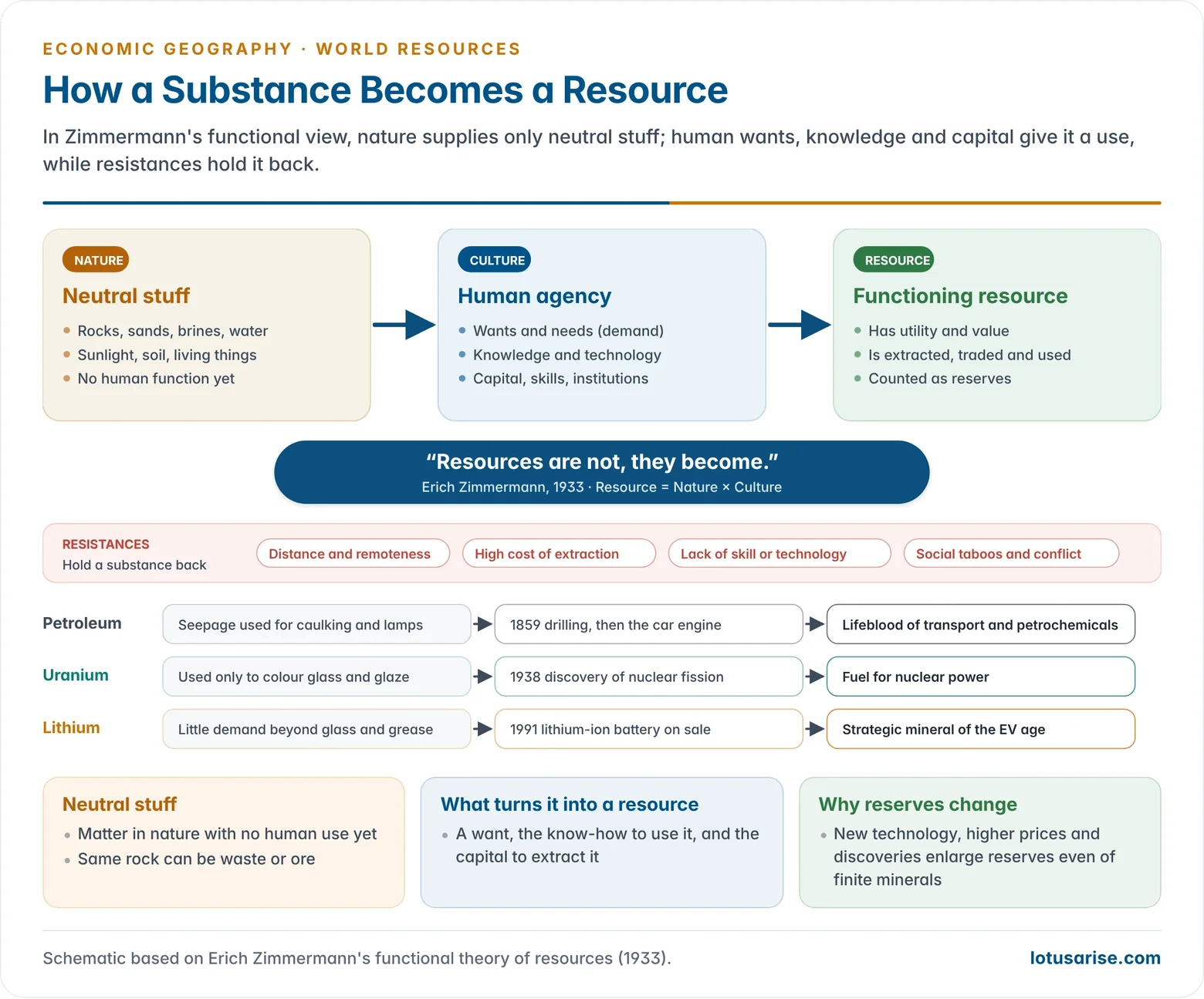
- Erich Zimmermann (1933) gave the functional theory of resources: “Resources are not, they become.”
- A substance becomes a resource only when human wants, knowledge and technology give it a function. Before that it is “neutral stuff”.
- Petroleum was neutral stuff until the internal-combustion engine created a demand for it. Uranium had little use before nuclear fission. Lithium became a strategic resource only with the rechargeable battery.
- Every resource has two attributes:
- Utility: the capacity to satisfy a need. This is what makes a substance a resource.
- Value: its worth. Some resources, such as petrol, have market value. Others, such as fresh air or a beautiful landscape, have non-market value.
- A substance is treated as a resource when:
- it is of use to humans;
- it can be transformed into something more useful;
- human skill and capital exist to exploit it.
- Resource = nature × culture. Zimmermann saw resources as the product of nature, human wants and culture (technology, institutions, capital) working together.
- Culture also creates resistances: obstacles such as distance, cost, social taboos or lack of skill that keep a substance from becoming a resource.
- People are the most important resource. Their ideas, knowledge and inventions create new resources from old materials. Fire led to cooking and smelting, the wheel to transport, and hydroelectric technology turned fast-flowing water into energy.
The Changing Perspective
| Aspect | Traditional view | Modern view |
|---|---|---|
| Nature of resource | Fixed gift of nature | Created by human wants and technology |
| Quantity | Finite stock to be shared | Expands or shrinks with technology, price and policy |
| Key factor | Physical endowment | Knowledge, capital, institutions and markets |
| Example | Coal as a fixed seam | Shale oil and gas made usable by fracking |
Classification of Resources
| Basis | Types | Examples |
|---|---|---|
| Origin | Biotic (organic) and abiotic (inorganic) | Forests, fisheries, livestock; minerals, water, land |
| Renewability | Renewable, non-renewable, recyclable | Solar, forests; coal, oil; metals such as iron and copper |
| Distribution | Ubiquities, commonalities, rarities, uniquities | Air and sunlight; farmland and water; tin and uranium; cryolite (once found commercially only in Greenland) |
| Stage of development | Potential, developed (actual), reserves, stock | Thorium in Kerala sands (potential); coal being mined (developed) |
| Ownership | Individual, community, national, international | Private farm; village common land; minerals under the state; the high seas and seabed beyond national jurisdiction |
| Purpose | Energy, raw materials, food | Coal, oil; cotton, iron ore; cereals, fish |
| Agency | Natural, human-made, human | Rivers; dams and machines; skills and institutions |
- Renewable resources are replenished by nature within a human time-span, but the rate of replenishment varies. A forest regrows in decades, groundwater may take centuries.
- They can be exhausted if use exceeds the rate of renewal, as in overfishing or groundwater mining.
- Non-renewable resources formed over geological time and are exhaustible. Some, like metals, can be recycled. Others, like coal and natural gas, are destroyed when used.
- Reserves are the part of a resource that is known and economically extractable with present technology and prices. Reserves therefore grow with discovery, technology and price, even for a finite resource.
Factors Governing Resource Distribution
- Geological factors: mineral wealth follows rock type and tectonic history.
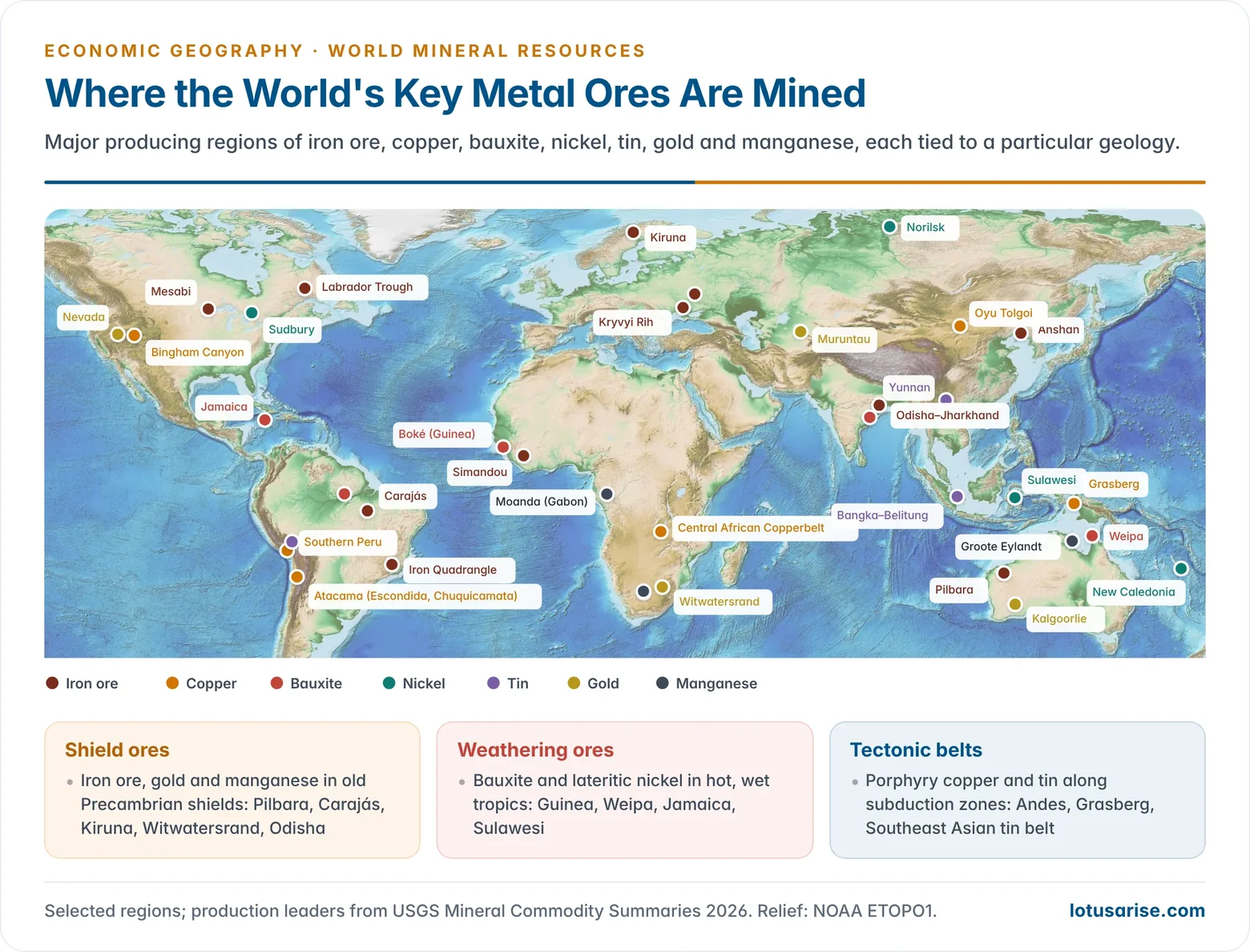
- Precambrian shields (Canadian, Brazilian, Australian, African and Indian shields) hold iron ore, gold, manganese and diamonds.
- Sedimentary basins hold coal, oil and natural gas. Subduction belts of the Andes and the Pacific rim hold porphyry copper.
- Climatic factors: rainfall and temperature shape soil fertility, vegetation, water resources and solar and wind potential.
- Laterite weathering in the humid tropics concentrates bauxite (Guinea, Australia’s Cape York, Odisha).
- Physiographic and biotic factors: relief controls hydropower potential and farmland, and biomes control forest and fishery resources.
- Historical and technological factors: colonial exploitation shaped the global resource map, from plantation crops to oil concessions in West Asia. New technology opens new frontiers, such as deep-water oil and shale.
- Economic and political factors: investment, infrastructure, prices and geopolitics decide which resources are worked.
- Examples include OPEC’s control of oil supply, Arctic resource claims, and China’s dominance of rare earth processing.
World Distribution of Mineral Resources
- Metallic minerals are unevenly spread. A few countries supply most of the world’s output of each metal, and the producing countries are often not the main consumers.
- Data below are mine production for 2025 (estimates) from the US Geological Survey (USGS), the standard global reference.
Ferrous Minerals
Iron Ore
- About 60 countries mine iron ore. World output of usable ore was about 2.6 billion tonnes in 2025.
- Australia is by far the largest producer (about 980 million tonnes, nearly two-fifths of world output), followed by Brazil, India and China.
- China is also by far the largest consumer and importer, because it makes over half the world’s steel.
- Australia and Brazil hold the largest reserves of iron content, followed by Russia.
| Region | Major producing areas |
|---|---|
| Australia | Pilbara (Mount Whaleback, Mount Tom Price), Koolyanobbing, Iron Knob and Iron Duke (South Australia) |
| Brazil | Carajás (Pará), Iron Quadrangle of Minas Gerais (Itabira) |
| China | Anshan (Liaoning, in old Manchuria), Hebei, Shandong, Xinjiang |
| Russia and Ukraine | Kursk Magnetic Anomaly, Urals (Magnitogorsk, Nizhny Tagil), Kryvyi Rih (Ukraine) |
| Europe | Kiruna and Malmberget (Sweden); historic Lorraine, Bilbao and South Wales |
| North America | Mesabi Range (Lake Superior), Labrador Trough (Quebec–Labrador) |
| Africa | Sishen and Postmasburg (Northern Cape, South Africa), Simandou (Guinea, first exports in 2025), Liberia, Mauritania |
| India | Odisha (Keonjhar–Barbil), Jharkhand (Noamundi), Chhattisgarh (Bailadila), Karnataka (Bellary–Hospet), Goa |
Manganese
- Manganese is essential for steel-making and increasingly for battery cathodes.
- South Africa mines about two-fifths of world manganese (Kalahari field of the Northern Cape) and holds close to a third of reserves.
- Gabon (Moanda), Ghana, Australia (Groote Eylandt, Woodie Woodie), Brazil (Amapá, Carajás), India and China follow.
- India mines manganese in Odisha, Madhya Pradesh (Balaghat), Maharashtra (Nagpur–Bhandara), Karnataka and Andhra Pradesh.
Non-Ferrous Minerals
Copper
- Copper makes up only about 0.01% of the Earth’s crust, and most ores carry well under 1–2% copper. It usually occurs as sulphide compounds such as chalcopyrite.
- World mine output was about 23 million tonnes in 2025.
- Chile is the largest producer (5.3 million tonnes, nearly a quarter of the world), followed by the Democratic Republic of the Congo (DRC), Peru, China, Russia and the USA.
- The DRC overtook Peru to become the second-largest producer in 2023, on the strength of the Central African Copperbelt.
- Chile holds the largest reserves (about 18%), followed by Australia, Peru, the DRC and Russia.
- China refines about half of the world’s copper, mostly from imported concentrate.
| Country | Major mines and regions |
|---|---|
| Chile | Escondida, Chuquicamata, El Teniente, Collahuasi |
| Peru | Cerro Verde, Antamina, Las Bambas, Toquepala; historic Cerro de Pasco |
| DRC and Zambia | Katanga (Kolwezi, Kamoa-Kakula) and the Zambian Copperbelt |
| USA | Arizona (Morenci), Utah (Bingham Canyon), New Mexico (Chino) |
| Canada | Sudbury (Ontario), British Columbia, Manitoba |
| Others | Grasberg (Indonesia), Oyu Tolgoi (Mongolia), Olympic Dam (Australia), Lubin (Poland) |
| India | Malanjkhand (Madhya Pradesh), Khetri–Singhana (Rajasthan), Singhbhum (Jharkhand) |
Bauxite (Aluminium Ore)
- Bauxite forms by lateritic weathering in hot, wet climates, so the largest deposits lie in the tropics.
- World output was about 440 million tonnes in 2025.
- Guinea has become the largest producer (about 150 million tonnes, a third of the world), ahead of Australia, China, Brazil and India.
- Guinea also holds the largest reserves, about a quarter of the world’s 29 billion tonnes, in the Boké–Sangarédi belt.
- Australia: Weipa on Cape York Peninsula (Queensland), the Darling Range (Western Australia) and Gove (Northern Territory).
- Other producers: Jamaica (St Elizabeth, Manchester), Brazil (Pará, Trombetas), Indonesia, Russia, Kazakhstan, Saudi Arabia and Vietnam (Central Highlands).
- India: Odisha (Panchpatmali in Koraput, Kalahandi), Jharkhand (Lohardaga), Chhattisgarh, Gujarat and Maharashtra.
Lead, Zinc and Tin
- Lead (ore: galena) and zinc (ore: sphalerite) usually occur together, so the producers overlap.
- China dominates both, mining over two-fifths of the world’s lead and about a third of its zinc.
- Lead: Australia (Broken Hill, Mount Isa), Peru, the USA, Russia, India and Mexico follow China.
- Zinc: Peru (Antamina, Cerro de Pasco), Australia, India (fourth-largest producer), Mexico, the USA and Bolivia follow China.
- India’s lead–zinc comes mainly from Rajasthan: Rampura Agucha, Zawar and Sindesar Khurd.
- Tin (ore: cassiterite) is concentrated in a few pockets.
- China (Yunnan) and Indonesia (Bangka–Belitung islands and offshore placers) lead, followed by Peru (San Rafael), Brazil, the DRC and Myanmar (Wa region of the Shan State).
- Malaysia’s Kinta Valley once led world output but now produces little, while the high plateau of Bolivia remains a historic producer.
Precious Metals and Diamonds
- Gold: world output about 3,300 tonnes (2025).
- China has been the largest producer since 2007, ahead of Russia, Australia, Canada and the USA.
- South Africa led the world until 2006 and still holds large reserves in the Witwatersrand basin. Australia and Russia hold the largest reserves.
- Key fields: Kalgoorlie–Boulder and Boddington (Australia), Olimpiada and Natalka (Siberia and the Russian Far East), Nevada (USA), and Muruntau (Uzbekistan).
- Silver: the chief ore minerals are argentite and other silver sulphides. Much silver is a by-product of lead, zinc, copper and gold mining.
- Mexico is the largest producer (Zacatecas, Chihuahua), followed by Peru, China, Bolivia (Potosí) and Chile.
- Diamonds: Russia (Yakutia) leads by volume, and Botswana (Jwaneng, Orapa) is a leader by value. Canada, the DRC, Angola (Catoca) and South Africa (Kimberley) follow.
- Australia’s Argyle mine was famous for pink diamonds until it closed in 2020.
- Lab-grown diamonds, made mainly in China and India, now take a large and growing share of the market.
Alloy, Strategic and Non-Metallic Minerals
| Mineral | Main uses | Leading producers (2025) | Key regions | Notes |
|---|---|---|---|---|
| Nickel | Stainless steel, battery cathodes | Indonesia (about two-thirds), Philippines, Russia, Canada, New Caledonia | Sulawesi and Halmahera (Indonesia); Mindanao and Palawan; Norilsk–Talnakh and Kola (Russia); Sudbury (Ontario); Kambalda (Western Australia); Moa Bay (Cuba) | Indonesia, Australia and Brazil hold the largest reserves |
| Tungsten | Hard alloys, cutting tools, defence | China (about four-fifths), Vietnam, Kazakhstan, Russia | Jiangxi, Hunan (China); Primorsky Krai (Russia); Mittersill (Austria); Panasqueira (Portugal); Hemerdon (UK); Degana (Rajasthan) | China holds over half of reserves |
| Antimony | Flame retardants, lead-acid batteries, munitions | China, Russia, Tajikistan | Xikuangshan in Hunan (the largest mine); Sakha–Yakutia (Russia); Anzob (Tajikistan); western Anatolia (Turkey) | China banned antimony exports to the USA in December 2024 |
| Mica | Electrical insulation, paints, cosmetics | India, Madagascar, China | Koderma–Giridih (Jharkhand), Nellore (Andhra Pradesh), Rajasthan; Madagascar; Inner Mongolia | Illegal mining in Jharkhand’s mica belt is a long-standing problem |
- Nickel shows how policy reshapes resource geography. Indonesia’s ban on raw nickel-ore exports from 2020 forced processing onshore, and Sulawesi and Halmahera became the world’s nickel-smelting hub.
World Distribution of Energy Resources
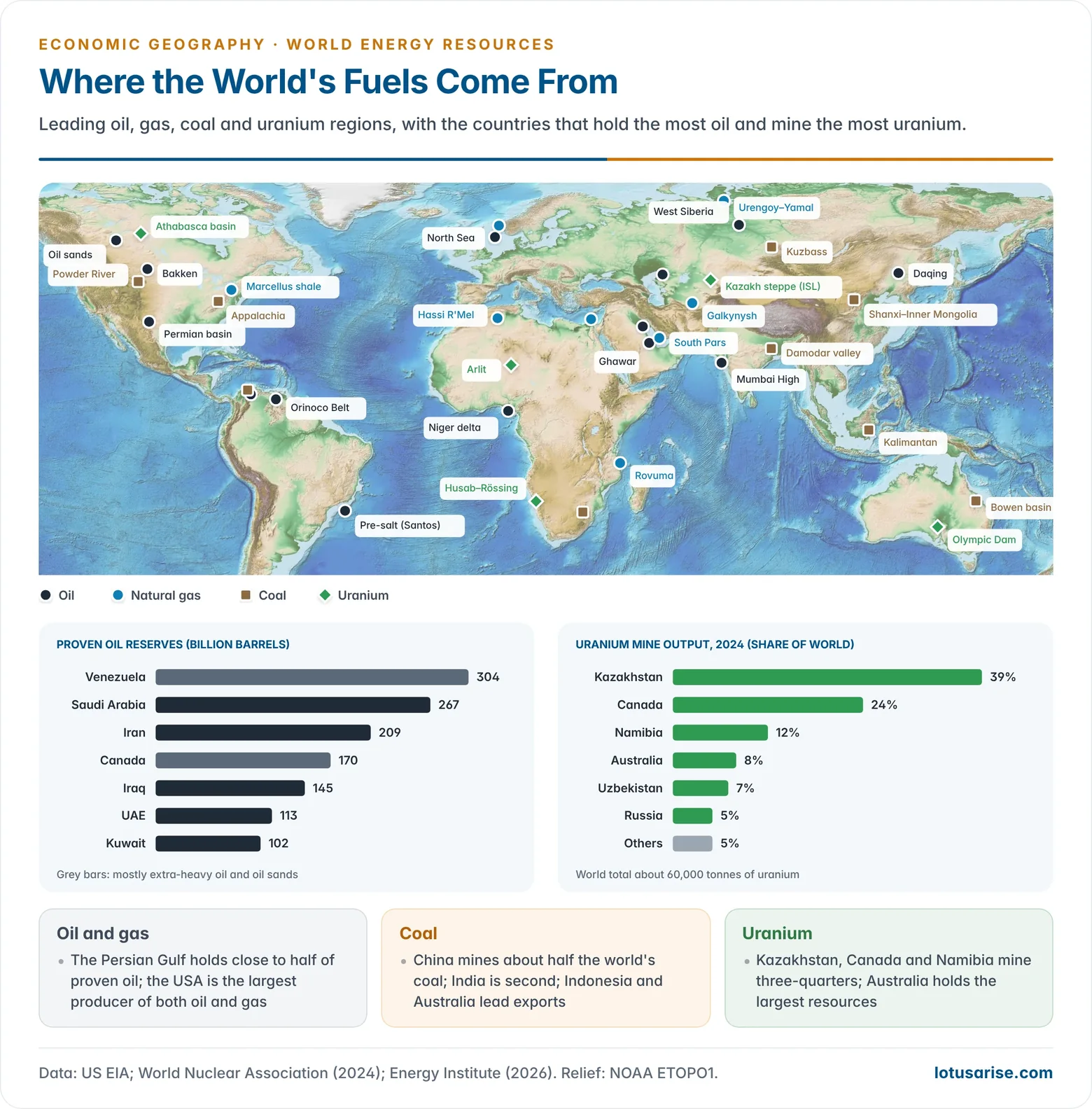
- Fossil fuels still supplied about 86% of the world’s energy in 2025, while renewables were the largest source of growth.
- Energy resources are even more concentrated than metals, which makes them central to geopolitics and trade.
Coal
- Coal was the backbone of the Industrial Revolution. It still supplies about a quarter of primary energy and generated 32.6% of the world’s electricity in 2025.
- Coal is bulky and low in value per tonne, so heavy industries such as iron and steel historically grew on or near coalfields (Ruhr, Donbas, Pennsylvania, Damodar valley).
- Coking coal is essential for steel. Coke-oven by-products such as coal tar, ammonia and benzol feed the chemical industry.
- Production: China mines about half of the world’s coal, mainly in Shanxi, Inner Mongolia and Shaanxi. India is the second-largest producer and crossed 1 billion tonnes in 2024–25.
- Indonesia is the largest exporter by volume, while Australia is the leading exporter of coking coal.
- Reserves: the USA has the largest, followed by Russia, Australia, China and India.
- Problems of coal production: coal mining causes land subsidence, mine fires (Jharia), acid mine drainage, deforestation, displacement and black-lung disease. Coal burning is the largest single source of CO₂.
- Economic problems include falling demand under climate policy, stranded assets, low productivity of underground mines, and job losses in coal regions (the “just transition” problem in Appalachia, the Ruhr and Jharkhand).
| Country | Major coalfields |
|---|---|
| China | Shanxi, Inner Mongolia (Ordos), Shaanxi, Xinjiang, Heilongjiang |
| India | Jharia, Raniganj, Bokaro (Damodar valley), Talcher (Odisha), Korba (Chhattisgarh), Singrauli, Wardha valley; Neyveli lignite (Tamil Nadu) |
| USA | Appalachian field, Illinois basin, Powder River basin (Wyoming–Montana) |
| Russia, Ukraine, Kazakhstan | Kuznetsk (Kuzbass), Pechora, Kansk–Achinsk, South Yakutia; Donbas; Karaganda and Ekibastuz |
| Australia | Bowen basin (Queensland), Hunter Valley and Sydney basin (New South Wales), Latrobe Valley lignite (Victoria) |
| Others | Indonesia (Kalimantan, Sumatra), South Africa (Witbank, Highveld), Colombia (Cerrejón), Poland (Upper Silesia), Germany (Rhineland lignite, historic Ruhr and Saar), Mozambique (Tete) |
Petroleum
- Oil is the lifeblood of modern transport and industry. It supplies fuels and the feedstock for petrochemicals, plastics and fertilisers, and it is the largest single source of primary energy (about a third).
- Oil is light, valuable and easily moved by tanker and pipeline, so it has the most globalised trade of any resource.
- Reserves: the Middle East holds close to half of the world’s proven oil reserves.
- Leading reserve holders: Venezuela (about 304 billion barrels, mostly extra-heavy crude of the Orinoco Belt), Saudi Arabia (267), Iran, Canada (Alberta oil sands), Iraq, the UAE and Kuwait.
- Supergiant fields: the Arabian–Iranian sedimentary basin holds most of them, including Ghawar, the largest conventional oilfield.
- Production: world output was about 100.6 million barrels per day in 2025.
- The USA is the largest producer (about 21 million barrels per day of crude and natural gas liquids), thanks to the shale revolution in the Permian basin and North Dakota’s Bakken.
- Saudi Arabia and Russia follow, and US output roughly equals the two combined.
| Region | Major oilfields and basins |
|---|---|
| Middle East | Ghawar, Safaniya, Khurais, Shaybah (Saudi Arabia); Burgan (Kuwait); Rumaila, Kirkuk (Iraq); Ahvaz (Iran); Upper Zakum (UAE); Dukhan (Qatar) |
| Russia and the Caspian | West Siberia (Ob basin, Samotlor), Volga–Ural, Sakhalin; Baku (Azerbaijan); Tengiz and Kashagan (Kazakhstan) |
| North America | Permian basin (Texas–New Mexico), Bakken (North Dakota), Gulf of Mexico offshore, Prudhoe Bay (Alaska); Athabasca oil sands (Alberta); Campeche Sound (Mexico) |
| South America | Orinoco Belt and Lake Maracaibo (Venezuela); pre-salt Santos and Campos basins (Brazil); Guyana’s Stabroek block (production since 2019); Vaca Muerta shale (Argentina) |
| Africa | Niger delta (Nigeria), Cabinda offshore (Angola), Sirte basin (Libya), Hassi Messaoud (Algeria) |
| Europe | North Sea (Brent, Statfjord, Ekofisk, Johan Sverdrup); historic Ploiești (Romania) |
| Asia-Pacific | Daqing, Shengli, Bohai Gulf, Tarim (China); Sumatra and Java (Indonesia) |
| India | Assam (Digboi, Naharkatia, Moran), Mumbai High offshore, Cambay basin (Ankleshwar), Barmer (Mangala, Rajasthan), Krishna–Godavari basin |
Natural Gas
- Natural gas is the cleanest fossil fuel, emitting about half the CO₂ of coal per unit of electricity. It is found associated with oil or in non-associated reservoirs.
- Liquefied natural gas (LNG) has turned a regional, pipeline-bound fuel into a global commodity.
- Reserves: Russia holds the largest proven reserves, followed by Iran, Qatar, Turkmenistan and the USA.
- South Pars–North Dome, shared by Iran and Qatar, is the largest gas field in the world.
- Production: the USA is the largest producer (about 1,074 billion cubic metres in 2025), followed by Russia, Iran and China.
- LNG exports: the USA became the top LNG exporter in 2023 and shipped about a quarter of global LNG in 2025, ahead of Qatar (Ras Laffan) and Australia.
| Region | Major gas fields and basins |
|---|---|
| Middle East | South Pars–North Dome (Iran–Qatar), Ghawar associated gas (Saudi Arabia), offshore Abu Dhabi |
| Russia and Central Asia | Urengoy, Yamburg, Bovanenkovo (Yamal), Sakhalin; Galkynysh (Turkmenistan); Karachaganak (Kazakhstan) |
| North America | Marcellus–Utica shale (Appalachia), Haynesville, Permian; Montney (Canada) |
| Africa | Hassi R’Mel (Algeria), Zohr (Egypt), Niger delta, Rovuma basin (Mozambique) |
| Europe | Troll and Ormen Lange (Norway); Groningen (Netherlands, closed in 2024 because of induced earthquakes) |
| Asia | Sichuan, Ordos and Tarim basins (China); Shwe (Myanmar); Sui (Pakistan); KG-D6 and Mumbai High (India) |
Nuclear Fuels: Uranium and Thorium
- Uranium is a strategic mineral for nuclear power and defence. Natural uranium is 99.3% U-238 and only 0.7% fissile U-235.
- Production (2024): about 60,000 tonnes of uranium were mined.
- Kazakhstan mines about 39% of the world’s uranium by in-situ leaching in its southern steppe basins.
- Canada (24%) works the world’s highest-grade ores in Saskatchewan’s Athabasca basin (McArthur River, Cigar Lake).
- Namibia (12%; Husab, Rössing), Australia, Uzbekistan and Russia follow.
- Resources: Australia holds the largest share of recoverable uranium (about 27%), mainly at Olympic Dam (South Australia), the world’s largest known uranium deposit.
- Niger (Arlit) long supplied France, and South Africa recovers uranium as a by-product of Witwatersrand gold.
- India’s modest deposits lie in the Singhbhum shear zone (Jaduguda, Turamdih), Tummalapalle (Andhra Pradesh) and Meghalaya (Domiasiat).
| Country | Major uranium mines and deposits |
|---|---|
| Kazakhstan | Inkai, South Inkai, Budenovskoye, Tortkuduk (in-situ leach mines of the southern steppe) |
| Canada | McArthur River, Cigar Lake, Key Lake (Athabasca basin, Saskatchewan); Elliot Lake (Ontario, worked out) |
| Namibia and Niger | Husab, Rössing, Langer Heinrich (Namibia); Arlit (Niger) |
| Australia | Olympic Dam, Four Mile, Beverley (South Australia); Ranger (Northern Territory, closed 2021) |
| Russia and Uzbekistan | Krasnokamensk–Streltsovsk (Transbaikal), Elkon (Yakutia, undeveloped); Navoi district (Uzbekistan) |
| India | Jaduguda, Narwapahar, Turamdih (Jharkhand); Tummalapalle (Andhra Pradesh); Domiasiat (Meghalaya) |
- Thorium is fertile, not fissile: it absorbs neutrons to form fissile U-233. It is about three times more abundant than uranium in the crust.
- Its main source is monazite in coastal placer sands. India, Brazil, Australia and the USA hold the largest resources.
- Other holders: Australia (Western Australian coastal sands), Brazil (Minas Gerais, Espírito Santo, Bahia), the USA (Idaho, Montana), Norway (where thorium was first identified, in 1828–29) and China (with rare earths).
- India’s monazite sands lie along the coasts of Kerala (Chavara), Tamil Nadu (Manavalakurichi), Odisha (Chhatrapur) and Andhra Pradesh. Thorium is the basis of the third stage of India’s three-stage nuclear programme.
Hydropower and Nuclear Power
- Hydropower is the largest source of renewable electricity, with about 1,300 GW installed.
- China has the largest capacity (Three Gorges, 22.5 GW, on the Chang Jiang). In July 2025 it began building a giant project on the lower Yarlung Tsangpo, upstream of India’s Brahmaputra.
- Brazil (Itaipu, shared with Paraguay; Belo Monte), Canada (Quebec’s La Grande and Churchill Falls, British Columbia), the USA (Grand Coulee, Hoover, the Tennessee Valley Authority) and Russia (Angara–Yenisei) follow.
- Norway draws around nine-tenths of its electricity from hydropower.
- Africa has vast untapped potential: the Inga site on the Congo, the Grand Ethiopian Renaissance Dam on the Blue Nile (inaugurated in 2025), Kariba (Zambezi) and Aswan (Nile).
- India: the North-East has the largest potential, followed by the Himalayan rivers. Major projects are Bhakra–Nangal, Tehri, Sardar Sarovar, Nagarjuna Sagar, Hirakud and Idukki.
- Nuclear power supplied about 9% of the world’s electricity in 2025.
- About 435 reactors stand in about 30 countries, including about 20 idle units in Japan, with roughly 376 GW of capacity.
- The USA has the largest fleet (94 reactors). France draws about two-thirds of its electricity from nuclear power, the highest share of any large country.
- China (61 reactors) has the fastest-growing programme and the most reactors under construction. Russia exports reactors through Rosatom (Kudankulam, Rooppur, Akkuyu).
- Germany closed its last three reactors in April 2023. Japan has restarted part of its fleet after the Fukushima disaster of 2011.
- India has over 20 reactors at Tarapur, Rawatbhata, Kalpakkam, Narora, Kakrapar, Kaiga and Kudankulam.
| Country | Nuclear profile |
|---|---|
| USA | Largest fleet; plants concentrated in Illinois, Pennsylvania, South Carolina and Alabama |
| France | About two-thirds of electricity; Gravelines, Cattenom, Paluel; reprocessing at La Hague |
| China | Coastal plants in Guangdong, Fujian, Zhejiang and Liaoning; the most reactors under construction |
| Russia | Kursk, Novovoronezh, Leningrad; Rosatom builds reactors in Turkey, Bangladesh, Egypt and India |
| Canada | CANDU heavy-water reactors in Ontario |
| Ukraine | Zaporizhzhia, Europe’s largest plant, shut down under occupation since 2022; Chernobyl disaster (1986) |
| UK | About 15% of electricity; Hinkley Point C under construction |
| South Korea | About 30% of electricity; also exports reactors (Barakah, UAE) |
| Others | Pakistan (Chashma, Karachi), Iran (Bushehr), Brazil (Angra), Argentina (Atucha, Embalse), South Africa (Koeberg, Africa’s only plant), Egypt (El Dabaa, under construction) |
Other Renewable Energy
- Renewable capacity reached 5,149 GW at the end of 2025. A record 692 GW was added that year, 85.6% of all new power capacity, and Asia accounted for about three-quarters of the additions.
- Solar is the fastest-growing source: about 511 GW was added in 2025. In 2025 solar’s share of world electricity (8.7%) overtook wind (8.4%) for the first time.
- Potential is highest in subtropical deserts and the tropics, where insolation is high and skies are clear.
- China has over 1,000 GW of solar, with large parks in the Gobi and Qinghai. Other leaders are the USA (California, Texas, Nevada), India, Germany and the Gulf states. Morocco’s Noor Ouarzazate is a landmark solar-thermal complex.
- India had about 171 GW of solar by September 2026. Bhadla (Rajasthan) and the Khavda renewable park in Kutch, designed as the world’s largest, are flagship sites.
- Wind favours mid-latitude westerly coasts, trade-wind belts and open plains.
- China (Gansu’s Jiuquan wind base), the USA (Texas and the Great Plains “wind belt”), Germany, India (Tamil Nadu’s Muppandal, Gujarat) and Brazil’s north-east lead.
- Offshore wind is led by the UK, China, Germany, Denmark and the Netherlands in the shallow North Sea and Baltic.
- Bioenergy: sugarcane ethanol in Brazil, maize ethanol in the USA, biogas and biomass heating in Europe, and bagasse, rice-husk and compressed-biogas plants in India.
- Geothermal is tied to plate boundaries and hotspots.
- Key sites: The Geysers (California), Indonesia and the Philippines on the Pacific Ring of Fire, Turkey, New Zealand (Taupō), Italy’s Larderello (the first geothermal electricity, 1904), Kenya’s Olkaria in the Rift Valley, and Iceland, which heats most of its homes geothermally.
- Tidal energy needs a large tidal range: Sihwa Lake (South Korea, 254 MW, the largest), La Rance (France, 1966) and the Bay of Fundy (Canada). The Gulfs of Kachchh and Khambhat and the Sundarbans offer India’s potential.
| Source | Leading regions | Locational control |
|---|---|---|
| Hydropower | China, Brazil, Canada, USA, Norway | High relief and large, perennial discharge |
| Solar | China, USA, India, Germany, Gulf states | High insolation, clear skies, cheap land |
| Wind | China, USA, Germany, India, UK (offshore) | Steady winds: westerly coasts, trade-wind belts, plains, shallow seas |
| Geothermal | USA, Indonesia, Philippines, Turkey, New Zealand, Kenya, Iceland | Plate margins, hotspots, rift valleys |
| Tidal | South Korea, France, Canada, UK | Funnel-shaped bays with high tidal range |
Resource Scarcity and Resource Management
The Global Resource Dilemma
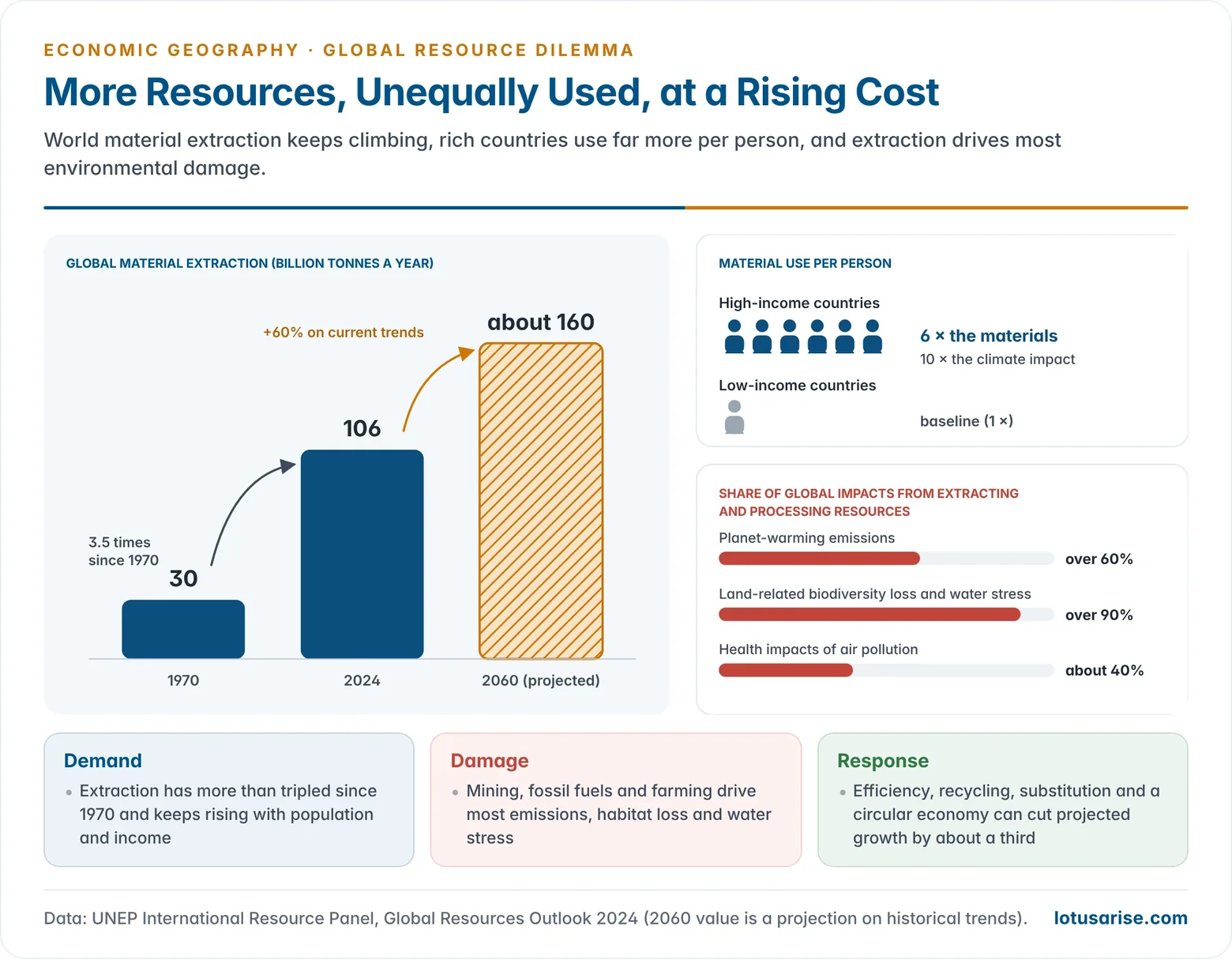
- The world faces a resource dilemma: development needs ever more resources, but their use is unequal, their supply is concentrated and their extraction is damaging the environment.
- Rising demand: global material extraction rose from about 30 billion tonnes in 1970 to 106 billion tonnes in 2024, and per-capita use from about 23 to 39 kg per person per day.
- Extraction is projected to grow by another 60% by 2060 on current trends.
- Unequal use: high-income countries use six times more materials per person than low-income countries and cause ten times more climate impact per person.
- Environmental cost: extraction and processing of resources, from farming to mining and large dams, cause over 60% of planet-warming emissions and over 90% of land-related biodiversity loss and water stress.
- Concentrated supply: the top three producers of key energy minerals supplied about 86% of world output in 2024. China is the leading refiner of 19 of 20 strategic minerals.
- Resource nationalism: producing states increasingly restrict exports to capture value or exert power.
- Examples include Indonesia’s nickel-ore ban, the DRC’s cobalt export ban and quotas of 2025, and China’s export controls on antimony, gallium, germanium, graphite and rare earths.
- Resource curse: abundant resources often coincide with weak institutions, conflict and slow growth, as in Venezuela, the Niger delta and the eastern DRC.
- The other side: technology, substitution and recycling keep expanding reserves. Shale oil, deep-water fields and new copper discoveries have repeatedly postponed predicted exhaustion.
- This debate between resource pessimists and optimists runs back to the Limits to Growth model of 1972.
Resource Management and Conservation
- Resource management is the planned use, development and protection of resources so that they meet present needs without compromising future generations. It is central to sustainable development.
- Principles:
- Sustainable yield: use renewable resources (forests, fisheries, groundwater) no faster than they regenerate.
- Efficiency and the 3Rs: reduce, reuse, recycle. Recycled aluminium needs about 5% of the energy of primary metal.
- Substitution: replace scarce materials (sodium-ion for lithium-ion batteries, renewables for fossil fuels).
- Circular economy: design products for repair and recovery, and recover urban mines such as e-waste.
- Integrated, area-based planning: watershed, river-basin and coastal-zone management that treats land, water and biota together.
- Equity and participation: benefit-sharing with local and tribal communities, as through India’s District Mineral Foundations.
- Conservation of minerals: develop replacement minerals, cut waste in mining and processing, use by-products, locate processing plants near mines, and train miners in safer, cleaner methods. Seabed exploration within the EEZ can add new reserves.
- India’s measures: the National Mineral Policy 2019, auction-based allocation under the amended MMDR Act, the National Critical Mineral Mission (2025), ethanol blending, the 500 GW non-fossil capacity target for 2030, and the LiFE (Lifestyle for Environment) movement.
Previous Year Questions
2014Discuss environmental and economic problems associated with coal production.2014“World is passing through a global resource dilemma.” Comment.1998Explain the term resource management. Discuss its relevance in the context of global resource scarcity and the future of mankind.



Sir, please start an answer writing program over here! for geography optional.
Thanx alot for these notes and my request is can you provide us all of the notes and link in a single pdf form
Yeah Sure, but in the future. For now, Please make your own short notes.
Thanks
Geography as a subject is very scattered so thank you for providing such consolidated notes
Keep Reading
Nagarjuna Sagar Project in Andhra Pradesh correction
All important resources at one place. Exactly the way I wanted. Thank you so much.
Legendary notes
Wonderful notes.
PYQ ADD KARO SIRJI
You should also add up some crucial points such as largest exporter or importer of natural resources
FIRST TIME VISITED THIS WEBSITE AND GOT AMAZING PRECISE AND WELL DEFINED MATERIAL,……..THANK YOU