

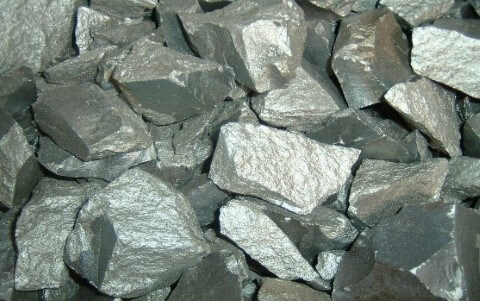
- Manganese is a silvery-grey metal, very hard and brittle, and it is the essential alloying input of steel making.
- India’s reserves are considered satisfactory. Yet India now imports far more ore than it exports, because steel demand has outrun domestic output of good grades.
Manganese
Nature and Occurrence
- Like iron ore, manganese ore is abundant in the Dharwar and Cuddapah rocks of the Pre-Cambrian era, the ore-bearing part of the Indian rock system.
- It is never found free in nature. It occurs combined with iron, laterite and other minerals.
- Pyrolusite is the most important ore.
- Ores of major commercial importance:
| Ore | Composition | Manganese content |
|---|---|---|
| Pyrolusite | MnO₂ | about 63.2% |
| Psilomelane | Manganese oxide with water, and oxides of Ba, K and Na as impurities | commonly 45–60% |
| Manganite | Mn₂O₃.H₂O | about 62.4% |
| Braunite | 3Mn₂O₃.MnSiO₃ | about 62%, with SiO₂ about 10% |
Importance
- It is used primarily in the iron and steel industry, and it is the basic raw material for steel alloys.
- About 6 kilograms of manganese ore go into one tonne of steel.
- It also goes into bleaching powder, insecticides, paints and batteries.
Manganese Ore Distribution in India
- Reserves in world terms:
- An older claim ranks India second in reserves after Zimbabwe, at 430 million tonnes. Current world tables do not bear it out.
- USGS (2024) places South Africa (32%), Australia (26%), China (15%), Brazil (14%) and Ukraine (7%) in the lead by metal content. India has about 34 million tonnes of metal content, out of 1,900 million tonnes.
- Production in world terms: India stays fifth, but the countries ahead have changed.
- Older lists had China, Gabon, South Africa and Australia ahead of it, or Brazil in place of China.
- In 2023 the order ran South Africa (36%), Gabon (19%), Australia (12%), China (8%), then India (6%), narrowly above Ghana.
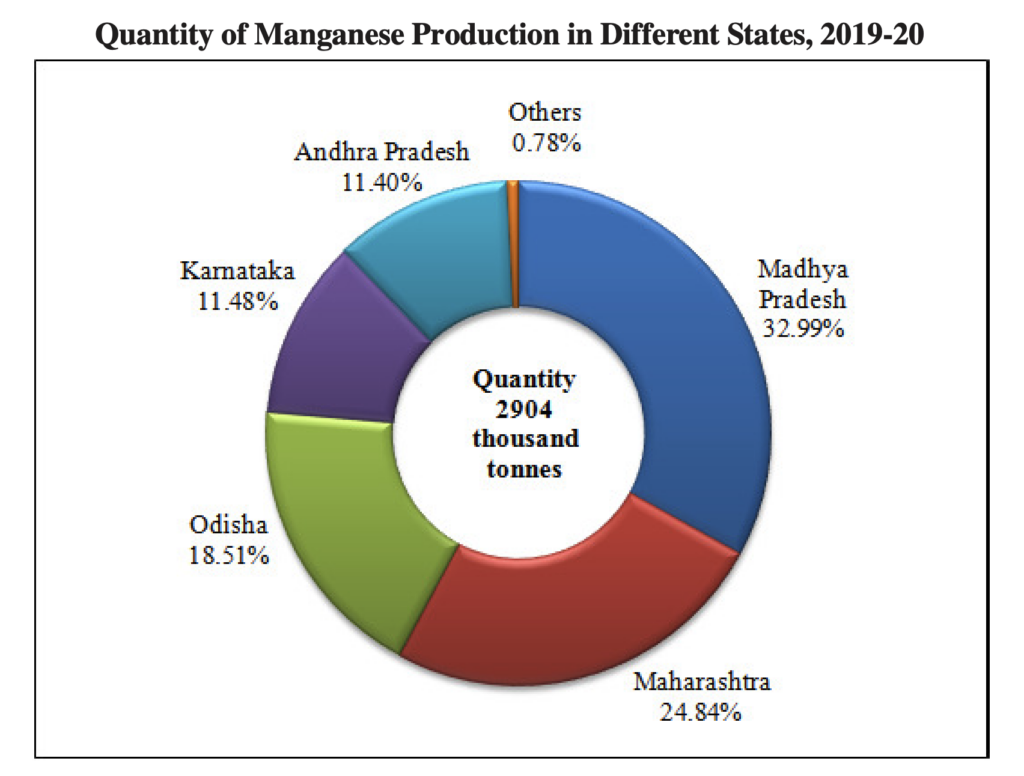
- Major producing States: Madhya Pradesh, Maharashtra, Odisha, Karnataka and Andhra Pradesh, whose combined output tops 98%.
- Maharashtra and Madhya Pradesh between them account for over half of national output: 61.10% in 2023-24.
- Output in 2023-24: 3,381 thousand tonnes, 20% more than the 2,827 thousand tonnes of the previous year. Provisional output for 2024-25 was 3.80 million tonnes.
- It was long close to static: 1,632 thousand tonnes in 1980-81 and 2,349 thousand tonnes in 2011-12.
- About 69% of 2023-24 output was below 35% Mn, and only about 7% above 46% Mn.
- Mode of occurrence: metamorphosed bedded sedimentary deposits of Archaean age, in two series:
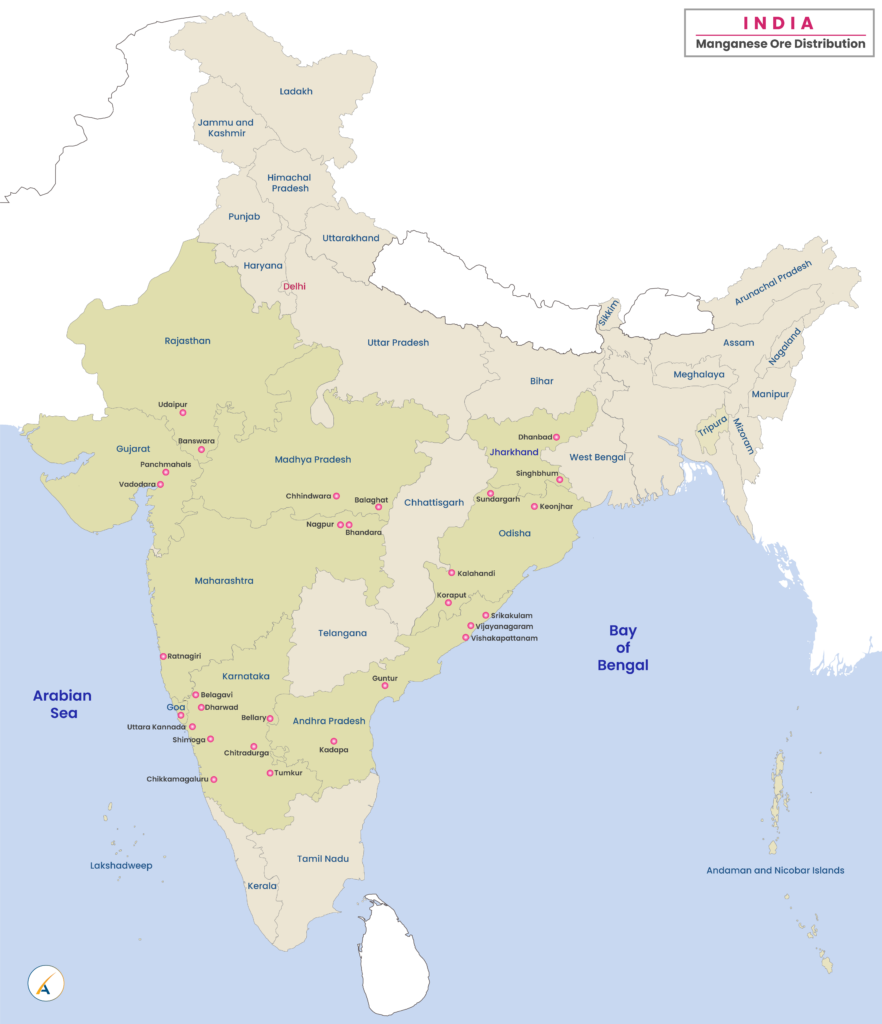
- Gondite Series: Madhya Pradesh (Balaghat, Chhindwara, Jhabua), Maharashtra (Bhandara, Nagpur), Gujarat (Panchmahal), Odisha (Sundargarh).
- Kodurite Series: Odisha (Ganjam, Koraput) and Andhra Pradesh (Srikakulam, Visakhapatnam).
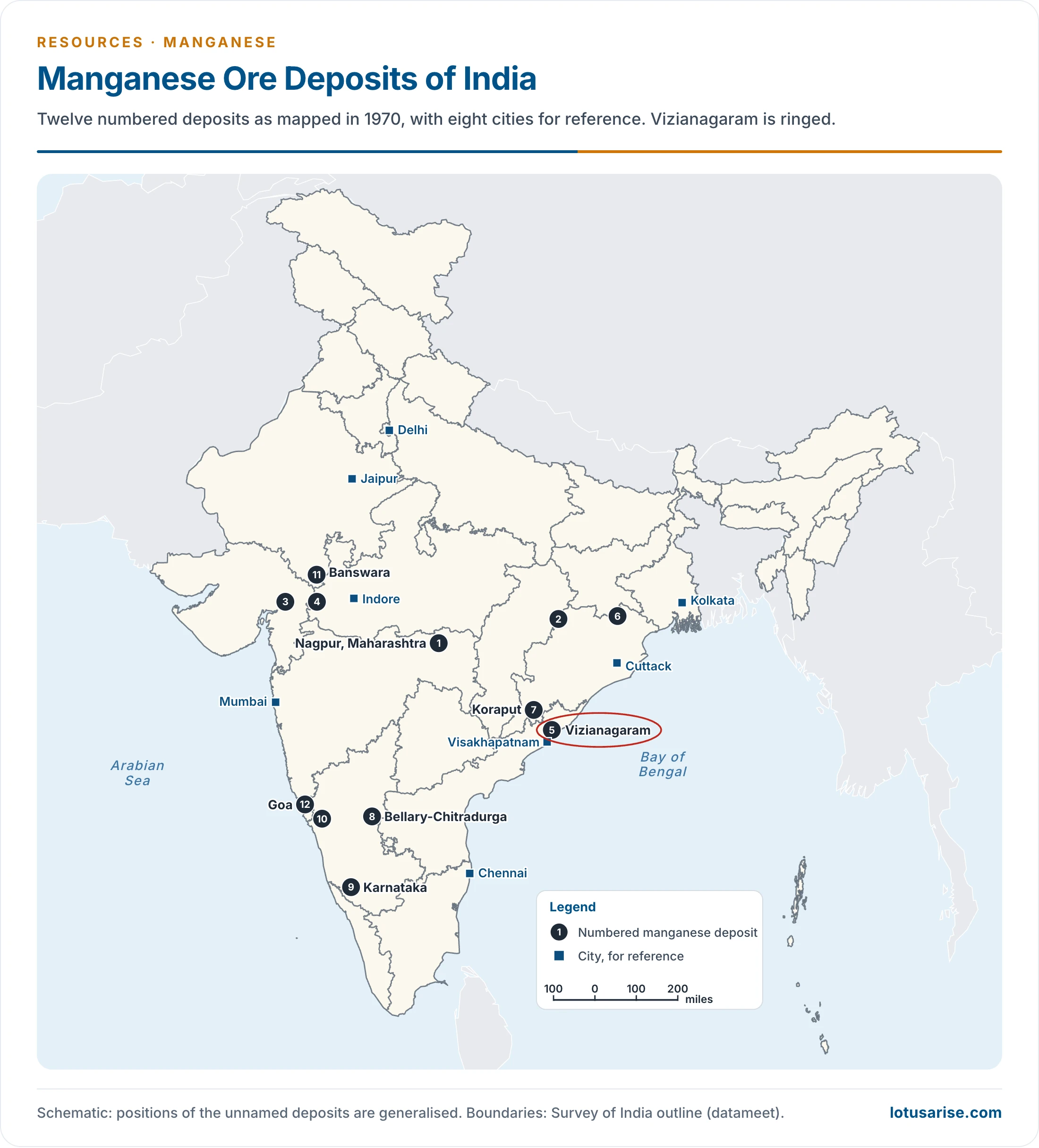
- On this map, the deposit in the Bellary-Chitradurga interior lies in Karnataka and Andhra Pradesh. Its numbered dots carry no key.
State-wise Reserves of Manganese
- Total reserves and resources have grown with survey under the UNFC system of the National Mineral Inventory:
| Item | 2010 | 1 April 2015 | 1 April 2020 |
|---|---|---|---|
| Total (million tonnes) | 430 | 495.87 | 503.62 |
| Reserves | – | 93.47 | 75.04 |
| Remaining resources | – | 402.40 | 428.58 |
| Odisha | 44% | 44% | 34% |
| Karnataka | 22% | 22% | 25% |
| Madhya Pradesh | 13% | 12% | 12% |
| Maharashtra | 8% | 7% | 12% |
| Goa | 3% | 7% | 7% |
| Andhra Pradesh | 4% | 4% | 6% |
| Jharkhand | 3% | 2% | 3% |
| Others | 3% (Rajasthan, Gujarat, West Bengal) | 2% (with Telangana) | 2% (with Telangana) |
- By grade:
- In 2015: ferromanganese grade 7%, medium grade 11%, blast furnace (BF) grade 28%, and the remaining 54% mixed, low, other and unclassified, including 0.17 million tonnes of battery or chemical grade.
- In 2020: ferromanganese 8%, medium 7%, BF 30%, and the remaining 55% in the same lower classes, with battery or chemical grade at about 0.03%.
- Only a small part ranks as reserves, so proven good ore is scarcer than the total suggests.
Production by State
| State | Older share | 2011-12 | 2019-20 | 2023-24 |
|---|---|---|---|---|
| Madhya Pradesh | 27.08% | 27.59% | 32.99% | 30.55% |
| Maharashtra | 25.25% | 27.66% | 24.84% | 30.55% |
| Odisha | 24% | 24.08% | 18.51% | 19.25% |
| Karnataka | 10.92% | 5.79% | 11.48% | 10.50% |
| Andhra Pradesh | 9.71% | 13.71% | 11.40% | 8.81% |
Madhya Pradesh
- Joint leader in 2023-24 at 30.55%, after leading alone with about 33% in 2019-20. Two decades before 2011-12 its share had been only about 11%.
- The main belt runs through Balaghat and Chhindwara, and Balaghat alone gave 9.10 lakh tonnes in 2023-24.
- Geologically this tract continues the Nagpur-Bhandara belt of Maharashtra.
- MOIL Ltd, the public sector miner, runs mines here, including mechanised underground workings at Balaghat.
Maharashtra
- Joint leader in 2023-24 at 30.55%, against an earlier 25.25%.
- Nagpur and Bhandara carry the principal belt, and Ratnagiri has ore of high grade.
Odisha
- Largest holder of resources (34%) and third in output (19.25%). It was earlier reckoned at 24%, and was called one of the largest producers.
- Sundargarh and Keonjhar are the main districts. Keonjhar alone once gave one-fourth (1/4th) of national output.
- Kalahandi and Koraput are also important. Ore types differ by tract:
- Gondite deposits in Sundargarh.
- Kodurite and khondalite deposits in Kalahandi and Koraput.
- Lateritic deposits in Bolangir and Sambalpur.
Karnataka
- Second largest resources (25%), with 10.50% of output in 2023-24, against an earlier 10.92%.
- Districts: Uttara Kannada, Shimoga, Bellary, Chitradurga and Tumkur. The Sandur company mines in Ballari.
Andhra Pradesh
- 8.81% of output in 2023-24, against an earlier 9.71%.
- Srikakulam and Visakhapatnam form the main belt.
- Srikakulam was India’s earliest producer, from 1892.
- Cuddapah, Vizianagaram and Guntur are other districts.
Other Producers
- Goa, which holds 7% of resources.
- Gujarat: Panchmahals and Vadodara.
- Rajasthan: Udaipur and Banswara.
- Jharkhand: Singhbhum and Dhanbad.
Mining
- Eight reporting mines were underground in 2023-24: three in Madhya Pradesh and five in Maharashtra. Seven of them belong to MOIL.
- Other mines are worked opencast, ranging from shallow workings in Odisha, Karnataka and Goa to deep ones in the regular deposits of Madhya Pradesh, Maharashtra and Andhra Pradesh.
Export of Manganese
- Older pattern:
- Four-fifths of output was consumed at home, and exports kept falling as domestic demand rose in steel, dry batteries, chemicals and other industries.
- Japan was the largest buyer, at about two-thirds of exports. Other buyers were the USA, UK, Germany, France and Norway.
- India banned the export of ore above 35% manganese in 1971 to feed its own industries. The exported share of output fell from 88.86% in 1970-71 to under 15% in 2013-14.
- Current pattern (2023-24):
- Exports were a mere 271 tonnes, all to Nepal.
- Imports reached 5.59 million tonnes, more than domestic output, from South Africa (43%), Gabon (20%), UAE (12%), Singapore (9%) and France (5%).
- Most grades can leave the country only through MOIL as the State Trading Enterprise.
Uses of Manganese
- Hard manganese steel goes into rifle barrels, railway tracks, safes and prison bars.
- Steel production is the main use, and manganese is also alloyed widely.
- It serves to deoxidise and desulphurise steel.
- Dry-cell batteries use manganese dioxide.
- It gives a black-brown pigment in paint.
- It acts as a catalyst and decolouriser of glass.
- Manganese sulphate goes into a fungicide and other pesticides.
Worldwide Supply of and Demand for Manganese
- Production:
- Only four countries gave 70% of world ore in 2011, in this order: South Africa, Australia, China and Gabon.
- In 2023 world output was about 53 million tonnes, with South Africa and Gabon now first and second. The four leaders gave 75%.
- Reserves: those four countries, with Brazil and Ukraine, were put at 90% of proven reserves. On USGS 2024 figures they hold about 97%.
- Only a small fraction of reserves is economic, which keeps interest alive in deep-sea nodules.
- Import dependence:
- The United States, like many industrial countries, particularly in Europe, has no manganese reserves of its own to work. It has produced no ore of 20% or more manganese since 1970.
- All its ore is imported. From 2008 to 2011 the sources were Gabon (61%), Australia (21%), South Africa (7%) and Brazil (5%). From 2021 to 2024 they were Gabon (64%), South Africa (24%) and Mexico (12%).
- Demand tracks steel: consumption has followed steel production historically and still does.
Previous Year Questions
1986Discuss briefly the utilization, distribution and production of manganese in India.





Thank you so much 🙌
Thankyou so much !
Thanks sir
truly amazing notes , hats of to your hardworking commitment
great notes
Very usefull article in free ho cost such a great heart sir.
But your content is misused by some coaching institutes @ live3gurukul Ranchi Jharkhand
They just compiled your free content topic wise and sell notes
Hope this will be helpful to you