

- A mineral is a naturally occurring substance, usually solid and inorganic, that can be written as a chemical formula and has a crystal structure.
- The number of known minerals keeps rising. The older count was “more than two thousand“; the International Mineralogical Association now recognises about 6,200 species (2025).
- Most are inorganic, formed by various combinations of elements.
- A few occur as single elements: gold, silver, diamond (carbon) and sulphur. These native elements are not organic.
- A small proportion of the earth’s crust is organic material, such as coal and petroleum.
- India’s mineral wealth rests on old crystalline rocks of the Peninsula, and its output is concentrated in a handful of States. Iron ore alone made up about 70% of the value of metallic minerals in 2018-19 and about 78% in 2023-24.
Mineral Resources
Mining and India’s Mineral Base
- Mining and quarrying span pits, shafts, quarries and wells, along with the on-site work that makes ore saleable: dressing and beneficiation, such as crushing, screening, washing, cleaning and grading.
- Methods:
- Opencast mining suits minerals lying close to the surface.
- Underground mining reaches deeper deposits.
- Drilling and pumping bring up oil and natural gas.
- Why India is rich: its large area and varied geology give it a wide range of minerals.
- A classical appraisal counted nearly 100 minerals worked, about 30 of them important.
- It rated coal, iron and mica as fairly abundant; manganese, titanium, aluminium, refractory materials and limestone as adequate; and copper, lead and zinc as deficient. Tin and nickel were called workable.
- Trade has shifted since that appraisal:
- Exports traditionally included iron ore, titanium, manganese, bauxite and granite.
- Imports included copper, silver, nickel, cobalt, zinc, lead, tin, mercury, limestone, platinum and graphite.
- In 2023-24 India imported 5.59 million tonnes of manganese ore against 271 tonnes exported, and 4.49 million tonnes of bauxite.
- It is now self-sufficient in zinc, while nickel is wholly imported.
- World rank in 2023 (British Geological Survey, with Indian output for 2023-24):
| Mineral or metal | India’s rank | Share of world output |
|---|---|---|
| Iron ore | 3rd | 11.05% |
| Chromite | 3rd | 8.39% |
| Manganese ore | 5th | 6.38% |
| Bauxite | 6th | 5.75% |
| Aluminium (primary) | 2nd | 5.95% |
| Zinc (slab) | 3rd | 5.75% |
| Copper (refined), lead (refined) | 10th | 1.84%, 1.44% |
Types of Minerals
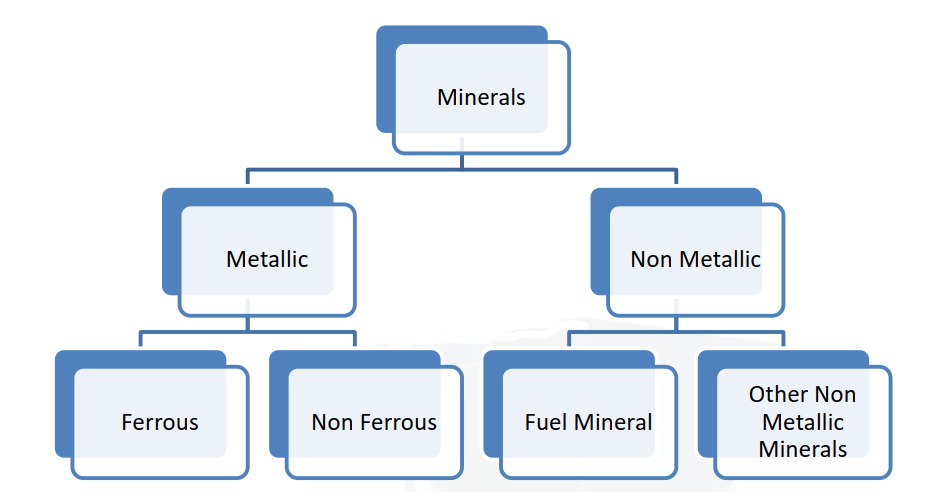
- Mineral resources fall into two major categories: metallic and non-metallic.
Metallic Minerals
- Metallic minerals contain metal elements in their raw form. Smelting them yields a new product, the metal.
- They rank as the second most important group after fossil fuels, and they are lodged mainly in Archaean and Dharwar rocks, with some in the Cuddapah system.
- Examples: iron ore, copper, gold, zinc, silver, manganese and chromite.
- Share in mineral value:
- Older accounts, which counted fuels, put them at 7% of total mineral value.
- Leaving out fuel, atomic and minor minerals, they are dominant: ₹1,28,632 crore of ₹1,41,803 crore in 2023-24, against ₹13,171 crore for non-metallic minerals.
- They give a strong base to metallurgical industry, and so drive industrialisation and urbanisation. India’s reserves are substantial.
- Ferrous and non-ferrous:
- Ferrous minerals contain iron: chromite, iron ore and manganese. Pyrites, tungsten, nickel and cobalt are often listed here too, for their part in steel making.
- Non-ferrous minerals have none: lead, silver, gold, copper and bauxite, with tin and magnesium. The Indian Bureau of Mines places nickel in this group.
- Significance: iron consumption per person serves as a yardstick of a country’s living standard. Iron underpins modern civilisation and basic industry.
Non-metallic Minerals
- Non-metallic minerals yield no metal. Melting them gives no new metallic product.
- By origin they are organic or inorganic:
- Organic: the fossil fuels or mineral fuels, formed from buried plants and animals, such as coal and petroleum. Coal is mined from India’s coalfields in Gondwana and Tertiary rocks.
- Inorganic: mica and limestone, graphite, dolomite, gypsum, nitrate and potash.
| Feature | Metallic | Non-metallic |
|---|---|---|
| Content | Metal elements in raw form | No metal to extract |
| On melting | A new product forms | No new product |
| Rock setting | Usually igneous and metamorphic | Often young fold mountains and sedimentary rocks |
| Conduction | Good conductors of heat and electricity | Mostly insulators |
| Working | Malleable and ductile | Not malleable or ductile; break easily |
| Look | Generally lustrous | No shine or lustre |
Mineral Belts of India
- The defining feature of Indian minerals is their uneven distribution, and relief, rock and rainfall explain it:
- High-rainfall tracts lack soluble minerals such as limestone, gypsum and salts.
- The northern plains are poor because thick alluvium buries the bedrock.
- The Himalaya has varied rocks but a complex structure. Small deposits, hard terrain, poor transport, sparse population and a harsh climate make most mining uneconomic.
- The old crystalline plateaus and low hills of the Peninsula hold the rich, sizeable deposits. The belts are grouped there.
- Five major belts are usually recognised. Names vary, so both forms appear below.
| Belt | Also called | Extent | Geological base | Main minerals |
|---|---|---|---|---|
| North-Eastern Peninsular | Northern, Chota Nagpur | Chota Nagpur and Odisha plateaus: Jharkhand, West Bengal, Odisha | Archaean, Dharwar, Gondwana troughs | Coal, iron, manganese, mica, bauxite, copper, kyanite, chromite, beryl, apatite |
| Central | Midland | Chhattisgarh, Madhya Pradesh, Telangana, Andhra Pradesh, Maharashtra | Dharwar, Gondwana, Vindhyan | Manganese, bauxite, limestone, marble, coal, gems, mica, iron, graphite |
| Southern | South-Eastern | Karnataka plateau, Tamil Nadu upland, parts of Andhra Pradesh | Dharwar, Cuddapah, Tertiary lignite | Iron, manganese, chromite, bauxite, gold, lignite |
| South-Western | – | Western Karnataka, Goa, Ratnagiri | Dharwar | Iron, garnet, clay |
| North-Western | Western | Aravalli in Rajasthan, adjoining Gujarat | Aravalli and Delhi rocks, Tertiary basins | Copper, lead, zinc, uranium, mica, steatite, beryllium, gems, petroleum, salt |
North-Eastern Peninsular (Northern) Belt
- The richest belt and the mineral heartland of India. Almost every major mineral occurs here.
- Chota Nagpur is credited with very high national shares. These are classical figures, and the distribution has since moved:
| Mineral | Older list | Classical appraisal | Now |
|---|---|---|---|
| Kyanite | 100% | 100% | Jharkhand 7.83% of resources; Telangana 45.75%, Andhra Pradesh 30.28% (2020) |
| Iron ore | 90% | 93% | Odisha, Jharkhand and Chhattisgarh hold 78% of haematite (2020) |
| Chromium | 90% | 70% | Odisha alone about 96% of chromite (2020) |
| Mica | 75% | 70% | Shifted to other States |
| Coal | 70% | 84% | Spread across Gondwana fields in several States |
- The same appraisal gave it 50% of fire clay, 45% each of asbestos and china clay, 20% of limestone and 10% of manganese.
- Manganese, copper and limestone are other notable minerals of the region.
- Assam petroleum tract: older schemes attach Assam to this belt for petroleum, lignite and Tertiary coal. Most schemes now treat it as lying outside the main belts.
Central Belt
- The second largest belt, and an eastward extension of the same ore province, covering the Chhattisgarh and Maharashtra region beside Chota Nagpur.
- Huge iron ore and limestone reserves lie in Chhattisgarh.
- The Godavari-Wardha valley holds large coal reserves.
- The belt still needs fuller geological survey.
Southern (South-Eastern) Belt
- Eastern Karnataka: Bellary and Hospet for iron ore.
- Andhra Pradesh: the Cuddapah and Kurnool region for mining, and Nellore for mica.
- Telangana: an older line credits it with bauxite, but it has no named share of bauxite resources (2020). Those lie in Andhra Pradesh (12%). Telangana leads in kyanite and produces limestone and manganese ore.
- Tamil Nadu: the largest lignite reserves in India, at 79% of the national total (1 April 2024), mainly around Neyveli.
- In ferrous minerals and bauxite it resembles the north-eastern belt. It lacks coal other than lignite, so its range is narrower.
South-Western Belt
- Karnataka: the Dharwad region is rich in minerals, with Shimoga, Chitradurga, Tumkur and Chikmagalur as other areas.
- Goa is known for iron ore, and Ratnagiri in Maharashtra also has iron reserves.
- Garnet and clay are the other deposits.
North-Western Belt
- It runs along the Aravalli Range through Rajasthan and Gujarat. It developed late and promises non-ferrous metals: copper, lead and zinc, with uranium, mica, steatite, beryllium, and aquamarine and emerald.
- Gujarat: known for petroleum, with gypsum, manganese and bauxite.
- Salt: both States are rich in it, from the Kachchh coast and the playa lakes of Rajasthan.
- Rajasthan: building stones (sandstone, granite, marble), with extensive gypsum and Fuller’s earth. Dolomite and limestone feed the cement industry.
Outside the Main Belts
- Himalaya: generally poor in metals, with pockets of coal, bauxite, copper, slate, lead, zinc, nickel, cobalt, tungsten, gold, silver, gypsum and limestone.
- Offshore: Mumbai High and the Godavari basin hold oil and gas.
- Sea bed: ocean resources include oil, gas and polymetallic nodules carrying manganese, copper and nickel.
- India has held a nodule exploration contract with the International Seabed Authority since 25 March 2002, covering 75,000 sq km of the Central Indian Ocean Basin.
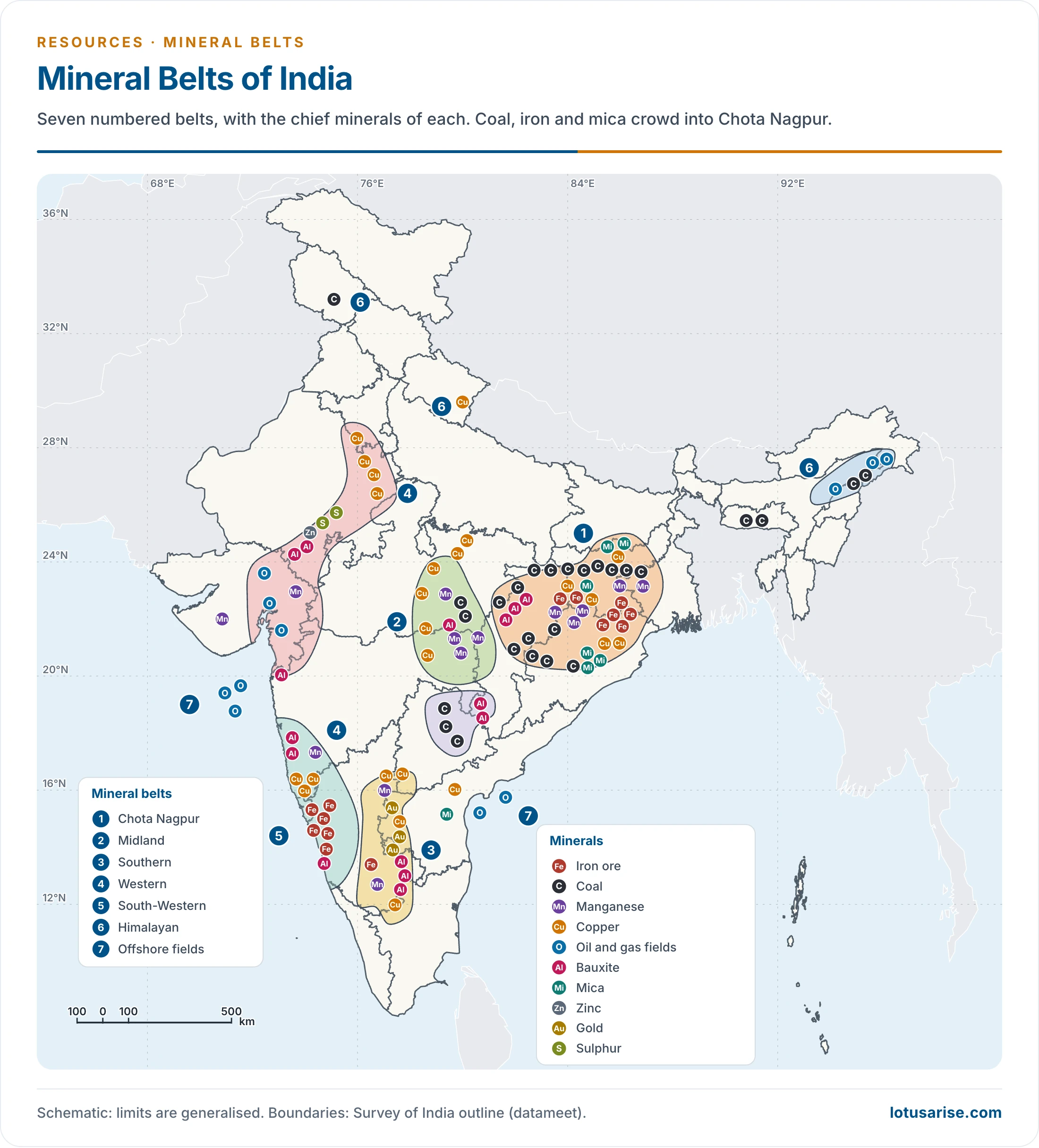
- This map numbers seven belts: 1 Chota Nagpur, 2 Midland, 3 Southern, 4 Western, 5 South-Western, 6 Himalayan, and 7 the offshore fields.
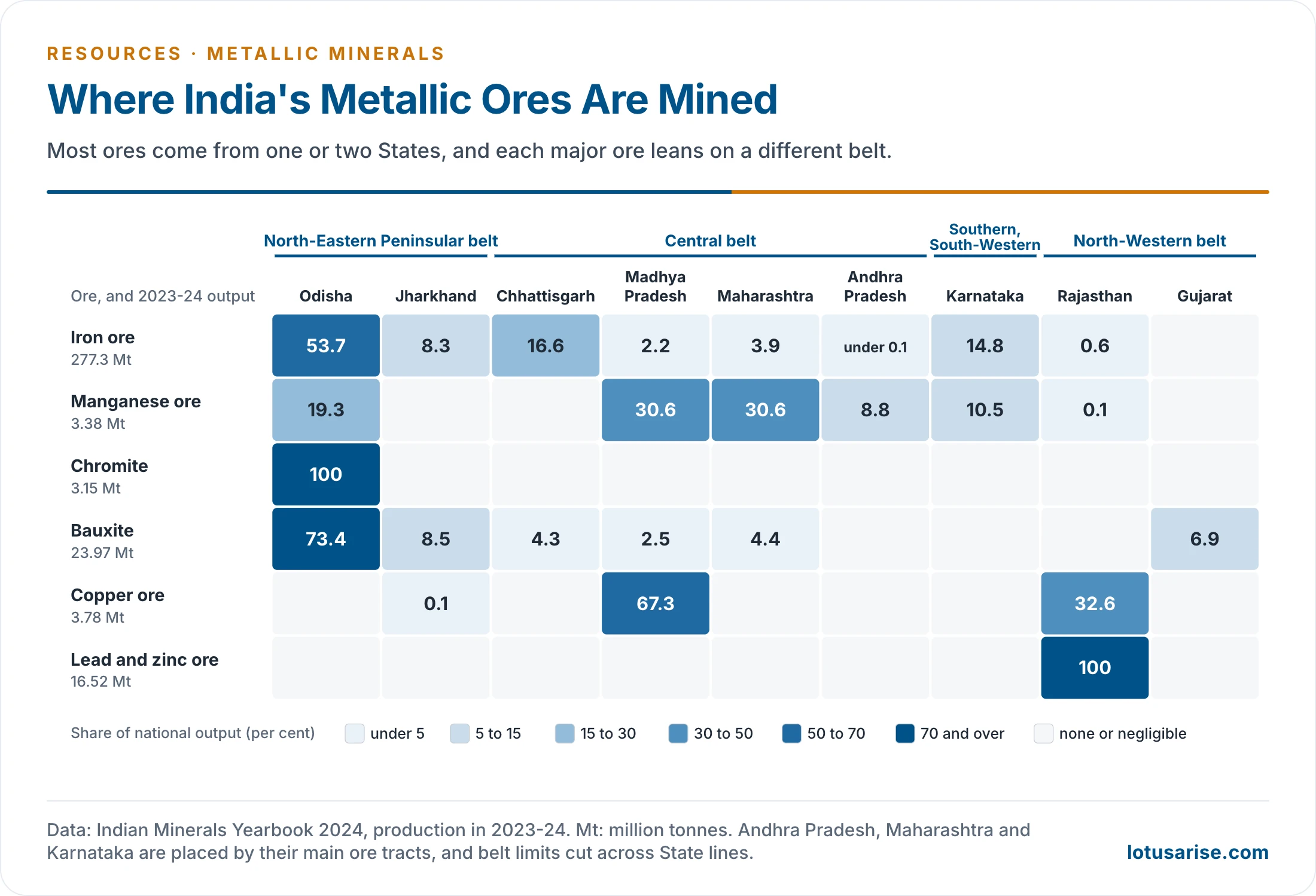
Geological Structure and the Belts
- Each belt follows a rock system:
- Dharwar rocks carry the high-grade iron and manganese of Singhbhum, Bastar, Bellary and Goa, along with gold and copper.
- Cuddapah rocks add iron, manganese, copper and cement limestone.
- Gondwana troughs along the Damodar, Mahanadi and Godavari hold nearly all the coal.
- Vindhyan rocks supply limestone, building stone and diamonds.
- Laterite cappings on old plateau surfaces hold bauxite, from the Eastern Ghats to the Maikala Range.
- Tertiary rocks hold petroleum and lignite.
- So the belts trace the older part of the Indian rock system, exposed across the Peninsular Plateau, while alluvium hides it in the plains.
Conservation and Critical Minerals
- Minerals are exhaustible, which earns mining the label of a robber industry: ore once removed never comes back.
- Ways to conserve:
- Efficient mining and beneficiation, so that less ore is lost.
- Recycling of cyclic metals such as iron, aluminium, copper, brass and tin. Scrap use is already large in Japan, Britain and Italy.
- Substitution of scarce metals by plentiful ones, such as aluminium for copper in electrical work.
- Exporting manufactured goods instead of raw ore.
- Policy: the National Mineral Policy, 2019 aims at transparency, better regulation and sustainable mining.
- Critical minerals:
- In June 2023 the Ministry of Mines listed 30 critical minerals, including copper, nickel, cobalt, lithium, tungsten, graphite and the rare earths. They carry high economic value and high supply risk.
- The MMDR Amendment Act, 2023 placed 24 critical and strategic minerals in a separate part of its First Schedule and empowered the Centre to auction their blocks.
- The National Critical Mineral Mission, approved on 29 January 2025, runs from 2024-25 to 2030-31 with ₹16,300 crore of government spending and an expected ₹18,000 crore from public sector firms.
- Why they matter: they feed electric vehicles, batteries, defence and clean energy, while India depends on imports for many of them.
- Challenges: long import chains, thin domestic resources, and the tailings, dust and forest loss that come with extraction.
Iron Ore Distribution in India
Iron Ore
- Iron ores are rocks and minerals from which metallic iron can be extracted.
- India’s reserves are large. They occur in several formations, but the main economic deposits lie in the Precambrian volcano-sedimentary Banded Iron Formation (BIF).
- Magnetite has the highest iron content, up to 72%, and its magnetic quality is valuable in the electrical industry.
- Haematite is the main industrial ore by quantity used, though its theoretical iron content is a little lower.
- Four producing belts:
- Odisha-Jharkhand
- Durg-Bastar-Chandrapur
- Bellary-Chitradurga-Chikmagalur-Tumkur
- Maharashtra-Goa
Four Types of Iron Ore
| Ore | Iron content | Colour and form | Setting | Areas or remarks |
|---|---|---|---|---|
| Magnetite (Fe₃O₄, “black ore”) | Up to 72%; 60–70% as mined | Black, magnetic | Dharwar and Cuddapah; igneous or metamorphosed banded rock | Karnataka, Andhra Pradesh, Rajasthan, Tamil Nadu, Goa, Keralam (Kerala) |
| Haematite (Fe₂O₃) | 60–70% | Red and brown; massive, hard | Dharwar and Cuddapah; banded iron formations | Odisha, Jharkhand, Chhattisgarh, Andhra Pradesh; Karnataka, Maharashtra, Goa in the west |
| Limonite | 30–40% in low-grade ore; up to 60% in classical tables | Yellow | Damuda series of Raniganj, Garhwal, Mirzapur, Kangra valley | Low grade, but easy and cheap to mine |
| Siderite (iron carbonate) | About 48% in pure form; under 40% in Indian ore | Brown; many impurities | Mixture of iron and carbon | Low grade, but self-fluxing because it holds lime |
- Which is “best”: magnetite is richest in iron, so it is often called the best. Haematite is still treated as superior in India, because its ores are of higher grade as actually worked and far more of them are proven.
- Only 202 million tonnes of magnetite rank as reserves, against 6,209 million tonnes of haematite.
Iron Ore Distribution and Reserves
- Total resources: 35.29 billion tonnes (National Mineral Inventory, 1 April 2020).
| Ore | Total resources (million tonnes) | Of which reserves | Older figure (2010) | Leading States (2020) |
|---|---|---|---|---|
| Haematite | 24,057 | 6,209 | 17,882 | Odisha 39%, Jharkhand 20%, Chhattisgarh 19%, Karnataka 12%, Goa 5% |
| Magnetite | 11,227 | 202 | 10,644 | Karnataka 69.5%, Andhra Pradesh 13.1%, Rajasthan 7.1%, Tamil Nadu 4.7%, Goa 2.3% |
- About 95% of total resources lie in Odisha, Jharkhand, Chhattisgarh, Karnataka, Goa, Telangana, Andhra Pradesh and Tamil Nadu.
- About 79% of haematite lies in the Eastern Sector, and about 93% of magnetite in the Southern Sector.
- World position: by iron content India holds about 3,400 million tonnes of the world’s 87,000 million tonnes of reserves (USGS, 2024).
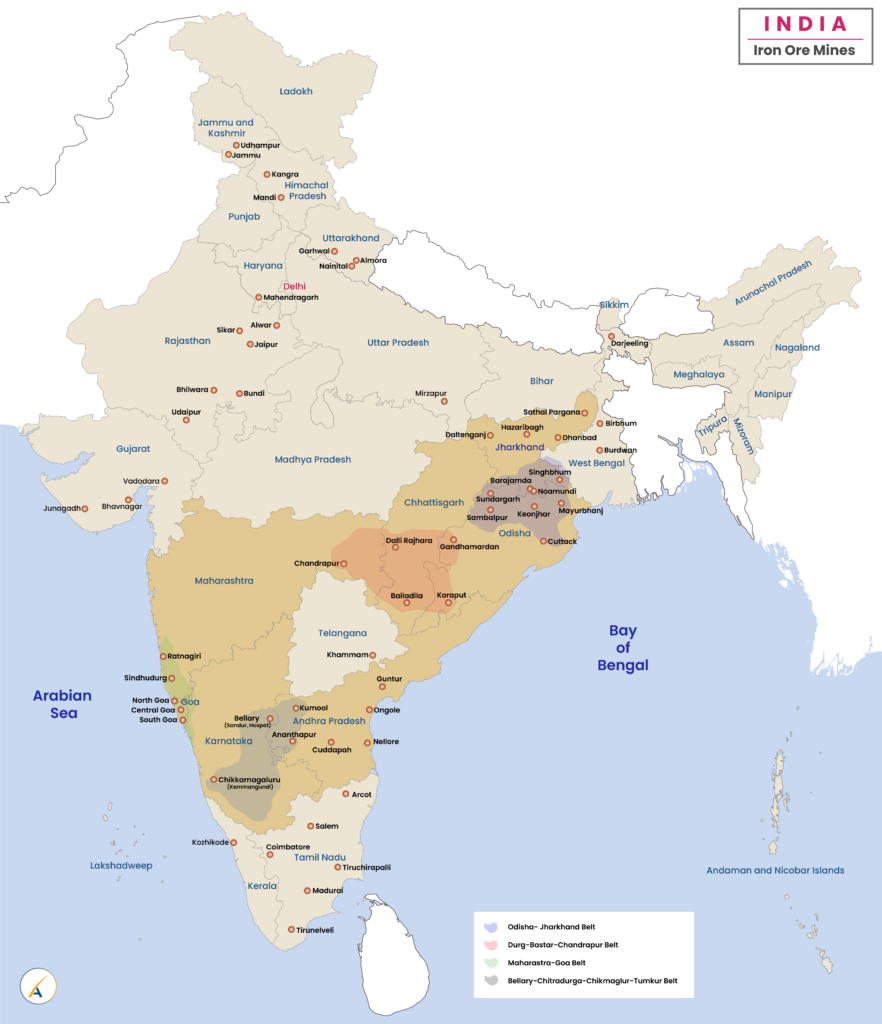
- On this map, “Sathal Pargana” should read Santhal Parganas.
Production
| Year | 1950-51 | 1960-61 | 1970-71 | 1980-81 | 1990-91 | 2000-01 | 2009-10 | 2011-12 | 2022-23 | 2023-24 | 2024-25 |
|---|---|---|---|---|---|---|---|---|---|---|---|
| Million tonnes | 3.9 | 10.9 | 32.5 | 42.2 | 53.7 | 80.6 | 218.6 | 167.3 | 258.3 | 277.3 | 289.4 |
- Output climbed steadily to 2009-10, then fell sharply when the courts halted mining in Karnataka and Goa. It has since passed the old peak.
- World production (2023): Australia 952 million tonnes (38%), Brazil 436 (17%), India 277 (11%), China 250 (10%).
| State | 2023-24 (million tonnes) | Share | Share in 2011-12 |
|---|---|---|---|
| Odisha | 148.96 | 53.71% | 40.06% |
| Chhattisgarh | 46.04 | 16.60% | 18.21% |
| Karnataka | 41.00 | 14.78% | 7.88% |
| Jharkhand | 22.90 | 8.26% | 11.32% |
| Maharashtra | 10.73 | 3.87% | 0.88% |
| Madhya Pradesh | 6.05 | 2.18% | 0.66% |
| Rajasthan | 1.53 | 0.55% | 0.02% |
| Goa | 0.01 | under 0.01% | 19.95% |
- About 90% of output comes from mechanised mines. All iron ore mining is opencast, and 72.95% of output in 2023-24 was fines.
- The ranks have changed more than once:
- Goa led for years before other States passed it.
- An older order of output ran Karnataka 25%, Odisha 22%, Chhattisgarh 20%, Goa 18%, Jharkhand 14%. The matching order of reserves was Jharkhand 25%, Odisha 21%, Karnataka 20%, Chhattisgarh 18%, Goa 10%.
- In 2023-24 the order was Odisha, Chhattisgarh, Karnataka.
Iron Ore in Karnataka
- Third in output in 2023-24. The ore is mainly high-grade haematite and magnetite, and output has grown about threefold since 1980.
- Chikmagalur district:
- Kemmangundi in the Baba Budan Hills has high-grade ore that fed the Bhadravati steel plant.
- The Kudremukh Hills hold very large deposits of low-grade magnetite.
- Kudremukh was mined on a large scale for export through New Mangalore port.
- Mining there stopped at the end of 2005 after a Supreme Court judgment, because the area had become a national park.
- KIOCL now runs a pellet plant at Mangaluru on ore from elsewhere.
- Bellary-Hospet area and Sandur Ranges: high-grade ore that serves the Vijayanagar steel plant of JSW at Toranagallu.
- Illegal mining in Bellary grew into a national scandal.
- The Supreme Court banned mining in Bellary on 29 July 2011, and in Tumkur and Chitradurga in August 2011.
- On 18 April 2013 it let Category A and most Category B mines reopen and cancelled 49 Category C leases.
- Other mining areas: Chitradurga, Uttara Kannada, Shimoga, Dharwad, Tumkur, Kumaraswamy and Ramandurg.
- Dust is the main environmental problem of the Bellary-Hospet area.
- Donimalai Iron Ore Mine:
- Commissioned in 1977 in the Bellary region and worked by the National Mineral Development Corporation (NMDC).
- It produced 4 million tonnes a year of run-of-mine ore, that is, ore in its natural, unprocessed state, at an average of 65% iron.
- Export routes: Chennai outer harbour (532 km by rail) and Marmagao (370 km by rail).
- Dispute:
- Karnataka set an 80% premium on ore sales as a condition of lease renewal, and NMDC stopped work in November 2018.
- The lease now runs 20 years, from 4 November 2018 to 3 November 2038.
- Mining resumed after more than two years, once a 22.5% premium had been approved in December 2020.
Iron Ore in Odisha
- Largest producer: 148.96 million tonnes, 53.71% of India (2023-24), and largest holder of haematite. Odisha was Orissa until 2011.
- India’s richest haematite deposits lie in the Barabil-Koira valley, in Keonjhar and adjoining Sundargarh. About 100 deposits crowd into 53 sq km, with ore of about 60% iron or more.
- The most important deposits, by district:
- Keonjhar: Banspani, Thakurani, Toda, Kodekola, Kurband, Phillora, Kiriburu.
- Sundargarh: Malangtoli, Kandadhar Pahar, Koira, Barsua.
- Mayurbhanj: Gorumahisani, Sulaipat, Badampahar.
- Cuttack: the Tomka range in the Sukind area, and Daitari hill on the Keonjhar boundary.
- Koraput: Hirapur hills. Sambalpur: Nalibassa hill.
Iron Ore in Chhattisgarh
- Second in output in 2023-24 (16.60%), and in earlier years third. It has about 18% of resources in older counts; its 19% of haematite in 2020 makes about 13% of haematite and magnetite together.
- The ores are widely spread. The leading deposits are in Bastar and Durg: Bailadila in the south and Dalli-Rajhara in Durg. Raigarh, Bilaspur and Surguja also produce.
- Bailadila:
- 14 deposits lie along a north-south range about 48 km long, with high-grade ore above 65% iron.
- It has long been described as the largest mechanised mine in Asia. Mining and beneficiation are done here, and smelting elsewhere, as at the Visakhapatnam steel plant.
- Slurry pipeline: a line of about 270 km (267 km in current records) carries ore slurry, a semi-liquid mixture, from the Bailadila pithead to Visakhapatnam.
- It was commissioned in the mid-2000s to feed the pellet plant at Visakhapatnam now run by AM/NS India.
- NMDC is building its own 15 million tonne a year line from Bailadila through Jagdalpur to Visakhapatnam.
- Nagarnar: NMDC’s steel plant in Bastar started production in 2023-24.
- Trade: high-grade ore goes through Visakhapatnam to Japan and other countries. Japan has almost no iron ore, and its large automobile industry keeps demand high.
- Environment: the forest here is dense, and mining and waste dumping call for steady afforestation.
- Dalli-Rajhara: a 32 km range with about 120 million tonnes of ore at 68–69% iron, worked for the Bhilai steel plant.
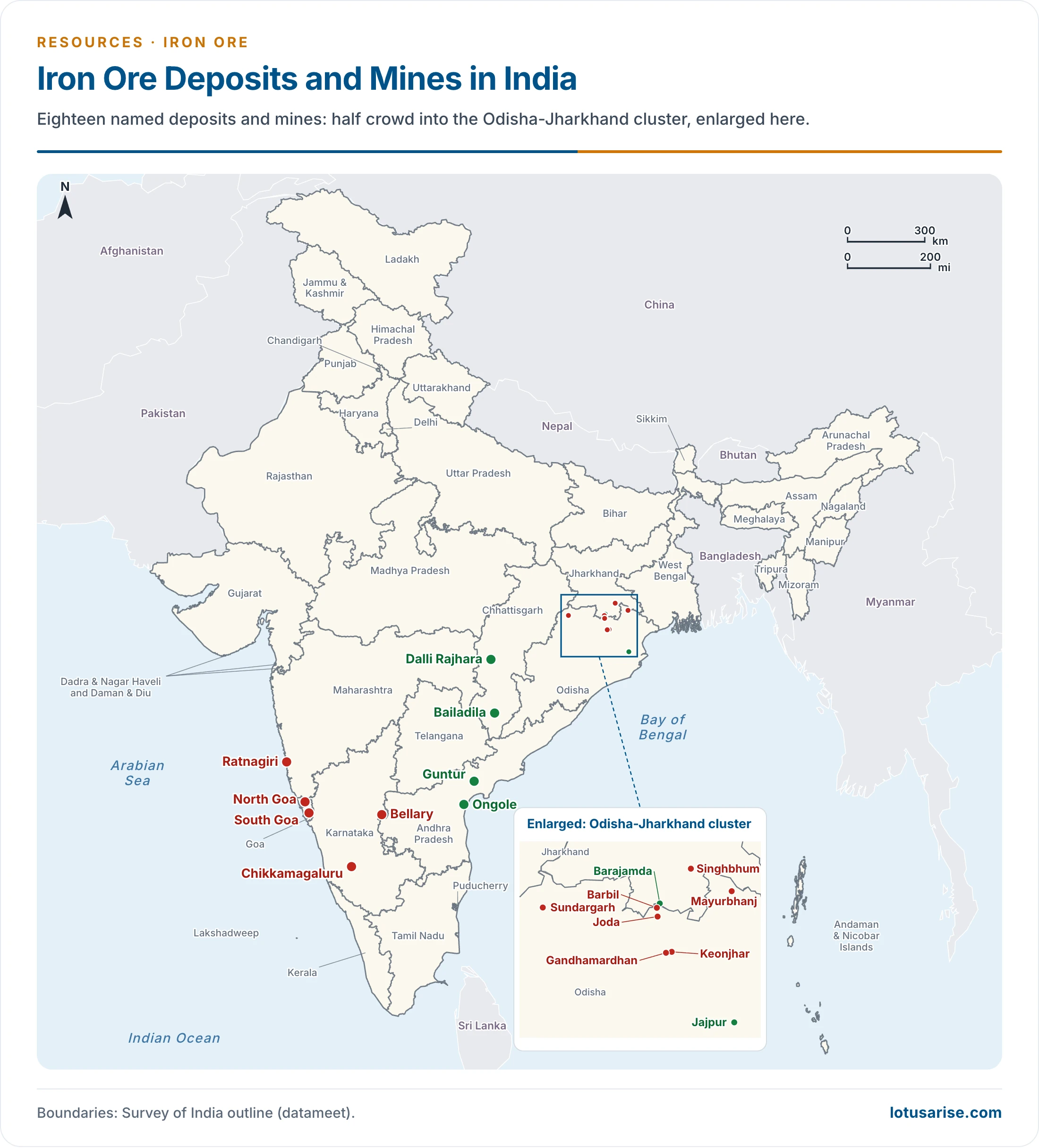
- Jammu and Kashmir and Ladakh have been two Union Territories since the 2019 reorganisation.
Iron Ore in Goa
- Production began late, and Goa rose quickly from nothing to a leading position.
- Older shares: it was the fourth-largest producer with over 18% in an older count, and second with 19.95% in 2011-12 (33.4 million tonnes).
- Now: only about 0.01 million tonnes in 2023-24, after court orders stopped mining.
- The Supreme Court suspended mining in 2012, allowed it back in 2014 under a cap of 20 million tonnes a year, and in February 2018 quashed 88 leases.
- Output has been returning through auctioned blocks: 0.36 million tonnes in April-November 2024.
- Mines: there were nearly 315 mines in North, Central and South Goa.
- The ore is mostly low-grade limonite and siderite, worked efficiently in opencast mechanised mines.
- The richest deposits are in North Goa, at Pirna-Adolpale-Asnora, Sirigao-Bicholim-Daldal, Sanquelim-Onda, and Kudnem.
- Transport: river barges on the Mandovi and Zuari, joined by the Cumbarjua canal, or ropeways, carry ore to Marmagao port.
- Trade: most of Goa’s ore went to Japan; recent shipments have gone to China.
- Environment: wash-off from dumps silts fields, streams and creeks in the rains, harming crops and fish.
Iron Ore in Jharkhand
- Fourth in output in 2023-24 (8.26%), down from over 14% and then 11% in earlier counts.
- It is credited with 25% of reserves in older accounts. In 2020 it held 20% of haematite, which is about 13% of the two ores together.
- Mining began in Singhbhum district in 1904, when it was part of Bihar. The ore is of very high quality, and the deposits are long-lived.
- The main belt is a range about 50 km long, from near Gua to Pantha in Bonai, Odisha.
- Gua is a mechanised public sector mine of the Steel Authority of India.
- Other Singhbhum deposits are Budhu Buru, Kotamati Buru and Rajori Buru. The Noamundi mines lie at Kotamati Buru.
- Magnetite occurs near Daltonganj in Palamu. Smaller deposits occur in Santhal Parganas, Hazaribagh, Dhanbad and Ranchi.
Iron Ore in Other States
- These States produce small quantities. Shares in brackets are for 2011-12, with 2023-24 output where reported:
- Andhra Pradesh (1.02%; 0.13 million tonnes): Kurnool, Guntur, Cuddapah, Anantapur, Khammam (now in Telangana), Nellore.
- Maharashtra (0.88%; 10.73 million tonnes): Chandrapur, Ratnagiri, Sindhudurg, and now Gadchiroli.
- Madhya Pradesh (0.66%; 6.05 million tonnes).
- Tamil Nadu: Salem, North Arcot, Tiruchirappalli, Coimbatore, Madurai, Tirunelveli.
- Rajasthan: Jaipur, Udaipur, Alwar, Sikar, Bundi, Bhilwara.
- Uttar Pradesh: Mirzapur.
- Uttarakhand (formerly Uttaranchal): Garhwal, Almora, Nainital.
- Himachal Pradesh: Kangra and Mandi.
- Haryana: Mahendragarh.
- West Bengal: Burdwan, Birbhum, Darjeeling.
- Jammu and Kashmir: Udhampur and Jammu.
- Gujarat: Bhavnagar, Junagadh, Vadodara.
- Keralam: Kozhikode.
Ministry of Mines Annual Report 2019-20
- Self-sufficiency: India was self-sufficient in bauxite, iron ore and sillimanite. Magnesite, rock phosphate, manganese and copper concentrate were imported.
- With Odisha’s mines working again, India could also export iron ore.
- State shares that year: Odisha over 55%, Chhattisgarh almost 17%, Karnataka 14%, Jharkhand 11%.
- Value in 2018-19: metallic minerals were worth ₹64,044 crore, with iron ore above ₹45,000 crore, about 70%.
- Value in 2023-24: iron ore was worth about ₹99,825 crore, out of ₹1,28,632 crore for metallic minerals.
Export of Iron Ore from India
- Volume swings widely:
| Year | 1960-61 | 1980-81 | 2000-01 | 2010-11 | 2011-12 | 2013-14 | 2022-23 | 2023-24 |
|---|---|---|---|---|---|---|---|---|
| Exports (million tonnes) | 3.2 | 22.4 | 20.2 | 46.9 | 47.2 | 16.5 | 21.17 | 46.37 |
- Older accounts made India the fifth largest exporter, sending 50–60% of output abroad, and later about 25%. Buyers named were Japan, Korea, European and Gulf countries, with Japan taking about three-fourths.
- Now:
- Exports were about 17% of output in 2023-24.
- China took 94% and Indonesia 3%, so Japan is no longer the main buyer.
- Fines made up 68% of exports, pellets 26% and lumps 5%.
- India also imported 4.96 million tonnes.
- Major ports: Visakhapatnam, Paradip, Marmagao and Mangalore.
- Trade policy: export duty is 30% on ore of 58% iron and above, and nil below that grade.
- A growing steel industry absorbs more ore at home, which leaves less for export.
Problems Faced by the Iron Ore Mining Industry
- Lack of adequate mechanisation: small private mines remain manual or semi-mechanised, though about 90% of output is mechanised.
- Infrastructure: rail, port and pipeline capacity limit movement from mine to market.
- Financial resources: exploration and beneficiation are capital-hungry.
- Human resources: the sector needs trained mining and processing staff.
- Environmental concerns: tailings disposal, dust in Bellary, silting in Goa and forest loss at Bailadila.
- Export orientation: raw ore is sold abroad while domestic steel needs grow.
- Trade policy: export duties and restrictions change the economics of mining.
- Global economic slowdown: demand and prices follow world steel, and China above all.
- Concentration: most ore lies in only a few States, as the mineral map shows.
Previous Year Questions
2025What are the key environmental and economic challenges linked to the extraction and processing of critical minerals?2024Map item: Gua2023Why are critical minerals essential for economic development and national security in India?2022India is bestowed with rich mineral resources due to its geological structure. Correlate the above statement with the large mineral belts of India.2016Map item: Kudremukh2012Delineate the mineral belts of India and mention their distinctive features.1996Critically examine the metalliferous mineral resources of India with particular reference to their present and future demands.1992Explain the distribution of the major mineral resources of the Deccan plateau together with the extent of their exploitation.1989Attempt a spatial analysis of the development of minerals-based industries in relation to mineral resources potentialities and their exploitation in different states of India.




I don’t know who are you and how you are able to make a profit from this but I should thank you from the bottom of my heart sir.
such detailed notes and well-written
thankyou sir thank you soo much
I have gone through all of the resources and I find it really soo helpful sir thankyou
I don’t make any profit from this website instead I have invested all my affiliate + ebook income + my savings to this website to help UPSC aspirants who can’t afford coaching or don’t want to join any coaching. I thought UPSC aspirants will support this website but, very few people are supporting it and unfortunately, It is becoming unsustainable for me to run this website. Let’s see how long I can run this website.
you should charge atleast a token fee of 500 rs atleast … just to ensure value of labour as well as value for resource.
True
Sir, kindly add a token amount who are willing to contribute now! Once selected will definitely contribute in some kind!
tell us how can we contribute sir
great initiative shouldn’t stop in the way sir
we are ready to contribute
Thanks 😊 sir for providing wonderful content…. please provide your UPI I’d…so that anyone who wants to send you money can send..thanks again you are just amazing no one provide content like yours
yes sir …keep the good work … pls tell how we can contribute..thanks
sir please tell us how we can support by financially sir please provide any link
Support by downloading any Notes on LotusArise Store.
https://store.lotusarise.com
You have to run this website Sir.It is helping us alot.Thank you
Guys, Even 1% people of total visitors are not contributing when everything is available for free!
Sir, you are truly saying Good but here is a fact, We are students, some of us are from poor background and some of us belongs to Average financially well living family background
It’s our pleasure to have your benevolent support ♥️
We are truly helpful to you..
And we will surely purchase your other notes as well if we need..
Now lastly, I want to say, We are really thankful to you for your work
It is free, Just because of you, Your free content proves that In our country not salable, Knowledge is not for sale…
Thanks You & Love from Uttar Pradesh 🍫♥️
Thank you so much 🙏
Sir if you have such a great knowledge you should start a YouTube channel for geography optional as we all need a great teacher for geography and I truly believe it turn into income source.
sir thank you so much.
There are only some people who helps the other selflessly. You are one of them sir. This site is really very helpful. Whenever i have any questions to answer or doubt, the first site that comes in my mind is lotusarise. I jump on this site without wasting my time because I know the things that I get here, will not get anywhere else. Thank you from the bottom of my heart and love u sir.
Thanks for your kind words. Keep reading & Happy Learning.
Sir plz tell us about urself
Thank you sir for providing a precious guideline to us
Thank you so much sir
Its really a great full work till now i also did not contribute but definetly contribute in future from my saving because now i am not earning thank you sir from bottom of my heart
Excellent job
I am preparing for the examination by self-study and have wasted a lot of time in finding the good resource for Geography and now found this site. All the topics are at one place and that too with very informative, well-presented content.
Thanks a lot for providing us such an excellent content!
Internet Surfing is the best hobby of every UPSC aspirant. Keep Reading.
Sir thank you so much for providing such information to us with out any charges .🙏🙏🙏🙏🙏🙏🙏🙏🙏🥰 I can see your hard work and dedication in these notes . again thank you so much sir ❤️
Sir Thank you so much for this website .
It helps not only understand the syllabus very easily but also a top quality notes are also available ..Really appreciating sir ❤️
V nyc
THANK YOU WORD IS EVEN SMALL FOR YOUR EXCELLENT CONTRIBUTION TO UPSC ASPIRANT , THIS SHOWS YOUR WILLINGNESS TO HELP NEEDY PEOPLE AT NO COSTS .
THANK YOU FOR HELPING STUDENTS LIKE ME WHO WANT CONSOLIDATE MATERIAL FOR Preparations.
Thank you sir for your kind gesture to help us for our preparation…it’s really very helpful…please go ahead…whole heartedly wishing for your great success and make more aspirants get benefitted like us🙏🙏
i do self study at home and this site helps at a very great extent in my preparation. thankyou so much sir this is really really helpfull . the best , detailed, simplify and excellent content.
i have no such word which can show how thankfull i am. thank you for your efforts sir. ☺
Keep Reading
Heartly TQ so much and Love you sir ❤️ 😍
Sir great explanation
thank you so much for the information, it’s really helpful for us, thank you thank you thank you very much.
Great content i must say… I don’t known who you are Sir, but this is an excellent initiative of yours… Perhaps you might have been one of the brightest aspirats… I have been using the contents of your site for the last 6-7 months.. Perhaps the best blogging on upsc geography I have ever read..thankful to u & your all hardworks… You should charge a minimum token fee
Thankq so much sir
Best quality iron ore is Hematite not Magnetite. Please rectify it.
Thanku so much sir …inti help ke liye.✨
Thankful to u sir, but sir I have need of medical history notes pls help me
Thanks you so much sir❤️
Thank you so much for your service sir wherever you are godbless u . You are my last resort surely i will never forget you sir. Now i cant offord but surely will in future and i will share to friends.please never stop your service.Im totally dependent on your notes. Thank u for your selfless service we will surely support you sir.
this content is too old please update accrodingle
Hello! I just wanted to ask if the notes are up to date?
Yes in pdf, I have updated.