

Religion without God.
Official Syllabus: Paper II, Section B, Unit 7
Whether there can be a religion without God depends almost entirely on what we mean by religion. If religion simply means belief in God, the question is closed before it is asked — and Buddhism, Jainism, classical Sāṃkhya, Mīmāṃsā, Daoism and Confucianism, followed by hundreds of millions of people for over two thousand years, are suddenly “not religions”. If religion means something wider — a response to the sacred, an ultimate concern, a path to liberation, a way of life — then a religion without God becomes not only possible but historically real. This article sets out the main ways of defining religion — the word’s roots, the Indian idea of Dharma, the narrow theistic definitions, the broad functional ones, and Wittgenstein’s idea of family resemblance — and asks what the central concept of a religion without God is.
In simple words
Ask ten people “What is a game?” One says “something played for fun” — but professional football is played for money. Another says “something with winners and losers” — but a child playing catch has neither. Yet nobody doubts that football and catch are both games. “Religion” is like “game”: Christianity, Buddhism, Jainism and Hinduism are all called religions, but it is very hard to find one feature — even belief in God — that every one of them shares.
Context & Problem
Why the Definition Decides the Answer
- The question is partly verbal, partly real. “Can there be religion without God?” sounds like a question about facts. But much of the disagreement is about how the word “religion” should be used. Change the definition and the answer changes.
- The Western habit. For centuries Western philosophy of religion was shaped by the three Abrahamic faiths — Judaism, Christianity and Islam — in which faith begins with “I believe in one God” (Credo in unum Deum, the opening of the Christian creed). So religion came to be identified with theism: belief in one personal, all-powerful, all-knowing, all-good creator God.
- The blind spot this created. When Western scholars met Buddhism, Jainism, Daoism and Confucianism, they found deep reverence, discipline, scripture, monasteries, temples and a goal of liberation — but no creator God. On the theistic definition these had to be called “ethical systems” or “philosophies“, not religions. This is the parochial (narrow, home-grown) bias that the topic “religion without God” sets out to correct.
- Two kinds of answer.
- The narrow answer — religion is belief in God; so “religion without God” is a contradiction, like a “square circle”.
- The broad answer — belief in God is one form of religion among others; the essence of religion lies elsewhere, so religion without God is possible.
- What this article does. Before judging the debate (Article 3) or studying the non-theistic religions themselves (Articles 4–8), we need a clear map of the definitions on which every argument depends.
In simple words
Imagine a rule that says “a vehicle is anything with an engine“. By this rule a bicycle is not a vehicle — not because anything is wrong with the bicycle, but because the rule was written by someone who only knew cars. The theistic definition of religion is like that rule: written by people who knew only God-centred faiths, it shuts out Buddhism and Jainism by definition, not by examination.
Core Doctrine
1. The Word “Religion”: Binding and Re-reading
- Two Latin roots have been proposed, and each suggests a different picture of religion:
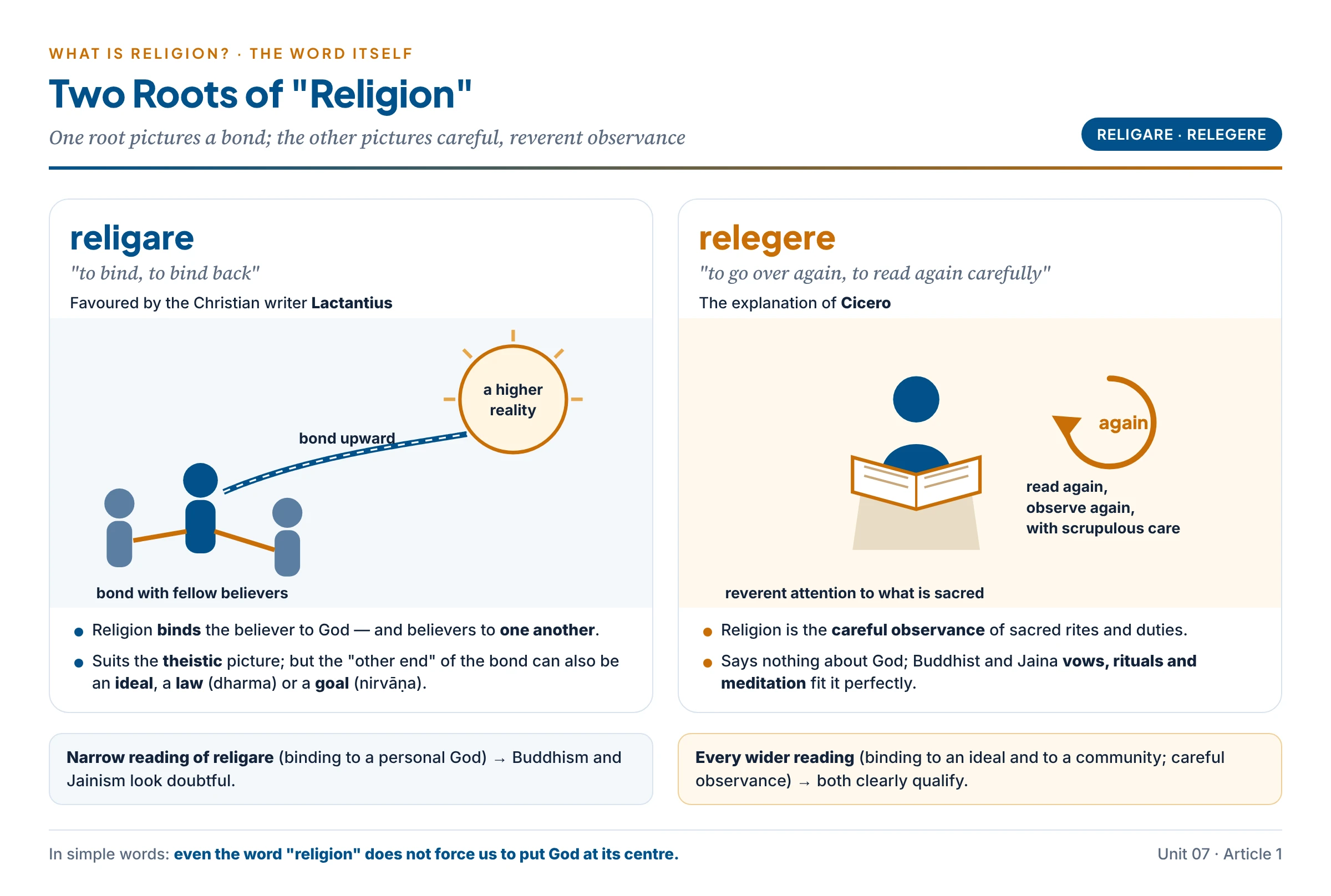
- Religare — “to bind” or “to bind back” (the explanation favoured by the Christian writer Lactantius, 4th century). Religion binds human beings to God, and binds believers to one another. This root suits the theistic picture: religion as a bond with a higher power. It also suits the social picture of religion as what ties a community together.
- Relegere — “to go over again, to read again carefully” (the explanation of the Roman statesman Cicero, 1st century BCE). Religion is the careful, scrupulous observance of rites and duties — conscientious attention to what is sacred. This root says nothing about God; it stresses practice and reverence.
- What follows for our question.
- If religion means binding to a higher being, Buddhism and Jainism look doubtful — there is no creator to be bound to.
- But even on this root, the “binding” can be to an ideal, a law (dharma) or a goal (nirvāṇa), and binding of people to one another happens in every religion. So even religare does not strictly require God.
- If religion means careful observance of what is sacred, Buddhism and Jainism clearly qualify: their monastic rules, rituals and meditations are among the most careful observances in the world.
In simple words
Two pictures of the same word. In the first, religion is a rope tying you to something higher and to your fellow believers. In the second, religion is a person reading a sacred text again and again with care. The rope seems to need something at the other end — a God, or at least an ideal. The careful reader needs only something treated as sacred.
2. Dharma: India’s Wider Word
- Dharma is not a translation of “religion”. In India the nearest word is Dharma, from the root dhṛ, “to hold, to support”. Its meanings include cosmic law, duty, virtue, justice, right conduct, character, and also religion.
- Classical definitions of dharma — none of them mentions God:
- The Mahābhārata: “It is called dharma because it upholds (dhāraṇāt); dharma upholds the people.” Dharma is whatever sustains individual and social life.
- The Vaiśeṣika Sūtra: dharma is “that from which come worldly well-being (abhyudaya) and the highest good (niḥśreyasa)”. Dharma is defined by what it achieves.
- The Mīmāṃsā Sūtra: dharma is “a good that is known through the Vedic injunction“. Dharma is defined by its source — the authorless Veda — not by a divine lawgiver (Article 6).
- The Buddhist Dhamma: the truth the Buddha discovered and the path he taught. The Buddha “discovered” the Dhamma; he did not create it.
- Religion as a way of life. Swami Vivekananda described the different religions as rivers that rise in different places but all flow into the same ocean. He also said: “Religion is the manifestation of the Divinity already in man.” On this view religion is a way of life leading the person to their own highest possibility — which need not involve a creator outside them.
- What follows. In the Indian setting religion “may or may not include God“. The problem of “religion without God” arises mainly from Western definitions that make God an essential element. Indian thought always had both theistic schools (Nyāya, Yoga, theistic Vedānta) and non-theistic ones (Jaina, Buddhist, Sāṃkhya, Mīmāṃsā) inside the same religious culture.
Indian Connect — Dharma and religion without God
- The word dharma is used for both the theistic Vaiṣṇava’s devotion and the non-theistic Jaina’s conduct; Indian usage never needed a separate word for “godless religion”.
- Indian law has absorbed this. In the Shirur Mutt case (1954) the Supreme Court said: “Religion is certainly a matter of faith with individuals or communities and it is not necessarily theistic. There are well known religions in India like Buddhism and Jainism which do not believe in God or in any Intelligent First Cause.” It added that a religion includes not only beliefs but also ethical rules, rituals, ceremonies and modes of worship.
3. The Narrow Definitions: Religion as Belief in God
These are substantive definitions — they define religion by what it believes in (its content).
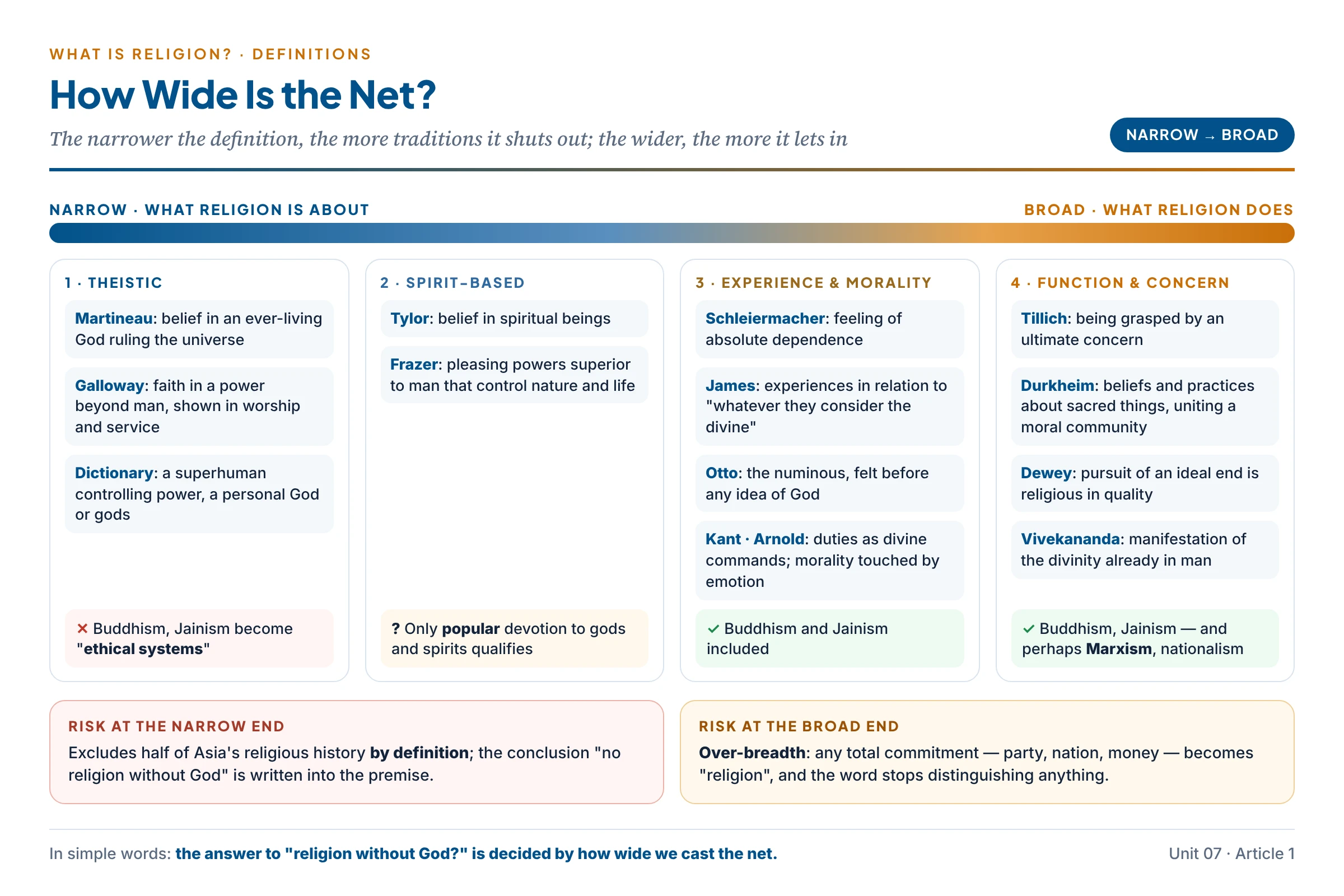
- E.B. Tylor (anthropologist, Primitive Culture, 1871) gave a famous “minimum definition“: religion is “the belief in Spiritual Beings“. The definition is wider than “belief in God”, since spirits, ancestors and gods all count — but it still requires supernatural persons.
- James Frazer (The Golden Bough): religion is “a propitiation or conciliation of powers superior to man which are believed to direct and control the course of nature and of human life”. Religion here is dealing with higher powers — pleasing them, asking favours.
- James Martineau (Unitarian theologian): religion is “a belief in an ever-living God, that is, a Divine Mind and Will ruling the Universe and holding moral relations with mankind”.
- George Galloway: religion is “man’s faith in a power beyond himself whereby he seeks to satisfy emotional needs and gain stability of life, and which he expresses in acts of worship and service“.
- The dictionary definition (Concise Oxford Dictionary): “human recognition of a superhuman controlling power and especially of a personal God or gods entitled to obedience and worship”.
- What these definitions have in common.
- A higher, personal power beyond man — God, gods or spirits.
- A relationship with that power — worship, prayer, obedience, propitiation.
- Religion as man’s dependence on that power for security and help.
- Their consequence. On these definitions Jainism and Hīnayāna (Theravāda) Buddhism are not religions but “ethical systems“, because they have no room for “an ever-living God” or “a power beyond man” who grants favours.
Common confusion
Did William James hold that “anything less than theism is no religion at all”? Many notes put this sentence in William James’s mouth. In fact James did the opposite. In The Varieties of Religious Experience (1902) he deliberately widened religion to “whatever they may consider the divine” and wrote that “there are systems of thought which the world usually calls religious, and yet which do not positively assume a God. Buddhism is in this case.” He noted that popularly “the Buddha himself stands in place of a God”, but that “in strictness the Buddhistic system is atheistic”. James is a witness for a broad definition, not against religion without God.
4. The Broad Definitions: Religion as Feeling, Concern and Function
These definitions look at what religion does in human life (its function) or how it feels from inside (its phenomenology), rather than at what it believes in.
- Psychological and experiential definitions.
- Friedrich Schleiermacher (1768–1834): religion is “the feeling of absolute dependence” — the immediate sense that one’s whole existence is held by something one does not control. Schleiermacher himself called its object God, but the feeling is prior to any theory.
- William James: religion is “the feelings, acts, and experiences of individual men in their solitude, so far as they apprehend themselves to stand in relation to whatever they may consider the divine“. The phrase “whatever they may consider the divine” leaves room for a non-personal divine.
- A.N. Whitehead: “Religion is what the individual does with his own solitariness.“
- Rudolf Otto: the core of religion is the experience of the numinous — the holy as mysterium tremendum et fascinans (an awe-inspiring, overwhelming and fascinating mystery). For Otto this experience comes before any concept of a personal God; the idea of God is one way of interpreting it (Article 8; Unit 06).
- Moral definitions.
- Immanuel Kant: religion is “the recognition of all our duties as divine commands” — religion is morality seen in a certain light.
- Matthew Arnold: religion is “morality touched by emotion” — “ethics heightened, enkindled, lit up by feeling”.
- Definitions by ultimate concern.
- Paul Tillich (1886–1965): “Religion is the state of being grasped by an ultimate concern, a concern which qualifies all other concerns as preliminary and which itself contains the answer to the question of the meaning of our life.”
- Tillich adds a striking corollary: “whatever concerns a man ultimately becomes god for him“. “God” is the name for what concerns us ultimately; it is not first a being and then an object of concern.
- So the test of religion is not “do you believe in God?” but “what do you treat as ultimate — what would you sacrifice everything else for?”
- A holistic definition. Religion may be described as man’s holistic response to what he considers his ultimate concern. It involves all three sides of the mind:
- Cognition (knowing) — beliefs about reality;
- Conation (willing, acting) — a moral way of life;
- Affection (feeling) — reverence, awe, love.
- From unity to autonomy. In early cultures religion, science, morality and art were found together; with time they became relatively independent — “art for art’s sake”, “morality for morality’s sake”. Religion remains the whole-hearted response of the whole person.
- Spiritual and humanist definitions.
- Herbert Spencer: religion is “the recognition that all things are manifestations of a Power which transcends our knowledge” — an unknowable, not a personal God (Article 2).
- John Dewey: religion is not a thing but a quality of experience — “any activity pursued in behalf of an ideal end against obstacles … because of conviction of its general and enduring value is religious in quality” (Article 8).
- Humanity’s response to the divine — a short formula that leaves open what “the divine” is.
- Sociological definitions.
- Talcott Parsons: religion is “a set of beliefs, practices, and institutions which men have evolved in various societies”.
- Émile Durkheim (1912): religion is “a unified system of beliefs and practices relative to sacred things, that is to say, things set apart and forbidden — beliefs and practices which unite into one single moral community called a Church, all those who adhere to them”. Durkheim explicitly rejected definitions by gods or spirits, because “there are great religions from which the idea of gods and spirits is absent” — and he gave Buddhism and Jainism as his examples (Article 7).
- Hostile (naturalistic) definitions. Some definitions describe religion from outside, in order to explain it away: “a body of scruples which impede the free exercise of our faculties” (Salomon Reinach); “illusions, fulfilments of the oldest, strongest and most urgent wishes of mankind” (Freud); “the opium of the people” (Marx) (Articles 2 and 7). Even these do not make God part of the definition — they make God a product of human needs.
In simple words
Think of a fishing net. The theistic definitions are a net with a small mouth: they catch Christianity, Islam and Vaiṣṇava devotion but let Buddhism and Jainism slip out. The functional definitions are a net with a wide mouth: they catch Buddhism and Jainism — but if the mouth is too wide, they also catch football fandom and nationalism. The whole debate is about how wide the net should be.
5. Substantive, Functional and Family-Resemblance Approaches
- Substantive definitions say what religion is about — God, gods, spirits, the supernatural.
- Strength: clear; they separate religion from politics, sport and art.
- Weakness: they exclude major non-theistic traditions by stipulation.
- Functional definitions say what religion does — gives ultimate meaning, binds a community, answers suffering and death, offers liberation.
- Strength: they include Buddhism, Jainism and Sāṃkhya.
- Weakness: they may include too much — Marxism, nationalism, devotion to science, even a passion for money — and so the word “religion” stops distinguishing anything (the dilution objection, Article 3).
- All definitions are stipulative. Each definition decides how the word is to be used and then presents that decision as if it were a discovery. A Christian theologian, a sociologist and a Buddhist scholar each define religion in a way that suits their own starting point.
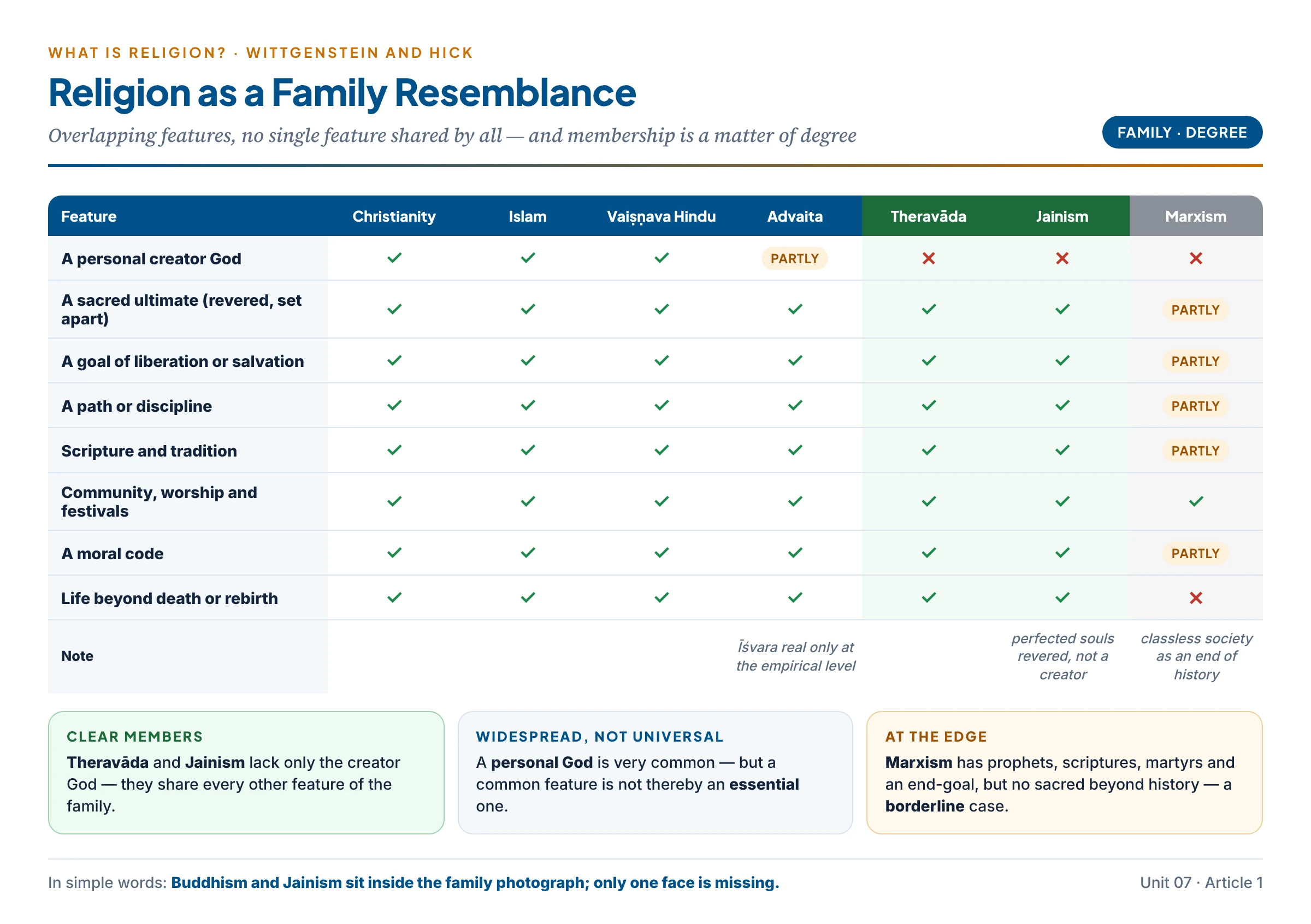
- Family resemblance (Wittgenstein). Ludwig Wittgenstein showed that the word “game” cannot be defined by any single feature: some games are for pleasure, some for profit; some competitive, some solitary; some need skill, some only luck. Yet all games “hang together” in a network of overlapping similarities, like the features shared in different ways by members of a family — one has the father’s nose, another the mother’s eyes, a third the grandmother’s walk.
- Applying it to religion. John Hick applies this idea to religion:
- In much religion there is worship of God or gods — but in Theravāda Buddhism there is not.
- Religion often makes for social cohesion — but in some strands it is “what a man does with his solitariness”.
- Religion often brings inner harmony — yet some great religious innovators seemed unbalanced, even insane, to their contemporaries.
- Marxism shares several features of the family — an end-of-history ideal (the classless society), a doctrine of historical necessity like predestination, scriptures, prophets, saints and martyrs — while lacking others.
- So “whether a movement is religious is not an all-or-nothing matter but a question of degree“.
- The one very widespread feature. Within this network Hick finds one feature that is extremely widespread though not universal: a concern with salvation or liberation. All the great developed faiths have a soteriological structure (from Greek sōtēria, salvation): they offer a passage from a radically unsatisfactory state to a limitlessly better one — redemption in Christianity, mokṣa in Hinduism, nirvāṇa in Buddhism, kaivalya in Jainism.
In simple words
In a big family photograph, no single feature is shared by everyone — yet you can tell at a glance that they are one family, because each person shares several features with several others. Theravāda Buddhism lacks God but has scripture, monks, rituals, ethics and a goal of liberation; Marxism has a goal, prophets and martyrs but no sacred and no liberation from suffering in the religious sense. Buddhism sits inside the family photo; Marxism stands near its edge.
6. The Marks of a Religion
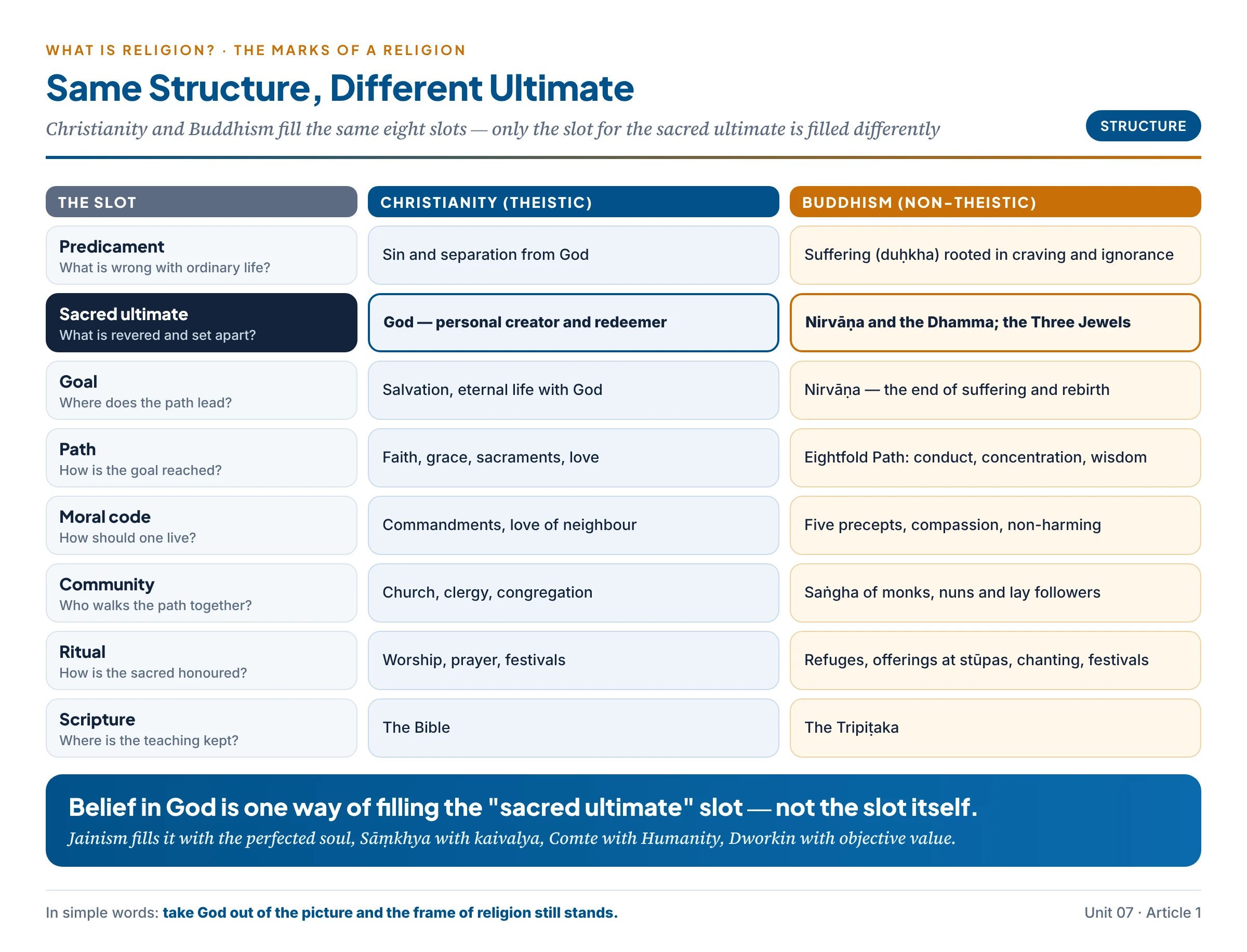
If no single feature defines religion, we can still list the marks that make something strongly religious. The more of these a tradition shows, the more clearly it is a religion:
- A diagnosis of the human predicament — something is deeply wrong with ordinary life: sin, ignorance (avidyā), suffering (duḥkha), bondage (bandha).
- A sacred or ultimate reality, value or state — set apart and revered: God, Brahman, nirvāṇa, the liberated soul, the moral law, the holy.
- A goal beyond ordinary welfare — salvation, mokṣa, nirvāṇa, kaivalya.
- A path or discipline — prayer, devotion, meditation, ethical training, ritual, knowledge.
- A moral code — rules and virtues that shape conduct.
- Community and institutions — church, saṅgha, monastic orders, priests or teachers.
- Ritual, worship and festivals — places of worship, sacred times, the distinction of sacred and profane.
- Scriptures and tradition — Bible, Qur’ān, Veda, Tripiṭaka, the Jaina Āgamas.
- Total commitment — an all-pervading pattern of life, not a part-time interest.
- Note what is missing. Belief in a creator God is not on the list as a separate mark. It is one possible way of filling mark 2 — the sacred or ultimate. Buddhism fills that place with nirvāṇa and the Dhamma; Jainism with the perfected soul; Sāṃkhya with kaivalya; Comte with Humanity; Dworkin with objective value and the sublime in nature.
7. Should There Be a Transcendent Reality in a Religion?
- The question. A reality is transcendent if it goes beyond the ordinary world of sense experience. Must every religion point to such a reality?
- The case for “yes”.
- Without something beyond the ordinary, religion collapses into ethics (a code of conduct) or politics (a social programme).
- Even the non-theistic Indian religions accept transcendent realities: nirvāṇa is “the unborn, unbecome, unmade, unconditioned”; the Jaina siddha dwells beyond the world; the Sāṃkhya Puruṣa is pure consciousness beyond Prakṛti; the Mīmāṃsā apūrva is an unseen potency.
- So the real line runs not between “God” and “no God” but between “some transcendent” and “nothing transcendent“.
- The case for “not necessarily”.
- Humanist and naturalist religions (Comte, Julian Huxley, Dewey, Dworkin) find the sacred within nature and human life (Articles 7–8).
- Even in these, there is a kind of self-transcendence — the individual goes beyond his narrow self in devotion to Humanity, to truth, to an ideal.
- A balanced answer. A religion needs something treated as sacred and ultimate and a self-transcending response to it. That “something” is usually transcendent (beyond the world), sometimes only transcending the self (beyond one’s petty interests). It need not be a personal creator.
8. The Central Concept in a Religion without God
If God is absent, what holds the religion together? Different answers are given, and they are not rivals but layers of one answer:
- The Sacred. That which is “set apart“, revered, not to be used for ordinary ends — Durkheim’s key category. In Buddhism the Three Jewels, the stūpa, the Dhamma; in Jainism the Tīrthaṅkara and the vow of non-violence.
- Liberation (mokṣa, nirvāṇa, kaivalya). The supreme goal that gives the whole system its direction. For Buddhism and Jainism this is the central concept: freedom from suffering and rebirth by one’s own effort.
- The moral law (dharma, karma, ṛta). An impersonal moral order that guarantees that good and evil bear their fruit without a divine judge. It does for these religions what divine justice does for theism.
- The perfected human being. The Buddha, the arhat, the Tīrthaṅkara, the jīvanmukta — a human being who has reached the goal and serves as model and guide. Where theism worships a perfect God, non-theism reveres a perfected person.
- Ultimate concern and objective value (in Western forms). Humanity (Comte), the evolutionary future (Julian Huxley), the ideal (Dewey), the objective value of life and the sublimity of nature (Dworkin).
- In one sentence. The central concept of a religion without God is the sacred goal of self-transcendence — liberation or ultimate value — reached through an impersonal moral order and modelled by perfected human beings, rather than granted by a personal creator.
In simple words
A school can run without a principal if the rules are clear, the goal (passing the final exam) is shared, and the toppers of earlier years show everyone how it is done. A religion without God is like that school: the moral law replaces the principal’s orders, liberation is the final exam, and the Buddha or the Tīrthaṅkara is the topper whose notes everyone follows.
9. When Religion Is Defined as Religare: Are Buddhism and Jainism Religions?
- If religare means binding to a personal God — no; neither has a creator to bind to, and both call this a mistaken idea.
- If religare means binding the self to its highest ideal and binding believers into one community — yes, and strongly:
- Both bind the follower to a supreme goal (nirvāṇa, kaivalya) by vows and refuges — the Buddhist takes refuge in the Buddha, Dhamma and Saṅgha; the Jaina recites the Namokāra salutation to the five supreme beings.
- Both bind followers into communities — the Buddhist saṅgha and the Jaina fourfold order of monks, nuns, laymen and laywomen.
- Both have scriptures (Tripiṭaka; the Jaina Āgamas), temples, festivals, pilgrimage and rituals.
- The criteria for something to be called a religion can be drawn from the marks listed above: a sacred or ultimate reality, a goal, a path, a moral code, a community with rites, and a total commitment. Buddhism and Jainism satisfy all of these.
- The verdict. On the narrow reading of religare, they fail; on every reasonable reading, they pass. This shows that the narrow reading is the one at fault.
Critical Evaluation
Problems with Narrow (Theistic) Definitions
- They beg the question. “Religion is belief in God, therefore there is no religion without God” is a circular argument: the conclusion is already written into the definition.
- They are culturally parochial. They were framed by Western scholars with Abrahamic religion in mind and do not fit the religious history of Asia.
- They misdescribe even theistic religions. In Advaita Vedānta the personal God (Īśvara) is real only at the empirical level; the ultimate is the impersonal Brahman. In mystical Christianity and Sufism God is often beyond all personal attributes. A strict “personal God” definition fits the great theistic traditions imperfectly.
- They confuse the common with the essential. That most religions are theistic does not show that theism is the essence of religion — as most vehicles having engines does not make engines essential to vehicles.
Problems with Broad (Functional) Definitions
- Over-breadth. If religion is any ultimate concern or any total commitment, then devotion to the nation, the party, money or a football club becomes “religion”. The term loses its edge.
- Loss of the transcendent. Functional definitions may reduce religion to its social or psychological uses, ignoring what believers themselves think it is about. The believer prays to God, not “to a function”.
- The danger of reductionism. Durkheim, Freud and Marx define religion by function partly in order to explain it away. A broad definition can be a step towards saying “religion is nothing but society, wish or ideology”.
Problems with Family Resemblance
- Too loose? If anything that resembles a religion in a few ways is “a bit religious”, the boundary disappears.
- The reply. Family resemblance does not deny degrees; it says that clear cases (Christianity, Buddhism, Jainism) are clear, and borderline cases (Marxism, nationalism, devotion to science) are borderline. This is an honest description, not a defect.
Critics and Defenders
Criticism — Against religion without God (narrow definitions)
- Tylor, Frazer, Martineau, Galloway: religion is belief in, and relation with, higher spiritual powers or a living God.
- The dictionary: religion means recognising a superhuman controlling power entitled to worship.
- Theists: the binding of religare needs a personal other to bind to.
- Critics of functionalism: broad definitions make nationalism and football into religions.
- Believers: religion is about a real object, not about its social uses.
Defence — For religion without God (broad definitions)
- James: Buddhism is a religion though it does not positively assume a God.
- Durkheim: there are great religions — Buddhism, Jainism — without gods or spirits.
- Tillich: whatever concerns a person ultimately becomes god for him.
- Wittgenstein and Hick: religion is a family of resemblances; theism is a common feature, not a necessary one.
- Indian tradition and the Supreme Court: dharma, and religion, are not necessarily theistic.
Cross-Tradition Comparison
Western and Indian Ways of Defining Religion
| Point | Dominant Western view | Indian view |
|---|---|---|
| Key word | Religion (religare, relegere) | Dharma (dhṛ, to uphold) |
| Centre | Relationship with a personal God | Right order of life and the highest good |
| God | Usually essential | Optional — present in Nyāya and Vedānta, absent in Jaina, Buddhist, Sāṃkhya, Mīmāṃsā |
| Goal | Salvation by God’s grace | Liberation (mokṣa, nirvāṇa, kaivalya), often by one’s own effort |
| Non-theistic faiths | Called “ethical systems” or “philosophies” | Accepted as full religious paths |
| Typical definition | Martineau, Galloway, the dictionary | “That which upholds”; Vivekananda’s “manifestation of the divinity already in man” |
Definitions Compared
| Type | Example | Includes Buddhism and Jainism? | Main weakness |
|---|---|---|---|
| Theistic (substantive) | Martineau, Galloway | No | Parochial; begs the question |
| Spirit-based (substantive) | Tylor, Frazer | Doubtful | Popular devotion only |
| Experiential | Schleiermacher, James, Otto | Yes | Private; hard to test |
| Moral | Kant, Arnold | Yes | Reduces religion to ethics |
| Ultimate concern | Tillich | Yes | May include nationalism |
| Sociological | Durkheim, Parsons | Yes | May explain religion away |
| Family resemblance | Wittgenstein, Hick | Yes | Boundaries blurred |
Indian Connect — Takeaways
- Indian thought never made God the defining mark of religion; dharma is defined by what it upholds and achieves.
- The Western question “Is Buddhism a religion?” arises from a definition, not from anything lacking in Buddhism.
- The marks that Buddhism and Jainism share with theism — a goal, a path, a community, reverence, scripture — are richer than the one mark they lack.
Synthesis (Siddhānta)
- The answer depends on the definition — but not every definition is equally good. A definition that makes the religious life of a large part of humanity “not religion” by stipulation is a bad definition.
- The best approach combines Wittgenstein’s family resemblance with a short list of central marks: a sacred or ultimate reality, a goal of liberation or fulfilment, a path, a moral code, a community with rites, and total commitment. Belief in a personal creator is a very common member of this family, not its essence.
- Religion without God is therefore possible — and, as Buddhism, Jainism, Sāṃkhya and Mīmāṃsā show, it has long been actual. The central concept of such religion is the sacred goal of self-transcendence, reached through an impersonal moral order and modelled by perfected human beings.
- But two cautions remain.
- A definition so broad that it includes every strong commitment loses its usefulness; a religion needs something sacred and a self-transcending aim, not merely enthusiasm.
- Theists rightly point out that certain religious attitudes — prayer, grace, personal love — need a personal object. These belong to theistic religion; their absence does not make non-theistic religion unreal, only different (Article 3).
- Contemporary relevance.
- Law and policy. Courts in India (Shirur Mutt, 1954) and elsewhere must decide what counts as “religion” for religious freedom — and they have consistently refused to make belief in God a requirement.
- Interfaith understanding. Seeing religions as a family rather than as believers versus unbelievers helps dialogue between theists and non-theists.
- The “spiritual but not religious”. Growing numbers of people reject God or institutions but keep meditation, ethics and reverence — a living test case for the broad definitions.
“Religion is the state of being grasped by an ultimate concern, a concern which qualifies all other concerns as preliminary and which itself contains the answer to the question of the meaning of our life.” — Paul Tillich
Previous Year Questions
- 2010What is the central concept in a religion without God? Discuss.
- 2003When a religion is defined as ‘religare’, is Buddhism or Jainism a religion? What are the criteria for an organisation to be called a religion? Should there be a transcendental reality in a religion? Discuss.
- 2001What do you understand by religion? Do you think that the belief in the existence of God is an essential feature of religion? Discuss.