

Religious Experience: Nature and Object (Indian and Western).
Official Syllabus: Paper II, Section B, Unit 6
A religious experience happens inside one person, often for a few moments, and the mystics say it cannot be put into words. Yet religions are public: they have scriptures, symbols, rituals, institutions and arguments; they speak in parliaments, courts and classrooms. How does a private, ineffable experience become a shared revelation, a symbol, a language and a matter of public discussion? This article examines the relation between mystical experience and revelation, the kind of language that can make religious experience communicable, whether religious symbolism leads to mysticism, how far religious experience can be a topic of public discourse, and why a religion of reason alone would lack the experiential heart of religion — drawing the unit together in an Indian–Western synthesis.
In simple words
A person returns from seeing the ocean for the first time. He cannot hand you the ocean; he can only tell you about it, draw it, use comparisons (“bigger than a thousand lakes”), fall silent in wonder — or take you there. Religion does all of these with its deepest experiences: scripture tells, symbols draw, poetry compares, mystics fall silent, and spiritual practice takes others to the shore.
Context & Problem
From the Private to the Public
- Four movements. Religious experience becomes part of a shared religion through:
- Revelation — the experience of a prophet or seer becomes a message for a community;
- Language — the transient glimpse is conceptualised in words;
- Symbol — images, sounds and rituals carry the experience to others and lead them towards it;
- Public discourse — the experience and its claims enter society, where they are discussed, studied, contested.
- Expression is needed. “If experience is the soul of religion, expression is the body through which it fulfils its destiny” (Radhakrishnan). The momentary glimpse of God has to be conceptualised in words; since the experience is extraordinary, words can never be precise — ordinary words are used in an extraordinary way.
- The problems.
- How are mystical experience and revelation related?
- What language can communicate the ineffable?
- Do symbols lead to mystical experience, or block it?
- Can something private and unverifiable be a topic of public discourse?
- Can reason alone give us religion?
Core Doctrine
1. Mystical Experience and Revelation — Meanings
- Revelation — the disclosure of something previously hidden: knowledge about God, the soul and the supernatural, which is beyond the ordinary means of knowing, is made known — communicated by God to chosen persons — through scripture, prophets, visions, dreams, historical events or spiritual experiences that transform individuals and groups.
- Mystical experience — the most direct, intense experience of ultimate reality — union or identity with God, Brahman or nirvāṇa — usually reached through discipline, and described as ineffable, noetic, transient and passive.
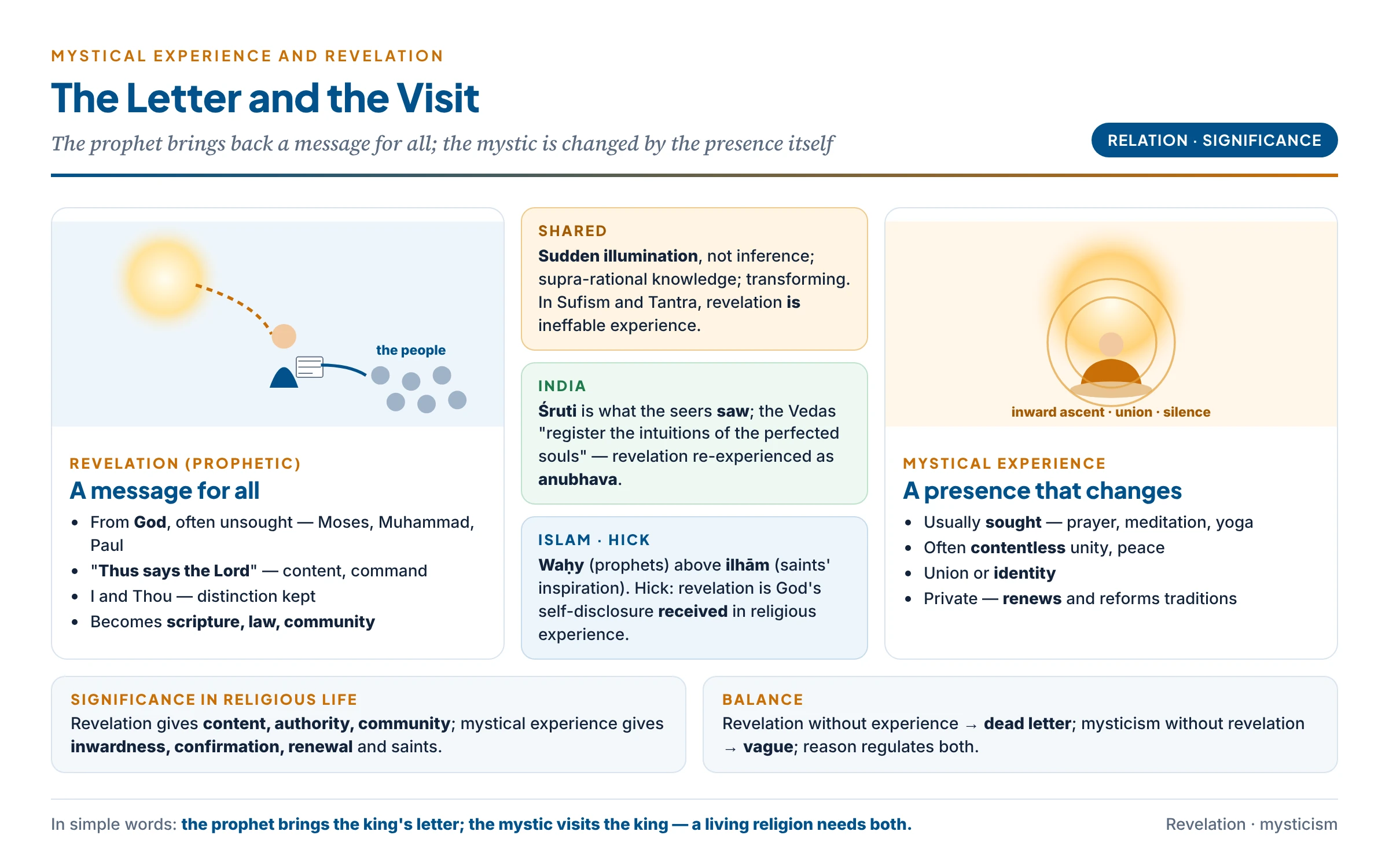
2. How They Are Related
Similarities:
- Directness. Both are accepted “not as a matter of logical inference but through sudden, unexpected illuminations that invade and transform the human spirit“.
- Supra-rational knowledge. Both claim knowledge of what reason and the senses cannot reach.
- Overlap in mystical religions. In mystical traditions such as Sufism and Tantric Buddhism, revelation is itself viewed as an ineffable experience of the transcendent.
- Shared conviction. Among the great religions there is wide agreement that revelation cannot be fully communicated by books and sermons, but only by an ineffable, supra-rational experience — hence the emphasis on contemplation.
Differences:
| Point | Revelation (prophetic) | Mystical experience |
|---|---|---|
| Initiative | From God — given, often unsought (Moses, Muhammad, Paul) | Usually sought through prayer, meditation, yoga |
| Direction | God speaks to a person, for others | The soul rises towards or merges into the divine |
| Content | A message — “Thus says the Lord”; commands, law, promises | Often contentless unity, silence, peace |
| Relation | I and Thou — distinction kept | Union or identity |
| Scope | Public and communal — given to an accredited spokesman to herald to a whole people | Private — for the mystic’s own transformation |
| Result | Scripture, law, community, history | Inner renewal, contemplative schools |
| Typical religions | Judaism, Christianity, Islam, Zoroastrianism | Upaniṣadic Hinduism, Buddhism, Sufism, Christian mysticism |
- Kinds of revelation.
- In primitive religions, revelation is linked to divination and to supernatural power felt in stones, trees, bones and the heavenly bodies — sacred objects that mediate numinous experience;
- in prophetic religions, revelation is the “Word of God“, enabling the prophet to speak with certainty about God’s actions and intentions;
- in mystical religions, revelation is an ineffable experience of the divine;
- religions that see God as a free, personal spirit speak of divine self-disclosure, modelled on a meeting between persons.
- Revelatory relationships. In some Eastern mysticism the goal is absorption in the divine with loss of individual consciousness; Western religions and bhakti Hinduism affirm the abiding distinctness of the person; Islamic orthodoxy stresses communion with God and obedient submission; Sufism aspires to personal union.
- Non-propositional revelation (Hick). Revelation is not mainly a set of statements handed down but God acting in history, recognised by those who experience events as God’s acts (“experiencing-as“). On this view, revelation and religious experience are two sides of one event: God’s self-disclosure, and its human reception in faith. Without religious experience, revelation would not be received at all.
- Islam — wahy and ilhām. Islam distinguishes waḥy, the prophetic revelation given only to prophets (the Qurʾān), from ilhām or kashf, the inspiration or “unveiling” granted to saints. Sufi experience is real but subordinate: it must agree with the Qurʾān.
- India — śruti as the seers’ vision. The Vedas are śruti, “heard” by the ṛṣis. For Mīmāṃsā they are authorless and eternal; for Vedānta and Radhakrishnan they “register the intuitions of the perfected souls” — revelation is recorded mystical experience, “capable of being re-experienced”.
In simple words
A prophet is like a messenger who returns from the king’s palace with a letter for the whole kingdom: “The king says…” A mystic is like someone who enters the palace and is so overwhelmed by the king’s presence that she forgets to bring back any letter at all — she returns changed, but with little to report. Religions need both: the letter gives a community its shared message; the visit keeps the message alive.
3. Their Significance in Religious Life
Significance of revelation:
- Gives religion its content and authority — scripture, doctrine, law;
- creates a community around a shared message and history;
- offers truths beyond reason to those who cannot attain mystical states — “the sacred scriptures make the life of the spirit real even to those who are incapable of insight” (Radhakrishnan).
Significance of mystical experience:
- Gives inwardness — turns belief into personal realisation;
- confirms revelation by re-experiencing it (anubhava confirming śruti);
- renews and reforms traditions — Eckhart, the Sufis, Kabīr and the bhakti saints criticised empty formalism;
- produces saints whose lives become a living proof for others.
Tensions and balance:
- Mystics who claim identity with God have clashed with orthodoxy (al-Ḥallāj, Eckhart).
- Revelation without experience becomes legalism and a dead letter; mysticism without revelation becomes vague and private.
- Reason acts as a regulative force over both: it interprets scripture, conceptualises experience and tests both for coherence and moral worth.
4. What Language Can Make Religious Experience Communicable?
The problem of ineffability:
- James: the mystical state “defies expression”; St Teresa: “I wish I could give a description of at least the smallest part of what I have learned, but, when I try to discover a way of doing so, I find it impossible.”
- Why? All words in all languages are products of our sensory-intellectual consciousness — sensations, images and concepts. The mystical state has none of these, so no word fits it literally.
- The paradox. Yet mystics write volumes. “Ineffable” cannot mean “nothing at all can be said”; it means that literal, descriptive language fails, so other kinds of language are needed.
Kinds of language used:
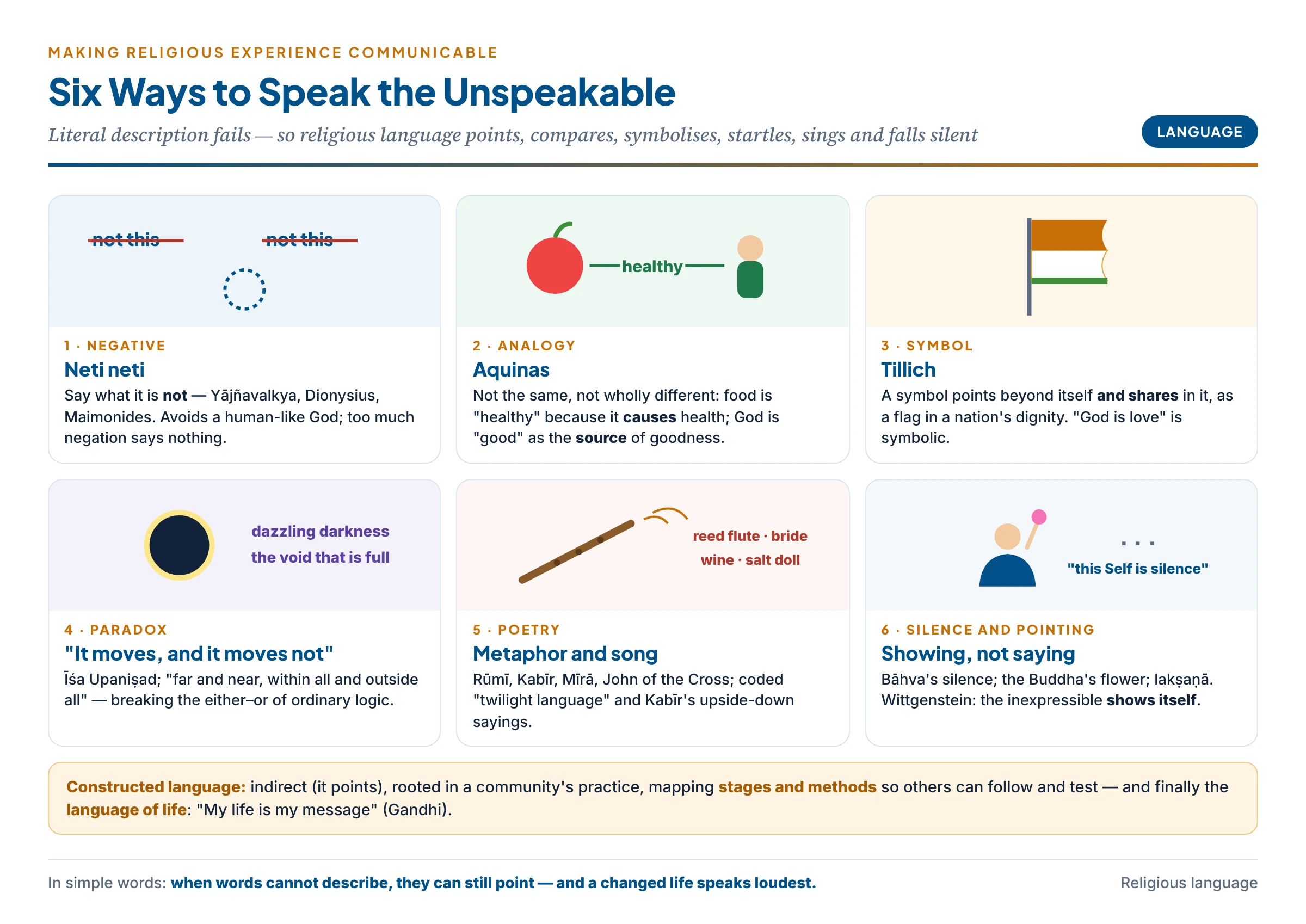
- Negative language (via negativa). Say what the ultimate is not: Yājñavalkya’s “not this, not this” (neti neti); Dionysius’ “divine darkness”; Maimonides‘ negative attributes (“God is not powerless” rather than “God is powerful”). Strength: avoids making God a big human being. Weakness: endless negation risks saying nothing — what is the difference between an infinitely negated God and no God?
- Analogical language (Aquinas). Words used of God are neither univocal (exactly the same meaning as of humans — this makes God human-like) nor equivocal (totally different meaning — then we know nothing) but analogical:
- analogy of attribution — we call food “healthy” because it causes health in a man; so “good” applies to God as the cause of all goodness;
- analogy of proportionality — God’s wisdom is to God’s nature as a man’s wisdom is to a man’s nature: wisdom in the measure fitting each.
- Symbolic language (Tillich). A sign points to something by convention (a red light); a symbol points beyond itself and participates in what it points to (a flag shares in the dignity of the nation). Symbols “open up levels of reality which otherwise are closed for us” and also open dimensions of the soul; they cannot be invented, they grow and die. “God is love” is symbolic. For Tillich, the only non-symbolic statement about God is that God is Being-itself.
- Paradoxical language. Mystics speak of a “dazzling darkness“, a “void that is full“, and the Īśa Upaniṣad says: “It moves, and it moves not; it is far, and it is near; it is within all this, and it is outside all this.” Paradox signals that ordinary logic of “either–or” is being transcended.
- Poetic and metaphorical language. The Song of Songs, John of the Cross, Rūmī‘s reed flute, Kabīr and Mīrābāī; images of marriage, wine, the ocean, the salt doll. Indian Tantric and Siddha poets used a deliberately coded “twilight language” (sandhā-bhāṣā); Kabīr’s “upside-down sayings” (ulaṭbāṃsī) shock the mind out of habit.
- Silence and pointing. The Upaniṣadic sage’s silence (“this Self is silence“); the Buddha’s silence on unanswerable questions; the Zen story of the Buddha holding up a flower and Mahākāśyapa smiling; Advaita’s method of implication (lakṣaṇā). Wittgenstein: “There is indeed the inexpressible. This shows itself; it is the mystical” — and “Whereof one cannot speak, thereof one must be silent.”
- The language of life. Saints communicate through conduct — compassion, fearlessness, service. Gandhi: “My life is my message.“
- Myth, narrative and ritual. Stories (the burning bush, Arjuna’s vision, the Buddha’s enlightenment under the tree) and rituals (Eucharist, pūjā, dhikr) let people enter an experience rather than merely hear about it.
What kind of language needs to be constructed?
- Indirect, not descriptive — it should point rather than picture: negation, analogy, symbol and paradox together.
- Rooted in a community — words like “grace”, “nirvāṇa”, “samādhi” gain meaning from use within a shared form of life (Wittgenstein’s “language-games”); outsiders learn them as one learns a craft.
- Tied to practice — a technical vocabulary of stages and methods (Christian purgation–illumination–union; Patañjali’s stages of samādhi; Buddhist jhānas; Sufi stations and states) lets others follow the path and test the claim for themselves — “come and see“.
- Both cognitive and evocative — it should claim truth about the ultimate while also evoking the attitude it calls for — awe, love, surrender.
- Open to reason — expressions should be coherent and criticisable, so that genuine experience can be told from fantasy.
5. Does Religious Symbolism Lead to Mysticism?
What religious symbols are:
- Sounds (Om, mantras, divine names), images (icons, mūrtis), shapes (cross, crescent, yantra, mandala, stūpa), places (temples, rivers, mountains), acts (rituals, pilgrimage).
- Otto called the expressions of the numinous “ideograms” — pointers, not concepts. The sacred shows itself through a stone or tree, yet remains other than it.
How symbols can lead to mysticism:
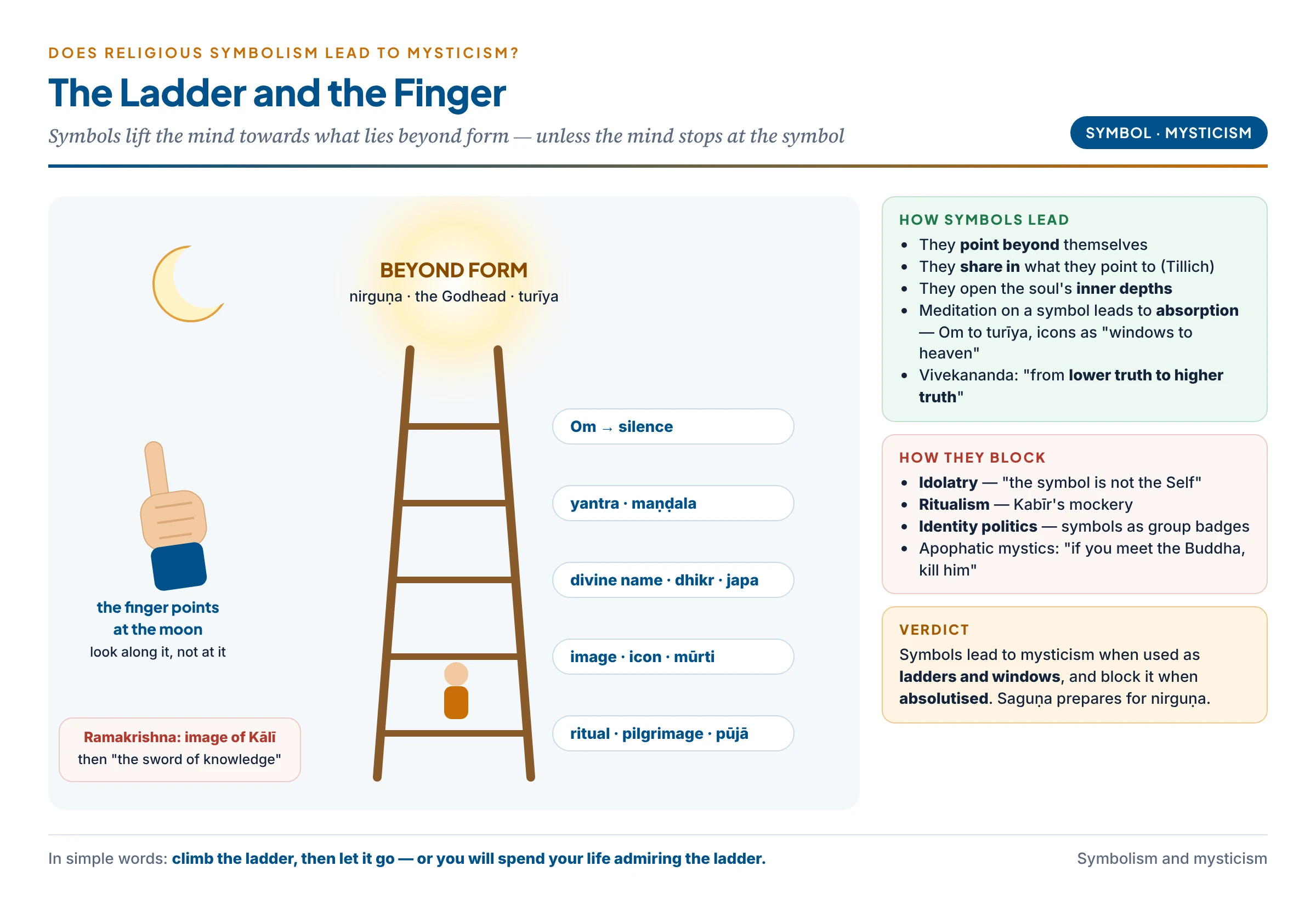
- They point beyond themselves — and so turn attention from the finite to the infinite.
- They participate in what they symbolise (Tillich) — so the worshipper feels the presence of the sacred, not just an idea of it.
- They open the inner depths — symbols awaken levels of the soul that argument cannot reach.
- Meditation on a symbol leads to absorption.
- The Māṇḍūkya treats Om as the whole of reality: its three sounds stand for waking, dreaming and deep sleep; the silence after it is turīya. Meditation on Om leads from the sound to the soundless.
- The Upaniṣads teach symbol-meditation (pratīka-upāsanā) — meditating on name, mind or the sun as Brahman.
- Eastern Orthodox Christians call icons “windows to heaven“; the Jesus Prayer and Sufi dhikr use the divine name until the mind rests in God.
- Tantric yantras and mandalas are maps of the cosmos and of consciousness used to lead the meditator to the centre.
- Ramakrishna’s example. Through intense worship of the image of Kālī he reached vivid experience of the Mother; when he sought formless realisation, his teacher Totāpurī told him to cut through the form with the sword of knowledge — and he entered nirvikalpa samādhi. The symbol was a ladder, then left behind.
- Vivekananda: images and rituals are helps for the mind; “it is not that the Hindu is going from error to truth, but from lower truth to higher truth.”
Why symbols may not lead to mysticism:
- Idolatry. The symbol may be taken for the ultimate itself; Tillich calls the absolutising of a finite symbol “demonic“. The Brahma Sūtra warns that the symbol is not the Self (na pratīke na hi saḥ).
- Ritualism. Symbols may become routine; Kabīr mocked those who bathe and chant without inner change.
- Social identity. Religious symbols are often used as markers of group identity in politics, producing conflict rather than mystical unity.
- Apophatic suspicion. Many mystics see images as obstacles to be transcended: Eckhart’s “God beyond God”; the Zen saying “if you meet the Buddha, kill him” (do not cling even to the image of the Buddha); the “finger pointing at the moon” — do not mistake the finger for the moon.
- Aniconic traditions. Islam and Judaism forbid images of God; yet they have rich mysticism — through words, names and letters rather than pictures.
Verdict: Symbols can lead to mysticism — when they are used as ladders to be climbed and then let go, or as windows looked through. They block it when they are absolutised, mechanised or politicised. In Indian terms, worship with form (saguṇa) prepares the mind for the formless (nirguṇa).
In simple words
A finger points at the moon. A wise person looks along the finger and sees the moon. A foolish one stares at the finger — or quarrels with others about whose finger is better. Religious symbols are fingers: they can lead you to the moon of mystical experience, or they can become the thing you stare at and fight over.
Common confusion
Does “a symbol participates in what it symbolises” mean that the symbol is itself divine? No. For Tillich, participation means the symbol truly shares in and conveys the power of what it points to — as a national flag shares in the dignity of the nation, so that insulting it insults the nation. But the flag is not the nation. When people forget this and treat the symbol as the ultimate itself, the symbol becomes an idol. Indian thought says the same: the image is a support for meditation on God, not God limited to the image.
6. Can Religious Experience Be a Topic of Public Discourse?
Meaning: Public discourse is discussion in the shared public sphere — politics, law, education, the media, academic research — ideally conducted with reasons accessible to all citizens, whatever their faith.
Arguments that it cannot (or should not):
- Privacy and ineffability. It happens to individuals, cannot be described adequately and cannot be checked by others.
- Conflicting claims. Rival experiences — and their political use — can divide citizens.
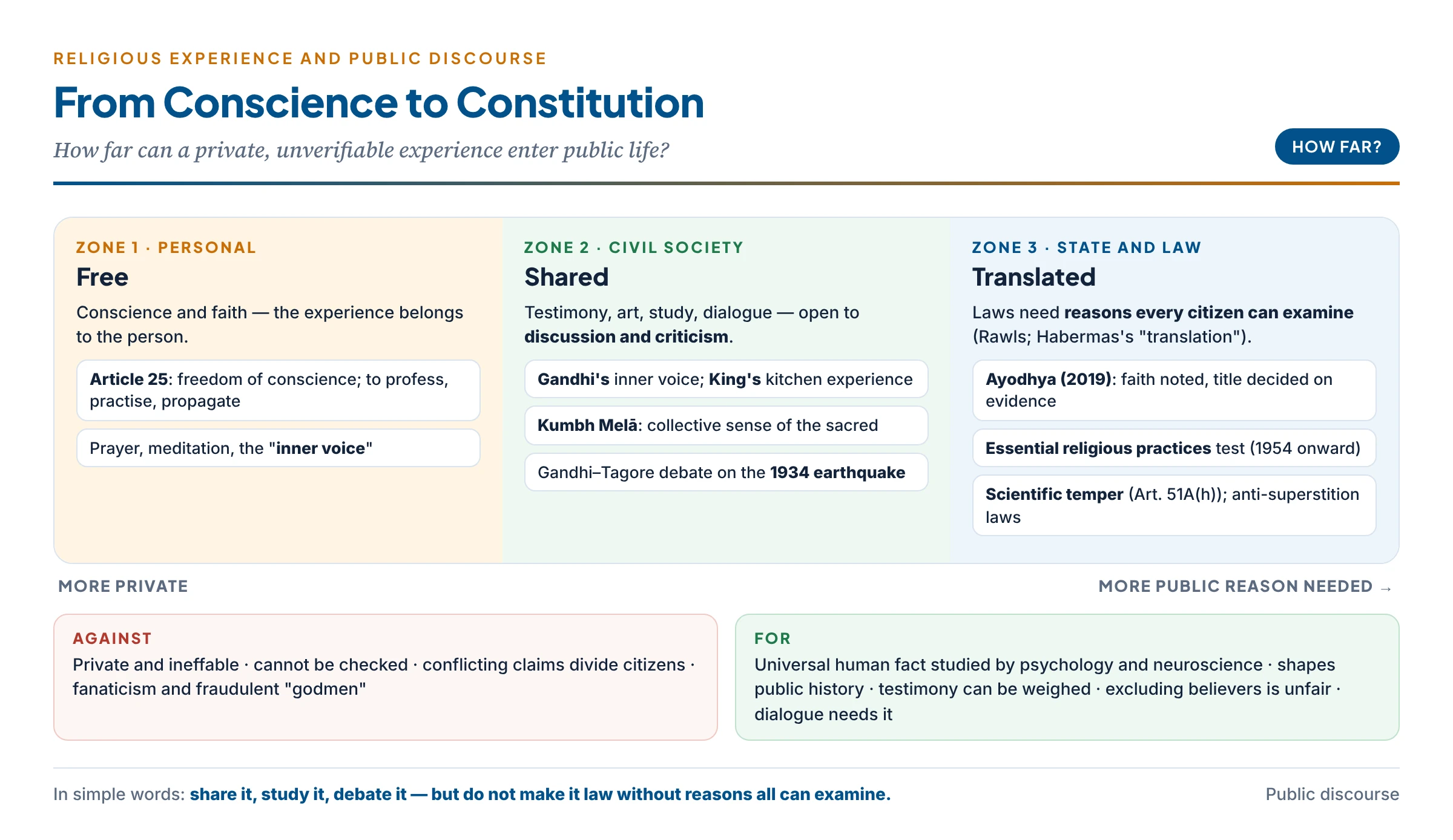
- Public reason (Rawls). On basic political questions, citizens should offer reasons that others can reasonably accept; religious reasons may be offered only if proper public reasons are also given in due course.
- Translation (Habermas). Religious citizens may speak in religious language in the informal public sphere, but before such views enter laws and court decisions they must be translated into generally accessible reasons.
- Dangers. Fanaticism (“God told me to…”), exploitation by fraudulent “godmen”, superstition, and communal mobilisation.
Arguments that it can:
- A universal human phenomenon. Religious experience is studied publicly by psychology (James), neuroscience, sociology and comparative religion — it is a legitimate object of public knowledge.
- Public effects. Experiences have shaped public history: Gandhi’s “inner voice” guided fasts and campaigns; Martin Luther King Jr. spoke of an experience of God’s presence at his kitchen table that sustained the civil-rights struggle; Vivekananda’s and Ramakrishna’s experiences inspired service movements.
- Testimony can be shared. By the principle of testimony, people can report experiences, and others can weigh them.
- Democratic inclusion. Excluding religious voices is unfair to believers; religious traditions carry moral insights (human dignity, compassion) that public life needs — Habermas himself came to stress that secular society can learn from them.
- Collective experiences. Some experiences are public by nature — festivals, pilgrimages like the Kumbh Melā, congregational worship — where a shared sense of the sacred is felt by millions.
- Interfaith dialogue requires that experiences be spoken about and compared.
The Indian context:
- Article 25 of the Constitution guarantees freedom of conscience and the right freely to profess, practise and propagate religion — subject to public order, morality and health.
- Courts publicly examine religious claims through the “essential religious practices” test (from the Shirur Mutt case, 1954), deciding which practices are integral to a faith.
- In the Ayodhya judgment (2019), the Supreme Court noted the faith and belief of Hindus about the birthplace of Rāma, but held that title to land could not be decided on faith alone — it had to rest on evidence: faith enters public discourse, but public decisions require public reasons.
- Article 51A(h) makes developing the scientific temper, humanism and the spirit of inquiry a fundamental duty; states such as Maharashtra (2013) and Karnataka (2017) have passed anti-superstition laws against exploitative “miracle” practices.
- The Gandhi–Tagore debate (1934): Gandhi called the Bihar earthquake a divine chastisement for the sin of untouchability; Tagore objected that linking natural disasters to moral sin is unscientific and dangerous — a classic example of a religious insight entering public discourse and being publicly criticised.
How far — a balanced answer:
- Yes, as a phenomenon to be described, studied, respected and debated — in literature, academia, interfaith dialogue and civil society.
- Yes, as testimony and inspiration for public causes, provided it does not claim exemption from criticism.
- No, as a ground of law binding on all citizens: in a secular democracy, public decisions need reasons that all can examine — religious experience must be “translated”.
In simple words
If your friend tells you at dinner that she felt God’s presence in a hospital corridor, you can listen, ask questions and be moved — that is public discourse at its best. If she asks the city council to close the hospital on Fridays because God told her so, the council must ask: can she give reasons that every citizen — believer or not — could examine? Sharing an experience is one thing; making it binding on others is another.
7. Reason and Experience in Religion — “Reason Alone” Would Lack an Experiential Account
The claim: “If religion were a subject of reason alone, it would have lacked an experiential account.”
What “religion of reason alone” means:
- Natural theology and the classical proofs; deism — a Creator known by reason who does not intervene; Kant‘s Religion within the Bounds of Bare Reason (1793), which reduces religion to morality and its postulates; Hegel, for whom religion expresses in images what philosophy grasps in concepts.
Reasons to agree:
- The God of the philosophers is not the God of prayer. Pascal’s memorial: “God of Abraham, God of Isaac, God of Jacob — not of the philosophers and scholars.” A First Cause can be proved but not loved or worshipped.
- “The heart has its reasons which reason does not know” (Pascal).
- Religion is feeling or intuition — Schleiermacher: religion is neither knowing nor doing, but the feeling of absolute dependence; Otto: the holy is “non-rational” at its core.
- Personal religion is primary — James: experience comes first; theology and philosophy are secondary “over-beliefs”.
- Indian view — “Intellect is subordinated to intuition, dogma to experience” (Radhakrishnan); Śaṅkara: Brahman is not an object of reasoning; the bhakti saints and the Buddha teach a path to be lived, not a theory to be proved.
- Without experience there would be no conversion, saints, mystics, devotion — the living heart of every tradition. Religion would shrink into philosophy or ethics.
Reasons for qualification:
- Reason has indispensable functions in religion:
- Selection and criticism — separating genuine from spurious experience and superstition;
- conceptualisation — putting the transient glimpse into words;
- interpretation of scripture — Śaṅkara uses inference to understand scripture; Rāmānuja makes reason support scripture;
- conviction — reason cannot create faith, but can strengthen or weaken it.
Reason remains “a regulative force in all possible sources of religious belief” — mystic experience, revelation and faith.
- Experience without reason is blind — it can lead to fanaticism, superstition and communal conflict.
- Rational religions are not without experience — Kant felt “the starry heavens above me and the moral law within me” fill the mind with “ever new and increasing admiration and awe”; moral experience was his religious experience.
- No final breach — Radhakrishnan: reason and intuition are two powers of one mind; Śaṅkara’s manana (reflection) is part of the path to realisation.
Verdict: The statement is largely true: reason alone gives a religion about God, not a living relation with God. But experience alone is unreliable. A sound religion needs experience as its source, reason as its guide and revelation or tradition as its shared memory — reason without experience is empty, experience without reason is blind.
Indian Connect — Indian Connect — scripture, reason and experience together
- Vedānta’s three steps — hearing (śravaṇa), reflection (manana), contemplation (nididhyāsana) — combine revelation, reason and experience in a single path.
- The Indian tests of genuine experience — agreement of scripture, teacher and one’s own realisation — show how private experience is made answerable to shared standards.
- Buddhism adds the empirical attitude: test teachings in your own experience; Jainism adds humility about any single viewpoint (anekāntavāda).
Critical Evaluation
Objections
- Ineffability makes communication impossible. If the experience truly cannot be described, all religious language is either empty or misleading.
- Symbols are arbitrary. What is a symbol to one community is meaningless or offensive to another; symbols cannot carry truth.
- Revelation and mysticism conflict. Mystics’ private experiences may contradict the public revelation — leading to heresy or anarchy.
- Public discourse should be secular. Introducing religious experience into politics endangers equal citizenship and invites majoritarianism.
- Experience-based religion is subjective. Without rational proofs, religion becomes a matter of taste.
Replies
- “Ineffable” means “not literally describable”, not “unspeakable in every way” — negative, analogical, symbolic and poetic language communicate in other ways, as poetry communicates love.
- Symbols are not arbitrary signs; they grow from shared life and can be understood across cultures with effort (light, water, mountain, ocean are near-universal symbols).
- Revelation and mysticism support each other when mystical experience is tested by scripture and scripture is re-experienced in mystical life.
- Public discourse need not be religious lawmaking — religious experience can be discussed, studied and offered as testimony while laws rest on public reasons.
- Experience is not mere taste — it can be tested by fruits, coherence and the agreement of independent witnesses (Article 8).
Critics and Defenders
Criticism — Critics
- Logical positivists: religious language is meaningless; ineffable claims say nothing.
- Iconoclasts: symbols become idols and empty rituals.
- Orthodox authorities: mystical claims threaten revealed truth (trials of Ḥallāj and Eckhart).
- Rawls and Habermas: public decisions need reasons accessible to all.
- Rationalists and deists: religion should be grounded in reason and morality alone.
- Tagore (1934): linking natural events to divine punishment is superstition.
Defence — Defenders and strengths
- Tillich: symbols participate in the ultimate and open hidden levels of reality.
- Aquinas: analogy allows meaningful speech about God.
- Radhakrishnan: experience is the soul, expression the body; scripture records re-experienceable intuition.
- Hick: revelation is God’s self-disclosure received in religious experience.
- Pascal, Schleiermacher, James: the heart, feeling and personal religion are the core.
- Vivekananda: symbols lead from lower truth to higher truth.
Cross-Tradition Comparison
Indian and Western Approaches
| Theme | Western | Indian |
|---|---|---|
| Revelation | Prophetic Word of God; propositional (Aquinas) and non-propositional (Hick) views | Śruti as the seers’ vision (Vedānta) or authorless word (Mīmāṃsā); Buddhist teaching to be verified |
| Mysticism and revelation | Tension: mystic vs orthodoxy; Islam’s wahy above ilhām | Harmony: anubhava confirms śruti; the seers are mystics |
| Language | Via negativa, analogy (Aquinas), symbol (Tillich), Wittgenstein’s silence | Neti neti, lakṣaṇā, anirvacanīya, sandhā-bhāṣā, the Buddha’s silence |
| Symbols | Icons (Orthodox), cross, sacraments; Protestant suspicion of images | Om, mūrti, yantra, maṇḍala; saguṇa as ladder to nirguṇa |
| Public discourse | Rawls’s public reason; Habermas’s translation | Constitutional secularism of equal respect; essential-practices test; scientific temper |
| Reason and experience | Pascal, Schleiermacher vs deists and Kant | Śravaṇa–manana–nididhyāsana; “no final breach” (Radhakrishnan) |
Indian Connect — Takeaways — an Indian–Western synthesis of the unit
- Nature: religious experience is a direct, transforming awareness of the sacred — numinous (Otto) or mystical (James, Stace), devotional (bhakti) or non-dual (Advaita).
- Object: God in the West; Brahman, the Lord, nirvāṇa, śūnyatā or the pure self in India — “the One Real sages name variously”.
- Validity: strong for the experiencer, weaker as public proof; tested by credulity and fruits in the West, by intrinsic validity, success and non-contradiction in India.
- Expression: revelation, symbol and language carry experience to others; reason keeps all of them honest.
Synthesis (Siddhānta)
- Revelation and mystical experience are two poles of religious knowledge: revelation gives a shared message, mystical experience gives inner realisation; each needs the other, and reason regulates both.
- Language. Religious experience becomes communicable through a constructed language of negation, analogy, symbol, paradox, poetry and silence — rooted in a community’s practice and pointing others to a path they can follow and test.
- Symbols can lead to mysticism when they are ladders and windows, not idols or political badges.
- Public discourse. Religious experience is a proper subject of public study, testimony and dialogue, but in a secular democracy it cannot by itself ground laws; it must be translated into reasons all can examine.
- Reason and experience. A religion of reason alone would be a religion about God without the experience of God; a religion of experience alone would be blind. The Indian path of hearing, reflection and realisation and the Western dialogue of faith and reason both point to the same balance.
- Contemporary relevance. In plural societies, the ability to speak about religious experience honestly — respecting it without making it binding on others — is essential to interfaith harmony, scientific temper and constitutional secularism.
Previous Year Questions
- 2026“If religion were a subject of reason alone, it would have lacked an experiential account.” Do you agree with this statement? Give reasons in support of your answer.
- 2023Examine the relation between mystical experience and revelation and expound their significance in religious life.
- 2019Discuss whether and how does religious symbolism lead to mysticism.
- 2019How far can religious experience be made a topic of public discourse? Analyse.
- 2017In order to make expressions of religious experiences communicable, what kind of language needs to be constructed and used? Explain.