

Religion without God.
Official Syllabus: Paper II, Section B, Unit 7
“Religion without God” needs a clear map of the possible positions on God. A theist says God exists; an atheist says God does not; an agnostic says we cannot know (or do not yet know); and a non-theist, in the Indian sense, sets aside a creator God while keeping other spiritual realities — soul, karma, liberation. These words are often used loosely, and the confusion spills into the debate: is Buddhism “atheist”? Is an agnostic irreligious? Can atheism itself be a religion? This article defines each position and its kinds, explains T.H. Huxley’s agnosticism and how agnostics relate religion and God, traces the Indian parallels from the Ṛg Veda’s “who really knows?” to the Buddha’s unanswered questions, examines Nietzsche’s “God is dead”, and asks whether atheism can be a religion.
In simple words
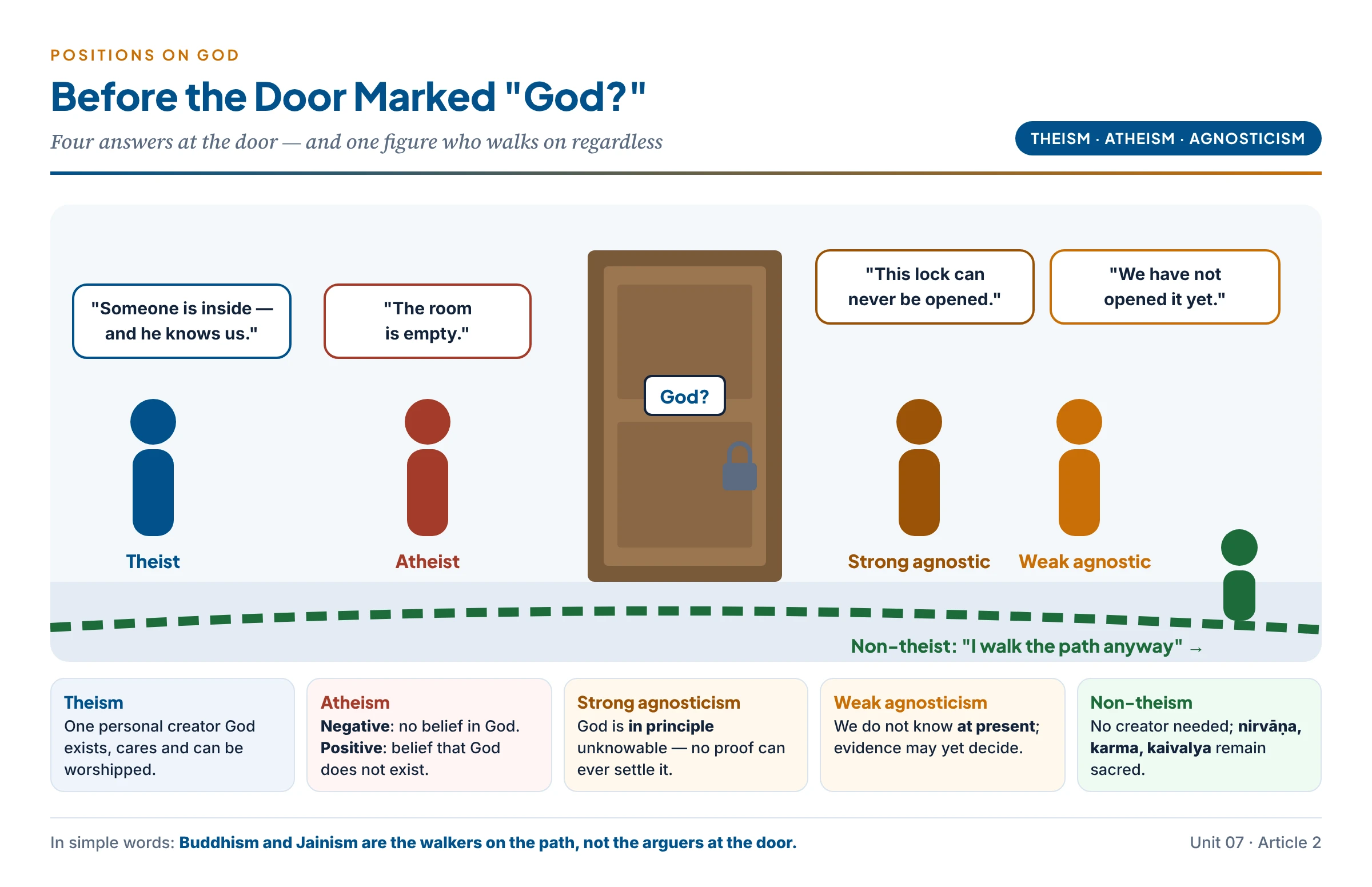
Four people stand outside a locked room and are asked, “Is anyone inside?” The theist says, “Yes — and he knows us.” The atheist says, “No — the room is empty.” The agnostic says, “The door is locked; none of us can know.” The non-theist says, “I cannot say who is inside, and it does not matter for my journey — I know the road out of suffering, and I will walk it myself.” The last answer is the one taken by Buddhism and Jainism.
Context & Problem
Why These Distinctions Matter
- “Religion without God” is ambiguous. It may mean:
- religion after denying God (an atheist’s religion);
- religion without deciding about God (an agnostic’s religion);
- religion in which God, even if real, is not central (the Indian non-theistic religions);
- religion in which “God” is re-interpreted as an ideal, a value or nature (Articles 7–8).
- The words carry feelings. In ordinary speech “atheist” often sounds like an accusation — godless, immoral, dangerous. Philosophy needs more neutral and exact terms.
- The syllabus questions ask what agnostics think about religion and God, whether atheism can be a religion, and whether “God is dead”. All three need precise definitions first.
Core Doctrine
1. Theism and Its Neighbours
- Theism (Greek theos, God): belief in one personal God who is the creator and sustainer of the world, transcendent (beyond it) and immanent (present in it), all-powerful, all-knowing, all-good, who cares for human beings and can be worshipped and prayed to — the God of Judaism, Christianity, Islam, Rāmānuja and Madhva.
- Deism: God created the world and its laws, then left it to run by itself; God is known by reason and the observation of nature, not by revelation, miracles or prophecy. Critics called the deist God an “absentee landlord” who cannot inspire devotion. In history, deism was soon replaced by agnosticism, naturalism, materialism and humanism — positions holding that the world and morality can be explained without any transcendental entity.
- Pantheism: “all is God and God is all” — God and the world are two aspects of one reality (Spinoza‘s “God or Nature”). There is no separate personal God.
- Panentheism: the world is in God, but God is more than the world.
- Polytheism: belief in many gods; henotheism (a term of Max Müller): worshipping one god at a time as supreme, as in many Vedic hymns.
- Monism (Advaita): the ultimate reality is the impersonal Brahman; the personal God (Īśvara) is real only at the empirical level.
In simple words
Think of a clockmaker. The theist‘s clockmaker made the clock, keeps winding it, and listens when you speak to him. The deist‘s clockmaker made it, wound it once and went away. The pantheist says the clock and the clockmaker are the same thing. The atheist says the clock was never made — it grew. The non-theist says, “Whatever the answer, I must learn to keep my own time well.”
2. Atheism: Meaning and Kinds
- Meaning. Atheism (Greek a-, “without”, and theos, “god”) is the denial of God — or, more weakly, the absence of belief in God.
- Kinds of atheism.
- Theoretical vs practical. Theoretical atheism argues that there is no God. Practical atheism simply lives as if there were no God, without arguing about it — a person may profess faith yet live as a practical atheist.
- Negative (weak) vs positive (strong). Negative atheism is the lack of belief in God. Positive atheism is the belief that God does not exist, defended by arguments.
- Local vs global. Local atheism rejects one concept of God (say, the personal creator) while leaving room for other spiritual realities. Global atheism rejects all gods and every supernatural reality.
- The main grounds of atheism.
- The problem of evil — an all-good, all-powerful God would not allow so much suffering (Unit 03).
- The failure of the proofs — the ontological, cosmological and design arguments do not succeed (Unit 02).
- Naturalism — science explains the world without God; “I had no need of that hypothesis” (Laplace).
- Verificationism — “God exists” cannot be verified, so it is not even a meaningful statement (logical positivists).
- Projection theories — God is a human creation: the projection of the human essence (Feuerbach), of society (Durkheim), of the father (Freud), of class interests (Marx) (Article 7).
- Freud. Religious ideas are “illusions, fulfilments of the oldest, strongest and most urgent wishes of mankind“. Faced with a terrifying nature — storm, disease, death — we turn its forces into persons whom we can appease, and project on the universe the memory of our father as a great protector. Religion is “the universal obsessional neurosis of humanity”, to be outgrown when people learn to face the world through science.
- “New atheism”. In recent decades Richard Dawkins and Daniel Dennett have argued that religion is a by-product of evolution, spread by cultural replicators (“memes”) much as genes spread biological traits; and that religious belief should be challenged openly as a matter of reason.
- Indian atheism.
- Cārvāka — the only classical school that is atheist in the global sense: no God, no soul, no karma, no rebirth, no liberation; perception alone is valid (Paper I, Cārvāka unit).
- Modern voices — Bhagat Singh‘s essay “Why I Am an Atheist” (written in jail, 1930–31) rejects God in the name of reason and self-reliance; E.V. Ramasamy (Periyar) attacked religion as a prop of caste; Gora (Goparaju Ramachandra Rao) founded the Atheist Centre at Vijayawada (1940) and preached “positive atheism” — atheism as the basis of human equality and moral self-responsibility.
3. Non-theism: Not the Same as Atheism
- Non-theism is the doctrine that negates the concept of a personal God — a divine being who is omnipotent, omniscient and the creator, sustainer and destroyer of the world. It says simply that the person in question does not believe in such a God.
- A difference of feeling. When we call someone an atheist, we usually add a feeling of criticism or contempt. “Non-theist” is neutral.
- A difference of logic. Non-theism negatively rejects belief in God; it does not positively assert that God cannot exist. It is closer to “God is not needed” or “God is not proved” than to “God is impossible“.
- A difference of content. A non-theist may reject a personal God and still accept other spiritual and supernatural realities. Jainism, Buddhism and Sāṃkhya reject God but accept nirvāṇa, kaivalya, the Tīrthaṅkaras, the law of karma, Prakṛti and Puruṣa. These are sacred, but they are not God, because they lack God’s personal qualities — they do not create, command, judge or forgive.
- So “non-theistic religion” is not a contradiction. It means a religion whose sacred realities are impersonal or perfected human, not a personal creator.
Common confusion
Do “āstika” and “nāstika” mean believer and non-believer in God? No. In classical Indian usage āstika means one who accepts the authority of the Veda; nāstika one who rejects it. So Sāṃkhya and Mīmāṃsā are āstika though they reject a creator God, while Jainism and Buddhism are nāstika though they are deeply spiritual. Only the Cārvāka is nāstika in both senses. Translating nāstika as “atheist” turns two great religions into “atheisms” and hides the very point of this unit.
4. Agnosticism: Huxley’s Method
- The word. The English biologist T.H. Huxley (“Darwin’s bulldog”) coined “agnostic” in 1869 and explained it in his essay “Agnosticism” (1889). In the Metaphysical Society, where every member was some kind of “-ist”, Huxley felt like the fox who had lost its tail among foxes with tails. Most members were sure they had attained a certain “gnosis” (knowledge) about the problem of existence; he was sure he had not, and suspected the problem was insoluble. So he invented a label as the opposite of the ancient “Gnostics” who claimed to know so much.
- A method, not a creed. Huxley wrote: “Agnosticism, in fact, is not a creed, but a method, the essence of which lies in the rigorous application of a single principle.” The principle, positively: “In matters of the intellect, follow your reason as far as it will take you, without regard to any other consideration.” Negatively: “In matters of the intellect, do not pretend that conclusions are certain which are not demonstrated or demonstrable.“
- Its ancestors.
- Protagoras (5th century BCE): “Concerning the gods, I am unable to know whether they exist or not, or what they are like; many things prevent knowledge — the obscurity of the subject and the shortness of human life.”
- Hume: the arguments of natural theology go beyond experience; on God, the wise “suspend judgment”.
- Kant: God can be neither proved nor disproved by theoretical reason; God belongs to the noumenal realm beyond possible experience — though God may be postulated by practical (moral) reason (Paper I, Kant unit).
- Herbert Spencer (First Principles, 1862): behind all phenomena lies a Power that is the Unknowable; religion and science are reconciled in recognising this ultimate mystery.
- Russell’s distinction. Bertrand Russell (in “Am I an Atheist or an Agnostic?”, 1947) said that strictly he was an agnostic, since he could not prove that God does not exist; but in practice he was an atheist, in the same sense as he was an atheist about the gods of Olympus — he did not think them worth taking seriously.
- Kinds of agnosticism.
- Strong (permanent) agnosticism — God’s existence is in principle unknowable; no argument, a priori or a posteriori, can ever establish it conclusively.
- Weak (temporary) agnosticism — we do not know at present; new evidence may decide it.
- Apathetic agnosticism — whether or not God exists, it makes no practical difference to how we should live.
- Ignosticism (linked to the logical positivists) — the very question “does God exist?” is meaningless until “God” is defined in a verifiable way. A.J. Ayer argued that theism, atheism and agnosticism are all equally out of place, since “God exists” is neither true nor false but nonsensical.
5. How Agnostics Relate Religion and God
Agnosticism is a position about knowledge, not about religion. So agnostics have related religion and God in several quite different ways:
- Religion without religious knowledge-claims. Since God cannot be known, religion should not rest on dogmas about God. It can rest on ethical practice, reverence and community — religion as a way of living, not a set of assertions. Huxley himself honoured the moral core of religion while rejecting its theology.
- Religion as reverence for the Unknowable. For Spencer, the deepest truth of all religions is that the Power behind the universe is inscrutable. Religion at its best is humility and awe before this mystery — an agnostic religious attitude that science can share.
- Faith beyond knowledge. Kant was a theoretical agnostic but a practical believer: God cannot be known, but may be postulated as the guarantor of the moral order (the highest good). Many religious people are “agnostic theists” — they believe without claiming to know.
- Negative theology. Within the religions themselves, apophatic (negative) theology says God is beyond every concept — we know only what God is not. Advaita’s “not this, not this” (neti neti) and the medieval mystics’ “cloud of unknowing” are a religious agnosticism about God’s nature.
- God irrelevant to the religious life. The agnostic may hold that whether God exists or not, the religious task — overcoming selfishness, suffering and ignorance — remains the same. This is very close to the Buddha‘s attitude (below) and to Dewey‘s “religious” quality of experience (Article 8).
- Religion as human culture. Some agnostics treat religion as a human creation — valuable as art, myth and moral symbol (Santayana, Braithwaite), without any claim that its God exists (Article 8).
- The agnostic’s typical conclusion. God is not knowable, so God cannot be the foundation of religion; but religion — as reverence, morality, community and the quest for meaning — can remain. This is why agnosticism naturally supports the possibility of religion without God.
In simple words
A student is told, “There may or may not be an invigilator watching through the camera — no one can tell.” The agnostic student does not cheat anyway. He says, “Whether or not anyone is watching, honesty is still the right way to write the exam.” The agnostic’s religion is like that: whether or not God is watching, goodness, reverence and self-discipline keep their value.
6. Indian Parallels: “Who Really Knows?”
- The Nāsadīya Sūkta (Ṛg Veda, the Hymn of Creation). After describing the mystery before creation — “then there was neither existence nor non-existence” — the hymn ends: “Who really knows? Who will here proclaim it? … Whence this creation has arisen — perhaps it formed itself, or perhaps it did not — he who surveys it in the highest heaven, he surely knows — or perhaps he does not know.” Even the supreme overseer may not know: one of the earliest agnostic voices in world literature, inside a sacred text.
- Sañjaya Belaṭṭhiputta, a contemporary of the Buddha, refused to affirm or deny anything about the other world, the fruits of action or life after death: “If you ask me whether there is another world — I do not say so, I do not say otherwise, I do not say no, and I do not say not not.” Buddhists called this “eel-wriggling” — a slippery scepticism that avoids every commitment.
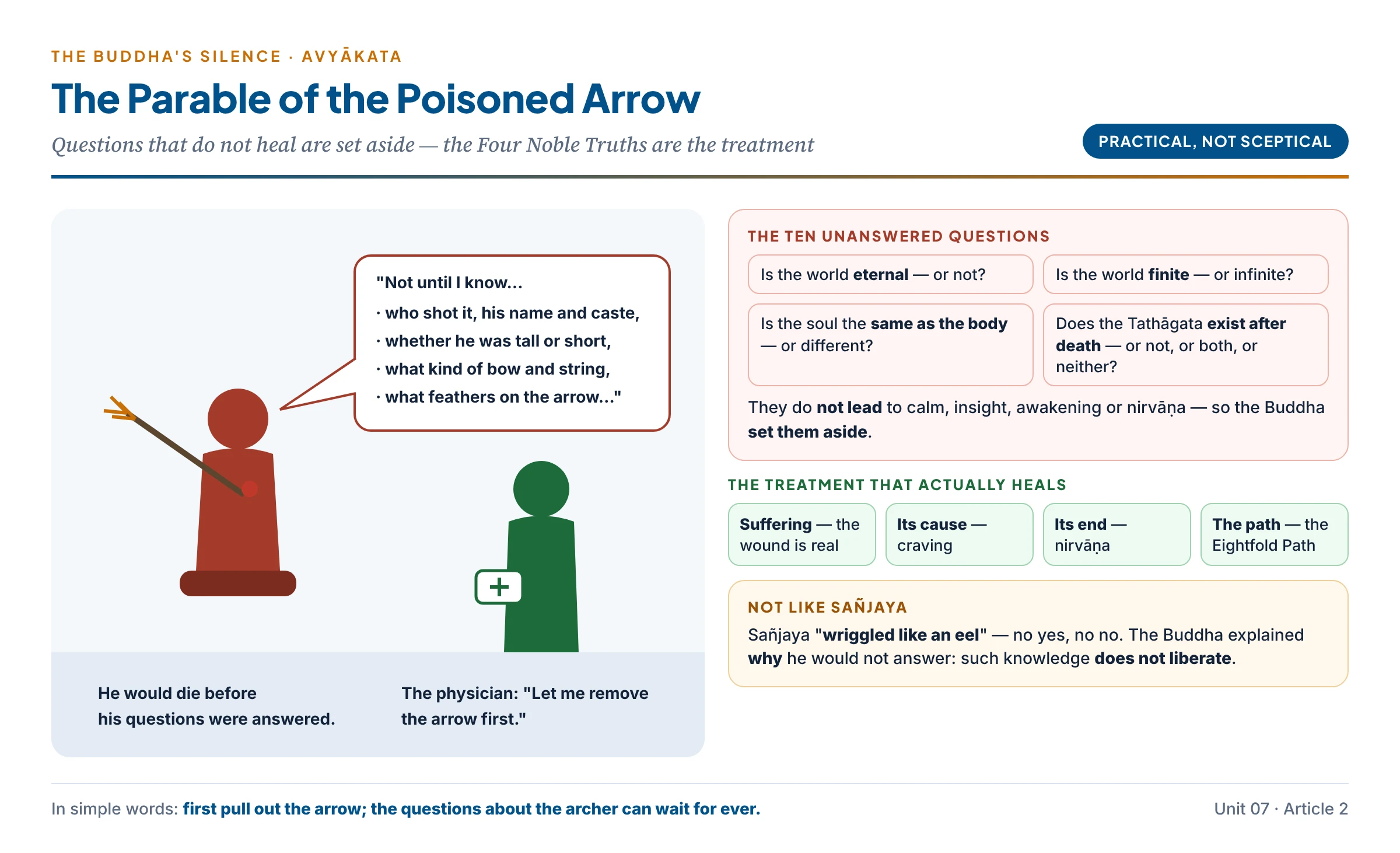
- The Buddha’s unanswered questions (avyākata). The Buddha set aside ten speculative questions — whether the world is eternal or not, finite or not, whether the soul is the same as the body or different, whether the Tathāgata exists after death or not. Unlike Sañjaya, he did not wriggle; he explained why he would not answer:
- The parable of the arrow. A man struck by a poisoned arrow refuses treatment until he learns who shot it, his caste, his name, the kind of bow and feathers — he will die before he learns. The questions do not lead to the end of suffering; the Four Noble Truths do.
- So the Buddha’s silence is practical, not sceptical. He was not saying “nobody can know”; he was saying “this knowledge does not liberate“.
- The Kālāma Sutta. The Buddha told the Kālāmas not to accept a teaching merely because of tradition, scripture, logic or the authority of a teacher, but to test it: “when you know for yourselves that these things are wholesome … then you should practise them.” He then offered four assurances to one who lives a pure life: if there is another world and karma bears fruit, he will be reborn well; if there is no other world, he still lives happily here and now; if evil befalls the evil-doer, he has done no evil; if not, he is pure either way. Religious practice is justified whatever the metaphysical truth turns out to be — a strikingly agnostic-proof case for the religious life.
- Jaina caution. The Jainas rejected sceptics (ajñānavādins) but taught syādvāda — every statement is true only “in some respect” — a doctrine of intellectual humility that shares the agnostic’s dislike of dogmatism.
Indian Connect — Indian agnosticism in a religious key
- In the West, agnosticism usually led away from religion; in India, agnostic and sceptical attitudes often grew within religion — in the Nāsadīya hymn, the Buddha’s silence and Jaina syādvāda.
- The Buddha’s position is unique: practically indifferent to the God-question, yet the founder of a world religion. This is the clearest historical model of religion without God built on agnostic-proof foundations.
7. Nietzsche: “God Is Dead”
- The text. In The Gay Science (1882) a madman runs into the market-place with a lantern in broad daylight, crying “I seek God!” The bystanders, who do not believe, laugh at him. He cries: “God is dead. God remains dead. And we have killed him.” Then he falls silent: “I have come too early … this tremendous event is still on its way.”
- What it means.
- Not a metaphysical proof. Nietzsche is not proving that no God exists; he is diagnosing a cultural event: belief in the Christian God has become unbelievable for modern educated Europe.
- “We have killed him.” Science, historical criticism of scripture and the honesty that Christianity itself taught have undermined faith from within.
- The consequence — nihilism. The values of Western civilisation — truth, morality, meaning — rested on God. With God gone, these values lose their foundation: “What were we doing when we unchained this earth from its sun?” Most people have not yet realised this.
- The task — a revaluation of all values. Human beings must now create values themselves; Nietzsche’s ideal of the Übermensch (the “overman”) is one who affirms life and creates meaning without God.
- Sartre’s development. Sartre (Existentialism Is a Humanism, 1946) drew the conclusion: if God does not exist, there is no human nature fixed in advance; “existence precedes essence“; man is “condemned to be free” and responsible for creating his values (Paper I, Existentialism unit). He quotes Dostoevsky: “If God did not exist, everything would be permitted” — and accepts the starting point while rejecting the despair.
- Is God dead or living? The believers’ reply:
- What died is an idea of God, not God — the “God of the gaps” who explained what science could not, or the tyrant in the sky. Martin Buber spoke instead of the “eclipse of God“: God is hidden from a culture that no longer listens.
- Religion is not dying across the world. Large global surveys (e.g. Pew Research Center, 2012) found that more than eight in ten people identified with a religion; faith has revived in many societies.
- God lives in religious experience, prayer and the lives of saints — which no cultural change can refute.
- Nietzsche’s lasting point for this unit. If God “dies” in a culture, either morality and meaning must find a new foundation, or nihilism follows. The attempts to find that foundation — Comte’s Humanity, Huxley’s evolutionary humanism, Dewey’s ideals, Dworkin’s objective values — are the Western “religions without God” (Articles 7–8).
In simple words
A building’s pillars are suddenly removed. For a few minutes nothing happens — the roof seems to float. Nietzsche’s madman shouts that the pillars are gone; the people laugh, because the roof is still there. Nietzsche’s point is that Western morality is that roof: it rested on God, and once belief in God is gone, we must either build new pillars or watch the roof fall.
8. Can Atheism Be a Religion?
The case for “No”:
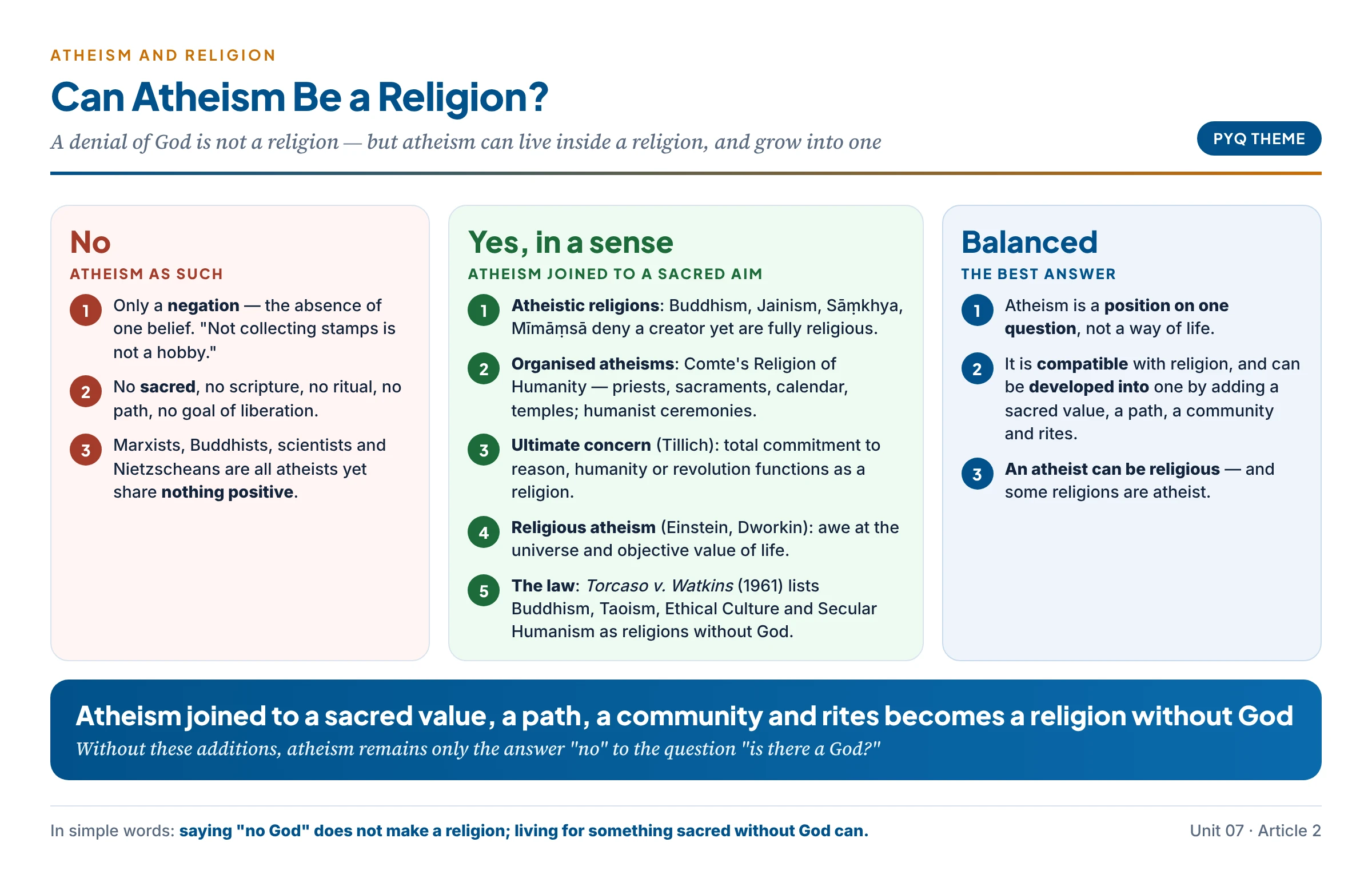
- Atheism is only a negation. It is the absence of a belief, not a set of beliefs. As people say, atheism is a religion only in the way that “not collecting stamps is a hobby”.
- No sacred, no path, no community. Atheism as such has no scripture, no ritual, no worship, no goal of liberation and no moral code — it says nothing about how to live.
- Atheists differ widely. A Marxist, a Buddhist, a scientific naturalist and a Nietzschean are all atheists, yet they share nothing positive.
The case for “Yes, in a certain sense”:
- Atheistic religions exist. Buddhism, Jainism, Sāṃkhya and Mīmāṃsā are atheistic about a creator God — yet fully religious. So atheism (about God) is compatible with religion.
- Organised atheisms have taken religious form. Comte‘s “Religion of Humanity” had priests, sacraments, a calendar of saints and temples — a deliberately atheistic religion (Article 7). Soviet state atheism developed its own cult — the embalmed Lenin in his mausoleum, sacred texts, festivals. Humanist societies offer naming, wedding and funeral ceremonies.
- Functionally, any ultimate concern is a religion. If atheism becomes a person’s ultimate concern — a total commitment to reason, humanity or revolution — then, on Tillich‘s definition, it has become their religion, and its object their “god” (Article 1).
- Religious atheism. Dworkin and Einstein describe a “religious attitude” — awe at the universe and a conviction that life has objective value — that atheists can share fully (Article 8).
- The law. In the United States, the Supreme Court noted in Torcaso v. Watkins (1961) that among religions in that country “which do not teach what would generally be considered a belief in the existence of God are Buddhism, Taoism, Ethical Culture, Secular Humanism and others”.
A balanced view:
- Atheism as such is not a religion — it is a position on one question.
- But atheism can be part of a religion (Buddhism, Jainism), or can be developed into a religion-like way of life when joined to a sacred value, a path, a community and rites (Comte, humanism).
- So the right answer is: atheism is not a religion, but an atheist can be religious — and some religions are atheist.
9. Is Secularism the Same as Atheism?
- No. Atheism is a view about God; secularism is a view about the state — that the state should not be controlled by, or favour, any religion.
- Western secularism often means a wall of separation between church and state; some forms (like the French laïcité) keep religion out of public life.
- Indian secularism (Articles 25–28 of the Constitution) means equal respect for all religions (sarva dharma samabhāva) and principled distance — the state may reform religious practices (abolishing untouchability, regulating temples) but does not adopt or persecute any faith. It protects both believers and non-believers: Article 25 guarantees “freedom of conscience” along with the right to profess, practise and propagate religion.
- Gandhi and Nehru. Gandhi was deeply religious yet secular — “Truth is God” was meant to include even atheists (Article 3). Nehru was an agnostic, yet he defended the freedom of all faiths.
- So a secular state can be run by believers; a theocracy can be run by hypocrites; and an atheist state (the USSR) can be anti-secular in its persecution of religion. Secularism is neutral about God; atheism is not.
Critical Evaluation
Assessing the Three Positions
- Against atheism.
- Proving a negative — one cannot show that God exists nowhere and in no form; strong atheism claims more than the evidence allows.
- Morality and meaning — critics argue that if there is no God, moral obligation and life’s meaning have no ultimate ground (Dostoevsky’s worry). Atheists reply that morality rests on human nature, reason and compassion (Unit 08).
- The global persistence of religion suggests a deep human need that a mere denial cannot satisfy.
- For atheism.
- The burden of proof lies on the one who asserts a reality; in its absence, disbelief is the reasonable default (Russell‘s analogy of the teapot orbiting the sun, too small to be seen — we need not believe in it merely because it cannot be disproved).
- The problem of evil remains the strongest argument against a perfect personal God.
- Against agnosticism.
- Fence-sitting? Critics say it avoids a decision that life forces on us. Pascal: “You must wager; it is not optional.” William James: when the choice is “live, forced and momentous“, refusing to decide is itself a decision, with its own risk.
- Theists reply that God is known — through revelation, religious experience or reason — so agnosticism ignores real evidence.
- Atheists reply that lack of evidence for God is itself evidence of absence; agnosticism is “atheism without courage”.
- For agnosticism.
- It is intellectually honest — it claims no more than the evidence supports.
- It keeps the mind open, and it is compatible with a reverent, moral and even religious life (Spencer, Kant, the Buddha).
- On non-theism. It avoids the extremes: it neither affirms a personal God nor makes the denial of God its centre. Its weakness, theists say, is that it leaves grace and personal devotion without an object (Article 3).
Critics and Defenders
Criticism — Critics of belief in God
- Freud: God is an illusion born of the wish for a protecting father.
- Nietzsche: God is dead; we must create values ourselves.
- Russell: the burden of proof lies on the believer; no teapot, no God.
- Cārvāka, Bhagat Singh, Gora: reason and human dignity need no God.
- Huxley: do not claim certainty where nothing is demonstrable.
Defence — Defenders of belief, and replies
- Theists: God is known through revelation, experience and reason.
- Pascal and James: the choice is forced; agnosticism is itself a decision.
- Buber: God is not dead but eclipsed by a culture that has stopped listening.
- Kant: God may be unprovable yet rationally postulated by morality.
- The Buddha (on the practical side): whatever the truth about God, the path of purity is worth walking.
Cross-Tradition Comparison
Positions on God, Western and Indian
| Position | Core claim | Western examples | Indian examples |
|---|---|---|---|
| Theism | A personal creator God exists | Aquinas, Descartes, Kant (by faith) | Nyāya, Rāmānuja, Madhva |
| Deism | God made the world, then left it | Toland, Voltaire | — |
| Pantheism / monism | God and the world are one | Spinoza | Advaita (impersonal Brahman) |
| Strong atheism | There is no God | Holbach, Nietzsche, Russell (in practice) | Cārvāka, Bhagat Singh, Gora |
| Agnosticism | God cannot be (or is not) known | Protagoras, Hume, Huxley, Spencer | Nāsadīya Sūkta, Sañjaya |
| Non-theism | No creator needed; other sacred realities kept | Spinoza’s “God or Nature” (partly), Dworkin | Buddhism, Jainism, Sāṃkhya, Mīmāṃsā |
The Buddha and Huxley
| Point | The Buddha | T.H. Huxley |
|---|---|---|
| On the God-question | Sets it aside as not leading to liberation | Calls it insoluble by human reason |
| Reason | “Know for yourselves” (Kālāma Sutta) | “Follow your reason as far as it will take you” |
| Attitude to religion | Founds a path of liberation | Respects religion’s moral core, rejects its theology |
| Result | A religion without God | A method without a religion |
Indian Connect — Takeaways
- In India, “atheist” (nāstika) and “non-believer in God” are different ideas; most Indian “atheisms” are non-theisms inside religious traditions.
- The Buddha’s silence shows that one can build a complete religious life without settling the question of God.
- Indian secularism is equal respect for all faiths — and for unbelief — not state atheism.
Synthesis (Siddhānta)
- The positions on God are not two (believer and unbeliever) but many: theism, deism, pantheism, atheism in its kinds, agnosticism in its kinds, and the Indian non-theism that sets aside a creator while keeping the sacred.
- Agnosticism is a position about knowledge: it holds that God is not (or not yet) knowable, and it naturally supports a religion based on practice, reverence and morality rather than on dogmas about God. Spencer’s Unknowable, Kant’s moral faith, negative theology and the Buddha’s practical silence are its religious forms.
- Atheism is not itself a religion — it answers only one question — but it is compatible with religion: Buddhism and Jainism are atheist about a creator, and Comte’s Religion of Humanity was a deliberate atheistic religion.
- Nietzsche’s “God is dead” describes a crisis of foundations: if God no longer grounds value, value must be grounded anew. The religions without God studied in the following articles are, in part, answers to this crisis.
- Contemporary relevance.
- The fastest-growing “religious” group in many countries is the unaffiliated — many of them agnostic but spiritual.
- Constitutional freedom of conscience protects belief and unbelief alike; India’s secularism is neutral about God, not hostile to faith.
- Dialogue between theists and non-theists works best when each recognises that the other may share reverence, morality and the search for meaning.
“In matters of the intellect, follow your reason as far as it will take you, without regard to any other consideration … do not pretend that conclusions are certain which are not demonstrated or demonstrable.” — T.H. Huxley
Previous Year Questions
- 2023What is Agnosticism? How do agnostics conceptualize the relation between religion and God? Discuss.
- 2009Is secularism analogous to atheism? Examine in the Indian context.
- 2005Can atheism be a religion? Discuss.
- 2003Is God dead (Nietzsche) or living (faithful people)?