

Nyāya–Vaiśeṣika: Theory of Categories; Theory of Appearance; Theory of Pramāṇa; Self, Liberation; God; Proofs for the Existence of God; Theory of Causation; Atomistic Theory of Creation
Official Syllabus: Paper I, Section B, Unit 15
Vaiśeṣika is the metaphysics of the Nyāya–Vaiśeṣika partnership. Its founder, Kaṇāda, set out to list everything there is — every kind of thing that a word can name and a mind can know — under a small number of categories (padārtha). He found six kinds of positive reality: substance (dravya), quality (guṇa), action (karma), universal (sāmānya), particularity (viśeṣa) and inherence (samavāya); later Vaiśeṣikas added a seventh, absence (abhāva). The school even takes its name from one of them, viśeṣa, the principle of difference. This article explains what a padārtha is, the division into being and non-being, and the first three categories in detail — the nine substances, the twenty-four qualities and the five kinds of action — together with the great Buddhist challenge: are there really substances, or only bundles of qualities? Articles 8 and 9 take up the remaining categories.
In simple words
Look at a red ball flying up into the air. The ball is a thing that can carry features — a substance. Its redness and roundness are features that sit in it — qualities. Its flying upward is a movement that happens in it — an action. It is a ball like all other balls — that shared nature is a universal. The tie that makes the redness belong to the ball is inherence. And the fact that there is no second ball beside it is an absence. Vaiśeṣika claims that, with a handful of such headings, it can place everything in the universe.
Context & Problem
The School and Its Founder
- Kaṇāda. The founder is called Kaṇāda or Kaṇabhuk — “eater of grains” — because, as an ascetic, he lived on grains gleaned from the fields after harvest. He is also called Ulūka (so the system is called Aulūkya) and Kāśyapa (by his lineage). The name “grain-eater” is also linked by tradition to his teaching that matter is made of tiny particles.
- Texts.
- Vaiśeṣika Sūtra of Kaṇāda — ten books, each in two sections.
- Praśastapāda‘s Padārthadharmasaṅgraha — an independent restatement of the system, which fixed the list of twenty-four qualities.
- Commentaries on it: Vyomaśiva‘s Vyomavatī, Udayana‘s Kiraṇāvalī and Śrīdhara‘s Nyāyakandalī.
- Later manuals combining Nyāya and Vaiśeṣika: Śivāditya‘s Saptapadārthī (“the seven categories”), Viśvanātha‘s Bhāṣāpariccheda with the Siddhāntamuktāvalī, and Annambhaṭṭa‘s Tarkasaṅgraha.
- The name. Vaiśeṣika comes from viśeṣa, “particularity” or “difference”. The system stresses that reality is made of distinct, irreducible kinds — it is a pluralistic realism.
- Its aim. The Sūtra opens: dharma is that from which come prosperity (abhyudaya) and the highest good (niḥśreyasa). The highest good — liberation — follows from true knowledge of the categories through their similarities and differences.
- Partnership with Nyāya. Nyāya and Vaiśeṣika are allied systems (samāna-tantra, Article 1). Vaiśeṣika accepts only two pramāṇas (perception and inference); Nyāya accepts four. Nyāya lists sixteen topics of debate; Vaiśeṣika lists seven categories of reality — and later Nyāya adopted the Vaiśeṣika list as its metaphysics.
The Philosophical Problem
- What exists, and of what kinds? A theory of categories answers the most basic question of metaphysics.
- Against reductionism. The Buddhists reduce things to momentary qualities (dharmas); Advaita reduces everything to one Brahman; Sāṃkhya to two principles. Vaiśeṣika insists that a careful analysis of experience and language reveals several irreducible kinds of reality.
- Method. The categories are found by analysing what we know and what our words name: “the red ball moves” mentions a thing, a quality and a movement, and each is irreducible to the others.
Core Doctrine
1. What Is a Padārtha?
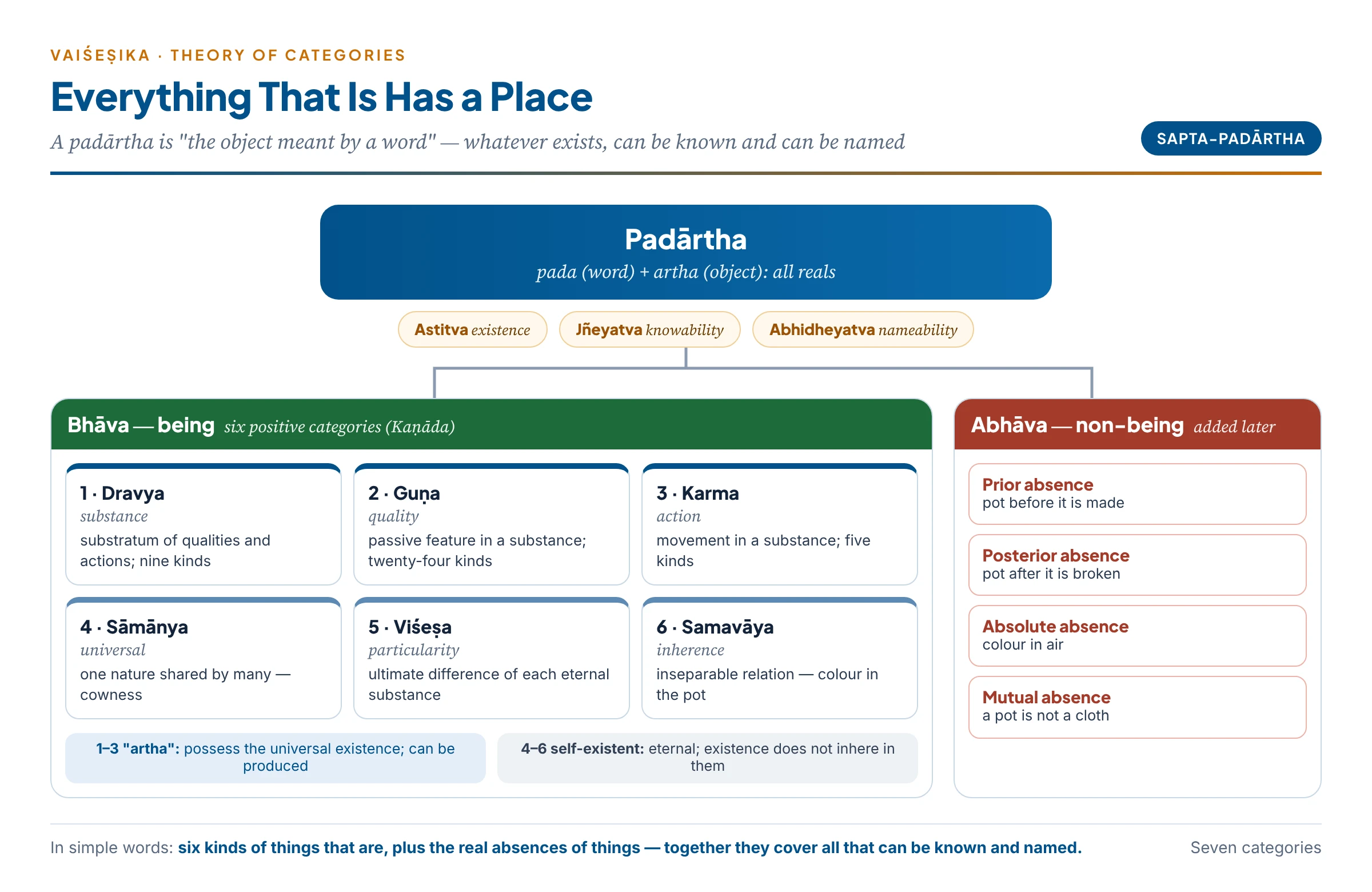
- Literal meaning. Pada means word; artha means meaning or object. A padārtha is “the object meant by a word“. So by padārtha Vaiśeṣika means all objects of knowledge — all reals.
- Three marks of every padārtha.
- Astitva — existence (is-ness). It really is; it is not a figment.
- Jñeyatva — knowability. It can be known by some valid means.
- Abhidheyatva — nameability. It can be expressed by a word.
- What the three marks imply.
- Realism — whatever is real is knowable; there are no unknowable things-in-themselves.
- Harmony of being, knowing and naming — the structure of reality, of knowledge and of language correspond.
- Even absence qualifies — the absence of a pot is knowable and nameable, so it too is a padārtha (Article 9).
- Further shared features. Praśastapāda points out what groups of categories share:
- All six positive categories have existence, knowability and nameability.
- Substance, quality and action alone possess the universal existence (sattā), have universals and particular differences, and can be causes and effects of a kind. Kaṇāda calls these three artha (“objects” in the full sense).
- Universal, particularity and inherence are self-existent (svātma-sat) — they are, but the universal “existence” does not inhere in them. They are eternal and are not produced.
- The test of a separate category. A thing deserves its own category only if it cannot be reduced to any other — if it has features, functions or relations that no other category has.
2. Being and Non-Being: The Seven Categories
- Two broad classes. All objects named by words are either being (bhāva) — positive reals — or non-being (abhāva) — negative facts.
- Six kinds of being (listed by Kaṇāda):
- Dravya (substance) — the substratum of qualities and actions.
- Guṇa (quality) — a passive feature residing in a substance.
- Karma (action) — a movement residing in a substance.
- Sāmānya (universal) — the common nature shared by many things.
- Viśeṣa (particularity) — the ultimate difference of each eternal substance.
- Samavāya (inherence) — the inseparable relation between whole and parts, substance and quality, and so on.
- Non-being. Abhāva (absence) was added by later Vaiśeṣikas as the seventh category. It is of four kinds — prior, posterior, absolute and mutual (Article 9).
- Six plus one. The Vaiśeṣika Sūtra names only six positive categories; absence is discussed there but was counted as a separate seventh category only later — the title “Seven Categories” (Saptapadārthī) belongs to a later manual.
- Dependence. Of the positive categories, only substance is independent in the sense of being a substratum; qualities and actions depend on substances; universals and particularities depend on what they reside in; inherence relates them all.
3. Substance (Dravya)
- Definition. Kaṇāda defines substance by three marks: it possesses action, it possesses qualities, and it is the inherent (material) cause (samavāyi-kāraṇa) of its effects.
- Substratum. Qualities and actions exist in it; it is distinct from both. Without substance there can be no quality or action — a thing must exist before it can have features.
- Material cause. A cloth is made of threads and subsists in them, so the threads are its material cause; wood and graphite are the material cause of a pencil.
- A substance has no qualities at its first moment. When a pot is produced, for the very first moment it is without qualities; its colour arises in the next moment. Why? A quality needs its substance as its cause, and a cause must precede its effect. So the substance must exist, if only for an instant, before its qualities. This shows that a substance is not merely the sum of its qualities.
- Key features. Substance is the support (ādhāra) of qualities and actions; it is causally active; it exists in itself, not in another (except composite substances, which exist in their parts); reality is many substances, not one.
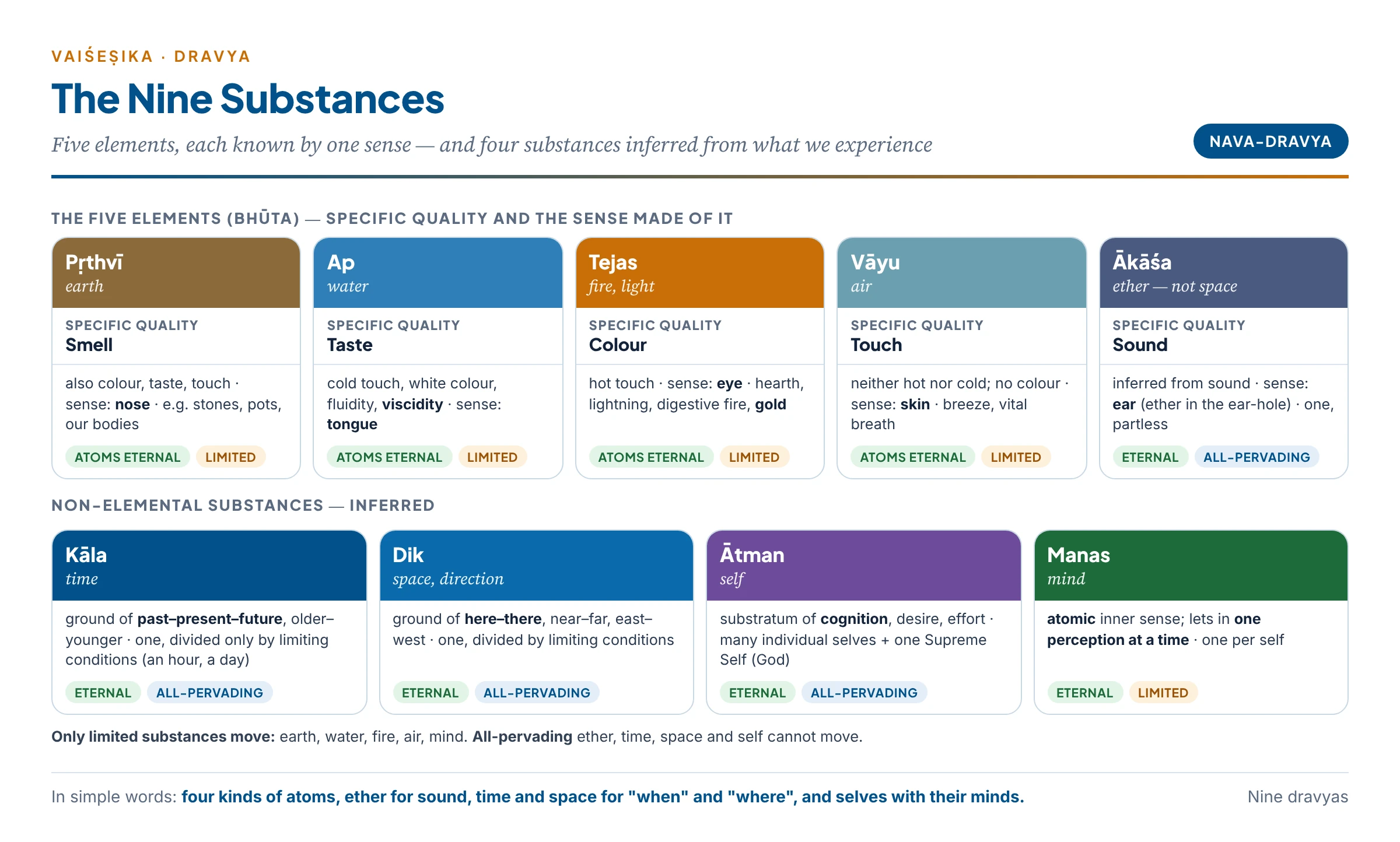
- The nine substances.
- Pṛthvī — earth. Specific quality: smell. Also has colour, taste and touch.
- Ap — water. Specific quality: taste. Also cold touch, white colour, natural fluidity and viscidity.
- Tejas — fire or light. Specific quality: colour (bright). Also hot touch.
- Vāyu — air. Specific quality: touch that is neither hot nor cold. Air has no colour.
- Ākāśa — ether. Specific quality: sound.
- Kāla — time. The ground of “past, present, future”, “older, younger”.
- Dik — space (direction). The ground of “here, there”, “near, far”, “east, west”.
- Ātman — self. The substratum of consciousness; individual selves and the Supreme Self.
- Manas — mind. The atomic inner sense.
In simple words
How do we know air is a separate substance? You feel a breeze on your face, yet you see nothing. The touch must belong to something, because every quality needs a bearer. It is not earth, water or fire (you would see them). So there must be an invisible substance whose quality is touch — that is air. Vaiśeṣika uses exactly this pattern — a quality is perceived, so its bearer must exist — to prove ether from sound, and space and time from “here–there” and “before–after”.
4. The Nine Substances in Detail
- The five elements (bhūtas). Earth, water, fire, air and ether are the five physical elements: each has a specific quality (viśeṣa-guṇa) sensed by one external sense.
- Each sense is made of its element. The nose is made of earth and senses smell; the tongue of water and senses taste; the eye of light and senses colour; the skin of air and senses touch; the ear is ether enclosed in the ear-hole and senses sound.
- Why? A sense reveals only the quality of the element it is made of — as odorous particles reveal smell.
- Smell in water? Pure water has no smell; muddy water smells because of the earth mixed in it.
- Eternal and non-eternal forms. Earth, water, fire and air exist in two forms:
- Eternal — as atoms (paramāṇu), partless, neither produced nor destroyed (Article 11).
- Non-eternal — as composite products made of atoms, which come into being and perish.
- Products are of three kinds: bodies (śarīra), sense organs (indriya) and objects (viṣaya). Thus earth appears as our bodies, as the sense of smell and as stones and pots.
- Kinds of fire. Earthly fire (in the hearth), celestial fire (lightning), digestive fire (in the stomach) and mineral fire — the Vaiśeṣikas class gold as a form of light, because its colour is not destroyed even by intense heat.
- Ether (ākāśa).
- Inferred, not perceived. Sound is perceived; ether is not. External perception of a substance needs a perceptible magnitude and manifest colour, and ether has no colour.
- Argument for ether. Every quality needs a substance. Sound is not a quality of earth, water, fire or air (their qualities are not heard); it occurs even where they are thin. It is not a quality of space, time, self or mind (these exist when there is no sound). So there must be another substance, ether, whose quality is sound.
- One, eternal, all-pervading — partless and unlimited.
- Space (dik) and time (kāla). Like ether, each is one, eternal, all-pervading and imperceptible.
- Space is inferred as the ground of “here–there”, “near–far”, “east–west”.
- Time is inferred as the ground of “past–present–future”, “older–younger”, “simultaneous–successive”.
- One but spoken of as many. “The ether in a jar”, “the east”, “an hour”, “a day” divide what is really one ether, space and time by limiting conditions (upādhi).
- Self (ātman). The eternal, all-pervading substratum of cognition, desire, effort and feeling. Two kinds: the individual self (jīvātman), many — one in each body, known by inner perception (“I am happy”) — and the Supreme Self (Paramātman, God), one, inferred as the maker of the world (Articles 12–13).
- Mind (manas). An atomic, imperceptible inner sense, one for each self. Its existence is inferred:
- Inner perception needs an inner sense. As outer objects need outer senses, pleasure, pain and cognition need an internal sense.
- No simultaneous cognitions. Talking to a friend, your eyes see his face, your ears hear the traffic, your skin touches your clothes — yet you do not perceive all at once. Some further cause lets in one perception at a time: the mind, which must turn to (attend to) an object.
- Atomic. If the mind had parts, its parts could join many senses at once and give many simultaneous perceptions. Since this does not happen, it is partless.
- Groupings of the nine.
- Limited, corporeal (mūrta): earth, water, fire, air, mind — these alone can move.
- All-pervading (vibhu): ether, space, time, self — these cannot move, having nowhere to go.
- Material elements (bhūta): earth, water, fire, air, ether.
- Always eternal: ether, space, time, self, mind.
- Ontological dualism. Vaiśeṣika recognises material and non-material substances — atoms and ether on one side, selves on the other — neither reducible to the other. Its pluralism is not materialism, because time, space, self and mind are also real.
Common confusion
Is ākāśa “space”? No. Many notes translate ākāśa as “space” and describe it as “providing spatial dimension”. In Vaiśeṣika, ākāśa is ether — the physical substance whose specific quality is sound. Space is a separate substance, dik, the ground of “here–there” and “east–west”. Ākāśa is one of the five elements; dik is not an element at all. Keeping them apart is essential, because Vaiśeṣika counts them as two of the nine substances.
5. The Buddhist Challenge: Are There Substances at All?
- The Buddhist position. Reality consists of momentary qualities or point-instants (dharmas). A “thing” is only a bundle or series of qualities; “substance” is a mental construction. “Our knowledge is confined to qualities“: we see colour, feel hardness, taste sweetness — we never perceive a bare substance behind them.
- The Buddhist arguments.
- We know things only through qualities. Take away colour, shape, smell and touch, and nothing is left to know. We tell a table from a chair only by their features.
- The whole is nothing over and above its parts. A table seen from the north shows two legs, from the south two others; the “whole table” is put together by the mind from these impressions.
- No quality-less substance is ever found. The Vaiśeṣika claim that a substance exists for a moment without qualities is unverifiable.
- What is the “more”? If the whole is more than its parts, what is that extra? To posit it is to imagine, not to observe.
- Nyāya–Vaiśeṣika replies.
- Qualities need a bearer. Colour, taste and smell cannot float free; “red” is always red of something. The judgment “the mango is yellow” has a subject and a predicate; the predicate qualifies a real subject.
- Different senses, one object. “What I see, I also touch“: the same pot is seen and touched. Colour and touch are different qualities known by different senses; what unifies them is the one substance in which both reside.
- Change presupposes something that stays. A green mango turns yellow; we say “the same mango has ripened”. If there were only qualities, there would be nothing that changed — only one quality replaced by another.
- Recognition of identity. When a glass jar is broken, we still say “these are the pieces of that jar“; the qualities have changed but the material identity is recognised.
- The whole is real. If there were no wholes, we could not hold or pull a thing as one — lifting one part of a stick lifts the whole. And if only invisible atoms existed, nothing would be perceived, since atoms are imperceptible; the perceived pot is a new whole (avayavin) with its own magnitude.
- Language supports it. We say “the pot has colour”, never “the colour has pot” — the asymmetry shows the substance–quality relation is real.
In simple words
Peel an onion layer by layer, looking for the “real onion” inside — you end with nothing. The Buddhist says a thing is like that: take away its colour, smell, taste and shape, and no “substance” is left. The Vaiśeṣika replies with a mango: it was green, now it is yellow; it was hard, now it is soft — and yet you say “the same mango has ripened”. Something stayed while the qualities changed. That something is the substance.
- Locke and Berkeley. The debate mirrors the Western one: Locke kept substance as an unknown “something I know not what” behind qualities; Berkeley and Hume dissolved it into a bundle of ideas. Vaiśeṣika holds that the substance is not unknown — it is perceived along with its qualities.
6. Quality (Guṇa)
- Definition. Kaṇāda defines quality as what:
- Resides in a substance (dravyāśrayī);
- Has no qualities of its own (aguṇavān);
- Is not an independent cause of conjunction and disjunction — unlike action.
- Qualities have no qualities. Colour belongs to the thing, not to its smell or to another colour. “This red is bright” means the thing is brightly red.
- Qualities have no action. When a bird flies, the bird moves, not its colour; the colour seems to move only because its bearer moves.
- Passive and static. A quality is a motionless property of things (niṣkriya); it does not by itself carry one thing to another.
- Non-inherent cause. A quality can be the non-inherent cause (asamavāyi-kāraṇa) of a similar quality in the effect: the colour of the threads causes the colour of the cloth (Article 10).
- Multiplicity. One substance can have many qualities at once — a mango is yellow, sweet, fragrant and soft.
- Dependence. No quality exists apart from a substance, and qualities make substances knowable and distinguishable.
Common confusion
Is a quality the “non-inherent cause of a substance”? No. Some notes say that qualities and actions are “the non-inherent cause of substance”, giving the green colour of threads as the non-inherent cause of a green cloth. Precisely: the conjunction of the threads (a quality) is the non-inherent cause of the cloth, and the colour of the threads is the non-inherent cause of the colour of the cloth. The threads themselves are the inherent (material) cause of the cloth. Action is the non-inherent cause of conjunction and disjunction, not of substance as such.
7. The Twenty-Four Qualities
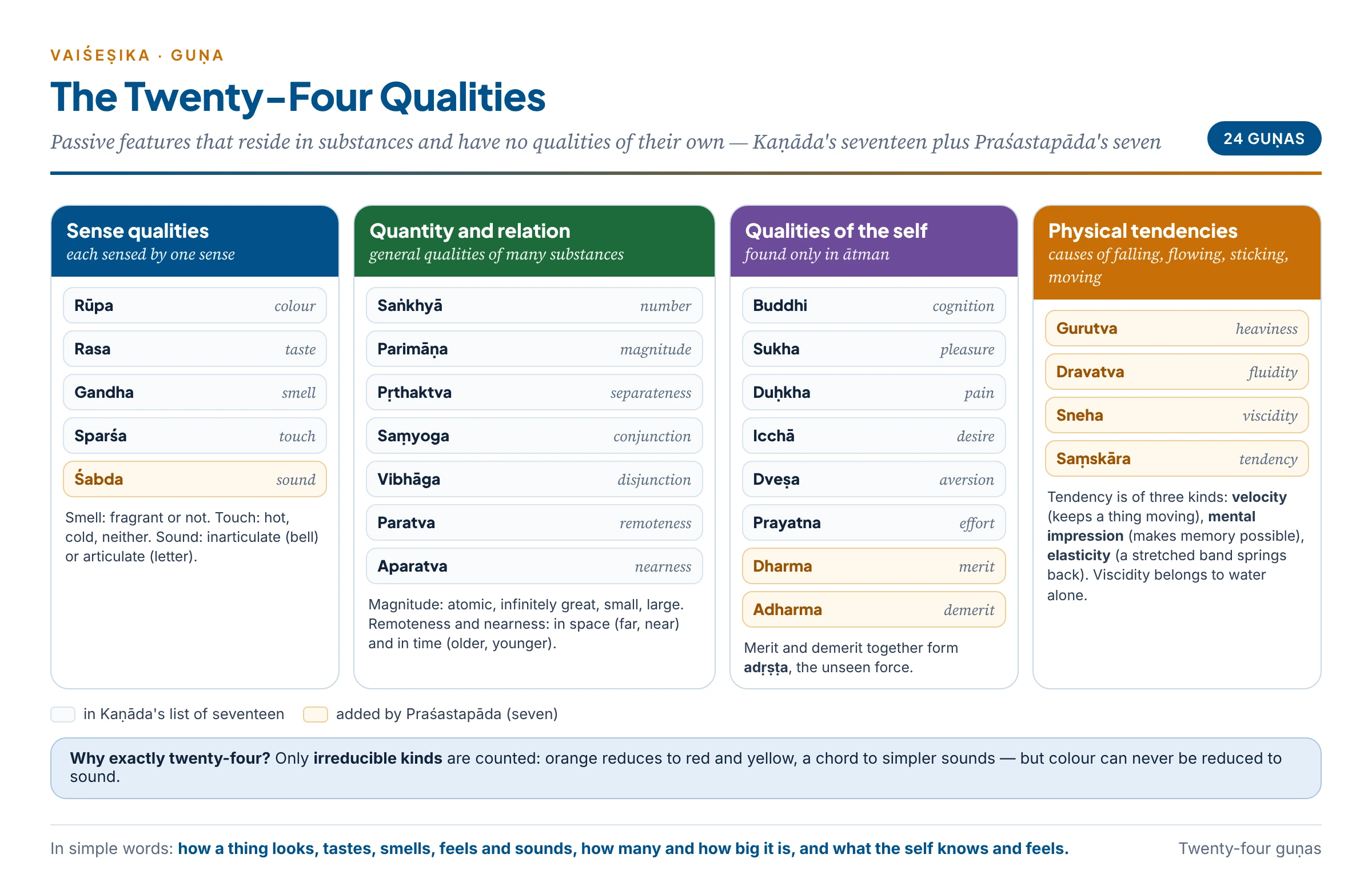
- Kaṇāda’s seventeen. Colour (rūpa), taste (rasa), smell (gandha), touch (sparśa), number (saṅkhyā), magnitude (parimāṇa), separateness (pṛthaktva), conjunction (saṃyoga), disjunction (vibhāga), remoteness (paratva), nearness (aparatva), cognition (buddhi), pleasure (sukha), pain (duḥkha), desire (icchā), aversion (dveṣa) and effort (prayatna).
- Praśastapāda’s seven additions. Heaviness (gurutva), fluidity (dravatva), viscidity (sneha), tendency (saṃskāra), merit (dharma), demerit (adharma) and sound (śabda). Total: twenty-four.
- The qualities explained.
- Colour — white, blue, yellow, red, green, brown, variegated. Taste — sweet, sour, salty, bitter, pungent, astringent. Smell — fragrant and non-fragrant. Touch — hot, cold, and neither hot nor cold.
- Sound — of two kinds: inarticulate (dhvani), like a bell, and articulate (varṇa), like a letter.
- Number — the quality by which we say one, two, three. “One” may be eternal (in an eternal thing); “two” and higher numbers are produced by a relating cognition (apekṣā-buddhi) that counts things together (Article 11).
- Magnitude — four kinds: atomic (infinitely small), infinitely great (ether, space, time, self), small and large.
- Separateness — that by which we know one thing is distinct from another — a jar from a picture.
- Conjunction — the separable union of two things that can exist apart, like a book and a table. Three kinds: produced by the motion of one (a kite settling on a hill), by the motion of both (two balls colliding), or by another conjunction (my hand touches the table because the pen in my hand touches it).
- Disjunction — the ending of a conjunction; again by the motion of one (a bird flying off a hill), of both (the balls rebounding), or by another disjunction (dropping the pen disconnects my hand from the table).
- Remoteness and nearness — spatial (far and near) and temporal (older and younger).
- Cognition, pleasure, pain, desire, aversion — qualities of the self.
- Effort — three kinds: striving towards something, striving away from something, and the vital effort that keeps the body alive (breathing).
- Heaviness — the cause of falling. Fluidity — the cause of flowing (water, milk, melted butter). Viscidity — the cause of particles sticking together into a lump, belonging only to water (as when flour and water make dough).
- Tendency (saṃskāra) — three kinds: velocity (vega), which keeps a thing moving; mental impression (bhāvanā), which makes memory and recognition possible; and elasticity (sthiti-sthāpakatva), by which a thing returns to its former state, like a stretched rubber band.
- Merit and demerit — produced in the self by enjoined and forbidden acts, leading to happiness and misery; together called adṛṣṭa, the “unseen” force (Articles 11–12).
- Ways of grouping them.
- Specific and general. Specific qualities (viśeṣa-guṇa) mark off one substance from others — smell, taste, colour, touch, sound; cognition, pleasure, pain, desire, aversion, effort, merit, demerit, impression; also viscidity and natural fluidity (of water). General qualities (sāmānya-guṇa) belong to many substances — number, magnitude, separateness, conjunction, disjunction, remoteness, nearness, heaviness, fluidity produced by heat (as in melted butter), velocity.
- Physical and mental. Most qualities belong to material substances; nine belong only to the self: cognition, pleasure, pain, desire, aversion, effort, merit, demerit and mental impression.
- A convenient study grouping — sense qualities (colour, taste, smell, touch, sound); quantitative and relational (number, magnitude, separateness, conjunction, disjunction, remoteness, nearness); qualities of the self; and physical tendencies (heaviness, fluidity, viscidity, velocity, elasticity).
- Why twenty-four? If every subdivision were counted, qualities would be countless. The list contains only irreducible kinds: orange can be reduced to red and yellow, and a chord to simpler sounds, but colour cannot be reduced to sound. The twenty-four are the simplest passive qualities of substances.
Common confusion
Is viscidity (sneha) one of the twenty-four qualities? Yes. Some notes list Praśastapāda’s later additions as heaviness, fluidity, merit, demerit, sound and tendency — six — and so arrive at only twenty-three. The seventh addition is viscidity (sneha), the stickiness that lets particles of flour or earth hold together when wet, and it belongs to water alone. Kaṇāda’s seventeen plus these seven make twenty-four.
8. Action (Karma)
- Definition. Kaṇāda defines action as what:
- Resides in one substance only at a time;
- Has no qualities;
- Is the independent cause of conjunction and disjunction — it needs nothing else to bring them about.
- Action is physical movement. Like a quality it belongs only to substance, but it differs:
- A quality is static, an action dynamic. A quality does not take a thing beyond itself; an action is a transitive process by which one thing reaches another.
- Transient. An action lasts only a few moments: it arises, separates the thing from its old place, joins it to a new place, and ceases.
- Causal. Action is the independent cause of conjunction and disjunction — something a quality is not.
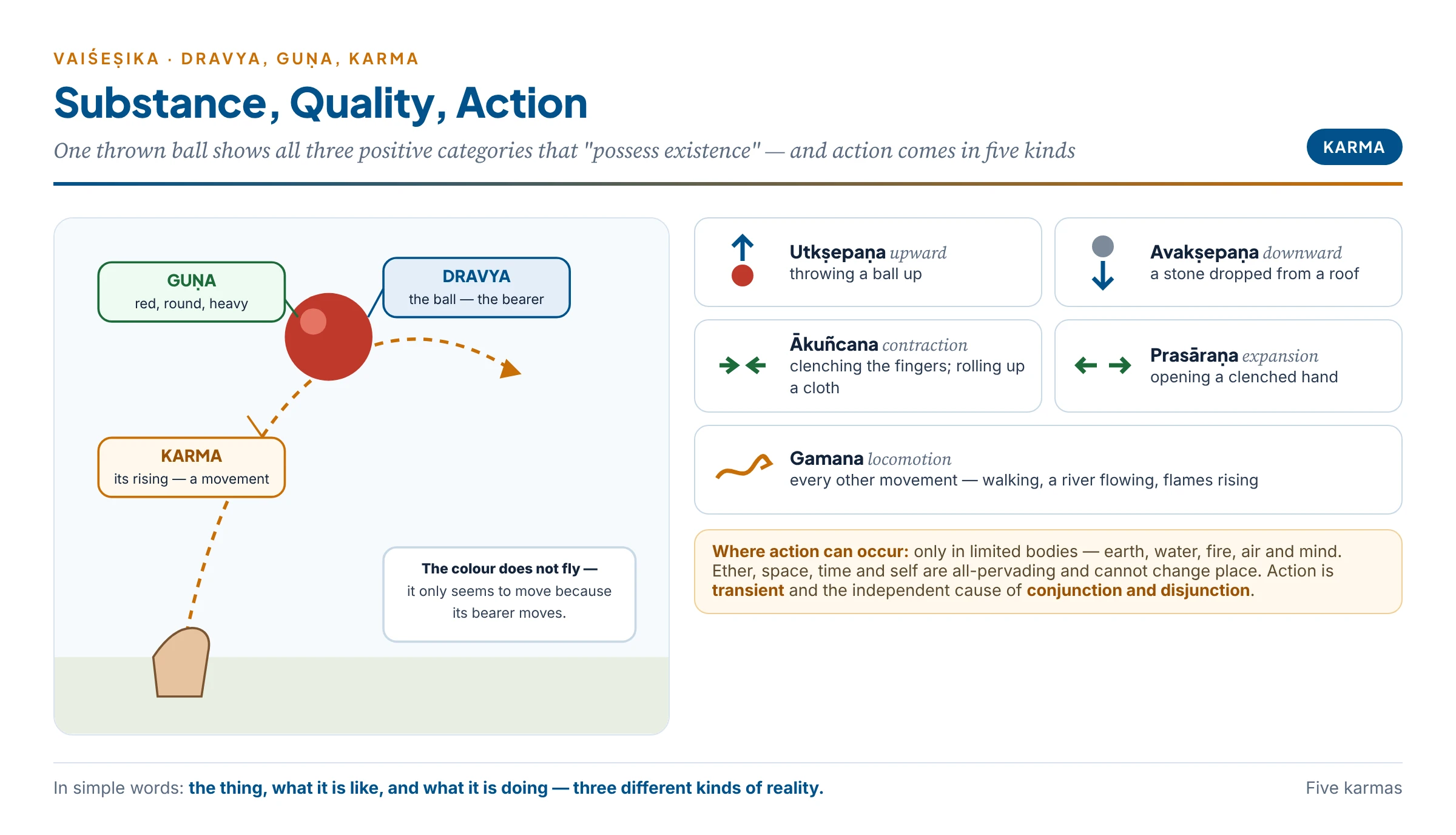
- Where action can occur. Only in limited, corporeal substances (mūrta) — earth, water, fire, air and mind. The all-pervading substances — ether, space, time and self — cannot move, since they cannot change position.
- The five kinds of action.
- Utkṣepaṇa — upward motion. Throwing a ball upward: the cause of contact with a higher region.
- Avakṣepaṇa — downward motion. Throwing a ball down from a roof.
- Ākuñcana — contraction. Clenching the fingers; rolling up a cloth — bringing parts into closer contact.
- Prasāraṇa — expansion. Opening a clenched hand — undoing the closer contact.
- Gamana — locomotion. All other movements: walking, flames rising, a river flowing.
- Perception of action. The motions of perceptible substances (earth, water, fire) are perceived by sight and touch; the motion of the imperceptible mind is not.
- Why a separate category? Action cannot be a quality, because it is the independent cause of conjunction and disjunction and is essentially transient; it cannot be a substance, because it needs a substance to reside in.
- The Buddhist denial of motion. For the Buddhist, nothing moves: a “moving” ball is a series of momentary balls arising at successive places, like the frames of a film. Vaiśeṣika replies that we perceive one thing moving and that conjunction and disjunction require an enduring mover.
9. Substance, Quality and Action Compared
| Feature | Dravya (substance) | Guṇa (quality) | Karma (action) |
|---|---|---|---|
| Exists in | Itself (or, if composite, its parts) | A substance | A substance |
| Has qualities? | Yes | No | No |
| Has action? | Yes (if corporeal) | No | No |
| Causal role | Inherent (material) cause | Non-inherent cause of similar qualities | Independent cause of conjunction and disjunction |
| Nature | Substratum | Static, passive | Dynamic, transient |
| Number of kinds | Nine | Twenty-four | Five |
| Example | The ball | Its redness | Its rising |
Critical Evaluation
Objections (Pūrva-pakṣa)
- Buddhists. There are no enduring substances, only momentary qualities; knowledge is confined to qualities; wholes are mental constructions; motion is a series of new arisings.
- Jainas. Accept substances but criticise the rigid separation of eternal and non-eternal: every real is permanent in substance and changing in modes (Unit 13).
- Advaita Vedānta. Rejects the plurality of substances: Brahman alone is real, and multiplicity is an appearance. Selves are not many; there is one Self.
- Mīmāṃsā. Accepts substances but adds categories — the Prābhākaras recognise potency (śakti), similarity (sādṛśya) and number (saṅkhyā) as separate; and they question whether nine substances are needed.
- General criticisms of the scheme.
- A catalogue, not a synthesis. Vaiśeṣika gives a common-sense list of categories without showing how they form one whole.
- Unequal status. Qualities and actions depend on substance, so they cannot have the same status as substance. Universal, particularity and inherence seem to depend on thought; absence is relative to existence. So only substance is truly fundamental — and substance stripped of qualities becomes Locke’s “something I know not what“.
- Too many substances. Ether merely carries sound; space and time are forms of intuition; mind is an inner organ. What remains basic is physical atoms and spiritual selves; the qualitative difference between four kinds of atoms is questionable.
- Opposites left unreconciled. By admitting non-being, Vaiśeṣika recognises that being and non-being presuppose each other, but it does not reconcile them in a higher unity, as Hegel would demand.
- Later Nyāya itself revised the list. Raghunātha Śiromaṇi rejected particularity as a separate category and identified space and time with God, while admitting new categories.
Defences and Strengths
- Grounded in language and experience. Every category corresponds to a real distinction in what we say and see: “the red ball rises” really mentions three kinds of thing.
- Irreducibility is argued, not assumed. Each category is shown to have features no other has — quality cannot act, action cannot last, substance must precede its qualities.
- Realism without materialism. By counting self, mind, time and space among substances, Vaiśeṣika avoids both idealism and crude materialism.
- A scientific temper. The analysis of matter into elements and atoms, of qualities into irreducible kinds and of motion into five types is an early natural philosophy.
- Substance answers real puzzles. Unity across senses, persistence through change and the reality of wholes all need a bearer of qualities.
Critics and Defenders
Criticism — Critics
- Buddhists: only momentary qualities exist; “substance” and “whole” are mental constructions.
- Jainas: reality is permanent and changing at once; the eternal/non-eternal split is too rigid.
- Advaitins: the plurality of substances is appearance; Brahman alone is real.
- Modern critics: the categories are a catalogue, not a system; substance without qualities is “something I know not what”.
Defence — Defenders and strengths
- What I see, I touch — one substance unifies the qualities of many senses.
- The same mango ripens — change needs something that persists.
- Qualities need a bearer; “the pot has colour”, never “the colour has pot”.
- Wholes are real — lift one end of a stick and the whole stick rises.
- Each category is admitted only because it is irreducible to the others.
Cross-Tradition Comparison
Vaiśeṣika and Western Theories of Categories
| Point | Vaiśeṣika | Western parallel |
|---|---|---|
| What a category is | The object meant by a word; knowable and nameable | Aristotle — categories as kinds of predication: substance, quality, quantity, relation, place, time, position, state, action, passion |
| Primacy of substance | Substance is the substratum of qualities and actions | Aristotle’s primary substance; Descartes’ substance |
| Quality without qualities | A quality has no qualities | Aristotle — qualities are “in” a subject |
| Bundle theory | Buddhist: things are bundles of momentary qualities | Hume — the bundle theory; Berkeley — objects as collections of ideas |
| Unknown substratum | Rejected — substance is perceived with its qualities | Locke — substance as “something I know not what” |
| Material elements | Earth, water, fire, air, ether | Empedocles’ four roots; Aristotle’s fifth element, the aether |
| Space and time | Real, one, all-pervading substances | Newton — absolute space and time; contrast Kant — forms of intuition |
| Mind as atomic inner sense | One perception at a time | Modern accounts of attention as a bottleneck |
| Five kinds of motion | Up, down, contraction, expansion, locomotion | Aristotle’s kinds of change |
Indian Connect — Key takeaways
- Vaiśeṣika is India’s most systematic theory of categories, built from an analysis of what words name and what minds know.
- Its three marks of a padārtha — existence, knowability, nameability — make it a thoroughgoing realism.
- The Buddhist–Vaiśeṣika debate on substance and qualities anticipates the Locke–Berkeley–Hume debate in Europe.
- Vaiśeṣika’s pluralism includes non-material substances — self, mind, time, space — so it is realism, not materialism.
- The list of categories was never closed: the Mīmāṃsakas added potency and similarity, and later Naiyāyikas pruned and expanded it.
Synthesis (Siddhānta)
- A padārtha is whatever exists, can be known and can be named. All padārthas are either being (six kinds) or non-being (absence).
- Substance is the bearer of qualities and actions and the material cause of its products. There are nine substances: earth, water, fire, air, ether, time, space, self and mind.
- Qualities are passive features without qualities of their own; there are twenty-four. Actions are transient movements that cause conjunction and disjunction; there are five.
- Against the Buddhist bundle theory, Vaiśeṣika argues that qualities need a bearer, that one substance unifies the data of different senses, and that change and wholes require something that endures.
- The scheme is open to criticism as a catalogue rather than a system, but its method — admit a category only if it is irreducible — remains a model of careful metaphysics.
- Contemporary relevance.
- Ontology in computing. Knowledge-representation systems classify the world into entities, attributes, relations and events — very close to substance, quality, inherence and action.
- Physics and metaphysics. The question whether there are only properties and fields or also things that bear them is still debated — the Buddhist–Vaiśeṣika debate in modern dress.
- Cognitive science. The atomic mind that admits one perception at a time anticipates research on the attention bottleneck.
- Indian science history. Vaiśeṣika’s analysis of matter, motion and qualities is an important chapter in the history of Indian natural philosophy.
“The highest good results from the knowledge of the essence of the categories — substance, quality, action, universal, particularity and inherence — through their similarities and differences.” — Kaṇāda, Vaiśeṣika Sūtra
Previous Year Questions
- 2017What are the necessary characteristics of padartha according to vaisesika philosophy?
- 2015‘Our knowledge is confined to gunas only.’ Examine this statement in the light of Vaisesika and Buddhist controversy.
- 2010Can qualities exist without substance? Substantiate your views in the light of Nyaya-Buddhism controversy.
- 2005State and discuss the nature and kinds of Dravyas according to Vaisesikas.
- 1997Padartha. Short Notes.
- 1995Give an account of the chief tenets of Vaisesika metaphysics.