

Nyāya–Vaiśeṣika: Theory of Categories; Theory of Appearance; Theory of Pramāṇa; Self, Liberation; God; Proofs for the Existence of God; Theory of Causation; Atomistic Theory of Creation
Official Syllabus: Paper I, Section B, Unit 15
Article 7 placed substance, quality and action in the Vaiśeṣika list of reals. This article takes up the three categories that make the list hang together: the universal (sāmānya), which explains why many things are of one kind; particularity (viśeṣa), which explains why things that are exactly alike are still many; and inherence (samavāya), the inseparable tie that binds a quality to its thing, a whole to its parts and a universal to its instances. Together they answer three of the oldest questions in philosophy — the problem of sameness, the problem of difference and the problem of unity — and they provoked some of the sharpest debates in Indian thought, with the Buddhists, Śaṅkara, Rāmānuja and the Mīmāṃsakas.
In simple words
Think of three mangoes in a basket. You call each one “a mango” — something common runs through all three: that is the universal, mango-ness. Yet they are three, not one — something keeps each separate: at the deepest level, that is particularity. And the yellow colour of each mango is not just lying next to it like the basket lies next to the table — it is in the mango and cannot be peeled away and set down elsewhere: that tie is inherence. Vaiśeṣika says all three are as real as the mangoes themselves.
Context & Problem
Why Three More Categories?
- The one and the many. We see many cows but call them by one name; we see two identical atoms (by inference) and still count them as two; we see one cloth that is made of many threads. A realist must say what in the world answers to “one kind”, “two things” and “one whole”.
- Vaiśeṣika’s answer. It does not reduce these to habits of thought or of language. It posits three real categories:
- Sāmānya — the ground of assimilation (seeing many as one kind).
- Viśeṣa — the ground of discrimination (seeing exact likes as many).
- Samavāya — the ground of unity (seeing a quality, action, universal or whole as in something).
- Self-existent reals. All three are eternal and not produced. They are called self-existent (svātma-sat): they are, but the universal “existence” (sattā) does not inhere in them as it does in substance, quality and action (Article 7).
- Opponents. The Buddhists deny all three as real entities; Advaita treats them as empirical constructions; Jainas fuse universal and particular in one many-sided thing; Rāmānuja and the Bhāṭṭa Mīmāṃsakas replace inherence with other relations. The debate shapes the whole of Indian metaphysics.
Where These Categories Come From
- Kaṇāda names sāmānya, viśeṣa and samavāya among the six positive categories and says that “universal and particular are relative to thought” — a remark that later caused much confusion (see below).
- Praśastapāda gives the classic definition of inherence; Udayana lays down the tests for a genuine universal; the later manuals (Tarkasaṅgraha, Bhāṣāpariccheda) list the five pairs that inherence relates.
Core Doctrine
1. Sāmānya: The Universal
- Meaning. Sāmānya means “commonness“; it is also called jāti (“kind”, “class-nature”). It is the common nature that makes many individuals members of one class: cowness (gotva) in all cows, potness (ghaṭatva) in all pots, humanity in all men.
- Definition. The universal is “eternal, one, and residing in many” (nityam ekam anekānugatam). Each word does work:
- Eternal (nitya). Cows are born and die; cowness is neither born nor destroyed. When the last cow of a herd dies, cowness is not destroyed — it simply has no instance there.
- One (eka). There are many cows but one cowness, the same in each. It is not a separate copy in every cow.
- Residing in many (anekānugata). It is present in all its individuals at once, related to each by inherence (samavāya).
- A universal is not the class. The universal is not the set of cows or a “genus” containing sub-groups. It is the common character by possessing which each individual belongs to the class.
- Where universals reside. Only in substance, quality and action (dravya-guṇa-karma-vṛtti). There is “substance-hood” in all substances, “colour-hood” in all colours, “motion-hood” in all motions.
- No universal in a universal. There is no “cowness-ness”. If one universal had another in it, the regress would never stop (see Udayana’s tests below).
- None in particularity, inherence or absence. These do not admit a universal at all.
- One universal per class. Each class has exactly one lowest universal. If the same individuals carried two rival universals of the same level, one animal could be a man and a cow at once — which is absurd.
- Real, objective and independent of the mind. The universal is not a concept in our head. It is an objective entity in the world, to which our class-concept corresponds. Our idea of “cow” is true because cowness is really in the cow.
In simple words
Walk through a cattle fair. Every animal is different — black, white, spotted, big, small — yet within seconds you say “cow, cow, cow“. What makes this effortless? Vaiśeṣika says you are seeing something that is really there and the same in each: cowness. The colour, size and age differ; the cowness does not. That shared, unchanging nature is the universal.
2. Why Universals Must Be Real: Their Functions
- Common cognition (anuvṛtti-pratyaya). We have the recurring awareness “this is a cow, that too is a cow” across very different animals. A recurring awareness needs a recurring object; that object is the universal.
- Classification. Without real kinds, grouping things would be arbitrary — like putting cats, horses and dogs in one class because each has four legs. Kaṇāda insists that not every loose likeness is a universal; only an eternal nature present in all members counts.
- Meaning of words. A word like “cow” applies to cows never seen before. It can do this because it signifies the individual qualified by the universal (Article 5). If there were no universals, general words would have no meaning.
- Inference and science. Inference rests on universal relations — “wherever there is smoke, there is fire“. Nyāya grounds this in a real relation between smokeness and fireness, not between particular puffs of smoke (Article 4).
- Realism preserved. Classes are not mere names (as the Buddhists hold); they are objective features of the world.
3. Kinds of Universal: Para, Parāpara and Apara
- By extent, universals form a ladder:
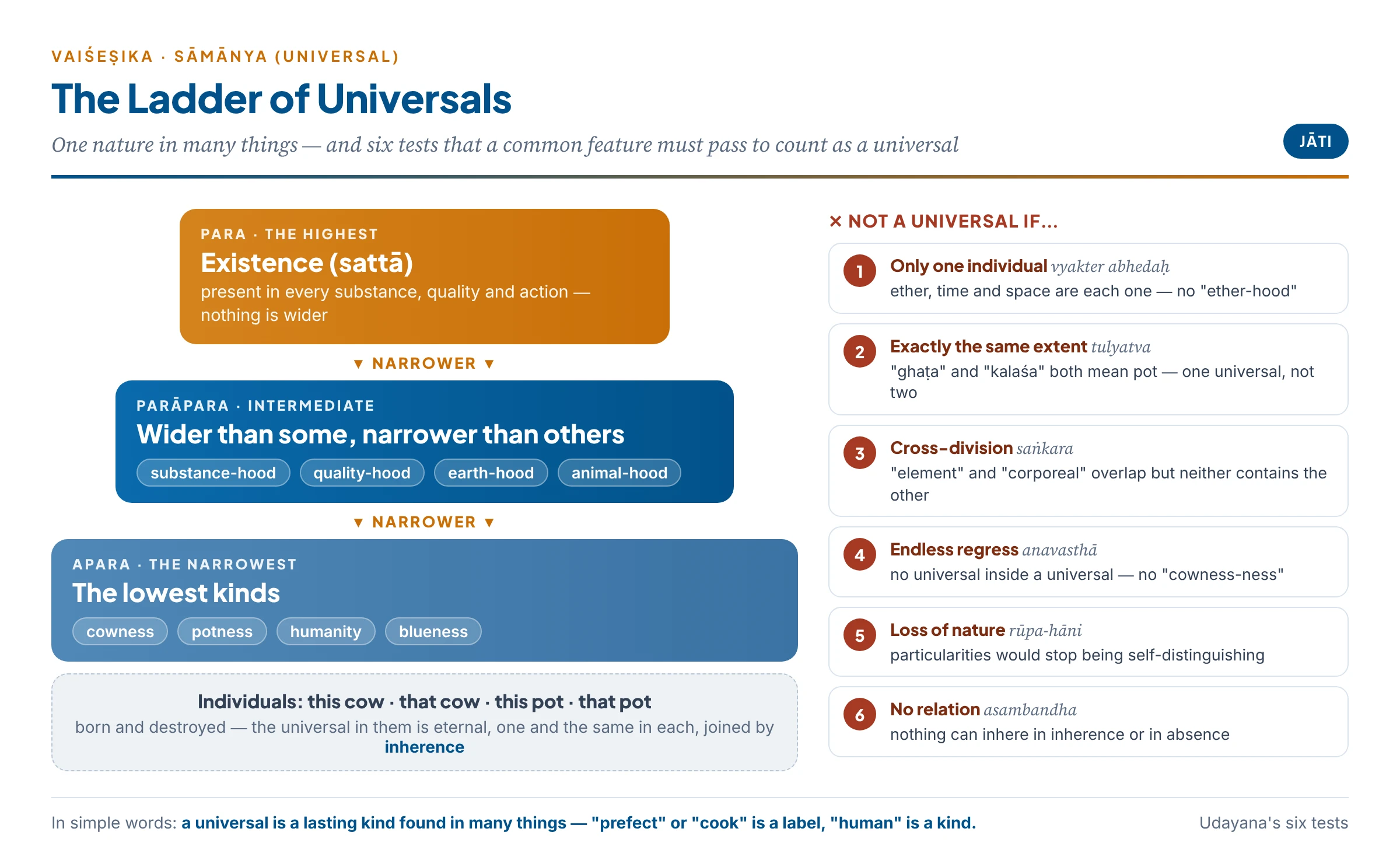
- Para — the highest. Existence or being-hood (sattā). It is present in every substance, quality and action, and nothing is wider than it.
- Apara — the lowest. The narrowest universals, like potness in pots or cowness in cows. They cover the fewest individuals.
- Parāpara — intermediate. Universals like substance-hood (dravyatva), earth-hood (pṛthvītva) or animal-hood. They are wider than the universals below them and narrower than those above. Substance-hood is wider than earth-hood but narrower than existence, which also covers qualities and actions.
- Relative position. A universal is “higher” or “lower” only relative to others. This is exactly what Kaṇāda meant when he said that universal and particular are “relative to thought” — an intermediate universal is general when looked at from below and specific when looked at from above.
Common confusion
Is “animal-hood” the highest universal and “being-hood” an intermediate one? No. Some notes give “animal-hood” as the highest (para) universal, “man-hood” as the lowest and “being-hood” as the intermediate. This turns the scheme upside down. The highest universal is existence (sattā), which covers every substance, quality and action. The lowest universals are the narrowest, like potness or cowness. Animal-hood and substance-hood are intermediate (parāpara) — wider than cowness, narrower than existence.
4. When Is a Common Feature Not a Universal? Jāti and Upādhi
- Not every shared property is a universal. “Being a cook”, “being a teacher”, “being visible”, “being blind” are shared by many people, yet none is a universal. Such derived or imposed properties are called upādhi (“adjunct” or “imposed property”). Only an unconditioned, eternal class-nature is a jāti.
- Udayana’s six impediments (jāti-bādhaka). Udayana lists six conditions, any one of which stops a property from being a universal:
- Only one individual (vyakter abhedaḥ). A universal must reside in many. Ether, time and space are each one, so “ether-hood” is not a universal.
- Exact sameness of extension (tulyatva). Two words that pick out exactly the same things do not name two universals. “Ghaṭa” and “kalaśa” (two words for pot) name one universal, potness.
- Cross-division (saṅkara). Two properties that overlap but neither contains the other cannot both be universals. “Being an element” (earth, water, fire, air, ether) and “being corporeal” (earth, water, fire, air, mind) overlap: ether is an element but not corporeal; mind is corporeal but not an element. So one of them is not a universal — “being corporeal” is counted as an imposed property.
- Infinite regress (anavasthā). If substance-hood had a universal in it, that universal would need another, and so on without end. So universals have no universals.
- Loss of nature (rūpa-hāni). Particularities are self-distinguishing. If there were a universal “particularity-hood” making them alike, they would lose the very nature by which they differ. So there is no universal in viśeṣa.
- No relation (asambandha). A universal must be related to its instances by inherence. Inherence itself and absence cannot have anything inhering in them, so there is no universal “inherence-hood” or “absence-hood”.
- Two further cases.
- Conjunction resides in many things but is not eternal, so it is not a universal.
- Absence is eternal (some kinds) and is found in many places, but it does not inhere in them, so it is not a universal.
In simple words
A school has hundreds of students who are all “prefects“. Is “prefect-ness” a real kind, like humanity? No — make a student a prefect today, remove the badge tomorrow, and the student is unchanged. “Prefect” is an imposed property (upādhi). But “human” cannot be taken away while the student remains: that is a universal (jāti). Udayana’s six tests are a careful way of separating the two.
5. How Universals Are Known
- Perceived along with the individual. For Nyāya, when the eye meets a cow, it grasps the cow together with cowness. The relevant sense–object contact is “inherence in what is conjoined“: the eye is conjoined with the cow, and cowness inheres in the cow (Article 2).
- Determinate perception. In “this is a cow” the universal appears as the qualifier of the individual. Even the first, indeterminate grasp (nirvikalpa) takes in the universal, though not yet as “cowness”.
- Extraordinary perception through the universal (sāmānya-lakṣaṇa). Having perceived smokeness in one puff of smoke, the mind is related through it to all smoke, past and future. This is how Nyāya explains our knowledge of universal propositions (Articles 2 and 4).
- Vaiśeṣika’s two pramāṇas. Vaiśeṣika also accepts perception of universals; where they are not perceived (as in imperceptible atoms), they are inferred.
- Are universals really perceived? Critics say we see only this brown cow, never cowness. Nyāya replies that the recurring element in “cow, cow, cow” is given in experience, not added by the mind; if it were added, the judgment “this is a cow” would be true of nothing in the object.
6. “Relative to Thought”: Does Kaṇāda Make Universals Mental?
- Kaṇāda’s remark. “Universal and particular are relative to thought” (buddhy-apekṣa).
- What it means. Whether a given universal counts as general or specific depends on the comparison we make. Substance-hood is general compared with earth-hood, specific compared with existence. The relative status belongs to our viewpoint; the universal itself is real.
- What it does not mean. It does not mean that universals are concepts made by the mind. The system is staunchly realistic: a universal has as much objective reality as the individual in which it inheres.
7. The Great Debate on Universals
- Nyāya–Vaiśeṣika: realism. Universals are eternal, objective entities, distinct from individuals but inhering in them. Both individual and universal are separately real.
- Mīmāṃsā: realism with a difference.
- Kumārila Bhaṭṭa accepts real, eternal universals but holds that universal and individual are related by identity-in-difference (tādātmya or bhedābheda), not by a separate relation of inherence.
- Universals have a ritual function: a Vedic command like “perform the Agnihotra” applies not to one act but to a class of acts.
- The Prābhākaras also accept universals but are more sparing about which properties count as universals.
- Advaita Vedānta: conceptualism. Universals are useful constructs at the empirical level (vyavahāra). They are identical with the individuals in point of existence and have no ultimate reality; only Brahman is real, beyond all categories.
- Jainism: both universal and particular. Every real is universal-and-particular (sāmānya-viśeṣātmaka). From one standpoint this cow is “cow” (general); from another it is this cow (particular). Neither aspect exists apart from the other.
- Cārvāka: nominalism. Only perceptible particulars are real; “cowness” is a mere name (nāma-mātra).
- Buddhism: apoha nominalism. Dignāga and Dharmakīrti hold that only the unique particular (svalakṣaṇa) is real. The word “cow” does not name a positive cowness; it excludes everything that is not a cow. “Cow” means “not non-cow“.
8. The Buddhist Attack and the Nyāya Defence
- Buddhist objections.
- Universals are never perceived. We see this brown cow, that white cow — never cowness. Perception grasps only the unique particular; the “common” is added by conceptual thought.
- The dilemma of presence. Is cowness wholly present in each cow, or partly? If wholly, there are as many cownesses as cows (so it is not one); if partly, it has parts (so it is not partless and eternal).
- The problem of the new cow. When a calf is born, where does its cowness come from? It did not move there (universals do not move); it was not already there (there was no calf); it is not born (universals are eternal). So the universal is unintelligible.
- The dead cow. When the last cow in a place dies, does cowness stay in an empty field? If it stays, it exists without an instance; if it leaves, it moves.
- Similarity is enough. We group things by resemblance and by excluding what is different; nothing more is needed.
- Nyāya replies.
- Apoha presupposes the universal. To exclude “non-cows” you must already know what a cow is. “Not non-cow” is circular unless “cow” has a positive meaning.
- Resemblance presupposes the universal. Two things resemble each other only by sharing something. Resemblance itself is a many-in-one relation.
- One and whole in each. The universal is partless; it is wholly present in each instance, as the same entity — that is just what being a universal means. The dilemma treats it like a material stuff spread out in space.
- No travel needed. A universal does not travel. It is eternal and is related by inherence to an individual the moment that individual exists. A new calf does not “receive” cowness from elsewhere; cowness simply inheres in it as soon as it is born.
- Common cognition needs a common ground. Nothing else explains the recurring awareness “this is a cow” across endlessly different animals.
Indian Connect — Universals across the schools
| School | Status of the universal | How it relates to the individual | Example |
|---|---|---|---|
| Nyāya–Vaiśeṣika | Real, eternal, one-in-many | Distinct, joined by inherence | Cowness inheres in each cow |
| Bhāṭṭa Mīmāṃsā | Real, eternal | Identity-in-difference | Cowness is one with and different from this cow |
| Jainism | Real as an aspect | Inseparable from the particular | This cow is both “cow” and “this cow” |
| Advaita Vedānta | Empirically valid, not ultimately real | Identical in existence | Cowness is a useful construct |
| Buddhism (apoha) | Denied; a mental exclusion | — | “Cow” means “not non-cow” |
| Cārvāka | Denied; a mere name | — | Only this cow exists |
- Not a Platonic Form in another world. Some notes say that sāmānya, “like Plato’s ideas”, subsists in a transcendental world apart from particulars. Vaiśeṣika universals are eternal like Plato’s Forms, but they are found in the things that have them, related by inherence, and are perceived in them. In Western terms they stand closer to universals in things (Aristotle) than to universals before things (Plato) — with the difference that, unlike Aristotle’s forms, they are eternal and can remain without an instance.
9. Viśeṣa: Particularity
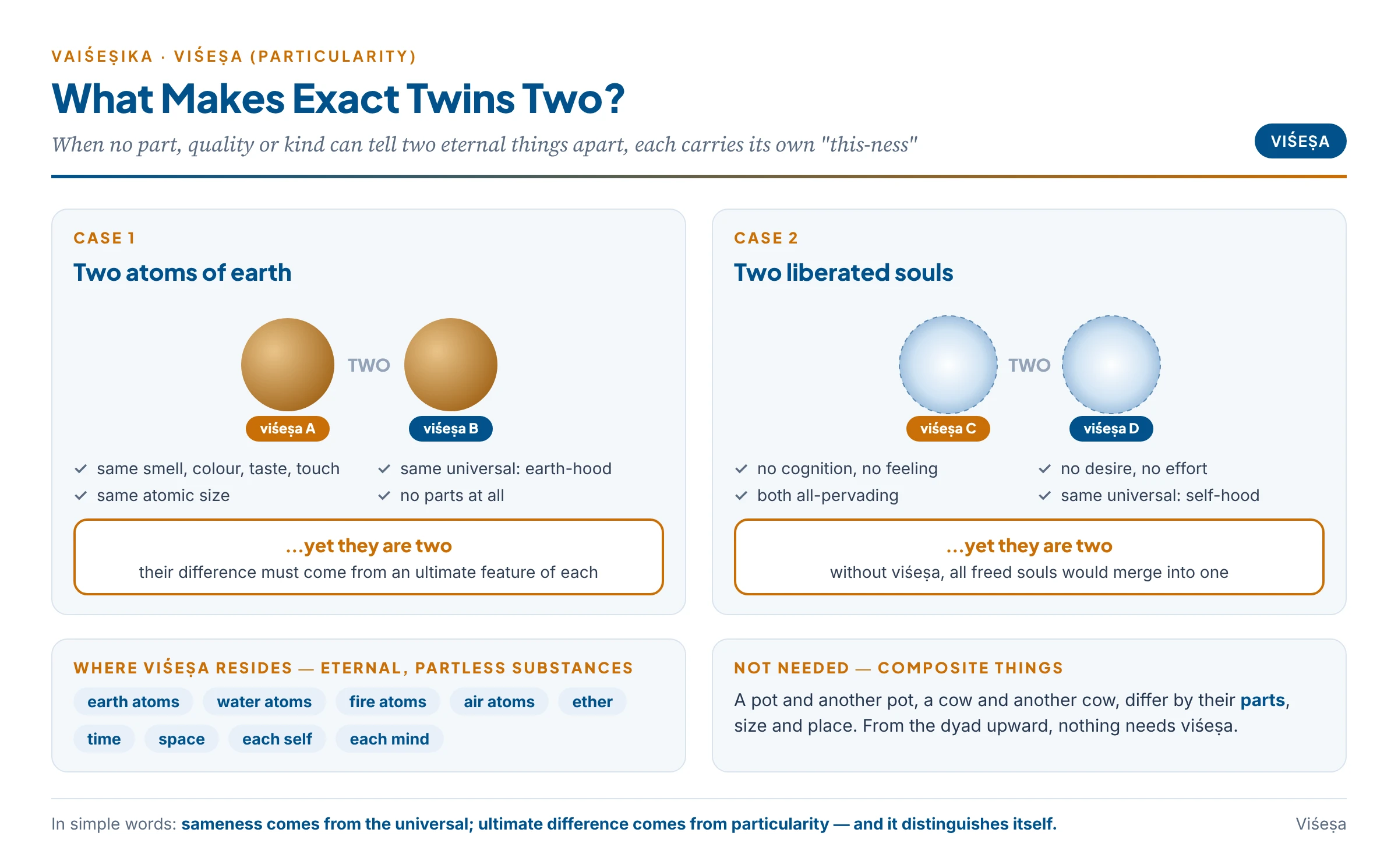
- The problem. Composite things are easy to tell apart: two pots differ in parts, shape, size, position. But what about two atoms of earth? They have no parts, the same qualities (smell, colour, taste, touch), the same universal (earth-hood) and the same atomic size. Yet they are two. What makes them two?
- The answer. Each eternal, partless substance carries an ultimate distinguishing feature of its own — its viśeṣa, “particularity“. It is the “this-ness” of the thing, its ultimate individuality.
- Definition. Viśeṣa is the ultimate differentiator (vyāvartaka) residing in eternal substances (nitya-dravya-vṛtti).
- Where it resides. Only in eternal, partless substances:
- Atoms of earth, water, fire and air — each atom has its own viśeṣa.
- Selves — each soul is distinguished by its own viśeṣa. This matters most in liberation, when a soul loses all its specific qualities (cognition, pleasure, pain, desire); without viśeṣa, all liberated souls would be indistinguishable (Article 12).
- Minds (manas) — each atomic mind has its own viśeṣa.
- Ether, time and space — each is one; viśeṣa marks each off from the others.
- Not in composite things. A pot, a cloth, a tree or a cow is not a “particular” in this technical sense. Composite things — from the dyad upward — are told apart by their parts, so they need no viśeṣa.
- Features of viśeṣa.
- Eternal — it resides in eternal substances and is neither produced nor destroyed.
- Innumerable — as many as the eternal substances.
- Self-distinguishing (svato-vyāvartaka). Viśeṣas distinguish their substances from others, and they distinguish themselves from one another by their own nature. If each viśeṣa needed a further viśeṣa, there would be an endless regress; so the series stops here.
- No universal in it. There is no “particularity-hood” (Udayana’s fifth test).
- Supersensible. Like atoms, viśeṣas are not perceived by ordinary people; they are inferred, and said to be perceived by yogins.
In simple words
Imagine two brand-new coins from the same mint — same metal, weight, design, shine. Put them under a cloth and shuffle. You can no longer tell which was which, yet they are still two coins, not one. For coins, their tiny parts and positions still differ. But atoms have no parts. Vaiśeṣika says each atom must carry its own built-in “this-ness” — a particularity that is not a quality and not a part, but simply what makes it this one and not that one.
10. The Logical and Metaphysical Status of Viśeṣa
- Metaphysical status.
- A full category. Viśeṣa is raised to the rank of a padārtha: it exists, can be known and can be named.
- Irreducible. It is not a substance (it has no qualities), not a quality (qualities can be shared, and atoms share all theirs), not an action, not a universal (it excludes, not includes).
- Ground of pluralism. It secures qualitative and not merely numerical pluralism: each atom and each soul has an underived uniqueness. The school takes its very name — Vaiśeṣika — from it.
- Bulwark against monism. Without viśeṣa, all souls would collapse into one, as Advaita holds, and all atoms of a kind into one “earth”.
- Logical status.
- Opposite of the universal. Sāmānya is the ground of assimilation (“these are alike”); viśeṣa the ground of discrimination (“these are different”). The universal includes; particularity excludes.
- Limit of analysis. Viśeṣa marks the point where explanation of difference stops: it is the last term in any account of why things differ.
- Protection against “numerical nonsense”. Without it, two things exactly alike would have to be one, making the plurality of atoms and selves incoherent.
- Criticisms of viśeṣa.
- Śaṅkara — regress or redundancy. If atoms need viśeṣa to be distinct, viśeṣas need something to be distinct, and so on. If viśeṣas are self-distinguishing, why not say the atoms are self-distinguishing and drop viśeṣa?
- Raghunātha Śiromaṇi. This later Naiyāyika rejected viśeṣa as a separate category: the own nature (svarūpa) of each eternal substance is enough to distinguish it.
- Buddhists. Individuality needs no extra category — every real is already a unique momentary particular (svalakṣaṇa).
- Mīmāṃsā. Distinctions of this kind are epistemic, not separate entities.
- Jainas. Atoms of a kind are qualitatively alike and only numerically different; no extra principle is required.
- Qualitative difference without content. If atoms really differ in quality, why do they behave and weigh the same? And viśeṣa makes no felt difference to a liberated soul, which has no consciousness to enjoy its individuality.
- An empty name. Viśeṣa says that each atom is unique, not what its uniqueness consists in. The deep problem of individuation is named rather than solved.
- Defence. Vaiśeṣika replies that some ultimate stopping-point is unavoidable. Placing it in a dedicated category keeps substance (the bearer of qualities) and difference (the ground of distinctness) conceptually clear; the regress stops because viśeṣa is by nature self-distinguishing, whereas a substance is by nature a bearer of qualities, which are shared.
Common confusion
Is viśeṣa the “particular cow” or “this moment as against that moment”? No. Some notes treat ordinary things — this table, this cow — as viśeṣa, or say viśeṣa distinguishes “this moment from that moment” in time. Viśeṣa belongs only to eternal, partless substances: atoms, selves, minds, and the single substances ether, time and space. Ordinary things are composites and are distinguished by their parts. Moments and places are divisions of the one time and the one space made by limiting conditions; they are not separate eternal substances and have no viśeṣa of their own.
11. Samavāya: Inherence
- Two kinds of relation. Vaiśeṣika recognises two basic relations between reals:
- Conjunction (saṃyoga) — a temporary, separable relation, counted as a quality.
- Inherence (samavāya) — an eternal, inseparable relation, counted as a separate category.
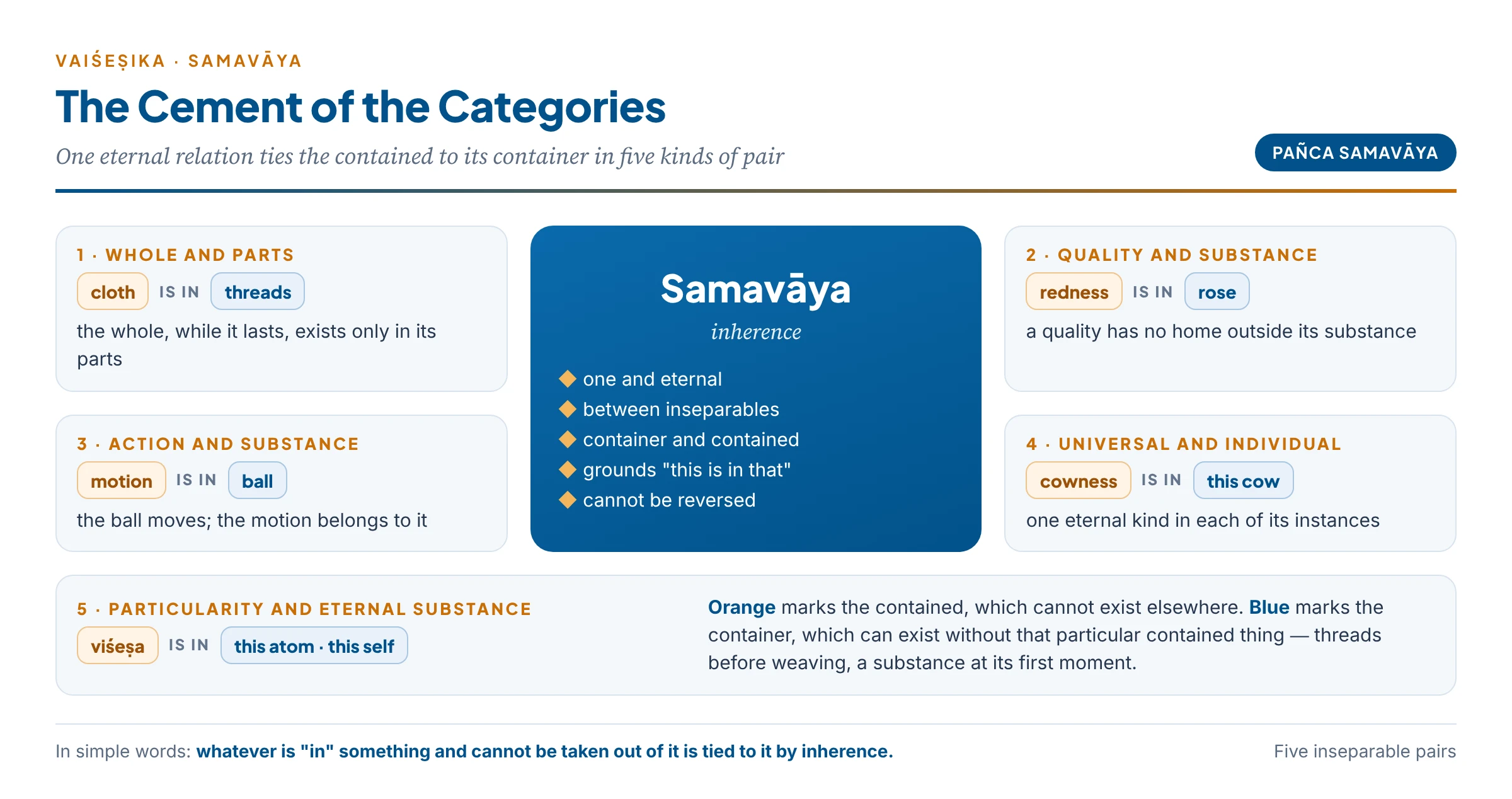
- Definition. Praśastapāda defines inherence as “the relation between things that are inseparable, standing to each other as container and contained, which is the ground of the cognition ‘this is in that’“. Three elements:
- Between inseparables (ayuta-siddha).
- Container and contained (ādhāra–ādheya): one thing is the locus, the other resides in it.
- Ground of “this is in that” (iha-pratyaya): “the colour is in the pot“, “the cloth is in the threads“.
- Kaṇāda’s view. Kaṇāda describes inherence as the relation between cause and effect — the effect inheres in its material cause (Article 10).
- The five pairs it relates.
- Whole and parts (avayavin–avayava) — the cloth inheres in the threads; the pot in its two halves.
- Quality and substance (guṇa–guṇin) — redness in the rose; brown colour in the table.
- Action and substance (kriyā–kriyāvat) — the motion of a ball in the ball.
- Universal and individual (jāti–vyakti) — cowness in this cow.
- Particularity and eternal substance (viśeṣa–nitya-dravya) — the viśeṣa of an atom in that atom.
- Features of inherence.
- One (eka). There is a single inherence everywhere, not a separate inherence for each pair.
- Eternal (nitya). It is not produced. If inherence had to be produced, the produced inherence would need another inherence to tie it to its terms, and so on endlessly; so it must be eternal.
- Asymmetric. The terms cannot be reversed. “The pot has colour” — never “the colour has pot”. In conjunction, if the hand touches the pen, the pen equally touches the hand.
- Not produced by motion. Conjunction arises from the action of one or both things; inherence does not.
- Perceived or inferred? For Nyāya, inherence is perceived (we see “colour-in-pot”); for Vaiśeṣika, it is inferred from the cognition “this is in that”.
In simple words
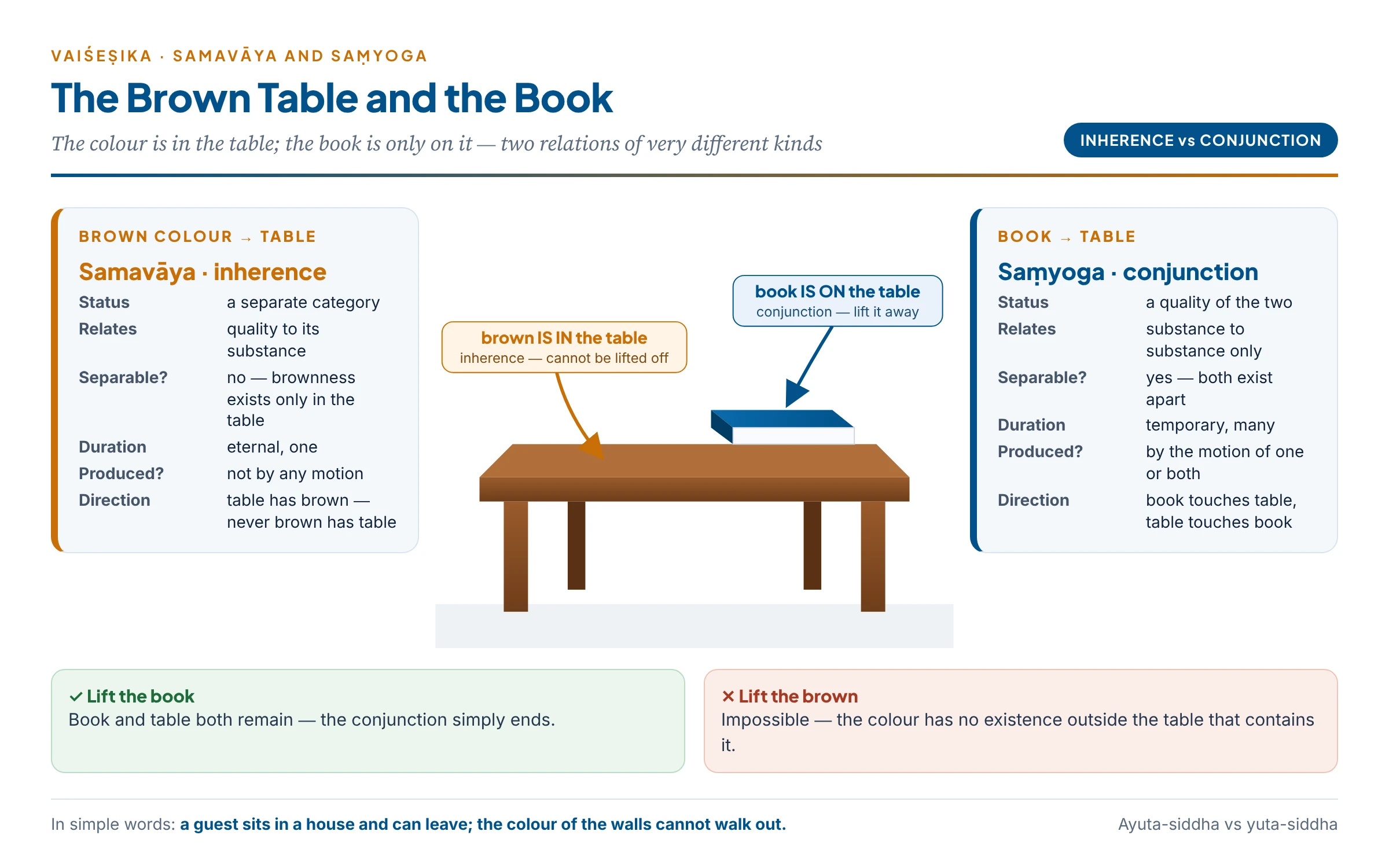
Put a book on a brown table. Lift the book: the table is still there, the book is still there — their relation was conjunction. Now try to lift the brown off the table and set it on the floor. You cannot. The brownness exists only in the table; it has no life of its own elsewhere. That inseparable “in-ness” is inherence. One is like a guest sitting in a house; the other is like the colour of the house’s walls.
12. Inseparability (Ayuta-siddhi) Explained
- Precise meaning. Two things are ayuta-siddha when, of the two, one — so long as it is not destroyed — exists only as resting in the other. The cloth, while it lasts, exists only in its threads; a colour, while it lasts, exists only in its substance.
- One-sided dependence. The dependence runs one way:
- The cloth cannot exist without the threads, but the threads can exist without the cloth — before weaving and after unravelling.
- A quality cannot exist without its substance, but a substance exists for its first moment without qualities (Article 7).
- Cowness cannot be “in” anything except cows, but it is eternal and does not depend on any one cow.
- Yuta-siddha (separately established) things, by contrast, can each exist apart — the book and the table, two balls that collide.
Common confusion
Can the threads exist without the cloth? Yes. Some notes say that in inherence “the cloth cannot exist apart from the threads, and the threads cannot exist without forming a cloth“. The second half is wrong. Inseparability is one-sided: the contained (cloth, colour, motion, universal, viśeṣa) cannot exist except in its container, while the container (threads, substance) can exist without that particular contained thing. Threads lie in a spool before they become cloth.
13. Is Inseparability Necessary or Sufficient for Inherence?
- Necessary — yes. Every pair related by inherence is inseparable: whole–parts, quality–substance, action–substance, universal–individual, viśeṣa–eternal substance. Where the terms can exist apart, the relation is conjunction, not inherence. So inseparability is a necessary mark:
- Inherence affects existence, not just description — a quality simply cannot be except in a substance.
- It explains why inherence is eternal: a produced relation between inseparables would invite a regress.
- It is the very point on which Vaiśeṣika distinguishes inherence from conjunction.
- It explains the irreversibility of the terms.
- Sufficient — no. Inseparability alone does not define inherence:
- Container and contained. Praśastapāda adds that the terms must stand as locus and located, and that the relation must ground the cognition “this is in that“.
- Other inseparable relations. The relation between an absence and its locus (the absence of a pot “on” the floor) or between a thing and its own nature is not inherence; Nyāya calls it a self-linking relation (svarūpa-sambandha). So something inseparable can be related without inherence.
- Identity is not inherence. A thing is “inseparable” from itself, but identity is no relation of inherence at all; inherence needs two distinct terms.
- Critics go further. Śaṅkara argues that inseparability is not even strictly necessary, because it is only partial: a substance exists without its qualities for a moment, threads exist without the cloth, a universal exists without any given instance. Then inherence is just another relation, and there is no ground for ranking it a category while conjunction is only a quality.
14. Why Inherence Is a Separate Category
- The grounds Vaiśeṣika gives.
- The cognition “this is in that” needs a ground. “The colour is in the pot” is a true cognition of a relation; something in the world must answer to it.
- It is not conjunction. Conjunction holds only between substances, is produced by motion, and is separable. Colour and pot are not two substances, nothing moved them together, and they cannot be parted.
- It is not a quality. A quality resides only in a substance; but inherence also relates a quality to a substance and a universal to a quality. And if inherence were a quality, it would itself need inherence to reside in its substance — a regress.
- It is not identity. The pot and its colour are different (seen by different senses, one can change while the other stays). Identity would collapse the pot into its colour.
- It explains the reality of wholes. Against the Buddhist claim that a “whole” is only a name for its parts, inherence shows how a new whole (avayavin) exists in its parts without being a mere heap.
- It links the other categories. Quality, action, universal and particularity would float free without a tie to substance. Inherence is the cement of the Vaiśeṣika universe.
15. Inherence and Conjunction: The Brown Table and the Book
- The two cases.
- The brown colour of the table — a quality related to its substance: inherence.
- The book on the table — two substances brought together: conjunction.
| Point | Samavāya (brown colour of the table) | Saṃyoga (book on the table) |
|---|---|---|
| Status | A separate category | A quality of the two substances |
| Relata | Whole–part, quality–substance, action–substance, universal–individual, viśeṣa–eternal substance | Only substance and substance |
| Separability | Inseparable — brownness cannot exist apart | Separable — book and table exist apart |
| Duration | Eternal, one | Temporary, many |
| Origin | Not produced | Produced by the motion of one or both |
| Direction | Irreversible — table has colour, not colour has table | Reversible — book touches table, table touches book |
| Effect on existence | The contained thing cannot be without it | Makes no difference to the existence of either |
| Known by | Inferred (Vaiśeṣika); perceived (Nyāya) | Perceived |
- Kinds of conjunction. Conjunction may be produced by the motion of one thing (a kite settling on a hill), of both things (two balls colliding), or by another conjunction (my hand touches the table because the pen in my hand touches it).
Critical Evaluation
Objections (Pūrva-pakṣa)
- Śaṅkara on inherence.
- Infinite regress. If inherence is a third thing different from the two it relates, then a further relation is needed to relate inherence to each term, then another, and so on endlessly.
- Where does it reside? If inherence resides in the first term only, it cannot reach the second; if in the second only, it cannot reach the first; it cannot be in both, being one and partless. So it cannot relate anything.
- Inconsistent ranking. Conjunction and inherence are both relations; to call one a quality and the other a category is arbitrary.
- Eternal relation, perishable terms. If inherence is eternal, its relata (a pot and its colour) should also be eternal; if it perishes with them, it is not eternal.
- Rāmānuja. Rejects inherence as a third entity. The relation between substance and attribute is inseparable dependence (apṛthak-siddhi): the attribute is a mode of the substance, needing no extra relation. The world and souls relate to Brahman in this way.
- Bhāṭṭa Mīmāṃsā. Replaces inherence with identity-in-difference (tādātmya): the cloth is one with and different from its threads.
- Buddhists. Inherence is a needless reification. Wholes are only names for collections of parts (prajñapti); qualities are themselves the reals.
- Jainas. Substance and mode are both different and non-different; no separate tie is needed.
- Vallabha. Holds substance and attribute, cause and effect, to be identical (tādātmya), and rejects inherence altogether.
- Hegelian critics. Inherence points to an organic unity — the whole is more than the sum of its parts — but Vaiśeṣika treats it as a one-sided, partially inseparable relation. A true internal relation would make both terms mutually dependent and reconcile them in a higher unity.
- Against universals. Buddhists: never perceived, the dilemma of whole-or-part presence, the problem of the new and dead cow. Advaitins: empirical constructions.
- Against particularity. Regress or redundancy; Raghunātha’s rejection; the “empty name” problem.
Defences and Replies
- Inherence is self-linking. Nyāya replies to the regress that inherence is by nature a relation. It relates itself to its terms directly, through its own nature (svarūpa), as light shows itself while showing other things. Only something that is not a relation needs a further relation to connect it.
- The location dilemma misreads inherence. Inherence does not “reside” in its terms as a quality resides in a thing; it is the way in which one term resides in the other.
- Ranking is principled. Conjunction is produced, perishable and between substances, like other qualities; inherence is eternal, one and relates all categories — so it cannot be a quality.
- The eternal relation and perishing terms. Inherence is eternal, but a particular instance of it (this colour in this pot) lasts only as long as its terms. The same eternal universal can be with or without a given cow.
- Wholes are real. Lift one end of a stick and the whole stick rises; a pot holds water, its scattered atoms do not. A real whole needs a real tie to its parts.
- Universals and particularity are needed. Without the first, there is no ground for sameness; without the second, no ground for the plurality of exact likes. The system is incomplete without either.
Critics and Defenders
Criticism — Critics
- Śaṅkara: inherence leads to regress, cannot be located, and is no different in rank from conjunction.
- Rāmānuja: substance and attribute are inseparable modes — inseparable dependence, not a third entity.
- Kumārila: universal and individual, whole and parts are one-and-different, not two things tied together.
- Buddhists: universals are exclusions, wholes are names, particularity is redundant.
- Raghunātha: each eternal substance distinguishes itself; viśeṣa is superfluous.
Defence — Defenders and strengths
- Inherence is self-linking; only a non-relation needs a further relation.
- “This is in that” is a true cognition and needs a real ground.
- Apoha presupposes what it denies: excluding non-cows requires knowing cows.
- Liberated souls without any qualities can still be many only through viśeṣa.
- The three categories together give realist answers to sameness, difference and unity.
Cross-Tradition Comparison
Vaiśeṣika and Western Debates
| Issue | Vaiśeṣika | Western parallel |
|---|---|---|
| Status of universals | Eternal, objective, in things | Plato — Forms before things; Aristotle — universals in things; Russell — universals as timeless entities |
| Nominalism | Buddhist apoha; Cārvāka “mere names” | Ockham, Hobbes — only names are general; Berkeley against abstract ideas |
| Conceptualism | Jaina and Advaita: universal identical with individuals in existence | Locke — general ideas made by the mind |
| Resemblance | Nyāya: resemblance presupposes a universal | Russell — resemblance itself is a universal |
| Fuzzy kinds | Upādhi vs jāti; Udayana’s six tests | Wittgenstein — family resemblance, no single common essence |
| Individuation | Viśeṣa — an underived “this-ness” | Duns Scotus — haecceitas (thisness) |
| Indiscernibles | Exact-alike atoms remain two | Leibniz — no two things exactly alike; Max Black — two identical spheres as a counter-example |
| Inherence | Inseparable relation, a separate category | Aristotle — qualities are “in” a subject |
| Regress of relations | Śaṅkara against samavāya | F. H. Bradley — any relation needs further relations |
| Organic relation | Rāmānuja’s inseparable dependence | Hegel — internal relations, concrete universal |
Indian Connect — Key takeaways
- Sāmānya answers “why many are one kind”, viśeṣa “why exact likes are many”, samavāya “why a quality or whole is one with its bearer”.
- The Buddhist–Nyāya debate on universals is India’s version of the realism–nominalism controversy, centuries before medieval Europe.
- Viśeṣa anticipates Scotus’s thisness and stands opposed to Leibniz’s identity of indiscernibles.
- Śaṅkara’s regress against inherence is the same argument Bradley used against relations in the nineteenth century.
- Rāmānuja’s inseparable dependence and Kumārila’s identity-in-difference offer Indian alternatives to inherence.
Synthesis (Siddhānta)
- Sāmānya is an eternal, single nature present in many individuals; it grounds common cognition, classification, the meaning of words and inference. It comes in higher, intermediate and lower grades, and Udayana’s six tests separate genuine universals (jāti) from imposed properties (upādhi).
- Viśeṣa is the self-distinguishing uniqueness of each eternal substance. It secures pluralism — of atoms and especially of liberated souls — and blocks the slide into monism.
- Samavāya is the one, eternal, inseparable relation of whole to part, quality and action to substance, universal to individual and viśeṣa to eternal substance. Inseparability is necessary for it but not sufficient; it must also be a container–contained relation grounding “this is in that”.
- The critiques of Śaṅkara, Rāmānuja and the Buddhists expose real strains — the regress, the one-sided inseparability, the unexplained uniqueness — but Vaiśeṣika’s replies (self-linking relation, principled ranking, apoha’s circularity) keep its realism coherent.
- Contemporary relevance.
- Ontology design. Computer knowledge-bases separate classes (universals), instances (individuals), “is-a” links (individual to kind) and “part-of” links (whole to parts) — almost exactly sāmānya, vyakti and samavāya.
- Physics and identity. Modern physics finds that two electrons in the same state cannot be told apart even in principle; philosophers still debate whether such particles have any “this-ness” — Kaṇāda’s question about atoms in new form.
- Biology and natural kinds. Whether species are real kinds or useful groupings of similar individuals continues the jāti–upādhi debate.
- Language technology. Machines that learn the meaning of “cow” from examples face the old problem: is there a shared nature, or only resemblance and exclusion?
“Sāmānya is eternal, one, and resides in many.” — Annambhaṭṭa, Tarkasaṅgraha
Previous Year Questions
- 2026Critically explain the nature of Samavāya (inherence) as propounded in Vaiśeṣika philosophy.
- 2023Elucidate Naiyāyikas’ view of ordinary and extraordinary perception. Are they justified in accepting that universals are perceived? Discuss.
- 2022What is the ontological status of Sāmānya, according to Vaiśeṣika Philosophy? Critically examine.
- 2021Is ‘inseparability’ (ayuta-siddhatva) a necessary condition or a sufficient condition for defining characteristics (lakṣaṇa) of samavāya (inherence)? Explain with reference to Vaiśeṣika Philosophy.
- 2020Critically evaluate the logical and metaphysical status of Viśeṣa in the context of Vaiśeṣika Philosophy.
- 2018How do the Vaiśeṣika philosophers explain the difference of the relationships in the two cases — (i) the brown color of the table and (ii) the book on the table? Discuss.
- 2013What is Samavāya? What are the grounds for accepting samavāya as a distinct padārtha?
- 2008Sāmānya in Vaiśeṣika. Short notes.
- 2003The Nyāya-Vaiśeṣika view of Sāmānya. Short notes.