

Nyāya–Vaiśeṣika: Theory of Categories; Theory of Appearance; Theory of Pramāṇa; Self, Liberation; God; Proofs for the Existence of God; Theory of Causation; Atomistic Theory of Creation
Official Syllabus: Paper I, Section B, Unit 15
Look at the night sky: you are as certain that the sun is not there as that the moon and stars are. Vaiśeṣika takes such certainty at face value. Besides the six kinds of being (Articles 7–8), it admits a seventh category, non-being or absence (abhāva): the absence of a pot on the floor, of colour in air, of a cloth in a pot. Absence, it argues, is as real, as knowable and as nameable as presence. This article explains what an absence is, the four kinds of absence, the analysis of every absence into “absence of what” and “absence where“, the debate on how absence is known — by perception (Nyāya), by a special non-perception (Bhāṭṭa Mīmāṃsā and Advaita), as the bare place itself (Prābhākara), or as a construction (Buddhist) — and why the Naiyāyikas insisted on absence as an independent category.
In simple words
You walk into your room and say at once, “My phone is not on the table.” You did not reason it out — you saw it. But what exactly did you see? Not the phone; it is not there. Not just the table; you have seen that table a thousand times without thinking of your phone. You saw the table-without-the-phone — the absence of the phone on the table. Vaiśeṣika says that this absence is a real feature of the world, and that is why your judgment “the phone is not here” is true.
Context & Problem
Why a Category of Non-Being?
- Negative facts are everywhere. “There is no water in the well”, “the patient has no fever”, “a cow is not a horse”, “the house is not yet built”, “the pot is broken”. Each is true or false, and we act on it.
- A realist’s problem. For a realist, a true cognition must correspond to something in the world. If “the phone is not on the table” is true, what in the world makes it true? Vaiśeṣika answers: an absence, a real negative fact.
- The opponents. The Buddhists treat absence as a mental construction; the Prābhākara Mīmāṃsakas reduce it to the bare locus; Advaita grants it only empirical reality; the Bhāṭṭas accept it as real but deny that it is perceived. Nyāya–Vaiśeṣika holds the strongest view: absence is a real category and is ordinarily perceived.
Kaṇāda and the Seventh Category
- Kaṇāda names six. The Vaiśeṣika Sūtra lists only six positive categories. Some infer that Kaṇāda accepted only six.
- But he discusses absence. The Sūtra examines non-existence as an object of knowledge — the non-existence of an effect before its production, after its destruction, and so on. Kaṇāda’s goal, liberation, is itself the absolute cessation of pain — an absence. So absence was present in his thought.
- Later writers made it the seventh. Śrīdhara, Udayana and Śivāditya (whose manual is called Saptapadārthī, “the seven categories”) counted abhāva as the seventh padārtha. Later Nyāya adopted the seven as its metaphysics.
Core Doctrine
1. What an Absence Is
- Absence is always of something, somewhere. Every absence has two terms:
- Counter-positive (pratiyogin) — the thing whose absence it is. In “there is no pot on the floor”, the pot is the counter-positive: it is what would oppose or cancel the absence if it were present.
- Locus (anuyogin or adhikaraṇa) — the place where it is absent. Here, the floor.
- Absence depends on its counter-positive. An absence is defined by what it is the absence of. The absence of a pot is not the absence of a cloth. So the knowledge of an absence depends on knowledge of its counter-positive: you cannot notice the absence of your phone unless you know what a phone is.
- The limiting feature. Strictly, the absence of a pot is the absence of a pot as a pot (qualified by potness) and in a given relation (resting on the floor by conjunction). The pot may well be in the room — on the shelf — while it is absent on the floor.
- Absence is relative; the other categories are not. The six positive categories are conceived in themselves; absence is always conceived in relation to a positive thing. Hence later critics call it the one relative category.
- Absence is not a positive thing. It does not fall under substance, quality, action, universal, particularity or inherence: it has no qualities, does not move, is not shared by inherence and is not a relation of inherence. Hence it needs a category of its own.
In simple words
An absence is like an empty slot in an egg tray. The empty slot is not an egg, and it is not just “the tray”. It is a definite emptiness — an egg-shaped gap in that tray. Change either term and you have a different absence: a missing spoon in a cutlery drawer is not the same gap. That is why every absence has a counter-positive (the egg) and a locus (the tray).
2. The Four Kinds of Absence
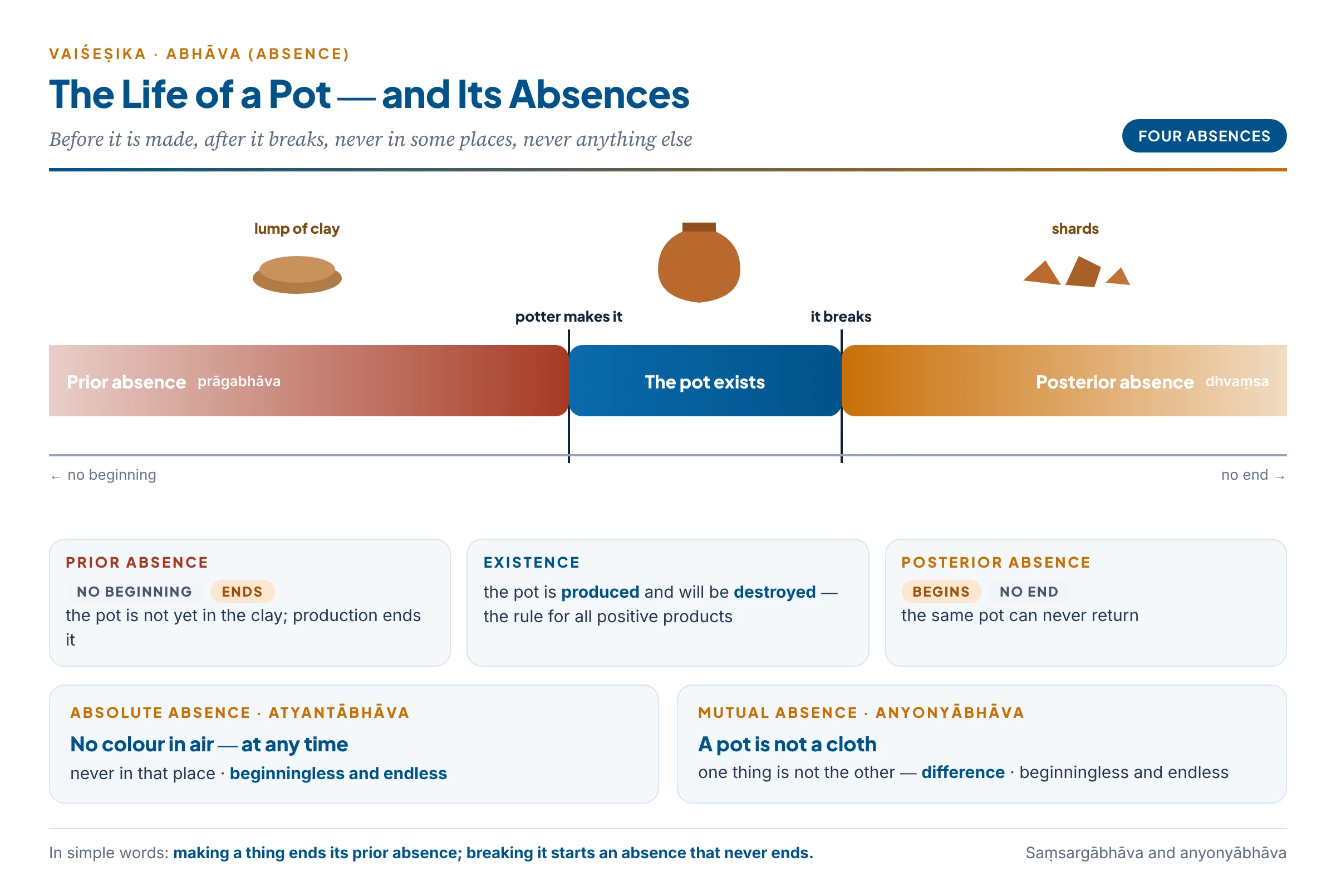
- Two main kinds.
- Relational absence (saṃsargābhāva) — the absence of a connection of one thing in another. Form: “this is not in that“: “there is no pot on the floor”, “there is no colour in air”. Its opposite is the presence of the connection: “there is a pot on the floor”.
- Mutual absence (anyonyābhāva) — the absence of identity between two things, that is, difference. Form: “this is not that“: “a pot is not a cloth”, “a cow is not a horse”. Its opposite is identity: “a pot is a cloth”.
- Relational absence is of three kinds.
- Prior absence (prāgabhāva) — the absence of a thing before it is produced. The house is absent in the bricks before it is built. It has no beginning (the house never existed before) but it has an end (it ends when the house is built). Beginningless, with an end.
- Posterior absence (pradhvaṃsābhāva or dhvaṃsa) — the absence of a thing after its destruction. The broken jar is absent in its pieces. It has a beginning (the moment of breaking) but no end — the very same jar can never be brought back. With a beginning, endless.
- Absolute absence (atyantābhāva) — the absence of a connection between two things for all time, past, present and future. There is no colour in air; a hare has no horn. Beginningless and endless.
- Mutual absence is likewise beginningless and endless: a pot never was, is not and never will be a cloth.
- A remarkable asymmetry. Among positive things, whatever is produced is destroyed. Among absences, posterior absence is produced (by the breaking) and yet is never destroyed; prior absence is never produced and yet is destroyed (by the production of the thing).
| Kind | Form | Beginning? | End? | Example |
|---|---|---|---|---|
| Prior absence (prāgabhāva) | Not yet in it | No | Yes — when the thing is produced | The pot in the clay before the potter works |
| Posterior absence (dhvaṃsa) | No longer in it | Yes — when the thing is destroyed | No | The pot in its shards |
| Absolute absence (atyantābhāva) | Never in it | No | No | Colour in air |
| Mutual absence (anyonyābhāva) | One thing is not the other | No | No | A pot is not a cloth |
- A temporary absence. Some later writers also speak of a temporary absence (sāmayika abhāva): the pot is carried out of the room, so it is now absent from the floor where it stood, and it may return. Others treat this as a relational absence limited by time rather than a fifth kind.
Common confusion
If a broken pot is put together again, has its posterior absence ended? No. Some notes say that “when a pot breaks we can recreate it from its pieces”. A pot made again from the shards is a new pot with its own prior absence and its own existence; the original pot remains destroyed for ever. That is exactly why posterior absence is said to have a beginning but no end: the very same thing can never be brought back into existence.
3. Relational and Mutual Absence: “Air Does Not Have Heat” and “Air Is Not Fire”
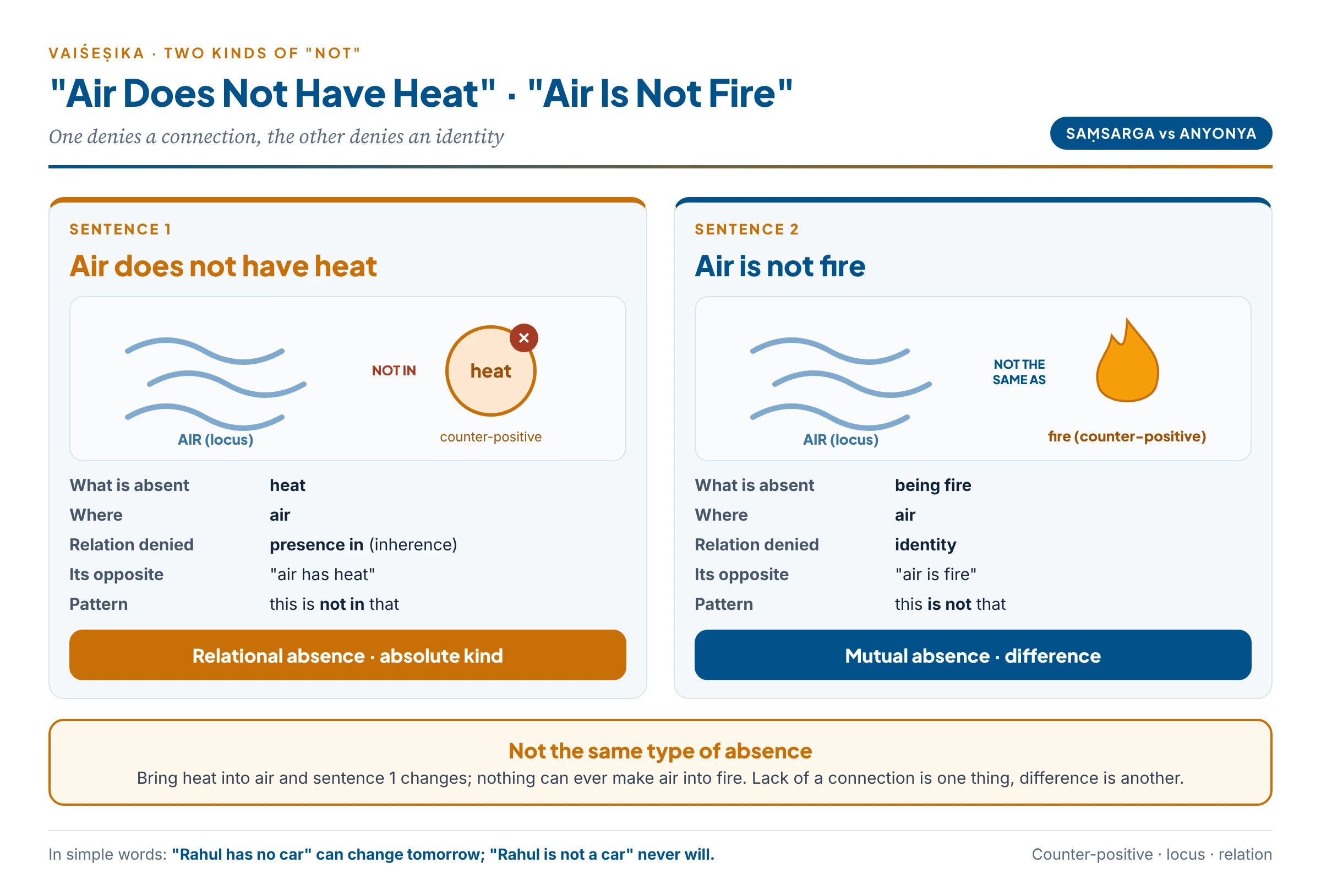
- “Air does not have heat.” This denies that heat is in air. It is a relational absence — specifically an absolute one, since for Vaiśeṣika air’s own touch is “neither hot nor cold”; the heat of a hot wind belongs to particles of fire mixed in it (Article 7).
- Counter-positive: heat. Locus: air.
- Relation denied: inherence (a quality residing in a substance).
- Opposite statement: “Air has heat”.
- “Air is not fire.” This denies that air is identical with fire. It is a mutual absence — a statement of difference.
- Counter-positive: fire. Locus: air.
- Relation denied: identity.
- Opposite statement: “Air is fire”.
- So they are not the same type of absence. The first negates a connection between two different things (“this is not in that”); the second negates the sameness of two things (“this is not that”). One can be true while the other is false: “air is not earth” is true, yet “air has no touch” is false — air does have touch.
- Why the difference matters.
- Different opposites. Relational absence is opposed by presence; mutual absence is opposed by identity.
- Different ways of ending. Some relational absences (prior and posterior) begin or end in time; mutual absence never does.
- Different jobs. Relational absence explains production, destruction and lack; mutual absence explains plurality and distinction — that there are many different things at all.
In simple words
“Rahul has no car” and “Rahul is not a car” both use “not”. But the first says a car is missing from Rahul’s life — buy him one and it becomes false. The second says Rahul and a car are different things — nothing you buy will ever make Rahul a car. The first is a relational absence, the second a mutual absence (difference).
4. “Negation Always Has a Counter-Positive; Absolute Negation Is Impossible”
- Every negation has a counter-positive. There is no “absence of nothing in particular“. To deny is always to deny something; the knowledge of the absence of a jar presupposes the idea of a jar. Negation therefore presupposes affirmation: we can only say “no pot here” because pots exist somewhere.
- Every negation has a locus. An absence is always somewhere: no colour in air, no pot on the floor. A “pure nothing”, absent nowhere and of nothing, is not an object of knowledge.
- So “absolute negation” — negation without any affirmation — is impossible. A sheer void, a negation that negates everything and refers to nothing, is a pseudo-idea. This is the realist’s point: knowledge of negation, like all knowledge, points to an object distinct from itself.
- The counter-positive must be real. Nyāya does not admit an absence whose counter-positive is a fiction. “The hare’s horn does not exist” is analysed as “a horn (a real thing, found on cows) is not in a hare (a real animal)”. The horn and the hare are real; what is absent is their connection. A “hare’s horn” taken as one entity is not a counter-positive at all.
- Two meanings of “absolute”. The word “absolute” is used in two ways:
- Absolute absence (atyantābhāva) — a relational absence that holds at all times, like no colour in air. This is real and perfectly possible.
- Absolute negation — negation with no counter-positive and no locus, a pure nothing. This is impossible.
Common confusion
Is “hare’s horn” or “sky-lotus” an example of absolute absence (atyantābhāva)? Only when it is read correctly. Many notes give “hare’s horn”, “sky-flower” and “barren woman’s son” as the classical examples of absolute absence, and some even say that absolute absence is “a pseudo-idea”. For Nyāya–Vaiśeṣika, absolute absence is a real absence of a real thing in a real locus at all times — colour in air is the standard example. “A hare has no horn” qualifies only because it means that a horn (real) is never in a hare (real). A fictitious entity like “the sky-lotus” or “the barren woman’s son” cannot be the counter-positive of any absence; it is the pure nothing that Nyāya calls impossible.
5. How Absence Is Known: The Nyāya View
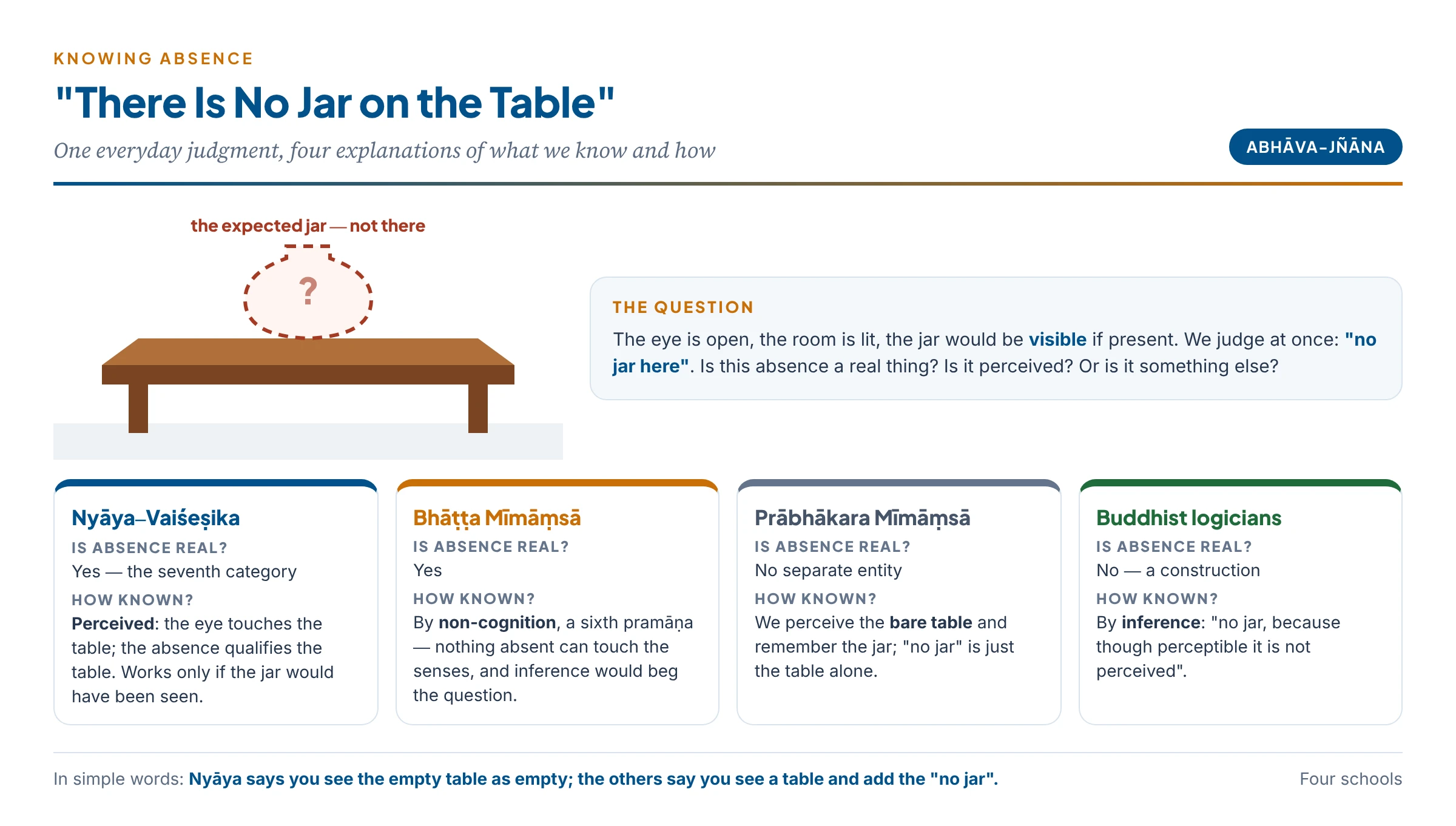
- Absence is perceived. When I look at the table and the jar is not there, I see that it is not there. The knowledge is immediate, as vivid as seeing the table itself.
- Through a special relation. The eye is in contact with the table; the absence of the jar qualifies the table (“the table is jar-less“). The sense reaches the absence through its locus by the relation of qualifier and qualified (viśeṣaṇatā), the sixth kind of sense-contact (Article 2).
- Only appropriate non-perception reveals absence. Not every failure to see something proves its absence. We do not see a table in the dark, or atoms, ether, merit and demerit — yet they exist. The absence of X is perceived only when X would have been perceived if it were there: the light is good, the eyes are open, the mind attends, the object is of a perceptible size and kind. This is appropriate non-perception (yogya-anupalabdhi) — for Nyāya, not a separate pramāṇa but a condition of perceiving absence.
- Absence can also be inferred. “There is no smoke on the lake, because there is no fire there” — the absence of the pervader (fire) proves the absence of the pervaded (smoke). Absences of imperceptible things (no merit in a stone) are known by inference.
- Absence can be known by testimony. “There is no bridge on this river,” says a reliable traveller.
- Why not a separate pramāṇa? Since perception, inference and testimony between them explain all our knowledge of absence, a sixth pramāṇa would be superfluous.
In simple words
A goalkeeper glances at the penalty area and instantly knows “no defender is marking that striker“. He does not infer it; he sees the unguarded striker. But this works only because the area is lit, his eyes are on it and a defender would be visible if present. In fog, the same “not seeing” would prove nothing. Nyāya: absence is seen — but only where the missing thing would have been seen.
6. How Absence Is Known: The Mīmāṃsā Views
- Bhāṭṭa Mīmāṃsā (Kumārila) — real, but known by non-perception.
- Absence is real. The Bhāṭṭas agree that absence is an objective, real feature of things; every thing has an existent aspect and a non-existent aspect.
- But it is not perceived. Perception needs sense-contact, and nothing can contact what is not there: an absence cannot stimulate the eye as the table does.
- Not inferred. To infer “the jar is absent because it is not perceived”, we would need the universal rule “whatever is not perceived is absent” — which assumes what is to be proved, and is false anyway (atoms are not perceived).
- Not comparison or testimony. The knowledge involves no similarity and no words.
- So a sixth pramāṇa. Our immediate knowledge of absence comes from non-cognition (anupalabdhi) — strictly, appropriate non-cognition. Advaita Vedānta accepts the same pramāṇa.
- Prābhākara Mīmāṃsā — absence is the bare locus.
- No separate category. There is no entity called “absence of jar”. What we cognise is simply the bare table — the table by itself (kevala-adhikaraṇa).
- Known by ordinary perception. Since the bare table is a positive thing, we see it in the ordinary way; no special pramāṇa is needed.
- The jar is remembered. We remember the jar that is expected, and see the table alone; “no jar here” is just this combination.
- Nyāya against the Bhāṭṭas.
- Sense-contact through the locus. The eye does not touch the absence directly; it touches the table, and the absence is a qualifier of the table. That is enough for perception, as with the colour of a thing.
- Economy. “Appropriate non-perception” is a condition of this perception, not a new means of knowledge; to make it a pramāṇa multiplies sources needlessly.
- Nyāya against the Prābhākaras.
- The bare table is not the same as the table. The table is there whether or not the jar is on it. If the cognition of absence were just the cognition of the table, we would cognise the jar’s absence even when the jar is present.
- “Bare” is itself negative. To say “the table alone“, “the mere table”, already means “the table without the jar” — absence is smuggled back in.
- Different absences, same locus. The same table lacks a jar, a cloth and a book; three different true judgments cannot be about the one bare table alone.
7. The Buddhist View: Absence Without an Entity of Absence
- No real absence. For the Buddhist logicians (Dharmakīrti), only momentary, positive particulars are real. “Absence” is not an entity in the world.
- What we really perceive. In “there is no jar on the table” we perceive only the bare place; the “absence” is a conceptual construction built on this, by contrast with the jar we expect.
- Non-perception as a logical mark. Dharmakīrti treats non-perception of the perceptible as a reason in an inference: “There is no jar here, because, although it fulfils the conditions of being perceived, it is not perceived.” So knowledge of absence is inferential, not perceptual — and inference itself, for the Buddhist, deals with constructions.
- Absence elsewhere in Buddhism. For the Mādhyamika, every thing is “empty” of self-nature, so absence is not a separate entity but the lack of own-being in all things. For the Yogācāra, “absence” is a mode of consciousness.
- Nyāya reply.
- The immediacy of the cognition. “No jar here” arises at once, with no reasoning; it is as perceptual as seeing the table.
- True negative judgments need truth-makers. If absence were only a construction, “there is no fire in the lake” would be no more true than “there is no water in the lake”.
- The Buddhist mark presupposes absence. “Non-perception of the perceptible” is itself an absence — of perception. The Buddhist uses absence to explain absence.
Indian Connect — Knowledge of absence across the schools
| School | Is absence real? | How is it known? | Key point |
|---|---|---|---|
| Nyāya–Vaiśeṣika | Yes — the seventh category | Perception (through the qualifier relation), also inference and testimony | Appropriate non-perception is only a condition |
| Bhāṭṭa Mīmāṃsā | Yes — an aspect of every real | Non-cognition (anupalabdhi), a sixth pramāṇa | No sense-contact with what is not there |
| Advaita Vedānta | Empirically real only | Non-cognition | Ultimately only Brahman is real |
| Prābhākara Mīmāṃsā | No separate entity | Perception of the bare locus | “No jar” is the table alone |
| Buddhism | No — a conceptual construction | Inference from non-perception of the perceptible | Only positive momentary particulars are real |
| Jainism | Real as an aspect | Through the sevenfold predication — “in some sense it is not” | Every thing both is and is not, relative to standpoint |
| Cārvāka | No independent status | — | Absence is mere non-perception |
8. Why Absence Is an Independent Category
- It has the marks of a padārtha. Absence exists (as a negative fact), is knowable and is nameable. By Vaiśeṣika’s own definition (Article 7), it is a category.
- It cannot be reduced to the six positive categories.
- Not a substance — it has no qualities or actions.
- Not a quality — qualities reside only in substances, but absences are found in qualities and actions too (no smell in a colour, no motion in a sound).
- Not an action, universal, particularity or inherence — it is not a movement, not shared by inherence, not a self-distinguishing mark, not a relation of inherence.
- Not the bare locus — as shown against the Prābhākaras.
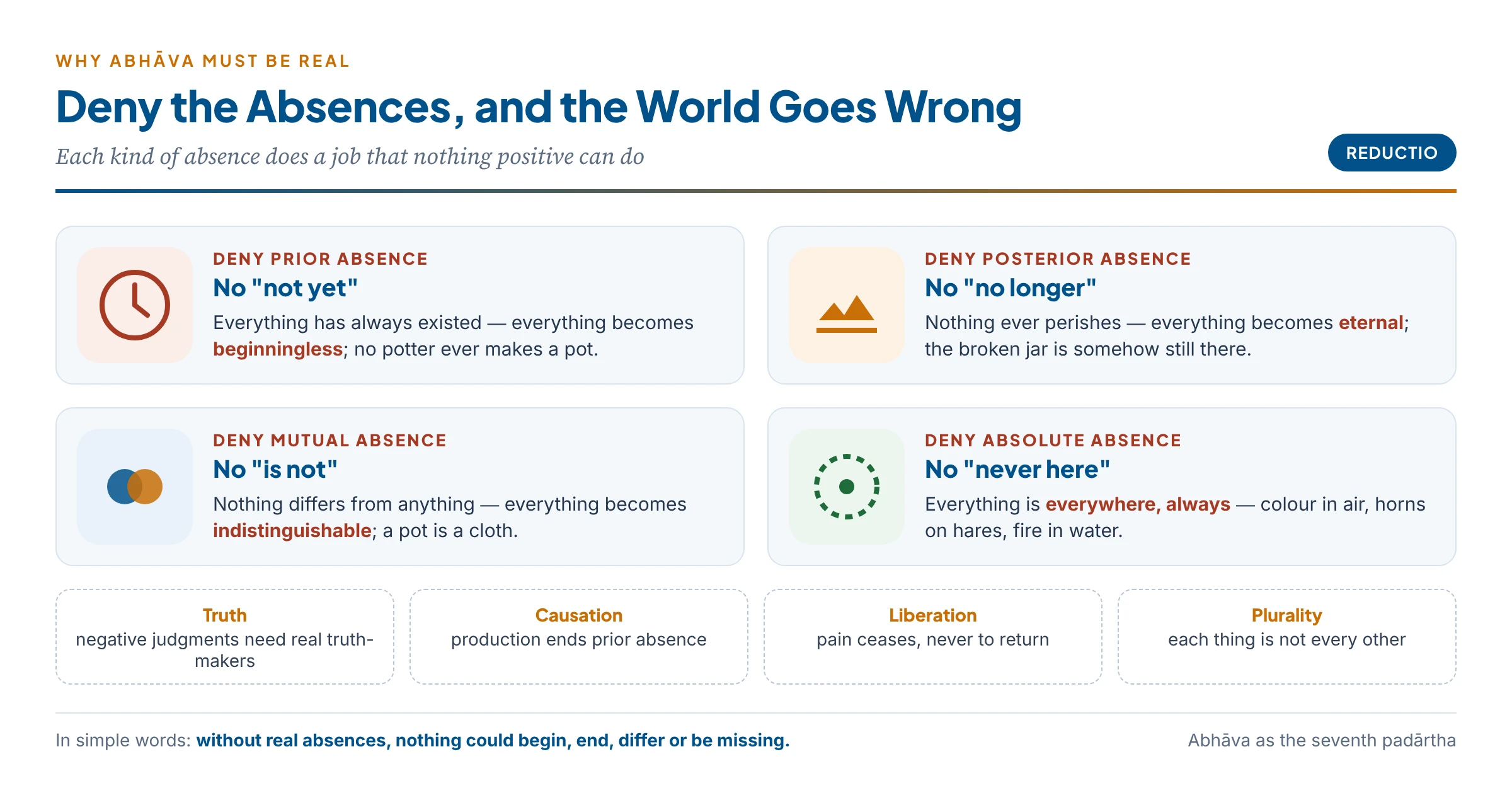
- Negative judgments are true. “No pot on the floor” is true and can guide action. A realist theory of truth needs something in the world that makes it true.
- Causation needs prior absence. The Nyāya theory that the effect is a new creation (asatkāryavāda, Article 10) rests on the effect’s prior absence in its material cause. Production is the end of prior absence; destruction is the start of posterior absence.
- Liberation needs absence. Liberation (apavarga) is the absolute cessation of pain — a posterior absence of suffering that never ends (Article 12).
- Plurality needs difference. That there are many things, and not one, is the fact of mutual absence: each thing is not every other.
- Without the four absences, absurdities follow.
- Deny prior absence, and everything becomes beginningless — nothing is ever produced.
- Deny posterior absence, and everything becomes eternal — nothing is ever destroyed.
- Deny mutual absence, and everything becomes indistinguishable — a pot would be a cloth.
- Deny absolute absence, and everything would exist always and everywhere — colour in air, horns on hares.
- Everyday life depends on it. A judge says, “No evidence is found against the accused”; a doctor reports “no fracture“; a priest checks that no required offering is missing from the altar. In each case an absence is known and acted upon.
9. Prior Absence and the Debate with Sāṃkhya
- Where prior absence resides. The prior absence of a pot resides in its material cause — the clay (strictly, the two halves of the pot that will be joined). It does not reside “nowhere”.
- What it explains.
- Why production is needed. The pot is really absent in the clay before the potter works; so the potter’s activity produces something.
- Why only some causes produce some effects. Only clay has the prior absence of a pot; threads have the prior absence of a cloth. That is why a pot comes from clay and not from threads — answering the Sāṃkhya challenge that, unless the effect pre-exists, anything could come from anything.
- What production is. To produce a pot is to end its prior absence.
- Against Sāṃkhya’s satkāryavāda. Sāṃkhya says the effect pre-exists in its cause (the oil in the sesame seed). Nyāya replies: if the pot already existed in the clay, it would already be seen and used; the potter’s work would be pointless; and we could never say “the pot will be made”. The truth of “the pot is not yet” is the prior absence (Article 10 develops the full debate).
Critical Evaluation
Objections (Pūrva-pakṣa)
- Buddhists. Absence is not an entity but a construction on the perception of a bare place; its knowledge is inferential, from the non-perception of the perceptible.
- Prābhākaras. Absence is just the bare locus; to posit an extra entity is needless.
- Bhāṭṭas and Advaitins. Absence is real but cannot be perceived, since nothing can contact the senses that is not there; it is known by non-cognition.
- Advaita. Ultimately, only Brahman is; absence, like presence, belongs to the empirical level (vyavahāra). The final goal is to go beyond both being and non-being.
- Jainas. Absence is relative: everything is from one standpoint and is not from another. There is no absolute non-being.
- Cārvāka. Absence is only the non-perception of something; there is no negative entity.
- Philosophical critics.
- Relative, not absolute. Absence is admittedly relative to its counter-positive, so it cannot have the same status as the absolute positive categories.
- Being and non-being unreconciled. In admitting negation, Vaiśeṣika rightly sees that affirmation and negation, existence and non-existence, presuppose each other. But it leaves them side by side as two categories instead of reconciling them in a higher unity, as a Hegelian would demand.
- Ontological inflation. If every absence is an entity, the world contains infinitely many absences — of elephants in my pocket, of unicorns in my room — a vast population of negative entities.
Defences and Replies
- The construction view cannot explain truth. If absence is a mental construction, “there is no fire in this lake” is no more objective than “there is no water in it”. Only a real absence makes one true and the other false.
- Perception through the locus is ordinary. We perceive colour through contact with the coloured thing; we perceive absence through contact with its locus. No special pramāṇa is needed.
- The bare locus already contains the negative. “The table alone” means “the table without the jar”.
- Relativity is not unreality. Absence depends on its counter-positive for its identity, not for its reality: the absence of the jar is a real fact about the table.
- Inflation is harmless. The infinitely many absences are not extra “stuff”; they are facts about what things are not, and only those we can know matter to knowledge.
- The theory is indispensable to Nyāya’s theories of causation, liberation, plurality and truth.
Critics and Defenders
Criticism — Critics
- Buddhists: absence is a construction known by inference from non-perception of the perceptible.
- Prābhākaras: “no jar” is simply the bare table; no new entity is needed.
- Bhāṭṭas and Advaitins: absence is real but needs a sixth pramāṇa, non-cognition.
- Hegelian critics: being and non-being are left unreconciled; absence is merely relative.
Defence — Defenders and strengths
- “No jar” is seen at once — absence is perceived through its locus.
- Only appropriate non-perception reveals absence; it is a condition, not a pramāṇa.
- The “bare” table already means the table without the jar.
- Deny the four absences and things become beginningless, eternal, indistinguishable and everywhere.
- Negative truths need real negative facts to make them true.
Cross-Tradition Comparison
Abhāva and Western Thought on Non-Being
| Issue | Nyāya–Vaiśeṣika | Western parallel |
|---|---|---|
| Can non-being be thought? | Yes — but always as absence of something somewhere | Parmenides — “what is not cannot be thought or said” |
| Non-being as difference | Mutual absence means difference | Plato (Sophist) — non-being is difference (the Other) |
| Negation and determination | Every thing is distinct by mutual absence from all others | Spinoza — “all determination is negation” |
| Pure nothing a pseudo-idea | Absolute negation (pure nothing) is impossible | Bergson — the idea of absolute nothing is a pseudo-idea |
| Perceiving absence | “No jar on the table” is perceived | Sartre — “Pierre is not in the café“: absence is experienced |
| Negative facts | Real truth-makers of negative judgments | Russell — negative facts; opposed by those who reduce them to positive facts |
| Being and non-being reconciled | Left as two categories | Hegel — being and nothing pass into becoming |
| Empty names | No absence of a fiction | Russell’s analysis of “the present King of France” |
Indian Connect — Key takeaways
- Abhāva is the Indian realist’s answer to negative facts: absence is real, knowable and nameable.
- Mutual absence anticipates Plato’s discovery in the Sophist that “not-being” is really difference.
- The Nyāya–Mīmāṃsā debate on perceiving absence is the Indian counterpart of Sartre’s café and the modern debate on negative perception.
- Prior absence is the hinge of Nyāya’s theory of causation against Sāṃkhya.
- Every absence has a counter-positive and a locus — “absolute negation”, pure nothing, is impossible.
Synthesis (Siddhānta)
- Abhāva is the seventh category: absence is a real, knowable, nameable feature of the world, always the absence of something (counter-positive) in something (locus).
- It is of two main kinds: relational absence (“this is not in that”) — prior, posterior and absolute — and mutual absence or difference (“this is not that”). “Air does not have heat” and “air is not fire” express these two different kinds.
- Absence is perceived through its locus, provided the missing thing would have been perceived if present; it can also be inferred or known by testimony. The Bhāṭṭas’ non-cognition, the Prābhākaras’ bare locus and the Buddhists’ construction are each answered.
- The category is indispensable: it grounds negative truths, the novelty of effects, the finality of liberation and the plurality of things.
- Contemporary relevance.
- Medicine and science. A negative test result — “no infection” — is real knowledge on which lives depend; science advances by noticing what is absent (the dog that did not bark).
- Computing. Databases distinguish a missing value from an empty record and from a different record — the distinctions between relational absence, the bare locus and mutual absence.
- Law. “Absence of evidence” and “absence of consent” are legally decisive negative facts.
- Philosophy of perception. Psychologists study how we see silence, gaps and missing items — confirming that absence can be experienced directly, as Nyāya held.
In one line: for the Nyāya–Vaiśeṣika realist, what is not is known as surely as what is — and always as the absence of something, somewhere.
Previous Year Questions
- 2025Discuss the debate between the Bhāṭṭa and the Prābhākara mīmāṃsakas with reference to the nature of Non-existence (Abhāva) and its knowledge.
- 2024Do these two sentences “Air does not have heat” and “Air is not fire” refer to the same type of absence or abhāva, according to the Vaiśeṣikas? Discuss.
- 2023Present an account of Vaiśeṣika’s view of negation in the light of their statement “Negation always has a counter-positive and absolute negation is an impossibility.”
- 2023Write a note on Nyāya notion of Prāgabhāva (prior non-existence). How does this notion help Naiyāyikas in defending their position on causation against the Sāṃkhya view of causation? Critically discuss.
- 2023Present Bhāṭṭa’s view of anupalabdhi (non-cognition) as a valid means of knowledge.
- 2021What, according to Mīmāṃsakas, is the ontological status of abhāva (absence) and how does one know it? Explain and examine.
- 2019Justify the status of Abhāva as a category in Vaiśeṣika philosophy.
- 2018How do the Buddhists and the Nyāya philosophers explain our knowledge of ‘the absence of the jar on the table’? Answer in detail.
- 2016How do the Naiyāyikas justify the introduction of ‘Abhāva’ as an independent category? Explain.
- 2014How is an absence of an object known according to Naiyāyikas and Mīmāṃsakas? Discuss.
- 2011Why do the Vaiśeṣikas treat Abhāva as an independent category? Explain.
- 2009Compare the viewpoints of Nyāya, Vaiśeṣika, Mīmāṃsā and Buddhism on the issue of knowledge of abhāva.