

Nyāya–Vaiśeṣika: Theory of Categories; Theory of Appearance; Theory of Pramāṇa; Self, Liberation; God; Proofs for the Existence of God; Theory of Causation; Atomistic Theory of Creation
Official Syllabus: Paper I, Section B, Unit 15
Does the pot already exist, hidden, in the lump of clay — or does the potter bring into being something that was not there before? This old question divides Indian philosophy into camps, and each camp’s answer shapes its whole picture of reality. Nyāya–Vaiśeṣika gives the realist’s answer: the effect is not present in its material cause before it is produced (asatkāryavāda); it is a new beginning, a fresh whole built from its parts (ārambhavāda). This article explains how Nyāya defines a cause, how it weeds out the many things that merely happen before an effect (the five anyathāsiddhas), the three kinds of cause, the role of prior absence, and the long debate with Sāṃkhya, the Buddhists and Advaita Vedānta.
In simple words
A tailor stitches a shirt from a roll of cloth. Was the shirt already “inside” the cloth? You could not wear the roll; you could not button it; you would not call it a shirt. Something new has come into the world — with a new shape, a new name and a new use. Nyāya says this is what every production is: the beginning of something that did not exist before, made out of materials that did.
Context & Problem
The Question of the Effect
- The core question. Does the effect (kārya) exist in its material cause (upādāna) before it is produced?
- Two broad answers.
- Yes — satkāryavāda (“the effect is existent”): Sāṃkhya, Yoga, Rāmānuja and, in its own way, Śaṅkara.
- No — asatkāryavāda (“the effect is non-existent”): Nyāya, Vaiśeṣika, the Buddhists, some Mīmāṃsakas and, loosely, the Cārvākas.
- Within asatkāryavāda, two forms.
- Ārambhavāda — the effect is a new creation, a whole that begins to exist in its enduring material parts (Nyāya–Vaiśeṣika).
- Pratītyasamutpāda — the effect simply arises in dependence on momentary conditions, with no enduring material (Buddhism).
- Why it matters. A school’s theory of causation decides its theory of reality: whether the world is a real transformation of one stuff, an appearance of Brahman, a flow of momentary events, or — for Nyāya–Vaiśeṣika — a real plurality of eternal atoms building new wholes.
The Nyāya Starting Point
- Realism. The pot you see is a real whole, distinct from the clay; the colour of the cloth is a new colour, distinct from the colour of the threads.
- Common sense and language. We say “the potter made the pot”, “the pot will be made”, “the pot is not yet made”. These statements are true only if the pot was really absent before.
- Purpose of the theory. By making the world a set of produced composites built from eternal atoms, Nyāya–Vaiśeṣika reconciles change with permanence and leaves room for God as the efficient cause of the world (Articles 11 and 13).
Core Doctrine
1. What Is a Cause?
- Definition. A cause (kāraṇa) is the invariable and unconditional antecedent of an effect; the effect (kārya) is the invariable and unconditional consequent of a cause. In the manuals: a cause is “that which invariably precedes the effect and is not otherwise established” (kārya-niyata-pūrva-vṛtti ananyathāsiddha).
- Three marks of a cause.
- Antecedence (pūrva-vṛttitva). It must come before the effect. Nothing that comes after, or merely at the same time, is a cause.
- Invariability (niyata). It must always be present before such an effect. If clay is sometimes absent before a clay pot, clay is not the cause.
- Unconditionality (ananyathāsiddha). It must be directly and necessarily related to the effect — not merely present because it is attached to the real cause, or present for some other reason.
- Effect. An effect is the counter-positive of prior absence (prāgabhāva-pratiyogin): it is precisely what was absent before and then comes to be. This definition already contains the whole asatkāryavāda (Article 9).
- Cause and effect are different. Since the cause precedes and the effect follows, they cannot be one and the same thing; they are linked but two. The effect is a “later development” of the cause in which there is something new — and that newness is what makes it an effect.
In simple words
A cricket ball breaks a window. Before the crack, many things were there: the ball, the bowler’s throw, the glass, a bird on the roof, a car horn, the colour of the ball. Which were causes? Nyāya’s test: a cause must come before, must always be there in such cases, and must be directly relevant. The bird and the horn were only there; the colour of the ball made no difference. The ball’s impact and the glass are the causes.
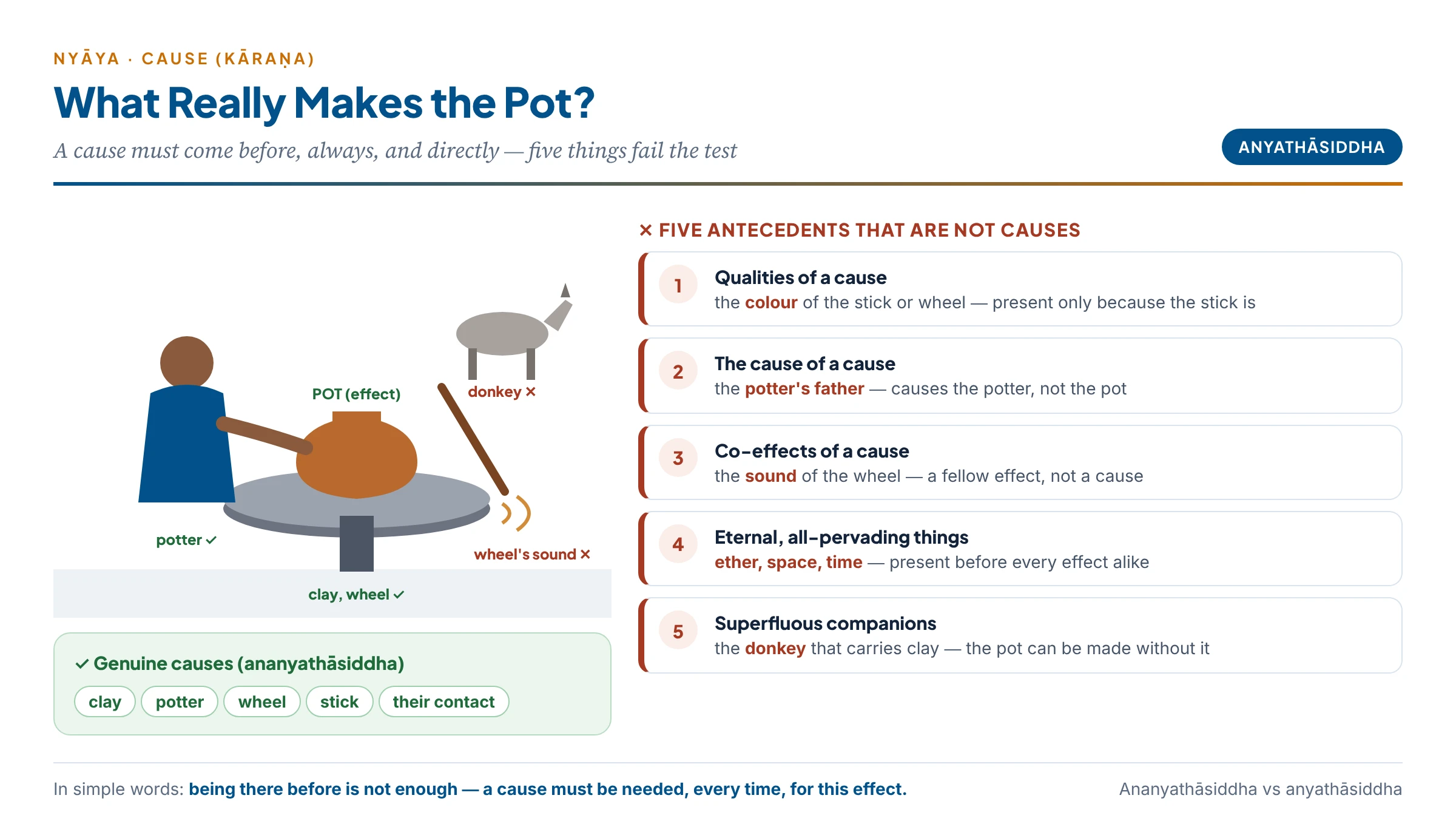
2. Anyathāsiddha and Ananyathāsiddha
- Two kinds of antecedent.
- Ananyathāsiddha — a genuine antecedent, “not otherwise established“: its presence before the effect is explained only by its being a cause. Clay, the potter, the wheel and the stick are ananyathāsiddha causes of the pot.
- Anyathāsiddha — an accidental or irrelevant antecedent, “otherwise established“: it is present before the effect for some other reason, so it is not a real cause even if it is always there.
- The five accidental antecedents (anyathāsiddha).
- Qualities of a cause. The colour of the potter’s stick or wheel is always present when the stick turns the wheel, but it is not a cause of the pot; it is present only because the stick is. (Likewise “stick-ness”, the universal in the stick.)
- The cause of a cause (remote cause). The potter’s father is a cause of the potter, not of the pot. His antecedence is known only through the potter’s.
- Co-effects of a cause. The sound of the potter’s wheel is produced by the same wheel that helps make the pot; it precedes the pot’s completion, but it is a fellow effect, not a cause.
- Eternal, all-pervading substances. Ether (ākāśa), space, time are present before every effect; their presence is general, not specific to the pot. (Ether is antecedent to the pot only as the bearer of sound.)
- Unnecessary accompaniments. The potter’s donkey, which carries the clay, may always be around, yet the pot can be made without it; it is superfluous.
- How the texts frame them. The classical manuals state the five more abstractly — what is antecedent only through the cause (stick-ness, the colour of the stick), what is known to be antecedent to something else first (ether), what is antecedent to the cause (the potter’s father), and whatever is beyond the necessary and sufficient antecedents. The standard teaching list above follows the same idea with plainer examples.
- Why the distinction matters. It sharpens the definition of cause, separates causal from merely regular sequences, and shows that the effect is produced only by specific causes — which is why a pot comes from clay and not from threads.
3. The Three Kinds of Cause
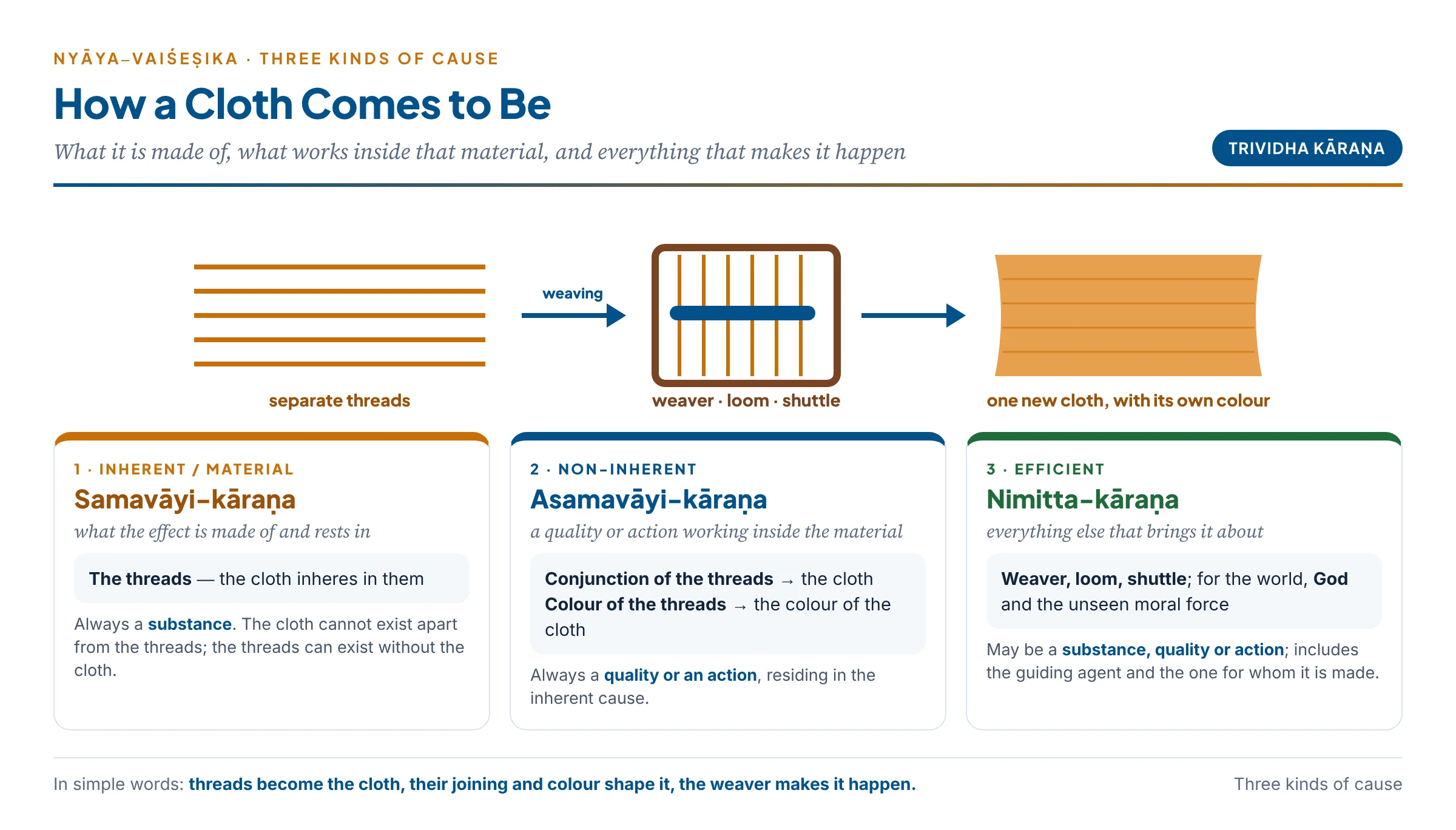
- (a) Inherent or material cause (samavāyi-kāraṇa).
- The substance in which the effect inheres — out of which it is made. The threads are the inherent cause of the cloth; the two halves of the pot (and ultimately the clay) are the inherent cause of the pot.
- Always a substance. Only a substance can be an inherent cause, since only a substance can be the locus in which something inheres.
- One-way dependence. The effect cannot exist apart from its inherent cause; the cause can exist apart from the effect (threads before weaving).
- Also called the upādāna-kāraṇa (material cause).
- (b) Non-inherent cause (asamavāyi-kāraṇa).
- A quality or action that inheres in the inherent cause (or in the same thing as the effect) and helps produce the effect.
- The conjunction of the threads is the non-inherent cause of the cloth — it resides in the threads, and the cloth resides in the threads.
- The colour of the threads is the non-inherent cause of the colour of the cloth — it resides in the threads, which are the inherent cause of the cloth in which the new colour resides.
- Always a quality or an action, never a substance.
- (c) Efficient or instrumental cause (nimitta-kāraṇa).
- Everything else needed to bring the effect about: the weaver, the loom, the shuttle; the potter, his wheel and stick.
- May be a substance, quality or action.
- It includes the directive cause (the agent who guides the process) and the final cause (the one for whose use the effect is made).
- General and special causes. Some causes are common to all produced things (sādhāraṇa-kāraṇa): God, God’s knowledge, desire and effort, time, space, adṛṣṭa (the unseen moral force), and prior absence. Others are special to particular effects (asādhāraṇa-kāraṇa): clay for pots, threads for cloth.
- The instrumental cause par excellence (karaṇa). Among the causes, the most effective one, which immediately brings the effect about, is the karaṇa — for example, the sense organ in perception. A pramāṇa is the karaṇa of valid knowledge (Article 1).
In simple words
Think of making tea. The water and tea leaves become the tea — the material that ends up in it (inherent cause). The mixing of leaves and water and the colour of the leaves give the tea its body and colour — features working within the material (non-inherent cause). The cook, the stove, the pan, the flame make it happen without becoming part of the tea (efficient cause).
4. Asatkāryavāda and Ārambhavāda
- The thesis. The effect is non-existent (asat) in its material cause before production. It begins (ārambha) at the moment of production as a new entity.
- What “new” means.
- A new whole. The cloth is a whole (avayavin) that inheres in the threads; it is not the threads rearranged, nor the threads under another name.
- New qualities. The cloth has its own colour, size and weight, produced by those of the threads.
- New use. The cloth covers the body; scattered threads do not.
- Production as the end of prior absence. Before the potter works, the clay contains the prior absence of the pot. Production ends this prior absence; destruction starts the posterior absence (Article 9).
- Destruction is not annihilation. When the cloth is destroyed, its threads remain; when anything composite is destroyed, its parts — ultimately the eternal atoms — remain. Only composites come and go.
- Nyāya’s arguments for asatkāryavāda.
- Causal activity would be pointless. If the pot already existed in the clay, why would the potter work, the wheel turn and the kiln burn? One does not make what is already made — like grinding flour that is already ground.
- Language would be false. “The pot will be made”, “the pot is being made”, “the pot has been made” — these distinctions of time would be meaningless if the pot always existed.
- Cause and effect would be indistinguishable. We would have to use the same name for clay and pot, and use a lump of clay to carry water.
- Difference of form proves newness. If the effect differs from its cause even in form, then there is something in the effect not present in the cause — which is all that asatkāryavāda claims.
- “Manifestation” does not help. Sāṃkhya says the cause only manifests what was hidden. But is the manifestation itself pre-existent? If yes, the potter has nothing to do. If no, then something new — the manifestation — comes into being, and asatkāryavāda is admitted.
- Perception. We do not see oil in a sesame seed, curd in milk, or a pot in clay; what is not perceived under perceptible conditions is absent (Article 9).
5. The Sāṃkhya Case for Satkāryavāda — and the Nyāya Replies
- Sāṃkhya’s five reasons (from the Sāṃkhyakārikā), with Nyāya’s answers:
- The non-existent cannot be produced (asad-akaraṇāt). No effort can produce a sky-flower or a hare’s horn, or press oil out of sand. Nyāya replies: Nyāya does not say that the absolutely non-existent is produced. It says that what is not yet existent, and has its prior absence in a suitable material, is produced. A pot is not a sky-flower: it is producible from clay.
- A definite material is taken (upādāna-grahaṇāt). People take clay for pots and milk for curd. The cause must be related to the effect, and nothing can be related to what does not exist. Nyāya replies: The relation is one of invariable causal capacity, not of pre-existence. Only clay has the prior absence of a pot; that is why clay, and not milk, is taken.
- Not everything comes from everything (sarva-sambhava-abhāvāt). If effects did not pre-exist, anything could come from anything. Nyāya replies: Causation is regulated: specific effects follow specific causes, as experience shows. Regularity needs invariable antecedence, not pre-existence.
- A potent cause produces only what it is potent for (śaktasya śakya-karaṇāt). A cause has a power for a particular effect, and a power must be related to an existing object. Nyāya replies: A power is a feature of the cause; it is defined by what it can produce, not by a pre-existing effect. The power of fire to burn does not mean that the burnt house already exists inside the fire.
- The effect has the nature of the cause (kāraṇa-bhāvāt). The cloth is not different from the threads: same stuff, same weight. Nyāya replies: Cloth and threads differ in name, form, number (many threads, one cloth), function (only cloth clothes us) and time of origin. Sameness of material is not sameness of thing.
- Sāṃkhya’s further charge: something from nothing. If the effect was non-existent, production means being from non-being, which is absurd.
- Reply. The effect does not come from nothing; it comes from existing material and efficient causes. Only its own existence is new.
- The two theories side by side.
| Point | Nyāya–Vaiśeṣika (asatkāryavāda) | Sāṃkhya (satkāryavāda) |
|---|---|---|
| Effect before production | Non-existent; only its prior absence is in the cause | Existent in unmanifest form |
| What production is | A new beginning (ārambha) | Manifestation of the latent (abhivyakti) |
| Relation of cause and effect | Different, linked by inherence | Identical in substance, different in state |
| Example | The pot is a new whole in the clay halves | The pot is the clay made explicit, as oil in the seed |
| Destruction | The effect perishes; parts remain | The effect returns to the latent state |
| Ultimate cause | Many eternal atoms + God as efficient cause | One prakṛti, unconscious and evolving |
| Picture of reality | Pluralistic realism | Dualism of prakṛti and puruṣa |
6. Prior Absence: The Hinge of the Nyāya Theory
- What it is. The absence of an effect in its material cause before production — beginningless, ending when the effect is produced (Article 9).
- How it defends asatkāryavāda against Sāṃkhya.
- It makes the effect’s newness real. “The pot is not yet” is a true judgment; its truth-maker is the prior absence of the pot in the clay.
- It explains why causal activity is needed. The potter’s work is needed to end that absence.
- It answers “why clay and not milk?” Prior absence is specific: clay contains the prior absence of a pot, milk of curd. This accounts for the regularity Sāṃkhya explains by pre-existence.
- It defines the effect. An effect is “the counter-positive of prior absence” — that which was absent and came to be.
- It saves the distinction of times. Past, present and future are real for effects: before (prior absence), during (existence), after (posterior absence).
- Sāṃkhya’s objection. An absence is nothing; how can nothing be located in the clay or explain anything? Nyāya replies that absence is a real category (Article 9), always the absence of something somewhere.
In simple words
A school’s admission register lists students who will join next year; their seats are empty now. The empty seats are not nothing — they are specific gaps waiting for specific students. Prior absence is like that: the clay holds a definite “pot-shaped gap“, not a hidden pot. Making the pot fills the gap.
7. Does the Seed Contain the Tree?
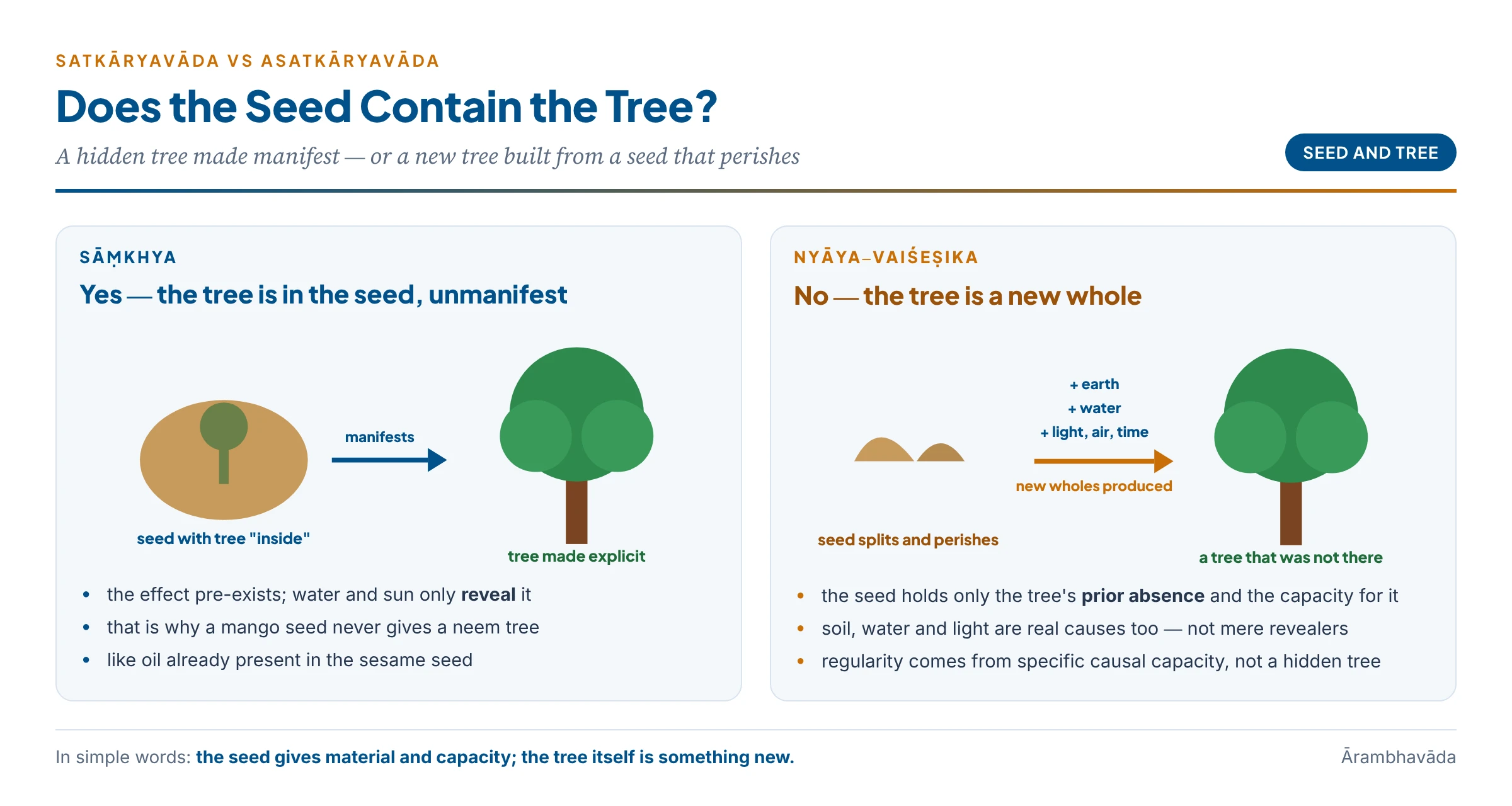
- Sāṃkhya: yes, potentially. The mango tree exists in the mango seed in an unmanifest form. Watering and sunlight only manifest it, as pressing manifests the oil in a seed. That is why a mango seed always gives a mango tree and never a neem tree.
- Nyāya–Vaiśeṣika: no.
- The tree is a new whole. The tree does not exist in the seed; there is only the prior absence of the tree in the seed.
- The seed is destroyed. The seed swells, splits and perishes; out of its parts, together with earth, water, light and air, the sprout is produced, and so on through many new wholes to the tree.
- Many causes, one effect. The seed is not the only cause: soil, water, sunlight and time are also needed. If the tree were already in the seed, these would be needless.
- Regularity explained. A mango seed gives a mango tree because it has the specific causal capacity (and contains the specific prior absence) for mango trees, not because a tiny tree is hidden in it.
- What the seed “contains”. It contains the material and the capacity, not the tree.
- Aristotle’s middle position. For Aristotle the acorn is potentially an oak; the potential becomes actual. This is close to Sāṃkhya’s “unmanifest to manifest”, but Aristotle also stresses the new actuality — a point Nyāya would welcome.
8. Causation and Theories of Reality
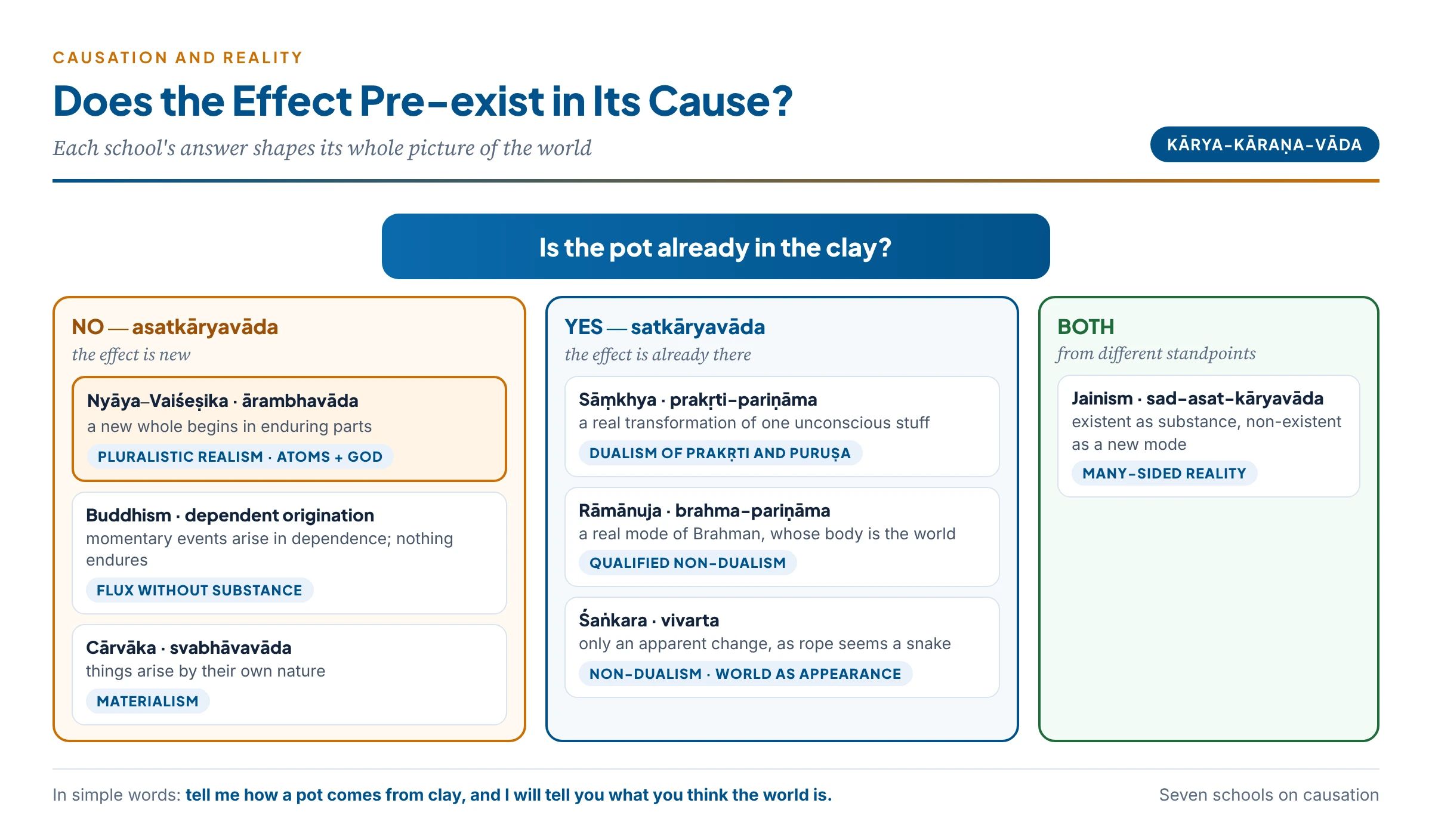
- Every school’s metaphysics follows its causation.
- Sāṃkhya — prakṛti-pariṇāmavāda. The effect is a real transformation of one material, prakṛti. The world evolves from, and dissolves into, one unconscious stuff — leading to dualism of prakṛti and puruṣa.
- Rāmānuja — brahma-pariṇāmavāda. The world is a real modification of Brahman, who has matter and souls as his body — qualified non-dualism.
- Śaṅkara — vivartavāda. The effect is an apparent transformation of the cause, as a rope appears as a snake. The world is an appearance of Brahman — non-dualism.
- Nyāya–Vaiśeṣika — ārambhavāda. The effect is a new whole produced from eternal parts. The world is a real plurality of composites built from atoms, with God as the efficient cause — pluralistic realism and theism.
- Buddhism — pratītyasamutpāda and momentariness. Each momentary event arises in dependence on prior events; nothing endures to be a material cause — a world of flux without substance or self.
- Jainism — sad-asat-kāryavāda. The effect is existent as substance and non-existent as a new mode — many-sided reality (anekānta).
- Cārvāka — svabhāvavāda. Things arise by their own nature; there is no need for a hidden cause or a God — materialism.
- Why causation is central. The theory of causation decides what the ultimate cause is (one prakṛti, Brahman, many atoms, momentary events), whether change is real, and whether the world is real. Hence it is the hinge of every Indian theory of reality.
Indian Connect — Causation and reality across the schools
| School | Theory of causation | Is the effect real? | Picture of reality |
|---|---|---|---|
| Nyāya–Vaiśeṣika | Asatkāryavāda — ārambhavāda | Yes, a new whole | Pluralistic realism; atoms + God |
| Sāṃkhya–Yoga | Satkāryavāda — prakṛti-pariṇāma | Yes, a real transformation | Dualism of prakṛti and puruṣa |
| Rāmānuja | Satkāryavāda — brahma-pariṇāma | Yes, a real mode of Brahman | Qualified non-dualism |
| Śaṅkara | Satkāryavāda — vivarta | Only apparently | Non-dualism; world as appearance |
| Buddhism | Asatkāryavāda — dependent origination | Momentarily | Flux without substance |
| Jainism | Sad-asat-kāryavāda | Both, from different standpoints | Many-sided reality |
| Cārvāka | Svabhāvavāda | — | Materialism |
9. The Buddhist Critique of Nyāya Causation
- No enduring material cause. For the Buddhist, everything is momentary. The threads of one moment do not survive into the next; so there is no enduring inherent cause in which the cloth could inhere.
- No whole over and above parts. The “cloth” is a name for a collection of thread-moments; the Nyāya whole (avayavin) is an unnecessary entity. Is the whole wholly present in each part, or partly? If wholly, there are as many wholes as parts; if partly, it has parts of its own, and the regress begins.
- No inherence. Inherence, needed to tie the new whole to its parts, is itself an unnecessary entity (Article 8).
- Causation is dependence, not production. “When this is, that arises”: a cause is just the condition on which the next moment depends, not a substance that produces a new substance.
- Nyāya replies.
- Recognition (“this is the same cloth I bought”) and unified action (lifting one end lifts the whole cloth) show that wholes endure and are one.
- If only momentary parts existed, nothing perceptible would exist, since atoms are imperceptible; the perceived whole must be real.
- Momentariness makes the regularity of causation mysterious: why should a cloth-moment follow only thread-moments?
10. Advaita and Other Critiques
- Śaṅkara on asatkāryavāda.
- No relation with the non-existent. A cause can be related only to something existent; a non-existent effect cannot be related to anything, so it could not be produced.
- The effect is not other than the cause. “All this is clay” — the pot is only a name and form of clay; take away name and form and only clay remains.
- The world as vivarta. Ultimately even the transformation is apparent: Brahman alone is real, and the world of effects is an appearance.
- Rāmānuja. The effect is a real state of the cause, not a new entity; cause and effect are the same substance in two states.
- Jainas. The effect is both existent (as substance) and non-existent (as a new mode); Nyāya’s one-sided view ignores the first aspect.
Common confusion
Is asatkāryavāda the view that something comes out of nothing? No. The charge that Nyāya makes the effect arise “from nothing” is a Sāṃkhya caricature. For Nyāya–Vaiśeṣika, every effect arises from existing causes — an existing material (threads, clay, ultimately eternal atoms), existing qualities and actions, and existing agents and instruments. What is new is only the effect itself. The absolutely non-existent — a sky-flower or a hare’s horn — is never produced; only what has a prior absence in a suitable material can be.
Critical Evaluation
Objections (Pūrva-pakṣa)
- Sāṃkhya. Being cannot come from non-being; the regularity of causes shows that effects pre-exist; cause and effect are one substance.
- Advaita. No relation is possible with a non-existent effect; the effect is only a name and form of its cause; ultimately the whole causal world is appearance.
- Buddhists. No enduring material cause, no whole over its parts, no inherence; causation is momentary dependence.
- Jainas. The effect is both existent and non-existent; asatkāryavāda is one-sided.
- Logical objections.
- Weight. A cloth weighs exactly what its threads weigh. If the cloth were a new substance added to the threads, should not the total weight be more?
- Too many entities. Every new whole is an extra entity alongside its parts — a multiplication of things.
- Mill-like definition. “Invariable unconditional antecedent” is close to regularity; it may not capture what makes a cause produce its effect.
Defences and Replies
- Weight answered. The weight of the whole is produced by the weights of the parts; it is not added on top of theirs. We weigh the whole, whose weight is caused by the parts’ weights — no double counting.
- Wholes are needed. Perception, unified action and language all require wholes. The “extra” entity is what we actually see and use.
- More than regularity. Nyāya’s causes are not mere regularities: inherent causes contain the effect, non-inherent causes work in them, efficient causes act. Invariability is the sign of causation, not the whole of it.
- No something-from-nothing. Every effect has existing causes; only the effect itself is new.
- Prior absence grounds the newness and the regularity of effects without pre-existence.
Critics and Defenders
Criticism — Critics
- Sāṃkhya: being cannot come from non-being; effects must pre-exist in their causes.
- Śaṅkara: a non-existent effect cannot be related to anything; the effect is a name and form of the cause.
- Buddhists: nothing endures to be a material cause; wholes are names; causation is dependence.
- Logical critics: a new whole should weigh more; “invariable antecedent” is mere regularity.
Defence — Defenders and strengths
- Pots are made, not merely revealed — otherwise the potter’s work is pointless.
- “Not yet“, “now“, “no longer” are real distinctions, grounded in prior and posterior absence.
- Manifestation itself is either pre-existent (pointless) or new (asatkāryavāda).
- Cloth and threads differ in name, form, number, function and time.
- The five anyathāsiddhas separate real causes from what merely comes before.
Cross-Tradition Comparison
Nyāya Causation and Western Theories
| Point | Nyāya–Vaiśeṣika | Western parallel |
|---|---|---|
| Definition of cause | Invariable, unconditional antecedent | J. S. Mill — “the invariable and unconditional antecedent” |
| Regularity | Invariability is a sign of causation | Hume — constant conjunction and habit |
| Kinds of cause | Inherent, non-inherent, efficient | Aristotle — material, formal, efficient, final |
| Material cause | Threads in which the cloth inheres | Aristotle’s material cause (the bronze of a statue) |
| Efficient cause | Potter, wheel, stick; God for the world | Aristotle’s efficient cause; Aquinas — God as first efficient cause |
| Final cause | Included in the efficient cause (the one for whom it is made) | Aristotle’s final cause |
| Is the effect new? | Yes — a new whole | Emergentism — wholes with new properties |
| Pre-existence of effect | Rejected | Leibniz — all states of a monad are contained in it from the start |
| Potentiality | Prior absence plus causal capacity | Aristotle — the acorn is potentially an oak |
| Occasionalism | God as common efficient cause of all effects | Malebranche — God is the true cause of every event |
Indian Connect — Key takeaways
- Nyāya’s definition of cause anticipates Mill by many centuries: an invariable, unconditional antecedent.
- The three kinds of cause cover Aristotle’s material and efficient causes and add the non-inherent cause — a quality or action working inside the material.
- The debate with Sāṃkhya on whether the effect pre-exists is the Indian form of the Western debate on potentiality and emergence.
- Prior absence is Nyāya’s distinctive device for explaining newness without pre-existence.
Synthesis (Siddhānta)
- A cause is the invariable and unconditional antecedent of an effect; the five anyathāsiddhas — qualities of a cause, the cause of a cause, co-effects, eternal substances and superfluous accompaniments — are antecedents but not causes.
- There are three kinds of cause: the inherent (a substance in which the effect inheres), the non-inherent (a quality or action in that substance) and the efficient (all agents and instruments).
- Asatkāryavāda holds that the effect does not exist in its material before production; ārambhavāda that it is a new whole. Prior absence grounds this newness and the regularity of causes.
- Against Sāṃkhya, Advaita and the Buddhists, Nyāya defends the reality of production, of wholes and of the distinctions of time, while rejecting creation out of nothing.
- The theory is the base of Vaiśeṣika atomism (Article 11) and of the causal argument for God (Article 13).
- Contemporary relevance.
- Science. Experimental method separates genuine causes from confounding factors that merely accompany them — the modern counterpart of the anyathāsiddhas.
- Emergence. Chemistry and biology study wholes with new properties — water’s wetness, life, mind — that are not simply present in their parts, a theme close to ārambhavāda.
- Law. Courts distinguish the proximate cause from remote causes and mere background conditions, much as Nyāya separates the potter from the potter’s father.
- Medicine. A risk factor that always accompanies a disease may still not cause it; identifying the real cause is the work of the five anyathāsiddhas in modern form.
“The effect is the counter-positive of its prior absence.” — Annambhaṭṭa, Tarkasaṅgraha
Previous Year Questions
- 2026“A mango tree is grown out of a mango seed.” How do the Sāṃkhya philosophers explain this process through their theory of causation by rejecting their rival perspectives?
- 2025Present an exposition of Nyāya-Vaiśeṣika’s theory of causation.
- 2023Write a note on Nyāya notion of Prāgabhāva (prior non-existence). How does this notion help Naiyāyikas in defending their position on causation against the Sāṃkhya view of causation? Critically discuss.
- 2021Does the seed contain the tree? Discuss with reference to Nyāya-Vaiśeṣika Philosophy.
- 2020Explain the concepts of ‘Anyathāsiddha’ and ‘Ananyathāsiddha’ in the context of Asatkāryavāda.
- 2020“A mango tree is grown out of a mango seed.” How will Sāṃkhya system explain this process through their theory of causation by rejecting their rival perspectives?
- 2014How is the theory of causation central to the theories of Reality in classical Indian tradition? Discuss.
- 2012How Sāṃkhya theory of causation is different from that of Nyāya theory of causation? Explain.
- 2010Does the effect pre-exist in the cause? Discuss.
- 2007Explain fully Nyāya’s Asatkāryavāda.
- 2000Examine the Vaiśeṣika theory of causality (Asatkāryavāda).
- 1999The Nyāya theory of causality. Short notes.
- 1997Evaluate the Buddhist critique of the Nyāya theory of causation.