

Nyāya–Vaiśeṣika: Theory of Categories; Theory of Appearance; Theory of Pramāṇa; Self, Liberation; God; Proofs for the Existence of God; Theory of Causation; Atomistic Theory of Creation
Official Syllabus: Paper I, Section B, Unit 15
Break a clay pot, then break the pieces, then grind the pieces to dust. Can you go on dividing for ever? Vaiśeṣika says no: division must stop at ultimate, partless, eternal particles — atoms (paramāṇu). From atoms of earth, water, fire and air, joined in pairs and triads, the whole perishable world is built; into atoms it dissolves again. Yet this is no materialism. The atoms are inactive in themselves; they move only through the unseen moral force (adṛṣṭa) of souls, under the will of God (Īśvara), so that each soul meets the fruits of its deeds. This article explains the proof of atoms, their nature, how they build the world, the cycle of creation (sṛṣṭi) and dissolution (pralaya), the criticisms of Śaṅkara, the Buddhists and modern science, and how Vaiśeṣika atomism compares with Greek and modern atomism.
In simple words
Think of LEGO. A castle, a ship and a robot look completely different, yet all are made of the same small bricks, and when you take them apart the bricks remain, ready for the next model. Vaiśeṣika sees the world like that: pots, trees, bodies and mountains are temporary models; the bricks — atoms — never break and never wear out. But LEGO bricks do not build themselves: someone has to want the castle. In Vaiśeṣika that “someone” is God, guided by what each soul has earned.
Context & Problem
Why an Atomic Theory?
- Permanence and change. The things around us are born and perish; yet the world as a whole goes on. What lasts through all change? Vaiśeṣika answers: eternal atoms — combinations come and go, the atoms remain.
- Against two extremes. Against Sāṃkhya, which derives everything from one evolving stuff (prakṛti), and against Advaita, for which the many is an appearance of one Brahman, Vaiśeṣika holds that the material world is really many — innumerable atoms of four kinds.
- Link with causation. The theory applies asatkāryavāda (Article 10): every composite is a new whole, made of parts that pre-existed it; destruction is the separation of parts, never annihilation. Hence the theory is also called the doctrine that atoms are the material cause (paramāṇu-kāraṇa-vāda).
- Link with ethics. The world exists as a stage on which souls reap the fruits of their deeds. Creation is guided by adṛṣṭa and God, so physics serves a moral order.
The School’s Name and a Popular Story
- Kaṇāda, “the grain-eater”. The founder’s name is traditionally linked both to his gleaning of grains and to his teaching of the minutest particles (kaṇa).
- A popular story tells of Kaṇāda watching an ant and wondering what it was made of — legs, body, smaller parts, smaller still — until he concluded that everything is made of tiny indivisible units. Whatever its history, the story captures the method: analyse a whole into its parts until analysis must stop.
Core Doctrine
1. Why Atoms Must Exist
- Atoms are not perceived; they are inferred. The arguments:
- Division must stop somewhere. Composite things have parts, and parts have smaller parts. If division went on without end, every object would contain infinitely many parts — a mustard seed and a mountain would then have the same infinity of parts and so be of the same size, which is absurd. So there must be smallest parts.
- Division cannot end in nothing. A thing cannot be made of nothing; the smallest parts must be something real.
- The smallest visible thing has parts. The tiniest perceptible particle — a speck of dust dancing in a sunbeam (trasareṇu) — is a composite, since it has size and can be destroyed. Its parts are therefore smaller than anything we can see.
- Destruction is dissolution. When a pot is destroyed, it breaks into parts, and these into smaller parts. Destruction always stops at something not further destroyed — the atom.
- Conclusion. There exist ultimate, partless, eternal particles of matter — atoms (paramāṇu), “the finest of the fine”.
In simple words
Cut a sheet of paper in half, then in half again, and again. If you could go on for ever, a grain of sand and the Himalayas would both contain endlessly many pieces — so why is one bigger? The only way to keep “bigger” and “smaller” meaningful is to say that cutting stops at pieces that cannot be cut, and that bigger things simply have more of them.
2. The Nature of Atoms
- Eternal (nitya). Atoms are never produced and never destroyed; they last through all cycles of creation and dissolution.
- Partless and indivisible (niravayava). They have no parts, so they cannot break.
- Of the smallest magnitude. Their size is the atomic or “spherical” magnitude (pārimāṇḍalya) — the limit of smallness.
- Imperceptible (atīndriya). Too small to be seen; known by inference.
- Infinite in number. There are innumerable atoms of each kind.
- Each one unique. Each atom has its own particularity (viśeṣa), which makes it this atom and no other (Article 8).
- Inactive by nature (niṣkriya). In themselves atoms are motionless. During dissolution they lie still; motion must be imparted to them.
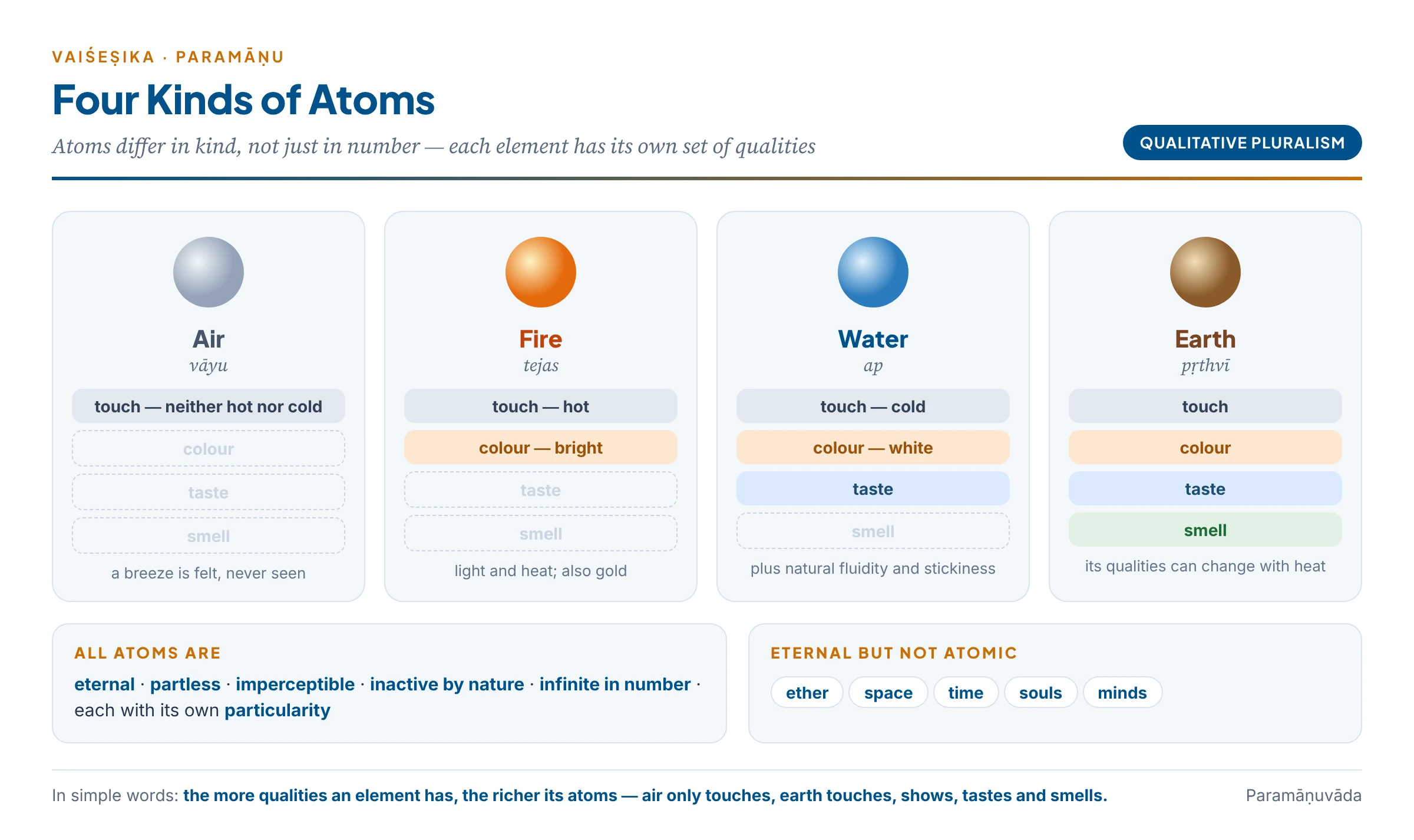
- Four kinds, differing in quality. Atoms are of earth, water, fire and air — qualitatively different, not just different in arrangement:
- Air atoms — touch only (neither hot nor cold).
- Fire atoms — touch (hot) and colour (bright).
- Water atoms — touch (cold), colour (white) and taste; also natural fluidity and viscidity.
- Earth atoms — touch, colour, taste and smell.
- All atoms also have number, magnitude, separateness, conjunction, disjunction and the like.
- Qualities of atoms. The qualities of composite things come from the qualities of their atoms. In water, fire and air atoms these qualities are eternal. In earth atoms, colour, taste, smell and touch can be changed by heat — as a green mango turns yellow or a black clay pot turns red in the kiln.
- Not everything is atomic. Ether, space, time, souls and minds are eternal substances but not made of atoms (minds are atomic in size but are not material atoms). Ether is one and all-pervading and provides the medium in which atoms combine.
Common confusion
Do atoms move by themselves? No. Some notes say that “atoms possess inherent motion” and combine on their own. In Vaiśeṣika, atoms are inactive and motionless in themselves; during dissolution they lie still. Their first motion at creation is imparted — by the unseen moral force (adṛṣṭa) of souls under the will of God. This is precisely one of the main differences between Vaiśeṣika atomism and the Greek atomism of Democritus, whose atoms move eternally of their own nature.
3. How Atoms Build the World: Dyads and Triads
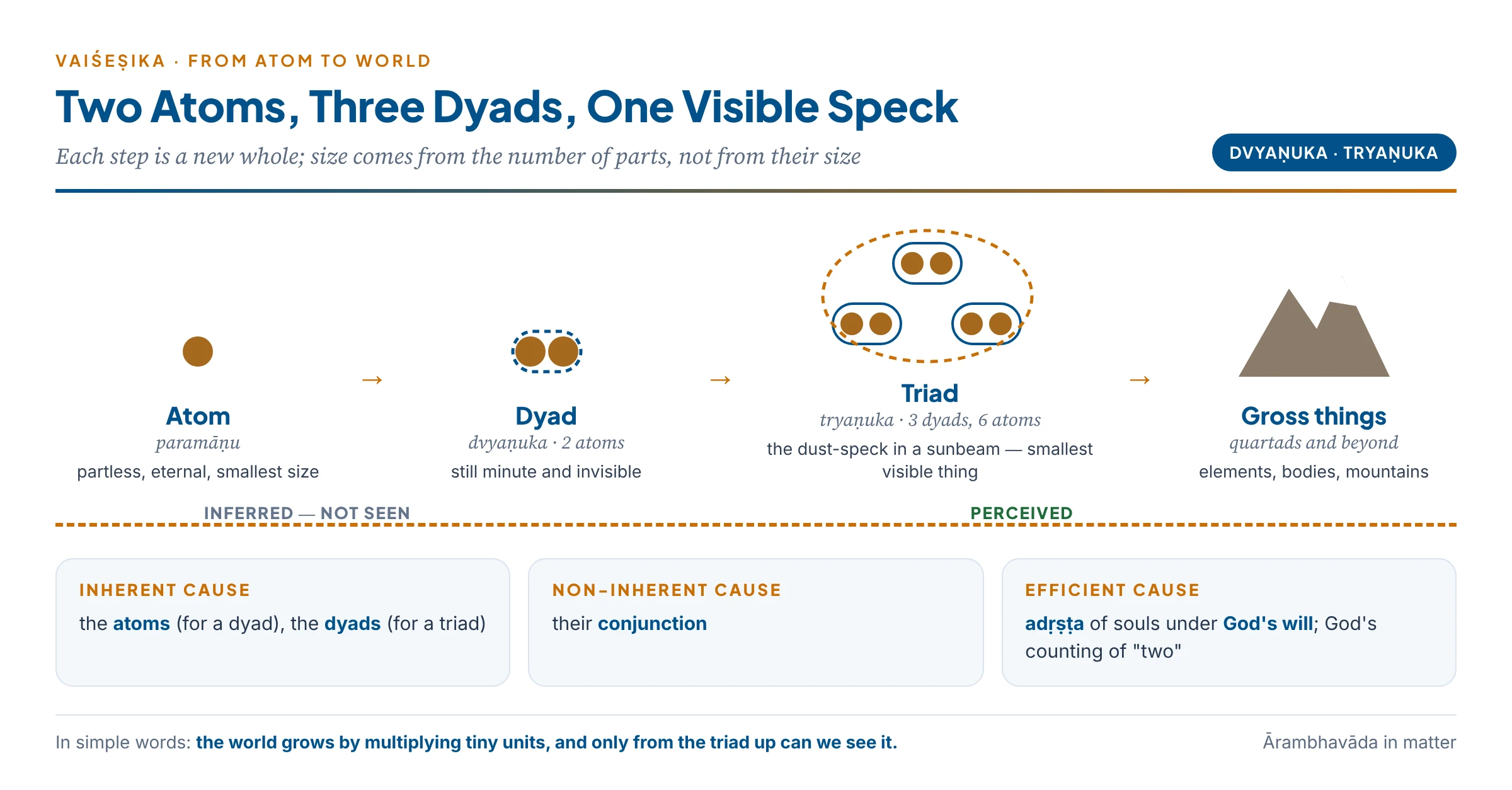
- Step 1 — the dyad (dvyaṇuka). Two atoms combine to form a dyad.
- Inherent cause: the two atoms.
- Non-inherent cause: their conjunction.
- Efficient cause: the motion produced by adṛṣṭa under God’s will.
- Size: still minute (aṇu) and short — imperceptible.
- Step 2 — the triad (tryaṇuka). Three dyads (six atoms in all) combine to form a triad.
- Size: for the first time great (mahat) and long — perceptible.
- The triad is the trasareṇu, the dust-speck visible in a sunbeam, the smallest perceptible thing.
- Step 3 — larger wholes. Four triads form a quartad (caturaṇuka), and so on, until the gross elements of earth, water, fire and air arise, and from them all bodies, sense organs and objects.
- Why “two” and “three” matter. The atom’s own size is the limit of smallness and cannot by itself make anything bigger. So the size of a dyad comes not from the size of its atoms but from their number — two. Likewise the triad’s perceptible size comes from the number three of its dyads. Vaiśeṣika therefore says that composites grow by the multiplication of units, not by mere addition of tiny sizes.
- The number two needs a mind. For Vaiśeṣika, the number “two” (and every number above one) is produced by a relating cognition that takes things together (Article 7). At the first moment of creation no human mind exists to count the first atoms as “two”; so the relating cognition must be God’s. This is the basis of Udayana’s argument for God “from the special number” (Article 13).
- Each step is a new whole. The dyad is not just two atoms; it is a new substance inhering in them. The triad inheres in its dyads, and so on — a ladder of new wholes (Article 10).
Common confusion
Is a triad (tryaṇuka) made of three atoms? No. Some notes and even some textbooks say that “the combination of three atoms is called a tryaṇuka”. In Vaiśeṣika, two atoms form a dyad, and three dyads — six atoms — form a triad. The point matters: the triad’s perceptible “great” size is explained by the number three of its dyads, each of which is minute. A combination of three single atoms would still be imperceptible.
4. Adṛṣṭa and God: The Moral Engine of Creation
- What adṛṣṭa is. Adṛṣṭa (“the unseen”) is the stock of merit and demerit (dharma–adharma) accumulated in each soul by its past actions. It is a quality of souls, not of atoms.
- Kaṇāda’s use of adṛṣṭa. Kaṇāda appeals to adṛṣṭa to explain motions that have no visible cause: the first motion of atoms at creation, the upward rising of flames, the sideways blowing of wind, the movement of a needle towards a magnet, and the movement of the mind into a new body.
- Why adṛṣṭa needs God. Adṛṣṭa is unconscious. It cannot by itself select which atoms to move, in what order and to what end. Later Vaiśeṣikas (from Praśastapāda) therefore add Īśvara, the Supreme Lord (Maheśvara), whose will directs adṛṣṭa and atoms so that each soul meets exactly the experiences it has earned.
- Division of causal labour.
- Atoms — the material (inherent) cause of the world.
- Conjunctions of atoms — the non-inherent cause.
- God and adṛṣṭa — the efficient cause.
- God is not the material cause. God does not create atoms out of himself or out of nothing; atoms, souls, ether, space, time and minds are co-eternal with God. God is like an architect who arranges existing bricks, not a magician who makes the bricks.
- Why this is not materialism. Five of the nine substances — ether, space, time, souls and minds — are not material atoms, and the motions of atoms serve a moral purpose. The world is a “moral stage for the education and emancipation of souls”.
5. Creation (Sṛṣṭi) and Dissolution (Pralaya)
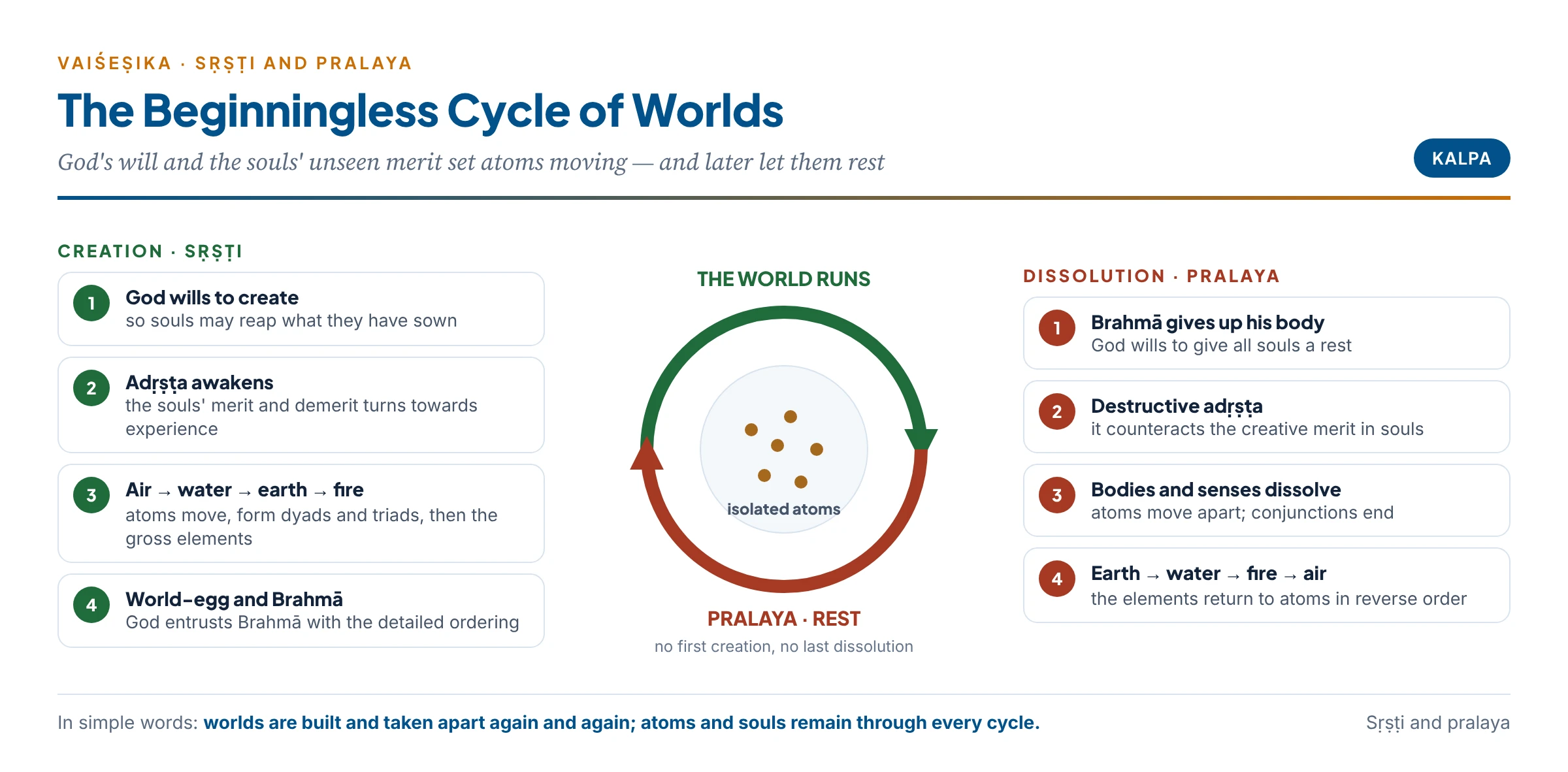
- No first creation. Creation and dissolution alternate without beginning (anādi). Every creation is preceded by a dissolution, and every dissolution by a creation. One full round is a cosmic cycle (kalpa).
- The state of dissolution. Only eternal things remain: isolated, motionless atoms; ether, space and time; and souls with their minds and their unexhausted adṛṣṭa and mental impressions.
- The order of creation.
- God wills to create a world in which souls may experience the fruits of their deeds.
- The adṛṣṭa of souls becomes active in the direction of experience.
- Through contact with such souls, air atoms are set in motion first; dyads and triads of air form the gross element air, a vibrating medium in ether.
- Next water atoms combine into gross water, held up and moved by air.
- Then earth atoms form gross earth, resting in the vast waters.
- Then fire atoms form gross fire or light, shining in the waters.
- By God’s mere thought, the world-egg (brahmāṇḍa) arises from atoms of fire and earth. God animates it with Brahmā, the world-soul, endowed with wisdom, detachment and power, and entrusts him with the detailed work of creation — fitting merit to happiness and demerit to misery.
- The order of dissolution.
- After a long age, when Brahmā gives up his body, God wills to destroy the world, to give all souls a rest from suffering, as night follows a day’s labour.
- The creative adṛṣṭa in souls is counteracted by destructive adṛṣṭa.
- Motion arises in the atoms of bodies and senses; they separate, and bodies and senses disintegrate.
- Then the gross elements dissolve in reverse: earth first, then water, then fire, then air.
- Only isolated atoms and the other eternal substances remain — until the next creation.
- The analogical argument for dissolution. Earthen jars break, so earthy mountains will one day crumble; ponds dry up, so the oceans will one day dry up; a lamp goes out, so the sun too will one day be extinguished.
In simple words
Think of a school’s annual cycle. In the vacation, the building is empty but the students, teachers and their records (merit!) still exist. When term begins, the principal decides to reopen; classes form in a set order; everyone’s position depends on last year’s results. At the year’s end, classes break up in reverse order and the building is empty again. Pralaya is the vacation; sṛṣṭi is the new term; adṛṣṭa is each student’s record; God is the principal who reopens the school.
6. Baking a Pot: Atoms or the Whole?
- The question. When a black clay pot is baked red in the kiln, where does the colour change happen?
- Vaiśeṣika — baking of atoms (pīlupāka). The heat breaks the pot down to its atoms; the atoms change colour; they then recombine into a new red pot — all so quickly that it looks like the same pot.
- Nyāya — baking of the whole (piṭharapāka). The heat penetrates the pores of the pot and changes the colour of the whole pot while it remains standing; we recognise “this is the same pot, now red”.
- Why it matters. The debate shows how seriously both schools took the mechanics of change at the atomic level — and how Nyāya trusted recognition of the same object over theoretical neatness.
7. The Distinctive Features of Vaiśeṣika Atomism
- Qualitative pluralism. Atoms differ in kind, not just in number, size or shape.
- Atoms with secondary qualities. Atoms have colour, taste, smell and touch, not only shape and size.
- Inactive atoms. Motion comes from outside — from adṛṣṭa and God.
- Spiritual realism. Souls are not made of atoms; they are separate, eternal substances.
- Theism and moral order. Creation serves the law of karma; God is the efficient cause.
- Integration of physics and metaphysics. The same theory explains the physical origin of things and the moral justice of the world.
Critical Evaluation
Objections (Pūrva-pakṣa)
- Śaṅkara’s critique.
- Inconsistent inheritance of qualities. Vaiśeṣika holds that the qualities of a cause produce similar qualities in the effect — white threads, white cloth. Then spherical, infinitesimal atoms should produce spherical, infinitesimal dyads, and minute dyads should produce minute triads. Yet triads are said to be great and long. The theory breaks its own rule.
- Active or inactive? Are atoms by nature active, inactive, both or neither? If active, creation would never stop; if inactive, it could never start; both is contradictory; if neither, motion must come from outside — and the outside agency is either seen (no seen agent exists before creation) or unseen (adṛṣṭa is unconscious and always present, so creation would be permanent or impossible).
- Unconscious adṛṣṭa cannot direct. A non-intelligent force cannot produce an ordered world.
- Atoms with qualities cannot be eternal. Whatever has colour, taste and smell is gross and perishable, as experience shows; atoms with such qualities should also perish.
- Inherence fails. The dyad must inhere in its atoms by samavāya, and samavāya leads to an infinite regress (Article 8).
- The Buddhist critique (Vasubandhu). How can partless atoms combine? If an atom touches others on its six sides, it has six parts and is not partless. If all touch it at one point, the whole cluster would occupy the space of a single atom and no bigger thing could arise. The Buddhist realists themselves held atoms to be momentary, not eternal; the idealists denied external atoms altogether.
- Sāṃkhya. Material atoms cannot explain the subtle products — mind, intellect, ego. The ultimate cause must be one subtle prakṛti, not many gross atoms.
- Jainas. All atoms are qualitatively alike; they become earth, water and so on through different combinations. Vaiśeṣika’s four kinds of atoms are unnecessary; their qualities are not permanent.
- Philosophical critics.
- Qualitative difference is arbitrary. If earth atoms have four qualities and air atoms one, they should differ in weight and size.
- No unity. Innumerable, inactive, imperceptible material points do not explain the world unless they are unified under one common source.
- Why should God need atoms at all? A God who must work with co-eternal atoms is limited — more an architect than a creator.
- Scientific critique. Modern atoms are divisible into protons, neutrons and electrons, and these into quarks; there are over a hundred elements, not four; atoms are in ceaseless motion and energy is intrinsic to matter; no moral force enters physical laws.
Defences and Replies
- Inheritance of qualities. Vaiśeṣika does not hold that every quality is copied. Magnitude is a special case: the size of a composite is produced by the number of its parts (two, three), not by their size, since the atomic size is the limit of smallness. Colour, taste and smell are passed on; magnitude is not.
- Activity and inactivity. Atoms are inactive by nature, and motion comes from an intelligent source — God — who uses adṛṣṭa as his instrument. Creation is neither permanent nor impossible, because it follows God’s will, which itself follows the ripening of souls’ deeds.
- Partless contact. Contact (saṃyoga) of partless things does not require parts: it is a quality of the two substances, and it does not make one atom occupy the place of another. The size of the compound comes from number, not from spatial overlap.
- Eternal qualities. That composite things perish shows only that compounds decay, not that the qualities of partless atoms must.
- Strength of the theory. It explains conservation (nothing is annihilated), change (recombination), diversity (different kinds and proportions of atoms) and moral order in one framework.
Critics and Defenders
Criticism — Critics
- Śaṅkara: atoms that are inactive can never start moving; unconscious adṛṣṭa cannot guide them; spherical atoms should yield spherical dyads.
- Vasubandhu: partless atoms cannot touch without having sides.
- Sāṃkhya: gross atoms cannot explain mind and intellect.
- Jainas: all atoms are alike; four kinds are unnecessary.
- Science: atoms are divisible, restless and far more than four kinds.
Defence — Defenders and strengths
- Division must stop, or a mustard seed would equal a mountain.
- Size comes from the number of parts — so dyads are minute and triads visible.
- Inactive atoms plus an intelligent mover avoid both blind chance and endless creation.
- Qualitative atoms anticipate the idea of distinct chemical elements.
- One theory unites physics and the moral law.
Cross-Tradition Comparison
Vaiśeṣika, Greek and Modern Atomism
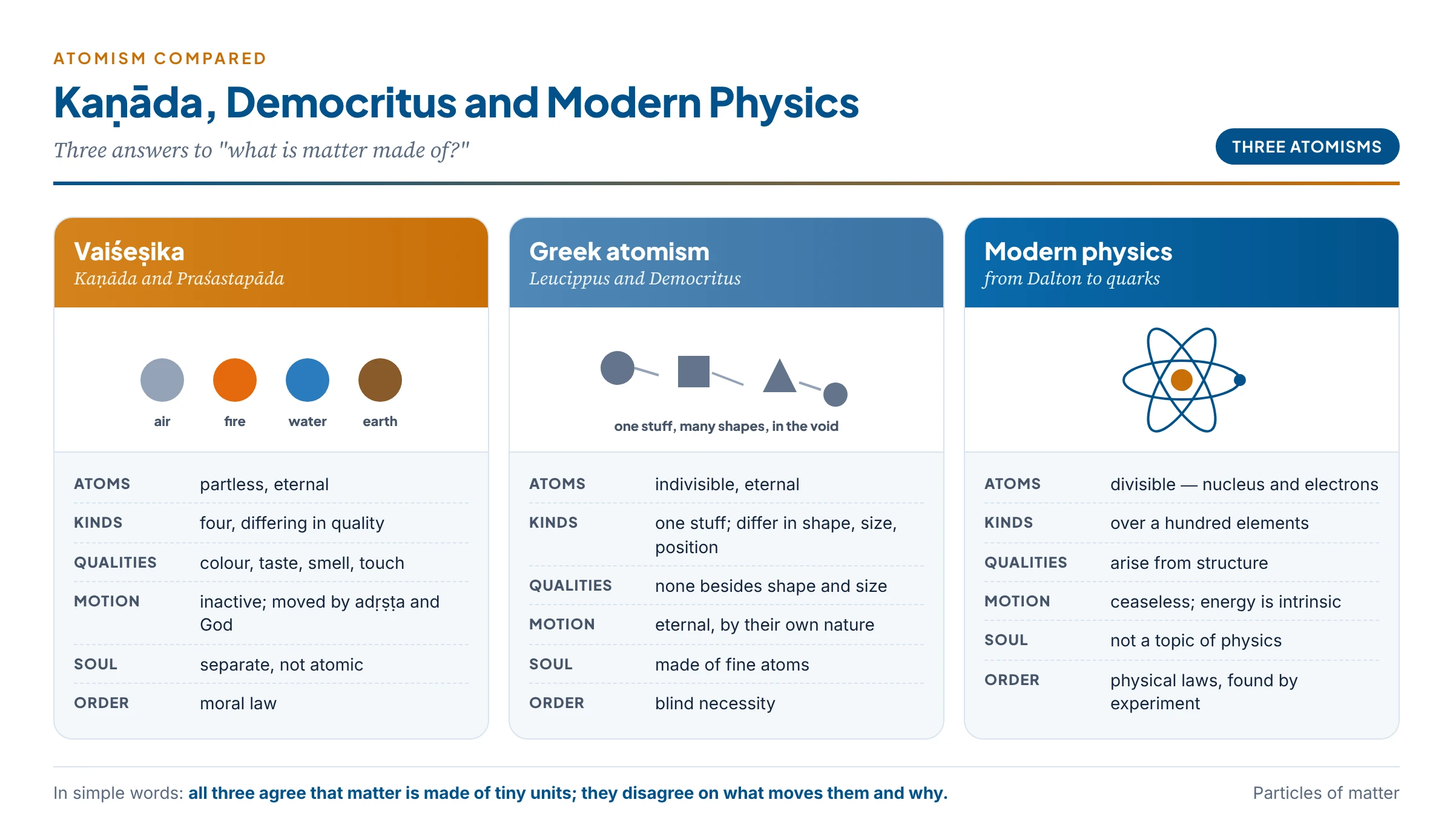
| Point | Vaiśeṣika | Greek atomism (Leucippus, Democritus) | Modern science |
|---|---|---|---|
| Atoms indivisible? | Yes — partless and eternal | Yes — “atomos” means uncuttable | No — atoms have parts; quarks and leptons are the current ultimate particles |
| Kinds of atoms | Four — earth, water, fire, air — qualitatively different | All of one stuff; differ only in shape, size, position | Over a hundred elements, differing in protons and electrons |
| Secondary qualities | Atoms have colour, taste, smell, touch | Atoms have no colour or taste; these arise “by convention” | Colour, taste arise from structure and interaction |
| Motion | Atoms inactive; moved by adṛṣṭa and God | Atoms move eternally by nature in the void | Particles in ceaseless motion; energy intrinsic |
| Soul | Souls are separate eternal substances, not atomic | The soul is made of fine atoms | Mind studied as a function of the brain |
| Guiding principle | Moral order and God’s will | Blind mechanical necessity | Physical laws, no moral purpose |
| Conservation | Nothing is annihilated; only combinations perish | Nothing comes from nothing | Conservation of mass-energy |
| Method | Rational inference | Rational inference | Experiment and measurement |
- Other parallels.
- Dalton (nineteenth century) held that atoms of different elements differ in kind and weight and combine in fixed proportions — closer to Vaiśeṣika’s qualitatively distinct atoms than Democritus was.
- Leibniz’s monads are “spiritual atoms” — simple, eternal, each unique — recalling Vaiśeṣika’s eternal souls with their viśeṣa.
- Epicurus added a random “swerve” to explain how atoms first collide; Vaiśeṣika uses adṛṣṭa for the first motion.
Indian Connect — Atomism across Indian schools
| School | Atoms? | Nature |
|---|---|---|
| Vaiśeṣika | Yes | Eternal, partless, four kinds, inactive, qualitatively different |
| Jainism | Yes (pudgala atoms) | Eternal, all of one kind; differences arise by combination; qualities change |
| Buddhist realists | Yes | Momentary atoms; aggregates, not new wholes |
| Yogācāra | No external atoms | Atoms are constructions of consciousness |
| Sāṃkhya | Not ultimate | Gross elements evolve from subtle elements, ultimately from prakṛti |
| Advaita | Rejected | The many is an appearance of Brahman |
Common confusion
Was Kaṇāda the first atomist in history, earlier than the Buddha, Mahāvīra and Democritus? That claim goes beyond the evidence. Some notes call Kaṇāda “the father of atomic theory” and say that Vaiśeṣika preceded Jainism and Buddhism. The date of Kaṇāda is uncertain, and most scholars place the Vaiśeṣika Sūtra in the last centuries BCE; Jaina and early Buddhist texts also speak of atoms, and Democritus taught in the fifth century BCE. What can be said firmly is that Vaiśeṣika developed India’s most systematic atomic theory, with features — qualitatively distinct atoms, combination in fixed steps — found nowhere else in the ancient world.
Synthesis (Siddhānta)
- Atoms are inferred as the limit of division: eternal, partless, imperceptible, inactive, infinite in number, each with its own particularity, of four qualitatively different kinds.
- Two atoms make an imperceptible dyad; three dyads make the smallest perceptible triad; larger wholes follow, each a new substance. The size of a composite comes from the number of its parts.
- Atoms are the material cause, their conjunctions the non-inherent cause, and God guiding the souls’ adṛṣṭa the efficient cause of the world.
- Creation and dissolution alternate without beginning: air, water, earth and fire are built in that order and dissolved in reverse, for the moral education and rest of souls.
- Śaṅkara, the Buddhists, Sāṃkhya, the Jainas and modern science raise serious objections; Vaiśeṣika’s replies — magnitude from number, an intelligent mover, contact without parts — keep the theory coherent on its own terms.
- Is it an anticipation of modern science?
- Yes, in spirit: matter has a particulate structure; nothing is annihilated; diversity comes from different kinds and combinations of basic units; qualitatively distinct elements anticipate Dalton.
- No, in substance: modern atoms are divisible, restless and discovered by experiment; Vaiśeṣika atoms are inferred, inactive, four in kind and moved by a moral force. It is a philosophical atomism, not a physical theory.
- Contemporary relevance.
- Science education. Kaṇāda’s argument from divisibility is still a neat way to introduce the idea of atoms.
- Philosophy of physics. The question whether there are truly simple, partless constituents of matter is still open.
- Ethics and cosmology. Vaiśeṣika’s insistence that the physical order serves a moral order poses the question modern cosmology leaves aside: does the universe have a purpose?
“The highest good results from the knowledge of the essence of the categories through their similarities and differences.” — Kaṇāda, Vaiśeṣika Sūtra
Previous Year Questions
- 2025Present an exposition of Nyāya-Vaiśeṣika’s theory of causation.
- 2005State and discuss the nature and kinds of Dravyas according to Vaiśeṣikas.
- 1995What is the nature of ultimate substance according to Vaiśeṣika philosophy? Would it be right to say that the idea of the ultimate substance as given by the Vaiśeṣika thinkers is an anticipation of modern scientific in this context? Discuss.
- 1995Give an account of the chief tenets of Vaiśeṣika metaphysics.