

Nyāya–Vaiśeṣika: Theory of Categories; Theory of Appearance; Theory of Pramāṇa; Self, Liberation; God; Proofs for the Existence of God; Theory of Causation; Atomistic Theory of Creation
Official Syllabus: Paper I, Section B, Unit 15
Who is the “I” that sees, remembers, wants and suffers? For Nyāya–Vaiśeṣika, the self (ātman) is neither the body, nor the senses, nor the mind, nor a stream of fleeting thoughts, nor pure consciousness. It is an eternal, all-pervading substance in which consciousness arises as a quality — and only when the self is linked to a body, senses and mind. From this realist view follows a striking idea of liberation (apavarga): the absolute and final end of all pain, in which the self, freed from the body, rests without pain, without pleasure — and without consciousness. This article explains the Nyāya doctrine of the self, the six marks (liṅga) by which it is known, the arguments against the Cārvāka, Buddhist and Advaita views, the chain of bondage, the nature and means of liberation, and the sharp criticisms the doctrine has faced.
In simple words
Think of a light bulb and electricity. The bulb is real even when it is off; it glows only when connected to the circuit. Nyāya sees the self like the bulb, and consciousness like the glow: the self is a real, lasting thing, and awareness lights up in it only when it is “wired” to a mind, senses and a body. Cut the wiring for good — that is liberation — and the bulb remains, but no longer glows, and therefore no longer hurts.
Context & Problem
The Four Main Views of the Self
- Cārvāka — the self is the conscious body. Consciousness arises from matter as intoxicating power arises from fermented grain (Unit 12).
- Buddhism — no permanent self. The “self” is a stream of momentary cognitions and the five aggregates (Unit 14).
- Advaita Vedānta — the self is pure consciousness. One, unchanging, self-luminous awareness (svaprakāśa caitanya), neither subject nor object, neither “I” nor “me”.
- Viśiṣṭādvaita (Rāmānuja) — the self is a conscious subject. The knower, the “I” (jñātā ahamartha eva ātmā), essentially conscious.
- Nyāya–Vaiśeṣika — the realist view. The self is a substance to which cognitions, feelings and volitions belong as qualities. It is not consciousness; it has consciousness, and even that only sometimes.
Why the Self Matters to Nyāya
- Self is the first object of knowledge. Of the twelve objects of knowledge that matter for liberation (prameya), the self comes first (Article 1). Knowing the self truly is the key to freedom.
- Bondage is a mistake about the self. “I am this body”, “I am this mind” — such false knowledge starts the chain of suffering. Correct knowledge ends it.
Core Doctrine
1. The Nature of the Self
- A substance (dravya). The self is one of the nine substances (Article 7) — the substratum of cognition, pleasure, pain, desire, aversion, effort, merit, demerit and mental impressions.
- Its qualities. Fourteen in all:
- Nine specific qualities found only in selves: cognition (buddhi), pleasure (sukha), pain (duḥkha), desire (icchā), aversion (dveṣa), effort (prayatna), merit (dharma), demerit (adharma) and mental impression (saṃskāra).
- Five general qualities shared with other substances: number, magnitude, separateness, conjunction and disjunction.
- Eternal and indestructible. The self is not produced and not destroyed; birth is its connection with a new body, death its separation from one.
- All-pervading (vibhu). The self is not limited by space and time. It experiences only through the body and mind it is linked to.
- Many (aneka). There is a different self in each body, since the experiences of different persons do not overlap: your toothache is not mine.
- Distinct from body, senses and mind. The body and senses are material instruments; the mind (manas) is an atomic inner organ; the self is the knower and enjoyer that uses them.
- Two kinds of self. The individual self (jīvātman), many, and the Supreme Self (Paramātman), one — God (Article 13).
2. Consciousness as an Adventitious Quality
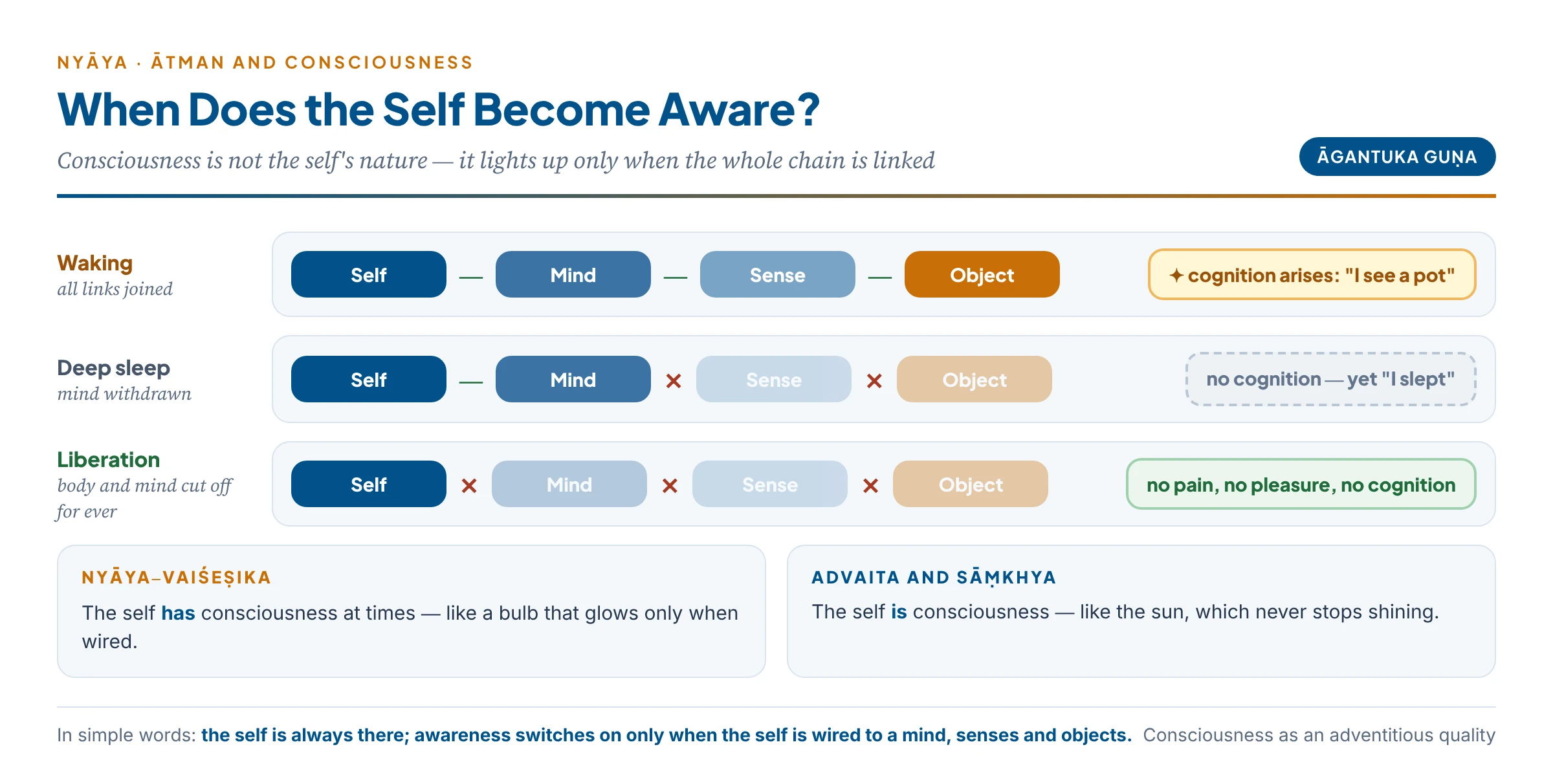
- Consciousness is not the essence of the self. It is an adventitious or accidental quality (āgantuka-guṇa) — it comes and goes.
- How consciousness arises. A cognition arises in the self only when a chain of contacts is complete:
- the self is conjoined with the mind;
- the mind is conjoined with a sense organ;
- the sense is in contact with an object.
When the chain is broken, no cognition arises.
- Evidence.
- Dreamless sleep. In deep sleep the mind withdraws into a channel (purītat) where it is not joined to the senses; no cognition arises — yet the self exists, since on waking we say “I slept”.
- Fainting and anaesthesia show the same.
- Liberation. When the self is finally freed from body and mind, it has no cognition at all.
- Why this view? If consciousness were the very nature of the self, the self would be conscious in deep sleep and in liberation, and pain could never be ended while the self exists. Making consciousness an accidental quality allows the self to persist while its experiences come and go.
Common confusion
Is the self “pure consciousness” in Nyāya? No. That is the Advaita and Sāṃkhya view. For Nyāya–Vaiśeṣika, the self is a substance and consciousness is only one of its qualities — and an adventitious one, present only when the self is linked to a mind and body. The self is not consciousness; it has consciousness at times. This is the single most important difference between the Nyāya self and the selves of Vedānta and Sāṃkhya.
3. How the Self Is Known
- Early Nyāya — testimony and inference. The older Naiyāyikas held that the self is known from scripture or by inference from its marks — desire, aversion and the rest.
- Later Nyāya — inner perception. The later Naiyāyikas hold that one’s own self is perceived by the mind (mānasa-pratyakṣa):
- Some say it is perceived as pure self-awareness — “I am“.
- Others say it is perceived only together with a quality — “I am happy“, “I know“, “I want“. We perceive the self as knowing, feeling or willing, never bare.
- Other selves are inferred. I cannot perceive your self; I infer it from your purposeful bodily actions, which an unconscious body cannot explain.
- When doubted, the self is proved. If anyone denies or doubts the self, it must be established by inference, from its marks.
4. The Six Marks of the Self (Liṅga)
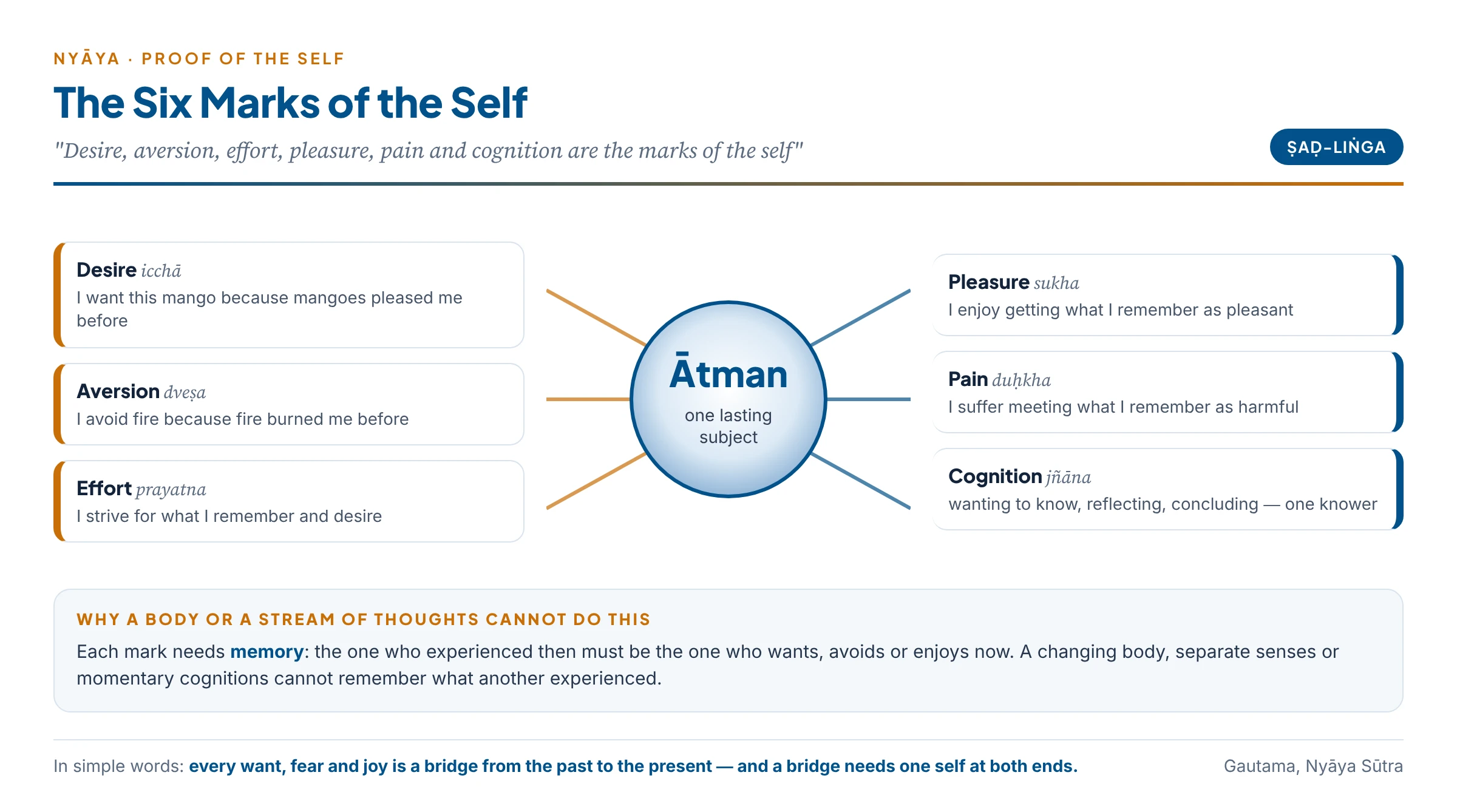
- The sūtra. Gautama says: “Desire, aversion, effort, pleasure, pain and cognition are the marks of the self.” These six are the six reasons (ṣaḍ-hetu) by which Nyāya proves a permanent self distinct from body and mind.
- The six, explained.
- Desire (icchā). To desire a mango, I must judge it similar to mangoes that gave me pleasure before. This needs a subject who experienced the past pleasure and now sees the present mango — one lasting self.
- Aversion (dveṣa). I avoid fire because I remember that fire burned me. The one who was burnt and the one who now avoids must be the same.
- Effort (prayatna). I strive to get what I desire and avoid what I dislike. Purposeful effort presupposes a self that remembers, desires and acts — the same throughout.
- Pleasure (sukha). Pleasure arises when I get what I remember to have been pleasant. The enjoyer of the past and the present is one.
- Pain (duḥkha). Pain arises when I meet what I remember to have hurt me. Again, one sufferer across time.
- Cognition (jñāna). Thinking a problem through — wanting to know, reflecting, concluding — is one connected process in one knower.
- The common thread: memory and unity. Each mark requires remembering a past experience and connecting it with a present one. Neither the changing body, nor the separate senses, nor a stream of momentary cognitions can do this — “just as one person cannot remember what another experienced, no momentary state can remember a previous state”. So there must be a permanent self.
- Why they cannot belong to the body. These six are not perceived by the outer senses, as colour and hardness are; they are inner states, perceived by the mind. So they are qualities of a non-physical substance.
In simple words
You burn your finger on a hot pan at age five. At twenty-five you still grab a cloth before touching a pan. Your body’s cells have changed many times; your thoughts have changed countless times. Who learned the lesson and who is using it? Nyāya says: the same self. Each of the six marks — wanting, avoiding, trying, enjoying, suffering, knowing — is a bridge between past and present, and a bridge needs one bank on both sides.
5. Further Arguments for the Self
- From the unity of the senses. “What I see, I also touch“: I recognise that the pot I see is the pot I touch. Sight and touch are different senses; neither can compare its data with the other’s. A single knower must receive both.
- From the two eyes. What is seen with the left eye is recognised with the right eye. The eyes are two; the recogniser is one.
- From the mouth watering. Seeing a sour fruit, my mouth waters — a change in the organ of taste caused by the eye’s perception, through memory of the taste. Only a self that unites the senses can explain it.
- From memory and recognition. “I who saw the Ganga yesterday remember it today.” Memory needs the same subject who experienced and now recalls.
- From waking after deep sleep. “I slept well and knew nothing” — the “I” persists across sleep, though cognition ceased.
- From the newborn infant. A newborn smiles, fears and seeks the breast without having learned to. Nyāya traces these to memories of a previous life, so the self existed before this body — it is eternal.
- From moral continuity. People are born with unequal fortunes not earned in this life. The law of karma needs a permanent self to carry the fruits of deeds across births.
- From scripture. The Upaniṣads speak of the eternal self; testimony supports reason.
- From the absence of cognition in parts of the body. Injury to the eye stops seeing but not the awareness of pain or the memory of colours; the locus of awareness is not the eye.
Common confusion
Are the “six reasons” for the self memory, deep sleep, the body’s parts, desire-and-effort, karma and scripture? Not as Gautama states them. Some notes give a table of “six reasons” made up of memory, absence of cognition in body parts, recognition after deep sleep, desire–aversion–effort taken together, moral continuity and scripture. These are genuine supporting arguments (section 5), but the classical six marks of the self are the six qualities named in the sūtra: desire, aversion, effort, pleasure, pain and cognition. Each is a reason for the self because it links a past experience with a present one in one lasting subject.
6. Refuting the Rival Views
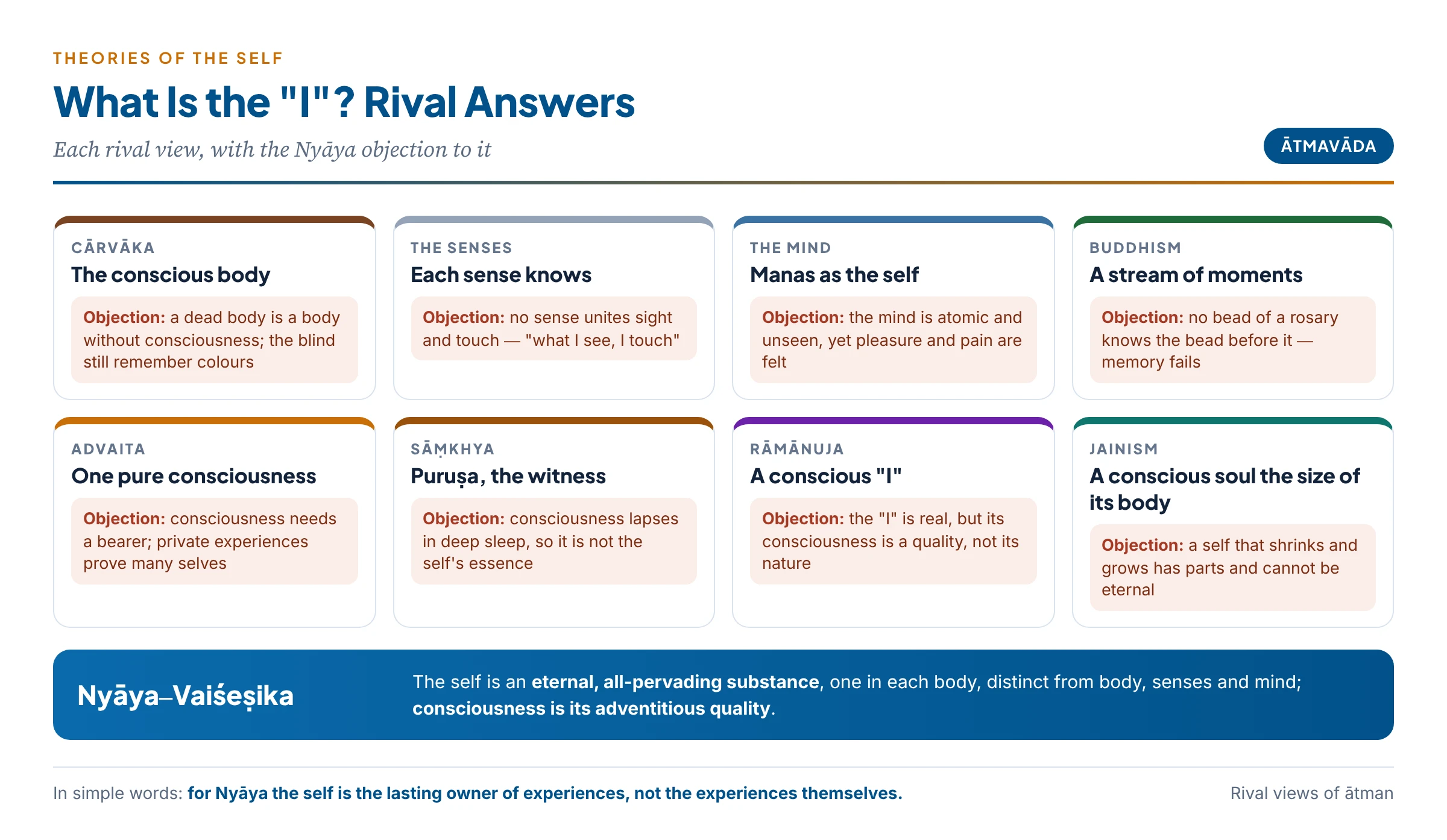
- Against the Cārvāka (self is the body).
- The body is unconscious. Its elements are not conscious; their combination cannot produce consciousness, as colourless things combined do not produce colour.
- A dead body is a body, yet has no consciousness.
- The body changes constantly from childhood to old age, yet I remember my childhood; a changing body cannot be the rememberer.
- The blind remember colours. If the eye were the knower, a man who loses his sight would lose his memories of colours; he does not.
- Against the senses as self. Each sense knows only its own object; none can combine sight and touch. And senses can be lost while the knower remains.
- Against the mind (manas) as self. The mind is atomic and therefore imperceptible. Its qualities would also be imperceptible. But pleasure and pain are perceived. So their bearer is not the atomic mind but an all-pervading self.
- Against the Buddhist stream of cognitions. A series of momentary cognitions cannot remember: no bead of a rosary knows the bead before or after it. Memory, recognition, desire and moral responsibility all need a lasting subject (Unit 14).
- Against Advaita (self as pure consciousness).
- Consciousness needs a locus. There is no consciousness that is not someone’s and of something. Consciousness is a quality, and a quality needs a substance.
- Deep sleep shows the self without consciousness. If consciousness were the self’s very nature, it would never lapse.
- Selves are many. If there were one self, when one person is happy all would be happy, and when one is liberated all would be liberated. Experiences are private, so selves are many.
- The self is a knower. The self is the bearer of the “I” (ahaṅkāra-āśraya) and the enjoyer (bhoktā), not an impersonal witness.
- Against Sāṃkhya (self as pure witness-consciousness). If consciousness were the essence of puruṣa, it would never lapse; deep sleep shows that it does. And a witness that never acts cannot be the enjoyer of the fruits of action.
- Against Rāmānuja (self as essentially conscious “I”). Nyāya agrees that the self is a real, many, conscious subject and knower, but holds that its consciousness is a quality that comes and goes, not its unchanging nature.
- Against the Jainas (soul as large as its body). A soul that expands and contracts with the body — an ant’s and an elephant’s — must have parts; whatever has parts can be divided and destroyed, so it could not be eternal. The self must be either atomic or all-pervading, and since it feels in every part of the body, it is all-pervading.
Indian Connect — Views of the self across the schools
| School | What the self is | Is consciousness its essence? | One or many? |
|---|---|---|---|
| Nyāya–Vaiśeṣika | An eternal substance, all-pervading | No — an adventitious quality | Many |
| Cārvāka | The living body with consciousness | Consciousness is a product of matter | Many bodies |
| Buddhism | No permanent self; a stream of aggregates | — | — |
| Jainism | A conscious soul, as large as its body | Yes | Many |
| Sāṃkhya–Yoga | Puruṣa, pure witness-consciousness | Yes | Many |
| Mīmāṃsā (Bhāṭṭa) | A substance, partly conscious and partly unconscious | Partly | Many |
| Advaita Vedānta | Pure, self-luminous consciousness, one with Brahman | Yes — it is consciousness | One |
| Viśiṣṭādvaita | A conscious subject, the “I”, a mode of Brahman | Yes | Many |
7. Bondage: The Chain of Suffering
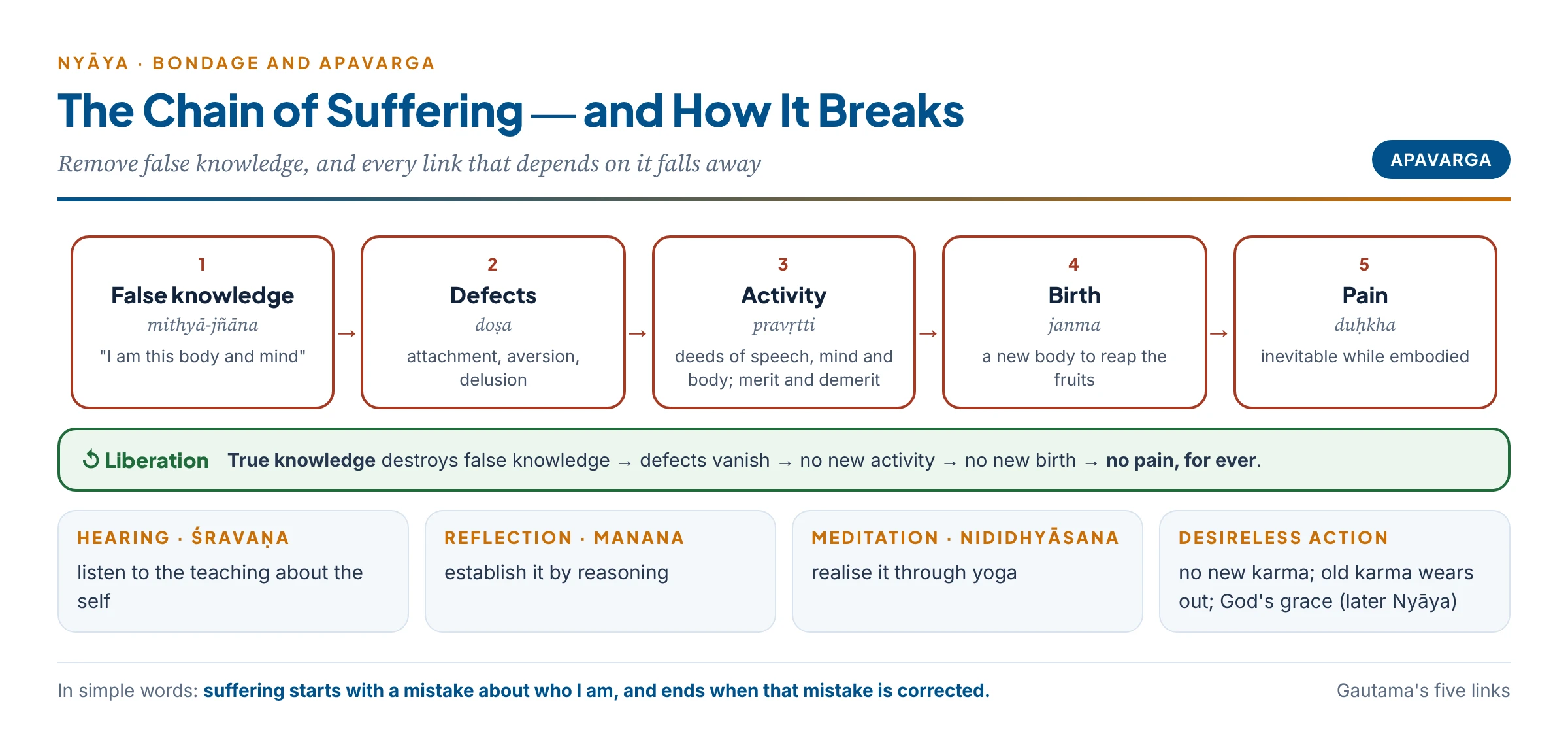
- The five links. Gautama traces suffering back through a chain:
- False knowledge (mithyā-jñāna) — taking the body, senses or mind to be the self; taking the painful to be pleasant.
- Defects (doṣa) — attachment (rāga), aversion (dveṣa) and delusion (moha), born of false knowledge.
- Activity (pravṛtti) — actions of speech, mind and body, prompted by the defects, which produce merit and demerit (adṛṣṭa).
- Birth (janma) — connection of the self with a new body, to reap the fruits of action.
- Pain (duḥkha) — the inevitable result of embodiment.
- How it is undone. In Gautama’s words, when each link is removed, the link that depends on it is removed too, and then liberation follows. Remove false knowledge, and defects go; without defects, no new activity; without activity, no new birth; without birth, no pain.
- Karma and the body. As long as the self is joined to a body, it will meet unpleasant objects and feel pain; while it acts from desire, it will be reborn. Bondage is the self’s association with the body, caused by its own actions.
8. Liberation (Apavarga)
- Definition. Liberation is the absolute cessation of pain (ātyantika duḥkha-nivṛtti) — not a pause, as in sound sleep or recovery from illness, but freedom from pain for all time to come.
- Twenty-one kinds of pain. Later Naiyāyikas say liberation ends twenty-one sources of pain: the body, the six senses (five outer and the mind), their six objects, the six cognitions, and pleasure and pain themselves — for in embodied life even pleasure is a source of pain.
- The liberated self. Freed from body and mind, the self exists as a pure substance:
- without pain;
- without pleasure;
- without cognition or consciousness;
- keeping its own individuality through its particularity (viśeṣa, Article 8).
- Why not pleasure too? Embodied pleasure is always mixed with pain — the pain of getting it, keeping it and losing it. The wise reject it as one rejects food mixed with poison, or honey on a razor’s edge. A state free from pain must be free from pleasure as well.
- Scriptural descriptions. Liberation is described as freedom from fear (abhayam), freedom from decay and change (ajaram), freedom from death (amṛtyu-padam) and as the attainment of Brahman.
- A later view: liberation as bliss. Some later Naiyāyikas, notably Bhāsarvajña, held that liberation is not only the end of pain but the attainment of eternal bliss (nitya-sukha), experienced by the freed self.
- Vaiśeṣika on liberation. The highest good (niḥśreyasa) follows from true knowledge of the categories through their similarities and differences. When actions stop, no new merit or demerit accrues; old merit and demerit wear out; the self is separated from body and mind and rests in its own qualityless nature.
In simple words
Imagine every sweet you are ever offered has a little poison mixed in — delicious at first, then a stomach ache, then the craving for the next one. Sooner or later you would choose to eat nothing. Nyāya looks at embodied life that way: every pleasure is mixed with pain. Liberation is not a bigger sweet; it is the end of the whole cycle of sweets and stomach aches.
Common confusion
Is Nyāya liberation a state of eternal bliss? Not in the classical view. Some notes describe Nyāya liberation as “eternal bliss” or “union with God”. For Gautama, Vātsyāyana and the Vaiśeṣikas, liberation is the absolute cessation of pain, in which the self has no consciousness and therefore no pleasure either — it is a negative state. Only some later Naiyāyikas, such as Bhāsarvajña, added eternal bliss. Nor is it union with God: the liberated self remains a distinct substance with its own particularity.
9. The Path to Liberation
- True knowledge (tattva-jñāna). One must know the self as distinct from body, mind and senses, and know the other objects of knowledge as they are. Knowledge of the sixteen topics (Article 1) serves this end.
- Three stages.
- Hearing (śravaṇa) — listening to the teaching of scripture about the self.
- Reflection (manana) — firmly establishing that knowledge by reasoning, removing doubts by argument.
- Meditation (nididhyāsana) — meditating on the self in accordance with the discipline of yoga, until the knowledge becomes direct.
- Desireless action. One who has true knowledge acts without desire for fruits; such action produces no new merit or demerit. Past karma is exhausted by bearing its fruits.
- The end of rebirth. With false knowledge destroyed and karma exhausted, there is no new birth; with no birth, no body; with no body, no pain — that is liberation.
- God’s grace. Later Nyāya holds that true knowledge, and through it liberation, is attained only by the grace of God (Article 13).
Critical Evaluation
Objections (Pūrva-pakṣa)
- The self is made an object. Treating the self as a substance with qualities turns the subject into an object, like a stone. The self is nothing if it is not a subject and if consciousness is not its essence.
- A liberation no one would want. A state without consciousness, pleasure or knowledge is a state of petrification — “the liberated self is no better than a stone”. A Vaiṣṇava saint said he would rather be born a jackal in the lovely forest of Vṛndāvana than seek the liberation of the Vaiśeṣikas.
- Nicknames from rivals. Śaṅkara called the Vaiśeṣikas “half-destroyers” (ardha-vaināśika) — nearly as nihilistic as the Buddhists. Śrīharṣa punned on Kaṇāda’s name Ulūka (“owl”) to call the system “owlish philosophy” (aulūkya darśana).
- Why should a conscious being arise from an unconscious one? If the self is unconscious by nature, contact with an unconscious mind and body cannot make it conscious — any atom could serve as well.
- Confusing bliss with pleasure. The Vedāntins argue that Nyāya mistakes transcendent bliss for empirical pleasure, and so wrongly empties liberation of joy.
- Buddhists. There is no permanent self; the six marks show only causal links between moments, not an enduring substance.
- Modern science. Consciousness depends on the brain; memory and personal identity are explained by neural continuity. There is no evidence of an eternal, all-pervading substance or of rebirth.
Defences and Replies
- Consciousness does depend on conditions. Nyāya’s view that consciousness arises only when self, mind, senses and objects are linked fits the fact that it lapses in deep sleep, fainting and anaesthesia — a point modern science confirms.
- The subject must be lasting. Memory, recognition, desire and responsibility require one subject across time; Nyāya’s self explains this better than a bundle or stream.
- The end of pain is a real good. For one who sees that all embodied experience is mixed with pain, the end of pain is the highest goal; it is not annihilation, since the self remains.
- Not a stone. A stone was never a self and never suffered; the liberated self is a self freed from the conditions of suffering, keeping its individuality.
- The many selves. The privacy of experience is a strong argument for plurality against Advaita.
Critics and Defenders
Criticism — Critics
- Vedāntins: the self is made an object; liberation without consciousness is petrification.
- The Vaiṣṇava saint: better a jackal in Vṛndāvana than Vaiśeṣika liberation.
- Sāṃkhya: consciousness is the very nature of puruṣa, not an accident.
- Buddhists: no permanent self; a stream explains memory well enough.
- Science: consciousness depends on the brain; no evidence of an eternal soul.
Defence — Defenders and strengths
- The six marks all need one subject linking past and present.
- What I see, I touch — only one knower unites the senses.
- Consciousness lapses in deep sleep — so it is a quality, not the essence.
- Private experiences prove many selves against Advaita.
- The end of all pain is a coherent highest good; the self survives as itself.
Cross-Tradition Comparison
The Nyāya Self and Western Theories
| Point | Nyāya–Vaiśeṣika | Western parallel |
|---|---|---|
| Self as substance | A substance bearing cognitions and feelings | Descartes — the self is a thinking substance; but for Descartes thought is its essence |
| Consciousness accidental | Arises only when linked to mind and body | Locke — the soul need not always think; consciousness can lapse in sleep |
| Bundle theory | Rejected (against the Buddhists) | Hume — the self is a bundle of perceptions |
| Unity of experience | “What I see, I touch” needs one knower | Kant — the unity of apperception, the “I think” that accompanies all representations |
| Memory and identity | Memory needs a lasting self | Locke — personal identity through memory; Reid — memory presupposes identity |
| Other minds | Inferred from purposive behaviour | The argument from analogy for other minds (J. S. Mill) |
| Liberation as end of pain | Absolute cessation of pain | Epicurus — absence of pain (ataraxia); Schopenhauer — release through the denial of the will |
| Self as subject, not object | Criticised for objectifying the self | Kierkegaard, Sartre — the self is subjectivity, not a thing |
Indian Connect — Key takeaways
- The Nyāya self is a substance; consciousness is its adventitious quality — the opposite of Advaita and Sāṃkhya.
- The six marks (desire, aversion, effort, pleasure, pain, cognition) prove a lasting self through memory and unity.
- Liberation is the absolute end of pain, a state without consciousness — later softened by Bhāsarvajña into eternal bliss.
- The Nyāya–Advaita debate on the self parallels the Descartes–Hume–Kant debate in the West.
Synthesis (Siddhānta)
- The self is an eternal, all-pervading substance, one in each body, distinct from body, senses and mind; consciousness is its adventitious quality, arising only through its link with mind and senses.
- It is known by inner perception (“I am happy”) and, when doubted, proved by inference from its six marks and from the unity of the senses, memory, recognition, infant instincts and moral continuity.
- Against the Cārvāka, the senses, the mind, the Buddhists and Advaita, Nyāya argues that only a lasting, plural, substantial self explains memory, unity and responsibility.
- Bondage runs from false knowledge through defects, activity and birth to pain; liberation (apavarga) is the absolute cessation of pain, reached by true knowledge through hearing, reflection and meditation, desireless action and, in later Nyāya, God’s grace.
- The doctrine is open to the charge of making liberation a lifeless state, but it is internally consistent and offers a clear, realist account of personal identity.
- Is the doctrine of the self acceptable in the age of science and reason?
- What science supports: consciousness depends on conditions and lapses in deep sleep and anaesthesia — exactly as Nyāya held against Advaita; memory and identity require some continuing bearer.
- What science questions: an eternal, all-pervading substance, rebirth and adṛṣṭa go beyond any evidence; neuroscience explains many functions Nyāya gave to the self.
- What remains open: the “hard problem” of why there is experience at all, and what makes me the same person over time, are unresolved — the questions Nyāya’s self was meant to answer are still alive.
- Contemporary relevance. Debates on personal identity in law (responsibility for past acts), medicine (dementia, brain death) and technology (uploading minds) revisit the Nyāya question: what must persist for me to persist?
“Desire, aversion, effort, pleasure, pain and cognition are the marks of the self.” — Gautama, Nyāya Sūtra
Previous Year Questions
- 2024Explain the six reasons offered by the Naiyāyikas to prove the existence of the self.
- 2024Discuss the concept of liberation (Apavarga) according to Nyāya-Vaiśeṣika.
- 2016Is the doctrine of ‘Self’ acceptable in the modern age of science and reason? Examine the view in the light of Indian philosophy.
- 2013Examine Nyāya-Vaiśeṣika’s arguments for the existence of jīvātmā (soul).
- 2002Nyāya view of Self. Short notes.
- 1996Examine the Nyāya arguments against the Advaitic view of the nature of Ātman.