

Nyāya–Vaiśeṣika: Theory of Categories; Theory of Appearance; Theory of Pramāṇa; Self, Liberation; God; Proofs for the Existence of God; Theory of Causation; Atomistic Theory of Creation
Official Syllabus: Paper I, Section B, Unit 15
Nyāya–Vaiśeṣika is India’s great school of rational theism. It does not rest belief in God on faith alone; it tries to prove God by the same logic it uses for smoke and fire. God (Īśvara) is the one, eternal, all-knowing Self who orders the eternal atoms into a world, sustains and dissolves it, and dispenses to every soul the fruits of its deeds. The classical statement of the proofs is Udayana‘s Nyāyakusumāñjali (“a handful of flowers of reasoning” offered to God), written against the atheist schools — Cārvāka, Mīmāṃsā, Buddhist, Jaina and Sāṃkhya. This article explains the Nyāya idea of God, each of Udayana’s proofs — kāryāt, āyojanāt, dhṛtyādeḥ, padāt, pratyayataḥ, śruteḥ, vākyāt, saṅkhyā-viśeṣāt and the argument from adṛṣṭa — the objections of the rival schools and of Western critics, and how the Nyāya proofs compare with those of Yoga and of Aquinas.
In simple words
You walk into an empty house and find a perfectly laid dinner table — plates arranged, food warm, candles lit. You never saw anyone, yet you are certain: someone did this, someone who knew what was needed, wanted it done and had the power to do it. Nyāya looks at the world the same way: mountains, rivers and living bodies are put together from parts in an orderly way, so there must be a maker with knowledge, will and power — and since the parts are as fine as atoms, a maker who knows everything.
Context & Problem
God in the Nyāya–Vaiśeṣika Tradition
- Gautama. The Nyāya Sūtra has short but explicit sūtras on God. It argues that God is a cause, because human efforts are sometimes seen to be fruitless; yet God does not act without human action — God’s causation is in conformity with the karma of beings.
- Kaṇāda. The Vaiśeṣika Sūtra does not name God. It says that the authority of the Veda comes from its being “his (or their) word” — which commentators read as God’s word, though it could mean the word of the seers. Kaṇāda appeals to adṛṣṭa for the first motion of atoms.
- The later school. Praśastapāda, Śrīdhara and Udayana are openly theistic. Praśastapāda makes Maheśvara‘s will the starting point of creation and dissolution (Article 11). Udayana gives the classical proofs and defends them against the atheists.
- Link with liberation. Later Nyāya holds that true knowledge and liberation are attained only by God’s grace (Article 12).
Why Prove God?
- Against atheism. Cārvākas deny God outright; Mīmāṃsakas hold that the eternal, authorless Veda and the law of karma need no God; Buddhists and Jainas reject a creator; classical Sāṃkhya finds God unnecessary.
- A question of logic. For Nyāya, God is not an object of ordinary perception, so the question is whether God can be established by inference and testimony. Udayana answers yes, and spends his whole work answering the atheists’ objections one by one.
Core Doctrine
1. The Nature of God (Īśvara)
- God is a self (ātman). God is the Supreme Self (Paramātman), one of the selves within the substance “self” (Article 7), but unique: free from merit and demerit, never bound, never born.
- One, eternal, all-pervading. There is one God, without beginning or end, present everywhere.
- Efficient, not material, cause. God is the efficient cause of the world, not its material cause. God does not create out of nothing, nor out of himself. The eternal atoms, ether, space, time, minds and souls are co-eternal with God; creation is God’s ordering of these into a moral world.
- Creator, sustainer, destroyer. God creates the world, keeps it in existence by his will, and dissolves it when the moral needs of beings require a rest (Article 11).
- Omniscient (sarvajña). God has eternal, direct knowledge of all things — past, present and future, near and far, gross and atomic.
- Eternal cognition, desire and effort. God possesses cognition (jñāna), desire (icchā) and effort (prayatna) eternally — the very three a maker needs. Unlike human selves, God has no pleasure, pain, merit, demerit or mental impressions.
- Consciousness an inseparable attribute. In God, consciousness is eternal and inseparable — not, as in human selves, adventitious; but it is still an attribute, not God’s very essence (as Advaita would say).
- The six perfections (ṣaḍ-aiśvarya). Majesty, almighty power, glory, infinite beauty, infinite knowledge and perfect freedom from attachment.
- Moral governor. God is the dispenser of the fruits of action (karma-phala-dātā). He is the directive cause of the actions of beings (prayojaka-kartā): beings act, but under God’s guidance, as a wise father directs a child according to its abilities and past conduct.
- Author of the Veda. For Nyāya the Veda is authored (pauruṣeya) by God, and its authority comes from its reliable author — against the Mīmāṃsā view that it is authorless and eternal.
- Theism, not deism. God is not a clock-maker who winds the world and leaves it; he sustains and governs it continuously.
Common confusion
Does the Nyāya God create the world out of nothing, or out of himself? Neither. Some notes call the Nyāya God simply “the creator of everything”. For Nyāya–Vaiśeṣika, God is the efficient cause only. The atoms (the material cause), and also ether, space, time, minds and souls, are eternal and co-exist with God; he neither creates nor destroys them. God’s creation is the arrangement of these eternal reals into a world fitted to the merit and demerit of souls — closer to Plato’s divine craftsman than to creation out of nothing.
2. Udayana’s Proofs
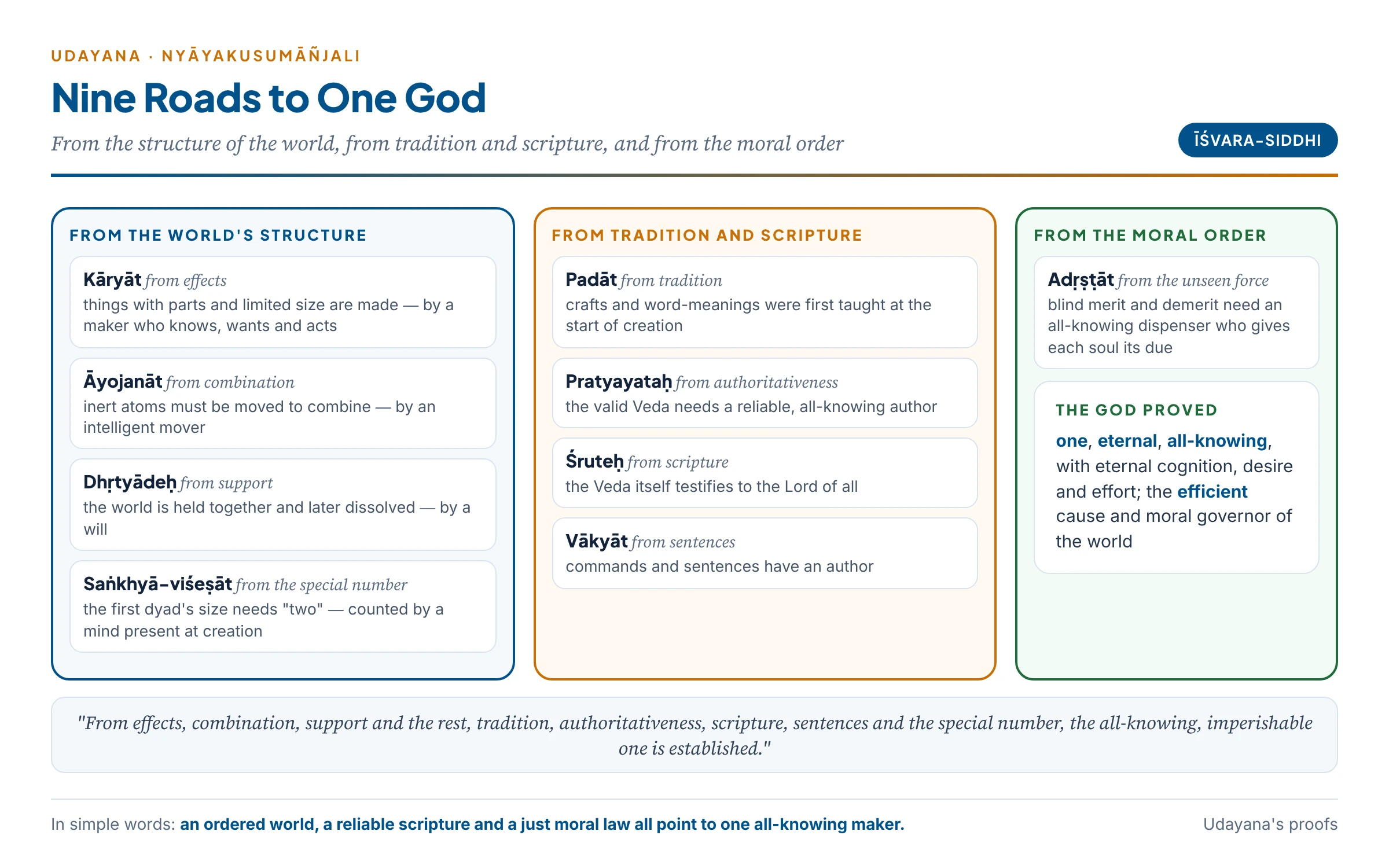
- The verse. Udayana sums up his proofs in one line: “From effects, from combination, from support and the rest, from tradition, from authoritativeness, from scripture, from sentences and from the special number, the all-knowing, imperishable one is to be established.” To these the argument from adṛṣṭa is usually added, making nine proofs.
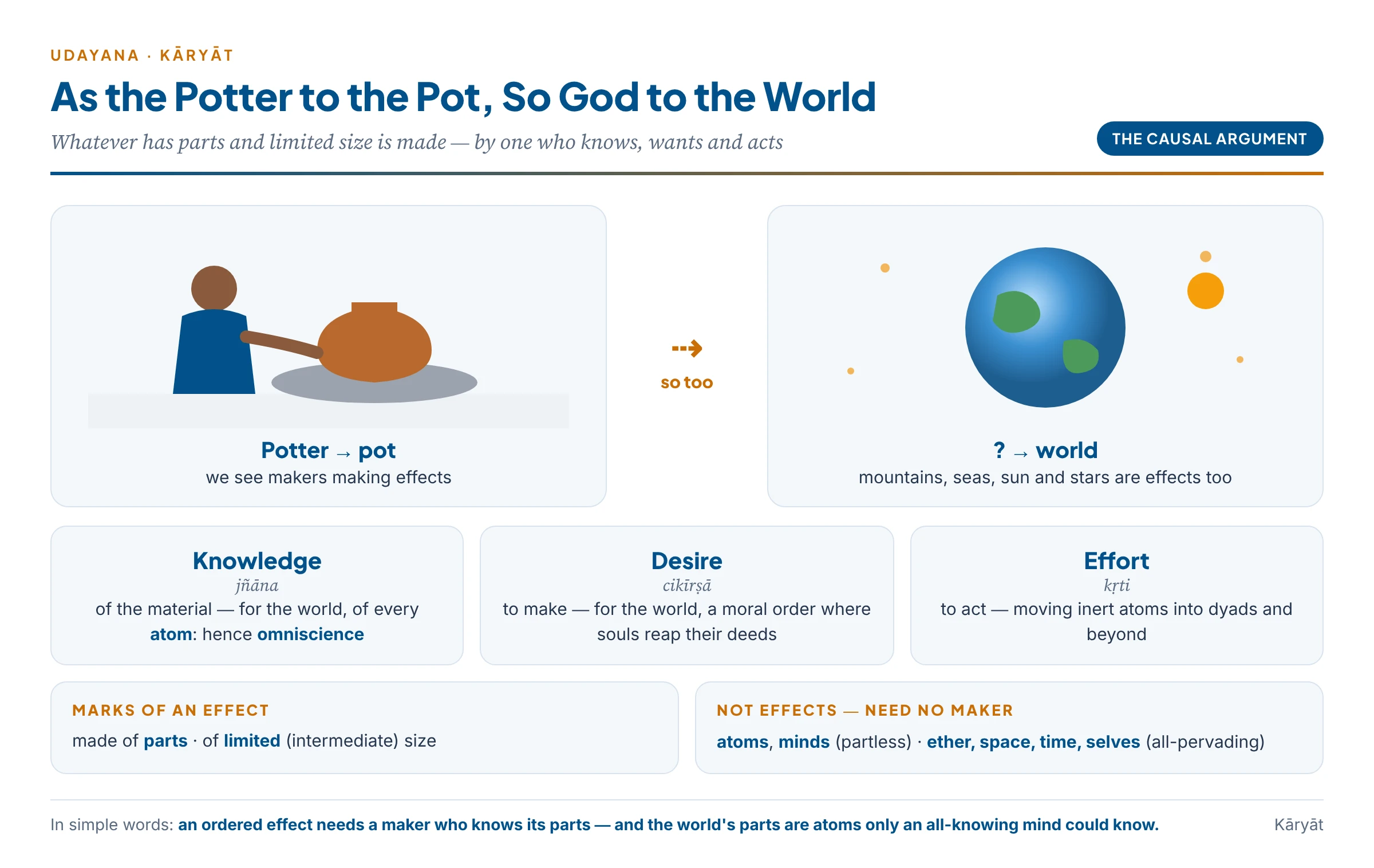
(a) Kāryāt — from effects (the causal argument).
- Argument.
- Things like the earth, mountains, seas, the sun and the stars are effects, because they are made of parts and have a limited (intermediate) size — like a pot.
- Every effect has an intelligent maker (kartā) who has knowledge of the material, desire to make, and effort to accomplish it (jñāna, cikīrṣā, kṛti) — as a pot has a potter.
- Therefore the world has an intelligent maker.
- Since the material of the world is atoms, which no human can see or handle, the maker must have direct knowledge of atoms — he must be omniscient. That maker is God.
- What is not an effect. Atoms, minds, ether, space, time and selves are partless or all-pervading, so they are not effects and need no maker.
- What the argument shows. Material causes alone cannot achieve the order, direction and co-ordination that produce definite effects; an intelligent cause is required.
(b) Āyojanāt — from combination.
- Argument.
- At creation, atoms must combine to form dyads (Article 11).
- Combination requires motion; but atoms are inactive by nature.
- Motion in inert things needs an intelligent source, as a chariot moves only when driven.
- Unconscious adṛṣṭa cannot select and direct it. So an intelligent being imparts the first motion — God.
- Dynamism to atoms. God is the source of the “first push” that brings atoms together.
(c) Dhṛtyādeḥ — from support (and destruction).
- Argument.
- The world does not fall or fall apart; it is held together (dhṛti), as a stick held aloft does not drop because something holds it — a bird carrying a twig in its beak.
- The world is also destroyed (ādi, “and the rest”) in due time.
- Holding up and destroying are the acts of a will; unconscious adṛṣṭa cannot do them.
- So the world is sustained and destroyed by the will of an intelligent being — God.
(d) Padāt — from tradition (the arts and the use of words).
- Argument.
- The arts and crafts (like weaving cloth) and the conventions that give words their meanings are learned from earlier teachers.
- At the beginning of each creation, after dissolution, no human teacher exists.
- So the arts and the meanings of words must have been first taught by an intelligent being present at the start of creation — God.
(e) Pratyayataḥ — from the authoritativeness of the Veda.
- Argument.
- The Veda is a valid source of knowledge; its injunctions about worldly matters work when tested, as a medical text proves itself in practice.
- For Nyāya, the validity of testimony comes from the excellence of its source — a reliable speaker (Article 5).
- The Veda speaks of supersensible things no human could know. So its author must be an omniscient, reliable person — God.
(f) Śruteḥ — from scripture.
- Argument. The Veda itself testifies to God: “the highest eternal Self is the Lord of all, the ruler of all, the protector of all”; “the one God lies hidden in all beings, all-pervading, the inner self of all”. What a reliable scripture affirms must be accepted.
(g) Vākyāt — from the sentences of the Veda.
- Argument.
- The Veda consists of sentences, especially commands (injunctions and prohibitions).
- Sentences and commands have authors, as the Mahābhārata has its author; a command presupposes one who commands.
- So the Veda has a personal author — God.
(h) Saṅkhyā-viśeṣāt — from the special number.
- Argument.
- The size of a dyad does not come from the infinitely small size of its atoms; it is produced by their number, “two” (Article 11).
- The number “two” (like every number above one) is produced by a relating cognition that takes things together.
- At the first moment of creation there are no embodied beings to count the first atoms.
- So the relating cognition must belong to an eternal mind present then — God.
(i) Adṛṣṭāt — from the unseen moral force.
- Argument.
- People are born happy or miserable, wise or foolish, without having earned it in this life. These differences must have causes: our past actions.
- Actions produce merit and demerit (adṛṣṭa), which bear fruit after long intervals, even in later lives.
- Adṛṣṭa is unconscious; it cannot by itself bring exactly the right joy or sorrow to the right person at the right time. Individual souls do not even know their adṛṣṭa.
- So an intelligent, all-knowing being must guide adṛṣṭa and dispense the fruits of action — God, like a wise king who rewards and punishes according to desert.
In simple words
Think of a bank that holds everyone’s savings and debts. The money itself is unconscious — it cannot decide whose account to credit or when a loan falls due. Someone must keep the accounts and pay out exactly what each person has earned. Nyāya says adṛṣṭa is like that money: real, but blind. The accountant who pays each soul its due joy and sorrow, at the right time and in the right life, is God.
Common confusion
Does “saṅkhyā-viśeṣāt” mean that numbers and categories need a divine designer? No. Some notes explain this proof as “numbers and categories have fixed properties, so they need an intelligent determiner”, or as “man’s ability to conceive numbers depends on divine consciousness”. The proof is much more specific. In Vaiśeṣika, the size of the first dyad at creation is produced by the number two of its atoms, and the number two arises only from a mind that counts things together. Since no human mind exists at the first moment of creation, that counting cognition must be God’s.
3. The Causal Argument Examined More Closely
- The marks of an effect. Udayana uses two marks: having parts (sāvayava) and having limited size (avāntara-mahattva). A thing with both is produced.
- The marks of a maker. Every maker needs knowledge of means, desire for an end and effort to act. A potter knows clay, wants a pot and works; the world’s maker must know atoms, want a moral world and act.
- Why one God, not many? Many independent makers would conflict; the unity and harmony of the world point to one ruler (and simplicity prefers one cause to many).
- Why omniscient? Only one who directly knows every atom and every soul’s adṛṣṭa can arrange the world so that each receives what it deserves.
In simple words
A watch found on a beach has gears that fit, a spring that drives and hands that point — clearly made. Nyāya adds two refinements: the watchmaker must know the parts, want a watch and work to make it; and if the “parts” of the world are atoms no human can see, its maker must see what no human can — he must be all-knowing.
4. Objections and Nyāya Replies
- The circularity objection. God is proved from the authority of the Veda, and the Veda’s authority from its being God’s word — a circle.
- Reply. Distinguish the order of existence from the order of knowledge. In existence, God comes first and reveals the Veda; in our knowledge, we know the Veda first (from teachers) and rise from it to God. Mutual dependence in different orders is not a vicious circle.
- The body objection. Every maker we know has a body; a bodiless God cannot act.
- Reply. A dilemma: if God is already established by valid proof, the objection is precluded; if God is not established, there is nothing to object to. Moreover, my will moves my body without another body; a will need not act through a body.
- The purpose objection. Why would a perfect God create? Not for himself — he lacks nothing. Not for others — then he would make them all happy, yet the world is full of misery.
- Reply. God creates out of compassion, but a world of pure happiness is impossible, since beings’ own good and bad deeds must bear fruit. The created world does not limit God any more than one’s own body limits one; it serves as the means of his moral purpose.
- The fruitless-effort sūtra. Gautama himself notes that human effort is sometimes fruitless, which shows that results depend on a higher cause; yet results never come without effort, which shows that God acts in accordance with karma.
Critical Evaluation
Objections (Pūrva-pakṣa)
- Mīmāṃsā.
- No need of God. The Veda is eternal and authorless; the law of karma works through the unseen potency (apūrva) produced by rituals; the world was never other than it is — there was no creation, so no creator.
- No perception of a creator. No one has ever seen the world being made; the inference from a pot to the world is a weak analogy.
- Buddhists.
- “Effect” is ambiguous. Mountains are not effects in the sense in which pots are; we have never seen mountains being made. The analogy fails.
- An eternal cause cannot produce successive effects. If God is eternal and unchanging, all his effects should appear at once and for ever; if they appear in succession, God must change.
- Many makers. At most the argument shows some maker or makers, not one omniscient God.
- Jainas.
- The body problem. Every maker is embodied; a bodiless maker is unknown.
- The problem of evil. A compassionate, omnipotent creator would not create a world of suffering; if he must follow karma, he is not free; if karma does the work, God is superfluous.
- Sāṃkhya. God would need desire, which implies imperfection; prakṛti’s own purpose (to serve puruṣa) explains evolution; a God who creates misery would be cruel.
- Cārvāka. God is not perceived, and inference is unreliable; “God” is an invention of priests.
- Western critics.
- Hume — the analogy between the world and a machine is weak; the world might have many makers, or a flawed one; order may arise without design.
- Kant — the cosmological and design arguments rely on the ontological argument; existence cannot be proved by reason; God can be at most a postulate of moral reason.
- Darwin — natural selection explains the appearance of design in living things without a designer.
- Internal criticisms.
- A limited God. A God who must work with co-eternal atoms and souls is an architect, not a creator; he is limited by them.
- External theism. God, atoms and souls fall apart, related only externally; there is no inner communion, and devotion (bhakti) has little place.
- Who really causes? If adṛṣṭa decides who gets what, God only executes it; if God’s will decides, adṛṣṭa is idle.
- Inconsistency about consciousness. God’s consciousness is eternal, but human consciousness is adventitious — why should the Supreme Self differ in kind from other selves?
- Reliance on scripture. Four of the proofs (padāt, pratyayataḥ, śruteḥ, vākyāt) presuppose the authority of the Veda, which the atheist schools reject.
Defences and Replies
- The analogy is about structure, not appearance. The argument does not say mountains look like pots; it says that whatever has parts and limited size is produced, and that production of order needs intelligence.
- The eternal will acts at the right time. God’s eternal will is a will to produce effects at their proper times, in accordance with adṛṣṭa; eternity of will does not mean simultaneity of effects.
- One God, not many. Many independent makers would clash; one coherent world points to one ruler.
- Evil and karma. Suffering is the fruit of beings’ own deeds; God dispenses it justly. God’s compassion appears in giving every soul the chance to work out its karma and reach liberation.
- Order of knowledge and existence. The alleged circle between God and the Veda dissolves once the two orders are distinguished.
- Value of the attempt. Even critics grant that Udayana gave the most rigorous rational theology in Indian thought, comparable to the medieval scholastics.
Critics and Defenders
Criticism — Critics
- Mīmāṃsakas: the Veda is authorless and karma works by itself; there was no creation.
- Buddhists: mountains are not pots; an eternal God would produce everything at once.
- Jainas and Sāṃkhya: a compassionate creator would not make a suffering world.
- Hume and Kant: design is a weak analogy; God cannot be proved, only postulated.
- Internal critics: a God limited by co-eternal atoms and souls is only an architect.
Defence — Defenders and strengths
- Whatever has parts and limited size is produced, and order needs intelligence.
- Inert atoms and unconscious adṛṣṭa need an intelligent director.
- God’s eternal will produces effects at their proper times, in step with karma.
- Suffering is the fruit of beings’ own deeds, justly dispensed.
- God and Veda depend on each other in different orders — no vicious circle.
Cross-Tradition Comparison
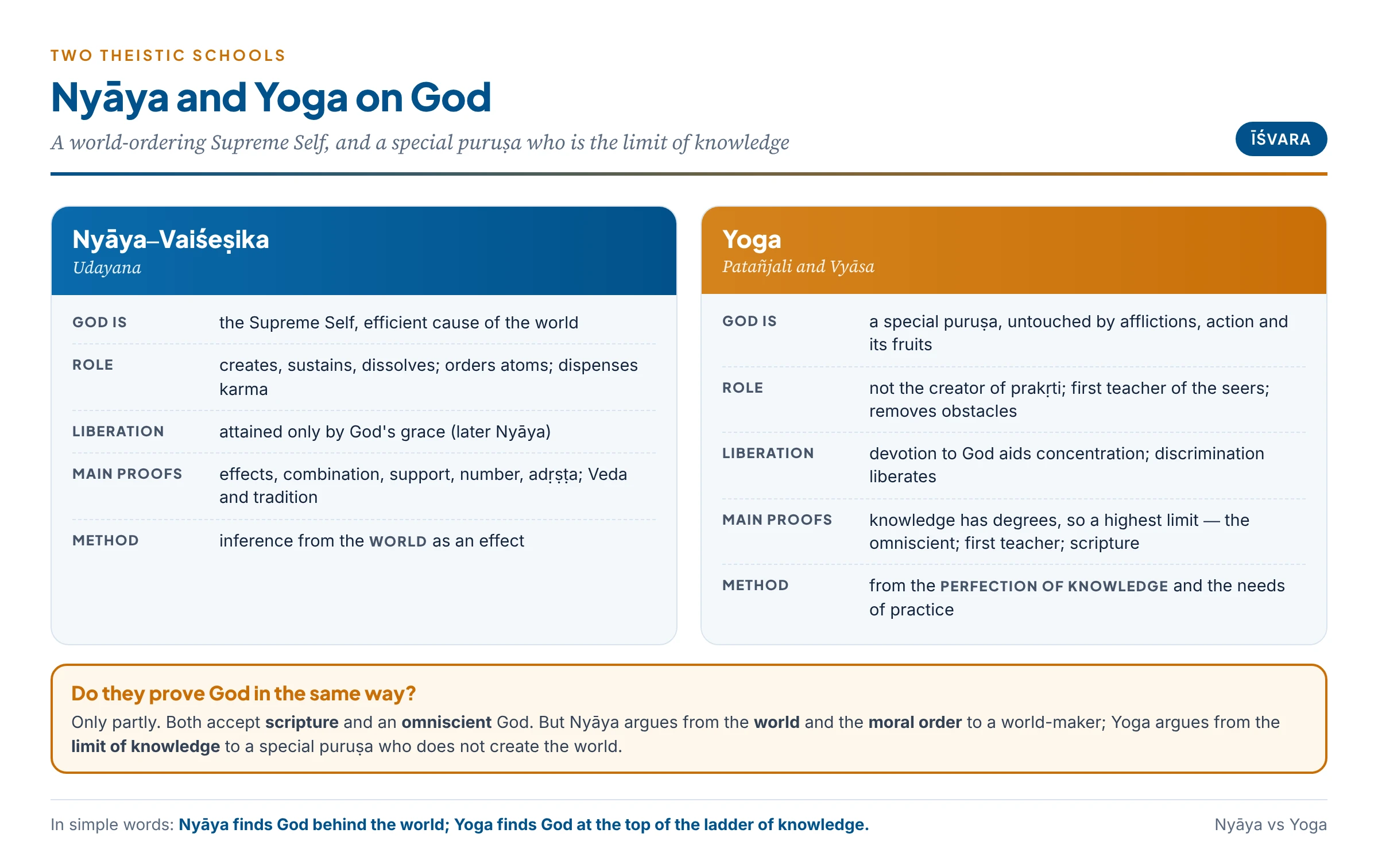
Nyāya and Yoga on God
| Point | Nyāya–Vaiśeṣika | Yoga |
|---|---|---|
| What God is | The Supreme Self, efficient cause of the world | A special puruṣa (puruṣa-viśeṣa), untouched by afflictions, action, its fruits and impressions |
| Role in the world | Creator, sustainer, destroyer; orders atoms; dispenses karma | Not the creator of prakṛti; removes obstacles; on some interpretations, brings prakṛti and puruṣa together and apart |
| Role in liberation | Liberation only by God’s grace (later Nyāya) | Devotion to God (Īśvara-praṇidhāna) is a means to concentration and liberation |
| Main proofs | Causal, from combination, support, tradition, Veda, sentences, number, adṛṣṭa | From degrees of knowledge (knowledge has degrees, so it has a highest limit — the omniscient God); from God as the first teacher of the seers; from scripture |
| Method | Mainly inference about the world | Mainly the perfection of knowledge and the needs of practice |
| Same way of proving? | No — Nyāya argues from the world as an effect; Yoga argues from the limit of knowledge and the guidance of seekers |
- So do the Yoga philosophers prove God in the same way? Only partly. Both accept scriptural testimony and both see God as omniscient. But Nyāya’s proofs are cosmological and moral — the world as an effect, the motion of atoms, the dispensing of karma — whereas Yoga’s main proof is from the gradation of knowledge to its unsurpassed limit, and Yoga’s God does not create the world.
Udayana and Western Proofs
| Nyāya proof | Western parallel |
|---|---|
| Kāryāt — the world as an effect needs an intelligent maker | Aquinas’s second way (efficient cause) and fifth way (governance); Paley’s watchmaker; the design arguments of Janet, Lotze and Martineau |
| Āyojanāt — inert atoms need a first mover | Aquinas’s first way (from motion); Aristotle’s unmoved mover |
| Dhṛtyādeḥ — the world is sustained and dissolved by a will | Aquinas — God conserves the world in being; Newton’s God who keeps the system stable |
| Adṛṣṭāt — someone must match happiness to virtue | Kant’s moral argument — God as the postulate that unites virtue and happiness |
| Yoga’s degrees of knowledge | Aquinas’s fourth way (from gradation of perfection) |
| Pratyayataḥ, śruteḥ — from revelation | Arguments from revelation and the authority of scripture |
| Saṅkhyā-viśeṣāt — the first counting needs a mind | No close parallel — distinctively Vaiśeṣika |
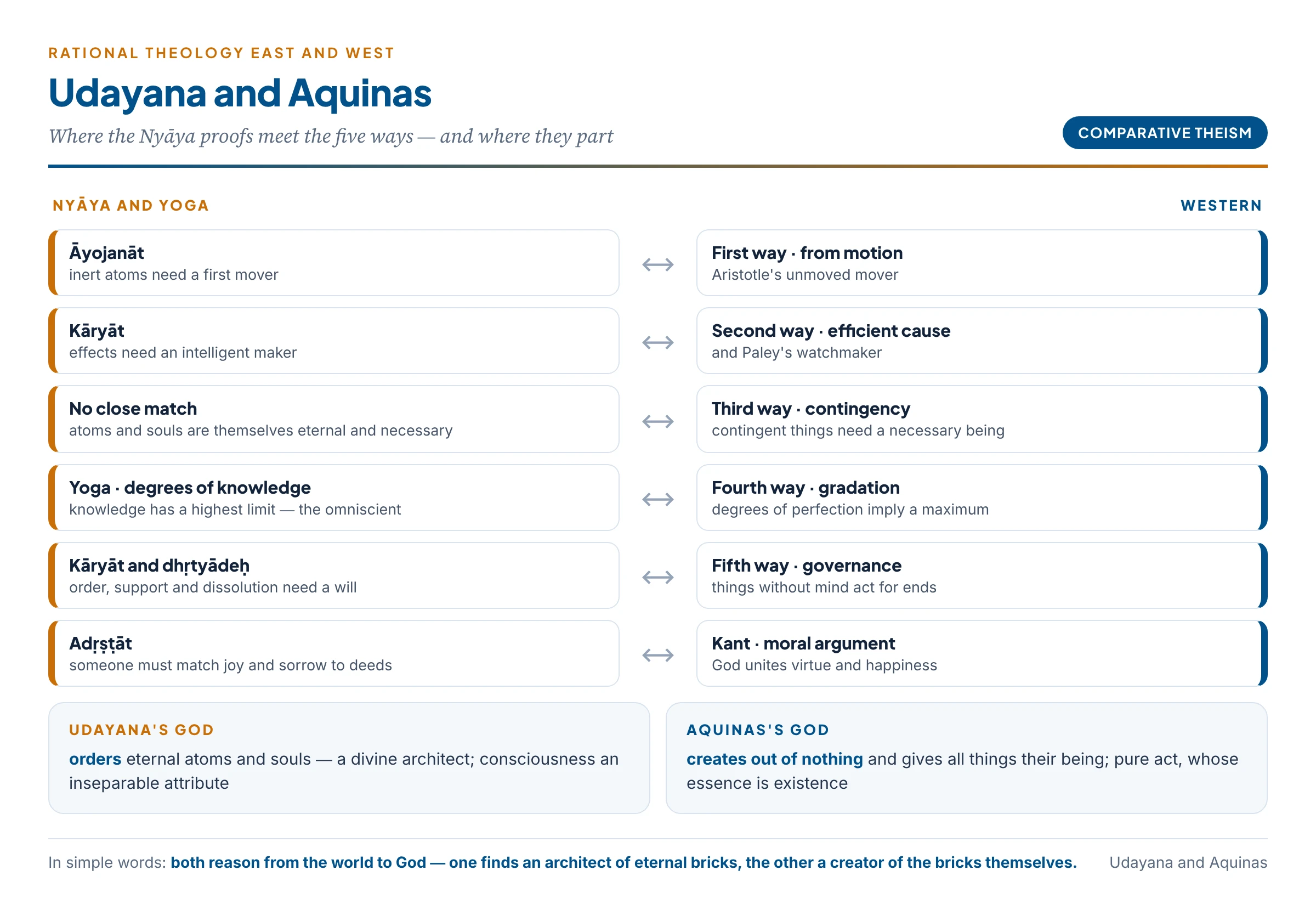
- Difference from Aquinas. Aquinas’s God creates the world out of nothing and is its very source of being; Udayana’s God orders eternal atoms and souls. Aquinas’s third way (from contingency to a necessary being) has no exact Nyāya counterpart, since Nyāya’s atoms and souls are themselves necessary and eternal.
Indian Connect — Key takeaways
- Nyāya offers India’s most systematic rational proofs of God, parallel to the medieval scholastics.
- Udayana’s nine proofs combine cosmological, scriptural and moral arguments.
- The saṅkhyā-viśeṣa proof is uniquely Vaiśeṣika, rooted in its theory of number and atomic size.
- Nyāya’s God is an efficient cause and moral governor, not the creator of matter out of nothing.
- Yoga’s God is a special puruṣa proved from the limit of knowledge — a different route to a different God.
Synthesis (Siddhānta)
- God, for Nyāya–Vaiśeṣika, is the one, eternal, all-pervading, all-knowing Supreme Self, with eternal cognition, desire and effort, the efficient cause who creates, sustains and dissolves the world from co-eternal atoms, and the just dispenser of the fruits of action.
- Udayana establishes God through nine proofs: from effects, from the combination of atoms, from support and destruction, from tradition, from the authoritativeness of the Veda, from scripture, from Vedic sentences, from the special number and from adṛṣṭa.
- The proofs face strong objections — from Mīmāṃsā, Buddhist, Jaina and Sāṃkhya atheism, from Hume and Kant, and from the internal tension of a God limited by co-eternal reals. Nyāya’s replies — on structure, timely will, karma and the two orders of knowledge and existence — keep the system coherent.
- Compared with Yoga, Nyāya proves a world-ordering God mainly from the world; Yoga proves a special puruṣa mainly from the limit of knowledge. Compared with Aquinas, Udayana’s God is a divine architect rather than a creator out of nothing.
- Contemporary relevance.
- Cosmic design debates — whether the precise settings of the physical universe point to a designer — revive the kāryāt argument.
- The problem of evil remains the central objection to theism, as the Jainas and Sāṃkhyas saw.
- Interfaith philosophy finds in Udayana a rigorous partner for dialogue with Christian, Islamic and Jewish rational theology.
“From effects, combination, support and the rest, tradition, authoritativeness, scripture, sentences and the special number, the all-knowing, imperishable one is established.” — Udayana, Nyāyakusumāñjali
Previous Year Questions
- 2025What proofs do Nyāya philosophers offer for the existence of God?
- 2024“In order to be conceived as the ultimate cause of the world, God must necessarily have some form of physical manifestation.” Do you agree with this view? Give reasons and justifications for your answer.
- 2023Critically examine the arguments of Nyāya for the existence of God.
- 2021Discuss the nature of God as propounded in Nyāya philosophy.
- 2019How does Udayana prove the existence of God through Kāryāt, Āyojanāt, Dhṛtyādeḥ and Śruteḥ? Discuss.
- 2018How do the Naiyāyikas prove the existence of God? Do the Yoga philosophers prove God in the same way? If yes, how? And if no, why? Give reasons for your answer.
- 2018Compare St. Thomas Aquinas’ five ways of knowing God with the arguments of the Nyāya School of Indian Philosophy for the existence of God.
- 2015Examine the Nyāya arguments in favour of the existence of God.
- 2011Do you find any inadequacy in the proofs for the existence of God as given by Naiyāyikas? Give reasons in support of your answer.