

Sāṃkhya: Prakṛti; Puruṣa; Causation; Liberation.
Official Syllabus: Paper I, Section B, Unit 16
Does the oil already exist in the sesame seed before it is pressed — or does the oil-presser bring into being something that was not there before? Sāṃkhya, the oldest of the orthodox systems, answers firmly: the effect already exists, hidden, in its material cause, and production only brings it out (satkāryavāda). It adds that this coming-out is a real change of the cause into the effect, as milk really becomes curd (pariṇāmavāda). This one theory of causation is the foundation of the whole system: it leads straight to Prakṛti, the single unmanifest root of the world, and shapes Sāṃkhya’s views on evolution, the self and liberation. This article explains the school’s background, the five classic proofs of satkāryavāda, the idea of manifestation and disappearance, the split between real and apparent transformation, and the long debate with Nyāya, the Buddhists, the Cārvākas, Advaita Vedānta and Aristotle.
In simple words
A sculptor looks at a block of marble and says, “The elephant is already inside — I only cut away what is not elephant.” Sāṃkhya says every production is like this. The pot is already in the clay, the curd in the milk, the cloth in the threads, the tree in the seed. The potter, the heat, the weaver and the rain do not create the effect; they only remove what hides it and let it show.
Context & Problem
Sāṃkhya: The School and Its Texts
- The oldest system. Sāṃkhya ideas appear in the Upaniṣads (especially the Chāndogya, Praśna, Kaṭha and Śvetāśvatara), the Mahābhārata, the Bhagavad Gītā, the smṛtis and the purāṇas. Its way of thinking runs through almost all ancient Indian literature.
- Founder and early teachers. Tradition names the sage Kapila as the founder. His disciple Āsuri and Āsuri’s disciple Pañcaśikha also wrote, but all their works are lost. Kapila is generally placed before the Buddha.
- The key text. Īśvarakṛṣṇa’s Sāṃkhyakārikā (around the 4th–5th century CE), a compact text of about seventy verses, is the earliest available and the most authoritative work of the school. Our knowledge of classical Sāṃkhya comes mainly from it.
- Commentaries. Gauḍapāda’s Sāṃkhyakārikā-bhāṣya, Vācaspati Miśra’s Tattvakaumudī, and Vijñānabhikṣu’s Sāṃkhya-pravacana-bhāṣya. The Sāṃkhya-sūtra (also called Sāṃkhya-pravacana-sūtra), traditionally ascribed to Kapila, is regarded by scholars as a much later work (around the 14th century), because earlier writers of other schools never mention it, it criticises later rival systems and it tries to revive theism.
- The name. Two explanations are given.
- From saṅkhyā, “number” — the system enumerates the ultimate principles of reality (the famous twenty-five tattvas). Some even suggest that this “philosophy of numbers” influenced Pythagoras.
- From samyak khyāti, “right knowledge” — Sāṃkhya is the philosophy of perfect knowledge, namely the knowledge that the self is distinct from matter. The Gītā uses the word in this sense.
- The aim. Like Nyāya–Vaiśeṣika, Sāṃkhya seeks knowledge of reality for a practical end: to put an end to suffering. The Kārikā opens with the threefold suffering of life as the reason for philosophical inquiry (Article 5).
What Kind of Philosophy Is It?
- Dualistic realism. There are two ultimate, uncreated, eternal and independent realities: Puruṣa (pure consciousness, the self) and Prakṛti (primordial matter). Both the knower and the known are equally real.
- Pluralistic spiritualism. Puruṣas are many — one for each living being (Article 4).
- Atheistic realism. Prakṛti alone is the material cause of the real world; no God is needed as its efficient cause (Article 5).
- Uncompromising dualism. Sāṃkhya gives separate proofs for Prakṛti and for Puruṣa and never lets one be reduced to the other.
- Orthodox but atheistic. Sāṃkhya is āstika because it accepts the authority of the Veda, yet it does not accept God. Āstika in classical usage means “accepting the Veda”, not “believing in God”.
- Sāṃkhya and Yoga — one system, two sides. Sāṃkhya is the theoretical, metaphysical side; Yoga (Patañjali) is the practical side that shows how the discriminating knowledge taught by Sāṃkhya can be realised. Sāṃkhya is called nirīśvara-sāṃkhya (Sāṃkhya without God) and Yoga seśvara-sāṃkhya (Sāṃkhya with God).
- Development. Many scholars hold that the earliest Sāṃkhya, close to the Upaniṣads, was monistic and theistic; classical Sāṃkhya, perhaps under the influence of materialism, Jainism and early Buddhism, became dualistic and atheistic. Later writers such as Vijñānabhikṣu (16th century) tried to bring theism back.
How Sāṃkhya Knows: The Three Pramāṇas
- Three sources of valid knowledge. Perception (pratyakṣa), inference (anumāna) and reliable testimony (śabda). Comparison, postulation and non-cognition are included under these three and are not separate pramāṇas.
- Knowledge as a mental modification lit by the self.
- The intellect is unconscious. Buddhi (intellect) is a product of matter. When an object reaches it through the senses and mind, buddhi takes the shape of the object — this modification (vṛtti) is the pramāṇa.
- The self supplies the light. Buddhi has a great deal of sattva (clarity) and so, like a clean mirror reflecting a lamp, it reflects the consciousness of Puruṣa. The unconscious shape in buddhi then becomes a conscious cognition.
- Three factors. The knower (pramātā) is the self as pure consciousness; the object (prameya) is what is presented; the means (pramāṇa) is the modification of buddhi.
- Two readings. Vācaspati holds that the self is reflected in the modified buddhi. Vijñānabhikṣu adds a double reflection: the modified buddhi is also reflected back in the self — to explain how the self seems to feel pleasure and pain.
- Two stages of perception. Indeterminate perception (nirvikalpaka, ālocana) is a bare sensing of “something”, like the experience of an infant; determinate perception (savikalpaka, vivecana) is the judgement “this is a cow”, made by the mind.
- Inference. Based on a universal relation (vyāpti) learnt from repeated observation. Sāṃkhya divides it into vīta (affirmative) and avīta (by elimination); vīta is either pūrvavat (smoke to fire) or sāmānyatodṛṣṭa (from similarity — e.g. we infer that we have sense-organs because every action needs an instrument, and perceiving is an action). Prakṛti, the guṇas and Puruṣa are all known by inference, not perception — which is why Prakṛti is also named anumāna, “the inferred”.
- Testimony. Only Vedic testimony counts as an independent pramāṇa; ordinary testimony rests on perception and inference. The Veda is impersonal (apauruṣeya) and free from personal defects, yet not eternal, since it arose from the experiences of the seers and is handed down from teacher to pupil.
In simple words
Think of a dark room with a mirror on the wall. Objects come in front of the mirror and the mirror takes their shape — but in the dark, nothing is seen. A lamp outside shines into the mirror, and now the shapes in it are visible. In Sāṃkhya, the mind and intellect are the mirror taking the shapes of things; Puruṣa is the lamp whose light makes those shapes known.
The Basic Question of Causation
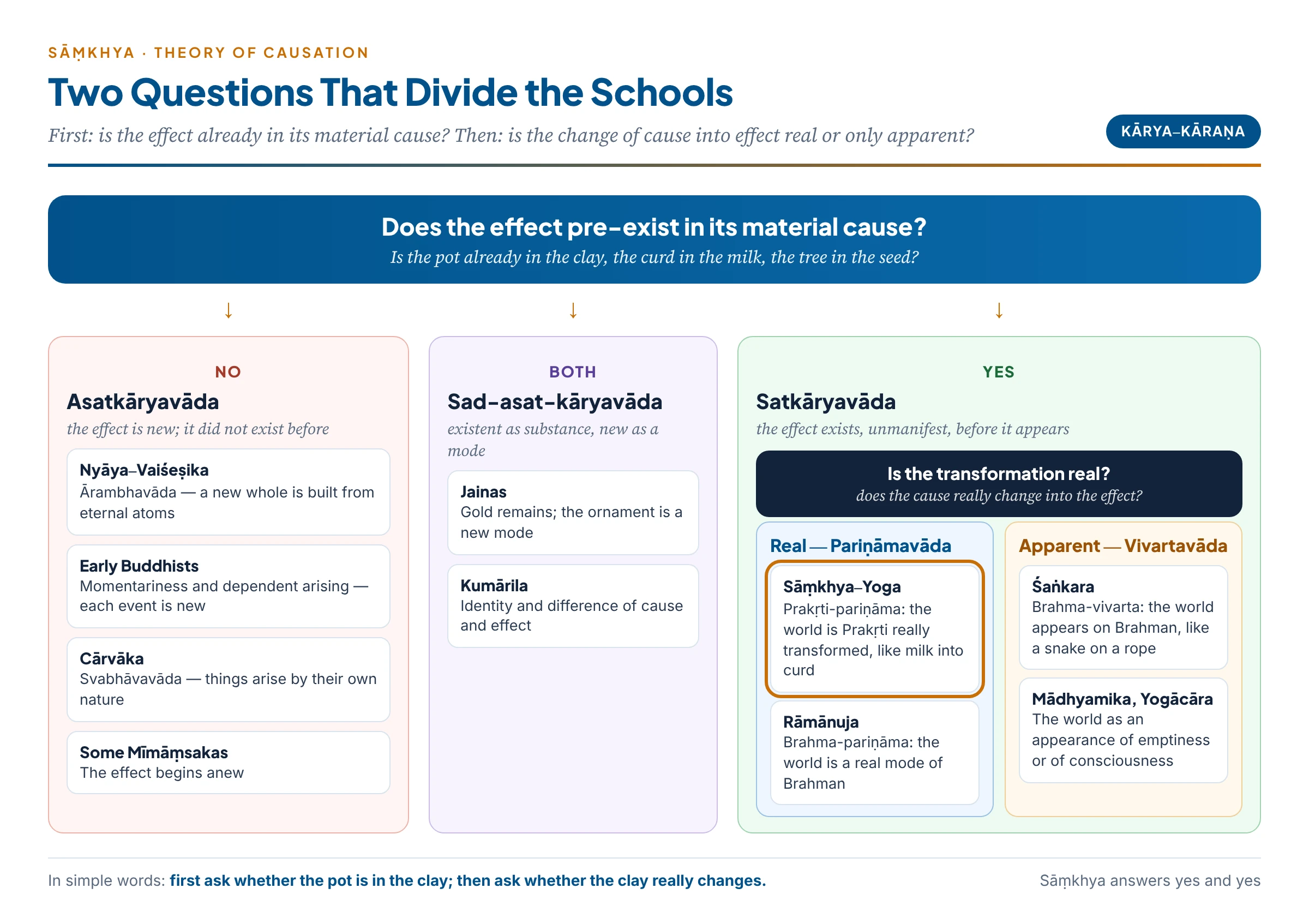
- First question. Does the effect (kārya) exist in its material cause (upādāna-kāraṇa) before it is produced?
- No — asatkāryavāda. The effect is non-existent (asat) before production; it is a new beginning. Held by Nyāya–Vaiśeṣika (ārambhavāda), the Hīnayāna Buddhists (momentariness, kṣaṇabhaṅgavāda), the Cārvākas (svabhāvavāda) and some Mīmāṃsakas.
- Yes — satkāryavāda. The effect is existent (sat) in the cause before production; it is only manifested. Held by Sāṃkhya, Yoga, Rāmānuja and Śaṅkara.
- Both — sad-asat-kāryavāda. The effect is existent as substance and non-existent as a new mode. Held by the Jainas and Kumārila; both lean finally towards real transformation.
- Second question (for satkāryavādins). Is the effect a real transformation of the cause or only an apparent one?
- Real — pariṇāmavāda. Sāṃkhya–Yoga (prakṛti-pariṇāmavāda: the world is a real transformation of Prakṛti) and Rāmānuja (brahma-pariṇāmavāda: the world is a real mode of Brahman).
- Apparent — vivartavāda. Śaṅkara (brahma-vivartavāda: the world is an appearance of Brahman), and in their own ways the Mādhyamika and Yogācāra Buddhists (the world as appearance of emptiness or of consciousness).
- Sāṃkhya’s place. Sāṃkhya was the first school to set out satkāryavāda as a systematic doctrine; Vedānta later accepted it but gave it a different meaning.
Core Doctrine
1. Satkāryavāda: The Effect Pre-exists in Its Cause
- The thesis. The effect exists in its material cause in a latent, unmanifest or potential form even before it appears. Curd was existing in the milk before it came out as curd.
- What production really is. Production is not creation out of nothing (ex nihilo); it is the manifestation (āvirbhāva, abhivyakti) of what was hidden. Destruction is not utter annihilation; it is the disappearance (tirobhāva) of the effect back into its cause.
- “Neither new production nor utter destruction.” Production is evolution (the subtle becoming gross); destruction is involution (the gross returning to the subtle).
- Example. Gold is made into ornaments; the ornaments are melted back into gold. Nothing is gained or lost — only the form appears and disappears.
- Cause and effect as two states of one thing. The cause is the implicit (unmanifest) state; the effect is the explicit (manifest) state of the same substance.
- Role of the efficient cause. The potter and his wheel, the weaver and his loom, the oil-presser and his press are necessary — but only to remove obstacles and bring out what is already there, as pressing brings oil out of the seed.
2. The Five Proofs of Satkāryavāda
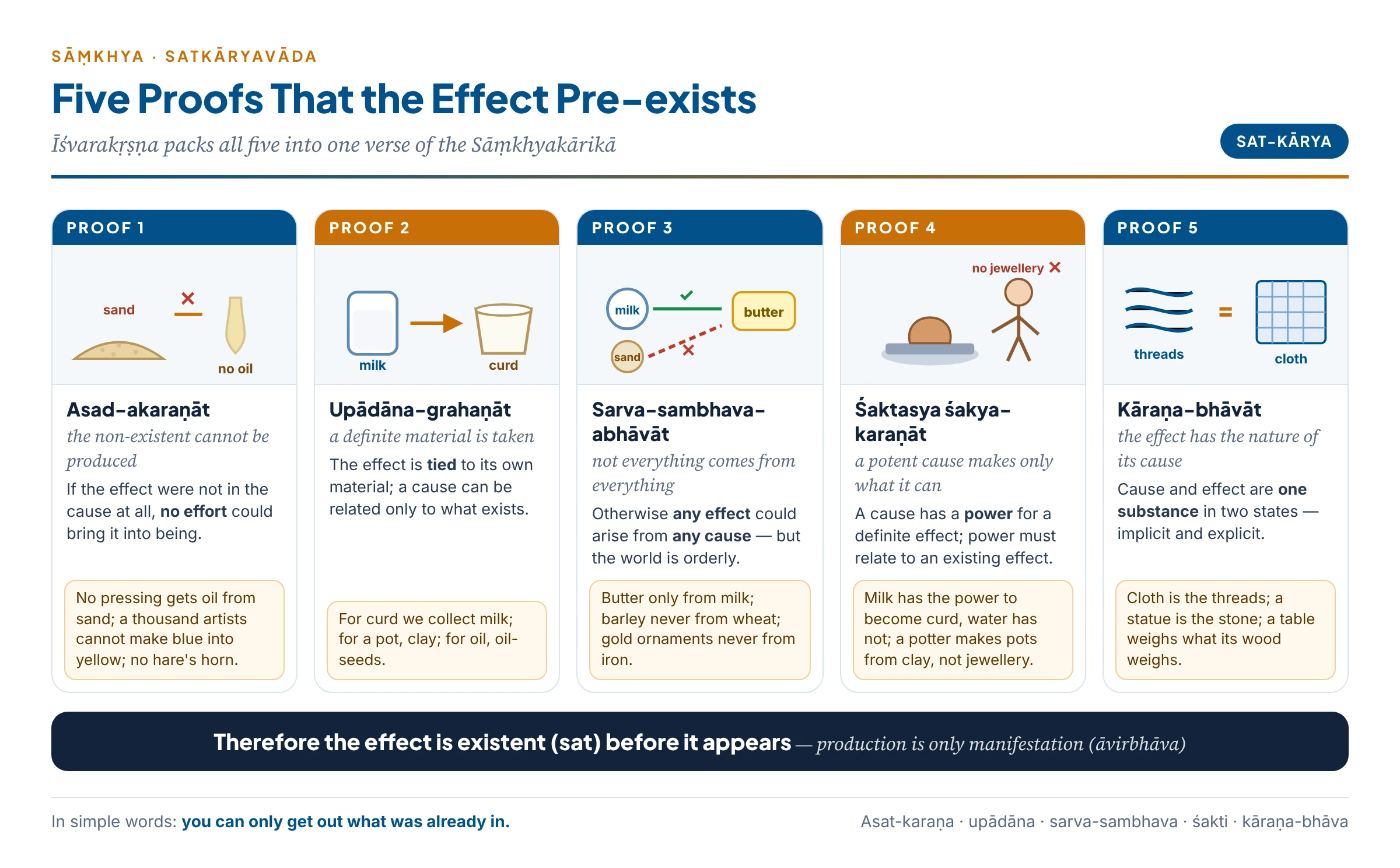
Īśvarakṛṣṇa gives the five reasons in a single verse:
“Asad-akaraṇād upādāna-grahaṇāt sarva-sambhava-abhāvāt, śaktasya śakya-karaṇāt kāraṇa-bhāvāc ca sat-kāryam.” — Īśvarakṛṣṇa, Sāṃkhyakārikā
That is: the effect is existent because (1) the non-existent cannot be produced, (2) a definite material is taken, (3) not everything arises from everything, (4) a potent cause produces only what it is potent for, and (5) the effect has the nature of its cause.
- (1) Asad-akaraṇāt — “because the non-existent cannot be produced”.
- The argument. If the effect did not exist in the cause in any form, nothing could ever bring it into being. What is utterly non-existent stays non-existent.
- Examples. No amount of effort can produce a hare’s horn or a sky-flower. A thousand artists cannot turn blue into yellow; no one can turn blue into red, or sugar into salt. No pressing will extract oil from sand, because oil does not exist in sand.
- The point. When oil is produced by pressing sesame seeds, it must have been there already, waiting to be manifested.
- (2) Upādāna-grahaṇāt — “because a definite material cause is taken”.
- The argument. The effect is invariably related to its material cause. A cause can be related only to what exists; it cannot be related to a non-entity. So the effect must exist in the cause.
- Examples. People who want curd collect milk; those who want a pot collect clay; those who want oil collect oil-seeds. Why would anyone choose a definite material if the effect were not already linked to it?
- (3) Sarva-sambhava-abhāvāt — “because everything does not arise from everything”.
- The argument. If effects did not pre-exist in specific causes, any effect could come from any cause — and the world would be a giant mess. But this never happens.
- Examples. Butter comes only from milk, never from sand, water or oil. Gold ornaments do not arise from iron; barley does not grow from wheat seeds; curd is got only from milk and cloth only from threads; the potter takes clay, not milk or threads.
- (4) Śaktasya śakya-karaṇāt — “because a potent cause produces only what it is potent for”.
- The argument. Only a cause that has the power (śakti) for a particular effect can produce it. But a power must be related to its effect, and it cannot be related to something that does not exist at all. So the effect exists in the cause as a potential, and production is only the actualisation of this potential.
- Examples. Milk has the potency to become curd; water does not. Were it otherwise, curd could be produced from water, cloth from reeds and oil from sand-particles. A potter can make pots from clay, but he cannot make jewellery out of it. Seeds lying in a storehouse do not become plants; only seeds sown in a field with water and sunlight manifest the plant.
- (5) Kāraṇa-bhāvāt — “because the effect has the nature of its cause”.
- The argument. The effect is not different from its material cause; it is identical in essence with it. If the cause exists, the effect must also exist, since there can be no identity between an entity and a non-entity.
- Examples. The cloth is nothing but the threads in a new arrangement; the statue is the stone with a new shape; the weight of a table is exactly the weight of the pieces of wood used in it. Oil is contained in oil-seeds; curd in milk.
- The flow of the effect. When the obstructions in the way of manifestation are removed, the effect naturally flows out of its cause — the oil only needs to be pressed, the cloth only needs to be woven.
- A further point made by many expositions. If the effect were non-existent before production, then production would mean that something comes out of nothing — which is absurd. This restates the first proof as a general principle.
In simple words
Think of a printed photograph being developed in an old darkroom. The image was already on the film; the chemicals did not paint it — they only brought it out. And you cannot develop a picture of the Taj Mahal from a film that was never exposed to it. Sāṃkhya says the world of effects is like this: every effect is “already exposed” in its cause, and causation is only the developing.
3. Pariṇāmavāda: The Effect Is a Real Transformation
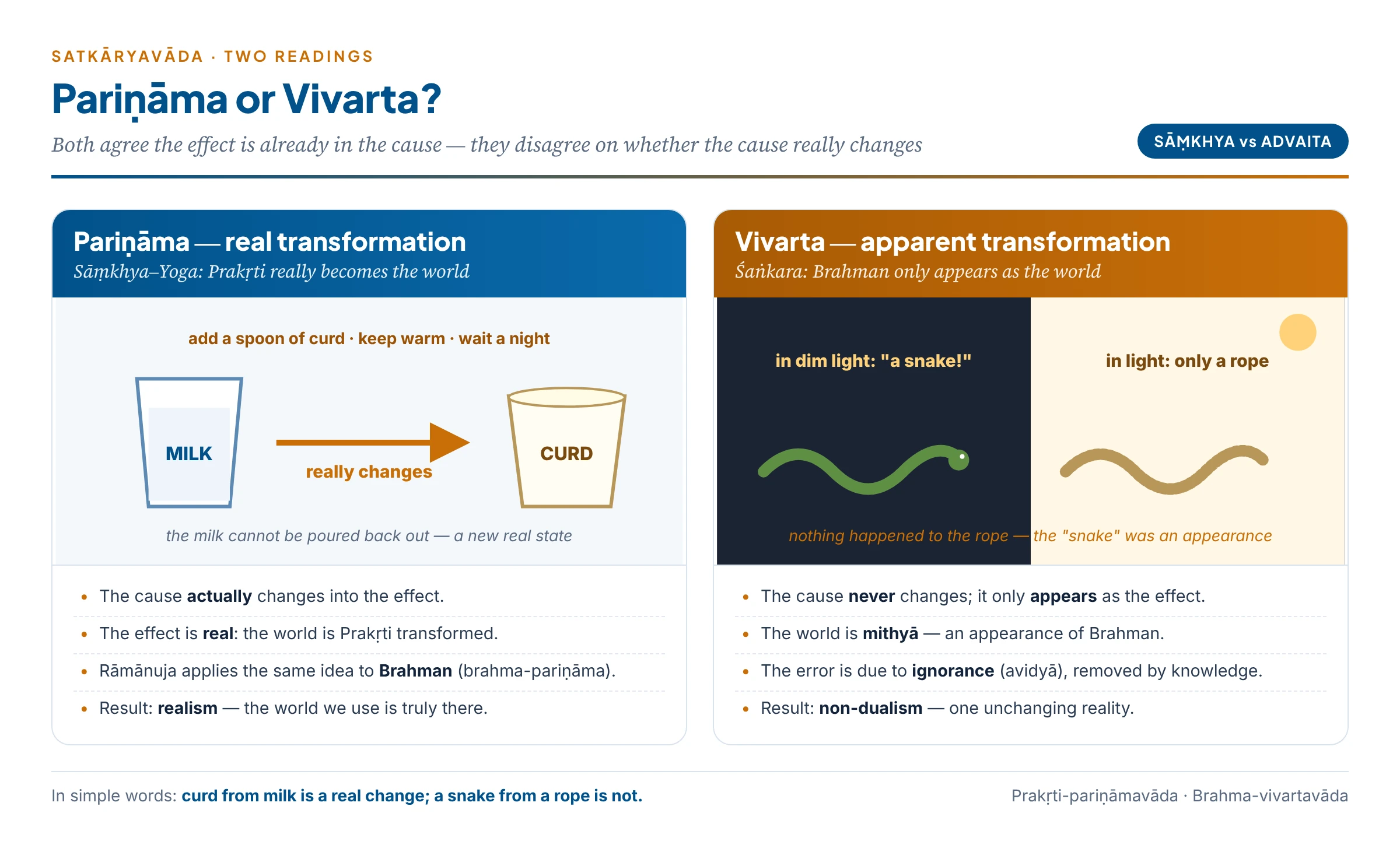
- Meaning. Sāṃkhya does not stop at “the effect pre-exists”. It adds that the effect is a real transformation (pariṇāma) of the cause. When milk becomes curd, the milk really changes; nothing is illusory.
- Applied to the world. The whole world of matter, body and mind is a real transformation of one eternal material principle, Prakṛti. The universe is not created out of nothing, nor by a divine will; it is Prakṛti itself unfolding, stage by stage (Article 3).
- Why it matters.
- A rational, non-theistic account of creation. The world’s origin is explained without God, purely from the nature of the material cause.
- Realism. Because the change is real, the world is real — unlike the Advaita view that the world is only an appearance.
- One of the earliest systematic realisms in India. Sāṃkhya affirms the real existence of the world as the modification of primordial nature.
- Pariṇāma and vivarta compared.
| Point | Pariṇāmavāda (Sāṃkhya) | Vivartavāda (Advaita Vedānta) |
|---|---|---|
| Meaning | Effect is a real transformation of the cause | Effect is only an apparent transformation, an appearance |
| Ultimate cause | Prakṛti, primordial matter | Brahman, pure consciousness |
| Nature of the change | Actual — milk into curd, seed into tree | Only apparent — rope seen as snake, mirage-water in a desert |
| Status of the world | Real, being Prakṛti’s actual modification | Mithyā — neither absolutely real nor absolutely unreal |
| Cause–effect relation | Effect pre-exists and comes out as a modification | Effect is superimposed on the cause through ignorance (adhyāsa) |
| Role of consciousness | Puruṣa is a passive witness; it makes evolution possible but does not create | Brahman is the only reality; creation is due to ignorance (māyā) |
| God | Not needed to explain creation | Īśvara is Brahman as conditioned by māyā |
| General position | Realism and pluralism — matter real, selves many | Absolute monism — only Brahman real, multiplicity an appearance |
| Liberation | Discriminating Puruṣa from Prakṛti (viveka) | Realising the identity of Ātman and Brahman |
In simple words
Leave milk overnight with a spoon of curd and in the morning it is curd — you cannot pour the milk back out; the milk has really changed. Now walk into a dim room and see a “snake” on the floor; switch on the light and it is a rope — nothing happened to the rope at all. Sāṃkhya says the world comes from Prakṛti the way curd comes from milk; Śaṅkara says it comes from Brahman the way the snake comes from the rope.
4. How Sāṃkhya Explains “A Mango Tree Grows from a Mango Seed”
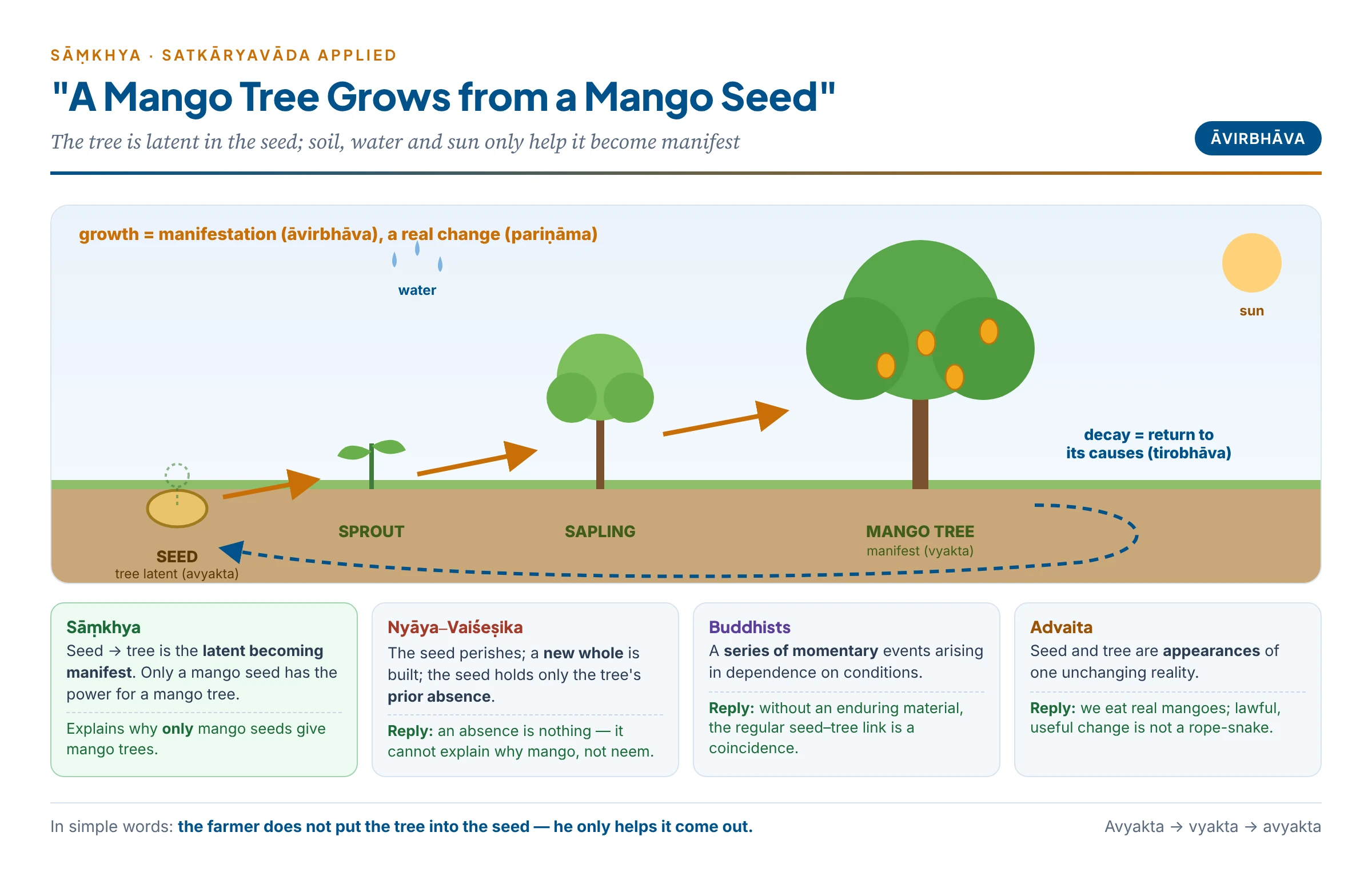
- The Sāṃkhya account in steps.
- The tree is already in the seed — not as a tiny visible tree, but in an unmanifest (avyakta) form, as a potential.
- Soil, water, sunlight and time are efficient or helping causes. They do not add the tree; they remove obstacles to its manifestation.
- Growth is manifestation (āvirbhāva): sprout, sapling and tree are successive stages in which the latent becomes explicit — like nails and hair that grow so gradually that no one sees the moment of growth, yet they grow.
- The change is real (pariṇāma): the seed really transforms; the tree is not an illusion.
- When the tree dies and decays, it returns (tirobhāva) to its causes; nothing is utterly destroyed.
- The five proofs applied.
- A mango tree cannot arise from a stone or from nothing (asad-akaraṇāt).
- A farmer who wants mangoes plants a mango seed, not a neem seed (upādāna-grahaṇāt).
- A mango seed never gives a banyan (sarva-sambhava-abhāvāt).
- Only a living, fertile seed has the power to grow into a tree; a roasted seed does not (śaktasya śakya-karaṇāt).
- The tree’s wood, sap and fruit are the seed’s own matter with earth, water and light, unfolded (kāraṇa-bhāvāt).
- Rejecting the rival views.
- Against Nyāya–Vaiśeṣika (the tree is a new whole). If the tree were utterly new, why does it come only from a mango seed? A new thing has no reason to choose one cause rather than another. Nyāya’s own “prior absence of the tree in the seed” is either some real relation to the tree — then the tree exists in some form — or nothing — then it cannot explain why only mango seeds give mango trees.
- Against the Buddhists (a series of momentary events). If each moment is new and the seed perishes completely, nothing continues from seed to tree; the regular link between mango seed and mango tree becomes a coincidence. Continuity of growth points to an enduring material that is transforming.
- Against the Cārvākas (it happens by nature, svabhāva). “By nature” names the regularity but does not explain it; the “nature” of the seed is exactly its latent tree.
- Against Advaita (the tree is only an appearance). The farmer eats real mangoes; the change from seed to tree is experienced, useful and lawful, unlike the snake in the rope, which disappears on inspection. So the transformation is real, not apparent.
Indian Connect — Aristotle’s acorn and Sāṃkhya’s seed
- For Aristotle, an acorn is potentially an oak; growth is the passage from potentiality (dynamis) to actuality (energeia). This is very close to Sāṃkhya’s passage from the unmanifest to the manifest.
- But Aristotle’s actuality is prior to potentiality — a real oak produced the acorn, and the form of the oak guides its growth. Sāṃkhya’s Prakṛti, by contrast, is unconscious, and its “guidance” comes only from the purpose of serving Puruṣa (Article 3).
5. From Causation to Prakṛti
- The next step. Satkāryavāda says every effect pre-exists in its material cause. The world as a whole is an effect. So it too must pre-exist in some ultimate material cause. This is Prakṛti — and so the doctrine of Prakṛti rests on the theory of causation.
- Why not consciousness (Puruṣa or Brahman)? An intelligent principle cannot transform itself into the unintelligent world. Since the effect has the nature of its cause (proof 5), a material world needs a material cause. The self is neither a cause nor an effect of anything.
- Why not atoms? The Cārvākas, Buddhists, Jainas and Nyāya–Vaiśeṣika take the atoms of earth, water, fire and air as the material causes of the world. Sāṃkhya objects:
- Atoms cannot explain the subtle products of nature — mind, ego and intellect.
- The unity of the universe points to a single cause, while atoms are many and scattered.
- In every evolution the cause is subtler than the effect and pervades it — as a seed develops into a tree, or a wish into a dream-object. So the ultimate cause must be the subtlest of all.
- Conclusion. The ultimate cause of the world is an unconscious, uncaused, eternal, all-pervading and extremely subtle principle, always ready to evolve — Prakṛti (Article 2).
Common confusion
Is satkāryavāda the view that the pot already exists, fully formed, inside the clay? No. Sāṃkhya does not say that a finished pot is hidden inside the lump like a toy inside a box. It says the pot exists in the clay as a potential, in an unmanifest (avyakta) state; what the potter does is to make that potential manifest. Many notes blur this, and then the Nyāya objection “why doesn’t the clay hold water?” seems decisive. Sāṃkhya’s reply is that an unmanifest pot cannot do the work of a manifest pot — just as an oak in the acorn gives no shade. What pre-exists is the effect’s being, not its manifest form and function.
Critical Evaluation
Nyāya–Vaiśeṣika Objections (Asatkāryavāda)
- Production becomes meaningless. If the effect already exists in the cause, there is no sense in saying that it is produced.
- The efficient cause becomes redundant. If the pot already exists in the clay, why should the potter exert himself and use his tools?
- Purpose becomes redundant. If the cloth is in the threads, why can the threads not serve the purpose of cloth? Why does milk not taste like curd? Why can the clay not hold water like the pot?
- Repeated birth is nonsense. If the effect already exists, its production would be a second birth of what is already born.
- No difference of names. If cause and effect are identical, we should use the same name for pot and clay.
- The admission of new form. If Sāṃkhya says the difference is only one of form, it must admit that something — the form — is in the effect but not in the cause. Then the effect, at least as a new form, did not pre-exist, and satkāryavāda collapses.
- Fatalism. If all future effects are already hidden in their causes, everything is predetermined.
- Prior absence (prāgabhāva). Nyāya explains why only clay gives a pot without pre-existence: clay contains the prior absence of the pot together with the causal capacity for it (see the Nyāya causation article).
Buddhist, Cārvāka and Logical Objections
- A verbal trick. The Buddhists say “latent existence” is only a form of words, not a real explanation of how transformation occurs.
- Where is the flame? If the flame is the effect, is it already present in the oil or in the cotton wick? It is in neither; it arises in dependence on both (pratītyasamutpāda).
- The five proofs turned around. The Buddhist logicians Śāntarakṣita and Kamalaśīla argue that Sāṃkhya’s arguments cut both ways:
- What already exists cannot be produced, since its production would be a vain repetition — if curd pre-exists in milk, milk should taste like curd.
- Since there is nothing to produce, there can be no definite material, no special cause, no potent cause and no “nature of the cause” at work.
- An eternal cause is inefficient. Something eternal and unchanging cannot produce effects one after another; it would produce all its effects at once. If accessories are needed, then they, and not eternal Prakṛti, are the causes.
- Diversity of potencies is enough. Everything does not come from everything because causes differ in their potencies — no hidden effects are needed.
- Cārvāka. There is no perceptual evidence that the effect pre-exists. The effect is a new configuration of matter.
- Circularity. The proofs assume what they set out to prove: they treat the relation of cause and effect as already a relation to an existing effect.
- The identity–difference dilemma. If the effect is identical with the cause, there is no change at all; if it is different, satkāryavāda is denied.
- No room for novelty. Satkāryavāda seems to reduce all creation to reshaping and cannot account for what is genuinely new.
Śaṅkara’s Rejection of Pariṇāmavāda
Śaṅkara accepts satkāryavāda but rejects real transformation in favour of vivartavāda.
- Pariṇāma admits a new form. If the effect is a real modification, then at least the new form did not exist in the cause. This concedes exactly what the Nyāya–Vaiśeṣika use to attack satkāryavāda.
- The third-man regress. If cause and effect are both given independent reality, a third thing is needed to relate them, then a fourth to relate that, and so on — an infinite regress.
- Does the form have a reality of its own? Sāṃkhya asks: can we deny that oil appears in a new form from the seed? Śaṅkara replies by asking whether a change in form means a change in reality. Whatever reality a form has, it has in virtue of its substance — the oil has no reality apart from the seed-stuff, the pot none apart from the clay. So causation involves no change of substance; the change of form is only an appearance — vivarta.
- Immutability. If the ultimate reality underwent a real transformation, it would become changeable and imperfect, and lose its original state — contradicting eternity.
- The rope and the snake. Just as a rope appears as a snake without changing, the world appears on Brahman without altering it. Only so is non-duality preserved.
- Sāṃkhya’s own admission. When Sāṃkhya later explains the relation of Puruṣa and Prakṛti as only a semblance of contact (saṃyogābhāsa), it tacitly accepts appearance rather than real change (Article 3). Śaṅkara says that, made consistent, Sāṃkhya’s satkāryavāda becomes vivartavāda.
Sāṃkhya’s Replies
- On production and the potter. Production means manifestation; the potter is needed to manifest the pot, just as a lamp is needed to make visible a jar already in a dark room.
- On purpose and function. An unmanifest effect cannot do the work of a manifest one; threads before weaving are cloth only potentially, so they cannot clothe us.
- On names. Names and uses follow states: the same substance in different states gets different names, as water, ice and steam do.
- On new form. The form too pre-exists in potential; only its manifestation is new, and manifestation is not a new thing but a new state of an existing thing.
- On Nyāya’s prior absence. Prior absence is a non-entity; a non-entity cannot be the reason why only clay — and not milk — produces pots. Only a positive relation to the effect can explain this regularity.
- On Śaṅkara. The world’s transformations are experienced, lawful and useful: curd nourishes, mangoes are eaten. Calling them appearances empties experience of meaning.
- On fatalism. Satkāryavāda concerns the material basis of effects; which potential is manifested still depends on efficient causes, including human effort.
Critics and Defenders
Criticism — Critics
- Nyāya–Vaiśeṣika: production, the potter and different names become pointless; a new form is admitted; prior absence suffices.
- Buddhists: latent existence is a verbal trick; the flame is in neither oil nor wick; an eternal cause cannot act; the proofs cut both ways.
- Cārvāka: no perception shows pre-existence; effects are new configurations.
- Logicians: the proofs are circular; identity leaves no change, difference leaves no satkārya; no room for novelty.
- Śaṅkara: real transformation admits a new form and leads to a third-man regress; made consistent, satkāryavāda becomes vivartavāda.
Defence — Defenders and strengths
- Nothing comes from nothing; every effect has a specific material cause — a principle every science assumes.
- Production as manifestation explains why the potter is needed and yet adds no new stuff.
- Unmanifest effects cannot do the work of manifest ones, so the “threads as cloth” objection misses the point.
- Prior absence is a non-entity and cannot explain why only clay yields pots.
- Real transformation keeps the world real, lawful and usable, against the appearance theory.
- Satkāryavāda grounds the doctrine of one Prakṛti and a non-theistic, rational cosmology.
Cross-Tradition Comparison
Sāṃkhya Causation and Western Thought
| Point | Sāṃkhya | Western parallel |
|---|---|---|
| Nothing comes from nothing | Asad-akaraṇāt — the non-existent cannot be produced | Parmenides; Lucretius: “nothing can be created out of nothing” (ex nihilo nihil fit) |
| Conservation | Neither new production nor utter destruction | Lavoisier: in chemical change nothing is lost and nothing is created; conservation of mass and energy |
| Potential to actual | Unmanifest becomes manifest (āvirbhāva) | Aristotle: potentiality (dynamis) becomes actuality (energeia); the acorn and the oak |
| Kinds of cause | Material cause is primary; efficient causes only manifest | Aristotle’s four causes — material, formal, efficient, final |
| Effects contained in their cause | Effect pre-exists in the material cause | Leibniz: every state of a monad is contained in it from the start; preformation in early biology |
| One substance unfolding | One Prakṛti evolves into all material things | Spinoza: one substance, Natura naturans, expressing itself in modes |
| Necessity in causation | The effect is bound to its own specific cause | Rationalists — the effect follows necessarily from its cause; opposed by Hume, for whom causation is only constant conjunction |
| Real vs apparent change | Pariṇāma — real transformation | Heraclitus (change real) vs Parmenides (change an illusion) — the Western form of pariṇāma vs vivarta |
Sāṃkhya and Aristotle on Causation
| Point | Sāṃkhya | Aristotle |
|---|---|---|
| Main focus | The material cause and its transformation | All four causes, with emphasis on form and end |
| Material cause | Prakṛti — one, eternal, unconscious | Prime matter — pure potentiality, never existing alone |
| Formal cause | No separate formal cause; forms are latent in the material | Form is a distinct cause and makes a thing what it is |
| Efficient cause | Only removes obstacles; ultimately the presence of Puruṣa | A real agent that produces change (the sculptor) |
| Final cause | The good of Puruṣa — experience and liberation | The end or perfection of the thing; ultimately the Unmoved Mover |
| Ultimate principle | Puruṣa moves Prakṛti by mere presence, like Aristotle’s God | The Unmoved Mover moves the world as an object of love |
| Is change real? | Yes — real transformation | Yes — actualisation of potential |
| Status of the effect before change | Exists, unmanifest | Exists only potentially, not actually |
Indian Connect — Key takeaways
- Indian causation theories are really theories of reality: Sāṃkhya’s satkāryavāda leads to one evolving Prakṛti; Nyāya’s asatkāryavāda to many atoms and new wholes; Śaṅkara’s vivartavāda to one Brahman and an apparent world; the Buddhist dependent origination to a world of momentary events.
- The Buddhist doctrine of dependent origination is often presented as a middle way between satkāryavāda and asatkāryavāda: the effect neither pre-exists (against Sāṃkhya) nor springs up from nothing (against crude asatkāryavāda) — it arises in dependence on conditions.
- Aristotle’s potentiality–actuality theory is the nearest Western analogue of Sāṃkhya’s unmanifest–manifest, but Aristotle keeps a separate formal and final cause, which Sāṃkhya folds into the material cause and the purpose of Puruṣa.
Synthesis (Siddhānta)
- Sāṃkhya, founded by Kapila and systematised in Īśvarakṛṣṇa’s Sāṃkhyakārikā, is a dualistic realism of Puruṣa and Prakṛti, orthodox in accepting the Veda and atheistic in rejecting God; it recognises three pramāṇas.
- Its theory of causation, satkāryavāda, holds that the effect pre-exists in its material cause and production is manifestation; it is proved by five reasons — the non-existent cannot be produced, a definite material is taken, not everything comes from everything, a potent cause produces only what it can, and the effect has the nature of its cause.
- Its special form is pariṇāmavāda: the effect is a real transformation of the cause, as milk becomes curd — opposed to Śaṅkara’s vivartavāda, in which the effect is only an appearance.
- Satkāryavāda leads directly to Prakṛti as the one, subtle, unconscious, eternal root of the world.
- Its critics — Nyāya, the Buddhists, the Cārvākas and Śaṅkara — press the problems of novelty, the role of the efficient cause, the new form and circularity; Sāṃkhya answers with the distinction between unmanifest and manifest states.
- A balanced view. The theory captures something true — effects are continuous with their causes and nothing comes from nothing — but it has difficulty with real novelty. Each rival theory keeps one side of the truth: Nyāya the newness of the effect, Sāṃkhya its continuity, the Buddhists its dependence on conditions, Śaṅkara the priority of the underlying reality.
- Contemporary relevance.
- Conservation laws. Modern physics and chemistry hold that matter-energy is neither created nor destroyed but transformed — a scientific echo of “neither new production nor utter destruction”.
- Genetics. A seed’s genetic programme fixes that a mango seed yields a mango tree; the environment only allows it to express itself — close to the Sāṃkhya picture of latent potential and helping conditions.
- Emergence debate. Whether wetness, life or mind are new in their wholes or latent in their parts is today’s version of the satkārya–asatkārya debate.
- Ecology. The idea that nothing is utterly destroyed but returns to its source fits modern thinking about cycles of matter in nature.
“The effect is existent, because the non-existent cannot be produced.” — Īśvarakṛṣṇa, Sāṃkhyakārikā
Previous Year Questions
- 2026“A mango tree is grown out of a mango seed.” How do the Sāṃkhya philosophers explain this process through their theory of causation by rejecting their rival perspectives?
- 2023Write a note on Nyāya notion of Prāgabhāva (prior non-existence). How does this notion help Naiyāyikas in defending their position on causation against the Sāṃkhya view of causation? Critically discuss.
- 2020“A mango tree is grown out of a mango seed.” How will Sāṃkhya system explain this process through their theory of causation by rejecting their rival perspectives?
- 2018How do the Advaita Vedāntins react to the Prakṛti-pariṇāmavāda of the Sāṃkhya philosophy? How do the Sāṃkhyas defend their own position in this regard? Discuss.
- 2016Does the ‘Doctrine of Dependent Origination’ reconcile the two extreme views on the law of causation, namely Satkāryavāda and Asatkāryavāda? Give reasons for your answer.
- 2015Write short note on Satkāryavāda.
- 2014How is the theory of causation central to the theory of reality in classical Indian tradition? Discuss.
- 2012How Sāṃkhya theory of causation is different from that of Nyāya theory of causation? Explain.
- 2010Does the effect pre-exist in the cause? Discuss.
- 2009Compare Aristotle’s view regarding causation with that of the Sāṃkhya School’s view of Causation.
- 2006Critically discuss the Sāṃkhya theory of Causation.