

Nyāya–Vaiśeṣika: Theory of Categories; Theory of Appearance; Theory of Pramāṇa; Self, Liberation; God; Proofs for the Existence of God; Theory of Causation; Atomistic Theory of Creation
Official Syllabus: Paper I, Section B, Unit 15
How does the world appear to us, and is it really as it appears? Nyāya–Vaiśeṣika gives the boldest realist answer in Indian philosophy: things exist independently of our knowing them, they are knowable and nameable, and in ordinary valid cognition they appear just as they are. Cognition is like a lamp — it shows the object; it does not make it. But realism must face a hard fact: illusion. When a shell glitters like silver or a rope looks like a snake, something appears that is not there. If the realist cannot explain this, the idealist and the Advaitin will say that all appearance may be like that. Nyāya’s answer is anyathākhyāti — error is the misplaced appearance of a real thing: the silver is real, but it exists elsewhere, and the shell is cognised otherwise than it is. This article explains the Nyāya theory of appearance, its theory of error, the role of jñānalakṣaṇa perception, and its long debate with the rival theories of error (khyātivāda), especially the akhyāti of the Prābhākara Mīmāṃsakas and the anirvacanīyakhyāti of Advaita.
In simple words
You walk into a dim storeroom and leap back — there is a snake coiled in the corner! You switch on the light: it is a rope. Now ask: what did you see a moment ago? Not nothing — your heart was pounding. Not the rope as a rope — you would not have jumped. Different schools give different answers: you saw a real snake you remembered placed wrongly here (Nyāya); you failed to notice that you were mixing a seen rope with a remembered snake (Prābhākara); you saw a snake of your own mind (Yogācāra); you saw a snake made for a moment by ignorance, neither real nor unreal (Advaita). The whole debate on error is about that one leap.
Context & Problem
What “Theory of Appearance” Asks
- Appearance and reality. Every philosophy must say how the way things appear to us is related to the way they are.
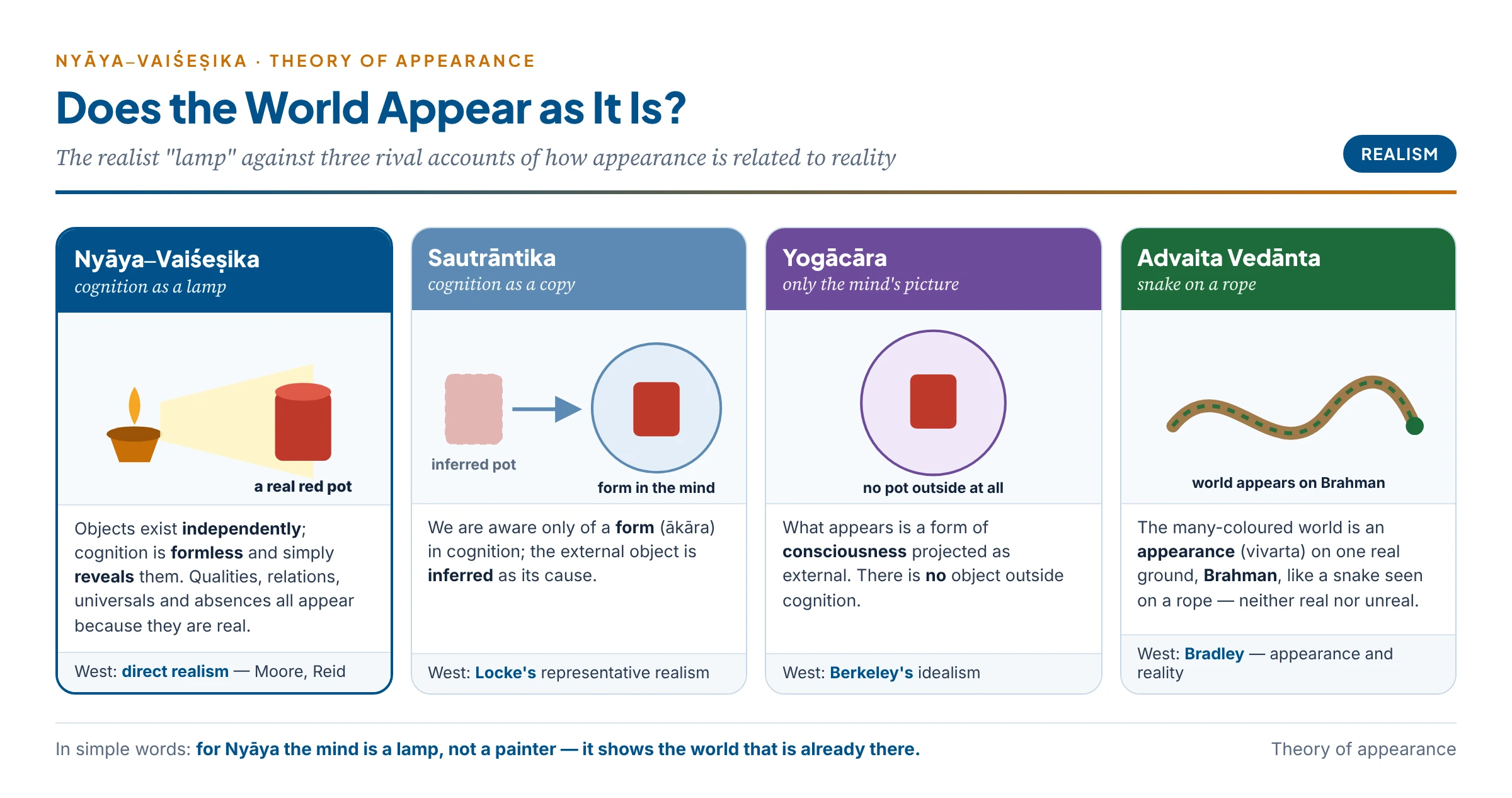
- Idealist answer (Yogācāra). What appears is only a form of consciousness; there is no external object.
- Representationalist answer (Sautrāntika). We see only a copy or form in cognition; the external object is inferred.
- Illusionist answer (Advaita). The many-coloured world is an appearance (vivarta) of one reality, Brahman, like a snake on a rope.
- Nihilist answer (Mādhyamika). Appearances have no own-being at all; they are empty.
- Realist answer (Nyāya–Vaiśeṣika). What appears in valid cognition is the real world — substances, qualities, actions, universals, relations and absences — exactly as it is.
- Why error is the test case. Every non-realist argument begins from illusion: “if the snake in the rope can appear without being there, perhaps the whole world appears without being there”. So a realist theory of appearance must also be a theory of error that keeps both the object and the possibility of mistake.
The Indian Debate on Error (Khyātivāda)
- Khyāti means “appearing” or “cognition”; khyātivāda is the theory of what appears in an error.
- The stock examples. Shell (śukti) seen as silver (rajata); rope seen as a snake; a white conch seen as yellow by one with jaundice; two moons seen when the eyeball is pressed; a mirage seen as water.
- The two questions. Every theory must say:
- What is the object of the erroneous cognition — real, unreal, mental, or indescribable?
- How does it come to appear — and why does it vanish when corrected?
Core Doctrine
1. The Nyāya–Vaiśeṣika Theory of Appearance: Realism
- Everything that is, is knowable and nameable. Every real category (padārtha) has existence (astitva), knowability (jñeyatva) and nameability (abhidheyatva) (Article 7). There is nothing real that is in principle hidden from knowledge.
- Objects exist independently of knowledge. A pot does not come into being when I see it or cease when I look away. Knowledge is a quality of the self that reveals objects (artha-prakāśa); it does not create them.
- Cognition is formless (nirākāra). The form, colour and shape belong to the object, not to the cognition. Cognition is like light: the lamp shows the colour of the cloth; the colour is not in the lamp. This rejects the Buddhist claim that cognition carries the object’s form (sākāra-jñāna).
- Appearance is normally faithful. In valid cognition (pramā) a thing appears as having the feature it really has — “this is silver” when silver is present. Appearances are not a veil over reality; they are reality presented.
- Qualities appear in substances. We perceive not floating sense-data but a coloured pot: qualities appear as belonging to a substance, because they really inhere in it (Articles 7–8).
- Relations and absences appear too. We see the book on the table and the absence of a pot on the floor; relations and absences are real and perceivable (Articles 8–9).
- Error is the exception, explained without unreal objects. Since only what is real can appear, even an illusion must be made of real elements. Error lies not in the things but in their wrong combination in a cognition.
In simple words
Think of a torch in a dark room. It lights up the chair, the table and the painting — it does not paint them. Point it at a red wall and you see red, not because the torch is red. For Nyāya, knowing is like that torch: it shows what is there. A mistake is not the torch inventing a chair; it is the torch catching a coat on a hook so that, for a moment, it looks like a person — real coat, real idea of a person, wrongly put together.
2. Valid and Invalid Cognition
- Valid cognition (pramā). Cognition of a thing as having a feature it really has — “this is silver” about silver.
- Error (viparyaya). Cognition of a thing as having a feature it does not have (atasmin tad-prakārakaṃ jñānam) — “this is silver” about a shell. Error is a positive, definite cognition, not just an absence of knowledge.
- Other invalid cognitions. Nyāya lists doubt (saṃśaya), error (viparyaya) and hypothetical reasoning (tarka) as non-valid, and does not count memory as pramā (Article 1).
- The Vaiśeṣika fourfold division of non-knowledge (avidyā). Praśastapāda lists:
- Doubt (saṃśaya) — “is it a post or a man?”
- Error (viparyaya) — “this is silver” of a shell.
- Indefinite cognition (anadhyavasāya) — “what is this?” — as when a person who has never seen a jackfruit sees one and cannot place it at all.
- Dream (svapna) — cognitions in sleep produced by impressions, bodily disorder and unseen merit and demerit.
- How error is detected. By the failure of action. A man stoops to pick up the silver and finds a shell. Under extrinsic validity (parataḥ prāmāṇya, Article 1), neither validity nor error is known from the cognition itself; both are known by checking it against further experience.
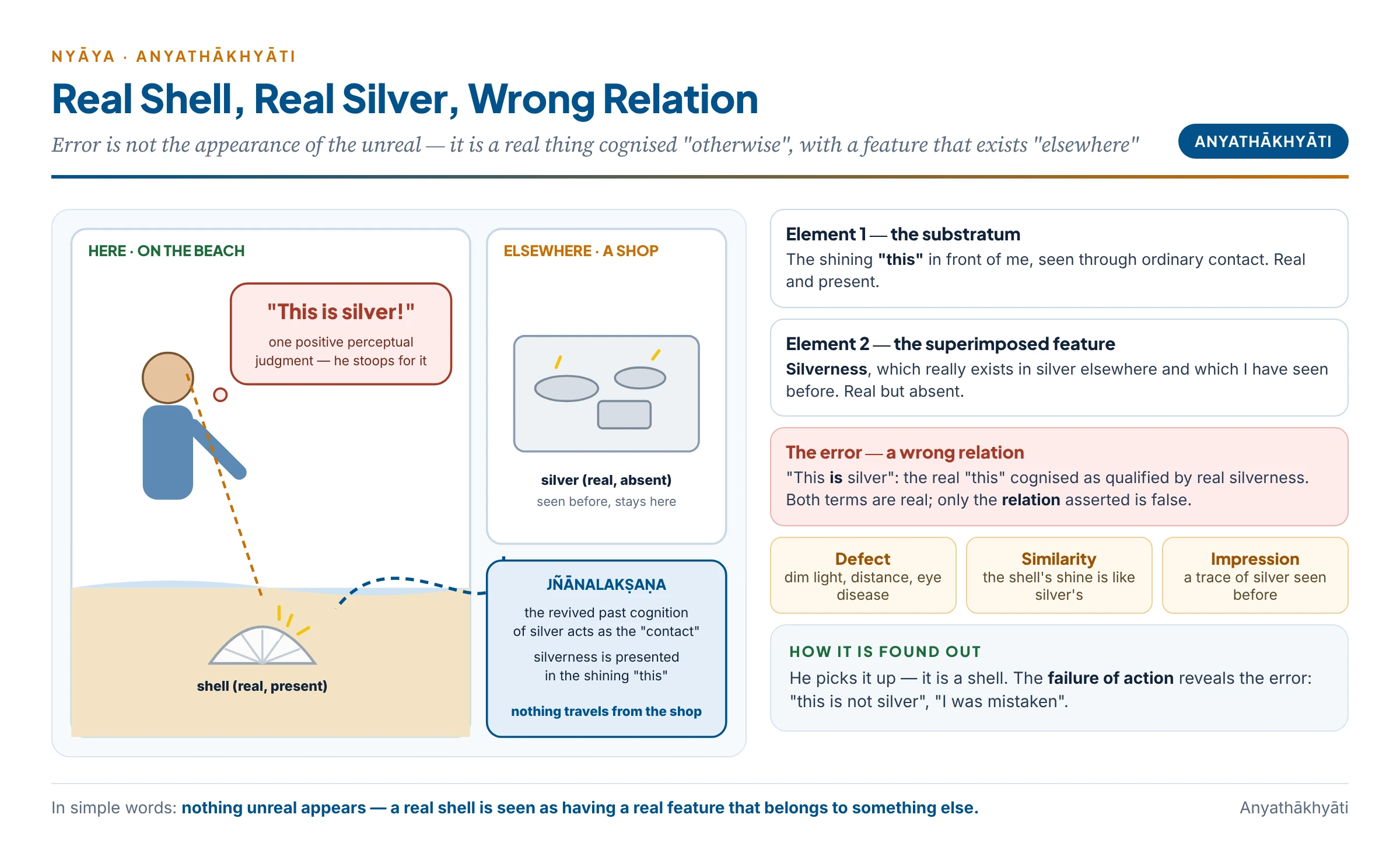
3. Anyathākhyāti: Error as Misplaced Appearance
- The name. Anyathā has two senses, and both apply:
- “Elsewhere” — the silver that appears is real, but it exists elsewhere, in a shop or a jeweller’s tray, not on the beach.
- “Otherwise” — the shell, which is really here, is cognised otherwise than it is — as silver.
- Two real elements.
- The substratum (adhiṣṭhāna) — the “this”, the shining object actually in front of me. It is perceived through ordinary sense-contact.
- The superimposed feature — silverness, which really exists in silver elsewhere and which I have seen before.
- One wrong relation. Error lies in the relation (saṃsarga) asserted between them — “this is silver“. Both terms are real; only their combination here is false. Nyāya’s realism is saved: no unreal object ever appears.
- The causes of error.
- Defect (doṣa) — in the sense organ (jaundice, a pressed eyeball), in the conditions (dim light, great distance), or in the object (very small, moving).
- Similarity (sādṛśya) — the shell’s shine resembles silver’s; the rope’s coil resembles a snake’s.
- Impression (saṃskāra) — a latent trace of an earlier cognition of silver, which the similarity awakens.
- Often a desire or fear — greed for silver, fear of snakes — sharpens the revival.
- Why it is perception, not memory. The illusory silver is felt as present here and now — “this is silver” — and the person reaches for it. Memory gives “that silver, which I saw”; error gives “this silver”. So error is a kind of perception. But the eye is in contact only with the shell; how can silver be perceived?
4. The Role of Jñānalakṣaṇa Perception
- The problem. For a perception there must be a contact (sannikarṣa) between sense and object (Article 2). The eye touches the shell; it does not touch silver.
- Nyāya’s answer. The past cognition of silver, revived by the similarity, itself serves as the contact. This is jñānalakṣaṇa pratyāsatti — “contact whose nature is cognition” — one of the three extraordinary (alaukika) contacts.
- How it works.
- The eye contacts the shining thing — ordinary contact.
- The shine awakens the impression of silver.
- That revived cognition of silver acts as a contact and presents silverness directly.
- The result is a single perceptual cognition: “this is silver”.
- The same mechanism in valid perception. “I see fragrant sandalwood” — the eye cannot sense fragrance, yet fragrance appears in the visual cognition, because a past smell-cognition presents it. “The ice looks cold“; “the stone looks hard” are the same kind of case.
- Why Nyāya needs it.
- It explains why error is felt as perception, not as memory or inference.
- It explains how an object not in contact now can appear here and now without being unreal.
- It lets Nyāya keep realism: what is presented — silverness — is a real feature known before.
- Its limit. Later Naiyāyikas restrict it so that it does not swallow inference: it presents only what was previously cognised, and only when the revival is part of a present perceptual situation.
Common confusion
Does Nyāya say the shell and the silver come into contact (saṃyoga)? No. Some notes describe Nyāya error as a “conjunction of the shell with the silver-memory”. Conjunction (saṃyoga) is a quality that holds between two substances; nothing like that happens here. The silver stays in the shop. What happens is cognitive: a single cognition presents the real “this” as qualified by the real silverness. The wrong element is the qualification relation within the cognition, not any physical link between shell and silver.
5. Akhyāti: The Prābhākara Theory of Non-Apprehension
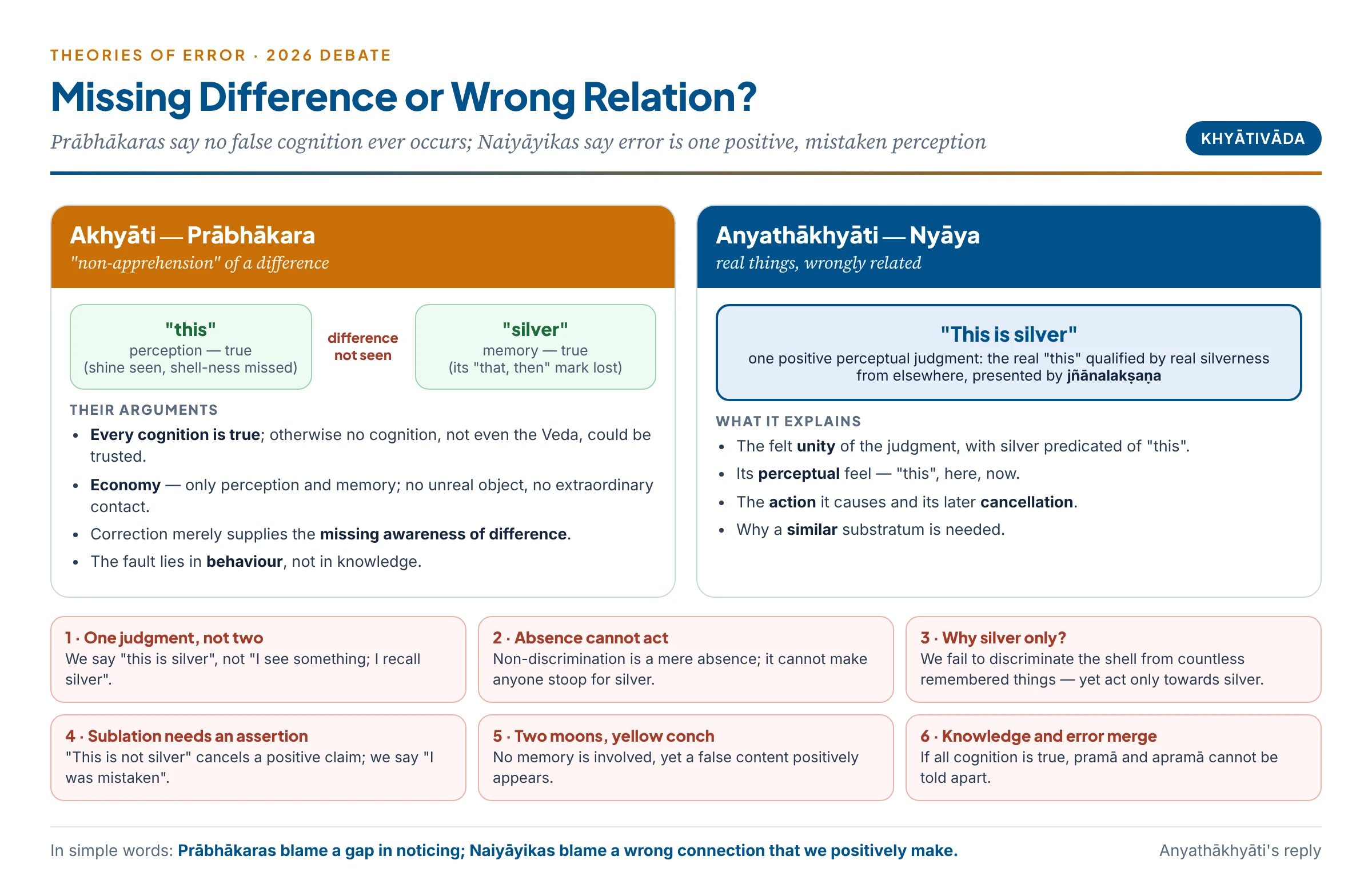
- The starting point. Prabhākara holds that every cognition is true (yathārthaṃ sarva-vijñānam). A cognition cannot misrepresent; if it could, no cognition could be trusted and the authority of the Veda would collapse.
- So there is no “erroneous cognition”. What we call an error is not one false cognition but two true cognitions whose difference is not apprehended:
- A perception of “this” — the shining object, with its common features (whiteness, shine) but not its specific shell-ness, because a defect blocks it.
- A memory of silver — true of silver seen in the past — from which the awareness of “that, in the past” has dropped out. This is lapse of the memory-mark (smṛti-pramoṣa).
- Non-discrimination (vivekāgraha, bhedāgraha). Because I do not grasp that the “this” is perceived and the silver only remembered, the two behave as if they were one cognition of silver here. I reach for it.
- Error belongs to behaviour. The fault is not in any cognition but in the activity that follows — I act towards the shell as I should towards silver.
- The name. A-khyāti — “non-appearance”: nothing false ever appears; what is lacking is the appearance of the difference.
- The Prābhākara arguments.
- Truth of all cognition. If cognitions could misrepresent, we could never trust any of them, and the self-validity of knowledge (svataḥ prāmāṇya) would fail.
- Economy. There is no need to posit unreal objects, indescribable objects or extraordinary contacts. Perception and memory, both familiar, explain everything.
- Absence of a single unreal object. On analysis, every element in “this is silver” is real — “this” is perceived, silver remembered.
- Correction explained. “This is not silver” simply supplies the missing awareness of difference; it does not overturn a positive false cognition.
- Action explained. A true cognition of silver here and the undiscriminated pair “this” + “silver” lead to the same action, so the action is no proof of a single false cognition.
In simple words
A phone rings in a film you are watching, and you reach for your own phone. The Prābhākara would say: you heard a real ringtone (true) and you have a real memory of your own phone ringing (true); you simply failed to notice that the two belong to different places. Nothing false was ever in your mind — only a difference went unnoticed, and your hand made the mistake. The Naiyāyika replies: you did not merely fail to notice; you positively thought “my phone is ringing” — and that thought was false.
6. The Anyathākhyātivādin’s Case against Akhyāti
- The judgment is one, not two. We say “this is silver“, not “I see something” and “I remember silver”. Silver is predicated of “this”. A single unified cognition, with “this” as subject and silver as predicate, is a positive identification, not mere failure to distinguish.
- Absence cannot drive action. Non-discrimination is a negative fact — an absence of knowledge. An absence cannot produce the positive effort of stooping to pick up silver. Only a positive cognition of “silver here” can awaken the desire and the action.
- Why silver and not a thousand other things? At any moment I fail to discriminate the shell from countless remembered things. If non-discrimination were enough, I should act towards all of them. It is the positive presentation of silver in the “this” that singles it out.
- Sublation needs a false cognition. The later cognition “this is not silver” contradicts and cancels an earlier cognition. One can cancel only what was asserted. We also say “I was mistaken” (bhrānto ‘ham) — not “I failed to notice a difference”.
- The two moons and the yellow conch. When the eyeball is pressed, two moons positively appear; when one has jaundice, the white conch looks yellow. No memory is involved here, so the theory of perception + memory cannot explain them. Kumārila presses the same objection.
- Lapse of memory is ad hoc. Why should memory lose its “that”-mark exactly when a similar object is present? The theory assumes the very confusion it should explain.
- It abolishes the distinction between knowledge and error. If every cognition is true, the difference between pramā and apramā disappears, and so does the need for any pramāṇa to check knowledge.
- The anyathākhyāti alternative. All the facts are kept — real “this”, real silver, a positive single cognition, its perceptual feel, its sublation — by saying that real silverness is wrongly presented in the “this” through jñānalakṣaṇa contact.
7. Viparītakhyāti: Kumārila’s Theory
- Kumārila Bhaṭṭa rejects akhyāti, mainly because of cases like the two moons: something positively appears.
- Both terms are real; the relation is wrong. In “this is a serpent”, the existing rope is brought under the serpent-class, which also exists in the world. Error lies in relating two really existing but separate things in the subject–predicate form. “Error always attaches to the wrong relation (saṃsarga), never to the objects related.” In the moon illusion, two real places are wrongly attributed to the one real moon.
- The name. Viparīta-khyāti — “reversed appearance”. The wrong relation makes one act in a way that is the reverse of the right one — treating what is not to be done as what is to be done.
- Closeness to Nyāya. Kumārila’s analysis is very near anyathākhyāti: two reals, one wrong relation. The differences:
- Kumārila keeps intrinsic validity: every cognition is valid when it arises; its invalidity is known extrinsically, by a sublating cognition or the discovery of a defect.
- Kumārila does not explain the presentation of the absent element through jñānalakṣaṇa contact.
Common confusion
Are anyathākhyāti and viparītakhyāti the same theory? They share the core — both terms real, the error in the relation — and many writers treat Kumārila’s view as a version of anyathākhyāti. But they are not identical. Nyāya explains how the absent silver is perceived (jñānalakṣaṇa) and treats both validity and invalidity as extrinsic. Kumārila treats validity as intrinsic and stresses the reversal of behaviour. Some notes also say Kumārila’s error is “memory dominating perception”; his own emphasis is the wrong relation of two real things.
8. Is the Mīmāṃsā Account of Error Consistent with Self-Validity?
- The difficulty. If every cognition is valid by itself (svataḥ), how can any cognition be false?
- Prabhākara’s way out. Deny that any cognition is false. Error is non-discrimination; the “erroneous” cognitions are each true. His theory of error is consistent with self-validity — at the cost of denying error as a cognitive fact.
- Kumārila’s way out. Every cognition claims truth when it arises, and is accepted unless contradicted. Error is a cognition whose claim is later overturned by a sublating cognition or the detection of a defect. Validity is intrinsic; invalidity is extrinsic.
- Nyāya’s criticism.
- If the erroneous “this is silver” arose with the same intrinsic validity as a true cognition, validity cannot belong to cognitions by their nature; it must depend on something beyond them — conformity with the object, checked by successful action.
- Prabhākara’s consistency is bought by denying the obvious — that we positively mistake things.
- Kumārila admits error and so concedes half of the Nyāya position: what can be overturned by later evidence was never self-guaranteed.
9. The Rival Theories of Error
- Ātmakhyāti — Yogācāra Buddhism. The silver is a form of consciousness itself, projected outward. Error consists in taking an internal idea as an external object. Since for the Yogācāra there are no external objects at all, every cognition of externality is in this sense an error; the illusory silver is only a vivid case.
- Nyāya’s criticism: the silver appears as “this“, out there, never as “I” or as a state of mind. The correcting cognition says “this is not silver“, not “this silver is internal“. If ideas could appear as external without any external objects, we could never explain why the illusion needs a shell and not a stone.
- Asatkhyāti — Mādhyamika Buddhism (as presented by rivals). In error the utterly non-existent silver appears. Since all things are empty, every appearance is ultimately the appearance of the non-existent.
- Nyāya’s criticism: the absolutely non-existent — a hare’s horn, a barren woman’s son — never appears to anyone. If the non-existent could appear, illusions would need no similarity and no substratum; anything could appear anywhere.
- Akhyāti — Prābhākara Mīmāṃsā. Two true cognitions, perception and memory, not discriminated (section 5).
- Viparītakhyāti — Kumārila. Two real things wrongly related; behaviour reversed (section 7).
- Anyathākhyāti — Nyāya–Vaiśeṣika. A real “this” presented as qualified by a real feature that exists elsewhere (sections 3–4).
- Anirvacanīyakhyāti — Advaita Vedānta. The silver is a temporary creation of ignorance, neither real nor unreal (section 10).
- Satkhyāti (yathārthakhyāti) — Rāmānuja. Even in error what appears is real: by the mixing of the elements in creation, every material thing contains particles of every other, so a shell really contains some silver. Error is only incomplete cognition of what is there.

| Theory | School | What appears as “silver”? | Is the cognition false? |
|---|---|---|---|
| Ātmakhyāti | Yogācāra | An idea in consciousness, projected outward | Yes — inner taken as outer |
| Asatkhyāti | Mādhyamika (as rivals present it) | Something utterly non-existent | Yes |
| Akhyāti | Prābhākara | Remembered real silver, not distinguished from the perceived “this” | No — two true cognitions; behaviour is faulty |
| Viparītakhyāti | Kumārila | Real silver-class, wrongly related to the real rope or shell | Yes — wrong relation |
| Anyathākhyāti | Nyāya–Vaiśeṣika | Real silver existing elsewhere, presented here by jñānalakṣaṇa | Yes — wrong qualification |
| Anirvacanīyakhyāti | Advaita | A momentary silver created by ignorance, neither real nor unreal | Yes — the object itself is indescribable |
| Satkhyāti | Rāmānuja | Real silver particles actually present in the shell | No — only incomplete |
10. Nyāya and Advaita on Error
- The stakes. Advaita explains the world on the model of an illusion: Brahman appears as the world as a rope appears as a snake. If Nyāya can explain every illusion through real elements, the illusion-model cannot be used to show the world’s unreality.
- The Advaita criticism of anyathākhyāti.
- Absurd displacement. To perceive here and now an object that exists at another place and time is absurd. However vivid a memory, it presents a “that” (seen there, then), never a “this” (present here, now). Nyāya cannot explain the presence of the illusory silver.
- No transport. A memory-idea cannot dislocate real silver from the shop and set it on the beach.
- Which silver? If the silver is real silver elsewhere, which piece of silver is it? No particular silver is presented.
- Even Nyāya must admit mystery. By calling it an extraordinary perception, the Naiyāyika concedes that something appears here that is not here.
- Too much perception. If past cognitions can serve as contacts, every inference and memory could be called perception.
- The Advaita alternative — anirvacanīyakhyāti.
- Ignorance (avidyā) conceals the real form of the object (the rope) and projects the appearance of another (the snake).
- Defective senses, insufficient light, similarity and a revived impression help this ignorance create a positive appearance present here and now.
- This snake is a temporary creation (sṛṣṭi) of ignorance. It is not real, because it is sublated by the later cognition of the rope. It is not unreal, because it appears, unlike a barren woman’s son, which never appears. So it is indescribable (anirvacanīya) as either.
- It has only apparent existence (prātibhāsika sattā); the rope has empirical existence; Brahman alone is absolutely real.
- From illusion to world. Śaṅkara describes superimposition (adhyāsa) as “the appearance, in a later locus, of what was experienced before”. Through ignorance we superimpose on pure being the forms of objects; the world, like the snake, is an appearance on a real ground. Advaita distinguishes root ignorance (mūlāvidyā), which projects the world, from minor ignorance (tūlāvidyā), which causes a passing illusion.
- Nyāya’s reply to Advaita.
- A third category is unintelligible. Whatever is must either be or not be; “neither real nor unreal” violates the law of excluded middle. Calling the snake indescribable describes nothing.
- Realism can explain presence. Through jñānalakṣaṇa, the real silverness known before is genuinely presented now; presence belongs to the cognition, not to a newly created object.
- Creation by ignorance is ad hoc. Ignorance is an absence of knowledge; an absence cannot create a positive object.
- Illusion presupposes reality. Every illusion requires a real substratum and a real element known before; the snake can appear only because real snakes have been seen. So illusion, far from proving the world unreal, presupposes a real world perceived at least in the past. The unreality of the world at all times can never be proved from illusion.
- Sublation shows the real. The correcting cognition “this is a rope” is itself a cognition of the real; there is no evidence that it in turn will be sublated.
Common confusion
Is the Advaita snake “unreal” (asat)? No. Advaita explicitly rejects the view that the illusory snake is non-existent: the utterly non-existent, like a hare’s horn, never appears, while the snake does appear. It also rejects calling it real, since the rope-cognition cancels it. That is why it is called indescribable (anirvacanīya). Do not confuse Advaita’s anirvacanīyakhyāti with the asatkhyāti attributed to the Mādhyamika, or with the ātmakhyāti of the Yogācāra, which makes the snake a mental idea. Advaita insists on a real ground — Brahman — behind every appearance.
Critical Evaluation
Objections (Pūrva-pakṣa)
- Prābhākara. Error as a positive false cognition destroys trust in all cognition; jñānalakṣaṇa is an uneconomical device.
- Advaita. Nyāya cannot explain the presence of the illusory object; “real silver elsewhere” is never what we experience; jñānalakṣaṇa blurs perception and memory.
- Buddhist. The silver does not exist anywhere as that silver; “real but misplaced” is a realist fiction imposed on experience.
- General. If one can perceive things not in contact with the senses, the line between perception, memory and imagination becomes hard to draw. And Nyāya’s realism treats the content of every illusion as previously experienced — yet we sometimes see novel shapes in clouds or in fever that we have never seen before.
Defences and Strengths
- Faithful to experience. It keeps the felt facts: one judgment, a “this”, a positive mistake, fear or desire, action, and later correction (“I was mistaken”).
- Realism without unreal objects. Every element of an illusion is real; only the relation is false — the most economical realist account.
- Explains the need for a substratum and similarity. Illusions arise on a similar object, not on anything at random — as anyathākhyāti predicts and asatkhyāti cannot.
- Fits extrinsic validity. Both truth and falsity are found by checking cognition against further experience — a pattern later adopted by modern fallibilist epistemology.
- Blocks the illusion argument for idealism. Since every illusion presupposes real elements, illusion cannot show that the whole world is unreal.
- Novel shapes. The “novel” fevered shape is made up of real elements — colours, shapes, parts — each experienced before, combined in a wrong relation.
Critics and Defenders
Criticism — Critics
- Prābhākaras: a false cognition would make all cognition untrustworthy; jñānalakṣaṇa is an extra device.
- Advaitins: memory gives “that”, never “this”; Nyāya cannot explain the illusory object’s presence; its own word “extraordinary” admits a mystery.
- Buddhists: “real silver elsewhere” is not what appears; realism is imposed on experience.
- Modern critics: extraordinary contact blurs perception, memory and imagination.
Defence — Defenders and strengths
- Error is felt as one positive judgment that is later cancelled — exactly as anyathākhyāti says.
- Absence cannot cause action; non-discrimination cannot make anyone reach for silver.
- Every illusion needs a real substratum, similarity and a past experience — the world cannot be one great illusion.
- “Neither real nor unreal” is logically unintelligible; Nyāya keeps the law of excluded middle.
- Error lies in the relation, not in the relata — realism and fallibility are reconciled.
Cross-Tradition Comparison
Indian Theories of Error and Western Philosophy
| Indian view | Core idea | Western parallel |
|---|---|---|
| Nyāya realism | Cognition reveals the object as it is, like a lamp | Direct realism — Moore, Thomas Reid; Aristotle’s mind receiving forms |
| Sautrāntika | We see a copy; the object is inferred | Locke’s representative realism |
| Yogācāra (ātmakhyāti) | Ideas mistaken for external objects | Berkeley’s idealism |
| Asatkhyāti | The non-existent appears | Meinong — objects that do not exist but are intended |
| Akhyāti | No false cognition; error is privation of discrimination | Spinoza — falsity is a privation of knowledge; Plato’s Theaetetus: false judgment as fitting a perception to the wrong memory-imprint |
| Anyathākhyāti / Viparītakhyāti | Real terms, false relation | Descartes — error lies in judgment, not in ideas; Russell’s multiple-relation theory of judgment |
| Anirvacanīyakhyāti | Appearance neither real nor unreal, sublated by knowledge | Kant‘s appearance and thing-in-itself (though for Kant appearances are not illusions); Bradley‘s appearance and reality |
| Satkhyāti | Everything that appears is in some way present | Anaxagoras — “in everything there is a portion of everything” |
| Correction by later experience | Sublation; extrinsic validity | Peirce’s fallibilism; correspondence-plus-coherence tests of truth |
Indian Connect — Key takeaways
- “Theory of appearance” in Nyāya–Vaiśeṣika is realism: what appears in valid cognition is the real world; cognition is a formless light.
- The Indian khyātivāda debate is one of the richest discussions of illusion anywhere — seven distinct theories built round one shell and one rope.
- Akhyāti and anyathākhyāti divide on one question: is error a positive cognition or only a missing discrimination?
- Nyāya’s jñānalakṣaṇa perception explains why an illusion is felt as seeing, not remembering.
- Against Advaita, Nyāya argues that every illusion presupposes a real world; the snake can only appear because real snakes exist.
Synthesis (Siddhānta)
- Appearance in Nyāya–Vaiśeṣika is the self-presentation of the real. Objects exist independently, are knowable and nameable, and appear in valid cognition as they are.
- Error is not the appearance of the unreal but a wrong relation between real elements: a real “this” cognised as qualified by a real feature that exists elsewhere — anyathākhyāti.
- Jñānalakṣaṇa contact explains how the absent feature is perceived here and now; defect, similarity and impression explain why.
- Against akhyāti, Nyāya shows that error is a single positive cognition that moves us to act and is later cancelled; against anirvacanīyakhyāti, it insists that “neither real nor unreal” is unintelligible and that illusion presupposes a real world.
- Both truth and error are known extrinsically, through further experience and successful action.
- Even Śaṅkara defines superimposition as the appearance of something previously experienced — the realist’s point that every illusion borrows its material from a real world.
- Contemporary relevance.
- Cognitive science. Visual illusions (the Müller-Lyer lines, the hollow-mask illusion) are explained as the brain applying real, learnt patterns to the wrong input — close to anyathākhyāti.
- Misinformation. A deep-fake or a doctored photo combines real elements wrongly; the mistake lies in the relation (“this person said this”), not in the parts.
- Eyewitness error. Witnesses often merge a real face seen elsewhere with a present scene — the memory research on “source confusion” matches both akhyāti (non-discrimination) and anyathākhyāti (misplacement).
- Science. Theories are corrected, not proved from within; truth is checked by further evidence — the extrinsic model.
- Debates on realism. The Nyāya argument that illusion presupposes reality remains a standard realist reply to “brain-in-a-vat” style scepticism.
“Superimposition is the apparent presentation, in the form of remembrance, of something previously observed in some other thing.” — Śaṅkara
Previous Year Questions
- 2026Critically explain the arguments presented by the Akhyātivādins for explaining erroneous cognition. Evaluate the arguments against Akhyātivādins by the Anyathākhyātivādins.
- 2022In-spite of accepting the intrinsic validity of knowledge, why and how Prabhakar and Kumarila differ in their interpretation of erroneous cognition? Discuss.
- 2021How do the advocates of anirvacaniya-khyati refute the position of the Naiyayikas and establish the position of Advaitins regarding the problem of error? Critically discuss.
- 2019What is the role of Jñānalakṣaṇa pratyakṣa in explaining Anyathākhyāti?
- 2015Is anyathakhyativada an adequate explanation of error?
- 2012Explain the theory of illusion accepted by Buddhist. Is it consistent with their philosophy? Give reasons for your answer.
- 2002What is Svatahpramanyavada according to Mimamsakas? Is their explanation of error consistent with it? Discuss fully.
- 2001Kumarila Bhatta’s explanation of perceptual error. Notes.
- 1993How is error explained in Nyaya and Advaita Philosophy? Which explanation is more reasonable and why?