

Nyāya–Vaiśeṣika: Theory of Categories; Theory of Appearance; Theory of Pramāṇa; Self, Liberation; God; Proofs for the Existence of God; Theory of Causation; Atomistic Theory of Creation
Official Syllabus: Paper I, Section B, Unit 15
Perception and inference are knowledge we produce ourselves. But most of what any of us knows — that Japan lies across the sea, that atoms exist, what a “saxophone” is, what happened in 1947 — reaches us through other people’s words. Nyāya accepts two further sources of valid knowledge to explain this: upamāna (comparison), by which we learn which thing a new word names, and śabda (verbal testimony), by which we learn facts from the words of a reliable person (āpta). This article explains both, the conditions under which a string of words yields knowledge (ākāṅkṣā, yogyatā, sannidhi, tātparya), primary and secondary meaning (śakti and lakṣaṇā), whether words mean universals or individuals, the authority of the Veda, and Nyāya’s long debates with the Mīmāṃsakas on comparison and on verbal knowledge (śābdabodha).
In simple words
You have never seen a dragon fruit. A friend tells you: “It looks like a pink pinecone with green flame-like scales.” A week later, at a fruit stall, you spot a pink, scaly fruit and say, “So this is a dragon fruit!” Your friend’s words alone did not let you point to it; your eyes alone did not tell you its name. Words and sight together taught you what the name “dragon fruit” applies to — that is upamāna. And when you believe your friend’s report that dragon fruit is grown in Gujarat, without ever going there, that is śabda.
Context & Problem
Knowledge That Depends on Others
- The four pramāṇas. Nyāya accepts four sources of valid knowledge: perception (pratyakṣa), inference (anumāna), comparison (upamāna) and testimony (śabda). The first two were explained in Articles 2–4.
- Two “social” pramāṇas. Upamāna and śabda both begin with someone else’s statement. They explain how knowledge is shared in a community and handed on across generations.
- Perception underlies both. We must hear the words and see the object. That is why Nyāya calls perception the most basic pramāṇa (Article 2) — yet it insists that what upamāna and śabda yield cannot be reduced to perception.
The Rival Positions
- Cārvāka. Only perception is valid. Comparison gives no real knowledge, and testimony — especially the Veda — is the invention of self-serving priests.
- Vaiśeṣika and Buddhists. Accept only two pramāṇas, perception and inference. Comparison and testimony are reduced to them.
- Sāṃkhya. Accepts testimony but treats comparison as a form of inference.
- Jainas. Treat comparison as a kind of recognition (pratyabhijñā).
- Mīmāṃsā and Advaita Vedānta. Accept comparison as independent but give it a different object: the similarity of a remembered thing to a perceived one. They place śabda, above all the Veda, at the centre of knowledge.
- Nyāya’s thesis. Comparison and testimony are independent sources, each producing a distinct kind of knowledge (pramā), and the Veda is valid because its author, God, is the most reliable of speakers.
Common confusion
Does Advaita Vedānta reject upamāna as a pramāṇa? No. Advaita accepts six pramāṇas — perception, inference, comparison, testimony, postulation (arthāpatti) and non-cognition (anupalabdhi) — and comparison is one of them. What Advaita rejects is the Nyāya account of comparison: like the Mīmāṃsakas, it holds that comparison yields knowledge of similarity (“my cow is like this gavaya”), not knowledge of a word’s meaning. Some notes say Advaita reduces comparison to perception and memory; that is a criticism Advaita makes of the Nyāya version, not a rejection of upamāna itself.
Core Doctrine
1. Upamāna: Knowing What a Word Names
- Etymology. Upa means near, resembling; māna means knowing, measuring. Upamāna is knowledge that comes through resemblance.
- Gautama’s definition. Upamāna is “the knowledge of a thing through its similarity to a well-known thing” (prasiddha-sādharmyāt sādhya-sādhanam).
- Its distinctive object. For Nyāya, comparison gives knowledge of the relation between a name and the thing named (saṃjñā–saṃjñi-sambandha) — the denotation of a word.
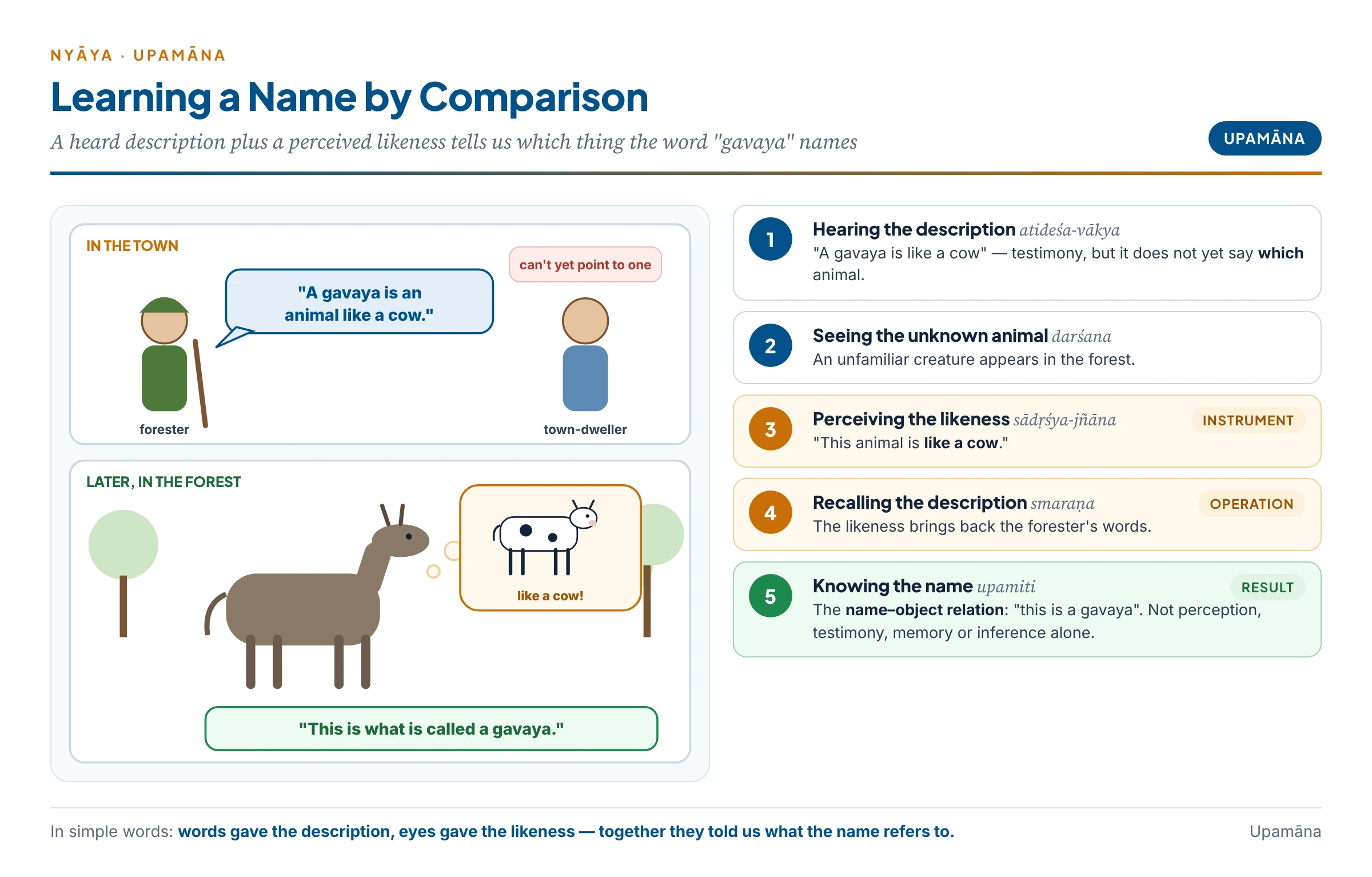
- The classic example — the gavaya. A town-dweller does not know what a gavaya (a wild ox, the nilgai) is. A forester tells him: “A gavaya is an animal like a cow.” Later, in the forest, he sees an animal resembling a cow, recalls the forester’s words, and knows: “This is what is called a gavaya.“
- More examples.
- The jackdaw. A boy is told a jackdaw is “like a crow, but bigger and of glossy black colour”. When he next sees one and says, “This must be a jackdaw”, he has learnt the denotation of the word.
- The saxophone. A musician says: “A saxophone is a musical instrument something like a U-shaped trumpet.” If on seeing one you can name it, you understand what “saxophone” means.
- The jaguar. A man who knows leopards is told a jaguar is “like a leopard, but with a barrel-like body”. In the American forest he sees such an animal and knows, “This must be a jaguar.”
- What it is not. It is not knowledge that the gavaya is similar to the cow — that he already heard. It is the new knowledge that this animal in front of me is what the word “gavaya” names.
In simple words
Think of a field guide for birds. It says: “The Indian roller is like a jay, but with a bright blue band on the wing in flight.” You see a bird flash blue as it takes off and say, “That’s an Indian roller!” The guide gave the description; your eyes gave the similarity; together they taught you which bird the name belongs to. Medical students collecting herbs from descriptions in a textbook of medicinal plants do exactly the same.
2. How Comparison Works: The Steps
- Step 1 — Hearing the description (atideśa-vākya). “A gavaya is like a cow.” This is testimony, but it does not yet tell you which animal is a gavaya.
- Step 2 — Seeing the unknown object (darśana). In the forest you see an unfamiliar animal.
- Step 3 — Perceiving the similarity (sādṛśya-jñāna). You notice that it resembles a cow. This perception of similarity is the instrument (karaṇa) of comparison.
- Step 4 — Recalling the description (smaraṇa). The perceived similarity reminds you of the forester’s words. This recollection is the operation (vyāpāra) that links instrument and result.
- Step 5 — The result (upamiti). “This animal is what is called a gavaya.” This knowledge of the name–object relation is the fruit of comparison.
- Two grounds. The grounds of comparison are always two: a given description of the unknown thing, and the perception of its similarity to a familiar thing mentioned in that description.
3. Kinds of Comparison
- Originally one kind. Early Nyāya recognised one kind — knowing a thing as named by a word through its similarity to a familiar object.
- Later, three kinds. Later Naiyāyikas noticed that a description can work through likeness, contrast or a unique mark:
- Sādharmya-upamāna — by similarity. The gavaya is “like a cow”.
- Vaidharmya-upamāna — by dissimilarity. You are told a horse is “unlike a cow, it has no cloven hoofs“; seeing such an animal, you know it is a horse. A camel may be described as “unlike other animals, with a long curved neck and a hump”.
- Dharmamātra-upamāna — by a peculiar property alone. “The rhinoceros has a single horn on its nose”; “the karabha (camel) is a long-necked animal with projecting lips that feeds on thorns”. The unique mark lets you pick out the thing and attach the name.
- A fourth use (later Nyāya). One may learn an unknown property through similarity: told that a herb resembling a known plant is an antidote to poison, one finds such a herb and knows that it is an antidote. Even here, comparison identifies an object from a description; it is not reasoning from resemblance to resemblance.
Common confusion
Are the three kinds of upamāna “new from known, known from unknown, and mutual”? No. Some notes list the kinds of comparison as knowing a new object from a known one, a known object from an unknown one, and two objects mutually. That is not the Nyāya classification. Nyāya’s three kinds are by similarity, by dissimilarity, and by a peculiar property. The idea of moving “back” from the gavaya to the familiar cow (“my cow is like this gavaya”) is in fact the Mīmāṃsā account of comparison, which Nyāya rejects (section 6 below).
4. Why Comparison Is an Independent Pramāṇa
- Not perception. Perception gives “this animal is like a cow“. It cannot give “this is called a gavaya“, because a name is not a visible property of the animal.
- Not testimony. The forester’s words alone do not let the town-dweller pick out a gavaya: before he goes to the forest, he cannot point to any animal and say “that is a gavaya”. Testimony supplies the description; comparison supplies the application of the name.
- Not memory. Memory only repeats what was known before. The knowledge “this is a gavaya” is new; recollection of the description is only a step in it.
- Not inference.
- Inference proves something unperceived (fire on the hill) from something perceived (smoke). In comparison the object — the gavaya — is in front of you; what is new is only its name.
- Inference needs a universal relation (vyāpti) known beforehand, and a middle term. Comparison uses no “wherever there is X, there is Y” — only a description and a perceived similarity.
- The inner awareness differs: after inference we feel “I infer“; after comparison we feel “I identify by likeness” (upamimīte). Nyāya uses this difference in self-awareness (anuvyavasāya, Article 1) as evidence that the instruments differ.
- Later Nyāya’s refinement. For Gaṅgeśa, comparison gives knowledge of the basis for applying a word (pravṛtti-nimitta) — the feature that triggers its correct use. Similarity means that one thing has a large number of the properties found in another (bhūyo-dharma-vattva). When the animal in front of me shows those shared properties, I grasp the basis on which the word “gavaya” is to be applied.
5. Other Schools on Comparison
| School | Status of upamāna | Their explanation |
|---|---|---|
| Cārvāka | Not a pramāṇa | Gives no true knowledge of what words denote |
| Buddhist logicians | Valid, but not separate | Reduce it to perception + testimony |
| Vaiśeṣika, Sāṃkhya | Not separate | A form of inference |
| Jaina | Not separate | A kind of recognition (pratyabhijñā) |
| Mīmāṃsā, Advaita | Independent, different object | Knowledge of the similarity of the remembered object to the perceived one |
| Nyāya | Independent | Knowledge of the name–object relation through perceived similarity |
6. The Nyāya–Mīmāṃsā Debate on Comparison
- The Mīmāṃsā view. On seeing a gavaya in the forest, a man who has a cow at home perceives that this animal is like his cow. From this he comes to know: “My cow at home is like this gavaya.” The object of comparison is the similarity residing in the remembered, absent object — the cow.
- Rat and mouse. On seeing a rat one perceives that it is like a mouse seen earlier, and so knows “that mouse is like this rat“.
- Why this cannot be another pramāṇa (Mīmāṃsā’s argument).
- Not perception — the cow known to be similar is not present to the senses.
- Not memory — when the cow was seen, its similarity to a gavaya was not then known, so it cannot be merely remembered.
- Not inference — to infer “the cow is like this gavaya” from “this gavaya is like the cow” one would need a general premise such as “whatever is like a thing is like that thing in turn”. No such premise is actually used.
- Not testimony — nobody tells us this.
- Similarity as a separate category. The Mīmāṃsakas treat similarity (sādṛśya) as an independent kind of reality. It is not a quality, because qualities themselves can be similar, and a quality cannot have a quality. It is not a universal, because a universal is exactly the same in all its instances, while similarity is never complete identity.
- Śabara’s analogical use. The early commentator Śabara used upamāna almost like an analogical argument: “Just as you feel your own self, so by analogy other people feel theirs” — a way of knowing other selves.
- Mīmāṃsā’s attack on Nyāya. In the Nyāya account, the knowledge “this animal is like a cow” is perception; the knowledge that “an animal like a cow is a gavaya” comes from recollecting the forester’s words; and “this animal is a gavaya” is then a simple inference. So nothing is left for a new pramāṇa.
- Nyāya’s replies.
- Similarity is mutual. If the gavaya is like the cow, the cow is like the gavaya. Knowing the second is part of knowing the first, so the Mīmāṃsā “result” is only a by-product of perception and memory, not a new kind of knowledge.
- No separate category is needed. Similarity is just the possession of many common properties by two things — a matter of qualities and universals already admitted.
- Word meaning must be learnt somehow. If comparison does not give the meaning of new words, how do we learn names of things never pointed out to us? Testimony alone cannot connect the word with this animal; comparison does.
- No vyāpti is used, so the Mīmāṃsā attempt to reduce Nyāya comparison to inference fails.
- What the debate shows. Nyāya’s interest is linguistic and logical: comparison is a bridge between words and things. Mīmāṃsā’s interest is in resemblance between things; for it, the meaning of words is learnt from usage and testimony.
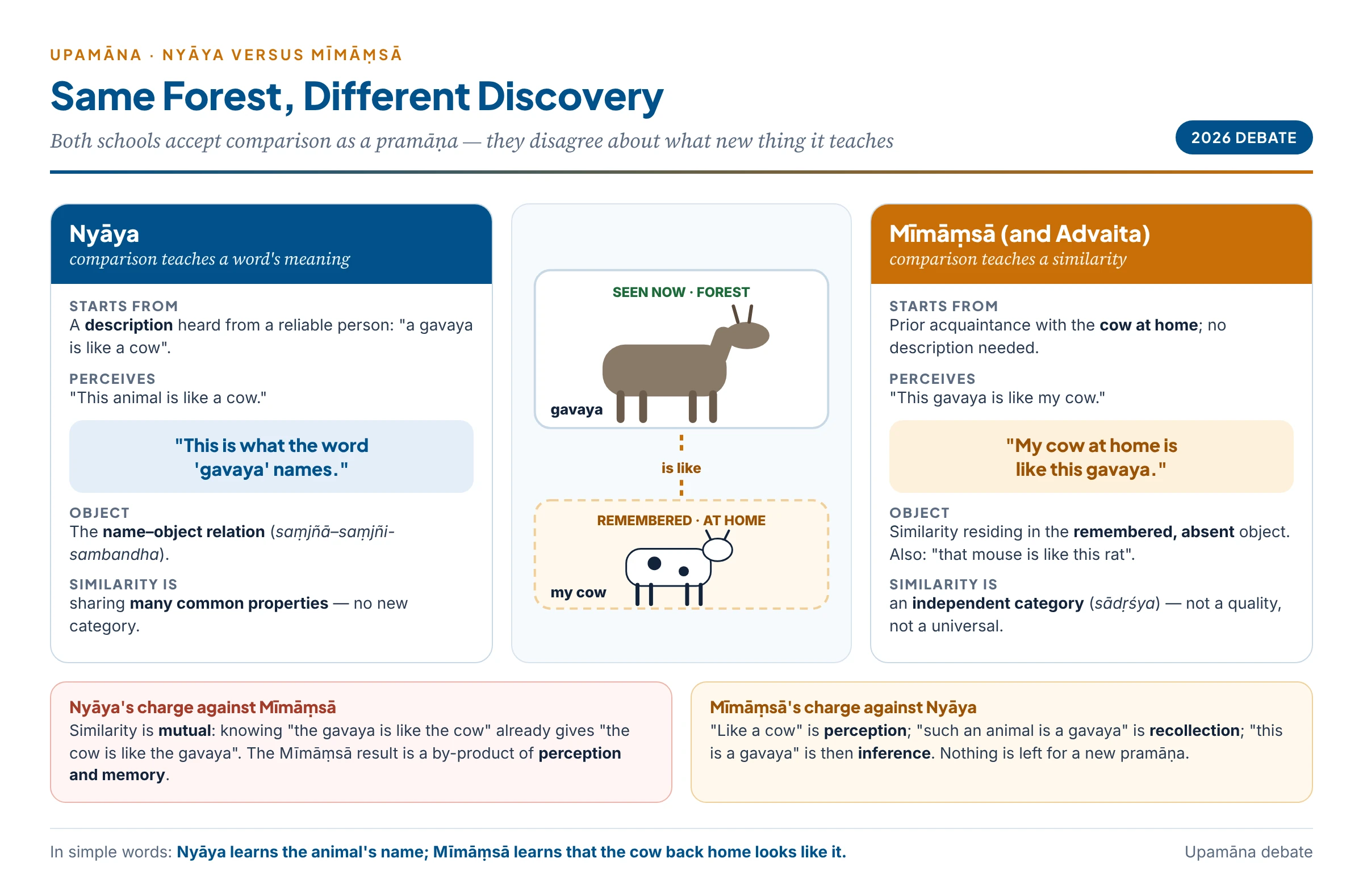
| Point | Nyāya | Mīmāṃsā (and Advaita) |
|---|---|---|
| Object of comparison | The name–object relation: “this is called a gavaya” | The similarity of the remembered cow to the perceived gavaya |
| Starting point | A description heard from a reliable person | Prior acquaintance with the cow; no description needed |
| Role of language | Central — comparison teaches denotation | Secondary — word meaning comes from testimony and usage |
| Status of similarity | Possession of many common properties | An independent category (sādṛśya) |
| Number of pramāṇas | Four | Five (Prābhākara) or six (Bhāṭṭa, Advaita) |
| Each side’s charge | Mīmāṃsā’s result is perception plus memory | Nyāya’s result is perception, memory and inference |
7. Śabda: The Word of a Reliable Person
- Literal meaning. Śabda means “word” or “sound”. As a pramāṇa, it is valid verbal testimony — knowledge of objects derived from words and sentences.
- Gautama’s definition. “Testimony is the instruction of a reliable person” (āptopadeśaḥ śabdaḥ).
- Not all verbal knowledge is valid. Rumour, propaganda and lies are also words. Only the statement of a person who knows the truth and speaks it for the guidance of another counts.
- Two conditions.
- Validity depends on the statement coming from a trustworthy person.
- Possibility depends on understanding the meaning of the statement. Hearing sounds in an unknown language gives no knowledge.
- So śabda, as a pramāṇa, consists in understanding the meaning of the statement of a trustworthy person.
- Who is an āpta? The commentator Vātsyāyana describes the reliable person as one who:
- Has directly known the matter (sākṣāt-kṛta-dharmā) — knowledge, not hearsay.
- Wishes to convey it as it is (yathā-dṛṣṭa-artha-cikhyāpayiṣā) — honesty and goodwill; no intention to deceive.
- Is able to express it — competent speech.
- Authority is not a matter of birth. Vātsyāyana adds that an āpta may be a sage, an ārya or even a mleccha (foreigner). What makes testimony valid is knowledge plus truthfulness, not caste, rank or community.
- Why śabda is a separate pramāṇa.
- Unlike perception, it does not arise from contact of sense and object.
- Unlike inference, it does not rest on a middle term and vyāpti.
- Unlike comparison, it does not rest on resemblance.
- Its reach. It gives knowledge of things beyond our own experience — history, distant places, scientific discoveries, moral and spiritual truths.
- Conditions and process (as commonly listed).
- Conditions: the words of a trustworthy person; clear expression; use of words according to accepted convention. If any is missing, the result is false testimony, gossip or propaganda.
- Process: a well-formed sentence is uttered → the hearer understands its meaning through the conventions of language → the reliability of the speaker is recognised → the hearer gains new knowledge he could not have got otherwise.
- Example. A child hears from his teacher: “There is a country called Japan across the sea.” He has never seen Japan, but by trusting the teacher he gains valid knowledge.
In simple words
You have a high fever. A qualified doctor says, “This is dengue; drink plenty of fluids.” You did not perceive the virus and did not infer it — you know it because a person who knows, and has no reason to mislead you, told you. Now imagine the same sentence from a stranger on social media. The words are the same; the source is not. Nyāya says the difference lies entirely in whether the speaker is an āpta.
8. Kinds of Śabda
- By the nature of the object.
- Dṛṣṭārtha — about perceptible things. The evidence of a witness in a law court; a reliable farmer’s statement about plants; “there are mango trees in that orchard” — which you could go and verify.
- Adṛṣṭārtha — about imperceptible things. A scientist’s statements about atoms, electrons, vitamins; a prophet’s teaching on virtue and vice; scriptural statements on God, freedom and immortality.
- By the nature of the source.
- Vaidika — scriptural. The words of God. Being perfect and infallible by nature, they are always valid.
- Laukika — secular. The words of human beings, which may be true or false; only those from trustworthy persons are valid.
- What both classifications agree on. Testimony is always personal — based on the words of some trustworthy person, human or divine. In respect of truth, there is no difference between the trustworthy statement of an ordinary person, a saint, a prophet or the scripture.
Common confusion
Does Nyāya hold that the Veda is authorless (apauruṣeya)? No — that is the Mīmāṃsā view. Some notes describe Nyāya’s scriptural testimony as “eternal, authorless Vedas”. For Nyāya the Veda is made by God (Īśvara). Its authority comes from the reliability of its author, just as a medical treatise is trusted because its author knew medicine. Nyāya actively argues against the eternity of words and of the Veda (section 14 below).
9. Words, Their Power and How We Learn Them
- Sentence and word. A sentence (vākya) is a group of words arranged in a certain way. A word (pada) is a group of letters in a fixed order.
- Śakti — the power of a word. A word has a fixed relation to some object, so that hearing it calls that object to mind. This capacity is its potency (śakti). Words are thus significant symbols.
- Its source. Older Nyāya holds that this fixed relation is due to the will of God (Īśvara-saṅketa): “from this word, this object is to be understood”. God is the ground of all order and uniformity in the world, including the order of language. Later Naiyāyikas add that human convention (ādhunika-saṅketa) also creates meanings — a newly named child, a technical term coined by a science.
- How the meaning of a word is learnt (śakti-graha). Tradition lists eight ways:
- Grammar — the meaning of suffixes and endings.
- Comparison (upamāna) — the gavaya case.
- Dictionary (kośa).
- Statement of a reliable person — “this is called a pika (cuckoo)”.
- Usage of elders (vyavahāra) — the chief way for children (see section 15).
- The rest of the sentence (vākya-śeṣa) — context fixes an unfamiliar word.
- Explanation or paraphrase (vivṛti).
- Nearness of a known word (siddha-pada-sānnidhya) — “the pika sings sweetly on the mango tree”.
- Kinds of words by how they mean.
- Yaugika (derivative) — meaning from the parts: pācaka, “one who cooks”.
- Rūḍha (conventional) — meaning fixed by usage, not by parts: go, “cow”.
- Yoga-rūḍha (derivative but restricted) — paṅkaja, literally “mud-born”, but used only for the lotus, not for every mud-born thing.
- Letters and words: no sphoṭa. The grammarians (above all Bhartṛhari) hold that meaning is carried by an indivisible, eternal sphoṭa — a “bursting forth” of the whole word or sentence. Nyāya rejects this: the last letter, heard together with the impressions left by the earlier letters, produces the cognition of the word. No extra entity is needed.
- Sound is not eternal. For Nyāya, sound is a quality of ether (ākāśa). It is produced (by striking, by speech) and destroyed, and it travels like ripples on water or like a kadamba bud sprouting in all directions, each sound producing the next until the last reaches the ear.
10. What Do Words Mean — Universal, Individual or Both?
- The problem. When I say “cow”, do I mean this cow, all cows, or cowness? The answer decides how words can apply to new cases and how they can be learnt.
- Nyāya — all three together. Gautama says the meaning of a word is the individual (vyakti), the configuration (ākṛti, the arrangement of parts) and the universal (jāti) together. Which one is prominent depends on the sentence:
- “Give a cow” — the individual is prominent; you cannot give cowness.
- “A cow is not to be touched with the foot” — the universal is prominent; the rule covers every cow.
- “Make a cow of flour-dough” — the configuration is prominent; only the shape is copied.
- Later Nyāya. The word “cow” means an individual qualified by the universal cowness (jāti-viśiṣṭa-vyakti). Both are meant, with the universal serving as the qualifier.
- Mīmāṃsā — the universal. The primary meaning of a word is the universal (jāti or ākṛti):
- If words meant individuals, a word would need infinitely many separate powers, one for each cow (ānantya).
- A word learnt from one cow could never apply to a new cow (vyabhicāra).
- The individual is understood only because a universal cannot exist without individuals — Kumārila says it is known by implication (ākṣepa). The Prābhākaras say the individual is presented along with the universal as its substratum.
- Buddhists — apoha. Words mean neither real universals nor real individuals but the exclusion of what is other (apoha): “cow” means “not non-cow” (Unit 14).
- Nyāya’s criticism. If “cow” meant only cowness, “bring the cow” would be absurd — one cannot bring a universal. If it meant only the individual, the word could not apply to other cows. So both must be meant.
| School | Primary meaning of “cow” | How the rest is known |
|---|---|---|
| Early Nyāya | Individual + configuration + universal together | Context decides which is prominent |
| Later Nyāya | Individual qualified by cowness | Universal acts as the qualifier |
| Bhāṭṭa Mīmāṃsā | Universal (cowness) | Individual by implication |
| Prābhākara Mīmāṃsā | Universal (cowness) | Individual presented as its substratum |
| Buddhist | Apoha — exclusion of non-cows | No real universal at all |
11. Four Conditions of a Meaningful Sentence
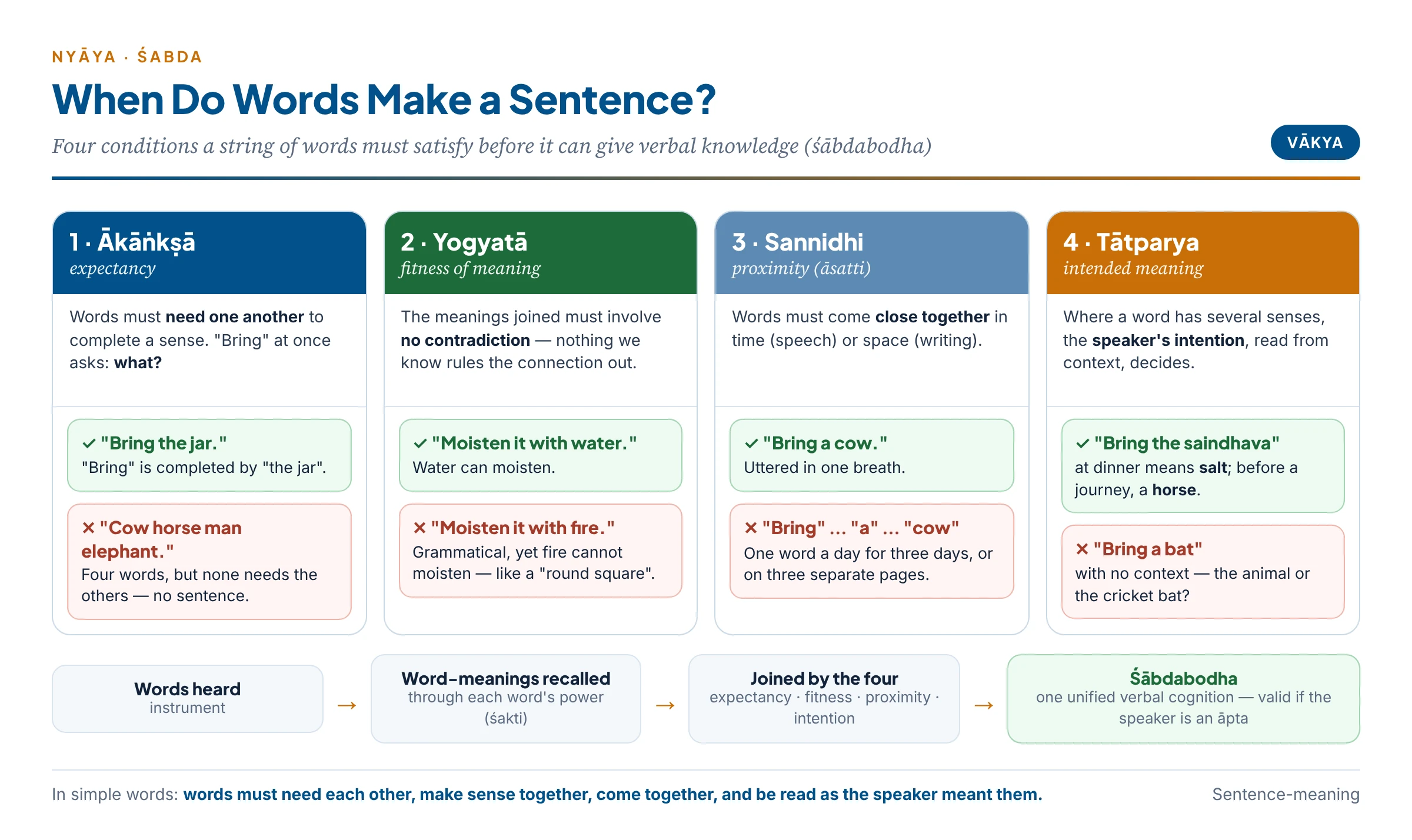
- The problem. Any combination of words does not make a meaningful sentence. “Cow horse man elephant” are words, but they say nothing. Nyāya lists four conditions for a sentence to yield verbal knowledge (śābdabodha):
- Ākāṅkṣā — expectancy. The words must need one another to complete a sense. On hearing “bring“, one asks “what?“; “the jar” fulfils the need. In “cooks rice“, “cooks” asks “cooks what?” and “rice” answers. A list of nouns lacks this mutual need. Gaṅgeśa defines expectancy as the incompleteness of a word’s reference without the other.
- Yogyatā — fitness. There must be no contradiction between the meanings joined. “Moisten it with fire” or “sprinkle water with fire” is grammatical but absurd, because fire cannot moisten. So is “today I saw a round square“. Gaṅgeśa defines fitness as the absence of known counter-evidence that would block the connection.
- Sannidhi (or āsatti) — proximity. The words must be continuous in time or space. “Bring a cow” spoken one word a day over three days, or written on three different pages, makes no sentence, though it has expectancy and fitness. Even a ten-minute pause between “bring” and “water” breaks the sentence.
- Tātparya — intended meaning. A word may mean different things; the speaker’s intention decides. “Bring a bat” may mean the animal or the cricket bat. “Bring the saindhava” means salt at the dinner table and a horse (from Sindh) when setting out on a journey. For human speech, intention is gathered from context (prakaraṇa); for the Veda, from the rules of interpretation worked out by Mīmāṃsā.
- Three or four? Gaṅgeśa counts the first three as the conditions of verbal knowledge and treats knowledge of intention as an additional requirement; the standard list gives all four.
- When testimony fails. Testimony does not give knowledge in cases like these:
- A false statement (anṛta) — “the sun rises in the west”.
- An unreliable speaker — a habitual liar, or a layman speaking about quantum physics.
- Disordered words — “cow sky runs sleep fire” lacks expectancy and order.
- Absurd combinations — “cook rice with ice” lacks fitness.
- Missing the intention — taking “he is a lion” literally.
- Conflict with other pramāṇas — “fire is cold” is overruled by perception.
12. Primary and Secondary Meaning: Śakti and Lakṣaṇā
- Primary meaning (śakti or abhidhā). The meaning a word conveys directly through its own power: “Ganges” means the river.
- Secondary meaning (lakṣaṇā). When the primary meaning cannot fit the sentence, the word conveys something related to its primary meaning.
- Conditions for secondary meaning.
- The primary meaning makes the sentence impossible — the connection fails (anvaya-anupapatti), or the speaker’s purpose is not served (tātparya-anupapatti).
- The secondary meaning must be related to the primary meaning — by nearness, part and whole, and so on.
- There must be usage or a purpose behind the transfer.
- The stock example. “There is a cowherd village on the Ganges” (gaṅgāyāṃ ghoṣaḥ). A village cannot stand on flowing water, so “Ganges” here means “the bank of the Ganges“.
- Three kinds of lakṣaṇā.
- Jahat-lakṣaṇā — the primary meaning is wholly abandoned. “Village on the Ganges”: the river is dropped; only the bank is meant.
- Ajahat-lakṣaṇā — the primary meaning is kept and something is added. “Protect the curd from the crows” means protect it from crows and from any other creature that would spoil it. “The lances are entering” means the men carrying lances.
- Jahad-ajahat-lakṣaṇā — part abandoned, part kept. “This is that Devadatta” (whom I met in Kāśī): the differences of time and place are dropped, the person is kept. Advaita Vedānta uses this pattern to read “That thou art” (tat tvam asi).
- Figurative meaning based on resemblance (gauṇī). “The boy is fire“, “he is a lion” — the quality (brilliance, courage) is transferred through likeness. Many treat this as a special kind of secondary meaning.
- Suggestion (vyañjanā). The poeticians hold that words also have a third power — suggestion — that conveys mood and overtones. Nyāya does not accept it as a separate power; what is “suggested” is explained by secondary meaning or by inference.
In simple words
“Delhi has rejected the proposal.” A city cannot reject anything, so we understand the government sitting in Delhi — the place stands for the people in it. “She drank a glass” — you drink the water, not the glass. In each case the plain meaning fails, and the mind shifts to something closely related. That shift is lakṣaṇā, and every language does it daily.
13. Is Testimony Only a Kind of Inference?
- The reduction. The Vaiśeṣikas, the Buddhists and (for human statements) the Prābhākaras say: when I hear a reliable person, I really infer — “this statement is true, because it is made by a reliable person, like his earlier statements”. So śabda is not a separate pramāṇa.
- Nyāya’s replies.
- New sentences. One who knows the meanings of the words understands a newly composed verse at once. Inference needs a relation known beforehand; the relation between the meanings in a new sentence is not known before hearing it, so it cannot serve as the ground of an inference (Jayanta).
- The connection comes from the sentence. Before hearing “Hari cooks rice”, I did not know that Hari, cooking and rice are connected in this way. What gives that connection is the sentence itself, not an earlier vyāpti.
- Reliability concerns validity, not production. Verbal knowledge arises from understanding the words; the reliability of the speaker decides whether it is valid. Even a lie produces understanding. Under Nyāya’s theory of extrinsic validity (Article 1), validity is checked separately in every pramāṇa — that does not turn perception into inference either.
- Different self-awareness. We say “I know this from his words“, not “I infer this“. The after-awareness (anuvyavasāya) marks the two as different.
- The Mīmāṃsā reply to the reduction. Every cognition carries its own assurance of truth from the conditions that produce it (svataḥ prāmāṇya), so testimony does not need an inference about the speaker to be valid.
14. The Authority of the Veda: God’s Word or Authorless?
- Nyāya — the Veda is valid because its author is reliable.
- Its authority is like that of mantras and of Āyurveda (medical science): we see that the medical treatise’s prescriptions work, so we trust its author’s knowledge; in the same way the part of the Veda we can check is found reliable, and we extend that trust to the rest.
- The Veda is the word of God, the most perfect āpta — omniscient, compassionate and free from defects. The Vaiśeṣika sūtras likewise say the Veda’s authority comes from its being His word.
- Nyāya’s arguments that the Veda has an author.
- The Veda consists of sentences, and every sentence we know of is composed by someone.
- Words are sounds, and sound is produced and perishable; what is made of perishable parts cannot be eternal.
- Tradition itself speaks of the Veda as produced by God.
- An author who is not remembered is not thereby non-existent; in any case, God is remembered as its source.
- Mīmāṃsā — the Veda is authorless and eternal (apauruṣeya). Its arguments:
- If the Veda had an author, his name would be remembered, since it has been handed down by an unbroken line of teachers and pupils.
- Those who say the Veda was produced disagree about its author — God, Hiraṇyagarbha or Prajāpati — which shows they are only guessing.
- They think of the Veda on the analogy of ordinary books, which must have authors.
- The persons named in Vedic hymns are seers (ṛṣis) who received them, or founders of Vedic schools — not their authors.
- Words are eternal. The sounds we hear are only the revealers of words; words are really letters, which are partless and uncaused. The letter “k”, spoken by different people at different times, is recognised as the same letter — so it transcends time and place.
- The Veda connects rituals with fruits such as heaven. No person could have observed such a connection, as one observes a medicine curing a disease — so no person could have authored it.
- It cannot be the work of a deceiver, as the Cārvāka claims; no one would have studied and preserved a fraud for so long.
- Being free from the defects of human authors (error, deceit, carelessness), it is infallible; and it applies to all times, so it is not the product of a particular time, place or person.
- Nyāya’s replies.
- Recognition of “the same k” is recognition of the class (k-ness) in many separate sounds — as we speak of “the same medicine” in two different tablets. It does not prove an eternal letter.
- The connection of ritual and fruit was observable to an omniscient author — God.
- An eternal, authorless text has no speaker whose intention could fix its meaning; Nyāya’s God supplies that intention (tātparya).
- Nyāya’s defence of the Veda against the charge of falsehood. Critics say the Veda contains:
- Falsehood (anṛta) — the sacrifice for a son sometimes produces no son. Reply: the failure is due to a defect in the performer, the materials or the procedure, not in the Veda.
- Contradiction (vyāghāta) — it prescribes the offering at different times. Reply: these are options for different persons, each valid for those who have chosen it.
- Repetition (punarukti). Reply: the repetition is purposeful — for emphasis or completeness.
15. Knowledge Through Words (Śābdabodha): Naiyāyikas versus Prābhākaras
- What śābdabodha is. Śābdabodha is the cognition of a sentence’s meaning that arises in the hearer. For Nyāya:
- The instrument (karaṇa) is the knowledge of the words heard.
- The operation (vyāpāra) is the recollection of the word-meanings through their śakti.
- The result (phala) is the unified verbal cognition.
- The auxiliaries are the knowledge of expectancy, fitness, proximity and intention.
- Point 1 — Is human testimony a separate pramāṇa?
- Nyāya: yes. Both secular and scriptural testimony are śabda.
- Prābhākara: only the Veda is śabda-pramāṇa proper. A human statement yields knowledge through inference from the reliability of the speaker — like the Vaiśeṣika view.
- Point 2 — How do word-meanings combine?
- Prābhākara — anvitābhidhāna-vāda (“words express meanings already connected”). A word never conveys its meaning in isolation; it conveys it as connected with the meanings of the other words. The sentence is the primary unit of meaning.
- The child’s learning. An elder says “bring the cow“; a younger man brings a cow. Then “tie the cow“, “bring the horse“. By inserting and removing words and watching the actions change, the child learns each word — but always inside a sentence that directs an action.
- Nyāya, nearer the Bhāṭṭa view. Each word first presents its own meaning through its śakti. These separate meanings are then joined by expectancy, fitness and proximity. The connection (saṃsarga) between them is not the meaning of any single word; it arises from the sentence as a whole. The Bhāṭṭas call their version abhihitānvaya-vāda (“meanings expressed first, then connected”).
- Nyāya’s objection. If every word expressed a meaning already connected with every other, each word would carry the whole sentence; the other words would become redundant, and the same word would have to mean different things in every sentence.
- Point 3 — Must every sentence be about something to be done?
- Prābhākara: words get their power only in contexts of action. The meaning of a sentence finally rests on what is to be done (kārya, niyoga). Statements of existing facts are secondary.
- Nyāya: words equally convey existing things. A father pointing to the sky says “that is the moon“; “a son is born to you” gives joy without commanding anything. The Veda’s statements about God and the self are fully meaningful.
- Point 4 — What is the centre of a verbal cognition?
- Nyāya: the thing named by the subject word (the word in the nominative case) is the chief qualificand. “Caitra cooks rice” is understood as “Caitra is the one who makes an effort that leads to cooking, whose object is rice.”
- Mīmāṃsā: the activity or injunction expressed by the verb is the centre — “a cooking, done by Caitra, on rice”. (The grammarians also centre it on the verb‘s action.)
- Point 5 — Where does the validity of verbal knowledge come from?
- Nyāya: from an excellence in the source — the speaker’s knowledge and honesty — known extrinsically.
- Prābhākara: every cognition is valid by itself (svataḥ); the Veda, having no author, has no source of defect at all.
- Point 6 — Author and intention of the Veda.
- Nyāya: the Veda is God’s word; its meaning is fixed by His intention.
- Prābhākara: the Veda is authorless; its purport is fixed by the text and its own context, interpreted by Mīmāṃsā rules.
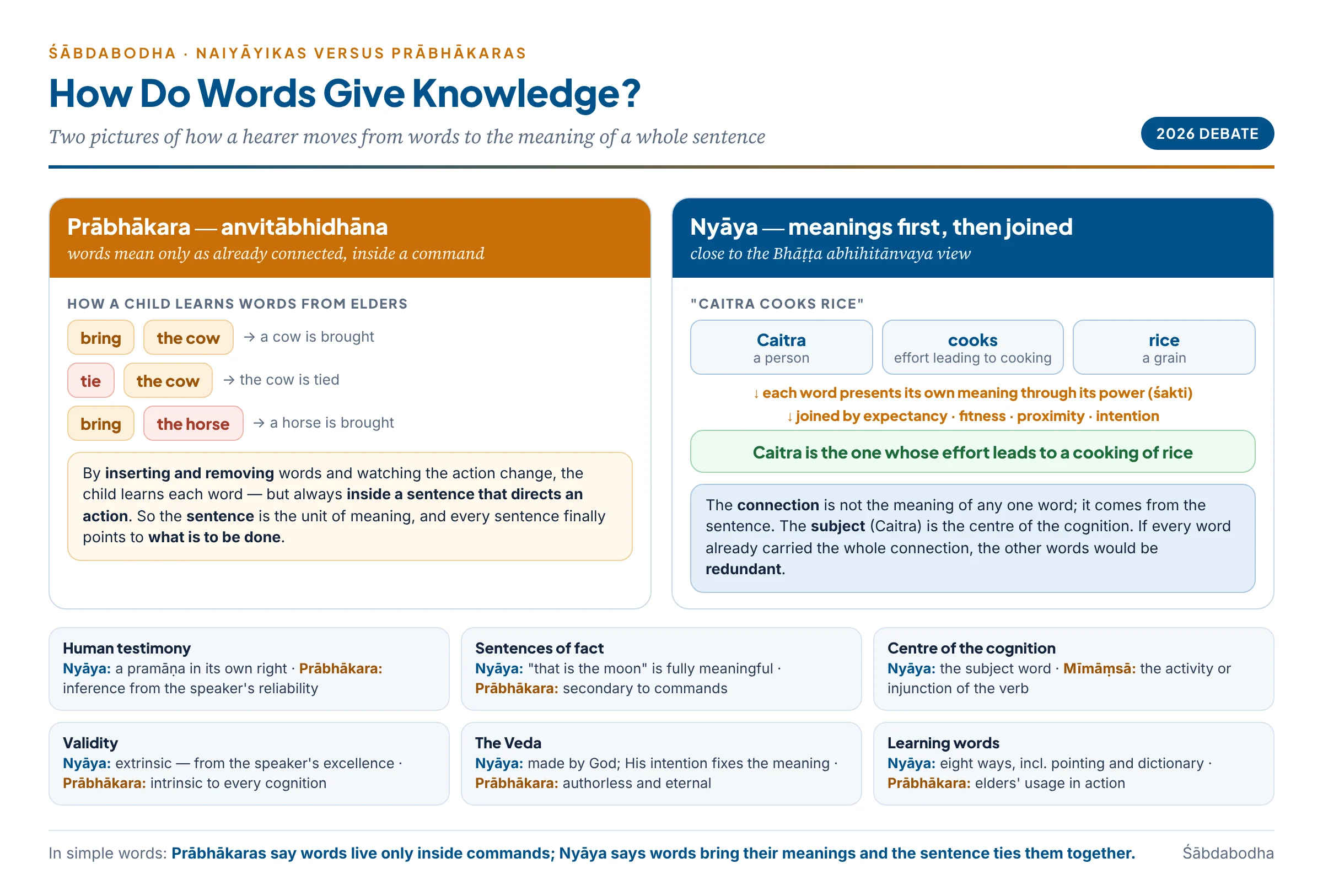
| Point of contest | Naiyāyikas | Prābhākara Mīmāṃsakas |
|---|---|---|
| Human testimony | A separate pramāṇa | Reduced to inference; only the Veda is śabda proper |
| Unit of meaning | Words present meanings; sentence connects them | Sentence — words mean only as connected (anvitābhidhāna) |
| How words are learnt | Eight ways, including pointing and dictionary | Elders’ usage in action-sentences |
| Sentences of fact | Fully meaningful | Secondary; meaning rests on what is to be done |
| Centre of the cognition | The subject (nominative) | The activity / injunction of the verb |
| Validity | Extrinsic — from the speaker’s excellence | Intrinsic — every cognition valid by itself |
| The Veda | Made by God; His intention fixes meaning | Authorless and eternal |
Critical Evaluation
Objections (Pūrva-pakṣa)
- Cārvāka. Testimony is mere belief in another’s word; the Veda is a fraud by priests who live off rituals; comparison gives nothing real.
- Buddhist. Words do not touch real things at all; they give only conceptual constructions (apoha). Testimony and comparison are perception or inference in disguise.
- Vaiśeṣika. Both reduce to inference: “this is a gavaya, since it is like a cow and was so described”; “this is true, since a reliable person said it”.
- Mīmāṃsā. Circularity: Nyāya proves God’s existence partly from the Veda, and the Veda’s validity from God’s authorship. Also, the Nyāya account of comparison is just perception, memory and inference.
- Advaita. Comparison yields knowledge of similarity, not of word-meaning; Nyāya’s version is perception plus testimony.
- Modern critics. How do we know someone is an āpta? Only by his track record — an inference. Then testimony depends on inference after all. And grounding the meaning of words in God’s will is unnecessary; usage and convention suffice.
Defences and Strengths
- New sentences are understood without any prior vyāpti — the strongest argument that testimony is not inference.
- Reliability is known by results. Like Āyurveda, a source proves itself through successful action (pravṛtti-sāmarthya). This checks validity; it does not generate the knowledge.
- No circle. Nyāya proves God independently by inference (Udayana’s arguments, Article 13), and then grounds the Veda in Him.
- Upamāna explains real learning — field guides, dictionaries of plants, a teacher’s descriptions — which neither perception nor testimony alone accounts for.
- Later Nyāya accepts human convention alongside God’s will, so its theory of meaning is not tied to theism.
- The four conditions of sentence-meaning give a precise, testable account of when words make sense.
Critics and Defenders
Criticism — Critics
- Cārvāka: testimony is credulity; the Veda is priestly fraud.
- Vaiśeṣika and Buddhists: comparison and testimony are only perception and inference.
- Mīmāṃsā: God-authorship is circular; Nyāya’s comparison is perception, memory and inference.
- Modern critics: knowing who is reliable requires inference; God’s will is idle in a theory of meaning.
Defence — Defenders and strengths
- A newly composed sentence is understood with no vyāpti — testimony cannot be inference.
- Reliability is confirmed by fruitful action, as with medical science.
- God is proved independently, so there is no circle.
- Comparison captures how we really learn names from descriptions.
- The four conditions and the theory of secondary meaning remain a model analysis of sentence-meaning.
Cross-Tradition Comparison
Nyāya, Mīmāṃsā and Western Philosophy of Language
| Indian doctrine | Content | Western parallel |
|---|---|---|
| Upamāna (Nyāya) | Learning what a name applies to from a description plus perceived similarity | Russell — knowledge by description; ostensive definition; learning words from a field guide |
| Śabara’s upamāna | “As I feel my self, so others feel theirs” | Mill’s argument from analogy for other minds |
| Śabda as independent | New sentences understood without prior inference | Thomas Reid — testimony is a basic source of belief (anti-reductionism) |
| Reduction to inference | Vaiśeṣika, Buddhists, Prābhākaras (for human speech) | Hume — trust in testimony rests on observed reliability (reductionism) |
| Āpta | Knowledge + honesty + competence, whatever the speaker’s birth | Modern social epistemology — the reliable expert |
| Ākāṅkṣā | Words need one another to complete a sense | Syntax; the “valency” of verbs |
| Yogyatā | “Moisten with fire” is grammatical but senseless | Ryle’s category mistake; Chomsky’s “colourless green ideas sleep furiously” |
| Tātparya | Speaker’s intention fixes meaning | Grice — speaker meaning |
| Anvitābhidhāna | A word means only in the context of a sentence | Frege’s context principle |
| Abhihitānvaya | Word-meanings first, then combined | Compositionality of meaning |
| Jāti-viśiṣṭa-vyakti | “Cow” means individual qualified by cowness | Mill — denotation and connotation; Frege — sense and reference |
| Lakṣaṇā | “Village on the Ganges” means on the bank | Metonymy and metaphor |
| Meaning through elders’ usage | Child learns “bring the cow” from action | Later Wittgenstein — meaning as use in a form of life |
Indian Connect — Key takeaways
- Nyāya’s upamāna is a theory of how we learn names from descriptions — not an analogical argument, though Śabara’s version comes close to one.
- The Nyāya–Mīmāṃsā debate on comparison is really about what is new in the knowledge: the name of the thing (Nyāya) or the similarity of the absent thing (Mīmāṃsā).
- The Nyāya–Vaiśeṣika split on testimony mirrors the Reid–Hume debate in Western epistemology, over a thousand years earlier.
- The Prābhākara–Nyāya debate on śābdabodha anticipates the Western debate between context principle and compositionality.
- Indian thought has a full theory of literal and secondary meaning (śakti, lakṣaṇā, gauṇī, vyañjanā) that later Advaita uses to interpret the great Upaniṣadic sentences.
Synthesis (Siddhānta)
- Upamāna gives knowledge of the relation between a name and its object, through a heard description and a perceived similarity. It is not perception, testimony, memory or inference.
- The Mīmāṃsā locates comparison in the similarity of the remembered object to the perceived one; Nyāya replies that this is only a by-product of perception and memory.
- Śabda is the instruction of a reliable person — one who knows, wishes to tell the truth and can say it, whatever his birth. Its validity depends on the speaker; its possibility on understanding the words.
- A sentence yields knowledge when its words show expectancy, fitness, proximity and a grasped intention. When the primary meaning fails, secondary meaning (lakṣaṇā) steps in.
- Against the Prābhākaras, Nyāya holds that human testimony is a real pramāṇa, that word-meanings are joined by the sentence, that statements of fact are fully meaningful, and that the Veda is God’s word, not an eternal authorless text.
- Contemporary relevance.
- Misinformation. The test of the āpta — knowledge, honesty, competence — is a ready checklist for judging news, experts and online claims.
- Courts and expert evidence. Testimony is weighed by the witness’s opportunity to know and freedom from motive to deceive — Vātsyāyana’s two marks.
- Language technology. Computational analysis of Sanskrit and Indian languages uses the ideas of expectancy and fitness — which words a verb requires, which combinations make sense.
- Education. Most learning is testimony plus learning by description; Nyāya treats this as genuine knowledge, not second-hand belief.
- Inclusive authority. By making reliability a matter of knowledge and truthfulness rather than birth, Nyāya offers an early egalitarian criterion of epistemic authority.
“Testimony is the instruction of a reliable person.” — Gautama, Nyāya Sūtra
Previous Year Questions
- 2026Present an account of Upamāna as an instrument of knowledge (Pramāṇa). How is Nyāya view of Upamāna different from Mīmāṃsā view? Discuss.
- 2026Bring out the main points of contestation between Naiyāyikas and Prabhākara Mīmāṃsakas with reference to knowledge through words (śabdabodha).
- 2024How does Bhatta’s view of nature of word-meaning and sentential-meaning differ from Prābhākara’s view? Critically discuss.
- 2023Do words refer to universals or particulars or both? Present an exposition of Nyāya and Mīmāṃsā position with regard to above question along with suitable examples.
- 2021Explain with reference to Nyaya Philosophy, the nature of sabda as the advice of apta (reliable person).
- 2019How does Mimamsa establish the authority of Vedic knowledge?
- 1991Explain the conditions that are to be fulfilled for construing the meaning and describe different types of secondary meaning.