

Union-State administrative, legislative and financial relations; Role of the Finance Commission; Governor; Chief Minister; Council of Ministers; Chief Secretary; State Secretariat; Directorates.
This article: The federal setting of Union–State relations; legislative relations (Articles 245–255, the Seventh Schedule, residuary powers, Parliament’s entry into the State field under Articles 249, 250, 252 and 253, repugnancy, the doctrines of interpretation, reservation of State Bills); administrative relations (Articles 256–263, Article 365, delegation, All India Services, central forces and central agencies, emergencies and Article 356, coordination forums); financial relations (Articles 264–293, distribution of taxing powers, GST and the GST Council, grants, cesses and surcharges, Centrally Sponsored Schemes, borrowing); commissions and demands on Centre–State relations (ARC, Rajamannar, Anandpur Sahib, West Bengal memorandum, Sarkaria, NCRWC, Punchhi); cooperative, competitive and confrontational federalism and current tensions; the Finance Commission in brief.
Official Syllabus: Paper II · Unit 2-06 State Government and Administration
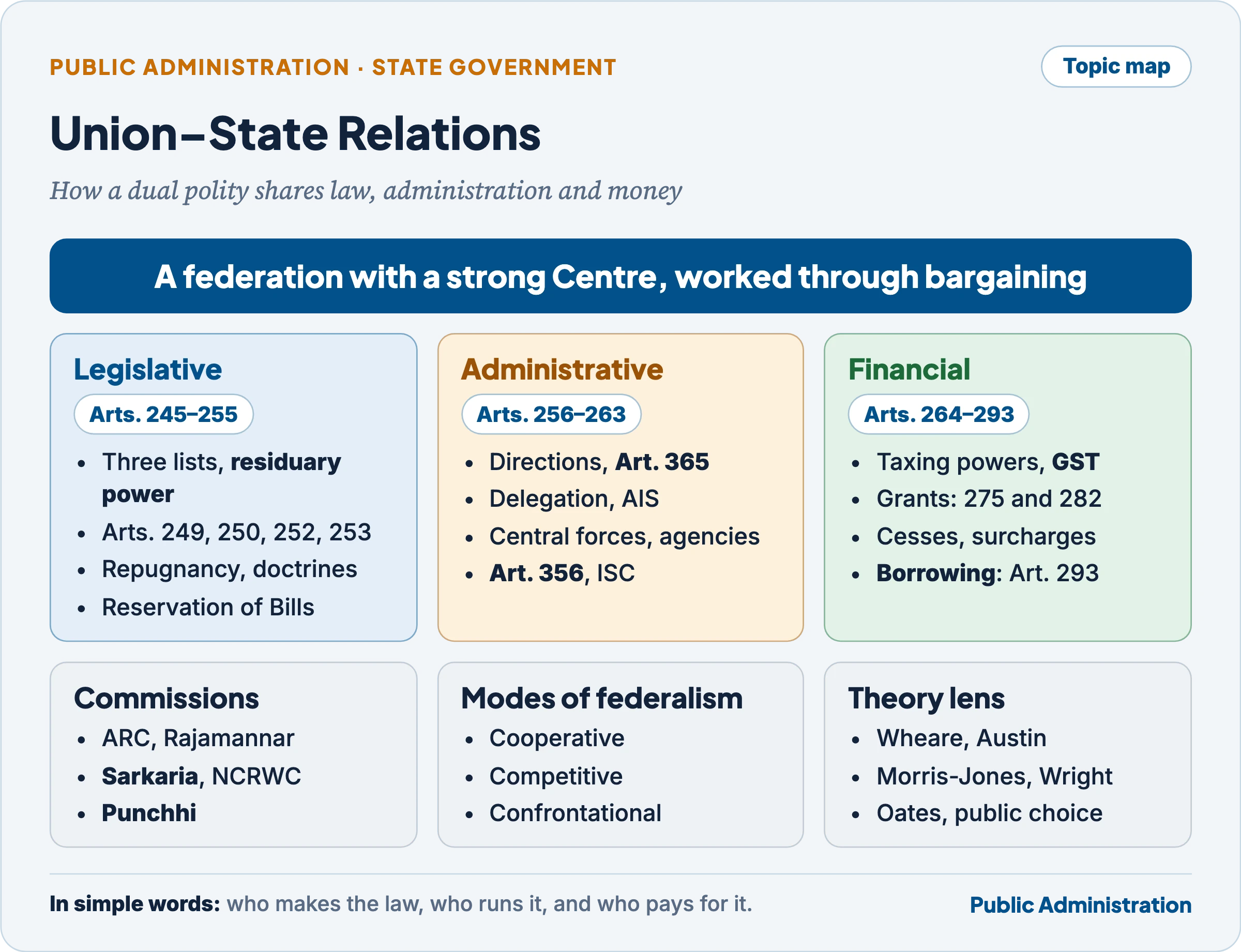
India has two orders of government, the Union and the States, each drawing its powers from the same written Constitution. How they share law-making, administration and money decides whether a farmer gets a crop-insurance payout, whether a State can borrow to build a metro, and whether a national law on forests is actually enforced in a district. Union–State relations are therefore not only a chapter of constitutional law but the working frame of Indian administration: most national programmes are designed in New Delhi and delivered by State machinery.
In simple words
Think of a large joint family business. The head office decides the brand, raises most of the money and sets common rules; the branches serve customers on the ground. If the head office keeps the money but the branches do the work, the branches must keep asking for funds and permission. Union–State relations are the rules for how this “head office” and its “branches” share power, work and money, and what happens when they disagree.
1. The Federal Setting of Union–State Relations
In simple words
India’s Constitution creates a federation with a strong Centre. The Union and the States each have their own subjects, but the Union has more powers and more money, and can step in during crises. How this balance works in practice depends on politics as much as on the text.
1.1 What “Union–State relations” means
- Meaning. Union–State relations are the legal, administrative, financial and political interactions between the Union government and the State governments in a dual polity, where each level is supreme in its own sphere but neither can work alone.
- Three constitutional dimensions. The Constitution regulates the relationship in three parts:
- legislative relations: Part XI, Chapter I (Articles 245–255) and the Seventh Schedule;
- administrative relations: Part XI, Chapter II (Articles 256–263), with Articles 312, 355, 356 and 365;
- financial relations: Part XII (Articles 264–293).
- A wider view: intergovernmental relations (IGR). The American scholar Deil S. Wright, in Understanding Intergovernmental Relations (1978), argued that the formal division of powers tells only half the story. IGR is the continuous, day-to-day interaction of officials at different levels: grants, conferences, bargaining, joint schemes and disputes. Wright noted that IGR is policy-centred, has few neat beginnings and endings, and often carries distrust and suspicion alongside cooperation.
- Wright’s three models, useful for reading India:
- Inclusive-authority model: lower levels are appendages of a dominant national government (India in the one-party era looked close to this);
- Coordinate-authority model: the levels are separate and autonomous, meeting only at the edges (the picture the Seventh Schedule suggests on paper);
- Overlapping-authority model: the levels share most functions, each has limited autonomy, and relations are bargained (the most accurate picture of India today, where health, education, agriculture and policing are all jointly funded and jointly run).
1.2 The nature of Indian federalism in brief
The detailed debate on federal and unitary features is taught elsewhere; only the points needed to read Union–State relations are summarised here.
- “Union of States”. Article 1 calls India a Union of States, not a federation. B.R. Ambedkar, Chairman of the Drafting Committee, explained (4 November 1948) that the federation was not the result of an agreement among States, so no State had a right to secede.
- Dual polity with a central tilt. Each level has its own legislature, executive and list of subjects, but the Union has the weightier list, residuary powers, emergency powers, control of the Governor’s appointment and the larger share of revenue.
- Scholars’ labels:
- K.C. Wheare, the Oxford scholar of federalism (Federal Government, 1946), called India quasi-federal, a unitary state with subsidiary federal features rather than the reverse;
- Granville Austin, the American historian of the Constitution (The Indian Constitution: Cornerstone of a Nation, 1966), called it cooperative federalism: a strong Centre that does not make the States weak, with both levels interdependent;
- W.H. Morris-Jones, the British political scientist (The Government and Politics of India, 1964), saw bargaining federalism: outcomes are negotiated between the levels, especially through the ruling party and the planning machinery;
- K. Santhanam, a member of the Constituent Assembly, in his lectures on Union–State Relations in India (1960), described a federation in which the Centre had become paramount, chiefly through planning and finance;
- Ambedkar himself said the Constitution could be unitary or federal according to time and circumstances.
- Holding-together federalism. The political scientist Alfred Stepan (1999) distinguished “coming-together” federations (sovereign units pooling sovereignty, like the United States) from “holding-together” federations (a unitary state devolving power to keep a diverse country united). India is the classic holding-together case, which explains why its Constitution protects the Union first.
- The judiciary’s view. In State of West Bengal v. Union of India (1962) the Supreme Court said the States are not sovereign and the Constitution is not a traditional federation. In S.R. Bommai v. Union of India (1994) a nine-judge bench held federalism to be a basic feature of the Constitution and said that within their sphere the States are supreme, not appendages of the Centre.
For the full set of federal and unitary features, asymmetric federalism and the “federal in form, unitary in spirit” debate, see the article on Salient Features and Value Premises of the Constitution.
1.3 Why the Constitution tilts towards the Centre
- Colonial inheritance. The Government of India Act, 1935 supplied the three lists, the Governor, the emergency powers and the federal court; a strong Centre was both an imperial habit and an administrative necessity.
- Partition and integration. After the 3 June 1947 Partition plan, the Union Powers Committee opted for a strong Centre with residuary powers to integrate more than 550 princely states and contain secession.
- Planned development. A mixed economy with national Five-Year Plans needed central resources and direction.
- Size and diversity. Linguistic, religious and regional diversity led the framers to see the Union as the guarantor of unity.
- The guiding principle. The States Reorganisation Commission (1955), chaired by Fazl Ali, put it plainly: the Union is the basis of nationhood and the States are its limbs; limbs must be healthy, but the strength of the Union is the governing consideration. The Law Commission and the Sarkaria Commission later added that a strong Centre and strong States are not opposites: a body is healthy only when its parts are.
Common confusion
Is a “strong Centre” the same as “centralisation”? No. A strong Centre means the Union has enough capacity for defence, macroeconomic stability and national standards. Centralisation means the Union absorbs functions and decisions that States and local bodies could handle better. The Sarkaria Commission defended the first and criticised the second; decentralisation theory holds that excessive centralisation itself breeds the regional discontent that threatens unity.
1.4 Phases of Union–State relations
The written Constitution has changed little; the party system has changed the way it works. The table traces the phases.
| Phase | Political setting | Character of Union–State relations |
|---|---|---|
| 1950–1967 | Congress in power at the Centre and in nearly all States | Centralised, intra-party: disputes settled inside the party; Planning Commission and NDC as instruments of central direction |
| 1967–1977 | Non-Congress governments in eight States (1967); Congress dominance restored in 1971–72 | Confrontational: demands for autonomy (Rajamannar, 1969–71); frequent use of Article 356; States called “glorified municipalities” |
| 1977–1989 | Janata interlude, Congress return; regional parties and ethnic movements (Punjab, Assam) | Contested: mass dissolutions of Assemblies (1977, 1980); Anandpur Sahib and West Bengal demands; Sarkaria Commission (1983–88) |
| 1989–2014 | Coalition governments with regional parties at the Centre; liberalisation from 1991 | Cooperative and bargained: Inter-State Council (1990); Bommai (1994) curbs Article 356; 73rd and 74th Amendments; Punchhi Commission (2007–10) |
| 2014 onwards | Single-party majorities (2014, 2019), then a coalition majority (2024) | Cooperative and competitive, with sharp confrontational episodes: NITI Aayog (2015); GST Council (2016); disputes over Governors, central agencies, borrowing, cesses and delimitation |
The pattern supports William Riker’s argument (Federalism: Origin, Operation, Significance, 1964) that the degree of centralisation in a federation depends mainly on its party system: when one party controls both levels, constitutional federalism lies dormant; when power is split, the federal clauses come alive and are contested in courts and councils.
2. Legislative Relations (Articles 245–255)
In simple words
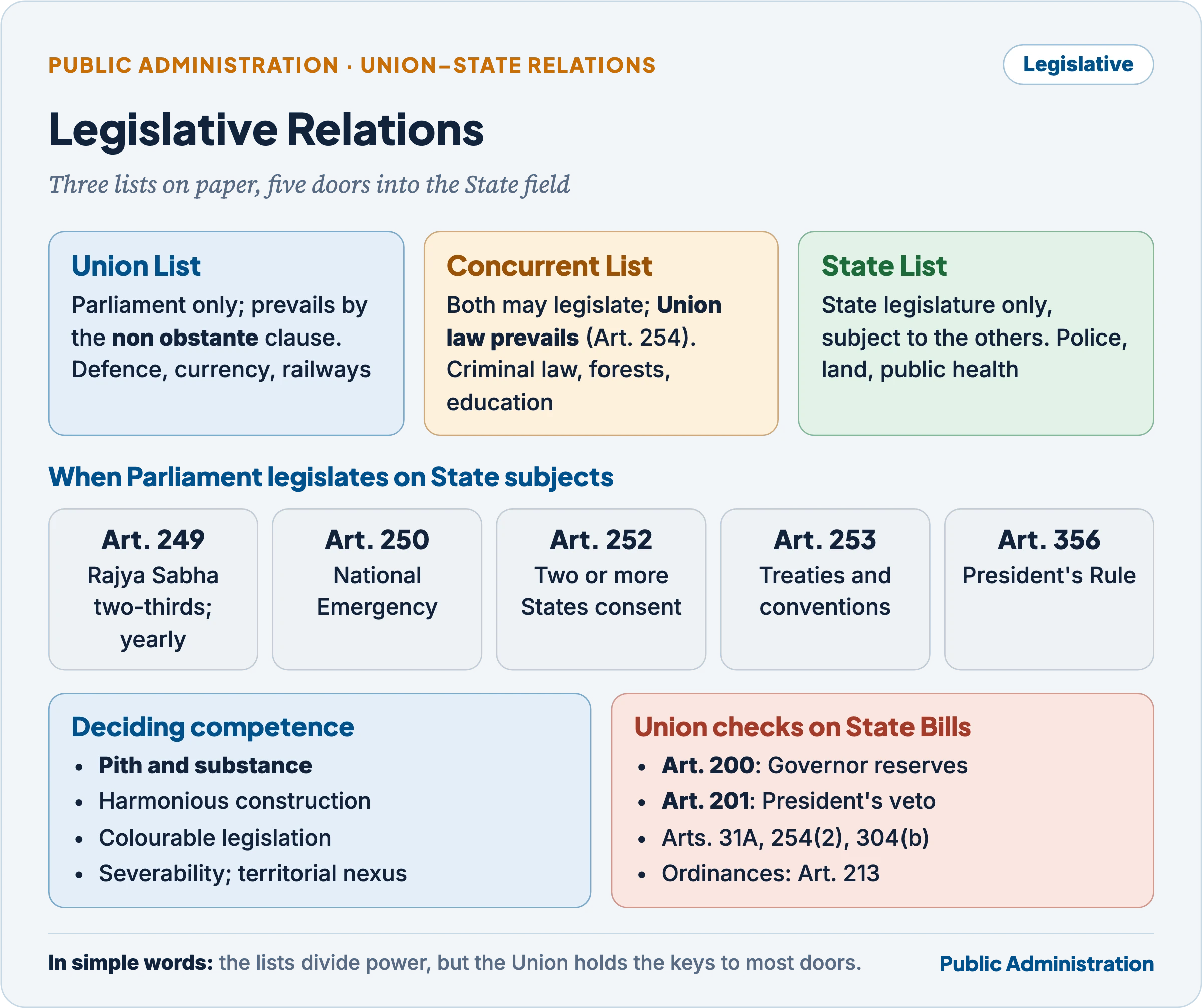
The Constitution gives Parliament a list of subjects, gives the State legislatures another list, and lets both make laws on a third, shared list. On paper the lines are clear. In practice, Parliament can enter the States’ list in several situations, Union law wins most conflicts, and the Governor can send State Bills to the President.
2.1 Territorial extent of laws (Article 245)
- Parliament may make laws for the whole or any part of India; a State legislature only for the whole or any part of the State.
- Extra-territorial operation. Article 245(2) says no parliamentary law is invalid because it operates outside India (for example, laws on Indian citizens abroad or on Indian ships). A State law with effect outside the State is valid only if there is a sufficient territorial nexus between the State and the object taxed or regulated (State of Bombay v. R.M.D. Chamarbaugwalla, 1957).
- Special areas. The President may make regulations for some Union Territories (Article 240); the Governor may exclude or modify parliamentary and State laws for Fifth Schedule areas; and Sixth Schedule autonomous councils make laws on specified subjects.
2.2 The Seventh Schedule and the three lists (Article 246)
- List I (Union List): subjects needing national uniformity, such as defence, foreign affairs, railways, currency, banking, atomic energy, inter-state rivers (as declared by law), corporation tax and customs. Parliament has exclusive power (Article 246(1)), and this power operates “notwithstanding” the other two lists: the non obstante clause that signals Union supremacy.
- List II (State List): subjects of local importance, such as public order, police, public health, agriculture, land, local government, water (subject to List I), markets and several taxes. State legislatures have exclusive power, but “subject to” the other two clauses.
- List III (Concurrent List): subjects needing both uniformity and local adaptation, such as criminal law and procedure, marriage and divorce, forests, education, labour, electricity, economic and social planning, trade unions and drugs. Both can legislate; Union law prevails in a conflict.
- Size and drift. The lists originally had 97, 66 and 47 entries. The 42nd Amendment (1976) moved education, forests, protection of wild animals and birds, weights and measures, and the administration of justice (constitution and organisation of courts other than the Supreme Court and High Courts) from the State List to the Concurrent List. The 101st Amendment (2016) deleted or narrowed several tax entries when GST came in. The State List has shrunk and the Concurrent List has grown: a structural shift towards the Union.
- Comparison. The United States and Australia list only federal powers and leave the rest to the units; Canada, like India, has detailed lists and vests residuary power in the Centre. India’s three detailed lists were meant to reduce litigation, though in practice they have generated a large body of case law on overlapping entries.
2.3 Residuary powers (Article 248)
- Parliament has exclusive power over any matter not listed in the State or Concurrent Lists, including taxes not mentioned in either (Entry 97 of List I).
- The Supreme Court has read this power widely (Union of India v. H.S. Dhillon, 1971, upholding a wealth tax), but courts first try to fit a law into a listed entry: residuary power is the last resort.
- Contrast: under the 1935 Act, the Governor-General decided case by case who would get a residuary subject; the Constituent Assembly first planned to give residuary powers to the provinces (Objectives Resolution, 1946) and then gave them to the Union after Partition.
- Reform demands. The Rajamannar Committee (1971) and the Anandpur Sahib Resolution wanted residuary powers moved to the States; the Sarkaria Commission proposed placing non-tax residuary powers in the Concurrent List while keeping residuary taxation with the Union.
2.4 When Parliament legislates on State subjects
The Constitution opens five doors through which Parliament can make law on matters in the State List. The table sets them out.
| Article | Situation | Conditions and duration | Example |
|---|---|---|---|
| 249 | National interest | Rajya Sabha resolution supported by two-thirds of members present and voting; valid for one year, renewable year by year; the law lapses six months after the resolution ends | Used rarely, because a two-thirds Rajya Sabha majority is hard to obtain |
| 250 (with 353) | National Emergency under Article 352 | Parliament may legislate on any State subject; the law lapses six months after the Emergency ends | Emergency-era laws, 1975–77 |
| 252 | Consent of two or more States | The legislatures of two or more States pass resolutions; other States may adopt the law later; only Parliament can then amend or repeal it | Prize Competitions Act, 1955; Wild Life (Protection) Act, 1972; Water (Prevention and Control of Pollution) Act, 1974; Urban Land (Ceiling and Regulation) Act, 1976; Transplantation of Human Organs Act, 1994 |
| 253 | Implementing treaties and decisions of international conferences | No time limit; Parliament may legislate even on State subjects | Air (Prevention and Control of Pollution) Act, 1981 and Environment (Protection) Act, 1986, framed to implement the Stockholm Conference decisions |
| 356(1)(b) with 357 | President’s Rule in a State | Parliament exercises the State legislature’s powers or delegates them to the President | State budgets passed by Parliament during President’s Rule |
- What the table shows. Articles 249 and 250 are temporary and need either an Emergency or a large Rajya Sabha majority; Article 252 is consensual but one-way (States cannot later amend the law); Article 253 is open-ended, because almost any subject can now be tied to an international commitment (climate, trade, biodiversity, human rights). This is why NCRWC (2002) suggested prior consultation with States through the Inter-State Council before India signs treaties that touch State subjects.
- Other constitutional routes. Parliament also gains power through Entry 2A of List I (deployment of Union forces, added by the 42nd Amendment), through declarations under List I entries (industries, mines, inter-state rivers “declared by Parliament by law”), and through the Concurrent List itself.
2.5 Conflicts between Union and State laws: repugnancy (Articles 251 and 254)
- The rule. If a State law on a Concurrent List subject is repugnant to a parliamentary law (passed before or after it), the parliamentary law prevails and the State law is void to the extent of the repugnancy (Article 254(1)). Article 251 applies the same rule to laws made by Parliament under Articles 249 and 250.
- The exception: Presidential assent. Under Article 254(2), a State law on a Concurrent subject that conflicts with an earlier Union law prevails in that State if it was reserved for and received the President’s assent. Many State amendments to labour laws, land acquisition and criminal procedure have used this route. The proviso lets Parliament later override even such a law.
- When is there repugnancy? In M. Karunanidhi v. Union of India (1979) the Supreme Court set out the tests:
- both laws must be on a Concurrent subject;
- there must be a direct and irreconcilable conflict, so that obeying one means disobeying the other; or
- Parliament must have intended to occupy the whole field (the doctrine of occupied field, discussed in Deep Chand v. State of U.P., 1959);
- courts first try to reconcile the two laws, and the party alleging repugnancy must prove it.
- The “shock absorber” turned centraliser. The framers saw the Concurrent List as a shock absorber that would let either level act in a crisis. The economist K.N. Kabra argued that “concurrent” became a misnomer, because Union laws occupy most Concurrent fields and States are left to fill gaps. The Sarkaria Commission found that Parliament had legislated on many Concurrent subjects without consulting the States, and recommended consultation as a convention.
2.6 Doctrines that decide legislative competence
When a law seems to cross from one list into another, courts use a small set of doctrines. They decide whether a law is valid, not whether it is wise.
| Doctrine | Question it answers | Key case | How it works |
|---|---|---|---|
| Pith and substance | What is this law really about? | Prafulla Kumar Mukherjee v. Bank of Commerce, Khulna (Privy Council, 1947); State of Bombay v. F.N. Balsara (1951) | If the true nature of a law falls within the legislature’s list, an incidental intrusion into another list does not invalidate it. Bombay’s prohibition law was “public health and liquor” (State List) even though it touched imports |
| Incidental and ancillary powers | Does power over a subject include related matters? | Settled in many cases | Each entry includes everything reasonably connected with it (power to tax includes power to prevent evasion) |
| Harmonious construction | Two entries seem to overlap: which applies? | Re C.P. and Berar Motor Spirit Act (Federal Court, 1939) | Entries are read together, each given a fair meaning so that both can operate; one is not read so widely that it swallows the other |
| Colourable legislation | Is the legislature doing indirectly what it cannot do directly? | K.C. Gajapati Narayan Deo v. State of Orissa (1953); State of Bihar v. Kameshwar Singh (1952) | The form of a law does not save it if its substance lies outside competence (“what cannot be done directly cannot be done indirectly”). The motive of the legislature is irrelevant; only competence matters |
| Repugnancy and occupied field | Two valid Concurrent laws conflict: which survives? | M. Karunanidhi (1979) | Union law prevails unless Article 254(2) applies |
| Severability | Must the whole law fall if one part is invalid? | R.M.D. Chamarbaugwalla v. Union of India (1957) | Only the invalid part is struck down if it can be separated and the rest still works as the legislature intended |
| Territorial nexus | Can a law reach things outside the territory? | R.M.D. Chamarbaugwalla (1957) | A State law is valid if there is a real connection between the State and the object |
Common confusion
Are the doctrines of pith and substance and severability the same thing? No; they are supplementary but distinct. Pith and substance works at the stage of deciding competence: it looks at the law as a whole and asks whether its true character falls within the legislature’s list; if it does, incidental overlap is ignored and the whole law survives. Severability works after a court has found some provisions invalid (for lack of competence or for violating rights): it asks whether the valid remainder can stand alone. One saves a law by characterising it; the other saves part of a law by cutting away the bad part. Courts often use both in sequence: pith and substance to test each provision’s competence, then severability to keep what passes.
2.7 Union control over State legislation
Beyond the lists, the Constitution gives the Union several checks on State law-making. They are the most visible source of friction today.
- Reservation of Bills by the Governor (Article 200). When a State Bill is presented, the Governor may assent, withhold assent, return it (if not a Money Bill) for reconsideration, or reserve it for the President. Reservation is compulsory for a Bill that would derogate from the powers of the High Court (second proviso).
- President’s options (Article 201). The President may assent or withhold assent, or direct the Governor to return the Bill; if the legislature passes it again within six months, the President is still not bound to assent. This is an absolute veto over reserved State Bills, unlike the suspensive veto over parliamentary Bills.
- Bills needing the President’s assent or previous sanction:
- Article 31A (laws acquiring estates) and Article 31C (laws giving effect to certain Directive Principles) get their protection only if reserved and assented to;
- Article 288(2) (State taxes on water or electricity of Union-created authorities);
- Article 304(b) proviso (Bills imposing reasonable restrictions on trade need the President’s previous sanction);
- Article 254(2) (a repugnant Concurrent law, to prevail);
- Article 360(4) (all Money Bills may be reserved during a Financial Emergency).
- Article 255. A missing recommendation or previous sanction is cured by the President’s later assent: the requirements are procedural.
- Ordinances (Article 213). The Governor cannot promulgate, without the President’s instructions, an ordinance whose contents would have needed previous sanction or reservation as a Bill.
- Scale of the problem. The Sarkaria Commission found that some reserved Bills had waited six to twelve years for a decision. It recommended that the President dispose of reserved Bills within four months, seek any clarification within two months, and communicate reasons for withholding assent. The Punchhi Commission (2010) suggested a six-month limit. Neither was enacted.
- Judicial turn, 2023–2025:
- In State of Punjab v. Principal Secretary to the Governor (10 November 2023) the Court held that a Governor who withholds assent must return the Bill to the legislature “as soon as possible”; he cannot simply sit on it.
- In State of Tamil Nadu v. Governor of Tamil Nadu (8 April 2025) a two-judge bench held that ten Bills the Governor had withheld and then reserved after re-passage were deemed assented, and set timelines for Governors (one to three months) and the President (three months).
- On a Presidential Reference under Article 143 (13 May 2025), a five-judge bench advised on 20 November 2025 that courts cannot impose timelines or declare deemed assent, and that the Governor has only the three options in Article 200; but prolonged, unexplained and indefinite inaction can attract limited judicial review.
The Governor’s role in these disputes is examined in the article on the Governor, Chief Minister and Council of Ministers.
2.8 Appraisal: is the legislative scheme biased towards the Union?
- Yes, in design. The Union List is larger and weightier; Union law prevails in Concurrent conflicts; residuary power, Article 249, Article 253 and emergency legislation all point one way; State Bills can be vetoed by the Union executive; and the Rajya Sabha, the supposed federal chamber, gives seats by population and since 2003 does not require members to be residents of the State they represent (upheld in Kuldip Nayar v. Union of India, 2006).
- Less so, in practice. Article 249 and 252 resolutions are rare; Article 254(2) lets States vary Union laws; courts apply pith and substance generously to save State laws; and since the 1990s coalition politics and judicial review have made central overreach costlier.
- Recent widening of State fiscal space by courts. In Jindal Stainless v. State of Haryana (2016) a nine-judge bench upheld State entry taxes, and in Mineral Area Development Authority v. Steel Authority of India (25 July 2024) a nine-judge bench held (8:1) that royalty is not a tax and that States can tax mineral rights and mineral-bearing land, a significant gain for mineral-rich States.
3. Administrative Relations (Articles 256–263 and Beyond)
In simple words
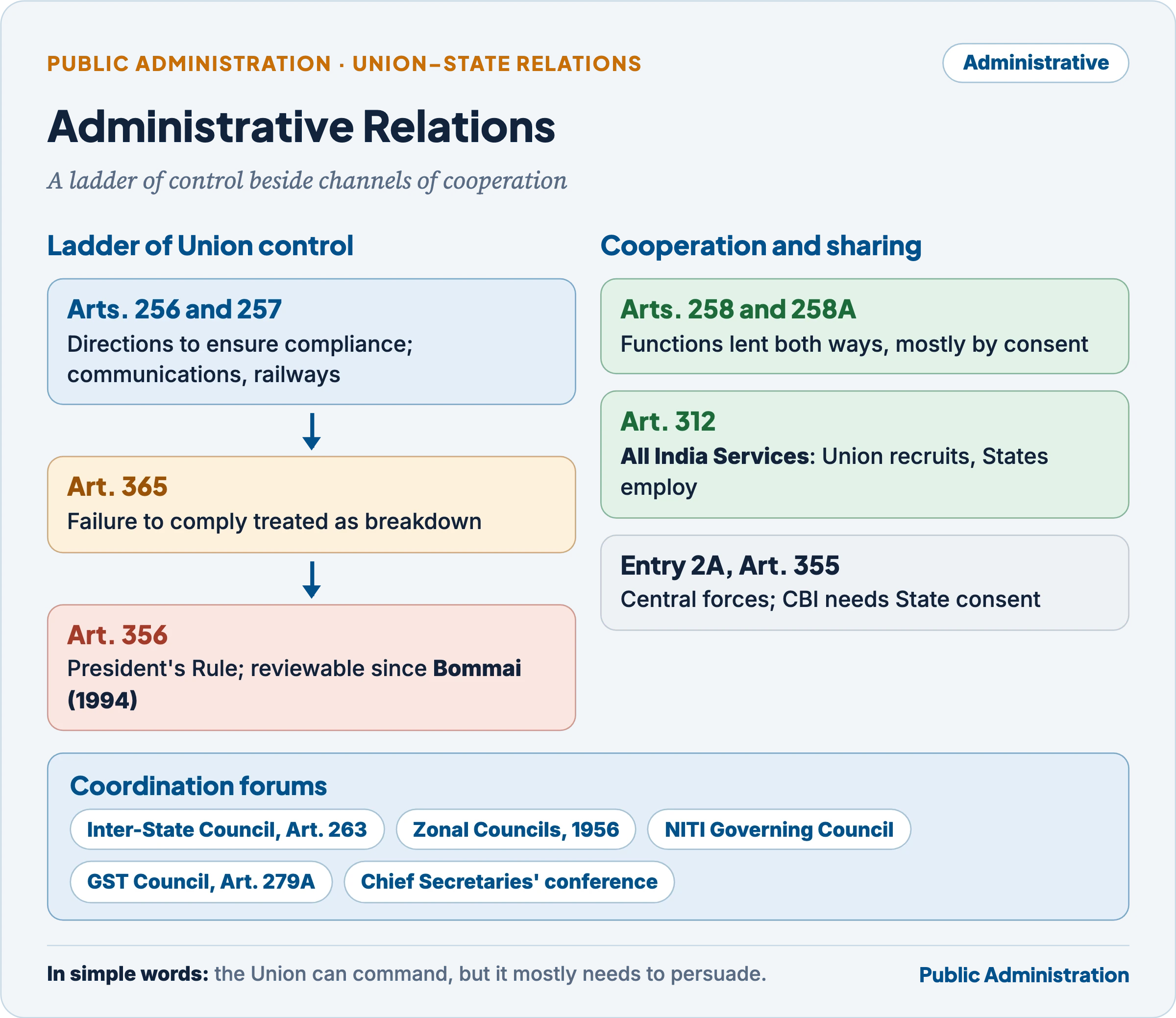
Most Union laws are carried out by State officers: the police, the Collector, the State health and agriculture departments. So the Constitution lets the Union give directions to States, lend and borrow officers and functions, share elite services, and in extreme cases take over a State’s government. It also creates forums where the two levels can talk.
3.1 How executive power is divided
- Co-extensive with legislative power. The Union’s executive power extends to matters on which Parliament can legislate (Article 73); a State’s extends to matters on which its legislature can legislate (Article 162).
- Concurrent subjects. Executive power on Concurrent subjects remains with the States unless the Constitution or a parliamentary law expressly gives it to the Union. Parliament can thus leave enforcement to States, take it over, or split it.
- The agency model. Because the Union has few field offices in most sectors, it relies on State machinery to deliver national programmes. Paul Appleby, the American expert invited by Nehru, observed in Public Administration in India: Report of a Survey (1953) that no other large national government depended so heavily on theoretically subordinate but practically independent units for administering national programmes. This dependence is the root of both cooperation and friction.
3.2 Obligations, directions and sanctions
- Article 256: compliance. Every State must exercise its executive power so as to ensure compliance with Union laws that apply to it, and the Union may give directions for that purpose. The Constituent Assembly reasoned that without this, Union laws would remain “paper legislation”.
- Article 257: non-obstruction. State executive power must not impede or prejudice the Union’s executive power. The Union may direct States on:
- the construction and maintenance of means of communication declared to be of national or military importance (Article 257(2));
- the protection of railways within the State (Article 257(3));
- the extra cost is borne by the Union; if the two disagree on the amount, an arbitrator appointed by the Chief Justice of India decides (Article 257(4)).
- Other directions: on schemes for the welfare of Scheduled Tribes (Article 339(2)), on instruction in the mother tongue at primary level (Article 350A), and, during a National Emergency, on any matter (Article 353(a)).
- Article 365: the sanction. If a State fails to comply with Union directions, the President may hold that a situation has arisen in which its government cannot be carried on in accordance with the Constitution, opening the way to Article 356.
- Last resort. The Sarkaria Commission advised that directions under Articles 256 and 257, and especially the Article 365 sanction, be used only after all other means of settling the dispute are exhausted. At the 2002 Inter-State Council meeting, some Chief Ministers asked for Article 365 to be deleted; the Union argued that a power to direct is meaningless without a sanction.
3.3 Mutual delegation and cooperation
- Article 258(1): the President may, with the State’s consent, entrust Union executive functions to a State or its officers (for example, the collection of some central levies, or census operations through State staff).
- Article 258(2): a parliamentary law may confer powers and impose duties on State officers even without consent, on Union subjects; the Union pays the extra cost (Article 258(3)).
- Article 258A (added by the Seventh Amendment, 1956): the Governor, with the Union’s consent, may entrust State functions to the Union.
- Article 261: full faith and credit. Public acts, records and judicial proceedings of the Union and every State are recognised throughout India, and civil decrees are executable anywhere.
- Article 262: inter-state river waters. Parliament may provide for adjudication of water disputes and bar the courts’ jurisdiction; the Inter-State River Water Disputes Act, 1956 sets up tribunals. For the tribunals, their delays and the lapsed 2019 reform Bill, see the article on Ministries, Departments, Boards, Commissions, Attached Offices and Field Organisations.
- Joint machinery: a Joint State Public Service Commission for two or more States on their request (Article 315); a common High Court for two or more States (Article 231); UPSC assistance in joint recruitment.
3.4 All India Services (Article 312)
- Provision. If the Rajya Sabha resolves by a two-thirds majority of members present and voting that it is necessary in the national interest, Parliament may create new All India Services common to the Union and the States. The IAS and IPS are deemed created under Article 312(2); the Indian Forest Service was created in 1966. An All India Judicial Service is provided for but has never been created.
- Dual control. Officers are recruited, trained and disciplined by the Union (major penalties and dismissal rest with the Union) under the All India Services Act, 1951, but serve under State governments, which post, transfer and can suspend them.
- Federal purpose. The services were Sardar Patel’s “steel frame” for national unity after Partition: they bring common standards, a national outlook in State administration and a link between the two levels.
- Federal tension. States see them as a Union presence inside the State machinery:
- Conflict of loyalty: an officer serving a State government may be torn between State political masters and Union rules or career interests;
- Central deputation: the Union’s 2022 proposal to amend Rule 6 of the IAS (Cadre) Rules, 1954, so that it could call officers to central deputation even without State consent, drew objections from many States;
- Disciplinary friction: Union action against officers seen as close to a State government (or the reverse) has become a recurring flashpoint.
- Commission views. The Sarkaria Commission called the AIS indispensable, said that disbanding them or letting States opt out would be retrograde, and suggested new AIS for engineering, medicine and health, and education, plus an element of compulsion in central deputation. The Punchhi Commission also supported strengthening and extending the AIS.
3.5 Central armed forces and central agencies
- Constitutional basis. Police and public order are State subjects (List II, Entries 1 and 2). But Entry 2A of List I, added by the 42nd Amendment (1976), lets the Union deploy its armed forces or any other force under its control in any State in aid of the civil power; Article 355 imposes on the Union a duty to protect every State against external aggression and internal disturbance. (The 42nd Amendment’s Article 257A, which gave similar power, was repealed by the 44th Amendment in 1978.)
- Practice. Central Armed Police Forces such as the CRPF, BSF and ITBP are routinely deployed for elections, insurgency, Left-wing extremism and riots, usually at the request of States. Sarkaria held that the Union may deploy forces without State consent but should consult the State first; Punchhi suggested a law under Article 355 allowing limited suo motu deployment in grave communal or similar crises.
- Central investigating agencies:
- The CBI works under the Delhi Special Police Establishment Act, 1946; under Section 6, it needs the State’s consent to act in a State. Since 2018, several States (beginning with West Bengal, 16 November 2018, and later Punjab, Kerala, Tamil Nadu, Karnataka and others) withdrew general consent. In State of West Bengal v. Union of India (10 July 2024) the Supreme Court held West Bengal’s Article 131 suit maintainable, ruling that the CBI is under the superintendence of the Union government. Courts can still order CBI probes without State consent (State of West Bengal v. Committee for Protection of Democratic Rights, 2010).
- The National Investigation Agency Act, 2008 lets the NIA investigate scheduled offences anywhere without State consent, and the Enforcement Directorate under the PMLA acts nationwide; States allege selective use against opposition leaders.
- Assessment. The Union argues that terrorism, organised crime and money laundering cross State borders; States argue that policing is their subject and that central agencies erode accountability to State legislatures. Cooperation has grown where threats are shared (joint operations against Left-wing extremism since 2007), while disputes concentrate in politically charged corruption cases. For the agencies themselves, see the article on central and State police organisations.
3.6 Emergency provisions and Article 356
The emergency provisions in Part XVIII can convert the federation into a near-unitary state. Their effects on Union–State relations differ by type.
| Emergency | Effect on legislative relations | Effect on administrative relations | Effect on financial relations |
|---|---|---|---|
| National Emergency (Article 352) | Parliament may legislate on any State subject (Article 250); may extend a parliamentary term | Union may give directions on any matter (Article 353) | President may modify the distribution of revenues (Article 354) until the end of the financial year |
| President’s Rule (Article 356) | Parliament exercises the State legislature’s powers (Articles 356(1)(b), 357) | President assumes the State’s executive functions, run through the Governor and advisers | State budget passed by Parliament |
| Financial Emergency (Article 360) | All Money Bills may be reserved for the President | Union may direct canons of financial propriety and cuts in salaries, including of High Court judges | Union controls State finances |
Article 356 in practice
- The provision. If the President, on the Governor’s report or otherwise, is satisfied that the government of a State cannot be carried on in accordance with the Constitution, he may proclaim President’s Rule. Parliament must approve it within two months; it lasts six months at a time, up to three years; beyond one year it needs a National Emergency and an Election Commission certificate (added by the 44th Amendment, 1978).
- Ambedkar’s hope. Ambedkar told the Constituent Assembly he hoped these provisions would remain a dead letter, used only as a last resort.
- Misuse. Article 356 has been used more than a hundred times. Notorious episodes include the dismissal of Kerala’s elected Communist government (1959), the Janata government’s dissolution of nine Congress-ruled Assemblies (1977) and Indira Gandhi’s dissolution of nine non-Congress Assemblies (1980). In State of Rajasthan v. Union of India (1977) the Court declined to intervene in the 1977 dissolutions, treating the matter as largely political.
- S.R. Bommai v. Union of India (11 March 1994). A nine-judge bench transformed the law:
- the President’s satisfaction is subject to judicial review on grounds of mala fides and irrelevant or extraneous material;
- the floor of the House, not the Governor’s opinion, is the test of majority;
- the Assembly may only be kept in suspended animation until both Houses of Parliament approve the proclamation; if they do not, or the court strikes it down, the dismissed government can be restored;
- secularism and federalism are basic features; a State government acting against secularism may be dismissed.
- After Bommai. In Rameshwar Prasad v. Union of India (2006) the Court held the 2005 dissolution of the Bihar Assembly unconstitutional, as it rested on the Governor’s unverified fears of horse-trading. In Nabam Rebia (2016) it restored the dismissed Arunachal Pradesh government. The use of Article 356 has fallen sharply since the mid-1990s, because of judicial review, coalition politics and the political cost of misuse.
- “Bolt from the blue.” Critics, echoing Sarkaria, note that the proclamation often comes without warning or a chance for the State to correct itself, and that the President acts on Cabinet advice under Article 74, so the office is drawn into partisan acts. Sarkaria recommended a warning to the State, a reasoned and published Governor’s report, and use only when all alternatives fail; NCRWC (2002) recommended that the Assembly not be dissolved before Parliament considers the proclamation; Punchhi proposed “localised emergency” under Articles 355 and 356 for a district or part of it, for not more than three months, instead of suspending a whole State’s government.
Indian Connect — Article 355 before Article 356
The Law Commission and later commentators have observed that many situations handled through President’s Rule could have been met by the Union’s duty under Article 355: deploying forces, advising and assisting the State while its elected government stays in office. Using the milder instrument first respects both federalism and democratic choice; the Punchhi Commission’s “localised emergency” proposal follows the same logic.
3.7 Coordination forums: the machinery of intergovernmental relations
Formal powers matter less day to day than the forums where the two levels meet. The table lists the main ones.
| Forum | Basis | Composition | Role and record |
|---|---|---|---|
| Inter-State Council | Article 263; Presidential Order of 28 May 1990 on Sarkaria’s advice | Prime Minister (chair), all Chief Ministers, UT Chief Ministers or Administrators, six Union Cabinet ministers; Standing Committee under the Home Minister (from 1996) | Mandate limited to clauses (b) and (c) of Article 263 (investigating subjects of common interest and recommending coordination), not adjudicating disputes. Met only eleven times (the eleventh on 16 July 2016, after ten years); its Standing Committee examined all 273 Punchhi recommendations in 2017–18; reconstituted in 2022 with ten Union ministers as permanent invitees |
| Other Article 263 councils | Presidential orders | Union and State ministers of the sector | Central Council of Health and Family Welfare, Central Council of Local Government, and similar sectoral councils |
| Zonal Councils (five) | States Reorganisation Act, 1956 | Union Home Minister (chair), Chief Ministers and two ministers from each State of the zone; Chief Secretaries | Advisory forums on border, transport, water, policing and linguistic-minority issues; long dormant, meetings became regular after 2014 |
| North Eastern Council | NEC Act, 1971 | Governors and Chief Ministers of the eight north-eastern States; Home Minister chairs since 2018 | Regional planning and development body |
| NITI Aayog Governing Council | Cabinet resolution, 1 January 2015 | Prime Minister, all Chief Ministers, Lieutenant Governors | “Team India” forum for national development agenda; replaced the National Development Council in practice |
| GST Council | Article 279A (101st Amendment, 2016) | Union Finance Minister (chair) and State finance ministers | A constitutional body of joint decision-making on indirect taxes (see section 4.3) |
| Conferences | Convention | Governors (chaired by the President), Chief Ministers, Chief Secretaries (chaired by the Cabinet Secretary), DGPs and IGPs, Chief Justices | Informal coordination and agenda-setting |
- The pattern. India has many forums but few with teeth. The Inter-State Council, which Sarkaria and Punchhi saw as the centrepiece of cooperative federalism, has met rarely; the GST Council is the only forum with binding joint decision-making in practice, and even its recommendations are legally persuasive rather than binding.
- Chief Secretary’s role. At the official level, Chief Secretaries are the main channel between the State and Union ministries (the Cabinet Secretary, Home Secretary, Finance Secretary); their conferences thrash out issues before they reach Chief Ministers. See the article on the Chief Secretary, State Secretariat and Directorates.
3.8 Planning and Union–State administrative relations
- The Planning Commission era (1950–2014). Created by a Cabinet resolution (15 March 1950), the Planning Commission was neither constitutional nor statutory, yet it fixed State plan sizes, approved schemes and gave plan grants. Critics called it a “super-cabinet” and an “economic cabinet” that reached into State subjects like agriculture, health and education. The National Development Council (1952), with all Chief Ministers, was meant to give States a voice but became largely a ratifying body.
- Gadgil formula (1969). Normal central assistance for State plans was distributed by a formula devised under D.R. Gadgil (population, per capita income, tax effort, special problems), later revised as the Gadgil–Mukherjee formula (1990); special category States got assistance on more generous terms.
- The centralising effect. Plan transfers grew alongside Finance Commission transfers, creating two channels (one constitutional and formula-based, one executive and discretionary). States preferred the Finance Commission; the Union preferred the flexibility of plan grants. This “centrally devised plan development” explains much of Indian centralism, a point the Sarkaria Commission accepted when it recommended a constitutional National Economic and Development Council.
- After 2015. The NITI Aayog replaced the Planning Commission on 1 January 2015 with no power to allocate funds; the plan and non-plan distinction was ended from 2017–18. For the machinery of planning, see the article on the machinery of planning and NITI Aayog.
3.9 Appraisal: administrative relations in normal times
- Arguments that the scheme is too centralised:
- Directions under Articles 256–257 backed by Articles 365 and 356 give the Union a coercive ladder unusual among federations;
- the AIS, central forces and central agencies put Union instruments inside State territory;
- many Union ministries exist for State subjects (health, agriculture, education, rural development, cooperation), designing schemes that States must implement.
- Arguments that it is cooperative and necessary:
- directions under Article 256 are rarely issued; most coordination is by consultation and money;
- the AIS gives States high-quality administrators they could not otherwise recruit;
- central ministries on State subjects reflect development administration: national goals (literacy, health, nutrition) need national standards and money, while States keep implementation;
- courts, coalition politics and Sarkaria-type conventions have reduced misuse.
- The real causes of the “centre-tilt” are known, as an old question puts it: the party system, fiscal dependence, planning and the AIS–Governor link. So are the remedies: conventions of consultation, a working Inter-State Council, restraint in Articles 356 and 365, more untied transfers and genuine devolution to local governments.
4. Financial Relations (Articles 264–293)
In simple words
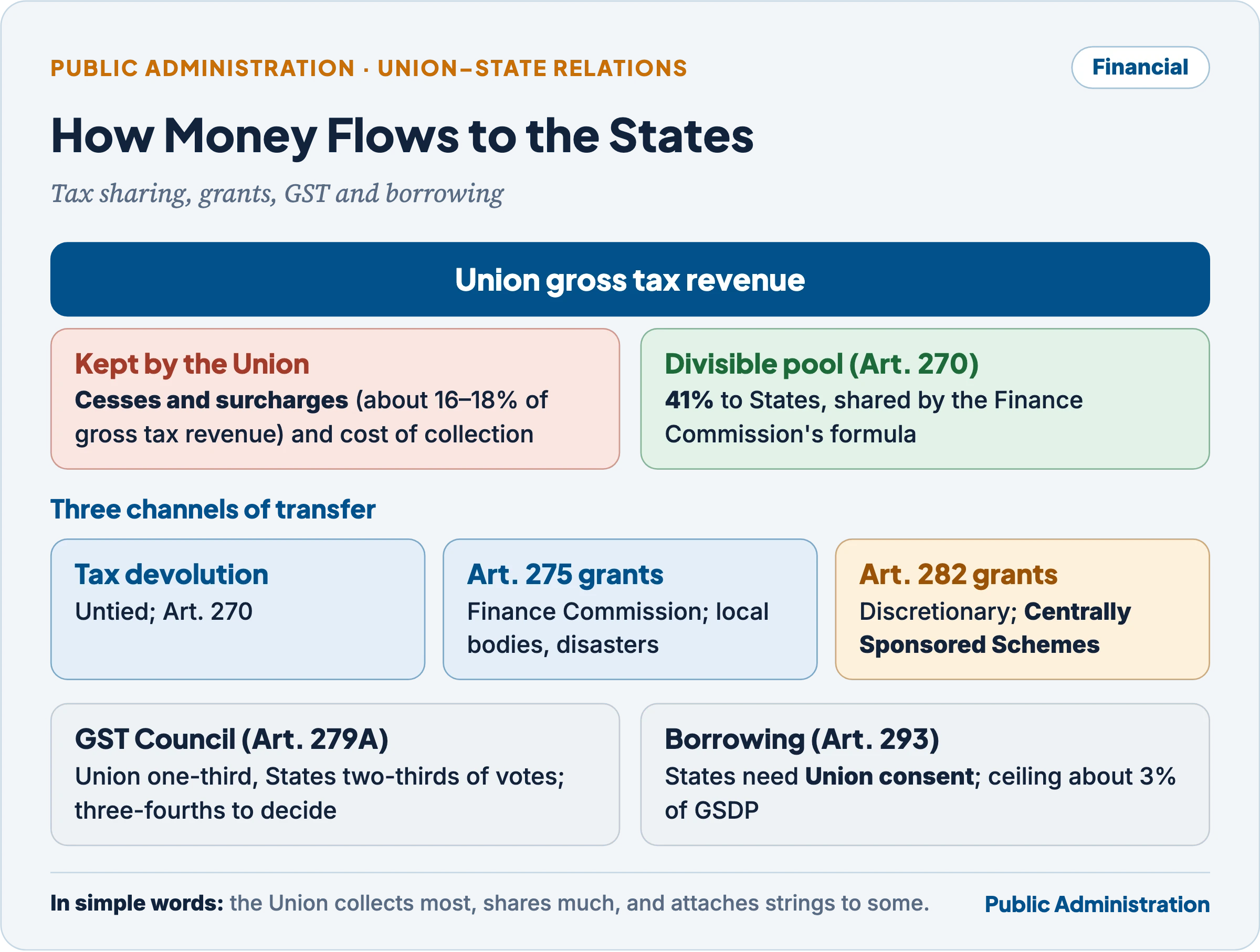
The Union collects the biggest and fastest-growing taxes, while the States run the most expensive services: police, schools, hospitals, roads and farm support. So money must flow from the Union to the States through tax-sharing, grants and loans. Who decides how much flows, and with what conditions, is the most contested part of Union–State relations.
4.1 Principles and the basic problem
- Power to levy is separate from power to keep. The Constitution distinguishes the power to impose a tax (given by the lists) from the right to its proceeds (given by Articles 268–272). A tax may be levied by the Union but collected and kept by States, or levied and collected by the Union but shared.
- No tax without law. Article 265: no tax shall be levied or collected except by authority of law.
- Vertical fiscal imbalance. The Union has the elastic, buoyant taxes (income tax, corporation tax, customs, central GST), while States bear the bulk of developmental and welfare expenditure. The gap between States’ spending responsibilities and own revenues is the vertical imbalance; transfers from the Union fill it. In 2025–26, total transfers to States (tax devolution plus grants) were estimated at about 7.2 per cent of GDP, and the Union shared roughly half of its gross revenue receipts with the States.
- Horizontal fiscal imbalance. States differ widely in revenue capacity and needs (Bihar and Uttar Pradesh versus Maharashtra and Tamil Nadu); transfers must also equalise across States.
- Theory. Richard Musgrave (The Theory of Public Finance, 1959) assigned stabilisation and redistribution to the national government and allocation of local public goods to lower levels. Wallace Oates (Fiscal Federalism, 1972) stated the decentralisation theorem: a public good whose benefits are local should be provided by the lowest level of government that covers those benefits, because it can match local preferences better than a uniform national supply. India’s design follows Musgrave on taxes (buoyant taxes central) and Oates on functions (most services with States), which makes large transfers unavoidable.
4.2 Distribution of taxing powers
| Category | Articles | Taxes (main examples) | Who keeps the proceeds |
|---|---|---|---|
| Union taxes (List I) | 246, 270, 271 | Income tax (non-agricultural), corporation tax, customs, central excise on tobacco and petroleum, central GST, taxes on capital value of assets | Shared through the divisible pool, except cesses and surcharges |
| State taxes (List II) | 246 | Land revenue, agricultural income tax, stamp duty (most documents), taxes on land and buildings, mineral rights (subject to Parliament’s limits), alcohol for human consumption, electricity consumption, vehicles, professions (capped at ₹2,500 a year by Article 276), entertainment by local bodies, sale of petroleum products outside GST, State GST | Fully retained by States |
| Concurrent taxing power | 246A | GST on goods and services: both Parliament and State legislatures legislate simultaneously | Each keeps its own component |
| Levied by Union, collected and kept by States | 268 | Stamp duties on bills of exchange, cheques, promissory notes and similar instruments | States |
| Levied and collected by Union, assigned to States | 269 | Taxes on inter-state sale and consignment of goods (outside GST) | States where leviable |
| Integrated GST | 269A | GST on inter-state supplies and imports | Apportioned between Union and States as Parliament provides on GST Council advice |
| Levied and collected by Union, shared | 270 | All Union taxes except those under 268, 269, 269A, surcharges and cesses | 41 per cent to States (15th and 16th Finance Commissions) |
| Surcharges | 271 | Surcharges on income tax and other Union taxes | Union alone |
- The 80th Amendment (2000). Before 2000, only income tax was compulsorily shared and Union excise optionally. On the Tenth Finance Commission’s “alternative scheme of devolution”, the 80th Amendment made all central taxes shareable through a single divisible pool (Article 270), so that States share in the Union’s overall buoyancy. This also met Sarkaria’s demand for sharing corporation tax.
- Article 274. Bills that vary taxes in which States are interested need the President’s prior recommendation.
- Mutual immunity. Union property is exempt from State taxes (Article 285) and State property and income from Union taxes (Article 289), with exceptions for trade.
- Restrictions on States. Article 286 bars States from taxing supplies outside the State or imports and exports; Articles 301–304 protect freedom of inter-state trade, with reasonable restrictions by States needing the President’s previous sanction.
4.3 GST, the 101st Amendment and the GST Council
- The reform. The Constitution (101st Amendment) Act, 2016 created a dual GST, rolled out on 1 July 2017. It subsumed central excise (most goods), service tax, additional customs duties and central surcharges, and on the State side VAT, entry tax, entertainment tax (except by local bodies), luxury tax, purchase tax and taxes on advertisements. Alcohol for human consumption remains outside GST; petroleum crude, diesel, petrol, natural gas and aviation turbine fuel are within GST in law, but GST applies to them only from a date the Council recommends; until then they bear central excise and State VAT.
- Key Articles. Article 246A (simultaneous legislative power), Article 269A (IGST on inter-state supply), Article 279A (GST Council), amendments to Articles 268, 270 and the lists, and Section 18 of the Amendment Act, which promised compensation to States for five years.
- GST Council (Article 279A):
- Members: Union Finance Minister (chair), Union Minister of State for Finance, and the finance or other nominated ministers of every State;
- Voting: the Union has one-third of the weighted votes cast and all States together two-thirds; decisions need three-fourths of the weighted votes of members present and voting; quorum is one-half of members;
- Consequence: the Union cannot pass a proposal without the support of nearly two-thirds of the States present, and all States together cannot pass one against the Union, because two-thirds is less than three-fourths. Each side holds a veto;
- Article 279A(11) provides for a dispute settlement mechanism, which has not been created.
- Compensation. The GST (Compensation to States) Act, 2017 guaranteed States 14 per cent annual growth over their 2015–16 revenue for five years (to 30 June 2022), funded by a compensation cess on luxury and sin goods. When the COVID-19 shortfall emerged, the Union borrowed on the States’ behalf (back-to-back loans in 2020–21 and 2021–22) and extended the cess to March 2026 to repay them. The cess was removed from most goods on 22 September 2025 and ended altogether on 1 February 2026, replaced on tobacco by additional central excise and on pan masala by the Health Security se National Security Cess.
- GST 2.0. The 56th GST Council meeting (3 September 2025) collapsed the four main slabs into two (5 and 18 per cent) with a 40 per cent rate for sin and luxury goods, effective 22 September 2025; States accepted it despite concerns about revenue loss.
- Union of India v. Mohit Minerals (19 May 2022). The Supreme Court held that:
- Article 246A gives Parliament and State legislatures equal, simultaneous power over GST; neither is superior;
- GST Council recommendations have persuasive value, not binding force; they bind only when adopted into law by the legislatures;
- cooperative federalism includes contestation: States may disagree and legislate otherwise;
- it also struck down IGST on ocean freight on imports.
Common confusion
Did GST take away the States’ power to tax? Partly, but it also pooled power. States gave up independent rate-setting on most goods and services (they can no longer vary VAT on their own) and a large part of their tax base. In return they gained a share in taxing services (earlier a Union-only field), a two-thirds vote in a joint body, a destination-based tax that helps consuming States, and five years of guaranteed compensation. Political scientists describe GST as “pooled sovereignty”: neither level is sovereign over indirect taxes; both are co-sovereign through the Council. The real loss for States is fiscal autonomy at the margin, the freedom to raise extra revenue quickly when needed.
- Has GST shifted Union–State relations?
- Financially: State GST is now the largest single item of most States’ own tax revenue, and its rates are set jointly in the Council; the end of compensation exposed States with weak post-GST growth; disputes over IGST settlement and delayed refunds continue.
- Politically: the Council has made dozens of consensus decisions, a rare model of institutionalised cooperative federalism; but the Union’s de facto veto, its control of the agenda and secretariat, and occasional voting (the 2019 lottery-rate decision) show the limits of equality. Opposition States argue it embodies “one nation, one tax” at the cost of “one nation, many needs”.
4.4 Grants-in-aid: Articles 275 and 282
- Article 275: statutory grants. Parliament provides grants each year to States in need of assistance, on the Finance Commission’s recommendation, charged on the Consolidated Fund of India. The provisos add grants for the welfare of Scheduled Tribes and for raising the administration of Scheduled Areas. These have included revenue-deficit, sector-specific and local-body grants. The 16th Finance Commission (2026–31) discontinued revenue-deficit, sector-specific and State-specific grants and kept grants for local bodies and disaster management.
- Article 282: discretionary grants. The Union or a State may make grants for any public purpose, even outside its legislative competence. This open-ended article became the legal basis for plan grants and today for Centrally Sponsored Schemes.
- Why the difference matters. Article 275 grants are formula-based and recommended by an independent constitutional body; Article 282 grants are decided by the Union executive, often tied to conditions and matching contributions. An old debate asked whether such discretionary transfers should be regulated through the National Development Council or the Finance Commission; the 16th Finance Commission itself notes that it has no role in Article 282 transfers but must take them into account.
4.5 Centrally Sponsored Schemes and Union spending on State subjects
- What they are. Centrally Sponsored Schemes (CSS) are designed and partly funded by the Union but implemented by States, mostly in State and Concurrent List fields: school education (Samagra Shiksha), health (National Health Mission), housing, drinking water (Jal Jeevan Mission), nutrition, and from 1 July 2026 rural employment under the VB–G RAM G Act, 2025.
- Rationalisation (2015–16). A sub-group of Chief Ministers under NITI Aayog recommended fewer, broader schemes; from 2016–17 CSS were grouped into core of the core, core and optional schemes, with a funding pattern of 60:40 (Union:State) for most States and 90:10 for the north-eastern and Himalayan States. A Single Nodal Agency system (from 2021) now releases funds closer to actual spending.
- Pros:
- National minimum standards in health, education and nutrition across rich and poor States;
- money for poorer States that could not fund such programmes alone;
- innovation diffusion and data-driven monitoring (dashboards, geo-tagging);
- a channel for national priorities (sanitation, digital inclusion) that individual States might underfund.
- Cons:
- one-size-fits-all design that ignores State priorities and conditions;
- matching shares pre-empt State budgets, so poorer States struggle to draw their allocation;
- conditionality and branding requirements reduce State ownership;
- the Union legislates indirectly on State subjects through spending power (Article 282), bypassing the Seventh Schedule;
- shift of burden: under the VB–G RAM G Act, States must now bear 40 per cent of the cost (against roughly 10 per cent under MGNREGA) and any spending above a Union-fixed normative allocation; several States, including some ruled by the Union’s allies, objected in 2025–26.
- Separate Union ministries for State subjects. Their existence reflects both Union supremacy (the power to set agendas through money) and development administration (national goals in social sectors). The balance depends on whether they enable States through untied, predictable funds or direct them through conditional schemes.
4.6 Cesses and surcharges: the shrinking divisible pool
- Rule. Under Article 270(1), cesses levied for specific purposes and surcharges under Article 271 are outside the divisible pool: the Union keeps them entirely.
- Trend. Cesses and surcharges rose from 9.6 per cent of the Union’s gross tax revenue in 2014–15 to 17.5 per cent in 2019–20 and 17.9 per cent in 2024–25, before easing to about 16.4 per cent in 2025–26 as the GST compensation cess wound down (Union Finance Ministry figures given to the Lok Sabha, July 2026). The effect is that the States’ 41 per cent share applies to a smaller base: their effective share of gross tax revenue is well below 41 per cent.
- New levies. The Health Security se National Security Cess Act, 2025 (on pan masala) and additional central excise on tobacco replaced the compensation cess from 1 February 2026; the excise is shareable, the cess is not.
- Responses. States and several Finance Commissions have urged that cesses and surcharges be capped or brought into the pool; the 16th Finance Commission asked the Union to publish the CAG-certified net proceeds each year (Article 279) for transparency, which the Union accepted.
4.7 Borrowing: Articles 292 and 293
- The Union may borrow on the security of the Consolidated Fund of India within limits fixed by Parliament (Article 292), including abroad.
- States may borrow only within India (Article 293(1)), within limits fixed by their own legislatures. The decisive clause is Article 293(3): a State needs the Union’s consent to borrow if any part of a loan from the Union (or guaranteed by it) is still outstanding. Since virtually every State owes the Union money, all States need consent, and Article 293(4) lets the Union attach conditions.
- How consent works today. The Union fixes an annual Net Borrowing Ceiling (NBC) for each State, usually 3 per cent of GSDP (with extra room tied to power-sector reforms), following the Finance Commission’s fiscal path and State Fiscal Responsibility and Budget Management laws. Since 2022, off-budget borrowings by State-owned entities serviced from the State budget (such as Kerala’s KIIFB) are counted against the ceiling.
- State of Kerala v. Union of India. Kerala filed an original suit under Article 131, arguing that the Union had exceeded Article 293 and violated fiscal federalism. On 1 April 2024 a two-judge bench refused interim relief and, noting that Article 293 had never been authoritatively interpreted, referred five questions to a Constitution Bench, including whether fiscal decentralisation is part of federalism and whether prior consultation with States is mandatory before acting on Finance Commission advice. As of October 2026 the reference is pending, while the Union has continued to trim Kerala’s quarterly borrowing limits.
- Counter-cyclical support. Since 2020–21, the Union has given States 50-year interest-free loans for capital spending under the Special Assistance to States for Capital Investment scheme, often tied to reforms: an example of conditional cooperation.
- Is the borrowing regime biased? Yes in structure: the Union borrows freely and abroad, States only within India and with Union consent. But the soft-budget-constraint problem identified by János Kornai and later fiscal-federalism scholars (Jonathan Rodden) is real: if States expect a bailout, they over-borrow. Rising State debt, off-budget borrowing, power-sector losses and unconditional cash transfers explain why the Union and the 16th Finance Commission (which set a 3 per cent of GSDP deficit limit for States) favour hard limits. The constraints on States’ prudent management are therefore both structural (inelastic own revenues after GST, committed salaries, pensions and interest, matching shares in CSS) and political (competitive welfare promises).
4.8 The Finance Commission in brief
The Finance Commission under Article 280 is constituted by the President every five years to recommend the vertical share of the divisible pool, its horizontal distribution among States, the principles of Article 275 grants, and measures to support local bodies; Article 281 requires its report and an action-taken memorandum to be laid before Parliament. The 16th Finance Commission, chaired by Arvind Panagariya, whose report for 2026–31 was tabled on 1 February 2026, kept the States’ share at 41 per cent and added contribution to GDP (10 per cent weight) to the formula. For its composition, criteria, debates over equity and efficiency, and State Finance Commissions, see the article on The Finance Commission and Fiscal Federalism.
4.9 Appraisal: the bottlenecks of fiscal federalism
- Structural mismatch: buoyant taxes with the Union, expensive functions with States.
- Multiple channels: formula-based transfers (Articles 270, 275) coexist with discretionary ones (Article 282); historically the Planning Commission and Finance Commission overlapped, compounding the confusion.
- Shrinking divisible pool through cesses and surcharges.
- Loss of autonomy under GST and the end of compensation.
- Borrowing controls and conditional loans.
- Perception of political bias in discretionary grants, disaster relief and scheme approvals; a “dependency syndrome” in poorer States.
- Horizontal tensions: richer southern and western States argue they are penalised for performance (lower population growth, higher income) under devolution formulas; the 16th Finance Commission’s GDP-contribution criterion partly responds to this.
Indian Connect — Southern States’ “fair share” campaign
On 7–8 February 2024, the Karnataka and Kerala governments led protests in Delhi against what they called unfair devolution, delayed grants and borrowing curbs; Tamil Nadu joined the demand. Karnataka also sued the Union under Article 131 over delayed drought relief in 2024. The campaign shows how fiscal grievances, once settled inside the ruling party, are now voiced as inter-regional claims, linking finance to the delimitation debate.
5. Commissions and Demands on Centre–State Relations
In simple words
Since the 1960s, governments, States and political parties have repeatedly asked experts to re-examine Union–State relations. Some demands wanted a radically looser federation; the national commissions preferred keeping the Constitution and changing the way it is worked.
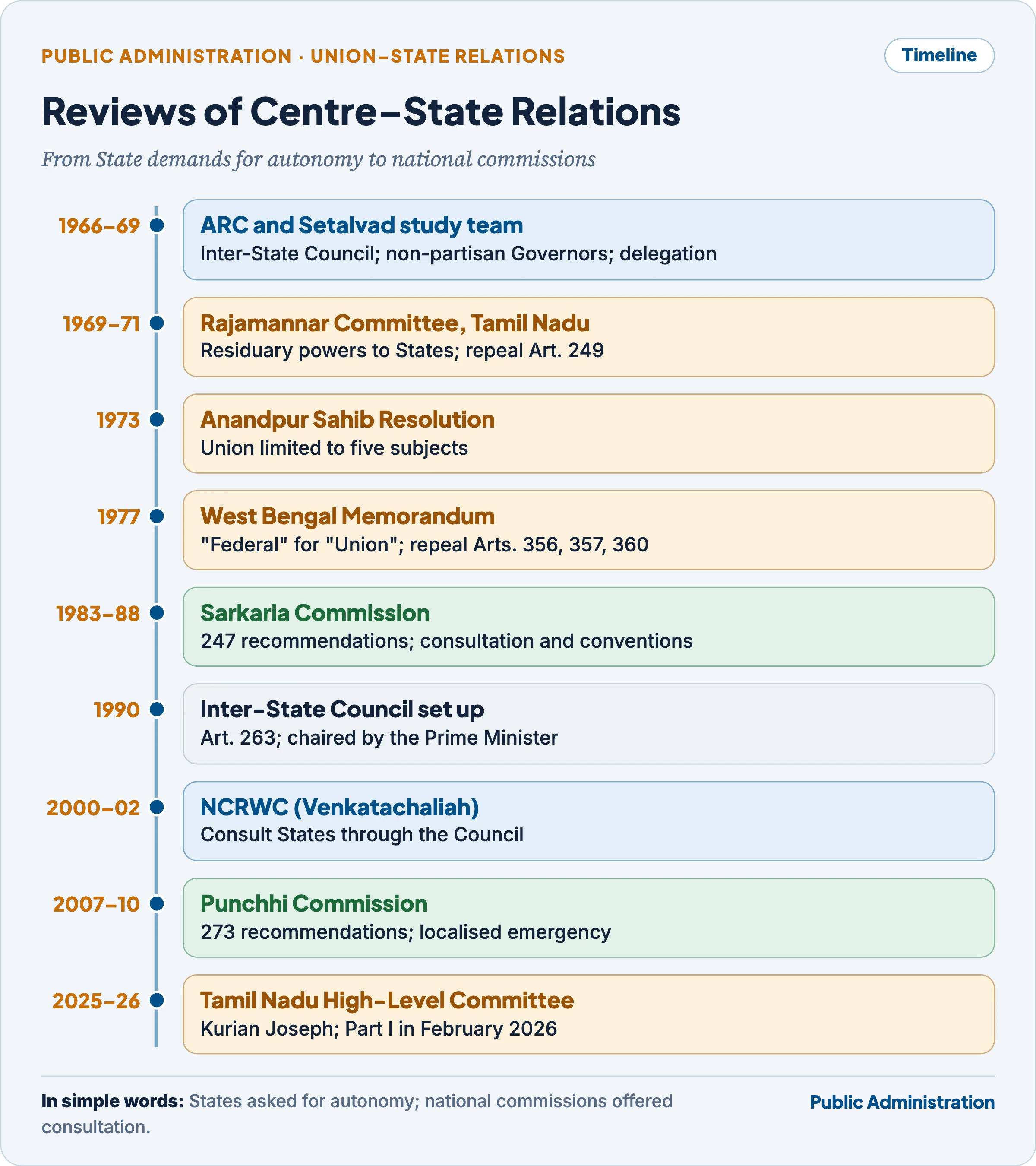
5.1 Administrative Reforms Commission (1966–70)
- Study Team on Centre–State Relationships under M.C. Setalvad, India’s first Attorney-General, set up on 17 May 1966; report 9 October 1967. It is still admired for its analysis of how planning and central agencies had grown in State fields.
- ARC report on Centre–State Relationships (presented 19 June 1969), under the ARC chaired first by Morarji Desai and then K. Hanumanthaiya:
- set up an Inter-State Council under Article 263;
- appoint Governors with long experience in public life and administration, non-partisan in outlook;
- delegate powers to States to the maximum extent;
- centralised planning had tended to interfere excessively in State freedom; yet the existing constitutional provisions were adequate.
5.2 Rajamannar Committee (1969–71)
- Appointed by the DMK government of Tamil Nadu in September 1969 under P.V. Rajamannar, former Chief Justice of the Madras High Court, with A. Lakshmanaswami Mudaliar and P. Chandra Reddy; report May 1971.
- Recommendations:
- redistribute the Seventh Schedule, moving several Union and Concurrent subjects to the State List and residuary powers to the States;
- repeal Article 249 and review Articles 356, 357 and 365;
- constitute an Inter-State Council immediately, with Bills of national importance referred to it before introduction in Parliament;
- modify the working of the Finance Commission and Planning Commission and widen the base of revenue devolution.
- The Union rejected it as a recipe for a weak Centre, but its Inter-State Council idea was adopted in 1990.
5.3 Anandpur Sahib Resolution (1973)
- Adopted by the Shiromani Akali Dal at Anandpur Sahib in October 1973; a revised version came in 1978.
- Demanded that the Union’s authority be confined to defence, foreign affairs, communications, railways and currency, with all residuary powers to the States; it became entangled with the Punjab crisis of the 1980s.
- The Punjab Accord (July 1985) between Rajiv Gandhi and Sant Harchand Singh Longowal referred it to the Sarkaria Commission.
5.4 West Bengal Memorandum (1977)
- Issued by the Left Front government of Jyoti Basu in December 1977.
- Demands: replace the word “Union” with “Federal”; repeal Articles 356, 357 and 360; make State consent mandatory for changing State boundaries (Article 3); greater share of revenue for States; restrict the Union to defence, foreign affairs, currency, communications and economic coordination.
- With the Rajamannar and Akali demands and the non-Congress Chief Ministers’ conclaves of the 1980s (Vijayawada, Calcutta, Srinagar), it built the pressure that led to the Sarkaria Commission.
5.5 Sarkaria Commission (1983–88)
- Set up on 9 June 1983 under Justice R.S. Sarkaria, retired Supreme Court judge, with B. Sivaraman and S.R. Sen; report submitted in 1988, with 247 recommendations.
- Approach. It found the “arranged marriage” of parliamentary government and federalism sound, rejected demands for a radical restructuring, and blamed the malaise on the behaviour of political actors rather than the text. Its remedy was consultation and conventions.
- Key recommendations:
- Legislative: consult States (individually and through an inter-governmental council) before legislating on Concurrent subjects; place non-tax residuary powers in the Concurrent List; Governors should reserve Bills only in rare cases; the President should decide reserved Bills within four months and give reasons.
- Inter-Governmental Council: a permanent Inter-State Council under Article 263 (named Inter-Governmental Council); revive the Zonal Councils; reconstitute the NDC as a constitutional National Economic and Development Council.
- Governor: an eminent person, from outside the State, detached from local politics, not recently active in politics, and preferably not from the Union’s ruling party when an opposition party rules the State; appointed after consulting the Chief Minister; five-year term not to be cut except for compelling reasons; no office of profit or return to active politics afterwards.
- Article 356: use sparingly, as a last resort; issue a warning first; the Governor’s report should state facts and be made public; majority to be tested on the floor of the House.
- Administrative: All India Services to be strengthened and new ones created; Union may deploy armed forces without consent but should consult States.
- Financial: share corporation tax; restrict surcharges to specific purposes; keep the then division of work between the Finance and Planning Commissions; review mineral royalties regularly; the Union should not depart from Finance Commission recommendations without compelling reasons.
- Implementation. The Inter-State Council (1990) was the main structural outcome; about 180 recommendations were accepted, mostly as conventions; corporation tax became shareable via the 80th Amendment (2000); Bommai (1994) gave judicial force to its Article 356 views.
5.6 National Commission to Review the Working of the Constitution (2000–02)
- Chaired by Justice M.N. Venkatachaliah, former Chief Justice of India; report submitted in 2002 (Chapter 8 on Union–State relations).
- Recommendations:
- use the Inter-State Council for individual and collective consultation with States; specify the subjects of consultation in the ISC Order;
- place disaster management in the Concurrent List;
- enumerate services that States may tax;
- an Inter-State Trade and Commerce Commission under Article 307;
- consult States through the ISC before signing treaties affecting State subjects;
- appoint Governors after consulting the Chief Minister; remove or transfer them the same way;
- amend Article 356 so that the Assembly is not dissolved before Parliament considers the proclamation.
5.7 Punchhi Commission (2007–10)
- Announced in 2005, constituted on 27 April 2007 under Justice Madan Mohan Punchhi, former Chief Justice of India, with Dhirendra Singh, V.K. Duggal, N.R. Madhava Menon and later Amaresh Bagchi; report submitted on 31 March 2010 in seven volumes with 273 recommendations.
- Key recommendations:
- Legislative: the Union should show restraint in Concurrent and State fields, legislate on Concurrent subjects only where uniformity is demonstrably needed, and consult States through the ISC; reserved Bills to be decided within six months.
- Governor: fixed five-year tenure; delete “during the pleasure of the President” and allow removal by a resolution of the State legislature (an impeachment-like procedure); Governors should not be chancellors of universities; narrow construction of Article 163(2) discretion; clear eligibility criteria.
- Emergency: “localised emergency” under Articles 355 and 356 for a district or part, for not more than three months; codify Bommai guidelines in Article 356.
- Internal security: a supporting law for suo motu deployment of central forces in grave crises; better coordination against terrorism and communal violence.
- Institutions: strengthen the Inter-State Council (meet at least thrice a year) and Zonal Councils (at least twice a year); equal representation of States in the Rajya Sabha (a controversial proposal).
- Financial: review cesses and surcharges; consider a permanent Finance Commission whose membership changes every five years, and let States participate in its constitution and terms of reference; reduce Centrally Sponsored Schemes; compensate States for revenue loss under GST in the initial years.
- Local government: constitutionally define devolution to local bodies so that decentralised governance has strong roots.
- Follow-up. The ISC (July 2016) referred the report to its Standing Committee, which completed deliberations on all 273 recommendations in May 2018; the Union later sought fresh comments from States, and the report has not been placed before a full ISC meeting.
The table below compares the two national commissions on the main issues.
| Issue | Sarkaria (1988) | Punchhi (2010) |
|---|---|---|
| Overall approach | Keep the Constitution; change conventions | Keep the Constitution; add some amendments and codify court rulings |
| Governor’s appointment | Consult the Chief Minister; detached outsider | Fixed tenure; removal by State legislature; no chancellorships |
| Reserved Bills | Decide within four months | Decide within six months |
| Article 356 | Last resort; warning; floor test | Localised emergency; codify Bommai |
| Central forces | May deploy without consent, after consultation | Law for suo motu deployment in grave crises |
| Inter-State Council | Create a permanent council | Make it active and credible; regular meetings |
| Finance | Share corporation tax | Review cesses; States in Finance Commission’s terms |
5.8 A new State-level review: Tamil Nadu’s High-Level Committee (2025–26)
- Constituted by Tamil Nadu on 15 April 2025 under Justice Kurian Joseph, former Supreme Court judge, with K. Ashok Vardhan Shetty and M. Naganathan; Part I of its report was submitted on 16 February 2026.
- Part I covers decentralisation and State autonomy, constitutional amendment, territorial integrity, language, the Governor, delimitation, elections, education, health and GST; it argues that federalism has been eroded step by step through Union laws, schemes and some judicial decisions, despite Bommai.
- It describes itself as the fourth major review after Rajamannar, Sarkaria and Punchhi, and shows how State governments now produce their own federal doctrine rather than waiting for national commissions.
6. Cooperative, Competitive and Confrontational Federalism
In simple words
The Union and the States can work as partners, compete as rivals, or fight as opponents. Indian federalism today does all three at once: partners in the GST Council, rivals for investment, and opponents in court over Governors, agencies and money.
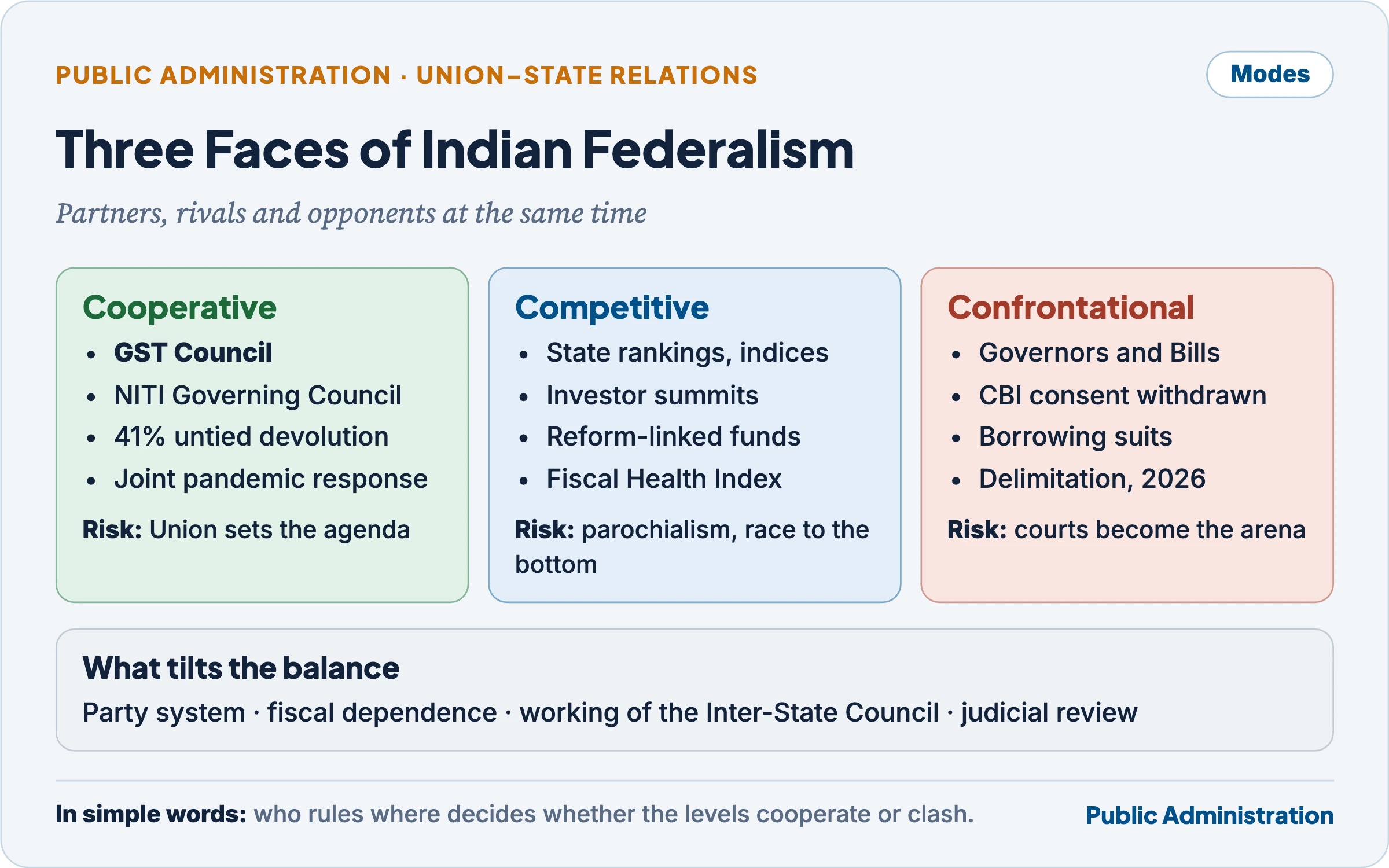
6.1 The concepts
- Cooperative federalism. Levels of government share functions and work together rather than operating in sealed compartments. Morton Grodzins (The American System, 1966) contrasted the old “layer cake” (separate layers) with the “marble cake” (mixed functions) of modern federations; Granville Austin applied the idea to India’s interdependent Union and States.
- Bargaining federalism. Morris-Jones saw Indian federalism as continuous bargaining between the Union and States, using party channels, planning negotiations and political pressure.
- Competitive federalism. States compete for investment, talent and performance rankings, and the Union rewards performance. Its roots lie in Charles Tiebout’s model (1956), where citizens “vote with their feet” among jurisdictions offering different packages of taxes and services, and in public choice theory, which sees competition among governments as a check on monopoly government. Barry Weingast’s “market-preserving federalism” (1995) adds that sub-national competition, with hard budget constraints, can promote growth.
- Confrontational federalism. Relations marked by open conflict: litigation, boycotts, withdrawal of consent, and constitutional office-holders acting as partisan agents.
6.2 Instruments of cooperative federalism since 2014
- NITI Aayog (1 January 2015): replaced the Planning Commission; its Governing Council of all Chief Ministers was described as “Team India“; sub-groups of Chief Ministers (2015) on Centrally Sponsored Schemes, Swachh Bharat and skill development; regional councils for specific issues.
- Higher untied devolution: the 14th Finance Commission raised the States’ share from 32 to 42 per cent (2015–20); the 15th and 16th set it at 41 per cent after Jammu and Kashmir became a Union Territory.
- GST Council (2016): shared sovereignty over indirect taxes.
- Crisis cooperation: joint management of the COVID-19 pandemic through the Disaster Management Act, 2005, and GST compensation borrowing by the Union for States.
- Outcome-based cooperation: the Aspirational Districts Programme (2018), built on convergence of Union and State schemes, competition among districts and collaboration with the district administration.
Indian Connect — NITI Aayog and cooperative federalism
NITI Aayog has no power to allocate funds, which makes it more of a think tank and convenor than its predecessor. Supporters say this removes a source of central discretion and makes it a genuine platform for States (State Support Missions, indices and best-practice sharing). Critics say that, without money, it cannot broker real bargains, that its Governing Council meets only about once a year, and that several opposition Chief Ministers boycotted its ninth meeting (27 July 2024) over the Union Budget’s alleged discrimination. Its effectiveness as a cooperative-federal forum therefore depends on political goodwill rather than structure.
6.3 Competitive federalism and its limits
- Instruments of competition:
- Business Reform Action Plan rankings for ease of doing business (from 2015);
- NITI Aayog’s SDG India Index, Health Index, School Education Quality Index, Export Preparedness Index and the Fiscal Health Index (first released in January 2025);
- State investor summits (Vibrant Gujarat, Invest Karnataka, Global Investors Summit in Uttar Pradesh);
- performance-linked Finance Commission grants and reform-linked borrowing room.
- Benefits: spreads best practices, rewards good governance, gives citizens and investors comparable data, and nudges laggard States.
- Tendencies towards parochialism:
- domicile-based job quotas in the private sector (Haryana’s 75 per cent law was struck down by the Punjab and Haryana High Court in November 2023; similar laws in other States);
- race to the bottom in tax concessions, land and labour norms to attract investment;
- “sons of the soil” sentiment against migrant workers;
- disputes over river waters and power shared across States;
- competitive welfarism (cash transfers and free services) straining State finances;
- unequal starting points: competition favours already advanced States and can widen regional disparities unless paired with equalising transfers.
- Balance. Competition works best within a cooperative frame: common rules (GST, inter-state trade freedom), equalising transfers, and Union restraint. Without these it turns into beggar-thy-neighbour rivalry.
6.4 Confrontational federalism: the current flashpoints
- Governors and State Bills. Prolonged delays in assent in Tamil Nadu, Kerala, Punjab, Telangana and West Bengal; the April 2025 Tamil Nadu judgment and the November 2025 Presidential Reference opinion (section 2.7); Governors’ roles as university chancellors; disputes over addresses to the Assembly.
- Central agencies. Withdrawal of CBI general consent by several States; the West Bengal Article 131 suit (maintainable, July 2024); allegations of selective ED action.
- Fiscal disputes. Kerala’s borrowing suit (pending before a Constitution Bench); Karnataka’s drought-relief suit; Tamil Nadu’s dispute over Samagra Shiksha funds linked to the PM SHRI scheme and the National Education Policy; protests over cesses, delayed grants and the 60:40 sharing under the VB–G RAM G Act.
- Delimitation and representation. The freeze on inter-State allocation of Lok Sabha seats based on the 1971 Census was extended by the 84th Amendment (2001) until the first census after 2026. Southern States fear losing seats to populous northern States for having controlled population. In March 2025 Tamil Nadu convened a Joint Action Committee of several States on “fair delimitation”. On 17 April 2026 the Constitution (131st Amendment) Bill, 2026, which sought to raise the Lok Sabha ceiling to 850, redraw seats on the 2011 Census and operationalise women’s reservation by 2029, was defeated in the Lok Sabha (298 for, 230 against, short of the two-thirds needed); the linked Delimitation Bill, 2026 was withdrawn. It was the first defeat of a government constitutional amendment since 2014, and shows how representation has joined money and power as a core federal issue.
- Language and education. Objections to the three-language formula and Hindi nomenclature of Union laws; the NEET dispute between Tamil Nadu and the Union.
- Rising use of Article 131. States increasingly sue the Union directly (Kerala, West Bengal, Karnataka, Tamil Nadu, Punjab), turning the Supreme Court into the chief arena of federal bargaining, a shift the November 2025 Reference addressed by asking whether federal disputes belong under Article 131 rather than Article 32.
Criticism — Is Indian federalism too centralised?
- Structural tilt: residuary powers, Article 249, Article 253, emergency powers, Union control of State Bills and borrowing make the States constitutionally junior partners.
- Fiscal dependence: a shrinking divisible pool (cesses), loss of GST autonomy, discretionary grants and conditional loans let the Union steer State priorities.
- Agents in the States: Governors, AIS officers and central agencies are seen as instruments of the Union’s ruling party.
- Unused cooperative machinery: the Inter-State Council rarely meets, Sarkaria and Punchhi recommendations remain largely unimplemented, and decisions are taken in Delhi first.
- Centralised representation debates: delimitation and “one nation” initiatives (one tax, one election proposals) are framed nationally, with States reacting.
Defence — The case for a strong but cooperative Centre
- Holding-together logic: a diverse, post-Partition country needs a Union able to protect unity, security and a common market.
- Equity: only the Union can redistribute from richer to poorer States; Finance Commission transfers and CSS fund basic services in Bihar or the North-East.
- Shared decision bodies: the GST Council, NITI’s Governing Council and the Finance Commission give States real voice; States hold a veto in the GST Council.
- Judicial protection: Bommai, Mohit Minerals, the 2024 mineral-tax ruling and the West Bengal CBI ruling show courts defending State space.
- More devolution than before: untied transfers rose from 32 to 41–42 per cent of the pool, plan discretion ended in 2015, and Article 356 misuse has sharply declined.
On balance, Indian federalism is best described as flexible and bargained: centralised in its constitutional design, more cooperative in its fiscal institutions than before, competitive in its development politics, and confrontational wherever the same party does not rule both levels.
Theory lens: Union–State relations through Paper I ideas
- Wheare’s quasi-federalism. K.C. Wheare (Federal Government, 1946) defined federalism as a division of powers in which general and regional governments are each coordinate and independent within their spheres. By that test, the Union’s overriding powers (Articles 249–254, 356, 365) make India quasi-federal: the coordinate-authority model exists on paper but is overridden in practice.
- Austin’s cooperative federalism. Granville Austin (1966) explains why States accept a strong Centre: interdependence in planning, finance and administration produces cooperation rather than rivalry. The GST Council and Centrally Sponsored Schemes are cooperative federalism institutionalised; the agency model of Article 256 is its administrative form.
- Morris-Jones’ bargaining federalism. W.H. Morris-Jones (1964) shows why outcomes depend on negotiation and political leverage: coalition-era concessions, special packages and GST compensation deals are bargains, not formula outcomes.
- Riker’s federal bargain and the party system. William Riker (1964) argues that the party system determines how centralised a federation is; India’s phases from one-party dominance to coalitions and back to strong national parties confirm it.
- Wright’s intergovernmental relations. Deil Wright (1978) moves the focus from constitutional division to IGR: officials, grants and continuous interaction. India fits his overlapping-authority model, with bargaining and some distrust among interdependent levels.
- Oates’ decentralisation theorem and Musgrave’s functions. Wallace Oates (1972) explains why services such as health, police and schooling belong with States, and Richard Musgrave (1959) why buoyant taxes and redistribution sit with the Union. Their combination produces vertical imbalance and makes transfer design the heart of Indian federalism. See the article on Monetary Fiscal Policy and Public Debt.
- Public choice and competitive federalism. Charles Tiebout (1956) and James Buchanan see competition among governments as a discipline on monopoly power; State rankings and investor summits apply this logic, while Kornai’s soft budget constraint explains why borrowing limits are needed. See the article on New Public Administration and Public Choice.
- Decentralisation theory and principal–agent. Decentralisation theory holds that decisions closer to citizens are more responsive and accountable; the Union’s conditional grants, by contrast, follow a principal–agent logic in which the Union (principal) uses money and monitoring to steer States (agents) whose priorities differ. Excessive conditions weaken the accountability of State governments to their own voters. For the democratic-decentralisation side to local bodies, see the article on Union–State–local relations.
Key Terms
| Term | Meaning in simple words |
|---|---|
| Dual polity | Two orders of government, Union and State, each with its own legislature and executive |
| Quasi-federal | Wheare’s term for a federation with strong unitary features |
| Cooperative federalism | Union and States sharing functions and working together |
| Competitive federalism | States competing for investment and performance, with the Union rewarding results |
| Bargaining federalism | Outcomes negotiated between the levels through political leverage |
| Intergovernmental relations (IGR) | Day-to-day interactions of officials and governments across levels |
| Seventh Schedule | The three lists dividing legislative subjects: Union, State, Concurrent |
| Residuary power | Power over subjects not in any list; with Parliament (Article 248) |
| Non obstante clause | “Notwithstanding” wording that makes Union powers prevail |
| Repugnancy | Direct conflict between a Union and State law on a Concurrent subject |
| Occupied field | When Parliament’s law is meant to cover a whole subject, leaving no room for State law |
| Pith and substance | The true nature of a law, used to decide which list it falls in |
| Colourable legislation | Doing indirectly what a legislature cannot do directly |
| Severability | Striking down only the invalid part of a law |
| Territorial nexus | A real link between a State and the object its law reaches outside its borders |
| Reservation of Bills | Governor sending a State Bill to the President for decision (Article 200) |
| Article 365 sanction | Treating a State’s failure to obey Union directions as constitutional breakdown |
| President’s Rule | Union takeover of a State’s government under Article 356 |
| Divisible pool | Union taxes shared with States, excluding cesses, surcharges and collection costs |
| Vertical fiscal imbalance | Gap between States’ spending duties and their own revenues |
| Horizontal fiscal imbalance | Differences in revenue capacity and needs among States |
| Cess and surcharge | Union levies for specific purposes or on top of taxes, not shared with States |
| Centrally Sponsored Scheme | A Union-designed, jointly funded scheme implemented by States |
| Net Borrowing Ceiling | Annual limit on a State’s borrowing fixed by the Union under Article 293 |
| Pooled sovereignty | Joint exercise of taxing power by Union and States through the GST Council |
| Localised emergency | Punchhi’s proposal for emergency rule over a district rather than a whole State |
| Delimitation | Redrawing constituencies and reallocating seats among States after a census |
Commissions, Committees and Judgments
The bodies, reports and cases below shaped Union–State relations, listed by year.
| Body / case | Year | Key point |
|---|---|---|
| Prafulla Kumar Mukherjee v. Bank of Commerce, Khulna (Privy Council) | 1947 | Pith and substance: incidental overlap does not invalidate a law |
| State of Bombay v. F.N. Balsara | 1951 | Prohibition law valid in pith and substance as a State subject |
| K.C. Gajapati Narayan Deo v. State of Orissa | 1953 | Colourable legislation is about competence, not motive |
| States Reorganisation Commission (Fazl Ali) | 1955 | Union’s strength the governing consideration; Zonal Councils followed in 1956 |
| R.M.D. Chamarbaugwalla v. Union of India | 1957 | Severability; territorial nexus |
| State of West Bengal v. Union of India | 1962 | States not sovereign; Constitution not a traditional federation |
| ARC Study Team on Centre–State Relationships (M.C. Setalvad) | 1967 | Analysis of central agencies and planning in State fields |
| ARC report on Centre–State Relationships (K. Hanumanthaiya) | 1969 | Inter-State Council; non-partisan Governors; delegation to States |
| Rajamannar Committee (P.V. Rajamannar), Tamil Nadu | 1969–71 | Redistribute lists; residuary powers to States; repeal Article 249; ISC |
| Anandpur Sahib Resolution (Shiromani Akali Dal) | 1973 | Union limited to defence, foreign affairs, communications, railways, currency |
| State of Rajasthan v. Union of India | 1977 | Court declined to review mass dissolutions under Article 356 |
| West Bengal Memorandum (Jyoti Basu government) | 1977 | “Federal” for “Union”; repeal Articles 356, 357, 360 |
| M. Karunanidhi v. Union of India | 1979 | Tests of repugnancy under Article 254 |
| Sarkaria Commission (R.S. Sarkaria) | 1983–88 | 247 recommendations; consultation, ISC, Governor criteria, Article 356 as last resort |
| Inter-State Council Order | 1990 | Permanent ISC under Article 263, chaired by the Prime Minister |
| S.R. Bommai v. Union of India | 1994 | Article 356 reviewable; floor test; federalism a basic feature |
| 80th Amendment (Tenth Finance Commission’s alternative scheme) | 2000 | All central taxes in one divisible pool |
| NCRWC (M.N. Venkatachaliah) | 2000–02 | Consult States via ISC; Governor after consulting CM; no dissolution before Parliament acts |
| Rameshwar Prasad v. Union of India | 2006 | Bihar Assembly dissolution (2005) unconstitutional |
| Punchhi Commission (M.M. Punchhi) | 2007–10 | 273 recommendations; localised emergency; Governor removal by State legislature |
| State of West Bengal v. Committee for Protection of Democratic Rights | 2010 | Courts may order CBI probes without State consent |
| 101st Amendment (GST) | 2016 | Articles 246A, 269A, 279A; GST Council |
| Jindal Stainless v. State of Haryana | 2016 | State entry taxes valid |
| Union of India v. Mohit Minerals | 2022 | GST Council recommendations persuasive, not binding; simultaneous power |
| State of Punjab v. Principal Secretary to the Governor | 2023 | Governor withholding assent must return the Bill |
| State of Kerala v. Union of India (reference order) | 2024 | Article 293 questions referred to a Constitution Bench; no interim relief |
| State of West Bengal v. Union of India (CBI suit) | 2024 | Suit maintainable; CBI under Union’s superintendence |
| Mineral Area Development Authority v. SAIL | 2024 | Royalty not a tax; States may tax mineral rights |
| State of Tamil Nadu v. Governor of Tamil Nadu | 2025 | Timelines and deemed assent for ten Bills |
| Tamil Nadu High-Level Committee (Kurian Joseph) | 2025–26 | Part I on autonomy, Governor, delimitation, GST |
| In re Assent to Bills (Presidential Reference) | 2025 | No judicial timelines or deemed assent; limited review of indefinite inaction |
| Sixteenth Finance Commission (Arvind Panagariya) | 2026 | States’ share kept at 41 per cent; GDP contribution added |
Contemporary Developments
- 131st Amendment Bill defeated (17 April 2026). The Constitution (131st Amendment) Bill, 2026, linking women’s reservation to an expanded Lok Sabha of up to 850 seats and delimitation on the 2011 Census, got 298 votes to 230, short of the required two-thirds; the Delimitation Bill, 2026 was withdrawn. Southern and opposition-ruled States had opposed the use of the 2011 Census.
- VB–G RAM G replaces MGNREGA (1 July 2026). The new rural employment law runs as a Centrally Sponsored Scheme with 60:40 cost-sharing (90:10 for north-eastern and Himalayan States) and a Union-fixed normative allocation, raising the States’ burden and drawing objections from several States.
- Sixteenth Finance Commission (1 February 2026). Its report for 2026–31 kept the States’ share at 41 per cent, introduced contribution to GDP as a criterion, ended revenue-deficit grants and asked for CAG-certified disclosure of net proceeds; the Union accepted the main recommendations.
- End of GST compensation cess (1 February 2026). The cess, extended to repay pandemic-era loans, ended; additional central excise on tobacco and the Health Security se National Security Cess on pan masala took its place, while GST 2.0 (22 September 2025) had already moved to a two-slab structure.
- Tamil Nadu’s federal review (16 February 2026). The Justice Kurian Joseph committee submitted Part I of its report on Union–State relations, covering the Governor, delimitation, education, health and GST.
- Presidential Reference on assent (20 November 2025). A five-judge bench held that courts cannot fix timelines or declare deemed assent under Articles 200 and 201, but prolonged, unexplained inaction by a Governor is open to limited judicial review.
- Kerala’s borrowing dispute (2024–2026). The Article 293 reference remains pending before a Constitution Bench; in December 2025 the Union again reduced Kerala’s borrowing limit for the last quarter of 2025–26.
- Cesses and surcharges (July 2026). The Union told the Lok Sabha that cesses and surcharges formed 17.9 per cent of gross tax revenue in 2024–25 and about 16.4 per cent in 2025–26, against 9.6 per cent in 2014–15.
Revision Grid
| Thinker / body | Work or report (year) | Key idea |
|---|---|---|
| K.C. Wheare | Federal Government (1946) | Coordinate and independent spheres; India quasi-federal |
| Paul Appleby | Public Administration in India (1953) | Union depends on States to administer national programmes |
| K. Santhanam | Union–State Relations in India (1960) | Centre made paramount by planning and finance |
| W.H. Morris-Jones | The Government and Politics of India (1964) | Bargaining federalism |
| William Riker | Federalism: Origin, Operation, Significance (1964) | Party system decides centralisation |
| Granville Austin | The Indian Constitution: Cornerstone of a Nation (1966) | Cooperative federalism |
| Morton Grodzins | The American System (1966) | Marble cake, not layer cake |
| Charles Tiebout | “A Pure Theory of Local Expenditures” (1956) | Voting with the feet; competition among jurisdictions |
| Richard Musgrave | The Theory of Public Finance (1959) | Allocation, distribution, stabilisation by level |
| Wallace Oates | Fiscal Federalism (1972) | Decentralisation theorem |
| Deil Wright | Understanding Intergovernmental Relations (1978) | Inclusive, coordinate and overlapping authority models |
| Alfred Stepan | “Federalism and Democracy” (1999) | Holding-together versus coming-together federations |
| ARC (Setalvad Study Team) | Centre–State Relationships (1967, 1969) | ISC; non-partisan Governors; delegation |
| Rajamannar Committee | Report (1971) | State autonomy; residuary powers to States |
| Sarkaria Commission | Report (1988) | Consultation and conventions; ISC; Article 356 last resort |
| NCRWC | Report (2002) | ISC consultation; Governor after consulting CM |
| Punchhi Commission | Report (2010) | Localised emergency; fixed Governor tenure; Union restraint |
| Sixteenth Finance Commission | Report (2026) | 41 per cent; GDP contribution; no revenue-deficit grants |
Previous Year Questions
- 2026Competitive federalism in India while intended to have healthy competition among states has shown tendencies towards parochialism. Comment.
- 2026Doctrine of Pith and Substance, and the Doctrine of severability in the legislative relations between the Indian Union and states are supplementary in nature but distinct in application. Discuss.
- 2026Public debt of states in India has increased significantly in the last one decade. In this context discuss the constraints of the states in planning prudent fiscal management.
- 2025Despite the division of subjects, the Union Government contributes towards subjects in the State and Concurrent Lists. Discuss its pros and cons in the light of fiscal federalism.
- 2025Divergent political interests and financial constraints hinder the spirit of ‘cooperative federalism’. Comment.
- 2025Centre-State administrative relations are a matter of debate as constitutional provisions created a strong Centre. Discuss.
- 2024“Implementation of Goods and Services Tax (GST) has led to a Paradigm shift in the centre-state relations, both financially and politically.” Analyse.
- 2024“Centre-state relations are undergoing a drastic change.” Elaborate.
- 2022Analyse the specific areas of controversies with regard to Union-State financial relations, particularly in the context of one nation – one tax policy.
- 2021NITI Aayog has been constituted to implement the goal of co-operative federalism. Discuss.
- 2020Even if all the States combine together, they cannot have their way in the decision-making in the GST Council, unless the Union agrees to it. Analyze this in the perspective of federalism in India.
- 2019Article 356 acts, “very much like the proverbial bolt from the blue…. without giving an opportunity or notice to the State Government to correct its alleged shortcomings”. This phenomenon not only undermines the autonomy of the State Government, but also demeans the status of the President of India. Critically analyze.
- 2019Even though the law and order administration is a State subject, it is paradoxical that the Central agencies– NIA or paramilitary forces under the Union Government— have restricted the powers of State Governments. Discuss.
- 2017“Implementation of Goods and Services Tax (GST) has led to a paradigm shift in the Centre-State relations, both financially and politically.” Analyse with examples.
- 2016Examine the efficacy of the measures taken to redefine and execute cooperative federalism in India.
- 2016“Introduction of G.S.T. (Goods and Services Tax) no doubt has economic benefits, but tends to compromise the States’ inherent right to impose taxes.” In this context, comment on the changing nature of Union-State financial relations.
- 2015Briefly discuss the main recommendations of the Punchhi Commission on Centre-State relations for transforming Indian Federal System.
- 2015Comment on the recent changes in the approach and methodology of devolution of responsibilities and transfer of funds from the Union to the States.
- 2015The objectives, approaches and organisational arrangements for decision-making of the NITI Aayog aim at restoring the federal character of the Indian policy. Explain.
- 2014“The Centre State relations have acquired new dimensions in recent times due to several political parties being in power at the Centre and the States.” (Second administrative, commission). Do you agree? Give reasons to support your arguments.
- 2013“There is a tendency of centralism in Indian federalism, but it is not because of its institutional framework but because of its socialist goals and centrally devised plan development.” Explain the statement in the context of Union-State relationship.
- 2012Discuss the recommendations of the Sarkaria Commission in respect of the National Development Council for improving Centre-State planning relations.
- 2011“Indian federalism is passing through a state of potential maturity.” Discuss this statement in the context of the views of the Commission on Centre-State Relations (Justice M.M. Punchi).
- 2010The prevalence of multiple channels for transfer of resources from the Centre to the States is stated to have compounded the problems of federal arrangements. Discuss.
- 2009“Many of the programmes of development being implemented at the State and the Local level have been initiated or financed by the nature of Indian federalism.” Critically examine this assessment.
- 2008What are the tension areas in Union-State relations in Planning?
- 2007There is a separate Central Ministry or Department on each subject allocated to State List. Does it mean supremacy of the Union Government or an emphasis on development administration? Analyse.
- 2006“The main problem of Centre-State relations in India is bottenecks in fiscal federalism.” Comment.
- 2004“One of the greatest weakness inherent in a Federal polity is the possibility of conflict of loyalty and responsibility on the part of public servants as between Central and State Government.” – Elaborate and comment.
- 2002“Indian federalism is described as federal in form but unitary in spirit.” Comment.
- 2000“Among several other problems, the problem of financial relationship is perhaps the most complex one.” Explain in the context of recent developments in Union-State relations in India.
- 1999“The legislative and executive powers of the States are comprehensive, but the exercise of these powers are subject to regulation, abridgement and even suspension by the Union.” Comment.
- 1997“The States are constitutionally obliged to ensure that the laws passed by Parliament are implemented.” Explain the constitutional position fully.
- 1997“The legislative relations between Union and State governments are more biased towards Union government.” Comment.
- 1996“The Union-State financial relation, as provided in the Constitution, are biased towards Union Government in the context of borrowing.” Comment.
- 1994Critically review the constitutional provisions relating to centre-state administrative relations in India during normal times within the framework of a normative federal system.
- 1993“The concept of Fiscal Federalism calls for the National Development Council to regulate plan decisions about discretionary grants-in-aid, which should in fact be distributed by the Finance Commission.” Comment
- 1991‘In the case of the centre-tit in the administrative relations between Centre and State, neither the Causes are unknown nor are they incurable.’ Discuss and Suggest measures to improve this relationship.
- 1990‘The planning commission of India in the post-Nehru period has conduced to better Centre-State relations, but (it has) not necessarily brought about depoliticization of the planning process.’ Discuss and illustrate.
- 1988Discuss the various facets of the All India Services and examine the emerging patterns of Conflict and Co-operation between the Union and the State in Indian Federalism.
- 1987Discuss the financial and administrative relationships obtaining between the Union and the States in India. Do you think States have been reduced to a position of glorified municipalities?