

Union-State administrative, legislative and financial relations; Role of the Finance Commission; Governor; Chief Minister; Council of Ministers; Chief Secretary; State Secretariat; Directorates.
This article: Fiscal federalism and the constitutional scheme of financial relations (Articles 264–293); vertical and horizontal fiscal imbalance; the Finance Commission under Article 280 and the Finance Commission (Miscellaneous Provisions) Act, 1951 (composition, qualifications, powers, Article 281); functions and terms of reference (vertical devolution, horizontal distribution, grants-in-aid under Article 275, local body grants under Article 280(3)(bb) and (c), disaster management funding); how the Commission works (gap-filling and normative approaches, criteria and weights, formula changes from the Tenth to the Sixteenth Commission); the Fourteenth (42%), Fifteenth (41%, 2021–26) and Sixteenth (41%, 2026–31) Commissions; Finance Commission versus Planning Commission and NITI Aayog transfers (statutory and discretionary transfers, Gadgil formula, Centrally Sponsored Schemes, Article 282); cesses and surcharges and the divisible pool; GST compensation and its end; borrowing limits under Article 293, FRBM and Kerala v. Union of India (2024); issues (Centre’s dominance, terms of reference controversies, southern States’ grievances, conditional grants, acceptance by convention); State Finance Commissions (Articles 243I and 243Y, weaknesses, conditions set by the Fifteenth and Sixteenth Commissions, RBI studies of local finance); theories and debates of fiscal federalism.
Official Syllabus: Paper II · Unit 2-06 State Government and Administration
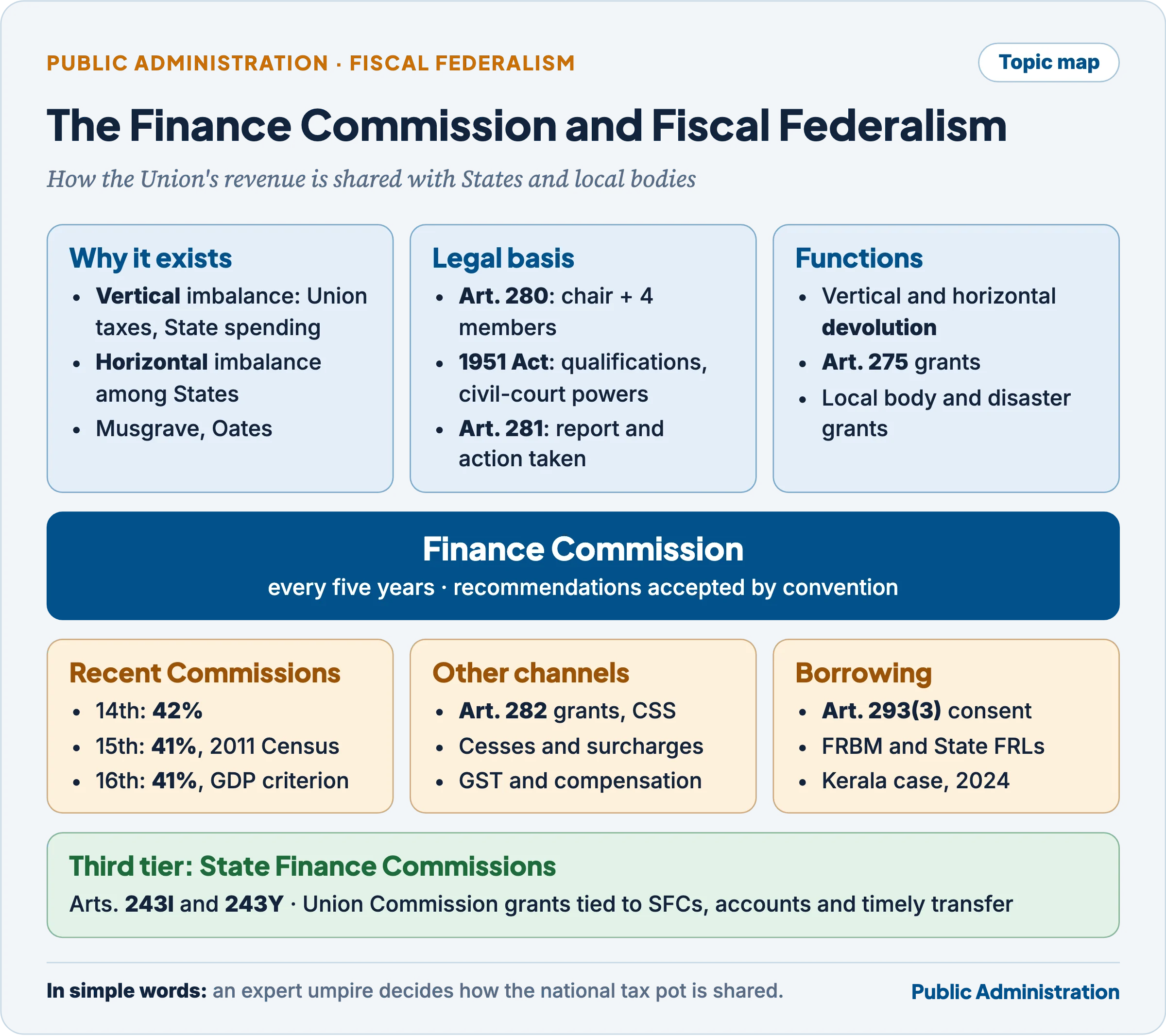
India’s States run the police, hospitals, schools, farms and most roads, yet the most buoyant taxes (income tax, corporation tax, customs) belong to the Union. Every federation has to settle who taxes what, who spends on what, and how the gap between the two is filled. India’s Constitution answers the last question with an unusual institution: a Finance Commission appointed every five years to recommend how the Union’s tax revenue is shared with the States and how grants are given. It has worked since 1952 and is often called the balancing wheel of fiscal federalism.
The Commission is studied in Public Administration for three reasons. It is a constitutional body whose recommendations are, by convention, accepted. It sits at the centre of Union–State conflict over money, from the terms of reference to the population base. And it is now the main channel of funds to panchayats and municipalities, which links it to State Finance Commissions and democratic decentralisation.
In simple words
Think of a joint family where the eldest brother collects the rent from all the family shops, but the younger brothers run the households, schools and clinics. Every five years the family appoints a respected umpire who decides what share of the rent goes to the younger brothers, how it is split among them (the poorer household gets more), and what extra help is given for emergencies. The umpire’s word is not legally binding, but the family has always accepted it. That umpire is the Finance Commission.
1. Fiscal Federalism and the Constitutional Scheme
In simple words
A federation has two sets of governments, each with its own duties and its own money. Fiscal federalism studies how taxes, spending and borrowing are divided between them, and how money is moved from the richer level to the poorer one so that both can do their jobs.
1.1 Meaning of fiscal federalism
- Fiscal federalism is the division of taxing powers, expenditure functions and borrowing powers among levels of government, together with the transfers that bridge the gaps between them.
- Richard Musgrave, the German-American public finance economist, in The Theory of Public Finance (1959), divided the fiscal role of the state into allocation (providing public goods), distribution (reducing inequality) and stabilisation (managing employment and prices).
- Stabilisation and distribution suit the national government, because a State cannot run its own monetary policy and rich residents can move away from a high-tax State.
- Allocation of local public goods can be shared, because people’s needs differ by place.
- Wallace Oates, the American economist, in Fiscal Federalism (1972), stated the decentralisation theorem: a public good whose benefits are confined to one area should be provided by the lowest level of government that covers that area, because it knows local preferences better and can tailor the service.
- Charles Tiebout, in “A Pure Theory of Local Expenditures” (1956), argued that citizens “vote with their feet“, moving to jurisdictions whose mix of taxes and services suits them, so competition among local governments improves efficiency.
- India’s design. The Constitution follows this logic in part: defence, currency, foreign trade and macro-stabilisation lie with the Union, while public order, health, agriculture, land and local government lie with the States. But it gives the Union the wider and more elastic tax bases, which creates a structural gap.
1.2 Vertical and horizontal fiscal imbalance
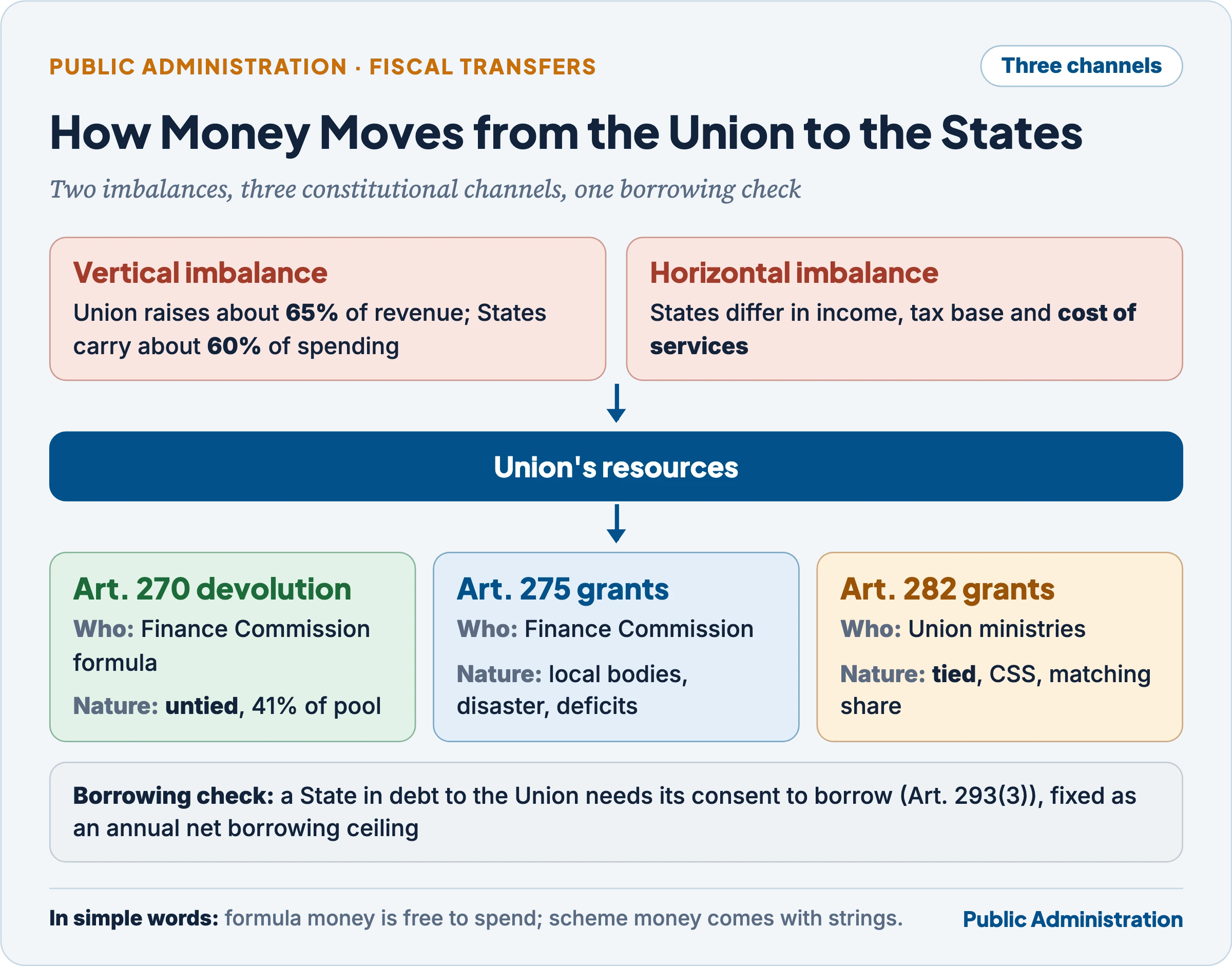
- Vertical fiscal imbalance is the gap between the expenditure responsibilities and revenue powers of the two levels taken as a whole. In India the Union raises about 65% of general government revenue, but the States carry about 60% of general government expenditure (World Bank study for the Sixteenth Finance Commission).
- Why it arises: taxes on mobile bases (income, corporations, customs) are better collected nationally; services (health, schools, police) are better delivered locally. A gap is therefore built into every federation.
- Horizontal fiscal imbalance is the difference among States in their ability to raise revenue and their cost of providing services. Bihar’s per capita income is a fraction of Goa’s or Telangana’s; hill and north-eastern States face high costs for small, scattered populations.
- Two jobs of transfers. Transfers must (i) close the vertical gap so that States can perform their functions, and (ii) narrow the horizontal gap so that a citizen in a poor State gets broadly comparable public services. This second goal is called fiscal equalisation.
- The trade-off. Equalisation (equity) means giving more to poorer States; rewarding good fiscal behaviour (efficiency) means giving more to States that raise taxes and grow. Every Finance Commission formula is a compromise between the two.
1.3 Division of taxing powers
The Constitution separates taxing powers by Lists in the Seventh Schedule and then provides for sharing. The main categories are set out below.
| Category | Examples | Article |
|---|---|---|
| Union taxes | Income tax (non-agricultural), corporation tax, customs, Union excise on tobacco and petroleum, residuary taxes | Entries 82–92C, List I; Art. 248 |
| State taxes | Land revenue, agricultural income tax, stamp duty (most), excise on liquor, taxes on vehicles, electricity, entertainment, professions | Entries 45–63, List II |
| Concurrent power over GST | Goods and Services Tax, levied by both Union and States | Art. 246A (101st Amendment, 2016) |
| Levied by Union, collected and kept by States | Stamp duties on bills of exchange and similar instruments | Art. 268 |
| Levied and collected by Union, assigned to States | Taxes on inter-State sale of goods (other than GST items), consignment tax | Art. 269 |
| Levied and collected by Union, shared with States | All Union taxes and duties, including CGST, except cesses, surcharges and Art. 268/269 items | Art. 270 (as amended in 2000 and 2016) |
| Surcharges for Union purposes | Surcharge on income tax | Art. 271 |
| IGST | Tax on inter-State supply, apportioned between Union and States | Art. 269A |
- Article 270 after the 80th Amendment (2000). Before 2000 only income tax was compulsorily shared (Article 270) and Union excise duties could be shared if Parliament so provided (Article 272). On the Tenth Finance Commission’s “alternative scheme of devolution”, the 80th Amendment made all Union taxes part of a single shareable pool and omitted Article 272. This “global sharing” gives States a share in the buoyancy of every Union tax.
- Exclusions from the pool. Article 270 excludes cesses and surcharges (Article 271) and the cost of collection. This exclusion is the source of today’s dispute over the “shrinking divisible pool” (section 7).
- Article 274. A Bill that varies a tax in which States are interested, or imposes a surcharge, needs the President’s prior recommendation, a safeguard for States’ interests.
- Article 279. “Net proceeds” of a tax are ascertained and certified by the Comptroller and Auditor General, whose certificate is final.
- Emergencies. Under Article 354 the President may modify the sharing of taxes and grants while a national emergency is in force; under Article 360 (financial emergency) the Union may direct States to observe canons of financial propriety, cut salaries and reserve money Bills for the President.
For the wider Union–State legislative and administrative relations, the Sarkaria and Punchhi Commissions, the Inter-State Council and the GST Council as a forum, see the article on Union–State Relations.
1.4 Channels of transfer
Resources flow from the Union to the States through three constitutional channels, plus borrowing.
- Tax devolution under Article 270: the States’ share of the divisible pool, recommended by the Finance Commission. It is untied: States spend it as they wish.
- Grants-in-aid under Article 275(1): statutory grants charged on the Consolidated Fund of India for States “in need of assistance”, on the Finance Commission’s recommendation. The provisos make grants mandatory for schemes for Scheduled Tribes’ welfare and for raising the administration of Scheduled Areas, with special provision for Assam.
- Discretionary grants under Article 282: the Union (or a State) may make grants “for any public purpose” even outside its legislative competence. This is the channel for Centrally Sponsored Schemes (CSS) and was earlier used for Planning Commission assistance. The Finance Commission has no say in their size or design.
- Loans from the Union, and market borrowing with the Union’s consent under Article 293(3) (section 8).
- Size of each channel. The Sixteenth Commission found that Finance Commission transfers averaged 23.1% of the Union’s gross tax revenue in the award periods of the first four Commissions (1952–69) and 38.5% in the periods of the last two. Including non-Finance-Commission transfers, total transfers reached about 55.8% of gross tax revenue during the Fourteenth and Fifteenth Commission periods.
- Why the mix matters. Devolution and Article 275 grants are formula-based, predictable and untied; Article 282 grants are discretionary, conditional and ministry-driven. States prefer the first, the Union often prefers the second because it can steer national priorities.
2. The Finance Commission: Constitutional and Legal Framework
In simple words
The Constitution itself orders the President to set up a Finance Commission every five years. Parliament has passed a short law saying who can be its members and what powers it has. Once the Commission reports, its report must be placed before Parliament with a note on what the government has done about it.
2.1 Article 280
- Constitution. The President shall constitute a Finance Commission within two years of the commencement of the Constitution and thereafter at the expiration of every fifth year or earlier as the President thinks necessary (Article 280(1)).
- Composition. A Chairman and four other members appointed by the President.
- Qualifications. Parliament may by law fix the qualifications and the manner of selection (Article 280(2)). This was done by the Finance Commission (Miscellaneous Provisions) Act, 1951.
- Duties (Article 280(3)). To make recommendations to the President on:
- (a) the distribution between the Union and the States of the net proceeds of taxes to be divided under Chapter I of Part XII, and the allocation among the States of their shares;
- (b) the principles that should govern grants-in-aid of the revenues of States out of the Consolidated Fund of India;
- (bb) the measures needed to augment the Consolidated Fund of a State to supplement the resources of the Panchayats, on the basis of the recommendations of the State Finance Commission (inserted by the 73rd Amendment, 1992);
- (c) the same for Municipalities (inserted by the 74th Amendment, 1992);
- (d) any other matter referred to it by the President “in the interests of sound finance”.
- Procedure. The Commission determines its own procedure and has such powers as Parliament confers (Article 280(4)).
- Article 281. The President shall cause every recommendation, together with an explanatory memorandum as to the action taken, to be laid before each House of Parliament.
2.2 The Finance Commission (Miscellaneous Provisions) Act, 1951
- Chairman: a person who has had experience in public affairs.
- Members: chosen from persons who
- are, or are qualified to be, judges of a High Court;
- have special knowledge of the finances and accounts of Government;
- have wide experience in financial matters and administration; or
- have special knowledge of economics.
- Disqualifications: mental unsoundness, undischarged insolvency, conviction for an offence involving moral turpitude, and any financial or other interest likely to affect prejudicially the member’s functions.
- Term: as specified by the President in the order; members are eligible for reappointment.
- Powers: the Commission has the powers of a civil court under the Code of Civil Procedure for summoning witnesses, requiring documents and requisitioning public records; it may require any person to furnish information useful to its work.
- Practice: the Commission is appointed by a presidential order that also lays down its terms of reference (ToR) and reporting date; it is serviced by a small secretariat headed by a Secretary drawn from government, and is dissolved after it reports.
2.3 Articles and Acts at a glance
The constitutional and statutory provisions on the Finance Commission and fiscal transfers are gathered below.
| Provision | Content |
|---|---|
| Art. 246A | Concurrent power of Union and States to levy GST |
| Art. 268, 269, 269A | Taxes collected by one level and kept or assigned to the other; IGST apportionment |
| Art. 270 | Sharing of all Union taxes (except cesses, surcharges) on Finance Commission recommendation |
| Art. 271 | Surcharges for purposes of the Union, not shared |
| Art. 273 | Grants in lieu of export duty on jute to Assam, Bihar, Odisha, West Bengal (now spent) |
| Art. 274 | President’s prior recommendation for Bills affecting taxes in which States are interested |
| Art. 275 | Statutory grants-in-aid to States in need; mandatory for Scheduled Tribes and Scheduled Areas |
| Art. 279 | Net proceeds certified by the CAG |
| Art. 279A | GST Council |
| Art. 280 | Constitution, composition and duties of the Finance Commission |
| Art. 281 | Report and action-taken memorandum laid before Parliament |
| Art. 282 | Discretionary grants for any public purpose |
| Art. 292, 293 | Borrowing by the Union and by States; Union consent to State loans |
| Art. 243H, 243I | Panchayat taxes and grants; State Finance Commission for Panchayats |
| Art. 243X, 243Y | Municipal taxes and grants; State Finance Commission for Municipalities |
| Finance Commission (Miscellaneous Provisions) Act, 1951 | Qualifications, disqualifications, powers of the Commission |
| FRBM Act, 2003; State FRLs | Fiscal deficit and debt rules for the Union and the States |
| GST (Compensation to States) Act, 2017 | Five-year compensation for GST revenue loss through a cess |
| Disaster Management Act, 2005 | NDRF, SDRF and mitigation funds financed on Finance Commission recommendation |
2.4 Nature of the Commission and binding force of its recommendations
- Quasi-judicial in spirit. The Commission hears the Union, every State, local bodies, experts and the public, studies data and gives reasoned recommendations; scholars have described it as a buffer that takes the division of money out of the vortex of day-to-day federal politics.
- Recommendatory in law. Article 280 uses the word “recommendations”, and Article 281 requires only an action-taken memorandum. The Union is not legally bound.
- Accepted by convention. In practice the core recommendations on tax devolution have always been accepted, and those on statutory grants almost always. Departures have occurred on peripheral grants: for example, the Union did not implement the Fifteenth Commission’s sector-specific and State-specific grants, saying it would give them “due consideration”.
- Implementation route. The tax share is given effect by a presidential order under Article 270; grants under Article 275 are paid through the Union Budget.
Common confusion
Is the Finance Commission’s report an “award” binding on the Union? No. It is popularly called an “award”, but the Constitution speaks only of recommendations. The Union could reject them, subject to explaining its action to Parliament under Article 281. What makes them effective is a strong constitutional convention: the devolution share and formula have been accepted every time since 1952, so departing from them would cause a serious federal crisis. Peripheral items (sector grants, fiscal roadmaps) are often accepted only “in principle” or set aside.
2.5 The sixteen Finance Commissions
The Commissions so far, with their chairs and award periods, are listed below.
| FC | Chair | Award period | FC | Chair | Award period |
|---|---|---|---|---|---|
| 1st | K.C. Neogy | 1952–57 | 9th | N.K.P. Salve | 1989–95 |
| 2nd | K. Santhanam | 1957–62 | 10th | K.C. Pant | 1995–2000 |
| 3rd | A.K. Chanda | 1962–66 | 11th | A.M. Khusro | 2000–05 |
| 4th | P.V. Rajamannar | 1966–69 | 12th | C. Rangarajan | 2005–10 |
| 5th | Mahavir Tyagi | 1969–74 | 13th | Vijay Kelkar | 2010–15 |
| 6th | K. Brahmananda Reddy | 1974–79 | 14th | Y.V. Reddy | 2015–20 |
| 7th | J.M. Shelat | 1979–84 | 15th | N.K. Singh | 2020–26 |
| 8th | Y.B. Chavan | 1984–89 | 16th | Arvind Panagariya | 2026–31 |
- Chairs have been drawn from politics (Neogy, Tyagi, Chavan, Salve, Pant, Singh), law (Rajamannar, Shelat) and economics or central banking (Khusro, Rangarajan, Kelkar, Reddy, Panagariya). Since the 1990s the Commission has become increasingly technocratic, staffed by economists and former finance officials.
- Unique in comparative terms. Few federations have a periodic constitutional commission of this kind. Australia’s Commonwealth Grants Commission is statutory and advisory; Canada, Germany and the United States settle transfers through legislation and intergovernmental bargaining.
3. Functions and Terms of Reference
In simple words
The Finance Commission answers four big questions: how much of the Union’s taxes the States get, how that share is split among States, which States need extra grants, and how much money should reach villages and towns. The government can also give it extra questions, which is where most quarrels begin.
3.1 Vertical devolution
- Meaning. Vertical devolution is the percentage of the divisible pool of Union taxes that goes to all States together.
- How it is fixed. The Commission projects the revenues and expenditure needs of the Union and of the States for five years, assesses the Union’s own commitments (defence, interest, national programmes), takes account of other transfers (CSS, grants), and arrives at a share that leaves both levels able to perform their duties.
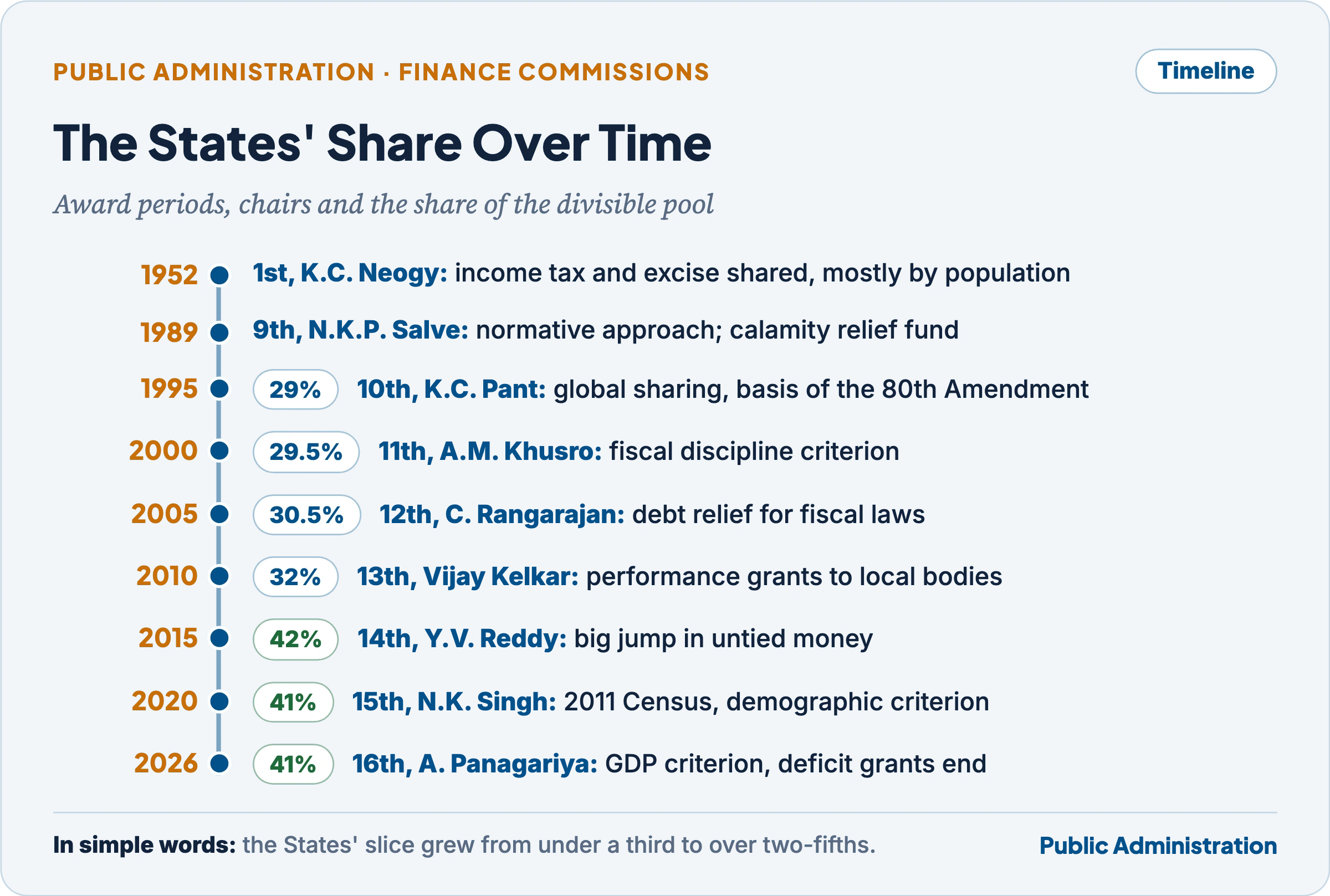
- Historical trend. Before 2000 Commissions fixed separate shares of income tax and Union excise; the share of net income tax reached 85% by the late 1970s. Under global sharing the States’ share has been 29% (Tenth, alternative scheme), 29.5% (Eleventh), 30.5% (Twelfth), 32% (Thirteenth), 42% (Fourteenth) and 41% (Fifteenth and Sixteenth).
- Indicative ceiling on total transfers. Some Commissions also suggested an indicative ceiling on all revenue transfers as a share of the Union’s gross revenue receipts (37.5% by the Eleventh, 38% by the Twelfth, 39.5% by the Thirteenth).
3.2 Horizontal distribution
- Meaning. Horizontal distribution is the inter se share of each State in the States’ total. It is decided by a formula of criteria with weights: a weight of 15% to area means that 15% of the States’ share is divided in proportion to each State’s area.
- Principles behind the criteria. The Thirteenth Commission’s review grouped them into four:
- Need: population and its composition;
- Revenue disability (equity): income distance or fiscal capacity distance, which gives more to States with lower per capita income;
- Cost disability: area, forest cover, infrastructure index;
- Efficiency: tax effort, fiscal discipline, demographic performance, contribution to GDP.
- Section 4 explains each criterion and how weights have changed.
3.3 Grants-in-aid under Article 275
- Purpose. Devolution follows a formula and cannot fill every State’s gap. Grants address what the formula misses: a State’s remaining revenue deficit, special needs, and nationally important sectors.
- Types over the years:
- Revenue deficit (gap-filling) grants to States whose assessed revenue expenditure exceeds their revenue after devolution: given by most Commissions; 17 States received about ₹2.95 lakh crore under the Fifteenth Commission; the Sixteenth Commission discontinued them.
- Sector-specific grants for health, education, police, judiciary, roads, statistics (Twelfth, Thirteenth, Fifteenth).
- State-specific grants for special problems (Twelfth, Thirteenth, Fifteenth).
- Local body grants (from the Tenth onward) and disaster management grants (from the Ninth onward).
- Principles. Commissions have followed need, equity, efficiency and conditionality: grants are given where a disability is not captured by devolution, and increasingly tied to reforms and outcomes.
3.4 Local body grants under Article 280(3)(bb) and (c)
- Origin. The 73rd and 74th Amendments (1992) made panchayats and municipalities constitutional institutions and created State Finance Commissions (Articles 243I and 243Y). They also added clauses (bb) and (c) to Article 280(3), asking the Union Finance Commission to recommend measures to augment States’ Consolidated Funds for local bodies on the basis of SFC recommendations.
- Evolution of the grants:
- Tenth Commission: the first local body grants, an ad hoc ₹4,381 crore for panchayats and ₹1,000 crore for municipalities (1996–2000), with release slowed by States’ failure to send utilisation certificates.
- Eleventh and Twelfth Commissions: fixed amounts (the Twelfth gave ₹20,000 crore for PRIs and ₹5,000 crore for ULBs), with priority to water supply, sanitation and solid waste management.
- Thirteenth Commission: linked grants to the divisible pool and split them into general basic and performance grants, the latter conditional on reforms such as better accounts and audit, a local body ombudsman, property tax boards and action on SFC reports.
- Fourteenth Commission: ₹2.87 lakh crore, given only to gram panchayats and municipalities, split into basic (90:10 for panchayats, 80:20 for ULBs) and performance grants linked to audited accounts and growth in own revenue.
- Fifteenth Commission: ₹4.36 lakh crore, to all three tiers of panchayats, including ₹70,051 crore of health grants through local governments; 60% of rural grants tied to sanitation and drinking water.
- Sixteenth Commission: ₹7.91 lakh crore (section 5.3).
- Significance. Finance Commission grants have become the most predictable and untied source of money for gram panchayats, and the main lever for pushing States to constitute SFCs and publish local accounts (section 10).
3.5 Financing disaster management
- Ninth Commission (1990): created the Calamity Relief Fund (CRF) in each State, financed 75:25 by the Union and the State, replacing ad hoc “margin money”.
- Tenth and Eleventh Commissions: a national fund for calamities of rare severity, later the National Calamity Contingency Fund (NCCF).
- Disaster Management Act, 2005: created the National and State Disaster Response Funds (NDRF, SDRF) and mitigation funds; the Thirteenth Commission merged the CRF and NCCF into these.
- Fifteenth Commission: created integrated State and National Disaster Risk Management Funds with separate mitigation windows (80:20 between response and mitigation), a corpus of about ₹1.6 lakh crore for States, Union share 75% (90% for north-eastern and Himalayan States), and graded cost-sharing for national assistance.
- Sixteenth Commission: asked by its ToR to review disaster financing under the 2005 Act; recommended a State corpus of ₹2,04,401 crore (Union share ₹1,55,916 crore), split 80:20 between the SDRF and SDMF, a cap on unspent SDRF balances, and data entry in the National Disaster Management Information System as a condition from 2027-28.
3.6 Terms of reference: “any other matter”
- Why ToR matter. Article 280(3)(a)–(c) fixes the core mandate, but the Union adds tasks under clause (d) and also tells the Commission what to “have regard to”. Through ToR the Union shapes the lens through which the Commission sees State finances.
- Typical additions:
- Debt: review of States’ debt and a debt relief scheme (Ninth, Twelfth);
- Fiscal discipline: a roadmap for fiscal consolidation and the FRBM framework (Twelfth onward);
- Population base: use of the 1971 Census (from the Seventh to the Fourteenth), then of the 2011 Census (Fifteenth, Sixteenth);
- GST: the impact of GST on Union and State finances (Fourteenth, Fifteenth);
- Incentives: performance incentives for States (Fifteenth);
- Defence: whether a separate mechanism is needed for defence and internal security funding (added to the Fifteenth’s ToR in 2019);
- Disaster financing: review of arrangements under the Disaster Management Act (Fifteenth, Sixteenth).
- Lean ToR of the Sixteenth Commission. Its ToR, approved by the Cabinet on 29 November 2023, contained only the three constitutional items and a review of disaster financing, without the contested “have regard to” clauses that marked the Fifteenth’s.
3.7 Two famous ToR disputes
- Ninth Commission (1987). A conclave of non-Congress Chief Ministers in Calcutta (December 1987) protested that the Union had unilaterally framed the ToR, asking the Commission to adopt a “normative” assessment and to consider the Union’s own needs. A working group led by West Bengal’s Finance Minister Asim Dasgupta drafted alternative ToR. The States’ complaint was that a body meant to arbitrate between Union and States was being given a brief by one of the parties.
- Fifteenth Commission (2017–18). The ToR notified on 27 November 2017 required use of the 2011 population, asked whether revenue deficit grants should be given at all, invited a review of the “impact” of the Fourteenth Commission’s higher devolution on the Union’s finances, and proposed performance incentives tied to Union priorities (such as DBT, digital transactions and population control). Finance Ministers of Kerala, Karnataka, Andhra Pradesh and Puducherry met at Thiruvananthapuram on 10 April 2018 and called the ToR contrary to federal principles; Tamil Nadu objected separately.
4. How the Finance Commission Works
In simple words
The Commission is like an assessor who studies every State’s income and expenses, visits all the States, listens to complaints, and then writes a formula. The formula decides each State’s share of the national pot, and the leftover problems are handled through grants.
4.1 The process
- Inputs. Memoranda from the Union and every State; visits to each State to meet the Chief Minister, ministers, officials, local bodies, political parties and trade bodies; studies by research institutions; data from the CAG, RBI, NSO and ministries.
- Assessment. The Commission projects each State’s own revenue and expenditure needs for the award period, then computes the post-devolution gap.
- Report. Volume I gives the analysis and recommendations; later volumes give State-wise data. It is submitted to the President, then laid before Parliament with the action-taken memorandum.
- Critique of “statistics aggregation”. Critics have argued that the Commission merely aggregates statistics supplied by governments, applies a formula and moves on, without a permanent secretariat, its own data system or follow-up. Defenders reply that its strength lies precisely in rule-based, data-driven distribution, which keeps discretion and politics out; the weakness is its temporary character, which prevents continuous monitoring.
4.2 Gap-filling and normative approaches
- Gap-filling approach. Early Commissions projected a State’s actual revenue and expenditure and filled the deficit with grants. Critics said this created moral hazard: a State that spent more or taxed less got more.
- Normative approach. Starting with the Ninth Commission, Commissions estimated revenue and expenditure on norms (what a State should raise given its tax base, and what it should spend given average standards), so that grants filled only the gap a reasonable State would have.
- “Norms-based rather than need-based”. Modern Commissions rely on norms and formulae (population, area, income distance) rather than on each State’s claimed needs. This promotes objectivity, predictability and incentives, but critics argue that norms derived from averages ignore special needs (coastal disasters, insurgency, ageing populations) and favour the Union’s view of what States should spend.
4.3 The criteria explained
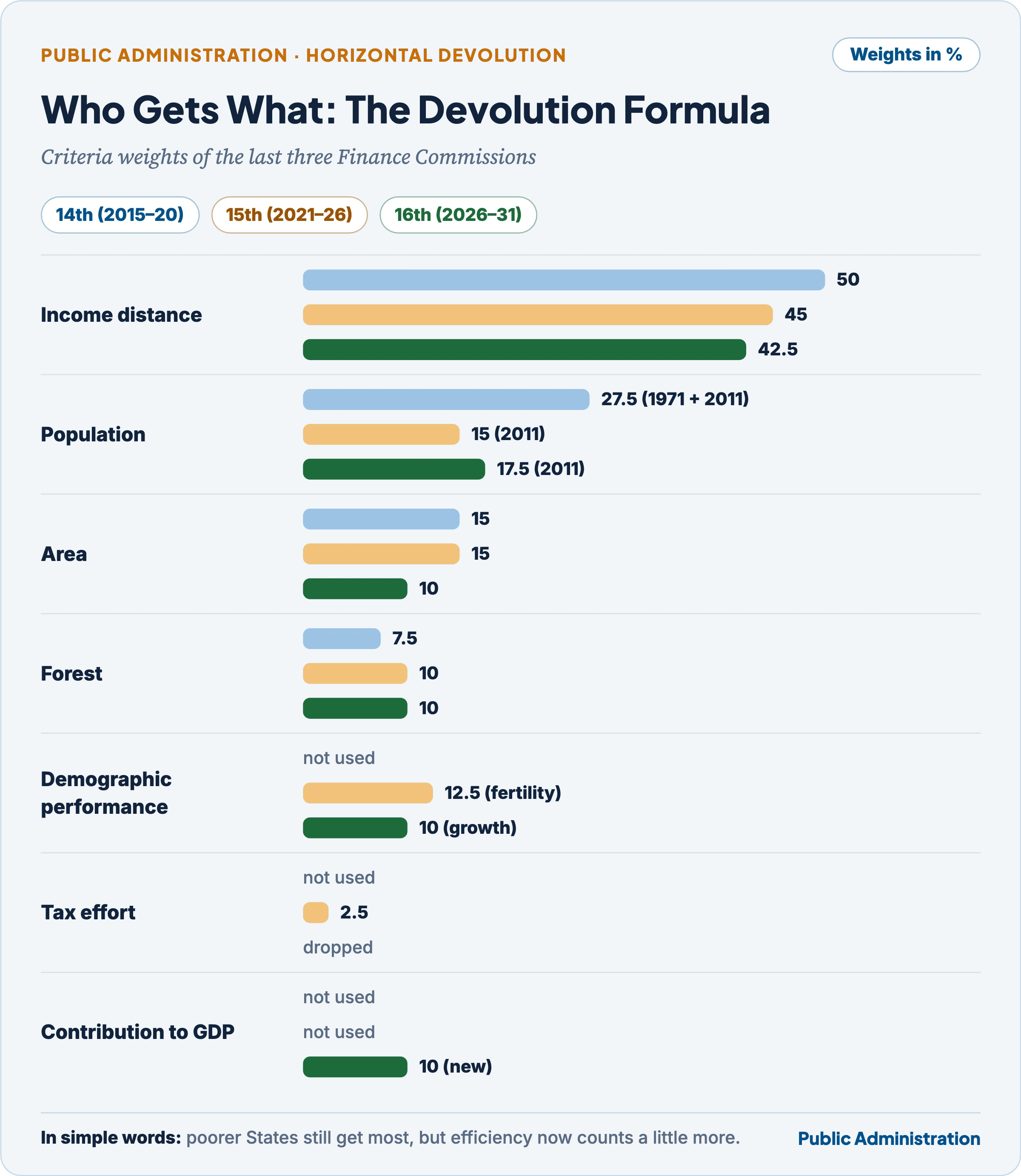
- Population. A proxy for need: more people need more services. Until the Sixth Commission, 80% or more of the pool was shared by population. From the Seventh to the Fourteenth Commission the ToR required the 1971 Census, so that States that controlled population growth (mostly southern) were not penalised. The Fourteenth used 1971 (17.5%) plus 2011 (10%); the Fifteenth and Sixteenth used 2011 only, with a separate demographic criterion.
- Income distance. The gap between a State’s per capita income and that of the richest State(s): the larger the gap, the larger the share. It is the main equalisation criterion, with weights of 45–62.5%. The Sixteenth measured distance from the average of the three large States with the highest per capita GSDP.
- Area. A proxy for the higher cost of delivering services over a large territory, with a floor so small States get a minimum (2% earlier; 1.5% under the Sixteenth).
- Forest and ecology. Introduced by the Fourteenth (7.5%) to compensate States for the opportunity cost of keeping land under forest; raised to 10% by the Fifteenth. The Sixteenth included open forest and rewarded increase in forest cover between 2015 and 2023.
- Demographic performance. Introduced by the Fifteenth (12.5%) using the inverse of the total fertility rate, to reward States that controlled population growth while using 2011 population. The Sixteenth replaced it with the inverse of population growth between 1971 and 2011 (10%) and said the criterion should be phased out as India ages.
- Tax effort and fiscal discipline. Rewarded States that raise more own tax relative to income (Tenth, Eleventh, Twelfth, Fifteenth) or improve the ratio of own revenue to revenue expenditure (Eleventh to Thirteenth).
- Contribution to GDP. Introduced by the Sixteenth (10%): a State’s share of the square root of GSDP in the sum for all States. It rewards economic efficiency and responds to the complaint of richer States that they get back little of what they contribute; the square root dampens the advantage of the largest economies.
4.4 How the formula has changed
The weights used by recent Commissions show the shifting balance between need, equity and efficiency.
| Criterion | 10th (alt.) | 11th | 12th | 13th | 14th | 15th | 16th |
|---|---|---|---|---|---|---|---|
| Population | 20 | 10 | 25 | 25 (1971) | 17.5 (1971) + 10 (2011) | 15 (2011) | 17.5 (2011) |
| Income / fiscal capacity distance | 60 | 62.5 | 50 | 47.5 | 50 | 45 | 42.5 |
| Area | 5 | 7.5 | 10 | 10 | 15 | 15 | 10 |
| Infrastructure index | 5 | 7.5 | – | – | – | – | – |
| Tax effort | 10 | 5 | 7.5 | – | – | 2.5 | – |
| Fiscal discipline | – | 7.5 | 7.5 | 17.5 | – | – | – |
| Forest | – | – | – | – | 7.5 | 10 | 10 |
| Demographic performance | – | – | – | – | – | 12.5 | 10 |
| Contribution to GDP | – | – | – | – | – | – | 10 |
- The dominant criterion throughout has been income distance, so the formula is strongly equalising: Uttar Pradesh (about 17.6%) and Bihar (about 10%) get the largest shares under the Sixteenth Commission, Goa and Sikkim the smallest.
- The efficiency turn. Efficiency criteria rose from tax effort (Tenth) to fiscal discipline (Eleventh to Thirteenth), disappeared in the Fourteenth, returned as tax effort and demographic performance (Fifteenth) and became contribution to GDP (Sixteenth). The Sixteenth argued that “India’s growth imperative” required a small shift towards efficiency.
- The ecological turn. Forest cover entered with the Fourteenth and grew, reflecting the idea of compensating States for global and national public goods.
Common confusion
Is the Gadgil formula a Finance Commission formula? No. The Gadgil formula (1969), named after D.R. Gadgil, Deputy Chairman of the Planning Commission, and its revision, the Gadgil–Mukherjee formula (1991), distributed Normal Central Assistance for State Plans through the Planning Commission and the National Development Council. The 1991 version gave population 60%, per capita income 25%, fiscal performance 7.5% and special problems 7.5%. Finance Commission devolution has always used its own criteria. The Gadgil formula ended with the Planning Commission in 2015, when the Fourteenth Commission’s higher devolution replaced most plan assistance.
5. The Fourteenth, Fifteenth and Sixteenth Finance Commissions
In simple words
The last three Commissions changed Indian fiscal federalism more than the previous ten. The Fourteenth gave States a much bigger untied share; the Fifteenth kept most of it but quarrelled over population; the Sixteenth kept the share and tilted the formula slightly towards States that contribute more to national growth.
5.1 The Fourteenth Finance Commission (Y.V. Reddy, award 2015–20)
- Vertical share raised from 32% to 42%. The largest jump in history: Finance Commission transfers rose from about 32.2% to 40.6% of gross tax revenue between 2014-15 and 2015-16.
- Philosophy. States know their needs best, so give them untied funds instead of tied plan grants. The Commission treated devolution as the primary channel and recommended a new institutional arrangement for deciding transfers outside its purview.
- Criteria. Population 1971 (17.5%), demographic change by 2011 population (10%), income distance (50%), area (15%), forest cover (7.5%); fiscal discipline dropped.
- Grants. Revenue deficit grants to 11 States; local body grants of ₹2.87 lakh crore; disaster relief; no sector-specific or State-specific grants.
- Acceptance and effects. Accepted in February 2015, just after the Planning Commission was replaced by NITI Aayog (1 January 2015). The Union cut its share in many Centrally Sponsored Schemes, and a NITI Sub-Group of Chief Ministers on rationalising CSS (convener Shivraj Singh Chouhan, 2015) classified schemes as core of the core, core and optional, with funding of 60:40 (Union:State) for core schemes and 90:10 for north-eastern and Himalayan States.
- Debate. States gained untied money but lost some tied money; net gains were smaller than the headline jump. The Union argued that its fiscal space had shrunk, a concern later written into the Fifteenth Commission’s ToR.
5.2 The Fifteenth Finance Commission (N.K. Singh, award 2020–26)
- Constitution and reports. Constituted on 27 November 2017; its term was extended in 2019 so that it gave an interim report for 2020-21 and a final report for 2021–26, tabled on 1 February 2021.
- Vertical share: 41%. The 1 percentage point reduction from 42% reflected the conversion of Jammu and Kashmir and Ladakh into Union Territories in 2019, whose needs the Union now met; in substance the Fourteenth’s share was retained.
- Criteria. Income distance 45%, population (2011) 15%, area 15%, forest and ecology 10%, demographic performance 12.5%, tax and fiscal efforts 2.5%.
- Grants (₹10.33 lakh crore recommended):
- Revenue deficit grants of about ₹2.95 lakh crore to 17 States, tapering over the period;
- Local body grants of ₹4.36 lakh crore, including health grants;
- Disaster risk management funds;
- Sector-specific grants (about ₹1.3 lakh crore for eight sectors, including health, school and higher education, agricultural reforms, PMGSY roads, judiciary, statistics and aspirational districts) and State-specific grants (₹49,599 crore). The Union did not implement these two, saying it would give them “due consideration”.
- Other recommendations:
- A Modernisation Fund for Defence and Internal Security, a non-lapsable fund in the Public Account, accepted in principle;
- A fiscal roadmap: State fiscal deficit limits of 4% of GSDP (2021-22), 3.5% (2022-23) and 3% (2023–26), with extra borrowing of 0.5% of GSDP for power sector reforms;
- A high-powered inter-governmental group to review the FRBM framework, and an independent Fiscal Council;
- Local body conditions: online accounts, minimum floor rates for property tax, and no grants after March 2024 to States that had not constituted SFCs and acted on their reports.
- Census controversy. Shifting fully to the 2011 population lowered the shares of States that had controlled population growth: Kerala’s share fell from 2.50% (Fourteenth) to 1.93%, Karnataka’s from 4.71% to 3.65%. The demographic performance criterion was meant to compensate, but southern States argued that it did not offset the loss.
5.3 The Sixteenth Finance Commission (Arvind Panagariya, award 2026–31)
- Constitution. Constituted on 31 December 2023 with Arvind Panagariya, former Vice-Chairman of NITI Aayog and Columbia University professor, as Chairman; full-time members included Ajay Narayan Jha and Annie George Mathew. The report was submitted on 17 November 2025 and tabled on 1 February 2026 with the Union Budget.
- Vertical share: 41%, retained. Several States, led by Tamil Nadu and Karnataka, had asked for 50%; the Commission retained 41% and asked the Union to publish CAG-certified figures of net proceeds each year so that the actual pool is transparent. Accepted.
- Horizontal criteria: income distance 42.5%, population (2011) 17.5%, demographic performance 10% (inverse population growth 1971–2011), area 10% (floor 1.5%), forest 10% (including open forest and growth in cover), contribution to GDP 10%. Accepted.
- Effect on States. Southern and western States gained modestly: Karnataka 4.13% (from 3.65%), Kerala 2.38% (from 1.93%), Gujarat 3.76%, Maharashtra 6.44%; Uttar Pradesh 17.62%, Bihar 9.95%, Madhya Pradesh 7.35% fell slightly.
- Grants (₹9.47 lakh crore over five years):
- Revenue deficit, sector-specific and State-specific grants discontinued. The Commission held that States have scope to raise revenue and rationalise spending; the Union “took note”.
- Local body grants of ₹7,91,493 crore: rural ₹4,35,236 crore, urban ₹3,56,257 crore (basic and performance components split 60:40 between rural and urban bodies). Basic and performance components are split 80:20; half the basic grant is tied to sanitation, solid waste and water management. Urban grants include a Special Infrastructure Component (₹56,100 crore) for wastewater systems in 22 cities of 10–40 lakh population and an Urbanisation Premium (₹10,000 crore) for merging peri-urban villages into larger ULBs and adopting a rural-to-urban transition policy. Accepted.
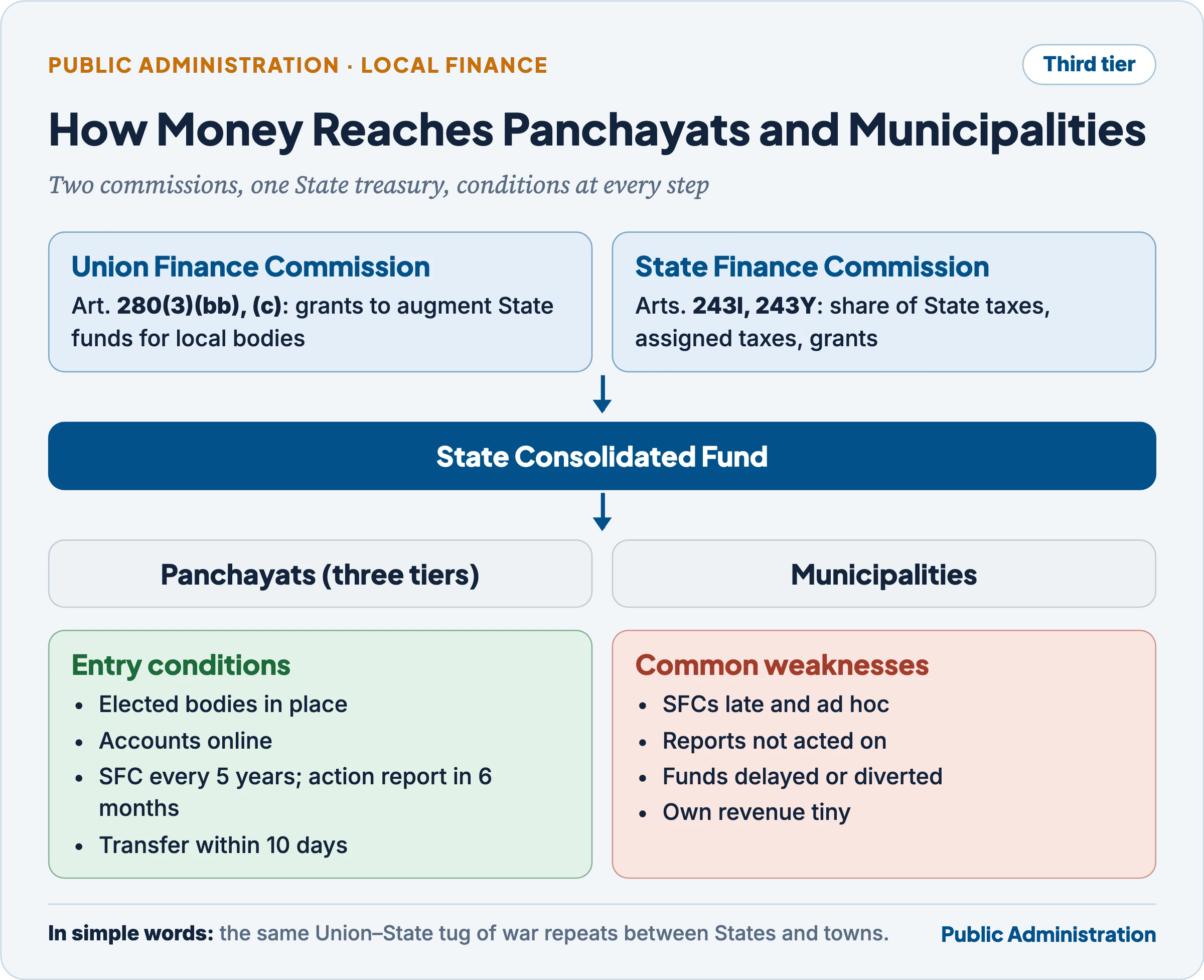
- Entry conditions for local body grants: (i) duly constituted local bodies under Parts IX and IX-A; (ii) provisional and audited accounts online; (iii) regular constitution of the SFC every five years and an action-taken report laid in the legislature within six months. States must transfer grants to local bodies within ten working days, or pay interest; no other conditions may be added by the Union or States.
- Disaster management: State corpus ₹2,04,401 crore, Union share ₹1,55,916 crore; 75:25 sharing (90:10 for north-eastern and Himalayan States). Accepted.
- Fiscal roadmap. State fiscal deficits capped at 3% of GSDP (excluding 50-year capital loans), enforced through Article 293(3); an end to off-budget borrowings; uniform State FRLs; Union fiscal deficit to 3.5% of GDP by 2030-31; combined debt projected to fall from 77.3% to 73.1% of GDP. The Union accepted the borrowing ceiling in principle and said the rest would be examined separately.
- Reform advice. Privatisation of electricity distribution companies with a debt-warehousing SPV, rationalisation of untargeted cash-transfer subsidies, closure of 308 inactive State PSEs, and rationalisation of CSS.
5.4 Fifteenth and Sixteenth Commissions compared
The two most recent Commissions are compared below.
| Feature | Fifteenth (2021–26) | Sixteenth (2026–31) |
|---|---|---|
| Chair | N.K. Singh | Arvind Panagariya |
| Vertical share | 41% | 41% |
| Population base | 2011, with TFR-based demographic criterion | 2011, with population-growth criterion |
| Efficiency criterion | Tax and fiscal effort (2.5%) | Contribution to GDP (10%) |
| Revenue deficit grants | About ₹2.95 lakh crore to 17 States | Discontinued |
| Sector and State grants | Recommended; not implemented | Not recommended |
| Local body grants | ₹4.36 lakh crore, including health | ₹7.91 lakh crore, with urban components |
| SFC condition | No grants after March 2024 without SFC | SFC every five years and ATR within six months as entry condition |
| State fiscal deficit | 4% → 3% of GSDP | 3% of GSDP, off-budget borrowing to end |
- Continuity: the vertical share, the 2011 base and the dominance of income distance.
- Change: a cleaner, formula-only model with fewer discretionary grants, a stronger efficiency signal and a much larger push to local governments, especially cities.
6. Finance Commission, Planning Commission and NITI Aayog
In simple words
For sixty years India had two pipes carrying money to the States: the Finance Commission’s pipe, fixed by the Constitution, and the Planning Commission’s pipe, controlled by the Union. When the second pipe grew bigger, States complained that their constitutional umpire was being sidelined.
6.1 Statutory and discretionary transfers
- Statutory transfers are those under Articles 270 and 275 on the Finance Commission’s recommendation: formula-based, untied (mostly) and constitutionally anchored.
- Discretionary transfers are those under Article 282: grants by the Union government for schemes it designs, through ministries (and earlier the Planning Commission).
- The plan/non-plan division (1951–2017). From the 1960s the ToR in effect confined the Finance Commission to the non-plan revenue account of the States, while the Planning Commission (an executive body set up by a Cabinet resolution in 1950, neither constitutional nor statutory) gave plan assistance: Normal Central Assistance by the Gadgil formula, plus CSS and special assistance. The Sarkaria Commission (1988) found this division of roles broadly sound.
- Overlap and friction. The two bodies worked in watertight compartments: the Finance Commission assessed non-plan needs and the Planning Commission plan needs, each without full regard to the other. States that had a non-plan surplus after devolution were expected to use it for plans, but the Planning Commission set plan sizes on its own. Scholars called the Finance Commission’s role “devalued” as plan transfers grew; plan and discretionary transfers formed a large part of total transfers.
- Did the overlap circumscribe Parliament? Critics argued that the two bodies together pre-decided much of the Union’s spending outside effective parliamentary scrutiny: one by constitutional convention, the other by executive dominance through the NDC. Others replied that Parliament still votes the grants and approves the Budget; what was reduced was the States’ say, not Parliament’s.
6.2 After 2015: NITI Aayog and Centrally Sponsored Schemes
- NITI Aayog (1 January 2015) has no power to allocate funds. Plan assistance ended; the Union Budget dropped the plan/non-plan distinction from 2017-18. Finance Commission devolution is now the dominant untied transfer.
- Centrally Sponsored Schemes continue under Article 282, funded by Union ministries with matching State shares (60:40 or 90:10) and conditions. They cover national priorities in State subjects: health (National Health Mission), education (Samagra Shiksha), housing, water (Jal Jeevan Mission) and nutrition.
- Pros of Union funding in State and Concurrent subjects: national minimum standards, horizontal equity (poor States cannot fund these alone), spread of innovations, focus on SDGs, common outcome monitoring.
- Cons: “one size fits all” design, matching shares that pre-empt State budgets, delays in releases, blurred accountability (citizens cannot tell who is responsible), proliferation of small schemes and branding disputes. The Sixteenth Commission recommended rationalising CSS; the Union said it would examine this.
- Special Assistance to States for Capital Investment (SASCI). Since 2020-21 the Union has given 50-year interest-free loans to States for capital spending, some tied to reforms. These sit outside the Finance Commission framework and outside the normal borrowing ceiling, showing that discretionary channels have not disappeared.
Indian Connect — Indian Connect: why States prefer the Finance Commission route
- The Finance Commission is constitutional, expert, periodic and formula-bound; its share is untied and cannot be cut mid-period.
- Article 282 grants are decided by the Union executive, vary year to year, carry conditions and logos, and can be withheld for non-compliance.
- Hence States have repeatedly demanded that more of the Union’s transfers move from Article 282 to Articles 270 and 275, and that any Union funding of State subjects be routed through the Finance Commission, a demand voiced as early as the 1980s conclaves of Chief Ministers and repeated in memoranda to the Sixteenth Commission.
7. Cesses, Surcharges, GST and the Shrinking Divisible Pool
In simple words
The States get 41% of the “shareable” pot. But the Union can raise money through cesses and surcharges, which do not go into that pot. The more it uses them, the smaller the pot, and the smaller the States’ real share of all Union taxes.
7.1 How the divisible pool is calculated
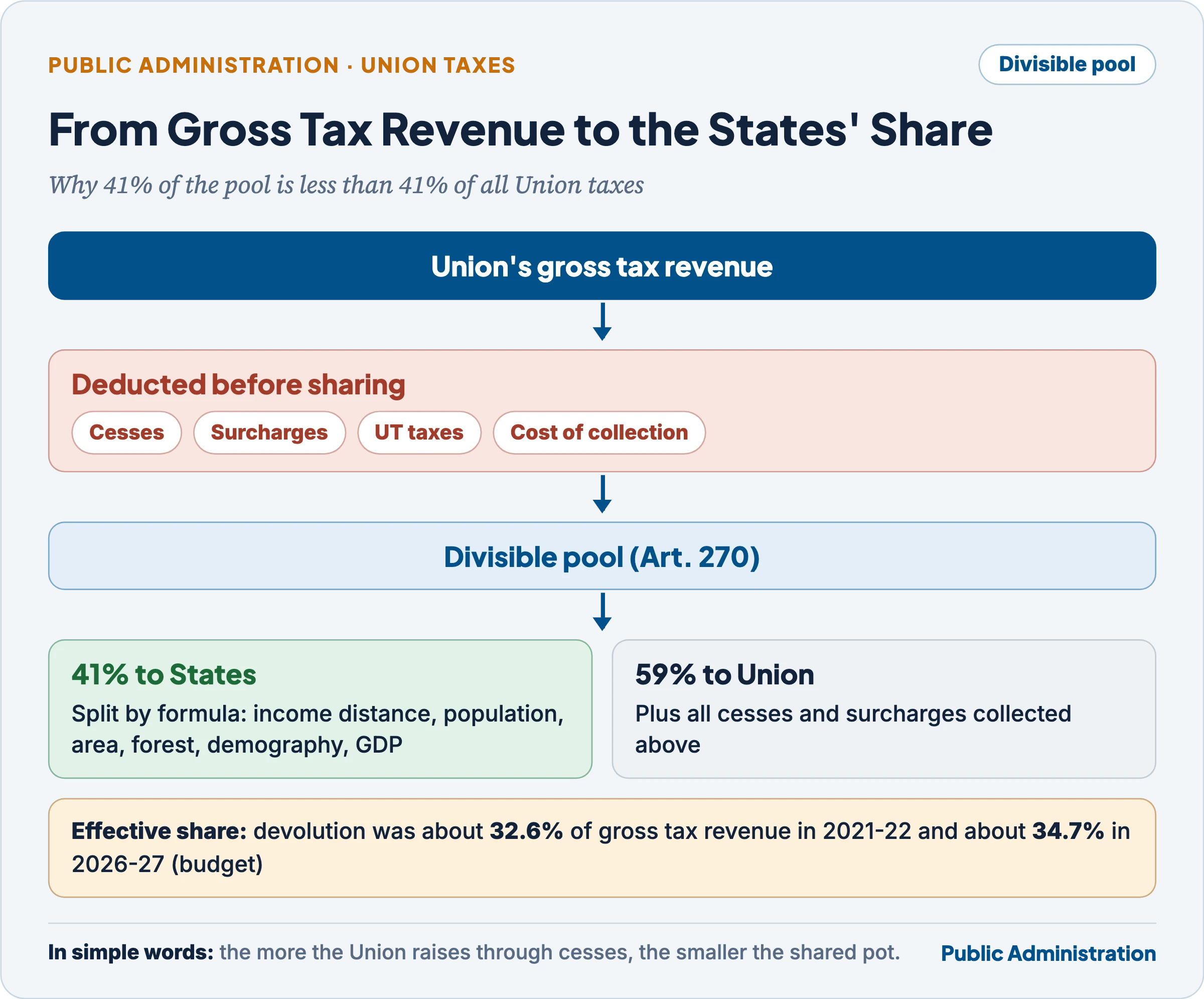
- Gross tax revenue (GTR) of the Union, minus cesses, surcharges, taxes of Union Territories and the cost of collection, gives the divisible pool. The Finance Commission’s share applies only to this pool.
- Cesses are levies for a specific purpose under a separate law (for example, the Health and Education Cess, Road and Infrastructure Cess, Agriculture Infrastructure and Development Cess). Surcharges are additional taxes on a tax (Article 271), mainly on high incomes. Neither is shared with States.
7.2 Why the pool has shrunk
- Trend. A World Bank study for the Sixteenth Commission found that cesses and surcharges had roughly doubled since 2011 to about 18% of gross central tax revenue. Excluding the GST compensation cess, about ₹13.5 of every ₹100 the Union collected in 2021-22, and about ₹11 in 2025-26 (budget), fell outside the pool, against ₹5–7 in 2013–19. Tamil Nadu’s memorandum put the share at 16.83% and proposed a cap of 10%, with any excess merged into the pool.
- Effect. Although the States’ share of the divisible pool is 41%, devolution as a share of gross tax revenue was about 32.6% in 2021-22 and about 34.7% in 2026-27 (budget estimate), according to data in the Sixteenth Commission’s report.
- Why the Union uses them. Earmarked funding for specific goals (health and education, roads, defence, agriculture), speed in a crisis, and the fact that they are not shared. Critics see this as a way of circumventing the Finance Commission.
- Recent example. When the GST compensation cess ended on 1 February 2026, high taxes on tobacco were preserved partly through higher Union excise duty (which is shareable) under the Central Excise (Amendment) Act, 2025, and partly through a new Health Security se National Security Cess on pan masala (which is not).
7.3 GST and compensation
- GST (1 July 2017) subsumed Union excise, service tax and State VAT, entry tax and other levies under the 101st Amendment (2016). States lost independent power over most indirect taxes; decisions now come through the GST Council (Article 279A), where the Union has one-third and the States two-thirds of the weighted vote and decisions need three-fourths. For the Council as a federal forum and Union of India v. Mohit Minerals (2022), see the article on Union–State Relations.
- GST (Compensation to States) Act, 2017: States were guaranteed compensation for five years (to 30 June 2022) for any shortfall below 14% annual growth over their 2015-16 base revenue, paid from a compensation cess on demerit and luxury goods.
- COVID shortfall. When cess collections fell, the Union borrowed and passed on back-to-back loans of about ₹1.1 lakh crore (2020-21) and ₹1.59 lakh crore (2021-22); the cess was extended to 31 March 2026 to repay them.
- End of compensation. States have had no compensation since July 2022. After the GST rate rationalisation of 22 September 2025 (“GST 2.0”, two main rates of 5% and 18% and a 40% rate for demerit goods), the cess was removed from most goods, and it ceased altogether on 1 February 2026.
- Fiscal federalism impact. GST pooled sovereignty, widened the base and reduced cascading, but left States with fewer independent levers (mainly petroleum, liquor, stamp duty, vehicles and property). Several States now argue that the loss of tax autonomy should be compensated through a higher Finance Commission share or a cap on cesses.
8. Borrowing, Fiscal Rules and Article 293
In simple words
A State that spends more than it earns must borrow. But if it already owes money to the Union, it needs the Union’s permission to borrow more. That permission has become a powerful tool of control, and a source of court cases.
8.1 Constitutional provisions
- Article 292: the Union may borrow on the security of the Consolidated Fund of India within limits fixed by Parliament.
- Article 293(1): a State may borrow only within India, on the security of its Consolidated Fund, within limits fixed by its legislature.
- Article 293(2): the Union may lend to States or guarantee their loans.
- Article 293(3): a State may not raise any loan without the Union’s consent if any part of a loan from the Union is still outstanding. Article 293(4): consent may carry conditions.
- In practice every State owes the Union money, so every State needs consent, and the Union fixes an annual Net Borrowing Ceiling (NBC), normally 3% of GSDP, as recommended by Finance Commissions.
- Bias towards the Union? States cannot borrow abroad and need consent; the Union can borrow without such a check. Critics see an asymmetry; defenders note that the Union bears the macroeconomic risk and the sovereign rating.
8.2 Fiscal rules for States
- Twelfth Commission (2005–10): offered debt consolidation and write-off on condition that States enact Fiscal Responsibility Legislation (FRL) with targets of zero revenue deficit and a 3% fiscal deficit; all States did so. It also ended the Union’s role as intermediary for most State borrowing.
- Thirteenth to Sixteenth Commissions: fiscal consolidation roadmaps for States, with extra borrowing room tied to reforms (power sector, capital spending).
- Counting off-budget borrowings (2022). The Union began counting borrowings by State-owned entities and special purpose vehicles serviced from the budget, and liabilities in the Public Account, against the NBC.
- The Union’s own rules. The FRBM Act, 2003 (amended 2018) set targets for the Union; since 2026-27 the Union follows a debt anchor (central debt of 50 ± 1% of GDP by 2030-31). For FRBM in detail, see the article on Monetary and Fiscal Policy and Public Debt.
8.3 Kerala v. Union of India (2024)
- The suit. Kerala sued the Union under Article 131 (original jurisdiction), challenging the NBC of 3% of GSDP for 2023-24, the counting of borrowings by its infrastructure fund (KIIFB) and pension company against the ceiling, and the 2018 FRBM amendment setting a general government debt target. It argued that the Union’s consent power under Article 293(3) did not extend to capping all borrowing.
- Order of 1 April 2024 (Justices Surya Kant and K.V. Viswanathan): since Article 293 had never been authoritatively interpreted, the questions were referred to a Constitution Bench of five judges under Article 145(3). Interim relief was refused: prima facie the Union could deduct over-borrowing of one year from the next year’s ceiling, and financial hardship arising from a State’s own mismanagement was not “irreparable injury”.
- Significance. The first constitutional test of the Union’s borrowing controls; the reference was pending in 2026. It frames the federal question of whether the Union’s macro-prudential role can justify detailed control of State finances.
8.4 Why prudent fiscal management is hard for States
- Rising debt. States’ consolidated outstanding liabilities were budgeted at 29.2% of GDP at end-March 2026; their gross fiscal deficit was 3.3% of GDP in 2024-25 and 2025-26 (RBI, State Finances: A Study of Budgets of 2025-26, January 2026).
- Constraints:
- Committed expenditure (salaries, pensions, interest) takes a large and rising share of revenue; some States have returned to the old pension scheme;
- Untargeted subsidies and cash transfers (power, transport, women’s income support), which the Sixteenth Commission asked States to rationalise;
- Loss-making power distribution companies and guarantees;
- Limited own-tax levers after GST, and the end of compensation;
- Matching shares for CSS, which pre-empt State budgets;
- Borrowing ceilings and counting of off-budget liabilities, which limit room for capital spending;
- Ageing in southern and western States, which the RBI’s 2026 study flagged as a source of rising committed spending and shrinking tax bases.
9. Issues in the Working of the Finance Commission
In simple words
The Finance Commission is respected, but States complain that the Union chooses its members, writes its questions, keeps cesses outside its reach and then decides which recommendations to follow. Richer States also complain that the formula takes from them to give to poorer ones.
9.1 Centre’s dominance over the institution
- Unilateral constitution and ToR. The Union alone appoints the Chairman and members and frames the ToR, though the Commission arbitrates between the Union and the States. The Punchhi Commission (2010) urged a method for State participation in constituting the Commission and framing its ToR, so that it does not remain a “centrally created” body.
- Temporary character. The Commission is dissolved after reporting; there is no permanent secretariat, data system or monitoring. Proposals include a permanent secretariat or a standing fiscal body, and the Fifteenth Commission’s call for an independent Fiscal Council.
- Selective acceptance. The Union accepts devolution but can set aside grants and fiscal roadmaps (the Fifteenth Commission’s sector and State grants), which undermines the idea of a balanced package.
- Outside channels. Cesses, surcharges, CSS and SASCI loans move a large part of transfers outside the Commission’s control.
9.2 Southern and better-off States’ grievances
- Population base. States that controlled population growth argue that using 2011 population penalises success in family planning. Between 1971 and 2011 Kerala’s and Tamil Nadu’s populations grew far more slowly than those of Uttar Pradesh or Bihar.
- “We give more, we get less.” High-income States contribute a large share of Union taxes but receive a small share of devolution because of the income distance criterion. Karnataka’s leaders claimed in 2024 that the State received back only about ₹13 of every ₹100 it contributed in taxes. On 7 and 8 February 2024 the governments of Karnataka and Kerala held protests at Jantar Mantar in New Delhi over devolution and grants.
- Efficiency penalty. States with good governance and high growth lose share as their income distance narrows, a complaint heard since the Eleventh Commission. The Sixteenth’s contribution to GDP criterion is a partial answer.
- Counter-argument. Equalisation is the purpose of fiscal federalism: richer States benefit from a common national market, labour from poorer States and national public goods, and per capita services in Bihar remain far below those in Kerala. The issue is the balance, not the principle.
- Future delimitation link. With Census 2027 under way, the coming debate on delimitation of constituencies and on the population base for the Seventeenth Commission will revive the north–south divide.
9.3 Conditional grants and the principal–agent problem
- Shift to conditions. Since the Thirteenth Commission, grants have been increasingly conditional (performance grants for local bodies, fiscal and power reforms, SFC compliance).
- For: conditions align State behaviour with national goals, reward reform and improve accountability and data (audited accounts online, property tax floors).
- Against: conditions blur the line between a neutral Finance Commission and the Union’s policy agenda; they penalise local bodies for the failures of State governments; and frequent conditions turn untied money into tied money.
9.4 Other issues
- Equity versus efficiency in the formula, and frequent changes that reduce predictability.
- Data quality: GSDP estimates, forest data and local accounts are uneven; the Commission has to work with stale Census data.
- Moral hazard of gap-filling, which the Sixteenth addressed by ending revenue deficit grants, but which hurts States with structural deficits (hill and north-eastern States).
- Delays in transfers of local body grants by States, now addressed by the ten-day rule.
9.5 The central debate
Criticism — Criticism: a constitutional umpire under the Union’s control
- The Union appoints the Commission and writes its ToR, and can steer it towards its own priorities (2011 Census, revenue deficit grants, performance incentives).
- Cesses and surcharges shrink the pool on which the share is applied, so 41% is less than it looks.
- Discretionary transfers (CSS, SASCI) and borrowing controls under Article 293 give the Union leverage that the formula was meant to remove.
- The Commission is temporary, cannot monitor implementation, and its recommendations are not binding.
- Its conditions on local body grants make it an instrument of the Union’s reform agenda rather than a neutral arbiter.
Defence — Defence: the most successful federal institution in India
- Its core recommendations have been accepted every time since 1952, a strong convention that makes it effectively binding.
- It is rule-based and transparent, publishes its methods and data, and takes the division of money out of partisan bargaining.
- The States’ share has risen from about a quarter to over a third of gross tax revenue, and untied money now dominates transfers.
- It balances equity and efficiency better than political bargaining would, and protects poor States that have little political weight.
- Its grants have given panchayats and municipalities their most reliable money and pushed States to constitute SFCs and publish accounts.
10. State Finance Commissions
In simple words
Just as the Union shares money with the States through the Finance Commission, each State is supposed to share money with its villages and towns through its own State Finance Commission. The design is good, but many States set up these commissions late, ignore their reports, or delay the money.
10.1 Constitutional provisions
- Article 243I (Panchayats). The Governor shall, within one year of the 73rd Amendment (1992) and thereafter every five years, constitute a State Finance Commission (SFC) to review the financial position of panchayats and recommend:
- the distribution between the State and panchayats of the net proceeds of State taxes, duties, tolls and fees, and their allocation among the tiers;
- the taxes, duties, tolls and fees that may be assigned to or appropriated by panchayats;
- grants-in-aid to panchayats from the State’s Consolidated Fund;
- measures to improve panchayats’ financial position.
- Composition and qualifications are fixed by State law (Article 243I(2)).
- Report is laid before the State legislature with an explanatory memorandum of action taken (Article 243I(4)).
- Article 243Y makes the same provisions for municipalities; Articles 243H and 243X allow States to authorise local taxes and grants.
- Link to the Union Commission: Article 280(3)(bb) and (c) ask the Union Finance Commission to base its local body recommendations on SFC reports.
10.2 What SFCs have done
- Devolution models. SFCs have recommended transfers as a share of the State’s own tax revenue, of its own revenue, or of its total revenue including central transfers; some recommend assigned taxes (entertainment tax, surcharge on stamp duty, profession tax).
- Growth. Average per capita SFC grants across States rose from about ₹599 a year (2010–14) to ₹1,180 (2015–19), with Bihar, Sikkim, Haryana, Assam, Kerala, Uttarakhand and Himachal Pradesh showing the largest increases (RBI, January 2024).
- Kerala devolves a fixed share of the State’s plan outlay to local governments, a legacy of the People’s Plan Campaign (1996); it is often cited as the model of fiscal decentralisation.
10.3 Weaknesses
- Delays and irregular constitution. The sixth SFCs were due around 2019-20. By the time of the Fifteenth Commission’s report only 4 States (Assam, Bihar, Punjab and Rajasthan) had constituted their sixth SFC; by 2022 only 9 States had done so (Ministry of Panchayati Raj, cited by the RBI).
- Non-implementation. Reports are often not tabled for years, action-taken memoranda are vague, and accepted recommendations are not funded. The RBI’s 2024 municipal report called the constitution of SFCs “ad hoc“, with delayed reports, inadequate implementation and limited resources.
- Weak capacity. SFCs are often chaired by retired officials with small staff, short terms and poor data; their periods rarely match the Union Commission’s, so the Union Commission cannot build on them.
- State reluctance. State governments facing their own deficits are unwilling to give up revenue or create predictable claims; the same pattern of vertical dependence they complain of in Union–State relations is reproduced at the State–local level.
- Diversion and delay. Funds meant for local bodies have been delayed or used to meet the State’s ways-and-means needs; the Sixteenth Commission’s ten-day transfer with interest rule targets this.
- Low own revenue of local bodies. Panchayats’ own tax revenue was only about 1% of their revenue in 2020–23, and around 95% came from grants (RBI, Finances of Panchayati Raj Institutions, January 2024). Own tax revenue of municipal corporations was about 30% of their revenue in 2023-24, with property tax under-assessed (RBI, Report on Municipal Finances, November 2024).
- Fiscal indiscipline worry. Some critics, including the World Bank, warned that the 73rd Amendment could reproduce at the local level the soft budget constraints of Union–State transfers, with local bodies relying on grants rather than raising revenue.
10.4 Central Finance Commission conditions on SFCs and local bodies
- Thirteenth Commission: performance grants conditional on, among other things, action on SFC reports, accounting reforms, an ombudsman and a property tax board.
- Fourteenth Commission: performance grants conditional on audited accounts and increase in own revenues.
- Fifteenth Commission: entry conditions of online provisional and audited accounts, property tax floor rates for urban bodies, and a bar on grants after March 2024 to States not constituting SFCs and acting on them.
- Sixteenth Commission: entry conditions of constituted local bodies, online accounts, and SFC every five years with an ATR in six months; release within ten working days.
10.5 Have Finance Commission grants strengthened local bodies?
- Yes, in important ways. Grants have given panchayats, especially gram panchayats, a regular, formula-based and largely untied stream of money; they funded basic services (water, sanitation, street lights, drains); and conditions have driven accounts online (eGramSwaraj, audit portals), property tax reform and more regular SFCs. Performance grants have improved financial accountability: local bodies must publish accounts and show own-revenue growth to qualify.
- But limits remain. Tied components and conditions reduce local discretion; grants are a small share of total local needs; local bodies remain dependent rather than self-governing; and accountability to citizens (gram sabha scrutiny, social audit) has improved less than accountability upwards.
- For the functioning of panchayats and municipalities and the 73rd and 74th Amendments in full, see the articles on Panchayati Raj and on Municipal Governance.
11. Fiscal Federalism: Theory and Debates
In simple words
Economists and political scientists ask: who should do what, who should pay, and how transfers change behaviour. Their answers help explain why Indian States depend on the Union, why the Union attaches conditions, and why richer and poorer States see the Finance Commission differently.
11.1 Cooperative, competitive and bargaining federalism
- Cooperative federalism. Granville Austin, the American historian of the Constitution, described Indian federalism as cooperative: a strong Centre working with States that are not weak. The Finance Commission, the GST Council and the NITI Governing Council embody shared decision-making.
- Competitive federalism. States compete for investment and for higher shares through better performance; NITI’s indices and the efficiency criteria of the Finance Commission (tax effort, demographic performance, contribution to GDP) reward such competition.
- Bargaining federalism. W.H. Morris-Jones, the British political scientist, called Indian federalism “bargaining federalism“: Union and States negotiate continuously. Conclaves of Chief Ministers on ToR (1987, 2018) and the 2024 protests show bargaining around the Commission.
- “Quasi-federal.” K.C. Wheare‘s description of India as quasi-federal fits the financial scheme best: residuary taxes, the elastic tax bases and borrowing consent all lie with the Union.
- Paul Appleby, in his reports of the 1950s, noted that Indian administration was highly dependent on State implementation even as policy and money were concentrated at the Union.
11.2 Theory lens: fiscal federalism and Paper I ideas
- Musgrave’s three functions and Oates’ decentralisation theorem. Richard Musgrave (The Theory of Public Finance, 1959) assigns stabilisation and distribution to the Centre; Wallace Oates (Fiscal Federalism, 1972) argues that local public goods should be provided by the lowest competent tier. India assigns most allocation functions to States and local bodies but most tax bases to the Union, so vertical imbalance and transfers are unavoidable; the Finance Commission is the institution that makes this design workable. See the article on Monetary and Fiscal Policy and Public Debt.
- Vertical and horizontal imbalance and equalisation. Equalising transfers, the core of the income distance criterion, follow the idea that citizens should receive comparable services at comparable tax burdens regardless of where they live, an idea associated with Canadian and Australian equalisation and with Anwar Shah‘s work on intergovernmental transfers for the World Bank.
- Public choice and Leviathan. James Buchanan and Geoffrey Brennan (The Power to Tax, 1980) see government as a revenue-maximising Leviathan and federal competition as a restraint on it. The Union’s growing reliance on unshared cesses fits the Leviathan model; so does the habit of both levels of shifting costs onto each other. Buchanan and Richard Wagner (Democracy in Deficit, 1977) explain the deficit bias that fiscal rules (FRBM, State FRLs, Article 293 ceilings) try to curb. See the article on New Public Administration and Public Choice.
- Soft budget constraints. János Kornai, the Hungarian economist, coined the term for organisations that expect to be bailed out; Jonathan Rodden applied it to sub-national governments. Gap-filling grants, debt write-offs and repeated bailouts of power utilities created soft budget constraints for Indian States; the normative approach, the Twelfth Commission’s debt relief tied to FRLs, the counting of off-budget borrowing and the Sixteenth’s ending of revenue deficit grants are attempts to harden them.
- Principal–agent theory and conditional grants. In principal–agent terms the Union (principal) funds States (agents) who have better local information and their own goals. Conditions, matching shares and performance grants are monitoring and incentive devices; their cost is reduced autonomy and “gaming” of indicators. The same logic applies to Union Commission conditions on SFCs and local accounts. See the articles on Accountability and Control and on Planning Machinery.
- The flypaper effect. Empirical public finance finds that grant money “sticks where it hits“: a grant raises spending in the targeted area more than an equal rise in local income would. Tied Finance Commission grants for sanitation and water exploit this, but also crowd out local choice.
- Market-preserving federalism. Barry Weingast argued that federalism promotes growth when sub-national governments face hard budget constraints, have primary responsibility for their economies and cannot erect internal trade barriers. GST’s common market and the efficiency turn in the devolution formula move India in this direction.
- Decentralisation and formalism. The decentralisation theorem justifies State Finance Commissions and local body grants; Fred Riggs’ idea of formalism, a gap between formal rules and actual practice in prismatic societies, describes SFCs that exist in law but are constituted late, ignored and unfunded. See the articles on Riggsian Models and on Decentralised Planning.
Key Terms
| Term | Meaning in simple words |
|---|---|
| Fiscal federalism | Division of taxes, spending and borrowing among levels of government, and transfers between them |
| Vertical fiscal imbalance | Gap between the States’ spending duties and their revenue powers, taken as a whole |
| Horizontal fiscal imbalance | Differences among States in revenue capacity and cost of services |
| Fiscal equalisation | Transfers that let poorer States provide comparable services at comparable tax burdens |
| Divisible pool | Union’s gross tax revenue minus cesses, surcharges, UT taxes and collection cost |
| Vertical devolution | The States’ combined share of the divisible pool (41% now) |
| Horizontal devolution | Each State’s share of the States’ total, decided by a weighted formula |
| Income distance | Gap between a State’s per capita income and that of the richest State(s) |
| Demographic performance | Criterion rewarding States that slowed population growth |
| Contribution to GDP | Sixteenth Commission criterion based on the square root of each State’s GSDP |
| Revenue deficit grant | Grant under Article 275 to cover a State’s assessed post-devolution revenue gap |
| Gap-filling approach | Filling a State’s projected actual deficit with grants |
| Normative approach | Assessing revenue and spending on norms of what a State should raise and spend |
| Statutory transfers | Devolution and grants on Finance Commission recommendation (Arts 270, 275) |
| Discretionary transfers | Union grants under Article 282, mostly for Centrally Sponsored Schemes |
| Centrally Sponsored Scheme | Union-designed scheme in a State subject, funded with a matching State share |
| Gadgil formula | Planning Commission formula for Normal Central Assistance to State Plans (1969, revised 1991) |
| Cess | Earmarked Union levy under a separate law, not shared with States |
| Surcharge | Additional Union tax on a tax under Article 271, not shared |
| Net Borrowing Ceiling | Annual limit on a State’s borrowing fixed through Union consent under Article 293(3) |
| Off-budget borrowing | Loans by State entities serviced from the budget but kept outside it |
| State Finance Commission | Body under Articles 243I and 243Y recommending State-to-local transfers |
| Performance grant | Grant released only when conditions (accounts, own revenue, reforms) are met |
| Soft budget constraint | Expectation of a bailout that weakens a government’s fiscal discipline |
| Flypaper effect | Grant money tends to stay in the spending area it is given for |
Commissions, Committees and Judgments
The commissions, committees and judgments that shaped India’s fiscal federalism are listed below with their key points.
| Body / case | Year | Key point |
|---|---|---|
| First Finance Commission (K.C. Neogy) | 1951 | Set the pattern of sharing income tax and excise, mostly by population |
| Gadgil formula (D.R. Gadgil, Planning Commission) | 1969 | Formula for Normal Central Assistance to State Plans; revised as Gadgil–Mukherjee (Pranab Mukherjee) in 1991 |
| Ninth Finance Commission (N.K.P. Salve) | 1987 | Normative assessment; Calamity Relief Fund (75:25); ToR dispute with States |
| Sarkaria Commission (R.S. Sarkaria) | 1988 | Found Finance Commission–Planning Commission division sound; proposed sharing of corporation tax |
| Tenth Finance Commission (K.C. Pant) | 1992 | Alternative scheme of global sharing (29%), basis of the 80th Amendment (2000); first local body grants |
| Twelfth Finance Commission (C. Rangarajan) | 2002 | Debt consolidation and write-off tied to State FRLs; 30.5% share |
| Thirteenth Finance Commission (Vijay Kelkar) | 2007 | 32% share; fiscal capacity distance; performance grants for local bodies |
| Punchhi Commission (M.M. Punchhi) | 2010 | State participation in constituting the Finance Commission and framing its ToR |
| Fourteenth Finance Commission (Y.V. Reddy) | 2013 | 42% share; 2011 population introduced; forest criterion; untied transfers |
| Sub-Group of Chief Ministers on CSS (convener Shivraj Singh Chouhan) | 2015 | Core of the core, core and optional schemes; 60:40 and 90:10 sharing |
| N.K. Singh FRBM Review Committee | 2017 | Debt as the anchor; general government debt target of 60% of GDP |
| Fifteenth Finance Commission (N.K. Singh) | 2017 | 41%; 2011 population; demographic performance; SFC condition |
| Sixteenth Finance Commission (Arvind Panagariya) | 2023 | 41% retained; contribution to GDP; revenue deficit grants ended; ₹7.91 lakh crore to local bodies |
| Union of India v. Mohit Minerals | 2022 | GST Council recommendations are persuasive, not binding, on legislatures |
| State of Kerala v. Union of India | 2024 | Article 293 questions referred to a Constitution Bench; interim relief refused |
| Mineral Area Development Authority v. Steel Authority of India | 2024 | Nine-judge bench (8:1): royalty is not a tax; States can tax mineral-bearing land |
Contemporary Developments
- Sixteenth Commission’s report tabled (1 February 2026). Submitted on 17 November 2025, it retained the 41% share, introduced contribution to GDP (10%), ended revenue deficit, sector and State grants, and recommended ₹9.47 lakh crore in grants for 2026–31; the Union accepted devolution, local body and disaster grants, and the State borrowing ceiling in principle.
- New local body regime (from April 2026). Local body grants of ₹7.91 lakh crore, with a Special Infrastructure Component for wastewater in 22 cities, an Urbanisation Premium, SFC and accounts as entry conditions, and a ten-working-day transfer rule.
- GST compensation cess ended (1 February 2026). After GST 2.0 (22 September 2025) the cess was confined to tobacco and pan masala, then abolished; higher excise on tobacco and a new Health Security se National Security Cess on pan masala replaced it.
- RBI study on State finances (23 January 2026). States’ outstanding liabilities budgeted at 29.2% of GDP; gross fiscal deficit 3.3% of GDP; theme of demographic transition, warning that ageing States face shrinking tax bases.
- Devolution below the recommended share (February 2026). A newspaper analysis of budget data put devolution at about 38.7% of the divisible pool in 2026-27 (BE), below the recommended 41%, and at about 34.7% of gross tax revenue.
- Mineral taxation judgment (25 July 2024). A nine-judge bench held that States have the power to tax mineral rights, widening their tax base.
- Kerala borrowing case (1 April 2024). Article 293 questions referred to a five-judge bench; still pending in 2026, it will decide the reach of the Union’s control over State borrowing.
- Southern States’ protests (7–8 February 2024). Karnataka and Kerala governments protested in New Delhi over tax devolution and grants, a prelude to demands for a 50% share before the Sixteenth Commission.
Revision Grid
| Thinker / body | Work or report (year) | Key idea |
|---|---|---|
| Richard Musgrave | The Theory of Public Finance (1959) | Allocation, distribution, stabilisation functions |
| Wallace Oates | Fiscal Federalism (1972) | Decentralisation theorem |
| Charles Tiebout | “A Pure Theory of Local Expenditures” (1956) | Voting with the feet; inter-jurisdictional competition |
| Buchanan and Brennan | The Power to Tax (1980) | Government as a revenue-maximising Leviathan |
| Buchanan and Wagner | Democracy in Deficit (1977) | Deficit bias; need for fiscal rules |
| János Kornai | Soft budget constraint (1979–86) | Expected bailouts weaken discipline |
| Barry Weingast | Market-preserving federalism (1995) | Hard budget constraints and a common market for growth |
| K.C. Wheare | Federal Government (1946) | India as quasi-federal |
| W.H. Morris-Jones | The Government and Politics of India (1964) | Bargaining federalism |
| Granville Austin | The Indian Constitution: Cornerstone of a Nation (1966) | Cooperative federalism |
| Tenth Finance Commission | Report (1994) | Global sharing; first local body grants |
| Twelfth Finance Commission | Report (2004) | Debt relief tied to fiscal responsibility laws |
| Fourteenth Finance Commission | Report (2014) | 42% devolution; untied transfers |
| Fifteenth Finance Commission | Reports (2019, 2020) | 41%; 2011 population; demographic performance |
| Sixteenth Finance Commission | Report (2025) | 41%; contribution to GDP; end of revenue deficit grants |
| RBI | Finances of PRIs (2024); Report on Municipal Finances (2024) | Local bodies depend on grants; SFCs ad hoc |
Previous Year Questions
- 2026Public debt of states in India has increased significantly in the last one decade. In this context discuss the constraints of the states in planning prudent fiscal management.
- 2025Despite the division of subjects, the Union Government contributes towards subjects in the State and Concurrent Lists. Discuss its pros and cons in the light of fiscal federalism.
- 2024“The role of State Finance Commission in distribution of finances between state and local governments is vital.” Discuss.
- 2023Is it true that the Finance Commission has been lending Financial strength to the local bodies in India? Argue in favour of your response.
- 2022The recommendations of National Finance Commissions are more norms based than the need based. In the light of this statement analyse the terms of references of 15th National Finance Commission.
- 2022Analyse the specific areas of controversies with regard to Union-State financial relations, particularly in the context of one nation – one tax policy.
- 2021As a constitutionally mandated body the Finance Commission stands at the centre of fiscal federalism. Evaluate the role of Finance Commission in ensuring just and equitable resource sharing among the states and the union.
- 2020Urban local governance is perpetually afflicted with lack of financial autonomy and starvation of funds. Elaborate.
- 2019Efforts to strengthen State Finance Commissions have faced apathy of State Governments over the years, which has also affected the successive Central Finance Commissions in recommending appropriate fiscal transfers to local bodies. Substantiate the answer with examples.
- 2019Performance grants devolved by Finance Commission of India have increased the financial accountability of the local bodies. Elaborate.
- 2018Critically examine the criteria adopted by the 15th Finance Commission for allocation of resources to States. What have been the major issues of contention since the 10th Finance Commission?
- 2016“The objectives of fiscal devolution to local bodies as mandated by the 73rd and 74th Constitutional Amendment Acts has been derailed by the actual working of the State Finance Commissions.” Comment.
- 2016“Introduction of G.S.T. (Goods and Services Tax) no doubt has economic benefits, but tends to compromise the States’ inherent right to impose taxes.” In this context, comment on the changing nature of Union-State financial relations.
- 2015Comment on the recent changes in the approach and methodology of devolution of responsibilities and transfer of funds from the Union to the States.
- 2014The 13 th Finance Commission highlighted an indispensable need to improve the finances of rural and urban level bodies. Des this make local bodies more accountable in the discharge of their functions?
- 2013“Finance Commission in India performs the job of statistics aggregation.” Comment.
- 2013“The 73 rd Amendment, it is felt, may accentuate fiscal indiscipline by establishing between States and Local Governments a system of transfers similar to the one in place between the Central and State Government.” (World Bank) Comment.
- 2010States with a record of good governance, it is argued by spokesperson of some states, lost their earlier share from the Finance Commission’s award. Comment.
- 2010The optimism expressed by the proponents of the Financial Responsibility and Budget Management Act, 2003, in ensuring fiscal discipline appears to be unwarranted. Comment.
- 2006“The main problem of Centre-State relations in India is bottenecks in fiscal federalism.” Comment.
- 2000“Among several other problems, the problem of financial relationship is perhaps the most complex one.” Explain in the context of recent developments in Union-State relations in India.
- 1998“The State Finance Commission under Panchayat Raj Law is designed to ensure regional balance in the distribution of State and Central Funds.” Comment.
- 1996“After the creation of the Planning Commission, the role of the Finance Commission has started diminishing.” Review the statement.
- 1996“The Union-State financial relation, as provided in the Constitution, are biased towards Union Government in the context of borrowing.” Comment.
- 1993“The concept of Fiscal Federalism calls for the National Development Council to regulate plan decisions about discretionary grants-in-aid, which should in fact be distributed by the Finance Commission.” Comment
- 1992‘The jurisdictions of Planning Commission and Finance Commission overlap and together the two circumscribe the Sovereign character of Indian Parliament.’ Comment.
- 1990‘The recommendations of a Finance Commission, according to Constitutional provisions, do not constitute an award. These are recommendations…… the Finance Commission is an aid, and the executive may or mat not accept its recommendations considering their feasibility and desirability of implementation on objective considerations.’ Comment.
- 1989‘It is high time that the distribution of Central Assistance Under Article 282 of Indian Constitution, (which is entirely or even mainly made on the basis of Semi-Judicial Awards of the Finance Commission) needs to be re-examined in all its implications.’ Why?