

Union-State administrative, legislative and financial relations; Role of the Finance Commission; Governor; Chief Minister; Council of Ministers; Chief Secretary; State Secretariat; Directorates.
This article: The parliamentary executive in the States (Articles 153–167); the Governor: appointment, qualifications, tenure and removal (Articles 155–157, B.P. Singhal), executive, legislative, financial, judicial and emergency-related powers, ordinances (Article 213), assent to Bills (Articles 200–201), special responsibilities under the Fifth and Sixth Schedules and Article 371, the Governor as Chancellor; constitutional and situational discretion (Article 163), hung Assemblies, dismissal, dissolution, floor tests and reports under Article 356; the dual role as constitutional head and link with the Centre; politicisation and controversies; Sarkaria, Venkatachaliah, Punchhi and later recommendations; the judgments from Shamsher Singh (1974) to the Presidential Reference (2025); the Chief Minister: appointment, position, powers and relations with the Council of Ministers, Governor, legislature, Chief Secretary, party and Centre, coalition and dominant-party Chief Ministers; the State Council of Ministers: composition, the 91st Amendment, collective responsibility, cabinet and cabinet committees, parliamentary secretaries, Rules of Business and cabinet procedure; President’s Rule cases including Manipur (2025–26); a theory lens from Paper I.
Official Syllabus: Paper II · Unit 2-06 State Government and Administration
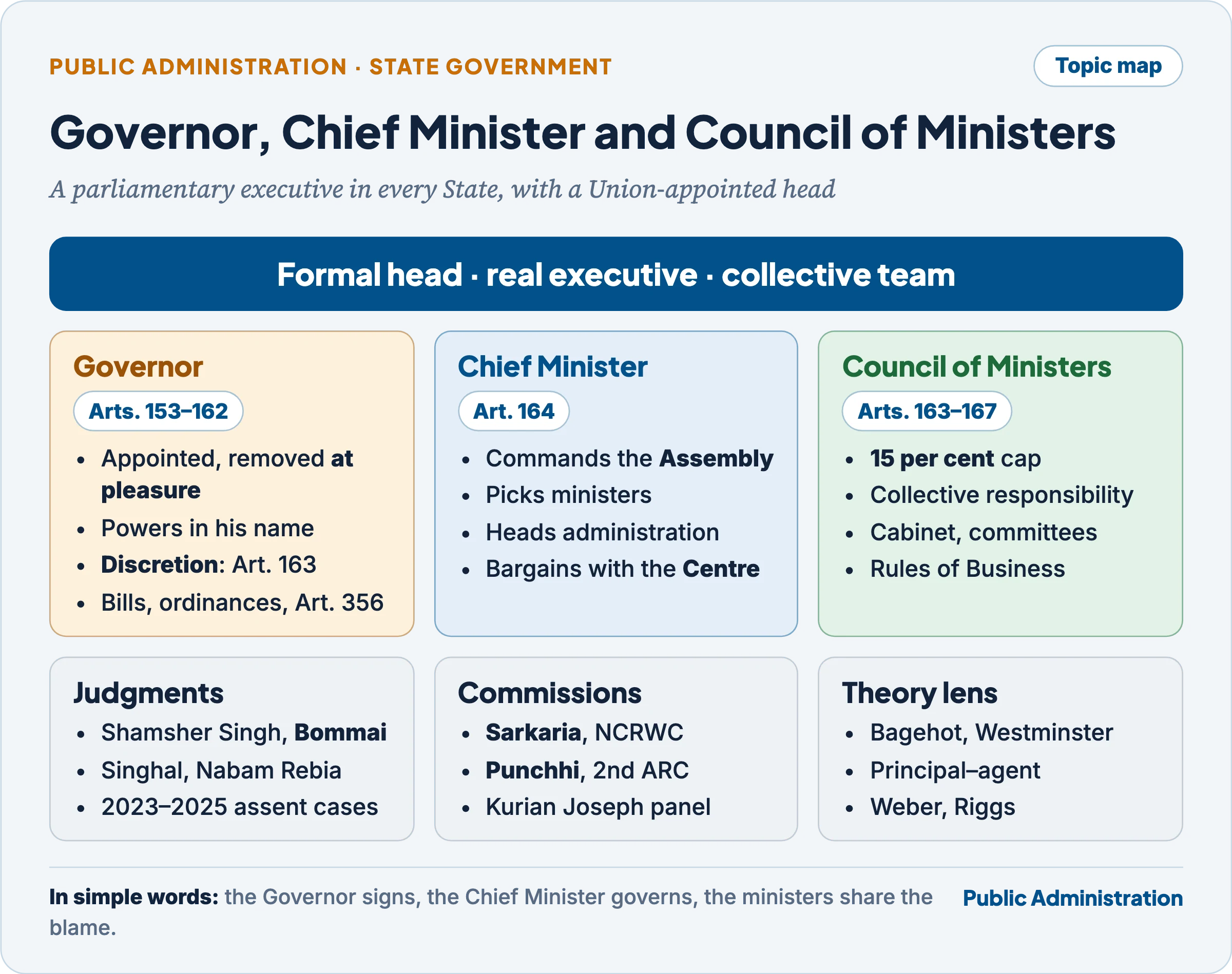
Every State in India is run by a parliamentary executive modelled on the one in New Delhi. A Governor, appointed by the President, is the formal head in whose name every order is issued; a Chief Minister who commands a majority in the Legislative Assembly actually governs; and a Council of Ministers headed by the Chief Minister advises the Governor and is answerable to the Assembly. When this triangle works by convention, the Governor is barely noticed. When it does not, as in a hung Assembly, a defection crisis, a pile of unsigned Bills or a recommendation for President’s Rule, the Governor becomes the most contested office in Indian federalism, and the Chief Minister’s survival depends on him.
- The State executive is therefore a study in two tensions: between the formal and the real executive (Governor and Chief Minister), and between State autonomy and the Union’s oversight (because the Governor is also the Centre’s appointee).
- It is also where most citizens meet government: police, land, schools, hospitals, irrigation and local bodies are State subjects, so the quality of the State executive decides the quality of daily administration.
In simple words
Think of a big school run by a trust. The chairman of the trust signs every certificate and opens every function, but the principal actually runs the school with a team of senior teachers, and the principal can be removed if most teachers lose faith in her. The chairman steps in only when the school has no principal or the team collapses. The Governor is the chairman, the Chief Minister is the principal, and the Council of Ministers is the team of senior teachers. The twist in India is that the chairman is chosen by the head office in Delhi, not by the school.
1. The State Executive: Design and Setting
In simple words
The Constitution copies the Union’s system in each State: a formal head (the Governor) and a real government (the Chief Minister and ministers) that must keep the support of the elected Assembly. The difference is that the Governor is appointed by the Centre and has a few powers he can use on his own.
1.1 A parliamentary executive at the State level
- Constitutional location. Part VI, Chapter II of the Constitution (Articles 153–167) sets out the State executive: the Governor (Articles 153–162), the Council of Ministers (163–164), the Advocate-General (165) and the conduct of government business (166–167).
- Formal and real executive. Article 154 vests the executive power of the State in the Governor, to be exercised directly or through subordinate officers; Article 163(1) gives him a Council of Ministers headed by the Chief Minister to aid and advise him; and Article 164(2) makes that Council collectively responsible to the Legislative Assembly. Power in the text sits with the Governor; power in practice sits with the Council that the Assembly can remove.
- Bagehot’s distinction. Walter Bagehot, the Victorian journalist, in The English Constitution (1867), separated the dignified parts of a constitution, which win reverence and loyalty (the Crown), from the efficient parts, which actually rule (the Cabinet). The Governor is the dignified part of a State government and the Chief Minister with his Cabinet the efficient part, with one Indian twist: the Governor keeps a small but real reserve of discretion.
- Continuity with 1935. The Government of India Act, 1935 created responsible ministries in the provinces but left the Governor with “special responsibilities” and powers “in his discretion” and “in his individual judgment”. The Constitution removed most of these, but kept the Governor as a channel between Centre and State, the ordinance power and the reservation of Bills, all colonial-era tools of supervision.
1.2 The Constituent Assembly’s choice: a nominated Governor
- Options debated. The early drafts considered a directly elected Governor and a Governor chosen by the President from a panel elected by the State legislature. The Assembly finally chose nomination by the President.
- Reasons given:
- an elected Governor would claim a popular mandate and become a rival centre of power to the Chief Minister, unworkable in a parliamentary system;
- elections would be costly and would drag a supposedly neutral head into party politics;
- after Partition, a nominated Governor was seen as a link that would hold the Union together against separatist pressures;
- Jawaharlal Nehru argued that a respected outsider, detached from local factions, would serve the State better.
- Instrument of Instructions dropped. The draft Constitution had a Fourth Schedule of instructions guiding the Governor in choosing Chief Ministers. It was deleted on the reasoning that the Governor would act on ministerial advice and his discretionary field would be meagre, best left to conventions. That silence is the root of most later disputes.
- The framers’ expectation. B.R. Ambedkar described the Governor’s office as one with no functions he could discharge by himself, only duties, and expected the discretionary provisions to be used rarely. The political scientist K.V. Rao later blamed the vagueness of the State executive provisions on haste and on the framers’ assumption that one party would rule at both levels for a long time.
1.3 Articles and Acts at a glance
The table lists the provisions that define the three institutions of this article.
| Article / Act | Subject |
|---|---|
| Art 153 (proviso by 7th Amendment, 1956) | A Governor for each State; one person may be Governor of two or more States |
| Art 154 | Executive power of the State vested in the Governor |
| Art 155–156 | Appointment by the President by warrant; holds office during the pleasure of the President; five-year term; may resign to the President |
| Art 157–158 | Qualifications (citizen, 35 years); no legislative seat or office of profit; emoluments by parliamentary law |
| Art 159 | Oath before the Chief Justice of the High Court |
| Art 160 | President may provide for the Governor’s functions in unforeseen contingencies |
| Art 161 | Pardon, reprieve, respite, remission; suspend, remit or commute sentences |
| Art 163 | Council of Ministers to aid and advise, except where the Governor acts in his discretion; Governor’s decision on what is discretionary is final; advice not inquired into by courts |
| Art 164 | Chief Minister appointed by the Governor; other ministers on the CM’s advice; pleasure; collective responsibility; six-month rule; (1A) 15 per cent cap and (1B) bar on defectors (91st Amendment, 2003); tribal welfare minister proviso |
| Art 165 | Advocate-General |
| Art 166 | Conduct of business: orders in the Governor’s name; Rules of Business |
| Art 167 | Chief Minister’s duty to inform the Governor and place matters before the Council |
| Art 174, 175, 176 | Summoning, prorogation, dissolution; addresses and messages; special address at the first session each year |
| Art 200–201 | Assent, withholding, return and reservation of Bills; President’s decision on reserved Bills |
| Art 213 | Ordinances |
| Art 356 | President’s Rule on the Governor’s report “or otherwise” |
| Art 361 | Personal immunity of the Governor |
| Art 371, 371A–371J | Special provisions and special responsibilities for certain States |
| Fifth and Sixth Schedules | Governor’s role in Scheduled and Tribal Areas |
Common confusion
Is the Governor simply the President of the State? No. Both are constitutional heads bound by ministerial advice, but the differences are basic. The President is elected by an electoral college and can be removed only by impeachment; the Governor is appointed by the Union and holds office at the President’s pleasure. Article 74 gives the President no general discretion and makes advice binding after one reconsideration; Article 163 expressly contemplates functions “in his discretion”. The Governor can reserve Bills for the President, must report under Article 356, and in some States carries special responsibilities. The President has no superior; the Governor is both head of a State and a link with the Union.
2. The Governor: Appointment, Tenure and Removal
In simple words
The Governor is chosen by the Union government and can be removed by it at any time, though not for purely political reasons. Who is chosen, and how easily he can be removed, decides whether he behaves as a neutral head or as the Centre’s representative.
2.1 Appointment and qualifications
- Appointment (Article 155). The President appoints the Governor by warrant under his hand and seal, acting on the advice of the Union Council of Ministers, which in practice means the Prime Minister and the Home Ministry.
- Qualifications (Article 157). A citizen of India who has completed 35 years. Article 158 adds that he cannot be a member of Parliament or a State legislature (a seat is vacated on taking office) and cannot hold any other office of profit; his emoluments and privileges are fixed by Parliament (the Governors (Emoluments, Allowances and Privileges) Act, 1982) and cannot be reduced during his term. When one person is Governor of two States, the President decides how the cost is shared.
- Conventions, not law. Two practices grew up: the Governor is usually not from the State he governs, and the Chief Minister is consulted before the appointment. Neither is binding; the Sarkaria Commission found that consultation had often shrunk to a mere intimation, and sometimes not even that.
- Oath (Article 159). Before the Chief Justice of the High Court, to “preserve, protect and defend the Constitution and the law” and to devote himself to the service and well-being of the people of the State. Both the Supreme Court and reform commissions have read this oath as the source of the Governor’s duty to act in the State’s interest, not the ruling party’s.
- Immunity (Article 361). The Governor is not answerable to any court for the exercise of his powers; no criminal proceedings can be started and no arrest made during his term; civil suits for personal acts need two months’ notice. The immunity is personal: the courts can still review the validity of his actions (Rameshwar Prasad, 2006).
2.2 Tenure and removal: the doctrine of pleasure
- The text (Article 156). The Governor holds office during the pleasure of the President; “subject to the foregoing”, the term is five years; he continues until a successor takes over. There is no impeachment procedure.
- The practice. Governors have been changed en masse after changes of government at the Centre, notably in 1977, 1980, 2004 and 2014. On 2 July 2004 the new Union government removed the Governors of Uttar Pradesh, Gujarat, Haryana and Goa; a public-interest petition followed.
- B.P. Singhal v. Union of India (7 May 2010). A five-judge bench settled the meaning of “pleasure”:
- the pleasure doctrine in a democracy under the rule of law is not a licence to act arbitrarily, capriciously or whimsically; removal needs a valid reason, though the reason need not be communicated;
- the Governor is not an employee or agent of the Union government (following Hargovind Pant v. Raghukul Tilak, 1979), and cannot be removed because he is out of sync with the policies or ideology of the party in power at the Centre, or to make room for a favoured person;
- removal is open to limited judicial review: if the petitioner shows a prima facie case of arbitrariness or mala fides, the court may ask the Union to disclose the material, but it presumes valid reasons otherwise.
- The “fuzzy area”. The judgment created a zone between the President’s withdrawal of pleasure (which needs no cause to be stated) and compelling reasons for removal (which the court said must exist). Because the burden of proof lies on the removed Governor and the reasons can stay in the file, removals and forced resignations have continued after 2010, for instance the transfer and then dismissal of Mizoram Governor Kamla Beniwal in 2014. In practice Governors still serve at the Centre’s discretion, though no longer at its whim in law.
2.3 Who should be Governor? Commission criteria
Commissions over four decades have proposed nearly the same criteria; the table shows how each built on its predecessor.
| Body | Who should be appointed | How | Tenure and removal |
|---|---|---|---|
| ARC (1966–70) | Persons of long experience in public life and administration, non-partisan in outlook | Not specified | Guidelines for discretion should be framed |
| Sarkaria Commission (1988) | Eminent in some walk of life; from outside the State; detached from local politics; not too active in politics recently; no member of the Union’s ruling party for an Opposition-ruled State | Consult the Chief Minister; Prime Minister to consult the Vice-President and Lok Sabha Speaker informally | Five-year term not to be cut short except for compelling reasons, with an opportunity to explain; no other office after Governorship except Vice-President or President |
| NCRWC (Venkatachaliah, 2002) | Endorsed Sarkaria’s criteria | Appointment by the President after consulting the Chief Minister | Removal before five years only after consulting the Chief Minister |
| Punchhi Commission (2010) | Away from active politics (even local) for at least two years before appointment | A committee of the Prime Minister, Home Minister, Lok Sabha Speaker and the Chief Minister (Vice-President may be added) | Fixed five-year term; delete “during the pleasure of the President”; impeachment by the State legislature on the lines of Article 61 |
| Tamil Nadu High-Level Committee (Kurian Joseph, Part I, 2026) | An outsider, eminent, with no party or government office in the previous five years | President bound to appoint one of three names approved by the State Assembly | Single non-renewable five-year term; removal by a resolution of the Assembly; binding Instrument of Instructions in a new Schedule |
- The common thread. Every body accepts that the Governor should be eminent, non-partisan and secure in tenure, and that the State should have a say in choosing him. The disagreement is only on how far to go: Sarkaria wanted conventions, Punchhi wanted constitutional amendment, and the Tamil Nadu committee wants the State legislature to control both entry and exit.
- Implementation record. None of these proposals has been enacted. Union governments of every party have appointed active or recently retired politicians, and have used Governorships to accommodate party veterans. This is the factual basis of the question whether the office can ever be made apolitical.
3. Powers and Functions of the Governor
In simple words
On paper the Governor has almost every power a State government has: he appoints ministers, signs laws, issues ordinances, grants pardons and presents the budget. In practice he does nearly all of this on the advice of the Chief Minister’s government; his own judgment counts only in a few situations.
3.1 Executive powers
- Executive power in his name (Articles 154 and 166). Every executive action is expressed to be taken in the Governor’s name; orders are authenticated as the Governor’s rules prescribe, and their validity cannot be questioned on the ground that the Governor did not personally make them. The word “officers subordinate to him” in Article 154 includes the ministers.
- Rules of Business (Article 166(3)). The Governor makes rules for the more convenient transaction of business and for allocating business among ministers, except for matters in which he acts in his discretion. These rules decide which files a minister can dispose of, which go to the Chief Minister and which to the Cabinet (Section 8.5).
- Appointments. The Chief Minister and, on his advice, other ministers (Article 164); the Advocate-General (165); the Chairman and members of the State Public Service Commission (316, though only the President can remove them); the State Election Commissioner (243K); the State Finance Commission (243I, 243Y); district judges in consultation with the High Court (233); and Vice-Chancellors where State university laws make him Chancellor.
- Right to be informed (Article 167). The Chief Minister must communicate all Cabinet decisions on administration and proposals for legislation, furnish information the Governor calls for, and, if the Governor asks, place before the Council any matter decided by a single minister without Council consideration. This is the Governor’s main instrument for exercising the three rights Bagehot attributed to the monarch: to be consulted, to encourage and to warn.
- Reports to the Centre. Governors send periodic (traditionally fortnightly) reports to the President on the State’s affairs. NCRWC (2002) called the practice unhealthy and wanted reports confined to genuine Article 356 situations; Sarkaria wanted the Chief Minister taken into confidence. These reports are the information channel that makes the Governor the Centre’s eyes and ears.
3.2 Legislative powers
- Part of the legislature (Article 168). The State legislature consists of the Governor and the House or Houses; no Bill becomes law without him.
- Summoning, prorogation and dissolution (Article 174). He summons the House so that six months do not pass between two sittings, prorogues it, and dissolves the Assembly. Normally all three are done on the Chief Minister’s advice (Nabam Rebia, 2016; Section 4).
- Addresses (Articles 175–176). He may address and send messages to the House; under Article 176 he “shall” address the legislature at the first session after each general election and the first session of each year, explaining the causes of summons. The address is written by the Cabinet; the Governor reads the government’s policy, not his own (Section 6.3 on the 2026 walkouts).
- Nominations. About one-sixth of a Legislative Council’s members are nominated by the Governor from literature, science, art, cooperative movement and social service (Article 171). The Governor’s earlier power to nominate an Anglo-Indian member to the Assembly (Article 333) ended when the 104th Amendment (2019) let that provision lapse from 25 January 2020.
- Disqualification of members (Article 192). Questions of disqualification of a legislator (other than defection, which goes to the Speaker under the Tenth Schedule) are decided by the Governor, who must act on the opinion of the Election Commission.
- Assent to Bills (Articles 200–201). The most disputed legislative power; see Section 3.3.
- Ordinances (Article 213). When the legislature is not in session and the Governor is satisfied that circumstances need immediate action, he may promulgate an ordinance with the force of a State law.
- It must be laid before the legislature and lapses six weeks after it reassembles, unless disapproved earlier; the Governor may withdraw it at any time.
- He needs the President’s instructions for an ordinance whose contents would, in a Bill, have required previous sanction or reservation for the President.
- Abuse by re-promulgation. Studies of Bihar by the economist D.C. Wadhwa showed hundreds of ordinances being re-promulgated session after session, some kept alive for more than a decade without ever going to the legislature. In D.C. Wadhwa v. State of Bihar (1987) the Supreme Court called this a fraud on the Constitution; in Krishna Kumar Singh v. State of Bihar (2017) a seven-judge bench held that re-promulgation without placing the ordinance before the legislature is unconstitutional, that laying is mandatory, and that the Governor’s satisfaction is open to judicial review on grounds of mala fides or no material.
3.3 Assent to Bills: the four options and the recent judgments
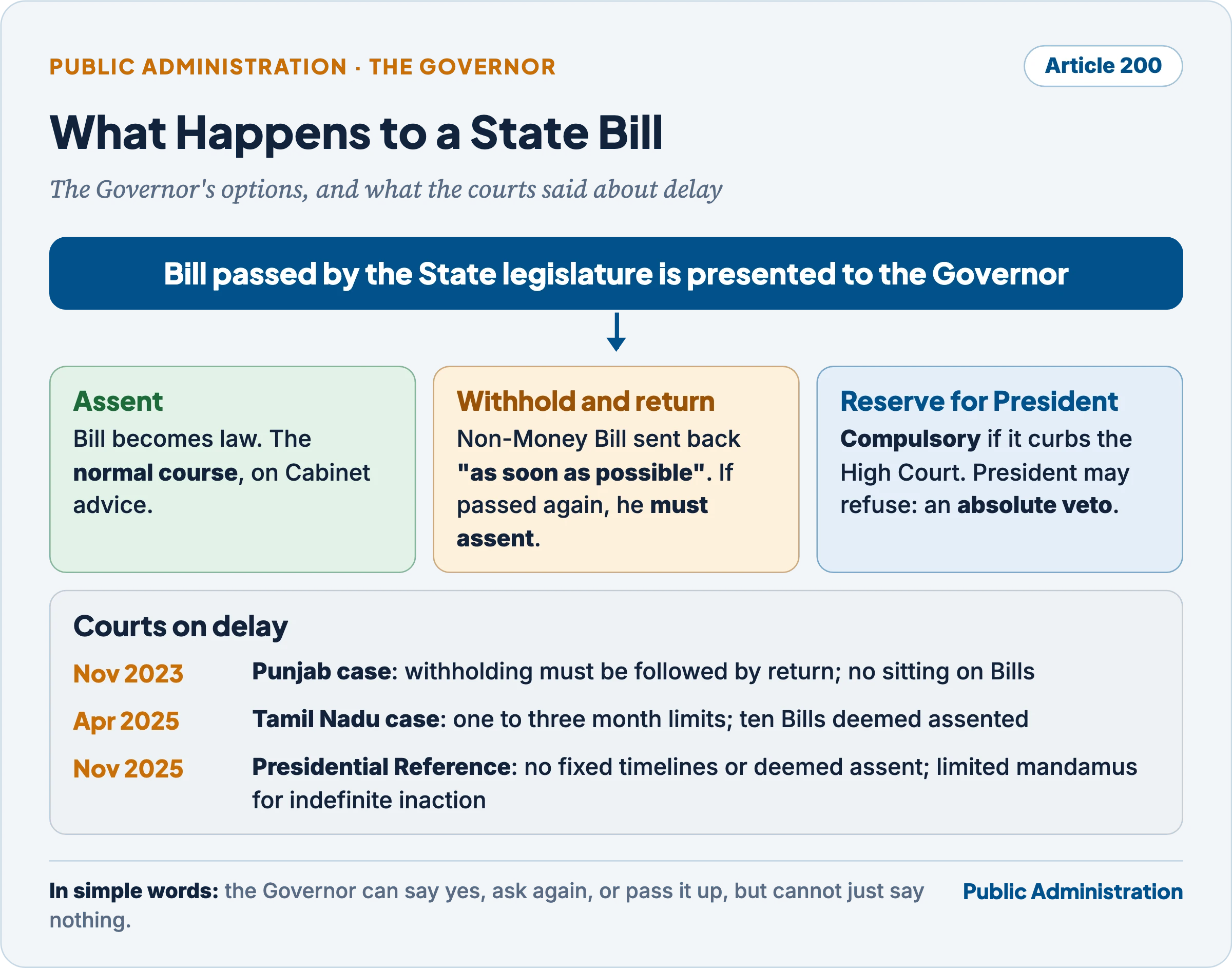
When a Bill passed by the legislature is presented, Article 200 offers the Governor the options below.
| Option | What it means | Limits |
|---|---|---|
| Assent | Bill becomes law | Normal course, on Cabinet advice |
| Withhold assent and return (first proviso) | Return a non-Money Bill “as soon as possible” with a message asking the House to reconsider | If the House passes it again, with or without amendment, the Governor “shall not withhold assent” |
| Reserve for the President | President decides under Article 201 | Compulsory if the Bill would derogate from the High Court’s powers; also required where the Constitution needs the President’s assent (for example Article 31A, 31C, 254(2), 288) |
| Money Bills | Introduced only on the Governor’s recommendation (Article 207) | Cannot be returned for reconsideration; withholding assent to a Bill he recommended would be anomalous |
- President’s options (Article 201). For a reserved Bill the President may assent or withhold; for a non-Money Bill he may direct the Governor to return it, and the House must reconsider within six months; even if it is passed again the President is not bound to assent. Reservation thus gives the Union an absolute veto over State Bills.
- The problem of silence. Article 200 sets no time limit except “as soon as possible” for returning a Bill. From about 2020, Governors in Tamil Nadu, Kerala, Punjab, Telangana and West Bengal kept Bills pending for months or years; some were then reserved for the President after re-passage. This produced three landmark rulings:
- State of Punjab v. Principal Secretary to the Governor of Punjab (10 November 2023). A three-judge bench (Chief Justice D.Y. Chandrachud) held that a Governor who withholds assent must follow the first proviso and return the Bill to the legislature; he cannot simply declare “assent withheld” and sit on it, because an unelected head would then hold a veto over an elected legislature. It also held that the Governor cannot question the validity of an Assembly sitting that the Speaker had adjourned rather than prorogued.
- State of Tamil Nadu v. Governor of Tamil Nadu (8 April 2025). A two-judge bench (Justices J.B. Pardiwala and R. Mahadevan) held the Governor’s reservation of ten re-passed Bills illegal, declared that Governors have no absolute or pocket veto, and fixed timelines: one month for withholding or reserving on Cabinet advice; three months for withholding or reserving against advice; one month for assent to a re-passed Bill; and three months for the President. Using Article 142 it declared the ten Bills deemed to have received assent. Tamil Nadu notified them as Acts on 12 April 2025, the first State laws to take effect without the signature of either Governor or President; several transferred Vice-Chancellor appointments from the Governor to the government.
- In re: Assent, Withholding or Reservation of Bills (Presidential Reference No. 1 of 2025, opinion of 20 November 2025). On fourteen questions referred by President Droupadi Murmu on 13 May 2025, a five-judge bench (Chief Justice B.R. Gavai, with Justices Surya Kant, Vikram Nath, P.S. Narasimha and A.S. Chandurkar) advised that:
- the Governor has three options (assent, reserve, or withhold and return with comments); withholding without return is not permitted, because Article 200 envisages a dialogic process between Governor and legislature;
- in choosing among these options the Governor is not bound by the aid and advice of the Council of Ministers, otherwise reservation and return would be meaningless;
- courts cannot impose uniform timelines or declare deemed assent; doing so would usurp the Governor’s and President’s functions and breach the separation of powers;
- the merits of the Governor’s decision are not justiciable, but prolonged, unexplained and indefinite inaction can attract a limited mandamus to decide within a reasonable time; the Governor’s personal immunity under Article 361 remains.
- Where the law now stands. The pocket veto is dead (both 2023 and 2025 rulings agree on this), but the Governor keeps a real discretion among the three options and no fixed clock binds him. Delay can still be challenged, case by case. Section 4.4 places these rulings in the longer line of cases on gubernatorial discretion.
3.4 Financial powers
- Budget (Article 202). The annual financial statement is laid before the legislature in the Governor’s name.
- Money Bills and demands (Articles 203 and 207). No demand for a grant and no Money Bill can be moved without his recommendation.
- Contingency Fund (Article 267(2)). The Contingency Fund of the State is placed at his disposal for unforeseen expenditure pending legislative approval.
- State Finance Commission (Articles 243I and 243Y). He constitutes it every five years to review the finances of panchayats and municipalities, and lays its report before the legislature.
- Audit (Article 151(2)). CAG reports on State accounts are submitted to him, and he causes them to be laid before the legislature.
3.5 Judicial powers: pardon under Article 161
- The power. The Governor may grant pardons, reprieves, respites or remissions and suspend, remit or commute sentences for offences against laws on matters to which the State’s executive power extends.
- Comparison with the President (Article 72).
| Point | President (Art 72) | Governor (Art 161) |
|---|---|---|
| Scope | Offences against Union laws | Offences against State laws |
| Death sentence | Can pardon a death sentence | Can suspend, remit or commute, but cannot pardon it |
| Court-martial | Can pardon sentences by court-martial | No power |
| Advice | Bound by Union Cabinet advice | Bound by State Cabinet advice |
- Bound by advice. In Maru Ram v. Union of India (1980) the Court held that the pardon power is exercised on the advice of the government, not personally. In A.G. Perarivalan v. State (18 May 2022) it held the Tamil Nadu Governor bound by the State Cabinet’s recommendation to release a convict in the Rajiv Gandhi assassination case, found his referral to the President without constitutional basis, and ordered release under Article 142 after years of inaction.
- Limits of review. The decision can be reviewed only on narrow grounds: no application of mind, mala fides, extraneous or arbitrary considerations, or discrimination (Epuru Sudhakar v. State of Andhra Pradesh, 2006).
3.6 Special responsibilities, Scheduled Areas and the Union Territory role
In some areas the Constitution asks the Governor to act in his individual judgment or discretion, usually to protect tribal or regional interests that a State majority might neglect.
| Provision | Governor’s role |
|---|---|
| Fifth Schedule (Scheduled Areas in ten States) | Annual report to the President on administration of Scheduled Areas; may by public notification direct that any Act of Parliament or the State shall not apply or apply with modifications; may make regulations for peace and good government, especially on land transfer and money-lending, after consulting the Tribes Advisory Council, with the President’s assent |
| Sixth Schedule (Assam, Meghalaya, Tripura, Mizoram) | Creates and reorganises autonomous districts; decides in his discretion disputes over the share of mineral royalties between the State and a District Council (para 9); may dissolve a Council on the recommendation of a commission |
| Art 371(2) Maharashtra, Gujarat | Special responsibility for separate development boards (Vidarbha, Marathwada, rest of Maharashtra; Saurashtra, Kutch, rest of Gujarat) and equitable allocation of funds |
| Art 371A Nagaland | Special responsibility for law and order while internal disturbances continue, in his individual judgment after consulting ministers; Tuensang district arrangements |
| Art 371C Manipur | Special responsibility for the proper functioning of the Hill Areas Committee; annual report to the President |
| Art 371F Sikkim | Special responsibility for peace and an equitable arrangement for the advancement of different sections |
| Art 371H Arunachal Pradesh | Special responsibility for law and order, in his individual judgment |
| Art 371J Karnataka (added by 98th Amendment, 2012) | Special responsibility, by Presidential order, for a development board for the Hyderabad-Karnataka (now Kalyana-Karnataka) region, equitable funds and reservation in jobs and education |
| Art 239(2) | A Governor appointed Administrator of an adjoining Union Territory acts there independently of his Council of Ministers |
- Significance. These provisions are asymmetric federalism in action: the Union, through the Governor, retains a protective role where ethnic, tribal or regional fault lines are deep. Critics note that the Fifth Schedule powers have been rarely used to protect tribal land, so the safeguard is more formal than real, a case of what Riggs called formalism (Section 9).
3.7 The Governor as Chancellor of universities
- A statutory, not constitutional, role. Most State university Acts make the Governor the ex officio Chancellor, with powers to appoint Vice-Chancellors from panels prepared by search committees, nominate members to university bodies and approve statutes. Because these powers come from State laws, they vary between States, and the question whether the Chancellor must act on ministerial advice is answered by each Act, not by Article 163.
- The conflict. From about 2021, Governors in Kerala, Tamil Nadu, West Bengal and Punjab clashed with State governments over Vice-Chancellor appointments, search committees (including whether a UGC nominee must be included), and interim appointments. State governments responded with Bills to remove the Governor as Chancellor (Kerala and West Bengal in 2022, Tamil Nadu among the Bills of 2020–23), which Governors in turn did not sign.
- Courts step in. In August 2025 the Supreme Court appointed former judge Sudhanshu Dhulia to head search-cum-selection committees for two Kerala universities, giving the Chief Minister a role in recommending names; by December 2025 it described the Governor–Chief Minister disagreement over the names as a deadlock and asked the committee for a ranked list.
- Reform view. The Punchhi Commission (2010) recommended ending the convention of making Governors Chancellors, so that the office is not dragged into academic patronage and controversy. The opposing view is that a non-partisan Chancellor protects universities from the State government’s own political interference.
4. Discretionary Powers: Constitutional and Situational
In simple words
The Governor normally does what the Chief Minister’s government advises. Discretion means the few occasions when he decides by himself: when no party has a clear majority, when a government seems to have lost its majority, when he must report a breakdown to the President, or when a Bill must go to the President. The courts have spent fifty years narrowing these occasions.
4.1 Article 163: the text and its meaning
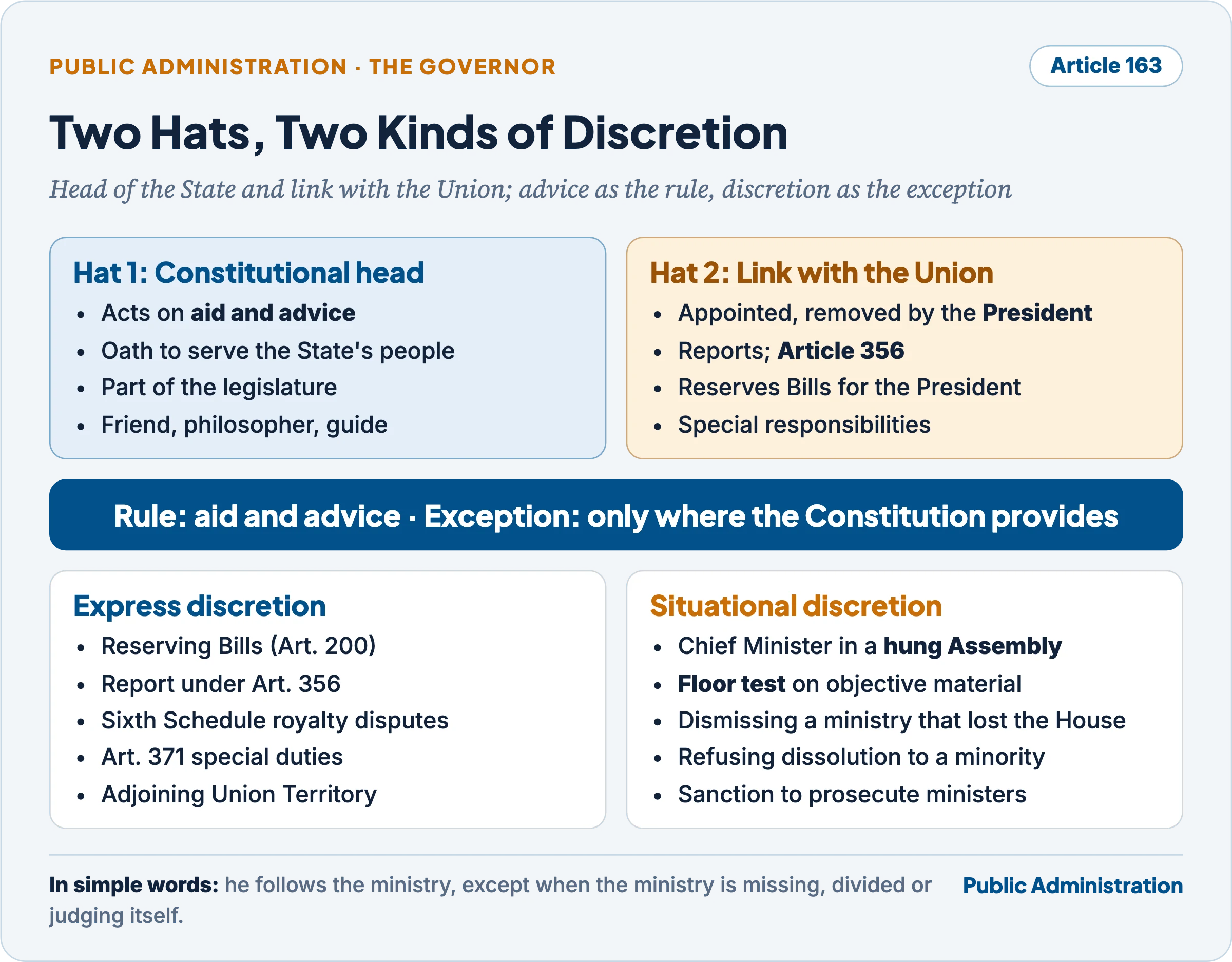
- The text. Article 163(1) gives the Governor a Council of Ministers to aid and advise him “except in so far as he is by or under this Constitution required to exercise his functions or any of them in his discretion“. Article 163(2) adds that if a question arises whether a matter is discretionary, the Governor’s decision in his discretion is final, and nothing he does can be questioned on the ground that he ought or ought not to have acted in his discretion. Article 163(3) bars courts from inquiring whether, and what, advice was given.
- Why it seems to make him “sole judge”. Read literally, 163(2) lets the Governor decide both whether he has discretion and how to use it, with finality. Nothing similar exists for the President under Article 74.
- How the courts read it down. In Nabam Rebia v. Deputy Speaker (13 July 2016) a five-judge bench held that the finality in 163(2) applies only to matters where the Constitution expressly or by necessary implication requires discretion; it does not give the Governor a general power to decide any matter by himself. “In his discretion” is the exception; aid and advice is the rule.
Common confusion
Does Article 163(2) put the Governor’s discretion beyond the reach of courts? No. The finality clause protects a genuine exercise of discretion in a field the Constitution assigns to him; it does not protect action outside that field or action that is mala fide, irrational or based on no material. S.R. Bommai (1994) reviewed the Governor’s reports under Article 356, Rameshwar Prasad (2006) struck down a dissolution based on his report, Nabam Rebia (2016) undid his summoning of the Assembly, and Subhash Desai (2023) held his call for a floor test unjustified. What Article 361 protects is the person of the Governor, not the legality of his acts.
4.2 Constitutional (express) discretion
These are functions where the Constitution itself uses words such as “in his discretion” or “individual judgment”, or where the logic of the provision excludes ministerial advice.
- Reservation of Bills for the President (Article 200), now confirmed by the 2025 Reference as outside aid and advice.
- Report under Article 356(1) that the State’s government cannot be carried on according to the Constitution; by its nature it may condemn the very ministry that would otherwise advise him.
- Sixth Schedule royalty disputes (para 9) and certain functions in Tripura and Mizoram.
- Special responsibilities under Article 371 and its sub-articles (individual judgment after consulting ministers).
- Administrator of an adjoining Union Territory (Article 239(2)).
- Seeking information under Article 167; it would be absurd to require the Chief Minister’s advice before asking the Chief Minister for information.
4.3 Situational (implied) discretion
These powers are not labelled discretionary in the text but arise because the advising ministry is absent, divided or suspect. The Sarkaria Commission listed six such areas: choosing the Chief Minister, testing a government’s majority, dismissing a Chief Minister, dissolving the Assembly, recommending President’s Rule and reserving Bills.
Appointing a Chief Minister in a hung Assembly
- Clear majority: no discretion. When one party or a pre-poll alliance has a majority, the Governor must invite its leader.
- Hung Assembly: real choice. The dilemma first arose after 1967, when the Congress lost its majority in eight States. Should the Governor invite the single largest party, a post-poll coalition, or the party best able to give a stable government? Governors have used three methods: the list system (supporters’ signatures, sometimes verified individually), the parade of legislators before the Governor, and the list-cum-parade. All three test majority outside the House and invite horse-trading.
- Sarkaria’s order of preference (endorsed by Punchhi):
- a pre-poll alliance commanding a majority (treated as one party);
- the single largest party claiming majority with the support of others, including independents;
- a post-poll coalition with all partners joining the government;
- a post-poll alliance with some partners in government and others, including independents, supporting from outside.
- The person appointed should seek a vote of confidence within 30 days. Sarkaria added that the Governor’s task is to find the leader most likely to command a majority, not to form a government of his choice.
- Indian cases:
- Madras, 1952: Governor Sri Prakasa invited C. Rajagopalachari of the Congress, the largest party without a majority (Rajaji was not even a member of the Assembly), setting an early precedent for the largest party;
- West Bengal, 1970: Governor S.S. Dhavan declined to invite Jyoti Basu, leader of the largest party, to prove his majority on the floor, a decision attacked as partisan;
- Jharkhand, 2005: Governor Syed Sibtey Razi invited Shibu Soren though the rival alliance claimed a majority; the Supreme Court advanced the floor test, and Soren resigned without facing it;
- Goa and Manipur, 2017: Governors invited post-poll alliances led by the BJP although the Congress was the single largest party; the Supreme Court declined to interfere but ordered an early floor test in Goa;
- Karnataka, 2018: Governor Vajubhai Vala invited B.S. Yeddyurappa, leader of the single largest party (104 of 224), and gave him 15 days; on 18 May the Supreme Court cut this to one day, and he resigned before the vote, after which the post-poll Congress–JD(S) coalition took office;
- Maharashtra, 2019: after President’s Rule, it was revoked in the early hours of 23 November and Devendra Fadnavis was sworn in; the Supreme Court ordered a floor test within about a day, and he resigned before it.
- Lesson. The cases show no uniform convention, and the outcome has often matched the preference of the Union’s ruling party. The courts’ answer has been the early floor test, which takes the decision away from the Governor’s assessment and puts it in the House.
Floor tests, dismissal and the Speaker
- Pleasure means confidence. Ministers hold office “during the pleasure of the Governor” (Article 164(1)), but that pleasure must be read with collective responsibility to the Assembly (Article 164(2)). So long as the ministry has the House’s confidence, the Governor cannot dismiss it; the Committee of Governors (1970–71) headed by Bhagwan Sahay and later courts agreed that a refusal to face the House can be treated as prima facie loss of confidence.
- Floor of the House is the only test. S.R. Bommai v. Union of India (1994) held that majority must be tested on the floor, not in the Governor’s drawing room or by lists. When the Chief Minister appears to have lost his majority, the Governor may direct a floor test (Shivraj Singh Chouhan v. Speaker, Madhya Pradesh Legislative Assembly, 2020), but only on objective material showing the government’s majority is in doubt.
- Subhash Desai v. Principal Secretary, Governor of Maharashtra (11 May 2023). The Constitution Bench held that Governor Bhagat Singh Koshyari was not justified in calling for a floor test in June 2022, because the resolution of rebel MLAs showed discontent within a party, not an intention to leave the government; a floor test cannot be used to resolve intra-party disputes. The Court could not restore Uddhav Thackeray, who had resigned without facing the vote, and held that the Governor was justified in then inviting Eknath Shinde.
- Dismissal cases.
- West Bengal, 1967: Governor Dharma Vira dismissed the Ajoy Mukherjee ministry for not calling the Assembly by the date he fixed; widely criticised, since the House should have decided.
- Andhra Pradesh, 1984: Governor Ram Lal dismissed N.T. Rama Rao while he was abroad for surgery and installed a defector-backed ministry without a floor test; after nationwide protest NTR was restored within a month and the Governor resigned.
- Uttar Pradesh, 1998: Governor Romesh Bhandari dismissed Kalyan Singh and swore in Jagdambika Pal; the High Court restored Kalyan Singh and the Supreme Court ordered a composite floor test, which Kalyan Singh won.
- Goa, 1994 and 2005: Governors dismissed Chief Ministers on their own reading of majority; in 2005 S.C. Jamir dismissed Manohar Parrikar’s government after a disputed confidence vote.
- Dismissal of individual ministers. Ministers other than the Chief Minister are appointed and removed on the Chief Minister’s advice; the Governor has no discretion here. A Chief Minister unable to persuade a minister to resign advises the Governor to dismiss him.
- The Speaker’s role. In a defection crisis the Speaker decides disqualification under the Tenth Schedule (upheld in Kihoto Hollohan, 1992), conducts the floor test and controls the House calendar. Courts have tried to stop Speakers from delaying or advancing disqualification for partisan ends: Keisham Meghachandra Singh v. Speaker, Manipur (2020) asked Speakers to decide within three months, and Nabam Rebia (2016) held that a Speaker facing a notice for his own removal should not decide disqualification petitions (a rule the 2023 Maharashtra bench referred to a larger bench). The Governor and the Speaker are thus the two umpires of government formation, and both have been accused of partisanship.
Summoning, prorogation and dissolution
- Normal rule. All three are exercised on the Chief Minister’s advice.
- Exception: a ministry that has lost the House. If a Chief Minister fearing defeat advises prorogation to avoid a no-confidence motion, or refuses to advise summoning, the Governor may act on his own to let the House decide. The 1970 Governors’ Conference and jurists such as M.C. Chagla and L.M. Singhvi took this view.
- Nabam Rebia (2016). In Arunachal Pradesh Governor J.P. Rajkhowa advanced the Assembly session from January 2016 to December 2015 and fixed its agenda (removal of the Speaker) without the Chief Minister’s advice. The Court held this unconstitutional, restored Nabam Tuki’s government, and ruled that the Governor may summon the House on his own only when he has objective reason to believe the ministry has lost confidence, and even then must not dictate the House’s agenda.
- Dissolution. If a ministry with a majority advises dissolution, the Governor must accept. If a ministry that has lost its majority advises dissolution to escape the House, he may refuse and explore an alternative government (refusals in Punjab, 1967, Uttar Pradesh, 1968 and Uttar Pradesh, 2003). Rameshwar Prasad v. Union of India (2006) struck down the dissolution of the Bihar Assembly in May 2005, made on Governor Buta Singh’s report that a majority was being cobbled together by horse-trading: a Governor cannot pre-empt a claim to form government on the suspicion that the majority was assembled by improper means.
Sanction to prosecute ministers
- M.P. Special Police Establishment v. State of Madhya Pradesh (2004). A five-judge bench held that the Governor may grant sanction to prosecute ministers in his own discretion where the Cabinet’s refusal is biased or plainly irrational, because a Cabinet cannot be a fair judge of its own members. Earlier, in the early 1980s, the Maharashtra Governor, acting on his own, sanctioned the prosecution of former Chief Minister A.R. Antulay in the cement-allotment case.
- Karnataka, 2024. On 16 August 2024 Governor Thaawarchand Gehlot approved investigation and prosecution of Chief Minister Siddaramaiah in the Mysuru Urban Development Authority land-allotment case, despite contrary Cabinet advice. On 24 September 2024 the Karnataka High Court upheld the order, holding that a Cabinet nominated by the Chief Minister cannot be free from bias towards him, so this is an exceptional situation calling for independent discretion. Punchhi (2010) had endorsed this power.
4.4 How the courts narrowed discretion
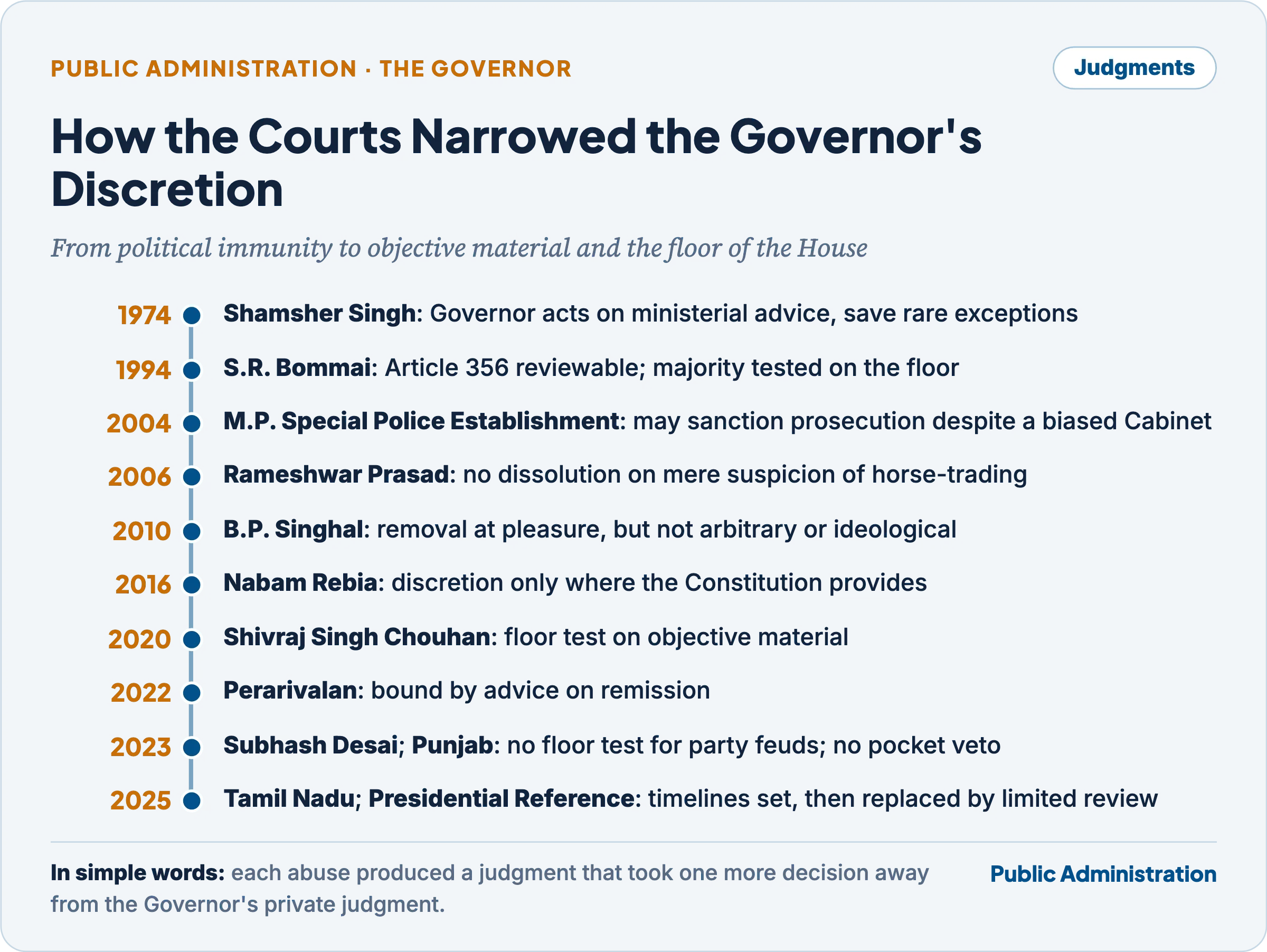
The judgments form a clear arc: from treating the Governor’s acts as political and unreviewable to testing them against objective material, the floor of the House and the dialogic process.
| Judgment | Year | Ratio on the Governor |
|---|---|---|
| Shamsher Singh v. State of Punjab (seven judges) | 1974 | President and Governor act on ministerial advice save in a few well-known exceptional situations; the “satisfaction” of the Governor is the satisfaction of his Council |
| State of Rajasthan v. Union of India | 1977 | Governor’s report-making under Article 356 is an independent function as the Union’s observer; Court reluctant to review |
| Hargovind Pant v. Raghukul Tilak | 1979 | Governor is not an employee of the Union; independent constitutional office |
| Maru Ram v. Union of India | 1980 | Pardon power exercised on government advice |
| S.R. Bommai v. Union of India (nine judges) | 1994 | Article 356 reviewable; floor test the only test of majority; Assembly not to be dissolved before Parliament approves |
| M.P. Special Police Establishment | 2004 | Discretion to sanction prosecution of ministers where Cabinet is biased |
| Rameshwar Prasad v. Union of India | 2006 | Bihar dissolution (2005) unconstitutional; Governor cannot act on suspicion of horse-trading; Article 361 no bar to reviewing the action |
| B.P. Singhal v. Union of India | 2010 | Pleasure doctrine not arbitrary; no removal for ideological mismatch; limited review |
| Nabam Rebia v. Deputy Speaker | 2016 | Discretion only where the Constitution provides; summoning and agenda on advice; status quo ante restored |
| Shivraj Singh Chouhan v. Speaker, MP | 2020 | Governor may call a floor test on objective material |
| A.G. Perarivalan v. State | 2022 | Governor bound by advice under Article 161; inaction reviewable |
| Subhash Desai v. Principal Secretary to Governor | 2023 | Floor test not to settle intra-party disputes; Governor’s call unjustified |
| State of Punjab v. Principal Secretary to Governor | 2023 | Withholding assent must be followed by return; no pocket veto |
| State of Tamil Nadu v. Governor of Tamil Nadu | 2025 | Timelines; deemed assent of ten Bills under Article 142 |
| Presidential Reference No. 1 of 2025 | 2025 | No judicial timelines or deemed assent; three options; discretion under Article 200; limited mandamus against indefinite inaction |
- The trend. Each judgment answered a specific abuse: dismissal by headcount (Bommai), dissolution on suspicion (Rameshwar Prasad), removal for politics (Singhal), summoning against advice (Nabam Rebia), indefinite delay (Punjab, Tamil Nadu). The 2025 Reference shows the limit of this trend: the Court will police abuse, but it will not rewrite the Constitution’s silences into fixed rules.
- Hence the 2007 question. Judicial pronouncements have made Governors less free to act as the Centre’s agents, but they have not changed the appointment and removal structure that produces the agency in the first place.
5. The Governor and President’s Rule
In simple words
If a State’s government cannot be run according to the Constitution, the President can take it over. The Governor’s report is usually the trigger, and during President’s Rule the Governor actually runs the State on behalf of the Centre.
- The provision in brief. Under Article 356, if the President is satisfied, on the Governor’s report or otherwise, that the State’s government cannot be carried on in accordance with the Constitution, he may assume its executive functions and declare that Parliament will exercise the legislature’s powers. Parliament must approve within two months; approval lasts six months at a time, up to three years, and beyond one year only if a National Emergency is in force and the Election Commission certifies that elections cannot be held (44th Amendment, 1978). The full federal analysis, misuse statistics and Sarkaria, NCRWC and Punchhi proposals are in the article on Union–State Relations.
- The Governor’s role.
- Before: his report is the usual basis; it must rest on verifiable material, not on the Union’s political wish. Sarkaria wanted the report to be reasoned and published, and the State to be warned first.
- During: the Governor exercises the State’s executive power on behalf of the President, usually assisted by advisers (often retired civil servants) appointed by the Centre; the Chief Secretary becomes the administrative fulcrum.
- After Bommai: the Assembly is normally kept in suspended animation rather than dissolved, so that a new government can be formed without fresh elections; if the proclamation is struck down, the dismissed government can be restored.
- Grounds commonly cited (following the scholar H.S. Kathuria’s analysis of President’s Rule): breakdown of law and order, political instability through defections, a Chief Minister refusing to resign after losing his majority, no party able or willing to form a government, corruption and maladministration, insurgency, and occasionally a State inviting President’s Rule to escape a crisis.
- Misuse and decline. Article 356 was invoked more than a hundred times, including against the elected Communist government of Kerala in 1959, nine Congress-ruled States in 1977 and nine non-Congress States in 1980. After Bommai, coalition politics and the political cost of misuse, use has fallen sharply. Recent State cases include Jammu and Kashmir (2018–19), Maharashtra (12–23 November 2019) and Manipur (2025–26).
Indian Connect — Manipur, February 2025 to February 2026
- Background. Ethnic violence between the Meitei and Kuki-Zo communities began in May 2023. The Assembly last sat from 31 July to 12 August 2024. A budget session called for 10 February 2025 was cancelled on 9 February, the day Chief Minister N. Biren Singh resigned.
- Constitutional trigger. Article 174(1) requires that six months must not elapse between two sittings; with no session possible and no leader acceptable to the ruling legislators, President’s Rule was proclaimed on 13 February 2025, with the Assembly (tenure till March 2027) kept in suspended animation, not dissolved.
- Extension. Parliament extended the proclamation on 5 August 2025 for six months, to 13 February 2026. Going beyond one year would have needed a National Emergency and an Election Commission certificate, or a constitutional amendment.
- Revocation. President Droupadi Murmu revoked the proclamation on 4 February 2026; the same evening Governor Ajay Kumar Bhalla swore in Yumnam Khemchand Singh as Chief Minister at Lok Bhavan, Imphal, with Nemcha Kipgen (Kuki-Zo) and Losii Dikho (Naga) as Deputy Chief Ministers. Kipgen took the oath by video from New Delhi, a sign that the conflict itself was unresolved.
- What it shows. President’s Rule here was used without dissolution, ended before the one-year limit, and served as a holding device to rebuild a ministry acceptable across communities. It also showed the limits of governing a conflict-hit State through a Governor and advisers for a year.
6. The Dual Role: Constitutional Head and Link with the Centre
In simple words
The Governor wears two hats. As head of the State he should act like a neutral referee who follows the elected government’s advice. As the Centre’s appointee he also watches the State for the Union and reports to it. Trouble starts when the second hat is worn as a party cap.
6.1 Two hats
- Constitutional head of the State. Bound by advice (Article 163), oath to serve the State’s people (Article 159), integral part of the legislature (Article 168). In this role the Governor is expected to be a friend, philosopher and guide to his ministry (words the Supreme Court used in 2025), a sagacious counsellor, mediator and arbitrator rather than an active politician.
- Link between Union and State. Several provisions make him the Union’s channel:
- appointment and removal by the President (Articles 155–156);
- reports to the President and the Article 356 report;
- reservation of Bills (Article 200) and the need for Presidential instructions for some ordinances (Article 213);
- Article 160 (functions in contingencies) and the special responsibilities that require Presidential directions;
- his role in transmitting Union views on Articles 256–257 directions.
- Link versus agent. K.V. Rao distinguished a link, a positive channel that carries the State’s view to the Centre as much as the Centre’s to the State, from an agent, who merely executes the principal’s will. He argued the Governor should be a reflection of the State government, “not its antithesis nor a spy of the Centre”. The political scientist S.C. Dash observed that the office invites a split personality: it can play Dr Jekyll to the Union and Mr Hyde to the State Cabinet, with neither side able to hold it to account.
- Official positions. The Committee of Governors (1971) said the Governor is not the agent of the President; the Supreme Court said the same in Hargovind Pant (1979) and B.P. Singhal (2010). Yet as long as the Centre appoints and removes at pleasure, the incentives of an agent remain.
6.2 Politicisation: from 1967 to the present
- The Nehru era (1950–67). With the Congress ruling almost everywhere, disputes were settled inside the party, and Governors were largely ceremonial. Even then, the 1959 Kerala dismissal showed what the office could be used for.
- After 1967. When non-Congress governments came to power in many States, Governors became arbiters of government formation. Their choices in hung Assemblies, dismissals and dissolutions frequently favoured the Union’s ruling party, giving the office its reputation as an “agent of the Centre”. The position of Governors in exercising discretion changed qualitatively from formal to political.
- Coalition and defection era (1989–2014). Hung Assemblies and floor-crossing multiplied the Governor’s opportunities for discretion; Bommai (1994) and Rameshwar Prasad (2006) were responses to this period. Mass replacements of Governors after changes at the Centre (1977, 1980, 2004, 2014) confirmed that Governorships were part of political patronage.
- The present phase (2019 onwards). With a dominant party at the Centre and strong regional parties in many States, the conflict has shifted from government formation to day-to-day governance: delays in assent, Vice-Chancellor appointments, public criticism of State policies by Governors, the content of the Governor’s address and sanctions to prosecute ministers.
- The “activist Governor” debate. Some Presidents and Prime Ministers have urged Governors to be more active in monitoring development and welfare schemes. Supporters see a useful watchdog; critics see a parallel centre of power with no accountability to the legislature, which a parliamentary system cannot accommodate.
6.3 Why disagreements between Governors and State governments have grown
The recent strain has several causes that reinforce one another.
- Political mismatch. Governments of different parties at the Centre and in the States, with Governors drawn from the Union’s ruling party, turn constitutional disagreements into partisan contests.
- Textual silences. No time limit in Article 200, no criteria for choosing a Chief Minister, no definition of the Governor’s discretion, and university laws that differ from State to State.
- Appointment and tenure. Appointment of active politicians, the absence of State consultation and tenure at pleasure give Governors reasons to please the Centre.
- Public role-taking. Some Governors have publicly criticised State policies on education, language or governance, a departure from the convention that the Governor speaks through his ministry.
- New flashpoints. University appointments, sanctions to prosecute Chief Ministers and ministers, CBI and ED investigations of State leaders, and fiscal disputes in which Governors side with the Union.
- The address itself. In January 2026, Governor R.N. Ravi of Tamil Nadu (20 January) walked out without reading the Cabinet-approved address, Governor Rajendra Arlekar of Kerala (20 January) omitted passages criticising the Union, and Governor Thaawarchand Gehlot of Karnataka (22 January) read only two lines of a 43-page text. Article 176 says the Governor “shall” address the House, and the address is the Cabinet’s policy statement; these episodes raise the question whether the Governor has any discretion over its content.
- Symbolic change. On 25 November 2025 the Union Home Ministry directed that Raj Bhavans be renamed “Lok Bhavan” and the residences of Lieutenant Governors “Lok Niwas”, following a recommendation of the Conference of Governors (August 2024) and a committee chaired by Governor R.N. Ravi, to shed a colonial label. The renaming changes the name, not the structure of appointment and pleasure that drives the disputes.
6.4 Should the office be abolished?
The central debate on the office is whether it serves the federation or subverts it.
Criticism — Criticism: the Governor as the Centre’s instrument
- Unaccountable power. An unelected appointee, removable only by the Centre and immune under Article 361, can block an elected government’s Bills, appointments and policy addresses.
- Partisan record. From Kerala (1959) and Andhra Pradesh (1984) to Bihar (2005) and Maharashtra (2022), courts have found Governors’ actions unjustified or unconstitutional; the pattern consistently favoured the Union’s ruling party.
- Patronage. Governorships have become rewards for retired politicians and loyal officials, defeating the Sarkaria criteria.
- Federal distrust. In States ruled by Opposition parties, the office is seen as a surveillance post; as the Tamil Nadu leader C.N. Annadurai quipped, a State needs a Governor no more than a goat needs a beard.
- Cost and redundancy. In normal times the Governor’s functions are formal; the courts, the Speaker and the floor of the House now decide most contested questions.
Defence — Defence: why a neutral Governor is still needed
- Constitutional continuity. Someone must appoint a Chief Minister, administer the oath, and keep government going when a ministry falls, resigns or loses its majority; an elected rival would be worse.
- A check on State-level majoritarianism. Reservation of Bills, sanction to prosecute biased Cabinets and special responsibilities for tribal and backward regions protect minorities, the High Court and national law.
- Federal glue. In a holding-together federation with secessionist pressures in some regions, a link with the Union is a safeguard, not an insult.
- The problem is the practice, not the office. Every commission (Sarkaria, NCRWC, Punchhi) rejected abolition and instead proposed better selection, fixed tenure and codified discretion; the 2025 Reference called the Governor a guide, philosopher and friend of the government.
- Coalition and hung-Assembly instability makes a neutral umpire more, not less, necessary; abolition would hand the umpire’s role entirely to the Speaker, himself a party member.
- Balance. The office is defensible as a dignified, neutral link; it is indefensible as a political outpost. The reform agenda that follows from both columns is the same: State consultation in appointment, fixed tenure, removal only for cause, codified conventions on discretion, and time-bound action on Bills. Whether the role is “diplomatic” or “administrative” today, the evidence suggests it is mostly the former in normal times and decisively the latter in crises.
7. The Chief Minister
In simple words
The Chief Minister is the real head of a State’s government. He picks the ministers, chairs the Cabinet, leads the Assembly, controls the bureaucracy and bargains with the Centre. How powerful he really is depends on his majority, his party and his own personality.
7.1 Appointment and removal
- Appointment (Article 164(1)). The Chief Minister is appointed by the Governor; the Constitution says nothing more. Convention requires the Governor to appoint the person who can command a majority in the Legislative Assembly.
- Member of either House. He may be from the Assembly or the Legislative Council; several have sat in the Council, such as Nitish Kumar (Bihar) and Yogi Adityanath (Uttar Pradesh, until 2022). By convention the Chief Minister should belong to the popular House, but there is no legal bar.
- Six-month rule (Article 164(4)). A non-member may be appointed but must become a member of the legislature within six months. In S.R. Chaudhuri v. State of Punjab (2001) the Supreme Court held that a non-member cannot be reappointed for successive six-month spells during the same legislature’s term without getting elected: that would be a fraud on the Constitution.
- Oath and salary (Article 164(3) and (5)). Oath of office and secrecy before the Governor; salary fixed by the State legislature.
- Removal. In law, the Chief Minister holds office at the Governor’s pleasure; in practice he goes when:
- he loses a vote of confidence or a no-confidence motion is carried, or the government is defeated on the budget or a major policy vote;
- his party or coalition replaces him (as when Uttarakhand had three Chief Ministers in 2021 and Gujarat replaced its entire Council of Ministers with a new Chief Minister in September 2021);
- President’s Rule is imposed;
- he resigns, for instance after a court verdict or arrest (the 130th Amendment Bill, 2025, would make removal after 30 days in custody automatic; see Section 7.6).
- The Prime Minister’s shadow. In national parties, the party high command effectively makes and unmakes Chief Ministers; it was a common observation that Chief Ministers of a national party travel to Delhi before announcing their ministries. This is a political, not constitutional, reality.
7.2 Powers and functions
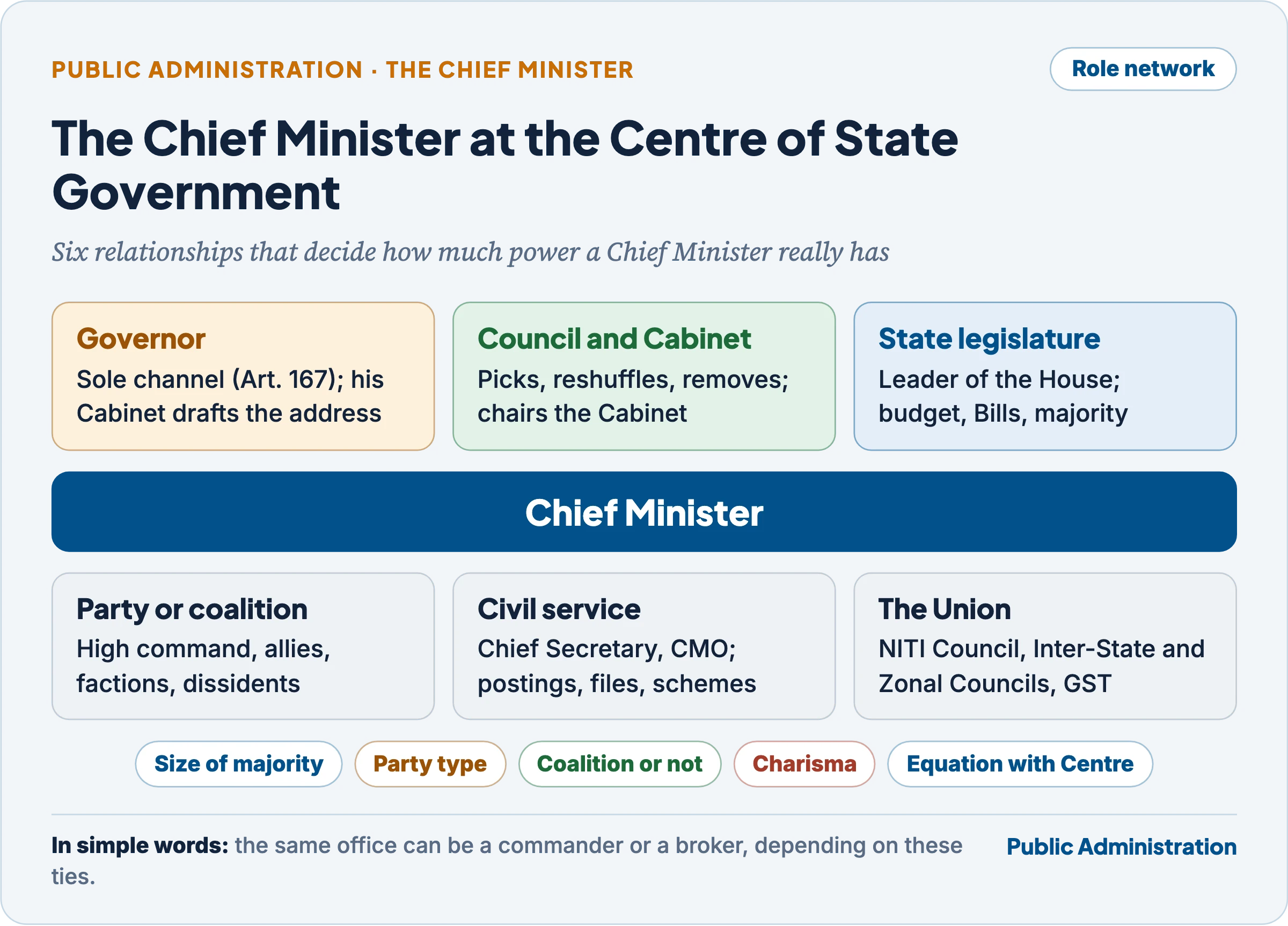
In relation to the Council of Ministers
- Formation. Ministers are appointed on his advice; he decides who is in, at what rank, and with which portfolios. The Governor has no discretion here.
- Constraints on choice. In practice he balances regions, castes, communities, women and minorities, party factions, the wishes of the high command, the need for experienced hands in Home, Finance and Planning, and, in a coalition, allies’ quotas. Total satisfaction is impossible; dissidents are often accommodated as chairpersons of public sector undertakings and boards.
- Reshuffles as discipline. He can reshuffle portfolios at will, enlarging a loyal minister’s charge or clipping the wings of an ambitious one; he can ask any minister to resign and, failing that, advise the Governor to dismiss him. His own resignation brings down the entire Council.
- Chairing the Cabinet. He fixes the time, place and agenda of Cabinet meetings, presides, settles disagreements and often takes urgent decisions himself for post facto Cabinet approval.
- Coordination. Under the Rules of Business he decides coordination cases, matters on which ministers disagree, and can call any file to himself or to the Cabinet.
In relation to the Governor
- The sole channel (Article 167). He communicates Cabinet decisions and legislative proposals to the Governor, furnishes information, and places matters before the Council on the Governor’s request. The Governor’s address, ordinances and most appointments are drafted by his government.
- Advice on the legislature. He advises summoning, prorogation and dissolution; while he has a majority, this advice binds.
- Appointment of the Governor. The Constitution gives him no role, though Sarkaria wanted him consulted and later bodies wanted a formal say.
- Personal equation. Sarkaria stressed the need for personal rapport between Governor and Chief Minister; where it fails, every routine file can become a dispute.
In relation to the State legislature
- Leader of the House. He sets the legislative agenda, pilots important Bills, defends ministers who cannot satisfy the House, and announces major policies.
- Budget. Even when he is not Finance Minister, the budget is prepared with his approval; some Chief Ministers hold Finance themselves.
- Majority management. He keeps the legislature party together (constituency demands, postings of officials, development works) and cultivates the Opposition; his tenure depends on the legislature party more than on the Assembly as a whole.
- Decline of the legislature. State Assemblies now sit for few days a year, pass Bills with little debate and are often disrupted. Critics argue that legislatures have become arenas of partisan confrontation rather than deliberation, which further concentrates policy-making in the Chief Minister’s office.
As head of State administration
- Political head of the bureaucracy. He approves postings of Secretaries, Heads of Departments, District Collectors and Superintendents of Police, and chairs key bodies (State Planning Board, investment and disaster management authorities).
- Portfolios he keeps. Chief Ministers usually keep General Administration and Personnel, often Home, sometimes Finance, Planning or Industries, and any department that faces a crisis. In Rajasthan, every Chief Minister since 1949 has kept General Administration and Personnel; Mohan Lal Sukhadia took over Power during the shortage of 1968. Holding many departments seems to violate the span of control, but strong secretaries make it workable.
- Chief Minister’s Office (CMO). A Secretariat directly accountable to him, usually headed by a Principal Secretary (an IAS officer), handles his tours, correspondence, public grievances, the Chief Minister’s relief fund, assurances and monitoring of flagship schemes (dashboards, “CM helplines”, war rooms). The Principal Secretary to the Chief Minister often carries influence far above his rank, sometimes rivalling the Chief Secretary; this demands that the post be held by an officer who keeps the civil-service virtues of anonymity, impartiality and neutrality.
In relation to the party and the Centre
- Party leader. In regional parties he is usually also the party supremo; in national parties he depends on the high command for selection, ministry formation and survival.
- Federal bargainer. He negotiates with the Prime Minister and Union ministers for funds, projects and centrally sponsored schemes, and represents the State in:
- the Governing Council of NITI Aayog (all Chief Ministers; replaced the National Development Council in practice; its tenth meeting on 24 May 2025, on “Viksit Rajya for Viksit Bharat @2047“, was attended by Chief Ministers or Lieutenant Governors of 24 States and 7 UTs);
- the Inter-State Council under Article 263 (all Chief Ministers; met only rarely, the last full meeting in 2016);
- the Zonal Councils (Chief Ministers of each zone; the Union Home Minister chairs) and the North Eastern Council;
- the GST Council, through the State’s Finance Minister, where the Chief Minister’s political line shapes votes.
- Boycotts as bargaining. Chief Ministers of Opposition-ruled States have at times boycotted NITI Aayog meetings or walked out, using absence itself as a signal in federal bargaining. Details of these forums are in the article on Union–State Relations.
7.3 The Chief Minister and the Chief Secretary
- The pivotal pair. The Chief Secretary, the senior-most civil servant and Secretary to the Cabinet, is the Chief Minister’s principal adviser, coordinator of departments and link to the districts. A Chief Minister’s effectiveness depends heavily on whom he chooses for this post.
- “Alter ego”? The Chief Secretary is often called the Chief Minister’s alter ego: he implements the Chief Minister’s priorities across the government, manages crises, and speaks for the State to the Cabinet Secretary in Delhi. Yet he is also the head of a politically neutral service, bound by service rules and the All India Services (Conduct) Rules.
- Tensions. Chief Ministers often choose a junior officer over many seniors for loyalty; frequent changes of Chief Secretary with each new Chief Minister; and the rise of a powerful CMO can sideline him. The 2nd Administrative Reforms Commission favoured a transparent selection and a reasonable fixed tenure for the post.
- The office, functions and selection of the Chief Secretary, and the State Secretariat and Directorates under him, are covered in the article on the Chief Secretary, State Secretariat and Directorates.
7.4 Position: from “first among equals” to “the sun of the system”
- Theory. Like the Prime Minister, the Chief Minister is in theory primus inter pares, first among equals in a collective Cabinet.
- Practice. In most States he is, as one classic description goes, the sun around which the lesser planets revolve: ministers owe their posts to him, Cabinet decisions follow his line, and a dissenting minister generally has to resign. He combines the roles of chief policy-maker, principal planner, coordinator, guardian of the civil service, party leader and voice of the people.
- Determinants of his power:
- size and cohesion of the majority (a landslide gives command; a thin or factional majority gives dependence);
- type of party (a regional party’s leader answers to no high command; a national party’s Chief Minister must keep Delhi’s confidence);
- coalition or single-party government;
- personality and charisma (Section 9);
- equation with the Centre (same party at both levels brings funds but also control; different parties bring autonomy but also conflict);
- tenure (long-serving Chief Ministers accumulate control over party and bureaucracy).
- Long tenures. Some Chief Ministers have dominated their States for decades: Pawan Chamling (Sikkim, about 24 years, 1994–2019), Naveen Patnaik (Odisha, about 24 years, 2000–2024), Jyoti Basu (West Bengal, 1977–2000). Nitish Kumar was sworn in as Bihar’s Chief Minister for a record tenth time on 20 November 2025.
Indian Connect — Personality and the Centre: two kinds of Chief Minister
- The regional supremo. Leaders such as Naveen Patnaik, Mamata Banerjee or M.K. Stalin combine control of party, government and public image. The Cabinet often looks like a body of secretaries carrying out the leader’s programme, with flagship schemes branded in the Chief Minister’s name. Their autonomy from Delhi is high, and their conflicts with Governors are frequent.
- The high-command Chief Minister. In national parties, Chief Ministers are often chosen and replaced by the central leadership, sometimes without a long base in the legislature party. Their effectiveness depends on the trust of the central leadership, which brings resources and cover, but their Cabinet colleagues may have their own lines to Delhi.
- The coalition Chief Minister. Power is shared through a common minimum programme, a coordination committee, Deputy Chief Ministers from allies, and negotiated portfolios. The Chief Minister becomes a broker and manager rather than a commander, and the Governor’s role grows whenever the coalition wobbles.
7.5 The Chief Minister in coalition governments
- Constraints. Allies demand portfolio quotas, veto ministers, and threaten to withdraw support; the Chief Minister cannot freely dismiss an ally’s minister; collective responsibility is weakened as allies publicly dissent.
- Instruments of coalition management. Common minimum programmes, coordination committees of party leaders, Deputy Chief Ministers (a post the Supreme Court in February 2024 called merely a label for a minister, not unconstitutional), and an enlarged ministry, now capped by the 91st Amendment.
- Effect on administration. Departments become party fiefdoms; transfers and postings follow allies’ preferences; long-term reforms stall. Yet coalitions also bring wider social representation and consultative decision-making.
- Effect on the Governor. Coalition breakdowns, defections and post-poll alliances are exactly the conditions in which the Governor’s situational discretion comes alive (Section 4.3).
7.6 Accountability of the Chief Minister
- Political accountability to the Assembly (questions, motions, committees), to the party and to voters.
- Legal accountability: no immunity like the Governor’s; Chief Ministers can be investigated and prosecuted, with sanction from the Governor where the law requires it (Section 4.3).
- The custody question. In 2024 a sitting Chief Minister of Delhi continued in office for months while in judicial custody, and the Jharkhand Chief Minister resigned before his arrest; this prompted the Constitution (130th Amendment) Bill, 2025, introduced on 20 August 2025 and sent to a Joint Parliamentary Committee. It provides that a Prime Minister, Chief Minister or minister held in custody for 30 consecutive days on charges punishable with five years or more must be removed. In July 2026 the Committee’s draft favoured temporary removal with reinstatement after release or acquittal; adoption was deferred and the deadline extended to the Winter Session of 2026. Critics fear misuse of arrest by central agencies against Opposition Chief Ministers; supporters argue that government cannot be run from jail.
8. The State Council of Ministers
In simple words
The Council of Ministers is the team that actually runs the State’s departments. It acts as one body: all ministers share the blame or credit for every decision, and the whole team falls if the Assembly withdraws support. Its size is now capped, and its procedures are laid down in the Rules of Business.
8.1 Composition
- Three tiers, as at the Centre:
- Cabinet ministers: heads of the important departments (Home, Finance, Revenue, Planning, Industries), who alone attend Cabinet meetings as of right;
- Ministers of State: junior ministers, some with independent charge of a department, others attached to a Cabinet minister;
- Deputy Ministers: assist a Cabinet minister, rarely with independent charge.
- Deputy Chief Ministers. A political title for senior ministers, common in coalitions and in large parties; the Supreme Court held in February 2024 that it confers no extra constitutional status or pay.
- Parliamentary Secretaries. Some States created a fourth tier of legislators as “parliamentary secretaries” with perks, often to get round the size cap. In Bimolangshu Roy v. State of Assam (26 July 2017) the Supreme Court struck down the Assam Act creating such posts, holding that State legislatures lack competence to create these offices under Article 194 and Entry 39 of the State List. Similar appointments in other States (for instance 21 Delhi MLAs appointed in 2015, which led to office-of-profit proceedings) have been challenged on the same ground.
- Tribal welfare minister. The proviso to Article 164(1) requires a minister in charge of tribal welfare (who may also handle Scheduled Castes and backward classes) in Chhattisgarh, Jharkhand, Madhya Pradesh and Odisha (Bihar was replaced by Chhattisgarh and Jharkhand by the 94th Amendment, 2006).
- Ministerial-rank posts. Chairpersons of boards, corporations and commissions are often given Cabinet or Minister of State rank, enlarging the political executive outside the Council.
8.2 Size: the 91st Amendment and beyond
- The problem. Before 2003, States such as Uttar Pradesh had ministries of 90 or more; Assam had 36 ministers in a House of 126 (about 28.6 per cent). Large ministries were used to buy defectors and keep coalitions together, with high costs and poor coordination.
- The 91st Amendment Act, 2003:
- Article 164(1A): the total number of ministers, including the Chief Minister, shall not exceed 15 per cent of the Assembly’s strength, but shall not be less than 12;
- Article 164(1B): a member disqualified for defection cannot be appointed a minister until his term ends or he is re-elected;
- the Tenth Schedule’s “split” exception (one-third of a party) was deleted, leaving only mergers (two-thirds) as protected.
- Did it right-size the Council? It capped the biggest ministries and ended the most blatant ministries-for-defectors bargains. But:
- the floor of 12 means small States (Goa, Sikkim, Mizoram, with 40 or fewer members) can have ministries of 30 per cent of the House;
- 15 per cent is itself generous for large States;
- governments evade the cap through parliamentary secretaries, ministerial-rank chairpersons and political advisers;
- defectors increasingly resign and get re-elected, which 164(1B) does not prevent.
- 2nd ARC’s graded cap. The Second Administrative Reforms Commission (chaired by M. Veerappa Moily), in its 15th Report, State and District Administration (2009), called a compact Council an essential requirement of good governance and proposed:
| Assembly strength | Maximum size of Council |
|---|---|
| More than 200 (large States) | 10 per cent |
| 80 to 200 (medium States) | 12 per cent (but not more than a large State with 200 members) |
| Below 80 (small States) | 15 per cent (but not more than a medium State with 80 members) |
– It suggested no prescribed minimum and asked that a national consensus be built in the Inter-State Council. The Union accepted the idea in principle; nothing has been enacted.
- The first ARC (1966–70) had also urged small ministries; the advice was ignored because political accommodation outweighs administrative efficiency. Only a politically secure Chief Minister can afford a compact ministry.
8.3 Collective and individual responsibility
- Collective responsibility (Article 164(2)). The Council is responsible as a body to the Legislative Assembly (not to the Council, where one exists). Ministers “sink or swim together“: they may differ in the Cabinet room but must defend every decision in public and in the House; a minister who cannot do so must resign. A minister cannot disown a decision by saying he was absent from the meeting.
- What holds solidarity together. The Chief Minister’s standing, the size of the Cabinet (small bodies cohere better), and the strength and cohesion of the ruling party; coalitions weaken it.
- Cabinet secrecy. The oath of secrecy binds ministers even after leaving office; only decisions meant for publication are announced. Premature leaks can harm the State’s interests and the Union’s.
- Individual responsibility. Each minister answers for his department; he holds office at the Governor’s pleasure, which in practice means the Chief Minister’s pleasure. Resignations on grounds of departmental failure are rare in India; ministers resign far more often because of corruption charges or political pressure.
- Limits of the convention. Courts do not enforce collective responsibility; it is political. Its decline in coalitions and under dominant Chief Ministers is one reason the Council can look like a body of secretaries.
8.4 The Cabinet and cabinet committees in the States
- Cabinet versus Council. The Council of Ministers is the constitutional body (Article 163); the Cabinet, the inner circle of Cabinet ministers, is the real policy-making body, though the word appears in the Constitution only in Article 352.
- Cabinet committees. Some States set up standing committees of the Cabinet (on appointments, infrastructure, investment, law and order, disaster response) and ad hoc committees for specific issues. The practice is far less developed than at the Union level: because State Cabinets are small and meet often, most matters go to the full Cabinet. Growing policy complexity is pushing States towards more committees and Groups of Ministers.
- Inner cabinet. In practice a few ministers close to the Chief Minister, and senior officers in the CMO, form a kitchen cabinet where key decisions are shaped.
8.5 Work processes: Rules of Business and cabinet procedure
- Rules of Business (Article 166(3)). Made by the Governor on the Cabinet’s advice, usually in two sets:
- Allocation of Business Rules distribute subjects among departments (by function, clientele, area or a mix), and departments among ministers;
- Transaction of Business Rules prescribe which cases a minister may decide alone, which must go to the Chief Minister (coordination cases, inter-departmental disputes) and which to the Cabinet, and how cases reach the Governor.
- Matters normally reserved for the Cabinet:
- the Governor’s address and matters the Governor refers under Article 167;
- proposals for legislation and ordinances;
- major policy changes and proposals to reverse a previous Council’s decisions;
- the budget, supplementary demands, advances from the Contingency Fund, new taxes and proposals affecting State finances that the Finance Minister has not agreed to;
- major structural changes in administration and service rules;
- appointments of the Public Service Commission, Board of Revenue and similar bodies; exemptions from the Commission’s purview;
- appeals and memorials of government servants to the Governor;
- Union–State and inter-State matters and references to Zonal Councils;
- alienation of government land and other matters the Chief Minister directs.
- Cabinet procedure:
- Cabinet memorandum prepared by the department: history and facts, the issue, arguments for and against, financial and legal implications, views of consulted departments (Finance, Law), and the decision sought;
- Agenda and notice issued by the Chief Secretary, as Secretary to the Cabinet, with the Chief Minister’s approval; meetings at two days’ notice or, in urgency, a few hours;
- Decision by circulation for urgent matters, with silence by the deadline treated as consent, ratified at the next meeting;
- Minutes recording decisions (not deliberations), approved by the Chief Minister and sent to ministers, the Governor’s Secretary and Secretaries;
- Implementation and monitoring by the department, with a register in the Cabinet Secretariat (usually a wing of the General Administration Department under the Chief Secretary) tracking compliance.
- Practical drift. Strong Chief Ministers sometimes decide first and seek post facto approval; files bypass the Cabinet through “CM’s orders”; and delegated legislation shifts real rule-making to departments, enlarging ministerial power at the legislature’s expense.
8.6 Legislative and political role
- The Council prepares all government Bills, ordinances and the Governor’s address; ministers pilot Bills and answer questions, call-attention and adjournment motions. Because government Bills almost always pass, the Cabinet functions like a standing legislative committee of the majority.
- It advises on summoning, prorogation and dissolution; this advice binds only while it commands the House.
- It oversees departments, public sector undertakings and autonomous bodies, and through the Chief Secretary, the Secretariat and Directorates (covered in the article on the Chief Secretary, State Secretariat and Directorates).
8.7 Is the Council reduced to “a body of secretaries”?
- Evidence for. Under dominant Chief Ministers: ministers are chosen and moved at will; important decisions are taken in the CMO and ratified by the Cabinet; schemes carry the Chief Minister’s name; departmental Secretaries report directly to the CMO; ministers rarely contradict the Chief Minister publicly. Some Chief Ministers have kept a large number of departments themselves.
- Evidence against. The Council remains collectively responsible to the Assembly; strong ministers with independent bases (caste, region, allies) cannot be treated as subordinates; coalitions restore bargaining power; courts insist on Cabinet decisions where the law requires them; and a Chief Minister who alienates his ministers risks revolt, as several leadership changes have shown.
- Assessment. The Council’s real weight depends on the political structure more than the constitutional text: high under coalitions and in factional national parties, low under charismatic regional leaders with landslide majorities. The same Constitution produces both collegial and presidentialised State governments.
9. The State Executive in Theory and Practice
In simple words
Ideas from Paper I help explain why the State executive works as it does: why the Governor is mostly ceremonial but sometimes decisive, why some Chief Ministers dominate everything, and why written rules and real practice so often differ.
- The overall pattern. The text of the Constitution concentrates power in the Governor; conventions transfer it to the Chief Minister and Council; politics then decides whether the Chief Minister dominates the Council and whether the Governor behaves as a neutral head or a Union agent; and courts step in when conventions are broken.
- The direction of reform. Each institution needs codification of what conventions once left to good faith: criteria and procedure for appointing Governors, time-bound action on Bills, rules for hung Assemblies, smaller ministries, and protection of the Council’s collective role against a personalised executive.
Theory lens: the State executive through Paper I ideas
- Bagehot’s dignified and efficient parts. Walter Bagehot (The English Constitution, 1867) explains the Governor–Chief Minister division: the Governor provides legitimacy and continuity, the Chief Minister and Cabinet govern. The Indian twist is that the dignified part retains reserve powers, and controversy arises when a dignified office tries to act as an efficient one. See the article on the Union Executive (Paper II) for the same logic at the Centre.
- Westminster conventions and their codification. The British model rests on unwritten conventions; Ivor Jennings (The Law and the Constitution, 1933) argued that a convention exists when there are precedents, a belief that they bind, and a reason for the rule. India borrowed the model but not the political culture that sustains conventions, so courts have turned conventions into law: aid and advice (Shamsher Singh), floor test (Bommai), limited discretion (Nabam Rebia). See the article on Comparative Public Administration for the British administrative tradition.
- Principal–agent theory. In the theory developed by Michael Jensen and William Meckling (1976) and applied to politics by Terry Moe, a principal delegates to an agent who has more information and different interests, and must monitor him. The Union is the principal and the Governor its agent, monitored by reports and removable at pleasure; but the Constitution gives the Governor a second principal, the State’s people and its Constitution-bound oath. The result is a multiple-principal problem, and Governors resolve it in favour of the principal who controls their tenure. B.P. Singhal‘s limit on removal is an attempt to weaken that control. See the article on New Public Administration and Public Choice.
- Weber’s charismatic authority. Max Weber (Economy and Society, 1922) identified charismatic authority, resting on devotion to the extraordinary qualities of a leader, alongside traditional and legal-rational authority. Many Chief Ministers rule through personal charisma (welfare schemes in their name, direct appeal to voters), which explains the “sun of the system” and “body of secretaries” phenomena. Weber also predicted the routinisation of charisma: personal parties pass to heirs (traditional authority) or harden into machines. See the article on Weber and Bureaucracy.
- Contingency theories of leadership. Fred Fiedler’s contingency model (1967) holds that a leader’s effectiveness depends on the situation: leader–member relations, task structure and position power. A Chief Minister’s power is situational in exactly this way: a landslide and a cohesive party give high position power; a coalition or factional party lowers it. See the article on Leadership Theories.
- Federal bargaining. William Riker (Federalism: Origin, Operation, Significance, 1964) saw federalism as a bargain between national and regional leaders, and W.H. Morris-Jones called Indian federalism bargaining federalism. Chief Ministers bargain in NITI Aayog, the GST Council and Zonal Councils, while Governors are an instrument in the Union’s hand during the bargain. See the article on Union–State Relations.
- Riggs’ formalism. Fred Riggs (Administration in Developing Countries, 1964) described formalism, the gap between prescribed norms and actual behaviour in prismatic societies. The State executive is rich in it: “aid and advice” that Governors bypass; “as soon as possible” read as “never”; “pleasure” read as patronage; a 15 per cent cap evaded through parliamentary secretaries; Fifth Schedule protections rarely used. See the article on Riggsian Models.
- Accountability theory. The Governor has power without accountability (immune under Article 361, answerable only to the Union), while the Chief Minister is accountable to the Assembly, party and voters. Accountability theory predicts friction wherever power and answerability are separated, which is the core of the Governor problem. See the article on Accountability and Control.
Key Terms
| Term | Meaning in simple words |
|---|---|
| Constitutional head | The formal head in whose name government acts but who follows the elected ministry’s advice |
| Real executive | The Chief Minister and Council of Ministers who actually take decisions |
| Aid and advice | The ministry’s advice that binds the Governor in normal matters (Article 163) |
| Constitutional discretion | Functions the Constitution itself leaves to the Governor’s judgment, such as reserving Bills |
| Situational discretion | Judgment forced on the Governor by circumstances, such as a hung Assembly |
| Doctrine of pleasure | Holding office at the will of the appointing authority; for Governors, limited by B.P. Singhal |
| Hung Assembly | An Assembly where no party or pre-poll alliance has a majority |
| Floor test | A vote in the House to check whether the government has a majority |
| Composite floor test | A single vote in which rival claimants test their support together |
| Suspended animation | Assembly kept alive but not functioning during President’s Rule |
| Reservation of a Bill | Governor sending a State Bill to the President for decision |
| Pocket veto | Killing a Bill by simply not acting on it; held unavailable to Governors |
| Deemed assent | Treating a Bill as assented to after a fixed time; rejected by the 2025 Reference |
| Dialogic process | The exchange between Governor and legislature through return and reconsideration of a Bill |
| Re-promulgation | Issuing the same ordinance again without placing it before the legislature |
| Special responsibility | Duty laid on certain Governors by Article 371 to protect a region or group |
| Scheduled Areas | Tribal areas under the Fifth Schedule where the Governor can modify laws |
| Primus inter pares | First among equals; the theory of the Chief Minister’s position |
| Collective responsibility | All ministers answer together to the Assembly for every decision |
| Rules of Business | Rules under Article 166(3) dividing work and fixing how decisions are taken |
| Coordination case | A matter needing the Chief Minister’s decision because departments disagree |
| Decision by circulation | Cabinet decision taken by circulating papers instead of meeting |
| Parliamentary secretary | Legislator given quasi-ministerial status; States lack power to create the post |
| Deputy Chief Minister | A political title for a minister, with no separate constitutional status |
| Chief Minister’s Office | The Chief Minister’s personal secretariat headed by a Principal Secretary |
| Lok Bhavan | New name (2025) of the Governor’s residence-cum-office, formerly Raj Bhavan |
Commissions, Committees and Judgments
The bodies and cases below shaped the State executive, listed by year.
| Body / case | Year | Key point |
|---|---|---|
| Constituent Assembly: Fourth Schedule (instructions to Governors) deleted | 1949 | Choice of Chief Minister left to conventions; Governor nominated, not elected |
| Seventh Amendment Act | 1956 | Same person may be Governor of two or more States |
| Administrative Reforms Commission (Morarji Desai, then K. Hanumanthaiya) | 1966–70 | Non-partisan Governors; guidelines for discretion; small ministries |
| Committee of Governors (Bhagwan Sahay) | 1970–71 | Governor not the President’s agent; refusal to face the House shows loss of confidence |
| Shamsher Singh v. State of Punjab | 1974 | Governor acts on ministerial advice save exceptional situations |
| Hargovind Pant v. Raghukul Tilak | 1979 | Governor not an employee of the Union |
| Maru Ram v. Union of India | 1980 | Pardon on government advice |
| D.C. Wadhwa v. State of Bihar | 1987 | Re-promulgation of ordinances a fraud on the Constitution |
| Sarkaria Commission (R.S. Sarkaria) | 1988 | Criteria for Governors; consult CM; order of preference in hung Assemblies; Article 356 as last resort |
| Kihoto Hollohan v. Zachillhu | 1992 | Speaker’s Tenth Schedule decisions valid but reviewable |
| S.R. Bommai v. Union of India | 1994 | Floor test; Article 356 reviewable; suspended animation |
| S.R. Chaudhuri v. State of Punjab | 2001 | Non-member cannot be reappointed minister repeatedly without election |
| NCRWC (M.N. Venkatachaliah) | 2002 | Governor appointed and removed after consulting CM; pre-poll alliance as one party; stop routine reports |
| 91st Amendment Act | 2003 | 15 per cent cap, minimum 12; defectors barred from office |
| M.P. Special Police Establishment v. State of MP | 2004 | Governor may sanction prosecution of ministers against biased Cabinet advice |
| 94th Amendment Act | 2006 | Tribal welfare minister in Chhattisgarh, Jharkhand, MP, Odisha |
| Rameshwar Prasad v. Union of India | 2006 | Bihar dissolution unconstitutional; no action on mere suspicion |
| 2nd ARC, 15th Report (M. Veerappa Moily) | 2009 | Graded 10–12–15 per cent cap on State ministries |
| Punchhi Commission (M.M. Punchhi) | 2010 | Committee to select Governors; fixed tenure; impeachment by State legislature; end Chancellor role |
| B.P. Singhal v. Union of India | 2010 | Removal not arbitrary or ideological; limited review |
| Nabam Rebia v. Deputy Speaker | 2016 | Discretion only where provided; summoning on advice |
| Krishna Kumar Singh v. State of Bihar | 2017 | Laying ordinances mandatory; satisfaction reviewable |
| Bimolangshu Roy v. State of Assam | 2017 | States cannot create parliamentary secretaries |
| 104th Amendment Act | 2019 | Anglo-Indian nomination ended from January 2020 |
| Keisham Meghachandra Singh v. Speaker, Manipur | 2020 | Speaker to decide disqualification in about three months |
| Shivraj Singh Chouhan v. Speaker, MP | 2020 | Governor may order a floor test on objective material |
| A.G. Perarivalan v. State | 2022 | Governor bound by advice under Article 161 |
| Subhash Desai v. Principal Secretary, Governor of Maharashtra | 2023 | Floor test not for intra-party disputes; Governor’s call unjustified |
| State of Punjab v. Principal Secretary to Governor | 2023 | Withhold-and-return; no indefinite sitting on Bills |
| Public Political Party v. Union of India | 2024 | Deputy Chief Minister only a label |
| State of Tamil Nadu v. Governor of Tamil Nadu | 2025 | Timelines; deemed assent of ten Bills |
| Presidential Reference No. 1 of 2025 | 2025 | No judicial timelines or deemed assent; limited mandamus |
| Tamil Nadu High-Level Committee (Kurian Joseph), Part I | 2026 | Governor from Assembly-approved panel; fixed non-renewable term; Instrument of Instructions |
Contemporary Developments
- Presidential Reference on assent (20 November 2025). A five-judge bench held that Governors have three options under Article 200, are not bound by Cabinet advice in choosing among them, and cannot be tied to judicial timelines or deemed assent; only prolonged, unexplained inaction invites a limited mandamus.
- Raj Bhavan becomes Lok Bhavan (25 November 2025). The Union Home Ministry directed all States and UTs to rename Governors’ residences Lok Bhavan and Lieutenant Governors’ residences Lok Niwas; West Bengal implemented it first on 29 November 2025.
- Manipur: President’s Rule ends (4 February 2026). Imposed on 13 February 2025 and extended in August 2025, it was revoked a year later and Y. Khemchand Singh was sworn in with Kuki-Zo and Naga Deputy Chief Ministers.
- Address walkouts (January 2026). The Governors of Tamil Nadu and Karnataka refused to read, and the Governor of Kerala truncated, Cabinet-approved addresses under Article 176, reopening the question of the Governor’s discretion over the address.
- Tamil Nadu’s federal review (16 February 2026). Part I of the Justice Kurian Joseph committee’s report proposed that Governors be chosen from three names approved by the Assembly, serve a single fixed term and follow a binding Instrument of Instructions.
- Kerala Vice-Chancellor impasse (August–December 2025). The Supreme Court appointed Justice Sudhanshu Dhulia to head search committees and later called the Governor–Chief Minister disagreement a deadlock.
- 130th Amendment Bill (2025–26). Introduced on 20 August 2025 to remove a Chief Minister or minister after 30 days in custody; in July 2026 the Joint Committee’s draft favoured temporary removal with reinstatement, and its deadline was extended to the 2026 Winter Session.
- Tenth NITI Aayog Governing Council (24 May 2025). Chief Ministers deliberated on “Viksit Rajya for Viksit Bharat @2047”, showing the Chief Minister’s role as a partner in national planning.
Revision Grid
| Thinker / body | Work or report (year) | Key idea |
|---|---|---|
| Walter Bagehot | The English Constitution (1867) | Dignified (Governor) and efficient (Chief Minister, Cabinet) parts |
| Ivor Jennings | The Law and the Constitution (1933) | Test for a convention: precedent, belief, reason |
| Max Weber | Economy and Society (1922) | Charismatic authority explains dominant Chief Ministers |
| Fred Riggs | Administration in Developing Countries (1964) | Formalism: gap between constitutional text and practice |
| William Riker | Federalism (1964) | Federalism as a bargain between leaders |
| W.H. Morris-Jones | The Government and Politics of India (1964) | Bargaining federalism |
| Jensen and Meckling | Theory of the firm (1976) | Principal–agent problem; Governor as Union’s agent |
| Fred Fiedler | A Theory of Leadership Effectiveness (1967) | Leader’s power depends on the situation |
| K.V. Rao | Writings on the Governor | Governor should be a link, not an agent or spy |
| S.C. Dash | Writings on the Governor | Split personality: Jekyll to the Union, Hyde to the State |
| H.S. Kathuria | President’s Rule in India | Grounds on which Article 356 has been invoked |
| Committee of Governors (Bhagwan Sahay) | Report (1971) | Governor not the President’s agent |
| Sarkaria Commission | Report (1988) | Criteria for Governors; hung-Assembly order; floor test |
| NCRWC (Venkatachaliah) | Report (2002) | Consult CM on appointment and removal |
| 2nd ARC (Moily) | 15th Report (2009) | Graded cap on State ministries |
| Punchhi Commission | Report (2010) | Fixed tenure, impeachment, selection committee, no Chancellor role |
| Kurian Joseph Committee | Part I (2026) | Assembly-approved panel; Instrument of Instructions |
Previous Year Questions
- 2026Trace the reasons for growing incidences of disagreements between the Governors and state governments.
- 2024“There has been a strain in relations between Governor and State governments in the recent past.” Examine.
- 2023“There shall be Council of Ministers with the Chief Minister at the head to aid and advise the Governor in the exercise of his functions, except…….” This constitutional provision is being intensively debated nowadays. Elucidate.
- 2023The Ninety-First Constitutional Amendment Act successfully right-sized the Council of Ministers both at Union and State levels. Comment.
- 2021The role of the Governor is of a sagacious counsellor, mediator and arbitrator rather than that of an active politician. In this context, examine the role of the Governor in state politics in India.
- 2020The Speaker of the State Assembly has assumed a significant role in formations and dissolutions of governments. Examine under the circumstances of coalition governments with examples.
- 2019Various commissions have reiterated the crucial role of the Governor in Indian system of governance, but the successive governments have not heeded to make the Governor’s office apolitical. Examine with examples.
- 2019Article 356 acts, “very much like the proverbial bolt from the blue…. without giving an opportunity or notice to the State Government to correct its alleged shortcomings”. This phenomenon not only undermines the autonomy of the State Government, but also demeans the status of the President of India. Critically analyze.
- 2018“In the coalition era with elusive majority of a single party in the State Legislature, the role of the Governor becomes even more challenging.” Discuss.
- 2017“The position of the council of ministers in a state is reduced to that of a body of secretaries in the presence of a domineering chief minister.” Critically analyse with examples.
- 2017“The chief secretary is often termed as the alter ego of the Chief Minister.” Discuss, with examples, the dynamics of their relationships in State administration.
- 2016“Legislatures have become a place for infighting rather than for proper policy making.” Comment in the context of the Working of State Governments.
- 2015“In very recent time, the role of the State Governor is found to be more of diplomatic than administrative nature.” Comment on the statement with suitable examples.
- 2014“The gubernatorial position of the Governor is comfortably placed in the fuzzy area between ‘Withdrawal of the pleasure of the President’ and ‘Compelling reasons for removal’.” Discuss with some recent examples.
- 2013Is there a need to dispense with the Office of the Governor? Examine in the context of coalition governments.
- 2012‘The authority of the Governor in the discretionary field is not unrestrained. If it is misused … the President can check him/her and if necessary, he may even remove the Governor.’ Examine this statement critically in the context of the Office of the Governor.
- 2008‘The Chief Minister is the real executive of the State, whose effectiveness is largely related to his personality traits and equation with central leadership.’ Explain and illustrate with relevant examples.
- 2007“Because of several judicial pronouncements, Governors in States are no longer viewed as agents of the ‘Power’ at the Central level.” Evaluate.
- 2005“The Chief Minister symbolizes ruling power structure and is the real executive head of the State Government.” Discuss the above statement in the light of his position in a Coalition Government.
- 2004“The position of Governors towards exercising their discretion and powers has considerably changed after 1967.” Discuss.
- 2003“Article 163 makes the Governor the sole judge in matters in which he is required to act in his discretion.” Explain.
- 1999“It would be a gross fallacy to regard the institution of the Governor as a faint presence like a full moon at midday.” Comment.
- 1996“The Governor of a State wears two hats, and therefore, dilemmas have arisen in practice.” Comment.