

Machinery of planning; Role, composition and functions of the Planning Commission and the National Development Council; ‘Indicative’ planning; Process of plan formulation at Union and State levels; Constitutional Amendments (1992) and decentralized planning for economic development and social justice.
This article: Meaning and types of planning (imperative and indicative, centralised and decentralised, rolling and perspective plans); planning in India from the National Planning Committee (1938) and the plans of 1944–45 through the Five Year Plans, plan holidays and the rolling plan to the shift to indicative planning; the Planning Commission (1950 resolution, functions, composition, organisation, criticism, the First ARC, the 2014 IEO evaluation and abolition); the National Development Council (1952, 1967 reconstitution, functions, decline, status after 2015); NITI Aayog (1 January 2015 resolution, composition, Governing Council, regional councils, hubs, think-tank role, cooperative and competitive federalism, indices, DMEO, Atal Innovation Mission, State Support Mission, Viksit Bharat @2047, critique); Planning Commission versus NITI Aayog; State planning machinery (State Planning Boards and departments, State Institutions for Transformation); plan formulation at Union and State levels, then and now; indicative planning in a market economy; a short note on decentralised planning after 1992.
Official Syllabus: Paper II · Unit 2-05 Plans and Priorities
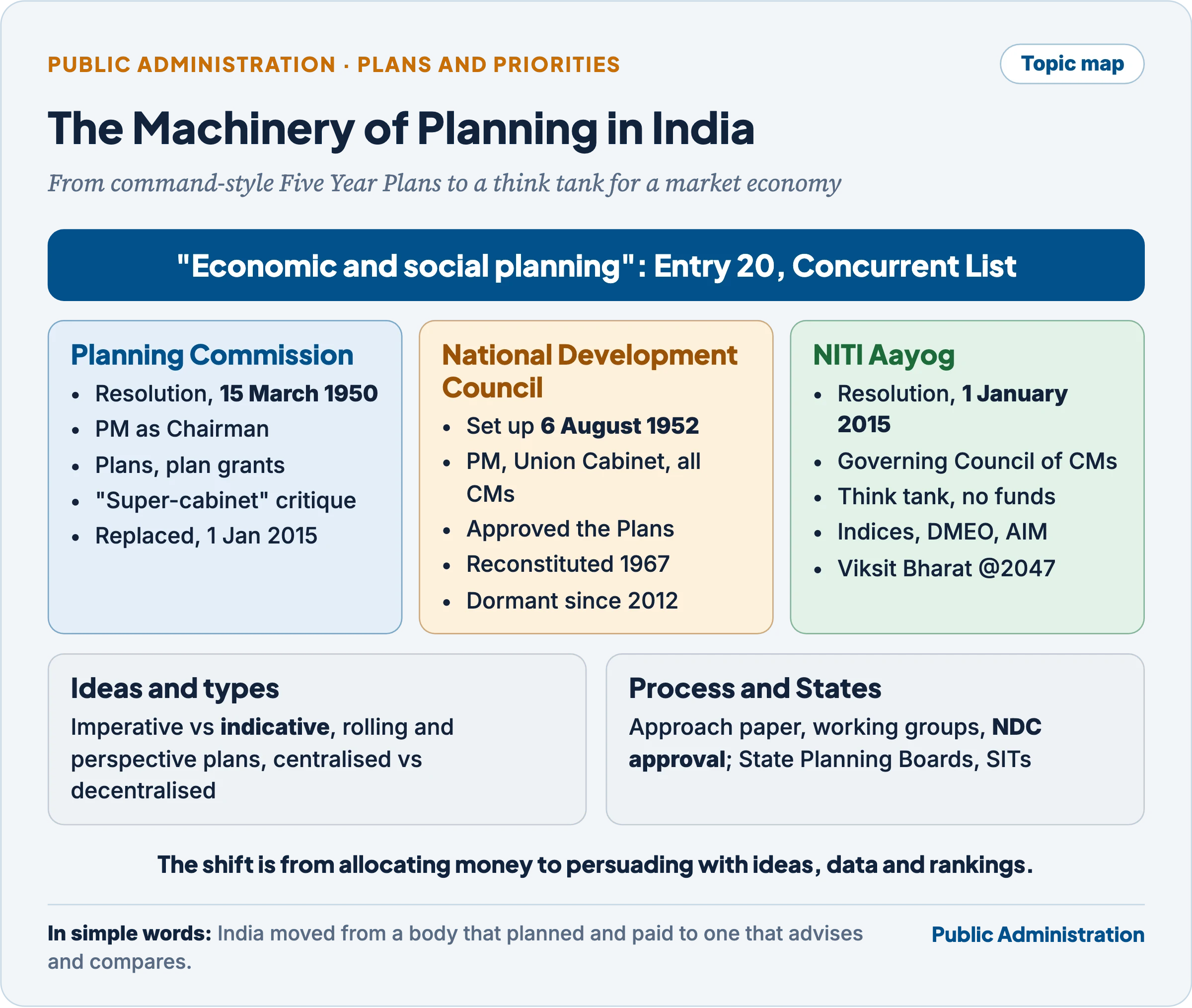
For six decades India’s development was organised around Five Year Plans, prepared by a Planning Commission set up by an executive resolution in 1950 and approved by a National Development Council (NDC) of the Prime Minister and all Chief Ministers. These bodies decided not only what the economy should produce but how much money each ministry and State would get, and so they shaped Union–State relations, the budget and the bureaucracy. After 1991 planning became indicative, and on 1 January 2015 the Planning Commission was replaced by NITI Aayog, a think tank without the power to allocate funds.
The machinery of planning is therefore a study of how a developing democracy tried to steer economic and social change: first by command and money, now by vision, data, ranking and persuasion. Its story touches federalism, the finance system, policy-making theory and the State–market debate.
In simple words
Think of a large joint family running a business. In the early years the eldest member writes a five-year budget, decides which son runs which shop and hands out money from a common chest; nobody can open a new shop without his approval. Later the shops become independent and the elder stops handing out money. He now studies the market, shares ideas, compares which shop is doing best and gets the brothers to meet and agree on common goals. The first elder is the Planning Commission; the second is NITI Aayog. The family meeting where all branches sit together is the NDC, now replaced by NITI’s Governing Council.
1. Planning: Meaning, Rationale and Types
In simple words
Planning means deciding in advance what to achieve, with what resources, in what order and by whom. A country plans because markets alone may not build roads, schools or steel plants fast enough. But plans differ in how far they order people and how far they only guide them.
1.1 Meaning of planning and development planning
- Plan and planning. A plan is a scheme of action for reaching definite goals: it states what is to be done, by whom, when and with what means. Planning is the continuous process of making, carrying out, reviewing and revising such schemes. In this sense every plan is a policy statement, and planning is a form of policy-making that looks ahead and ties goals to resources.
- Elements of planning. Planning involves forecasting future trends, choosing the best use of limited resources, identifying problems and constraints, reducing risk and uncertainty, and reconciling conflicting activities so that departments pull in one direction.
- Economic planning: classical definitions.
- Lionel Robbins, the British economist, described planning as collective control or suppression of private activity in production and exchange, a definition coloured by its critique of central planning.
- Friedrich Hayek, in The Road to Serfdom (1944), defined it as the direction of productive activity by a central authority and warned that it leads to loss of freedom.
- Hugh Dalton, the British Labour economist, saw it as the deliberate direction of large economic resources by those in charge of them towards chosen ends.
- Most economists now agree on a core meaning: deliberate direction and coordination of the economy by a central authority to achieve definite targets within a definite period.
- Development planning. In developing countries, planning is the organised effort of government to achieve specific economic and social goals (growth, employment, equity, regional balance) through plan formulation, implementation and evaluation. W. Arthur Lewis, the St Lucian Nobel economist, in The Principles of Economic Planning (1949), argued that planning need not mean State ownership: the State sets the framework, incentives and infrastructure within which public and private effort works.
- Gunnar Myrdal, the Swedish economist, in Asian Drama (1968), saw planning in poor countries as the State’s effort to break the cumulative causation of poverty through coordinated intervention, but warned that “soft states” (states unable to enforce their own decisions) would plan on paper and fail in practice.
1.2 Why developing countries plan, and the sceptics
- Market failure and missing markets. Markets in poor countries are thin, imperfect and slow to invest in infrastructure, heavy industry and human capital, which have long gestation and wide spillovers. Planning fills these gaps.
- Coordination of investment. Big projects (a dam, a steel plant, a railway line) depend on one another; planning makes sure the power, coal and transport are ready together (the “big push” idea of development economics).
- Mobilising scarce resources. The State raises domestic savings and foreign finance and channels them to priority sectors.
- Equity and social justice. In India the Directive Principles (Articles 38 and 39) ask the State to reduce inequality and distribute material resources for the common good; planning was the instrument for this.
- Rational choice among alternatives. Planning makes trade-offs explicit (growth versus inflation, industry versus agriculture) and resolves competing demands systematically.
- The sceptics. Hayek and later public choice writers argued that no central authority can gather the dispersed knowledge held by millions of producers and consumers, and that planning concentrates power. Studies of African and Asian planning noted that some countries grew fast with little formal planning while heavily planned ones stagnated; the belief in planning as a “magic formula” gave way to the view that its value depends on institutions, flexibility and implementation.
1.3 Steps in development planning
Development planning is usually divided into five linked steps, each of which became a stage of the Indian planning process.
- Analysis of facts and values. Technocrats analyse economic, demographic and social data; political leaders bring in the value judgements that express the nation’s vision.
- Setting targets. Planners fix targets for key variables (growth rate, employment, inflation) and work out the trade-offs among them, choosing a feasible set.
- Choosing the strategy and instruments. The crucial step: selecting the policy instruments (public investment, taxes, credit, prices, licences) and checking them against resource constraints such as capital, labour and the balance of payments.
- Implementation and monitoring. The plan is translated into projects and budgets; monitoring brings out effects that were not foreseen, and feedback goes back to step two.
- Evaluation and learning. Results are compared with goals; the experience of one plan shapes the next. Planning is thus a process of learning by doing.
1.4 Types of planning
Planning can be classified by how binding it is, who plans, how long the plan runs and what it measures. The table below sets out the main pairs.
| Basis | Type | Meaning in brief | Example |
|---|---|---|---|
| How binding | Imperative (by direction) | State fixes targets and orders enterprises to meet them; little consumer or producer choice | Soviet Five Year Plans from 1928 |
| Indicative (by inducement) | State forecasts, sets priorities and uses incentives; private firms remain free | French planning from 1946; India from the Eighth Plan | |
| Political setting | Totalitarian | Single authority plans and enforces; no opposition | Stalinist planning |
| Democratic | People and groups are consulted at each stage; private property and price mechanism retained | Indian Five Year Plans | |
| Who plans | Centralised | One central authority decides objectives, targets and allocations for every sector | Soviet Gosplan; India in practice till 1991 |
| Decentralised | Plans built up from village, block and district to State and nation | 73rd and 74th Amendment design | |
| What is planned | Financial | Allocation of resources in money terms; balances demand and supply, avoids inflation | Plan outlays |
| Physical | Allocation of real resources: men, materials, machinery; physical targets of output | Tonnes of steel, hectares irrigated | |
| Time span | Perspective | Long-range goals for 15–25 years, broken into medium-term plans | Viksit Bharat @2047 |
| Medium and annual | Five-year plans operationalised through annual plans tied to the budget | First to Twelfth Plans | |
| Flexibility | Fixed | Targets and outlays fixed for the plan period; changed only in emergencies | Indian Five Year Plans |
| Rolling | Plan revised every year so that it always covers the next few years | India, 1978–80 |
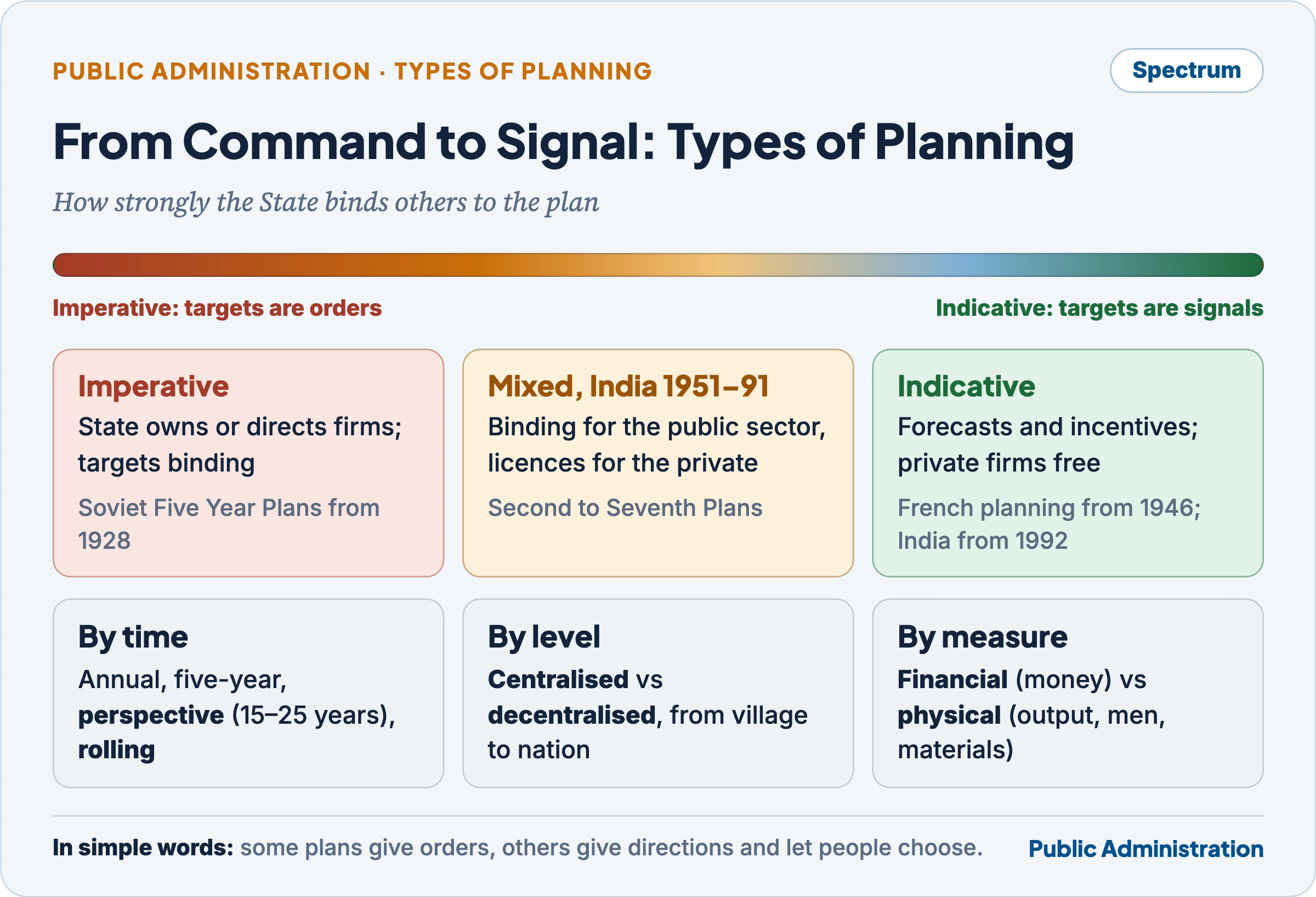
The key contrast for Indian administration is between imperative and indicative planning: it decides whether the plan is an order backed by licences and public enterprise, or a signal that guides markets. India’s early plans were a mixed case: binding for the public sector, enforced on the private sector through industrial licensing, import controls and credit allocation, but never Soviet-style.
1.5 Rolling and perspective plans
- Rolling plan. Under a rolling plan, three plans are prepared and revised every year:
- an annual plan for the current year, tied to the budget and the foreign exchange budget;
- a medium-term plan of three to five years, revised each year by dropping the year that has passed and adding a new one;
- a perspective plan of 10–20 years setting broad goals.
Indian accounts usually trace the idea to Gunnar Myrdal, who criticised the rigidity of fixed-period plans in Asian Drama (1968). Its merit is flexibility: targets adjust to droughts, oil shocks and price changes. Its weakness is instability: if targets change every year, departments and investors lose a fixed reference point, and accountability for shortfalls becomes harder.
- Perspective planning. A perspective plan sets long-term goals (population, employment, poverty, infrastructure, ecology) over 15–25 years and gives direction to medium-term plans. The Planning Commission had a Perspective Planning Division; today the Viksit Bharat @2047 vision and India’s net-zero by 2070 commitment are perspective goals. Perspective planning is valuable because big transformations (urbanisation, energy transition) take decades, but it is only as good as the medium-term plans and budgets that translate it into action.
Common confusion
Is “planning by inducement” the same as indicative planning, and does indicative planning mean no planning? Planning by inducement and indicative planning describe the same idea: the State induces private actors through incentives rather than commanding them. But indicative planning is still planning. The State continues to forecast, set priorities, make large public investments, regulate, and coordinate Centre and States; it simply does not give binding orders to private firms. India’s plans after 1992 still fixed public investment and sectoral targets, and NITI Aayog’s visions and strategies continue the indicative tradition without a single plan document.
2. Planning in India: From the National Planning Committee to Viksit Bharat
In simple words
India’s leaders decided before Independence that a poor, newly free country needed a plan. From 1951 to 2017 India had twelve Five Year Plans, with breaks when war, drought or political change upset them. After 1991 the plans became guides for a market economy, and after 2017 the Five Year Plan itself ended.
2.1 Before Independence: ideas and rival plans
- Early ideas. M. Visvesvaraya, the engineer-statesman, argued for planned industrialisation in Planned Economy for India (1934), one of the first Indian calls for a national plan.
- National Planning Committee (1938). On the initiative of Congress president Subhas Chandra Bose, a conference of provincial Industries Ministers in October 1938 accepted the need for comprehensive national planning. The Congress set up the National Planning Committee with Jawaharlal Nehru as chairman and K.T. Shah as its secretary; its members included industrialists, scientists and economists. Its work was interrupted when leaders were jailed during the war, but it established planning as a nationalist goal.
- Rival plans of 1944–45.
- Bombay Plan (1944): prepared by leading industrialists including J.R.D. Tata, G.D. Birla and Purshotamdas Thakurdas; accepted a large role for the State in infrastructure and basic industry, with protection for Indian industry.
- Gandhian Plan (1944): prepared by Shriman Narayan Agarwal, with a foreword by Gandhi; stressed agriculture, cottage industry and decentralised village self-sufficiency.
- People’s Plan (1945): associated with M.N. Roy and the labour movement; stressed agriculture, consumer goods and land nationalisation.
- Sarvodaya Plan (1950): by Jayaprakash Narayan, on Gandhian and Sarvodaya lines.
- Official preparations. The colonial government set up a Planning and Development Department (1944), and an Advisory Planning Board under K.C. Neogy (1946) recommended a single, expert, high-level planning commission. These efforts led directly to the Planning Commission of 1950.
2.2 Constitutional basis of planning
The Constitution does not create any planning body, but it gives planning both a legislative home and a social purpose. The provisions below are the legal frame of the whole machinery.
| Provision | What it says | Relevance to planning |
|---|---|---|
| Entry 20, List III (Concurrent List) | “Economic and social planning” | Both Union and States may plan; Union law prevails in conflict; basis of joint Centre–State planning |
| Articles 38 and 39 | State to promote welfare, minimise inequalities, distribute material resources for the common good, prevent concentration of wealth | Social objectives of the Plans |
| Article 73 and Article 162 | Executive power of Union and States | Planning bodies created by executive resolution under these powers |
| Article 77(3) | Allocation of Business Rules | Planning Commission and now NITI Aayog placed under the Ministry of Planning |
| Article 275 | Statutory grants-in-aid to States on Finance Commission advice | The constitutional channel of grants |
| Article 280 | Finance Commission every five years | Tax sharing and grants; overlap with plan transfers |
| Article 282 | Grants by Union or States for any public purpose | Used for plan grants and Centrally Sponsored Schemes; criticised as bypassing Article 280 |
| Article 263 | Inter-State Council by presidential order | Sarkaria proposed placing the NDC under it; Inter-State Council set up in 1990 |
| Articles 243G and 243W | Panchayats and municipalities to prepare plans for economic development and social justice | 73rd and 74th Amendments (1992) |
| Articles 243ZD and 243ZE | District and Metropolitan Planning Committees | Constitutional machinery for decentralised planning |
The table shows a paradox: planning is a constitutional subject with constitutional goals, but the national planning bodies (Planning Commission, NDC, NITI Aayog) are executive creations, while the only planning bodies the Constitution itself names are local ones (DPCs and MPCs). This is why critics called the Planning Commission extra-constitutional when it acquired great financial power.
2.3 The Five Year Plans and what they meant for administration
The twelve Plans differed in their models and goals; each also changed the machinery of administration. The table summarises the Plans with their administrative significance.
| Plan | Years | Focus and model | Administrative significance |
|---|---|---|---|
| First | 1951–56 | Agriculture, irrigation, power; Harrod–Domar savings-investment logic | Community Development Programme (2 October 1952) and National Extension Service: the block and BDO as development units; PEO set up (1952) |
| Second | 1956–61 | Rapid industrialisation, heavy industry; Mahalanobis model; “socialistic pattern of society” | Public sector giants, Industrial Policy Resolution 1956, licensing; rise of a development bureaucracy; Panchayati Raj after the Balwantrai Mehta report (1957) |
| Third | 1961–66 | Self-reliant, self-generating economy; food self-sufficiency | Shortfalls after the 1962 and 1965 wars and droughts exposed weak implementation |
| Plan holiday | 1966–69 | Three Annual Plans | Devaluation (1966), drought; planning credibility shaken; ARC review of the machinery (1967) |
| Fourth | 1969–74 | Growth with stability, self-reliance; reducing concentration of economic power | Gadgil formula (1969) for central assistance to States; bank nationalisation (1969) |
| Fifth | 1974–79 | Removal of poverty and self-reliance; Minimum Needs Programme | Ended a year early (March 1978) by the Janata government |
| Rolling plan | 1978–80 | Employment, rural focus; rolling plan for 1978–83 | Experiment abandoned in 1980; 1979–80 left as an isolated Annual Plan |
| Sixth | 1980–85 | Direct attack on poverty | IRDP, NREP, TRYSEM; target-group and area programmes run by DRDAs |
| Seventh | 1985–90 | “Food, work and productivity” | Jawahar Rozgar Yojana (1989) funded through panchayats; growth near 6 per cent |
| Annual Plans | 1990–92 | Political instability, balance of payments crisis | Plan postponed; 1991 reforms |
| Eighth | 1992–97 | Indicative planning; human development; structural adjustment | Planning as facilitation; 73rd and 74th Amendments (1992); people’s institutions in implementation |
| Ninth | 1997–2002 | Growth with social justice and equity; Basic Minimum Services | Decentralisation through PRIs; target scaled down to 6.5 per cent from 7 |
| Tenth | 2002–07 | 8 per cent growth; monitorable targets | First State-wise growth targets; governance named as a key factor; growth close to target |
| Eleventh | 2007–12 | Faster and more inclusive growth | Flagship programmes (NREGA, NRHM, JNNURM); Centrally Sponsored Schemes multiply |
| Twelfth | 2012–17 | Faster, more inclusive and sustainable growth; target cut to 8 per cent | Approved by the last NDC meeting (27 December 2012); last Five Year Plan |
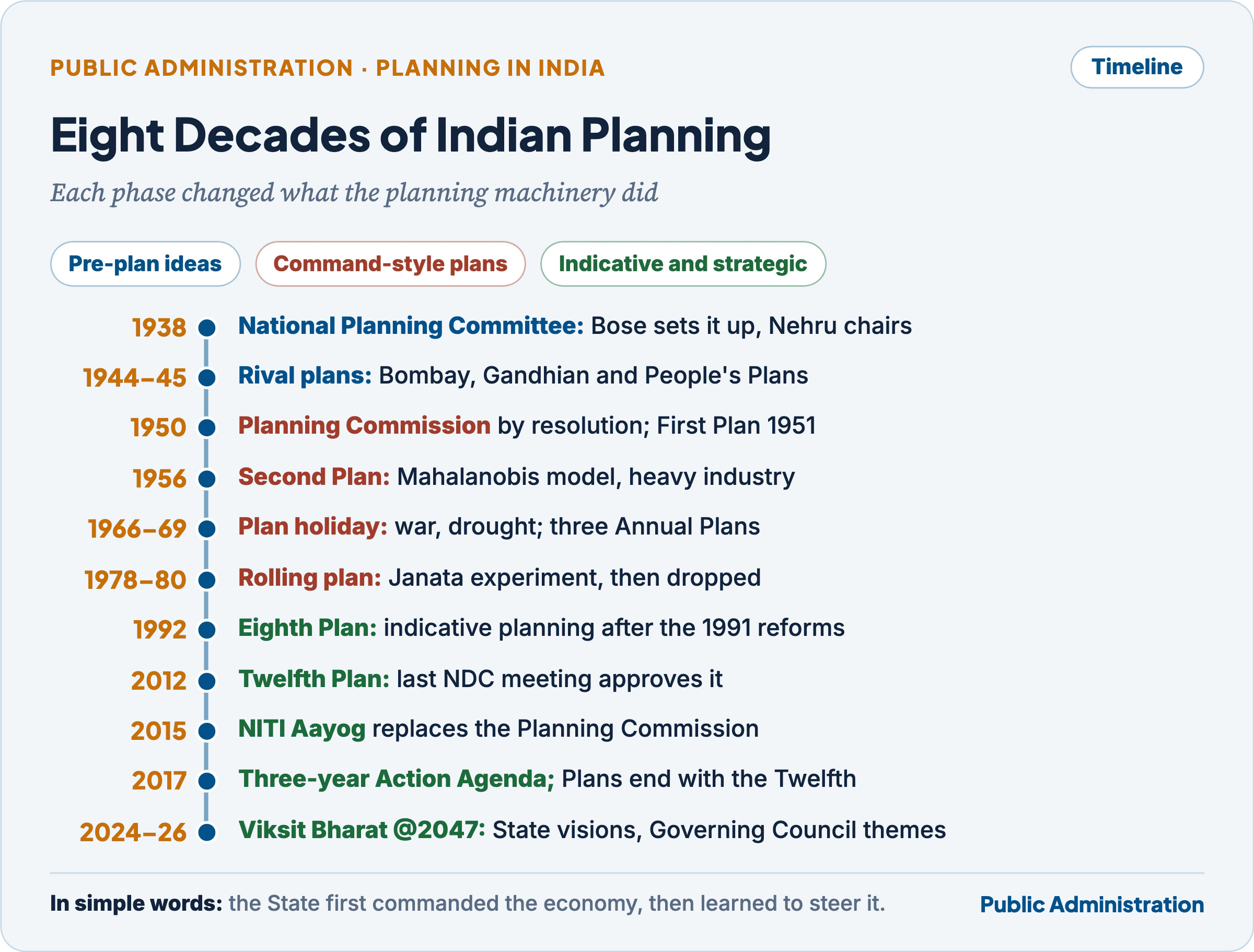
Three lessons stand out from the sequence.
- Plans tracked politics. War, drought and changes of government produced the plan holidays of 1966–69 and 1990–92 and the rolling plan of 1978–80. The Janata government’s critique of the Nehruvian model (concentration of power, neglect of employment) was itself a planning debate.
- The machinery grew with the Plans. Each Plan added programmes, divisions, schemes and agencies: community development, area programmes, DRDAs, Centrally Sponsored Schemes. Planning thus became a principal driver of the growth of Indian administration.
- Implementation was the weak link. Successive Plans recorded shortfalls caused not by the models but by delays, cost overruns, leakages, poor targeting and weak delivery systems (section 2.4).
2.4 Achievements and failures, and the implementation problem
- Achievements. Planning reversed the stagnation of colonial times; raised savings and investment rates; built a diversified industrial base, mostly in the public sector; achieved food self-sufficiency through the Green Revolution; and expanded schooling, health and infrastructure. In much of the period, outcomes fell short of targets mainly because of external shocks (wars of 1962, 1965 and 1971; droughts of 1965–66 and 1971–73; oil shocks).
- Failures. Persistent poverty and unemployment, widening regional disparities, concentration of economic power, low efficiency of capital, and the gap between targets and achievements. Anti-poverty programmes suffered from wrong identification of beneficiaries, rigid schemes, bureaucratic delivery and leakages.
- Implementation as the weakest link. Planners wrote good plans; ministries and States executed them poorly. Reasons included:
- frequent transfers of senior officers and a secretariat-centred financial system;
- weak technical capacity at State, district and block levels (the BDO lacked staff and powers);
- multiplicity of clearances and a dilatory decision process;
- poor monitoring and evaluation: the ARC (1967) asked for an annual progress report to Parliament, and later a separate ministry for programme implementation was created;
- lack of people’s participation: the Eighth Plan’s foreword stressed making people active participants, and V. Subramaniam, the Indian administrative scholar, argued that a people’s plan needs built-in flexibility for mid-course correction.
- Planning for administration. Albert Waterston, the World Bank planning expert, in Development Planning: Lessons of Experience (1965), showed that most plans in developing countries failed at implementation because administrative capacity was not planned. Plans must therefore include analysis and reform of the administrative institutions that will execute them: personnel, audit, statistics, training, public enterprise control.
Indian Connect — Indian Connect: why “unified and holistic” plans are hard
India’s attempt to prepare one plan for the whole country ran into five difficulties. Federal diversity: agriculture, health and police are State subjects, so a national plan is only as good as 28 State plans. Information: the data on which targets rest arrive late and are revised often. Political change: coalitions and changes of government upset plan priorities (1978, 1990). Market uncertainty: after 1991 most investment is private and cannot be planned by order. Coordination: dozens of ministries with separate schemes resist a single frame. These difficulties explain both the shift to indicative planning and the later replacement of the single plan document by vision, strategy and sectoral roadmaps.
3. Indicative Planning
In simple words
In indicative planning the government acts like a weather forecaster and traffic police together: it tells businesses where the economy is likely to go, builds the roads, sets the rules and offers incentives for desired directions, but does not order anyone to produce a fixed quantity.
3.1 Meaning and origin
- Meaning. Indicative planning is a form of national planning in which the State sets targets and forecasts that are not compulsory for the private sector, embeds them in medium-term macroeconomic projections, and uses influence, information, subsidies, credit, taxes and public investment to steer the economy, without compulsion. Its purpose is to reduce the uncertainty that private investors face and to coordinate public and private decisions.
- French origin. The model began in France after the Second World War. The Commissariat général du Plan (1946), first led by Jean Monnet, prepared plans in consultation with business, unions and officials in “modernisation commissions”. Pierre Massé, a later Commissioner, described the French plan as a reducer of uncertainty: by sharing forecasts and coordinating expectations, it made private investment more confident. Japan’s post-war administrative guidance through its trade and industry ministry and Korea’s development planning are related forms.
- Features.
- Targets are binding for the public sector but indicative for the private sector.
- The State relies on market mechanisms and prices, correcting them where they fail.
- Planning is consultative: business, labour and States help shape it.
- Emphasis shifts from physical allocation to policy planning: regulation, infrastructure, human capital, and an enabling climate.
- Contrast with “indirect planning”. The New Economic Mechanism of Hungary (1968) and Soviet reforms of the late 1980s kept State control of investment and supply while using some market signals. Soft budget constraints led to inflation, shortages and debt; this was not indicative planning in a market economy.
3.2 Imperative and indicative planning compared
| Point | Imperative planning | Indicative planning |
|---|---|---|
| Ownership | Mostly State ownership | Mixed or market economy |
| Targets | Binding orders for all enterprises | Binding for public sector; signals for private |
| Instruments | Physical allocation, quotas, licences, prices fixed by State | Fiscal and monetary incentives, credit, information, public investment, regulation |
| Consumer choice | Limited | Retained |
| Flexibility | Rigid; decisions hard to change | Flexible; adapts to markets |
| Role of planning body | Command centre | Forecaster, coordinator, adviser |
| Example | Soviet Gosplan | French Commissariat général du Plan; India after 1992 |
The table shows why indicative planning is often called a middle path between planning and the market: it keeps the coordination that planning offers while relying on the efficiency and information of markets.
3.3 India’s shift to indicative planning
- From regulation to indication. The first seven Plans were regulative: public sector dominance of the “commanding heights”, industrial licensing, import controls and administered prices. The 1991 crisis (balance of payments, fiscal deficit) and the reforms of liberalisation, privatisation and globalisation (LPG) changed this.
- The Eighth Plan (1992–97) declared planning to be indicative: the State would concentrate on areas the market neglects and create a climate for private investment. The Planning Commission described its own new role as building a long-term strategic vision, deciding national priorities, working out sectoral targets and providing promotional stimulus so that the economy grows in the desired direction.
- The new role of the Planning Commission, as the Commission saw it.
- Integrative role: a holistic approach to cross-cutting areas (rural health, drinking water, literacy, energy, environment) which many agencies handled separately.
- Mediating role: allocating scarce budgetary resources between States and ministries fairly.
- Systems-change role: promoting self-managed organisations and offering consultancy within government to develop better systems.
3.4 Planning in a market economy: why the State still plans
The case for planning in a liberalised economy rests on functions that markets cannot perform on their own.
- Social sectors. Health, education, nutrition and social security need a larger public role, not a smaller one.
- Rural infrastructure. Soil and water conservation, drinking water, sanitation and rural roads will not be supplied adequately by private firms.
- Economic infrastructure through partnership. Power, ports, railways and highways now draw private investment through PPPs, but need public planning, viability support and regulation.
- Public investment and its priorities. Centre and States still spend large sums; choosing among projects is a planning task.
- Regulatory frameworks. Markets in electricity, telecom and infrastructure need independent regulators and stable rules: policy planning replaces material planning.
- Federal coordination. With subjects divided among Union, States and local bodies, a planning body must build a shared vision and stop tiers from working at cross-purposes.
- Cross-cutting goals. Poverty, employment, population and regional balance need a holistic view; left to sectoral ministries, inter-linkages are lost.
3.5 How useful has indicative planning been for India?
- Gains.
- Higher growth: the economy moved from the “Hindu rate” of about 3.5 per cent to 6–8 per cent in the 2000s; private investment, exports and services expanded.
- Diversity recognised: uniform national schemes gave way to State-specific targets (Tenth Plan), flexi-funds within schemes, and later State visions, an answer to the critique of “one size fits all“.
- Better use of the State’s limited capacity: the State withdrew from areas the private sector manages well and focused on public goods and social sectors.
- Limits.
- Regional disparity widened: richer, coastal States attracted most private investment while poorer States depended on central transfers.
- Indicative targets lack teeth: when private investment slumps, the State has few levers short of public spending.
- Old habits persisted: detailed scrutiny of State plans and the growth of Centrally Sponsored Schemes showed that centralised planning survived inside a liberalised economy until 2014.
- Jobless growth and agrarian distress showed that markets did not automatically deliver the social goals of planning.
Indian Connect — Indian Connect: strategic planning grew out of indicative planning
NITI Aayog’s documents, the Three-Year Action Agenda (2017–18 to 2019–20), the Strategy for New India @75 (December 2018) and the Viksit Bharat @2047 vision, are indicative in method. They set goals and milestones, identify constraints and recommend policies, but do not allocate funds or bind private actors. PM GatiShakti National Master Plan (2021), a GIS platform that puts infrastructure projects of many ministries on one map, is an example of indicative spatial planning: it coordinates public investment and signals to private investors where connectivity will come. The roots of such strategic planning lie in the French idea of planning as coordination and uncertainty reduction, not command.
4. The Planning Commission (1950–2014)
In simple words
The Planning Commission was a small group of experts and ministers, chaired by the Prime Minister, who wrote India’s Five Year Plans. It was meant only to advise, but because it decided how much plan money each ministry and State got, it became one of the most powerful bodies in the country.
4.1 Origin and legal status
- Set up by resolution. The Government of India set up the Planning Commission by a Resolution of 15 March 1950, soon after the Constitution came into force. It was neither constitutional nor statutory: an advisory body created by executive order.
- Design principle. The resolution said that comprehensive planning based on an objective appraisal of resources was best done by an organisation “free from the burden of the day-to-day administration, but in constant touch with the Government at the highest policy level“. It was thus meant to be a staff agency close to the Cabinet yet independent of ministries.
- Social purpose. The resolution tied planning to the Directive Principles: a rapid rise in the standard of living through efficient use of resources, more production and employment for all.
- First leadership. Jawaharlal Nehru was the first Chairman and Gulzarilal Nanda the first Deputy Chairman. The last Deputy Chairman before its abolition was Montek Singh Ahluwalia (2004–2014).
4.2 Functions under the 1950 Resolution
The resolution assigned seven functions, which defined the Commission’s role till 2014.
- Assess the material, capital and human resources of the country, including technical personnel, and investigate ways of augmenting deficient resources.
- Formulate a Plan for the most effective and balanced use of the country’s resources.
- On a determination of priorities, define the stages in which the Plan should be carried out and propose the allocation of resources for each stage.
- Indicate the factors retarding development and the conditions needed for the Plan’s success.
- Determine the machinery needed for implementing each stage of the Plan.
- Appraise progress periodically and recommend adjustments of policy and measures.
- Make interim or ancillary recommendations on current economic conditions, policies and programmes, or on problems referred by the Centre or States.
- Additional subjects under the Allocation of Business Rules. Public cooperation in national development, hill area development, perspective planning, the Institute of Applied Manpower Research (now NILERD) and, for a time, the National Informatics Centre.
- What it did not do. It did not execute plans; execution lay with ministries and State governments. Its tools were formulation, appraisal, allocation advice, monitoring and evaluation.
4.3 Composition and organisation
- Chairman: the Prime Minister. He presided over meetings of the full Commission and gave direction on major policy. His chairmanship gave the Commission status and coordinating power, but critics said it also made the Commission too powerful (section 4.5).
- Deputy Chairman. The de facto executive head, appointed by the Cabinet, with Cabinet rank; he attended Cabinet meetings without a vote. Eminent holders included V.T. Krishnamachari, Ashok Mehta, D.R. Gadgil, P.N. Haksar, Pranab Mukherjee, Madhu Dandavate, K.C. Pant, Jaswant Singh and Montek Singh Ahluwalia.
- Members.
- Full-time members: economists, scientists, administrators and technical experts, each in charge of a group of subjects, who met frequently and worked as a team.
- Part-time minister-members: important Cabinet ministers (Finance, Home, Agriculture and others at times) who attended only important meetings of the “full Commission”.
- The Minister of State for Planning as an ex officio member, answering in Parliament.
- A Member-Secretary (usually a senior IAS officer or specialist).
- Office of the Commission.
- General divisions dealing with the whole economy: Development Policy, Financial Resources, International Economics, Labour and Employment, Perspective Planning, Plan Coordination, Project Appraisal and Management, State Plans (including multi-level planning, hill and border areas), Statistics and Surveys.
- Subject divisions: Agriculture, Education, Energy, Health, Housing and Urban Development, Industry, Irrigation, Rural Development, Science and Technology, Transport, Village and Small Industries and others, each under an Adviser working with the member in charge.
- Two hierarchies: an administrative one under the Secretary (Joint, Deputy and Under Secretaries, mostly IAS and CSS) and a technical one of Advisers, Chiefs and Directors (mostly from the Indian Economic and Statistical Services).
- Programme Advisers of Additional Secretary rank linked the Commission with groups of States, assessed implementation and advised on State proposals.
- Attached and associated bodies.
- Programme Evaluation Organisation (PEO), set up in October 1952 (initially with Ford Foundation support), to evaluate the Community Development Programme and later other schemes, with an Evaluation Advisory Committee.
- Institute of Applied Manpower Research (1962) and the National Informatics Centre (for a period).
- The Independent Evaluation Office (IEO), set up in the Commission’s last years, which wrote the evaluation that recommended its abolition.
4.4 Why a commission and not a ministry?
- Collegial expertise. A multi-member commission brings together economists, scientists and administrators who deliberate as a body; important decisions were taken by the Commission as a whole, not by individual members.
- Insulation from routine. Free from day-to-day administration, it could take a long-term, economy-wide view that busy ministries could not.
- Neutrality between Centre and States. Not being a ministry, it could appear as an impartial arbiter of State claims (the ARC thought this flexibility valuable).
- Link to the top. With the PM as Chairman and Cabinet-rank Deputy Chairman, its advice carried weight across ministries.
- Flexibility. A body created by resolution could be reorganised without legislation as needs changed. The ARC expressly preferred this to statutory or constitutional status.
These reasons explain why the commission form was deliberately preferred: it combined the authority of the PM with the independence and expertise of a board. The same features, however, produced the main criticisms.
4.5 Role in practice and the main criticisms
- Formulating plans and appraising projects. The Commission prepared the approach, draft and final plans, appraised large projects and set sectoral outlays.
- Allocating resources. Through Annual Plans it fixed each State’s plan outlay and central assistance, distributed under the Gadgil formula (approved by the NDC in 1969) and later revisions, and approved ministries’ plan budgets and Centrally Sponsored Schemes. This made it a financial power centre.
- Coordinating. It mediated among ministries, between Centre and States, and served as the NDC’s secretariat.
The criticisms fall into six groups.
- “Super-cabinet” or “parallel cabinet”. The First ARC observed in its Interim Report on the Machinery for Planning (1967) that, taking advantage of the PM’s chairmanship, the Commission had steadily added to its functions and personnel and stepped into areas of executive authority of the Centre and States, earning the reputation of a parallel cabinet and sometimes a super cabinet. Ministries got decisions “cleared” by it; it became an extra layer in executive decisions and a source of red tape.
- Extra-constitutional encroachment on the Finance Commission. Plan grants under Article 282, decided by a non-statutory body, came to exceed in importance the transfers recommended by the constitutional Finance Commission under Article 280. The Second and Third Finance Commissions complained that the role the Constitution gave them could not be fully realised because of the Planning Commission. The Rajamannar Committee of Tamil Nadu (1969–71) and many States made the same complaint.
- Centralisation and erosion of federalism. K. Santhanam, the constitutional expert who chaired the Second Finance Commission, argued that planning had superseded the federation, so that India functioned like a unitary system in many respects. A.K. Chanda, chairman of the Third Finance Commission, held that centralised planning had eroded the idea of exclusive State functions in education, agriculture and housing. The Commission scrutinised State plans scheme by scheme, earmarked much of the money, and imposed uniform schemes on diverse States.
- Bureaucratisation. The Commission’s staff multiplied several times in its first two decades. Nehru is reported to have regretted that a small body of serious thinkers had become an ordinary government department; critics later called it an “anachronism” and an “orphanage” for the mediocre rather than a think tank.
- Ineffectiveness and dependence on the PM. Others argued the opposite: its advice was not always accepted, it had no responsibility for execution, and it was guided by political pressure more than expertise. A former member, J.D. Sethi, remarked that the Commission was as important as the PM chose to make it. The 2010 description of it as an “armchair adviser” captured this weakness.
- No accountability. As a non-statutory body headed by an appointed Deputy Chairman, it was not accountable to Parliament for its allocative decisions; the IEO (2014) called its functioning opaque.
- Defence. V.T. Krishnamachari, a long-serving Deputy Chairman, replied that the critics misunderstood a planning body in a parliamentary democracy: the strategy, resources and inter-sectoral allocations were settled by the Cabinet and the NDC, on proposals worked out with ministries and States; the Commission, free from daily administration, simply gave an economy-wide view. A balanced view is that it was neither a super-cabinet nor an ornamental body but a coordinator that had to make political compromises; its non-statutory status made it seem independent of both Centre and States, and its leverage came from annual plans and project appraisal.
4.6 Reform attempts: the First ARC and later commissions
The Administrative Reforms Commission (1966) appointed a Study Team on the Machinery for Planning under R.R. Morarka. Because the Commission was being reconstituted, the ARC submitted an Interim Report on the Machinery for Planning (1967), followed by a final report (1968). Its main recommendations are below.
| ARC recommendation (1967) | Purpose | What happened |
|---|---|---|
| Confine the Commission to formulation and evaluation of perspective, five-year and annual plans; shed executive functions | Stop it acting as a parallel executive | Some units transferred; executive role persisted through annual plans |
| Annual report to Parliament on plan performance | Accountability | Not consistently followed |
| Remain a non-statutory advisory body close to the Union Government | Keep flexibility | Accepted |
| PM to be closely associated without being Chairman | Remove the “super-cabinet” effect | Not accepted: PM remained Chairman |
| No ministers as members; Finance Minister associated without membership | Protect expert judgement | Partly: most minister-members dropped in 1967, but the Finance Minister and later others continued |
| Not more than seven members, chosen for expertise, five-year term | Small expert body | Partly |
| Decisions taken collectively, not by individual members’ “portfolios” | Joint thinking | Partly |
| Full Cabinet, not a committee, to decide on its proposals | Collective responsibility | General practice |
| State Planning Boards in every State | State-level expertise | SPBs set up gradually (section 8) |
| Reconstitute the NDC with redefined functions | Federal forum | Accepted, 7 October 1967 |
- The 1967 reconstitution. The Commission was reconstituted in 1967 with D.R. Gadgil, the economist, as Deputy Chairman and a smaller set of expert members, but the PM stayed as Chairman, so the core criticism remained.
- Sarkaria Commission (1983–88). Found the alleged overbearing approach of the Commission in scrutinising State plans to be “more apparent than real”, but recommended that it scrutinise only key schemes involving large outlays, minimise Centrally Sponsored Schemes and involve States more.
- Punchhi Commission (2007–2010). Recommended restricting plan formulation to the five-year frame, dispensing with approval of State annual plans, reducing Centrally Sponsored Schemes in phases, and asked the Commission to focus on coordination rather than micro-managing sectoral plans.
- Reports of 2011. The B.K. Chaturvedi Committee (2011) recommended cutting 147 Centrally Sponsored Schemes to 59 with flexi-funds for States (the government restructured them into 66 schemes in 2013). The C. Rangarajan Committee on efficient management of public expenditure (2011) recommended removing the plan/non-plan distinction, which was finally abolished from the Union Budget 2017–18.
4.7 The 2014 IEO evaluation and abolition
- IEO assessment (June 2014). The Independent Evaluation Office, headed by Ajay Chhibber, sent the new government an assessment that:
- the Commission had become a “control commission“, exceeding its authority by influencing the allocation of funds to States, which raised constitutional concerns since the Finance Commission was created for that purpose;
- it was staffed largely by non-specialist bureaucrats who could neither act as a think tank nor review implementation;
- its functioning was opaque, its Deputy Chairman lacked parliamentary oversight, and it had resisted reform;
- it should be replaced by a think tank, a “Reform and Solutions Commission“, acting as a solutions exchange, a source of systems reform and an early warning of emerging challenges; allocation to States should go to the Finance Commission and among ministries to the Finance Ministry.
- Abolition. Prime Minister Narendra Modi announced the end of the Planning Commission in his Independence Day speech of 15 August 2014. After consultations with Chief Ministers, a Cabinet Secretariat Resolution of 1 January 2015 set up NITI Aayog in its place.
- Why it ended.
- Mismatch with a market economy: a body built for allocating public investment in a State-led economy had lost its purpose once most investment was private.
- Federal demand: States resented central scrutiny and conditional transfers.
- The Fourteenth Finance Commission (chair Y.V. Reddy) raised the States’ share in central taxes to 42 per cent for 2015–20, shifting transfers from discretionary plan grants to formula-based devolution.
- Reform fatigue: decades of attempts to reform the Commission had failed.
Common confusion
Did NITI Aayog get a new legal basis, statutory or constitutional, that the Planning Commission lacked? No. Both were created by executive resolutions of the Union Government (15 March 1950 and 1 January 2015) and neither is mentioned in the Constitution or created by an Act. The difference lies in functions, not legal status: the Planning Commission allocated plan funds; NITI Aayog has no power to allocate funds and works as an advisory think tank with a federal forum (the Governing Council). Proposals to give NITI statutory backing have been made by commentators but not adopted.
5. The National Development Council
In simple words
The NDC was a meeting of the Prime Minister, Union ministers and all Chief Ministers that approved the Five Year Plans. It gave the Plans a national, federal stamp: a plan made in Delhi became everyone’s plan once the Chief Ministers had discussed and accepted it.
5.1 Origin and purpose
- Recommended by the Planning Commission itself. The draft outline of the First Plan argued that in a federation where States are autonomous in their sphere, there must be a forum where the PM and Chief Ministers can periodically review the Plan together.
- Set up on 6 August 1952 by a Government of India resolution, to strengthen and mobilise the effort and resources of the nation in support of the Plan, to promote common economic policies in vital spheres, and to ensure balanced and rapid development of all parts of the country. Its first meeting, under Nehru, was held in November 1952.
- Legal status. Like the Planning Commission, the NDC was an extra-constitutional, non-statutory advisory body; its recommendations were not legally binding but carried the weight of the PM and every Chief Minister.
5.2 Composition
- 1952: the Prime Minister (Chairman), the Chief Ministers of all States and the members of the Planning Commission; other Union ministers and experts attended by invitation.
- After 7 October 1967 (on the ARC’s recommendation): the Prime Minister, all Union Cabinet Ministers, Chief Ministers of all States, representatives of Union Territories (Chief Ministers or Administrators), and the members of the Planning Commission. The Secretary of the Planning Commission was Secretary of the NDC, and the Commission gave it administrative support.
- Working style. It was meant to meet at least twice a year; in practice it met when a Plan document was ready. It passed no formal resolutions: the record of discussion and the general trend of views formed its conclusions. It worked through committees for detailed issues (for example, committees on population, micro-level planning, austerity, employment, literacy and medical education were set up at one meeting in the 1990s).
5.3 Functions
| 1952 resolution | 1967 reconstitution |
|---|---|
| Review the working of the national Plan from time to time | Prescribe guidelines for formulating the national Plan, including assessment of resources |
| Consider important questions of social and economic policy affecting national development | Consider the national Plan as formulated by the Planning Commission |
| Recommend measures to achieve the Plan’s aims, including people’s participation, administrative efficiency, development of less advanced regions and sections, and building resources through equal sacrifice | Consider important questions of social and economic policy |
| Review the working of the Plan and recommend measures to achieve its targets (including people’s participation, administrative efficiency, backward regions, resource mobilisation) |
The 1967 change matters: by giving the NDC the power to prescribe guidelines for the Plan, it placed the NDC above the Planning Commission, whose task became to prepare the Plan within those guidelines. On paper the NDC became the top policy-making body for development.
5.4 The NDC at work
- Approval of every Plan. The approach paper, draft and final Plan of each Five Year Plan came before the NDC; with its endorsement the Plan became the accepted national Plan.
- Major decisions. The Gadgil formula (1969) for distributing central plan assistance and its revisions, the criteria for special category States, and policy debates on land reform, prohibition, Panchayati Raj, cooperation and regional disparities.
- A bridge. It linked the Union Government, the Planning Commission and the States, gave States a sense of ownership of the Plan and shared responsibility for its success.
- Decline. Meetings became irregular and ceremonial. Chief Ministers were given a few minutes each to read prepared speeches; at the 57th and last meeting (27 December 2012), which approved the Twelfth Plan with an 8 per cent growth target, Tamil Nadu’s Chief Minister walked out in protest against the 10-minute limit on her speech.
5.5 Super-cabinet or rubber stamp?
The NDC’s role has been judged in two opposite ways, and both are true of different periods.
- The super-cabinet view. In the Nehru era, with powerful Congress Chief Ministers, the NDC’s views carried the weight of directives.
- K. Santhanam wrote (1960) that the NDC had come close to a super-cabinet of the entire Indian federation, a cabinet functioning for the Government of India and all State governments together.
- H.M. Patel, the former ICS officer and later Finance Minister, held that its recommendations were policy decisions rather than advice, and that it was in fact superior to the Planning Commission.
- Michael Brecher, the political scientist, observed that the NDC had reduced the Planning Commission to a research arm.
- Critics warned that it could usurp the role of the Union and State Cabinets and even of Parliament, since a Plan approved by all heads of government left little for legislatures to change.
- The answer to the super-cabinet charge. The NDC was a creature of the Union Cabinet, without constitutional or statutory status; its recommendations were advisory and each Cabinet decided how much weight to give them. Parliament still voted the budgets through which Plans were financed.
- The rubber-stamp view. After the Nehru era, and especially in periods of one-party dominance at the Centre, the NDC became a forum where States complained but rarely changed outcomes; the real decisions were taken in the Planning Commission and the Union Cabinet. In coalition years it became an arena for political bargaining rather than technical planning.
- Depoliticised planning? The ideal of “depoliticised” planning (planning by experts above party conflict) clashed with the reality that the NDC was a political body of elected leaders. Its value lay precisely in turning technical plans into a political consensus across parties ruling different States; its weakness was that consensus often meant lowest-common-denominator bargaining over central assistance.
5.6 Reform proposals
- First ARC, Centre–State Relationships report (1969). Favoured an Inter-State Council under Article 263 for Centre–State consultation.
- Sarkaria Commission (1988). Recommended that the NDC keep its separate identity, be given constitutional status under Article 263 and be renamed the National Economic and Development Council (NEDC), so that it could act as a federal economic cabinet for the whole country. The government instead set up the Inter-State Council (28 May 1990) under Article 263, and the NDC stayed as before.
- Punchhi Commission (2010). Emphasised cooperative federalism and fuller State involvement at every stage of plan formulation.
5.7 Status after 2015
- Dormant, not formally abolished. The NDC has not met since December 2012. In December 2015 the government was reported to be preparing a Cabinet resolution to close it and transfer its role to NITI Aayog’s Governing Council, but no resolution formally winding it up has been notified.
- Successor forum. The Governing Council of NITI Aayog, which brings together the PM, all Chief Ministers and Lieutenant Governors, now performs the NDC’s function of Centre–State dialogue on development. Unlike the NDC, it approves no plan and allocates no money; it sets themes and shared goals.
Common confusion
Is the NDC a constitutional body? No. Some official and secondary sources describe the NDC as “constitutional”, but it was set up by an executive resolution of 6 August 1952 and reconstituted by another of 7 October 1967; no Article of the Constitution creates it. The Sarkaria Commission recommended giving it constitutional status under Article 263 as a National Economic and Development Council, but this was never done. The only constitutional bodies in this area are the Finance Commission (Article 280), the Inter-State Council (Article 263, set up in 1990) and the District and Metropolitan Planning Committees (Articles 243ZD and 243ZE).
6. NITI Aayog
In simple words
NITI Aayog is the government’s think tank and meeting place with the States. It writes long-term visions and strategies, ranks States on health, education and other goals to spur competition, evaluates schemes, and supports innovation. Unlike the Planning Commission, it does not hand out money.
6.1 Creation and rationale
- Resolution of 1 January 2015. A Cabinet Secretariat Resolution created the National Institution for Transforming India (NITI Aayog). “Aayog” is Hindi for commission; “niti” means policy.
- Rationale in the resolution. India had changed: a larger, more open economy; a vibrant private sector; States demanding a greater voice; and the need to replace a one-size-fits-all, top-down model with a bottom-up, cooperative one where the Centre and States work as “Team India”. The resolution stated that strong States make a strong nation.
- Governing Council constituted by notification of 16 February 2015 and reconstituted on 19 February 2021.
6.2 Objectives
The resolution listed thirteen objectives. They can be grouped into five clusters.
- Shared vision with States. Evolve a shared vision of national development priorities with active State involvement, providing a “national agenda” for the PM and Chief Ministers.
- Cooperative federalism. Foster cooperative federalism through structured, continuous support to States.
- Planning from below. Develop mechanisms to formulate credible plans at the village level and aggregate them progressively upwards.
- Strategy and policy design. Design strategic and long-term policy frameworks; incorporate national security interests in economic policy where referred; pay special attention to sections at risk of being left behind.
- Knowledge, coordination and monitoring.
- Partner national and international think tanks and research institutions; build a knowledge, innovation and entrepreneurship support system.
- Offer a platform to resolve inter-sectoral and inter-departmental issues.
- Maintain a Resource Centre of research and best practices on good governance.
- Monitor and evaluate programmes, identifying needed resources; focus on technology upgradation and capacity building.
6.3 Composition
The resolution laid down a two-tier structure: federal forums and a full-time framework.
- Chairperson: the Prime Minister.
- Governing Council: Chief Ministers of all States and Union Territories with legislatures and Lieutenant Governors of other UTs (with Union ministers as ex officio members and special invitees attending).
- Regional Councils: formed for a specified tenure to address issues affecting more than one State or a region; convened by the PM; comprising the CMs and LGs of the region; chaired by the NITI Chairperson or his nominee. The NITI Forum for North East (2018) is an example of a regional platform.
- Special invitees: experts, specialists and practitioners nominated by the PM.
- Full-time organisational framework:
- Vice-Chairperson, appointed by the PM;
- full-time Members;
- up to two part-time Members from leading universities and research institutions, ex officio and by rotation;
- up to four ex officio Members from the Union Council of Ministers, nominated by the PM;
- a Chief Executive Officer of Secretary rank, appointed by the PM for a fixed tenure;
- a Secretariat.
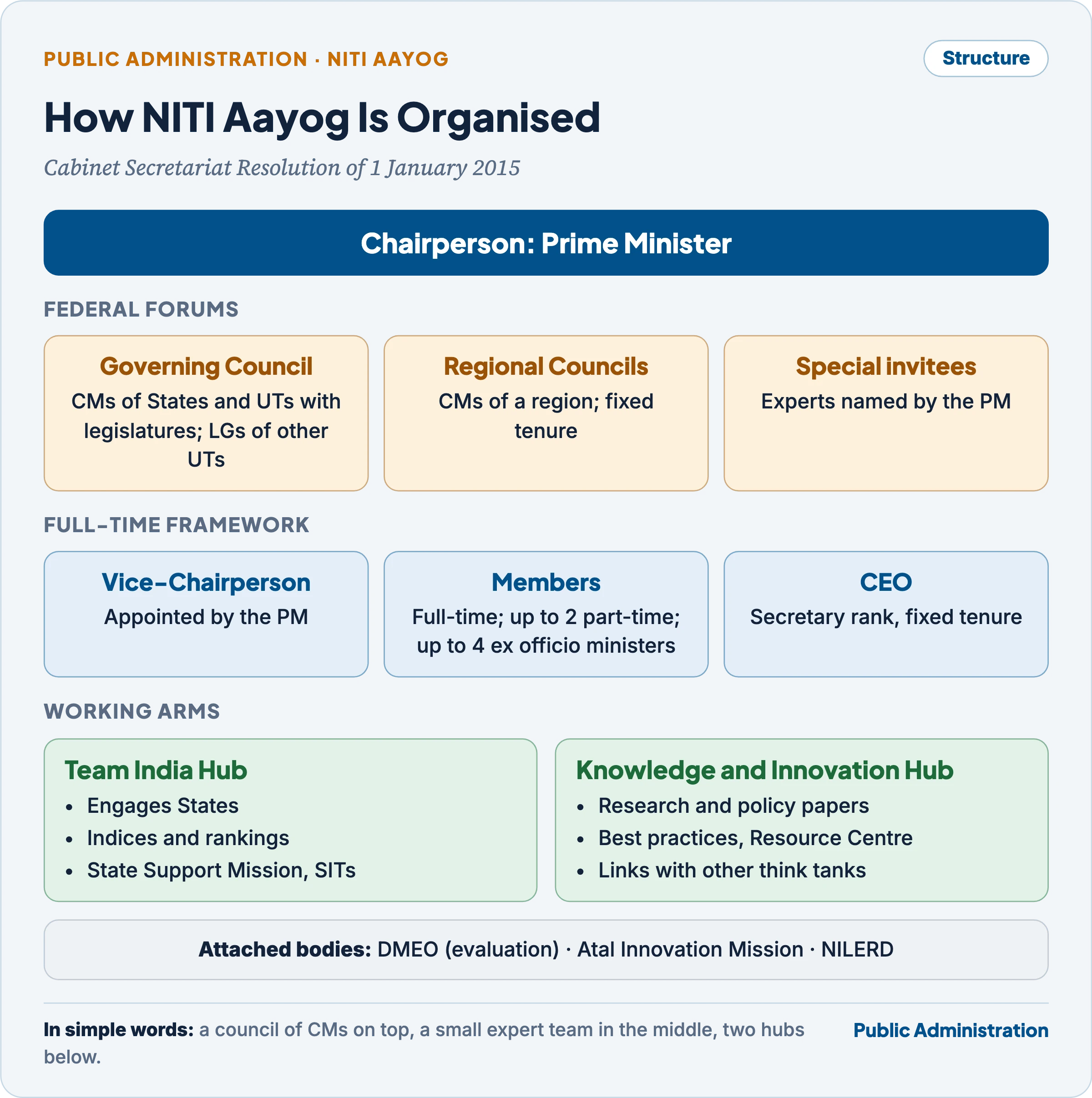
- People. The first Vice-Chairperson was Arvind Panagariya (2015–17), followed by Rajiv Kumar (2017–22) and Suman Bery (2022–26). In the first major revamp, a notification of 24 April 2026 appointed economist and former Chief Economic Adviser Ashok Kumar Lahiri as Vice-Chairperson and five full-time Members (Rajiv Gauba, K.V. Raju, Gobardhan Das, Abhay Karandikar and M. Srinivas), keeping the 2024 ex officio members (the Ministers of Defence, Home, Agriculture and Finance) and special invitees. Anurag Jain, former Madhya Pradesh Chief Secretary, took charge as CEO on 17 August 2026, succeeding B.V.R. Subrahmanyam (2023–26).
6.4 Internal organisation and attached bodies
- Two hubs. The Team India Hub leads engagement with States (State coordination, indices, the State Support Mission). The Knowledge and Innovation Hub builds think-tank capacity: research, policy papers, best practices and partnerships.
- Verticals and divisions cover sectors (agriculture, health, education, energy, infrastructure, social justice, governance and others), each led by Advisers or Programme Directors; NITI recruits lateral experts, young professionals and fellows alongside civil servants.
- Attached and autonomous bodies.
- Development Monitoring and Evaluation Office (DMEO), constituted on 18 September 2015 by merging the Programme Evaluation Organisation and the Independent Evaluation Office.
- Atal Innovation Mission (AIM) (2016), with Atal Tinkering Labs in schools and Atal Incubation Centres; AIM 2.0 was approved on 25 November 2024 with Rs 2,750 crore till 31 March 2028.
- National Institute of Labour Economics Research and Development (NILERD), the former Institute of Applied Manpower Research.
6.5 Functions in practice
(a) Think tank and strategy
- Vision and strategy documents. NITI planned a 15-year vision, 7-year strategy and 3-year action agenda to replace the Five Year Plan. Only part of this appeared: the Three-Year Action Agenda (August 2017, for 2017–18 to 2019–20) and the Strategy for New India @75 (December 2018, 41 areas). In March 2023 the government told the Lok Sabha that no other vision document had been released and that the Five Year Plan process had been discontinued after the Twelfth Plan.
- Viksit Bharat @2047. Since 2024 the national goal of a developed India by 2047 has framed NITI’s work: Governing Council themes, sectoral roadmaps (for example on manufacturing, digital public infrastructure and net zero), and State and district vision documents prepared with NITI’s support. By May 2025 about 17 States had prepared or were finalising their 2047 visions.
- Policy advice. Papers and roadmaps on agriculture, health, energy, electric mobility and frontier technology; it prepared the National Monetisation Pipeline (2021) and identifies public sector enterprises for strategic disinvestment.
(b) Cooperative federalism
- Governing Council meetings set a national theme with CMs: for instance, the 9th meeting (27 July 2024) on Viksit Bharat @2047, the 10th (24 May 2025) on “Viksit Rajya for Viksit Bharat @2047“, and the 11th (11 June 2026) on “Inclusive Human Development for Viksit Bharat @2047“, the first attended by the CMs of all 28 States.
- Sub-groups of Chief Ministers (2015) on Centrally Sponsored Schemes, Swachh Bharat and skill development. The sub-group on rationalisation of CSS, led by Madhya Pradesh CM Shivraj Singh Chouhan, reported on 27 October 2015: CSS to be divided into core and optional schemes, with social protection schemes forming the “core of the core“; a Centre–State sharing pattern of 60:40 for core schemes (90:10 for the eight North-Eastern and three Himalayan States); optional schemes as lump sums that States may choose.
- Chief Secretaries’ conferences (five by December 2025) whose recommendations feed into the Governing Council.
- State Support Mission (announced in the Union Budget 2023–24; Rs 237.5 crore for 2022–23 to 2024–25): NITI helps States set up State Institutions for Transformation (SITs) (section 8.3).
- NITI for States platform (March 2024): a digital repository of best practices, policies and data for State, district and block officials, with a Viksit Bharat Strategy Room.
(c) Competitive federalism: indices and rankings
NITI’s indices rank States on outcomes, using comparison and reputation rather than money as the incentive. The main ones are listed below.
| Index | First edition | What it ranks |
|---|---|---|
| SDG India Index | 2018 (latest 2023–24, released 12 July 2024) | Progress of States and UTs on the 17 Sustainable Development Goals |
| Health Index | 2018 | Health outcomes, governance and inputs |
| Composite Water Management Index | 2018 | Water management practices |
| School Education Quality Index | 2019 | Learning, access, equity, governance in schools |
| India Innovation Index | 2019 | Innovation capacity and performance |
| Export Preparedness Index | 2020 | Policy, business ecosystem, export performance |
| National Multidimensional Poverty Index | 2021 | Deprivation in health, education and living standards |
| Fiscal Health Index | 24 January 2025 | Fiscal health of 18 major States on five sub-indices |
- Aspirational Districts Programme (January 2018): 112 lagging districts ranked monthly on outcome indicators in health and nutrition, education, agriculture and water, financial inclusion and skills, and basic infrastructure, on the “3Cs“: convergence of schemes, collaboration of Centre, State and district, and competition among districts. The Aspirational Blocks Programme (January 2023) extended this to 500 blocks. In June 2026 the PM suggested applying the same approach to 100 districts in agriculture.
(d) Monitoring, evaluation and data
- DMEO prepares the Output–Outcome Monitoring Framework attached to the Union Budget since 2017–18 and evaluates Centrally Sponsored Schemes, giving NITI an evidence-based role across ministries.
- National Data and Analytics Platform (NDAP), opened for public use on 13 May 2022 (beta in August 2021), hosts standardised government datasets with tools for analysis and visualisation, so that researchers, journalists, civil society and governments can merge and compare data across sectors.
(e) Innovation and entrepreneurship
- AIM promotes innovation in schools, incubators, start-ups and community innovation; AIM 2.0 shifts from building infrastructure to filling gaps and scaling successes through States, industry and academia.
Indian Connect — Indian Connect: NDAP and the democratisation of data
Before NDAP, public data sat in hundreds of ministry portals, often as PDFs or images, in incompatible formats. NDAP puts datasets from many ministries into a common schema so that a user can, for instance, combine district health data with school data and rainfall. Its claims to democratisation and inclusivity rest on three features: open access (anyone can download and merge data free), use-case design (datasets chosen for what users need), and integration with the NITI for States platform for officials down to the block. Its limits are equally clear: data quality depends on source ministries; much sub-district and real-time data is missing; and digital access is unequal. Open data supports evidence-based policy only when officials and citizens have the capacity to use it.
6.6 Planning Commission and NITI Aayog compared
The two bodies share a legal basis but differ in almost every function, as the table shows.
| Basis | Planning Commission | NITI Aayog |
|---|---|---|
| Created by | Resolution, 15 March 1950 | Resolution, 1 January 2015 |
| Nature | Advisory, but an allocator of funds | Advisory think tank; no funds to allocate |
| Main output | Five Year and Annual Plans | Visions, strategies, indices, policy papers |
| Financial role | Fixed plan outlays and central assistance; approved CSS | None; allocation with the Finance Ministry and Finance Commission |
| States’ role | Plans scrutinised at Yojana Bhavan; NDC as forum | Governing Council and Regional Councils; State visions and SITs |
| Approach | Top-down; uniform schemes | Bottom-up in design; cooperative and competitive federalism |
| Members | Full-time experts and minister-members; Deputy Chairman | Vice-Chairperson, full-time, part-time and ex officio members; CEO |
| Staff | Mostly career civil servants | Civil servants plus lateral experts and fellows |
| Evaluation | PEO, IEO | DMEO, dashboards, indices |
| Main criticism | “Super-cabinet”, centralising, opaque | Toothless, or a think tank of the Union Government only |
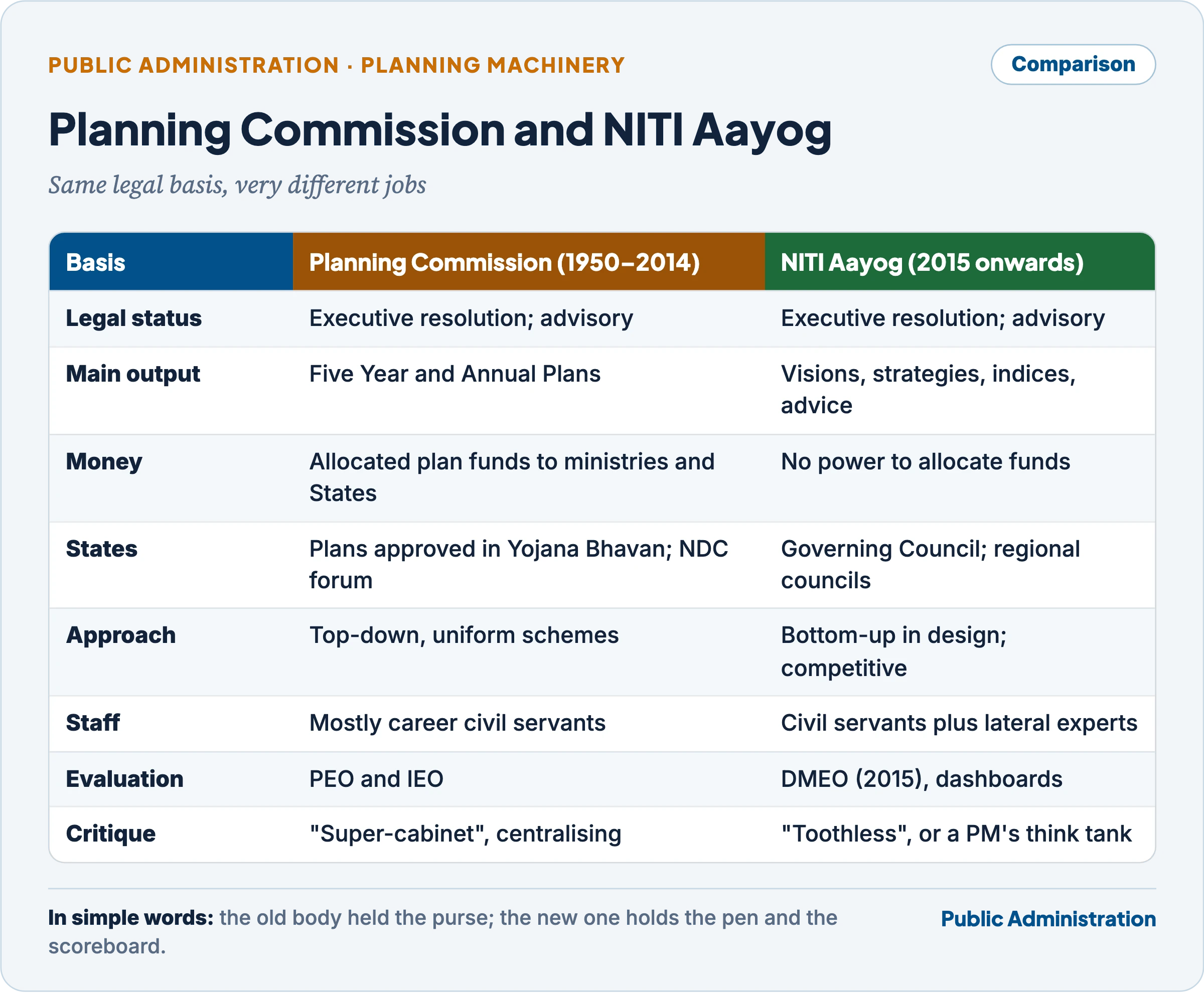
The deepest difference is the move from power through money to influence through knowledge. The Planning Commission could make a State change a scheme by withholding funds; NITI can only persuade, rank, convene and advise.
6.7 NITI Aayog: the central debate
Is NITI Aayog an improvement on the Planning Commission or a weaker body that has left India without a plan? The arguments on both sides are set out below.
Criticism — Criticism: an advisory body that weakened planning
- No financial power. Without the power to allocate funds, its advice can be ignored by large spending ministries and by States; plan finance has passed to the Finance Ministry, which thinks annually, not strategically.
- Fragmentation of planning. With no plan document, each ministry plans its own schemes; NITI’s visions are not tied to budgets. Critics say it has “broken the edifice of planning into fragments”.
- Centralisation by other means. NITI is chaired by the PM and staffed by Union appointees; critics argue it acts as an arm of the Union Government (a “super cabinet” for the development agenda through flagship ideas such as asset monetisation and disinvestment lists) rather than a neutral federal body.
- Weak federal forum. The Governing Council meets about once a year for a day; several opposition CMs boycotted the 2024 meeting. It lacks the NDC’s formal role of approving national strategy.
- Competitive indices can be unfair. Ranking poorer States against richer ones without compensating resources can reward initial advantage and invite data gaming; competition may also breed parochialism.
- No statutory backing or accountability. As an executive creation it has no mandate from Parliament and no duty to report on outcomes; its evaluation office sits inside the government it evaluates.
Defence — Defence: a think tank suited to a market economy and a federal polity
- Right role for the times. In an economy where most investment is private, a body that forecasts, coordinates and advises fits better than one that allocates public money.
- Money already moved to States. Higher formula-based devolution (42 per cent under the Fourteenth Finance Commission, 41 per cent under the Fifteenth) gave States untied funds; a central allocator is no longer needed.
- Knowledge and evidence. DMEO, NDAP, outcome frameworks and indices have made data-driven governance routine; the Aspirational Districts Programme was widely appreciated for convergence and real-time monitoring.
- Federal engagement without coercion. SITs in 26 States and UTs, State visions, the NITI for States platform and CM sub-groups give States technical help without conditions.
- Flexibility. Without a five-year straitjacket, strategy can respond to shocks (pandemic, geopolitics, climate) and long-term goals such as Viksit Bharat @2047.
- Participation. In June 2026 the CMs of all 28 States attended the Governing Council for the first time, showing the forum’s acceptance across parties.
On balance, NITI Aayog has been effective as a think tank, data platform and convenor, but limited as a planning institution: it shapes ideas but not budgets, and its success depends on the PM’s patronage and the willingness of ministries and States to follow its advice. Proposals to strengthen it include statutory status, a defined link with the Finance Commission and budget, a regular report to Parliament, an independent evaluation office, and more frequent Governing Council and Regional Council meetings.
7. Plan Formulation at the Union and State Levels
In simple words
Making a Five Year Plan took about two to three years and passed through many hands: experts, ministries, States, the Cabinet, the NDC and Parliament. After 2015 there is no single plan, but there is still a cycle of setting goals, budgeting for them and checking results.
7.1 National plan formulation under the Planning Commission
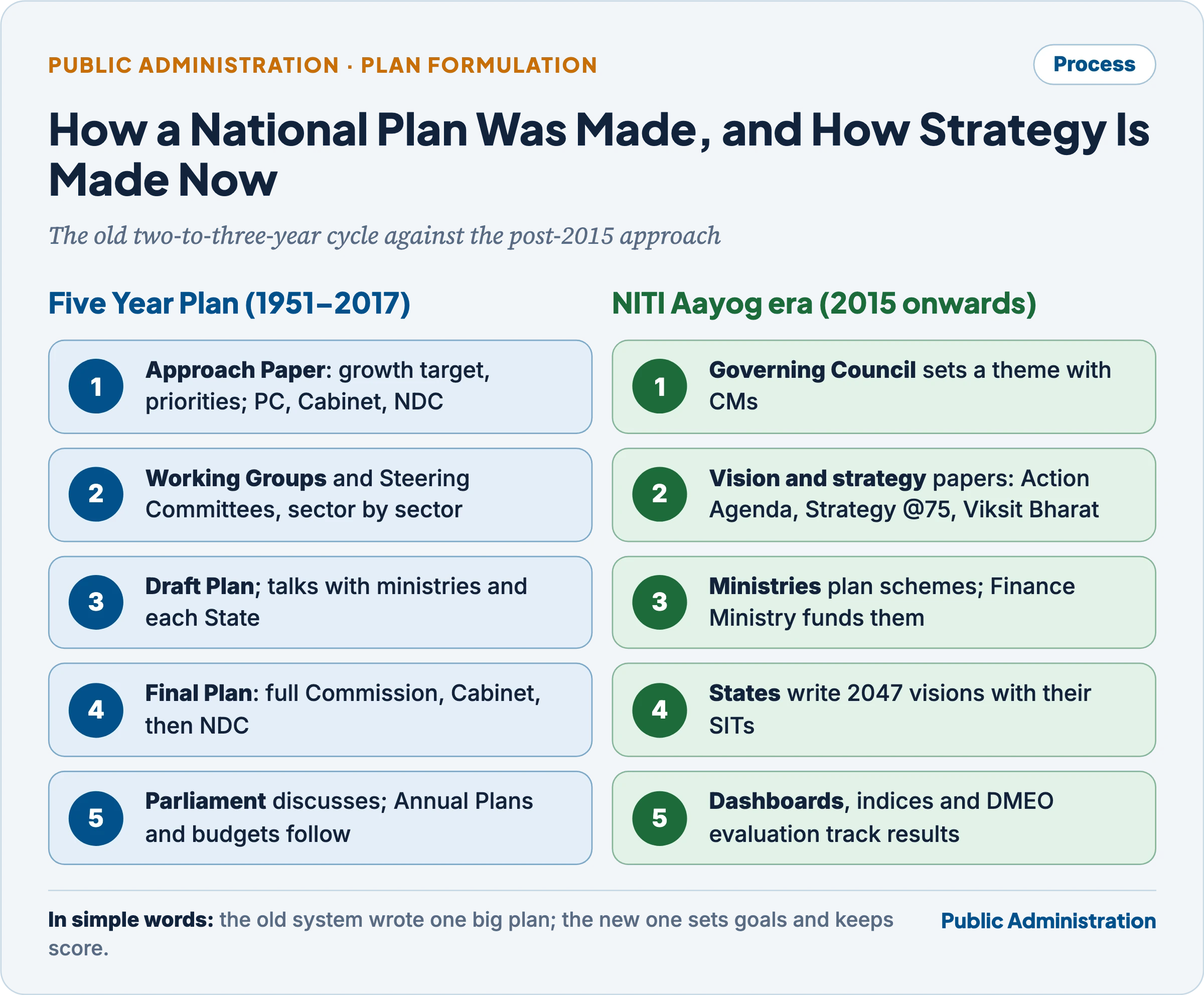
A national Plan covered the Centre, States, Union Territories, public enterprises and the private sector; the public sector part was the operative core, divided into Central and State plans. Its formulation followed five stages.
- Preliminary studies (about three years ahead). Review of the economy’s past performance, assessment of resources, identification of problems and a long-term perspective, drawing on evaluation studies by the PEO, the Central Statistical Organisation and other institutions.
- Approach Paper. A short document setting the growth target, objectives and strategy, reflecting the government’s social and economic priorities. It went to the full Planning Commission, the Union Cabinet and the NDC; once approved, it guided the rest of the process.
- Working Groups and Steering Committees. Scores of Working Groups (experts, officials of ministries, the Commission and the Finance Ministry, outside specialists) and Steering Committees worked out sector plans and policies on the basis of the approach; States set up their own working groups and talked to the central ones.
- Draft Plan. The Commission prepared a Draft Plan (earlier a “Draft Memorandum” and “Draft Outline”), discussed by the full Commission, Cabinet and NDC, published for public debate, and discussed in Parliament and its consultative committees. The Commission held detailed meetings with each ministry and each State, at expert and political levels, ending with a Deputy Chairman–Chief Minister meeting that agreed on the State’s plan size and central assistance.
- Final Plan. The final document was approved by the full Commission, the Union Cabinet and the NDC, and then placed before Parliament, whose general approval sufficed; no law was needed.
- Annual Plans: the real instrument. Each year, in the third quarter of the financial year, the Commission indicated objectives and likely central assistance; States sent resource forecasts and draft annual plans; Central Working Groups examined them; meetings between the Deputy Chairman and each CM (November–December) fixed the outlay; the Finance Department then prepared the “budget–plan link“. Because central plan assistance was decided here, outside the Finance Commission, annual plans made the Commission an allocator.
7.2 State plan formulation
- Advance action. State departments began work on the broad contours of their plan even before the Commission’s guidelines arrived.
- Suggestions for the national approach. States sent proposals that fed into the national Approach Paper.
- State approach and draft plan. After the NDC approved the national approach, the State Planning Department (aided by the State Planning Board and State working groups) prepared a State draft plan within national priorities and its own resources, consulting departments and district agencies on one side and central working groups and ministries on the other.
- Scrutiny in Delhi. The draft was discussed by central working groups and the Commission, which approved or modified it in the light of national and State priorities and resources.
- Approval. The State plan went to the State Council of Ministers, then to a State Development Board or Planning Advisory Committee where one existed, and finally to the State Legislature through the budget.
7.3 Problems in State and sub-State planning, and Centre–State tension
The process generated recurring problems, many recorded by the Sarkaria Commission.
- Detailed central scrutiny. The Commission examined not only plan size but individual schemes, leaving States little freedom even in State subjects.
- Earmarking. A large share of State plan resources (about 60 per cent at one stage) was earmarked for sectors chosen by the Centre, reducing flexibility.
- Nature of central assistance. Too much of it came as loans rather than grants; the formula had discretionary elements; weaker States wanted more weight for need.
- Centrally Sponsored Schemes. Schemes in State subjects, designed and partly funded by the Centre with matching State contributions. Sarkaria noted that about 43 per cent of Sixth Plan outlay on agriculture and rural development (State subjects) lay in the central sector. States complained that such schemes were imposed without consultation, ignored diversity, and distorted their budgets. The ARC (1967) wanted limits on them and a committee under K. Ramamurti suggested criteria; the number of such schemes kept growing until the 2013 and 2015 rationalisations.
- Weak State machinery. State Planning Boards had little status; planning departments were manned by generalist officers with little planning expertise.
- Weak sub-State planning. District plans were often aggregations of departmental schemes; District Planning Committees, though constitutional after 1992, remained weak in most States (see section 8.4).
- Politics and delay. Plans were seldom ready on time; the Eighth Plan’s approach paper came almost a year into the planned period; annual budgeting replaced coordinated annual planning.
7.4 After 2015: planning without a Plan
- End of the Five Year Plan. The Twelfth Plan (2012–17) was the last. The plan/non-plan distinction was removed from the Union Budget 2017–18, and the Railway Budget was merged with the general budget the same year.
- Who now decides what.
- Finance Ministry and Union Budget: allocations to ministries and schemes, with outcome budgets tracked by DMEO’s monitoring framework.
- Finance Commission: formula-based transfers to States; the Sixteenth Finance Commission (chair Arvind Panagariya) covers 2026–31.
- Ministries: design and appraise schemes, with appraisal and evaluation requirements tied to the Finance Commission cycle.
- NITI Aayog: visions, strategies, State support, indices and evaluation.
- States: their own plans and budgets, now often framed as 2047 State visions with SIT support.
- Strategic cycle. The present cycle is: Governing Council theme → vision and sectoral roadmaps → budgets and schemes → dashboards, indices and evaluation. In June 2026 the PM asked for monitoring frameworks with 100-day and five-year goals towards Viksit Bharat @2047, and for district GDP estimates, signs that targets and timelines remain central even without a Plan.
Indian Connect — Indian Connect: Atmanirbhar Bharat as a priority without a Plan
Atmanirbhar Bharat Abhiyan (2020), launched during the pandemic, shows how national priorities are now set outside the Five Year Plan. It combined a relief and stimulus package with structural reforms (MSME definitions, agricultural marketing, coal and mineral auctions, defence production, labour codes) and Production-Linked Incentive schemes for manufacturing. It is indicative in method: it uses incentives and reforms to steer private investment towards self-reliance in strategic sectors. Supporters call it progressive because it links self-reliance with global integration rather than the import substitution of earlier Plans; critics warn of protectionism, fiscal costs of incentives, and benefits concentrated in large firms. Its design, priorities set by the Union executive and implemented by ministries and budgets, illustrates planning without a Plan.
8. State Planning Machinery
In simple words
Each State needs its own planning body, because agriculture, health, education and local government are State subjects. States have Planning Departments that do the paperwork and Planning Boards meant to give expert advice; since 2023 many have turned these into “transformation” institutions on NITI’s model.
8.1 Evolution
- First decade. The State Planning Department alone handled planning, with a Development Commissioner (often the Chief Secretary or an Additional Chief Secretary) coordinating development departments, and a State Development Committee of the CM and ministers.
- 1962. The Planning Commission asked States to set up State Planning Boards (SPBs) for perspective and five-year plans, resource mobilisation, social objectives and project appraisal.
- First ARC (1967). Found SPBs vaguely defined and too large (one had 65 members), mere “consultative bodies” or “public relations committees“, and recommended a compact Board in every State, built in the image of the Planning Commission, with its own secretariat.
- 1972 Planning Commission guidelines. Suggested an apex Board of the CM, Finance Minister, key ministers and a few experts, supported by steering groups, with the Planning Department as its secretariat; and asked Planning Departments to add Perspective Planning, Monitoring and Evaluation, Project Appraisal, Regional/District Planning, Plan Coordination and Manpower and Employment units, with central financial help.
- Sarkaria Commission (1988). Found that SPBs, though set up in almost all States, were not doing “real planning work“; it recommended that SPBs do for States what the Planning Commission did for the Centre and be involved in annual plans.
8.2 Composition and functions of State Planning Boards
- Composition. The Chief Minister as Chairman (the Governor during President’s Rule); a Vice or Deputy Chairman (often the Finance or Planning Minister, sometimes an expert, as in Kerala’s State Planning Board); official members (Chief Secretary, Development and Finance Commissioners, Planning and Finance Secretaries); non-official experts; and the Planning Secretary as Member-Secretary. Punjab’s Board, for instance, had divisions for plan coordination, local plans, agriculture, energy, monitoring and evaluation and others.
- Functions (ARC list).
- Assess the State’s resources and plan their most effective and balanced use.
- Fix State priorities within the national framework.
- Help district authorities prepare plans and coordinate them with the State plan.
- Identify factors retarding development and conditions for success.
- Review implementation and recommend adjustments.
- Some Boards also prepared perspective plans and evolved strategies to combine growth with social justice.
8.3 Problems and the shift to State Institutions for Transformation
- Why State planning bodies were ineffective.
- Status: SPBs lacked authority; the State Cabinet and Finance Department decided allocations.
- Composition: too many politicians and too few experts in many States; no clear division of work.
- Secretariat: most SPBs had no independent technical staff; the Planning Department, staffed by generalist officers, did the real work, and the two often worked in parallel with little interaction.
- Central dominance: State plans were shaped by central guidelines, earmarking and schemes, leaving little to plan.
- Reluctance of States to hand planning to an expert body that might rival the Cabinet.
- State Institutions for Transformation (SITs). Under NITI’s State Support Mission, States may create a new institution or reimagine their planning department or board as an SIT: a multi-disciplinary resource of officials and lateral experts that identifies growth drivers, strengthens monitoring and data systems, and prepares State strategies and 2047 visions. NITI’s Annual Report 2024–25 records 26 SITs notified, including the Maharashtra Institute for Transformation (MITRA), the Gujarat Rajya Institution for Transformation (GRIT), Karnataka’s State Institute for Transformation, Uttar Pradesh’s State Transformation Commission, Assam’s State Innovation and Transformation Aayog, and the State Planning Commissions of Tamil Nadu and Chhattisgarh. States may also designate a Lead Knowledge Institution (an IIM, IIT or university) to support the SIT.
- Significance. SITs mirror the Planning Commission-to-NITI shift at the State level: from allocating plan funds to strategy, data and delivery. Their success depends on the same factors that limited SPBs: political backing, expert staff and a link to the State budget.
8.4 Below the State: decentralised planning (in brief)
The 73rd and 74th Amendments (1992) require panchayats and municipalities to prepare plans for economic development and social justice (Articles 243G and 243W), and every district to have a District Planning Committee (Article 243ZD) and every metropolitan area a Metropolitan Planning Committee (Article 243ZE) to consolidate local plans into a draft development plan. Earlier efforts (the Dantwala Working Group on block-level planning, 1978, and the Hanumantha Rao Working Group on district planning, 1984), the People’s Plan Campaign of Kerala (1996) and today’s Gram Panchayat Development Plans belong to this story. In most States DPCs have stayed weak. See the article on Decentralised Planning after the 73rd and 74th Amendments.
9. Planning Machinery through Theory
In simple words
Theories of decision-making, development and federalism help explain why India planned the way it did, why the Planning Commission grew so powerful, and why the country moved to a think tank that ranks and persuades.
Theory lens: Indian planning machinery and Paper I ideas
- Rational-comprehensive planning versus incrementalism. The Five Year Plan was a rational-comprehensive exercise in form: goals, alternatives, models, consistent targets. Herbert Simon, in Administrative Behavior (1947), showed that decision-makers have bounded rationality; Charles Lindblom, in “The Science of ‘Muddling Through'” (1959), argued that real policy proceeds by successive limited comparisons. Indian Plans, in practice, rolled forward the previous Plan’s schemes with marginal changes, while information gaps and politics made comprehensive optimisation impossible. Aaron Wildavsky‘s essay “If Planning Is Everything, Maybe It’s Nothing” (1973) captures the trap: a plan that covers everything ends up guiding nothing. Amitai Etzioni‘s mixed scanning (1967), a broad scan of fundamental choices with detailed incremental steps, fits NITI’s model of a long-term vision plus short action agendas. See the articles on Decision-Making and on Models of Policy-Making.
- Development administration. The term, credited to U.L. Goswami (1955) and popularised by Edward Weidner and Fred Riggs, describes administration geared to planned socio-economic change. The Planning Commission, community development and the district development bureaucracy were its Indian embodiment. Riggs’s formalism, the gap between prescribed norms and actual behaviour in prismatic societies, explains the gap between Plan targets and outcomes and between constitutional DPCs and real district planning. See the articles on Development Administration and on Riggsian Models.
- Strong state versus market. Gunnar Myrdal‘s “soft state” in Asian Drama (1968) explains why Indian plans were not enforced; Friedrich Hayek‘s knowledge argument (The Road to Serfdom, 1944) explains why central planners could not run a complex economy; Peter Evans‘s embedded autonomy (1995) shows that successful developmental states combine a capable, cohesive bureaucracy with close ties to business. India’s move to indicative planning and then to a think tank reflects the shift from the State as producer to the State as enabler and regulator. See the article on Bureaucracy and Development, the State versus Market Debate and Liberalisation.
- Cooperative and competitive federalism. Morton Grodzins‘s image of “marble-cake” federalism, where functions are shared rather than separated, fits planning as a Concurrent subject and forums like the NDC and Governing Council. Competitive federalism draws on Charles Tiebout‘s model (1956) of jurisdictions competing to attract residents and Albert Breton‘s Competitive Governments (1996): NITI’s indices use yardstick competition among States. The risks, unequal starting points and parochialism, follow from the same theory.
- Policy process models. The elite model (Thomas Dye) suggests that development priorities are set by a small core (PMO, NITI, Finance Ministry) and ratified in federal forums; the group model explains the NDC as an arena of bargaining among State governments; the institutional model stresses how the Planning Commission’s position (PM as Chairman, control of funds) gave it power beyond its advisory status. The policy cycle shows why NITI focuses on monitoring and evaluation, the stages most neglected by the old Plans. See the article on The Policy Process.
- Public choice and principal–agent. William Niskanen‘s budget-maximising bureaucrat (1971) helps explain the Planning Commission’s expansion of staff and functions. Centrally Sponsored Schemes are a principal–agent arrangement: the Union (principal) funds States (agents) with conditions, monitoring and matching shares to align their behaviour, at the cost of State autonomy.
- Think tanks and network governance. Diane Stone (Capturing the Political Imagination, 1996) describes think tanks as knowledge brokers that shape policy agendas through research and networks. R.A.W. Rhodes (Understanding Governance, 1997) describes governance through networks of state and non-state actors. NITI’s partnerships with think tanks, universities, development partners and States, its fellows and its data platforms are a network governance model; its challenge is that a think tank inside government struggles to keep the independence that gives think-tank advice its value.
Key Terms
| Term | Meaning in simple words |
|---|---|
| Planning | Deciding in advance goals, resources, stages and agencies for achieving them |
| Development planning | Organised State effort to reach economic and social goals through plan formulation, implementation and evaluation |
| Imperative planning | Planning by command: binding targets for enterprises |
| Indicative planning | Planning by guidance: targets binding on the public sector, signals and incentives for private firms |
| Perspective plan | Long-term plan of 15–25 years setting broad goals |
| Rolling plan | Plan revised every year so it always covers the next few years; tried in India 1978–80 |
| Plan holiday | Period without a Five Year Plan, run on Annual Plans (1966–69, 1990–92) |
| Annual Plan | Yearly slice of the Five Year Plan linked to the budget |
| Approach Paper | Short first document of a Plan setting targets and strategy |
| Working Group | Expert-official group preparing a sector’s plan |
| Central assistance | Plan funds given by the Centre to States through the Planning Commission |
| Gadgil formula | NDC-approved formula (1969) for distributing central plan assistance among States |
| Centrally Sponsored Scheme (CSS) | Scheme in a State subject designed and partly funded by the Centre, implemented by States |
| Core of the core | CSS for social protection given first charge on funds (2015 classification) |
| Plan/non-plan expenditure | Old budget classification of spending; abolished from 2017–18 |
| Super-cabinet | Charge that an advisory body (Planning Commission or NDC) dominated the elected Cabinet |
| Governing Council | NITI Aayog’s forum of the PM, Chief Ministers and Lieutenant Governors |
| Regional Council | NITI forum of CMs of a region for a fixed tenure |
| Team India Hub | NITI wing for engagement with States |
| Knowledge and Innovation Hub | NITI wing for research and think-tank work |
| DMEO | NITI’s attached office for monitoring and evaluation (2015) |
| SIT | State Institution for Transformation, set up with NITI support under the State Support Mission |
| Cooperative federalism | Centre and States working jointly on shared goals |
| Competitive federalism | States competing to improve outcomes and attract investment, often spurred by rankings |
| Aspirational district | Lagging district ranked on outcome indicators under NITI’s programme |
| Viksit Bharat @2047 | National goal of a developed India by the centenary of Independence |
Commissions, Committees and Judgments
The bodies and reports that shaped India’s planning machinery are listed below with their key points. No major court judgment bears directly on the planning bodies, which rest on executive resolutions.
| Body / case | Year | Key point |
|---|---|---|
| National Planning Committee (chair Jawaharlal Nehru; set up under Congress president Subhas Chandra Bose) | 1938 | First nationalist effort at comprehensive planning |
| Advisory Planning Board (chair K.C. Neogy) | 1946 | Recommended a single expert planning commission |
| Planning Commission Resolution | 15 March 1950 | Advisory body free from day-to-day administration, close to government |
| NDC Resolution | 6 August 1952 | Forum of PM and CMs to review the Plan and build national support |
| ARC Study Team on the Machinery for Planning (chair R.R. Morarka) | 1967 | Examined the Commission’s growth into an executive body |
| First ARC, Interim Report on Machinery for Planning (ARC chair K. Hanumanthaiya) | 1967 | Commission to plan and evaluate only; PM not Chairman; no minister-members; SPBs; NDC reconstituted |
| NDC reconstitution | 7 October 1967 | All Union Cabinet ministers added; power to prescribe Plan guidelines |
| Gadgil formula (D.R. Gadgil) | 1969 | Formula-based distribution of central plan assistance |
| Working Group on Block Level Planning (chair M.L. Dantwala) | 1978 | Block as a unit of planning |
| Working Group on District Planning (chair C.H. Hanumantha Rao) | 1984 | District as part of multi-level planning; district sector funds |
| Sarkaria Commission on Centre–State Relations (chair R.S. Sarkaria) | 1988 | NDC to become National Economic and Development Council under Article 263; less scrutiny of State plans; fewer CSS; real role for SPBs |
| Punchhi Commission on Centre–State Relations (chair M.M. Punchhi) | 2010 | Drop approval of State annual plans; cut CSS; Commission to coordinate, not micro-manage |
| B.K. Chaturvedi Committee on CSS | 2011 | Reduce 147 CSS to 59; flexi-funds for States |
| C. Rangarajan Committee on Public Expenditure | 2011 | Remove the plan/non-plan distinction |
| Independent Evaluation Office (DG Ajay Chhibber) | 2014 | Replace the Commission with a “Reform and Solutions Commission” think tank |
| Fourteenth Finance Commission (chair Y.V. Reddy) | 2015 | States’ share of central taxes raised to 42 per cent |
| NITI Aayog Resolution | 1 January 2015 | Think tank; Governing Council; cooperative federalism |
| Sub-Group of CMs on Rationalisation of CSS (convenor Shivraj Singh Chouhan) | 2015 | Core and optional schemes; core of the core; 60:40 sharing |
The sequence shows that the same three problems recur across seventy years: an advisory body acquiring financial power, the States’ demand for autonomy in State subjects, and weak machinery for evaluation. The 2014–15 changes resolved the first by removing financial power, but the other two remain live.
Contemporary Developments
- NITI Aayog revamped (24 April 2026). In the first major reconstitution since 2015, economist Ashok Kumar Lahiri replaced Suman Bery as Vice-Chairperson and four of the five full-time Members were replaced; Anurag Jain took charge as CEO on 17 August 2026.
- 11th Governing Council meeting (11 June 2026). Theme “Inclusive Human Development for Viksit Bharat @2047“; for the first time CMs of all 28 States attended; the PM called for district-level evaluation, 100 districts on the aspirational model for agriculture, and 100-day and five-year goals.
- 10th Governing Council meeting (24 May 2025). Theme “Viksit Rajya for Viksit Bharat @2047“; States urged to prepare their own 2047 visions.
- Fiscal Health Index (24 January 2025). NITI’s first annual index of the fiscal health of 18 major States, launched by the chairman of the Sixteenth Finance Commission.
- State Institutions for Transformation (2024–25). Under the State Support Mission, 26 States and UTs had notified SITs, reshaping State planning bodies into strategy and delivery units.
- AIM 2.0 (25 November 2024). Cabinet approved the continuation of the Atal Innovation Mission with Rs 2,750 crore till March 2028.
- SDG India Index 2023–24 (12 July 2024) and NITI reconstitution (16 July 2024) with 15 Union ministers as ex officio members or special invitees; the 9th Governing Council meeting (27 July 2024) was attended by 20 States and 6 UTs, with several opposition-ruled States staying away.
- NITI for States platform (7 March 2024). Digital knowledge platform and Viksit Bharat Strategy Room for State, district and block officials.
Revision Grid
| Thinker / body | Work or report (year) | Key idea |
|---|---|---|
| M. Visvesvaraya | Planned Economy for India (1934) | Early call for national planning |
| P.C. Mahalanobis | Second Plan model (1955–56) | Heavy industry first for long-run growth |
| W. Arthur Lewis | The Principles of Economic Planning (1949) | State sets the framework; planning need not mean ownership |
| Friedrich Hayek | The Road to Serfdom (1944) | Central planning cannot use dispersed knowledge; threatens freedom |
| Gunnar Myrdal | Asian Drama (1968) | Soft state; rolling plan idea commonly traced to him |
| Jean Monnet; Pierre Massé | French Plan (from 1946) | Indicative planning as a reducer of uncertainty |
| Albert Waterston | Development Planning: Lessons of Experience (1965) | Plans fail at implementation; plan the administration too |
| Charles Lindblom | “The Science of ‘Muddling Through'” (1959) | Incrementalism against comprehensive planning |
| Amitai Etzioni | Mixed scanning (1967) | Broad vision plus incremental steps |
| Aaron Wildavsky | “If Planning Is Everything, Maybe It’s Nothing” (1973) | Comprehensive planning becomes meaningless |
| K. Santhanam | Union-State Relations in India (1960) | Planning superseded federation; NDC a super-cabinet |
| First ARC | Interim Report on Machinery for Planning (1967) | Commission had become a parallel and super cabinet |
| Sarkaria Commission | Report (1988) | NDC as National Economic and Development Council |
| IEO (Ajay Chhibber) | Assessment of the Planning Commission (2014) | Replace it with a Reform and Solutions Commission |
| NITI Aayog | Resolution (2015); Action Agenda (2017); Strategy @75 (2018) | Cooperative and competitive federalism; vision–strategy–action |
| Peter Evans | Embedded Autonomy (1995) | Capable bureaucracy tied to society drives development |
| Diane Stone | Capturing the Political Imagination (1996) | Think tanks as knowledge brokers |
Previous Year Questions
- 2026The present model of strategic planning has roots in indicative planning. Comment.
- 2026Planning Commission planned for economic development and social justice, but NITI Aayog has been structured to realise growth potential across the sectors. Discuss.
- 2026Competitive federalism in India while intended to have healthy competition among states has shown tendencies towards parochialism. Comment.
- 2025Trace the reasons for limited effectiveness of the NITI Aayog.
- 2025Divergent political interests and financial constraints hinder the spirit of ‘cooperative federalism’. Comment.
- 2024The National Data and Analysis Platform (NDAP) of NITI Aayog facilitates a robust ecosystem to promote democratization and inclusivity in development. Discuss.
- 2023“Attempts to prepare unified and holistic plans for the country are complex and full of challenges.” Discuss.
- 2022“National Institution for Transforming India (NITI) Ayog has become super cabinet in formulating the development agenda of our country”. Examine the statement by giving suitable examples.
- 2022“Indicative Planning, is a middle path of planning and market mechanism to ensure coordination between public and private activities.” Explain.
- 2022The Atmanirbhar Bharat Abhiyaan is a progressive policy. Analyse.
- 2021NITI Aayog has been constituted to implement the goal of co-operative federalism. Discuss.
- 2020Considering India’s diversity, the planning pattern of ‘one-size-fits-all’ was discarded in favour of indicative planning. To what extent has it been useful to India?
- 2019‘NITI Aayog’ has changed the way India strategized for economic development, but its effectiveness is yet to be seen, especially when its financial powers are far less than its predecessor. Analyze.
- 2018It is argued that the NITI Aayog has broken the edifice of planning into fragments. Comment.
- 2018“In the transition from the State-led economy to the market economy, India should rely more on ‘indicative planning’.” Do you agree? Explain your position.
- 2016“Planning in India has failed to meet the challenges of economic development and social change.” Discuss the statement in the context of the emergence of NITI Aayog.
- 2016Examine the efficacy of the measures taken to redefine and execute cooperative federalism in India.
- 2015The objectives, approaches and organisational arrangements for decision-making of the NITI Aayog aim at restoring the federal character of the Indian policy. Explain.
- 2014How far do you agree with the view that national development Council could resonate the demands of the state governments as long as planning commission is kept subservient to it? Critically examine.
- 2013“Planning enables comprehensive and scientific understanding of problems.” Examine the statement in the context of planning methodology.
- 2012Justify ‘indicative’ planning in the context of LPG.
- 2012Discuss the recommendations of the Sarkaria Commission in respect of the National Development Council for improving Centre-State planning relations.
- 2010Explain the context and perspectives of the following statements: – The Planning Commission is “an armchair adviser”. The Planning Commission should reinvent itself as a systems reforms commission in the backdrop of changed global and domestic scenarios.
- 2008Discuss the problems in the planning process at the state and sub-state levels.
- 2008What are the tension areas in Union-State relations in Planning?
- 2005“National Development Council is criticized as an usurping authority-functioning as a virtual super – cabinet.” Explain.
- 2005“From highly centralized planning system, India has moved towards indicative planning under which long-term strategic vision of the future is built and nation’s priorities are decided.” Elucidate.
- 2004“National Development Council was established to co-ordinate between Union government, the Planning Commission and the State governments.” Comment.
- 2004“Effective implementation of plan projects has been the weakest link in the chain of the entire planning programme.” Elucidate.
- 2003“Indian planning is highly centralized.” Comment.
- 2002“National Development Council gas virtually become a super-cabinet and tries to arrogate itself the functions of Parliament.” Comment.
- 2000“National Development Council, it seems, is like a super-Cabinet.” Comment.
- 1999“The Planning Commission continues to exist but some would say that it is withering away, along with real planning itself.” Comment.
- 1998“State and district planning bodies in India have not been effective in achieving their goals.” Comment.
- 1997“For national planning, the commission type of organisation was deliberately preferred.” Examine the statement.
- 1996“After the creation of the Planning Commission, the role of the Finance Commission has started diminishing.” Review the statement.
- 1995“Development administration ultimately boils down to effective project implementation, and it is implementation that has been badly negated in Indian planning. Critically examine the statement.”
- 1994“The organization of the Planning Commission is in consonance with its expert character.” Comment.
- 1993“The concept of Fiscal Federalism calls for the National Development Council to regulate plan decisions about discretionary grants-in-aid, which should in fact be distributed by the Finance Commission.” Comment
- 1992‘Planning in a federal system, needs to depoliticised.’ Comment.
- 1992‘The National Development Council should be grafted as a Federal Economic Cabinet of the Prime Minister in the East Minister model of Indian democracy.’ Comment.
- 1992‘The jurisdictions of Planning Commission and Finance Commission overlap and together the two circumscribe the Sovereign character of Indian Parliament.’ Comment.
- 1990‘The planning commission of India in the post-Nehru period has conduced to better Centre-State relations, but (it has) not necessarily brought about depoliticization of the planning process.’ Discuss and illustrate.
- 1988“The National Development Council (not the planning Commission) is the appropriate instrument to ensure linkages between the district, the State and the regional levels of nation planning processes. Do you agree?
- 1987Examine the inadequacies of machinery for planning to ensure democratic but depoliticised planning process in Indian federation. How does National Development Council accentuate or inhibit this process?
- 2013“The policy process was not structured in the way required by bureaucratic planning. “Arguably, incrementalism now stands most in contrast to neo-liberal nationality that impose markets against both gradual change and democratic liberalism.” Analyse these two statements.