

Machinery of planning; Role, composition and functions of the Planning Commission and the National Development Council; ‘Indicative’ planning; Process of plan formulation at Union and State levels; Constitutional Amendments (1992) and decentralized planning for economic development and social justice.
This article: Constitutional Amendments (1992) and decentralised planning for economic development and social justice: meaning, rationale and forms of decentralised and multi-level planning; attempts before 1992 (Community Development, Balwantray Mehta, ARC, the 1969 guidelines, Dantwala, Asoka Mehta, Hanumantha Rao, G.V.K. Rao, Singhvi, Thungon and Gadgil); Articles 243G, 243W, 243ZD, 243ZE, 243I and 243Y, the Eleventh and Twelfth Schedules and the 3Fs; District and Metropolitan Planning Committees in practice; State models (Kerala, Karnataka, West Bengal, Madhya Pradesh, Maharashtra); GPDP, People’s Plan Campaign, BPDP and DPDP, e-GramSwaraj, Viksit Gram Panchayat Plans under the VB–G RAM G Act, 2025; Aspirational Districts and Blocks; Finance Commission grants; planning for social justice; problems, the Expert Group (2006) and the 2nd ARC; theory lens.
Official Syllabus: Paper II · Unit 2-05 Plans and Priorities
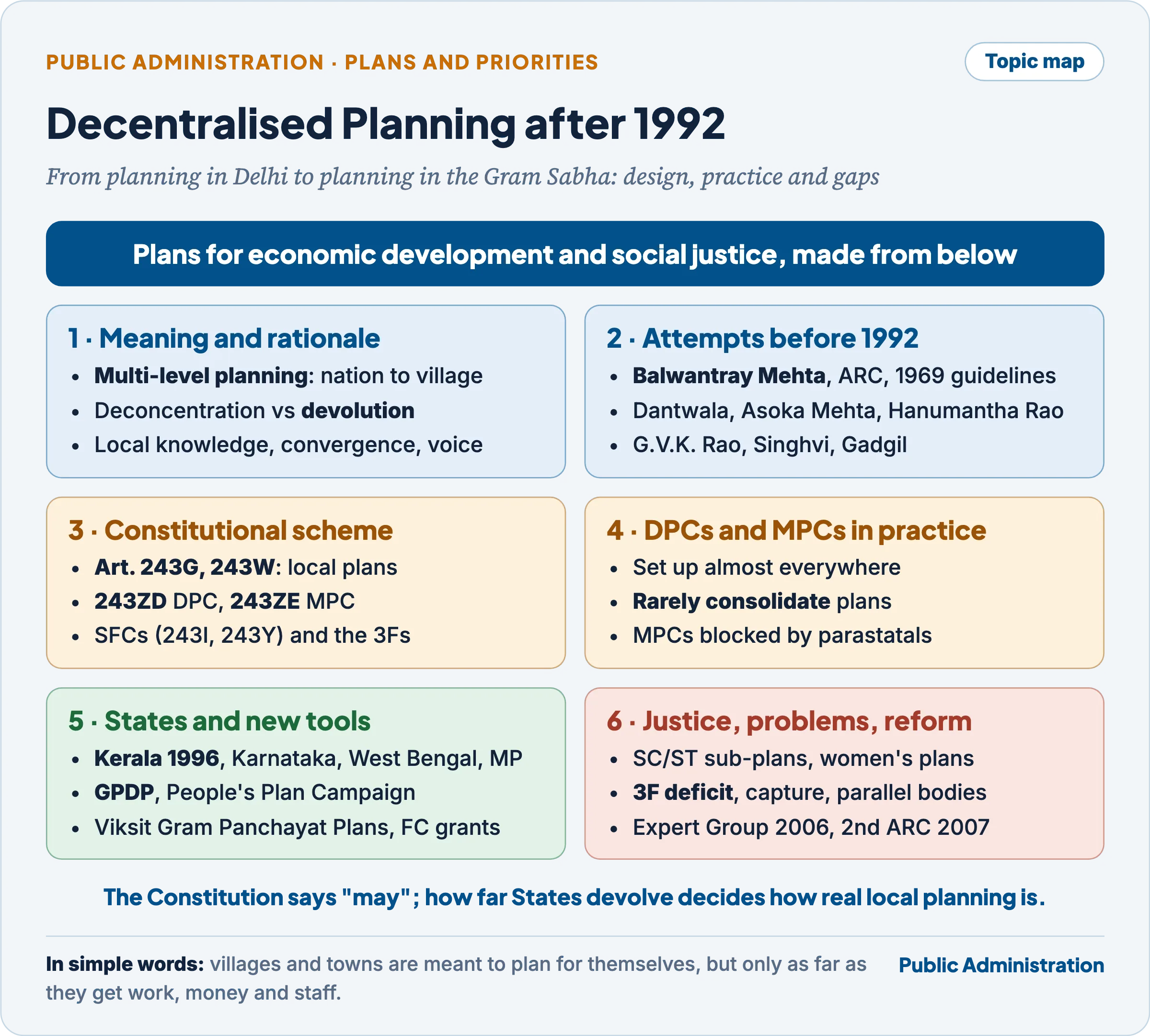
Decentralised planning means that the plans for a village, a town, a block and a district are prepared by the people and the elected bodies of that area, using resources they control, and are then fitted into the plans of the State and the nation. India talked of “planning from below” from its First Five Year Plan, but for four decades the plans were made in Delhi and the State capitals and only executed below. The 73rd and 74th Constitutional Amendments (1992) changed the legal position: they made preparation of plans for economic development and social justice a function of Panchayats and Municipalities, created District Planning Committees (DPCs) and Metropolitan Planning Committees (MPCs), and set up State Finance Commissions to give these bodies money. Three decades later, the constitutional design is complete on paper, but whether local planning has become real is the central question of this topic.
In simple words
Think of a family that wants a new well. If an officer in the State capital decides where every well in the State will be dug, he may put it on the wrong side of the village or dig it where the water is salty. If the villagers decide, using their own knowledge and a fixed budget, the well is more likely to be useful and to be looked after. Decentralised planning is this idea applied to roads, schools, clinics, drains and jobs.
1. Decentralised Planning: Meaning, Rationale and Levels
In simple words
Planning is deciding in advance what to do with limited money and resources. Decentralised planning moves that decision closer to the people who live with its results. It does not abolish national planning; it adds layers below it so that local needs, local knowledge and local voices count.
1.1 Where decentralised planning sits in the planning machinery
- From 1950 to 2014 the Planning Commission (an executive body set up by Cabinet resolution of 15 March 1950) drew up Five Year Plans, and the National Development Council (1952) brought the Union and the Chief Ministers together to approve them. The process was top-down: national targets were broken into State plans, and States broke them into departmental schemes.
- After 1991 Indian planning became indicative: the State set direction and built infrastructure, and markets carried more of the investment. On 1 January 2015 the Planning Commission was replaced by NITI Aayog, a think-tank without the power to allocate plan funds; the last Five Year Plan (the Twelfth) ended in March 2017.
- For the Union and State machinery, the NDC and indicative planning in detail, see the article on Planning Machinery: Planning Commission, NITI Aayog, NDC and Indicative Planning. This article deals with planning below the State: districts, blocks, villages and cities.
- The end of Five Year Plans did not end local planning. Panchayats still prepare annual development plans under Article 243G, Finance Commission grants require them, and the Viksit Gram Panchayat Plans of 2026 are statutory. Local planning has outlived national planning.
1.2 Meaning of key terms
- Decentralised planning: a system in which plan-making powers and resources are shared among several levels of government, so that each level plans for the matters it is best placed to handle. The UN and Indian planning documents describe it as “planning from below” or grassroots planning.
- Multi-level planning (MLP): planning carried out at the national, State, district, block and village levels, with each level’s plan feeding into and being disciplined by the next. The Planning Commission had a Multi-Level Planning Division that handled district planning work in the 1980s and 1990s.
- District planning: the preparation of a single, integrated plan for the whole district, covering rural and urban areas, consolidating the plans of Panchayats and Municipalities and the district-level schemes of State departments. It introduces a spatial dimension (where things are located) into a planning process that is otherwise sectoral (what each department spends).
- Spatial planning: deciding the location of facilities and land uses, such as where a school, a market yard or a landfill should be, so that services are within reach and do not clash.
- Sectoral planning: planning by department or subject (agriculture, health, roads). Indian planning was mostly sectoral, which is why district plans often became a bundle of departmental schemes rather than a plan for an area.
- Participatory planning: planning in which citizens themselves identify needs, set priorities and monitor works, through the Gram Sabha (assembly of all voters of a village), Ward Sabhas and similar forums.
1.3 Forms of decentralisation and what they mean for planning
Dennis Rondinelli, the American development-administration scholar, with John Nellis and G. Shabbir Cheema, in Decentralization in Developing Countries (World Bank Staff Working Paper 581, 1983), distinguished four forms of decentralisation. They are the best tool for judging whether a planning reform really decentralises.
| Form | What is transferred, and to whom | Indian planning example |
|---|---|---|
| Deconcentration | Work moves to field offices of the same government; decisions stay with the centre | Collector-led district planning cells; the Aspirational Districts Programme |
| Delegation | Defined tasks go to semi-autonomous agencies outside the normal hierarchy | DRDAs (until 2022), development authorities, parastatal boards |
| Devolution | Powers, functions and money go to elected local governments with their own legal identity | Panchayats and Municipalities under Articles 243G and 243W |
| Privatisation / debureaucratisation | Tasks go to markets, NGOs and community groups | SHG federations preparing village plans, user groups |
The table shows why much of what is called “decentralised planning” in India is really deconcentration: the district plan is prepared by officials under the Collector, while elected bodies approve it. Only devolution gives local people the right to decide, which is why the 73rd and 74th Amendments are framed in its language (“institutions of self-government”).
1.4 Why plan from below: the rationale
The case for decentralised planning combines economic, administrative and political arguments.
- Local knowledge. Needs, resources and constraints vary from village to village: soil, water, skills, caste composition, distance to markets. Friedrich Hayek, the Austrian economist, argued in “The Use of Knowledge in Society” (1945) that such knowledge of “particular circumstances of time and place” cannot be gathered centrally. A State plan either ignores this diversity or spends heavily collecting data; local planning reduces information costs.
- Avoiding waste from uniform schemes. Applying centrally designed schemes uniformly, “without regard to local conditions”, leads to misuse of physical, financial and human resources: check dams where there is no catchment, school buildings without teachers.
- Coordination and convergence. At the district level more than twenty departments, banks and agencies operate with separate hierarchies. An integrated plan can get more benefit from the same outlay than the sum of uncoordinated departmental efforts, for example by locating a road, a market and a cold store together.
- Allocative efficiency. Wallace Oates, the American public-finance economist, stated in Fiscal Federalism (1972) the decentralisation theorem: a public good whose benefits are local should be provided by the lowest level of government that covers those benefits, because it can match output to local preferences.
- Ownership and maintenance. People who choose a work are more willing to contribute labour or money and to maintain it. Plans managed by communities are also less of a financial burden on government.
- Accountability. A Gram Sabha can see the road it asked for; a social audit can check it. Distance between decision and result is short.
- Social justice. With reservation for SCs, STs and women in local bodies, the people who were left out of earlier development can set priorities themselves. Article 243G joins economic development and social justice for this reason.
- Democracy as an end. For Mahatma Gandhi, village self-rule (gram swaraj) was the foundation of freedom, and Article 40 (a Directive Principle) asks the State to organise village panchayats as units of self-government. People’s participation is not only a means to better plans but a value in itself.
Common confusion
Is district planning the same thing as decentralised planning? No. District planning is one level of multi-level planning. It can be done in a centralised way (State officials preparing a district plan for State approval, as in most States before 1992) or a decentralised way (elected local bodies preparing plans that a DPC consolidates). The test is not where the plan is written but who decides priorities and who controls the money.
1.5 Multi-level planning: who plans what
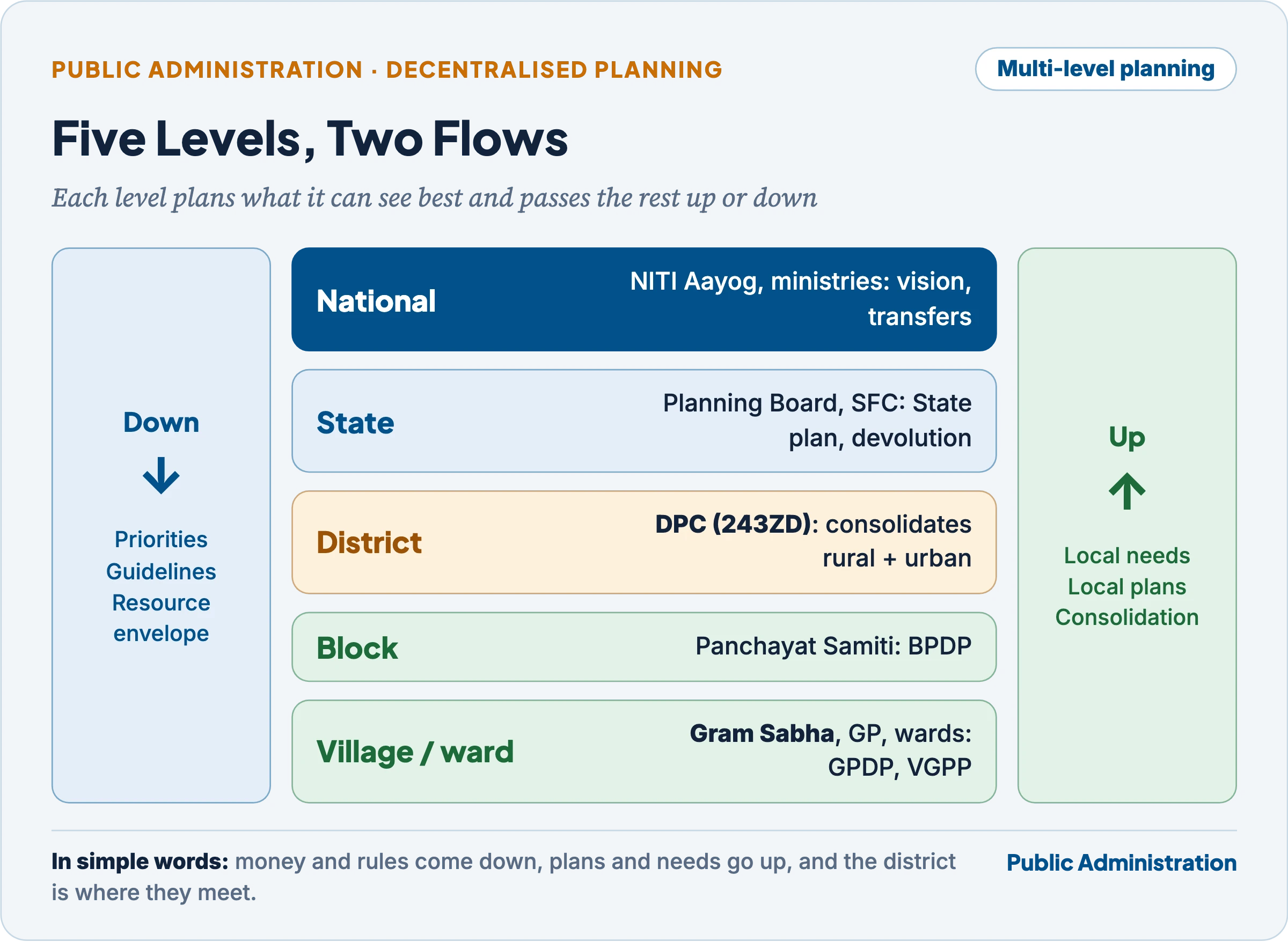
The logic of multi-level planning is that each level plans for what it can see and manage best, and passes upward what it cannot. The diagram shows the five levels and the two flows between them.
| Level | Planning body | What it plans |
|---|---|---|
| National | NITI Aayog (formerly Planning Commission), Union ministries | Vision, macro priorities, national programmes, transfers to States |
| State | State Planning Board / Department, State Finance Commission | State plan and budget, district-wise allocations, devolution to local bodies |
| District | District Planning Committee (Art. 243ZD); District Panchayat | District plan consolidating rural and urban plans; spatial and inter-local matters |
| Block | Intermediate Panchayat (Panchayat Samiti) | Block plan (BPDP); works spanning several villages |
| Village / ward | Gram Panchayat with Gram Sabha; Municipality with Ward Committees | GPDP / municipal plan; local works, services, beneficiary lists |
- Downward flow: national and State priorities, guidelines and a resource envelope (the amount of money each local body can expect). Without a known resource envelope local planning becomes a wish list.
- Upward flow: local needs, local plans and consolidation. The DPC is the point where rural and urban plans meet and are passed to the State.
- The block was favoured by the Dantwala Working Group (1978) as the best sub-State level because it links clusters of villages to the district; the district was favoured by the Hanumantha Rao Working Group (1984) and the Asoka Mehta Committee (1978) because it has the officials and data needed for planning. The Constitution chose both: plans at every Panchayat level, consolidated at the district.
1.6 Limits and prerequisites
Decentralised planning is not a cure-all, and its own supporters list conditions for it to work.
- Limits:
- Spillovers and scale: irrigation systems, highways and river basins cross local boundaries and need higher-level planning.
- Capacity: small Panchayats lack engineers, planners and data.
- Elite capture: local power-holders may capture plans and benefits (see Section 7.6).
- Inequality between areas: richer areas can raise more money, so pure local planning can widen gaps unless transfers equalise.
- Prerequisites:
- Clear functions (activity mapping: which tier does what).
- Assured, largely untied funds and a known resource envelope in advance.
- Functionaries answerable to the local body.
- Data and technical support, a planning calendar that fits the State budget cycle, and people’s participation that is real rather than ritual.
2. Attempts at Decentralised Planning before 1992
In simple words
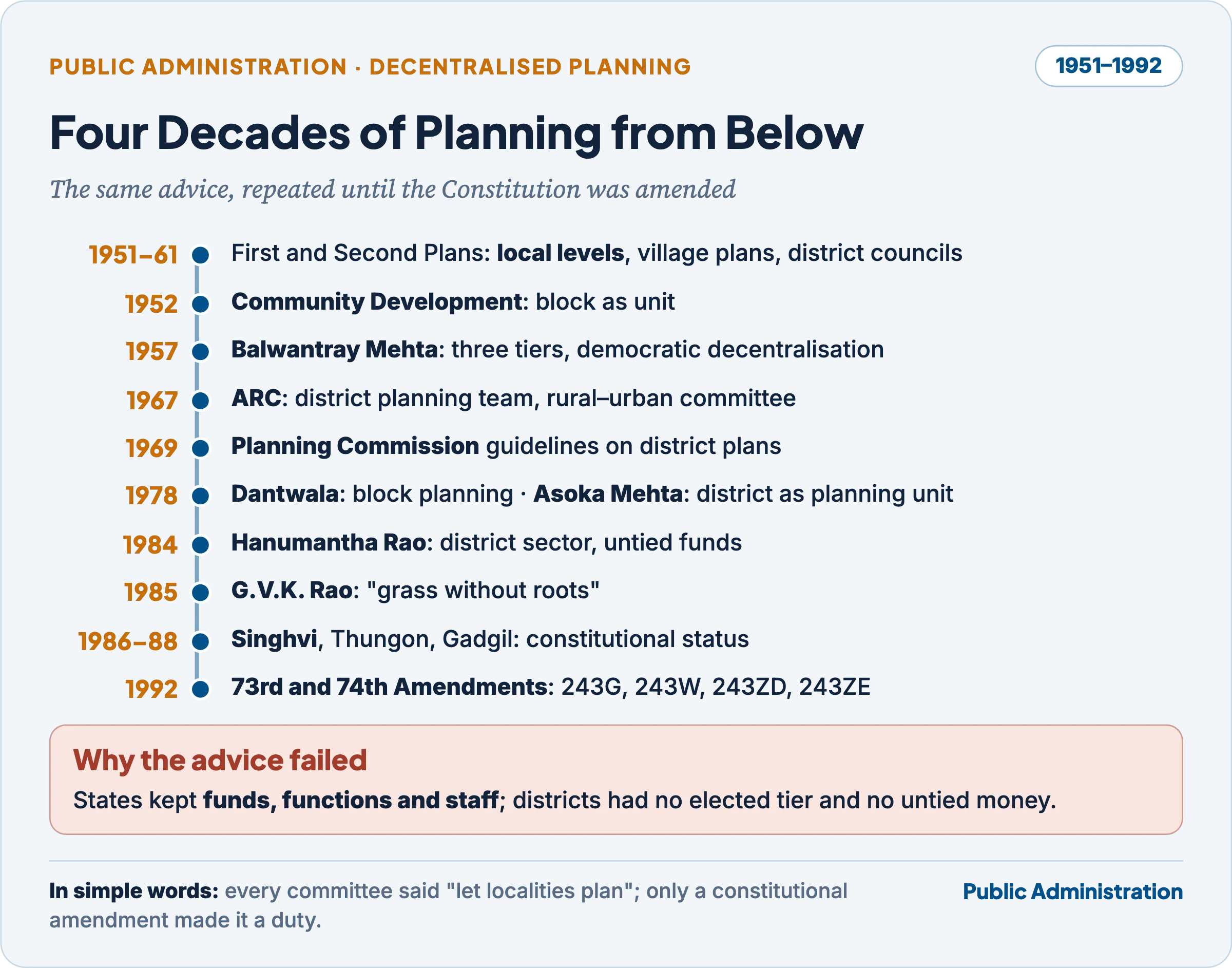
For forty years India kept promising that plans would start in the village. Committee after committee said the same things: give local bodies money, staff and real power, and plan for the whole district. Each time, State governments and departments held on to control, and local planning stayed mostly on paper. The 1992 Amendments were written to break this cycle.
2.1 The early Plans and Community Development
- The First Five Year Plan (1951–56) recognised the need to break the planning exercise into national, State, district and local community levels, but did not say how this would work.
- The Community Development Programme began on 2 October 1952, followed by the National Extension Service (1953). The development block became the unit, staffed by a Block Development Officer, extension officers for agriculture, animal husbandry, cooperation and panchayats, social education organisers and village level workers (multi-purpose field workers). Block Advisory Committees and District Development Committees of officials and non-officials were meant to involve people.
- The Second Plan (1956–61) added District Development Councils and the drawing up of village plans, with popular participation through democratic decentralisation. These did not succeed because no enabling framework for planning or for integrating activities at the micro level was devised.
2.2 Balwantray Mehta Study Team (1957)
- Appointed in January 1957 by the Committee on Plan Projects to review the Community Development Programme and National Extension Service; chaired by Balwantray Mehta; reported in November 1957.
- Finding: the “least successful” aspect of Community Development was its attempt to evoke popular initiative. District Boards were too large, lacked expertise and legitimacy, and were often under dual control.
- Recommendation: democratic decentralisation through a three-tier structure (village Panchayat, block Panchayat Samiti, district Zila Parishad) with statutory elected bodies, definite functions and resources. The Panchayat Samiti was to be the main executive body; the Zila Parishad was to be advisory and coordinating, chaired by the Collector.
- Planning link: local plans were to be the joint responsibility of people’s representatives assisted by development staff; the concept of block and district budgets was introduced, with a District Statistical Officer for planning and evaluation.
- Outcome: the NDC accepted the scheme in January 1958; Rajasthan inaugurated Panchayati Raj at Nagaur on 2 October 1959, and most States followed by the early 1960s.
Why Panchayati Raj did not become a planning system (as later reviews found):
- Lack of skill and help in planning: “district plans” were compilations of departmental schemes, with block plans as a statistical summary, presented to the Zila Parishad as a formality. The American economist Walter C. Neale described a Five Year Plan placed before a Zila Parishad in the morning and passed the same evening.
- Bureaucratic domination: officials prepared departmental plans, pooled them and sought approval; better information let them prevail.
- Inadequate financial powers: Zila Parishads could alter only about 10–15 per cent of budget items; schematic budgets of departments (such as road specifications) were beyond their reach.
- Subordinate status: the Collector could veto Zila Parishad acts, MLAs interfered, Centrally Sponsored Schemes bypassed them, and elections were postponed and bodies superseded, especially during the “plan holiday” (1966–69).
2.3 The ARC (1967) and the 1969 guidelines
- The Administrative Reforms Commission (1966–70), in its work on the machinery for planning (1967–68), found district planning ineffective because there was no clear idea of aims and resources and “the district had no planning expertise as such”.
- It recommended a district planning team led by a full-time Planning Officer, physical planning for the development of local resources, and a District Planning Committee of the Zila Parishad, municipal bodies, professional talent and district officers. Because Zila Parishads had no urban members, they were not the best agency for planning the district as a whole: this is the origin of the rural–urban DPC that the 74th Amendment adopted 25 years later.
- The ARC also urged that districts be told in advance the resources they would get, so they could prepare purposeful plans, and that State Planning Boards be set up.
- In 1969 the Planning Commission issued guidelines for district plans, describing the concept and the method of drawing up district plans within annual, medium-term and perspective plans. Several States prepared district plans in the Fifth Plan, but only Maharashtra, Gujarat and Karnataka integrated them into their annual plans.
Common confusion
Is the “Gadgil formula” the same thing as the “Gadgil Committee”? No. The Gadgil formula (1969) was devised under D.R. Gadgil, Deputy Chairman of the Planning Commission, to divide Central plan assistance among States using population, per capita income, tax effort and special problems; it was revised as the Gadgil–Mukherjee formula in 1991. It is multi-level planning between the Union and the States, and some States copied the idea to allocate a “district sector” among districts. The Gadgil Committee (1988) was a committee of the Congress party under V.N. Gadgil on Panchayati Raj, which recommended constitutional status, five-year terms, direct elections, reservations, State Finance and Election Commissions, and making Panchayats responsible for plans for socio-economic development. Its ideas went into the 64th Amendment Bill.
2.4 State experiments in the 1970s and 1980s
- Maharashtra (from 1974): District Planning and Development Councils (DPDCs) with a formula-based district sector of the State plan, which the council distributed among schemes; the most durable State-sector model of district planning.
- Gujarat: District Planning Boards with a discretionary outlay (about 15 per cent of the district plan) and an incentive outlay (about 5 per cent) to reward local contributions, while about 80 per cent of district-level schemes were still planned at the State level. An evaluation found it “only partially successful” and the role of Panchayats low.
- Karnataka: the Karnataka Zilla Parishads, Taluk Panchayat Samitis, Mandal Panchayats and Nyaya Panchayats Act, 1985, in force from 1987, made a directly elected Zilla Parishad the district planning and development body, closest to the Asoka Mehta model.
- West Bengal: regular panchayat elections from 1978, linked to land reform, and district and block planning bodies from the mid-1980s gave Panchayats a real role in planning and in rural employment works.
2.5 Dantwala Working Group on Block-Level Planning (1978)
- Chair: Prof. M.L. Dantwala, agricultural economist; set up by the Planning Commission; reported in 1978.
- Diagnosis: planning agencies at the district were remote from the scene of action, so allocations did not match location-specific needs; the Collector’s coordinating role was “largely undefined and informal”. District planning cells performed routine secretariat work.
- Recommendations:
- The block should be the basic sub-State planning level, linking clusters of villages to the district, region, State and nation.
- A core district planning team: a Chief Planning Officer plus six specialists (economist/statistician, cartographer/geographer, agronomist, engineer, industry officer, credit planning officer).
- Result: the Planning Commission issued block-level planning guidelines, and in June 1982 a Scheme for Strengthening of Planning Machinery at the District Level, with the Centre bearing half the cost. In practice, block planning became integrated rural development (IRDP) planning. At about the same time the Reserve Bank of India directed lead banks to prepare district credit plans, but these had little link with district development plans.
2.6 Asoka Mehta Committee (1978)
- Appointed in December 1977 by the Janata government; chaired by Asoka Mehta; reported in August 1978.
- Two-tier Panchayati Raj (Zila Parishad and Mandal Panchayat), with the district as the first point of decentralisation below the State and the basic unit of planning.
- Zila Parishad as the planning body: a committee of the whole Zila Parishad, with MLAs and MPs as members, to plan; all district-level development functions, staff and earmarked funds to move to it.
- Direct elections, reservation for SCs and STs, open participation of political parties.
- Outcome: a 1979 conference of Chief Ministers discussed it; Karnataka (and to an extent West Bengal and Andhra Pradesh) acted on its ideas, but most States did not.
2.7 Hanumantha Rao Working Group on District Planning (1984)
- Chair: Prof. C.H. Hanumantha Rao, Member, Planning Commission; set up in 1982; reported in May 1984.
- Findings: most States had some district planning body (Board, Council, Committee), usually chaired by the Collector, in some States (Maharashtra, Gujarat, Uttar Pradesh, Bihar) by a Minister of State. Technical staff ranged from two to six officers on deputation with no planning training. Planning from below was undermined by multiple streams of funding, rigid State guidelines and funds retained at the State level.
- Recommendations:
- Treat the district as part of a multi-level planning framework.
- Divide State plan funds into a State sector and a district sector, and allocate the district sector among districts by an objective formula.
- Distinguish district funds committed to State schemes from untied funds the district can use at its discretion; encourage local resource raising.
- A broad-based District Planning Body (about fifty members: Zila Parishad, Panchayat Samitis, municipalities, MLAs, MPs, banks, experts) with a smaller executive committee chaired by the Collector, and a District Planning Cell under a Chief Planning Officer ranking next to the Collector.
- Plan jointly for rural and urban areas; integrate DRDA, sectoral and famine-relief planning; District Planning cells in State Plan Departments.
- Character: a technocratic and administrative report. Its planning body could be set up by executive order, and it strengthened the Collector, in contrast with the Asoka Mehta emphasis on elected Zila Parishads.
2.8 G.V.K. Rao Committee (CAARD, 1985)
- Full name: Committee to Review the Existing Administrative Arrangements for Rural Development and Poverty Alleviation Programmes (CAARD); chair: G.V.K. Rao; 1985.
- Diagnosis: rural development had been bureaucratised and divorced from Panchayati Raj, producing what it called “grass without roots”.
- Recommendations: the Zila Parishad should be the principal agency to manage all development programmes at the district; district-level planning functions to be transferred to it; a District Development Commissioner (senior to the Collector) as its chief executive for development, separating developmental from regulatory work; a State Development Council, on the analogy of the NDC, to link district and State plans; endorsement of decentralised functions, powers and finances.
2.9 Towards constitutional status: Singhvi, Thungon and Gadgil
- L.M. Singhvi Committee (1986): prepared a concept paper on Revitalisation of Panchayati Raj Institutions for Democracy and Development. It recommended that local self-government be constitutionally recognised, protected and preserved as a third tier, with the Gram Sabha as the embodiment of direct democracy, regular elections, more finance and nyaya panchayats. It argued that development planning should be democratic planning, which “bureaucratic structures and devolutionary strategies” cannot achieve.
- P.K. Thungon Committee (1988): a sub-committee of the Parliamentary Consultative Committee; recommended constitutional recognition, the Zila Parishad as the pivot and the district planning and development agency, a five-year term, a State Finance Commission, a list of subjects in the Constitution and the Collector as chief executive of the Zila Parishad.
- V.N. Gadgil Committee (1988): see the confusion box above.
- 64th Amendment Bill (1989): passed by the Lok Sabha but defeated in the Rajya Sabha (October 1989), partly because States saw it as the Union reaching past them to local bodies. The 73rd and 74th Amendment Bills were introduced in 1991 and passed in December 1992.
2.10 Why the pre-1992 attempts failed
- Political and bureaucratic resistance at the State level to sharing power and resources with local institutions.
- Planning and authority were separated: the district was not a tier of government, so it could not set targets, mobilise resources or allocate them.
- Inadequate financial powers: few untied funds, negligible revenue powers, no borrowing.
- Central schemes in standard form (from the 1970s) left little room for local priorities.
- Inadequate planning machinery and untrained staff at the district.
- Pressure for decentralisation came from above (the Union and the Planning Commission), not from the grassroots, so it lacked a political constituency in the States.
- Absence of elected bodies: in most States Panchayati Raj elections were not held for long periods.
3. The 73rd and 74th Amendments: the Constitutional Scheme for Local Planning
In simple words
The 1992 Amendments did three things for planning. They told every Panchayat and Municipality that preparing plans for development and social justice is its job. They created a committee in every district (and every big city region) to join those plans together. And they created State Finance Commissions so that local bodies would have money to plan with. What they did not do was force States to hand over the work, money and staff.
3.1 The two Amendments at a glance
- 73rd Amendment Act, 1992 (in force 24 April 1993): added Part IX (Articles 243 to 243O) and the Eleventh Schedule (29 subjects) on Panchayats.
- 74th Amendment Act, 1992 (in force 1 June 1993): added Part IXA (Articles 243P to 243ZG) and the Twelfth Schedule (18 subjects) on Municipalities.
- States had one year to bring their laws into conformity (Articles 243N and 243ZF). 24 April is observed as National Panchayati Raj Day.
3.2 Article 243G: Panchayats as planning bodies
- Text in substance: subject to the Constitution, the Legislature of a State may, by law, endow Panchayats with such powers and authority as may be necessary to enable them to function as institutions of self-government, including provisions for the devolution of powers and responsibilities with respect to:
- (a) the preparation of plans for economic development and social justice;
- (b) the implementation of schemes for economic development and social justice as may be entrusted to them, including those in relation to the matters listed in the Eleventh Schedule.
- The key word is “may”. Devolution is discretionary: the Constitution describes what Panchayats should become but leaves the extent of powers to each State legislature. This single word explains most of the gap between design and practice.
- Eleventh Schedule (29 subjects), grouped:
- Agriculture and allied: agriculture and extension, land improvement and soil conservation, minor irrigation and watershed, animal husbandry, dairying and poultry, fisheries, social forestry and farm forestry, minor forest produce.
- Industry and livelihoods: small-scale industries including food processing, khadi, village and cottage industries, poverty alleviation programmes.
- Infrastructure: rural housing, drinking water, fuel and fodder, roads, culverts, bridges, ferries and waterways, rural electrification, non-conventional energy, markets and fairs, maintenance of community assets.
- Social sectors: education including primary and secondary schools, technical training and vocational education, adult and non-formal education, libraries, cultural activities, health and sanitation including hospitals and dispensaries, family welfare, women and child development, social welfare including welfare of the handicapped and mentally retarded, welfare of the weaker sections, in particular SCs and STs, public distribution system.
3.3 Article 243W: Municipalities as planning bodies
- Parallel to 243G: the State Legislature may endow Municipalities with powers to function as institutions of self-government, including responsibility for preparation of plans for economic development and social justice and implementation of schemes, including those on the Twelfth Schedule; and may endow Committees (such as Ward Committees) with powers.
- Twelfth Schedule (18 subjects) includes urban planning including town planning; regulation of land use and construction of buildings; planning for economic and social development; roads and bridges; water supply; public health, sanitation and solid waste management; fire services; urban forestry and environment; safeguarding the interests of weaker sections including the handicapped and mentally retarded; slum improvement and upgradation; urban poverty alleviation; urban amenities such as parks and playgrounds; cultural and educational aspects; burials and cremation grounds; cattle pounds; vital statistics; street lighting, parking and bus stops; and regulation of slaughter houses and tanneries.
- Note that planning itself is a Twelfth Schedule subject, whereas for Panchayats it sits in Article 243G(a). In many cities, however, town planning still rests with parastatal development authorities (bodies created by State law, outside the municipality), not with the elected council.
3.4 Article 243ZD: the District Planning Committee
- (1) There shall be constituted in every State at the district level a District Planning Committee to consolidate the plans prepared by the Panchayats and the Municipalities in the district and to prepare a draft development plan for the district as a whole.
- (2) The State Legislature may by law provide for the composition, the manner of filling seats, the functions relating to district planning assigned to it, and the manner of choosing the Chairperson. Not less than four-fifths of the members must be elected by, and from amongst, the elected members of the district Panchayat and of the Municipalities in the district, in proportion to the ratio between the rural and urban population of the district.
- (3) In preparing the draft plan, every DPC shall:
- (a) have regard to matters of common interest between Panchayats and Municipalities, including spatial planning, sharing of water and other physical and natural resources, integrated development of infrastructure and environmental conservation; and to the extent and type of available resources, financial or otherwise;
- (b) consult such institutions and organisations as the Governor may by order specify.
- (4) The Chairperson shall forward the development plan, as recommended by the DPC, to the State Government.
3.5 Article 243ZE: the Metropolitan Planning Committee
- A Metropolitan area is an area with a population of ten lakh or more, in one or more districts, consisting of two or more Municipalities or Panchayats or other contiguous areas, specified by the Governor by public notification (Article 243P(c)).
- (1) There shall be constituted in every Metropolitan area a Metropolitan Planning Committee to prepare a draft development plan for the Metropolitan area as a whole.
- (2) State law provides for composition and functions; not less than two-thirds of members are elected by, and from amongst, the elected members of the Municipalities and Chairpersons of the Panchayats in the area, in proportion to their populations; the law also provides for representation of the Government of India, the State Government and other organisations.
- (3) In preparing the plan the MPC shall have regard to the plans prepared by Municipalities and Panchayats; matters of common interest including coordinated spatial planning, sharing of water and natural resources, integrated infrastructure and environmental conservation; the overall objectives and priorities set by the Government of India and the State; and the extent and nature of investments likely to be made by Union and State agencies. It shall consult institutions the Governor specifies.
- (4) The Chairperson forwards the plan to the State Government.
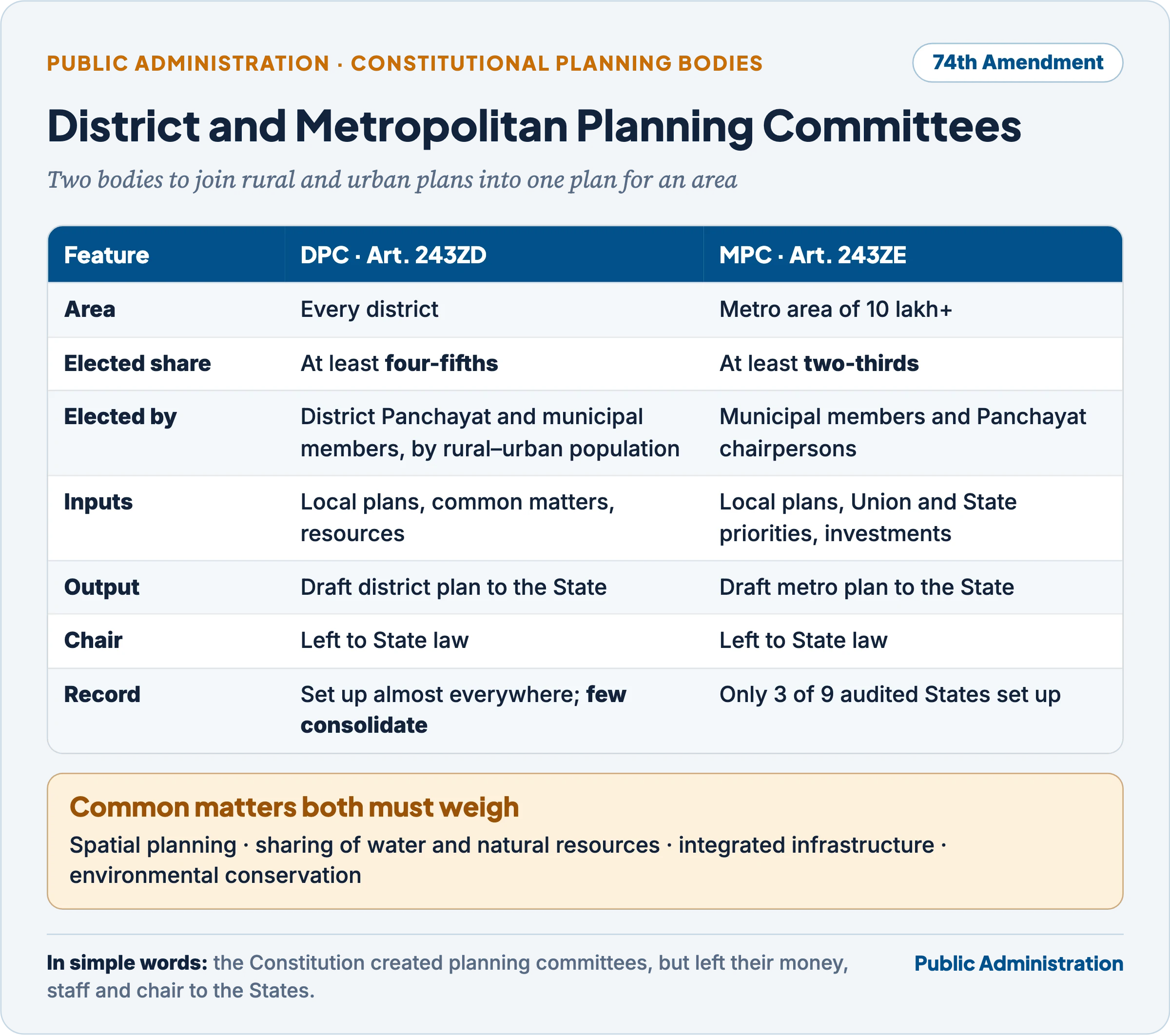
The comparison below sets the two committees side by side.
| Feature | DPC (Article 243ZD) | MPC (Article 243ZE) |
|---|---|---|
| Area | Every district | Metropolitan area of 10 lakh+ |
| Elected share | At least four-fifths | At least two-thirds |
| Elected by | Elected members of district Panchayat and Municipalities, in rural–urban population ratio | Elected members of Municipalities and Chairpersons of Panchayats in the area |
| Other members | Left to State law (often ministers, MLAs, MPs, officials) | Union and State government representatives, experts |
| Task | Consolidate local plans; draft district plan | Draft development plan for the metro region |
| Extra inputs | Common rural–urban matters, available resources | Also national and State priorities and planned investments |
| Plan goes to | State Government | State Government |
- Both committees are planning bodies, not executive bodies: their plans are drafts forwarded to the State, which keeps the final say. Neither the Constitution nor most State laws give them a budget of their own.
- The higher nominated share in the MPC reflects the large Union and State investments (railways, ports, highways, airports) that shape a metropolis.
Common confusion
Was the District Planning Committee created by the 73rd Amendment? No. Article 243ZD sits in Part IXA and was inserted by the 74th Amendment on Municipalities, although it covers rural areas too. This was deliberate: a district plan must join rural and urban plans, and Part IXA was the place where both Panchayats and Municipalities could be addressed together. The Constitution also does not say who chairs a DPC: State laws variously choose a Minister, the President of the District Panchayat or, in a few cases, the Collector.
3.6 Finance for local planning: SFCs and Article 280
- Own taxes: State law may authorise Panchayats (Article 243H) and Municipalities (Article 243X) to levy, collect and appropriate taxes, duties, tolls and fees, assign them State taxes, and provide grants-in-aid.
- State Finance Commission (Article 243I): the Governor constitutes a Finance Commission within one year of the 73rd Amendment and thereafter every fifth year to review the finances of Panchayats and recommend the distribution of State taxes between the State and Panchayats, the taxes assigned to them and grants-in-aid. Article 243Y applies the same Commission to Municipalities. The Governor lays its recommendations and an explanatory memorandum before the legislature.
- Union Finance Commission: Article 280(3)(bb) and (c) (inserted in 1992) ask it to recommend measures to augment the Consolidated Fund of a State to supplement the resources of Panchayats and Municipalities on the basis of the SFC’s recommendations. From the Tenth Finance Commission onward this has meant direct grants to local bodies (see Section 6.7 and the article on the Finance Commission and Fiscal Federalism).
- Why it matters for planning: a plan is only as real as the money behind it. Planning needs a predictable, formula-based, largely untied flow, which is what SFCs were meant to provide; most States have constituted SFCs late, accepted their reports partially and released less than recommended.
3.7 Participation and social justice built into the Amendments
- Gram Sabha (Article 243A): a body of all registered voters of a village, exercising powers given by State law. In practice it identifies needs, prioritises works, selects beneficiaries and conducts social audit.
- Ward Committees (Article 243S): compulsory in municipalities of three lakh or more population, to bring city planning closer to neighbourhoods.
- Reservation (Articles 243D and 243T): seats and chairpersons’ posts for SCs and STs in proportion to population and not less than one-third for women (many States have raised it to 50 per cent). The people who plan are therefore more representative than the old district boards.
- PESA, 1996: the Panchayats (Extension to the Scheduled Areas) Act applies Part IX to Fifth Schedule areas with modifications; section 4(e) requires every Gram Sabha to approve plans, programmes and projects for social and economic development before the Panchayat implements them, and to identify beneficiaries.
3.8 The 3Fs: functions, funds and functionaries
The 73rd and 74th Amendments are only an enabling frame; real decentralisation depends on what States actually transfer. This is summed up as the 3Fs.
- Functions: which subjects, and which activities within each subject, belong to which tier. Activity mapping, urged by the Round Tables of State Panchayati Raj Ministers convened by the Union Ministry of Panchayati Raj (2004) and by the 2nd ARC, breaks each subject into activities and assigns each to the lowest tier able to perform it (for example, in primary education: the Gram Panchayat maintains buildings and monitors attendance, the block runs teacher training, the State sets curriculum).
- Funds: own revenue, SFC devolution, Union Finance Commission grants and scheme funds. Planning requires a substantial untied share.
- Functionaries: staff who report to the local body rather than only to line departments. Without them, even a devolved function is performed by department staff on the department’s priorities.
The Articles and Acts for local planning at a glance:
| Provision | Content |
|---|---|
| Article 40 | DPSP: organise village panchayats as units of self-government |
| Article 243A | Gram Sabha |
| Article 243D, 243T | Reservation for SCs, STs and women in Panchayats and Municipalities |
| Article 243G | Panchayat powers: plans and schemes for economic development and social justice; Eleventh Schedule |
| Article 243H, 243X | Taxation powers and grants-in-aid |
| Article 243I, 243Y | State Finance Commission for Panchayats and Municipalities |
| Article 243P(c) | Definition of Metropolitan area (10 lakh+) |
| Article 243S | Ward Committees (3 lakh+ municipalities) |
| Article 243W | Municipal powers: plans for economic development and social justice; Twelfth Schedule |
| Article 243ZD | District Planning Committee |
| Article 243ZE | Metropolitan Planning Committee |
| Article 280(3)(bb), (c) | Union Finance Commission to augment State resources for local bodies |
| Eleventh / Twelfth Schedules | 29 Panchayat subjects / 18 municipal subjects |
| PESA Act, 1996, s.4(e) | Gram Sabha approval of plans in Scheduled Areas |
| VB–G RAM G Act, 2025, ss.4(3), 16 | Viksit Gram Panchayat Plans prepared through the Gram Sabha |
4. District and Metropolitan Planning Committees in Practice
In simple words
The Constitution says every district must have a planning committee. Almost every State has now set one up. But in most districts the committee meets rarely, has no office or experts of its own, and signs off lists of schemes prepared by departments. A planning committee without money, staff or time cannot plan.
4.1 State laws: who chairs and who serves
- Chairperson: State laws differ widely.
- A Minister (the minister in charge of the district) in Madhya Pradesh, Maharashtra, Uttar Pradesh, Punjab and several others; this makes the DPC an arm of the State government in the district.
- The President of the District Panchayat in Kerala and West Bengal (the Sabhadhipati of the Zilla Parishad); this keeps the DPC with the elected local tier.
- The Collector acts almost everywhere as member-secretary, giving the State bureaucracy control of the agenda and records.
- Nominated members commonly include MPs, MLAs and the heads of departments, so the one-fifth non-elected share often carries the political and administrative weight.
- Secretariat: usually the District Planning Officer or the district statistical office, part-time, with no technical team.
4.2 How far DPCs have been set up and how they work
The record can be traced through four official assessments.
- 2005–06 (Expert Group and Planning Commission): DPCs had been constituted in many States, but some (such as Uttar Pradesh, Uttaranchal, Jharkhand) had not notified them; Maharashtra, Uttar Pradesh and Uttaranchal ran minister-headed district planning and development councils with nominated members instead of 243ZD bodies. A study of 14 States found that in most, DPCs neither consolidated nor prepared district plans.
- 2009 (Government’s action taken report on the 2nd ARC): DPCs constituted in 21 States; Uttarakhand and Jharkhand were the main exceptions.
- 2024–25 (Devolution Index, Ministry of Panchayati Raj and the Indian Institute of Public Administration, released 14 February 2025): DPCs have been constituted “in almost all States”, but detailed grassroots planning consolidated at the DPC “is undertaken nowhere”; Kerala and Rajasthan scored highest on the DPC indicator, followed by Sikkim, then Goa, Gujarat, Haryana and Tamil Nadu.
- 2024 (CAG compendium on the 74th Amendment in 18 States, November 2024): in the 10 States examined on this point, DPCs existed, but only Kerala, Maharashtra and Uttarakhand produced annual district plans (and Uttarakhand without municipal inputs). Assam and Tamil Nadu had DPCs that did not function; Punjab and Telangana had not constituted them in any district.
4.3 Why DPCs remain weak
- No money of their own. The DPC forwards a draft; the State budget decides. Where there is no separate district sector in the State budget, allocations to Panchayats do not match the functions devolved by law.
- Tied funds. Funds reaching Panchayats are mostly tied to schemes; Centrally Sponsored Schemes on devolved subjects are the largest element. Little is left to plan.
- Line-department domination. Departments prepare their district schemes vertically and send them to the State; the “district plan” is a summation of these, not an integration.
- Minister and MLA control. Where a Minister chairs and MPs and MLAs sit as members, the DPC becomes a forum for legislators’ priorities; MPLADS (1993) and MLA local area funds are spent outside any plan.
- No secretariat or expertise. The DPC is “an intermittent meeting” rather than a permanent office; the Expert Group (2006) found this undermined its effectiveness as a constitutional institution.
- Timing. District planning follows the State’s budget calendar, so plans are compiled in a rush with little debate in Panchayats.
- Weak local plans to consolidate. If Gram Panchayat and municipal plans are poor lists of works, the DPC has nothing to integrate.
- Rural–urban divide. Municipalities, under urban departments and development authorities, rarely send plans to the DPC, so the convergence of rural and urban planning needs that 243ZD intended does not happen.
- Absence of national plans. With the end of Five Year Plans (2017) and the merger of plan and non-plan expenditure, the State plan into which district plans were meant to fit has itself become less defined in many States.
Indian Connect — A DPC that works: Kerala
In Kerala every Panchayat and Municipality prepares an annual plan through Grama/Ward Sabhas, working groups and a development seminar, enters it online, and sends it to the District Planning Committee, chaired by the District Panchayat President with the Collector as member-secretary. The DPC checks compliance with State guidelines and arranges technical vetting, but cannot alter the priorities set by the local body. The CAG found that the DPCs of all 14 districts approved the annual plans of local governments from 2015 to 2020. The difference from other States lies not in the Article but in the money (a fixed share of the State plan), the formula and the political commitment behind it.
4.4 Metropolitan Planning Committees
- The need: India’s million-plus cities are governed by many bodies at once: a municipal corporation, smaller municipalities, Panchayats on the fringe, a development authority, water and transport boards, railways and ports. An MPC is meant to be the one democratic forum for a region-wide plan.
- Kolkata: under the West Bengal Metropolitan Planning Committee Act, 1994, West Bengal constituted the Kolkata MPC, the first in the country: chaired by the Chief Minister, with 60 members of whom two-thirds are elected, and the Kolkata Metropolitan Development Authority (KMDA) as its technical secretariat. It is often cited as the model to emulate.
- Mumbai: Maharashtra’s 1999 law provides for MPCs with the Mumbai Metropolitan Region Development Authority as the planning support.
- Bengaluru: an MPC was constituted in 2014, but the CAG found it had met only three times (2016–2018) against the norm of once a quarter.
- CAG 2024: of the 9 audited States that must have MPCs, only 3 (Haryana, Karnataka, Maharashtra) had constituted them, in 7 cities; development plans were prepared only for Mumbai, Nagpur and Pune. In Haryana, plans were prepared by the Town and Country Planning Department and approved by a State committee, contrary to the 74th Amendment.
- Why MPCs lag:
- Parastatal dominance: development authorities (DDA, BDA, MMRDA and the like) report to State governments, hold land and planning powers, and see an elected MPC as a rival.
- State reluctance to share control of high-value urban land and investment.
- Mismatch of boundaries between metropolitan regions, districts and authorities.
- Reform proposals: the 2nd ARC recommended that an MPC be constituted for the extended metropolitan region, be deemed the DPC for that area, prepare a Master Plan/City Development Plan including peri-urban areas, absorb the planning departments of development authorities, and leave enforcement to local bodies; it also wanted the monopoly of development authorities over urban land development ended. Under JNNURM (2005), constitution of MPCs was one of the mandatory State-level reforms. For urban governance in general, see the article on Urban Local Government.
4.5 State Planning Boards and the link with district plans
- The ARC (1967) recommended State Planning Boards for plan formulation and continuing evaluation; by the 1970s all States had them, typically chaired by the Chief Minister, with a Deputy Chairman, official members (Finance Minister, Chief Secretary, Planning Secretary) and a few experts.
- Functions: assess State resources; formulate long-term and five-year plans; fix State priorities within national ones; assist district authorities in formulating district plans and coordinate them with the State plan; identify retarding factors; review progress.
- Weaknesses: boards in most States became extensions of the bureaucracy with little professional strength; State plans were prepared from Planning Commission guidelines and departmental proposals, so district plans were added at the end, if at all. The 2nd ARC asked that State plans be prepared only after consolidating local plans.
- Recent change: several States have converted planning boards into State Institutions for Transformation on the NITI model (for example, Maharashtra’s MITRA, set up in 2022), which advise on strategy rather than consolidate district plans.
5. Decentralised Planning in the States: Leaders and Laggards
In simple words
The same Constitution produced very different results in different States. Where a State government chose to give local bodies a fixed share of its plan money, trained people to plan and let villagers argue over priorities, local planning became real. Where it did not, the committees exist but nothing much happens in them.
5.1 Kerala: the People’s Plan Campaign (1996)
- Launch: 17 August 1996, by the Left Democratic Front government, at the start of the Ninth Plan; a 400-member advisory committee was chaired by E.M.S. Namboodiripad; the State Planning Board under Vice-Chairman I.S. Gulati ran it, with T.M. Thomas Isaac as a leading organiser.
- Money: in July 1996 Kerala decided to devolve 35 to 40 per cent of the State plan outlay to local governments as largely untied grants, through a separate budget document and a devolution formula. At least 30 per cent had to go to productive sectors, not more than 30 per cent to infrastructure, and at least 10 per cent to a Women Component Plan.
- Process (the planning cycle):
- Grama Sabhas / Ward Sabhas identify problems and needs.
- A development report for each local body analyses its resources and status.
- A development seminar discusses priorities and forms task forces (later working groups) by sector, chaired by elected members and convened by officials.
- Task forces turn demands into projects; the plan document matches projects to resources.
- Back to the Grama Sabha for final discussion; council approval.
- Expert committees (from the Voluntary Technical Corps of retired engineers and professionals) vet projects; the DPC approves the plan without altering priorities.
- Mass mobilisation: about 600 key resource persons, 10,000 district resource persons and one lakh local resource persons were trained; the Kerala Sastra Sahitya Parishad (a people’s science movement) and the Kerala Institute of Local Administration (KILA) supported training.
- Institutionalisation: functions, institutions and staff were transferred (October 1995 to July 2000); the Committee on Decentralisation of Powers (Satyabrata Sen Committee) led to the restructuring of the Kerala Panchayat Raj and Municipality Acts in 1999; transferred staff got dual accountability to local bodies and departments.
- Achievements: large numbers of houses, roads, drinking water schemes and anganwadis; women’s neighbourhood groups that grew into Kudumbashree (1998); a planning culture that survives in every local body; consistently among the top States in devolution indices.
- Criticisms:
- Quality of projects: many small, scattered works; productive-sector projects underperformed.
- Politicisation: the campaign was seen as a party project; participation in Grama Sabhas fell after the first years.
- Routinisation: over time the campaign became a bureaucratic procedure with guidelines, deadlines and software, losing its movement character.
- Social capital pre-existed: high literacy, strong civil society and party competition made Kerala exceptional; its model is hard to transplant.
5.2 Karnataka
- Pre-1993 pioneer: the 1985 Act (under Chief Minister Ramakrishna Hegde and Rural Development Minister Abdul Nazir Sab) created directly elected Zilla Parishads (1987) with district-sector budgets and staff under them.
- After 1993: the Karnataka Panchayat Raj Act, 1993 and later amendments put district-sector schemes under Zilla Panchayats with a separate link document in the State budget showing funds for each tier.
- Recent standing: first in the Devolution Index 2024 (score 72.23), ahead of Kerala and Tamil Nadu, on the strength of its functions, finances and accountability dimensions.
- Weakness: urban planning remains with parastatals; the Bengaluru MPC has scarcely functioned.
5.3 West Bengal
- Panchayat elections from 1978 under the Left Front, combined with Operation Barga (registration of sharecroppers) and land reform, made Panchayats the main agencies for rural works and beneficiary selection.
- District and block planning committees from the mid-1980s and the West Bengal District Planning Committee Act after 1992; the Kolkata MPC pioneered metropolitan planning.
- Criticism: party control of Panchayats; studies by Pranab Bardhan and Dilip Mookherjee examined how benefits were distributed through party networks and to what extent local elites captured them.
5.4 Madhya Pradesh: “district government” (1999)
- Legal base: the Madhya Pradesh Zila Yojana Samiti Adhiniyam, 1995 set up DPCs with a Minister nominated by the State as Chairperson and the Collector as Member-Secretary, and four-fifths elected members.
- District government (Zila Sarkar): from 1 April 1999 the Digvijaya Singh government delegated to DPCs powers of the State government that had not gone to Panchayats and municipalities, so the DPC (with MLAs and MPs) functioned as the district unit of government; the Collector issued orders on its decisions. Monthly meetings were compulsory.
- Significance: the most ambitious attempt to make the district a governing tier; it speeded decisions and brought them nearer the people.
- Criticism: it was deconcentration to the district under a Minister, not devolution to elected local bodies; it strengthened ministers and MLAs over Zila Panchayats; it did not outlast the government that created it.
5.5 Maharashtra and others
- Maharashtra retains its long-standing District Planning Committees (successors of the DPDCs) chaired by the guardian minister, with a formula-based district annual plan approved by the State; the CAG found district plans duly prepared and approved from 2015–16 to 2020–21, but these are essentially State-sector plans for the district, with weak inputs from local bodies.
- Rajasthan scored well on DPC functioning in the 2024 Devolution Index; Tamil Nadu and Gujarat score highly on functionaries and capacity, less on planning.
5.6 Why district planning is prominent in a few States and marginal in many
| Factor | Where planning took root | Where it stayed marginal |
|---|---|---|
| Political will | Ruling parties saw local power as their base (Kerala, West Bengal, Karnataka) | Legislators and ministers saw Panchayats as rivals |
| Money | Fixed, formula-based, untied share of State plan | Scheme-tied funds; no district sector |
| History | Panchayati Raj and district planning before 1992 | Long supersession of local bodies |
| Civil society | Literacy, people’s science movements, cooperatives | Weak associations; caste-based patronage |
| Bureaucracy | Staff transferred with dual accountability | Departments kept staff and schemes |
| Party competition | Competitive, programme-based parties | Clientelist politics |
The table supports the view that decentralised planning succeeds where State-level political actors gain from it; constitutional mandates alone have not produced it.
6. Gram Panchayat Development Plans and the Planning Ecosystem since 2015
In simple words
Since 2015 every Gram Panchayat in India has been asked to make a yearly development plan, because Finance Commission money now goes straight to it. Each year from 2 October special Gram Sabhas discuss what the village needs, and the plans are uploaded online. In 2026 a new law on rural jobs made a village plan, the Viksit Gram Panchayat Plan, the basis for all rural employment works.
6.1 From district plans to Panchayat plans
- Expert Group on Planning at the Grassroots Level (2005–06): set up by the Ministry of Panchayati Raj under V. Ramachandran (former Vice-Chairman, Kerala State Planning Board), on the recommendation of the Second Round Table of State Ministers of Panchayati Raj; its report (2006) was accepted by the Ministry and the Planning Commission. Its recommendations are in Section 8.3.
- Planning Commission guidelines (25 August 2006) for district plans in the Eleventh Plan; a Manual for Integrated District Planning prepared by a Task Force was issued in 2008. The manual laid down a district vision (10–15 years), stocktaking, participatory plans at each tier, consolidation by the DPC and integration with the State plan.
- Backward Regions Grant Fund (BRGF, 2006–07): for about 250 backward districts, with untied funds released only against district plans consolidated by the DPC; it was the first large Union scheme that made DPC-approved plans a condition of funding. It was delinked from Union support in 2015–16.
- Fourteenth Finance Commission (2015–20): recommended grants of ₹2,87,436 crore to local bodies, of which ₹2,00,292 crore went directly to Gram Panchayats (90 per cent basic, 10 per cent performance), on the condition that they be spent on basic services through a plan. In October 2015 the Ministry of Panchayati Raj issued model GPDP guidelines, and States issued their own.
- Mission Antyodaya (2017): an annual survey of village infrastructure and services that gives gap data for planning.
6.2 The People’s Plan Campaign: “Sabki Yojana Sabka Vikas” (2018 onward)
- Launched on 2 October 2018 by the Ministry of Panchayati Raj and run every year from 2 October to 31 January to prepare plans for the next financial year.
- Method: structured special Gram Sabhas where frontline workers of line departments (health, education, agriculture, ICDS, water) present the status of their sectors; facilitators are appointed for each Panchayat; public information boards display schemes and finances; the Ministry works with about 20 line Ministries to secure their participation.
- Coverage: extended to Block Panchayat Development Plans (BPDP) and District Panchayat Development Plans (DPDP); BPDPs have been uploaded from the 2022–23 plan year.
- Content: integration of Village Poverty Reduction Plans prepared by SHG federations under the rural livelihoods mission, and from 2022 the nine themes of Localised Sustainable Development Goals (LSDGs).
- Scale (as on 29 July 2025): more than 18.13 lakh Panchayat Development Plans uploaded from 2019–20 to 2025–26, including over 17.73 lakh GPDPs, 35,755 BPDPs and 3,469 DPDPs. For 2025–26, 2,54,604 of 2,64,211 Gram Panchayats (96.36 per cent) had uploaded GPDPs by 11 March 2026.
The cycle below is the standard sequence a Gram Panchayat follows each year.
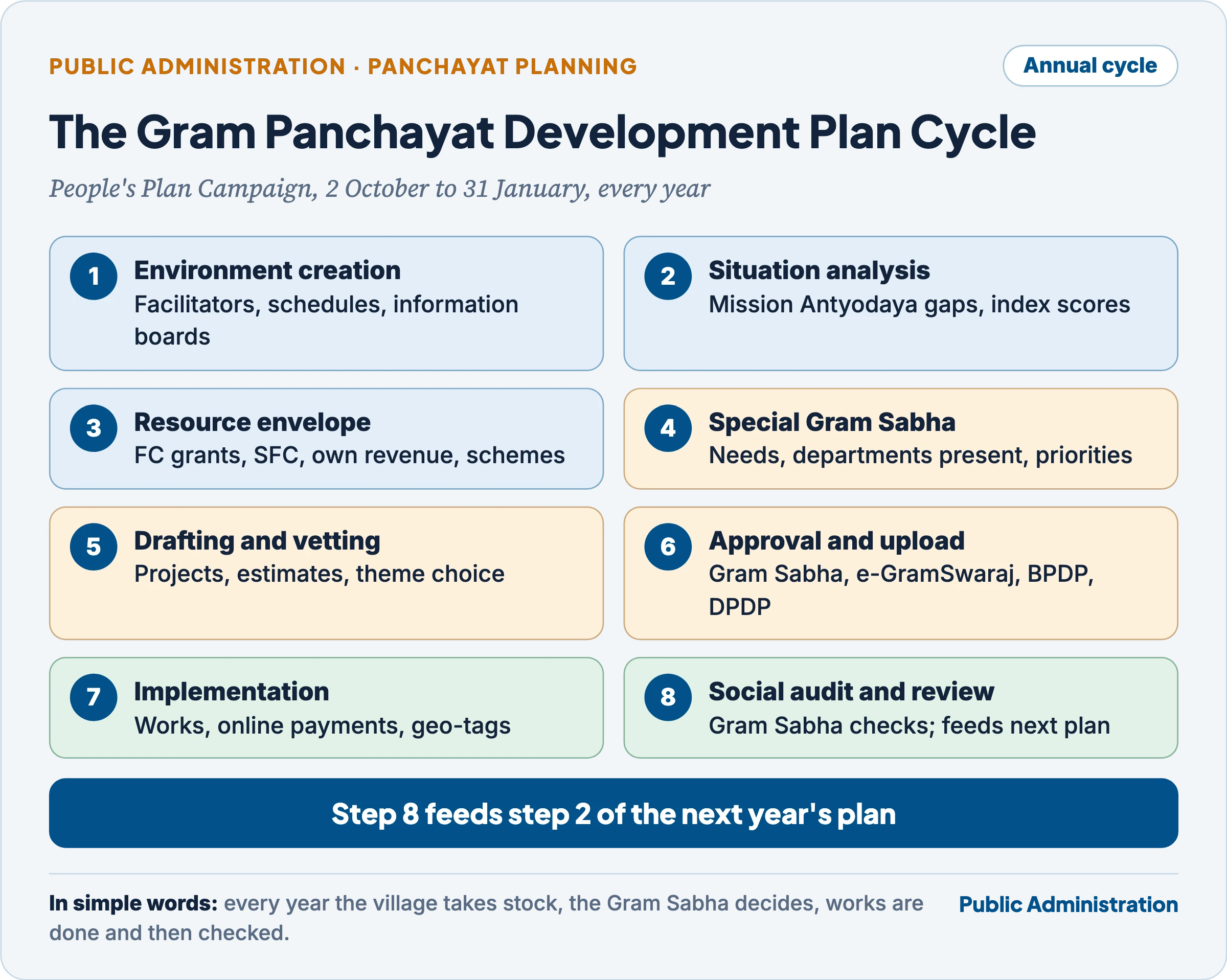
- Environment creation: awareness, appointment of facilitators, schedule of Gram Sabhas, public information boards.
- Situation analysis: Mission Antyodaya gap data, the Panchayat Advancement Index scores, review of the previous plan and unspent Finance Commission grants.
- Resource envelope: Finance Commission grants, SFC devolution, own revenue, and convergence with schemes (rural employment, housing, water, sanitation, livelihoods).
- Special Gram Sabha: needs and demands, presentations by line departments, the women’s and children’s sabhas where held; prioritisation by LSDG theme.
- Drafting and vetting: the Gram Panchayat (and its working groups or standing committees) prepares projects; technical estimates by engineers.
- Approval and upload: the Gram Sabha approves, the Panchayat adopts; the plan is uploaded on e-GramSwaraj and consolidated in the BPDP and DPDP.
- Implementation: works executed and paid online through the e-GramSwaraj–PFMS interface; assets geo-tagged.
- Social audit and review: the Gram Sabha reviews progress; findings feed the next cycle.
6.3 Localised SDGs and the Panchayat Advancement Index
- LSDG themes (adopted 2022): poverty-free and enhanced livelihoods; healthy; child-friendly; water-sufficient; clean and green; self-sufficient infrastructure; socially just and socially secured; good governance; women-friendly Panchayat. Panchayats are encouraged to take thematic GPDPs around one or more themes.
- Panchayat Advancement Index (PAI): baseline report for 2022–23 released on 9 April 2025; built on 435 local indicators across the nine themes, aligned with MoSPI’s National Indicator Framework. Of 2,16,285 Gram Panchayats with validated data, 699 were “Front Runners”, 35.8 per cent “Performers”, 61.2 per cent “Aspirants” and none “Achievers”. PAI scores now guide the People’s Plan Campaign.
6.4 Digital tools
- e-GramSwaraj (launched 24 April 2020): a single portal for Panchayat planning, accounting, progress reporting and asset tracking, integrated with PFMS so that Finance Commission funds move online to Panchayats and from them to vendors. In 2025–26, more than 2.55 lakh Gram Panchayats uploaded plans and Panchayati Raj institutions transferred about ₹53,342 crore through the interface.
- Meri Panchayat app (citizen access to plans and works), Gram Manchitra (GIS-based spatial planning), Panchayat NIRNAY (Gram Sabha meeting records) and SabhaSaar (AI-generated minutes of Gram Sabha meetings).
- Significance: digital tools increase transparency and upward reporting; critics note they can turn planning into data entry for compliance, which strengthens upward accountability to the Ministry more than downward accountability to the Gram Sabha.
6.5 Viksit Gram Panchayat Plans under the VB–G RAM G Act, 2025
- The Act: the Viksit Bharat – Guarantee for Rozgar and Ajeevika Mission (Gramin) Act, 2025 (VB–G RAM G) was enacted in December 2025 and replaced the Mahatma Gandhi NREGA; the scheme has been implemented across rural India from 1 July 2026. It guarantees 125 days of wage employment per rural household and runs as a Centrally Sponsored Scheme with 60:40 Centre–State sharing (90:10 for North-Eastern and Himalayan States and J&K).
- Planning provisions:
- Section 4(3): rural works are planned through Viksit Gram Panchayat Plans (VGPPs) prepared by Gram Panchayats.
- Section 16: every Gram Panchayat prepares a VGPP through a participatory process; the Gram Sabha identifies and prioritises the permissible works; approved VGPPs are consolidated at Intermediate and District Panchayat levels into Block and District Plans.
- VGPPs are meant to be bottom-up, convergence-based and saturation-oriented, aggregated into a Viksit Bharat National Rural Infrastructure Stack and spatially integrated with PM Gati Shakti; the Yuktdhara GIS tool supports the identification of works.
- Thematic priorities: water security, core rural infrastructure, livelihood infrastructure, and works against extreme weather.
- Normative allocation of funds to States on objective parameters, with transparent intra-State distribution to districts and Gram Panchayats; States may notify up to 60 days a year (peak agricultural seasons) when works are not taken up.
- Assessment:
- For decentralised planning: a statutory, Gram Sabha-based plan for the largest rural works programme; consolidation at block and district levels follows the constitutional multi-level logic; GIS tools can improve the quality of plans.
- Concerns raised by critics: the menu of permissible works, national themes and a normative allocation fixed from above can make the VGPP a template filled locally rather than a plan chosen locally; a demand-driven guarantee becomes a budget-bound programme; States bear a larger share; and technology-led planning may shift influence from the Gram Sabha to technical staff and dashboards. How far VGPPs merge with the wider GPDP will decide whether India ends up with one village plan or two.
6.6 Finance Commission grants as the engine of local planning
Union Finance Commission grants are now the most dependable source of untied money for local planning. The table compares the last three awards.
| Commission | Period | Local body grants | Main design for rural bodies |
|---|---|---|---|
| Fourteenth (Y.V. Reddy) | 2015–20 | ₹2,87,436 crore (₹2,00,292 crore to GPs) | Only to Gram Panchayats; 90% basic (untied for basic services), 10% performance |
| Fifteenth (N.K. Singh) | 2021–26 | ₹4,36,361 crore (rural ₹2,36,805 crore; urban ₹1,21,055 crore; health ₹70,051 crore) | All three tiers; 60% tied (drinking water and rainwater harvesting; sanitation and ODF), 40% untied; online accounts as entry condition |
| Sixteenth (Arvind Panagariya) | 2026–31 | ₹7,91,493 crore (rural ₹4,35,236 crore; urban ₹3,56,257 crore) | Basic 80% (half tied to sanitation/solid waste and water, half untied), performance 20% (entirely untied, split between local body and State performance) |
- The Sixteenth Finance Commission (report tabled on 1 February 2026) set three entry conditions for any State to receive local body grants: duly constituted local bodies under Parts IX and IXA; provisional and audited accounts of all local bodies online; and regular constitution of SFCs with the action taken report laid within six months. Its State performance grant rewards States that transfer a minimum share of their own resources to local bodies.
- Significance: by tying Union money to elections, accounts and SFCs, the Finance Commission now enforces the 1992 framework more effectively than any committee report did. But the growing tied share (to national priorities) narrows what Gram Sabhas can actually choose.
6.7 Aspirational Districts and Blocks: centrally driven district planning
- Aspirational Districts Programme (ADP): launched in January 2018, coordinated by NITI Aayog, covering 112 of the least developed districts. It ranks districts monthly on 49 key performance indicators across five themes (health and nutrition, education, agriculture and water resources, financial inclusion and skill development, basic infrastructure). Its method is the 3Cs: convergence of Union and State schemes, collaboration among officials, citizens and NGOs, and competition through “delta” (improvement) rankings. A UNDP appraisal (2021) called it a successful model of local development.
- Aspirational Blocks Programme (ABP): launched on 7 January 2023 for 500 blocks, with 40 indicators.
- How it relates to decentralised planning:
- Strengths: real-time data, a district-level focus, convergence that DPCs failed to achieve, and attention to the most deprived districts.
- Limits: it is Collector-led and NITI-monitored, i.e. deconcentration in Rondinelli’s terms. Indicators are chosen nationally, the DPC and Zila Parishad have no formal role, and the competition logic rewards measurable outputs. It shows that the State can plan at the district level effectively when it wants to, but through officials rather than elected bodies.
6.8 Parallel bodies that bypass local planning
- MPLADS (1993) and State MLA local area development schemes: legislators recommend works outside the plans of Panchayats and Municipalities.
- DISHA (District Development Coordination and Monitoring Committee, 2016): chaired by the senior-most MP of the district, to monitor Union schemes; it overlaps the DPC’s coordinating role.
- DRDAs (District Rural Development Agencies): registered societies that ran poverty programmes outside Zila Parishads for decades. The Union discontinued the DRDA Administration scheme from 1 April 2022 and asked States to merge DRDAs with Zila Parishads, a belated step towards the G.V.K. Rao Committee’s vision.
- Development authorities, water and transport boards, special purpose vehicles (for example, Smart City SPVs) in cities.
- Scheme committees (water and sanitation committees, school management committees, forest committees) with their own funds, often not accountable to the Gram Panchayat.
7. Planning for Social Justice at the Local Level
In simple words
Social justice in local planning means that a village plan must not only build roads but also make sure that Dalit hamlets, tribal settlements, women and the poorest households get their share. The Constitution gives these groups seats in local bodies; planning rules try to give them a share of the money; whether they get a real voice depends on local power.
7.1 What “social justice” adds to local planning
- Article 243G does not ask for plans for “development” alone but for economic development and social justice, signalling that local plans must address distribution: who benefits from works and services.
- Instruments:
- Representation: reservation for SCs, STs and women (Articles 243D, 243T).
- Earmarking: shares of plan funds for SCs, STs and women.
- Process: separate sabhas for women and marginalised groups, beneficiary selection in the Gram Sabha, social audit.
- Themes: the LSDG themes “socially just and socially secured” and “women-friendly” Panchayat.
7.2 SC and ST sub-plans at the local level
- Tribal Sub-Plan (TSP) from the Fifth Plan (1974–75) and Special Component Plan for SCs from 1979, renamed Scheduled Castes Sub-Plan (SCSP) in 2006: each ministry and State earmarks plan funds at least in proportion to the SC and ST population. After the merger of plan and non-plan spending (2017), these continue as allocations for the welfare of SCs and STs in Union and State budgets.
- Local earmarking: Kerala devolves SCSP and TSP funds to local governments as separate allocations that can be spent only on projects benefiting SC and ST households and habitations.
- Statutory sub-plans: undivided Andhra Pradesh (2013) and Karnataka (2013) passed laws making SCSP and TSP allocation and utilisation mandatory; Telangana later replaced the Andhra law with its own special development fund law (2017).
- PESA areas: Gram Sabhas in Scheduled Areas approve plans and identify beneficiaries; this is the strongest legal voice for tribal communities in planning, though many States have framed PESA rules late.
7.3 Women and gender in local planning
- From welfare to empowerment: women’s programmes in India moved from welfare (1950s–70s: relief, maternal and child care, women as beneficiaries) to development (Sixth Plan, 1980–85, the first with a chapter on women and development) to empowerment (Ninth Plan onward: women as agents and decision-makers, with the Women’s Component Plan earmarking at least 30 per cent of funds in women-related sectors). The emphasis shifted from consumption to recognising women as contributors to the economy, through SHGs, credit, skills and property rights (see the article on Women and Development: the Self-Help Group Movement).
- Local planning instruments:
- Women Component Plan in Kerala (at least 10 per cent of local plan funds since 1996).
- Mahila Sabhas (women’s assemblies) held before the Gram Sabha in several States, such as Maharashtra.
- Gender budgeting at the local level: Union gender budget statements since 2005–06; some States and local bodies tag their own spending.
- The “women-friendly Panchayat” LSDG theme, and SHG-prepared Village Poverty Reduction Plans in the GPDP.
- Representation: women are nearly half of all elected Panchayat representatives.
- Evidence: Raghabendra Chattopadhyay and Esther Duflo (“Women as Policy Makers”, Econometrica, 2004), studying randomly reserved posts in West Bengal and Rajasthan, found that women heads invested more in public goods that women had asked for, such as drinking water.
- Limits: proxy rule by male relatives (“sarpanch-pati“), low attendance of women in Gram Sabhas, and patriarchal norms. The Ministry of Panchayati Raj set up an advisory committee in 2023 on proxy representation, and several States have issued orders against it.
Indian Connect — Kudumbashree: a women’s agency woven into local planning
Kudumbashree, the State Poverty Eradication Mission of Kerala launched in 1998, organises poor women into neighbourhood groups, area development societies and community development societies attached to each local government. These groups take part in Grama Sabhas, prepare anti-poverty sub-plans, run micro-enterprises and implement Women Component Plan projects. The structure links a welfare agency to elected local bodies, so women are planners and implementers rather than passive beneficiaries. It is the model on which the national rural livelihoods mission’s SHG federations, and their Village Poverty Reduction Plans, were later built.
7.4 Does decentralised planning deliver social justice?
- Arguments that it does: reservation has brought lakhs of SC, ST and women leaders into office; Gram Sabhas select beneficiaries in public, reducing arbitrary selection; earmarked funds reach habitations that departmental planning ignored; evidence from reserved seats shows changes in what is built.
- Arguments that it does not, or not enough:
- Elite capture: dominant castes and landed groups can capture Gram Sabhas and plans. Pranab Bardhan and Dilip Mookherjee (“Capture and Governance at Local and National Levels”, American Economic Review, 2000) showed theoretically that local governments can be more prone to capture than central ones when local inequality is high and voters are poorly informed.
- Inadequate resources: with small untied funds, a socially just plan has little to redistribute; tied grants follow national priorities.
- Local politics: partisan and caste rivalries decide who benefits; participation of marginalised groups is often token, and in some regions participatory forums have become arenas of division rather than deliberation.
- Weak implementation: plans are approved but works are delayed, poorly built or diverted.
- Balance: decentralisation creates the space for social justice but does not guarantee it; it needs reservation plus earmarking plus information plus independent social audit plus State support.
7.5 From plan to implementation
- The gap: Indian planning has long been better at making plans than at implementing projects. At the local level the gap is wider: works are chosen but technical sanction, tendering and payments are controlled by departments; engineers are few; funds arrive late; the planning calendar does not match the working season.
- Remedies tried: Kerala’s Voluntary Technical Corps and expert committees; standing committees of Panchayats for implementation, from estimate to utilisation certificate (Expert Group, 2006); online payments and geo-tagging; social audit under the employment guarantee laws; 4 per cent of untied grants for accounting, audit and capacity (Expert Group, 2006).
- Lesson: development administration is ultimately about delivering projects; decentralised planning improves the choice of projects but must be matched by local implementing capacity and functionaries accountable to local bodies (see the article on Development Administration).
8. Problems, Reforms and the Way Forward
In simple words
After thirty years, the constitutional design of local planning is in place, but local bodies still get too few functions, too little free money and too few staff of their own. Expert groups have offered the same remedies for decades: a fixed share of State funds, a working district planning committee with its own office, a planning calendar, and staff answerable to local bodies.
8.1 The problems in one place
- Formal compliance, real centralisation: DPCs exist almost everywhere, but plans are not consolidated (Devolution Index 2024; CAG 2024).
- The 3F deficit: functions transferred on paper; finances tied; functionaries answerable to departments. The national average Devolution Index score is only 43.89 (2024), with the functions dimension weakest (29.18).
- Line-department domination: departmental schemes and vertical hierarchies; transferred staff report upward.
- Centrally Sponsored Schemes: uniform guidelines, matching shares and tied funds crowd out local priorities, though many now require village-level planning.
- Political interference: ministers chairing DPCs, MLA and MP funds, DISHA, and local politicians’ pressure on beneficiary lists.
- Capacity: no planners or engineers at the Panchayat level; weak data; training not followed by support.
- Parallel bodies: DRDAs (until 2022), development authorities, scheme committees, SPVs.
- Financial weakness: low own revenue; SFCs constituted late, their reports not acted on; the CAG found a 42 per cent gap between resources and expenditure of urban local bodies and 37 per cent staff vacancy (2024).
- Elections and supersession: delayed local elections (for example, over OBC reservation after 2021) leave bodies without elected members, and DPCs without electors.
- Participation fatigue: low Gram Sabha attendance and quorum problems; plans prepared by officials and “approved” by thin meetings.
- Rural–urban divide: municipal plans rarely reach DPCs; metropolitan regions lack MPCs.
- Loss of the national anchor: without Five Year Plans, multi-level planning has lost its upper levels; local plans now feed schemes and dashboards more than State plans.
8.2 The well-entrenched State, reforms and welfare
- The legacy: India entered the 1990s with a well-entrenched State: a large bureaucracy, departmental empires, licensing powers and a political class that distributed patronage through them. Gunnar Myrdal (Asian Drama, 1968) called it a soft state that makes laws it does not enforce; Pranab Bardhan (The Political Economy of Development in India, 1984) showed how a coalition of industrial capitalists, rich farmers and professionals (including the bureaucracy) competed for State subsidies.
- The post-reform promise: the 1991 reforms promised a leaner State that would steer rather than row; the 1992 Amendments, passed in the same years, promised to push power down to local governments. Both promises collided with the entrenched State: economic decontrol happened mainly at the Union level, while State governments and their departments kept control of the functions, funds and staff that the Amendments meant to devolve. Reform freed markets more than it freed local bodies.
- Globalisation and the welfare obligation: Directive Principles (Articles 38, 39, 41, 47) and laws on food, education and employment make welfare a constitutional and legal obligation of both Union and States “within available resources”. Globalisation and fiscal discipline (FRBM laws) narrowed fiscal space, but welfare spending did not disappear: it was re-routed through targeted schemes, direct benefit transfers and local bodies (Finance Commission grants, GPDPs, employment guarantee works). The obligation holds, but its delivery has moved downward and become more conditional.
8.3 Expert Group on Planning at the Grassroots Level (V. Ramachandran, 2006)
- Activity mapping and devolution of functions, funds and functionaries before planning begins.
- Resource envelope: States to tell each Panchayat and Municipality in advance the extent and type of resources available; funds to be untied as far as possible; a Panchayat sector in each departmental budget.
- DPC as a permanent institution with an adequate secretariat and access to experts; not merely an intermittent meeting, but not a new layer of bureaucracy to vet people’s plans.
- Annual plan proposals of States to show district-wise and tier-wise allocations, work towards a district plan outlay of 30 per cent of the State plan and untied funds of 25 per cent of the district plan, and earmark 4 per cent of untied grants for accounting, audit, dissemination and capacity building.
- Standing committees of Panchayats to handle implementation from conception to utilisation certificate; priority to basic minimum needs (literacy, primary health, drinking water, rural roads, housing for the poor, nutrition, livelihoods, electrification).
- Consolidation: each tier prepares five-year and annual plans; the DPC consolidates; the Planning Commission to ensure district plans precede approval of State plans.
- Social audit norms (later endorsed by the 2nd ARC).
8.4 Second ARC, Sixth Report: Local Governance (2007)
The Second Administrative Reforms Commission (chair M. Veerappa Moily) submitted Local Governance: An Inspiring Journey into the Future in October 2007. Its principles were democratic decentralisation, subsidiarity (what can be done at a lower level should not be centralised), clear delineation of functions, financial devolution and citizen-centric convergence.
- On planning:
- District Council: a third tier of representative government at the district, with rural and urban representation, absorbing the DPC’s role (the government did not accept this).
- In the interim, DPCs within three months of local elections, as the sole planning body for the district, with a planning office under a full-time District Planning Officer.
- Development authorities in urban districts to become the technical arms of DPCs.
- A dedicated centre in every district to provide data and inputs to local bodies.
- Strict implementation of the Planning Commission guidelines and the Expert Group’s recommendations.
- A planning calendar with deadlines for each tier.
- State Planning Boards to integrate district plans; State plans only after consolidating local plans.
- On metropolitan planning: MPCs for extended metropolitan regions, deemed DPCs there; MPCs to prepare master plans; planning departments of development authorities merged with DPCs/MPCs; end the land monopoly of development authorities.
- On the 3Fs:
- Activity mapping in every subject-matter law; a “local government memorandum” with new laws (like a financial memorandum).
- SFC reforms (qualifications by law, action taken report within six months, norms of devolution).
- A local body ombudsman; audit committees; a State legislature committee on local bodies.
- A separate cadre for local bodies.
- Elections to DPCs and MPCs to be conducted by the State Election Commission.
8.5 Way forward
- Constitutionalise devolution more firmly: activity mapping by law; a minimum share of State revenues for local bodies, as the Sixteenth Finance Commission’s State performance grant now encourages.
- Make the DPC a real institution: elected chair from local bodies, permanent secretariat with planners, a district plan budget, a planning calendar synchronised with the State budget, and a link to the State plan or State strategy.
- One village plan: converge the GPDP, VGPP, water, sanitation, health and education plans into a single plan prepared by the Gram Sabha, with one portal.
- Untied money: raise the untied share of grants; reduce CSS conditionalities on devolved subjects.
- Functionaries: transfer staff for devolved subjects with dual accountability; local cadres for engineers, planners and accountants.
- Capacity: handholding by State institutes of rural development and planning schools; spatial tools such as Gram Manchitra and Yuktdhara used to support, not replace, deliberation.
- Metropolitan governance: constitute MPCs with development authorities as their technical wings.
- Participation and social justice: Mahila and Bal Sabhas, SC/ST hamlet meetings, independent social audit units, disclosure on public boards and apps.
- Accountability for performance: PAI and devolution indices published regularly, with Finance Commission and State performance grants linked to them.
Criticism — Decentralised planning in India is a constitutional formality
- DPCs exist but do not plan: consolidated district plans are “undertaken nowhere” except in a few States.
- The key provision says “may”: States have used this discretion to transfer subjects in name and keep funds and staff.
- Plans are wish lists or compliance documents: GPDPs are often prepared by officials to unlock grants, uploaded, and forgotten.
- Money is tied from above: Finance Commission and CSS funds carry national priorities; Gram Sabhas choose among pre-set options.
- Real district planning is centrally driven: the Aspirational Districts Programme and VGPP templates show the Union planning districts through officials and dashboards.
- Local power is captured: elites, ministers and MLAs dominate planning bodies.
Defence — The case that decentralised planning has taken root
- Universal coverage: almost every Gram Panchayat now prepares and uploads an annual plan; over 18 lakh plans since 2019–20, a scale unthinkable before 1992.
- Statutory reinforcement: Finance Commission entry conditions, PESA and the VB–G RAM G Act make planning through the Gram Sabha a legal requirement, not an option.
- Real money: Finance Commission grants to local bodies have risen from ₹2.87 lakh crore (2015–20) to ₹7.91 lakh crore (2026–31), much of it untied.
- Working models exist: Kerala, Karnataka and others show that DPCs and Gram Sabhas can plan when backed by money and political will.
- Representation has changed: nearly half of local representatives are women, and lakhs are from SC and ST communities.
- Learning curve: institutions take decades; the Panchayat Advancement Index, LSDG themes and digital tools show steady improvement.
The debate shows that local planning in India is real in coverage but shallow in power. Its depth depends on the State government, and the most effective external lever so far has been conditional Finance Commission money rather than exhortation.
Theory lens: decentralised planning through Paper I ideas
- Rondinelli’s typology of decentralisation (Dennis Rondinelli, with Nellis and Cheema, 1983): most Indian district planning before 1992, the Hanumantha Rao model, the MP district government and today’s Aspirational Districts are deconcentration; DRDAs and development authorities are delegation; only Articles 243G and 243W with real 3Fs are devolution. The typology explains why “decentralised” programmes can leave local bodies powerless (see the article on Structure and Forms of Public Organisations).
- Subsidiarity (from Catholic social teaching, Quadragesimo Anno, 1931; adopted in the EU’s Maastricht Treaty, 1992): decisions should be taken at the lowest level competent to take them. The 2nd ARC made it its first principle, and activity mapping is subsidiarity applied subject by subject. Oates’ decentralisation theorem (1972) gives it an economic basis.
- Participatory democracy and the New Public Service (Janet and Robert Denhardt, “The New Public Service: Serving Rather than Steering”, 2000): citizens are not customers but co-producers who deliberate on the public interest. The Gram Sabha, Kerala’s development seminars and the People’s Plan Campaign are NPS-type institutions; Archon Fung and Erik Olin Wright (Deepening Democracy, 2003) treat Kerala’s campaign as a case of empowered participatory governance (see the article on New Public Management and After).
- Bottom-up implementation (Michael Lipsky, Street-Level Bureaucracy, 1980; Richard Elmore, “Backward Mapping”, 1979–80): policy is shaped where it meets citizens, so design should start from the point of delivery and work backward to higher levels. Multi-level planning that begins with the Gram Sabha and is consolidated upward is backward mapping in institutional form; top-down CSS guidelines are its opposite (see the article on The Policy Process).
- Social capital (Robert Putnam, Making Democracy Work, 1993): networks of civic engagement explain why the same institutions perform differently across regions of Italy. Kerala’s literacy, people’s science movement and associational life explain why the People’s Plan Campaign worked there and why the same Articles produced little elsewhere (see the article on Citizen and Administration).
- Riggs’ formalism (Fred Riggs, Administration in Developing Countries, 1964): a gap between formal rules and actual behaviour. DPCs that exist in law but do not plan, Gram Sabhas that “approve” plans written by officials, and SFC reports not acted upon are textbook formalism; minister-chaired DPCs and patronage-driven beneficiary lists show overlapping of formal and traditional structures (see the article on Riggsian Models).
- Public choice and elite capture (Bardhan and Mookherjee, 2000; Niskanen’s budget-maximising bureaucrat, 1971): departments resist devolution because it shrinks their budgets and staff; local elites capture decentralised benefits where inequality is high. Decentralisation must therefore be paired with information, audit and reservation (see the article on New Public Administration and the Public Choice Approach).
- Gandhian decentralisation and reinventing government: Gandhi’s “oceanic circle” of self-governing villages, quoted by the 2nd ARC, and David Osborne and Ted Gaebler’s Reinventing Government (1992), with its “community-owned government” and “decentralised government”, converge on the same prescription: empower communities and push decisions to the front line. They differ in purpose: Gandhi sought self-rule and moral community, the reinventing school sought efficiency and responsiveness in a market-like State.
Key Terms
| Term | Meaning in simple words |
|---|---|
| Decentralised planning | Plans made at several levels, with local bodies deciding local priorities |
| Multi-level planning | Planning at national, State, district, block and village levels, linked to each other |
| District planning | One integrated plan for the whole district, rural and urban |
| Spatial planning | Deciding where facilities and land uses should be located |
| Resource envelope | The amount of money a local body can expect, told in advance |
| Activity mapping | Dividing each subject into activities and assigning each to the right tier |
| 3Fs | Functions, funds and functionaries that States must transfer to local bodies |
| Untied funds | Grants local bodies can spend on their own priorities |
| DPC | District Planning Committee (Art. 243ZD): consolidates local plans into a district plan |
| MPC | Metropolitan Planning Committee (Art. 243ZE): plans for a 10 lakh+ metropolitan area |
| SFC | State Finance Commission (Arts. 243I, 243Y): recommends State–local fiscal transfers |
| Gram Sabha | Assembly of all voters of a village |
| GPDP | Gram Panchayat Development Plan, prepared annually since 2015 |
| BPDP / DPDP | Block and District Panchayat Development Plans |
| People’s Plan Campaign | Annual campaign (2 October–31 January) for participatory Panchayat plans, since 2018 |
| VGPP | Viksit Gram Panchayat Plan under the VB–G RAM G Act, 2025 |
| e-GramSwaraj | Online portal for Panchayat planning, accounts and payments |
| LSDGs | Localised Sustainable Development Goals: nine themes for Panchayats |
| PAI | Panchayat Advancement Index: scores Gram Panchayats on LSDG indicators |
| Deconcentration | Moving work to field offices of the same government |
| Devolution | Transferring powers and money to elected local governments |
| Subsidiarity | Deciding at the lowest level able to decide well |
| Elite capture | Local power-holders taking control of decentralised benefits |
| Women Component Plan | Earmarked share of plan funds for projects benefiting women |
| SCSP / TSP | Scheduled Castes Sub-Plan and Tribal Sub-Plan: earmarked funds for SCs and STs |
| Formalism | Rules that exist on paper but are not followed in practice |
Commissions, Committees and Judgments
The table lists, in order, the bodies, reports, laws and judgments that shaped decentralised planning.
| Body / case | Year | Key point |
|---|---|---|
| Community Development Programme | 1952 | Block as development unit; village level workers |
| Balwantray Mehta Study Team | 1957 | Democratic decentralisation; three tiers; Zila Parishad advisory under Collector |
| Administrative Reforms Commission (machinery for planning) | 1967–68 | District planning team; rural–urban District Planning Committee; State Planning Boards |
| Planning Commission guidelines on district planning | 1969 | Concept and method of district plans |
| Gadgil formula (D.R. Gadgil) | 1969 | Formula for Central plan assistance to States |
| Working Group on Block-Level Planning (M.L. Dantwala) | 1978 | Block as planning unit; core planning team of six specialists |
| Committee on Panchayati Raj Institutions (Asoka Mehta) | 1978 | District as first point of decentralisation; Zila Parishad plans; two tiers |
| Scheme for Strengthening Planning Machinery at District Level | 1982 | Centre funds half of district planning staff |
| Working Group on District Planning (C.H. Hanumantha Rao) | 1984 | District sector, untied funds, District Planning Body and cell, Collector as coordinator |
| CAARD (G.V.K. Rao) | 1985 | “Grass without roots”; Zila Parishad to manage all development; District Development Commissioner |
| L.M. Singhvi Committee | 1986 | Constitutional status; Gram Sabha; democratic planning |
| P.K. Thungon Committee | 1988 | Constitutional recognition; Zila Parishad as pivot; State Finance Commission |
| V.N. Gadgil Committee | 1988 | Constitutional status; Panchayats to prepare and implement plans |
| 73rd and 74th Amendment Acts | 1992 | Arts. 243G, 243W, 243ZD, 243ZE, 243I, 243Y; Eleventh and Twelfth Schedules |
| PESA Act | 1996 | Gram Sabha approves plans in Scheduled Areas (s.4(e)) |
| Kerala People’s Plan Campaign | 1996 | 35–40% of State plan to local bodies; participatory planning cycle |
| Kishansing Tomar v Municipal Corporation of Ahmedabad | 2006 | Elections to local bodies must be held on time; State Election Commission’s duty |
| Expert Group on Planning at the Grassroots Level (V. Ramachandran) | 2006 | Resource envelope, permanent DPC secretariat, untied funds, planning calendar |
| 2nd ARC, 6th Report, Local Governance (M. Veerappa Moily) | 2007 | Subsidiarity, activity mapping, DPC as sole planning body, District Council, MPC reforms |
| Manual for Integrated District Planning (Planning Commission) | 2008 | Method of district vision and integrated district plans |
| K. Krishna Murthy v Union of India | 2010 | Reservation in local bodies under Arts. 243D, 243T upheld; distinct from education and jobs |
| Fourteenth Finance Commission (Y.V. Reddy) | 2015 | Grants to Gram Panchayats tied to plans: origin of GPDP |
| People’s Plan Campaign (MoPR) | 2018 | Annual “Sabki Yojana Sabka Vikas” campaign |
| Fifteenth Finance Commission (N.K. Singh) | 2020–21 | ₹4,36,361 crore to local bodies; 60:40 tied–untied for rural bodies |
| Suresh Mahajan v State of Madhya Pradesh | 2022 | Local body elections cannot be postponed indefinitely; State Election Commission must notify |
| CAG compendium on the 74th Amendment (18 States) | 2024 | DPCs rarely produce plans; MPCs in only 3 of 9 States |
| Devolution Index 2024 (MoPR–IIPA) | 2025 | Karnataka first; DPC-based grassroots planning “undertaken nowhere” |
| Sixteenth Finance Commission (Arvind Panagariya) | 2026 | ₹7,91,493 crore to local bodies; entry conditions on elections, accounts, SFCs |
| VB–G RAM G Act | 2025 (in force 1 July 2026) | Viksit Gram Panchayat Plans through Gram Sabha (ss.4(3), 16) |
Contemporary Developments
- 2 October 2026: the People’s Plan Campaign 2026–27 began with more than 2.42 lakh special Gram Sabhas to prepare plans for 2027–28, run with 21 Union Ministries and Departments; the Viksit Gram Panchayat Plan under VB–G RAM G was placed before the Gram Sabhas as the instrument for choosing local works, and an interim allocation of ₹93,841 crore had been made to States for 2026–27.
- 28 July 2026: the Ministry of Rural Development explained in Parliament that under Section 16 of the VB–G RAM G Act every Gram Panchayat prepares a Viksit Gram Panchayat Plan through the Gram Sabha, consolidated at block and district levels, with the Yuktdhara GIS tool and cascading training down to Gram Panchayat level.
- 11 March 2026: 96.36 per cent of Gram Panchayats (2,54,604 of 2,64,211) had uploaded their GPDPs for 2025–26 on e-GramSwaraj, and about 92 per cent had made payments through the e-GramSwaraj–PFMS interface.
- 1 February 2026: the Sixteenth Finance Commission report was tabled; it recommended ₹7,91,493 crore for local bodies in 2026–31 (rural ₹4,35,236 crore, urban ₹3,56,257 crore), with entry conditions on duly constituted bodies, published accounts and regular SFCs, and a State performance grant for States that devolve their own resources.
- December 2025: Parliament enacted the VB–G RAM G Act, 2025, replacing MGNREGA and making Viksit Gram Panchayat Plans the basis of rural works, integrated with PM Gati Shakti.
- 2 October 2025: the People’s Plan Campaign 2025–26 was launched; by July 2025 more than 18.13 lakh Panchayat Development Plans had been uploaded since 2019–20, including 3,469 DPDPs.
- 9 April 2025: the first Panchayat Advancement Index baseline (2022–23) was released for 2.16 lakh Gram Panchayats across nine LSDG themes; no Panchayat reached “Achiever” status.
- 14 February 2025: the Devolution Index 2024 ranked Karnataka (72.23), Kerala (70.59) and Tamil Nadu (68.38) highest; the national average was 43.89, and it found DPC-based grassroots consolidation “undertaken nowhere”.
- November 2024: the CAG released a compendium of performance audits on the 74th Amendment in 18 States, finding inoperative DPCs and MPCs, a 42 per cent resource–expenditure gap and 37 per cent staff vacancy in urban local bodies.
Revision Grid
| Thinker / body | Work or report (year) | Key idea |
|---|---|---|
| Balwantray Mehta | Study Team report (1957) | Democratic decentralisation through three tiers |
| ARC | Machinery for planning (1967–68) | District planning team; rural–urban DPC |
| M.L. Dantwala | Working Group on Block-Level Planning (1978) | Block as planning unit |
| Asoka Mehta | Committee on PRIs (1978) | District as basic planning unit; Zila Parishad plans |
| C.H. Hanumantha Rao | Working Group on District Planning (1984) | District sector, untied funds, district planning body |
| G.V.K. Rao | CAARD (1985) | “Grass without roots”; Zila Parishad manages development |
| L.M. Singhvi | Concept paper (1986) | Constitutional status; development planning as democratic planning |
| V. Ramachandran | Expert Group on Grassroots Planning (2006) | Resource envelope, permanent DPC secretariat, untied funds |
| 2nd ARC (Veerappa Moily) | Local Governance (2007) | Subsidiarity, activity mapping, District Council, MPC reform |
| Dennis Rondinelli | Decentralization in Developing Countries (1983) | Deconcentration, delegation, devolution, privatisation |
| Wallace Oates | Fiscal Federalism (1972) | Decentralisation theorem |
| Friedrich Hayek | The Use of Knowledge in Society (1945) | Local knowledge cannot be centralised |
| Richard Elmore | Backward Mapping (1979–80) | Design policy from the point of delivery upward |
| Michael Lipsky | Street-Level Bureaucracy (1980) | Policy is made where it meets citizens |
| Robert Putnam | Making Democracy Work (1993) | Social capital explains institutional performance |
| Fred Riggs | Administration in Developing Countries (1964) | Formalism: law without practice |
| Bardhan and Mookherjee | Capture and Governance (2000) | Elite capture of local government |
| Denhardt and Denhardt | The New Public Service (2000) | Citizens as co-producers, not customers |
| Fung and Wright | Deepening Democracy (2003) | Empowered participatory governance (Kerala) |
| Chattopadhyay and Duflo | Women as Policy Makers (2004) | Women leaders change local investment priorities |
Previous Year Questions
- 2025While the Constitution offers a strong framework for decentralized and accountable governance, the real test lies in how institutions, civil society and citizens uphold constitutional values in practice. Examine.
- 2025Decentralized planning in India signifies a shift towards context-sensitive development, but inadequate resources and local politics complicate the realization of social justice goals. Comment.
- 2024Decentralized planning enhances economic development and social justice. Analyse.
- 2022Despite the constitutional status, the District planning committees remained a non-entity in preparation and implementation of plans. Discuss.
- 2021The institutional legacy of ‘well-entrenched state’ affected the post-reforms promises in India. Explain the statement in the light of economic reforms in India.
- 202173rd and 74th Constitutional Amendment Acts aimed at making the third tier of government more powerful and effective for democratic decentralization. Critically examine the extent to which this goal has been transformed into reality.
- 2019It is observed that non-functioning of District planning Committees is preventing the Convergence of rural and urban planning needs. Do you agree? Justify.
- 2019The evidences suggest that the dream of deliberative democracy could not be realized in practice at the grassroot level. Evaluate the impediments in the functioning of Gram Sabha.
- 2017’ District Planning Committee (DPC) has been the weakest structure in the local self-government mechanism in India.” Analyse with examples.
- 2015Why has District Planning been marginalised in many States and remained prominent in a few States? Explain.
- 2015“Decentralised governance must serve as an instrument of realising social change and social justice.” Comment on the statement.
- 2014Despite the adoption of decentralised planning, participatory initiative remain marginalised and divisive live in many regions. Discuss.
- 2013“Gandhian model of decentralization is similar to the process of reinventing governance.” Analyse in the context of good governance.
- 2011“Absence of District Planning Committees in a large number of districts has prevented convergence of planning at the district level.” Examine the above statement with examples.
- 2007“In spite of having Constitutional status the District Planning Committee is not able to implement decentralised planning bue to centralised nature of economic planning.” Comment.
- 2004“Welfare of the people has been a constitutional and legal obligation of the state, wherein – both the Centre and State Governments are required to discharge the obligation within available resources.” Does this stand true in the context of globalization?
- 2001“Although District Planning Committee and Metropolitan Planning Committees have been provided, those remain mostly on paper.” Comment.
- 1998“State and district planning bodies in India have not been effective in achieving their goals.” Comment.
- 1997“Conceptually, district planning introduces a spatial dimension to the planning process at the state level.” Examine, in this context, the role of district planning in practice in different states.
- 1995“The emphasis in women’s development programmes has in recent years shifted from a purely welfare and consumption oriented one to a realistic one which recognizes women as contributors to the country’s economy.” Elaborate.
- 1995“Development administration ultimately boils down to effective project implementation, and it is implementation that has been badly negated in Indian planning. Critically examine the statement.”
- 1991‘District Planning in India has been the dream of the technocrat, the promise of the democrat and a vanishing trick of the political administration. The nature and working of the district planning machinery are a mute witness to these.’ Comment.
- 1990How would you respond to the view that the welfare programmes for Women have touched the fringe of their problems. Account for the Existing state of apathy of the administration. Examine the working of a government agency involved in the implementation of a women’s welfare programme.
- 1989‘The ultimate picture of the Planning Organisation in India has to be a network of planning units in the villages and enterprises, coordinated at successive higher levels by State Planning Commissions, which will ultimately feed the Planning Commission at New Delhi.’ Make out a case for decentralised and depoliticised federal planning in India.
- 1997“Centralization inclines toward power and domination. Decentralization, on the other hand, inclines toward competition and self-determination.” Discuss.
- 1993“Decentralization is never just a technical exercise, with intentions and effects neatly confined to questions of economy and efficiency.” Comment.
- 1992‘Decentralization has a more important justification than more administrative efficiency.’ Comment.