

Executive, Parliament, Judiciary – structure, functions, work processes; Recent trends; Intra-governmental relations; Cabinet Secretariat; Prime Minister’s Office; Central Secretariat; Ministries and Departments; Boards; Commissions; Attached offices; Field organizations.
This article: Ministries and departments (meaning, constitutional basis, the Allocation and Transaction of Business Rules, creation, merger and split of ministries, size and rationalisation, the 2nd ARC’s 13th Report); bases of departmentalisation (Gulick, Haldane Committee); profiles of the Home, Finance and social-sector ministries; boards (Railway Board, CBDT, CBIC, commodity boards, Central Social Welfare Board; board versus single head); commissions (constitutional, statutory and executive; the Finance Commission and the commission form in planning); attached and subordinate offices and the secretariat–executive agency relationship; field organisations and headquarters–field relations; intra-governmental relations (inter-ministerial coordination, turf conflicts, Inter-State Council, inter-state river water disputes); recent trends (convergence, PM Gati Shakti, agencification, mission-mode bodies, rationalisation of autonomous bodies).
Official Syllabus: Paper II · Unit 2-04 Union Government and Administration
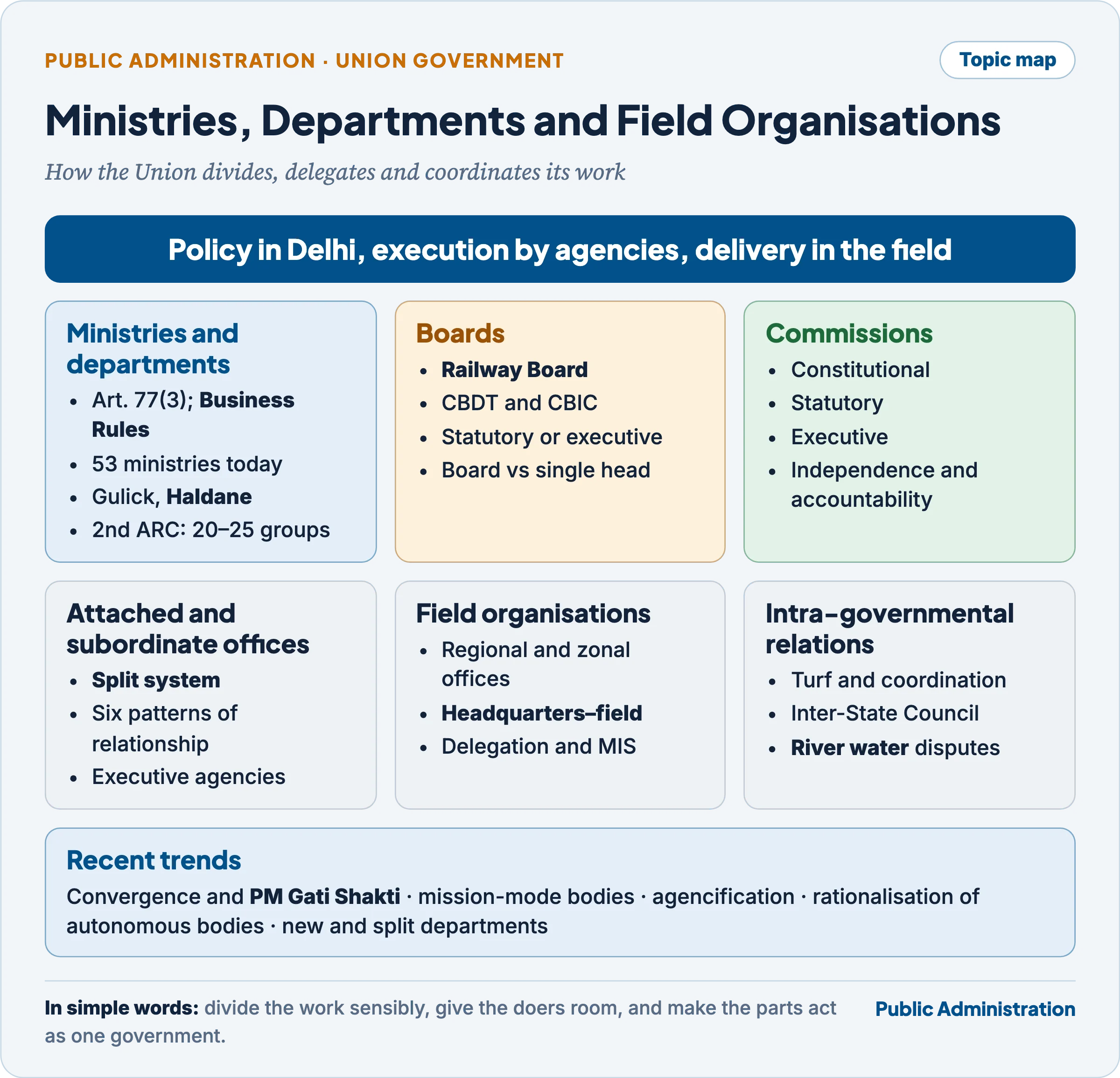
Below the Prime Minister and the Cabinet lies the working body of the Government of India: 53 ministries, the departments inside them, a ring of boards and commissions, hundreds of attached and subordinate offices, autonomous bodies and public sector undertakings, and a field network of regional, zonal and local offices that reaches into every district. This is where policy is turned into tax notices, passports, railway timetables, census forms and welfare payments.
How this machinery is divided (by purpose, client, process or area), how many parts it has, how the policy-making core relates to the executing agencies, and how the parts are made to work together are old questions of organisation theory that India answers in its own way. The answers decide whether government is coherent or fragmented, quick or slow, accountable or diffuse.
In simple words
Think of a large hospital. The board and the director decide policy; each department (surgery, paediatrics, pharmacy) has its own head; support units (stores, laundry, accounts) serve everyone; and outreach clinics in villages deliver care far from the main building. The hospital works only if the departments do not fight over patients and the clinics get clear instructions and enough freedom. The Government of India is the same, on a national scale.
1. The Departmental Machinery of the Union: An Overview
In simple words
The Union government is organised in layers. Ministers on top give political direction; the ministries and departments in New Delhi make policy; specialised offices, boards and agencies carry it out; and field offices across the country meet the citizen.
1.1 The four layers
- Political executive. The President, in whom executive power vests (Article 53), acts on the advice of the Council of Ministers headed by the Prime Minister (Article 74). Each minister holds charge of one or more departments. See the article on the Union Executive.
- Secretariat (policy core). The ministries and departments located in New Delhi, headed administratively by Secretaries to the Government of India, together form the Central Secretariat. They frame policy, draft laws, prepare budgets, answer Parliament and supervise execution. Its internal grades, tenure system and work processes are treated in the article on the PMO, Cabinet Secretariat and Central Secretariat.
- Executive agencies. Below or beside the secretariat sit the bodies that implement: attached offices (such as the Central Public Works Department), subordinate offices (such as the Regional Passport Offices), boards (Railway Board, Central Board of Direct Taxes), commissions, statutory authorities, autonomous societies, departmental undertakings (Posts, Railways) and public sector undertakings.
- Field organisations. The regional, zonal, circle and local offices of these agencies (income tax ranges, postal circles, railway zones and divisions, Directorates of Census Operations) that carry government to the citizen.
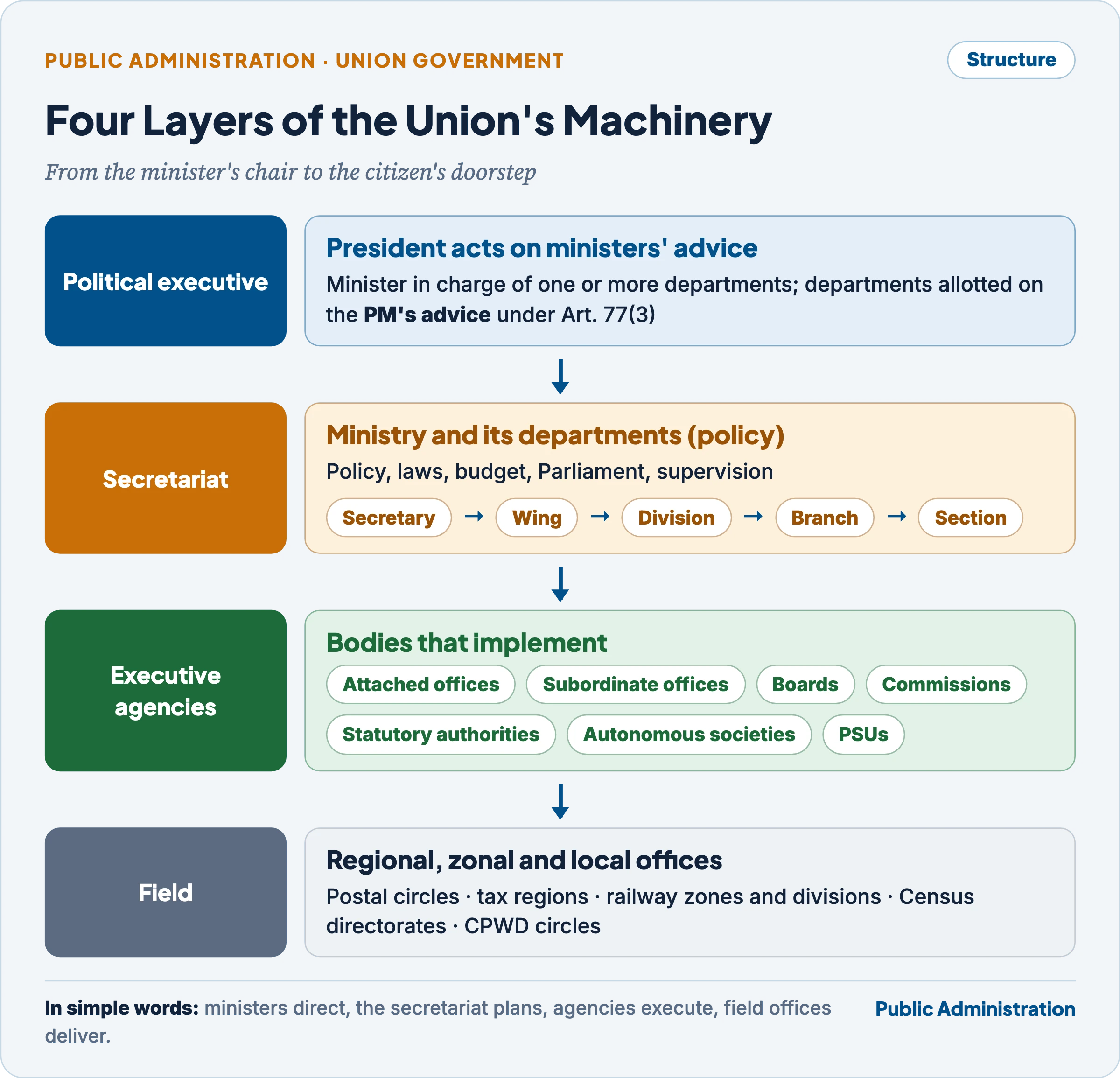
The layered design rests on two old ideas: the separation of policy from execution (the Indian “split system”) and departmentalisation (dividing government work into manageable parts). Both are examined below.
1.2 Articles and Acts governing the departmental machinery
The constitutional and legal basis of the machinery is set out below.
| Provision | What it does |
|---|---|
| Art. 53(1) | Executive power of the Union vested in the President, exercised directly or through officers subordinate to him |
| Art. 73 | Extent of Union executive power: matters on which Parliament can legislate, and treaty rights |
| Art. 74(1) | Council of Ministers headed by the PM to aid and advise; President shall act on that advice |
| Art. 77(1)–(2) | All executive action expressed to be taken in the President’s name; authentication of orders |
| Art. 77(3) | President makes rules for the more convenient transaction of business and its allocation among ministers |
| Art. 166(3) | The same rule-making power for the Governor in the States |
| Arts. 256–258A | Duty of States to comply with Union laws; Union may entrust functions to States (and States to the Union) with consent |
| Art. 262 | Parliament may provide for adjudication of inter-state river water disputes and bar courts’ jurisdiction |
| Art. 263 | President may establish an Inter-State Council |
| Arts. 280, 315, 324, 338, 338A, 338B | Constitutional commissions: Finance Commission, UPSC, Election Commission, National Commissions for SCs, STs and Backward Classes |
| Government of India (Allocation of Business) Rules, 1961 | First Schedule lists ministries, departments, secretariats and offices; Second Schedule lists subjects of each, including their attached and subordinate offices and PSUs |
| Government of India (Transaction of Business) Rules, 1961 | How business is disposed of: by or under the minister; cases for the PM, Cabinet or committees; compulsory inter-departmental consultation |
| General Financial Rules, 2017 (Rule 229) | Principles for setting up and reviewing autonomous bodies funded by the Union |
| Central Boards of Revenue Act, 1963 | Constitutes the CBDT and the board now called CBIC |
| Inter-State River Water Disputes Act, 1956 | Tribunals for inter-state water disputes; bar on court jurisdiction (s. 11) |
| River Boards Act, 1956 | Advisory river boards for inter-state rivers (never used) |
| States Reorganisation Act, 1956 (Part III) | Five Zonal Councils |
2. Ministries and Departments
In simple words
A ministry is the political charge a minister holds; a department is the administrative unit that does the work, headed by a Secretary. A ministry can hold several departments; a few departments stand on their own; and a ministry with no department under it is itself one department.
2.1 Ministry, department and secretariat distinguished
- Ministry. A minister’s charge: a grouping of related subjects for which one minister answers to Parliament. Being political, it is flexible: ministries are created, merged, renamed and split as political and policy priorities change.
- Department. The administrative unit of government, headed by a Secretary, responsible for formulating policy in its allotted subjects and for executing and reviewing it. Being administrative, it is the more stable unit. The Rules treat ministries, departments, secretariats and offices alike as “departments” for the purpose of transacting business.
- Forms in practice. A ministry may have no separate department (Ministry of External Affairs, Ministry of Railways), or two to six departments (Ministry of Finance has six; Defence has five; Home Affairs has six). A department may also stand outside any ministry (Department of Atomic Energy, Department of Space, both under the PM).
- Secretariat. The sum of the ministries and departments at the headquarters, as distinct from the executive agencies and field offices below them.
Common confusion
Is a ministry the same as a department? No. A ministry is a political unit defined by a minister’s charge; a department is the administrative unit headed by a Secretary. The Ministry of Finance is one ministry but six departments, each with its own Secretary; the Ministry of Railways is one ministry with no separate department, its administrative top being the Railway Board; and the Department of Space is a department with no ministry above it. The number of “ministries” (53) and the number of departments and offices (over 90) are therefore different counts.
2.2 Evolution of the departmental system
- Portfolio system (1859–61). Under Lord Canning, business of the Governor-General’s Executive Council was distributed among its members, each taking charge of a department; the Indian Councils Act, 1861 gave this legal sanction. This is the origin of the ministerial portfolio.
- Independence (1947). The first Union ministry began with about eighteen ministries. The number rose with the welfare and development tasks of the new State: planning, industry, community development, food, rehabilitation and later science, environment and social justice.
- Allocation of Business Rules (1961). Made on 14 January 1961 under Art. 77(3), they replaced earlier orders and remain the master list. By 22 July 2026 they had been amended 386 times.
- Composition today. As amended up to the 386th amendment (July 2026), the First Schedule lists:
- 53 ministries, of which 34 are stand-alone (no departments) and 19 contain departments;
- 53 departments inside those 19 ministries;
- 7 units outside any ministry: the Departments of Atomic Energy and Space, the Cabinet Secretariat, the President’s Secretariat, the Prime Minister’s Office, NITI Aayog and the National Security Council Secretariat.
- Comparisons over time. The government had 39 ministries split into about 80 departments around 2000, and the 2nd ARC in 2009 counted about 55 ministries and 80-plus ministries and departments. The count has thus stayed broadly stable for two decades, even though individual units have been merged, split and renamed.
2.3 Internal structure of a department
The standard internal pattern, laid down in the Central Secretariat Manual of Office Procedure, is summarised here; details of the grades and the tenure system are in the article on the PMO, Cabinet Secretariat and Central Secretariat.
- Secretary (administrative head and principal adviser to the minister) → wings under Additional or Joint Secretaries → divisions under Directors or Deputy Secretaries → branches under Under Secretaries → sections under Section Officers, where assistants do the first noting and drafting.
- Variations: the desk officer system (functional desks run by officers with stenographic support) and the Integrated Headquarters of the Ministry of Defence.
- Financial Adviser. Under the Integrated Finance scheme, each ministry has an Additional Secretary and Financial Adviser who belongs to the ministry but advises on expenditure under delegated powers from the Department of Expenditure. This is how the Finance Ministry’s control reaches into every department.
2.4 The Allocation of Business Rules: how the machinery is defined
The Allocation of Business Rules are the legal map of the Union government. Their key provisions are:
- Rule 2: business is transacted in the ministries, departments, secretariats and offices in the First Schedule.
- Rule 3: subjects are distributed as in the Second Schedule, and each allocation includes all attached and subordinate offices and other organisations, including PSUs, concerned with those subjects. Rule 3 also fixes which department sanctions prosecution of a public servant.
- Rule 4: business allotted to the Cabinet Secretariat is deemed allotted to the Prime Minister; the President, on the PM’s advice, allots departments to ministers, may associate another minister, or may entrust specified business to a minister of another department or to a minister without portfolio.
- How ministries are created, merged or split. A new ministry or department is born simply by amending the First and Second Schedules through a Presidential notification on the PM’s advice. No Act of Parliament is needed. The Department of Capital Development and the Department of Urban Development were created inside the Ministry of Housing and Urban Affairs in exactly this way on 22 July 2026 (the 386th amendment).
- Transaction of Business Rules, 1961. They complement the Allocation Rules by specifying how each department disposes of business: cases that need the PM’s, the Cabinet’s or a Cabinet Committee’s approval, and cases in which a department must consult others (the Department of Expenditure on money, the Ministry of Law on legal questions, the Department of Personnel on service matters) before deciding. Their working is treated in the article on the Union Executive.
Indian Connect — Restructuring by notification: the 2026 split of Housing and Urban Affairs
- What happened. Notification S.O. 4040(E) of 22 July 2026 inserted two departments under the Ministry of Housing and Urban Affairs: a Department of Capital Development and a Department of Urban Development.
- Division of subjects. The Department of Capital Development took Union properties and civil works, the Central Public Works Department, Government estates, the Delhi Development Authority, the Master Plan of Delhi, the National Capital Region Planning Board, the Delhi Metro and NCRTC, and Delhi land and rent laws. The Department of Urban Development took urban transport planning, town and country planning, municipal government (outside Delhi’s own bodies), urban water supply and sanitation, housing policy, urban poverty programmes and missions such as AMRUT, SBM-Urban, PMAY-Urban and PM SVANidhi, and the RERA and street-vendors laws.
- Why it matters. It shows departmentalisation by area (a department for the capital region) alongside departmentalisation by purpose (national urban development), and it shows that the departmental map is executive-made: one notification under Art. 77(3) re-drew it overnight.
2.5 Creation, merger and split since 2004
Recent changes show both the flexibility of the system and the political and policy pressures behind it.
| Year | Change | Reason or principle |
|---|---|---|
| 2004 | Department of Border Management created in the Home Ministry | Focus on borders after the Kargil review |
| 2004–06 | Ministry of Development of North Eastern Region (department 2001, ministry 2004); Ministry of Women and Child Development (30 January 2006, from a department in HRD); Ministry of Minority Affairs (2006); Ministry of Earth Sciences (2006) | Area and clientele focus; symbolic priority |
| 2012 | Department of Disability Affairs carved out in Social Justice; renamed Department of Empowerment of Persons with Disabilities (Divyangjan) | Clientele principle |
| 2014 | Ministry of AYUSH (a department since 1995, renamed AYUSH in 2003); Ministry of Skill Development and Entrepreneurship | New priorities |
| 2016 | Ministry of Overseas Indian Affairs merged into External Affairs; MeitY made a separate ministry | Rationalisation; digital priority |
| 2017 | Urban Development and Housing and Urban Poverty Alleviation merged into Ministry of Housing and Urban Affairs; Railway Budget merged with the Union Budget | Integration of related subjects |
| 2019 | Ministry of Jal Shakti (Water Resources merged with Drinking Water and Sanitation); Ministry of Fisheries, Animal Husbandry and Dairying carved out of Agriculture; Department of Military Affairs under the Chief of Defence Staff (30 December) | Integrated water management; sector focus; jointness |
| 2020 | HRD renamed Ministry of Education; Shipping renamed Ports, Shipping and Waterways | Mandate and policy shift |
| 2021 | Ministry of Cooperation created (6 July); Department of Public Enterprises moved to Finance | New sector focus; CPSE policy and disinvestment under one ministry |
| 2026 | Ministry of Housing and Urban Affairs split into the Departments of Capital Development and Urban Development (22 July) | Separate focus on the capital region |
The table shows that India merges and splits at the same time: the 2nd ARC’s umbrella-ministry logic appears in Jal Shakti and the 2017 urban merger, while new ministries (Cooperation, Fisheries, Skill Development) show the opposite pull of sector focus and political signalling.
2.6 Why the number of ministries grows
- Expansion of State functions: welfare, development, regulation and new technologies create tasks that fit no existing box (electronics, cyber security, cooperatives, climate).
- Symbolic recognition: a separate ministry signals priority to a group or sector (minorities, tribal affairs, fisheries, cooperatives).
- Coalition and representation: a large, diverse Council of Ministers needs portfolios; coalition partners bargain for ministries. The 15 per cent cap on the Council (91st Amendment, 2003) limits ministers, not ministries.
- Bureaucratic expansion: William Niskanen’s budget-maximising bureaucrat and Patrick Dunleavy’s “bureau-shaping” officials both predict pressure to create and protect separate units. See the article on New Public Administration and Public Choice.
- Personalities and portfolios: ministries are sometimes shaped around the stature of a particular minister rather than around functions.
2.7 Illustrative ministries: Home, Finance and the social sector
UPSC has repeatedly asked about the role and organisation of particular ministries. Three profiles show how the departmental form works in practice.
Ministry of Home Affairs
- Departments (six): Internal Security (police, law and order, central armed police forces, intelligence coordination), States (Centre–State relations, Union Territories), Official Language, Home (including notification of the President’s and Vice-President’s assumption of office), Jammu, Kashmir and Ladakh Affairs, and Border Management. The Union Home Secretary coordinates all but Official Language, which has its own Secretary.
- Role. Although police and public order are State subjects (List II, Entries 1–2), the Home Ministry discharges the Union’s duty under Art. 355 to protect States against external aggression and internal disturbance; advises on President’s Rule (Art. 356); administers the IPS and the central armed police forces (CRPF, BSF, ITBP, SSB, CISF, Assam Rifles, NSG); handles citizenship, foreigners, the Census (through the Registrar General of India, an attached office), disaster management (the NDMA under the Disaster Management Act, 2005), the Zonal Councils and Inter-State Council secretariats, and is the residuary ministry for subjects that belong nowhere else.
- “Foster ministry.” It has nursed new subjects until they could stand alone (welfare of Scheduled Castes and Tribes until 1985; personnel matters until the Ministry of Personnel was formed in 1985).
- Field organisations. The CAPF battalions and frontier headquarters, Subsidiary Intelligence Bureaus in the States, Foreigners Regional Registration Offices, the Directorates of Census Operations, and agencies such as the NIA (2008), the NCRB and the Indian Cyber Crime Coordination Centre.
- Why its role expanded:
- insurgency in the North-East and Jammu and Kashmir, Left-wing extremism and cross-border terrorism (the NIA and the multi-agency centre after the 2008 Mumbai attacks);
- border management as a separate function after the Kargil Review Committee (1999, K. Subrahmanyam) and the Group of Ministers on national security (2001), which laid down the “one border, one force” principle;
- direct administration of the Union Territories of Jammu and Kashmir and Ladakh after August 2019;
- new threats: cyber crime, narcotics, crimes against women (the Women Safety Division, 2018) and disasters.
- Coordination with the Ministry of Defence. Overlaps arise in border guarding (the BSF and ITBP under the Home Ministry, the Army on the Line of Control and parts of the Line of Actual Control), counter-insurgency (Army, CAPFs and State police together), coastal security (Navy, Coast Guard and State marine police) and the Assam Rifles, whose administrative control lies with the Home Ministry and operational control with the Army. Tools for coordination include Unified Headquarters in insurgency theatres, the National Security Council Secretariat and the National Security Adviser, the Department of Military Affairs (2020) as a single military interface, joint intelligence through the Multi-Agency Centre, clear lead-agency rules for each border, and Committees of Secretaries under the Cabinet Secretary.
Ministry of Finance
- Departments (six): Economic Affairs (macro-economic policy, the Union Budget, capital markets, external finance), Expenditure (control of expenditure, Finance Commission matters, the Controller General of Accounts), Revenue (direct and indirect taxes through the CBDT and CBIC; also the Enforcement Directorate and the Financial Intelligence Unit), Investment and Public Asset Management (DIPAM), Financial Services (banks, insurance, pension) and Public Enterprises (since 2021).
- Custodian of public revenues. It prepares the Annual Financial Statement (Art. 112) and Demands for Grants, manages the Consolidated Fund (Art. 266), borrowing and public debt, and controls spending through delegated financial powers, the Integrated Finance Divisions in each ministry, appraisal bodies (Expenditure Finance Committee, Public Investment Board) and the Public Financial Management System. Since 1976 accounts have been departmentalised: each ministry keeps its own accounts through Pay and Accounts Offices under the Controller General of Accounts.
- Limits of its custodianship. Tax devolution follows the Finance Commission (Art. 270); the GST Council (Art. 279A) shares indirect-tax policy with the States; the RBI runs monetary policy; and Parliament’s financial committees and the CAG audit its stewardship. It is thus a custodian under several checks, not a sovereign over public money.
- Relations with other ministries. Tension between the “treasury view” (economy, fiscal prudence) and spending ministries (programme expansion) is built into the system. Remedies that have been tried: the Integrated Finance scheme (Financial Advisers sit inside ministries), greater delegation of financial powers, outcome budgets (since 2005) and the Output–Outcome Monitoring Framework, and just-in-time fund release.
- Reforms in the liberalisation era. FRBM Act, 2003 for fiscal rules; a disinvestment department (1999), renamed DIPAM (2016); merger of the Railway Budget (2017); abolition of the plan/non-plan distinction (2017); the GST (2017); faceless tax assessment (2020).
Social-sector ministries: disability, women and children
- Persons with disabilities. The Department of Empowerment of Persons with Disabilities (Divyangjan) in the Ministry of Social Justice and Empowerment (separate department since 2012) administers the Rights of Persons with Disabilities Act, 2016 (21 specified disabilities; 4 per cent reservation in government posts and 5 per cent in higher education seats), the National Trust Act, 1999, the Rehabilitation Council of India Act, 1992, the Accessible India Campaign (2015), the Unique Disability ID, and schemes for assistive devices, scholarships and skills. A statutory Chief Commissioner for Persons with Disabilities monitors compliance. Critics point to low budgets, weak State commissioners, poor accessibility enforcement and dependence on State machinery for delivery.
- Women and children. The Ministry of Women and Child Development (ministry since 2006) is the nodal ministry. Its programmes are grouped into Mission Shakti (safety and empowerment of women, including One Stop Centres, the Women Helpline and Shakti Sadan homes), Mission Vatsalya (child protection under the Juvenile Justice Act, 2015) and Saksham Anganwadi and Poshan 2.0 (nutrition and early childhood care). Statutory bodies under it include the National Commission for Women (1992), the National Commission for Protection of Child Rights (2007) and the Central Adoption Resource Authority.
- Child labour. The Ministry of Labour and Employment administers the Child and Adolescent Labour (Prohibition and Regulation) Act, 1986 as amended in 2016 (complete ban on employing children below 14, except in family enterprises after school hours; ban on adolescents of 14–18 in hazardous work), with the PENCIL portal (2017) for complaints and rescue. Child sexual abuse is addressed by the POCSO Act, 2012, and the right to education by the RTE Act, 2009.
- Women in sex work and trafficking. The Immoral Traffic (Prevention) Act, 1956 remains the main law; rescue and rehabilitation were funded under the Ujjawala scheme (2007), now part of Mission Shakti, and Anti-Human Trafficking Units in districts are supported by the Home Ministry. In Budhadev Karmaskar v. State of West Bengal (orders of 19 May 2022), the Supreme Court recognised that adult sex workers are entitled to dignity and equal protection, directed police not to harass consenting adults, and asked for identity documents and rehabilitation without coercion. A comprehensive trafficking Bill passed the Lok Sabha in 2018 but lapsed in 2019.
- The structural lesson. Social-sector outcomes depend on many ministries (health, education, labour, rural development, home) and on the States, which run anganwadis, police, shelters and labour inspection. Ministries organised by clientele (women, children, disabled persons) therefore act mainly as policy, funding and convergence units, which is why their effectiveness turns on inter-ministerial and Centre–State coordination.
3. Bases of Departmentalisation and the Size of Government
In simple words
Before work can be done, it must be divided. A government can group its work by the purpose served (health), the skill used (engineering), the people served (tribals) or the area covered (the North-East). Each choice helps some things and hurts others, so every real government mixes them.
3.1 Gulick’s four bases in Indian practice
Luther Gulick, the American administrative theorist, in his “Notes on the Theory of Organization” (in Papers on the Science of Administration, 1937, edited with Lyndall Urwick), argued that work can be grouped by purpose, process, persons or place (the “four Ps”). The details are in the article on Classical Theory; the Indian application is below.
| Basis | Meaning | Union examples | Strength | Weakness |
|---|---|---|---|---|
| Purpose (major function) | Grouping by the objective served | Health, Defence, Education, Jal Shakti | Clear goals, public understands, single accountability | Turf building; ignores shared skills; overlaps |
| Process (skill or technique) | Grouping by the professional method used | Ministry of Law and Legislative Department, CPWD, Ministry of Statistics, Department of Expenditure | Specialisation, economy, professional standards | Loses sight of purpose; delays; “technicians’ arrogance” |
| Persons or things (clientele) | Grouping by the group served | Tribal Affairs, Minority Affairs, Women and Child Development, Ex-Servicemen Welfare, Divyangjan | Single window and voice for a group | Duplication of services; capture by the clientele; fragmentation |
| Place (area) | Grouping by territory | DoNER, Department of Jammu, Kashmir and Ladakh Affairs, Border Management, the 2026 Department of Capital Development; MEA territorial divisions | Adapts to local conditions; area coordination | Uniformity suffers; parochial pressures |
- Mixed bases. India applies purpose at the top (most ministries) and process, clientele and area lower down (divisions within a ministry, regional offices in the field). The Ministry of Agriculture serves a purpose (agricultural growth), uses processes (research, extension), serves a clientele (farmers) and works through areas (agro-climatic zones).
- Simon’s critique. Herbert Simon, in “The Proverbs of Administration” (1946) and Administrative Behavior (1947), showed that the four bases compete: grouping by one basis sacrifices the advantages of the others, so the “principle” gives no guidance on which to choose. The choice is an empirical and political judgement, not a scientific rule. See the article on Herbert Simon.
3.2 The Haldane Committee (1918)
The Machinery of Government Committee of the United Kingdom, chaired by Viscount Haldane, reported in 1918. It is the classic statement of the case for functional departmentalisation.
- Distribution by service. Business should be grouped according to the nature of the service rendered (education, health, finance), not according to the classes of persons dealt with.
- “Lilliputian administration.” Grouping by persons would give every class of client (the poor, the unemployed, children) its own small, duplicating services: a separate health and education system for each group.
- Ten main functions. It suggested grouping government into about ten functions: finance, national defence, external affairs, research and information, production, employment, supplies, education, health and justice.
- Research and a small Cabinet. It stressed investigation and thought as a distinct function before policy, and a small Cabinet able to consider policy as a whole.
- Indian echo. India’s First ARC, in its report on the Machinery of the Government of India and its Procedures of Work (1968), also preferred grouping by function and affinity of subjects. Yet India keeps many clientele ministries for symbolic and political reasons, exactly what Haldane warned against.
3.3 Why departmentalisation is “fraught with complexities”
The difficulty of dividing government work is partly technical and partly political.
- Technical complexities:
- Interdependence of functions: water is drinking, irrigation, industry, energy and environment at once; no division captures all links.
- New tasks do not fit old boxes (cyber security, climate adaptation, artificial intelligence).
- Choice among bases (Simon’s point): every grouping cuts some linkages to create others.
- Span and size: too many departments overload coordination at the top; too few produce unmanageable giants.
- Political complexities:
- Representation and coalition bargaining demand portfolios.
- Symbolism: a ministry signals that a group or sector matters.
- Bureaucratic turf: units resist merger and seek expansion.
- Federal sensitivity: creating a Union ministry for a State subject (cooperation) raises Centre–State questions (Section 8).
3.4 Size of the ministry system and rationalisation proposals
- The size question. India has about 53 ministries; the United Kingdom works with roughly two dozen departments and the United States with 15 executive departments. A large number spreads ministerial attention thin, multiplies inter-ministerial consultation, and produces what the 2nd ARC called fragmentation and narrow departmentalism.
- Earlier proposals. The Gopalaswami Ayyangar report on the Reorganisation of the Machinery of Government (1949) suggested grouping related ministries and led to an O&M Division (1954). The First ARC (1968) proposed a compact Cabinet and related subjects grouped together.
The 2nd ARC’s 13th Report: Organisational Structure of Government of India (2009)
The Second Administrative Reforms Commission (constituted 2005; chaired by M. Veerappa Moily, later V. Ramachandran) presented its 13th Report in May 2009. Its starting point was that the existing structures are Weberian, suited to command and control but not to developmental, promotional and facilitative functions.
- Core principles for restructuring:
- the Union should focus on core functions: defence, external relations, national security, justice and rule of law; human development through education and health; infrastructure and natural resources; social security and social justice; macro-economic management; and national policies in other sectors;
- subsidiarity: decentralise functions to States and local governments;
- closely inter-related subjects to be dealt with together;
- separation of policy-making from execution;
- coordinated implementation, flatter structures and team work, well-defined accountability and appropriate delegation.
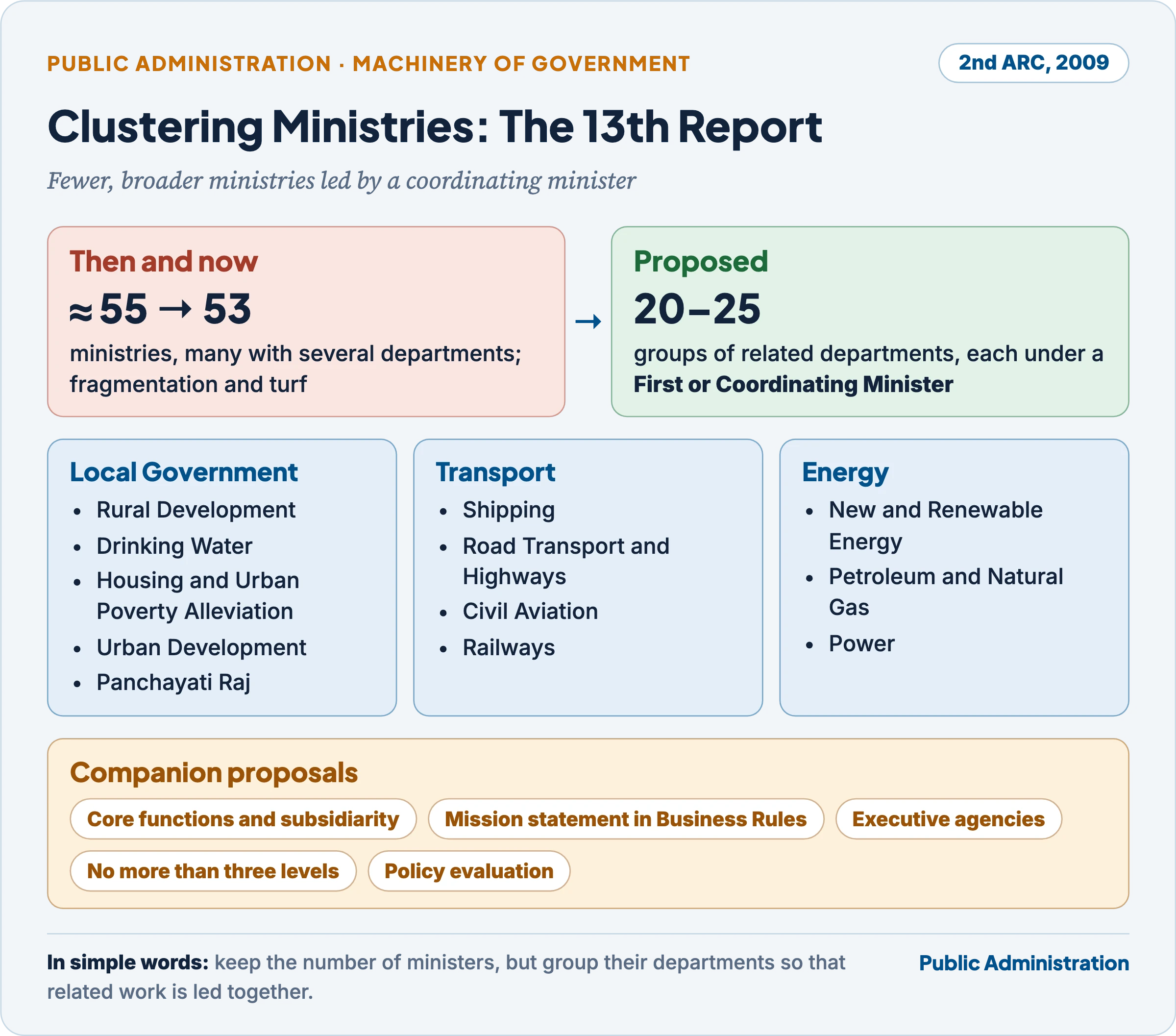
- Clustering ministries. Closely related subjects should be grouped to reduce the number of ministries from about 55 to 20–25. A ministry would be redefined as a group of departments with related functions under a First or Coordinating Minister, written into the Allocation of Business Rules; other Cabinet ministers and Ministers of State could hold individual departments within the group. The size of the Council of Ministers would stay (it reflects representational needs); only coordination would improve. Its illustrations:
- Ministry of Local Government: Rural Development, Drinking Water Supply, Housing and Urban Poverty Alleviation, Urban Development, Panchayati Raj;
- Ministry of Transport: Shipping, Road Transport and Highways, Civil Aviation, Railways;
- Ministry of Energy: New and Renewable Energy, Petroleum and Natural Gas, Power.
- Recasting the Allocation of Business Rules. Each department’s entry should begin with a mission statement and outcomes, not a long list of items; laws and PSUs should be covered by generic entries.
- Policy and execution. Ministries should concentrate on six functions (policy analysis and planning, budgeting and parliamentary work, monitoring, key appointments, coordination and evaluation); everything else should go to executive agencies, which may be departments, boards, commissions, companies or societies, autonomous or semi-autonomous, professionally managed under performance agreements. Attached and subordinate offices should serve as these agencies.
- Delayering. A detailed scheme of delegation for every department; a file should pass through no more than three levels before a decision.
- Policy evaluation at fixed intervals, and coordination mechanisms (GoMs and Committees of Secretaries) used selectively with clear mandates and time limits.
Common confusion
Did the 2nd ARC recommend cutting the hierarchy from seven levels to four? Many notes say so, but the Commission’s recommendation was that a file should pass through no more than three levels before decision: files needing a minister’s approval would start with a Deputy Secretary or Director and move through the Joint Secretary and Secretary; files for a Secretary would pass through just two levels; files for a Joint Secretary, Director or Deputy Secretary through just one. It also asked each department to publish a scheme of delegation and audit its use.
- Status. The umbrella idea appears in Jal Shakti (2019), the urban merger (2017) and some mergers of agencies, and delayering has advanced through e-office and desk systems. But the 20–25 ministry structure, the First Minister concept and a general executive-agency model remain unimplemented; new ministries continue to be created.
4. Boards
In simple words
Some jobs are given not to one boss but to a small group that decides together, such as a board that runs the railways or collects taxes. Group decision brings more expertise and checks, but it can also be slower and blur who is responsible.
4.1 Meaning and the plural-headed form
- Board. A body in which headship is vested in a group of members presided over by a chairperson, deciding collectively. Boards can be administrative (running a service), regulatory, advisory or promotional.
- Board versus single head (bureau). A department is normally headed by one person (unity of command, speed, clear responsibility); a board shares headship (collective wisdom, representation of interests, a check on arbitrariness, continuity) at the cost of delay, diffused responsibility and internal conflict. The general theory, including the American independent regulatory commissions and the “headless fourth branch” critique of the Brownlow Committee (1937), is in the article on Structure and Forms of Public Organisations.
- Indian hybrid. India’s administrative boards are not independent of the ministry: board members are usually ex officio Secretaries or Special Secretaries of the department, so the board is the top of the department. This “merger” of board and secretariat is one of the six patterns of secretariat–agency relations (Section 6.4).
4.2 Statutory and non-statutory boards
| Type | Basis | Examples |
|---|---|---|
| Statutory | Created by an Act, with powers defined by law | CBDT and CBIC (Central Boards of Revenue Act, 1963); Tea Board (Tea Act, 1953); Coffee Board (Coffee Act, 1942); Rubber Board; Spices Board (1986); Tobacco Board (1975); Central Board of Film Certification (Cinematograph Act, 1952); Bhakra Beas Management Board (Punjab Reorganisation Act, 1966) |
| Non-statutory (executive) | Created by executive order or resolution, or registered as a company or society | Postal Services Board; Central Social Welfare Board (1953, later a charitable company); the Ordnance Factory Board (until 2021); many advisory and development boards |
| Mixed origin | Executive creation, later given statutory powers | Railway Board (set up in 1905; powers conferred by the Indian Railway Board Act, 1905) |
4.3 The Railway Board
- Origin. Set up in 1905 to replace the Public Works Department’s railway branch, with powers under the Indian Railway Board Act, 1905. After the Acworth Committee (1921), railway finances were separated from general finances by the Separation Convention of 1924; the separate Railway Budget continued until it was merged with the Union Budget in 2017.
- Role. It is simultaneously the Ministry of Railways (its members are ex officio Secretaries to the Government) and the top management of the Indian Railways, a departmental undertaking. Policy, investment and operations are thus decided by the same body, which explains both its speed and the criticism that it is a closed, cadre-dominated system.
- Field organisation. Zonal railways under General Managers, divided into divisions under Divisional Railway Managers, plus production units and training institutions: the classic “long arms, short fingers” pattern.
- Restructuring (24 December 2019). The Cabinet approved a slimmer Board (a Chairman and Chief Executive Officer with four members for infrastructure, traction and rolling stock, operations and business development, and finance, plus independent members) and the unification of eight Group A railway services into the Indian Railway Management Service. The aim was to end “departmentalism” among engineering, traffic, accounts and other cadres that had made the Board a federation of rival services.
4.4 The revenue boards: CBDT and CBIC
- History. The Central Board of Revenue Act, 1924 created a single board; the Central Boards of Revenue Act, 1963 split it into the Central Board of Direct Taxes and the Central Board of Excise and Customs, the latter renamed the Central Board of Indirect Taxes and Customs in 2018 after GST.
- Composition. A Chairman and a small number of Members, who are ex officio Special Secretaries in the Department of Revenue. The boards frame tax administration policy and are the cadre controlling and administrative authorities for the Income Tax Department and the customs and GST commissionerates.
- Field formations. CBDT works through Principal Chief Commissioners in regions, Commissioners, and assessment units; CBIC through zones and commissionerates for GST and customs, and directorates such as the Directorate of Revenue Intelligence and the Directorate General of GST Intelligence.
- Technology and the field. The faceless assessment scheme (launched 13 August 2020) assigns income tax cases randomly to assessment units anywhere in India, removing the face-to-face link between taxpayer and local officer: a deliberate redesign of headquarters–field relations to reduce discretion and corruption.
4.5 Other boards and the Central Social Welfare Board
- Postal Services Board. The apex management of the Department of Posts (Secretary as Chairperson with Members), working through postal circles under Chief Postmasters General, regions and divisions. The Post Office Act, 2023 replaced the 1898 Act.
- Commodity boards under the Commerce Ministry (Tea, Coffee, Rubber, Spices, Tobacco): statutory promotional and regulatory boards with grower and industry representation; often criticised for overlapping with State agriculture departments and for weak autonomy.
- Ordnance Factory Board (OFB). A departmental board running 41 factories under the Ministry of Defence until 1 October 2021, when it was dissolved and its units transferred to seven defence public sector undertakings. This shows a shift from the board-department form to the company form where commercial efficiency is wanted (see the article on Liberalisation, Privatisation and Disinvestment).
- Central Social Welfare Board (CSWB).
- Origin. Set up in August 1953 by government resolution, with Durgabai Deshmukh as its first chairperson, to fund and guide voluntary organisations working for women and children. State Social Welfare Boards followed from 1954. In 1969 it was registered as a charitable company (section 25, Companies Act, 1956).
- Why it was called “anomalous”. It was neither a government department nor a voluntary body: funded entirely by government, staffed partly by officials, but meant to represent voluntary effort. It had dual accountability (to the ministry and to its own governing body), State boards answerable both to it and to State governments, overlapping schemes with the ministry, a top-down grant-in-aid culture, and complaints of rigidity and centralisation in sanctioning grants to small NGOs.
- Reform ideas. Clarify its mandate as a facilitator and accreditor of voluntary organisations rather than a parallel scheme-runner; decentralise grant decisions to State boards; transparent, online grant management; outcome-based monitoring; merger of overlapping schemes into ministry missions.
- Current position. It still appears among the ministry’s autonomous bodies, but the rationalisation drive has closed its sister body, the Rashtriya Mahila Kosh (operations closed from 31 December 2023), on the ground that newer schemes had made it redundant: the same logic now hangs over every legacy board.
4.6 The board debate in Indian administration
- For boards: collective expertise in technical fields; continuity of policy; a check on individual arbitrariness; a forum for representing interests (growers, industry, voluntary sector); insulation from day-to-day political pressure.
- Against boards: delay and diffused responsibility; boards captured by cadres (the old Railway Board) or by the interests they represent (commodity boards); duplication with the ministry; weak accountability to Parliament because the minister can shelter behind the board.
- Politics and administration. Because members are often chosen to represent parties or interests, board administration is said to inject politics into administration and so to violate the Wilsonian politics–administration dichotomy. Defenders reply that regulation and distribution inevitably involve value choices; a bipartisan or representative board handles them openly, which is more honest than pretending a single official is neutral. In India the debate has tilted towards single executive heads with advisory boards (Railway Board as Chairman and CEO; OFB corporatised), while quasi-judicial and regulatory work has moved to statutory commissions and authorities.
5. Commissions
In simple words
A commission is a body of several members given a task that needs independence, expertise or fairness: conducting elections, recruiting civil servants, dividing tax money, or protecting human rights. Some are written into the Constitution, some are created by Acts of Parliament, and some by a simple government order.
5.1 Why the commission form
- Independence and impartiality where the government of the day is an interested party (elections, recruitment, Centre–State finance, rights complaints).
- Collegial expertise for complex, multi-sector judgements.
- Quasi-judicial and quasi-legislative functions that should not rest with one official.
- Legitimacy and trust, especially in a federal, plural society.
5.2 Classification by legal basis
| Category | Basis | Examples | Protection |
|---|---|---|---|
| Constitutional | Created by the Constitution | UPSC (Art. 315), Election Commission (Art. 324), Finance Commission (Art. 280), National Commission for SCs (Art. 338), for STs (Art. 338A, 2003), for Backward Classes (Art. 338B, 2018) | Tenure and removal in the Constitution; reports laid before Parliament |
| Statutory | Created by an Act | Central Vigilance Commission (resolution 1964 on the Santhanam Committee’s advice; statutory under the CVC Act, 2003), NHRC (Protection of Human Rights Act, 1993), Central Information Commission (RTI Act, 2005), National Commission for Women (Act of 1990, set up 1992), NCPCR (2005 Act, set up 2007), Competition Commission (2002 Act) | Tenure and removal in the Act |
| Executive | Created by resolution or order | Atomic Energy Commission, Space Commission, Law Commission, Staff Selection Commission (1975, an attached office of DoPT), formerly the Planning Commission (1950); NITI Aayog (2015) | Depends on government |
- Regulatory commissions (SEBI, TRAI, CERC, CCI) are a special class of statutory bodies with quasi-legislative and quasi-judicial powers; they are treated in the articles on Regulatory Authorities and PPPs and on regulatory commissions in Indian administration.
- Not every “commission” is a commission. The Central Water Commission is an attached office of the Department of Water Resources, and a “Commissioner” (Textile Commissioner, Commissioner of Income Tax) is usually a single head of an executive agency. The label does not decide the form.
5.3 Executive commissions that run departments: Atomic Energy and Space
- Atomic Energy Commission. First set up in 1948; the Department of Atomic Energy followed in 1954, and the Commission was reconstituted in 1958 with full executive and financial powers. Its chairperson is ex officio Secretary, Department of Atomic Energy. The Space Commission and the Department of Space (1972) follow the same pattern.
- Why this form. Strategic, research-intensive work needs long-horizon policy, quick decisions free of routine secretariat procedure, and scientists at the top. Both departments sit directly under the Prime Minister. The commission frames policy and budget; the department and its units (BARC, ISRO and others) execute. It is the clearest Indian case of “complete merger” between policy body and executive agency.
5.4 The commission form in national planning
- Planning Commission (15 March 1950). Set up by executive resolution, chaired by the Prime Minister, with full-time expert members and a Deputy Chairman.
- Why the commission type was deliberately preferred:
- expertise from outside the bureaucracy in a technical task;
- a national, cross-sectoral view that no single ministry could take;
- collegial deliberation among members with different specialisms;
- flexibility and closeness to the PM without becoming another ministry with departmental loyalties;
- continuity of long-term planning above the annual budget cycle.
- Criticism. It grew into a “super-cabinet” and an extra-constitutional centre of power over States through discretionary plan grants; the First ARC and later the States criticised its control. It was replaced by NITI Aayog on 1 January 2015, again by resolution, as a think tank with a Governing Council of the PM and all Chief Ministers. See the article on Planning Machinery and NITI Aayog.
5.5 The Finance Commission as an institution
The Finance Commission is treated fully in the article on Union–State Relations and the Finance Commission. Its organisational features relevant here are:
- Basis and composition. Constituted by the President every five years under Art. 280, with a chairman and four members (Finance Commission (Miscellaneous Provisions) Act, 1951). The 16th Finance Commission (chair Arvind Panagariya, constituted 31 December 2023) covers 2026–31; its report was tabled on 1 February 2026 and kept the States’ share of the divisible pool at 41 per cent.
- Recommendation, not award. Under Art. 281 its report is laid before Parliament with an explanatory memorandum of the action taken. Its recommendations are advisory: the executive may in principle reject them. In practice the core recommendations on devolution have been accepted by convention, which gives them the moral force of an award.
- “Statistics aggregation”? Critics say the Commission applies a formula to data (population, area, income distance, forest cover, demographic performance) and so merely aggregates statistics. Defenders reply that choosing the criteria and weights is a judgement of fiscal equity and incentives, that it hears every State, and that formula-based transfers are valued precisely because they are non-discretionary.
- Article 282 transfers. Grants for “any public purpose” under Art. 282 are discretionary: formerly plan assistance through the Planning Commission, now mainly Centrally Sponsored Schemes run by Union ministries. The long-standing argument for re-examining them is that they bypass the Finance Commission, carry conditions that distort State priorities, and allow the Centre to steer State subjects.
5.6 Departments, boards and commissions compared
The three forms differ most sharply in accountability and responsibility.
| Aspect | Department | Board | Commission (constitutional or statutory) |
|---|---|---|---|
| Who answers | Minister, individually, to Parliament | Board collectively, through the minister | Commission itself, through reports and the courts |
| Line of control | Direct hierarchy | Partly hierarchical, partly collegial | Insulated by fixed tenure and protected removal |
| Responsibility | Clear and individual | Shared and diffused | Shared, but protected by independence |
| Parliament | Questions on every detail | Through the ministry | Annual reports (UPSC, Art. 323); action-taken memoranda (Finance Commission, Art. 281) |
| Justification | Democratic control | Expertise and representation | Impartiality, constitutional trust |
The department maximises political answerability; the board spreads responsibility; the commission exchanges direct answerability for independence, which is accountability to the Constitution rather than to the government of the day. The Chief Election Commissioner and Other Election Commissioners Act, 2023, passed after Anoop Baranwal v. Union of India (2023), shows that the appointment process decides how real that independence is.
6. Attached Offices, Subordinate Offices and the Secretariat–Executive Agency Split
In simple words
The ministry in Delhi decides what should be done. Specialised offices under it work out how, and local offices do it. An attached office is like a head office’s technical wing that directs a programme; a subordinate office is like a branch that carries it out on the ground.
6.1 The split system in brief
- Principle. India separates the secretariat (policy) from the executive agencies (execution). The Tottenham Report on the Reorganisation of the Central Government (1945–46) put the logic in a human analogy: the minister decides policy (the will), the Secretary provides the material for decisions (the brain), and the executive head carries them into effect (the hands).
- Contrast. In the British Whitehall model a ministry both makes and executes policy; the Indian system, with two sets of hierarchies, is closer to the Swedish model of small ministries and many executing agencies. The split system’s merits and criticisms are in the article on the PMO, Cabinet Secretariat and Central Secretariat; here the focus is on the agencies themselves.
6.2 Attached offices
- Meaning. The Central Secretariat Manual of Office Procedure says that where execution of government policy requires decentralisation of executive direction and the establishment of executive agencies, a ministry has subsidiary offices. Attached offices are responsible for providing the executive direction needed to implement the ministry’s policies; they also serve as repositories of technical information and advise the ministry on technical aspects of questions.
- Head. A head of department with titles such as Director-General, Director, Commissioner, Controller, Registrar General or Inspector-General, usually a specialist.
- Examples.
- Directorate General of Health Services (Health);
- Central Public Works Department (since July 2026 under the Department of Capital Development, Housing and Urban Affairs);
- Directorate General of Foreign Trade (Commerce);
- Office of the Registrar General and Census Commissioner (Home Affairs);
- India Meteorological Department (Earth Sciences);
- Central Water Commission (Water Resources);
- Staff Selection Commission (Personnel);
- Directorate of Estates (Housing and Urban Affairs).
- Change of form. Some attached offices have been converted into statutory bodies to give them legal authority and autonomy: the Directorate General of Civil Aviation, the Bureau of Civil Aviation Security and the Aircraft Accident Investigation Bureau became statutory under the Aircraft (Amendment) Act, 2020.
6.3 Subordinate offices
- Meaning. Subordinate offices function as field establishments or as agencies responsible for the detailed execution of government decisions. They normally work under an attached office, or directly under the ministry where the volume of executive direction is small.
- Examples. Regional Passport Offices (External Affairs); Directorates of Census Operations in the States (under the Registrar General); the Petroleum and Explosives Safety Organisation (under DPIIT); Pay and Accounts Offices; regional offices of the CPWD; the Sardar Vallabhbhai Patel National Police Academy (Home Affairs).
- Status problem. Though it is the subordinate office that actually delivers, it has been given a distinctly inferior status: lower pay scales and prospects, even where staff do similar work to secretariat staff. The criteria separating attached from subordinate offices are neither well defined nor consistently applied.
- Committees’ views. The Tottenham Report (1945–46) and the First Central Pay Commission (1946–47, Justice S. Varadachariar) found the distinction between attached and subordinate offices unsatisfactory and artificial and suggested abolishing it. The First ARC (1968) did not recommend a general merger of secretariat and executive agencies; it proposed that only agencies concerned with development programmes be integrated with their ministries’ secretariats, and that the distinction continue elsewhere.
Common confusion
Is an attached office the same as a subordinate office? No. An attached office sits close to the ministry and gives executive direction and technical advice for a whole programme across the country (the DGHS for health programmes). A subordinate office is mostly in the field and does the detailed execution, often under an attached office (a Directorate of Census Operations under the Registrar General). One directs implementation; the other carries it out.
6.4 Six patterns of secretariat–agency relationship
To make policy and execution work together, six arrangements have grown up at the Centre.
| Pattern | How it works | Example | Merit | Problem |
|---|---|---|---|---|
| Complete separation | Separate offices and separate files; consultation by self-contained letters | Ministry of Information and Broadcasting and the Directorate General of All India Radio (earlier) | Specialist proposals get a generalist’s scrutiny; division of work | Double scrutiny, duplication, delay |
| Complete merger | Secretariat and agency fully merged | Railway Board and Ministry of Railways; Atomic Energy Commission and DAE | Speed for operational and commercial work | Policy and execution blurred |
| Link officer | A senior secretariat officer is concurrently head of the agency | An Additional Secretary heading a directorate | Policy shaped by implementation experience | Blurs the two roles |
| Ex officio secretariat status | Agency head given ex officio secretariat rank and power to decide some matters | Textile Commissioner as ex officio Joint Secretary | Saves time and paper; head knows the policy background | Departs from the split principle |
| Common office | One common office, files and file bureau serve both | Favoured by the Estimates Committee and the Second Pay Commission | Single examination, economy | Secretariat absorbed into routine |
| Common files | Separate offices, but common files and a single file bureau | Ministry of Defence and Air Headquarters (earlier); favoured by the Rowlands Committee (Bengal, 1944–45) | Less paper movement | Separate staffs still duplicate |
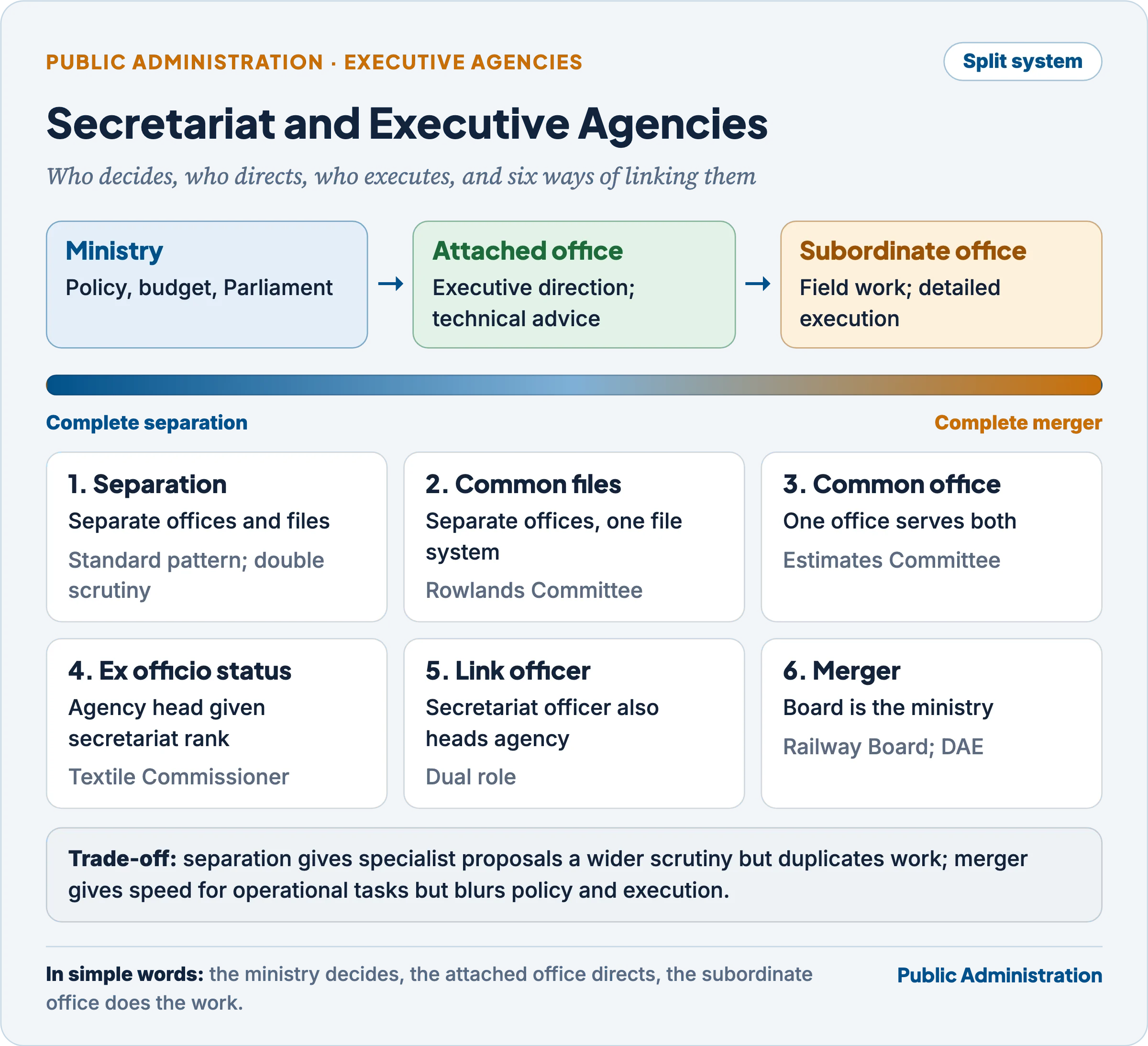
- No single best pattern. Separation is the standard, rooted in the policy–administration, staff–line and generalist–specialist dichotomies; merger suits operational and commercial work; intermediate patterns suit agencies whose policy and execution are closely linked. The choice should fit the agency’s function and history, which is a contingency argument. See the article on Systems and Contingency Theories.
- Strained relations in practice.
- The secretariat performs much executive work that it could pass down;
- executive agencies have grown in number but not in power;
- proposals are examined twice (once in the agency, again in the ministry), causing delay;
- generalist secretariat officers sit in judgement over specialist agency heads, breeding resentment;
- agencies are starved of delegated financial and personnel powers.
6.5 The Cabinet Secretariat’s own executive units
The Cabinet Secretariat is a small coordinating secretariat, but it carries specialised executive tasks through units placed under it. Its organisation is treated in the article on the PMO, Cabinet Secretariat and Central Secretariat; the units illustrate why attached and subordinate offices matter even to a coordinating body.
- Units under it include the Special Protection Group (SPG Act, 1988), the Research and Analysis Wing (1968) and the Directorate General of Security, the National Authority, Chemical Weapons Convention (by resolution, 1997), the Directorate of Public Grievances (1988) and, since 2015, the Direct Benefit Transfer Mission.
- Why they are integral. They let a policy-and-coordination secretariat discharge security, intelligence, treaty-compliance and grievance functions without burdening its core; they give the Cabinet Secretary operational information for crisis management and monitoring; and they keep sensitive functions close to the Prime Minister. Historically, the Cabinet Secretariat has also acted as an incubator: departments such as Personnel, Electronics and Ocean Development began there before becoming independent.
6.6 Executive agencies on NPM lines
- The British model. The Next Steps report (Improving Management in Government: The Next Steps, 1988, by the Efficiency Unit under Sir Robin Ibbs) recommended that the executive work of departments be hived off to executive agencies headed by chief executives working under framework documents with performance targets, while small core departments made policy. Within a decade most British civil servants worked in such agencies. This is agencification, a central idea of New Public Management. See the article on New Public Management and After.
- The Indian case for agencies. The 2nd ARC’s 13th Report argued that India’s attached and subordinate offices should become true executive agencies: autonomous, professionally managed, bound by performance agreements, and judged by results.
- Indian approximations. India has not adopted a general agency model, but it uses agency-like forms: statutory authorities (NHAI, the DGCA after 2020, the Unique Identification Authority), mission directorates (Jal Jeevan Mission, National Mission for Clean Ganga), special purpose vehicles (Smart City SPVs, the National High Speed Rail Corporation), company forms for former departmental units (the OFB’s seven DPSUs) and MoU-based performance contracts with CPSEs.
- Limits. Critics warn that agencies fragment government, weaken ministerial accountability (“the minister blames the chief executive”), and that performance contracts need capacity in ministries to write and enforce them, which India lacks. Hence the later turn to joined-up government (Section 9).
7. Field Organisations
In simple words
The ministry sits in Delhi, but citizens live in villages and towns. Field offices (income tax offices, post offices, railway divisions, census offices) take government to the people. Delhi makes the rules; the field applies them; and both must keep talking.
7.1 Meaning and theory in brief
- Headquarters and field. Headquarters is the central point from which direction and control fan out; the field is everything outside it. Both terms are relative: a regional office is “field” for the ministry but “headquarters” for its local units.
- Patterns. W.F. Willoughby (Principles of Public Administration, 1927) distinguished unitary (all field services under a regional chief) and multiple (each headquarters unit dealing directly with its own field units) types. Luther Gulick described them through “arms and fingers”: all fingers (direct dealing with every unit), short arms, long fingers (regional divisions located at headquarters) and long arms, short fingers (regional offices in the field). James Fesler (Area and Administration, 1949) contrasted the prefectoral and functional systems and set out the factors that decide how far field offices are decentralised.
- The Union’s field. Most Union ministries run a functional field system: separate vertical lines from Delhi to the field (taxes, posts, railways, telecom, passports), with regional, zonal or circle offices in the middle. The area coordinator (the Collector) belongs to the State, not the Union. The full theory of headquarters–field relations is in the article on Structure and Forms of Public Organisations.
7.2 Two routes to the field
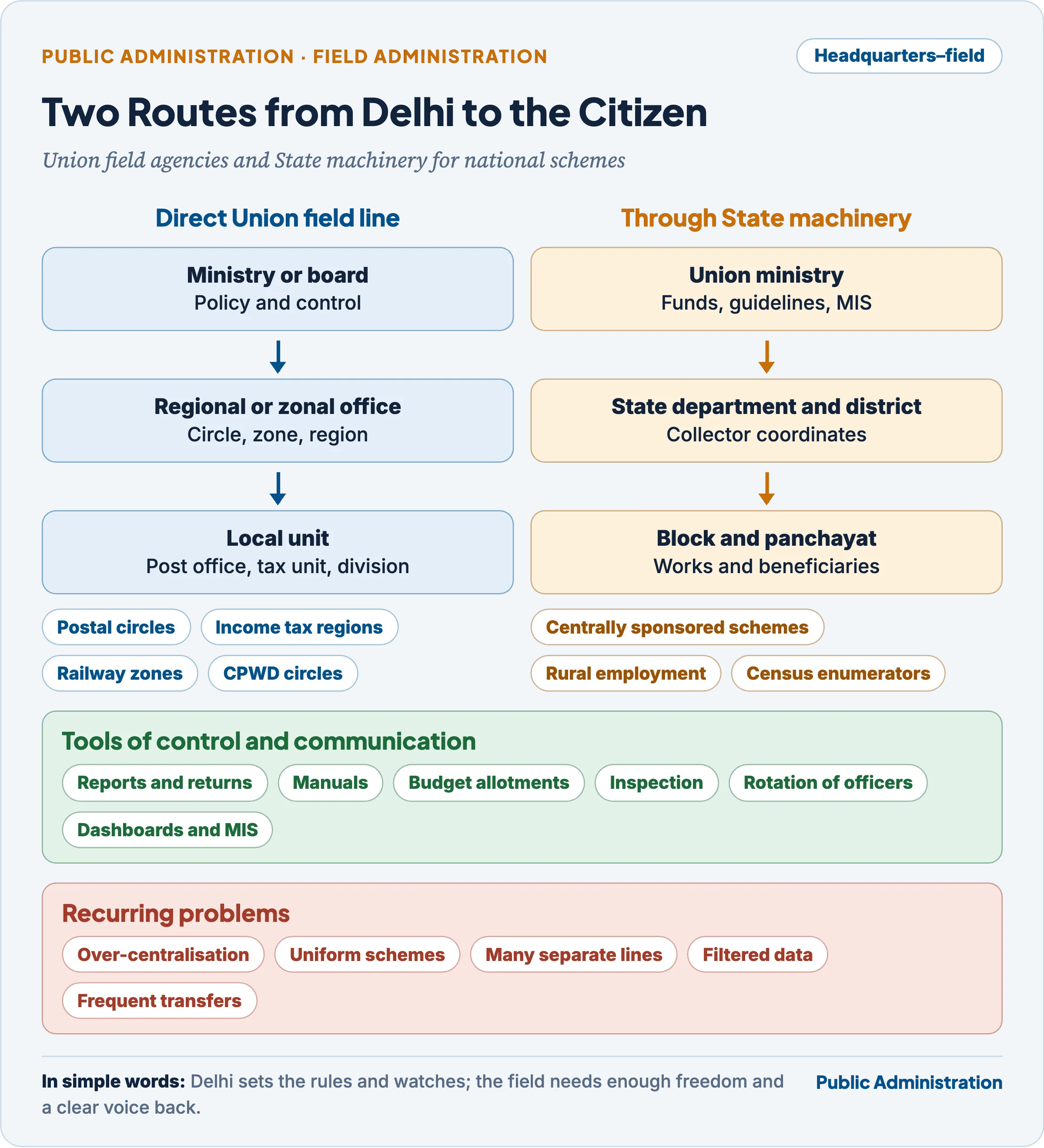
- Direct Union field agencies. Where a subject is in the Union List (income tax, customs, posts, railways, telecom, passports, central police), the Union runs its own field offices.
- Department of Posts: postal circles (each under a Chief Postmaster General), regions, divisions, head, sub- and branch post offices.
- Income Tax Department: regions under Principal Chief Commissioners, with national faceless assessment and appeal units since 2020.
- Indian Railways: zones and divisions.
- CPWD: zones, circles and divisions across India, building and maintaining Union buildings.
- Central armed police forces: frontiers, sectors and battalions.
- Through State machinery. Where the subject is in the State or Concurrent List, the Union works through State departments and local bodies, using funds, guidelines and monitoring: Centrally Sponsored Schemes in health, education, rural development and water. The Constitution enables this through Arts. 256–258: Union laws bind the States’ executive power, and the Union may entrust functions to State officers with their consent.
- Hybrid: the Census. The Registrar General and Census Commissioner (an attached office of the Home Ministry) and the Directorates of Census Operations in each State (subordinate offices) plan and supervise, while State government employees, mostly teachers, serve as enumerators and supervisors under the Census Act, 1948. Census 2027, the first digital census with self-enumeration, began its house-listing phase on 1 April 2026; population enumeration is due in February 2027, with 1 March 2027 as the reference date (1 October 2026 for snow-bound areas). Caste enumeration is part of the second phase.
7.3 Headquarters control and field discretion
- Tools of control: reports and returns; manuals and codes; budget allotments; inspection and audit; investigation; uniform organisation plans; rotation of officers between field and headquarters (the tenure system); and, increasingly, real-time dashboards (PFMS, e-office, programme MIS).
- What decides decentralisation (Fesler): the headquarters’ responsibility to Parliament; the age and maturity of the agency and its staff; the nature of the function (uniform functions such as tax and posts centralise, development functions need local adaptation); and the need for citizen and local-body cooperation.
- Two-way communication is the core of a healthy relationship: clear instructions downward, honest and timely feedback upward, field officers involved in policy design, and headquarters staff who visit and listen.
7.4 Problems of coordination and delegation
- Over-centralisation: minor financial and personnel matters referred to Delhi; field officers lack powers to adapt.
- Uniform schemes: “one size fits all” guidelines designed at headquarters ignore regional variation.
- Multiplicity of lines: dozens of Union schemes reach a district through separate departmental channels, each with its own funds, formats and review meetings.
- Communication distortion: information is filtered as it rises; dashboards can be gamed with target-driven data.
- Generalist–specialist friction: secretariat generalists over technical field heads.
- Status and morale: subordinate field offices with poorer pay and prospects.
- Frequent transfers break continuity in the field.
- Remedies: a published scheme of delegation (2nd ARC), financial delegation within budgets, outcome-based rather than process-based monitoring, convergence platforms at district level, stable tenures, training (Mission Karmayogi), and citizen feedback (social audit, grievance portals).
Indian Connect — Field organisations and the delivery of national schemes
- Rural employment guarantee. Under MGNREGA (2005), a District Programme Coordinator and block-level Programme Officers supervised works, gram panchayats executed at least half of them, an MIS recorded every job card and payment, and social audits by gram sabhas checked the field. The Viksit Bharat–G RAM G Act, 2025 has replaced MGNREGA from 1 July 2026, again depending on block, panchayat and district machinery for delivery.
- Swachh Bharat Mission (Grameen). District sanitation committees, block coordinators and village motivators, with geo-tagged verification of toilets, showed how field organisation combined with information systems can drive behaviour change at scale.
- Lesson. Field organisations turn national schemes into local results when they combine delegated discretion, local participation and real-time information; they fail when targets are imposed from above and verified only on paper.
8. Intra-governmental Relations
In simple words
A big government is many organisations under one name. Ministries compete for money and turf, and the Centre and the States share most tasks. Intra-governmental relations are about how these parts talk, agree and settle quarrels, from a meeting of secretaries in Delhi to a tribunal deciding how two States share a river.
8.1 Meaning and dimensions
- Horizontal (inter-ministerial): among Union ministries and departments.
- Vertical (Union–State): between the Union and State governments, and between Union field offices and State administrations.
- Inter-state: among States, often mediated by the Union (river waters, boundaries, migration, transport).
- The top-level Cabinet dimension (Cabinet Committees, GoMs, Committees of Secretaries) is treated in the article on the Union Executive; the Centre–State dimension as a whole in the article on Union–State Relations.
8.2 Inter-ministerial coordination
- Why it is hard. Most problems cross departmental lines: water (Jal Shakti, Agriculture, Housing and Urban Affairs, Environment, Power), nutrition (Women and Child Development, Health, Food, Education, Drinking Water), infrastructure (Roads, Railways, Environment, Defence land, States). James Thompson (Organizations in Action, 1967) showed that reciprocal interdependence needs the most costly coordination: mutual adjustment rather than rules.
- Mechanisms.
- Compulsory consultation under the Transaction of Business Rules (Finance, Law, Personnel and the concerned ministries before a Cabinet note);
- inter-ministerial committees and working groups;
- Committees of Secretaries under the Cabinet Secretary, which settle disputes before they reach ministers and work by consensus;
- Cabinet Committees and occasional Groups of Ministers (all standing GoMs and EGoMs were wound up in 2014; GoMs are now used sparingly);
- PMO review and PRAGATI (from 2015), the Prime Minister’s video platform for stalled projects and grievances;
- NITI Aayog for cross-cutting policy and monitoring;
- platforms and missions that put several ministries on one plan (PM Gati Shakti, Section 9).
- Turf conflicts. Anthony Downs (Inside Bureaucracy, 1967) described bureaus as territorial: they defend and enlarge their policy space. Indian examples:
- environment clearances versus infrastructure ministries;
- Home versus Defence on border management and the Assam Rifles’ control;
- jurisdictional overlaps in digital governance among MeitY, the Department of Telecommunications and Information and Broadcasting;
- skill development schemes spread over many ministries before the 2014 ministry;
- water split for decades between Water Resources and Drinking Water until Jal Shakti (2019).
- Effects: delay, duplication, inconsistent policies, “departmentalism” (loyalty to the department over government as a whole), and a “culture of alibis” in which no one is accountable.
8.3 Union–State and inter-state forums
| Forum | Basis | Composition and role |
|---|---|---|
| Inter-State Council | Art. 263; set up by Presidential Order on 28 May 1990 on the Sarkaria Commission’s advice | PM (chair), all Chief Ministers, Administrators of UTs, six Union ministers; investigates and advises on Centre–State and inter-state issues. Met rarely: its eleventh meeting (16 July 2016) came after a gap of ten years; a Standing Committee under the Home Minister processes issues such as the Punchhi Commission (2010) recommendations |
| Zonal Councils | States Reorganisation Act, 1956 (five councils) | Home Minister (chair), Chief Ministers of the zone; settle border, transport, water and policing issues; meetings became regular after 2014 |
| North Eastern Council | NEC Act, 1971 | Regional planning and development body for the North-East |
| NITI Aayog Governing Council | Resolution, 2015 | PM, all Chief Ministers and Lieutenant Governors; cooperative federalism and national agenda |
| GST Council | Art. 279A (101st Amendment, 2016) | Union and State finance ministers; joint indirect-tax policy |
| River boards and authorities | River Boards Act, 1956 (unused); specific Acts and schemes | Bhakra Beas Management Board (1966), Narmada Control Authority (1980), Brahmaputra Board (1980), Krishna and Godavari River Management Boards (Andhra Pradesh Reorganisation Act, 2014), Cauvery Water Management Authority (2018) |
- The new-ministry problem. Creating a Union ministry for a State subject raises federal friction. Cooperative societies are a State subject (List II, Entry 32), and in Union of India v. Rajendra N. Shah (20 July 2021) the Supreme Court struck down the parts of the 97th Amendment (Part IXB) that dealt with State cooperatives for want of ratification by the States, keeping them valid only for multi-State cooperatives. The Ministry of Cooperation, created a fortnight earlier, therefore works mainly through multi-State bodies, model laws (such as model bye-laws for primary agricultural credit societies), funding and persuasion; its National Cooperation Policy was released on 24 July 2025.
8.4 Inter-state river water disputes
Constitutional and legal frame
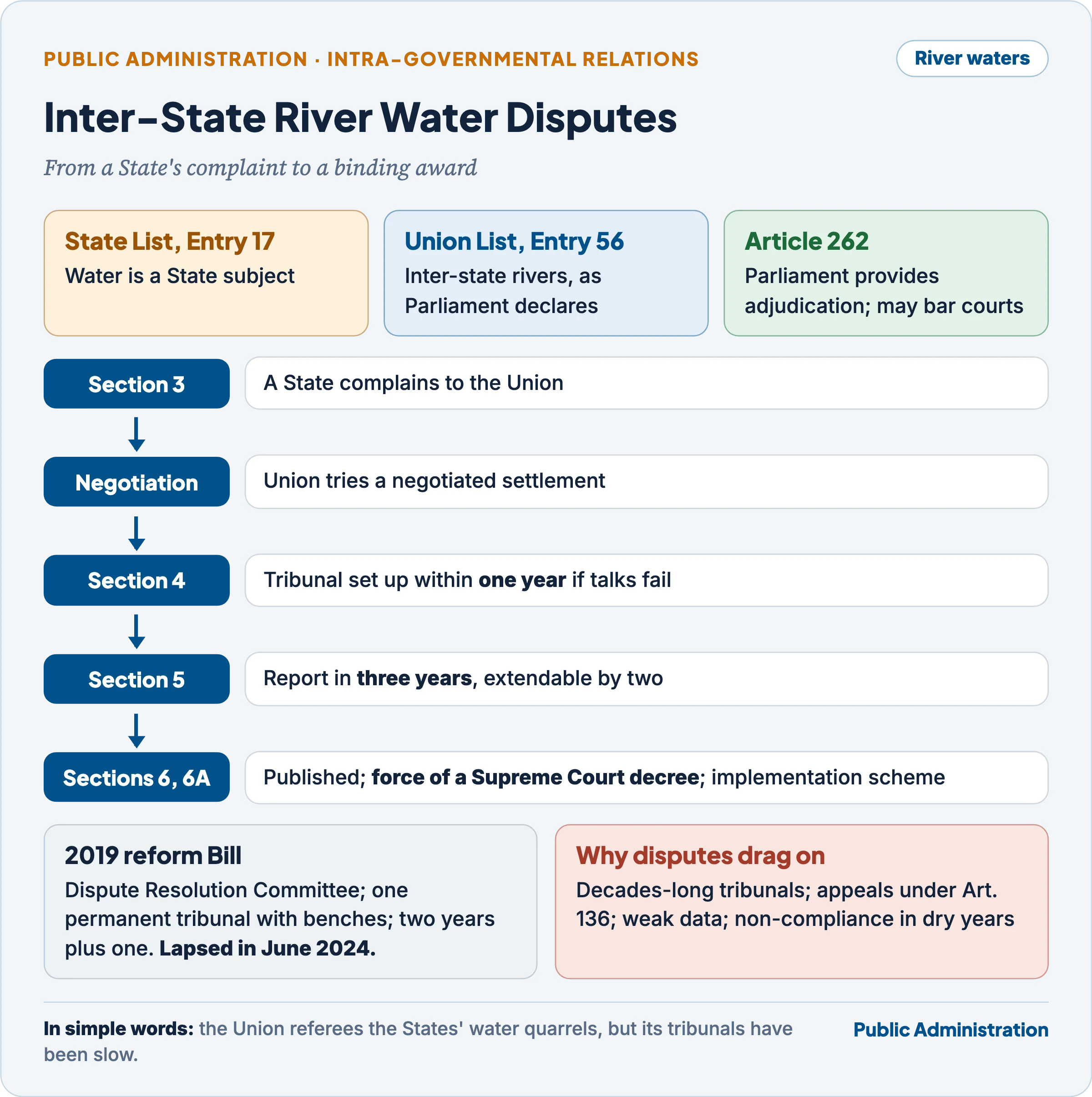
- Division of power. Water (supplies, irrigation, canals, embankments, storage, hydropower) is a State subject (List II, Entry 17), but subject to Entry 56 of List I, which lets Parliament regulate and develop inter-state rivers and river valleys to the extent declared by law to be expedient in the public interest.
- Article 262. Parliament may by law provide for the adjudication of any dispute about the use, distribution or control of the waters of an inter-state river or river valley, and may bar the Supreme Court and other courts from exercising jurisdiction over it.
- Inter-State River Water Disputes Act, 1956 (as amended in 1980 and 2002):
- s. 3: a State may complain to the Union that its interests are affected;
- s. 4: if the Union is of the opinion that the dispute cannot be settled by negotiation, it must constitute a tribunal (after 2002, within one year of the request);
- s. 5: the tribunal must report within three years, extendable by two; States or the Union may seek clarification within three months, and the further report is due within a year;
- s. 6: the Union publishes the decision; since 2002 it has the same force as an order or decree of the Supreme Court; s. 6A allows a scheme to implement it;
- s. 9A: a national data bank for each river basin (2002);
- s. 11: no court (including the Supreme Court) has jurisdiction over a dispute that may be referred to a tribunal.
- River Boards Act, 1956. Provides for advisory boards on inter-state rivers at the request of States, but no board has ever been set up under it.
The tribunals
Nine tribunals have been set up under the 1956 Act; five have given decisions and been dissolved, and four were still active in 2025.
| Tribunal | States | Set up | Status |
|---|---|---|---|
| Krishna (I) | Maharashtra, Karnataka, Andhra Pradesh | 1969 | Award 1976 (R.S. Bachawat) |
| Godavari | Maharashtra, Andhra Pradesh, Karnataka, Madhya Pradesh, Odisha | 1969 | Award 1980 |
| Narmada | Rajasthan, Madhya Pradesh, Gujarat, Maharashtra | 1969 | Award 1979; Narmada Control Authority (1980) |
| Ravi and Beas | Punjab, Haryana, Rajasthan | 1986 | Report 1987; still pending after nearly four decades |
| Cauvery | Karnataka, Tamil Nadu, Kerala, Puducherry | 1990 | Award 2007, notified 2013; modified by the Supreme Court in 2018 |
| Krishna (II) | Karnataka, Maharashtra, Andhra Pradesh, Telangana | 2004 | Report 2010, further report 2013, publication stayed by the Supreme Court; fresh reference on Telangana and Andhra Pradesh; active |
| Vansadhara | Andhra Pradesh, Odisha | 2010 | Report 2017; concluded and dissolved |
| Mahadayi | Goa, Karnataka, Maharashtra | 2010 | Report 2018; further reference pending; active, term extended in 2025 |
| Mahanadi | Odisha, Chhattisgarh | 2018 | Set up on the Supreme Court’s direction; active |
Role of the central government in adjudication
- Gatekeeper. It receives the State’s complaint, attempts negotiation, and decides whether to constitute a tribunal (a decision that has itself been delayed and litigated, as in the Mahanadi case, where the tribunal was set up only after the Supreme Court’s direction).
- Constitutes and services tribunals. The Chief Justice of India nominates sitting judges; the Union provides staff, extends terms and refers further questions.
- Publishes and implements. It notifies awards (the Cauvery award of 2007 was notified only in 2013), frames implementation schemes (the Cauvery Water Management Authority and Cauvery Water Regulation Committee, constituted in June 2018), and sets up boards to manage shared projects.
- Technical arm. The Central Water Commission and the data bank provide hydrological data and assessments; the National Water Development Agency handles river interlinking (the Ken–Betwa link, approved in 2021).
- Facilitator. Through the Ministry of Jal Shakti, Zonal Councils and direct talks between Chief Ministers, it encourages negotiated settlements, which remain the best outcome.
- Limits of its role. The Union is often seen as partisan when the governments in the disputing States are politically aligned or opposed to it; it lacks power to enforce awards against a defiant State without political cost; and its delays in notification and scheme-making have prolonged disputes.
Why the system has struggled
- Extreme delays: tribunals take decades (Ravi–Beas from 1986; Krishna II from 2004).
- Absence of reliable data, disputed hydrology and changing demands.
- Return to the courts. Despite s. 11, the Supreme Court held in December 2016 that appeals under Art. 136 against a tribunal’s final decision are maintainable, and in State of Karnataka v. State of Tamil Nadu (16 February 2018) it modified the Cauvery award, treating river water as a national asset and giving drinking water the highest priority. The 1991 Cauvery Presidential Reference had already held that a State cannot nullify a tribunal’s order by ordinance, and the 2016 opinion on the Punjab Termination of Agreements Act, 2004 held that Punjab could not unilaterally cancel its water agreements.
- Political mobilisation of water as an identity issue; non-compliance by upstream States in deficit years.
- Fragmented water administration: the Mihir Shah Committee (2016) recommended a National Water Commission merging the Central Water Commission and the Central Ground Water Board for basin-level management.
The 2019 reform proposal
- Inter-State River Water Disputes (Amendment) Bill, 2019 (introduced 25 July 2019, passed by the Lok Sabha 31 July 2019):
- a Disputes Resolution Committee of experts and State representatives to try negotiation within one year (extendable by six months);
- a single permanent Inter-State River Water Disputes Tribunal with multiple benches, replacing all existing tribunals;
- decision within two years, extendable by one;
- bench decisions final and binding without separate publication; an implementation scheme made mandatory;
- an agency to maintain the national data bank.
- Status. Pending in the Rajya Sabha, it lapsed on the dissolution of the 17th Lok Sabha (Rajya Sabha bulletin of 13 June 2024) under Art. 107(5). The disputes therefore remain under the 1956 framework with separate, ad hoc tribunals.
9. Recent Trends
In simple words
Recent reforms try to make many separate ministries act as one government: shared digital maps for infrastructure, missions that pull departments together, fewer and better-defined agencies, and offices that deliver services online rather than across a counter.
9.1 Convergence and whole-of-government approaches
- From silos to platforms. The reaction against NPM’s fragmentation produced joined-up government (the Blair government’s agenda from 1997; Perri 6, Holistic Government, 1997) and whole-of-government approaches. India’s version works through platforms, missions and dashboards rather than structural mergers.
- PM Gati Shakti National Master Plan (launched 13 October 2021): a GIS-based platform on which infrastructure ministries (roads, railways, ports, airways, power, telecom, gas, waterways) and States map their projects together. An Empowered Group of Secretaries under the Cabinet Secretary, a Network Planning Group of the ministries’ planning heads and a Technical Support Unit coordinate it. It is designed to overcome sequential, siloed planning (a road dug up again for a pipeline) through shared data.
- PRAGATI (2015): the PM’s monthly review of stalled projects with Union Secretaries and Chief Secretaries.
- Aspirational Districts (2018) and Aspirational Blocks (2023): convergence of schemes at district and block level, ranked on outcome indicators.
- Mission design: Jal Jeevan Mission, Swachh Bharat and Poshan Abhiyaan bring several departments under one mission directorate with common targets.
9.2 Agencification and mission-mode bodies
- Mission directorates and SPVs (National Mission for Clean Ganga, Jal Jeevan Mission, India Semiconductor Mission, the IndiaAI Mission) give time-bound, professionally staffed vehicles with some autonomy from secretariat procedure.
- Statutory conversion of attached offices (DGCA, BCAS and AAIB in 2020) and corporatisation of departmental boards (OFB in 2021).
- Risk: proliferation of semi-autonomous bodies outside parliamentary scrutiny, which feeds the next trend.
9.3 Rationalisation of autonomous bodies
- Why. Autonomous bodies (mostly societies, funded by grants) multiplied over decades; many overlap, some outlived their purpose, and all draw on the budget. GFR Rule 229 requires periodic review.
- Reviews.
- A NITI Aayog-led review in 2017 (under Principal Adviser Ratan Watal) began the exercise.
- The Department of Expenditure reviewed 231 autonomous bodies of 23 ministries and recommended (reported in January 2021) that 83 be retained, 117 be merged into 29, the Centre disengage from 20, and 7 be closed.
- Ministry-level expert committees, such as the Bimal Julka committees on film media units (2020), followed.
- Outcomes.
- Closure of Rashtriya Arogya Nidhi and Jansankhya Sthirata Kosh (Cabinet decision, 2018);
- abolition of the All India Handloom Board and All India Handicrafts Board (2020);
- merger of Films Division, the Directorate of Film Festivals, the National Film Archive and the Children’s Film Society into the NFDC (2022);
- closure of the Rashtriya Mahila Kosh (from 31 December 2023).
- Debate. Supporters see minimum government, maximum governance and better use of funds; critics fear loss of specialised capacity, pressure on research institutions to become self-financing, and decisions taken without public consultation.
9.4 Other trends
- Area departments return: the Department of Capital Development (2026) adds to DoNER and Jammu, Kashmir and Ladakh Affairs.
- Delayering and e-office in the Secretariat; faceless interfaces in tax and customs; digital field operations (the Census 2027 mobile app and self-enumeration).
- Capacity building: Mission Karmayogi (2020) and the Capacity Building Commission (2021) to build role-based competencies across ministries and field offices.
- Centralisation through technology: dashboards and platforms strengthen headquarters’ sight of the field; whether they also empower the field depends on delegation.
Criticism — Criticism: a fragmented and top-heavy departmental system
- Too many ministries (53, plus seven stand-alone units) for coherent policy; the 2nd ARC’s 20–25 target remains unmet, and new ministries keep appearing.
- Clientele and symbolic ministries duplicate services, which is Haldane’s “Lilliputian administration”.
- Turf and departmentalism: coordination depends on Committees of Secretaries, the PMO and platforms because the structure itself does not integrate.
- Secretariat over-reach: executive agencies lack power, proposals are examined twice, and subordinate offices are undervalued.
- Federal friction: Union ministries in State subjects (cooperation) and scheme-driven field control weaken State autonomy.
- Water disputes show the cost: decades-long tribunals and a lapsed reform Bill.
Defence — Defence: a flexible system that adapts
- Flexibility under Art. 77(3): ministries can be created, merged or split overnight by notification, as in 2019, 2021 and 2026, letting government respond to new priorities.
- Representation: in a large, diverse democracy, separate ministries give voice to groups and regions; the 2nd ARC itself accepted the need for a large Council of Ministers.
- Specialisation: focused ministries (Jal Shakti, Cooperation, Divyangjan) build expertise and attention that umbrella ministries can dilute.
- Coordination has improved: Gati Shakti, PRAGATI, mission directorates, e-office and outcome monitoring integrate across silos without costly structural upheaval.
- Rationalisation is under way: reviews of autonomous bodies, closure of redundant bodies, corporatisation of the OFB and the slimmed Railway Board.
- Field innovation: faceless taxation, the digital census and DBT have reshaped headquarters–field relations.
Theory lens: ministries, agencies and the field through Paper I ideas
- Gulick’s departmentalisation and POSDCORB. Luther Gulick (1937) gives the four bases (purpose, process, persons, place) by which Indian ministries are built and the coordination by organisation and by idea that Committees of Secretaries and missions provide. Herbert Simon’s “proverbs” critique explains why India mixes bases rather than following one rule. See the article on Classical Theory.
- Haldane’s functional principle. The Haldane Committee (1918) explains the case for grouping by service and against “Lilliputian” clientele ministries; India’s many clientele ministries show political logic prevailing over this administrative principle. See the article on Structure and Forms of Public Organisations.
- Line, staff and auxiliary agencies. W.F. Willoughby and later writers distinguished line (operating) agencies, staff (advisory and planning) units and auxiliary (housekeeping) services. The Indian secretariat claims a staff role over line executive agencies, while the CPWD, Department of Expenditure and Directorate of Estates act as auxiliaries for all ministries. The staff–line confusion explains why the secretariat over-reaches into execution.
- Headquarters–field theory. Willoughby, Gulick’s “arms and fingers” and James Fesler’s (1949) area-versus-function analysis explain why Union agencies run functional field lines while the State’s Collector coordinates by area, and why decentralisation varies with function, maturity and the need for local cooperation. See the article on Structure and Forms of Public Organisations.
- Weber and collegiality. Max Weber (Economy and Society, 1922) saw the hierarchical bureau as technically superior but recognised collegial bodies as a check on bureaucratic power; India’s departments are Weberian bureaus, its commissions and boards collegial checks. The 2nd ARC’s diagnosis that Indian structures are “Weberian” and suited to command and control is a direct application. See the article on Weber and Bureaucracy.
- NPM agencification. The Next Steps report (1988) and New Public Management explain the 2nd ARC’s call for executive agencies with performance agreements and India’s partial use of statutory authorities, SPVs and MoUs; public choice writers (Niskanen, Dunleavy) explain why ministries and bureaus multiply. See the articles on New Public Management and After and on New Public Administration and Public Choice.
- Joined-up and whole-of-government. Perri 6 (1997) and post-NPM writers argue that fragmentation must be countered by integration of policy and delivery; PM Gati Shakti, PRAGATI and convergence missions are Indian joined-up devices built on shared data rather than mergers.
- Coordination and interdependence. James Thompson (1967) explains why reciprocal interdependence (water, nutrition, infrastructure) needs mutual adjustment through committees and platforms, and Anthony Downs’s (1967) bureau territoriality explains turf conflicts; Mary Parker Follett’s principle of coordination by direct contact at early stages supports early inter-ministerial consultation. See the article on Mary Parker Follett.
Key Terms
| Term | Meaning in simple words |
|---|---|
| Ministry | A minister’s political charge, grouping related subjects; may contain several departments |
| Department | The administrative unit headed by a Secretary that frames and executes policy in its subjects |
| Allocation of Business Rules | Rules under Art. 77(3) listing all ministries and departments and the subjects of each |
| Transaction of Business Rules | Rules on how business is decided and which other departments must be consulted |
| Departmentalisation | Dividing government work into units on some basis (purpose, process, persons, place) |
| Lilliputian administration | Haldane’s term for many small, duplicating units created by grouping work by client groups |
| Coordinating (First) Minister | 2nd ARC proposal: a senior minister leading a cluster of related departments |
| Attached office | Executive agency giving technical direction and advice for implementing a ministry’s policy |
| Subordinate office | Field establishment or agency doing detailed execution, usually under an attached office |
| Split system | Separation of policy-making (secretariat) from execution (executive agencies) |
| Executive agency | A body implementing a defined task under a chief executive and a performance agreement |
| Agencification | Hiving off executive work from ministries to semi-autonomous agencies (NPM) |
| Board | A plural-headed body deciding collectively; administrative, regulatory, advisory or promotional |
| Statutory body | A body created by an Act of Parliament, with powers defined by law |
| Executive (non-statutory) body | A body created by government resolution or order |
| Commission | A multi-member body for tasks needing independence, expertise or impartiality |
| Field organisation | The regional and local offices that deliver an agency’s work outside headquarters |
| Functional field system | Each ministry runs its own vertical line from headquarters to the field |
| Departmentalism | Loyalty to one’s department over government as a whole; turf protection |
| Committee of Secretaries | Meeting of Secretaries under the Cabinet Secretary to settle inter-ministerial issues |
| Inter-State Council | Advisory body under Art. 263 for Centre–State and inter-state issues |
| Water disputes tribunal | Adjudicating body set up under the 1956 Act for an inter-state river dispute |
| Convergence | Bringing several departments’ schemes and data together for one outcome or place |
| Whole-of-government | Working across organisational boundaries towards shared goals |
| Autonomous body | A government-funded society or trust with its own governing body |
Commissions, Committees and Judgments
The bodies, reports and cases below shaped the Union’s departmental machinery, listed by year.
| Body / case | Year | Key point |
|---|---|---|
| Railway Board (Indian Railway Board Act) | 1905 | Board form for running the railways |
| Haldane Committee, UK (Viscount Haldane) | 1918 | Group by service, not persons; warns of “Lilliputian administration” |
| Acworth Committee (William Acworth) | 1921 | Separation of railway finances (Convention of 1924) |
| Rowlands Committee, Bengal (Archibald Rowlands) | 1944–45 | Favoured common files for secretariat and directorates |
| Tottenham Report on the Reorganisation of the Central Government (Richard Tottenham) | 1945–46 | Minister the will, Secretary the brain, executive head the hands; attached–subordinate distinction artificial |
| First Central Pay Commission (S. Varadachariar) | 1946–47 | Distinction between attached and subordinate offices unsatisfactory |
| Gopalaswami Ayyangar report (N. Gopalaswami Ayyangar) | 1949 | Grouping of ministries; led to the O&M Division (1954) |
| Central Social Welfare Board (Durgabai Deshmukh, first chair) | 1953 | Board to fund and guide voluntary welfare work |
| First ARC, Machinery of GoI and its Procedures of Work | 1968 | Group by affinity of subjects; integrate only development agencies with secretariats |
| Next Steps report, UK (Robin Ibbs) | 1988 | Executive agencies under chief executives |
| Sarkaria Commission (R.S. Sarkaria) | 1988 | Permanent Inter-State Council; time-bound, binding water awards |
| In re Cauvery Water Disputes Tribunal (Presidential Reference) | 1991 | A State cannot nullify a tribunal’s order by ordinance |
| Kargil Review Committee (K. Subrahmanyam) | 1999 | Led to the 2001 GoM: “one border, one force” |
| 2nd ARC, 13th Report, Organisational Structure of GoI | 2009 | 20–25 ministries under coordinating ministers; executive agencies; no more than three levels |
| Punchhi Commission (M.M. Punchhi) | 2010 | Centre–State relations; recommendations processed by the ISC Standing Committee |
| Mihir Shah Committee | 2016 | National Water Commission merging CWC and CGWB |
| Supreme Court, Cauvery maintainability ruling | 2016 | Art. 136 appeals against tribunal decisions maintainable |
| In re Punjab Termination of Agreements Act, 2004 | 2016 | A State cannot unilaterally cancel inter-state water agreements |
| State of Karnataka v. State of Tamil Nadu | 2018 | Cauvery award modified; water a national asset; drinking water first |
| Department of Expenditure review of autonomous bodies | 2020–21 | 231 bodies: retain 83, merge 117 into 29, disengage 20, close 7 |
| Union of India v. Rajendra N. Shah | 2021 | Part IXB valid only for multi-State cooperatives |
| Budhadev Karmaskar v. State of West Bengal | 2022 | Dignity and protection of adult sex workers |
| Anoop Baranwal v. Union of India | 2023 | Independence of the Election Commission depends on the appointment process |
| Sixteenth Finance Commission (Arvind Panagariya) | 2023–26 | States’ share kept at 41 per cent for 2026–31 |
Contemporary Developments
- Housing and Urban Affairs split (22 July 2026). The 386th amendment to the Allocation of Business Rules created the Department of Capital Development (Delhi, NCR, CPWD, Union properties) and the Department of Urban Development (national urban missions, housing policy, municipal governance) within the ministry; a follow-up notification of 1 September 2026 substituted the new Secretary’s designation in all laws and rules for Delhi subjects.
- Count of the machinery (July 2026). The consolidated Allocation of Business Rules list 53 ministries (34 stand-alone and 19 with a total of 53 departments) and 7 units outside ministries, after 386 amendments since 1961.
- Water-disputes reform lapses (13 June 2024). The Rajya Sabha notified that the Inter-State River Water Disputes (Amendment) Bill, 2019, which proposed a single permanent tribunal and Dispute Resolution Committees, had lapsed with the 17th Lok Sabha.
- Tribunals extended (July–August 2025). The Union extended the terms of the Ravi–Beas, Krishna and Mahadayi tribunals; with the Mahanadi tribunal, four tribunals remained active, the oldest constituted in 1986.
- National Cooperation Policy (24 July 2025). The four-year-old Ministry of Cooperation released its first policy, drafted by a committee chaired by Suresh Prabhu, aiming to make cooperatives a growth engine by 2047.
- Sixteenth Finance Commission (1 February 2026). Its report for 2026–31, tabled with the Budget, retained the States’ share of the divisible pool at 41 per cent and was accepted by the government.
- Census 2027 field operations (from 1 April 2026). The Registrar General’s field machinery began the first digital census, with self-enumeration and mobile-app enumeration by State-appointed staff; population enumeration, including caste, is due in February 2027.
- Rationalisation of autonomous bodies (2023–24). The Rashtriya Mahila Kosh was closed from 31 December 2023 (gazette notification, March 2024), its loans transferred to SIDBI and its funds returned to the Consolidated Fund, on the recommendation of a report on rationalisation of government bodies.
Revision Grid
| Thinker / body | Work or report (year) | Key idea |
|---|---|---|
| Viscount Haldane | Machinery of Government Committee (1918) | Functional grouping; no “Lilliputian administration” |
| W.F. Willoughby | Principles of Public Administration (1927) | Unitary and multiple field systems; line, staff and auxiliary |
| Luther Gulick | “Notes on the Theory of Organization” (1937) | Four Ps; coordination; arms and fingers |
| Herbert Simon | “The Proverbs of Administration” (1946) | Bases of departmentalisation contradict one another |
| James Fesler | Area and Administration (1949) | Area versus function; factors in field decentralisation |
| Max Weber | Economy and Society (1922) | Bureau superiority; collegiality as a check |
| Anthony Downs | Inside Bureaucracy (1967) | Bureau territoriality and turf |
| James Thompson | Organizations in Action (1967) | Pooled, sequential and reciprocal interdependence |
| William Niskanen | Bureaucracy and Representative Government (1971) | Budget-maximising bureaus |
| Patrick Dunleavy | Democracy, Bureaucracy and Public Choice (1991) | Bureau-shaping |
| Robin Ibbs (Efficiency Unit) | The Next Steps (1988) | Executive agencies with chief executives |
| Perri 6 | Holistic Government (1997) | Joined-up government against fragmentation |
| Richard Tottenham | Reorganisation of the Central Government (1945–46) | Will, brain and hands; split system |
| First ARC | Machinery of GoI (1968) | Affinity of subjects; integrate development agencies |
| 2nd ARC | 13th Report (2009) | 20–25 ministries; coordinating minister; executive agencies; three levels |
| Sarkaria Commission | Report (1988) | Inter-State Council; binding water awards |
| Mihir Shah Committee | Water reforms (2016) | National Water Commission |
Previous Year Questions
- 2025Examine the significance of field organizations in enhancing policy implementation of projects like MGNREGA and Swachh Bharat Mission.
- 2022Examine the role of central government in adjudication of disputes relating to water of interstate rivers.
- 2018“The attached offices and subordinate offices are integral to the functioning of the Cabinet Secretariat.” Discuss.
- 2016What factors have led to the expansion of the role of the Ministry of Home Affairs? How can it coordinate its affairs more effectively with the Ministry of Defence?
- 2013“Finance Commission in India performs the job of statistics aggregation.” Comment.
- 2007Critically analyse the functions and role of Ministry of Social Justice and Empowerment with regard to development of disabled persons in India.
- 2006What concrete steps have been taken by the Union and the State Govern-ments to protect child labour and prevent abuse of children?
- 2006What measures have been taken by the Union and the States for the welfare of women in the profession of sex?
- 2006Critically evaluate the policies of the Union Government. With regard to the welfare of women and children of India.
- 2001“The Central Social Welfare Board has become an anomalous institution.” In light of this statement, examine the functions and role of the Central Social Welfare Board and suggest measures for making it an effective institution.
- 1998Explain the role and structure of the Ministry of Home Affairs of the Government of India. What are the challenges being faced by this Ministry? Give suggestions for enhancing the capacity of this organization to meet these challenges.
- 1997Critically examine the role of the Finance Ministry as the custodian of all public revenues.
- 1997“For national planning, the commission type of organisation was deliberately preferred.” Examine the statement.
- 1996“Rigidity in administration and centralization has greatly incapacitated the Central Social Welfare Board,” Examine, in the light of this statement, the organization and working of the Central Social Welfare Board.
- 1993Outline in brief the organisation and working of the Union Ministry of Finance and offer concrete suggestions for organisational reform in the light of the new economic policy of liberalisation of the Central Government.
- 1992Outline the organisation and working of the Ministry of Home Affairs in the Government of India & examine its role in the event of breakdown of constitutional machinery in a state.
- 1991Analyse the role and functions of the Ministry of Finance of the Government of India. What steps would you visualise to improve its performance of the function of financial management. Suggest measures to streamline its relationships with other Ministries?
- 1990‘The recommendations of a Finance Commission, according to Constitutional provisions, do not constitute an award. These are recommendations…… the Finance Commission is an aid, and the executive may or mat not accept its recommendations considering their feasibility and desirability of implementation on objective considerations.’ Comment.
- 1989Outline in brief the organisational structure and working of the Ministry of Finance or Ministry of Home of the Union Government of India and discuss the role, relationship and relevance of its field organisations.
- 1989‘It is high time that the distribution of Central Assistance Under Article 282 of Indian Constitution, (which is entirely or even mainly made on the basis of Semi-Judicial Awards of the Finance Commission) needs to be re-examined in all its implications.’ Why?
- 2024Healthy Headquarters and Field Agencies relationship thrives on effective communication. Comment.
- 2020Departments, Boards and Commissions as forms of organization are dissimilar in the context of accountability and responsibility.” Analyse.
- 2018“An effective Management Information System (MIS) is the key to successful headquarter-field relationships.” Comment.
- 2009“There is no doubt the departmentalisation is fraught with complexities. These are in part technical, in part political.” Discuss.
- 1998“Headquarter and Field relationships determine the tendor of implementation of programmes.” Comment.
- 1997“Theoretically the Board administration violates the distinction between government and politics because through it politics is injected in the administration.” Comment.