

Official syllabusPaper II · Unit 1 · Psychological Measurement of Individual Differences
Types of psychological tests.
Definition
“A test may be defined as a systematic procedure for comparing the behavior of two or more persons.”
Cronbach (1949)
Because a test is defined by its procedure rather than its content, tests can be classified on as many dimensions as the procedure has parts: who is tested at once, what is sampled, how the response is made and scored, whether time matters, what a score is compared with, and what decision it serves. A principled typology gives every test a position on each dimension, and how far a result can be trusted follows largely from that position.
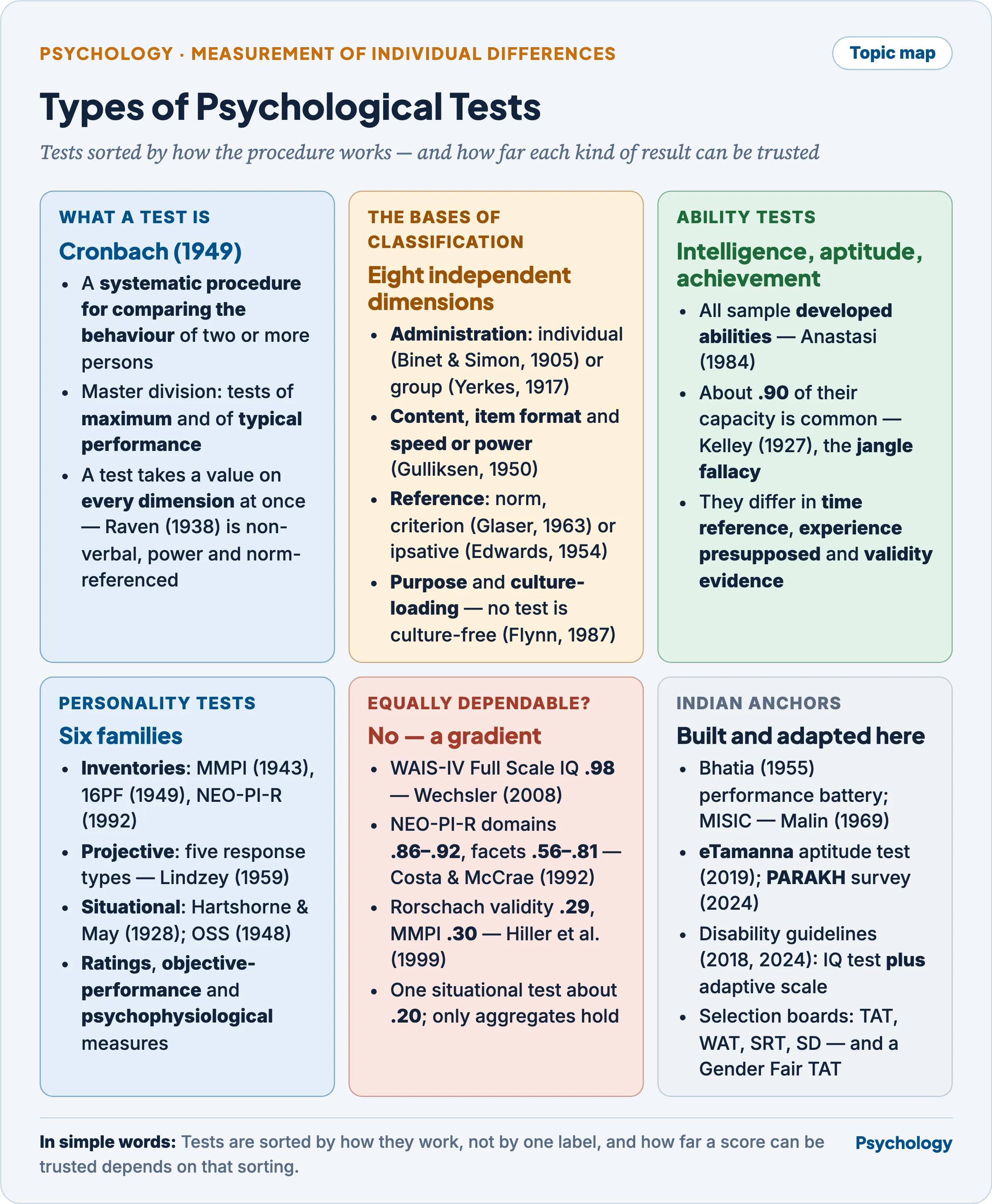
The top row says how tests are sorted; the bottom row shows that the sorting predicts how far each kind of score can be trusted.
Types of psychological tests: the bases of classification
- Each list of types sorts by one feature, so none is complete. Raven’s Standard Progressive Matrices (Raven, 1938) is at once a maximal-performance, non-verbal, power, norm-referenced ability test, usable individually or in groups, built to reduce cultural loading.
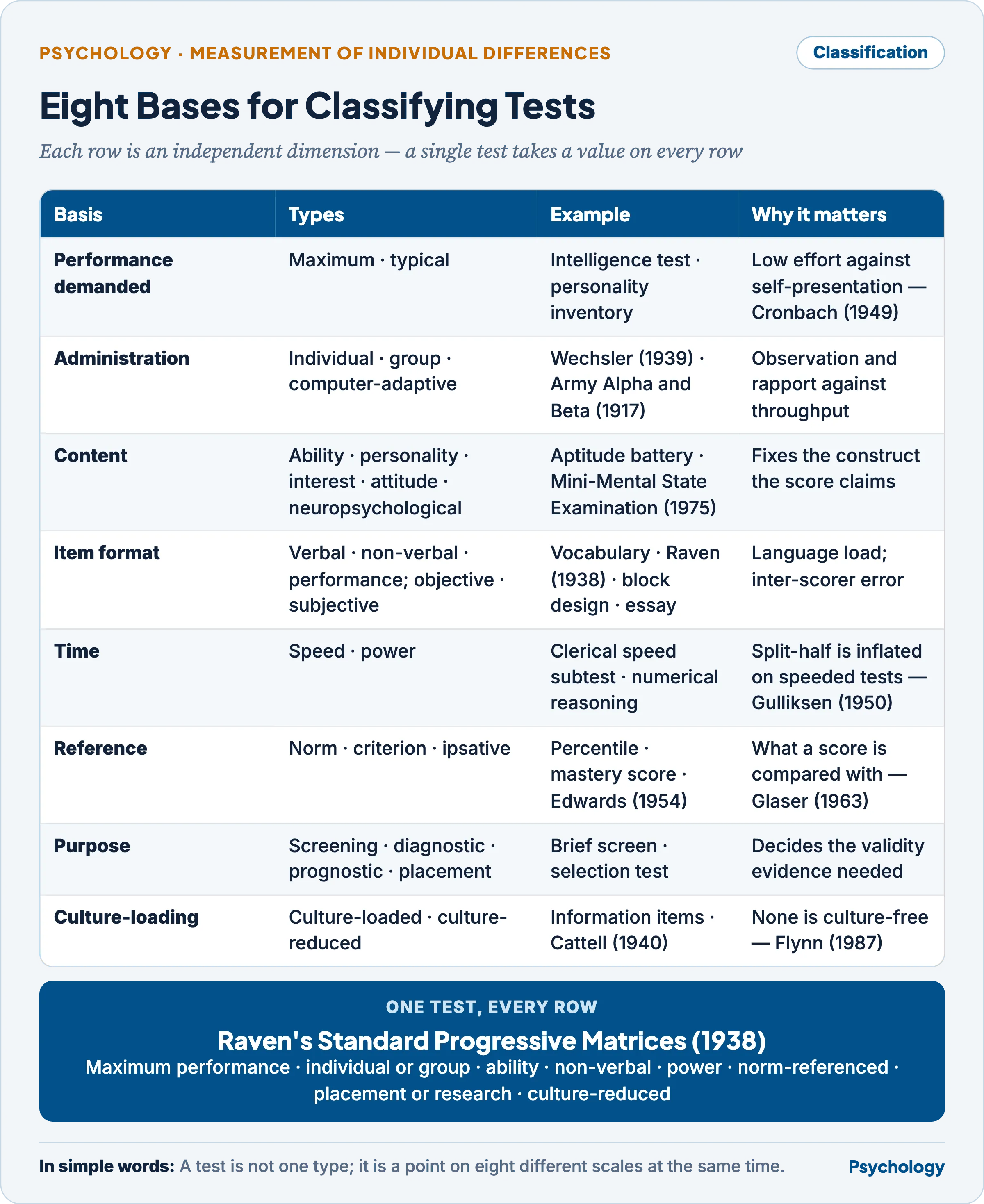
Each row is an independent dimension, so a single test takes a value on every row at once.
Maximal and typical performance
- Cronbach (1949) made the master division. Tests of maximum performance ask the testee to do their best on tasks with right answers; tests of typical performance ask what the person habitually does, where no answer is “best”.
- In a maximal test the danger is low effort; in a typical test it is self-presentation, giving what seems wanted.
- Ability tests are maximal. Personality, interest, attitude and value measures are typical, which is why they carry validity scales and disguised formats.
- Sackett, Zedeck and Fogli (1988) showed that the two are not interchangeable.
- Supermarket cashiers’ speed and accuracy were measured briefly under observation (maximal) and from weeks of scanner records (typical), in samples of 635 and 735 cashiers from 12 chains.
- The two correlated only weakly: what a person can do and will do are different variables.
- Limitation: one job and one psychomotor task.
Individual and group tests
- Individual tests, from Binet and Simon (1905) to the Wechsler (1939) scales, let the examiner pace items, keep rapport and watch how a problem is attacked; they are needed for diagnosis and disability, and are slow and costly.
- Group tests began with the Army Alpha (verbal) and Army Beta (non-verbal, for illiterate and non-English-speaking recruits) built under Yerkes (1917). They buy throughput and uniformity at the price of observation and flexibility.
- Computerised adaptive tests choose each item from the testee’s running ability estimate (Computer Application in the Psychological Laboratory and in Testing, Paper I).
What the test measures
- Ability tests sample maximal performance: intelligence tests sample general reasoning, aptitude tests the capacity to profit from training in a named area, achievement tests learning from defined instruction, and creativity tests divergent production, as in the Tests of Creative Thinking (Torrance, 1966).
- Personality, interest, attitude and value measures sample typical behaviour, as set out in Interests: Nature, Structure and Measurement and Measurement of Attitudes (Paper I).
- Neuropsychological tests infer the integrity of brain systems from performance, from brief screens such as the Mini-Mental State Examination (Folstein, Folstein and McHugh, 1975) to batteries sampling memory, language, executive and perceptual-motor functions.
Item and response format
- Verbal tests depend on reading or speech; non-verbal tests present figures with spoken or mimed instructions, as Raven’s matrices do; performance tests require handling apparatus, such as block designs (Measurement of Intelligence: Methods and Instruments, Paper I).
- Paper-and-pencil tests sample symbolic responses; situational tests place the testee in a real or simulated task and record what is done.
- Objective tests use selected responses scored against a key, so any two scorers agree. Subjective tests use constructed responses — essays, stories, inkblot percepts — whose scoring needs judgement and so adds inter-scorer error.
Speed and power tests
- Gulliksen (1950) defined the limiting cases. A pure speed test has items so easy that nobody errs, so the score is the number attempted; a pure power test allows time for every item, graded in difficulty, so the score is the number right.
- Real tests mix the two, so Gulliksen split errors into items answered wrongly and items not reached. A test is essentially power when not-reached items carry a tenth or less of the spread in total errors, and essentially speeded when wrong answers do.
- The clerical speed and accuracy subtest of the Differential Aptitude Tests (Bennett, Seashore and Wesman, 1947) is a speed test by design; its numerical and abstract reasoning subtests are power tests.
- On a speeded test an odd–even split-half coefficient is spuriously high, because both halves record how far the testee got, so parallel forms are needed (Gulliksen, 1950), as Reliability of Psychological Tests sets out.
Norm-, criterion- and self-referenced interpretation
- A norm-referenced score states a person’s standing in a reference group; a criterion-referenced score states what the person can do against a defined domain or standard, a contrast named by Glaser (1963) and developed in Test Norms and Norm-Referenced Measurement.
- An ipsative score compares a person’s traits with each other rather than with other people. The Edwards Personal Preference Schedule (Edwards, 1954) pairs statements matched for social desirability across 15 needs taken from Murray (1938).
- The forced choice curbs faking, but every testee’s totals sum to the same figure, so persons cannot be compared on absolute level.
Purpose of testing
- Screening tests are brief and sensitive, flagging who needs fuller assessment; diagnostic tests locate a specific deficit or disorder; prognostic tests forecast later performance, as aptitude and selection tests do; placement tests assign people to levels or streams.
- Achievement tests are formative when used to adjust teaching during a course and summative when used to certify its end, terms introduced by Scriven (1967); a survey test measures a school system rather than a child.
Culture-free and culture-fair tests
- Every test is culture-loaded to some degree: vocabulary items presuppose a curriculum, figural reasoning items less. Cattell (1940) titled his figural test “A culture-free intelligence test”; it was later renamed the Culture Fair Intelligence Test, a retreat from removing culture to reducing it.
- Flynn (1987) settled the point with data from 14 nations.
- IQ rose by 5 to 25 points within a generation, and the largest gains were on culturally reduced tests such as Raven’s: a median 0.588 points a year, against 0.374 on verbal tests.
- Scores that move so fast with environment cannot be culture-free: abstract figural reasoning is itself a cultivated skill.
- Anastasi (1985) drew the constructive conclusion: tests work best when built for a specified context, so the workable target is test fairness, equal validity for every group tested, through local adaptation and norms.
Intelligence, aptitude and achievement tests: similarities and differences
| Dimension | Intelligence test | Aptitude test | Achievement test |
|---|---|---|---|
| What is sampled | General reasoning across domains | Capacity to profit from training in a named area | Learning from a defined course |
| Time reference | Present functioning | Future learning | Past instruction |
| Experience presupposed | Broad, common to a culture | Broad to moderately specific | Narrow, course-specific |
| Score reported | Composite IQ with index scores | A profile, read for its shape | Mastery, or standing in the course |
| Main validity evidence | Construct | Predictive | Content |
| Examples | WAIS-IV (2008); MISIC (1969) | Differential Aptitude Tests (1947); eTamanna (2019) | Classroom examinations; PARAKH Rashtriya Sarvekshan (2024) |
- Similarities. All three are standardised, normed maximal-performance tests sampling present behaviour (Cronbach, 1949). All measure developed abilities: Anastasi (1984) argued that no aptitude test reads innate capacity, since both aptitude and achievement tests sample learning.
- They overlap heavily. Kelley (1927) estimated that about .90 of what an all-round achievement battery and a general intelligence test measure is one and the same capacity, and named the error of treating differently labelled tests as different the jangle fallacy.
- Goh and McElheron (1992) gave 48 high-school students the WAIS-R Arithmetic subtest, an individual mathematics achievement test and a diagnostic mathematics test.
- The three intercorrelated about .80, as a continuum of developed ability implies.
- Limitation: one small sample and one domain.
- The same test can carry either label: a vocabulary test certifies learning when used for achievement and forecasts learning when used for aptitude. The label records the use, not the content.
- Differences. Anastasi (1984) ordered ability tests on a continuum of developed abilities by how specific the experience they presuppose is: course-specific achievement tests, broad achievement batteries, verbal scholastic aptitude and intelligence tests, then non-verbal and culture-reduced tests.
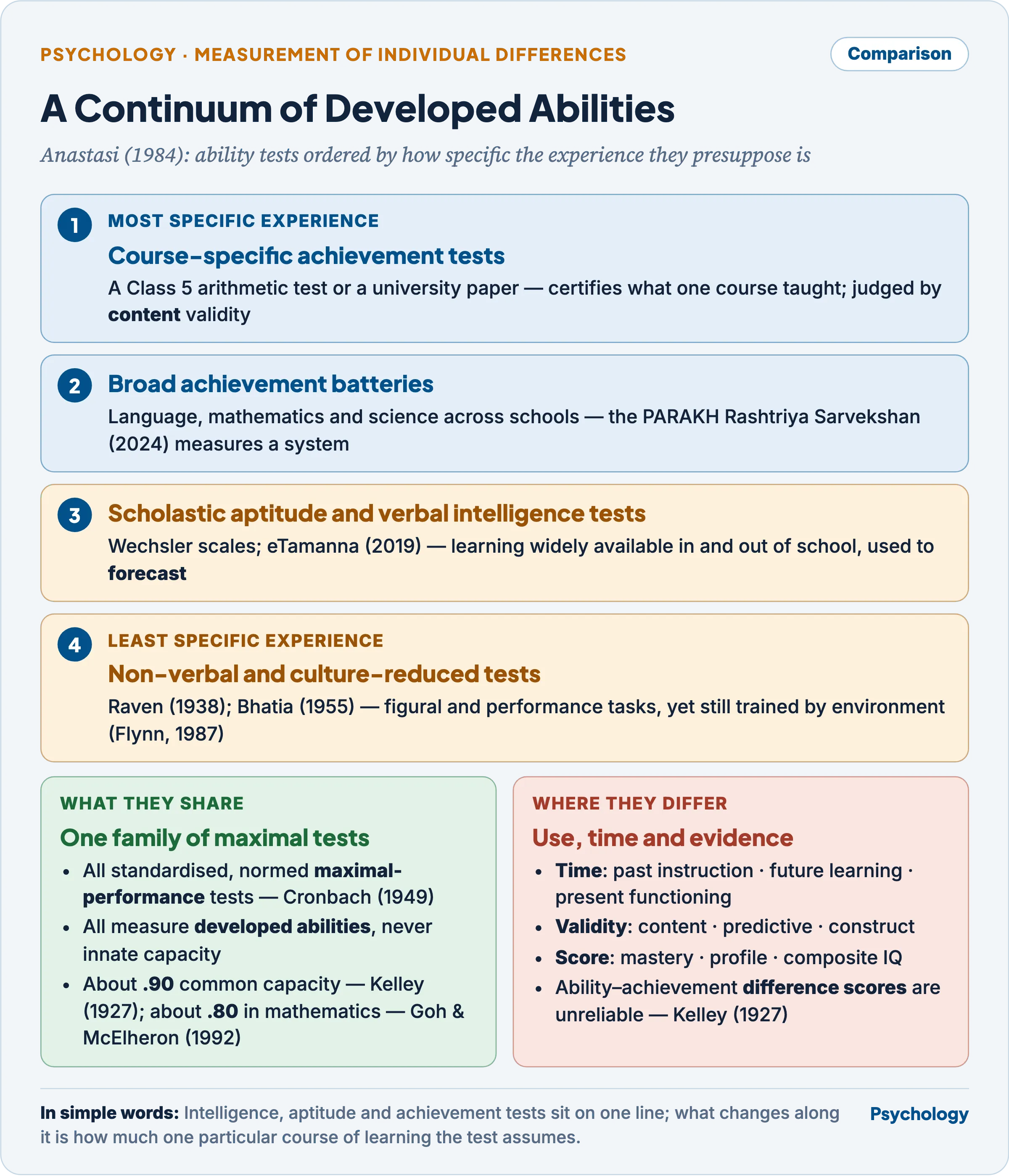
Moving down the ladder, the experience a test presupposes widens and its use turns from certifying the past to forecasting the future.
- Construction differs. An intelligence test sums many content areas so the general factor dominates; an aptitude battery samples each area intensively so a profile survives, as Aptitude and Its Measurement (Paper I) develops.
- Validation differs. Achievement tests are judged by how well items sample a content blueprint, aptitude tests by prediction of later training or job success, intelligence tests by construct evidence.
- Kelley (1927) drew the practical warning: with so large a common core, a difference between one person’s intelligence and achievement scores is unreliable. Every ability–achievement discrepancy rule for identifying learning disability inherits that problem.
Types of tests for personality assessment
- Personality tests are typical-performance measures that differ in how directly they ask and how the answer is scored. Of six families, the first two are treated fully in Objective and Self-Report Assessment of Personality and Projective Techniques of Personality Assessment (Paper I).
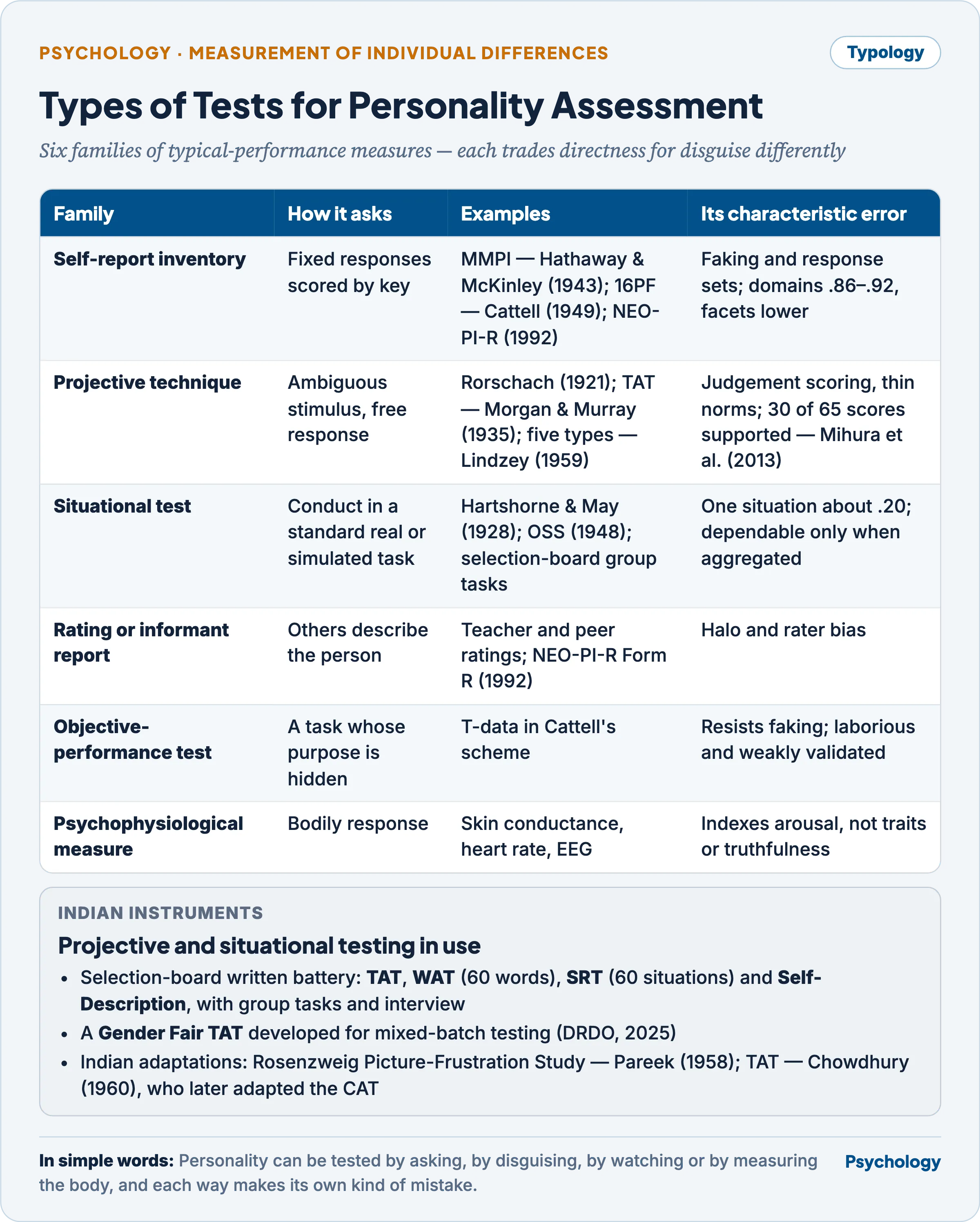
Each family trades directness for disguise in a different way, and pays for it in a different kind of error.
- Self-report inventories give fixed responses scored by key. They differ by construction strategy: rational (Woodworth, 1919), empirical criterion-keyed (Hathaway and McKinley, 1943), factor-analytic (Cattell, 1949), theoretical (Edwards, 1954) and combined (Costa and McCrae, 1992).
- These are the Personal Data Sheet, built in 1917–18 to screen recruits, described in 1919; the MMPI; the 16PF; the Edwards schedule; and the NEO-PI-R.
- Strength: economy, objective scoring and norms. Weakness: faking and response sets, met by validity scales such as the MMPI’s L, F and K.
- Projective techniques present ambiguous stimuli, on the projective hypothesis of Frank (1939). Lindzey (1959) classed them by the response required.
- Association: the Rorschach inkblots (Rorschach, 1921). Construction: the Thematic Apperception Test (Morgan and Murray, 1935). Completion: the Incomplete Sentences Blank (Rotter and Rafferty, 1950).
- Choice or ordering: the Szondi photographs. Expression: Draw-A-Person (Machover, 1949). Strength: disguised purpose. Weakness: judgement-based scoring and thin norms.
- Situational and behavioural tests observe conduct in standard real or simulated settings. Hartshorne and May (1928) gave thousands of children aged 8 to 16 contrived tests of honesty, later also of service and self-control.
- Any two single tests correlated only about .20; batteries combining several reached about .5 to .6 (Hartshorne and May, 1928; Hartshorne, May and Maller, 1929).
- Limitation: one situation is an unreliable sample of character; only aggregates are dependable.
- The British War Office Selection Boards and then the OSS Assessment Staff (1948), with simulated field tasks at “Station S”, carried situational testing into selection; assessment centres and the Indian boards’ group tasks descend from them.
- Rating scales and informant reports record what teachers, peers or spouses observe, including the NEO-PI-R’s observer Form R (Costa and McCrae, 1992). They escape self-presentation but carry halo and rater bias.
- Objective-performance tests — T-data in Cattell’s scheme — score behaviour in a task whose purpose the testee cannot guess; they resist faking but are laborious and weakly validated.
- Psychophysiological measures — skin conductance, heart rate, EEG — index arousal, not traits or truthfulness.
Are results in different areas of testing equally scientific and dependable?
- They are not. Dependability falls along a regular gradient: maximal above typical performance, objective above judgement scoring, long scales above short ones, aggregated behaviour above single occasions.
- Even the best fall short: Charter (2003) found most average values among 937 reliability coefficients below recommended standards.
- Ability tests are the most dependable. The WAIS-IV Full Scale IQ has internal consistency of .98 and a retest coefficient of .96 over about three weeks, with subtests from .78 to .94 (Wechsler, 2008).
- Self-report inventories are dependable for broad traits. NEO-PI-R domain scales reach .86 to .92, but its eight-item facets only .56 to .81 (Costa and McCrae, 1992): length and breadth decide.
- The right reliability depends on the construct. The State-Trait Anxiety Inventory’s trait scale had retest coefficients of .65 to .86 and its state scale .16 to .62 (Spielberger, Gorsuch and Lushene, 1970); instability is the state scale’s validity, not its error.
- Projective techniques are dependable only for some scores.
- Unweighted mean validity was .29 for the Rorschach against .30 for the MMPI (Hiller, Rosenthal, Bornstein, Berry and Brunell-Neuleib, 1999).
- Of 65 Comprehensive System variables, 13 had excellent and 17 good support against external criteria (Mihura, Meyer, Dumitrascu and Bombel, 2013).
- Most Rorschach and TAT indexes lack support, and figure drawings are weaker still (Lilienfeld, Wood and Garb, 2000).
- Trait measures predict a single external behavioural criterion at about .20 to .30, the personality coefficient of Mischel (1968); behavioural measures become stable only when aggregated across occasions (Epstein, 1979).
- In perspective, Meyer and colleagues (2001) placed validity coefficients for the MMPI, Rorschach, TAT and neuropsychological tests in the same .30 to .50 range as electrocardiograms, mammography and MRI.
- Dependability is therefore a property of a score used for a purpose, not of an area of testing as a whole.
Measures for ensuring reliability and accuracy
- Lengthen and aggregate: more items, raters or occasions raise reliability (Reliability of Psychological Tests).
- Standardise instructions, timing and conditions, and use objective keys where the construct allows. For judgement-scored tests, train scorers and report inter-scorer agreement under codified systems such as the Comprehensive System (Exner, 1974) and R-PAS (Meyer, Viglione, Mihura, Erard and Erdberg, 2011).
- Control response distortion with validity scales and matched forced-choice formats (Edwards, 1954); estimate speeded tests’ reliability from parallel forms (Gulliksen, 1950).
- Adapt and norm locally — by age, education, language and literacy — and cross-validate scoring keys on fresh samples.
- Combine methods and assessors so that each method’s error is checked by another, the logic of the multitrait–multimethod matrix in Validity of Psychological Tests; report scores as bands built from the standard error of measurement.
Criticisms and limitations
- Overlap. Types are positions on dimensions, not exclusive kinds. The same test changes type with its use, and different names can hide one construct — the jangle fallacy of Kelley (1927).
- Misleading labels. “Aptitude” invites reading a score as innate potential; “culture-free” overclaimed (Flynn, 1987).
- Pure types are fictions. Timed tests mix speed and power (Gulliksen, 1950), and maximal and typical measures of one skill correlate weakly (Sackett and colleagues, 1988).
- Each type has a characteristic misuse, set out in Use, Misuse and Limitations of Psychological Tests: IQ read as fixed, an aptitude profile used as a streaming verdict, inventories trusted where faking pays, projective signs read diagnostically.
- The last persists because clinicians see illusory correlations between drawing features and symptoms that the data do not contain (Chapman and Chapman, 1967).
- Instruments travel badly. Items, norms and response formats assume the culture of origin, so adaptation is more than translation, as Ethical Issues in the Use of Psychological Tests sets out.
Indian context
- Indian tests span most types:
- Performance intelligence: Bhatia (1955) — five tests, among them block design, pass-along and picture construction, standardised on boys of 11 to 16 with separate norms for literates and illiterates.
- Individual intelligence: Malin (1969) — the Malin’s Intelligence Scale for Indian Children (MISIC), adapted from the WISC (Wechsler, 1949).
- Projective: Pareek (1958) adapted the Rosenzweig Picture-Frustration Study for Indian children; Chowdhury (1960) adapted the TAT, and later the Children’s Apperception Test.
- Neuropsychological: the NIMHANS battery for adults (Rao, Subbakrishna and Gopukumar, 2004) — 19 tests normed for ages 16 to 65 by age, education, illiterates included, and gender.
- The National Library of Educational and Psychological Tests at NCERT holds about two thousand tests, catalogued by content type (NLEPT catalogue, 2025).
- eTamanna (NCERT, Ministry of Education; first released as Tamanna in 2019) — a voluntary aptitude test for Classes 9 and 10 that operationalises aptitude as a prognostic profile for guidance, not a selection cut-off.
- Seven subtests — language, abstract, verbal and mechanical reasoning, numerical, spatial and perceptual aptitude; no pass or fail, and not to be used to impose subjects (Ministry of Human Resource Development, 2019).
- Piloted by CBSE with 17,000 students; norms from 5,491 students at 11 locations (Ministry of Human Resource Development, 2019).
- Disability assessment guidelines under the Rights of Persons with Disabilities Act, 2016 (Ministry of Social Justice and Empowerment; notified 4 January 2018, revised 14 March 2024) — intellectual disability is certified only on an individual IQ test plus an adaptive-behaviour scale.
- The 2018 list named the Binet-Kamat Test or MISIC with the Vineland Social Maturity Scale; the 2024 list adds the WISC, WISC-IV and NIEPID Indian Test of Intelligence (2023). In both, the disability percentage is computed from the Vineland score.
- Principle: diagnosis rests on convergence between a maximal-performance test and a typical-behaviour rating, never on IQ alone.
- PARAKH Rashtriya Sarvekshan (NCERT, Ministry of Education; held 4 December 2024) — a group, competency-based survey achievement test of Grades 3, 6 and 9, taken by over 21 lakh students (PIB, 2026). It operationalises criterion-referenced measurement of a system, not a child.
- Defence selection. The Defence Institute of Psychological Research, begun at Dehradun in 1943 and constituted as the Psychological Research Wing in 1949, designs the selection boards’ tests (DRDO, 2025). Three test types are judged by three assessors of equal weight.
- Stage I: the Officer Intelligence Rating test and the Picture Perception and Description Test.
- Stage II: a written battery of three projective-type tests — Thematic Apperception Test, Word Association Test (60 words), Situation Reaction Test (60 situations) — and a self-report Self-Description, with group situational tasks and an interview.
- Recent instruments by type: a Gender Fair TAT for mixed-batch testing, a computerised adaptive test of emotional stability, and the Computerised Pilot Selection System of cognitive and psychomotor tests, inducted in 2014 (DRDO, 2025).
Previous Year Questions
- 2021What are the different types of psychological tests for personality assessment?
- 2018Bring out the similarities and differences between intelligence, aptitude, and achievement tests.
- 2005Discuss the different types of psychological tests. Describe ethical issues involved in the use of psychological tests.
- 2001Mention different types of psychological tests and discuss their uses, misuses and limitations.
- 1996Discuss the different types of psychological tests. Are the results obtained in different areas of testing equally scientific and dependable? Suggest measures for ensuring their reliability and accuracy.