

Official syllabusPaper II · Unit 1 · Psychological Measurement of Individual Differences
Use, misuse and limitation of psychological tests.
Definition
“A psychological test is essentially an objective and standardized measure of a sample of behavior.”
Anastasi and Urbina (1997)
Every use of a test is an inference from a small sample of behaviour, taken once under standard conditions, to a decision about a person. Misuse is that inference stretched beyond its evidence; a limitation is a point where even a careful user cannot close the gap. The research on misuse locates most of the trouble in users rather than instruments, and that finding organises what follows.
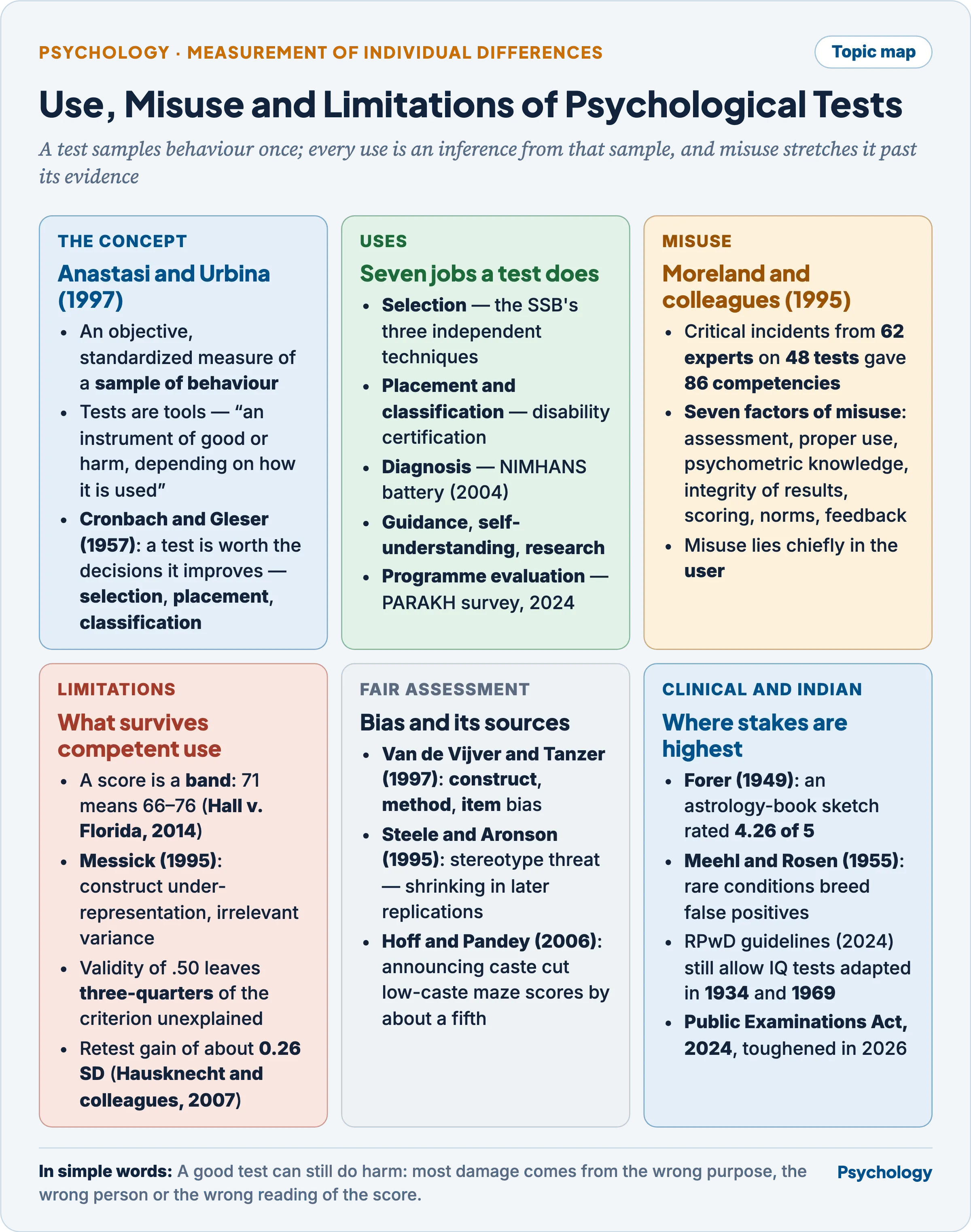
Every box on the bottom row is a way in which the inference on the top row breaks down.
Uses of psychological tests
- Anastasi and Urbina put the governing point plainly: “Psychological tests are tools … Any tool can be an instrument of good or harm, depending on how it is used.”
- Cronbach and Gleser (1957) recast testing as decision-making: a test is worth what it adds to the quality of decisions after the cost of testing. Their framework separates three decisions.
- Selection — accept or reject; placement — assign everyone retained to levels of one programme; classification — assign people to different programmes on several scores at once.
- The uses that follow, each with an Indian instance.
- Selection: the Services Selection Board scores officer candidates through psychological tests, group tasks and an interview, each rated independently by a psychologist, a group testing officer and an interviewing officer, then settled in a board conference.
- Classification and placement: disability certification turns scores into entitlements, taken up under the clinical setting below.
- Diagnosis: neuropsychological batteries grade and localise deficit against Indian norms (Rao, Subbakrishna and Gopukumar, 2004).
- Guidance and counselling: aptitude and interest profiles inform choices of stream and career, the use set out in The Nature of Individual Differences.
- Self-understanding: feedback of results can itself be therapeutic, examined under the clinical setting.
- Research: a test is the operational definition of a construct, so every finding on individual differences rests on one.
- Programme evaluation: the PARAKH Rashtriya Sarvekshan of 4 December 2024 tested about 21 lakh pupils of Grades 3, 6 and 9 in some 87,600 sampled schools (CBSE, 2025), to judge the system rather than the child.
Misuse of psychological tests
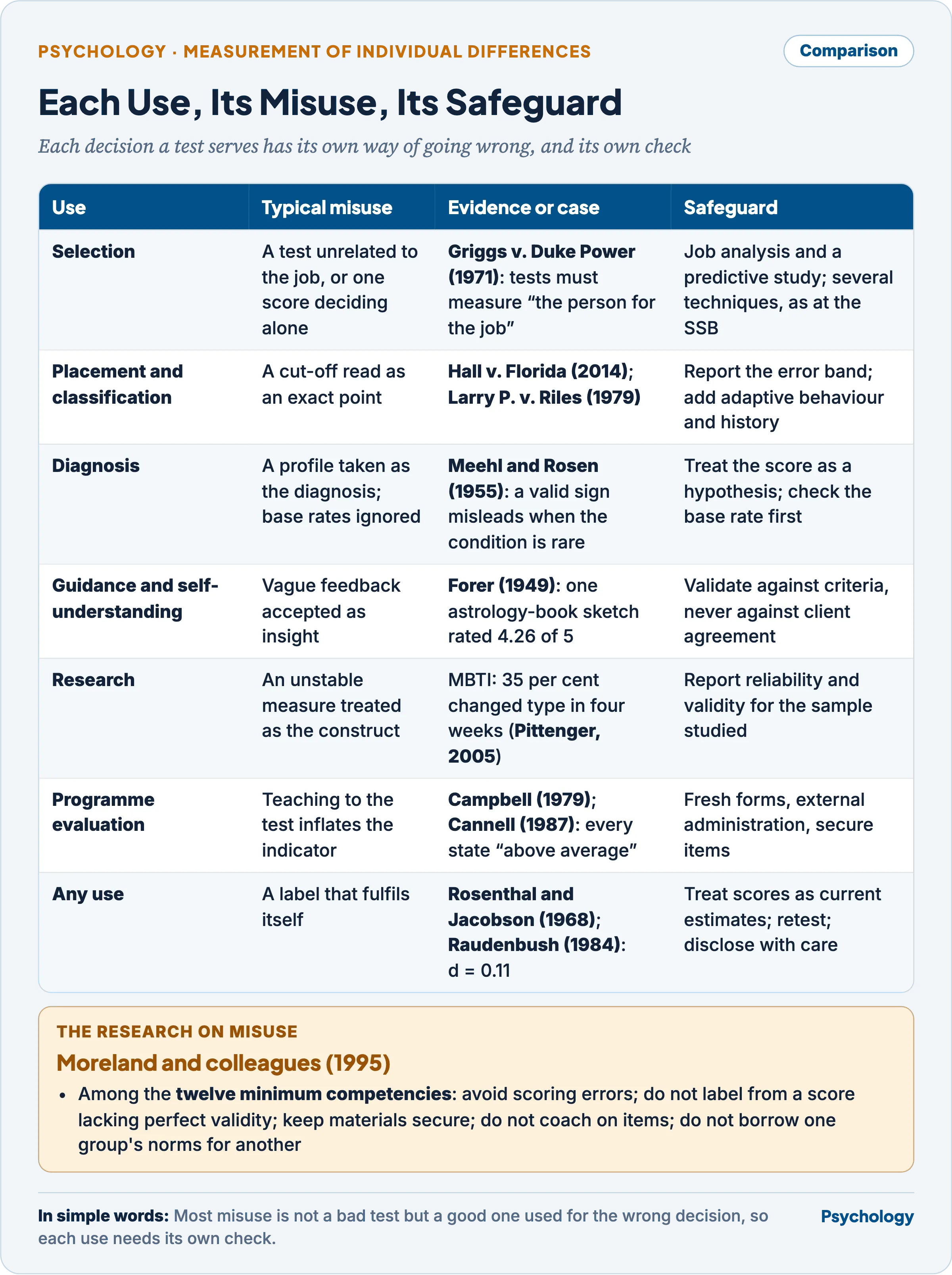
Each use has a characteristic misuse, and each misuse has a safeguard that already exists.
What the research on misuse found
- Moreland, Eyde, Robertson, Primoff and Most (1995) reported the Test User Qualifications Working Group’s study of how tests actually go wrong.
- Design: 62 experts described critical incidents of misuse on 48 tests (1995), yielding 86 test-user competencies; 200 experts then rated 76 tests for the trouble likely if each competency were absent.
- Factor analysis gave seven factors of test misuse: comprehensive assessment, proper test use, psychometric knowledge, maintaining integrity of test results, accuracy of scoring, appropriate use of norms and interpretive feedback.
- Among twelve minimum competencies: avoiding scoring errors, refusing to label people from a score lacking perfect validity, keeping materials secure, not coaching on items, and not assuming one group’s norms fit another.
- Finding: misuse lies chiefly in the user, and credentials and job titles had been poor screens of competence.
- Limitation: experts reported incidents rather than sampling them, which shows what goes wrong but not how often.
The principal forms of misuse
- Labelling and self-fulfilling expectancy. A score changes how others treat a person, and the treatment can produce what the score predicted.
- Rosenthal and Jacobson (1968) disguised a group ability test as a predictor of intellectual “blooming” and told teachers that a randomly chosen fifth of each class would bloom.
- Eight months on, the named children had gained about four IQ points more than controls, almost wholly in Grades 1 and 2.
- Limitation: Thorndike (1968) found the test unreliable for the youngest children; Raudenbush (1984), pooling 18 experiments, found a mean effect of 0.11 standard deviations, present only when teachers barely knew the pupils.
- Reading a score as a fixed property — an IQ is a rank against one norm group on one occasion, as IQ, Deviation IQ and the Constancy of IQ (Paper I) sets out.
- Outdated norms. Kanaya, Scullin and Ceci (2003) found children near the cut-off lost about 5.6 IQ points when retested on the renormed WISC-III, and nearly 20 per cent of the borderline group were then classified as mentally retarded (2003).
- Use by the untrained, made easier by software that administers and interprets, traced in Computer Application in the Psychological Laboratory and in Testing (Paper I).
- Culturally inappropriate tests. Goddard (1917) tested “six small highly selected groups” of steerage passengers at Ellis Island through interpreters and classed 83 per cent of Jews and 87 per cent of Russians as feeble-minded (1917), though he judged deprivation a likelier cause than heredity.
- Rigid cut-offs. In Buck v. Bell (1927) a Stanford-Binet mental age of nine helped justify compulsory sterilisation, with Justice Holmes writing: “Three generations of imbeciles are enough.”
- Hall v. Florida (2014) struck down a strict IQ-70 bar that ignored the standard error of measurement, under which a score of 71 is a band of roughly 66 to 76.
- Decisions on a test alone. The Standards (AERA, APA and NCME, 2014), Standard 12.10, require that a decision with major impact on a student “should take into consideration not just scores from a single test but other relevant information.”
- Griggs v. Duke Power (1971) struck down intelligence tests unrelated to job performance that excluded Black applicants: “any tests used must measure the person for the job and not the person in the abstract.”
- Unvalidated purposes. The Myers-Briggs Type Indicator is widely used to sort employees, yet its own manual reports that 35 per cent of people received a different four-letter type after four weeks (Pittenger, 2005).
- Coaching and score inflation. Campbell (1979): “The more any quantitative social indicator is used for social decision-making, the more subject it will be to corruption pressures and the more apt it will be to distort and corrupt the social processes it is intended to monitor.”
- Cannell (1987) found every American state reporting elementary scores above the national average — the “Lake Wobegon effect” — which he traced to lax security, stale norms and reused forms.
- Breaches of test security destroy validity outright, since a leaked item measures access, not ability.
Limitations of psychological tests
These survive competent use; some can be reduced, none removed.
- A sample, not the person. A test measures behaviour on one occasion; “capacity” is an inference warranted only by demonstrated correspondence with other behaviour (Anastasi and Urbina, 1997).
- Measurement error. Every score is a band, not a point, as Reliability of Psychological Tests works out.
- Construct under-representation and construct-irrelevant variance, the two threats Messick (1995) named: a test too narrow for its construct, or one that also picks up reading load, familiarity, response sets or guessing.
- Prediction is probabilistic. A validity coefficient of .50, high by applied standards, leaves three-quarters of criterion variance unexplained, so group accuracy coexists with many individual misforecasts (Validity of Psychological Tests).
- Practice and coaching. Hausknecht, Halpert, Di Paolo and Moriarty Gerrard (2007) pooled 107 samples of 134,436 people: scores rose about a quarter of a standard deviation on a second sitting (2007), more with identical forms and much more with coaching.
- Test anxiety. Von der Embse, Jester, Roy and Post (2018), synthesising 238 studies, found anxiety negatively related to standardised tests, entrance examinations and grades — small to moderate — with anxiety higher when stakes were high.
- Faking and response sets, treated in Objective and Self-Report Assessment of Personality (Paper I).
- Cultural loading, which no test escapes entirely, taken up next.
- In perspective, tests remain more accurate than the judgement that would replace them, as the clinical evidence below shows. In the words of Griggs (1971): “Nothing in the Act precludes the use of testing or measuring procedures; obviously they are useful.”
Factors that impede fair assessment of individual differences
Van de Vijver and Tanzer (1997) gave the standard taxonomy: a test is biased when group differences in scores do not reflect differences in the target construct, and equivalence is the degree to which scores are comparable across groups.
| Bias | Where it arises | Example | Remedy |
|---|---|---|---|
| Construct bias | The construct differs across groups | Western intelligence tests stress reasoning and knowledge, not social intelligence | Local definition; decentred development |
| Method bias — sample, instrument, administration | Schooling, familiarity with materials, communication with the tester | Zambian children outscored British children copying patterns in wire, the British in pencil (Serpell, 1979) | Matched samples; familiar materials; bilingual examiners |
| Item bias | Single items mean different things to different groups | Poor translation; unfamiliar content | Differential item functioning analysis (Item Analysis and Item Validation) |
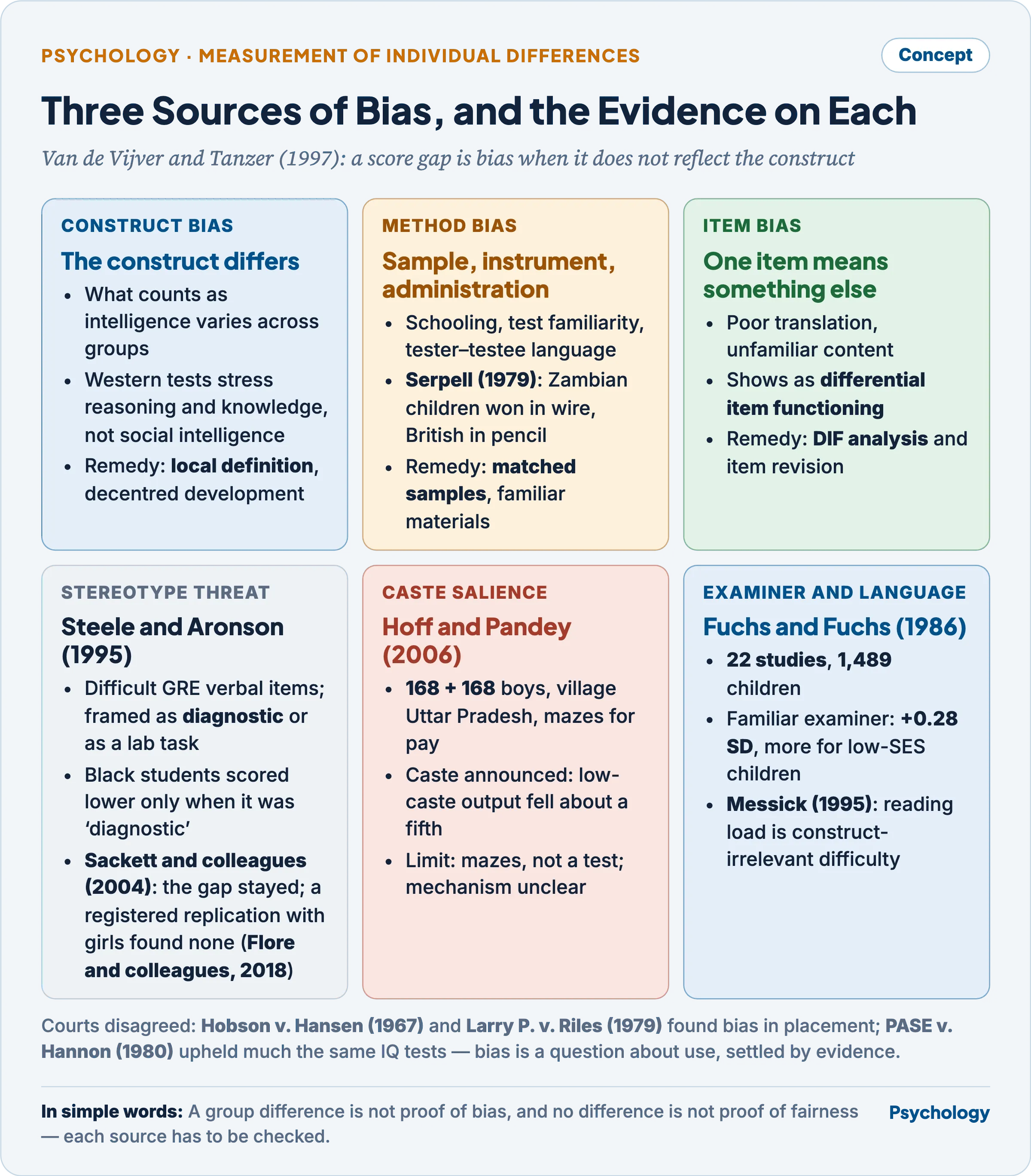
The same score gap can come from the construct, the method or the item, and each has its own remedy.
- Stereotype threat. Steele and Aronson (1995) gave Black and White Stanford undergraduates difficult verbal items from the Graduate Record Examination.
- Described as diagnostic of ability, the test drew lower scores from Black participants; described as a laboratory task, it did not (prior SAT controlled). Merely recording race on a questionnaire impaired performance.
- Limitation: Sackett, Hardison and Cullen (2004) showed the result is misread — scores were adjusted for SAT, so removing threat did not remove the group gap.
- Replication: Flore and Wicherts (2015) pooled 47 effects for girls in mathematics, g = −0.22, falling to −0.07 after correction for publication bias; a registered study of 2,064 Dutch students found none (Flore, Mulder and Wicherts, 2018).
- Caste salience. Hoff and Pandey (2006) had 168 low-caste and 168 high-caste junior-high boys in village Uttar Pradesh solve mazes for piece-rate pay in six-boy sessions.
- With caste anonymous there was no caste gap; announced to a mixed group, a gap opened through a fall of about 20 per cent in the mazes low-caste boys solved (2006).
- Limitation: mazes are not a standardised test, and the mechanism may be expected unfairness rather than anxiety; the warning holds for any examination that makes identity visible.
- Examiner effects. Fuchs and Fuchs (1986) pooled 22 studies of 1,489 children: a familiar examiner raised scores by 0.28 standard deviations, more for low-SES children and on harder tests.
- Language and disadvantage are construct-irrelevant difficulty (Messick, 1995): a reasoning test that demands fluent English measures English too, the medium-of-instruction problem examined in Construction and Standardization of Psychological Tests.
- The American courts as contrast. Hobson v. Hansen (1967) abolished Washington’s tracking by aptitude tests standardised on white middle-class children.
- Larry P. v. Riles (1979) barred IQ tests for placing Black children in California’s “educable mentally retarded” classes, where they were 10 per cent of pupils but about 25 per cent of those classes (1979).
- PASE v. Hannon (1980) upheld much the same IQ tests in Chicago after an item-by-item review — bias is an empirical question about use, not something settled by inspection.
Uses, misuses and limitations in the clinical setting
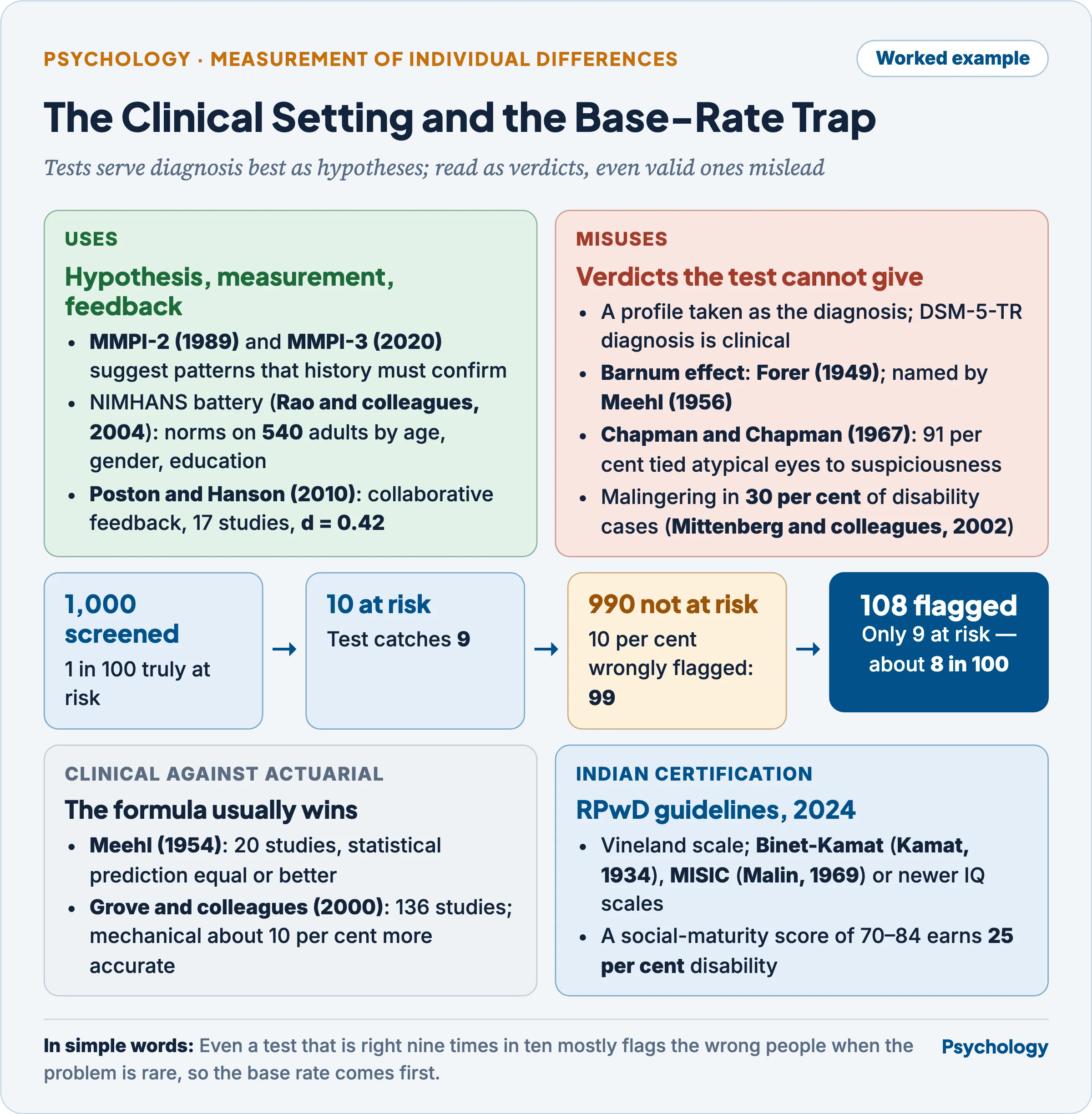
A test that is right nine times in ten still flags mostly the wrong people when the condition is rare.
Uses
- Tests generate and check hypotheses: the MMPI-2 (Butcher and colleagues, 1989) and MMPI-3 (Ben-Porath and Tellegen, 2020) suggest symptom patterns that interview and history must confirm.
- Neuropsychological assessment grades deficit against norms; the NIMHANS battery drew norms from 540 healthy adults aged 16 to 65, stratified by age, gender and education, plus an illiterate sample (Rao and colleagues, 2004).
- Therapeutic assessment. Finn and Tonsager (1997) set an information-gathering model against a therapeutic one in which collaborative feedback is itself the intervention; Poston and Hanson (2010) pooled 17 studies of 1,496 participants and found d = 0.42.
- Repeated testing monitors outcome, turning “the client feels better” into measured change.
Misuses
- Diagnosing from a test alone. Diagnosis under DSM-5-TR (American Psychiatric Association, 2022) is a clinical judgement on criteria; a scale elevation is evidence towards it, never the diagnosis.
- The Barnum effect. Forer (1949) gave 39 students a “Diagnostic Interest Blank” and a week later handed each the same sketch of 13 statements, mostly from a newsstand astrology book.
- Rated from zero to five for how well it revealed their personality, the sketch averaged 4.26 (Forer, 1949).
- Meehl (1956) named the Barnum effect, for “those pseudo-successful clinical procedures in which personality descriptions from tests are made to fit the patient largely or wholly by virtue of their triviality.”
- Limitation: one classroom and no control group — a demonstration, since reproduced many times.
- Illusory correlation. Chapman and Chapman (1967) surveyed 110 diagnosticians on Draw-a-Person signs (Machover, 1949): 91 per cent linked atypical eyes to suspiciousness (1967).
- Undergraduates shown drawings paired at random with symptoms “saw” the same links, so the lore came from verbal association, not observation (Projective Techniques of Personality Assessment, Paper I).
- Uncritical computer interpretation, including the evidence of Epstein and Rotunda (2000), is set out in Computer Application in the Psychological Laboratory and in Testing (Paper I).
- Ignoring base rates. Meehl and Rosen (1955) showed that for a rare condition even a valid sign yields mostly false positives.
- Worked case on the logic of Meehl and Rosen (1955), with illustrative figures: screen 1,000 students where 1 per cent are at suicidal risk, with a test 90 per cent sensitive and specific.
- It catches 9 of the 10 but also flags 99 others, so only about 8 of every 100 flagged are truly at risk.
- Missing malingering. Mittenberg, Patton, Canyock and Condit (2002), from 33,531 cases, estimated probable malingering in 30 per cent of disability and 29 per cent of personal-injury evaluations (2002); where a score brings compensation, effort must be checked.
Limitations
- Meehl (1954) reviewed 20 studies and found statistical prediction equal or superior to clinical judgement; Grove, Zald, Lebow, Snitz and Nelson (2000), across 136 studies, found mechanical prediction about 10 per cent more accurate and clearly worse in only 6 to 16 per cent (2000).
- The clinical limitation is therefore less the test than the habit of overriding it with impression — or of reading a profile without the history.
- Certification in India. RPwD Act guidelines (Ministry of Social Justice and Empowerment, March 2024, superseding those of 2018) pair the Vineland Social Maturity Scale with an IQ test: the Binet-Kamat Test, Malin’s Intelligence Scale for Indian Children, WISC-IV or the NIEPID Indian Test of Intelligence.
- A social-maturity score of 70 to 84 earns a 25 per cent “borderline” disability (2024), so a few points decide an entitlement.
- The Binet-Kamat descends from Kamat (1934), adapting the 1916 Stanford-Binet, and MISIC from Malin (1969), adapting the 1949 WISC — two permitted scales rest on norms decades old.
- The Mental Healthcare Act, 2017, section 2(1)(g), defines a “clinical psychologist” by a qualification recognised by the Rehabilitation Council of India, tying clinical test use to a regulated profession.
Indian context: challenges in developing and using tests in India
- Language. The 2011 Census recorded 121 languages, 22 of them scheduled, and 270 mother tongues of 10,000 or more speakers (Office of the Registrar General, 2018); PARAKH’s 2024 survey ran in 23 media of instruction (2024), each translation needing proof of equivalence.
- Adaptation outruns development, and adaptation can fix bias or import it.
- Ganguli, Ratcliff, Chandra and colleagues (1995) rebuilt the Mini-Mental State Examination in Hindi for the largely illiterate elderly of Ballabgarh, near Delhi, modifying item by item the tasks that required reading or writing.
- It worked, but orientation to time stayed hard to test and the educated still scored higher — adaptation removes the literacy barrier, not the education effect.
- Norms that are old, urban and educated, against which the NIMHANS battery’s education-stratified norms are the corrective.
- Too few qualified users. The National Mental Health Survey 2015–16 found psychologists ranging from 0.63 per lakh in Kerala to 0.01 in Rajasthan (Suhas and colleagues, 2023).
- Rehabilitation Council of India Act, 1992 (Ministry of Social Justice and Empowerment; amended 2000) — section 13 bars anyone not on the Central Rehabilitation Register, which includes clinical psychologists, from practising as a rehabilitation professional or signing statutory certificates.
- Principle: competence as a precondition of use, the central lesson of Moreland and colleagues (1995); its gap is that it governs who practises, not who buys or administers a test.
- Digital testing. Entrance examinations are now computer-based, yet 9.9 per cent of rural people aged five and above could operate a computer, against 32.4 per cent of urban (NSS 75th round, 2017–18) — familiarity becomes construct-irrelevant variance.
- Test security. In Vanshika Yadav v. Union of India (2024) the Supreme Court found the May 2024 NEET-UG paper leaked at Hazaribagh and Patna but refused a re-test, as centre-wise results matched earlier years and beneficiaries could be identified — an argument from score distributions.
- An expert committee under K. Radhakrishnan (2024), set up by the Ministry of Education, reported in October 2024 on securing the National Testing Agency’s examinations.
- By contrast, the Agency cancelled NEET-UG 2026, held on 3 May, after evidence of a leak and re-held it on 21 June 2026 — the remedy refused in 2024.
- Public Examinations (Prevention of Unfair Means) Act, 2024 (Ministry of Personnel, Public Grievances and Pensions; in force 21 June 2024) — makes paper leaks, unauthorised help to candidates and tampering with computer systems in central recruitment and entrance examinations cognisable, non-bailable offences.
- The Amendment Act, 2026 (assent 31 July 2026) raised the term to five to ten years and fines to ₹50 lakh, with seven years and ₹10 crore minimum for organised rackets and Special Fast Track Courts.
- Principle: equal item exposure — a score means the same across candidates only if none has seen the items, so security is a condition of validity.
- Compelled testing of the accused, and privacy of test data, belong to Ethical Issues in the Use of Psychological Tests.
Previous Year Questions
- 2023Explain the characteristics of standardized psychological tests. Highlight the limitations of psychological tests.
- 2022Discuss uses, misuses and limitations of psychological tests in clinical setting.
- 2020What are the challenges in the development and uses of psychological tests? Illustrate with examples.
- 2016Analyze the factors determining the efficacy of psychological tests. Discuss the limitations in the use of psychological tests.
- 2014What factors can impede fair assessment of individual differences? Examine in the light of research evidence.
- 2001Mention different types of psychological tests and discuss their uses, misuses and limitations.