

Anthropology Optional › Paper II › Unit 01: Evolution of Indian Culture and Civilization
1.1 Prehistoric (Paleolithic, Mesolithic, Neolithic and Neolithic-Chalcolithic) Protohistoric (Indus Civilization): PreHarappan, Harappan and postHarappan cultures. Contributions of tribal cultures to Indian civilization.
Official Syllabus: Paper II, Unit 1.1
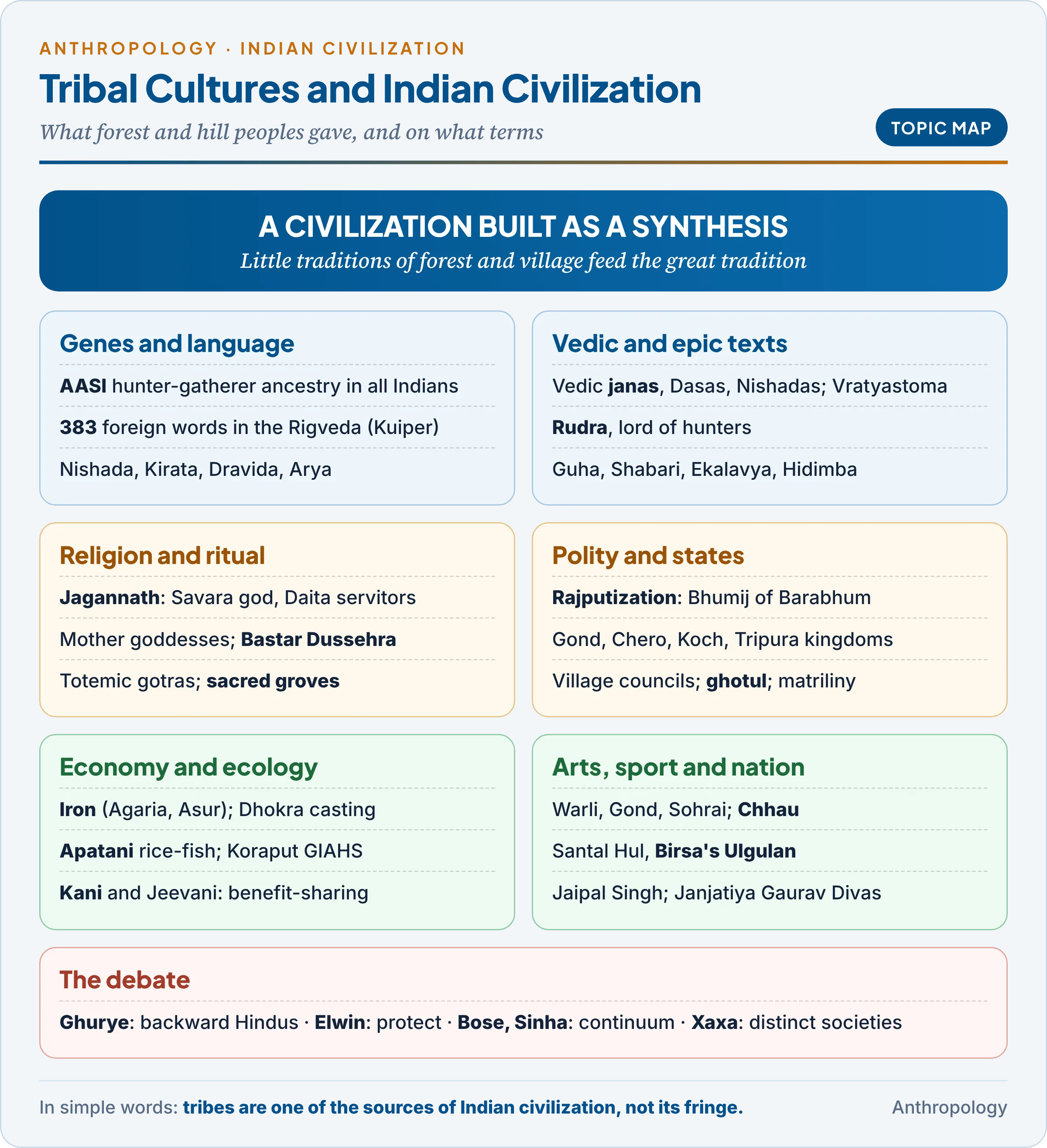
This article covers the last item of the syllabus line: what tribal cultures have given to Indian civilization. The prehistoric cultures are in 1.1a and the Indus civilization with its pre- and post-Harappan cultures in 1.1b; this article starts where they end, with the people who carried forager and early farming ways of life into the historic period. Three later units take up related threads in full: the tribe-caste continuum (Unit 3.2), great and little traditions (Unit 5.3) and the impact of Hinduism on tribes (Unit 8.1). Here each is summarised only as far as it explains a contribution.
1. Tribe and Civilization: Framing the Question
In simple words
India’s civilization was not built by one people or from one book. It grew over thousands of years as forest, hill and river communities met farmers, priests and kings and exchanged gods, words, skills and customs. Asking what tribes “contributed” is a way of seeing this long exchange from the side of the communities that are usually left out of the story.
1.1 Who counts as a “tribe” in Indian history?
- Ancient words: Sanskrit texts used jana (a people), vish (a clan settlement) and gana (a group ruled by an assembly). They named forest and hill peoples as Nishada, Sabara, Pulinda, Kirata, Naga and Bhilla. These were ethnic or regional names, not a legal category.
- Colonial category: “tribe” became an administrative label through the Census: “Forest Tribes” in 1891, “animists” in 1901 and 1911, “tribal religion” from 1921. Officials drew the line between tribe and caste; many communities called their own group jat or jati.
- Constitutional category: Article 342 lets the President notify Scheduled Tribes state by state, but the Constitution does not define “tribe”. The 2011 Census counted 10.43 crore Scheduled Tribe people, 8.6% of India, in over 700 notified communities.
- Why this matters: “tribe” is a modern category, so the question is really about many different peoples (Munda, Dravidian, Tibeto-Burman and Indo-Aryan speakers) who stayed at the margins of caste society for long periods and gave to it continuously.
1.2 Civilization as a synthesis
Example first. Every eight to nineteen years, in a year when the lunar calendar has two months of Ashadha, the wooden images of Jagannath at Puri are replaced in the Nabakalebara (“new body”) rite. The most secret part, moving the sacred substance from the old image to the new, is done not by Brahmin priests but by the Daitas, servitors who trace their descent to a Savara tribal princess. A pan-Indian Vaishnava shrine still depends on a tribal lineage for its holiest act (Section 4.1).
The case shows the central idea of this topic: Indian civilization is a synthesis, and its classical “great tradition” is built on, and keeps drawing from, little traditions of village and forest.
- Robert Redfield and Milton Singer, American anthropologists who planned the Chicago study of Indian civilization, distinguished (1954) primary (orthogenetic: grown out of its own folk culture) from secondary (heterogenetic: shaped by contact with other cultures) civilizations. India was their prime example of a primary civilization: its learned tradition systematised the beliefs of its own villages and forests.
- McKim Marriott, Redfield’s student, showed in Kishan Garhi (Uttar Pradesh, 1955) that local deities rise into the Sanskritic pantheon (universalization) while Sanskritic gods are reworked locally (parochialization).
- Surajit Sinha, the Indian anthropologist who studied the Bhumij of Manbhum, wrote (1958) that tribal cultures of peninsular India are a dimension of the little tradition of Indian civilization, not a separate world.
- K.S. Singh, the historian-anthropologist who directed the People of India survey (4,635 communities), wrote that Indian tribes “have not lain ‘torpid’ on the fringe of civilization”; tribal content in Indian life is like an iceberg in an ocean, as identifiable as the Aryan or the Dravidian.
- D.D. Kosambi, the Marxist historian, held (1965) that “the entire course of Indian history shows tribal elements being fused into a general society”, a fusion that lies at the base of caste itself.
The common ground: tribal cultures are not survivals beside civilization but one of its sources. The scholars differ on the terms of the fusion (Section 8).
1.3 A two-way flow
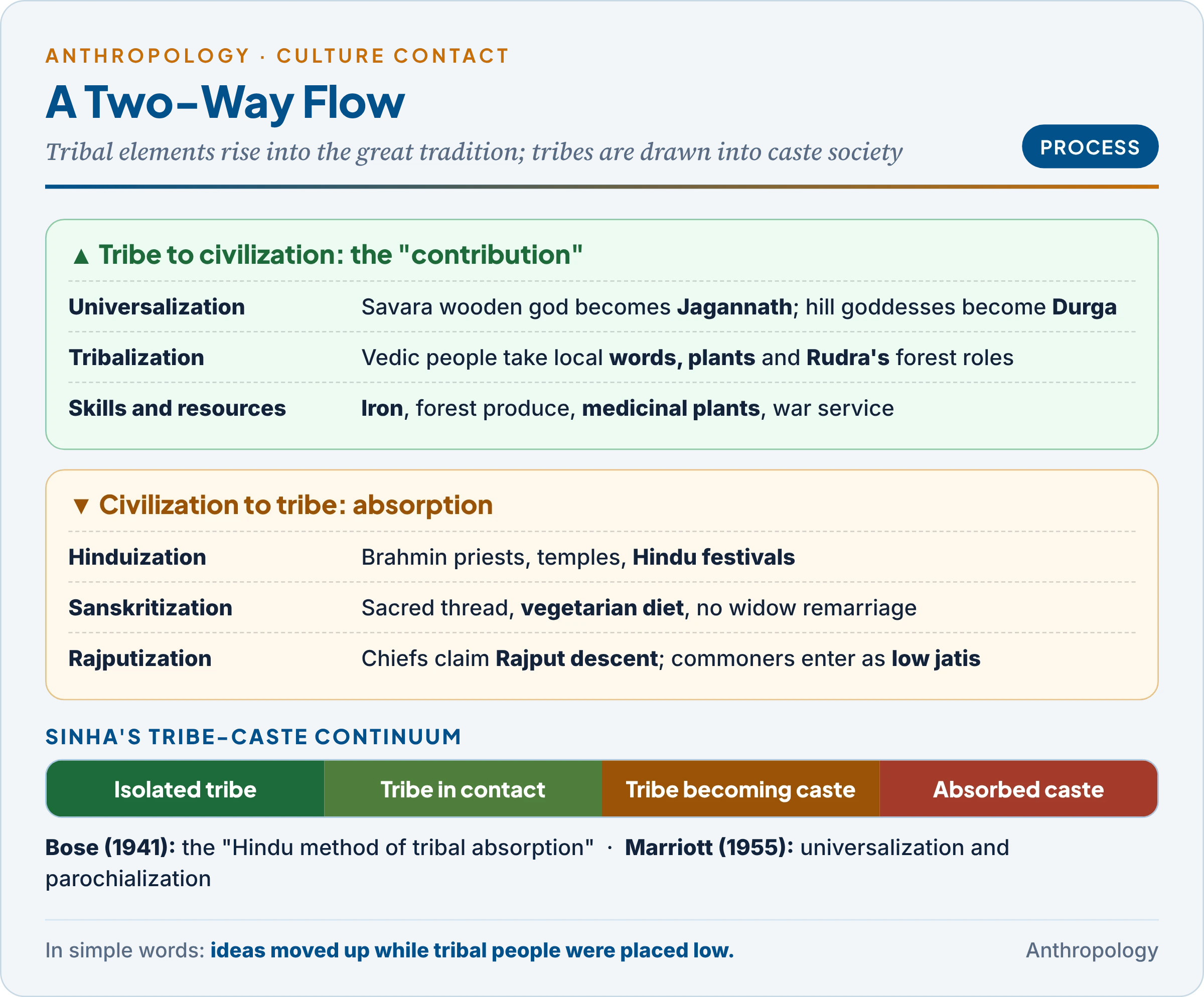
Contact ran in both directions; the “contribution” is the upward half of a two-way exchange.
| Direction | Process | Example |
|---|---|---|
| Tribe → civilization | Universalization of tribal deities and rites | Savara wooden deity becomes Jagannath; hill goddesses become forms of Durga |
| Tribe → civilization | Tribalization of incoming groups | Vedic people adopt local plants, words, plough terms and Rudra’s forest roles |
| Tribe → civilization | Borrowing of skills and resources | Iron, forest produce, medicinal plants, war service |
| Civilization → tribe | Hinduization and Sanskritization | Bhumij and Gond chiefs adopt Brahmin priests and sacred thread |
| Civilization → tribe | Rajputization or Kshatriyaization of chiefs | Tribal chiefs claim Rajput descent to legitimise rule |
The table shows why the subject cannot be told as a list of “gifts”. The same encounter that carried the Savara god into Puri carried Brahmin ritual, caste rank and land revenue into Savara country. N.K. Bose, the Indian anthropologist and Gandhian, called this the “Hindu method of tribal absorption” (1941); Sinha mapped it as a tribe-caste continuum (1965), a scale from isolated tribes to communities fully absorbed as castes. Tribal elements moved up the scale even as tribal people were placed low on it.
Common confusion
Is tribal absorption the same as Sanskritization? No. Sanskritization (M.N. Srinivas) is a low caste or tribe imitating the customs of higher castes to climb the existing hierarchy. Tribal absorption (Bose) is the wider, slower entry of a whole tribe into the caste order, usually as a new jati tied to a craft or service, often while it keeps its own gods and customs. Sanskritization can be one step within absorption, but absorption also carries tribal elements into the wider society, which Sanskritization does not explain.
2. Deep Foundations: Genes, Prehistory and Language
In simple words
Long before written history, India was peopled by hunter-gatherers whose descendants are found in every Indian community today. Their languages also left traces in Sanskrit and the modern Indian languages. So the tribal contribution begins at the very bottom layer of Indian ancestry and speech.
2.1 Ancestry: the oldest layer in everyone
- Two ancestral populations: David Reich and Indian colleagues (Nature, 2009) showed that almost all Indians descend from a mixture of Ancestral North Indians (ANI), related to West Eurasians, and Ancestral South Indians (ASI), found nowhere outside India; the Andamanese are distantly related to ASI.
- The first Indians: Vagheesh Narasimhan and colleagues (Science, 2019) traced ASI to an Ancient Ancestral South Indian (AASI) hunter-gatherer component, which mixed with Iranian-related farmers. The Rakhigarhi Harappan genome (Vasant Shinde and colleagues, Cell, 2019) carried exactly this mix: Iranian-related plus AASI ancestry, without steppe ancestry.
- Endogamy follows: mixing between ANI and ASI was widespread until about 4,200–1,900 years ago, after which endogamy (marriage within the group) froze group boundaries (Priya Moorjani and colleagues, 2013).
- What it means: the hunter-gatherer ancestry strongest in many tribal communities runs through all Indian castes and regions. The “tribal” layer is a foundation of the whole population, not a separate one.
2.2 Ways of life carried forward
- Living continuity: the Chenchu, Birhor, Kadar and Paliyan kept up hunting and gathering, and many central Indian tribes shifting cultivation (jhum, bewar, podu), into recent times; ethno-archaeology (1.3) uses them to read Mesolithic camps and tools.
- Rock art and living art: dancers, hunters and animals of the Bhimbetka paintings find parallels in Saura, Warli and Gond wall art, which archaeologists use to interpret the ancient images (not to claim direct descent).
- Harappan and after: Harappan practices that reappear in Hinduism (tree, animal and mother-goddess worship) are also tribal and folk practices (detail in 1.1b).
2.3 Language: a substratum under Sanskrit
India’s four language families were given Sanskrit labels by the linguist Suniti Kumar Chatterji: Nishada (Austro-Asiatic, mainly Munda), Kirata (Tibeto-Burman), Dravida (Dravidian) and Arya (Indo-Aryan). Chatterji and the Gazetteer of India (1965) described Indian culture as an “Aryo-Dravido-Austric” amalgam, with a Kirata element in the north and east.
Read the table as a list of proposed borrowings and their status.
| Evidence | Who proposed it | What it suggests | Status today |
|---|---|---|---|
| 383 non-Indo-Aryan words in the Rigveda (about 4% of its vocabulary) | F.B.J. Kuiper, Aryans in the Rigveda (1991) | Vedic poets borrowed words for local plants, farming, crafts, music and dance | Count disputed (some scholars accept about 340–360; others far fewer), but a substratum is widely accepted |
| A lost “Para-Munda” language in the Punjab | Michael Witzel | Words with prefixes like ka-, ki- (e.g. karpāsa “cotton”, kīnāśa “ploughman”) came from a prefixing language | Plausible; Witzel later renamed it a north-western substrate |
| lāṅgala (plough), liṅga, kadalī (banana), names of betel | Jean Przyluski, in Pre-Aryan and Pre-Dravidian in India (Lévi, Przyluski and Bloch, translated by P.C. Bagchi, 1929) | Plough and phallic cult taken from Austro-Asiatic speakers | Contested: Munda specialists reject the plough etymology |
| Counting in twenties (kodi, kori) | Przyluski; Chatterji | Vigesimal counting in eastern Indo-Aryan from Austric | Accepted as a regional areal trait |
| Retroflex sounds (ṭ, ḍ, ṇ) in Sanskrit | Many linguists | Contact with Dravidian or other local languages | Majority view; some argue internal development |
The table shows a balanced conclusion. The existence of a pre-Aryan substratum in Sanskrit is well established: it is strongest in words for village life, plants and crafts, the domains in which the newcomers learned from people already settled. The attribution of single words to Munda is often weak, as the Japanese Munda scholar Toshiki Osada (2006) showed for lāṅgala. A careful answer uses the general substratum, not a single favourite etymology.
- Kirata contribution: Chatterji’s Kirata-Jana-Krti (1951) argued that the Indo-Mongoloid (Tibeto-Burman) peoples shaped the kingdoms, goddess cults and arts of Assam, north Bengal and Nepal.
- Living tribal languages: Santali and Bodo were added to the Eighth Schedule by the 92nd Amendment (2003). Santali has its own script, Ol Chiki, created by Pandit Raghunath Murmu in 1925, a modern tribal contribution to India’s scripts.
3. Tribes in Vedic, Epic and Puranic Traditions
In simple words
The oldest Indian texts already talk about forest peoples, sometimes as enemies, often as allies, teachers and kin. Their gods, heroes and stories were taken into the epics and Puranas. Many tribes in turn retell the epics in their own way.
3.1 Tribal elements in Vedic culture
The Vedic people were themselves tribal in organisation, which is why the meeting with older Indian tribes was a meeting of similar societies.
- Vedic society as tribal: the Rigveda speaks of janas (peoples) such as the Bharatas and Purus, led by a rajan (chief) and checked by assemblies, the sabha and samiti. Wealth was counted in cattle, and war was raiding for cattle (gavishti). The “Aryan” side of the encounter was a set of pastoral tribes, not a state.
- Dasas, Dasyus and Panis: the hymns describe hostile Dasas and Dasyus with forts and wealth, and Panis who hid cattle. Several Dasa chiefs, such as Balbutha, appear as patrons of Vedic poets: enemies also became allies and donors.
- Absorbing outsiders by ritual: the Vratyastoma rites of the Panchavimsha Brahmana admitted Vratyas (groups outside Vedic norms) into the Vedic fold. A ritual route for incorporation existed from the start.
- Forest peoples named: the Aitareya Brahmana makes the Andhras, Pundras, Sabaras, Pulindas and Mutibas the outcast sons of the sage Vishvamitra, a myth that placed forest peoples inside the Brahmanical genealogy while ranking them low.
- Rudra, lord of the forest: the Shatarudriya hymn of the Yajurveda salutes Rudra as lord of hunters, Nishadas, carpenters, chariot-makers and potters. The god who became Shiva carried the world of forest and craft into the Vedic pantheon.
- The Nishada chief: the ritual philosophers of the Mimamsa school debated whether a nishada-sthapati (Nishada chief) could perform a Vedic offering to Rudra, and concluded that he could: a tribal ruler had a recognised, if limited, ritual place.
Contributions to Vedic culture, taken together: agricultural and craft vocabulary (Section 2.3), plants and cultivation of the Indian monsoon world, the Rudra-Shiva complex, fertility and goddess cults that grow in the later Vedic texts, and the assembly-based polity shared with older Indian tribes. The literary and linguistic evidence shows interaction clearly but rarely which community gave what.
3.2 Forest peoples in the epics and Puranas
The epics are full of forest peoples who help, marry and teach the heroes. Each episode records a relationship: alliance, marriage, service or exclusion.
| Figure | Text | People | What the episode shows |
|---|---|---|---|
| Guha | Ramayana | Nishada king of Shringaverapura | Ferries Rama across the Ganga; an ally and friend of the hero |
| Shabari | Ramayana | Shabara woman ascetic | Rama accepts fruit she has tasted; devotion above birth |
| Ekalavya | Mahabharata | Son of the Nishada king Hiranyadhanus | Masters archery alone; Drona demands his thumb: talent recognised, then excluded |
| Hidimba and Ghatotkacha | Mahabharata | Forest-dwelling rakshasa clan | Bhima marries Hidimba; their son fights for the Pandavas; Hidimba is worshipped at Manali (temple of 1553) |
| Ulupi | Mahabharata | Naga princess | Marries Arjuna; Naga lineages enter the epic world |
| Shiva as Kirata | Mahabharata; Bharavi’s Kiratarjuniya (6th century) | Kirata hunter | Shiva tests Arjuna in the guise of a mountain hunter |
| Vindhyavasini | Harivamsa | Worshipped by Sabaras, Barbaras and Pulindas | The goddess of the Vindhya forest becomes a form of Durga |
These stories show a civilization recording its debts and its hierarchies at once: forest peoples appear as allies, devotees, spouses and even the disguise of the highest god, while Ekalavya shows forest talent admitted only on the established order’s terms.
- Tribes retell the epics: the Bhil sing their own Bharath (Mahabharata), the Gond epic of Lingo tells of their culture-hero, and some Gond groups honour Ravana as an ancestor-king. Verrier Elwin, the British-born anthropologist who lived among the Gond and Baiga, collected such stories in Myths of Middle India (1949). The flow of stories was two-way.
4. Religion and Ritual: From Sacred Grove to Temple
In simple words
Many Hindu gods and festivals began as the worship of local tribal deities: a log, a stone, a tree or a hill goddess. Kings and priests built temples around them and gave them Sanskrit names, but tribal priests and customs often stayed at the heart of the worship.
4.1 Jagannath of Puri: the classic case
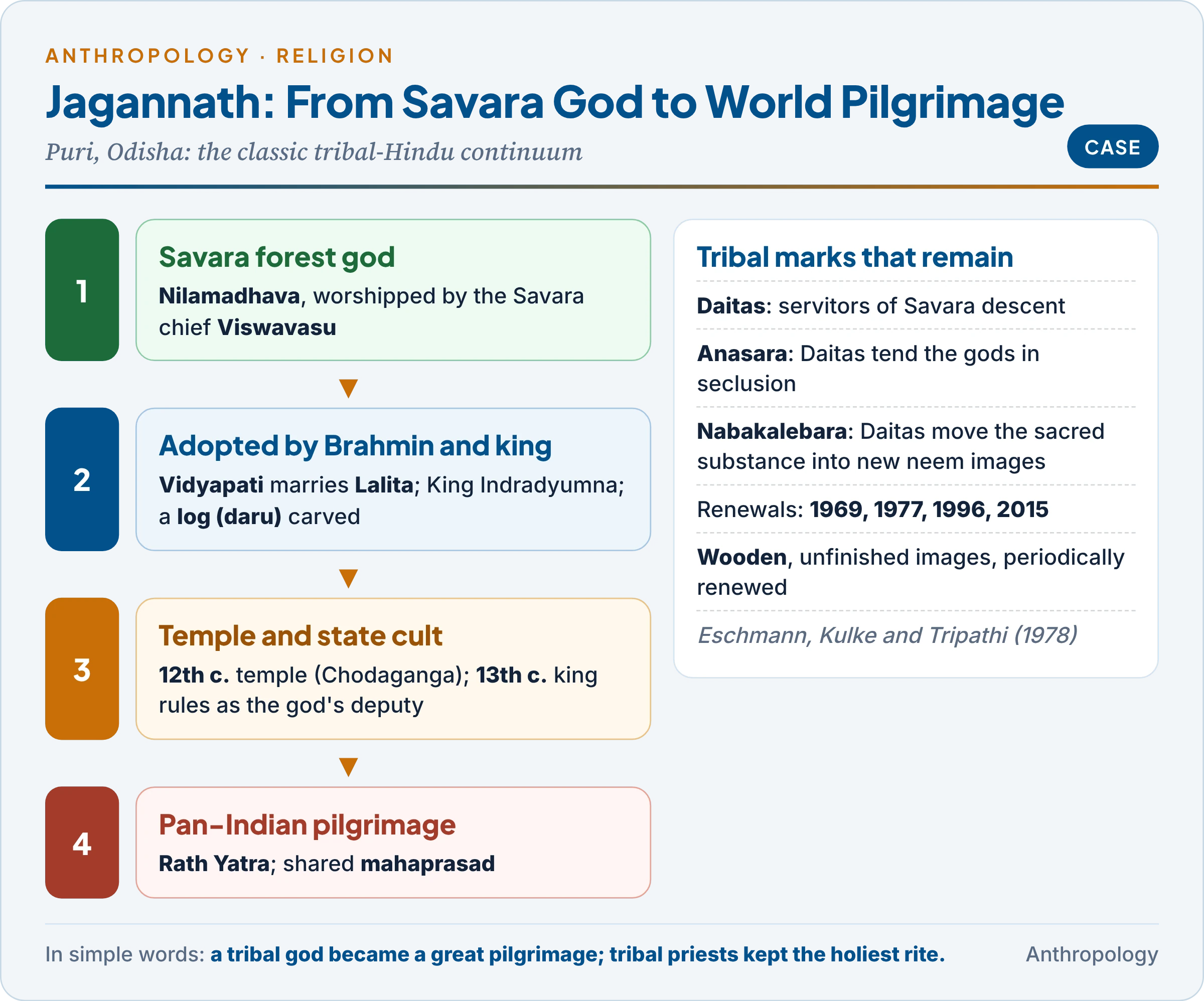
- The legend: King Indradyumna sends the Brahmin Vidyapati to find the god Nilamadhava, secretly worshipped in the forest by the Savara chief Viswavasu. Vidyapati marries the chief’s daughter Lalita; the god is later revealed as a log of wood (daru) floating to the shore, which is carved into the images.
- The tribal marks that remain: the deities are wooden, unfinished in form (no full hands or feet) and periodically renewed like a tribal effigy; the cult has no fixed caste bar at the mahaprasad (shared temple food). The anthropologists who studied it called Jagannath a god of the “tribal-Hindu continuum”.
- The Daitas: the Daitapati servitors, believed to descend from Vidyapati and the Savara princess, look after the deities during Anasara (the fortnight of seclusion after the bathing festival), carry them to the chariots in the Rath Yatra, and in Nabakalebara select the sacred neem tree and transfer the Brahma substance, blindfolded, into the new image. Recent renewals: 1969, 1977, 1996 and 2015.
- Royal patronage: the Eastern Ganga king Anantavarman Chodagangadeva built the present temple (12th century), and Anangabhima III (13th century) declared Jagannath the true ruler of the kingdom, ruling as his deputy. The Gajapati king still sweeps the chariots (chhera pahara).
- The scholarship: Anncharlott Eschmann, Hermann Kulke and Gaya Charan Tripathi edited The Cult of Jagannath and the Regional Tradition of Orissa (1978), which showed how a local tribal god became, through stages of Hinduization and state patronage, the centre of a regional tradition and a pan-Indian pilgrimage.
The Jagannath case is the clearest proof that the tribal contribution is structural, not decorative: without the tribal deity there would be no cult, and without tribal servitors its central rite could not be performed. It also shows the price: Savara descent is honoured inside the temple while Savara communities outside remain among Odisha’s poorest.
4.2 Goddesses, Shiva and the sacred landscape
- Mother goddesses: Kosambi traced many village and hill mother goddesses to tribal cults, absorbed by identifying them as forms of Durga, Kali or Parvati. Kamakhya (Assam), Vindhyavasini and Danteshwari (Bastar) are examples.
- Bastar Dussehra: in Jagdalpur (Chhattisgarh) Dussehra lasts about 75 days and honours Danteshwari, not Rama; tribal headmen, priests and carpenters have fixed ritual roles, and the festival closes with the Muria Darbar, a council of tribal leaders with the former ruling family: a Hindu festival reshaped around tribal deities and institutions.
- Shiva and the stone: worship of uncarved stones, trees and serpents (Naga cults, Nagapanchami) is shared by tribes and peasants, and the forest-and-mountain character of Rudra-Shiva (Section 3.1) links the high god to them.
- Murugan and Valli: in Tamil tradition the hill god Murugan (lord of the kurinji hill landscape) marries Valli, daughter of a Kurava hunter chief, alongside his Sanskritic wife Devasena: the two wives mark the meeting of the hill-hunter and Brahmanical traditions.
- Totemism and gotra: several gotra (exogamous clan) names of the great tradition are animal or plant names, such as Kashyapa (“tortoise”) and Vatsa (“calf”). Kosambi read these as totemic survivals; totemic clans are also found among castes of Chota Nagpur and Odisha. Clan exogamy and totemism are shared Indian structures, not markers that separate tribe from caste.
- Nature-Man-Spirit complex: L.P. Vidyarthi, the Ranchi anthropologist, found among the Maler of the Rajmahal hills (1963) a world-view in which nature, people and spirits form one interacting whole; his sacred complex of Gaya (1961) showed the same layering at a Hindu pilgrimage centre (Unit 3.3).
- Sacred groves: sarna (Munda, Oraon, Santal), devrai (Maharashtra), kavu (Kerala) and the Khasi forest of Mawphlang are patches of forest left uncut for deities. They preserve biodiversity and stand behind the temple grove and the sacred tree of the wider tradition.
Common confusion
Universalization or Sanskritization: which explains Jagannath? Universalization (Marriott). Sanskritization describes a group changing its customs to rise in rank. Universalization describes a cultural element (here, a tribal deity) rising from a local to a wider tradition. Jagannath moved from Savara forest worship to a pan-Indian pilgrimage; the Savaras as a people did not rise with him.
5. Polity and State Formation
In simple words
Many kingdoms of medieval India were founded by tribal chiefs or ruled over tribal lands with tribal support. Chiefs often claimed Rajput or Kshatriya descent to gain respect, while their courts kept tribal priests, gods and councils. Tribal self-government and resistance also shaped modern Indian democracy.
5.1 From lineage to state
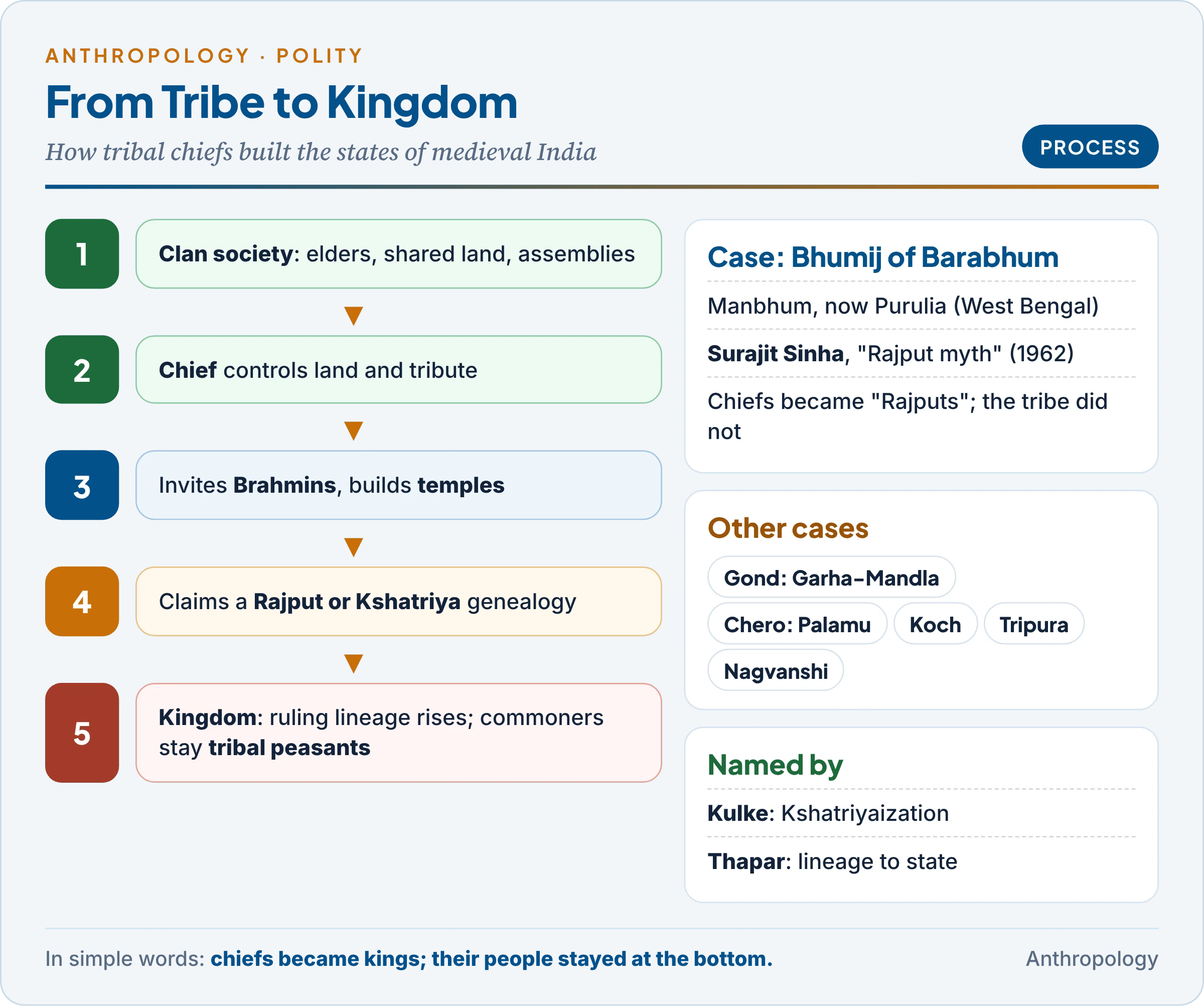
Example first. Surajit Sinha studied the Bhumij of Barabhum (Manbhum, now Purulia in West Bengal) and published “State Formation and Rajput Myth in Tribal Central India” (Man in India, 1962). The Bhumij chiefs of Barabhum built a kingdom, invited Brahmins, built temples and claimed Rajput descent; their commoners stayed Bhumij cultivators. The ruling house moved up the caste scale while the tribe below it did not.
- The pathway: clan chiefs gain control of land and tribute → patronise Brahmins and temples → adopt a Rajput or Kshatriya genealogy (Rajputization) → the lineage separates from the commoners and the tribe becomes the peasantry of a small state.
- Kshatriyaization: the German historian Hermann Kulke (1976) described the same process in Odisha: the little kingdoms of the hill tracts were built by tribal chiefs who became Kshatriyas, and these little kingdoms fed the larger states of the plains.
- From lineage to state: Romila Thapar, the historian of early India, traced in From Lineage to State (1984) how the clan-based janas became kingdoms; B.D. Chattopadhyaya (The Making of Early Medieval India, 1994) showed that early medieval states grew by integrating tribal peoples as peasants and their chiefs as rulers.
- Why it matters: much of medieval central India, Odisha, Chota Nagpur and the north-east was made by tribal state formation: the contribution to Indian polity is the kingdoms themselves.
5.2 Tribal and tribe-based kingdoms
The table lists kingdoms whose rulers were of tribal origin or whose power rested on tribal followings.
| Kingdom | Region | Period | Note |
|---|---|---|---|
| Gond kingdoms: Garha-Mandla, Deogarh, Chanda, Kherla | Central India | 14th–18th centuries | Rani Durgavati ruled Garha-Mandla and died fighting the Mughal general Asaf Khan in 1564; a Deogarh king founded Nagpur |
| Chero | Palamu, Jharkhand | 17th century (Medini Rai) | Tribal dynasty with forts at Palamu |
| Nagvanshi | Chota Nagpur | Medieval to colonial | Legend tells that the Mundas chose the first king |
| Bhumij chiefs | Barabhum, Manbhum | Medieval to colonial | Sinha’s Rajput-myth case |
| Manikya kings | Tripura | Medieval to 1949 | Royal lineage of the Tripuri people |
| Koch | Koch Bihar, north Bengal and Assam | 16th century (Bishwa Singha) | Koch rulers later claimed Kshatriya status |
| Dimasa Kachari and Jaintia | Assam, Meghalaya | Medieval | Hill kingdoms that adopted Hindu courts |
| Ahom | Brahmaputra valley | 1228–1826 | Founded by the Tai leader Sukaphaa; absorbed many local tribes into one polity |
- Tribes behind Rajput thrones: in Mewar the Bhils fought with Maharana Pratap at Haldighati (1576) under Punja, and the Mewar coat of arms shows a Bhil archer and a Rajput warrior as supporters of the shield. In several Rajput states a tribal headman anointed the new ruler with a tilak, a token recognition that the land had first belonged to the tribe.
5.3 Self-government, councils and dormitories
- Village republics: the Munda manki-munda system of village and federation headmen (recognised for the Ho of Kolhan under Wilkinson’s Rules in the 1830s), the Santal manjhi-paragana councils, the Khasi dorbar shnong and the Naga village councils are long-standing systems of assembly-based self-rule.
- Their legacy in law: the Sixth Schedule (autonomous district councils in Assam, Meghalaya, Tripura and Mizoram), Article 371A for Nagaland and the PESA Act (1996), which makes the gram sabha the guardian of customary law and resources in Fifth Schedule areas, all build on these institutions.
- Youth dormitories: the ghotul of the Muria of Bastar, studied by Elwin (The Muria and Their Ghotul, 1947), the dhumkuria of the Oraon and the morung of the Nagas trained the young in work, music, discipline and service: an education system rooted in community life.
- Women’s position: matriliny among the Khasi and Garo (the youngest Khasi daughter, khatduh, keeps the ancestral house), bride-price rather than dowry and freer divorce add alternative gender norms to the Indian repertoire.
5.4 Resistance and the making of the nation
- Anti-colonial struggle: the Santal Hul (1855–56) of Sidhu and Kanhu Murmu, the Ulgulan of Birsa Munda (1899–1900), the Tana Bhagat movement of the Oraon (from 1914), the Rampa rebellion (1922–24) of the Koyas led by Alluri Sitarama Raju, the Mangarh gathering of the Bhils under Govind Guru, fired on in 1913, and the movement of Rani Gaidinliu in the Naga hills were among the earliest and fiercest resistances to colonial land and forest policy (Unit 7.4).
- The Constitution: Jaipal Singh Munda, who had captained India’s hockey team to Olympic gold at Amsterdam (1928), spoke for the Adivasis in the Constituent Assembly, telling it that tribal people were “the most democratic people on earth”, from whom democracy had to be learned. The Fifth and Sixth Schedules carry that argument.
- Recognition today: since 2021, 15 November (Birsa Munda’s birth anniversary) is observed as Janjatiya Gaurav Divas, and in 2022 Droupadi Murmu, a Santal woman from Odisha, became the first tribal President of India.
6. Economy, Technology and Ecology
In simple words
Tribes gave India practical knowledge: how to smelt iron, cast metal, grow rice in hill valleys, keep hundreds of seed varieties, and use forest plants as food and medicine. Much of this knowledge is now valued for sustainable development, and some of it has been protected by law.
6.1 Metals and crafts
- Iron smelting: the Agaria of the Maikal hills (Elwin, The Agaria, 1942) and the Asur of Jharkhand (today a PVTG) smelted iron in small clay furnaces with hand bellows, supplying ploughshares and axes to the plains for centuries.
- Lost-wax casting: Dhokra metal-casting of the Dhokra Damar smiths of Bengal and Odisha and the Ghadwa of Bastar continues one of the oldest metal techniques in India (the method of the Harappan “dancing girl”).
- Forest-based crafts: bamboo and cane work of the north-east, lac (an insect resin) and tussar silk (from wild silkworms), largely produced by tribal communities of Jharkhand and its neighbours, entered India’s trade.
6.2 Farming systems and food
- Apatani wet-rice cultivation: in the Ziro valley (Arunachal Pradesh) the Apatani, studied by the Austrian anthropologist Christoph von Fürer-Haimendorf, grow irrigated rice with fish in the paddies, channel water through bamboo pipes and use no draught animals or machines, on a densely settled plateau. The Apatani Cultural Landscape has been on UNESCO’s tentative World Heritage list since 2014.
- Koraput: the tribal farming of Koraput (Odisha), where some 62 communities conserve hundreds of rice landraces and millets, was designated a Globally Important Agricultural Heritage System (GIAHS) by the FAO in 2012. The region is regarded as a centre of diversity of the aus rice type.
- Shifting cultivation and food: jhum with long fallow cycles is a sustainable mixed-cropping system that keeps millets, pulses and tubers in use; millets, mahua and forest greens are now promoted for nutrition.
6.3 Medicine and biodiversity
Example first. In 1987, scientists of the Tropical Botanic Garden and Research Institute (TBGRI), Kerala, trekking with Kani guides in the Western Ghats, saw them eat the fruit of arogyapacha (Trichopus zeylanicus) to stay energetic. TBGRI developed the herbal drug Jeevani, licensed it in 1995, and agreed to share 50% of the licence fee and royalties with the Kanis through a trust set up in 1997. The arrangement won the UN Equator Prize (2002) and is cited as an early benefit-sharing model.
- Why it matters: it treated tribal knowledge as intellectual property, anticipating the benefit-sharing rules of the Biological Diversity Act, 2002; its limits (only one Kani group party at first, payments ending with the licence) are instructive.
- Ecological stewardship: the Dongria Kondh of the Niyamgiri hills (Odisha) worship the hill as their god Niyam Raja. After the Supreme Court (April 2013) left the decision on bauxite mining to the gram sabhas under the Forest Rights Act, all twelve consulted villages rejected the project. Tribal religion here became an argument for conservation in Indian law.
7. Arts, Language, Music and Sport
In simple words
Tribal paintings, dances and songs are some of the best-known arts of India today. Tribal athletes have won some of India’s greatest sporting honours. These are living contributions, not only ancient ones.
The table lists art forms that have moved from village walls and festivals to national and world recognition.
| Art | Community and region | Recognition |
|---|---|---|
| Warli painting | Warli, Thane and Palghar, Maharashtra | GI tag (2014); Jivya Soma Mashe, Padma Shri (2011) |
| Gond painting | Pardhan Gond, Patangarh, Dindori (MP) | Pioneered by Jangarh Singh Shyam at Bharat Bhavan, Bhopal; GI tag (2023); Durga Bai Vyam, Padma Shri (2022) |
| Bhil painting | Bhil, Jhabua (MP) | Bhuri Bai, Padma Shri (2021) |
| Sohrai and Khovar | Women of Hazaribagh, Jharkhand | Harvest and wedding wall art; GI tag (2020) |
| Saura idital | Saura, south Odisha | Ritual wall paintings for spirits |
| Pithora | Rathwa and Bhil, Gujarat and MP | Painted vows on house walls |
| Chhau dance | Purulia (West Bengal), Seraikela (Jharkhand), Mayurbhanj (Odisha) | UNESCO Intangible Cultural Heritage list (2010) |
These forms show that the tribal contribution is ongoing. A ritual painting such as Sohrai or Pithora becomes an art commodity in the city, and who gains from that move (Unit 7.2) is part of the debate.
- Music and dance: the Mizo cheraw (bamboo dance), the dance of the Bison-horn Maria of Bastar and Santal drum music enrich India’s performing arts.
- Sport: after Jaipal Singh (1928), the hockey nurseries of Sundargarh (Odisha) and Simdega (Jharkhand) have given India several Olympians, and M.C. Mary Kom of the Kom tribe (Manipur) won Olympic boxing bronze (2012) and six world titles.
8. Evaluating the “Contribution” Debate
In simple words
Scholars agree that tribes have given a great deal to Indian civilization, but they disagree about what that means. Some saw tribes as backward Hindus to be absorbed; others wanted to protect them; others see them as separate societies with their own rights. The idea of “contribution” itself can hide unequal terms.
8.1 Three classic positions
| Position | Scholar and work | View of tribes | Consequence |
|---|---|---|---|
| Assimilation | G.S. Ghurye, The Aborigines—”So-called”—and Their Future (1943) | “Backward Hindus“, part of Hindu society at a lower level | Integrate them fully into Hindu society |
| Protection, then integration | Verrier Elwin, The Loss of Nerve (1941); A Philosophy for NEFA (1957) | Distinct cultures harmed by contact | First isolation, later integration on tribal terms; Nehru’s tribal Panchsheel (1959 foreword) |
| Continuum | N.K. Bose (1941); Surajit Sinha (1958, 1962, 1965) | One end of a scale running to caste | Tribes and castes as parts of one civilization |
| Distinct societies | Virginius Xaxa (1999, 2008) | Societies with their own history, now in a modern state | Rights, autonomy and recognition, not absorption |
The table shows how the meaning of “contribution” shifts with the position. For Ghurye, tribal gifts are simply Hindu culture at an earlier stage. For Bose and Sinha, they are evidence of one civilization with tribal roots. For Xaxa, the frame of “contribution” to someone else’s civilization can itself obscure that tribes are societies in their own right.
Criticism — Problems with the “contribution” frame
- One-way story: listing tribal “gifts” can make Hindu civilization the receiver and judge of value, and tribes mere donors.
- Absorption at the bottom: Bose himself noted that absorbed tribes entered as low-ranking jatis; the anthropologist Abhijit Guha (2018) argued that Bose’s theory rested on brief fieldwork among the Juang and overlooked resistance recorded by Tarak Chandra Das among the Bhumij.
- Appropriation: gods, art and plant knowledge were taken without benefit to the communities (the Savara poor beside a rich temple; biopiracy).
- Romanticism: treating tribes as “ancient” donors freezes them in the past.
Defence — What the frame still achieves
- Corrects the textbook: it puts forest and hill peoples back into a history told from Sanskrit texts and courts.
- Supported by evidence: genetics, linguistics and the Jagannath, Bastar and state-formation cases show real, structural contributions.
- Grounds rights: recognising tribal knowledge as a contribution supports benefit-sharing, GI tags, FRA and PESA.
- Shows agency: the state-formation and freedom-struggle cases show tribes as makers of Indian history, not passive sources.
8.2 A balanced view
- Contribution and cost go together: the same processes that carried tribal elements upward (universalization, Rajputization, temple patronage) also took land and rank away from tribal commoners.
- The flow continues: tribal art, ecological knowledge, sport and politics are current contributions, made by communities that are now citizens with constitutional safeguards (Unit 7.1).
- The best summary is Sinha’s and Singh’s: tribal cultures are a dimension of Indian civilization, present at its base, in its pantheon, in its states and in its present, while tribes remain distinct societies with their own claims.
Key Terms
| Term | Meaning in simple words |
|---|---|
| Jana | A “people” or tribe in Vedic texts, led by a chief and assemblies |
| Nishada | A Sanskrit name for forest peoples; also Chatterji’s label for the Austro-Asiatic language family |
| Kirata | A Sanskrit name for Himalayan and north-eastern hill peoples (Tibeto-Burman speakers) |
| Substratum | Traces of an older language left in the language that replaced it |
| AASI | Ancient Ancestral South Indian: the oldest hunter-gatherer ancestry in Indians |
| Primary (orthogenetic) civilization | A civilization grown out of its own folk culture |
| Great and little traditions | The learned, textual tradition and the local, oral tradition of a civilization |
| Universalization | A local element rising into the wider, Sanskritic tradition |
| Parochialization | A Sanskritic element being reshaped in a local tradition |
| Hindu method of tribal absorption | Bose’s idea of tribes entering caste society as new jatis while keeping some customs |
| Tribe-caste continuum | Sinha’s scale running from isolated tribes to fully absorbed castes |
| Rajputization | Tribal chiefs claiming Rajput descent to legitimise their rule |
| Kshatriyaization | Kulke’s term for tribal chiefs becoming Kshatriya kings in Odisha |
| Daita | Jagannath servitors of believed Savara descent |
| Nabakalebara | The renewal of Jagannath’s wooden images |
| Sacred grove | A forest patch protected for a deity (sarna, devrai, kavu) |
| Ghotul | The Muria youth dormitory |
| Benefit-sharing | Paying a community for the commercial use of its knowledge or resources |
Contemporary Developments
- Janjatiya Gaurav Varsh (2024–25): the 150th birth anniversary of Birsa Munda was marked by a year of commemoration from 15 November 2024, building on the annual Janjatiya Gaurav Divas (since 2021) and museums for tribal freedom fighters, such as the Birsa Munda museum at the old Ranchi jail (opened 2021).
- Dharti Aaba Janjatiya Gram Utkarsh Abhiyan (2024): a Union scheme approved in September 2024 to saturate about 63,000 tribal-majority villages with basic services, alongside PM-JANMAN (November 2023) for the 75 PVTGs.
- GI tags for tribal arts: Sohrai-Khovar painting (2020) and Gond painting of Madhya Pradesh (2023) joined Warli painting, giving communities legal control over the names of their arts.
- First tribal President: Droupadi Murmu, a Santal, took office in July 2022, a symbolic recognition of the tribal place in the nation.
- Ancient DNA: studies since 2019 (Rakhigarhi; Narasimhan and colleagues) confirm that the hunter-gatherer ancestry best preserved in many tribal groups is a foundation of all Indian populations.
Diagrams to Master
- Topic map: the seven domains of contribution (genes and language, texts, religion, polity, economy and ecology, arts, nation) and the debate.
- Two-way flow: upward arrows (universalization, tribalization, skills) and downward arrows (Hinduization, Sanskritization, Rajputization); label Bose and Sinha.
- Jagannath: Savara deity → royal adoption → temple and state cult → Daitas in Anasara, Nabakalebara and Rath Yatra; label Eschmann, Kulke and Tripathi (1978).
- Tribe to state: clan → chief → Brahmins and temples → Rajput genealogy → kingdom with tribal peasants; label the Bhumij of Barabhum (Sinha, 1962).
- Timeline: AASI hunter-gatherers → Harappan mix → Vedic janas and Nishadas → epics → tribal kingdoms → revolts (1855, 1899–1900) → Constitution → Janjatiya Gaurav Divas (2021).
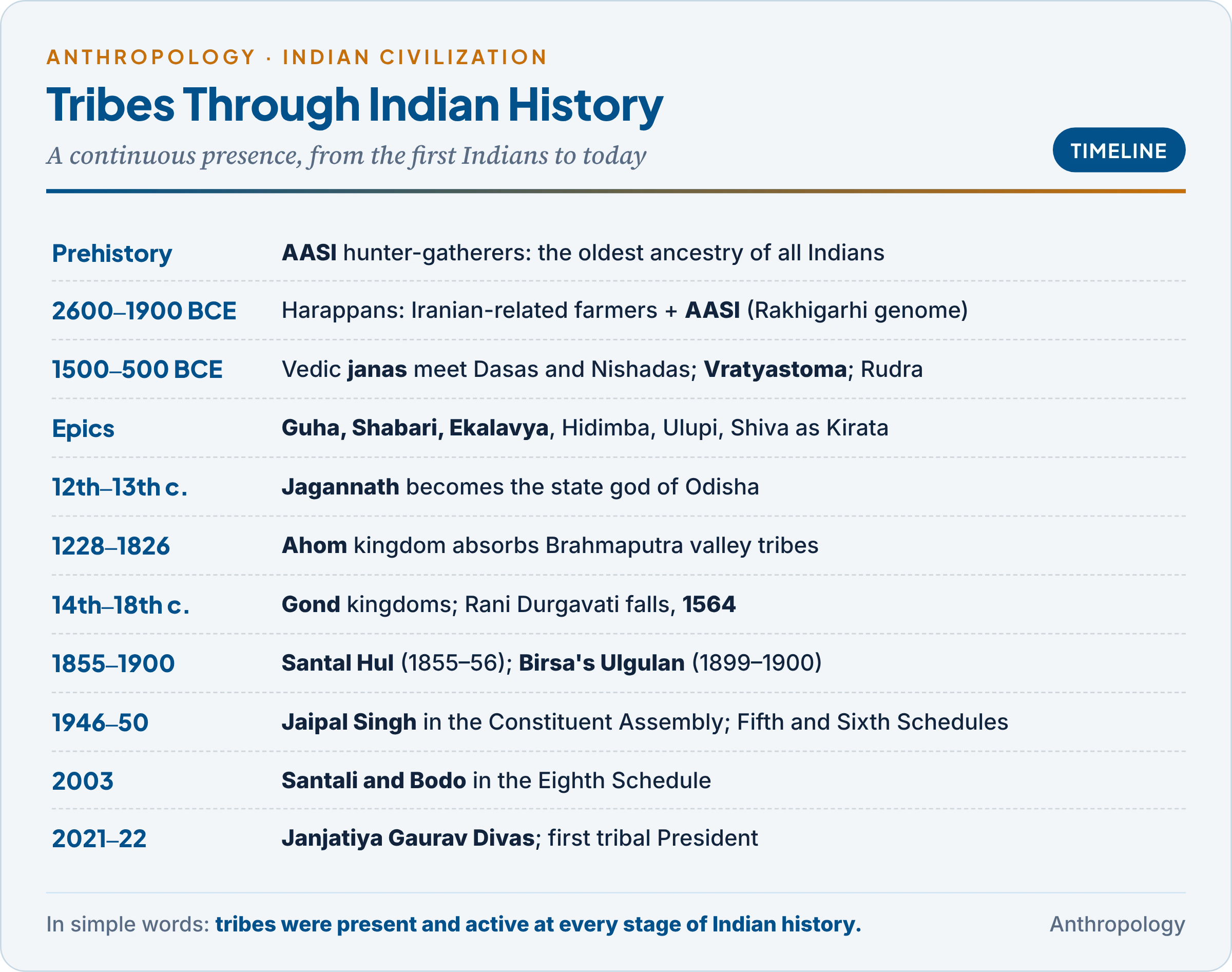
Revision Grid
| Scholar | Work (year) | Key idea |
|---|---|---|
| Lévi, Przyluski, Bloch | Pre-Aryan and Pre-Dravidian in India (trans. Bagchi, 1929) | Austro-Asiatic and Dravidian loans in Sanskrit |
| N.K. Bose | “The Hindu Method of Tribal Absorption” (1941) | Tribes absorbed as jatis, keeping customs |
| G.S. Ghurye | The Aborigines—”So-called”—and Their Future (1943) | Tribes as backward Hindus |
| Verrier Elwin | The Muria and Their Ghotul (1947); Myths of Middle India (1949) | Tribal institutions and myths; protection |
| S.K. Chatterji | Kirata-Jana-Krti (1951) | Indo-Mongoloid contribution; Aryo-Dravido-Austric culture |
| Redfield and Singer | “The Cultural Role of Cities” (1954) | Orthogenetic (primary) civilization |
| McKim Marriott | Kishan Garhi (1955) | Universalization and parochialization |
| Surajit Sinha | 1958; Man in India (1962); 1965 | Tribal little tradition; Rajput myth; tribe-caste continuum |
| L.P. Vidyarthi | Sacred Complex in Hindu Gaya (1961); the Maler (1963) | Sacred complex; Nature-Man-Spirit complex |
| D.D. Kosambi | Culture and Civilisation of Ancient India (1965) | Tribal elements fused into general society |
| Hermann Kulke | Kshatriyaization (1976); Jagannath volume (1978) | Tribal chiefs become kings; regional tradition |
| Romila Thapar | From Lineage to State (1984) | Clan societies to kingdoms |
| F.B.J. Kuiper | Aryans in the Rigveda (1991) | 383 foreign words in the Rigveda |
| K.S. Singh | People of India project | Tribal content as an iceberg |
| Virginius Xaxa | 1999; 2008 | Tribes as distinct societies |
| Reich; Narasimhan; Shinde | 2009; 2019; 2019 | ANI-ASI; AASI ancestry; Rakhigarhi genome |
Previous Year Questions
Contributions of tribal cultures to Indian civilization
- 2018Explain the contribution of tribal cultures to Indian civilization.
- 2003Critically ‘examine the contributions of tribal cultures to the development of Vedic culture.
Related questions from other units
- 2026Unit 3.2: Make a critical appraisal of Surajit Sinha’s line of argument that tribes and castes may not be isolated social categories, but are a part of the great Indian civilization.
- 2021Unit 4: Discuss the contributions of N.K. Bose in understanding tribal communities and their place in Indian civilization.
- 2020Unit 8.1: Explain the impact of Hinduism on Tribal people of India.
- 2016Unit 3.2: How is process of tribe-caste continuum different from Sanskritization? Comment.
- 2015Unit 3.3: Write a note in 150 words on Sacred complex as a dimension of Indian civilization.
- 2014Unit 1.1: Describe what is known of Harappan Religion. Have some of its elements continued into later Hinduism? Discuss.
- 2013Unit 4: Examine anthropological contributions dealing with tribes and Indian civilization. (375 words).
- 2012Unit 7.2: Write a note in 150 words on Commodification of Tribal Art.
- 2010Unit 5.3: Write a note in 150 words on Universalization and Parochialization.
- 1999Unit 1.1: Critically examine various sources of India’s culture and civilization. Also distinguish between primary and secondary civilization.
More from Evolution of Indian Culture and Civilization: all notes of this unit · every PYQ of this unit · Anthropology Optional hub