

Anthropology Optional › Paper II › Unit 01: Evolution of Indian Culture and Civilization
1.1 Prehistoric (Paleolithic, Mesolithic, Neolithic and Neolithic-Chalcolithic) Protohistoric (Indus Civilization): PreHarappan, Harappan and postHarappan cultures. Contributions of tribal cultures to Indian civilization.
Official Syllabus: Paper II, Unit 1.1
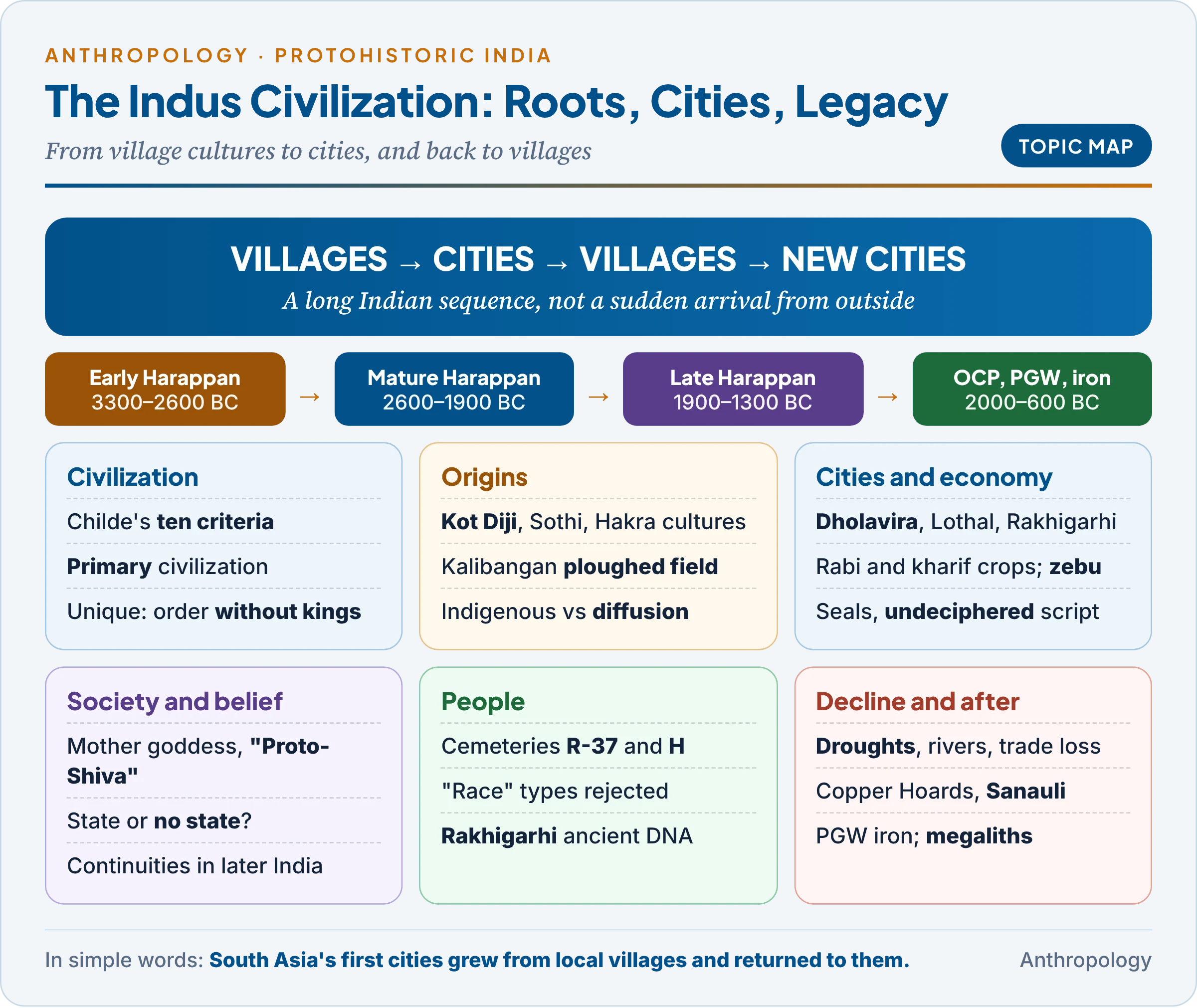
This article covers the protohistoric part of the syllabus line: the Indus civilization with what came before and after it. The Stone Age and the Chalcolithic villages are in 1.1a, and tribal contributions to Indian civilization in 1.1c. Paper 1, Unit 1.8c treats the Harappan as the Bronze Age of South Asia (town-planning diagram, maritime trade, Rakhigarhi); this note gives the fuller Indian synthesis and cross-refers where the two meet.
1. Protohistory and the Idea of Civilization
In simple words
Protohistory is the stage between prehistory and history: people had begun to write, but we cannot read what they wrote, or we know them only from others’ writings. The Indus civilization is protohistoric because its script is still undeciphered. A civilization is a society with cities, specialists, writing and a government, and the Indus people built the first one in South Asia.
1.1 What makes a civilization
V. Gordon Childe, the Australian-born archaeologist, listed ten criteria of the “Urban Revolution” (1950). The table applies them to the Harappan evidence; notice that one criterion, a visible ruling class, is the weakest.
| Childe’s criterion | Harappan evidence |
|---|---|
| Large, dense settlements | Mohenjo-daro, Harappa, Rakhigarhi, Ganweriwala and Dholavira, each of 50 ha or more |
| Full-time specialists | Bead-makers, shell-workers, metal-smiths, seal-cutters, potters |
| Surplus concentrated | Large storage halls; standard weights; sealings on goods |
| Monumental public works | Platforms, walls, the Great Bath, reservoirs, the Lothal basin |
| A ruling class | No palaces or royal tombs; elites inferred from house size and seals |
| Writing and record-keeping | About 400 signs on seals and tablets |
| Exact sciences | Standard weights, measuring scales, planned grids |
| Sophisticated art | Seal engraving, bronze “dancing girl”, steatite “priest-king” |
| Long-distance trade | Mesopotamia, the Gulf, Central Asia |
| State based on residence, not kinship | Uniform rules over about a million square kilometres |
The Harappan meets almost every criterion, yet without palaces, royal burials or great temples. This is why it is called unique among early civilizations:
- Scale and uniformity: the largest area of any Bronze Age civilization, with the same bricks, weights, seals and script from Makran to Haryana.
- Civic, not royal: drains, baths and wells for ordinary houses, but no palaces, royal tombs or war art.
- Peaceful and trading: few weapons, little evidence of conquest, and a society that seems to have been held together by trade and shared ideology rather than force.
- Achievements: the first planned cities and sanitation of South Asia, the world’s oldest cotton textiles, standard weights, fine bead technology and the plough.
- Primary and secondary civilizations: a primary (pristine) civilization grows from its own village base without an earlier model (Mesopotamia, Egypt, the Indus, China, Mesoamerica, the Andes); a secondary one grows through contact with an existing civilization. The long Indus sequence from Mehrgarh (see 1.1a) makes it primary.
- “The first settlement of a big civilization”? The Indus was the first urban civilization of South Asia and the largest in area of the Bronze Age, but not the first settlement (villages were 4,000 years older) and not the world’s first civilization: Mesopotamia and Egypt were slightly earlier and contemporary. India’s second urbanisation came in the Ganga plain after about 600 BC (§6.3).
2. Pre-Harappan Cultures and the Origin of the Civilization
In simple words
Before the great Indus cities, farming villages across Baluchistan, Sindh, Punjab, Haryana, Rajasthan and Gujarat developed their own pottery styles, walls, ploughs and trade. Over about seven centuries these regional cultures grew alike and then merged into one civilization. So the cities grew from local roots rather than arriving from outside.
Example first. At Kalibangan in north Rajasthan, beneath the Harappan town, B.B. Lal and B.K. Thapar (1961–69) found an earlier walled settlement of standard mud bricks and, outside it, a ploughed field with criss-cross furrows, one of the oldest known, matching the way local farmers sow two crops in one field. The plough, standard bricks and walls all came before the cities.
2.1 The long sequence
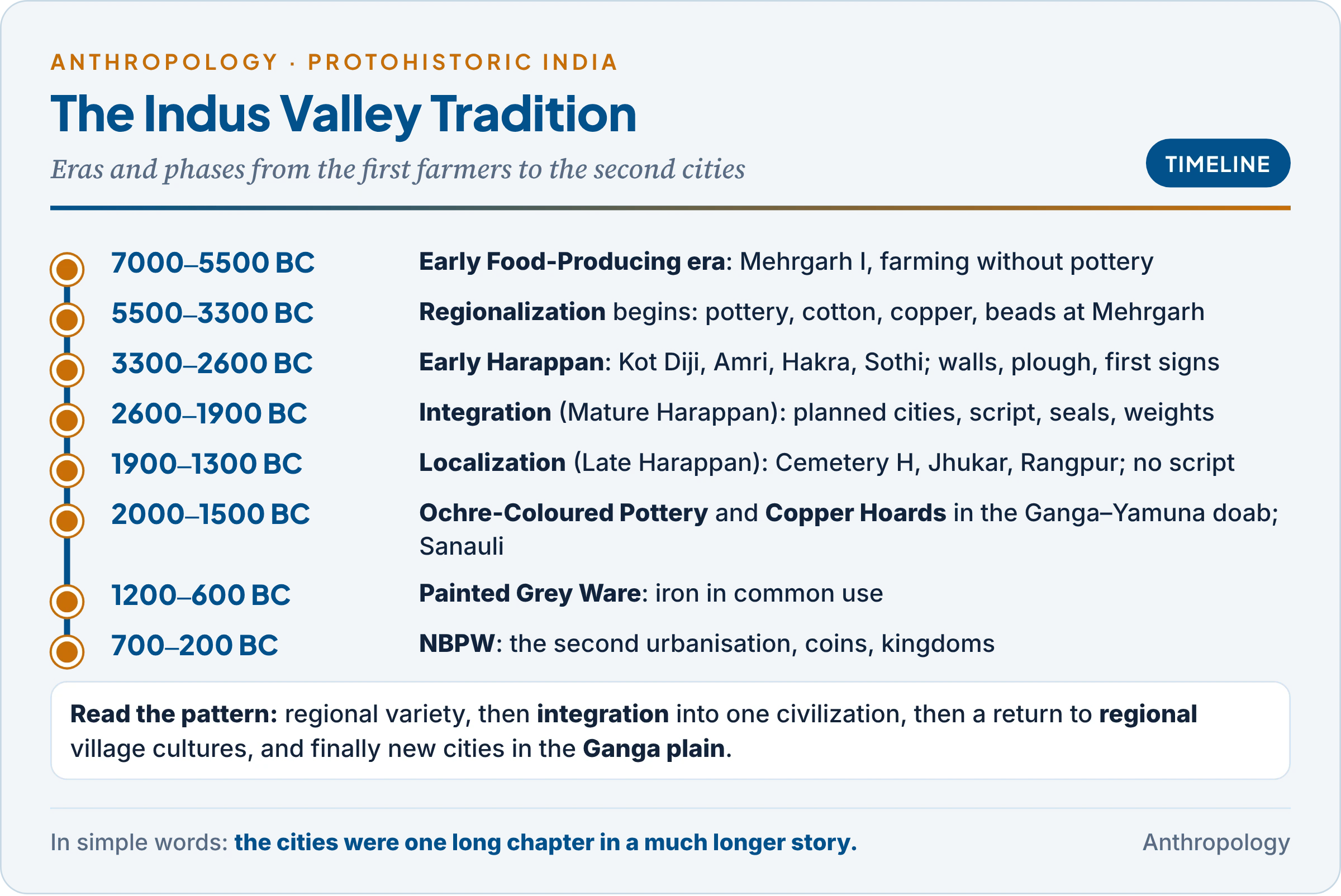
Archaeologists Jim Shaffer and Jonathan Mark Kenoyer divide the “Indus Valley Tradition” into eras; the Early, Mature and Late Harappan are its phases.
| Era | Date (approximate) | Content |
|---|---|---|
| Early Food-Producing | 7000–5500 BC | Mehrgarh I: aceramic farming |
| Regionalization | 5500–2600 BC | Ceramic Neolithic, then the Early Harappan regional cultures (3300–2600 BC) |
| Integration | 2600–1900 BC | Mature Harappan: cities, script, weights |
| Localization | 1900–1300 BC | Late Harappan regional cultures; cities abandoned |
2.2 The Early Harappan regional cultures
The table shows the main regional cultures and what each contributed to the later cities.
| Region | Sites and culture | What it anticipates |
|---|---|---|
| Baluchistan and Afghanistan | Mehrgarh III–VII, Damb Sadaat (Quetta), Mundigak, Nal, Balakot | Painted pottery, seals, copper, lapis lazuli trade with Central Asia |
| Sindh | Amri, Kot Diji (F.A. Khan, 1955–57) | Walls, wheel-made pottery; Kot Diji ware spread across the plains |
| Punjab and north-west | Harappa (Ravi and Kot Diji phases), Rehman Dheri, Sarai Khola | Planned walled town; graffiti like Indus signs; earliest Indus writing at Harappa (about 3300 BC) |
| Cholistan | About 40 Hakra ware sites; Ganweriwala | A settlement hierarchy with large towns |
| Ghaggar–Chautang | Sothi–Siswal culture: Kalibangan I, Banawali I, Rakhigarhi, Bhirrana | Plough, standard bricks, fortification |
| Gujarat | Anarta (north Gujarat), Padri, Dholavira I | Local pottery; shell and stone crafts |
Mehrgarh shows the whole climb in one place: aceramic farming (Period I), then pottery, cotton and copper (II–III), wheel-made painted pottery, seals and bead workshops (IV–VII), and finally the neighbouring Mature Harappan town of Nausharo.
The pattern is convergence: pottery, figurines, the horned deity motif and weights became alike across regions, while trade with Iran and Central Asia grew. Shaffer and D.A. Lichtenstein called the civilization a fusion of the Bagor, Hakra and Kot Diji traditions of the Ghaggar–Hakra borderland.
2.3 The origin debate
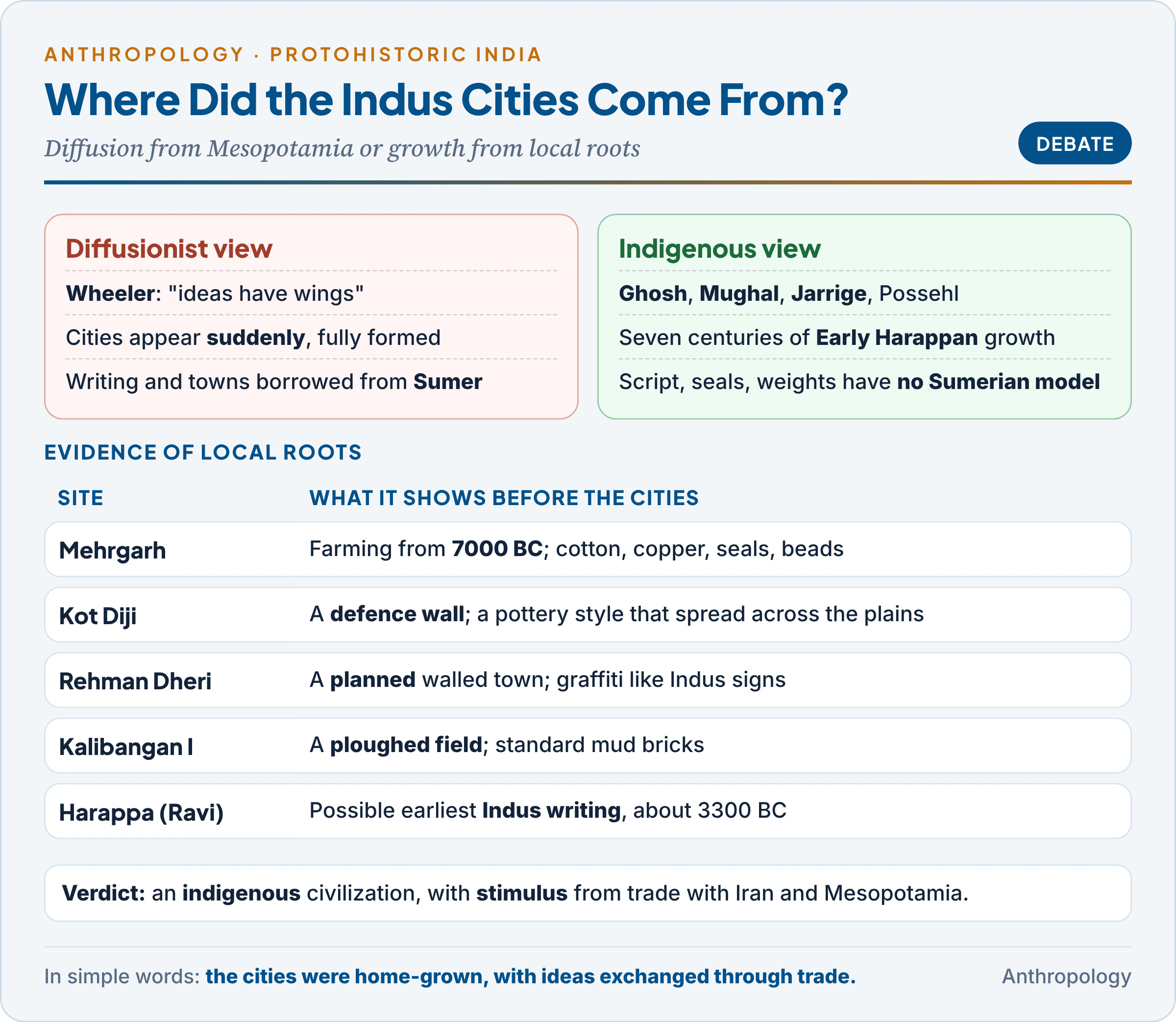
The question is whether the cities were planted from outside or grown at home. The two views are compared below.
| Diffusionist view | Indigenous (endogenous) view |
|---|---|
| Mortimer Wheeler: “ideas have wings”; the idea of the city came from Mesopotamia | Amalananda Ghosh (Sothi culture), M.R. Mughal (Early Harappan, 1970), Jean-François Jarrige (Mehrgarh), Walter Fairservis, Gregory Possehl |
| The civilization appears suddenly, already mature | Seven centuries of Early Harappan growth; a sequence from 7000 BC |
| Writing and cities were Sumerian inventions | Indus script and seals have no Sumerian model; distinct weights and town plans |
| Contacts with Iran and Mesopotamia | Contacts were trade, not colonisation |
The evidence now favours an indigenous origin, with stimulus from West Asian contact. The “sudden” appearance reflects a rapid integration about 2600 BC, perhaps through the rise of elites who controlled trade and craft, rather than an outside colony.
Why cities arose here. Four conditions came together: fertile floodplains of the Indus and Ghaggar that gave a surplus with the plough; varied neighbouring regions (hills with copper and stone, coasts with shell) that encouraged exchange; craft specialists and merchants who needed planned places to work and trade; and a shared ideology of order and purity that let many communities accept common rules.
Common confusion
Pre-Harappan or Early Harappan? The older term Pre-Harappan suggests cultures that were merely earlier. M.R. Mughal (1970) proposed Early Harappan because the same sites (Kot Diji, Kalibangan, Harappa) show a continuous development into the cities. Use “Early Harappan” for the formative phase of 3300–2600 BC, and “pre-Harappan” only for earlier Neolithic levels such as Mehrgarh I.
3. The Mature Harappan Civilization
In simple words
Between about 2600 and 1900 BC, cities with planned streets, drains, standard bricks and weights spread over a vast area of present-day Pakistan and north-west India. Farmers fed the cities, craftsmen made beads and seals, and merchants traded as far as Mesopotamia. The people wrote on small seals in a script nobody can read yet.
3.1 Discovery, extent and the Indian sites
- Discovery: Charles Masson described the ruins of Harappa (1842); Alexander Cunningham published the first seal (1875); Daya Ram Sahni excavated Harappa (1921) and R.D. Banerji Mohenjo-daro (1922) under John Marshall, who announced the civilization in 1924.
- Extent: from Sutkagen Dor on the Makran coast to Alamgirpur (Meerut), and from Manda (Jammu) to Daimabad (Maharashtra), with an outpost at Shortughai on the Oxus; over 1,500 sites, most of them in India along the Ghaggar–Hakra and in Gujarat. Because so many lie on the Ghaggar–Hakra, which some identify with the Vedic Sarasvati, the name “Sindhu–Sarasvati civilization” is also used; the identification is debated.
- Core cities in Pakistan: Mohenjo-daro (Sindh), the best preserved, with the citadel, Great Bath and grid-planned lower town; Harappa (Punjab), the type site, with its cemeteries and workshops; Chanhudaro, a bead and seal-making town without a citadel; and Ganweriwala in Cholistan.
The Indian sites matter because they show the eastern and southern halves of the civilization.
| Site (state) | Excavator | Significance |
|---|---|---|
| Rakhigarhi (Haryana) | Amarendra Nath; Vasant Shinde; ASI | Among the largest Harappan cities; Early to Mature levels; ancient DNA (§4) |
| Dholavira (Kutch, Gujarat) | R.S. Bisht (1990–2005) | Three-part city; stone reservoirs; signboard; UNESCO (2021) |
| Kalibangan (Rajasthan) | B.B. Lal, B.K. Thapar | Ploughed field; fire altars; script direction |
| Lothal (Gujarat) | S.R. Rao (1955–60) | Dockyard, warehouse, bead factory |
| Banawali (Haryana) | R.S. Bisht | Radial streets; plough model |
| Surkotada (Kutch) | J.P. Joshi | Stone fort; claimed horse bones (disputed) |
| Bhirrana, Farmana (Haryana) | ASI; Vasant Shinde | Hakra levels; large cemetery (Farmana) |
| Rupar, Alamgirpur | Y.D. Sharma | Northern and eastern limits |
3.2 Town planning and architecture
The planning is described with a diagram in Paper 1, Unit 1.8c; in short:
- Two-part plan: a raised walled citadel on the west and a larger lower town on the east; Dholavira adds a middle town, and Kalibangan and Surkotada wall both parts.
- Grid streets running north–south and east–west; Banawali is the exception with radial streets.
- Standard bricks in the ratio 1 : 2 : 4, burnt in the Indus cities and mud brick in Rajasthan.
- Sanitation: covered street drains with inspection holes, house bathrooms and soak pits; about 700 wells at Mohenjo-daro; reservoirs at Dholavira.
- Water at Dholavira: in a dry island of the Rann, the city caught monsoon run-off from two seasonal streams with dams and channels and stored it in a chain of stone-cut reservoirs, a rare Bronze Age feat of water harvesting.
- Public buildings: the Great Bath (about 12 × 7 m, 2.4 m deep, sealed with bitumen); large halls once called “granaries“, now often read as assembly or storage halls.
Why it matters: uniform bricks, drains and grids over a vast area imply shared rules and authority, yet no palace or temple dominates the city. Civic order rather than royal display is the Harappan signature.
3.3 The economic basis: crops, animals, crafts and trade
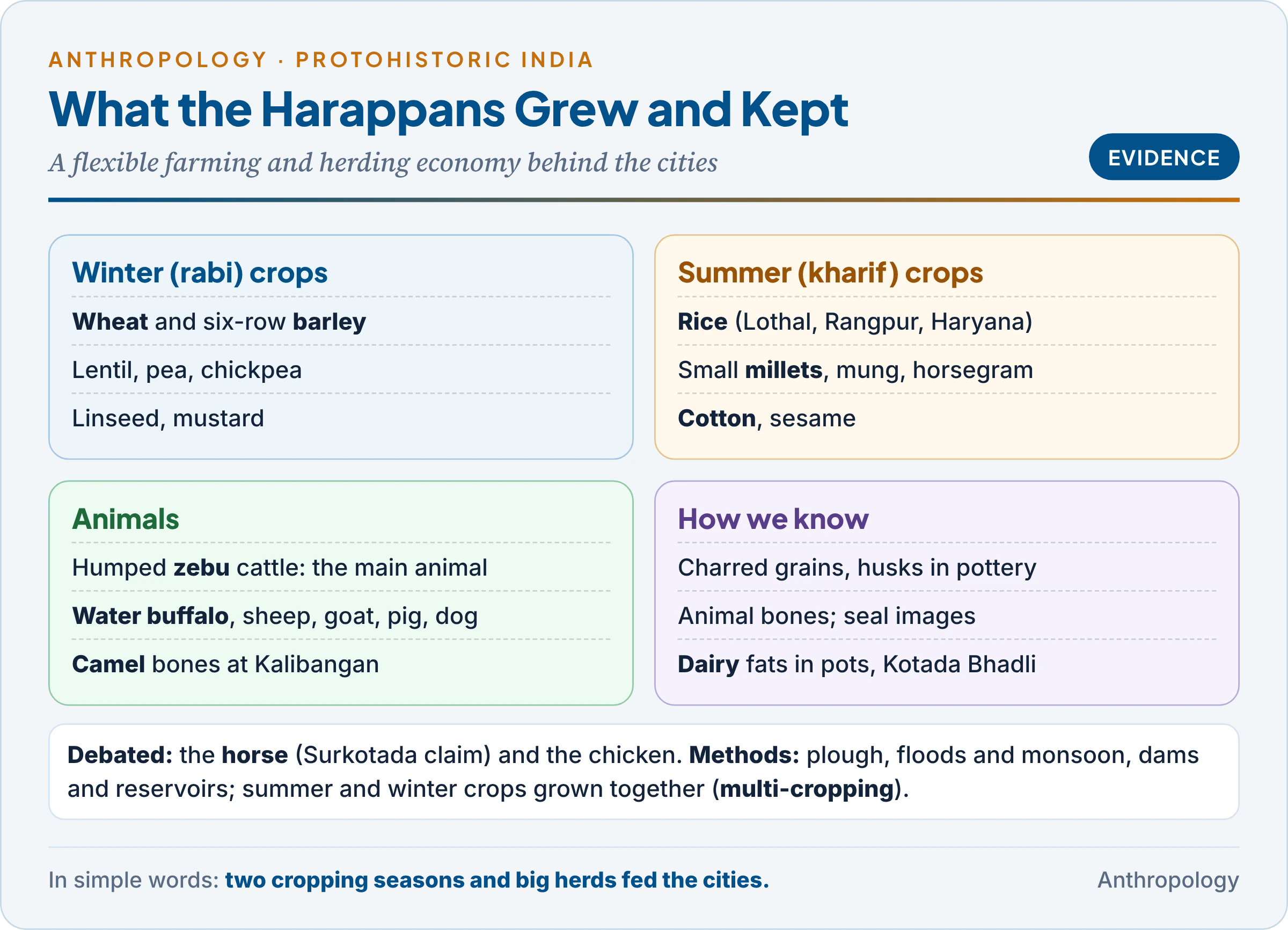
Agriculture was the base. Recent archaeobotany (study of plant remains) shows a flexible multi-cropping system rather than a wheat-and-barley economy alone.
| Category | Evidence |
|---|---|
| Winter (rabi) crops | Wheat (bread and club wheat), six-row barley, lentil, pea, chickpea, linseed, mustard |
| Summer (kharif) crops | Rice (Lothal, Rangpur husks; Haryana sites), small millets, mung, horsegram; sesame; cotton (the oldest in the world, from Mehrgarh) |
| Fruits | Dates, jujube, grapes |
| Animals | Humped zebu cattle (dominant), water buffalo, sheep, goat, pig, dog; camel bones at Kalibangan; wild deer and fish |
| Debated | The horse (claimed at Surkotada, disputed); the chicken |
- How they farmed: the plough (Kalibangan field, Banawali terracotta plough), floodwater and monsoon farming, dams (gabarbands) in Baluchistan and reservoirs at Dholavira; canal irrigation is not proved. Cameron Petrie and Jennifer Bates argue that summer and winter crops were grown together to cope with variable rains (2017).
- Dairying: lipid residues in pots from Kotada Bhadli (Kutch) give the earliest direct evidence of dairy processing in South Asia, from cattle and buffalo (Kalyan Sekhar Chakraborty and colleagues, 2020).
- Crafts and metals: bronze (copper with tin or arsenic), lost-wax casting, drilled carnelian beads (Chanhudaro, Lothal), shell bangles, faience; gold and silver ornaments.
- Weights: cubical chert weights, binary for small units (1, 2, 4 … 64) and decimal above (160, 320, 640), with the same standard across the whole area.
- Trade: internally, copper from Khetri (Rajasthan), shell and agate from Gujarat, lapis lazuli from Badakhshan via Shortughai; externally with Meluhha‘s partners in Mesopotamia (Paper 1, Unit 1.8c). There was no coinage; exchange was by barter or standard units.
- Imports and exports: in came gold (Karnataka), silver and tin (Afghanistan, Iran), lapis lazuli (Badakhshan) and turquoise (Iran and Central Asia); out went cotton cloth, carnelian beads, shell and ivory work, timber and grain. The cities thus depended on raw materials they did not have, which made trade a core activity rather than a luxury.
3.4 Gujarat: protohistory and international trade
Gujarat was the maritime and craft frontier of the civilization.
- Sequence: pre-Harappan Anarta pottery in north Gujarat; the Harappan in Kutch (Dholavira, Surkotada, Kanmer, Desalpur) and Saurashtra (Rangpur, Rojdi, Kuntasi, Gola Dhoro, Nageshwar, Lothal), many with a local “Sorath Harappan” pottery style (Possehl); then post-Harappan Lustrous Red Ware (Rangpur) and Prabhas cultures.
- Lothal: on the old Sabarmati–Bhogavo channel near the Gulf of Khambhat. Its brick basin (about 222 × 37 m) was called a dockyard by S.R. Rao; Lawrence Leshnik (1968) saw an irrigation tank. A 2024 study of satellite images and old channels (Ekta Gupta, V.N. Prabhakar and Vikrant Jain) links Lothal to a former Sabarmati course and supports the dockyard reading. Beside it stood a warehouse with about 70 sealings, a bead factory and a Persian Gulf seal.
- Trade links: carnelian and agate beads (from Khambhat sources), shell from the Gulf of Kutch, and cotton went west; Gujarat sites linked the Indus to Magan (Oman, where Harappan pots occur at Ras al-Jinz) and Dilmun (Bahrain, with Indus weights). Kuntasi and Gola Dhoro were craft-and-port centres.
- Significance: Gujarat shows how a peripheral region became the civilization’s gateway to the Arabian Sea, and how Harappan life continued there after the core cities declined.
3.5 Seals and the Indus script
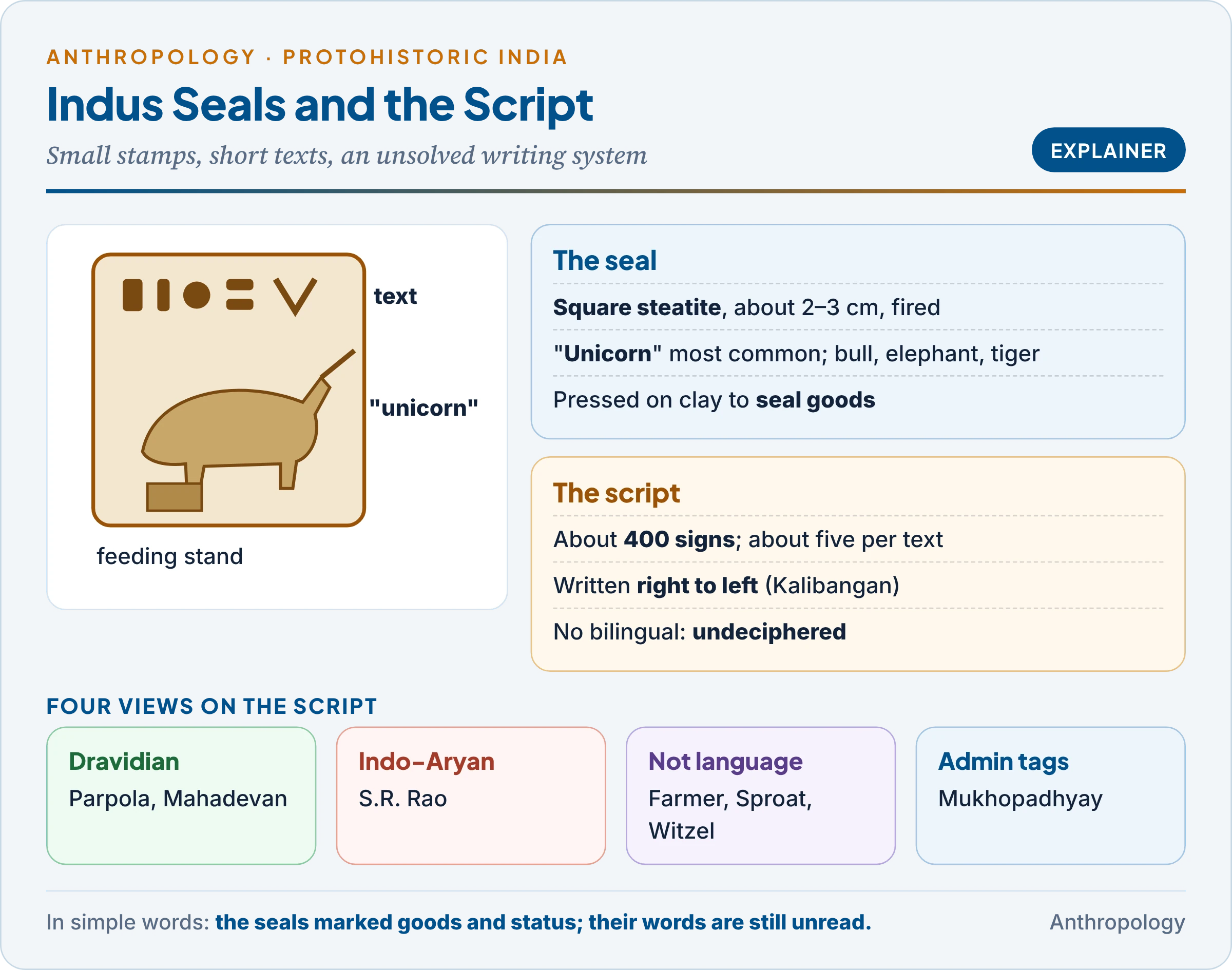
Seals are the hallmark object. They are mostly square steatite stamps, about 2–3 cm, with an animal (most often the “unicorn“, also the humped bull, elephant, rhinoceros, tiger) below a short inscription, and a pierced boss on the back. They were fired to harden them.
- Types: square seals with an animal and text (most common), rectangular seals with text only, rare cylinder seals (Kalibangan), and small inscribed copper tablets at Mohenjo-daro.
- Uses: pressed on clay to seal goods and doors (sealings at Lothal’s warehouse); marks of identity, office or clan; perhaps amulets. Indus seals at Ur, Susa and Kish and Gulf-type seals at Lothal show trade.
- The script: about 400 signs (Iravatham Mahadevan’s concordance, 1977), written mostly right to left (shown at Kalibangan by overlapping strokes), with an average of about five signs per text; the longest are short. Its short length and the lack of a bilingual inscription keep it undeciphered.
The views of scholars are compared below.
| View | Scholars | Argument and weakness |
|---|---|---|
| Proto-Dravidian | Asko Parpola, Iravatham Mahadevan | Fish sign read as mīn (“fish” and “star”); Dravidian survives in Brahui. Not proved by a reading |
| Indo-Aryan / Sanskrit | S.R. Rao (1982) and others | Sign values from later scripts. Conflicts with the absence of the horse and with the dating of Vedic Sanskrit |
| Not a language script | Steve Farmer, Richard Sproat, Michael Witzel (2004) | Texts too short; symbols like heraldry. Opposed by Rajesh Rao and colleagues (2009), whose statistics show language-like patterns |
| Administrative signs | Bahata Ansumali Mukhopadhyay (2019, 2023) | Signs mostly logographic (word-signs); seals and tablets were administrative tools for taxation, trade licensing and commodity control. A functional, not phonetic, reading |
In 2025 the Tamil Nadu government announced a US$1 million prize for an accepted decipherment, a sign of how open the question remains.
3.6 Religion and its continuities
The Harappans left no clear temples, so their religion is read from objects.
- Mother goddess: female terracotta figurines with fan-shaped headdresses; a seal from Harappa shows a plant growing from a woman, read as an earth or fertility goddess.
- The “Proto-Shiva”: a seated figure with a horned headdress among four wild animals, which John Marshall called Pashupati (“lord of beasts”) in a yogic posture. Doris Srinivasan and others warn that the horns may be a buffalo headdress and the posture is not certainly yogic.
- Other cults: pipal tree, humped bull and composite animals, cone and ring stones read as linga and yoni (some may be gaming pieces or architectural parts), fire altars at Kalibangan, Lothal and Banawali, and ritual bathing (Great Bath).
- Burial: extended burials with pots in cemeteries (Harappa R-37, Kalibangan, Farmana); paired male–female burials at Lothal.
Contributions to later Indian life. Beyond religion, the Harappans left a weight system based on 16 and its multiples, the potter’s wheel technique, the bullock cart and river boats, the courtyard house plan, attention to bathing and drains, and cotton cloth.
Continuity into later Hinduism. Shiva-like and goddess cults, tree and animal worship, ritual bathing, fire altars, the swastika, the namaste-like posture of figurines, bangles and sindur-like red pigment have all been traced into later Indian religion. The anthropological caution is that resemblance is not proof of descent; the links are strongest for domestic practice (bathing, ornaments, cattle) and weakest where later texts are read back into the seals.
3.7 What kind of society? State or no state
Anthropologists define the state as a society with a central authority that has a monopoly of force, territory, taxation and social classes (Paper 1, Unit 4). Theories of its origin include Karl Wittfogel‘s hydraulic theory (control of irrigation), Robert Carneiro‘s circumscription theory (war over scarce land), Elman Service‘s sequence of band, tribe, chiefdom and state, and Childe’s surplus and specialisation.
| View of Harappan society | Scholars | Evidence |
|---|---|---|
| Theocracy of priest-kings | Wheeler, Stuart Piggott | Citadels, Great Bath, the “priest-king” bust |
| Several city-states with competing elites | Kenoyer | Distinct seals and craft guilds; no single capital |
| A complex society without a state | Possehl (“complexity without the state”, 1998) | No palaces, royal tombs or war imagery; a shared ideology of purity and order |
| An early state | Shereen Ratnagar | Standard weights, planned works and trade need central control |
- Daily life: cotton and wool clothing (spindle whorls, needles), ornaments of gold, carnelian, shell and faience, bangles for women, bronze mirrors and combs; dice, marbles and toy carts with movable parts; music and dance (the “dancing girl”); a diet of cereals, pulses, dairy, meat and fish.
- Social reconstruction: stratification (large courtyard houses beside one-room dwellings), occupational specialisation that some compare to later endogamous craft groups, merchants and ritual specialists, and a peaceful record with few weapons. Hydraulic and warfare theories fit poorly, since there are no great canals or battle scenes; trade and ideology fit best.
4. The Harappans as People: Skeletons and Ancient DNA
In simple words
Bones from Harappan graves tell us how tall people were, what diseases they had and whether they died by violence. Older studies tried to sort the skulls into “races”, a method now abandoned. Today ancient DNA shows where the Harappans’ ancestors came from and how they relate to living South Asians.
- The cemeteries of undivided Punjab: Harappa‘s Cemetery R-37 (Mature Harappan; extended burials with pots) and Cemetery H (Late Harappan; extended burials below and pot burials of bones above, with painted urns); Rupar on the Sutlej; and in present Haryana, Farmana, Rakhigarhi and Sanauli (116 burials, 2005–06).
- Racial typology (now rejected): R.B. Seymour Sewell and B.S. Guha (1931) sorted Mohenjo-daro skulls into Proto-Australoid, Mediterranean, Alpine and Mongoloid types; the Anthropological Survey of India studied the Harappa series (P. Gupta, P.C. Dutta and A. Basu, 1962). Kenneth Kennedy, the American physical anthropologist, showed that these “types” are normal variation within one population, and that the skeletons show no break that an invasion would produce.
- What the bones say: Mature Harappan people were of moderate stature and fairly healthy, with dental caries rising with a starchy farming diet (John Lukacs; Brian Hemphill). Strontium isotopes in teeth suggest that some people buried in R-37 had grown up elsewhere, so the city drew migrants (Kenoyer and colleagues, 2013).
- The “massacre”: Wheeler’s unburied skeletons at Mohenjo-daro come from different levels and periods (George Dales, “The mythical massacre at Mohenjo-daro”, 1964).
- Health and violence: Gwen Robbins Schug and colleagues (2013) found that leprosy and tuberculosis and violent injuries rose at Harappa in the post-urban phase, most among people buried outside the cemetery: the decline had a biological cost, borne unequally.
- Ancient DNA from Rakhigarhi: the genome of a woman from the cemetery (Vasant Shinde, Vagheesh Narasimhan, Niraj Rai, David Reich and colleagues, Cell, 2019) combines ancestry related to early Iranian hunter-gatherers (separated before farming began) with ancient South Asian hunter-gatherer ancestry. It has no steppe (Yamnaya-related) and no Anatolian or Iranian farmer ancestry, and it matches eleven “Indus Periphery” individuals buried in Iran and Turkmenistan.
Why it matters: farming in South Asia grew locally or through spread of ideas, not by a mass migration of western farmers; steppe ancestry reached South Asia after the Mature Harappan; and the Harappan population is the largest ancestral source of most living South Asians.
5. The Decline: From Cities to Villages
In simple words
After about 1900 BC the big Indus cities were slowly abandoned. Writing, standard weights and seals went out of use, but people did not vanish: they moved east and south into smaller villages. Scholars now see a slow change caused by several pressures together, especially a drier climate and shifting rivers.
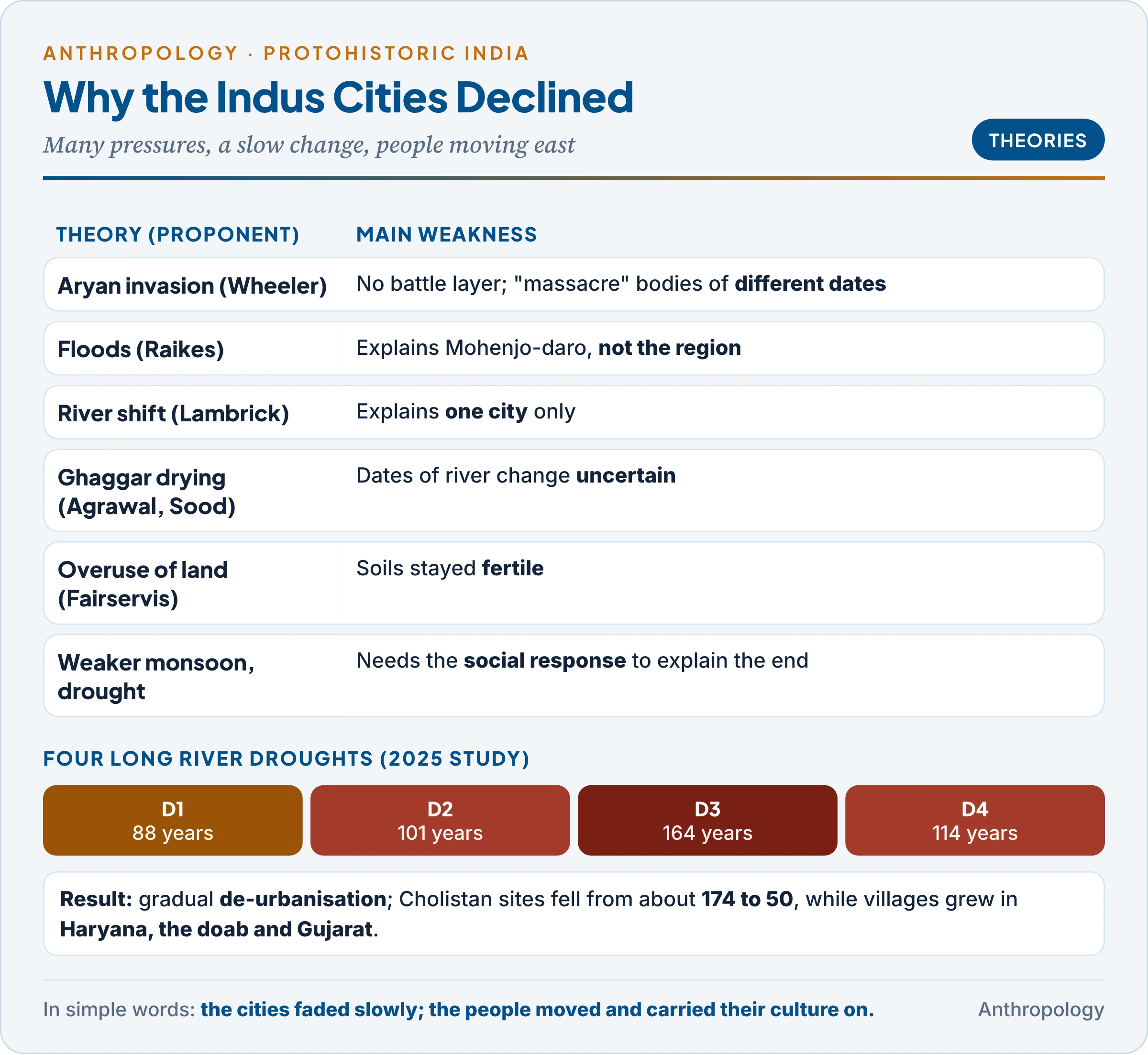
The evidence of decline: shoddy houses encroaching on streets at Mohenjo-daro, which shrank to a small settlement; the Great Bath and halls fell out of use; in Cholistan, settlements fell from about 174 Mature to about 50 Late Harappan sites, while sites multiplied in Haryana, the upper Doab and Gujarat.
The main theories are compared below, each with its weakness.
| Theory | Proponent | Weakness |
|---|---|---|
| Aryan invasion (“Indra stands accused”) | Mortimer Wheeler | No battle layer; skeletons of different dates (Dales); Aryans dated after the decline |
| Catastrophic floods from tectonic damming | R.L. Raikes | A dam would be breached quickly (Lambrick); explains Mohenjo-daro only |
| Shift of the Indus away from the city | H.T. Lambrick | Explains one city, not the whole region |
| Drying of the Ghaggar–Hakra by river capture and aridity | D.P. Agrawal and R.K. Sood | Dating of the river changes uncertain |
| Ecological overuse of land and wood | Walter Fairservis | Soils stayed fertile for later farmers |
| Collapse of Mesopotamian trade | Several | A consequence as much as a cause |
| Weaker monsoon and drought | Liviu Giosan and colleagues (2012); Hiren Solanki and colleagues (2025) | Climate pressure does not by itself explain the social response |
- New climate evidence: Solanki, Vimal Mishra and colleagues (Communications Earth & Environment, 2025) modelled four river droughts, each over 85 years, between about 4,450 and 3,400 years ago; the worst lasted about 164 years and cut rainfall by about 13%. Settlements first shifted closer to the Indus, then dispersed.
- Continuity after decline: in Gujarat, Haryana and the doab, villages kept Harappan crops, crafts and burial customs for centuries, so the decline was a change of scale more than an end of culture.
- Current view: a gradual de-urbanisation (loss of city life), not a collapse. Drier conditions, failing rivers and lost trade made large cities hard to sustain, and people moved east to the monsoon belt, carrying crafts and beliefs into later Indian life (§6, §3.6).
6. Post-Harappan Cultures
In simple words
After the cities, India was a land of regional farming cultures again. Some kept Harappan traditions in a simpler form; others in the Ganga–Yamuna plain made new pottery and copper tools. Iron came in during the second millennium BC, and by 600 BC new cities grew in the Ganga plain, while in the south people built great stone tombs.
6.1 The Late Harappan regional cultures
- Cemetery H culture (Punjab): new painted burial urns at Harappa, with peacocks carrying small human figures, read as souls of the dead.
- Jhukar (Sindh): Harappan pottery in a simplified form, new compartmented seals.
- Rangpur and Lustrous Red Ware (Saurashtra): continuity of Harappan crafts in Gujarat into the late second millennium BC; and the Late Harappan of Haryana and western U.P. (Bara, Alamgirpur, Hulas, Bhagwanpura, where it overlaps the Painted Grey Ware).
- Southward: Daimabad in the Deccan has a Late Harappan phase beneath the Malwa and Jorwe villages (see 1.1a).
6.2 Copper Hoards, Ochre-Coloured Pottery and Sanauli
- Copper Hoards: caches of pure-copper objects (anthropomorphs, harpoons, antenna-hilted swords, flat and shouldered celts) found since 1822 (Bithur) at about 90 places; the largest, at Gungeria (Madhya Pradesh), held 424 copper objects and 102 silver plates. Copper came from the Khetri belt or the Singhbhum region. Small anthropomorphs are still worshipped in places as village deities.
- Ochre-Coloured Pottery (OCP): a thick red pottery with an ochre wash that rubs off, found by B.B. Lal at Bisauli and Rajpur Parsu (1950); over 100 sites in the Ganga–Yamuna doab dated by luminescence to about 2000–1500 BC; copper harpoon with OCP at Saipai; rice, barley and gram at Atranjikhera.
- Sanauli (Baghpat, U.P.; S.K. Manjul, ASI, 2018): burials in wooden coffins with copper-sheathed lids, antenna swords, helmets, shields and three two-wheeled vehicles with copper-decorated wheels that the excavators call chariots, dated by radiocarbon to about 2000 BC and attributed to the OCP–Copper Hoard culture. They show a warrior elite in the doab while the Indus cities declined; whether horses or oxen drew the vehicles is unknown.
Common confusion
Are the Copper Hoards and the OCP one culture? Not simply. In the Ganga–Yamuna doab copper objects occur with OCP at Saipai and Sanauli, so there the two belong together. But Copper Hoards also occur in Bihar, Bengal, Odisha and Madhya Pradesh without OCP, so the term Copper Hoard names a type of find, while OCP names a pottery culture.
6.3 Black-and-Red Ware, Painted Grey Ware and the Iron Age in the Ganga plain
| Culture | Date (approximate) | Hallmarks |
|---|---|---|
| Black-and-Red Ware (BRW) | Mid-2nd millennium BC | Black inside, red outside from inverted firing; between OCP and PGW at Atranjikhera |
| Painted Grey Ware (PGW) | About 1200–600 BC | Thin grey ware painted black; over a thousand sites in Haryana, Punjab and the upper Ganga; Hastinapura, Ahichchhatra, Atranjikhera, Jakhera; first common iron |
| Northern Black Polished Ware (NBPW) | About 700–200 BC | Glossy luxury ware of the second urbanisation: fortified cities (Kaushambi), punch-marked coins |
- Iron in the Ganga region: iron arrowheads, spearheads, sickles and hoes in PGW levels; furnaces at Atranjikhera and Jodhpura; Rakesh Tewari reported iron from Malhar, Raja Nal-ka-Tila and Lahuradewa in the early second millennium BC, so iron-working in the middle Ganga may be older than once thought.
- Cultural impact: iron axes and ploughshares helped clear the Ganga forests and farm heavy soils, producing the surplus behind the janapadas, cities and states of the sixth century BC. This second urbanisation differed from the first: it was tied to kingdoms, coins, writing that can be read (Brahmi) and new religions (Buddhism, Jainism). B.B. Lal linked PGW sites with the Mahabharata and Later Vedic people; this remains a hypothesis.
6.4 The megaliths: South India and the North-East
A megalith (“large stone”) is a monument of big stones, usually for the dead (types and diagram in Paper 1, Unit 1.8c). The south Indian megaliths are an ancient Iron Age practice; those of the North-East are a living tradition. The comparison below sets them side by side.
| Feature | South Indian megaliths | North-East Indian megaliths |
|---|---|---|
| Date | Iron Age, about 1200 BC to the early centuries AD | Mostly recent centuries; still erected |
| Sites and peoples | Brahmagiri (Wheeler, 1947), Maski, Adichanallur, Porkalam, Junapani (Vidarbha) | Khasi and Jaintia hills (Nartiang), Naga (Angami, Ao), Karbi, Garo |
| Forms | Cists with port-holes, dolmens, cairn circles, urns, rock-cut caves and umbrella stones (Kerala) | Menhirs (upright stones), flat table stones, alignments, stone circles; carved wooden posts among the Naga |
| Purpose | Secondary burial of bones with iron tools, black-and-red ware and beads | Funerary and memorial stones (S.N. Rao): ancestors, feasts of merit, village founding (Garo), clan stones (Jaintia) |
| Interpretation | Early chiefdoms; possible Dravidian link; origin debated | Ethnographic study by J.H. Hutton and Christoph von Fürer-Haimendorf, who linked it to South-East Asian (Austroasiatic) traditions |
- Central India: Iron Age stone circles at Junapani and Mahurjhari (Vidarbha) parallel the south, while the Munda and Ho of Jharkhand still lay stone slabs (sasandiri, often a capstone on small supports) over the bones of the dead in the clan burial ground (sasan) and raise upright memorial stones (bid-diri, also written birdiri), as S.C. Roy recorded in The Mundas and Their Country (1912): a living link between ancient and modern practice.
- Khasi example: memorial stones (mawbynna) pair tall upright male stones (mawshynrang), standing for the clan’s men such as the maternal uncles, with flat female table stones (mawkynthei) for the clan ancestress. The bones themselves are gathered into the clan ossuary (mawbah) of the matrilineal clan, so the stones honour the mother’s line.
- Why the comparison matters: the living north-eastern practice lets anthropologists read the silent southern tombs (ethnoarchaeology, see 1.3): feasts, rank and ancestor cults may explain monuments that excavation alone cannot. Haimendorf argued that the two traditions are unconnected, the southern one Iron Age and Mediterranean-linked, the north-eastern South-East Asian.
Key Terms
| Term | Meaning in simple words |
|---|---|
| Protohistory | A period with writing that cannot be read, known mainly from archaeology |
| Civilization | A complex society with cities, specialists, writing and government |
| Primary civilization | One that grew from its own village base without a model |
| Early Harappan | The regional cultures of 3300–2600 BC before the cities |
| Integration era | The Mature Harappan phase of shared cities, script and weights |
| Localization era | The Late Harappan phase of regional village cultures |
| Citadel | The raised, walled western part of a Harappan town |
| Sealing | A clay lump impressed with a seal to secure goods |
| Meluhha | The Mesopotamian name for the Indus region |
| Archaeobotany | The study of ancient plant remains |
| Multi-cropping | Growing summer and winter crops in the same year |
| De-urbanisation | The slow loss of city life as people move to villages |
| Copper Hoard | A cache of copper tools and figures from the Ganga–Yamuna region |
| OCP | Ochre-Coloured Pottery of the doab, about 2000–1500 BC |
| PGW | Painted Grey Ware, the first common iron-using culture of the north |
| Megalith | A monument of large stones, usually for the dead |
| Ancient DNA | Genetic material recovered from old bones |
Contemporary Developments
- Indus droughts (2025): Hiren Solanki, Vimal Mishra and colleagues identified four river droughts of over 85 years each between about 4,450 and 3,400 years ago, linking them to the dispersal from the cities (Communications Earth & Environment).
- Lothal (2024): satellite and old-map study links Lothal to a former course of the Sabarmati and supports the dockyard interpretation (Journal of Archaeological Science).
- Indus script prize (2025): at the centenary of Marshall’s announcement, Tamil Nadu offered US$1 million for an accepted decipherment and set up a research chair named after Iravatham Mahadevan.
- Dholavira (2021): inscribed as India’s 40th UNESCO World Heritage Site, the first Harappan city in India on the list.
- Rakhigarhi: the 2019 genome study and continuing ASI excavations have made it the key site for Harappan biology and the eastern Harappan city.
Diagrams to Master
- Topic map: civilization, origins, cities, people, decline, post-Harappan.
- Phases: Regionalization → Integration → Localization, with OCP, PGW and NBPW after.
- Origin debate: diffusion vs indigenous, with Kalibangan, Kot Diji, Rehman Dheri and Mehrgarh.
- Crops and animals: rabi and kharif crops, zebu and buffalo, dairy, the doubtful horse.
- Seals and script: parts of a seal, right-to-left writing, four views.
- Decline: theories with weaknesses, the four droughts, the eastward shift.
Revision Grid
| Scholar | Work (year) | Key idea |
|---|---|---|
| John Marshall | Mohenjo-daro and the Indus Civilization (1931) | Announced the civilization; “Proto-Shiva” |
| V. Gordon Childe | “The Urban Revolution” (1950) | Ten criteria of civilization |
| Mortimer Wheeler | The Indus Civilization (1953) | Diffusion of the urban idea; Aryan invasion |
| George Dales | “The mythical massacre at Mohenjo-daro” (1964) | Rejected the invasion evidence |
| R.L. Raikes | Flood hypothesis (1960s) | Tectonic damming and floods |
| B.B. Lal and B.K. Thapar | Kalibangan (1961–69) | Ploughed field; fire altars; script direction |
| S.R. Rao | Lothal (1955–60) | Dockyard and port |
| R.S. Bisht | Dholavira (1990–2005) | Three-part city and water system |
| Asko Parpola | Deciphering the Indus Script (1994) | Proto-Dravidian reading |
| Gregory Possehl | The Indus Civilization (2002) | A complex society without a visible state |
| J.M. Kenoyer | Ancient Cities of the Indus Valley Civilization (1998) | Eras; city-states with competing elites |
| Kenneth Kennedy | Skeletal studies (1980s–2000) | No biological break; race typology rejected |
| Shinde, Reich and colleagues | Rakhigarhi genome (2019) | No steppe or farmer ancestry |
Previous Year Questions
Protohistoric India: the Indus civilization, pre-Harappan and post-Harappan cultures
- 2026What are the evidences available regarding crops and domesticated animals of Indus Valley Civilization? What are the views of the scholars regarding Indus script?
- 2025Write notes on: Lothal dockyard and international trade relations.
- 2024Critically describe evidences from Rakhi Garhi and its linkages to Harappan civilization.
- 2024Write notes on: Origin of State Societies.
- 2023“The Indus Valley was the first settlement of the big civilization.” Comment Critically.
- 2022Make a critical appraisal of Megalithic tradition in India with special reference to North-East India.
- 2022Describe briefly the proto-history of Gujarat. Discuss the significance of Gujarat proto-history in international trade.
- 2021Write short notes on “Harappan seals” in about 150 words.
- 2021Critically discuss the origin of Indus Valley Civilization. Mention the evidences of its endogenous origin from the pre-Harappan sites.
- 2019What kind of society may be reconstructed from the archaeological evidences of Harappan culture ?
- 2017Describe various aspects of trade and religion of Harappan civilization.
- 2016Give a detailed appraisal of skeletal remains from Chalcolithic culture of undivided Punjab.
- 2015Discuss the significance of Harappan Civilization sites from India.
- 2014Describe what is known of Harappan Religion. Have some of its elements continued into later Hinduism? Discuss.
- 2011Write a note in 150 words on Iron Age in Gangetic region.
- 2010Write a note in 150 words on Urban planning in Harappan culture.
- 2010Comment in detail on the socio-cultural life of the people of the Indus Valley Civilization.
- 2005Discuss the economic basis of Indus Civilisation. What were the factors of its decline ?
- 2003Write a note on Town planning in Indus cultures.
- 2000Write a note on Criteria of civilization.
- 2000Describe the geographical spread of Indus valley civilization. What were the causes of its decline ?
- 1999Critically examine various sources of India’s culture and civilization. Also distinguish between primary and secondary civilization.
- 1997Describe the distinguishing characteristic features of South Indian Megaliths and compare these with either Central Indian or North-eastern Indian Megaliths.
- 1994Write a note on Decline of the Indus Valley Civilization.
- 1991Discuss the nature of urbanization in the Indus Valley Civilization. What factors led to its decline ?
- 1990What are the important features of Indus Valley Civilization? Examine the conditions that may have led to urbanization in the Indian region.
- 1989Write a note on Indus Valley Civilization is regarded as the beginning of urban life of India. Discuss.
- 1988India’s protohistoric civilization is unique in the world. Discuss.
- 1982What are the main achievements of Indian civilization in the protohistoric period ?
- 1981Write a note on the economic bases of Indus civilization. (200 words).
Questions on the Stone Age and Chalcolithic cultures are in 1.1a; questions on tribal contributions, culture and civilization as concepts and traditional culture are in 1.1c.
Related questions from other units
- 2024Write notes on: Harappan maritime trade.
- 2023Write notes on: Prehistoric significance of Rakhigarhi.
- 2023Write notes on: Cultural impact of Iron Age.
- 2019Discuss with examples the Megalithic culture of India in the archaeological context.
- 2018Write a note in 150 words on Town Planning of Harappan Culture.
- 2013Bring out the distinguishing features of culture and civilization. (250 words).
- 2000Write a note on Copper-Bronze Age.
- 1983Civilization is a special development of culture. Elaborate.
More from Evolution of Indian Culture and Civilization: all notes of this unit · every PYQ of this unit · Anthropology Optional hub