

Anthropology Optional › Paper II › Unit 01: Evolution of Indian Culture and Civilization
1.1 Prehistoric (Paleolithic, Mesolithic, Neolithic and Neolithic-Chalcolithic) Protohistoric (Indus Civilization): PreHarappan, Harappan and postHarappan cultures. Contributions of tribal cultures to Indian civilization.
Official Syllabus: Paper II, Unit 1.1
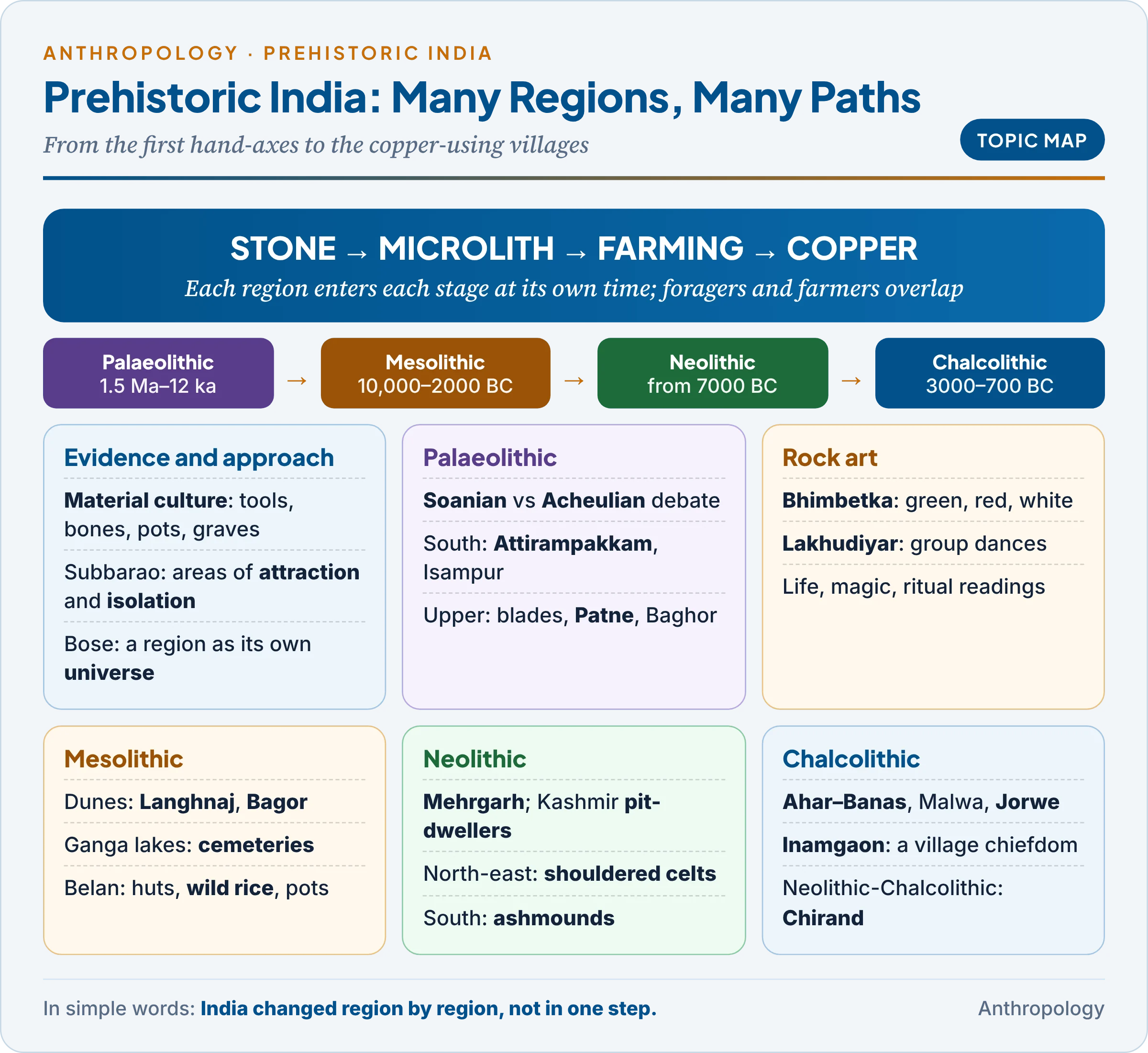
This article covers the prehistoric part of the syllabus line; the Indus civilization is in 1.1b and tribal contributions in 1.1c. The world framework of the Stone Age is in Paper 1, Units 1.8a–1.8c; here India is read as a set of regions with their own histories.
1. Studying Prehistoric India: Evidence, Sequence and Regions
In simple words
Prehistory is the long human past before writing. In India we know it from stone tools, bones, seeds, pottery, rock paintings and graves. These remains show that India did not climb one neat ladder of stages: regions moved from hunting to farming at different times, and hunters and farmers often lived side by side.
1.1 The evidence: material culture
Material culture means the physical things a society makes and uses: tools, houses, pots, ornaments, graves and art. For prehistory it is the only evidence.
- What it tells us: a stone tool shows technology (how it was made), economy (what it was used for) and contact (where its stone came from); a grave with ornaments shows belief in an afterlife and sometimes status.
- How it is read: through stratigraphy (the order of layers), typology (classifying objects by form), dating (Paper 1, Unit 1.8a) and the study of bones, seeds and sediments.
- Why anthropology matters: objects do not speak for themselves. Ethnoarchaeology, the study of living communities to learn how objects are made and used, helps read them: bored stones like Upper Palaeolithic ones are still used as net-sinkers by Yanadi fishermen of Andhra Pradesh (see 1.3).
1.2 The Indian sequence at a glance
The table gives the broad stages; notice how much they overlap.
| Stage | Indian dates (approximate) | Hallmark | Key Indian sites |
|---|---|---|---|
| Lower Palaeolithic | 1.5 million to 200,000 years ago | Hand-axes and cleavers; choppers | Attirampakkam, Isampur, Soan, Bhimbetka |
| Middle Palaeolithic | 385,000 to 40,000 years ago | Flake tools on prepared cores | Nevasa, Attirampakkam, Jwalapuram, Dhaba |
| Upper Palaeolithic | 45,000 to 12,000 years ago | Blades, burins, first art | Patne, Kurnool caves, Belan, Baghor |
| Mesolithic | 10,000 to 2000 BC (later in places) | Microliths; lake and dune camps | Bagor, Langhnaj, Sarai Nahar Rai, Damdama |
| Neolithic | 7000 BC (north-west) to 1st millennium BC (north-east) | Ground axes, farming, herding | Mehrgarh, Burzahom, Koldihwa, Utnur |
| Chalcolithic | 3000 to 700 BC | Copper with stone blades; painted pottery | Ahar, Gilund, Navdatoli, Inamgaon |
An Indian stage is a way of life, not a fixed date: the north-west farmed by 7000 BC while the north-east still foraged, and ways of life ran in parallel.
1.3 Why India does not fit the European ladder
- The ladder: John Lubbock, an English naturalist, coined “Palaeolithic” and “Neolithic” in Prehistoric Times (1865). The scheme assumes every region passes through the same stages in the same order.
- The Indian reality: B. Subbarao, an Indian archaeologist, divided the subcontinent in The Personality of India (1956) into areas of attraction (river plains that drew people and ideas), areas of relative isolation and areas of isolation (hills and forests where old ways lasted longest). This explains why foragers survived beside farmers.
- The anthropologist’s critique: N.K. Bose, the Indian anthropologist, excavated Stone Age sites at Kuliana (Mayurbhanj, Odisha) with Dharani Sen (1948) and treated the region as its own cultural universe, while V.D. Krishnaswami of the Archaeological Survey fitted finds from the Kortallayar valley into African and European stages. D.K. Bhattacharya, an Indian prehistorian, argued that change has many causes (subsistence, population, social complexity and ideology), so one environment can produce different cultures.
1.4 H.D. Sankalia and the pioneers
Robert Bruce Foote, a British geologist, found the first Palaeolithic tool in India at Pallavaram near Chennai (1863). H.D. Sankalia (1908–1989) of Deccan College, Pune, then made prehistory a field science.
- Discoveries: led the First Gujarat Prehistoric Expedition (1941–42), finding Langhnaj; identified a separate Middle Palaeolithic at Nevasa (1950s); found tools at Pahalgam in Kashmir; excavated about twenty sites, including Navdatoli, Ahar and Inamgaon.
- Method: read Godavari gravels as wet phases and silts as dry phases, and built laboratories of geomorphology, palaeobotany and archaeozoology, making Indian archaeology multidisciplinary.
- Writings: Prehistory and Protohistory of India and Pakistan (1963) and Born for Archaeology (1978); he trained three generations of archaeologists.
2. The Palaeolithic of India: A Regional Synthesis
In simple words
The Palaeolithic, or Old Stone Age, is the time when people lived only by hunting and gathering and made tools by chipping stone. India has tools from about 1.5 million years ago, but they differ by region because the stone, rivers and climate differed. Most sites have tools without bones or dates, so scholars still argue about how the regions fit together.
The techniques and general stages are in Paper 1, Unit 1.8b; this section reads the record region by region.
2.1 The north-west and sub-Himalaya: the Soanian
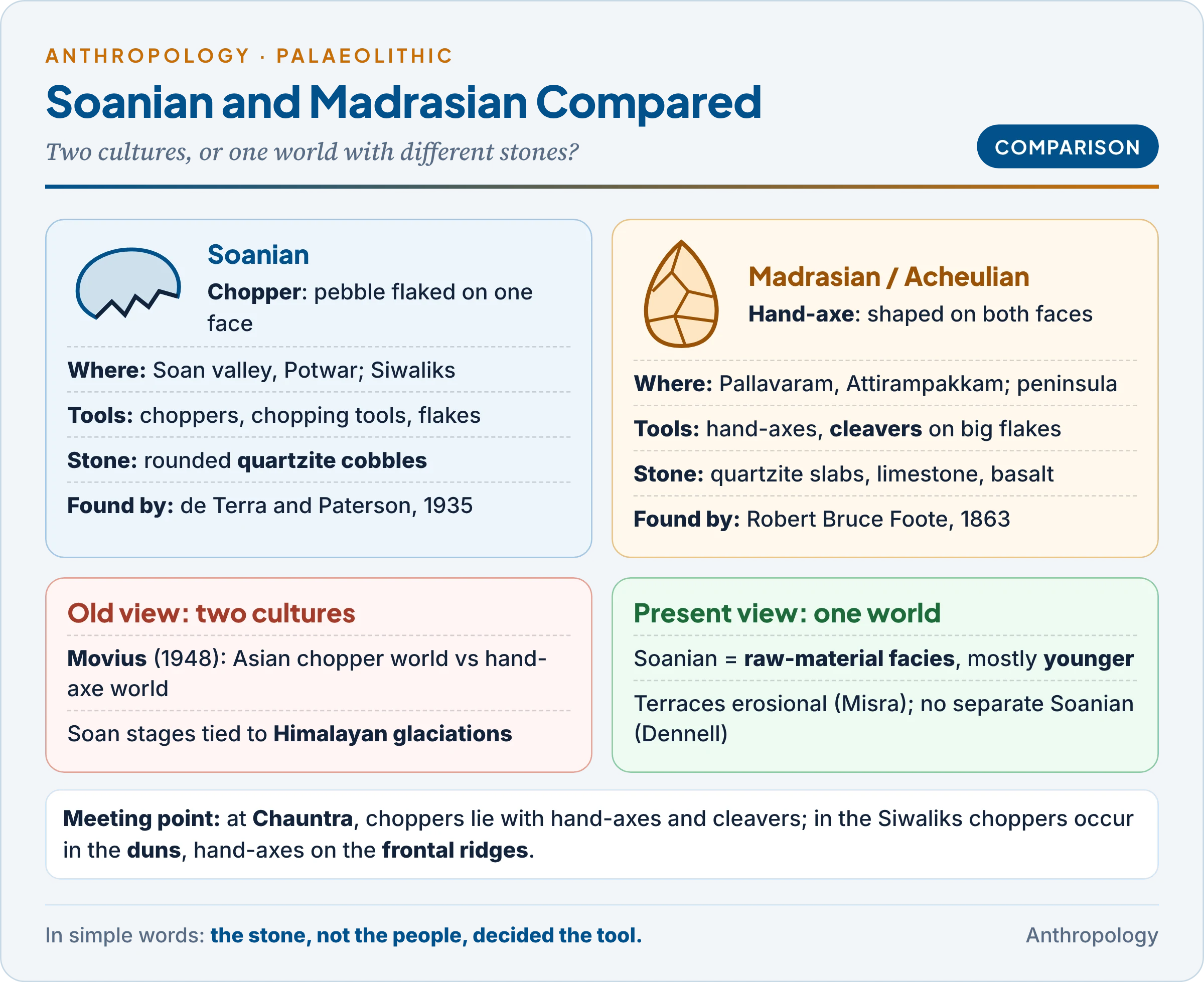
Example first. On the terraces of the Soan, an Indus tributary on the Potwar plateau (Pakistan), the Yale–Cambridge expedition of Helmut de Terra and T.T. Paterson (1935) found pebble choppers (flaked on one face) and chopping tools (flaked on both faces). At Chauntra, hand-axes and cleavers lay among the same pebble tools.
- The original scheme (report 1939): Pre-Soan (rolled flakes of doubtful human work), Early Soan (choppers, chopping tools), Late Soan A (refined pebble tools, Levallois flakes) and Late Soan B (flakes and blades; some texts add an “Evolved Soan”), each tied to a glacial stage.
- The two-culture idea: the American archaeologist Hallam Movius (1948) placed the Soanian in an Asian chopper-chopping tool complex (with the Anyathian of Burma, Choukoutienian of China and Patjitanian of Java), apart from the Acheulian hand-axe world. India seemed to hold two cultures: the Soanian north and the Madrasian (Acheulian) south.
- Why it collapsed: the British mission of Robin Dennell and Helen Rendell (1980s) found no independent Soanian; V.N. Misra (1989) showed the terraces are erosional and cannot date their tools; and most dated pebble-tool assemblages are younger than the Acheulian. The Soanian is now read as a raw-material and activity facies (a local variant): where rounded quartzite cobbles abound, people made choppers.
- Indian Siwaliks: in the Beas–Sutlej and Hoshiarpur–Chandigarh Siwaliks, G.C. Mohapatra (1976) found Soanian sites in the duns (inner valleys) and Acheulian sites on the frontal ridges.
- Kashmir: tools at Pahalgam in the Liddar valley (Sankalia) and at Pampore with broken elephant bone (see Contemporary Developments) show people inside the Himalaya by the Middle Pleistocene.
The table sets the two “traditions” side by side. The contrast was once read as one of peoples; it is now one of stone and task.
| Feature | Soanian (north-west) | Madrasian / Acheulian (peninsula) |
|---|---|---|
| Typical tools | Pebble choppers and chopping tools, flakes | Hand-axes and cleavers on large flakes |
| Raw material | Rounded quartzite cobbles | Quartzite slabs, limestone, basalt |
| Old view | A separate Asian tradition (Movius) | The African–European hand-axe tradition |
| Present view | A facies of the Acheulian world, mostly younger | The earliest dated occupation of India |
2.2 Peninsular and South India
- Attirampakkam (Kortallayar valley, Tamil Nadu): found by Foote in 1863, re-excavated by Shanti Pappu and colleagues. Hand-axes are dated by cosmogenic burial dating to about 1.5 million years (Science, 2011), and Levallois tools to 385,000–172,000 years (Nature, 2018). Why it matters: Acheulian makers reached India almost as early as they appear outside Africa, and the Middle Palaeolithic began here as early as in Africa.
- Hunsgi–Baichbal valleys (Karnataka; K. Paddayya): at Isampur, a quarry-workshop of limestone slabs, cores and half-made bifaces, dated by ESR to about 1.2 million years, shows the whole knapping process; Paddayya read the valley as a settlement system of seasonal camps.
- Kurnool caves (Andhra Pradesh): Muchchatla Chintamanu Gavi (M.L.K. Murty, 1970s) gave rare Upper Palaeolithic bone and antler tools. Renigunta has an early blade-and-burin industry. Jwalapuram has Middle Palaeolithic tools below and above the ash of the Toba eruption of about 74,000 years ago (Michael Petraglia and colleagues, 2007).
Significance: South India gives the earliest dates for humans in South Asia, shows long continuity (Lower to Middle Palaeolithic at Attirampakkam, Middle to Upper at Jwalapuram), and shows that raw material and landscape, not separate “races” of toolmakers, shaped the tools.
2.3 Central, western and eastern India
- Narmada valley: Hathnora gave the only hominin skull of its age in South Asia (see 1.2).
- Bhimbetka (Raisen, Madhya Pradesh; V.N. Misra and V.S. Wakankar): shelters used from the Acheulian to the microlithic. Misra’s late Acheulian stage (thin bifaces, many cleavers, Levallois) is best seen here, against an early stone-hammer stage with many choppers.
- Son and Belan valleys (G.R. Sharma; the American prehistorian J. Desmond Clark; J.N. Pal): a sequence from Acheulian to Mesolithic. At Dhaba, one Middle Palaeolithic industry lasts from 80,000 to 65,000 years, across the Toba ash (Chris Clarkson and colleagues, 2020).
- Thar margin: at Didwana (Singi Talav, the 16R dune), occupation came and went with wet monsoon phases.
- East: Kuliana (Odisha) and Sisunia (West Bengal): Acheulian and pebble tools on laterite gravels. Gaps: the Ganga plains (deep alluvium), Kerala and the west coast, and most of the North-East.
2.4 The Middle Palaeolithic: position, features and makers
- Position: in the Deccan rivers Sankalia found a lower gravel with Acheulian tools, a middle gravel with flake tools and a silt above with microliths. The flake industry sits between them, so he called it the Middle Stone Age (later “Middle Palaeolithic”).
- Features: after Parth Chauhan (2006): smaller tools, a shift from big bifaces to flake tools (scrapers, points, borers), more prepared-core working (Levallois, discoid) and fine-grained stone such as chert, jasper and chalcedony. Sankalia’s “Nevasian” was later shown by Sheila Mishra (1995) to include late Acheulian material.
- Distribution: Luni valley and Didwana; the Belan, Son and Narmada (Samnapur); the Godavari basin; the Eastern Ghats.
- Makers: unknown, since no fossil lies with the tools; some suggest early modern humans, others archaic humans. Neanderthals never lived in India.
Common confusion
Is the “Middle Stone Age” the Mesolithic? No. In Indian books after Sankalia, Middle Stone Age meant the flake industries between hand-axes and microliths, the Middle Palaeolithic. The Mesolithic is the microlithic stage of the Holocene. Some older texts translate “Mesolithic” as “Middle Stone Age”; read the tools, not the label.
2.5 The Upper Palaeolithic: distribution and features
The Upper Palaeolithic was recognised late in India because Indian sites lacked Europe’s bone tools and cave art. The table shows where it is known and what each region adds.
| Region | Sites | What the region shows |
|---|---|---|
| Belan and Son valleys | Chopani-Mando, Baghor I, Lohanda Nala | Blades and burins; a possible shrine |
| Upland Maharashtra | Patne (S.A. Sali) | Engraved ostrich eggshell, about 25,000 years old |
| Eastern Ghats | Renigunta, Kurnool caves | Backed blades; bone and antler tools |
| Central India | Bhimbetka, Mehtakheri | Blade industries; early microliths |
- Tools: parallel-sided blades from prismatic cores, burins (chisel-edged tools for bone and wood), backed blades (probably arrow inserts) and bored stones.
- Art and belief: Patne gives the earliest dated Indian art object. At Baghor I (Son valley), a circular platform held a natural triangular stone with concentric bands; the excavators (Jonathan Mark Kenoyer, J. Desmond Clark, J.N. Pal and G.R. Sharma, 1983) noted that local Kol and Baiga people still worship such stones as the Mother Goddess.
- Environment: wild buffalo, Bos namadicus and hippopotamus show grassland with forest; ostrich eggshells at over 40 sites (about 40,000–25,000 years) show a drier west.
- Microliths early: at Dhaba about 48,000 years and Mehtakheri about 45,000 years ago. Why it matters: in South Asia the microlith is an Upper Palaeolithic invention, perhaps marking modern humans.
2.6 What makes the Indian Palaeolithic distinctive
- Raw-material control: coarse quartzite dominates, and cleavers on large flakes are a regional hallmark.
- Mixed assemblages: pebble tools with hand-axes (Chauntra), Levallois within the late Acheulian, microliths within the Upper Palaeolithic; so the Indian Palaeolithic is neither chronologically nor culturally uniform.
- Few fossils and dates: acidic soils destroy bone, and many surface sites are assigned a stage by typology alone.
- Monsoon, not ice: occupation followed wet and dry monsoon phases; the old glacial and pluvial schemes are abandoned.
3. Prehistoric Rock Art of India
In simple words
Prehistoric people painted animals, hunts and dances on the walls of rock shelters. India has one of the world’s largest collections of such paintings, especially in the sandstone hills of central India. They record how hunter-gatherers lived and what they believed, and later layers show their contact with farming villages.
Example first. On a shelter wall at Bhimbetka, stick-like hunters with bows and barbed spears surround a huge red bison; nearby, people dance in a line holding hands and a man climbs a tree for honey: a hunter-gatherer world drawn by its own members.
3.1 Discovery and distribution
- Discovery: Archibald Carlleyle found painted shelters with microliths in the Kaimur hills of Mirzapur in 1867–68, about twelve years before the paintings of Altamira in Spain were found (1879). V.S. Wakankar found Bhimbetka in 1957.
- Main zones: the Vindhya, Satpura and Kaimur sandstones, the Chambal valley, the Kumaon hills, and the granite hills of Karnataka and Andhra Pradesh (Kupgal, Piklihal).
- Correction: Jogimara cave is in the Ramgarh hills of Surguja, Chhattisgarh, and its paintings are early historic, not prehistoric; Kupgal is in Karnataka, not Telangana.
3.2 Bhimbetka and the rock art of central India
- Site: about 750 shelters, over 400 painted, near Bhopal; a UNESCO World Heritage Site (2003), occupied from the Acheulian to historic times.
- Periods: after Wakankar and Yashodhar Mathpal, whose thesis (1978; book 1984) copied the paintings to scale:
| Period | Style and colours | Themes |
|---|---|---|
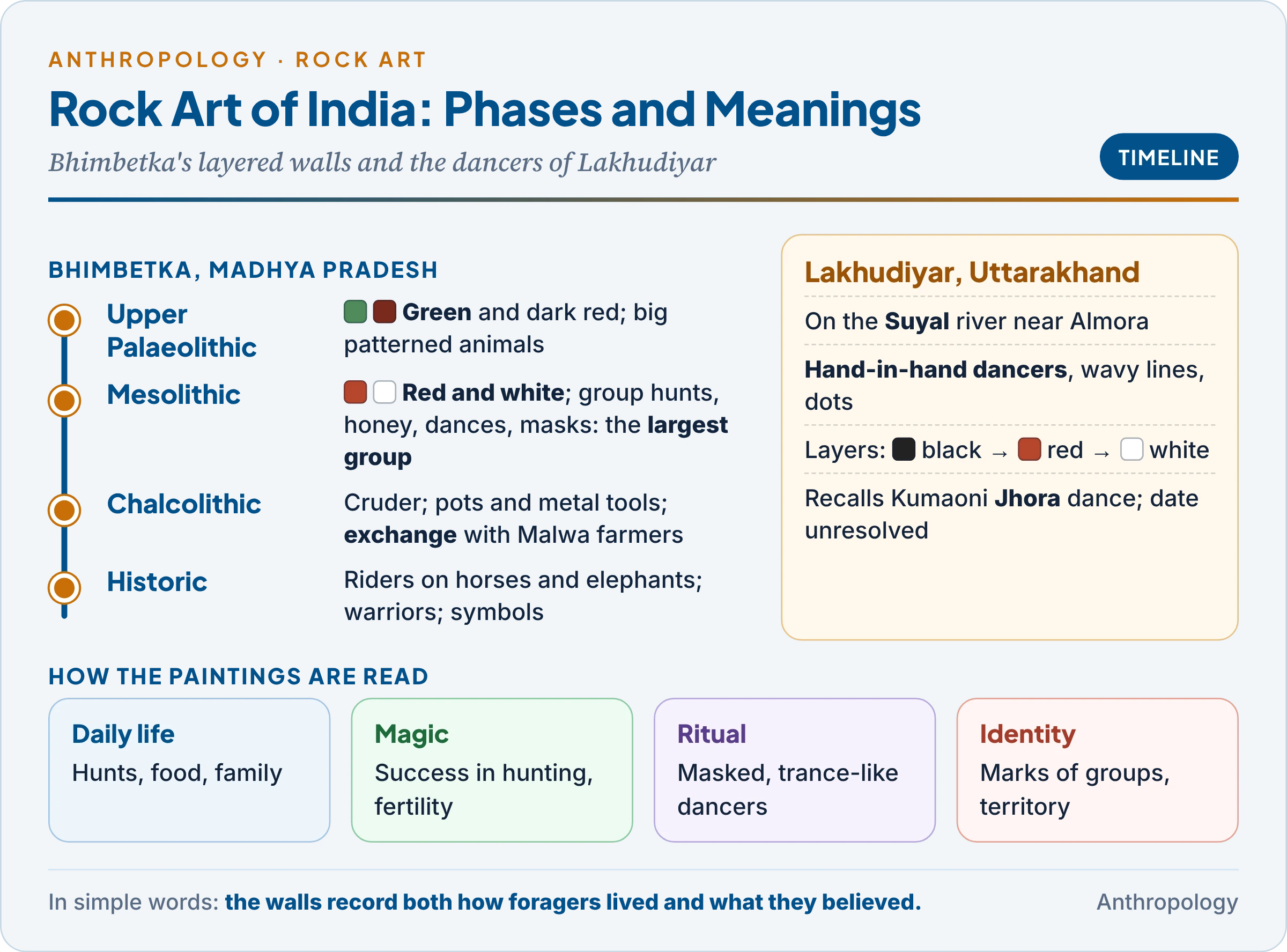
| Upper Palaeolithic | Linear figures in green and dark red (dating debated) | Large patterned animals; stick-like hunters and dancers |
| Mesolithic (largest group) | Small figures in red ochre and white; naturalistic animals, stylised humans | Group hunting, traps, honey collection, dances, masked figures, family scenes, burials |
| Chalcolithic | Similar but cruder; pots and metal tools appear | Exchange with farmers of the Malwa plateau |
| Historic | Red, white, yellow; schematic | Riders on horses and elephants, warriors |
- Pigments: red from haematite, white from limestone, green from a green rock; ground and mixed with water and perhaps animal fat or resin, applied with fibre brushes. Up to twenty layers overlap, so superimposition gives a relative sequence.
- Oldest claims: cupules (small hammered cups) in the Auditorium cave and at Daraki-Chattan (Chambal) are claimed by Robert Bednarik and Giriraj Kumar as the world’s oldest rock art; the claim is debated because cupules are hard to date.
3.3 Prehistoric rock art of Uttarakhand
- Lakhudiyar (“a lakh caves” in Kumaoni), on the Suyal river about 16 km from Almora on the Almora–Barechhina road, is the richest site: paintings in black, red and white of dancers holding hands, human and animal figures (a fox-like animal, a many-legged lizard), wavy lines and groups of dots. Superimposition runs black, then red, then white.
- Other sites: Lwethap, Phalsima and Petshal near Almora; Gwarkhya at Kimni (Chamoli); Hudoli (Uttarkashi).
- Date and meaning: the group dance dominates; some link the art to the megalith-builders of the first millennium BC, others place its earliest layers in the Mesolithic. The hand-in-hand dancers recall the Kumaoni Jhora and Chanchari circle dances, a continuity used cautiously to read the paintings.
3.4 What the paintings mean
Rock art is read as a record of daily life, as hunting and fertility magic, as ritual and shamanism (masked, trance-like dancers, as among the San of southern Africa) and as social markers of groups. Each has limits, so most scholars combine them; rock art remains the only direct window onto the ideas of Indian hunter-gatherers.
4. The Mesolithic of India: Regional Variation and the Road to Settlement
In simple words
The Mesolithic is the time after the last Ice Age when people still hunted and gathered but used tiny stone blades called microliths, set into arrows and sickles. In India, some Mesolithic groups lived for long periods beside lakes, buried their dead in their camps and began to keep a few animals. That is why the Mesolithic is seen as the bridge between wandering hunters and settled farmers.
Microliths are geometric (lunates, triangles) or non-geometric (blades, points), set in wood or bone as composite tools (tools of several parts).
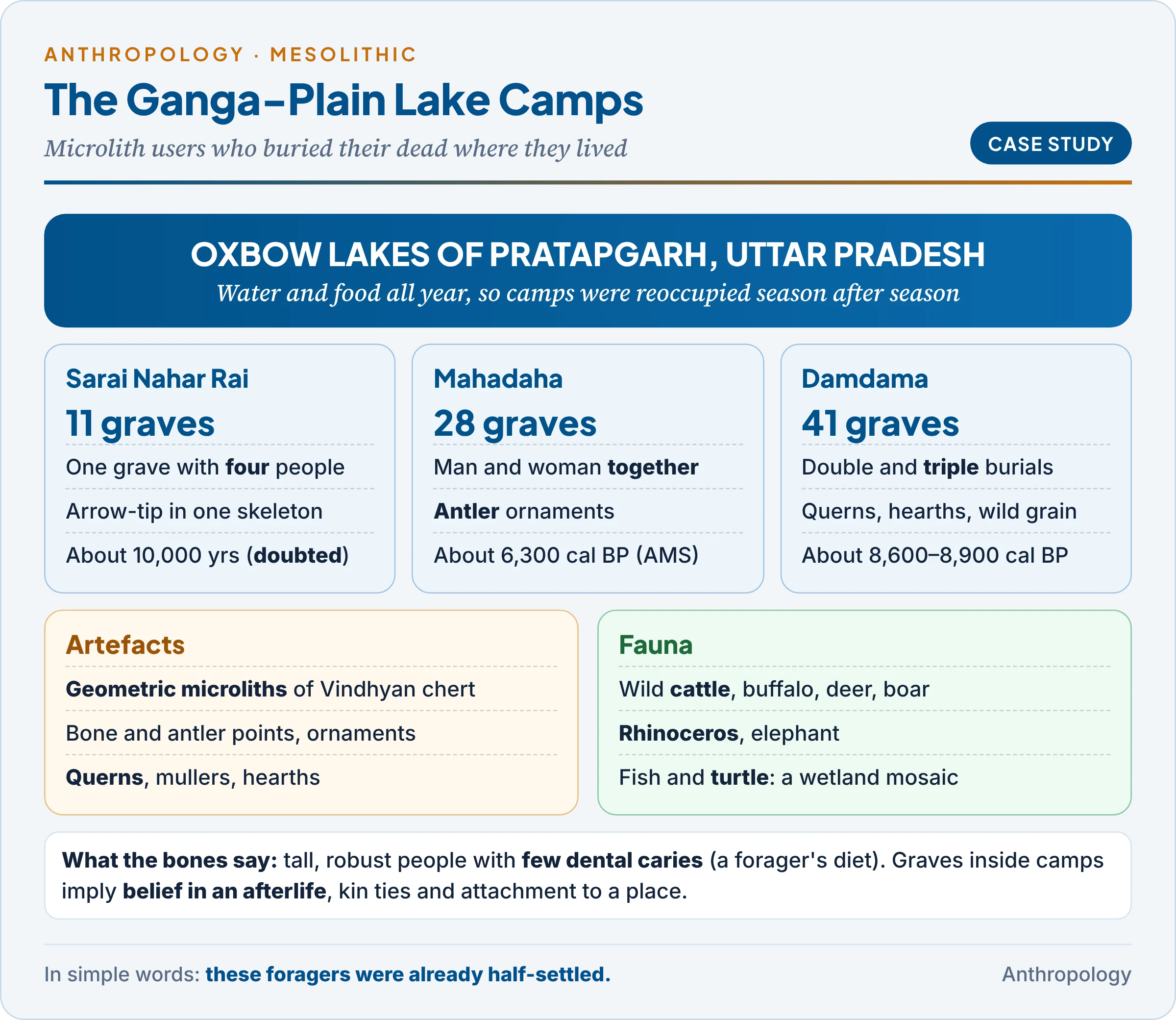
Example first. At Damdama, beside an old oxbow lake in Pratapgarh district, Uttar Pradesh, Allahabad University (1982–87) excavated 41 graves with about 46 skeletons, including double and triple burials, dug inside the camp among hearths, burnt bones, querns, microliths and bone tools. A people who buried their dead where they lived were already half-settled.
4.1 Regional variation
The Mesolithic took a different form in each environment.
| Region | Key sites (excavator) | Setting | Distinctive features |
|---|---|---|---|
| Western India | Langhnaj (Sankalia), Bagor (V.N. Misra) | Dunes by seasonal lakes | Wild game; sheep and goat at Bagor; flexed burials |
| Ganga plain | Sarai Nahar Rai, Mahadaha, Damdama (G.R. Sharma, J.N. Pal) | Oxbow lakes | Big game, fish, turtle; cemeteries in camps |
| Vindhya–Belan | Chopani-Mando (G.R. Sharma) | Shelters, terraces | Huts, wild rice, early pottery |
| Central India | Bhimbetka, Adamgarh (R.V. Joshi) | Sandstone shelters | Rock art; claimed domestic animals |
| Eastern India | Birbhanpur (B.B. Lal, 1957) | Damodar laterite | Quartz microliths; post-holes |
| South India | Teri sites (Zeuner and Bridget Allchin, 1956) | Red coastal dunes, Tirunelveli | Quartz microliths; coastal foraging |
Where water and food lasted all year (Ganga lakes, Rajasthan dunes), people stayed long, built floors and buried their dead; where they had to move, sites are small. Raw material also varied: chert and chalcedony in the west and centre, quartz in the south and east.
4.2 Western India: Langhnaj and Bagor
- Langhnaj (Mehsana, north Gujarat): a fossil sand dune by a seasonal lake, found by Sankalia’s expedition (1941–42).
- Tools and fauna: geometric microliths (many lunates); rhinoceros, boar, deer, nilgai, tortoise and fish.
- People: over a dozen mostly flexed skeletons, studied by Iravati Karve and later by Kenneth Kennedy (1965); some skulls show injuries.
- Phases and date: an aceramic (pottery-less) phase, then pottery and ground stones; dates around 2400–2200 BC. Why it matters: foragers lived here while farming villages flourished nearby, showing coexistence.
- Bagor (on the Kothari, Bhilwara; V.N. Misra, 1967–70): Phase I (about 5000–2800 BC) has stone-paved floors, microliths, and wild deer and boar beside sheep and goat; Phase II adds pottery and copper arrowheads; Phase III, iron. Foragers slowly borrowed herding, pottery and metal from neighbours.
4.3 The Ganga basin: artefacts, fauna and skeletons
The lake sites of Pratapgarh district give the richest human skeletal record of Mesolithic South Asia.
- Artefacts: geometric microliths of chert and chalcedony carried from the Vindhyas; bone and antler points; querns and mullers; hearths; bone and antler ornaments.
- Fauna: wild cattle and buffalo, deer, boar, rhinoceros, elephant, fish and turtle; charred wild grain at Damdama: a mosaic of wetland, grassland and forest around permanent lakes.
- Human skeletal remains: the table compares the three cemeteries.
| Site | Excavation | Burials | Notable finds | Date |
|---|---|---|---|---|
| Sarai Nahar Rai | 1971–73 | 11 graves, about 15 people; one with four | Head to the west; an arrow-tip in one skeleton | About 10,000 years (one date, doubted) |
| Mahadaha | 1978–79 | 28 graves, 30 people; man and woman together | Antler ornaments; butchering area | About 6,300 cal BP (AMS) |
| Damdama | 1982–87 | 41 graves, about 46 people; triple burial | Bone points, hearths, wild grain | About 8,600–8,900 cal BP (AMS) |
- What the bones say: the American physical anthropologists Kenneth Kennedy and John Lukacs, with J.N. Pal, found the people tall and robust, with few dental caries, as expected from a forager’s diet poor in cultivated starch.
- Why it matters: cemeteries inside camps, grave goods and joint burials imply belief in an afterlife, strong kin ties and attachment to a place.
4.4 The Vindhya–Belan valley
The Belan, a tributary of the Tons near Prayagraj, gives the most complete Stone Age sequence in one area, from Lower Palaeolithic to Neolithic (G.R. Sharma, 1970s).
- Chopani-Mando: from large flakes and blades, through an early Mesolithic, to an advanced Mesolithic with geometric microliths, beehive-shaped huts, common hearths, heavy anvils, ring-stones (perhaps digging-stick weights), hand-made cord-impressed pottery and husks of wild rice.
- Significance: it shows in one valley how hunters became semi-sedentary and then farmers (Koldihwa and Mahagara nearby); it shows pottery before farming; and the Kol of the region still collect wild rice and build similar huts.
- Correction: Chopani-Mando does not have “the earliest pottery in the world”; pottery in China (Xianrendong, about 20,000 years) and Japan (Jomon, about 16,000 years) is far older.
4.5 Was the Mesolithic the first step to settled life?
Older scholars called sites such as Langhnaj and Birbhanpur “Proto-Neolithic“: not yet farming, but on the way. The evidence points both ways.
| For a transition | Against a simple transition |
|---|---|
| Long stays: floors, hearths and cemeteries at the Ganga lakes and Bagor | Most groups stayed mobile; the Ganga sites were seasonal to semi-permanent |
| Wild rice and querns (Chopani-Mando, Damdama) | Gathering wild rice is not cultivation |
| Sheep and goat at Bagor, cattle at Adamgarh | Identifications are doubtful; animals may come by exchange |
| Pottery in late phases | Pottery can be borrowed from farmers |
The answer is regional. In the Belan valley and Ganga plain, Mesolithic people took the first steps to sedentism (living in one place) and plant use, and so fed into the Neolithic. In western India and the south, foragers coexisted with farmers and borrowed from them: a parallel way of life. Their ecological adaptation to the wetter early Holocene was broad-spectrum foraging, composite tools and seasonal moves.
5. The Neolithic of India: Many Roads to Farming
In simple words
The Neolithic, or New Stone Age, is when people began to grow crops, keep animals, live in villages and make polished stone axes and pottery. In India this did not happen once in one place. Each region began farming at its own time with its own crops, some borrowed from West Asia, some from South-East Asia and many domesticated at home.
The theories of why farming began are in Paper 1, Unit 1.8c; this section compares the Indian regions.
5.1 The “Neolithic Revolution” in India
- Definition: V. Gordon Childe, the Australian-born archaeologist, called the shift to food production a “revolution” (Man Makes Himself, 1936) because it changed population, property and society. The British prehistorian Miles Burkitt listed four traits: agriculture, domestic animals, ground and polished stone tools and pottery.
- The Indian evidence: the traits appear not together and not at once: Mehrgarh farmed for a millennium without pottery, Belan foragers made pottery before farming, and Kashmir’s first phase was aceramic and mostly hunting.
- Revolution or evolution? Revolutionary in its consequences (villages, surplus, inequality); slow and regional in its pace. Childe’s statement holds for the outcome, not the process.
5.2 The regional centres
The table compares the main regions; notice the direction of contact in the last column.
| Region | Key sites | Date (approximate) | Crops and animals | Hallmark and contacts |
|---|---|---|---|---|
| North-west | Mehrgarh (J.-F. Jarrige) | From 7000 BC | Barley, wheat; zebu, sheep, goat | Mud-brick granaries; West Asian crops |
| Kashmir | Burzahom, Gufkral | 2800–1700 BC | Wheat, barley, lentil; sheep, goat | Pit dwellings, bone tools; Central Asian, Chinese links |
| Vindhya–Belan | Koldihwa, Mahagara | Disputed | Rice; cattle, sheep, goat | Cattle pen; rice husk in pottery |
| Middle Ganga | Chirand, Senuwar; Lahuradewa | 2000–1500 BC (Lahuradewa claimed earlier) | Rice, wheat, barley, lentil | Bone and antler tools |
| East and North-east | Kuchai (Odisha); Daojali Hading, Sarutaru (Assam) | 2nd–1st millennium BC | Rice (assumed) | Shouldered celts, cord-marked pottery; South-East Asian links |
| South | Sanganakallu, Utnur, Kupgal, Budihal, Maski, Hallur, Nagarjunakonda | 2800–1200 BC | Horsegram, mung, millets; cattle | Ashmounds |
The north-west and Kashmir look west and north; the east and north-east look to South-East Asia and south China; the Ganga valley and the south built on local plants and cattle. India had several centres of food production.
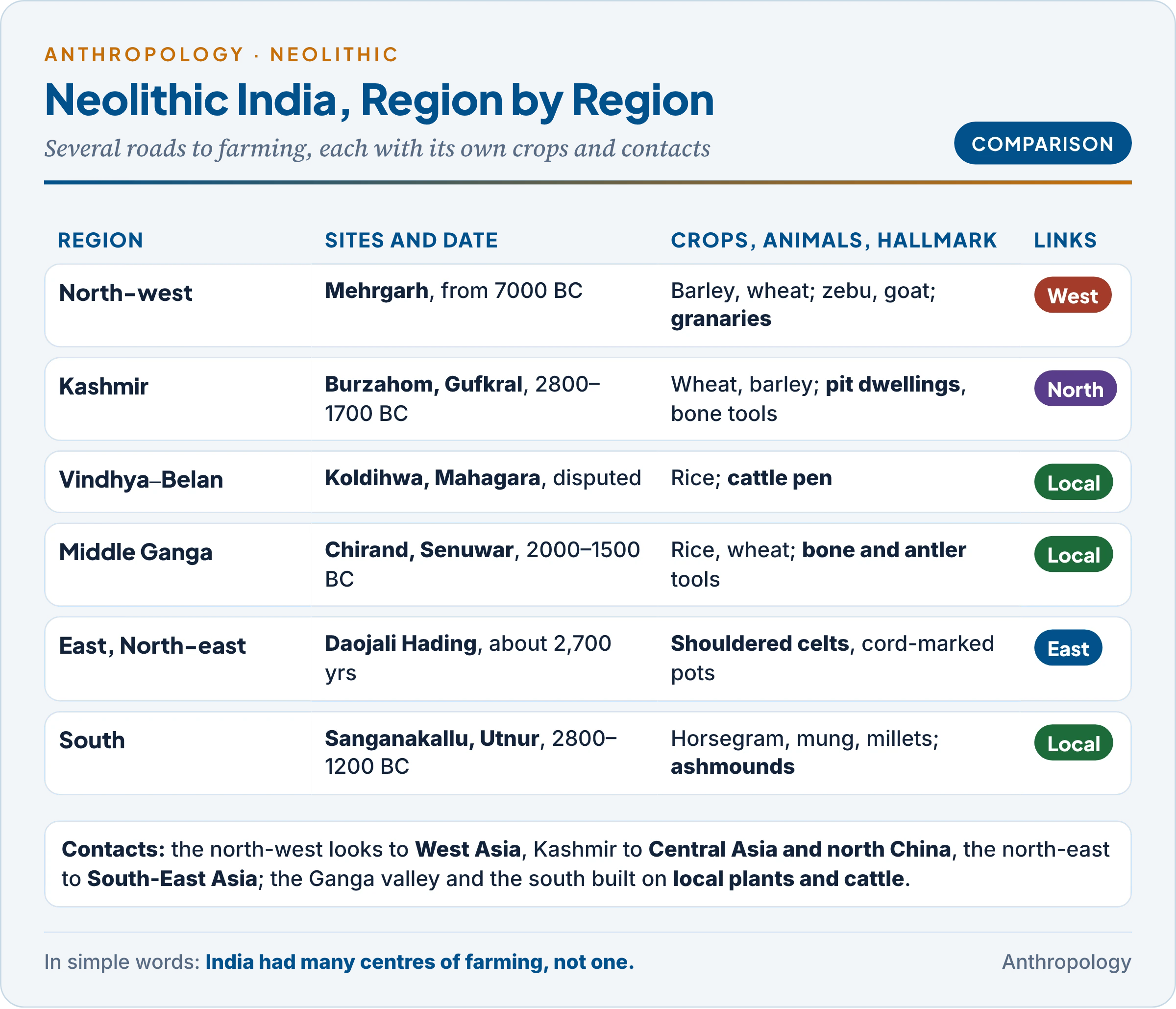
North-west. At Mehrgarh, at the foot of the Bolan Pass, Period I (about 7000–5500 BC) was aceramic, with mud-brick houses, granaries, six-row barley and wheat, and a shift from wild gazelle to domestic goat, sheep and zebu; shrinking zebu size points to local domestication. It leads into the Early Harappan (see 1.1b).
Kashmir: the pit-dwellers.
- Burzahom (near Srinagar; excavated by T.N. Khazanchi of the Archaeological Survey, 1960–71): aceramic and ceramic Neolithic, then Megalithic and early historic periods.
- Pit dwellings: round or oval pits dug into loess (wind-blown silt), narrow at the mouth and wide at the base, some about 4 m deep, with post-holes for a roof, steps and hearths. Why pits: warmth in the freezing Kashmir winter. Robin Coningham and T. Sutherland (1997) suggested some were storage pits, but hearths and tools inside support use as dwellings.
- Gufkral (A.K. Sharma, 1981–82): an aceramic Period IA (about 2800–2350 BC, calibrated) with pits, red-ochre floors, bone tools, wild animals and collected cereals; pottery in IB; farming and wool weaving by IC; menhirs and copper in Period II.
- Distinctive finds: bone tools; pierced stone harvesters and dog burials like those of north China; trepanned skulls (holes cut in the skull); a Kot Diji-type pot and carnelian beads from the Indus; parallels with Sarai Khola in Swat. Kashmir was a meeting ground of north China, Central Asia and the Indus.
Vindhya–Belan and the middle Ganga. Koldihwa and Mahagara gave rice husk in pottery and a cattle pen, but their very early dates are not accepted by most specialists. Lahuradewa (Rakesh Tewari) has rice dated to the 7th millennium BC, which the British archaeobotanist Dorian Fuller thinks may be wild. Chirand (Saran, Bihar; B.S. Verma) and Senuwar have mud floors, mixed crops and a fine bone and antler industry.
The North-East.
- Sites: the Pakistani archaeologist A.H. Dani (1960) divided the region into six zones (Cachar, Sadiya, Naga, Khasi and Garo hills, Brahmaputra valley). Daojali Hading (Dima Hasao, Assam; M.C. Goswami and T.C. Sharma, 1961–63) gave the first stratified Neolithic of the region: double-shouldered celts, cord-marked pottery, querns and tools of fossil wood. Others: Sarutaru (S.N. Rao), Garo hills, Napachik (Manipur), Chungliyimti (Nagaland).
- Date: OSL on Daojali Hading pottery gave 2,700 ± 300 years (Sukanya Sharma and Pankaj Singh, 2017): the north-eastern Neolithic is late, not 5000–2000 BC as once guessed.
- Origin: Sankalia looked to south-west China, Dani to Burma, T.C. Sharma to the Hoabinhian-rooted Neolithic of South-East Asia: all to an eastern source.
- Continuity: jhum (shifting cultivation) of the hill peoples has been read as a survival of Neolithic farming (S.K. Roy), but direct rice evidence is still lacking.
The South.
- Ashmounds: in the dry Bellary–Raichur region, beside hilltop villages, lie mounds of burnt cattle dung. Raymond Allchin, the British archaeologist who dug Utnur (1957), showed they were cattle pens whose dung was burnt periodically. Radiocarbon work by Dorian Fuller, Nicole Boivin and Ravi Korisettar (2007) shows each mound grew over a few generations and was often followed by a village, so the burning may have been a founding ritual.
- Crops: native horsegram, mung and small millets (browntop, bristly foxtail); wheat and barley came from the north in the early second millennium BC.
- Correction: ragi (finger millet, from East Africa) was not “one of the earliest crops”; early reports misidentified native millets.
- Society and art: a butchery floor at Budihal (K. Paddayya) suggests feasting; bruisings of humped cattle on the dolerite boulders of Kupgal, some of which ring when struck, link art, cattle and ritual (Boivin, 2004).
5.3 Neolithic tool typology and technology
Example first. To make an axe at Sanganakallu, a worker flaked a dolerite block into shape, pecked it all over with a hammerstone, ground it on a wet sandstone slab and finally polished it. Grinding grooves still mark rocks near many southern sites.
- Why these steps: pecking and grinding allowed tough, fine-grained rocks (dolerite, basalt; shale and fossil wood in the North-East) to be used; where stone was scarce, as in Kashmir and the Ganga valley, bone and antler took its place.
Most tools worked wood, because farmers cleared forest and built houses.
| Tool | Form | Use | Region |
|---|---|---|---|
| Celt / axe | Ground, edge across the long axis | Felling, clearing | All regions |
| Shouldered celt | Narrowed butt for hafting | Woodworking, hoeing | North-East, Odisha |
| Ring-stone | Perforated round stone | Digging-stick weight | Belan, Kashmir, south |
| Quern and muller | Slab with a rubber | Grinding grain | All farming sites |
| Harvester | Pierced rectangular knife | Cutting cereal ears | Kashmir |
5.4 Socio-cultural characteristics
- Settlement and economy: villages of round huts or mud-brick houses, cattle pens, mixed farming with hunting continuing, and storage that made surplus possible.
- Society and religion: kin-based villages with crafts (pottery, bone tools, weaving); grave goods and the Budihal feast hint at leaders but not classes; burials inside settlements and cattle-centred ritual; exchange of carnelian and lapis lazuli.
6. The Neolithic-Chalcolithic and Chalcolithic Cultures
In simple words
In the Chalcolithic, or Copper-Stone Age, farming villages began to use a little copper alongside stone blades. Outside the Indus cities these were the first large villages of central India, Rajasthan and the Deccan, with painted pottery, granaries and shrines. In the east and south, Neolithic villages simply added copper to their stone axes; this mixed stage is called Neolithic-Chalcolithic.
Common confusion
Neolithic-Chalcolithic or Chalcolithic? A Chalcolithic culture is a farming culture using copper with stone blades and its own painted pottery, such as Ahar, Malwa and Jorwe. A Neolithic-Chalcolithic culture is a Neolithic village tradition with ground axes that adds copper without a break, as at Chirand and Senuwar (Bihar), Pandu Rajar Dhibi (West Bengal) and the last phase of the Southern Neolithic.
6.1 The cultures outside the Harappan zone
Each is named after a type site and known by its painted pottery.
| Culture | Region and sites | Date (approximate) | Hallmarks |
|---|---|---|---|
| Ahar–Banas | Rajasthan: Ahar, Gilund, Balathal | 3000–1500 BC | White-painted black-and-red ware; copper smelting |
| Kayatha | Chambal: Kayatha (V.S. Wakankar) | Late 3rd millennium BC | Chocolate-slipped ware; copper axes |
| Malwa | Navdatoli, Eran, Nagda | 1700–1400 BC | Orange pottery painted black |
| Jorwe | Jorwe, Inamgaon, Daimabad, Nevasa, Chandoli | 1400–700 BC | Red ware painted black; urn burials |
| Eastern | Pandu Rajar Dhibi, Chirand II | 2nd millennium BC | Black-and-red ware; rice |
They share one way of life: village farming with cattle, sheep and goat, chalcedony blades with a little copper (largely from the Khetri belt), kiln-fired pottery, mother-goddess and bull cults, and child burials in urns under floors.
6.2 The Deccan Chalcolithic
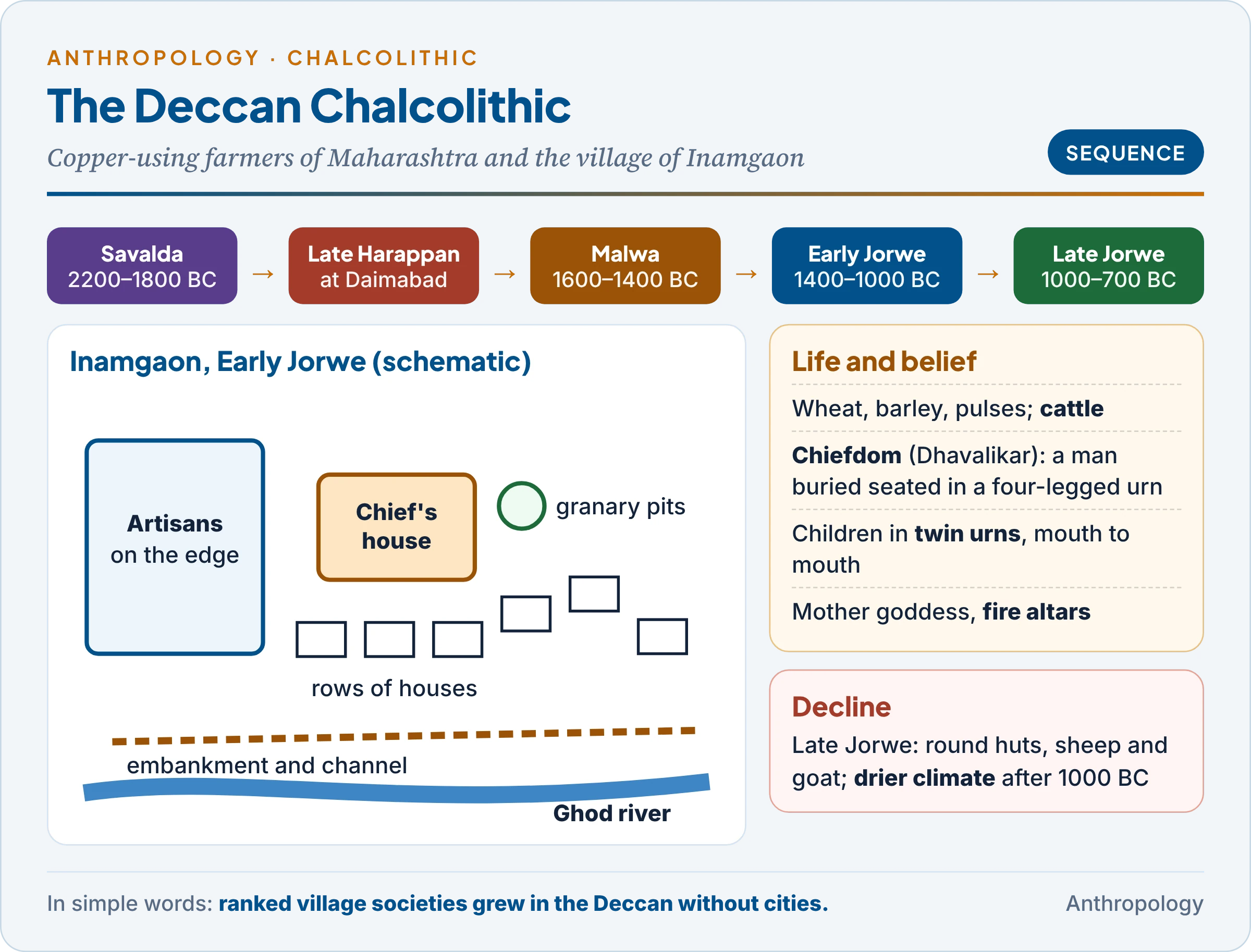
Example first. At Inamgaon, on the Ghod river about 89 km east of Pune, Deccan College (H.D. Sankalia, M.K. Dhavalikar and Z.D. Ansari, 1969–82) excavated about 134 houses and 266 burials. In the Early Jorwe phase a large house with grain pits stood at the centre, artisans lived on the edge, and an embankment and channel diverted floodwater to fields. In the central house a man was buried seated in a four-legged urn.
- Sequence: Savalda (about 2200–1800 BC), Late Harappan (at Daimabad), Malwa (1600–1400 BC), Early Jorwe (1400–1000 BC), Late Jorwe (1000–700 BC).
- Daimabad (S.A. Sali, 1976–79): the largest Jorwe village and the southernmost site with Harappan material; its four bronzes (an ox-drawn chariot, rhinoceros, elephant, buffalo), found in 1974, are of debated date.
- Society: a settlement hierarchy, craft quarters and public works; Dhavalikar read Inamgaon as a chiefdom, whose hereditary leader controlled the surplus.
- Religion and burial: mother-goddess and headless female figurines, fire altars and a bull cult; adults buried extended under floors with pots of food and water, children in twin urns mouth to mouth: belief in an afterlife.
- Decline: in the Late Jorwe most villages were abandoned; at Inamgaon houses shrank to round huts and sheep and goat replaced cattle, because of a drier climate after about 1000 BC.
6.3 Rajasthan and Malwa
- Ahar (Udaipur), Tambavati (“place of copper”), smelted local ore. At Gilund, a building of parallel mud-brick walls held a clay bin with most of the site’s 249 clay sealings (seal impressions), with designs paralleled at Indus sites and in Central Asia’s Bactria–Margiana complex: a non-literate village culture with stores under elite control (V. Shinde and G. Possehl).
- Balathal (V.N. Misra) was a fortified village; a skeleton of about 2000 BC shows the oldest known leprosy (Gwen Robbins and colleagues, 2009). Eran had a rampart and moat.
6.4 Significance of the Chalcolithic
- The base of rural India: mixed farming, cattle, craft specialists and village shrines continued into later villages.
- Neighbours of the Indus: they traded with the Harappans and carried on after the cities declined.
- Complexity without cities: Gilund’s sealings and Inamgaon’s chiefdom show ranking and public works before peninsular urbanisation.
The Copper Hoards and Ochre-Coloured Pottery of the Ganga–Yamuna doab belong to the post-Harappan horizon and are in 1.1b.
Key Terms
| Term | Meaning in simple words |
|---|---|
| Material culture | The physical things a society makes and uses |
| Soanian | Pebble-tool (chopper) industries of the Soan valley and Siwaliks |
| Madrasian | Older name for the Acheulian hand-axe industries of South India |
| Facies | A local variant of a culture caused by raw material or activity |
| Levallois | Shaping a core so that one flake of planned shape can be struck off |
| Burin | A chisel-edged stone tool for cutting bone and wood |
| Microlith | A tiny stone blade, 1–5 cm long, set into arrows and sickles |
| Sedentism | Living in one place for most or all of the year |
| Aceramic | Without pottery |
| Celt | A ground and polished stone axe or adze |
| Ashmound | A mound of burnt cattle dung at Southern Neolithic sites |
| Cupule | A small cup-shaped hollow hammered into rock |
| Chiefdom | A ranked society led by a hereditary chief who controls surplus |
Contemporary Developments
- Pampore, Kashmir (2024): a Palaeoloxodon elephant skull with 87 stone tools and humanly broken bone, about 300,000–400,000 years old, is the earliest Indian evidence of exploiting an elephant carcass (Ghulam Bhat, Advait Jukar and colleagues, Quaternary Science Reviews, 2024).
- Daojali Hading (2025): a new survey found a furnace and iron slag with celts and cord-marked pottery, confirming a settled village with early metal-working.
- Chennanur, Krishnagiri (2025): an OSL date of about 8450 BC for a microlithic layer shows some 10,000 years of occupation in Tamil Nadu.
- Attirampakkam (2018) and Dhaba (2020): Levallois tools by 385,000 years and an industry continuing across the Toba eruption have reshaped the Middle Palaeolithic.
Diagrams to Master
- Topic map: the six blocks from evidence to Chalcolithic.
- Soanian vs Madrasian: tools, raw material, Movius‘s view, facies view.
- Rock art phases: Bhimbetka’s periods and colours; Lakhudiyar dancers.
- Ganga-plain Mesolithic: three lake sites with graves and dates.
- Neolithic regions: sites, crops and direction of contact.
- Deccan Chalcolithic: Savalda → Jorwe, and the Inamgaon plan.
Revision Grid
| Scholar | Work (year) | Key idea |
|---|---|---|
| Robert Bruce Foote | Pallavaram hand-axe (1863) | Beginning of Indian prehistory |
| De Terra and Paterson | Studies on the Ice Age in India (1939) | Soan sequence tied to glaciations |
| N.K. Bose and D. Sen | Excavations in Mayurbhanj (1948) | A region as its own cultural universe |
| Hallam Movius | Two-culture hypothesis (1948) | Chopper-chopping tools vs hand-axes |
| B. Subbarao | The Personality of India (1956) | Areas of attraction and isolation |
| Raymond Allchin | Utnur (1957) | Ashmounds as burnt cattle pens |
| H.D. Sankalia | Prehistory and Protohistory of India and Pakistan (1963) | Middle Palaeolithic; multidisciplinary archaeology |
| A.H. Dani | Prehistory and Protohistory of Eastern India (1960) | Six zones of the north-eastern Neolithic |
| M.K. Dhavalikar | Inamgaon (1969–82) | A Chalcolithic chiefdom |
| Fuller, Boivin and Korisettar | Southern Neolithic dates (2007) | Native crops; ashmounds as founding rituals |
Previous Year Questions
Prehistoric India: Palaeolithic, Mesolithic, Neolithic and Neolithic-Chalcolithic cultures
- 2026Make a critical appraisal of the mesolithic culture of Ganga basin with reference to artifacts, faunal and human skeletal remains excavated from different sites.
- 2025Write notes on: ‘Soanian cultural’ tradition.
- 2025Describe the distinctive features and distribution of Upper Palaeolithic of India.
- 2024Describe the important Paleolithic sites from South India with suitable examples. What is the significance of South Indian Paleolithic cultures?
- 2023Write notes on: Material culture and archaeology.
- 2023Write notes on: Prehistoric rock arts from Uttarakhand.
- 2023Was Mesolithic culture the first step towards sedentary way of life? Illustrate your answer by citing suitable examples.
- 2022Write notes on: Pit-dwellers of Kashmir.
- 2021Give the distribution and characteristic features of Upper Paleolithic culture in India.
- 2020Discuss the characteristic features of ‘Neolithic culture’ in India.
- 2019Describe the Palaeolithic culture with special reference to Soanian tradition. Indicate the problems of describing the Indian Palaeolithic.
- 2019Write a note in 150 words on Distribution of Neolithic sites in India.
- 2018Examine the regional variations of mesolithic cultures of India.
- 2017Write a note in 150 words on Neolithic cultures of South India.
- 2017Describe the salient features of chalcolithic cultures of the Deccan.
- 2016Write a note in 150 words on Significance of Mesolithic findings from Belan Valley.
- 2015Write a note in 150 words on South Indian Paleoliths.
- 2015Write a note in 150 words on Prehistoric Rock Art of Central India.
- 2014Write a note in 150 words on Neolithic cultures of N-E India.
- 2013Write a note in 150 words : Discuss salient features of Mesolithic culture in India with special reference to western India.
- 2013Indian Paleolithic culture can neither be conceived chronologically homogeneous nor as a uniform cultural phase. Discuss. (250 words).
- 2013Discuss the contributions of H.D. Sankalia to prehistoric anthropology in India. (250 words).
- 2012Write a note in 150 words on Palaeolithic Art.
- 2012Compare the salient features and distribution of the Middle Palaeolithic and Upper Palaeolithic cultures in India. Add a note on the tool traditions of the Upper Palaeolithic period.
- 2011Describe the characteristic features of Mesolithic Cultures in India.
- 2011Discuss the significance of Sohan in Indian Prehistory.
- 2010Write a note in 150 words on Neolithic culture in India.
- 2010Examine Gordon Childe’s statement, “Neolithic culture is a revolution”.
- 2009Examine the contribution of Mesolithic culture to rise of Neolithic culture.
- 2008Write a note on ‘Langhnaj’
- 2007Write a note on Neolithic Culture.
- 2006Write a note on Burzahom.
- 2005Write a note on Mesolithic culture in India.
- 2004Write a note on Typo-technology of Indian Palaeolithic Culture.
- 2002Name a few Chalcolithic sites in India and describe their most salient features.
- 2001Write a note on Ecological adaptation during Mesolithic.
- 2001Critically examine evidence of Upper Paleolithic in India. Discuss its characteristics.
- 1999Write a note on Proto-Neolithic.
- 1998Describe the socio-cultural characteristics of the Neolithic period in India with suitable examples.
- 1997Write a note on Dating methods in Prehistory.
- 1996Write a note on Neolithic tool typology and technology of fabrication.
- 1996Discuss the cultural characteristics of Upper Palaeolithic period. Indicate its genesis and development in Indian context pointing to distribution and chronology.
- 1995Bring out the salient features of Lower Palaeolithic Culture complex in the Peninsular and extra Peninsular India.
- 1994Point out the salient features of Middle Palaeolithic industries and their makers. Illustrate your answer with examples from India.
- 1993To what extent could the Mesolithic culture be attributed to a phase of transition between Palaeolithic and Neolithic cultures? Illustrate the answer with apt. examples.
- 1992Describe the salient features of the Neolithic culture of the Indian subcontinent.
- 1989Discuss the stratigraphic and chronological position of the Middle Stone Age industries in India and describe their significant features.
- 1987Bring out the features which make the Indian palaeolithic complex distinctive.
- 1986What is meant by Neolithic Revolution ? What kind of evidence do we get about Neolithic revolution in india.
- 1985What are the main features of Mesolithic cultures in general ? What do you know about the origin and distribution of Mesolithic cultures in India ?
- 1984Write a note in 200 words : Neolithic revolution in India.
- 1984Place the Soan culture in the palaeolithic chronology in India and point out how it is distinguished from the Madrasian culture.
- 1983What are the important features of mesolithic phase of Indian prehistory ?
- 1982Examine the evidence of upper paleolithic cultures in different regions of India.
- 1981Write a note on Correlation between major environmental changes and cultural stages during pleitocene period in N.W. India. (200 words).
Related questions from other units
- 2026Give the distribution of Palaeolithic sites around the Himalayan and Sub-Himalayan areas, highlighting the typo-technologies of the tools.
- 2024Describe the evidences of food production and domestication of animals with special reference to Mehrgarh. Throw light on its significance.
- 2024Discuss the Acheulian and Oldowan traditions of Indian Paleolithic cultures with suitable illustrations.
- 2023Discuss the Paleolithic environment in light of available evidences with special reference to India.
- 2023Identify the major Mesolithic sites and describe the typo-technological features with special reference to India.
- 2022Write notes on: Mesolithic rock art in Indian subcontinent.
- 2022Discuss with suitable examples the typo-technological problems in Indian palaeolithic industry with reference to environmental hypotheses.
- 2022Enumerate the evidence of animal domestication in Indian microlithic industry.
- 2019Elucidate’ Mesolithic culture and associated rock art with examples from India.
- 2016Delineate the salient features of Chalcolithic cultures.
More from Evolution of Indian Culture and Civilization: all notes of this unit · every PYQ of this unit · Anthropology Optional hub