

Later Wittgenstein: Meaning and Use; Language-games; Critique of Private Language.
Official Syllabus: Paper I, Section A, Unit 8
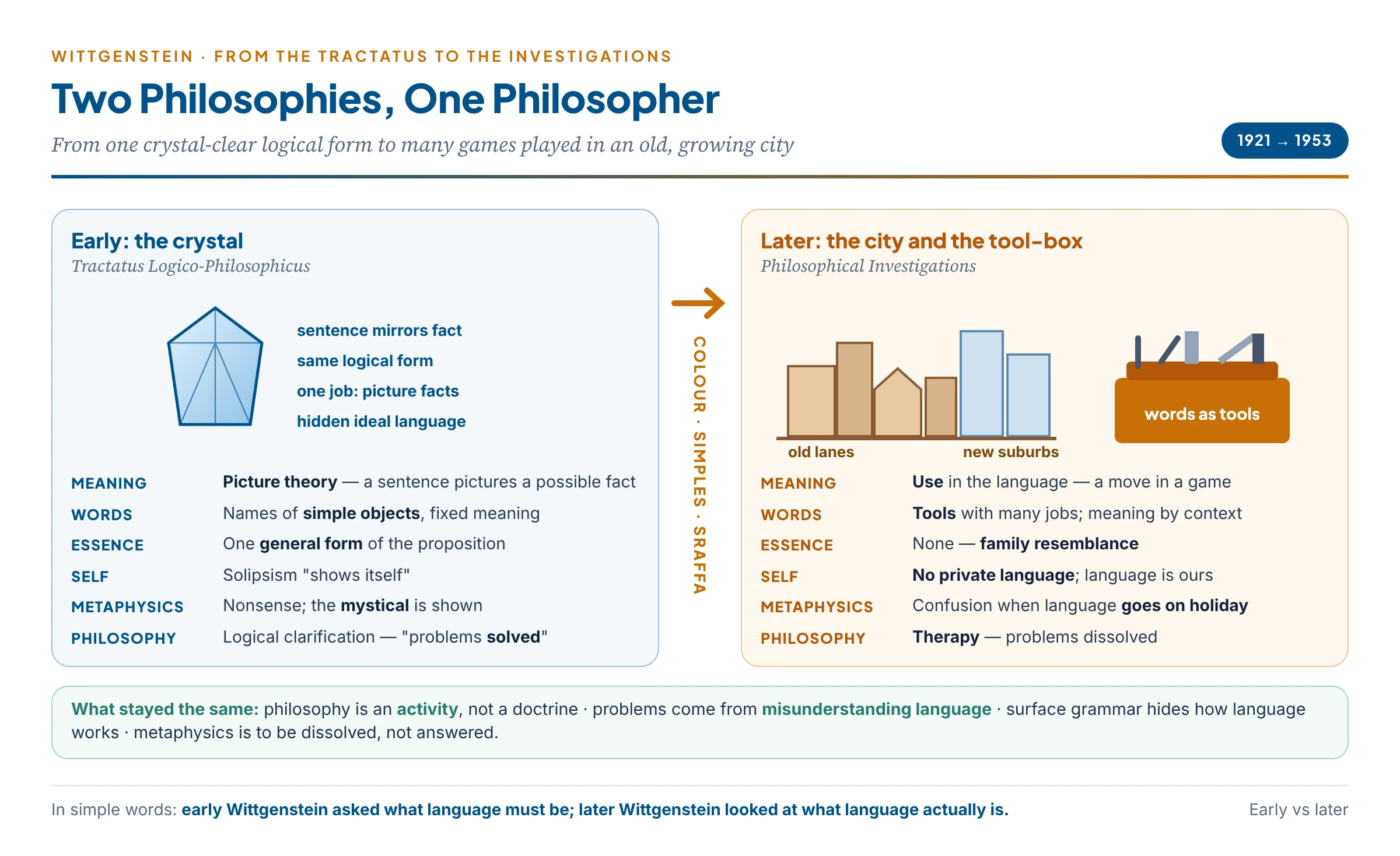
Ludwig Wittgenstein (1889–1951) is the rare thinker who created two great philosophies, and the second was largely a criticism of the first. The early Tractatus Logico-Philosophicus (1921) held that language has one essence — to picture facts — and a hidden, crystal-clear logical structure. The later Philosophical Investigations (1953) gave this up: “we should look not to an ideal language which derives its meaning from facts and has a precise logical structure but empirically, to the ways in which languages are actually used.” The move is from logical absolutism to pragmatic pluralism — from meaning as picturing to meaning as use, from one logical form to many language-games, and from philosophy as the discovery of logical structure to philosophy as therapy that dissolves confusions.
In simple words
Imagine an architect who first designs a perfect city on paper — every road straight, every house in a grid — and declares that every real city is just a messy copy of this ideal plan. Years later he walks through Old Delhi: winding galis, old havelis, new flyovers, all built for different needs at different times. He realises that the city works without fitting his plan, and that the plan was his demand, not the city’s nature. That is Wittgenstein’s journey from the Tractatus to the Investigations.
Context & Problem
A Life in Two Philosophies
- Early years. Born in Vienna in 1889 into one of the richest families in Europe, Wittgenstein studied engineering in Berlin and Manchester, became fascinated by the foundations of mathematics and logic, and went to Cambridge in 1911 to study with Bertrand Russell.
- The Tractatus. Written largely while he served as a soldier in the First World War, it was published in German in 1921 and in English in 1922. Its preface claimed that the problems of philosophy had, in essentials, been finally solved. Believing this, Wittgenstein left philosophy.
- The years away. He gave away his share of the family fortune; worked as a schoolteacher in rural Austrian villages (an unhappy period that ended amid complaints about his harshness towards pupils); worked as a gardener; and helped design a house for his sister in Vienna. He lived an austere, almost ascetic life of moral seriousness and self-criticism.
- The return. Discussions with members of the Vienna Circle, and growing doubts about the Tractatus, drew him back. In 1929 he returned to Cambridge, submitted the Tractatus as a doctoral thesis, and became a fellow of Trinity College. In the 1930s he dictated the Blue and Brown Books to his students, and in 1939 succeeded G. E. Moore as professor. During the Second World War he worked as a hospital porter in London. He resigned his chair in 1947 and spent his last years in Ireland and with friends, dying in Cambridge in 1951.
- The Investigations. His later work was published two years after his death (1953), edited by his students G. E. M. Anscombe and Rush Rhees. Other later writings (On Certainty, Zettel, Remarks on the Foundations of Mathematics) followed.
Why the Transition Matters
- Two movements from one man. The Tractatus inspired logical positivism; the Investigations inspired ordinary-language philosophy and reshaped philosophy of mind, language, mathematics, religion and the social sciences.
- Self-criticism. In the preface to the Investigations he wrote that he had been “forced to recognize grave mistakes” in his first book, and that the new thoughts could be seen in the right light only against the background of the old.
- The question. Why did he come to think his first philosophy was mistaken, and what replaced it?
Core Doctrine
1. The Early View in Brief
(For the full account, see the articles on the picture theory and saying and showing in Unit 06.)
- The world is the totality of facts, not of things; facts are built from atomic facts (states of affairs), which are arrangements of simple objects.
- Language mirrors the world: elementary propositions are made of names standing for simple objects, and an elementary proposition is a logical picture of a possible state of affairs.
- Picture and pictured share a logical form (isomorphism); that is how a sentence can be true or false of the world.
- Elementary propositions are independent of one another; all other propositions are truth-functions of them. There is one general form of the proposition.
- Logic is the hidden scaffolding of language and the world; tautologies say nothing.
- Only factual propositions have sense. Ethics, aesthetics, religion and metaphysics cannot be said — they can only be shown. “Whereof one cannot speak, thereof one must be silent.“
- Philosophy is not a body of doctrine but an activity of logical clarification. Even the Tractatus‘s own sentences are a ladder to be thrown away after climbing.
- Solipsism: “the limits of my language mean the limits of my world“; what the solipsist means is correct, but cannot be said.
2. Why Wittgenstein Changed His Mind
The 2023 and 2017 papers asked for the reasons behind the shift from the picture theory to the use theory. They can be grouped into logical, linguistic and philosophical reasons.
(a) Logical cracks in the Tractatus.
- The colour-exclusion problem. “This spot is red” and “This spot is blue” cannot both be true at the same time. If they were elementary propositions, they would have to be independent — yet they exclude each other. Wittgenstein first tried to analyse them further, then (around 1929) accepted that elementary propositions are not independent. With that, the whole system of truth-functions built on independent atoms began to unravel.
- No absolute simples. The Tractatus needed simple objects named by simple names. But “What are the simple constituent parts of a chair? — The bits of wood of which it is made? Or the molecules, or the atoms?” “Simple” and “composite” have meaning only relative to a purpose and context; it makes no sense to speak of the absolutely simple parts of anything.
- Logic does not apply itself. The Tractatus treated logical form as something that, once grasped, fixes meaning and inference mechanically. Reflection on rules showed that no formula or form determines its own application; application rests on practice.
(b) The discovery of the variety of language.
- Language has countless uses. The picture theory fits only fact-stating sentences. Ordering, asking, thanking, greeting, cursing, joking and praying picture no facts, yet are meaningful. “Language is the picture of reality” is true only in certain contexts.
- Most words are not names. Words are tools with different jobs (the tool-box); naming is only one job.
- Sraffa’s gesture. The Italian economist Piero Sraffa, a friend at Cambridge, made a Neapolitan gesture of contempt — brushing the underside of his chin with his fingertips — and asked, “What is the logical form of that?” The gesture plainly meant something but pictured no fact and had no logical form. Wittgenstein said that Sraffa’s criticism, together with that of Frank Ramsey, helped him see the errors of the Tractatus.
- The learning of language. His years as a village schoolteacher — when he even compiled a spelling dictionary for children — are often thought to have turned his attention to how language is actually taught and learned: by training, examples and correction, not by grasping logical forms.
(c) Philosophical self-diagnosis.
- The ideal was a demand, not a discovery. “The crystalline purity of logic was, of course, not a result of investigation: it was a requirement.” Demanding ideal exactness, we stepped on to “slippery ice where there is no friction” — ideal conditions, but we cannot walk. “Back to the rough ground!“
- A picture held us captive. “A picture held us captive. And we could not get outside it, for it lay in our language and language seemed to repeat it to us inexorably.” One thinks one is tracing the nature of things again and again, but is only tracing round the frame through which one looks at it. The “picture” was the idea that the general form of propositions is “This is how things are“.
- The craving for generality. In the Blue Book he named the source of his earlier errors: a “craving for generality” and a “contemptuous attitude towards the particular case” — the urge to find a common essence behind every general word, and the temptation to imitate the method of science, which explains many things by a few laws.
- Meaning as a mental act. The Tractatus tied meaning to a hidden act of thinking the sense of a proposition (a “method of projection”). The later Wittgenstein argued that if meaning rested on private mental acts, language would be subjective and shared meaning impossible; meaning must lie in public use (Articles 1 and 3).
- Ordinary language is in order. There is no hidden ideal language beneath ordinary speech. “Every sentence in our language is in order as it is.” Philosophy’s job is not to reform language but to understand it.
In simple words
Think of a school uniform rule: “All students must wear identical uniforms.” A principal who believes every school should look like this might see a village school — some children in kurta, some in shirts, all learning happily — and call it “disorder”. But the order there is real; it is just not the kind he demanded. The Tractatus demanded uniformity of language; the Investigations found order of a different kind — many games, each with its own rules.
3. Early and Later Wittgenstein: Point-by-Point
| Point | Early Wittgenstein (Tractatus, 1921) | Later Wittgenstein (Investigations, 1953) |
|---|---|---|
| Image of language | A crystal-clear logical calculus; a mirror of reality | A tool-box; an ancient city with old lanes and new suburbs |
| Theory of meaning | Picture theory: a proposition pictures a possible fact | Use theory: “the meaning of a word is its use in the language” |
| Unit of meaning | Proposition mirroring a state of affairs | Word or sentence as a move in a language-game |
| Function of language | One: to describe facts | Countless: ordering, asking, joking, praying, thanking… |
| Essence | One general form of the proposition | No essence; family resemblance |
| Words | Names standing for simple objects | Tools whose functions vary with the task |
| Fixed meaning? | Every name has a fixed meaning independent of context | Meaning depends on use in context |
| What gives meaning | A mental act of projection; logical form | Public practice, training, agreement in forms of life |
| Logic | Hidden ideal structure beneath ordinary language | Grammar of ordinary use; no hidden ideal language |
| Rule-following | Mechanical application of logical forms | A practice: training (Abrichtung), custom, agreement |
| Private sphere | Solipsism “shows itself“; “limits of my language” | No private language; language is ours |
| Metaphysics | Nonsense, but points to the mystical that can only be shown | Conceptual confusion produced when language “goes on holiday” |
| Philosophy’s role | Logical clarification; believed it had solved all problems | Therapy: dissolves problems; describes, does not explain |
| General posture | Foundationalist, dogmatic, logical realist — logical absolutism | Pragmatic, contextualist, therapeutic — pragmatic pluralism |
| Movement inspired | Logical positivism | Ordinary-language philosophy |
4. What Did Not Change: The Continuities
- Philosophy is an activity, not a doctrine. Both books deny that philosophy discovers new truths or builds theories. Early: “philosophy is not a body of doctrine but an activity”. Later: philosophy “simply puts everything before us“.
- Problems come from misunderstanding language. The Tractatus said that “most of the propositions and questions of philosophers arise from our failure to understand the logic of our language“. The Investigations keeps the diagnosis — but the “logic of our language” is now the varied grammar of ordinary use, not a hidden calculus.
- Surface hides the truth. Early and late, surface grammar conceals how language really works. Early: it hides the complex logical form of thought. Late: it hides the diversity of uses — the clutch and the brake look alike.
- Limits of language. The concern with the limits of sense remains — “the limits of my language are the limits of my world” — but language now seems much less limited, since it includes countless games beyond fact-stating.
- Hostility to metaphysics. Both reject speculative metaphysics. But the later Wittgenstein attacks it not with a blunt criterion of meaning (as the positivists did) but by careful attention to how particular words are used.
- Seriousness about ethics and religion. In both periods, ethics and religion are deeply important to him but are not doctrines or factual theories.
- Grammar replaces showing. What the Tractatus said could only be shown reappears in the later work as grammar — the rules of use that are not themselves facts.
Common confusion
Did the later Wittgenstein reject everything in the Tractatus? No. Many notes present the two books as total opposites. The later work rejects the picture theory, logical atomism, the single essence of language and the hidden ideal language — but it keeps the early view that philosophy is an activity rather than a theory, that philosophical problems arise from misunderstanding language, and that metaphysics is to be dissolved, not answered. Wittgenstein himself said the new thoughts could be understood only against the background of the old.
5. Philosophy as Therapy
The 2012 paper asked about the function of philosophy in the light of Wittgenstein’s remark:
“Philosophy is a battle against the bewitchment of our intelligence by means of language.” — Wittgenstein
How philosophical problems arise.
- Language goes on holiday. “Philosophical problems arise when language goes on holiday” — when words are taken out of the everyday work in which they have their life, like an engine idling rather than doing work.
- Misleading analogies of surface grammar. “Time flows” makes us picture time as a river; “the mind contains thoughts” makes us picture a box. We then ask where time flows to, or where the mind is located.
- The search for essences. Asking “What is time itself?“, “What is the essence of existence?” or “What is the self?” assumes that “time”, “existence” and “I” must name objects whose hidden nature we must discover. In ordinary use “The book exists on the table” simply does a practical job; and debates about whether the self is a substance arise from misunderstanding how personal pronouns work.
- Augustine’s puzzle. “What, then, is time? If no one asks me, I know; if I wish to explain it to him who asks, I do not know.” Wittgenstein’s comment: something we know when no one asks us but no longer know when we must give an account of it is something we need to be reminded of — the way we actually use the word “time”. The puzzlement comes from demanding a definition where we already have mastery of use.
- A picture holds us captive. The pictures built into our forms of speech force themselves on us and seem to state necessities about reality.
- Grammatical illusions. The resulting problems are not factual puzzles at all, but grammatical illusions — “bumps that the understanding has got by running its head up against the limits of language“.
How philosophy cures them.
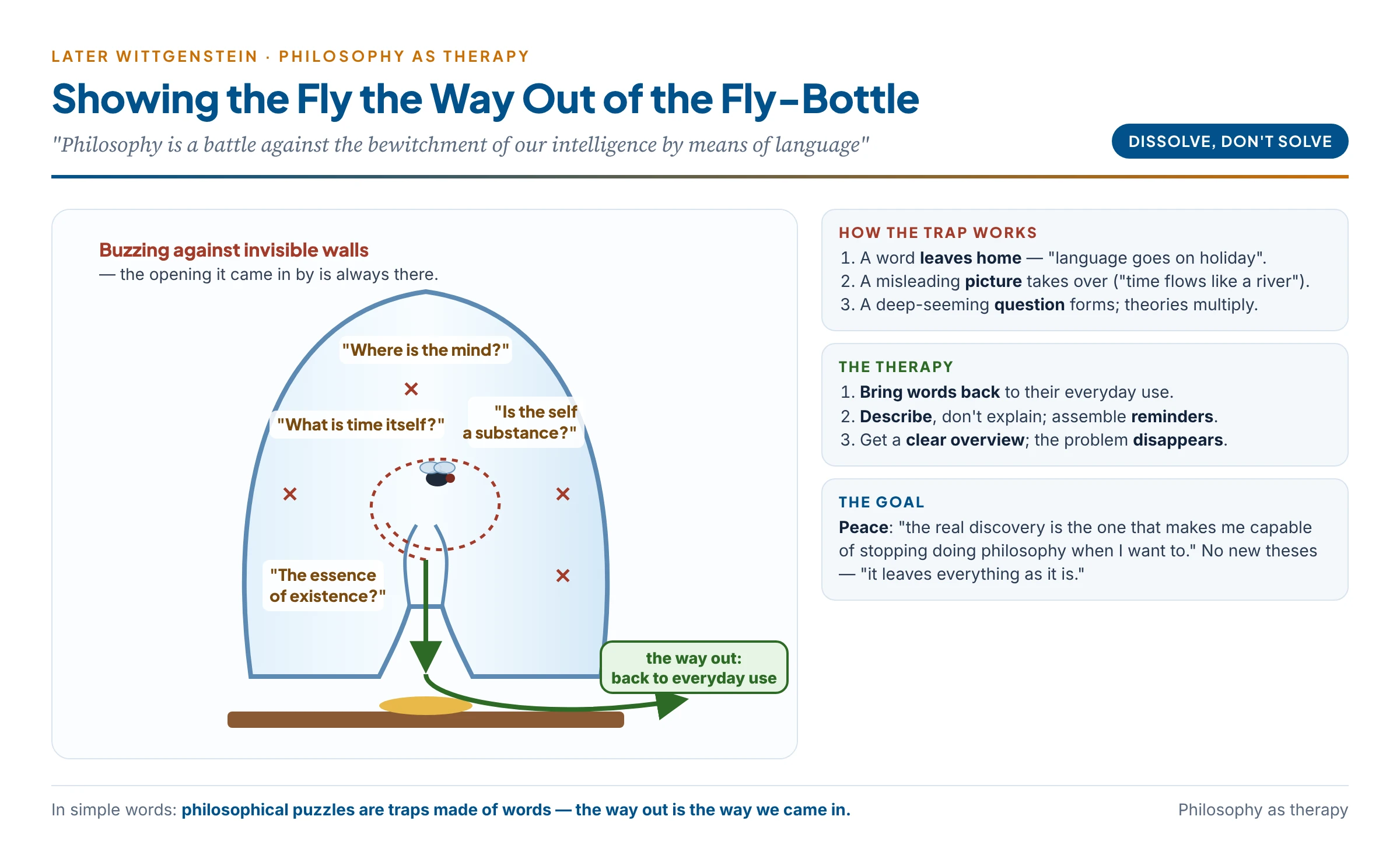
- Bring words home. “What we do is to bring words back from their metaphysical to their everyday use.” Ask of a philosopher’s word — “knowledge”, “being”, “object”, “I”, “name” — “Is the word ever actually used in this way in the language which is its original home?“
- Describe, do not explain. “Philosophy may in no way interfere with the actual use of language; it can in the end only describe it. For it cannot give it any foundation either. It leaves everything as it is.“
- Assemble reminders. “The work of the philosopher consists in assembling reminders for a particular purpose.” Philosophy tells us nothing new; it reminds us of what we already know about how we speak.
- No theses. “If one tried to advance theses in philosophy, it would never be possible to debate them, because everyone would agree to them.“
- A clear overview. The aim is a perspicuous representation (übersichtliche Darstellung) — a clear overview of the use of our words, like a good map of a confusing area, which lets us “see connections”.
- Many methods, like therapies. “There is not a philosophical method, though there are indeed methods, like different therapies.” “The philosopher’s treatment of a question is like the treatment of an illness.” Like a psychoanalyst — Wittgenstein admired Freud — the philosopher draws out the confusions we nurse, turning disguised nonsense into patent nonsense.
- Peace. “The real discovery is the one that makes me capable of stopping doing philosophy when I want to. — The one that gives philosophy peace, so that it is no longer tormented by questions which bring itself into question.” Problems are not solved but dissolved: they “completely disappear“.
In simple words
Look at a famous optical illusion: two lines of equal length, one with arrow-heads pointing in, one with arrow-heads pointing out — the second always looks longer. Measuring them with a ruler does not make the illusion go away; what helps is understanding how the arrow-heads trick the eye. Philosophical problems are like this: they keep looking deep and real, and the cure is to see how our words create the appearance, not to build a theory about the “longer line”.
“What is your aim in philosophy? — To show the fly the way out of the fly-bottle.” — Wittgenstein
The fly-bottle.
- The image. A fly-bottle was a glass trap: the fly enters through a narrow neck at the bottom, attracted by bait, and then buzzes against the glass walls, never finding its way out — though the opening by which it came in is always there.
- The meaning. The philosopher trapped by a picture is like the fly: he keeps beating against invisible walls of linguistic confusion, trying to solve a problem by force. The way out is not a new theory but seeing the way he got in — the misleading use of words — and leaving the same way.
- Fixed meaning as the trap. Insisting that every word must have one fixed meaning, or that meaning must lie in correspondence with reality, is like putting a fly in a bottle: it creates the problems. Once we look at use, “we realise there was no real problem” — we had been prisoners of incorrect use of language.
Why do we need philosophy at all?
- The philosopher within. If philosophy only dissolves problems that philosophers create, why bother? Because, Wittgenstein answers, there is a philosopher within each of us: the misleading grammar of our language bewitches everyone, especially when we turn to abstract studies — of mathematics, psychology or theology — where mythical pictures of numbers, the mind or the soul can distort thinking.
- Untying knots. The function of philosophy is to untie the knots in our thinking. The movements needed may be very complicated, but the result is “as plain as a piece of string“.
- No foundations. Philosophy has no foundations and gives none to other disciplines. It is “not a house, nor a tree, but a web“: one can start anywhere, and leave one problem to take up another.
Metaphysics as “grammar masquerading as science”.
- The temptation of science. “Philosophers constantly see the method of science before their eyes, and are irresistibly tempted to ask and answer questions in the way science does.” Metaphysics results when rules of grammar are mistaken for discoveries about reality — for instance, “another person cannot have my pain” taken as a deep fact about minds rather than a rule for the word “pain”.
- Against the positivists’ blunt tool. Like the positivists, Wittgenstein is hostile to metaphysics; but he attacks it not with the verification principle but by disentangling, case by case, the mixture of truism and nonsense in each metaphysical claim. And the metaphysics he criticises — of the mind as a mysterious medium, of meanings as objects — was one many positivists themselves accepted.
Language on holiday — examples of madness and comedy.
- Alice through the looking-glass. The White King asks Alice whether she sees anyone on the road. “I see nobody on the road,” says Alice. “I only wish I had such eyes,” says the King. “To be able to see Nobody! And at that distance too!” — treating “nobody” as the name of a person.
- The White Queen’s jam. She offers her maid “jam every other day” — and then refuses to give any, because today is never “any other day“.
- Category mistakes. Gilbert Ryle, influenced by Wittgenstein, called such errors category mistakes: the visitor who sees Oxford’s colleges and libraries and asks, “But where is the University?” Descartes’ “ghost in the machine” is, for Ryle, the same kind of mistake about the mind.
- Lesson. When rules of one kind of use are broken in subtle ways, the result is sometimes comedy (Lewis Carroll), sometimes madness, and sometimes metaphysics.
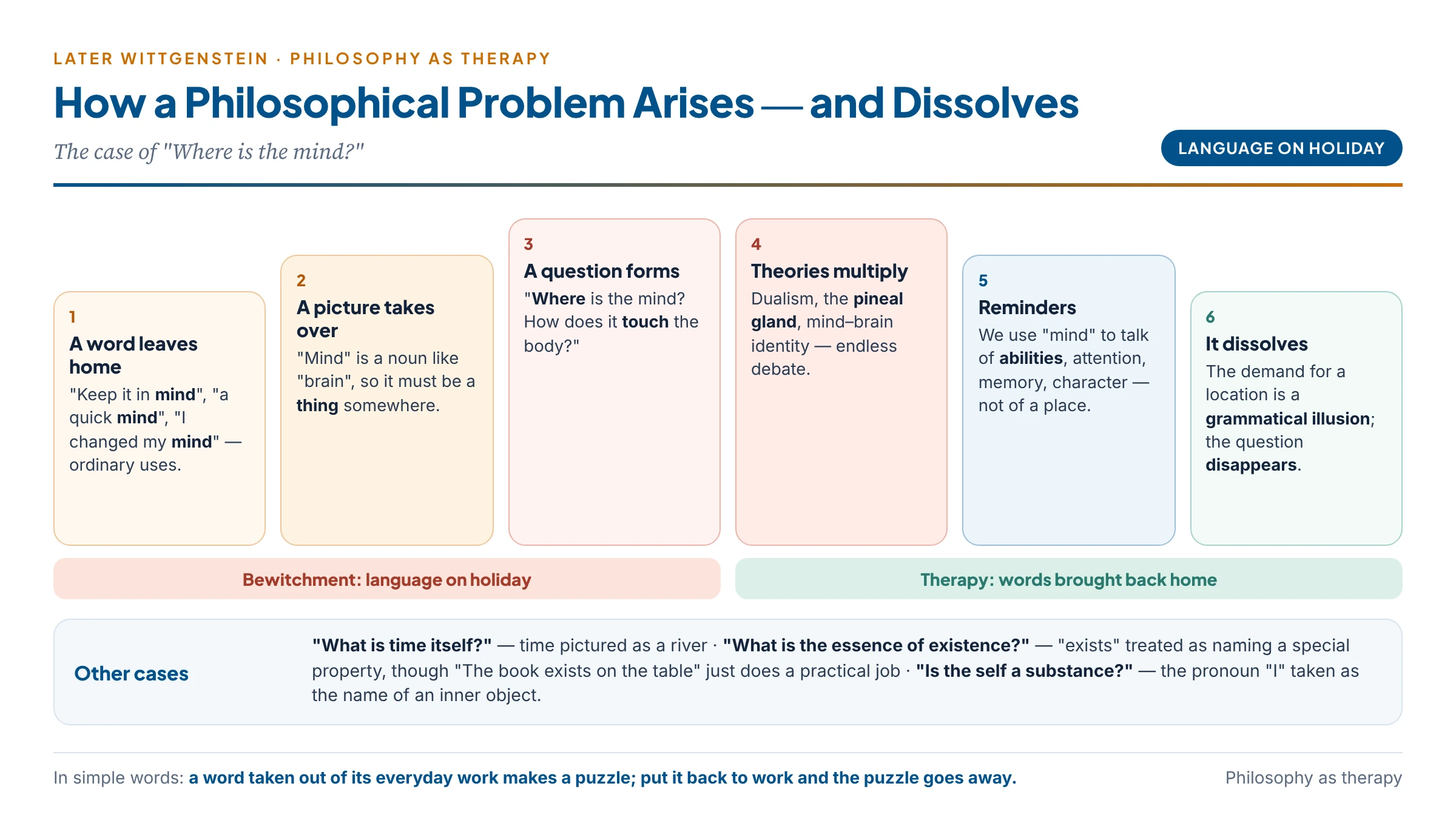
6. How a Philosophical Problem Arises and Dissolves
| Stage | What happens | Example: “Where is the mind?” |
|---|---|---|
| 1. A word leaves home | A word is taken from its everyday use | “Mind” in “keep it in mind”, “she has a quick mind”, “I changed my mind” |
| 2. A picture takes over | Surface grammar suggests a model | “Mind” is a noun like “brain” — so it must be a thing somewhere |
| 3. A question forms | The picture produces a puzzle | “Where is the mind located? How does it touch the body?” |
| 4. Theories multiply | Philosophers build rival answers | Dualism, the pineal gland, materialist identity |
| 5. Reminders are assembled | We look at how “mind” is actually used | We speak of minds in describing abilities, attention, memory, character |
| 6. The question dissolves | The demand for a location is seen as a grammatical illusion | The fly leaves the bottle — not with a new theory, but with a clear view |
In simple words
A child hears “the sun rises” and asks, “What pushes it up?” A parent who starts a lecture on gravity misses the point. The better answer is to show the child how the words are used: “We say the sun ‘rises’ when it appears over the horizon in the morning — the words describe what we see, not a push.” The puzzle does not get solved; it disappears once the use of the words is clear.
7. Influence and Significance
- Analytic and ordinary-language philosophy. Wittgenstein reshaped debates on meaning, rule-following, mind and scepticism, and inspired the Oxford ordinary-language school of Ryle, J. L. Austin and P. F. Strawson; Austin’s speech-act theory develops the idea that saying is doing.
- Philosophy of mind. The private language argument undermined Cartesian introspection and supported social and linguistic accounts of mind and consciousness; Ryle’s critique of the “ghost in the machine” and Strawson’s concept of the person grew from this soil.
- Philosophy of religion. His ideas encouraged non-cognitivist and practice-based interpretations of religious language (D. Z. Phillips; the “language-game” view).
- Social sciences and anthropology. The idea that human action is rule-governed and understood from within a form of life influenced the philosophy of the social sciences, anthropology and sociology — understanding a culture means understanding its practices “from inside”.
- Philosophy of science. Thomas Kuhn’s paradigms — shared rules and exemplars within a scientific community — echo language-games and forms of life.
- Cognitive science and computing. The view of meaning as use in context foreshadows approaches in linguistics and computer science that learn word-meaning from patterns of use rather than from fixed definitions.
- Postmodern thought. The plurality of language-games, with no single master discourse, was taken up by later thinkers who stressed the diversity of discourses.
- The self-image of philosophy. Most significantly, he transformed philosophy’s understanding of itself — from a theory-building discipline, a “super-science”, to a clarificatory activity aimed at freeing us from conceptual confusion. Humility, contextuality and anti-dogmatism became philosophical virtues.
Critical Evaluation
Criticisms of the Later Philosophy
- Reduction of philosophy to description. Critics argue that Wittgenstein turns philosophy into a mere description of language, abandoning its traditional aims of explanation, argument and systematic accounts of reality.
- Reply: description of grammar is not trivial; it removes confusions that block every inquiry, and Wittgenstein’s remarks contain powerful arguments (private language, rule-following).
- Over-rejection of metaphysics. Dissolving metaphysical problems through linguistic analysis is seen as extreme; many philosophers regard metaphysics as an unavoidable and meaningful inquiry. Karl Popper insisted, against Wittgenstein, that there are genuine philosophical problems, not just linguistic puzzles.
- Reply: Wittgenstein does not forbid deep questions; he asks us to check whether each question has a clear sense. Many supposed “deep” questions turn out to be grammatical.
- Vagueness of language-games. The concept lacks precise criteria for classification and boundaries.
- Reply: it is a tool for seeing variety, not a classification system (Article 2).
- Conservatism of the ordinary-language approach. By privileging ordinary usage, Wittgenstein seems to discourage conceptual innovation and limit philosophy’s critical and reformative role. Ernest Gellner attacked ordinary-language philosophy as complacent and conservative.
- Reply: “It leaves everything as it is” applies to language, not to society or science; new concepts and new language-games constantly arise.
- Controversy over the private language argument. Some thinkers hold that subjective experiences can retain meaning without public criteria (Article 3).
- The self-referential problem. If philosophy only dissolves confusions and advances no theses, are Wittgenstein’s own claims — “meaning is use”, “there can be no private language” — therapeutic remarks or theoretical assertions? He seems to put forward exactly the kind of general theses he forbids.
- Reply: his remarks are reminders about grammar that anyone can check against their own use; where they look like theses, they are summaries of many particular descriptions.
- Lack of systematic method and rigour. His anti-systematic style — examples, questions and dialogue rather than formal argument — is said to weaken clarity and evaluative precision.
- Reply: the style is deliberate: a method shown “by examples”, suited to dissolving confusions rather than building systems.
- Russell’s dismissal. His old teacher Bertrand Russell wrote that the later Wittgenstein “seems to have grown tired of serious thinking and to have invented a doctrine which would make such an activity unnecessary“.
- Reply: most later philosophers judged the Investigations to be serious thinking of the highest order — and its influence has outlasted Russell’s verdict.
- Rule-following scepticism and relativism. Kripke’s sceptical reading, and worries about relativism of forms of life, question whether the later philosophy can account for objective meaning and truth (Article 2).
- Meaning beyond use. Truth-conditional theories (Frege, Davidson) and Chomsky’s generative grammar argue that use cannot explain compositional and creative language (Article 1).
Critics and Defenders
Criticism — Critics
- Russell: grew “tired of serious thinking”.
- Popper: there are real philosophical problems, not only puzzles.
- Gellner: ordinary-language philosophy is conservative and complacent.
- Systematic philosophers: no theory, no rigour, only description.
- Self-reference: “no theses” is itself a thesis.
- Kripke: rule-following leads to scepticism about meaning.
- Truth-conditional semantics, Chomsky: use cannot explain compositional, creative language.
Defence — Defenders and strengths
- Grammar matters: confusions about meaning block every inquiry.
- Dissolution, not dismissal: deep questions are examined case by case.
- Language is dynamic: “leaves everything as it is” concerns language, not society.
- Method by examples: suited to curing, not building systems.
- Lasting results: private language, rule-following and family resemblance reshaped philosophy.
- Humility and anti-dogmatism: philosophy as clarification, not super-science.
Cross-Tradition Comparison
Philosophy as Therapy: Wittgenstein and Indian Thinkers
| Point | Later Wittgenstein | Nāgārjuna (Madhyamaka) | The Buddha | Advaita Vedānta | Bhartṛhari |
|---|---|---|---|---|---|
| Source of problems | Language “on holiday”; misleading pictures | Clinging to views (dṛṣṭi) that assume fixed self-nature (svabhāva) | Speculative questions that do not lead to liberation | Ignorance (avidyā) superimposing names and forms | Misunderstanding the nature of word and meaning |
| Method | Reminders of ordinary use; dissolving, not solving | Reductio of every position (prasaṅga) | Silence on unanswerable questions (avyākṛta) | Neti neti — “not this, not this” | Grammatical and philosophical analysis of language |
| Words have essences? | No — family resemblance, use in context | No — words are empty (śūnya), dependently arisen | — | Words apply only at the transactional level | Word and meaning eternally related through sphoṭa |
| Everyday language | “In order as it is”; the home of meaning | The ultimate cannot be taught without relying on everyday practice (vyavahāra) | Uses conventional speech skilfully (upāya) | Valid at the transactional level (vyāvahārika) | All cognition is interwoven with words |
| Goal | Peace: problems disappear | Nirvāṇa: the calming of conceptual proliferation (prapañca-upaśama) | Liberation from suffering | Liberation through knowledge of Brahman | Realisation of Śabda-Brahman |
| Danger | Turning therapy into a new theory | “Those for whom emptiness is itself a view are incurable” | Treating the teaching as an end (the raft parable) | Mistaking words for the reality beyond words | — |
Indian Connect — Key takeaways
- Nāgārjuna as a therapist. Nāgārjuna, like Wittgenstein, does not offer a rival thesis; he shows that every metaphysical position, pressed hard, collapses. Emptiness is a medicine for clinging to views — and must not itself become a view, just as Wittgenstein’s “meaning is use” must not become a new dogma.
- The Buddha’s silence. When asked whether the world is eternal or whether the soul is the same as the body, the Buddha remained silent, comparing such questions to asking who shot the arrow before having a poisoned arrow removed. Wittgenstein, too, sets aside questions that lead nowhere, though for a different reason — they rest on grammatical confusion, not merely on being unhelpful.
- Levels of language in Advaita. Advaita’s distinction between the transactional and the ultimate level resembles Wittgenstein’s view that words work within practices; but Advaita holds that there is an ultimate reality beyond all language, whereas the later Wittgenstein makes no such claim.
- Bhartṛhari’s word-monism. Bhartṛhari’s Śabdādvaita — that thought and language are inseparable and that all cognition is shot through with the potency of words (śabda-bhāvanā) — echoes Wittgenstein’s denial of private, wordless thought. But Bhartṛhari gives language a metaphysical status (Śabda-Brahman) that Wittgenstein would regard as language going on holiday.
- The raft and the ladder. The Buddha’s raft — to be left behind once the river is crossed — parallels the early Wittgenstein’s ladder to be thrown away. The later Wittgenstein’s therapy is the same spirit, applied not once but continually.
Western Comparisons
| Thinker | Diagnosis of philosophical error | Remedy | Compared with later Wittgenstein |
|---|---|---|---|
| Kant | Transcendental illusion: reason applies concepts beyond possible experience | Critique of reason; knowledge limited to phenomena | Wittgenstein’s grammatical illusion: words used beyond their use; critique of language instead of reason |
| Logical positivists | Metaphysics is unverifiable, hence meaningless | One criterion of meaning (verification) | Wittgenstein rejects any single criterion; examines each case |
| Moore | Scepticism denies common-sense truths | Defend common sense (“here is one hand”) | Wittgenstein (On Certainty): such certainties are hinges on which doubt turns — not known by proof |
| Ryle | Category mistakes (the “ghost in the machine”) | Logical geography of concepts | Directly influenced by Wittgenstein |
| Freud | Repressed conflicts produce symptoms | Bring them to light | Wittgenstein’s model of philosophy as therapy |
Synthesis (Siddhānta)
- The transition in one sentence. Wittgenstein moved from asking what language must be for it to picture the world (the Tractatus) to looking at what language actually is in human life (the Investigations) — from logical absolutism to pragmatic pluralism.
- Why. The Tractatus broke on its own logical problems (colour exclusion, simples), on the plain variety of language (Sraffa’s gesture), and on his recognition that the ideal of logical purity was a demand imposed on language, not a discovery about it.
- What replaced it. Meaning as use, language-games, forms of life, family resemblance, rule-following as practice, the critique of private language, and philosophy as therapy — showing “the fly the way out of the fly-bottle”.
- What remained. Philosophy as an activity, not a doctrine; problems rooted in misunderstanding language; hostility to speculative metaphysics; deep respect for what lies beyond theory — ethics, religion, the mystery of life.
- Assessment. Critics rightly ask whether a philosophy without theses can be stated consistently, whether it is too conservative, and whether it does justice to genuine philosophical problems. Yet its lasting results — the private language argument, the analysis of rules, the critique of essentialism — changed philosophy permanently.
- Contemporary relevance. In an age of slogans, jargon and misinformation, Wittgenstein’s method — ask how words are actually used, beware of pictures that hold us captive, and treat confusions before building theories — remains a valuable intellectual discipline. Its kinship with Nāgārjuna’s dissolution of views and the Buddha’s practical silence shows that the therapeutic idea of philosophy is not only Western.
“The real discovery is the one that makes me capable of stopping doing philosophy when I want to.” — Wittgenstein
Previous Year Questions
- 2025“We should look not to an ideal language which derives its meaning from facts and has a precise logical structure but empirically, to the ways in which languages are actually used.” Explain the transition from early views of Wittgenstein to his later views on language and meaning with reference to this statement.
- 2023What were the main reasons that led Wittgenstein to shift from picture-theory of meaning to use-theory of meaning? Critically discuss.
- 2017What is Wittgenstein’s picture theory of meaning? What are his reasons for giving up this theory and suggesting the use theory of meaning?
- 2012According to Wittgenstein, “Philosophy is a battle against bewitchment of our intelligence by means of language“. Explain the function of philosophy in the above context.