

Later Wittgenstein: Meaning and Use; Language-games; Critique of Private Language.
Official Syllabus: Paper I, Section A, Unit 8
Can there be a language that only one person could ever understand — a language whose words refer to that person’s immediate private sensations, which nobody else could know? Much of modern philosophy, from Descartes to Russell, quietly assumed that there could: that each of us first names his own inner experiences and only later, somehow, shares them. In the Philosophical Investigations the later Wittgenstein argues that such a private language is impossible in principle — not because it is hard to build, but because it could not even give its own words a meaning. Meaning needs rules, rules need a difference between being right and only seeming right, and that difference exists only within a shared, public practice. The argument ends by undermining solipsism, the Cartesian picture of the mind, and the sceptical problem of other minds.
In simple words
A schoolboy writes his diary in a secret code so his sister can’t read it. That is not a private language in Wittgenstein’s sense: his sister could crack the code, because the words still mean ordinary things like “school” and “cricket”. A truly private language would be one whose words stood for something nobody else could ever get at even in principle — the exact feel of the boy’s own sensations. Wittgenstein’s question is whether such words could mean anything at all, even to the boy himself.
Context & Problem
What Is — and Is Not — a “Private Language”?
Wittgenstein introduces the idea through a question (the very words UPSC quoted in 2020):
“But could we also imagine a language in which a person could write down or give vocal expression to his inner experiences — his feelings, moods and the rest — for his private use? — Well, can’t we do so in our ordinary language? — But that is not what I mean. The individual words of this language are to refer to what can be known only to the speaker; to his immediate, private sensations. So another person cannot understand the language.” — Wittgenstein
What is not meant:
- A coded diary — a personal cipher can in principle be deciphered by someone else.
- Talking to oneself — Wittgenstein mentions people who speak only in monologue; an explorer could observe them and learn their language.
- A last speaker — the last surviving speaker of a dying language speaks a language nobody else happens to know; it is private in fact, not in principle. Others could learn it.
- Describing feelings in ordinary words — we already do this in our ordinary language (“I feel anxious”, “my knee aches”).
What is meant:
- Its words would refer to what only the speaker can know — his immediate private sensations.
- Therefore no one else could understand it, even in principle — it would be untranslatable, unteachable and unlearnable.
- Its meanings would be fixed by a private act of naming — attending to a sensation and attaching a sign to it — with no public link at all.
Who Needs a Private Language?
Hardly any philosopher openly defended a private language. But many of the most influential theories depended on its possibility without saying so.
| Thinker | The hidden commitment |
|---|---|
| Descartes | I can be certain of my thoughts and name them while doubting that my body and the world exist — so my words for my experiences get their meaning inwardly |
| Locke | Words stand for ideas in the mind of the speaker; communication translates private ideas into sounds |
| Hume | Impressions and ideas can be recognised and classified while the existence of the external world is in suspense |
| J. S. Mill | I know other minds only by analogy from my own case — so the meaning of “pain” comes from my own inner experience |
| Russell | In a “logically perfect language” the basic names — like “this” used for a present sense-datum — would be private to one speaker |
| Logical positivists | Knowledge is built from each person’s private experiences; communication shares only their “form” |
| Early Wittgenstein | “The limits of my language mean the limits of my world” — a language that I alone understand; what solipsism means is “quite correct“ |
- The underlying picture. The mind is an inner theatre with a single spectator. Sensations are private objects displayed there; each person learns what “pain” means by naming his own pain; and he can only guess what goes on in other theatres. “I know I am in pain, but I can only believe that he is in pain.”
- What Wittgenstein targets. Not a particular theory, but this way of thinking — which, as he saw, underlies empiricism, idealism, Cartesian dualism and the sceptical problems of the external world and other minds.
Core Doctrine
1. Are Sensations Private? Two Senses of “Private”
Before attacking the private language, Wittgenstein examines the claim that sensations are private in the first place. He finds two senses, and in neither are our ordinary sensations private in the way the philosopher needs.
(a) “Only I can know whether I am really in pain.”
- In one way false. “If we are using the word ‘to know’ as it is normally used, then other people very often know when I am in pain.” When a child falls and screams, holding his knee, his mother knows he is in pain.
- In another way nonsense. “It can’t be said of me at all (except perhaps as a joke) that I know I am in pain. What is it supposed to mean — except perhaps that I am in pain?” Knowing makes sense where doubting, finding out and being mistaken make sense. I do not find out that I am in pain; I have no evidence; I cannot be wrong. So “I know I am in pain” adds nothing to “I am in pain”.
- The real point. The difference between my case and his is not that I have superior knowledge of my pain but that doubt has no place in the first-person case. “I can doubt whether he is in pain, but not whether I am” is a remark about grammar, not a report of a special inner perception.
(b) “Another person can’t have my pain.”
- Which pain is “my pain”? If two people both have a throbbing pain in the same place, we say they have the same pain (the same kind). The thought that another cannot have “this pain” — said while striking one’s chest — gives no criterion for what would count as having it; emphasis is not a criterion of identity.
- A grammatical remark. “Sensations are private” is like “One plays patience by oneself“. It does not report a deep fact about sensations; it states a rule of grammar for the word “sensation”, as the second states a rule for the game of patience.
Common confusion
Did Wittgenstein say we cannot authentically say “I know I’m in pain” because “pain” means different things in different contexts? No. Some notes give this reason. His point is grammatical, not about the ambiguity of “pain”. “I know I am in pain” is out of place because in the first-person case there is no room for doubt, evidence or mistake — and where doubt is excluded, talk of “knowing” is idle. Far from showing that my knowledge of my pain is weak, it shows that it is not knowledge at all in the usual sense; and it also shows that others can know of my pain, since for them doubt and evidence do make sense.
2. How Sensation Words Really Get Their Meaning
If not by private naming, how do we learn words like “pain”? Wittgenstein’s suggestion:
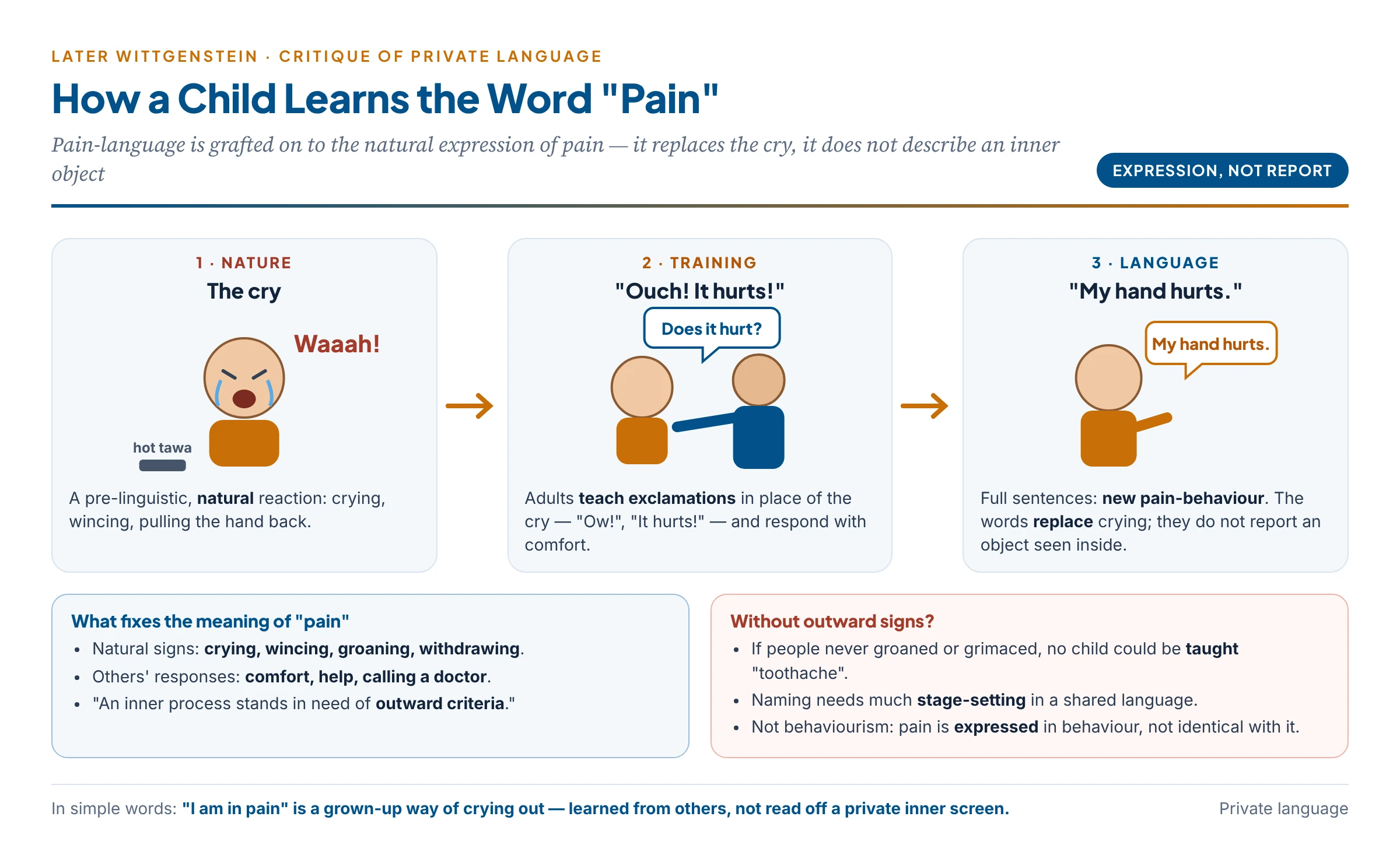
“Words are connected with the primitive, the natural, expressions of the sensation and used in their place. A child has hurt himself and he cries; and then adults talk to him and teach him exclamations and, later, sentences. They teach the child new pain-behaviour.” — Wittgenstein
- Grafting. The child’s cry is a natural, pre-linguistic expression of pain. Parents teach him to replace it with “Ow!“, then “It hurts!“, then “I have a pain in my knee.” Pain-language is grafted on to the natural expression of pain.
- Expression, not description. “The verbal expression of pain replaces crying and does not describe it.” “I am in pain” is not a report of an inner object observed by an inner eye; it is a learned, more articulate form of crying out. Such first-person sentences are called avowals.
- Not “pain means crying”. The objector asks: “So you are saying that the word ‘pain’ really means crying?” — “On the contrary“: the word replaces the cry; it does not refer to it.
- The surrounding practice. The meaning of “pain” is tied to a whole public context — crying, wincing, groaning, withdrawing the hand, seeking help — and to others’ responses — offering comfort, calling a doctor, recognising distress. Linguistic understanding is rooted in interaction, not introspection.
- What if there were no outward signs? “What would it be like if human beings showed no outward signs of pain (did not groan, grimace, etc.)? Then it would be impossible to teach a child the use of the word ‘toothache’.” Even if a gifted child invented a name for his sensation, “a great deal of stage-setting in the language is presupposed if the mere act of naming is to make sense“.
- Criteria. “An ‘inner process’ stands in need of outward criteria.” The criteria for “he is in pain” are not mere symptoms from which we infer a hidden cause; they are part of what gives the word its meaning. And “the human body is the best picture of the human soul“.
In simple words
A toddler touches a hot tawa and screams. Her mother rushes over: “Ouch! It’s hot! Does it hurt?” Next time, the child says “Ouch, hot!” instead of just screaming; a year later, “My hand hurts.” She never looked inward, found an object and baptised it. She learned a new, public way of doing what her scream had always done.
3. The Diary of “S”: The Central Argument
Now Wittgenstein tests the private language directly by imagining someone trying to set one up.
The thought experiment.
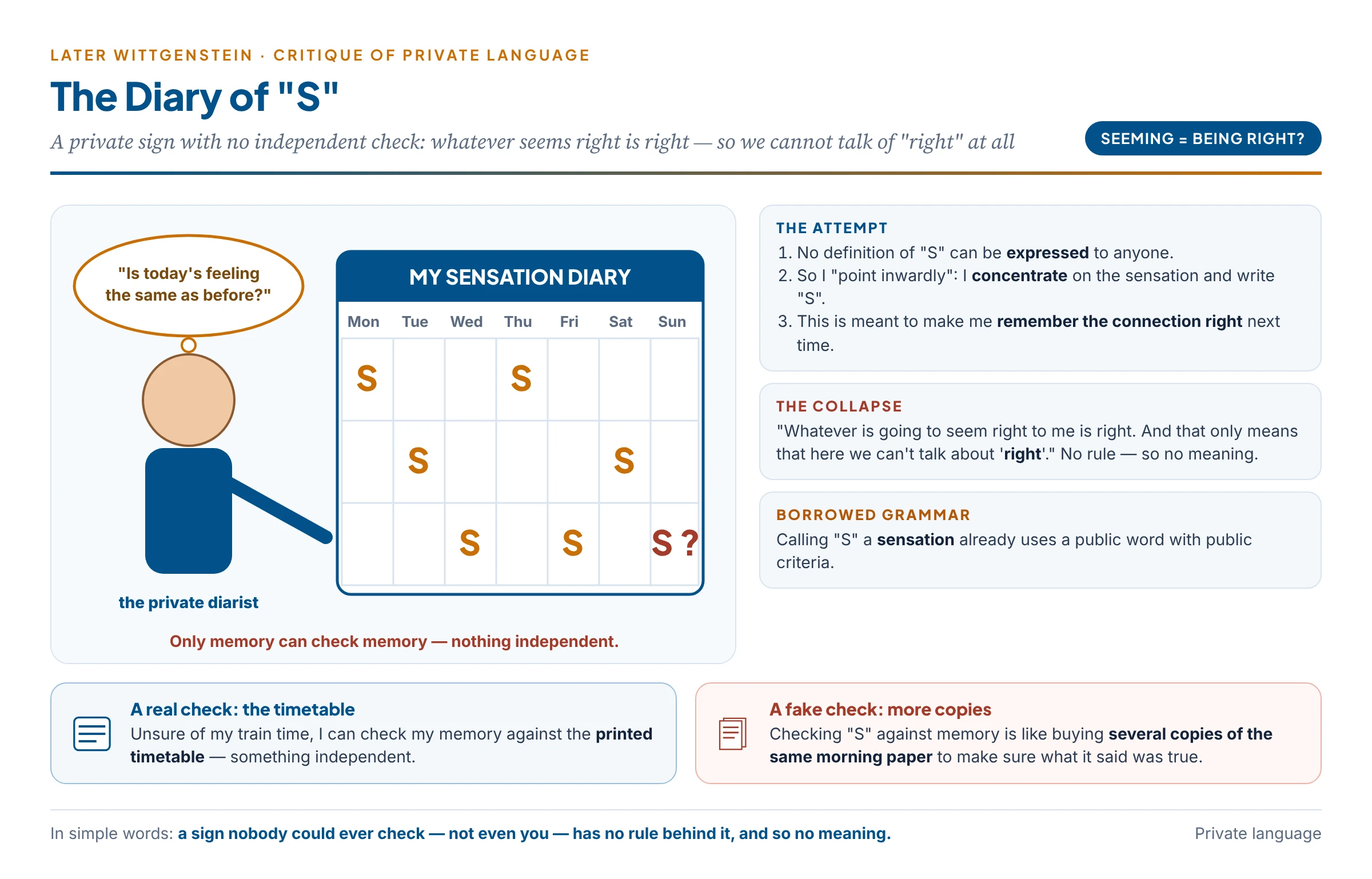
- The diary. “I want to keep a diary about the recurrence of a certain sensation. To this end I associate it with the sign ‘S’ and write this sign in a calendar for every day on which I have the sensation.“
- No definition can be given. The sign cannot be defined in words, since the definition would have to be private too.
- A private ostensive definition. But surely, the objector says, I can give myself a kind of ostensive definition: I concentrate my attention on the sensation — “point to it inwardly” — and write the sign.
Wittgenstein’s reply, step by step.
- What is the ceremony for? A definition serves to establish the meaning of a sign. Concentrating my attention is supposed to impress on me the connection between the sign and the sensation.
- “I impress it on myself” can only mean that this process brings it about that I remember the connection right in the future.
- But here there is no criterion of correctness. Tomorrow, when I write “S” again, how is it to be settled whether I have applied the sign correctly — to the same kind of sensation?
- “Whatever is going to seem right to me is right.” In the private case, there is nothing against which to check my use except my impression that it is right.
“One would like to say: whatever is going to seem right to me is right. And that only means that here we can’t talk about ‘right’.” — Wittgenstein
- The collapse. Where there is no difference between being right and seeming right, there is no rule; where there is no rule, the sign has no meaning. “S” is not a word in a language — not even in a language for one.
In simple words
Imagine a cricket match where the batsman is also the only umpire, and the rule is “out is whatever the batsman feels is out“. Could he ever be wrongly given not-out? Never — whatever he decides is right by definition. But then “out” no longer means anything; the rule has stopped being a rule. The private diarist’s “S” is like that: with no one and nothing to check it, “correct” and “seems correct to me” become the same thing.
Memory checking memory.
- The timetable. Ordinarily, if I am not sure when my train leaves, I can call up the timetable in memory — and if in doubt, I can check the memory against the real timetable at the station or ask a fellow passenger. The check appeals to something independent.
- The private case. In the private language, the only check on my memory of what “S” meant is another memory. That is like a person who buys several copies of the same morning paper to assure himself that what it said was true. A justification must appeal to something independent; here there is nothing.
“S” borrows public grammar.
- “S” is a sensation? To say that “S” stands for a sensation is already to use the word “sensation” — a word of our common language, intelligible to everyone, with public criteria. So the private linguist cannot even say what kind of thing his sign names without leaning on public language.
- “Just something”? Retreating to “I have something” does not help: “something” too is a word of the common language. In the end he would be reduced to an inarticulate sound — and even such a sound has its meaning only in a particular language-game.
When “S” does get a use — the private object idles.
- The blood-pressure gauge. Suppose I find that whenever I have sensation S, a manometer shows that my blood pressure is rising. Now “S” has a use: I can say “my blood pressure is rising” without the instrument. But now it does not matter at all whether I recognise the sensation “correctly”. Even if I always misidentified it, the sign would still work, so long as my reports matched the manometer.
- The idle wheel. “A wheel that can be turned though nothing else moves with it, is not part of the mechanism.” The private object — the exact inner feel — does no work in fixing the meaning; whatever meaning “S” has comes from its public connections.
- Forgetting “pain”. Imagine a person who could not remember what the word “pain” meant, and so kept calling different feelings by that name — but who still used it fittingly, in agreement with the usual signs and circumstances of pain. He would be using it just as we do.
- The gift to oneself. Why can’t my right hand give my left hand money? It can pass the money and write a receipt — but the further practical consequences would not be those of a gift. A private definition is like this: the outward motions are gone through, but nothing follows.
Common confusion
Is the private language argument just scepticism about memory? No. Many accounts present it as “memory is unreliable, so a private linguist might misremember what ‘S’ meant”. Critics then reply that public language also relies on memory. But Wittgenstein’s point is deeper. The private linguist’s trouble is not that his memory might fail; it is that there is nothing for it to get right. To “remember the meaning of S” he would have to call up the right memory — the memory of S — and to do that he must already know what “S” means. The private ceremony never gave “S” a meaning in the first place; there is no criterion of correctness at all, so talk of correct remembering is empty.
The two kinds of scepticism in the argument.
- Memory scepticism — I might misremember which sensation I called “S”. (The weaker point.)
- Meaning scepticism — even if my memory were perfect, there is no way to check — no criterion — for what “S” means. (The decisive point.)
4. The Beetle in the Box
Wittgenstein’s most famous image attacks the idea that a sensation word means a private object.
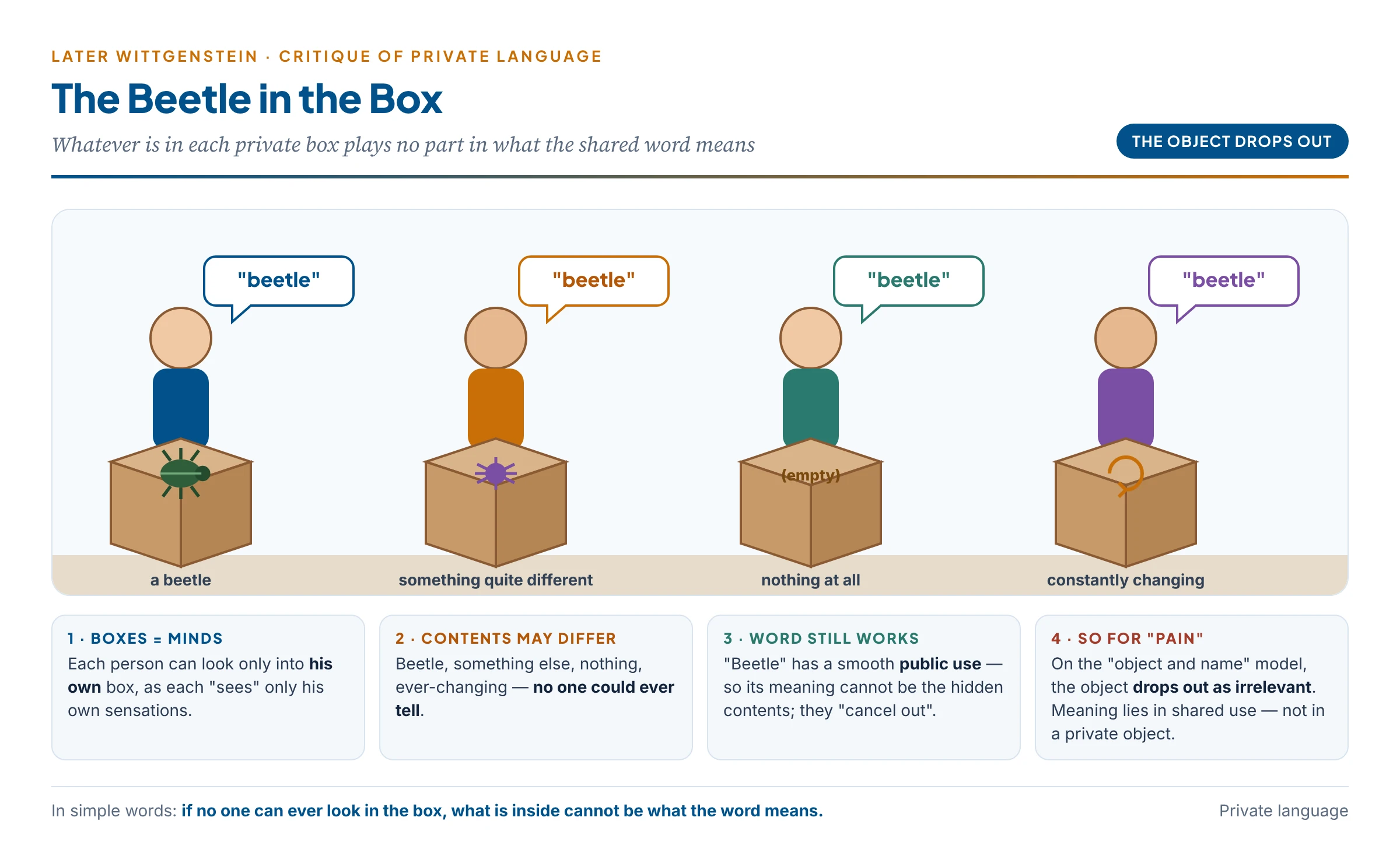
“Suppose everyone had a box with something in it: we call it a ‘beetle’. No one can look into anyone else’s box, and everyone says he knows what a beetle is only by looking at his beetle. — Here it would be quite possible for everyone to have something different in his box. One might even imagine such a thing constantly changing. — But suppose the word ‘beetle’ had a use in these people’s language? — If so it would not be used as the name of a thing. The thing in the box has no place in the language-game at all; not even as a something: for the box might even be empty.” — Wittgenstein
Reading the image step by step.
- The boxes are minds; the beetles are sensations as the private-object picture conceives them — visible to their owner alone.
- Each person learns “beetle” from his own case, just as the Cartesian thinks each of us learns “pain” from his own pain.
- The contents could differ — or change — or be absent, and no one could ever tell. Yet the word “beetle” still has a smooth public use: people talk about beetles, agree, disagree.
- So the contents play no part in the meaning. Whatever is in the box “cancels out” — like an item placed equally on both pans of a balance, which can be removed without changing anything.
- Conclusion for “pain”. “If we construe the grammar of the expression of sensation on the model of ‘object and designation’, the object drops out of consideration as irrelevant.” Since “pain” plainly does have a shared meaning, that meaning cannot be a private object. It lies in the public use — expressions, behaviour, circumstances, responses.
In simple words
In an office, every employee carries a sealed tiffin that nobody else may open, and they all call what is inside “lunch“. Maybe one has rice, one has rotis, one’s tiffin is empty. Yet “Let’s go and have lunch” works perfectly: people know when to say it, what follows, and where to go. The word gets its meaning from this shared routine, not from what sits in any one sealed box.
Not a denial of sensations.
- “Not a something, but not a nothing either!” The objector protests that Wittgenstein is saying the sensation itself is nothing. He replies: “Not at all. It is not a something, but not a nothing either! The conclusion was only that a nothing would serve just as well as a something about which nothing could be said.“
- “A behaviourist in disguise?” “Are you not really a behaviourist in disguise? Aren’t you at bottom really saying that everything except human behaviour is a fiction?” — “If I do speak of a fiction, then it is of a grammatical fiction.” What is a fiction is not pain, but the picture of pain as a private object that the word names.
- The real target. Wittgenstein rejects a grammar, not an experience: the model of “object and name” applied to sensations.
Common confusion
Does the beetle show that each person’s pain (or red) may secretly be different? No. Some notes read the beetle as a sceptical point — “your ‘pain’ or ‘red’ may be quite different from mine, so words mean different things in each person’s world” — and add examples like a “pain” from hot water that might feel like comfort to someone else. That is the opposite of Wittgenstein’s point. He imagines the contents differing only to show that if they could differ undetectably, they would make no difference to what the word means. The meaning of “pain” and “red” is fixed by shared public use; a supposed private difference that could never show itself is idle, not a hidden variation in meaning.
5. Private Rules Are No Rules
The private language argument applies the conclusion of Wittgenstein’s remarks on rule-following (Article 2).
- Language is rule-governed. To use a word meaningfully there must be a distinction between using it rightly and wrongly.
- Rules require criteria of correctness that are independent of the rule-follower’s impression — so that he can be corrected.
- “To think one is obeying a rule is not to obey a rule. Hence it is not possible to obey a rule ‘privately’.”
- Rules require teaching, learning and correction — the possibility of a public practice.
- A private language has no such criteria. So its “rules” are not rules, and its “words” mean nothing.
- Therefore a language in principle unintelligible to anyone but its speaker is impossible. Meaning is grounded not in solitary experience but in communal forms of life.
6. Can a Person Isolated from Birth Have a Language? The Crusoe Debate
- Ayer’s challenge (1954). A. J. Ayer asked: imagine a Robinson Crusoe left alone on a desert island from infancy, who never learned any language. Could he not invent names for the birds, plants and even his own sensations, and use them consistently? Ayer argued that he could — and that even in public language every check finally rests on someone trusting his own recognition, so the private linguist is no worse off.
- Rhees’s reply. Rush Rhees answered that a language needs a shared practice with rules; Crusoe’s marks would be mere signals with no standard of correctness unless something like a community gave them one.
- Two broad interpretations.
- The community view — language must actually be shared: a being who has never belonged to a community cannot follow rules or speak. Defenders such as Norman Malcolm read Wittgenstein this way, and Kripke’s “sceptical solution” (Article 2) gives a version of it.
- The practice view — what Wittgenstein rules out is a language unteachable in principle because it is about objects nobody else could know. A solitary Crusoe naming public things (birds, trees) in a regular way that an observer could learn would have a language; what he could not have is a language whose words get meaning from private objects.
- Balanced judgement. The argument most clearly shows that meaning requires public criteria and the possibility of being taught and checked. Whether it also requires an actual community is disputed. Either way, the Crusoe example does not save the private language in Wittgenstein’s sense: Crusoe’s words for birds are public in principle, and his words for sensations would need the same outward anchoring as ours.
- A frequent overstatement. It is sometimes said that, for Wittgenstein, a person who grew up alone on a desert island “would not develop an internal language because he has no one to develop an external one with“. That goes beyond his text. His target is a language private in principle — about inner objects nobody else could know — not a language that happens to have only one speaker; he himself mentions people who speak only in monologue, whose language an explorer could learn. Whether a person isolated from birth could create a language is the separate, disputed Crusoe question.
7. From the Critique of Solipsism to the Critique of Private Language
The 2019 paper asked how Wittgenstein’s critique of solipsism culminates in the critique of private language. The answer traces his own development.
What solipsism is.
- Metaphysical solipsism: only I (my mind) exist; everything else is my experience.
- Epistemological solipsism: I can know only my own mind; the external world and other minds can never be known and might not exist.
- Semantic solipsism: my words get their meaning from my experiences, so only I really understand what I mean.
Stage 1 — the Tractatus: solipsism “shows itself”.
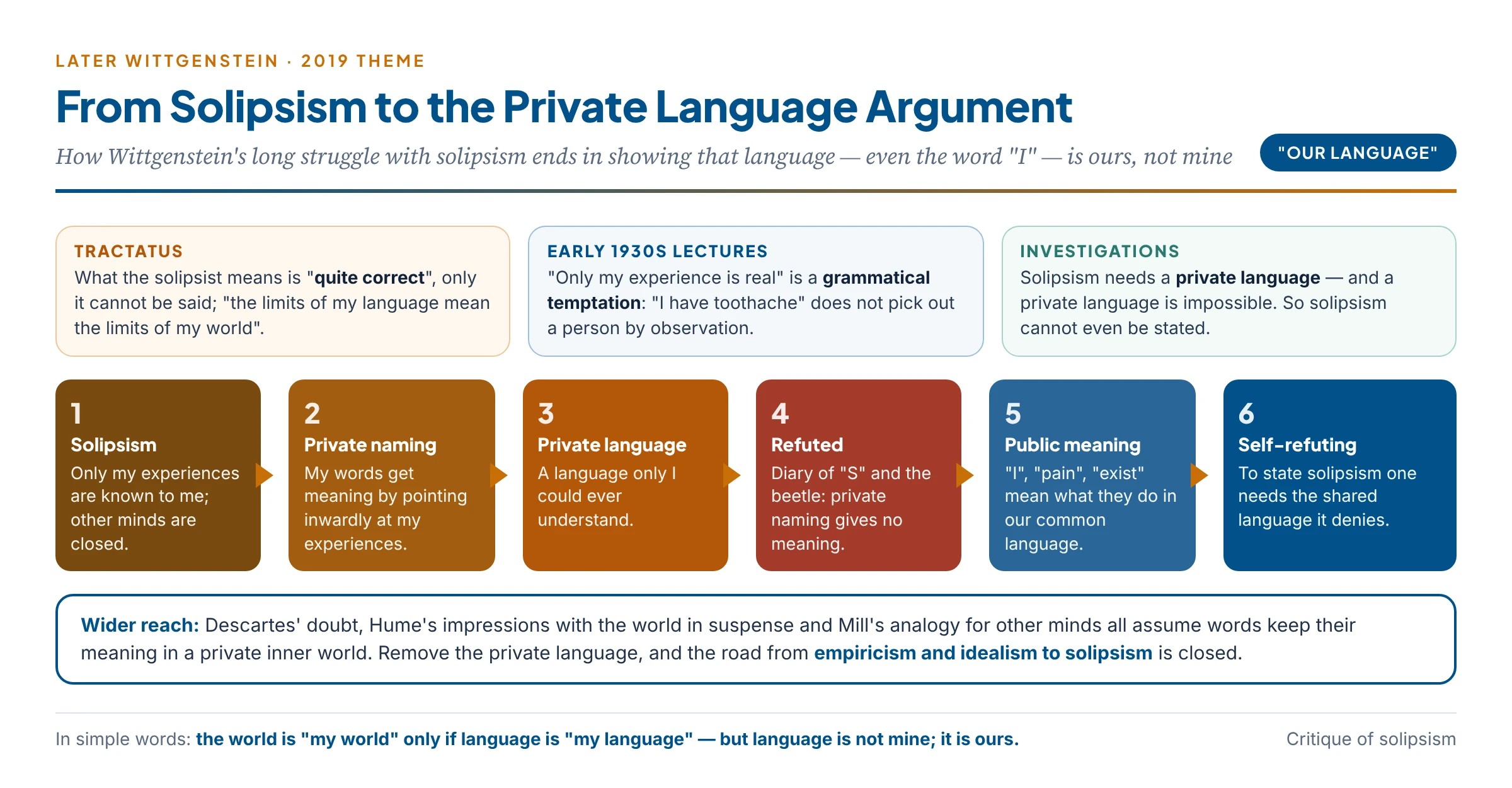
- Early Wittgenstein wrote that “what the solipsist means is quite correct; only it cannot be said, but makes itself manifest“. “The world is my world” shows itself in the fact that “the limits of language (of that language which alone I understand) mean the limits of my world.” The metaphysical subject is not in the world but its limit, like the eye that is not seen in its own visual field.
- The hidden private language. “The language which alone I understand” is close to a private language: language as my language, linked to the world by my acts of meaning.
Stage 2 — the middle period: diagnosing the solipsist.
- In his Cambridge lectures of the early 1930s (the Blue Book), Wittgenstein examined the solipsist who says “Only my experience is real” or “When anything is seen, it is always I who see it“.
- Two uses of “I”. In “I have a broken arm“, “I” is used for a person among others — I could be mistaken (it might be someone else’s arm in the tangle after an accident). In “I have toothache“, there is no question of recognising a person; “I” does not pick out anyone by observation. The solipsist mistakes this special grammar for the discovery of a unique, super-real inner self.
- A new notation. The solipsist is really tempted to a new way of speaking — reserving “real pain” for his own — which reports no new fact.
Stage 3 — the Investigations: solipsism cannot even be stated.
- Solipsism says that only my experiences are known to me, and others’ minds are closed.
- This implies that my sensation-words get their meaning from my private experiences — by private ostensive definition.
- That is exactly a private language.
- The diary of S and the beetle in the box show that a private language is impossible: private naming gives no meaning.
- So words — including “I“, “pain“, “experience“, “exist” — have meaning only in our common, public language.
- But then the solipsist must state his thesis in a public language whose very possibility depends on other people and a shared world. Solipsism refutes itself: it cannot be coherently formulated.
The world is my world only if language is my language — but language is not my language; it is our language. The home of language is not the inner world of the solipsist, but the life of the human community.
In simple words
A man stands up at a public meeting and announces into the microphone, in Hindi, “Nobody exists except me, and nobody can understand what I mean.” The audience understood him — in a language he learnt from his parents and teachers. His very announcement depends on the people he denies. That is why Wittgenstein says solipsism cannot even be stated without refuting itself.
- Even “I”. Even the word “I” has meaning only as a word in our common language; the solipsist’s “I” is borrowed from the public game.
- Wider reach. The same argument undercuts Descartes’ doubt (which assumes language keeps its meaning while body and world are in doubt), Hume’s classification of impressions with the world suspended, Mill’s analogy argument for other minds, and Schopenhauer’s view of the world as “my idea”. Empiricism and idealism, which both hold that the mind directly knows only its own contents, lead towards solipsism; by refuting private language, Wittgenstein undercuts the road to solipsism itself.
8. Consequences for the Philosophy of Mind
- The inner theatre dismantled. The Cartesian picture of the mind as a private theatre, known only by introspection, loses its foundation. Followers of the argument call Cartesian interactionism a pseudo-solution to a pseudo-problem.
- Other minds. We do not infer another’s pain by analogy from our own case, as Mill thought. We see pain in a face, hear it in a groan; the criteria are built into the concept. The sceptical problem of other minds rests on a private-language picture of meaning.
- Not behaviourism. Wittgenstein does not reduce pain to behaviour. Pain is expressed in behaviour and known through it, but the word “pain” does not mean groaning. What he rejects is the grammar of private objects, not inner life.
- Persons as public beings. The argument prepares Strawson’s view (Unit 11) that one can ascribe states of consciousness to oneself only if one can ascribe them to others — the concept of a person is primary.
- Brain-reading objection. Some argue that if neuroscience could read brain states, a sensation “S” could be identified exactly by its brain code, and the private-language problem would vanish. But this supports Wittgenstein: the brain-scanner’s readings would be a public criterion — like the blood-pressure gauge — and identifying a brain state as “pain” would still rely on our public concept of pain.
- Mind-first or body-first? The argument is sometimes presented as a contest over whether soul or body “dominates” our world. That misses its point: it is not a metaphysical theory about soul or matter, but an examination of the grammar of sensation-words.
Critical Evaluation
Objections and Replies
- Public language relies on memory too. If the private linguist’s memory is untrustworthy, so is everyone’s; checks in public language also end in someone’s trust in his own recognition (Ayer).
- Reply: the argument is not about fallible memory but about the absence of any criterion — in the private case there is nothing independent that could even count as a check.
- Verificationism in disguise. The demand that correct use be checkable seems to revive the verification principle Wittgenstein elsewhere rejects.
- Reply: the requirement is not that every statement be verified but that a rule must distinguish right from seeming-right; this is about meaning, not about knowledge.
- Behaviourism. By tying sensation-words to behaviour, Wittgenstein seems to deny inner experience.
- Reply: “not a something, but not a nothing either”; only the picture of the private object is a “grammatical fiction”.
- Crusoe. A solitary person from birth could, it seems, invent and use a language.
- Reply: at most this shows that a language need not be actually shared; it does not show that words can get meaning from private objects.
- The felt quality of experience. Critics say Wittgenstein ignores the subjective character of experience — “what it is like” to taste mango or feel grief. Subjective experiences, they argue, keep their meaning even without public criteria.
- Reply: Wittgenstein does not deny the felt quality; he denies that it can be the meaning of a word. We describe it richly — but in a public language.
- Too much scepticism. Kripke’s version turns the argument into a paradox that threatens all meaning, public as well as private.
- Reply: on many readings Wittgenstein used the paradox to reject the interpretation picture of rules, not to endorse scepticism.
- Interpretive uncertainty. Wittgenstein never used the phrase “private language argument“; his remarks are scattered, and interpreters disagree whether he shows the idea is false or nonsense.
- Reply: the core is clear: when we try to make the idea of a private language intelligible, the attempt fails — we cannot describe what speaking it would consist in.
Critics and Defenders
Criticism — Critics
- Ayer: memory is fallible in public language too; Crusoe could have a language.
- Verificationism charge: demanding checkability revives the verification principle.
- Behaviourism charge: inner experience seems reduced to behaviour.
- Subjectivists: the felt quality of experience is meaningful without public criteria.
- Kripke: the argument generalises into scepticism about all meaning.
Defence — Defenders and strengths
- No criterion at all: the issue is meaning, not fallible memory.
- Rules need independence: right must differ from seeming right.
- Grammatical fiction: sensations are real; the private-object model is not.
- Expression, not description: avowals replace natural cries.
- Dissolves scepticism: other minds and solipsism lose their foundations.
- Strawson, Ryle: persons and minds understood as public beings.
Cross-Tradition Comparison
Inner Experience, Other Minds and Language in Indian Thought
| Question | Indian view | Wittgenstein |
|---|---|---|
| How is my pain known? | Nyāya: pleasure and pain are known by the inner sense (manas) through inner perception (mānasa-pratyakṣa), and the cognition itself by a further introspective awareness (anuvyavasāya) | “I know I am in pain” is idle; first-person avowals are expressions, not inner perceptions |
| How are other selves known? | Nyāya: by inference from purposive bodily activity (ceṣṭā), on the analogy of one’s own case | Not by analogy; pain is seen in behaviour, whose criteria are part of the concept |
| Can consciousness reveal itself without language? | Advaita: the witness-consciousness (sākṣī) is self-luminous (svaprakāśa), revealed without any further knowing | Inner states need outward criteria to be named; but Wittgenstein does not deny inner life |
| Is idealism solipsistic? | Yogācāra (“only consciousness”) faced the charge of solipsism; Dharmakīrti wrote a treatise proving other mind-streams (Santānāntarasiddhi) by inference from others’ speech and action | Solipsism cannot even be stated, since language is public |
| Is there thought without words? | Bhartṛhari: “there is no cognition in the world that is not accompanied by the word; all knowledge appears as if interwoven with words” | No private, pre-linguistic language of thought from which public language is built |
| How is word-meaning learned? | Mīmāṃsā / Nyāya: from the usage of elders (vṛddha-vyavahāra) — a public practice | From training in public language-games |
Indian Connect — Key takeaways
- Nyāya’s inner perception and the Cartesian picture. Nyāya’s account of knowing one’s own pain by inner perception and other selves by inference from behaviour is close to the picture Wittgenstein criticises. A Wittgensteinian would say pain-talk is not a report of inner perception, and others’ pain is not merely inferred.
- Dharmakīrti and other minds. Dharmakīrti’s proof of other minds from observed speech and action shows that Indian idealists, too, felt the pressure of solipsism — and answered it, like Wittgenstein, by appeal to public behaviour, though by inference rather than by grammar.
- Bhartṛhari’s support. Bhartṛhari’s claim that all cognition is shot through with language — and that language is learned from shared usage — supports Wittgenstein’s denial of a private, word-free inner language from which meaning could be built.
- The sākṣī and the limits of the argument. Advaita’s self-luminous witness and yogic inner experiences are said to be beyond words (anirvacanīya). Wittgenstein would not deny such experiences, but would insist that whatever is said of them is said in a public language — and that what cannot be said is not thereby given a private name.
- Anātman and the grammar of “I”. The Buddhist teaching that there is no owner-self behind experiences (anātmavāda) parallels Wittgenstein’s point that the “I” in “I have toothache” does not pick out an inner object — though for the Buddhist this is a metaphysical truth leading to liberation, and for Wittgenstein a grammatical remark.
Western Positions Compared
| Point | Descartes / Locke | Russell / logical positivists | A. J. Ayer | Later Wittgenstein |
|---|---|---|---|---|
| Meaning of “pain” | Private idea or experience | Named by acquaintance with private data | Private naming possible | Public use grafted on natural expression |
| Knowledge of own mind | Certain, by introspection | Certain basis of knowledge | Fallible but adequate | Not “knowledge” — no room for doubt |
| Other minds | Inferred; sceptical problem | Inferred by analogy | Inferred | Known through criteria |
| Private language | Assumed possible | Explicitly allowed (Russell) | Defended (Crusoe) | Impossible in principle |
Synthesis (Siddhānta)
- The core argument. Meaning requires rules; rules require a difference between being right and seeming right; that difference requires independent, public criteria. A language whose words get their meaning from private objects has no such criteria — so it is no language at all. “Whatever is going to seem right to me is right. And that only means that here we can’t talk about ‘right’.“
- What it does not say. It does not deny sensations, inner life or solitude. It denies that sensations are private objects named by inner pointing, and that language could rest on such naming.
- What it explains. Sensation-words are learned as replacements for natural expressions; the private object drops out of the language-game as irrelevant (the beetle); and others’ minds are not hidden behind a wall but expressed in faces, cries and deeds.
- What it overturns. Solipsism (which cannot be stated without a public language), the Cartesian inner theatre, the analogy argument for other minds, and the empiricist project of building knowledge from private data — including Wittgenstein’s own early hints of solipsism.
- Open questions. Whether an actual community is needed (Crusoe), whether the argument is about falsehood or nonsense, and how to do justice to the felt quality of experience remain debated.
- Indian resonance. Bhartṛhari’s thesis that thought is interwoven with language, the Mīmāṃsā view of meaning learned from shared usage, and Dharmakīrti’s appeal to public behaviour against solipsism show that classical India, too, saw language and mind as intersubjective — while Advaita and Yoga keep open a realm of experience that language can point to but not capture.
“An ‘inner process’ stands in need of outward criteria.” — Wittgenstein
Previous Year Questions
- 2024Why does later Wittgenstein think that there cannot be a language that only one person can speak — a language that is essentially private? Discuss.
- 2020“But could we also imagine a language in which a person could write down or give vocal expression to his inner experiences — his feelings, moods and the rest — for his private use?” Critically discuss the answer offered by Wittgenstein to this question.
- 2019Show how Wittgenstein’s critique of solipsism culminates in the critique of private language.
- 2016Why does Wittgenstein reject the possibility of private language?
- 2013Explain Wittgenstein’s arguments against the possibility of private language.