

Phenomenology (Husserl): Method; Theory of Essences; Avoidance of Psychologism.
Official Syllabus: Paper I, Section A, Unit 9
Edmund Husserl (1859–1938), the founder of phenomenology (the study of things exactly as they appear to consciousness), wanted to make philosophy as certain as mathematics — a rigorous science (strenge Wissenschaft) that could give a firm foundation to every other science. The first obstacle on that road was a popular nineteenth-century view called psychologism: the view that the laws of logic and mathematics are only laws of how the human mind happens to work. If that were true, truth itself would depend on the make-up of our brains, and certain knowledge would be impossible. Husserl’s refutation of psychologism in the Logical Investigations (1900–01) and his attack on naturalism in Philosophy as a Rigorous Science (1911) cleared the ground on which the whole of phenomenology was built.
In simple words
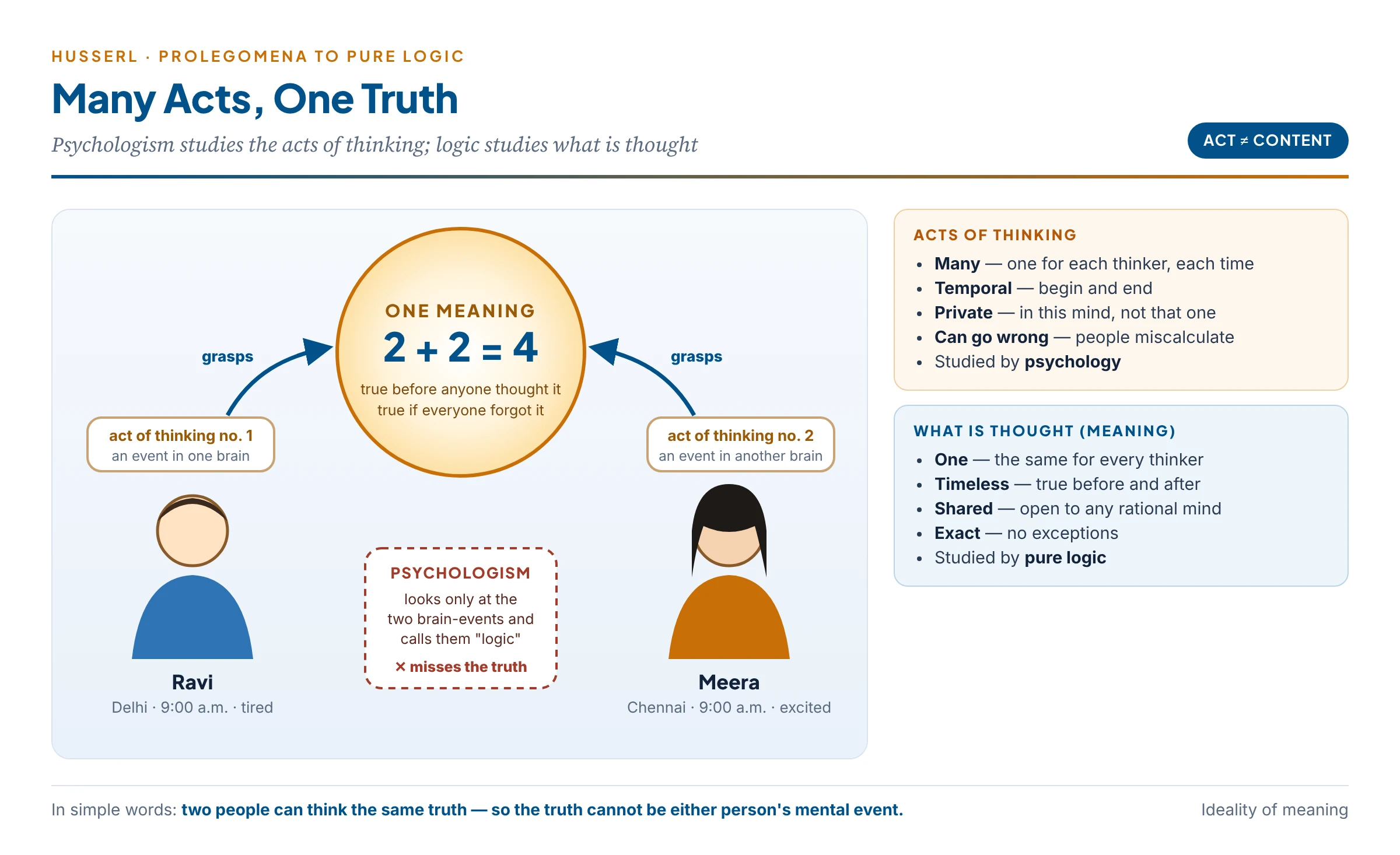
Ravi in Delhi and Meera in Chennai both think “2 + 2 = 4” at the same moment. There are two acts of thinking — two different events in two different brains. But there is one truth that both of them grasp. Psychologism looks only at the two brain-events and says logic is about them. Husserl says: look at what they both think. That shared truth was true before anyone thought it and would remain true even if every human being forgot it. Logic is about that truth, not about the brains that grasp it.
Context & Problem
Husserl’s Life and Intellectual Journey
- Birth and training. Born in 1859 at Prossnitz in Moravia (now in the Czech Republic), Husserl first trained as a mathematician — he studied under the great analyst Karl Weierstrass in Berlin and took a doctorate in mathematics at Vienna.
- Turn to philosophy. In Vienna he attended the lectures of Franz Brentano, whose idea of intentionality (“every mental act is directed at an object”) shaped his whole later thought. The move from mathematical rigour to the study of consciousness sums up his career: he wanted philosophy to have the certainty of mathematics, but drawn from careful study of experience.
- Teaching. He taught at Halle, then at Göttingen (1901–1916) and Freiburg (1916 until retirement in 1928). Martin Heidegger was his most famous pupil and succeeded him at Freiburg.
- Last years. Being of Jewish origin, he was pushed out of university life under the Nazi racial laws and worked in isolation. After his death in 1938 a Belgian priest carried his widow and some 40,000 pages of manuscripts to the University of Louvain, saving them from destruction.
- Main works. Philosophy of Arithmetic (1891); Logical Investigations (1900–01; its first volume is the Prolegomena to Pure Logic); Philosophy as a Rigorous Science (1911); Ideas I (1913); Cartesian Meditations (1931); The Crisis of European Sciences and Transcendental Phenomenology (1936).
- Influence. Phenomenology shaped existentialism (Heidegger, Sartre), Merleau-Ponty‘s philosophy of the body, hermeneutics (the theory of interpretation), Levinas, and much of twentieth-century continental thought.
What “Phenomenology” Means
- The word. Phainomenon (Greek: “that which appears”) + logos (“study, account”) — the study of what appears, of things as they are given in experience.
- The motto. “Back to the things themselves!” (Zu den Sachen selbst!) — set aside theories about experience and look at experience itself, exactly as it gives itself.
- Describe, don’t explain. Phenomenology does not explain experience by causes (as physics, physiology or psychology do). It describes how things are given. In Husserl’s spirit: the point is not to explain but to make us see.
- Neither empiricism nor rationalism. It does not start from sense-data (empiricism) or from innate ideas (rationalism); it describes the essential structures of experience that make knowledge possible.
- Example. When we see a table, we do not just receive patches of colour; we experience one unified, meaningful thing that has a hidden back, a use and a place in the room. Phenomenology studies these structures of givenness, not the table as a lump of physics.
Husserl’s Sense of the Word Compared with Kant and Hegel
| Thinker | What “phenomenon” means | Husserl’s response |
|---|---|---|
| Kant | The thing as it appears to us, contrasted with the noumenon (thing-in-itself), which is unknowable | Husserl rejects the unknowable noumenon. The pure phenomenon is not a veil over hidden reality; it can be known directly by intuition |
| Hegel | Phenomenology of Spirit: the stages through which consciousness develops towards Absolute Knowing | Husserl uses the word in a quite different sense — a descriptive science of how anything is given, not a history of spirit |
| Husserl | Things as they appear in experience, and the ways we experience them | The phenomenon, purified of assumptions, is the essence of the thing — nothing lies “behind” it |
Common confusion
Is phenomenology the same as phenomenalism? No — the names are similar, the ideas are opposite. Phenomenalism (Berkeley, Hume, J. S. Mill, the logical positivists) says that a physical object is nothing but a bundle of actual and possible sense-experiences — a table is “sense-data of brown, hard, square…”. It is an empiricist, reductive theory. Phenomenology does not reduce objects to sense-atoms; it studies the essential structures of consciousness through which objects are given as meaningful wholes. Phenomenalism deals with sense-experience; phenomenology deals with essences.
| Point | Phenomenalism | Phenomenology |
|---|---|---|
| Type of theory | Empirical, reductive theory of objects | Descriptive, non-empirical science of consciousness |
| What an object is | A collection of sense-data (actual and possible) | An object meant through acts of consciousness, given in profiles but grasped as one thing |
| Method | Analysis into sensory atoms; translation of object-statements into sense-data statements | Epoché, reduction, eidetic intuition, description |
| Typical thinkers | Berkeley, Hume, Mill, Ayer | Husserl |
| What it reaches | Particular sensations | Universal essences |
The Dream of Certainty
- The old problem. Since Socrates philosophers have noticed a contrast: we easily agree on questions we can measure (“how many olives are in this jar?”), but not on questions like “what is justice?” or “what is beauty?“. Husserl, the mathematician, dreamed that such questions could be settled with the same certainty as counting olives.
- Why experience alone is not enough. The sciences are empirical — they rest on experience. But experience is full of assumptions, biases and misconceptions. So, in Husserl’s phrase, “experience by itself is not science“.
- Facts versus apodictic truth. The sciences study “matters of fact“. Their results are probable and can be revised — scientific truths hold for their period and may be replaced. Philosophy, as Husserl conceived it, must reach truths that are necessarily and strictly universally true — apodictic truths, whose denial is inconceivable.
- A science of sciences. Philosophy should be the foundational discipline that grounds all the other sciences — “first philosophy” in a new form.
Core Doctrine
1. Philosophy as a Rigorous Science
Husserl argued that philosophy had never yet been a science. Every earlier system began with something it assumed without proof.
The presuppositions of earlier philosophies:
| Philosophy | What it takes for granted |
|---|---|
| Deductive systems (geometry, logic) | Their axioms — no deductive system proves its own axioms |
| Rationalism | Innate ideas, and that reason can know all possible things |
| Empiricism | That sense-experience is the only source of knowledge and is infallible in what it gives |
| Kant | That scientific knowledge is possible (he asks only how), and the split between phenomena and noumena |
| Hegel | That the dialectical method reveals everything — accepted without ground |
| Natural science | That a world exists independently of consciousness and is a system of causes |
- “Philosophy begins in absolute poverty.” A rigorous philosophy must start with no assets — no assumptions, theories, postulates or inherited opinions. Whatever it accepts must be self-given and self-evident.
- Primordial evidence. The goal is primordial evidence (Urevidenz) — an unshakeable foundation found in what is directly and originally given to consciousness.
- Concealment. Our ordinary outlook conceals the true nature of things. What we take to be the nature of objects is overlaid with theories, opinions, prejudices and habits. But this concealment is contingent: it can be removed by a method. Hence the slogan, as some put it, “back to the origin of things“.
- The method. The phenomenological method — epoché and reduction — is the means of removing the concealment so that the pure phenomenon (the essence) shows itself.
- Rigour of a new kind. Phenomenology’s rigour lies not in experiment but in precise reflective description and insight into essences — the invariant features any experience of a kind must have. For example, instead of studying perception through laboratory psychology, it asks how one and the same object is given across changing perspectives.
In simple words
Think of a dirty window. You look through it every day and think the smudges are part of the view — “the sky is grey and blotchy”. Husserl says our view of the world is like that: the smudges are theories and assumptions we have absorbed. They are not part of the world, and they can be cleaned off. Phenomenology is the window-cleaning: once the glass is clear, you see the things themselves.
2. Two Kinds of Pollution: Psychologism and Naturalism
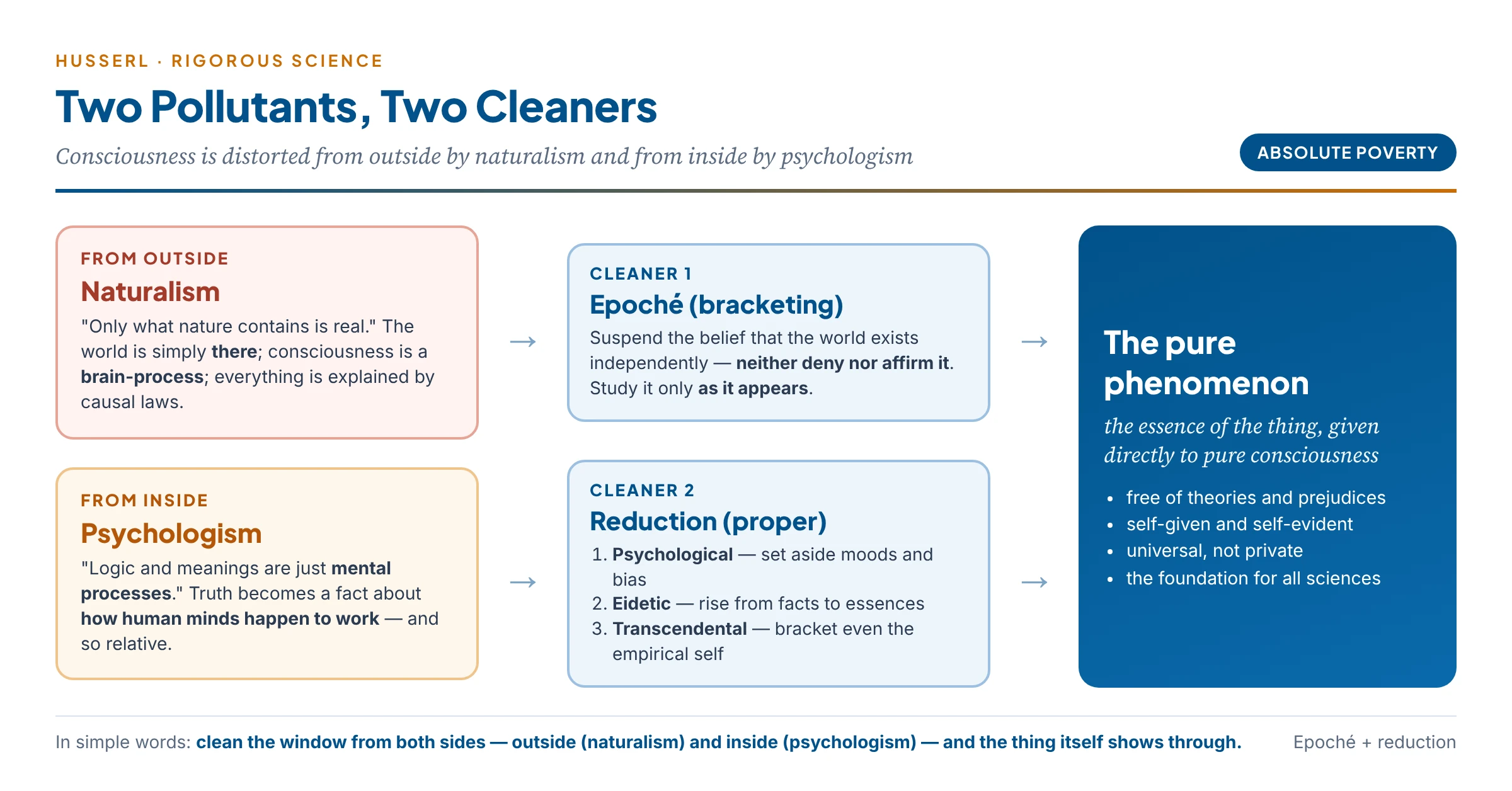
Husserl found that our consciousness and our knowledge are polluted by two deep-rooted attitudes. Both must be removed before the pure phenomenon can be reached.
| Attitude | What it claims | Where it pollutes | Removed by |
|---|---|---|---|
| Psychologism (psychological belief) | Logic, mathematics and meanings are products of mental processes and can be explained by the laws of psychology | From inside — internal pollutant | Reduction (proper) |
| Naturalism (naturalistic belief) | Only what belongs to nature (what is given in sense-experience and studied by natural science) is real; everything is explained by natural laws | From outside — external pollutant | Epoché (bracketing) |
Naturalism — what it holds:
- Sense-experience is the test. Whatever is given in sense-experience is taken as true; whatever is not part of nature is rejected.
- Natural law explains everything. All phenomena can be explained by natural laws; other theories are dismissed as myths and superstitions.
- Consciousness is naturalised. Consciousness is treated as identical with the brain, a physical thing; psychology becomes the study of the behaviour of the body on a stimulus–response formula.
- Ideas are naturalised. Even norms — logical, ethical, aesthetic — are treated as natural facts.
- Husserl’s verdict. Natural science is not a fully rigorous science, because it rests on an unexamined naturalistic belief — that the world simply exists out there, independent of consciousness. A philosophy built on naturalism cannot reach pure objectivity.
Historicism and “world-view” philosophy. In Philosophy as a Rigorous Science, Husserl attacked a second fashionable error alongside naturalism: historicism, the view that every philosophy is only the expression of its age and culture, so that there is no timeless truth. He also rejected world-view philosophy (Weltanschauung philosophy), which offers wisdom for living but gives up the claim to science. Both, he argued — together with the voluntarism (placing will above intellect) that such views encourage — end in relativism and scepticism: if truth changes with history, the statement “truth changes with history” is itself only a passing opinion.
3. What Psychologism Is
Psychologism is the view that logical laws, meanings and truths are nothing more than products of human psychological processes. Logic, on this view, is simply a description of how people in fact think, and so it is a branch of psychology.
- Origin of the word. The term (Psychologismus) was coined in 1870 by the Hegelian J. E. Erdmann to criticise the philosopher Eduard Beneke.
- Main defenders. J. S. Mill (“logic is a part or branch of psychology”), Christoph Sigwart, Theodor Lipps, Benno Erdmann, Wilhelm Wundt, Gerardus Heymans and Herbert Spencer — though how far each really held it was itself disputed.
- The great dispute. Between about 1890 and 1914 German philosophy was engulfed in the “psychologism dispute” (Psychologismus-Streit), whose best-known critics of psychologism were Frege and Husserl.
- Typical psychologistic arguments:
- Logic studies laws of thought; psychology studies all laws of thought; so logic is part of psychology.
- Rules need facts. Every normative discipline (telling us what we ought to do) must rest on a descriptive science; the only descriptive science of thinking is psychology.
- Logic studies mental things. Logic deals with concepts, judgments and inferences; these are mental entities; so logic belongs to psychology.
- Truth is felt. We recognise logical truth by a feeling of self-evidence, and feelings are mental.
- We cannot think otherwise. We cannot conceive of a different logic; the limits of what we can conceive are limits of the human mind; so logic is relative to the human species.
- Mill on contradiction. Mill held that even the law of contradiction is “one of the first and most familiar generalisations from experience” — based on the fact that belief and disbelief are two mental states that exclude each other.
4. Husserl’s Own Early Psychologism and Frege
- Philosophy of Arithmetic (1891). Husserl first tried to explain the concept of number by tracing it to psychological acts — collecting things together and abstracting from their differences.
- Frege’s review (1894). Gottlob Frege criticised the book sharply: it treated meanings, concepts and objects as kinds of ideas in the mind, gave psychological origins for abstract concepts, and wavered between calling concepts subjective and objective.
- The turn. Husserl re-examined his position and gave up his earlier view. (How much Frege’s criticism caused this, and how much Husserl’s own reading of Bolzano and Lotze, is still debated.) In the Prolegomena to Pure Logic he became the most influential critic of psychologism in Europe.
- Why it matters. This change of mind led him directly to the idea of phenomenology: a discipline that studies ideal meanings and the acts that grasp them without confusing the two.
5. Husserl’s Arguments against Psychologism
The basic distinction. Husserl distinguishes the psychological act of thinking from the logical content or meaning of what is thought.
- Acts are temporal, subjective and contingent — they happen in individual minds, at particular times, and vary from person to person.
- Logical truths are universal, necessary and objective — they do not depend on whether anyone happens to think them.
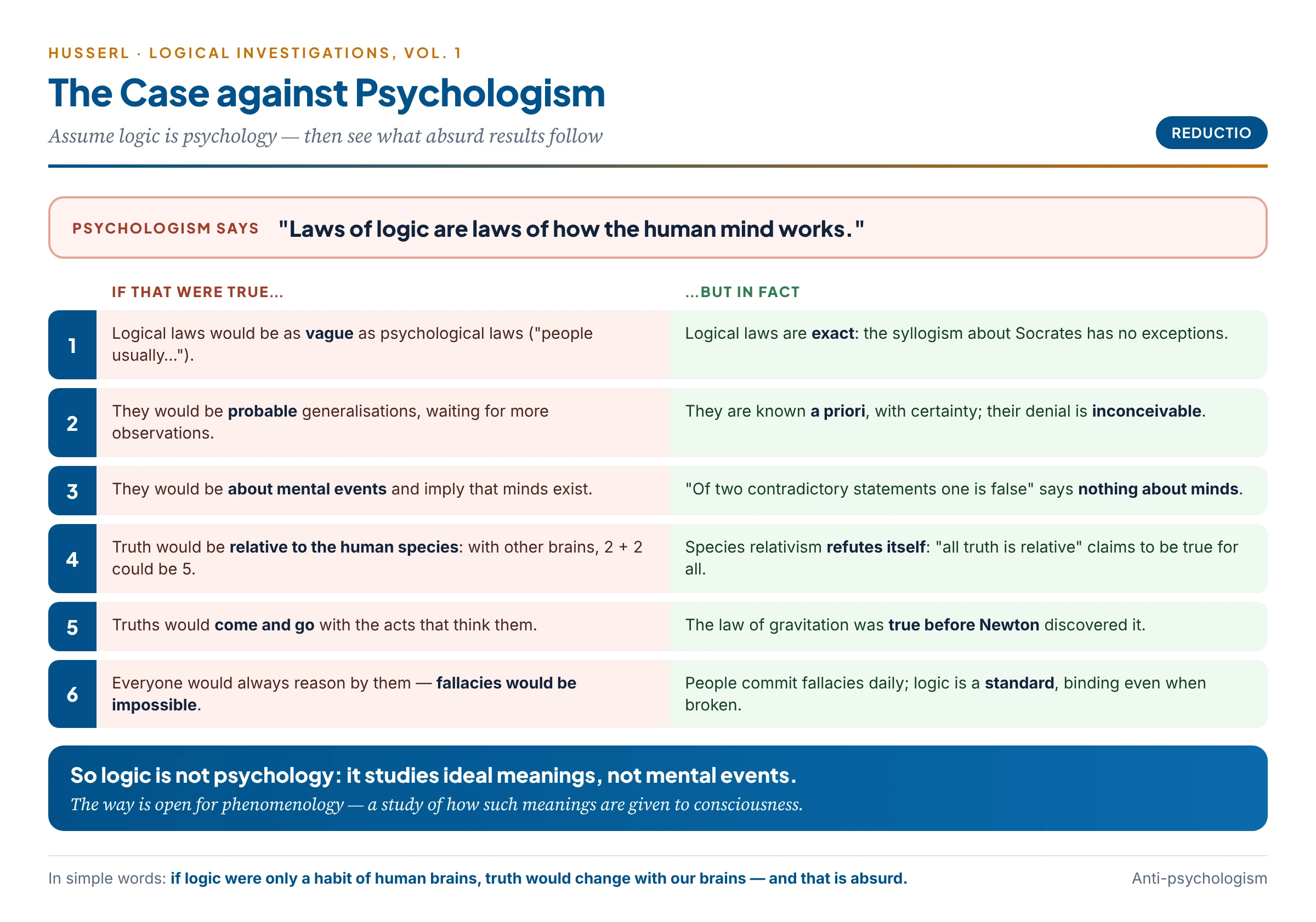
Argument 1 — Exactness against vagueness.
- If logical laws were based on psychological laws, they would be as vague as psychological laws are. (“People usually remember better what they repeat” — such laws hold only roughly and with exceptions.)
- But logical laws are perfectly exact. “If all men are mortal and Socrates is a man, Socrates is mortal” has no exceptions and no “roughly”.
- So logical laws are not psychological laws.
Argument 2 — Certainty against probability.
- Psychological laws are inductive generalisations from observed cases; they are only probable and can be overturned by new observations.
- Logical laws are known a priori, with apodictic self-evidence; they are valid, not merely probable. We do not wait for more experiments to confirm that a statement and its denial cannot both be true.
- So logic cannot be an empirical science of the mind.
Argument 3 — Logic is not about mental events.
- If logical laws were psychological laws, they would refer to mental events and would imply that such events exist.
- But a logical law like “of two contradictory statements, one is false” says nothing about minds, thinkers or acts. It would hold even if there were no minds at all.
Argument 4 — Psychologism leads to relativism, and relativism refutes itself.
- Truth would depend on the mind. If truth depended on mental processes, different individuals or cultures could have different truths, and there would be no objective standard of validity. Science, mathematics and philosophy would lose their universal character.
- Individual relativism (Protagoras’ “man is the measure of all things”) refutes itself: the thesis “all truth is relative” claims to be true without qualification — or else it is only “true for Protagoras” and need not concern anyone else.
- Species relativism (which Husserl calls anthropologism) says logic is valid only for the human species. It too is absurd:
- The same thought cannot be true for one species and false for another, because the law that a thought cannot be both true and false is part of the very meaning of “true”.
- Truths are timeless. They are not located in place or time, so they cannot vary with the biology of a species.
- If truth were relative, the existence of the world would also be relative — there would be one world for humans and another for other beings.
- The “2 + 2 = 5” test. If logic were only the way human brains happen to work, then had our brains evolved differently, 2 + 2 might equal 5. But the truth of arithmetic plainly does not wait on our brain chemistry.
Argument 5 — Truths are eternal; they do not come and go.
- The law of gravitation was true before Newton discovered it. Its meaning includes that it holds for all times, whether or not anyone is thinking it. Against Sigwart, Husserl insists that a judgment can be true even if no intellect ever thinks it.
- Mental events come into being and pass away. If logical laws were laws about such events, truths would come into being and pass away too — which is absurd.
Argument 6 — If the laws of logic were laws of thought, we would never reason badly.
- Psychological laws describe what actually happens. If the rules of valid reasoning were psychological laws, all actual reasoning would follow them — and fallacies would be impossible.
- But people make fallacies every day. Logic does not describe how we always think; it marks the difference between valid and invalid thinking.
Argument 7 — Logic is binding even when we break it.
- The law of non-contradiction (“a thing cannot both be and not be the same at the same time and in the same respect” — this wall cannot be both white and not white all over at once) is not a report of how people usually think. People do contradict themselves.
- The law remains binding: it tells us how we must think if we are to think rationally at all. In this sense logic is normative — it sets a standard — while psychology is descriptive.
Argument 8 — The ideality of meaning.
- When two people contemplate the Pythagorean theorem, their mental acts are numerically distinct — two events, in two heads. But the meaning they grasp is strictly identical: one theorem, not two.
- When we understand “triangle” or “justice“, we grasp a meaning that goes beyond our private experience: it can be shared, repeated and recognised as the same across different acts of thought and different thinkers.
- So meanings are ideal objects — neither physical things nor mental events, but intelligible structures open to any rational subject. Husserl even calls truths ideal species of the ideal genus “truth”.
Argument 9 — The three prejudices behind psychologism. Husserl traced psychologism to three mistaken assumptions:
- “Rules for thinking must rest on psychology.” False — the practical rules of logic rest on pure logic, a theoretical science of meanings and their relations.
- “Logic deals with ideas, judgments and inferences, which are mental.” False — by the same reasoning mathematics would be a branch of psychology, since we also count and calculate with our minds. But no one thinks the theorems of geometry are facts about brains.
- “Truth is recognised by a feeling of self-evidence, which is mental.” False — self-evidence is the experience of truth, not its ground. If one person finds a statement self-evident and another finds its denial self-evident, one of them is wrong. Truth comes before self-evidence.
In simple words
A thermometer and the temperature are different things. The thermometer is a glass tube that can crack, be badly made or show the wrong reading. The temperature is what it tries to measure. Our minds are like thermometers for truth: they grasp truth, sometimes well, sometimes badly. Psychologism studies the thermometer and thinks it has studied temperature. Husserl says the logician studies the temperature — the truth itself — and the psychologist studies the instrument.
6. Husserl’s Distinction Is Not Simply “Is versus Ought”
- A common short-cut. Many summaries say Husserl’s main argument is: “psychology tells us how we do think; logic tells us how we ought to think.”
- Husserl’s deeper point. Husserl himself did not think the is–ought contrast was enough. He agreed that rules for correct thinking are a kind of practical guidance, and that every such practical discipline must rest on some theoretical science. His point was that the theoretical science behind logic is not psychology but pure logic — the science of ideal meanings and their necessary relations.
- Why the difference matters. The normative force of logic does not come from a fact about minds plus a command; it comes from the truths about meanings themselves. “Whoever accepts that all men are mortal and that Socrates is a man ought to accept that Socrates is mortal” — because the meanings guarantee it, not because of a law of mental association.
Common confusion
Did Husserl refute psychologism just by saying “logic is normative, psychology is descriptive”? Not quite. The normative/descriptive contrast is a useful first step, and Husserl does say logic is binding while psychology only describes. But he explicitly rejected the idea that this contrast alone settles the matter. His decisive arguments are that logical laws are exact, a priori and certain, that they are not about mental events, that psychologism ends in self-refuting relativism, and that meanings are ideal — the same for every mind that grasps them.
7. From Anti-Psychologism to Phenomenology
- Separating two disciplines. Husserl separates empirical psychology — which studies how thinking actually occurs, its causes, associations and neural conditions — from pure logic, which studies the ideal meanings and laws that make thinking valid.
- A new task. But there remains a puzzle: ideal meanings are grasped in real mental acts. How do timeless truths appear in our time-bound experience? Studying this relation without reducing meanings to acts, or ignoring acts altogether, is the task of phenomenology.
- Consciousness is not one object among others. By rejecting psychologism, Husserl makes phenomenology a non-naturalistic foundation for knowledge. Consciousness is not treated as a thing inside nature, to be studied like a stone or a gland, but as the field in which meanings, truths and objects are constituted (built up and given as meaningful).
- “Descriptive psychology” abandoned. In the first edition of the Logical Investigations, Husserl called phenomenology “descriptive psychology“. He soon dropped the label, because it suggested that phenomenology was a branch of empirical psychology — exactly the confusion he was fighting.
- Avoiding a relapse. A critic might say: “If phenomenology studies consciousness, isn’t it psychologism all over again?” Husserl’s answer is the phenomenological method. Phenomenology does not study the consciousness of this person as a natural event; it studies the essential structures of consciousness as such, after the natural world (and the empirical self) has been bracketed.
8. How the Phenomenological Method Avoids Psychologism
The method is designed so that phenomenology never slides back into psychologism. Each step removes one source of it.
- Epoché (bracketing) — suspends the natural attitude and the naturalistic belief that consciousness is a thing in the causal order of nature. Consciousness is no longer studied as a brain-process.
- Psychological reduction — sets aside moods, feelings, biases and the personal colouring of experience, so that what is studied is not “how Ravi feels today” but the structure of the experience.
- Eidetic reduction — moves from particular facts to universal essences by free imaginative variation. Its results are a priori truths about every possible experience of a kind — not empirical generalisations about some people’s minds. Psychology collects facts; phenomenology grasps essences.
- Transcendental reduction — brackets even the empirical ego (the person with a body and a biography). What remains is transcendental consciousness, which is nobody’s private psychology but the field in which all meaning is constituted.
Result. Phenomenology studies consciousness without psychologism: it describes the ideal, essential and transcendental structures of experience, never the contingent workings of individual minds.
In simple words
Two ways of studying chess. A neuroscientist wires up the players and records which nerves fire when they move a bishop — that is like psychology. A chess teacher explains how a bishop must move and why a move is legal or illegal — that is like logic. Phenomenology is a third thing: it describes what it is for anyone to see the board as a game, to “see” a threat or a plan — the structure of the experience itself, true for every player, not the nerve-firings of one player.
9. The Task of the Philosopher
- To describe, not speculate. The philosopher’s task is the rigorous, presuppositionless description of consciousness and of things as they are given in it — not speculation about hidden realities.
- To reach essences. He must rise from facts to essential structures — of perception, memory, imagination, judgment, value, time-consciousness and selfhood — which hold for every possible experience of their kind.
- To ground the sciences. Philosophy must be the foundational science: it clarifies the basic concepts (number, space, cause, life, mind) on which each special science relies without examining them.
- To resist relativism. Against psychologism, naturalism and historicism, the philosopher defends the objectivity of truth.
- To serve humanity. In the Crisis (1936) Husserl called philosophers “functionaries of mankind“: by restoring the link between science and lived human meaning, philosophy is responsible for the rational renewal of culture. “We entirely lack a rational science of man and of the human community,” he lamented.
- Is the method still relevant? Yes, in several ways:
- Philosophy of mind — phenomenology gives a method that neither reduces experience to brain events nor rests on casual introspection; today’s “neurophenomenology” pairs careful first-person description with brain science.
- Human sciences — qualitative research in psychology, education, nursing and sociology uses “phenomenological” interviewing that brackets the researcher’s assumptions.
- Psychiatry — the description of patients’ lived experience (pioneered by Karl Jaspers) draws on phenomenology.
- Logic and AI — the debate on whether logic and meaning can be reduced to brain or machine processes is a modern form of the psychologism dispute.
Critical Evaluation
Objections to Husserl’s Anti-Psychologism
- Begging the question (Moritz Schlick). Husserl says psychological laws are vague, so logic cannot rest on them. But one could argue the other way: since logical thinking is a mental process, the existence of exact logic shows that some psychological laws are exact. To assume that all psychological laws are vague is to assume what has to be proved.
- Logical knowledge is also learnt (Heymans). We are more certain of logic only because we “experiment” with it every hour of our lives; its certainty is a very high probability, not a different kind of knowledge.
- Logic rests on values (Neo-Kantians). Some Neo-Kantians held that the highest logical norm — “every thinker ought to think what is true” — is a value, not a theoretical truth; so logic is grounded in values, not in a theory of ideal meanings.
- Platonism. Ideal meanings that exist in no mind and no place look like Plato’s Forms in a new dress. Where are they, and how does a mind in time come to grasp something timeless?
- The return of naturalism. In the twentieth century naturalised epistemology (for example Quine’s) and cognitive science brought back a moderate psychologism: knowledge and reasoning are to be studied as natural processes. Husserl’s sharp wall between logic and psychology is not accepted by all.
- Phenomenology as disguised psychologism. Some critics say that a philosophy which grounds everything in consciousness cannot escape psychologism, whatever it calls its consciousness (“transcendental”).
Husserl’s replies (and those of his defenders):
- To Schlick and Heymans. Even a psychology that found exact laws would still describe what happens; it could never show what must be true. The certainty of logic is not a high degree of probability but a different kind of evidence — its denial is inconceivable, not just unlikely.
- To the Platonism charge. Husserl’s ideal meanings are not things in a heaven of Forms; they are “irreal” — they exist only as meant, as the identical content of possible acts. They are correlates of consciousness, but not parts of anyone’s mind.
- To the disguised-psychologism charge. The transcendental reduction marks the difference: psychology studies consciousness as a part of the world; phenomenology studies consciousness as that for which there is a world at all.
Strengths
- It saved the objectivity of logic and mathematics at a time when they were being dissolved into psychology.
- The act/content distinction is now basic to philosophy of mind and language, in both continental and analytic traditions; Husserl and Frege together laid the foundation of twentieth-century philosophy of logic.
- It refutes relativism at its root by showing that “truth is relative” undermines itself.
- It opened phenomenology — the careful description of experience as a philosophical discipline.
Critics and Defenders
Criticism — Critics
- Schlick — calling all psychological laws vague begs the question.
- Heymans — logical certainty is only very high probability gained from constant practice.
- Neo-Kantians — logic rests on values, not on a theory of ideal meanings.
- Naturalists (Quine, cognitive science) — reasoning should be studied as a natural process; the wall between logic and psychology is too sharp.
- Platonism charge — timeless ideal meanings are mysterious entities.
Defence — Defenders and strengths
- Frege — independently reached the same conclusion: truth is independent of being taken to be true; logical laws are “boundary stones” that thought can overflow but never move.
- Certainty of a different kind — the denial of a logical law is inconceivable, not merely unlikely.
- Irreal, not Platonic — meanings exist as meant, as identical contents of possible acts, not in a separate world.
- Relativism refuted — psychologism leads to species relativism, which refutes itself.
- Lasting legacy — the act/content distinction and the objectivity of meaning are now common ground.
Cross-Tradition Comparison
Objectivity of Truth in Indian Philosophy
Indian epistemology faced a very similar question: does the truth or validity of knowledge depend on the knower, or on the object and the means of knowledge?
| Point | Husserl | Indian parallel |
|---|---|---|
| Truth independent of the knower | Truth does not depend on anyone’s mind; the law of gravity was true before Newton | Śaṅkara: knowledge of a real thing is vastu-tantra (dependent on the object), not puruṣa-tantra (dependent on the person). Action can be done this way or that at will; knowledge cannot |
| Self-evidence and validity | Truth comes before the feeling of self-evidence | Mīmāṃsā — knowledge is svataḥ-prāmāṇya (valid by its own nature); Nyāya — validity is parataḥ (checked by external tests such as successful action). Both reject the idea that validity is a private feeling |
| Logic not a description of thinking | Logical laws are exact and normative | Nyāya treats the rules of inference (vyāpti, the five-membered syllogism, the hetvābhāsa or fallacies) as conditions of valid knowledge (pramā), not as reports of how people happen to reason |
| Danger of relativism | Species relativism refutes itself | Jaina anekāntavāda allows many standpoints but not pure relativism: each standpoint is true from a viewpoint; Jainas still accept objective reality |
| Meaning as shared and ideal | One theorem, many acts of grasping | Mīmāṃsā and Bhartṛhari: word-meaning is eternal and universal; the sphoṭa (meaning-whole) is the same for all speakers, distinct from the passing sounds |
Indian Connect — Key takeaways
- Śaṅkara’s vastu-tantra / puruṣa-tantra distinction is a close Indian parallel to Husserl’s anti-psychologism: knowing is governed by what is known, not by the knower’s wishes or make-up.
- Mīmāṃsā’s eternal word-meaning and Bhartṛhari’s sphoṭa anticipate the ideality of meaning: many utterances, one meaning.
- Nyāya separated psychological questions (how a cognition arises) from epistemic ones (whether it is a valid cognition, pramā) — the same separation Husserl insisted on.
- Difference: Indian schools tie valid knowledge to pramāṇas and often to liberation (mokṣa); Husserl ties it to apodictic evidence and the foundation of the sciences.
Western Positions Compared
| Point | Mill (psychologism) | Frege | Husserl |
|---|---|---|---|
| What logic is about | Operations of the human understanding | Laws of truth | Ideal meanings and their laws |
| Status of logical laws | Generalisations from experience | Objective, timeless | Exact, a priori, apodictic |
| Danger seen | — | Idealism and solipsism | Relativism and scepticism |
| Meanings | Mental ideas | Objective “thoughts” in a third realm | Irreal ideal unities, correlates of acts |
| Next step | Empirical psychology of reasoning | Logicism (maths from logic) | Phenomenology |
Synthesis (Siddhānta)
- The core insight. The act of thinking and what is thought must never be confused. Acts are many, temporal and private; meanings and truths are one, timeless and shareable. Logic studies the second; psychology the first.
- The core arguments. Logical laws are exact, a priori, certain, not about mental events, and binding even when broken; psychologism makes truth relative to the human species, and species relativism refutes itself.
- The positive outcome. Anti-psychologism did not lead Husserl to ignore consciousness. It led him to a new science of consciousness — phenomenology — which studies how ideal meanings are given in experience, using epoché and reduction so that it never collapses back into psychology.
- The wider project. Philosophy must become a rigorous science — beginning in “absolute poverty“, accepting only what is self-given, and so grounding all the sciences and renewing human culture against naturalism, historicism and relativism.
- Open questions. How timeless meanings are related to time-bound minds, and how sharp the line between logic and psychology should be, are still debated — today in the language of naturalism and cognitive science.
- Indian resonance. Śaṅkara’s principle that knowledge depends on the object, not on the person, and the Mīmāṃsā doctrine of eternal meaning, show that classical India, too, refused to make truth a product of the knower’s mind.
“Experience by itself is not science.” — Husserl
“The laws of truth are not psychological laws: they are boundary stones set in an eternal foundation, which our thought can overflow but never displace.” — Frege
Previous Year Questions
- 2022What is psychologism? Critically discuss the way Edmund Husserl avoids the problem of psychologism in the discourse of transcendental phenomenology.
- 2020What, according to Husserl, is wrong with psychologism? How does Husserl address the problems with psychologism in his phenomenological method?
- 2016What, according to Husserl, is the task of a philosopher? Do you think his methods are relevant to philosophy? Discuss.
- 2005What is ‘epoche’? Bring out its significance for Husserl’s conception of rigorous science.
- 2003Discuss Husserl’s conception of philosophy as rigorous science.