

Phenomenology (Husserl): Method; Theory of Essences; Avoidance of Psychologism.
Official Syllabus: Paper I, Section A, Unit 9
Husserl’s phenomenological method is a step-by-step procedure for seeing things exactly as they are given to consciousness, free of every assumption we normally carry. It begins by noticing the natural attitude — our everyday, unquestioned belief that the world simply exists “out there” — and then suspends that belief through the epoché or bracketing. Through a series of reductions it then leads attention back from the world to the consciousness in which the world is given, up from particular facts to universal essences, and finally to transcendental consciousness — the field in which all meaning is constituted. The method was Husserl’s answer to the question: how can philosophy become a rigorous science that starts with no presuppositions at all?
In simple words
Imagine visiting an art gallery and standing before a painting of a mountain village. You do not ask, “Do these houses really exist? Can I walk to that village?” You set that question aside and look at how the scene is presented — the light, the depth, the way the path leads your eye. You lose nothing of the picture; you simply stop asking about its existence. The epoché asks us to look at the whole world in this way for a while: not denying it, not doubting it, just setting aside the question “does it really exist?” so that we can study how it appears.
Context & Problem
Why a Method Was Needed
- The goal. Husserl wanted philosophy to be a rigorous science beginning in “absolute poverty” — with no inherited assumptions — and accepting only what is self-given in experience.
- The obstacle. Our ordinary experience is shot through with presuppositions: theories, opinions, judgments, prejudices and, above all, the unexamined belief that the world exists independently of consciousness. These conceal the true nature of things. The concealment is contingent, so it can be removed — but only by a deliberate method.
- The two pollutants. Naturalism distorts consciousness from outside (by treating everything, consciousness included, as a natural thing); psychologism distorts it from inside (by treating meanings and truths as mental events). The method must remove both.
- The guiding principle. In Ideas I (1913) Husserl laid down the “principle of all principles“: whatever presents itself to us directly and originally in intuition is to be accepted simply as what it is presented as, but only within the limits in which it presents itself. Nothing else — no theory, no inherited doctrine — counts as evidence.
- Describe, don’t explain. The method marks a shift from explanatory thinking (asking why things exist, by finding causes) to reflective description (asking how they are given to consciousness).
Influences on the Method
- Descartes. Husserl admired Descartes’s method of doubt and his making the cogito (“I think”) the starting point of philosophy. He called his own late lectures Cartesian Meditations (delivered in Paris, 1929). But he believed Descartes had not understood his own discovery.
- Greek scepticism. The word epoché comes from the ancient sceptics, for whom it meant suspension of judgment.
- Kant. From Kant, Husserl learned that a theory of consciousness must study its form (its structures) as well as its content.
- Brentano. From Brentano came intentionality — every act of consciousness is directed at something — which the method lays bare.
Core Doctrine
1. The Natural Attitude
Definition. The natural attitude (natürliche Einstellung) is Husserl’s term for the ordinary, pre-philosophical way in which we relate to the world in everyday life. In it we simply take for granted the existence of the world, its objects and other people, without asking how they are known or experienced.
Its features:
- Naïve realism. We assume things exist independently of us and exactly as they appear.
- Immersion. We live absorbed in practical concerns — working, perceiving, judging, interacting — and never notice the part that consciousness plays in disclosing things as meaningful.
- The general thesis. Underlying all particular beliefs is one silent, all-embracing belief: “the world is there” — Husserl calls it the general thesis of the natural attitude.
- Science shares it. The natural sciences also work within the natural attitude: they treat the world as an objective system governed by causal laws, existing apart from consciousness.
- Captivation in acceptedness. We live, as some put it, in a “captivation-in-an-acceptedness” — we take for granted our bodies, culture, language and world, and everyone accepts them. This very acceptance is what holds us captive.
- Husserl’s own description. In Ideas I he describes it vividly: I am aware of a world spread out in space endlessly, and in time becoming and become, without end; I discover it immediately, intuitively; through sight, touch and hearing, corporeal things are simply there for me, whether or not I pay them special attention.
Examples:
- A tree. When we see a tree we immediately assume it exists “out there” as a physical object. We do not reflect on how perception organises changing appearances into the experience of one enduring tree.
- A book on the table. I assume, without reflection, that the book exists out there. Phenomenology asks how the book is actually experienced — through perception, interpretation, memory and expectation.
- Language. In conversation we take shared meanings as self-evident, without analysing how they come to be shared at all.
Is the natural attitude wrong?
- No — it is necessary. Husserl stresses that the natural attitude is not mistaken. It is needed for everyday life and for the growth of the sciences.
- But it conceals a problem. It hides the deepest philosophical question: “How is this world known to us at all?” Because we are absorbed in the world, the constituting role of consciousness stays hidden.
2. Husserl’s Criticism of the Natural Attitude
Husserl’s complaint is not that the natural attitude is false but that it is uncritical, and that philosophy built on it can never be rigorous.
- It assumes what needs examining. It takes the existence and nature of the world as given, so it cannot ask how the world comes to be given.
- It turns consciousness into a thing. It treats consciousness as one more object in nature — a brain-process among other processes — and so leads straight to naturalism and psychologism.
- It confuses theory with experience. It takes the models of science (atoms, waves, formulae) for the world itself, and forgets the lived world from which they were abstracted.
- It breeds scepticism. If the world is “out there” and consciousness is “in here”, there is a gap between them — and the sceptic asks how we could ever cross it. Descartes, trapped “inside” his mind, had to prove the world exists by proving God exists.
- It hides meaning. Absorbed in things, we never see the acts — perceiving, remembering, judging — through which things have their sense for us.
Husserl’s remedy. Not to reject the natural attitude, but to suspend it — to step back and examine it. This step back is the epoché.
In simple words
Think of the frame of your spectacles. You wear them all day and never see them — you see through them. The natural attitude is like those frames: it shapes everything you see, but you never notice it. The epoché is the moment you take the spectacles off and look at them: now you can study how they shape your vision. You will put them back on afterwards — but now you understand them.
3. The Epoché (Bracketing)
Definition. The epoché (Greek: “suspension”, “cessation”) is the foundational step of the method: a disciplined decision to set aside — to bracket — all our natural assumptions about the existence of the world, so that we can examine how things appear in consciousness.
What the word covers. Husserl describes it as bracketing (Einklammerung), disconnection, putting out of action, suspension, setting aside, standing at a distance — and as a neutralisation of belief.
What it is not:
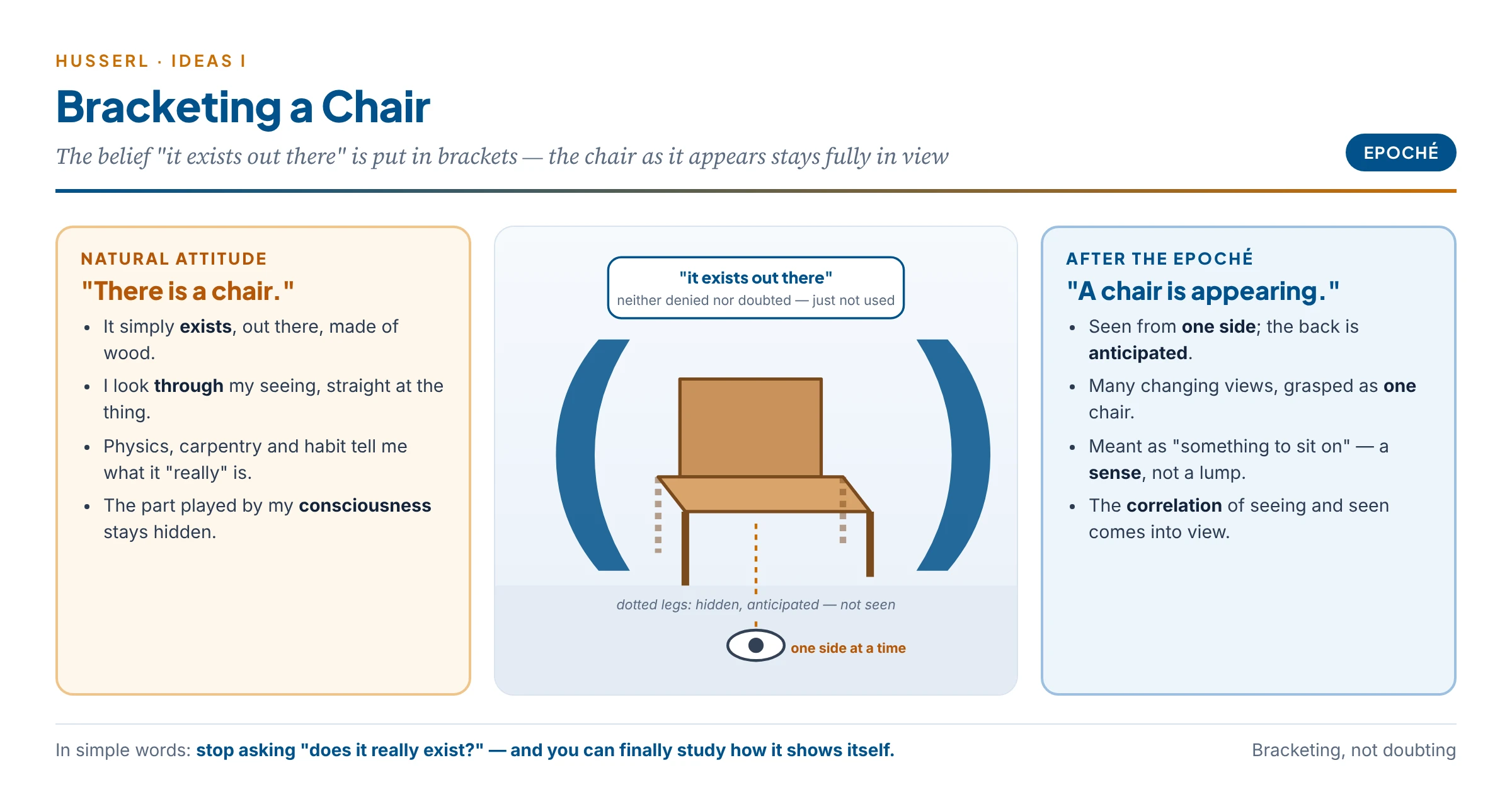
- Not denial. The world is not rejected or declared unreal. As in mathematics, what is placed in brackets is still there; it is simply not used for the time being.
- Not doubt. It is not Cartesian doubt. Descartes doubted the world’s existence to see if anything survived; Husserl neither denies nor doubts the world — he simply makes no use of the belief in it.
- Not scepticism. Its aim is not to show that we cannot know, but to find the firm ground on which knowledge rests.
What it does:
- It frees inquiry. It frees philosophical inquiry from unexamined presuppositions, so experience can be described in its purity.
- It brackets theories. It sets aside all scientific and metaphysical theories about the world — physics, physiology, psychology, theology — together with the general thesis of existence.
- It shifts the question. Phenomenology is not interested in whether things exist in a metaphysical sense, but in how they are experienced.
- It reveals the correlation. What comes into focus is the relation between consciousness and what appears to it.
- Nothing is lost. After the epoché we keep all our experiences and their objects — perceptions, images, memories and the rest — but now as phenomena, as consciousness-relative. In a nice phrase, it is the same tune in a different key.
- It disarms the sceptic. Since the question of existence is set aside, the sceptic’s challenge — “does what you describe really exist?” — has nothing to bite on. The phenomenologist can then undertake rigorous description of any phenomenon, and the descriptions themselves sort out, say, a perceived apple from a merely imagined one.
Examples of the epoché:
- Perceiving a chair. In the natural attitude I assume the chair exists as a wooden object. Under the epoché I suspend this and notice how it is given: I see only one side at a time; the unseen sides are anticipated; my perception involves interpretation, memory and expectation. The chair as experienced is a structured appearance, not a bare physical thing.
- A coffee cup. Bracketing my experience of a cup means suspending even the belief that it is for holding coffee and that its handle is for grasping. Then I see how it presents itself as a series of possible views — I cannot see front and back, or top and bottom, at once.
- A rainbow. Physics explains a rainbow by refraction of light. The epoché brackets the explanation and studies how the rainbow appears: dependent on my position, shifting as I move, with an aesthetic immediacy — the structure of experience before scientific abstraction.
- Music. Hearing a melody, we do not experience isolated notes but a meaningful whole in time. Bracketing the acoustic causes, we notice how consciousness retains the tones just past and anticipates those to come.
- Lived time. Bracketing clocks, calendars and train timetables, we find that lived time is always a “now“, shaded by the just-past and leaning into the about-to-come. To do anything is to do it now.
- Lived space. Bracketing maps and measurements, we find that lived space is always organised around “here” (where I am) and “there” (everything else, at different degrees of thereness).
Who brackets? The epoché raises a new question: who is doing the suspending? Not the world (it is bracketed), not the bodily person (who also belongs to the world). This points directly to the reduction proper and to transcendental consciousness.
4. Epoché and Reduction: Two Moments of One Movement
Husserl often uses “phenomenological reduction” for the whole movement, of which epoché is the first moment.
- Two internal moments. The phenomenological reduction has two internal, logical moments: epoché and reduction proper. They are mutually required and mutually conditioned — two sides of one movement, not two separate stages in time.
- Division of labour. The epoché purifies consciousness from external influence (the naturalistic belief). The reduction proper purifies it internally (from psychologism and the empirical, personal colouring of experience).
- Why bracketing alone is not enough. Bracketing does not by itself take us to the essence: consciousness is still coloured by psychological attitudes — moods, wishes, biases, the sense of being “this person here”. Hence a series of reductions is needed.
- Reduction as insight. The reduction proper is a transcendental insight that breaks open our “captivation-in-an-acceptedness”: we recognise our acceptance as an acceptance. It is like discovering that the mud on the carpet, which we had blamed on someone else, was brought in by ourselves — we see that the world’s sense comes through our own acts of consciousness.
- The meaning of “reduction”. The word comes from the Latin re-ducere, “to lead back“: the reduction leads our attention back from the world to the consciousness in which the world is given.
5. The Phenomenological Reduction
Definition. The phenomenological reduction redirects attention from objects in the world to the way those objects are experienced in consciousness. It is a movement from the empirical standpoint (things as facts in the world) to the transcendental standpoint (how meaning and objectivity are constituted in experience).
- The question it asks. Not “what exists out there?” but “how are objects given to us as meaningful at all?“
- What it discovers. Every object appears only within intentional acts — perceiving, remembering, imagining, judging, valuing. An object is never met in isolation; it is always an object-for-consciousness.
- Subject and object as one structure. Phenomenology studies this inseparable relation instead of treating subject and object as two separate domains.
Examples:
- Perceiving a house. I see only one façade at a time, yet I take it at once as a whole three-dimensional house. The reduction asks how this unity is experienced: consciousness synthesises past views, anticipated sides and background knowledge into the meaning “one house“. Objectivity arises through this synthesis of appearances.
- Remembering a birthday. A childhood birthday is not physically present, yet it appears meaningfully in memory. The reduction studies how memory constitutes this remembered event — through retention, imagination and emotional tone — rather than asking whether the memory matches historical fact.
- Grasping “2 + 2 = 4”. This is not perceived like a physical object; it is given as an ideal meaning. The reduction examines how such ideal objects are intended in acts of understanding.
In simple words
A film-goer usually watches the story — the hero, the chase, the ending. A film student watching the same film notices how the story is given: the camera angle, the cut, the music that makes a scene feel tense. Nothing on the screen has changed, but attention has been led back from what is shown to how it is shown. The phenomenological reduction does this with all experience: it leads attention back from the things to the ways they are given to consciousness.
Its significance. The phenomenological reduction discloses transcendental consciousness — not an individual psychological mind but the field of intentional acts in which all meaning and objectivity are constituted. This is what separates phenomenology from psychology, which studies mental processes as natural events.
6. Constitution of Meaning
Definition. Constitution is the process by which objects, values and truths come to be given as meaningful in consciousness.
- Not creation. Husserl does not claim that consciousness creates the world arbitrarily. Things become intelligible to us only through the structured acts of awareness by which they are experienced.
- Neither “out there” nor “in here”. Meaning is not simply lying in objects, nor merely inside the mind; it arises in the intentional relation between them.
- Synthesis. Consciousness organises partial appearances, temporal phases and contexts so that something is understood as the same object across changing perspectives.
Examples:
- A table. We see one side, then another, while anticipating hidden sides. Consciousness synthesises these profiles into the meaning “one table” — identity through experiential continuity.
- Reading a sentence. Words come one after another, yet we grasp one meaning. Retaining earlier words and anticipating later ones lets the sense emerge — temporal synthesis.
- A flag. A flag is not merely coloured cloth; it is experienced as the symbol of a nation, because consciousness constitutes it within a network of historical and social meanings — a cultural object.
Result. Constitution explains how objects are experienced as stable, intelligible and shareable.
7. The Structure of Time-Consciousness
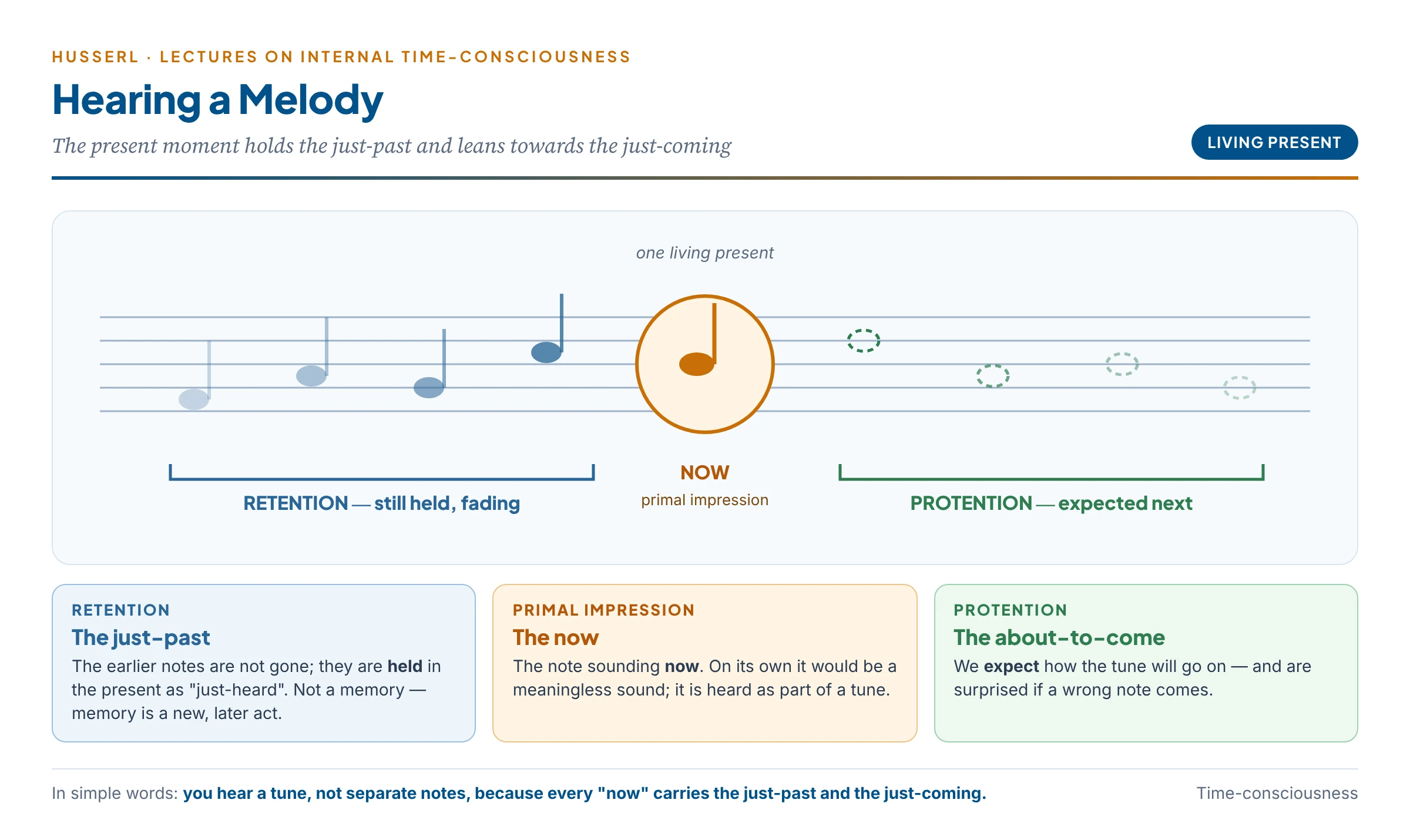
Since every experience happens in time, Husserl analysed how consciousness holds time together. The melody is his favourite example.
| Phase | What it is | Melody example |
|---|---|---|
| Primal impression | The now-phase of experience — what is given at this instant | The note sounding now |
| Retention | The just-past, held on to in the present (not a memory, but a fading “still-there”) | The previous notes, still echoing in my hearing |
| Protention | The about-to-come, expected in the present | The note I expect next |
- Why it matters. Without retention and protention we would hear only isolated sounds, never a tune. The unity of any experience — a sentence, a journey, a conversation — rests on this living present with its three phases.
- Retention is not memory. Remembering last week’s concert is a new act that re-presents the past; retention is part of the present experience itself.
In simple words
Watch the word “ELEPHANT” being typed one letter at a time. When “P” appears, “E-L-E” have not vanished from your awareness — you still hold them (retention). And you already expect something like “-HANT” (protention). That is why you see a word and not eight unrelated letters. Husserl says all experience is like this: the present moment always carries a tail of the just-past and a lean towards the just-coming.
8. The Transcendental Reduction
Definition. The transcendental reduction is the deepest stage of the method. It reveals the transcendental subjectivity (or transcendental consciousness, transcendental ego) that constitutes all meaning, knowledge and objectivity.
- Why “transcendental”. Because it investigates the conditions of possibility of experience, not empirical or psychological facts.
- Bracketing even myself. Ordinarily I think of myself as an individual in the world — a biological being with thoughts and perceptions. Husserl says this self-image still belongs to the natural attitude. The transcendental reduction brackets even this empirical or psychological ego.
- The new question. “What is the field within which both the world and the experiencing person are disclosed?” The answer: transcendental consciousness — the fundamental horizon in which all objects appear as meaningful.
- Not a person. This is not a personal ego or psychological mind, but the pure structure of subjectivity that makes experience possible at all. Pure consciousness is not the property of any ego-substance.
- Rock bottom. At this level the reduction reaches rock bottom: transcendental consciousness cannot itself be bracketed — every act of bracketing presupposes it. It is the foundation of all things, and Husserl could call it the wonder of all wonders.
- The phenomenon is consciousness. Through the method we reach consciousness as the pure phenomenon: the original form of a thing is given in consciousness and for consciousness. Ordinary objects become phenomena when we look at their invariant, necessary and universal aspects.
Examples:
- A table’s identity. The phenomenological reduction studies how a table appears. The transcendental reduction asks what structures of consciousness let it be experienced as one, spatial and enduring — and finds the synthesising acts of retention, anticipation and recognition.
- Objectivity. We usually think things are objective because they exist apart from us. The transcendental reduction shows that objectivity arises through intersubjective structures — things are given as accessible to anyone.
- Science. Science describes the world through mathematical models; the transcendental reduction uncovers the experiential foundations that make such abstractions possible. Even the most objective science presupposes a conscious subject for whom meaning appears.
Significance. The transcendental reduction makes phenomenology a foundational philosophy. It avoids both empiricism (which reduces knowledge to sense-data) and psychologism (which reduces truth to mental processes), revealing the transcendental structures through which any world, object or truth can be disclosed.
Common confusion
Does the transcendental reduction mean that the world exists only in my mind? No. The transcendental ego is not “my mind” — not Ravi’s or Meera’s psychology. And “constitution” does not mean manufacture: consciousness does not make trees and mountains. It means that whatever is real is given as real through acts of consciousness, and that the sense “real, existing, objective” is itself something consciousness confers and confirms in experience. Husserl called his position transcendental idealism, but it is an idealism of meaning, not a claim that things are made of ideas. Whether it fully escapes subjective idealism is one of the main criticisms of Husserl.
9. How Many Reductions? Sorting Out the Names
Different textbooks and study notes list the reductions differently, which confuses students. The substance is the same.
| Version | The steps |
|---|---|
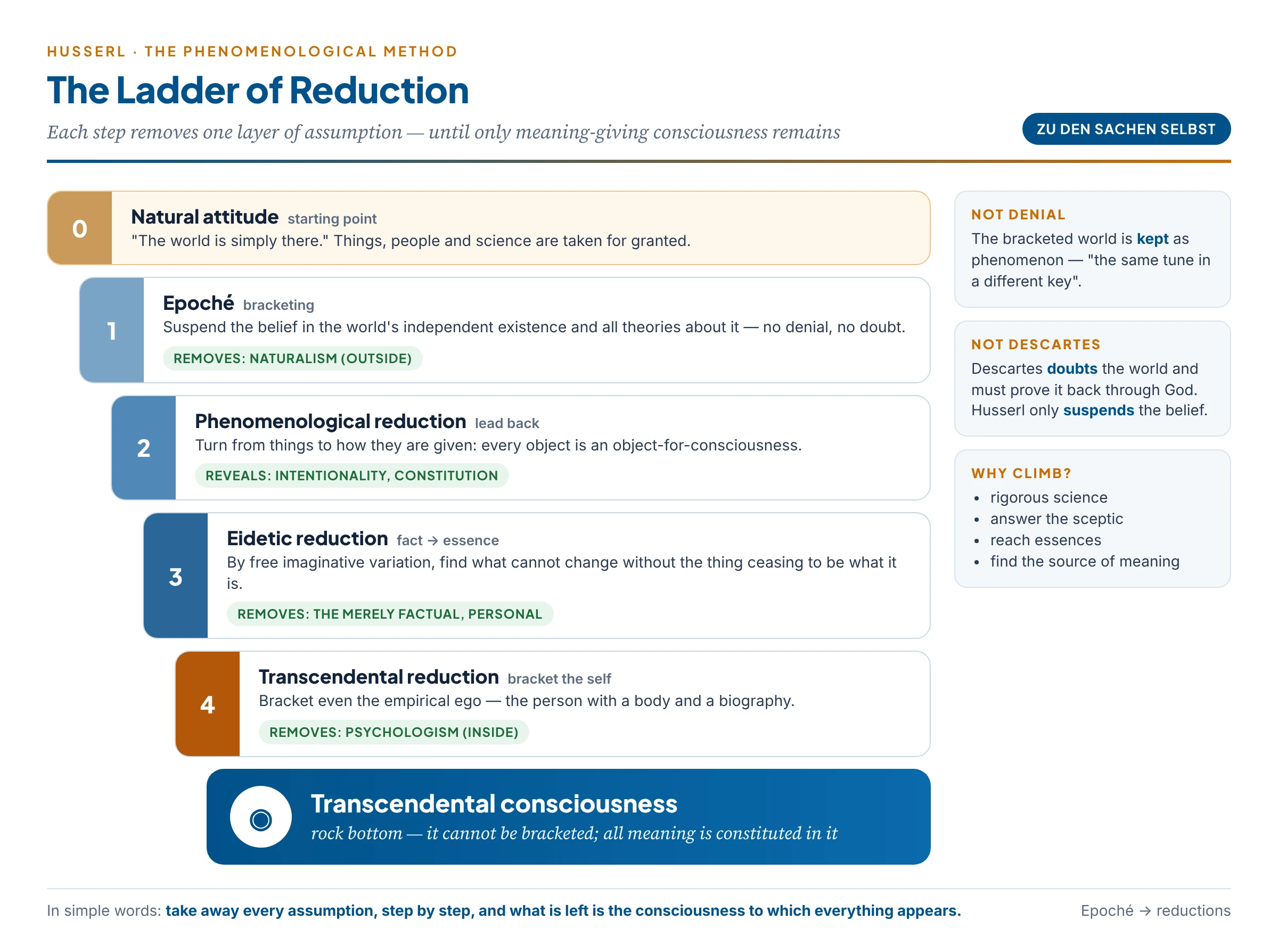
| Basic three-step version | 1. Epoché (bracketing) → 2. Eidetic reduction (from fact to essence) → 3. Transcendental reduction (to pure consciousness) |
| Epoché + reduction proper | Epoché (removes external naturalism) + reduction proper, which has three kinds: psychological (removes moods and biases), eidetic (grasps essences), transcendental (brackets the empirical ego) |
| Another listing | Phenomenological reduction (freeing consciousness from psychological states), transcendental reduction (from the subjective state to the objective structure), eidetic reduction (grasping what is given in universal form) |
| Husserl’s own usage | The phenomenological (or phenomenological-transcendental) reduction, which suspends the world and leads back to transcendental consciousness; and the eidetic reduction, which leads from facts to essences. They can be combined: transcendental phenomenology is an eidetic science of transcendental consciousness |
Common confusion
Which is the “right” order of the reductions? There is no single fixed order in Husserl’s writings; he described the method differently at different times. What matters is the three tasks the method performs: (1) suspend the natural belief in the world (epoché); (2) rise from particular facts to universal essences (eidetic reduction); (3) lead back from the empirical self to transcendental consciousness (transcendental reduction). Any list that covers these three tasks is correct.
10. Why Husserl Advocated the Reduction
Husserl’s reasons for insisting on phenomenological reduction can be summed up in seven points.
- To make philosophy a rigorous science. Only by suspending every presupposition can philosophy start from absolutely certain, self-given ground.
- To remove naturalism and psychologism. The epoché removes the external pollutant (the naturalistic belief); the reduction proper removes the internal one (psychologism).
- To answer scepticism. By bracketing the “being question”, it leaves the sceptic nothing to doubt and makes certain description possible.
- To reveal intentionality. It brings into view the correlation of consciousness and object — the noesis–noema structure — which the natural attitude hides.
- To reach essences. It opens the way to eidetic intuition — knowledge of what must belong to any experience of a kind.
- To discover the source of meaning. It uncovers transcendental consciousness, the field in which all meaning and objectivity are constituted.
- To ground all the sciences. Every science presupposes basic concepts and a world given in experience; the reduction lays bare that ground.
11. Epoché Compared with Cartesian Doubt
| Point | Descartes’ methodic doubt | Husserl’s epoché |
|---|---|---|
| Aim | To find indubitable certainty as the foundation of knowledge | To found philosophy as a rigorous science of experience |
| What it does to the world | Doubts it — treats it as possibly false | Brackets it — neither denies nor doubts; makes no use of the belief |
| Nature | Epistemic: used to eliminate false beliefs | Methodological: suspends belief to analyse experience |
| What survives | The thinking self (cogito ergo sum) as a substance | Transcendental consciousness with its whole world of phenomena |
| How the world returns | Proved later through God’s veracity | Never lost — studied as constituted in experience |
| Hidden presupposition | Still assumes a natural world and a soul-substance in it | Tries to assume nothing that is not self-given |
12. Heidegger’s and the Existentialists’ Rejection of the Epoché
Husserl’s most famous pupils accepted intentionality and phenomenological description, but rejected bracketing.
- Heidegger: we cannot bracket the world. For Heidegger, the human being (Dasein, “being-there”) is being-in-the-world (In-der-Welt-sein). We are not detached minds who could suspend our belief in a world “outside”; we are always already involved with things — using a hammer, walking a road. The world is not an object of belief that can be switched off; it is the horizon of our very existence.
- Practical before theoretical. Bracketing makes our basic relation to the world theoretical — as if we were born spectators who only later learn to act. Heidegger insists we are first in the world practically, through our concerns and tools (the ready-to-hand), and only secondarily as observers of objects (the present-at-hand).
- Being is not an essence. The existentialists’ main objection: being — the fact that we exist — is not an “essence” that can be captured by a reduction. Sartre points to “phenomena of being“, like the feeling of nausea, which reveal that we exist and need not exist (our contingency) — not something known but felt.
- “A complete reduction is impossible.” Merleau-Ponty drew the moderate lesson: the most important thing the reduction teaches is that a complete reduction is impossible, because you cannot “reduce” the existing reducer — we remain irremediably in the world, through our lived bodies and their “operative intentionality”.
- Being-in-the-world instead of the transcendental ego. Where Husserl ends with a pure transcendental ego that has bracketed the world, Heidegger begins with Dasein, whose very being is world-involving. The “subject” is not outside the world looking in.
- Husserl’s reaction. Husserl regarded Heidegger’s Being and Time (1927) as a relapse into anthropology — a study of one region of beings (man) passed off as fundamental philosophy — and refused to recognise it as true phenomenology.
- Husserl’s late concession. Even so, Husserl himself later introduced the life-world (Lebenswelt) — the pre-theoretical world of everyday life — as the ground of all theory, which partly meets the existentialist objection.
Indian Connect — Epoché and Indian disciplines of withdrawal
Indian traditions also teach a step back from the ordinary absorption in the world — but usually for liberation rather than for science.
- Yoga — yogaś citta-vṛtti-nirodhaḥ: Yoga is the stilling of the modifications of the mind. Like the epoché it withdraws attention from the flow of objects; unlike it, it aims at the cessation of mental activity and the isolation (kaivalya) of the pure witness (puruṣa).
- Buddhist mindfulness (sati, vipassanā) — bare attention to what arises, without adding judgments, labels or stories. This is very close to the descriptive attitude of phenomenology.
- Advaita Vedānta — neti neti (“not this, not this”) sets aside body, senses and mind as not the Self, until only the witness-consciousness (sākṣī) remains — a striking parallel to the transcendental reduction, which brackets the empirical ego.
- Śaṅkara’s adhyāsa — our ordinary life is built on superimposition, taking the not-self for the self; discrimination (viveka) removes it. Husserl’s natural attitude is likewise a deep taken-for-granted overlay, removed by reflection.
Critical Evaluation
Objections to the Method
- Can it be done? Many philosophers find the epoché hard to perform or even to understand. How can one truly bracket belief in the world while still analysing experience of it? The procedure may be more theoretical than practically achievable.
- The charge of idealism. By saying objects are constituted in consciousness, phenomenology seems to make the world dependent on subjectivity, weakening realism about an independent world. Several of Husserl’s early followers (the “realist” phenomenologists of Göttingen and Munich) broke with him on exactly this point after Ideas I.
- Solipsism. If philosophy begins from my consciousness after the world is bracketed, how can it reach other minds? Critics find Husserl’s account of intersubjectivity insufficient to escape methodological solipsism.
- Neglect of history and existence. Existentialists argue that human existence is always historically situated, embodied and finite; the method overlooks culture, temporality and death in favour of abstract essences.
- Anti-naturalism questioned. Thinkers influenced by cognitive science argue that consciousness must be studied empirically too; cutting phenomenology off from natural science isolates philosophy.
- Essentialism. The search for fixed universal essences looks too rationalistic; meanings and experiences are fluid, historically changing and socially shaped.
- “Look more closely.” The method rests on seeing essences directly. If someone says “I don’t see it“, the phenomenologist can only reply “look again” — there is no further proof.
- No agreement. Different philosophers following Husserl’s method reached different results, and there was little agreement even about what the method was.
Replies and Defences
- On performability. The epoché is not an exotic mental trick; it is a change of attitude, like the shift from using a word to studying its grammar. Scientists already do a version of it when they set aside their hopes to look at the data.
- On idealism. “Constitution” concerns sense, not manufacture; the reduction does not take the world away but keeps it as phenomenon — “the same tune in a different key”.
- On solipsism. Husserl devoted the fifth of his Cartesian Meditations to intersubjectivity, arguing that every experience of objects already refers to other possible perceivers.
- On history. The late Husserl’s turn to the life-world and to the history of science (in the Crisis) answers the charge that he ignored history.
- On “look more closely”. In practice we often do come to see the point; mathematics, too, ends in an “aha!” of insight rather than in a further proof.
“The Dream Is Over”?
- In a late note (1935) Husserl wrote: “Philosophy as science, as serious, rigorous, indeed apodictically rigorous science — the dream is over.“
- He was describing the mood of his age — the spread of world-view philosophy and irrationalism — not announcing his own surrender. He went on working to revive the dream in the Crisis.
Common confusion
Did Husserl give up his ideal of rigorous science at the end of his life? No. The famous sentence “the dream is over” describes what others in his time had come to believe as philosophy turned towards world-views and irrationalism. Husserl quoted it in order to resist it. His last work, the Crisis, is an attempt to rescue reason and rigorous philosophy from that collapse.
Critics and Defenders
Criticism — Critics
- Heidegger — we are being-in-the-world; the world cannot be bracketed; the practical comes before the theoretical.
- Merleau-Ponty — a complete reduction is impossible; we cannot reduce the existing, embodied reducer.
- Sartre — the transcendental ego is unnecessary; existence is felt (nausea), not reduced to essence.
- Realist phenomenologists — “constitution” slides into idealism.
- Naturalists — consciousness must also be studied empirically.
Defence — Defenders and strengths
- A real method — it made the careful, assumption-free description of experience a philosophical discipline.
- Epoché is not denial — the world is kept as phenomenon; only the belief in its independent existence is suspended.
- Answer to scepticism — by bracketing the “being question” it gives description a certain base.
- Self-correcting — Husserl’s own life-world analysis absorbs much of the existentialist criticism.
- Fruitful — existentialism, hermeneutics, Merleau-Ponty’s philosophy of the body and today’s phenomenological psychology all grew from it.
Cross-Tradition Comparison
Husserl’s Method and Indian Methods of Insight
| Point | Husserl | Yoga | Buddhism | Advaita Vedānta |
|---|---|---|---|---|
| Starting problem | Natural attitude: world taken for granted | Mind’s restless modifications (vṛtti) | Clinging to things as permanent, self-owned | Superimposition (adhyāsa) of not-self on Self |
| Step back | Epoché — suspend belief in existence | Nirodha — still the modifications | Mindfulness — bare attention, no added views | Neti neti — negate body, mind, ego |
| What remains | Transcendental consciousness constituting meaning | Puruṣa, the pure witness | Flow of momentary events, no self (anattā) | Sākṣī — witness consciousness, Brahman |
| Goal | Rigorous science of meaning | Kaivalya (isolation, freedom) | Nirvāṇa | Mokṣa (liberation) |
| Role of essences | Central — eidetic intuition | Not central | Rejected (no fixed essences) | Beyond all forms |
Indian Connect — Key takeaways
- The gesture of stepping back from ordinary absorption is common to Husserl and Indian contemplative traditions; the purpose differs — knowledge and science for Husserl, liberation for the Indian schools.
- Advaita’s witness (sākṣī) and Husserl’s transcendental ego are both “that which cannot be bracketed” — but the witness is actionless pure awareness, while Husserl’s ego is active, constituting meaning.
- Buddhist mindfulness is perhaps the closest practical analogue of the descriptive attitude, yet Buddhism would treat Husserl’s transcendental ego as another construction to be seen through.
Synthesis (Siddhānta)
- The method in one line. Suspend the natural attitude (epoché), lead back from the world to the consciousness that gives it (phenomenological reduction), rise from facts to essences (eidetic reduction), and reach the pure field of meaning-giving consciousness (transcendental reduction).
- What it achieves. It frees philosophy from naturalism and psychologism, disarms scepticism, reveals intentionality and the constitution of meaning, and makes possible a rigorous, descriptive science of experience.
- What it does not do. It does not deny or doubt the world, and “constitution” is not creation.
- Its limits. Whether the epoché can be fully carried out, whether it avoids idealism and solipsism, and whether existence can be bracketed at all remain open — and Heidegger, Sartre and Merleau-Ponty built their philosophies on these doubts.
- Its legacy. Even its critics kept its core: careful description of things as they show themselves. The late Husserl’s life-world shows the method correcting itself.
- Indian resonance. Yoga’s nirodha, Buddhist mindfulness and Advaita’s neti neti show that the step back from ordinary absorption is a universal philosophical gesture — turned in India towards liberation, in Husserl towards science.
“Back to the things themselves!” — Husserl
“The most important lesson which the reduction teaches us is the impossibility of a complete reduction.” — Merleau-Ponty
Previous Year Questions
- 2023Elucidate the significance of bracketing and reduction in Husserl’s phenomenological method.
- 2021Present a critical exposition of Husserl’s criticism of ‘natural attitude’. How does Husserl propose to address the problems involved in natural attitude through his phenomenological method?
- 2018What is Epoché? How does Heidegger reject this method of phenomenological reduction? Explain Heidegger’s concept of ‘being in the world’ as opposed to the concept of a transcendental ego.
- 2017Explain Husserl’s reasons for advocating phenomenological reductionism.
- 2016What, according to Husserl, is the task of a philosopher? Do you think his methods are relevant to philosophy? Discuss.
- 2015Write short note on Husserl’s notion of ‘bracketing’.
- 2014Explain the significance of ‘bracketing’ in Husserl Phenomenology.
- 2005What is ‘epoche’? Bring out its significance for Husserl’s conception of rigorous science.
- 2001Bring out the philosophical significance of Husserl’s method of bracketing.