

Jainism: Theory of Reality; Saptabhaṅgīnaya; Bondage and Liberation.
Official Syllabus: Paper I, Section B, Unit 13
Ordinary logic knows two kinds of judgment: affirmative (“the pot is red”) and negative (“the pot is not red”). The Jainas recognise seven. Because a real thing has infinite aspects (anekānta) and an ordinary knower sees only some, no judgment about it can be absolutely true or false; each holds from a standpoint. So every judgment should carry the small qualifier syāt — “from a certain standpoint“, “in some respect”. This is Syādvāda, the doctrine of the relativity of judgment. Worked out in full, it yields exactly seven forms of conditional judgment, the Saptabhaṅgī-naya (“the method of seven modes”). The doctrine has been attacked as self-contradictory, as scepticism, and as a relativism that secretly needs an absolute — and each charge has a Jaina reply.
In simple words
Is Ravi tall? Among his classmates, yes. Among basketball players, no. Looking at both groups one after another, he is tall and not tall. But if you demand one word, here and now, that states his height in every comparison at once — you cannot; it is inexpressible in a single word. Nothing about Ravi is confused; only our standpoints differ. Put “from this comparison…” in front of each statement and the quarrel disappears. That little phrase is the Jaina syāt.
Context & Problem
From Many-Sided Reality to a Logic of Many Standpoints
- The metaphysical root. Every object has innumerable positive and negative characters, and takes on new ones with time. Only the omniscient knows them all.
- The epistemological consequence. Ordinary knowers grasp some aspects from some standpoints. Our knowledge is therefore partial, relative and conditional — and “so are all our judgments”.
- The logical consequence. If a judgment is true only relative to a standpoint, it should say so. Otherwise a partial truth is mistaken for the whole, and quarrels follow. Syādvāda turns this into a rule of speech; saptabhaṅgī shows all the forms such qualified judgments can take.
- Two sides of one coin. “The metaphysical side that reality has innumerable characters is Anekāntavāda; the epistemological and logical side that we can know only some aspects of reality and that all our judgments are relative is Syādvāda.”
History of the Doctrine
- Early hints. Two passages of the Jaina canon (in the Bhagavatī Sūtra) already say: “relatively, the soul is knowledge; relatively, it is ignorance” and “relatively, the soul exists; relatively, it does not exist; relatively, it is indescribable” — three steps at most.
- Full seven-step form. The developed seven-step doctrine appears first in Kundakunda’s Pañcāstikāya and Pravacanasāra; Samantabhadra (Āptamīmāṃsā) gave it its classical logical defence; Mallavādin, Akalaṅka, Vidyānanda, Hemacandra and Malliṣeṇa (Syādvādamañjarī) developed it further.
- The Buddhist background. The Buddhist Dīgha and Majjhima Nikāyas already know four alternatives (catuṣkoṭi): “is”, “is not”, “both is and is not”, “neither is nor is not”. Critics argue that the first four Jaina steps were borrowed from this scheme.
Core Doctrine
1. What “Syāt” Means
- Literal meaning. Syāt is a form of the verb “to be” meaning “may be“, “perhaps“, “probably“. Some have therefore translated Syādvāda as the “theory of probability” or the “doctrine of may-be“.
- Why that translation is wrong.
- “Probably” suggests scepticism — but Jainism is not scepticism.
- “Somehow”, if understood as “in some unknown way”, smacks of agnosticism — and Jainism is not agnostic either.
- The word is used in the sense of the relative: “relatively speaking“, “from a particular standpoint“, “in a certain respect“, “from this frame of reference“. The correct rendering of Syādvāda is “the theory of the relativity of knowledge (and judgment)“.
- What syāt does. It does not express uncertainty about a judgment; it expresses its conditional character. Within its stated conditions the judgment is true beyond doubt.
- Example. On seeing a black earthen jug in a room, we should not say unconditionally “the jug exists” but “syāt, the jug exists” (syād ghaṭaḥ asti). This reminds us that the judgment is true under particular conditions of space, time and form, and prevents the mistake that the jug exists at all times, in every place, or that a jug of any other colour or shape exists.
- The universe of discourse. Western logicians agree that every judgment is made within a context (“universe of discourse”) of time, place, degree and quality, most of which is left unstated. Since these conditions can never be listed exhaustively — as the pragmatist F. C. S. Schiller admitted — it is wise to mark every judgment explicitly with a word like syāt. The American neo-realists named the error of mistaking one aspect of a thing for the whole the “fallacy of exclusive particularity” — exactly what the Jainas call ekānta (one-sidedness).
- The thing is absolute; our knowledge is relative. “The table exists in itself as an absolutely real and infinitely complex reality; only our knowledge of it is relative.” Syādvāda is not a theory that reality itself is vague.
- The mark of truth. “Syāt is the symbol of truth” (Samantabhadra). Every naya, to become a valid judgment (pramāṇa), must be qualified by syāt; to reject syāt is to fall into unwarranted absolutism.
Common confusion
Does “syāt” mean “perhaps”? No — this is the most common mistake about Jaina logic. Read as “perhaps”, Syādvāda becomes the view of the Greek sceptic Pyrrho, who advised adding “may be” to every statement. The Jaina “syāt” means “from a certain standpoint“. “Syāt, the jar exists” does not mean “the jar might exist — I am not sure”; it means “the jar certainly exists — as clay, here, now, with this form“. The relativity lies in the conditions of the judgment, not in any doubt about it.
2. The Blind Men and the Elephant
- The parable. Six blind men examine an elephant. The one who holds the ear says it is like a fan; the one who touches a leg says it is like a pillar; the one who holds the trunk says it is like a python; the one who feels the tail says it is like a rope; the one who touches the side says it is like a wall. Each insists that his description alone is correct, and they quarrel.
- The resolution. A person who can see the whole elephant knows that each touched only a part and mistook it for the whole. Each statement is true in a respect and false as a description of the whole. Had each said “syāt — in respect of its leg, the elephant is like a pillar”, there would have been no quarrel.
- The meaning.
- The blind men are ordinary knowers with partial knowledge.
- The elephant is many-sided reality.
- The sighted person is the omniscient (kevalin).
- The quarrel is the conflict of philosophies, ideologies and religions: “almost all philosophical, ideological and religious differences and disputes are mainly due to mistaking a partial truth for the whole truth“.
- The lesson. This view makes the Jaina catholic, broad-minded and tolerant: it teaches respect for others’ points of view.

3. The Fourfold Frame: Own and Other
- The rule. “Everything exists from the point of view of its own substance, place, time and form, and does not exist from the point of view of another’s substance, place, time and form.”
- Applied to a clay jar in a room:
| Frame | The jar exists as… | The jar does not exist as… |
|---|---|---|
| Substance (dravya) | Clay | Gold, silver, cloth |
| Place (kṣetra) | In this room | In another room, outside, in Delhi |
| Time (kāla) | Now | Before it was made; after it breaks |
| Form (bhāva) | With its narrow neck, broad belly, red colour | With another shape or colour |
- No contradiction. “Existence belongs to it by its own form, substance, place and time; non-existence by another’s. Where then is there room for contradiction?” Existence and non-existence are asserted of the jar, but not in the same respect.
- Judgments are double-edged. Every affirmation presupposes a negation and every negation an affirmation: to say what the jar is is to say what it is not.
4. The Seven Forms of Judgment (Saptabhaṅgī)
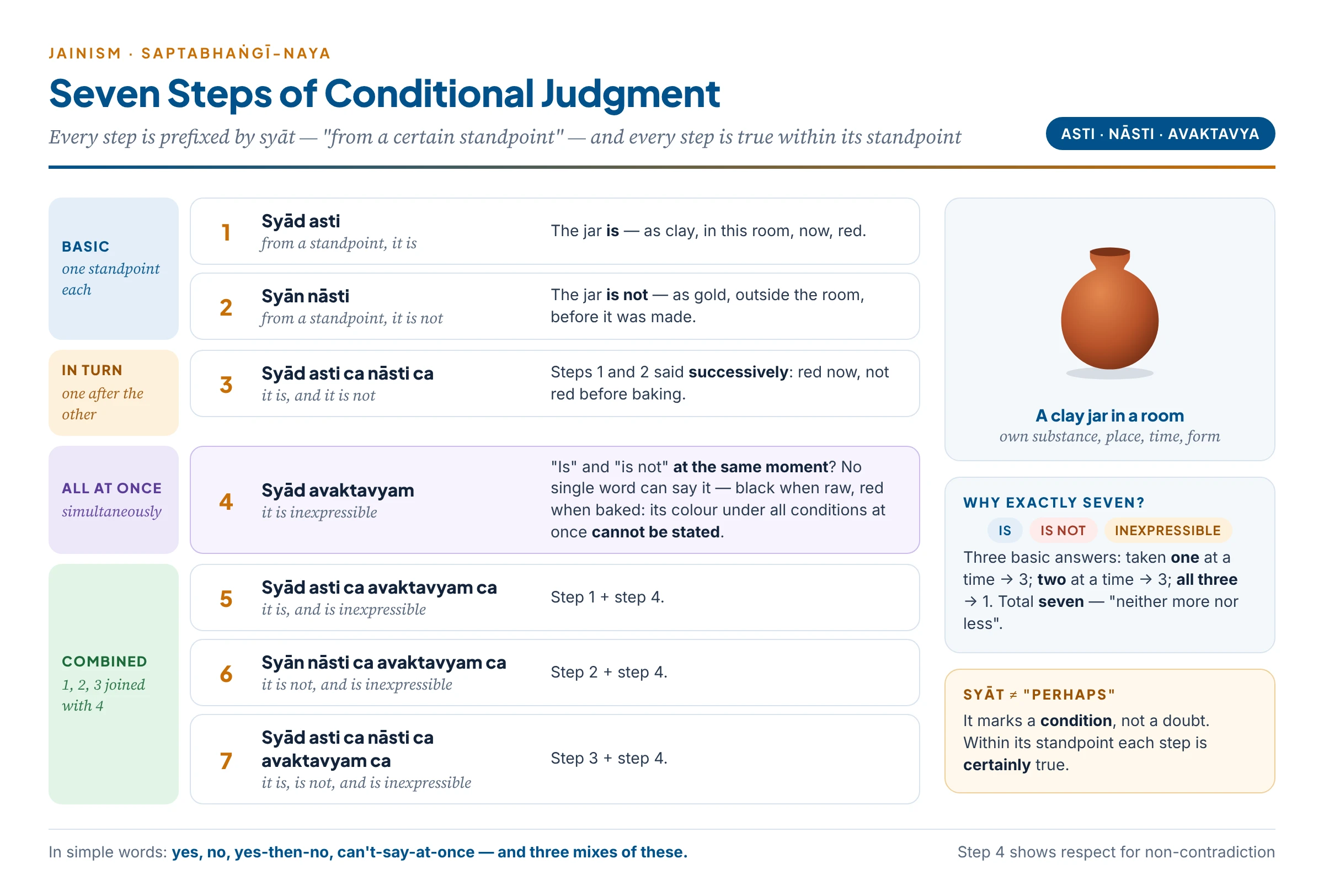
Each judgment is qualified by syāt. Take a clay jar that stands in a room, is red now, and was black before it was baked.
- Syād asti — “from a standpoint, it is.”
- Affirmation from the standpoint of the jar’s own substance, place, time and form: the jar exists as clay, in this room, now, red, with this shape.
- Syān nāsti — “from a standpoint, it is not.”
- Negation from the standpoint of another’s substance, place, time and form: the jar does not exist as gold, outside the room, yesterday, as black.
- Syād asti ca nāsti ca — “from a standpoint, it is, and it is not.”
- The first two standpoints taken one after the other (krama): the jar is red now and is not red as it was before baking.
- Needed because we want a comprehensive view of both the positive and the negative characters of a thing.
- Syād avaktavyam — “from a standpoint, it is inexpressible.”
- If we try to assert existence and non-existence together, at one and the same moment (yugapat), no single word can do it. The jar is black when raw and red when baked; asked “what is its colour under all conditions at once?”, the only honest answer is that it cannot be described that way.
- The thing is then “indescribable” — either “both real and unreal simultaneously” or “neither real nor unreal”.
- Syād asti ca avaktavyam ca — “from a standpoint, it is, and it is inexpressible.”
- The first combined with the fourth: the jar is red now, and without reference to any particular time it is indescribable.
- Syān nāsti ca avaktavyam ca — “from a standpoint, it is not, and it is inexpressible.”
- The second combined with the fourth.
- Syād asti ca nāsti ca avaktavyam ca — “from a standpoint, it is, it is not, and it is inexpressible.”
- The third combined with the fourth.
- The general pattern in words.
- Relatively, a thing is (real).
- Relatively, a thing is not (unreal).
- Relatively, it is and is not, taken in turn.
- Relatively, it is indescribable, taken all at once.
- Relatively, it is, and is indescribable.
- Relatively, it is not, and is indescribable.
- Relatively, it is, is not, and is indescribable.
- Why exactly seven? There are three basic predicates — “is”, “is not” and “inexpressible”. Taken one at a time they give three judgments, two at a time three more, all three together one more: seven, “neither more nor less”. The last three are formed by joining the first three successively with the fourth. If any of the first three were joined to the fourth simultaneously rather than successively, the result would simply be the fourth again — “inexpressible”. So though a thing has innumerable aspects, the forms of judgment about any one aspect are only seven.
- Not “seven truth-values”. The seven are modes of predication about one aspect of a thing, not seven grades of truth. Each one, within its standpoint, is simply true.
In simple words
Ask: “Is the light on?” At 8 pm, yes; at 3 am, no; over the whole day, yes, then no. Now ask: “In one word, valid for every moment at once — is the light on or off?” There is no such word: the honest answer is “that cannot be said in one word“. Combine that with the earlier answers and you get the last three steps. Seven judgments — and not one contradiction, because each has its own “when”.
5. The Unique Significance of the Fourth Judgment
- Recognition of the limits of language. The fourth step admits that some states of reality cannot be put into words at once. This is not agnosticism but epistemic humility: a limit on language, not on existence.
- It breaks the binary. The first three judgments stay within “is” and “is not”; the fourth introduces a third mode — inexpressibility.
- It is the hinge of the last three. Without the fourth, judgments five to seven could not arise.
- It shows that Jaina logic obeys the law of non-contradiction. The fourth step is precisely the Jaina confession that incompatible characters cannot be predicated together, in the same respect, at the same time. Far from violating the law of contradiction, saptabhaṅgī respects it.
- Philosophical wisdom. Wisdom does not lie only in answering “yes” or “no”; it also lies in seeing that some questions are unanswerable in the form in which they are asked. An object “in general”, described from no standpoint, is indescribable.
- Illustration. A mystical trance or deep meditative state defies “is” and “is not” when described from outside; the Jaina says, “from a certain standpoint, it is indescribable” — and so admits ineffability without falling into dogma or silence.
- Parallels.
- Wittgenstein: “Whereof one cannot speak, thereof one must be silent.”
- Buddhist śūnyatā: things lack a fixed essence and lie beyond the four alternatives.
- Upaniṣadic neti neti (“not this, not this”).
- Beyond silence. Unlike these, the Jainas do not stop at silence: they make the inexpressible one formal step of a logic.
- Avaktavya and anirvacanīya. The Jaina “inexpressible” resembles the Advaitic anirvacanīya (indescribable as either real or unreal) — a point critics use against the Jainas, who themselves criticise the Advaitic indescribable.
In simple words
Taste a sweet-and-sour chutney and someone asks, “Is it sweet or sour?” You can answer in turn: “sweet — and also sour.” But if they insist on one single word that states both tastes at the same instant, you have to say, “That can’t be put in one word.” The chutney is not confused; language has run out of room. That is the Jaina avaktavya.
6. Saptabhaṅgī, Catuṣkoṭi and Aristotelian Logic
| Form of judgment | Saptabhaṅgī (Jaina) | Catuṣkoṭi (Buddhist) | Aristotelian logic |
|---|---|---|---|
| “The pot is red” | Yes (from a standpoint) | Yes | Yes |
| “The pot is not red” | Yes (from a standpoint) | Yes | Yes |
| “It is red and not red” | Yes — in turn, from two standpoints | Yes | No (contradiction) |
| “It is inexpressible / neither” | Yes — “inexpressible” when both are asserted at once | “Neither is nor is not” | No (excluded middle) |
| Three further combinations | Yes | No | No |
| Qualifier | Syāt on every judgment | None | None |
- Uniqueness. Compared with other systems of judgment, Jaina logic uniquely includes the inexpressible as a regular form and qualifies every judgment by its standpoint.
7. Syādvāda and Anekāntavāda: the Relation
- Ontology and logic. Anekāntavāda is the theory of reality (reality has infinite aspects); Syādvāda with Saptabhaṅgī is the theory of judgment that follows from it (every judgment holds from a standpoint, in seven possible forms).
- Each supports the other. Reality’s many-sidedness requires conditional judgment; and the fact that one object admits seven valid forms of judgment is itself an argument for its many-sidedness.
- More than an appendix. Syādvāda is “not only an extension of the anekānta ontology, but a separate system of logic capable of standing on its own”.
- Through the fourth step. The inexpressible shows that reality outruns any single description — which is anekānta — and that the human mind knows it only partially — which is syādvāda.
8. Durnaya, Naya and Pramāṇa
An object can be stated in three ways (see the article on Nayavāda):
- Durnaya — “the pot is absolutely real”: a partial truth taken as the whole.
- Naya — “the pot is real”: a relative truth stated without calling it absolute or relative.
- Pramāṇa — “syāt, the pot is real”: a partial truth known to be partial. Naya + syāt = pramāṇa.
9. Why the Jainas Value Syādvāda
- Errorless judgment — it makes our ideas, concepts and judgments precise and authentic by stating their conditions.
- Resolving disputes — religious, social and philosophical quarrels are calmed when each side states its standpoint; it supports religious pluralism, tolerance and, in a sense, multiculturalism.
- A middle path — between the Buddhist theory of momentariness and the Advaitic theory of eternity, both of which Jainism accepts as real from different standpoints.
- Three uses — to show that rival schools are one-sided, to show them tolerance, and to overcome scepticism and agnosticism by giving every view its due place.
- Intellectual ahiṃsā — non-violence in thought: refusing to do violence to another’s standpoint.
Critical Evaluation
A. Is Syādvāda Self-Contradictory?
The charge.
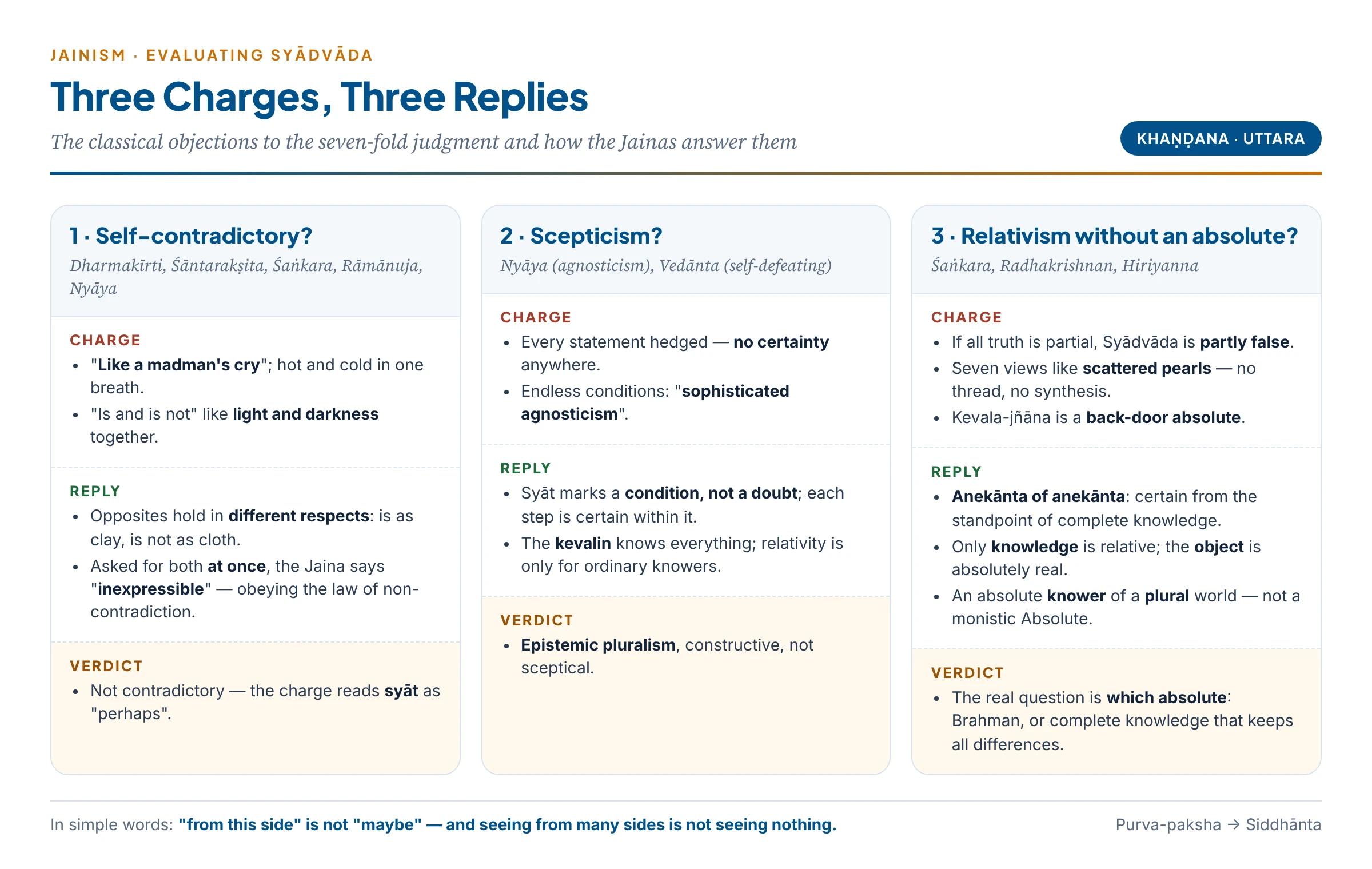
- Dharmakīrti (Buddhist): “these shameless and naked Jainas make contradictory statements like a madman“.
- Śāntarakṣita (Buddhist): Syādvāda, which combines the real and the unreal, the one and the many, the universal and the particular, is “like a madman’s cry“.
- Śaṅkara (Advaita): Syādvāda appears like “the words of a lunatic“; “you cannot blow hot and cold in the same breath“; unity and plurality, permanence and momentariness, reality and unreality cannot belong to the same thing at the same time, any more than light and darkness can be in the same place. A thing cannot have contradictory properties at once (Brahma Sūtra: naikasminn asambhavāt — “impossible in one and the same thing”).
- Rāmānuja: existence and non-existence, like light and darkness, can never be combined.
- Nyāya: the third judgment (“is and is not”) violates the law of non-contradiction and so destroys the basis of rational debate.
- The root of the charge. The critics take syāt in its popular sense of probability and read the judgments as made in the same respect.
The Jaina reply.
- Different respects. The Jainas never say contradictory attributes belong to the same thing at the same time and in the same sense. The jar exists as clay and does not exist as cloth; it is one, permanent and real from the standpoint of substance, many, changing and passing from the standpoint of modes.
- Syāt is a condition, not a doubt. The qualifier makes every statement contextual; contradiction requires the same context.
- The fourth step proves obedience to logic. When asked to affirm both at once, the Jaina says “inexpressible” — exactly what the law of non-contradiction demands.
- Reality is complex. What looks like contradiction is the many-sidedness of reality expressed carefully. Modern physics offers an analogy: light behaves as wave in one experiment and particle in another — contradictory only if both are asserted absolutely.
- “Fearing imaginary contradictions and mistaking partial views as absolute, fools fall from the right position” — so the Jainas answer the “madman” charge.
Verdict. On a careful reading Syādvāda is not self-contradictory: it is a disciplined way of indexing every predicate to its standpoint. The charge holds only against a caricature that reads syāt as “perhaps” and ignores the standpoints.
B. Is Saptabhaṅgī Scepticism?
Why it may seem sceptical.
- Every statement is qualified, which may look like a refusal of certainty.
- Endless conditionality (“it is, it is not, it is indescribable…”) may suggest the Jainas doubt that any definite truth is possible.
- Nyāya accused the Jainas of agnosticism; Vedānta called the view self-defeating relativism.
Why it is not.
- It accepts truth. The Jainas do not deny knowledge; they deny only that any ordinary judgment is total.
- Syāt means condition, not doubt. Within its standpoint a judgment is certain.
- Reality is knowable, not unknowable. Truth is many-sided, not hidden.
- Constructive, not destructive. Scepticism tears down knowledge; Syādvāda harmonises conflicting views.
- Certainty exists at the highest level. The omniscient (kevalin) has complete, absolute knowledge; Syādvāda applies to ordinary human viewpoints.
- Scepticism refutes itself. No one can be a thorough sceptic, for “nothing can be known” is itself a claim to knowledge — whereas the Jaina never says that.
- Ethical aim. Its purpose is tolerance and non-violence of thought, not paralysis.
Verdict. Saptabhaṅgī is epistemic pluralism, not scepticism: it affirms definite truths, each tied to its standpoint, and the possibility of complete truth in omniscience.
C. Can the Relativism of Syādvāda Stand Without an Absolute?
The absolutist argument (Śaṅkara and later Indian thinkers).
- Self-refutation. If everything is merely probable, Syādvāda too is merely probable. If all truth is partial, then Syādvāda itself is only partially true — and therefore partially false.
- Relativity presupposes an absolute. “Relativity itself is related to the Absolute and presupposes its existence”; that all our judgments are relative requires an Absolute in which the relatives fall and through which they are manifested.
- Scattered pearls. The seven judgments are like scattered pearls or flowers; they cannot be woven into a garland without the thread of the Absolute. “The Jainas forget that organic synthesis and not arithmetical addition is the secret of reality”: they give identity plus difference, not true identity in difference.
- The Jainas refuse to rise above the relative. Buddhists and Vedāntins also say all empirical knowledge is relative, but they distinguish the conventional from the ultimate (saṃvṛti and paramārtha, vyavahāra and paramārtha). Jainism, “wedded to common-sense realism”, refuses this distinction.
- Hidden absolutism. The Jainas call every other system one-sided and their own complete: “other systems are fireflies giving broken light; Jainism is the sun” (Hemacandra). “Vītarāga is the only God and anekānta the only philosophy” is itself an absolute claim. Putting partial views together “like the magic lamp of Aladdin” is supposed to make their defects vanish.
- Kevala-jñāna gives the game away. Perfect, direct, intuitive omniscience is absolute knowledge — “a half-hearted confession of absolutism”.
- Radhakrishnan: “In our opinion the Jaina logic leads us to a monistic idealism, and so far as the Jainas shrink from it they are untrue to their own logic… The theory of relativity cannot be logically sustained without the hypothesis of an absolute.”
- Hiriyanna: the sevenfold predication “stops at giving us the several partial views together, without attempting to overcome the opposition in them by a proper synthesis” — out of prejudice against absolutism or a wish to stay close to common beliefs.
The Jaina reply.
- Jainism has an absolute — of the right kind. It does not deny an absolute standpoint; it locates it in kevala-jñāna, the knowledge of the liberated soul. What it denies is that the absolute is a single undifferentiated Being in which plurality vanishes. An absolute knower of a plural world is not a monistic Absolute.
- Anekānta of anekānta. Samantabhadra: anekānta is itself anekānta — from the standpoint of complete knowledge (pramāṇa) the many-sidedness of reality is definitely true; from a partial standpoint one side may be stressed. So Syādvāda is not “partially false” in the critic’s sense.
- Relativity of judgment, not of reality. The table is absolutely real; only our knowledge of it is relative. The “absolute” that relativity presupposes is the real object with all its aspects — which realism already grants.
- Synthesis is not missing. A judgment qualified by syāt points to the whole object (sakalādeśa), not just a part (vikalādeśa); the seven forms together express the object’s positive, negative and inexpressible sides. Syādvāda and omniscience both illuminate all reality — one successively and indirectly, the other simultaneously and directly.
- Some Jaina thinkers grant a higher standpoint. Kundakunda distinguishes the practical standpoint from the pure, real standpoint; Siddhasena compares relative views to rivers that arise from and merge into the ocean.
Verdict. The critics are right that relativism needs an anchor: a judgment can be “relative” only to something not itself relative. But the Jaina anchor is realist (the many-sided object and the omniscient knower), not monistic. The real dispute is therefore not “relativism versus absolutism” but which absolute — Brahman in which differences dissolve, or a complete knowledge in which differences are all preserved.
In simple words
A city has a road map, a metro map and a terrain map. Each is accurate and each is partial. The critic says: calling them “partial” only makes sense if there is a real city they are maps of. The Jaina agrees — but insists that the real city is the city with all its streets, lines and hills, which a perfect surveyor (the kevalin) would see at once; it is not a featureless blank in which the streets disappear. That is the whole quarrel between Jaina realism and monistic absolutism.
D. “All Human Knowledge Is Empirical and Therefore Relative”
- What the Jaina accepts. All ordinary human knowledge — mati and śruta, through senses, mind and words — is empirical, conditioned and partial; hence every ordinary judgment needs syāt. Buddhists (dependent origination), Śūnyavādins, Vijñānavādins and Advaitins agree that empirical knowledge is relative.
- What the Jaina denies. That all knowledge is empirical. The soul’s own direct knowledge — up to kevala-jñāna — is not empirical, and it is not relative.
- The critic’s twist. Since Jainism keeps the relative and the absolute in one realm instead of ranking them as appearance and reality, it is accused of “refusing to rise higher than the relative”. The Jaina answer is that rising higher is precisely what liberation does: the bound soul speaks in syāt-judgments, the liberated soul sees.
- So Saptabhaṅgī is the logic of empirical knowledge — of finite knowers in a many-sided world — while kevala-jñāna is the knowledge of the whole.
E. Further Objections and Replies
| Objection | Jaina reply |
|---|---|
| The last three steps are redundant — mere combinations of the fourth with the first three. Kumārila: on this method “instead of seven, you could have a hundred steps“. | The combinations are logically distinct, and the series closes at seven: simultaneous combinations collapse back into the fourth. |
| The first four are borrowed from the Buddhist catuṣkoṭi. | Even if inspired by it, the Jaina scheme differs: syāt on every step, “inexpressible” in place of “neither”, and three new combined forms. |
| Why exactly seven? The number looks arbitrary. | Three basic predicates admit exactly seven non-empty combinations. |
| It blurs the two-valued clarity of classical logic (every proposition true or false). | Within its standpoint each judgment is plainly true or false; the standpoints are made explicit, not blurred. |
| It undermines definite knowledge (pramā); it is sophisticated agnosticism. | Definite knowledge is affirmed within each standpoint, and complete knowledge in omniscience. |
| Seven scattered judgments, no synthesis. | Syāt-judgments refer to the whole object (sakalādeśa). |
| If all knowledge is relative, how can anyone know that someone is omniscient, or even that “this table is a table”? | Ordinary judgments are relative but certain within their conditions; omniscience is inferred from the degrees of knowledge and tested by its teachings’ agreement with experience. |
| Vaiśeṣika: liberation itself becomes “true from one view only”. | Liberation is real; what varies is only the standpoint of description (as substance the soul was always pure; as mode it was bound and is now freed). |
Critics and Defenders
Criticism — Critics
- Dharmakīrti, Śāntarakṣita, Śaṅkara: a madman’s cry; “hot and cold in one breath”.
- Nyāya: the third step breaks the law of non-contradiction.
- Vedānta: partial truth makes Syādvāda itself partially false.
- Absolutists: relativity needs an absolute; identity plus difference; scattered pearls without a thread.
- Kumārila: why not a hundred steps? The last three are redundant.
- Borrowed from the catuṣkoṭi; seven looks arbitrary.
- Kevala-jñāna smuggles in the absolute it rejects.
Defence — Defenders and strengths
- Opposites asserted in different respects; the fourth step obeys the law of contradiction.
- Syāt = condition, not doubt — certainty within each standpoint.
- An absolute knower (kevalin) of a plural world — realism, not scepticism.
- Anekānta of anekānta answers the self-refutation charge.
- Seven is the exact number of combinations of three basic predicates.
- Anticipates context-relative logic and many-valued logic.
- Grounds tolerance, dialogue and intellectual ahiṃsā.
Cross-Tradition Comparison
| View | Is truth relative? | To what? | Compared with Syādvāda |
|---|---|---|---|
| Protagoras (“man is the measure”) | Yes | The perceiver | Idealistic relativity; Jaina relativity is realistic — relative to the object’s real relations |
| Pyrrho (scepticism) | Suspend judgment; add “may be” | — | Exactly what syāt is not |
| Pragmatism (Schiller) | No judgment true apart from context and purpose — even “a square is not a circle” | Purpose of the judge | Shares context-dependence; but pragmatists lean idealist, Jainas are realists |
| Whitehead | Things are constituted by relations | Real relations | Realistic relativity — closest to the Jaina |
| Hegel | Contradictions are moments of a whole, synthesised in the Absolute | The Absolute | Hegel synthesises; Syādvāda juxtaposes — the absolutist complaint |
| Many-valued logic (Łukasiewicz) | Propositions may take more than two values | — | J. B. S. Haldane (1957) and the statistician P. C. Mahalanobis (1954) read Syādvāda as an early logic of uncertainty and partial information |
| Einstein’s relativity | Measurements of motion and time depend on the observer’s frame | Frame of reference | An analogy: frame-relative descriptions of one real world |
| Niels Bohr (complementarity) | Wave and particle descriptions both needed, never at once | Experimental arrangement | Strikingly like steps 1–4 |
Indian Connect — Key takeaways
- The Buddhist catuṣkoṭi (is, is not, both, neither) is the closest Indian relative; Nāgārjuna used it to negate all four alternatives, while the Jainas use the seven to affirm each from its standpoint.
- The Advaitic anirvacanīya (neither real nor unreal) and the Jaina avaktavya look alike, but the Advaitin concludes that the world is appearance, while the Jaina concludes only that language has limits.
- Schiller’s pragmatism and the Jaina syāt agree that no judgment is true apart from its context; they disagree on whether the context belongs to the knower’s purposes (pragmatism) or to the real object’s relations (Jainism).
Synthesis (Siddhānta)
- The doctrine. Because reality is many-sided, every ordinary judgment is true only from a standpoint, and should be marked syāt — “from a certain standpoint”. Syāt expresses condition, not doubt; the thing is absolutely real, our knowledge relative.
- The seven forms. Is; is not; is and is not (in turn); inexpressible (both at once); and the three combinations of the first three with the inexpressible — exactly seven, each true within its own substance, place, time and form.
- The fourth step is the key: it shows the limits of language and the Jainas’ respect for the law of non-contradiction.
- Against the critics. Syādvāda is not self-contradictory (opposites hold in different respects), not scepticism (definite truths, and omniscience at the top), and not a relativism without anchor (the anchor is the many-sided real and the omniscient knower). Its genuine weak point is the one absolutists press: it shows how partial views fit side by side more clearly than how they unite into one vision.
- Contemporary relevance.
- Dialogue and pluralism. Syādvāda offers a working method for inter-religious dialogue, conflict resolution and deliberative democracy: state your standpoint, grant the other’s.
- Science and data. Every measurement has its frame, instrument and margin; scientists, like Jainas, attach conditions to every claim.
- Media and public debate. In an age of polarised, one-angle “post-truth” argument, the blind men and the elephant describe our predicament exactly.
- Law and ethics. Courts weigh several testimonies, each true from its witness’s position — a practical saptabhaṅgī.
“Syāt is the mark of truth.” — Samantabhadra
Previous Year Questions
- 2026Explain the meaning of seven steps of judgement (Saptabhaṅgīnaya) and its application in Jaina’s Syādvāda for advocating a philosophy of non-absolutism (Anekāntavāda).
- 2023“All human knowledge is empirical and therefore relative.” Critically examine Jaina theory of sevenfold judgement (Sapta-bhangi-naya) in the light of above statement.
- 2022“The doctrine of ‘Relativism‘ of Jain Philosophy cannot be logically sustained without postulating ‘Absolutism’.” Critically examine this view and give reasons in the favour of your answer.
- 2021Explain the Jain view of seven-fold (sapta bhangi) ‘Naya’.
- 2019How is reality defined by the Jainas? How is this theory of reality reflected in their view on judgements? Discuss.
- 2016Examine Jaina stance of ‘Naya’. How does it differ from ‘Syadvada’?
- 2013Analyse the relation between the theory of Saptabhanginaya and Anekantvada.
- 2011Why is Saptabhangi Naya not treated as a doctrine of Scepticism? Discuss.
- 2010Is syadvada a self-contradictory doctrine? Discuss.
- 2001Write short notes on relation between anekantvada and saptabhanginaya.
- 2000Sapta-bhangi Nyaya.
- 1993Syadvada and its justification.