

Jainism: Theory of Reality; Saptabhaṅgīnaya; Bondage and Liberation.
Official Syllabus: Paper I, Section B, Unit 13
If reality is many-sided, how much of it can a knower grasp? The Jaina answer has two halves. In its own nature every soul is pure consciousness, capable of knowing everything — omniscience (kevala-jñāna) is its birthright. But a soul bound by karma knows through a body, senses and mind, and so grasps only some aspects of a thing at a time, from a particular standpoint (naya). The Jaina theory of knowledge therefore does two things: it classifies the five kinds of knowledge, from ordinary sense-cognition up to omniscience, and it maps the standpoints from which partial knowledge is gained — the doctrine of Nayavāda. Nayavāda is the bridge between the metaphysics of many-sidedness (anekānta) and the logic of conditional predication (syādvāda, saptabhaṅgī).
In simple words
A cricket match is shown by ten cameras: one behind the bowler, one at square leg, one on the boundary, one in the sky. Each camera shows something true — and each misses something. The third umpire, with all angles, sees the whole play. Each camera angle is a naya; the replay room with every angle is closer to pramāṇa; and only an umpire who could see every angle at every moment at once would have kevala-jñāna. A commentator who insists his one camera shows “the whole truth” commits the Jaina fallacy of nayābhāsa.
Context & Problem
Why Jainism Needs a Theory of Standpoints
- From reality to knowledge. Anekāntavāda says every object has infinite positive and negative characters. A finite knower cannot take them all in; he looks from one point of view at a time. So every ordinary judgment is partial and relative — this is the epistemological side of anekānta.
- Knowledge and liberation. Knowledge is not a luxury: right knowledge is one of the three jewels of the path to liberation. Ignorance about the soul and the world produces passions, and passions bind the soul to matter.
- The name of the theory. Jaina epistemology is known as “the doctrine of the relativity of knowledge and judgments“.
- Against the Cārvāka. Before mapping standpoints, the Jainas had to secure more than perception. They accept perception, inference and testimony as sources of valid knowledge, and they refute the Cārvāka view that perception alone is valid (see section 2).
Core Doctrine
1. Knowledge Is the Very Nature of the Soul
- Soul as the locus of knowledge. The soul (jīva) is the knower; knowledge is not something grasped and possessed by the soul, but a state of the soul itself. Consciousness is the inseparable essence of every soul.
- Like the sun’s light. Consciousness is self-luminous: like the light of the sun, it reveals itself and other objects at once (jñānaṃ sva-para-bhāsi). “I know the pot” reveals both the pot and the knowing.
- Omniscience is natural; ignorance is acquired. Had there been no obstacles, every soul would be omniscient. Our knowledge is limited because karmic matter obstructs consciousness in different degrees. The body, senses and mind are themselves products of karma; they help us know in the embodied state, but really they are obstructions that stand between the soul and its objects.
- Not accidental. Against the Nyāya–Vaiśeṣika, for whom consciousness is an accidental quality the soul gains only when joined to mind and body, the Jainas make consciousness the soul’s essence; against the Cārvāka, for whom it is a by-product of matter, they make it independent of matter.
2. Sources of Knowledge and the Criticism of the Cārvāka
- Three pramāṇas for ordinary purposes: perception (pratyakṣa), inference (anumāna) and testimony (āgama or śabda). Testimony is valid when it is the report of a reliable authority — above all the teaching of the omniscient Tīrthaṅkaras. Inference is valid when it obeys the rules of logical correctness.
- Comparison is recognition. The Jainas do not accept comparison (upamāna) as a separate pramāṇa; they reduce it to recognition (pratyabhijñā). Later Jaina logicians list the forms of indirect knowledge as memory (smṛti), recognition (pratyabhijñā), inductive reasoning (tarka), inference (anumāna) and testimony (āgama).
- Refutation of “perception alone”.
- Ask the Cārvāka why perception is valid. If he stays silent, his view is a mere ipse dixit (an unsupported assertion). If he says “because it is not misleading“, he has given a reason — that is, used inference.
- The same reason validates the others. If perception is valid because it is uncontradicted, then inference and testimony are valid whenever they too are uncontradicted.
- Perception also misleads. If inference is rejected because it sometimes misleads, perception must be rejected too — it also sometimes deceives.
- The Cārvāka infers all the time. Denying an afterlife because it is not perceived is an inference from non-perception; saying perception will be valid in future generalises from past cases; and in debate the Cārvāka infers his opponents’ thoughts from their words.
- The right criterion of validity is harmony with practice (saṃvāda): any source is valid in so far as the knowledge it gives does not prove misleading when acted upon.
3. Immediate and Mediate Knowledge
- The basis of division. The Jaina classification is based on the manner of acquiring knowledge, not on its objects.
- Mediate knowledge (parokṣa) — any knowledge the soul gains through something other than itself: the senses or the mind.
- Immediate knowledge (aparokṣa or pratyakṣa) — knowledge the soul gains directly, without senses or mind, once the karmic obstacles are removed.
- A surprising reversal. Ordinary sense-perception, which every other school calls immediate, is classed as mediate by the Jainas, because the senses and mind — things other than the soul — are involved. At most it is relatively or empirically immediate (sāṃvyavahārika pratyakṣa) compared with inference; really immediate (pāramārthika pratyakṣa) knowledge belongs to the soul alone.
- Sensation is not yet knowledge. Mere sensation (sense–object contact) cannot be called knowledge; it must be given meaning and order by thought. So even perception presupposes the activity of thought, which is another reason for calling it mediate.
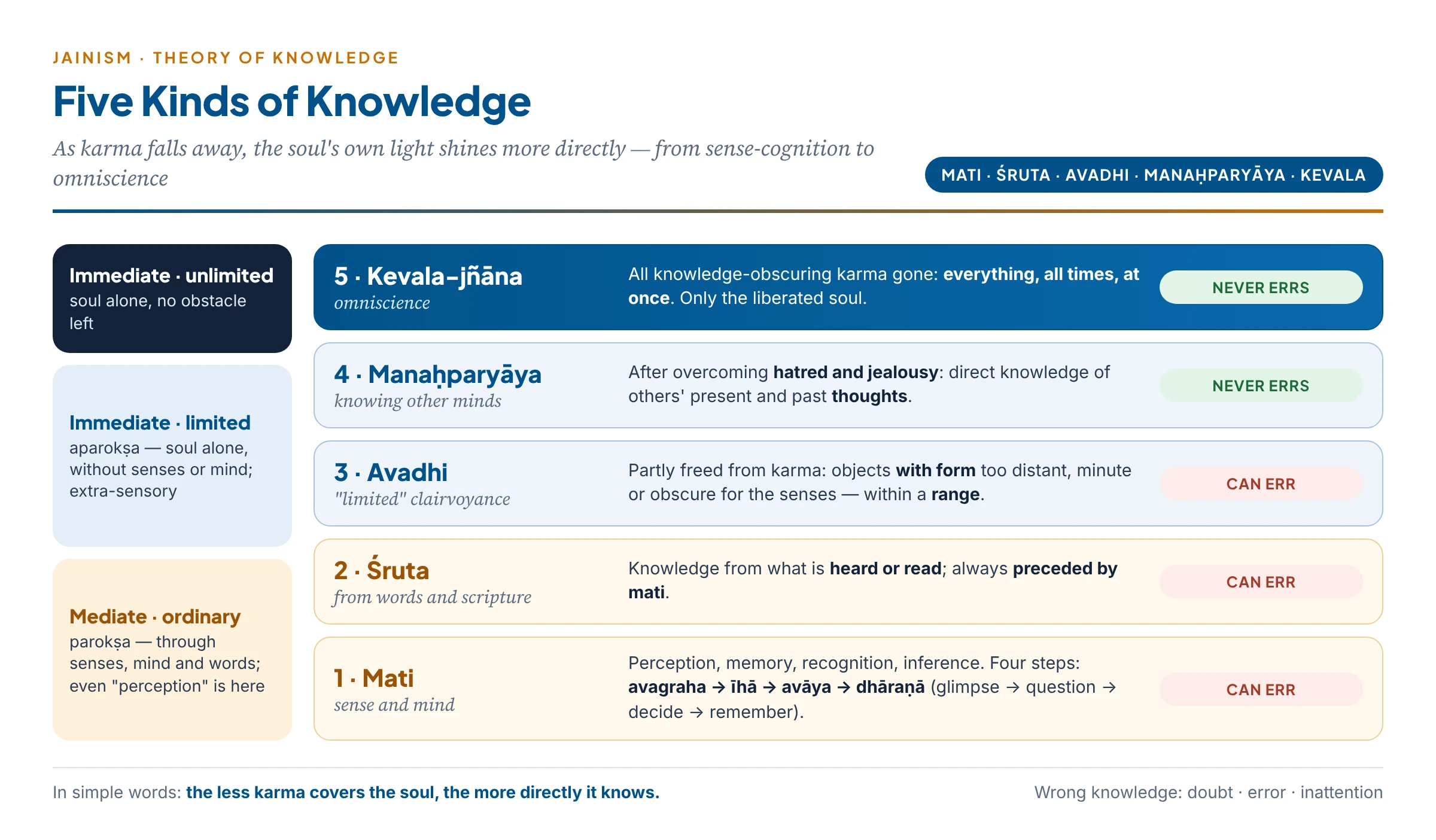
4. The Five Kinds of Knowledge
Mediate (ordinary) knowledge:
- Mati-jñāna — sensory and mental cognition. Knowledge gained through the senses or the mind: it includes internal and external perception, memory, recognition and inference. Mati unfolds in four stages:
- Avagraha (apprehension) — the first vague awareness when sense meets object: something indistinct in the distance; a sound is heard.
- Īhā (inquiry) — the mind asks “what exactly is this?” — “is it smoke or a cloud?”, “what is this sound?”
- Avāya (determination) — a definite judgment, doubt removed: “yes, it is smoke“; “this is the sound of a car”.
- Dhāraṇā (retention) — the knowledge is held in memory: later, “I saw smoke near the mountain“.
- Śruta-jñāna — knowledge from words and authority. Knowledge from what is heard (or read): all knowledge from spoken or written authority, above all the scriptures. Since we must first perceive sounds or letters, śruta is preceded by mati.
Immediate (extraordinary, extra-sensory) knowledge:
- Avadhi-jñāna — “limited” direct knowledge (clairvoyance). When a person is partly freed from karma, he directly knows objects that have form but are too distant, minute or obscure for the senses. It is called avadhi (“limit”) because it works within a particular range of space and time.
- Manaḥparyāya-jñāna — direct knowledge of other minds (telepathy). When hatred, jealousy and similar obstacles are overcome, a person can directly know the present and past thoughts of others. It too is limited by space and time.
- Kevala-jñāna — absolute knowledge (omniscience). When all knowledge-obscuring karma is removed, there arises unlimited, perfect, direct knowledge of all things in all aspects — past, present and future — not limited by space, time or object. It belongs only to the liberated soul (the kevalin).
Fallibility:
- Mati, śruta and avadhi are not entirely free from error; manaḥparyāya and kevala are never liable to error.
- Besides the five kinds of right knowledge, there are three kinds of wrong knowledge: doubt (saṃśaya), error (viparyaya) and wrong knowledge through indifference or inattention (anadhyavasāya).
| Knowledge | Type | Through | Range | Liable to error? |
|---|---|---|---|---|
| Mati | Mediate | Senses and mind | Present objects; memory, recognition, inference | Yes |
| Śruta | Mediate | Words, scripture (preceded by mati) | Whatever authority conveys | Yes |
| Avadhi | Immediate, limited | Soul alone | Objects with form, within a range of space and time | Yes |
| Manaḥparyāya | Immediate, limited | Soul alone | Others’ thoughts | No |
| Kevala | Immediate, unlimited | Soul alone | Everything, all times | No |
In simple words
You hear a faint noise outside at night (avagraha). You wonder, “Is it a cat or a thief?” (īhā). You look out and decide, “It’s the neighbour’s cat” (avāya). Next morning you remember, “The cat was at the gate last night” (dhāraṇā). That is ordinary mati. Reading about cats in a book is śruta. Seeing the cat across the city without eyes would be avadhi; knowing what the neighbour is thinking about the cat would be manaḥparyāya; knowing everything about every cat that ever was — kevala.
5. Pramāṇa and Naya
- Two ways of knowing a thing.
- Pramāṇa — knowledge of a thing as it is, as a whole: comprehensive, valid, holistic. It brings certainty, removes doubt, error and indeterminacy, and serves both worldly and spiritual ends, ultimately liberation.
- Naya — knowledge of a thing in its relation: one aspect of a many-sided object, grasped from a standpoint. The judgment based on such partial knowledge is also called naya. Naya serves practical reasoning and debate, not final cognition.
- Definition of naya. A naya is “the standpoint of thought from which we make a statement about a thing”; classically, “the intention of the knower” (jñātur abhiprāyaḥ) — what the speaker has in view. “All truth is relative to our standpoints.”
- Three ways of stating a truth. We can know and state an object in three ways:
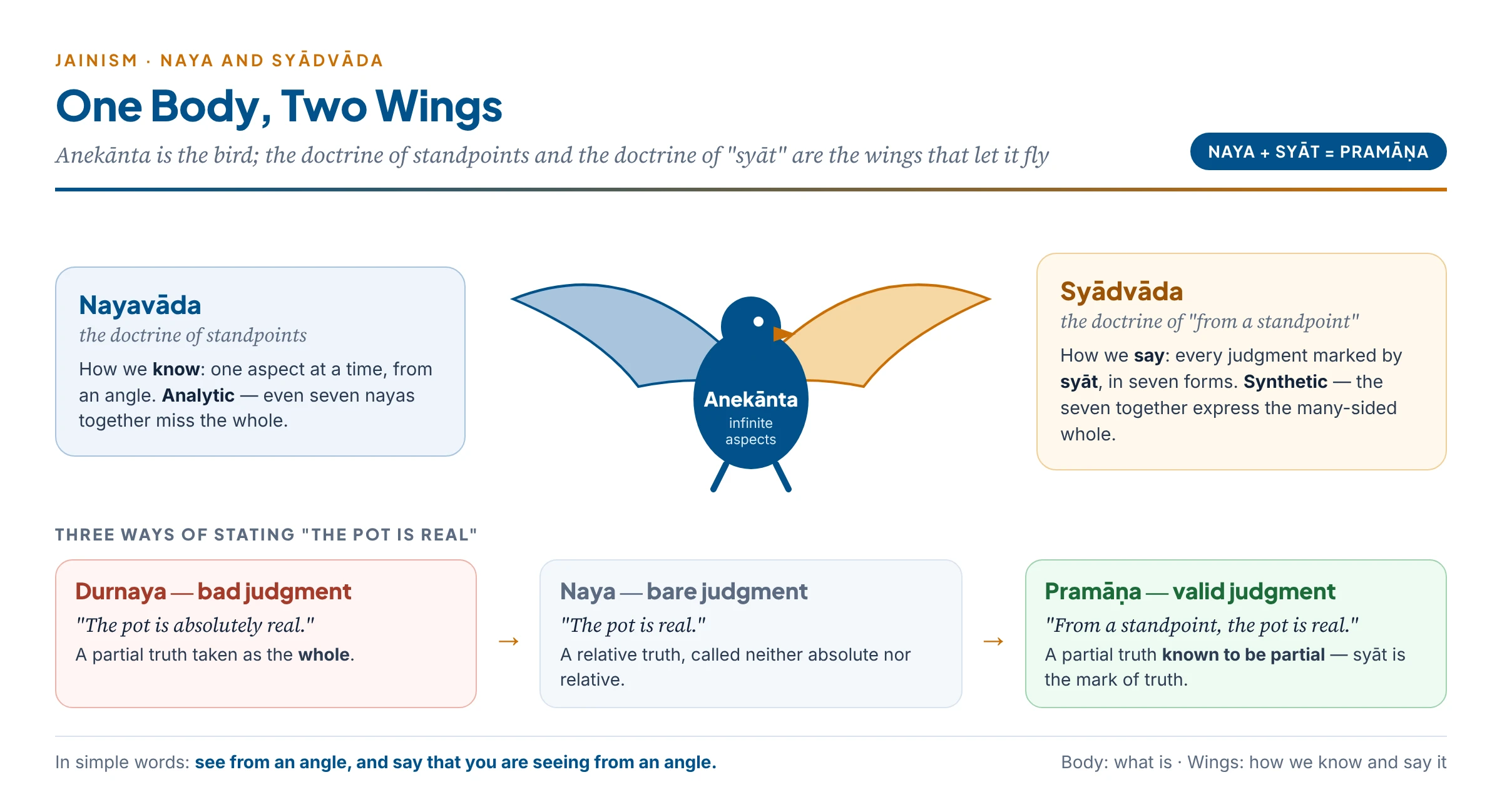
- Durnaya or durnīti (bad judgment) — taking a partial truth for the whole and absolute truth: “the pot is absolutely real” (sad eva).
- Naya (bare judgment) — stating a relative truth without calling it either absolute or relative: “the pot is real” (sat).
- Pramāṇa (valid judgment) — stating a partial truth knowing that it is partial, relative and open to other interpretations: “from a standpoint, the pot is real” (syāt sat).
- Naya + syāt = pramāṇa. “Every naya, in order to become pramāṇa, must be qualified by syāt.” Syāt (“from a standpoint”) is “the mark of truth” (syātkāraḥ satya-lāñchanaḥ — Samantabhadra). It removes all contradictions between different points of view. To reject syāt is to embrace an unwarranted absolutism contradicted by experience.
- Partial and complete statements. A statement that conveys one aspect is called vikalādeśa; a statement that, through syāt, points to the whole object with all its aspects is called sakalādeśa.
6. Two Basic Standpoints
- Dravyārthika-naya — the substance standpoint. Looks at the permanent essence and unity of things: gold as gold, the soul as consciousness. From here reality is one, permanent, universal.
- Paryāyārthika-naya — the mode standpoint. Looks at changing modifications and diversity: ring, bangle, crown; joy, pain. From here reality is many, momentary, particular.
- Both valid, neither complete. Taking a thing as only permanent or only momentary, only one or only many, gives rise to fallacies.
- Practical and real standpoints. Some Jaina thinkers, notably Kundakunda, also distinguish the practical or empirical standpoint (vyavahāra-naya) from the real or pure standpoint (niścaya-naya or śuddha-naya). From the practical standpoint the soul is bound, embodied and acting; from the real standpoint it is pure consciousness.
In simple words
At a school reunion one friend says, “You haven’t changed a bit!” and another says, “You’ve changed completely!” Both are right. The first looks at the same person who has lasted through the years — the substance standpoint. The second looks at the new job, new looks and new habits — the mode standpoint. A quarrel starts only if one of them insists that his remark is the whole truth.
7. The Seven Nayas
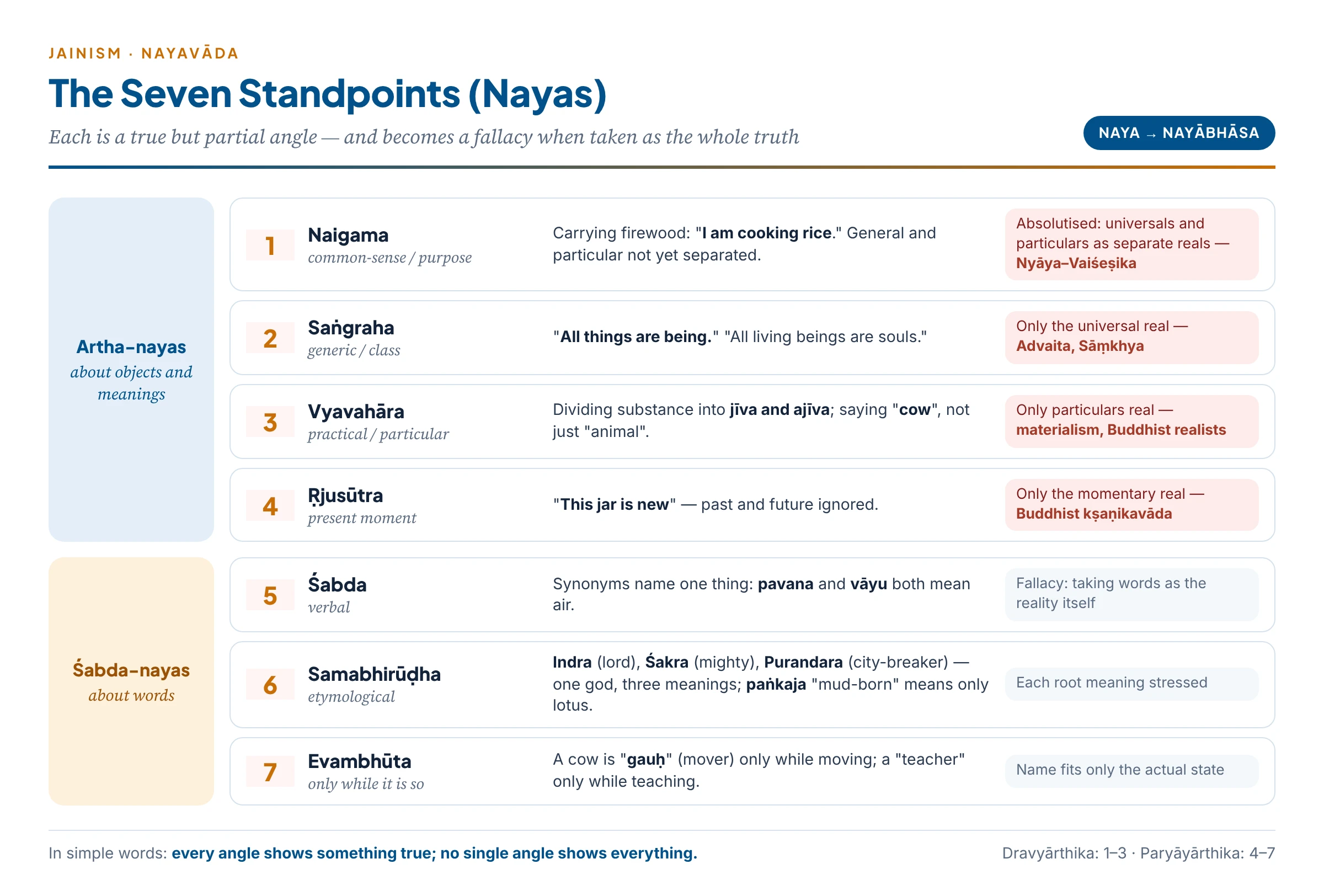
The Jainas enumerate seven standpoints, each addressing a different layer of understanding. The first four concern objects or meanings and are called artha-nayas; the last three concern words and are called śabda-nayas. Each becomes a fallacy (nayābhāsa) when taken as the whole truth — and the Jainas used this to locate the error of rival schools.
- Naigama-naya — the common-sense or teleological standpoint.
- Looks at a thing as having both general and particular features without distinguishing them; also judges an action by its purpose.
- Examples: a man carrying firewood, asked what he is doing, says “I am cooking rice” — he speaks of the end in view; a potter kneading clay says “I am making a pot“, ignoring the stages.
- Becomes fallacious when universals and particulars are taken as separately and absolutely real — the Jaina charge against Nyāya–Vaiśeṣika.
- Saṅgraha-naya — the generic or class standpoint.
- Emphasises universal, common features and ignores particulars.
- Examples: “All things are sat” (being); “all living beings are souls“.
- Becomes fallacious when only the universal is taken as real and particulars as unreal — the charge against Advaita Vedānta and Sāṃkhya.
- Vyavahāra-naya — the practical or empirical standpoint.
- Divides things into classes and particulars for practical life.
- Examples: dividing substance into jīva and ajīva; speaking of “cow” rather than just “animal”.
- Becomes fallacious when only particulars are real and universals are rejected — the charge against materialism and Buddhist realist pluralism.
- Ṛjusūtra-naya — the momentary or present standpoint.
- Considers only the present state of a thing, ignoring past and future.
- Example: “this jar is new” — ignoring that it will age.
- Becomes fallacious when the momentary is taken as the only reality — the charge against Buddhist momentariness (kṣaṇikavāda).
- Śabda-naya — the verbal standpoint.
- A word is necessarily related to the meaning it signifies; synonyms refer to the same thing; grammar (tense, gender, number) affects meaning.
- Example: “pavana” and “vāyu” both mean air.
- Samabhirūḍha-naya — the etymological standpoint.
- Distinguishes even synonyms by their roots.
- Examples: Indra (the lord), Śakra (the mighty) and Purandara (destroyer of cities) name the same god but stress different aspects; paṅkaja literally means “born of mud” but by convention means only the lotus; gauḥ literally means “that which moves” but by convention a cow.
- Evambhūta-naya — the “such-as-it-is-now” standpoint.
- A specialised form of the sixth: a name applies only when its meaning is actually fulfilled.
- Examples: a cow is gauḥ (“mover”) only while it is moving, not while lying down; a person is a “teacher” only while teaching, a “knower” only while knowing.
Common confusion
Are the first four nayas “dravya-nayas” and the last three “paryāya-nayas”? Not quite — two different groupings are often mixed up. The grouping by subject matter is: the first four are artha-nayas (they concern objects and meanings) and the last three are śabda-nayas (they concern words). The grouping by substance and mode is different: the standpoints that look at the enduring substance (naigama, saṅgraha, vyavahāra) are dravyārthika, while those that look at the passing mode (from ṛjusūtra onwards) are paryāyārthika. Some notes label the first four “dravya-naya” and the last three “paryāya-naya” — mixing the two schemes. Keep them apart: artha / śabda is about objects versus words; dravya / paryāya is about substance versus mode.
8. Nayābhāsa: When a Standpoint Becomes Dogma
- Meaning. A naya is a valid but partial viewpoint; a nayābhāsa (“semblance of a naya”) is a perverted standpoint — a partial view claimed as the whole truth, which leads to one-sided dogmatism. Naya is helpful partial truth; nayābhāsa is a misleading distortion.
- Five classical nayābhāsas (listed by Samantabhadra and Akalaṅka):
- Ekatva-nayābhāsa — taking oneness as the whole truth: “the jar is only clay“, denying its distinct form.
- Nānātva-nayābhāsa — overemphasising manyness: “the jar is completely different from clay”.
- Sāmānya-nayābhāsa — taking the general as the only reality: “only cow-ness is real; individual cows are unreal”.
- Viśeṣa-nayābhāsa — taking the particular as absolute: “only this cow is real; there is no cow-ness”.
- Śabda-nayābhāsa — taking words as the ultimate reality: “the word ‘lotus’ sounds pleasant, so the lotus must be pleasant”.
- The Jaina map of philosophies. Using the nayas, the Jainas located rival schools: Nyāya–Vaiśeṣika absolutises the naigama view, Advaita and Sāṃkhya the saṅgraha view, materialism the vyavahāra view, Buddhism the ṛjusūtra view. Each is true as a naya and false as the whole truth. So the doctrine was devised partly to counter the partial truths of other philosophies that mistake themselves for absolutes.
In simple words
A doctor who sees only your blood report, a psychologist who sees only your stress, and a dietician who sees only your food may each be right about one cause of your headache. Trouble starts when one of them says, “Ignore the others — my test tells the whole story.” That is a naya turning into a nayābhāsa.
9. Naya and Syādvāda: How They Differ
| Naya | Syādvāda | |
|---|---|---|
| What it is | A standpoint — the knower’s partial angle on a thing | A method of stating every judgment as conditional, with syāt |
| Concerns | Knowing (epistemic) | Speaking and judging (logical, linguistic) |
| Scope | One aspect at a time — analytic | All aspects through seven forms of judgment — synthetic |
| Status | Partial truth; without syāt it can slide into durnaya | Turns a naya into a pramāṇa (valid judgment) |
| Number | Seven nayas (with two basic standpoints) | Seven predications (saptabhaṅgī) |
| Relation | The raw material | The disciplined expression of the raw material |
- One root. Both spring from anekānta: because reality has infinite aspects, a knower needs standpoints (naya), and a speaker needs the qualifier that reminds everyone of the standpoint (syāt).
- Analytic and synthetic. Nayavāda gives the analytic view of reality — even all seven nayas put together do not capture an object’s full complexity. Syādvāda gives a synthetic view — its seven conditional judgments together express the object’s positive, negative and inexpressible aspects.
- The bird image. Anekānta is the body of the bird; nayavāda and syādvāda are its two wings.
10. Kevala-jñāna: the Absolute Standpoint
- Characteristics.
- Omniscience — complete knowledge of all substances, places and times.
- Direct — not mediated by senses or mind; a spontaneous, all-embracing intuition.
- Simultaneous — it knows all things at once, while ordinary knowledge goes step by step.
- Prerequisite of liberation — when the four “harming” karmas are destroyed, the soul becomes a kevalin (an arhat); at death it becomes a siddha.
- Inherent in every soul, only obscured by karma — hence attainable by all.
- Why believe in it? The Jaina argument (given by Samantabhadra): knowledge exists in degrees — some know more than others, and knowledge grows as obstacles fall away. Whatever has degrees can reach a maximum: just as gold heated in fire can be wholly purified of dross, the obstacles to knowledge can be wholly removed. When they are, the soul’s natural omniscience shines out.
- Syādvāda and kevala-jñāna. Samantabhadra says both illuminate all reality; the difference is that syādvāda does it indirectly and successively, kevala-jñāna directly and simultaneously.
- The absolutist reading. Critics say kevala-jñāna is a “half-hearted confession of absolutism“: the Jainas reject the split between the empirical and the absolute at the front door, but it creeps in at the back door — in the contrasts of mediate and immediate knowledge, naya and pramāṇa, practical and real standpoints, mode and substance. Some Jaina thinkers come close to saying so themselves:
- Siddhasena Divākara: as all rivers flow into the ocean, all relative viewpoints arise from and merge into the absolute.
- Kundakunda: the practical standpoint is empirically true but ultimately false; only the pure standpoint is ultimately true — even the three jewels are true only from the practical standpoint, for the ultimate knower is the pure self.
- Kundakunda again: just as a foreigner (mleccha) can be taught only in his own language, the ultimate truth can be taught to ordinary people only through the practical standpoint.
- Amṛtacandra: the practical standpoint is like an adult’s helping hand for a child learning to walk — needed on the way, dropped once the child can walk.
Critical Evaluation
Objections
- Against Nayavāda.
- Nyāya–Vaiśeṣika: excessive relativism undermines definitive knowledge; if every view is partial, no decisive truth is ever reached.
- Vedānta: the theory fragments reality and fails to acknowledge a unifying principle like Brahman.
- Buddhist logicians, though pluralists themselves, call the elaborate classification of nayas redundant.
- Modern critics ask whether Nayavāda leads to scepticism rather than constructive pluralism.
- Why seven? Siddhasena himself said there are as many nayas as there are ways of speaking; the number seven looks conventional.
- False impartiality. Treating all nayas equally, like one’s own children (Yaśovijaya) ignores the qualitative differences between better and worse views.
- Against the Jaina classification of knowledge.
- Calling perception mediate goes against the universal experience of perception as direct.
- Avadhi, manaḥparyāya and kevala are extra-sensory claims that cannot be publicly tested.
- Against omniscience.
- If all our knowledge is relative, how can a relative knower ever know that someone is omniscient?
- If everything is relative, on what basis do we say even “this table is a table”?
- An omniscient being who knows the future completely seems to leave no room for free effort.
Jaina Replies
- Partial is not doubtful. Within its standpoint a naya gives definite knowledge; Samantabhadra stresses that knowledge from a particular point of view is certain, without any element of doubt. What Nayavāda forbids is only the absolutising of one view.
- Unity is respected. The saṅgraha standpoint gives full weight to unity; what the Jaina rejects is unity as the only truth.
- Perception is “relatively” direct. The Jainas do call ordinary perception empirically immediate (sāṃvyavahārika pratyakṣa); they only insist that truly direct knowledge is the soul’s own.
- Omniscience is inferred. The existence of a maximum of knowledge is inferred from its degrees, and the teachings of the Tīrthaṅkaras are tested by saṃvāda — their harmony with experience and practice.
- Pluralism as humility. Treating all views as partial is not indifference to truth but a refusal to let any embodied mind claim the view from everywhere.
Critics and Defenders
Criticism — Critics
- Nyāya: relativism leaves no decisive truth.
- Vedānta: fragments reality; no unifying principle.
- Buddhists: the classification of nayas is redundant.
- Why seven? “As many nayas as ways of speaking.”
- False impartiality: all views treated equally.
- Perception called mediate; extra-sensory knowledge untestable.
- Omniscience: how could a relative knower recognise a kevalin?
Defence — Defenders and strengths
- Certainty within each standpoint; only absolutism is barred.
- Maps rival schools as partial truths instead of simply refuting them.
- Kevala-jñāna supplies the absolute standpoint critics ask for.
- Saṃvāda — harmony with practice — as a realistic test of validity.
- Refutes the Cārvāka: even denying inference uses inference.
- Grounds intellectual tolerance and dialogue.
Cross-Tradition Comparison
| Thinker / school | Knowledge is… | The “whole view” | Compared with Jainism |
|---|---|---|---|
| Kant | Shaped by the knower’s forms and categories; things-in-themselves unknowable | Impossible for humans | Jainism is realist: our views are partial, but the kevalin knows things as they are |
| Leibniz | Each monad mirrors the universe from its own point of view | God’s view | Closest parallel to plural standpoints |
| Nietzsche | “There is only a perspective seeing” | No view from nowhere | Jainism keeps an absolute knower |
| Einstein’s relativity | Motion and time measured relative to a frame of reference | Laws invariant across frames | An analogy: frame-relative descriptions of one real world |
| Nyāya | Pramāṇas give absolute knowledge of real objects | Ordinary pramāṇas suffice | Jaina pramāṇa is “syāt”-qualified |
| Buddhism / Advaita | Two truths: conventional and ultimate | Nirvāṇa / Brahman-knowledge | Jainism refuses a two-level reality but has kevala-jñāna |
Indian Connect — Key takeaways
- The Jaina nayas and the Buddhist and Advaitic two truths both admit that ordinary knowledge is conditioned; the difference is that the Jainas keep all standpoints on one level of reality, while the others rank them.
- Kant and the Jainas agree that the human knower never sees the whole; they disagree on whether a perfect knower is possible — for the Jaina, every soul can become one.
- The “blind men and the elephant” and the Leibnizian monad make the same point in two traditions: truth is many-sided, and each knower sees from somewhere.
Synthesis (Siddhānta)
- The soul as knower. Knowledge is the essence of the soul, self-luminous like sunlight; its limits come from karma, which builds the body, senses and mind that both enable and obstruct knowledge.
- Five kinds of knowledge. Mati and śruta (mediate, fallible), avadhi and manaḥparyāya (immediate but limited), kevala (immediate, unlimited, infallible). Ordinary perception is only relatively immediate.
- Pramāṇa and naya. Pramāṇa grasps the thing as a whole; naya grasps it from a standpoint. A naya qualified by syāt becomes valid; a naya claimed as absolute becomes nayābhāsa.
- Seven nayas — naigama, saṅgraha, vyavahāra, ṛjusūtra (about objects) and śabda, samabhirūḍha, evambhūta (about words) — give a map in which every rival philosophy finds its partial place.
- Balanced verdict. Nayavāda is one of the earliest systematic theories of perspective in world philosophy: realist, non-sceptical and tolerant. Its weak points are the conventional number of standpoints, the untestable extra-sensory knowledges, and the tension between its relativism and its omniscient knower — which critics read as a hidden absolutism, and defenders as the very anchor that keeps relativism from collapsing into scepticism.
- Contemporary relevance. The idea that every observation is from a standpoint is central to modern science (frames of reference, observer effects, model-dependence), to the sociology of knowledge, and to fair public debate and journalism, where presenting one angle as the whole story is today’s nayābhāsa.
“Syāt is the mark of truth.” — Samantabhadra
Previous Year Questions
- 2023“All human knowledge is empirical and therefore relative.” Critically examine Jaina theory of sevenfold judgement (Sapta-bhangi-naya) in the light of above statement.
- 2022“The doctrine of ‘Relativism‘ of Jain Philosophy cannot be logically sustained without postulating ‘Absolutism’.” Critically examine this view and give reasons in the favour of your answer.
- 2021Explain the Jain view of seven-fold (sapta bhangi) ‘Naya’.
- 2016Examine Jaina stance of ‘Naya’. How does it differ from ‘Syadvada’?
- 1994Analysis of perception in the Jaina Philosophy.