

Jainism: Theory of Reality; Saptabhaṅgīnaya; Bondage and Liberation.
Official Syllabus: Paper I, Section B, Unit 13
If reality is a plurality of substances, which substances are there? The Jainas answer with one of the most carefully worked-out lists in Indian philosophy. Everything that exists falls under two everlasting, uncreated, co-existing categories: the living (jīva, the conscious soul) and the non-living (ajīva). The non-living is of five kinds — matter (pudgala), the medium of motion (dharma), the medium of rest (adharma), space (ākāśa) and time (kāla). These six substances (ṣaḍ-dravya) are enough to explain the whole universe — living beings, physical things, motion, rest, place and change — without a creator God. This article explains each substance, the proofs offered for the soul, the famous doctrine that the soul is the size of its body, and the Jaina case against God.
In simple words
Picture a busy city. There are residents who think, feel and decide — the souls. There are buildings, cars and food — matter. There are roads that let traffic flow but never push a car — the medium of motion. There are benches and parking bays that let you stop but never force you to — the medium of rest. There is the land on which everything stands — space — and the clock that lets things be new and then old — time. Nobody “made” the city out of nothing; it has always been changing. That, in one picture, is the Jaina universe.
Context & Problem
Why Six Substances?
- The task. A realistic pluralist must account for everything we meet in experience: conscious beings, physical bodies, the fact that things move and stop, that they occupy places, and that they change over time. Each of these needs a real ground.
- The Jaina solution. Instead of deriving everything from one principle (like Brahman or prakṛti), the Jainas recognise six independent, eternal substances, each with its own function. Their essential characters are permanent; their modes change. So the universe as a whole is eternal and uncreated, yet constantly changing in its modes — exactly what the Jaina definition of reality (utpāda-vyaya-dhrauvya) requires.
- Two exhaustive categories. Jīva and ajīva “exhaust between them all that exists“. Jaina philosophy is essentially an account of the nature and interaction of these two — and the interaction (soul bound by matter) is the root of the problem of bondage.
Astikāya and Anastikāya: the Basic Classification
- Astikāya = asti (“exists”) + kāya (“body”): a substance that “exists like a body“, i.e. possesses extension in space (occupies many space-points). Five substances are astikāya: jīva, pudgala, dharma, adharma and ākāśa.
- Anastikāya — the non-extended: only kāla (time).
- Rūpī and arūpī. Only pudgala has form (rūpa or mūrti: colour, taste, smell, touch); the other five are formless (arūpī, amūrta).
- Conscious and unconscious. Only jīva is conscious; the five ajīvas are inert and unconscious — but they are eternal and also have modes.
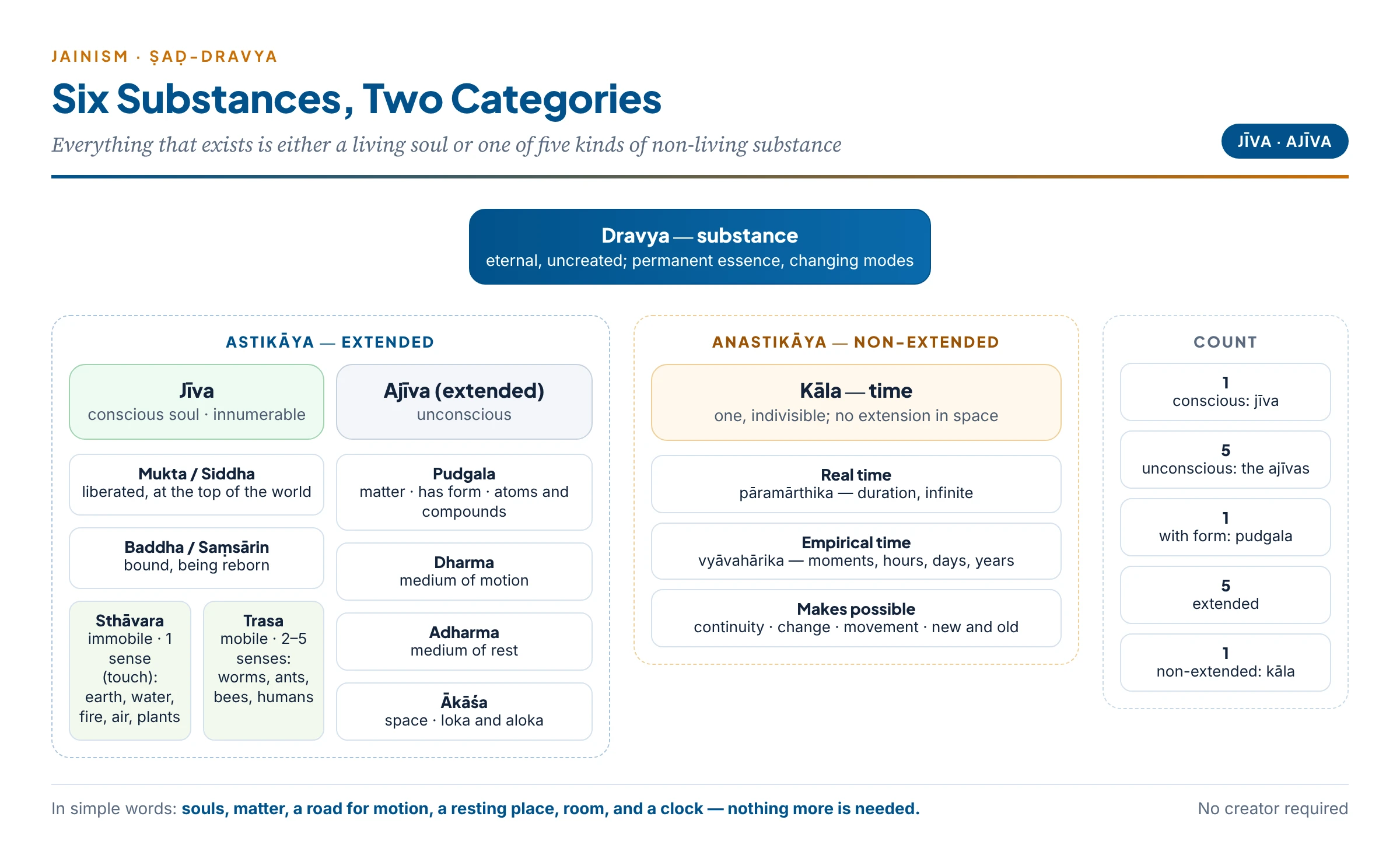
| Substance | Conscious? | Form? | Extended? | Number | Function |
|---|---|---|---|---|---|
| Jīva (soul) | Yes | No | Yes (body-sized) | Innumerable | Knows, acts, enjoys |
| Pudgala (matter) | No | Yes | Yes | Innumerable atoms | Forms bodies, senses, mind, karma |
| Dharma | No | No | Yes (whole world-space) | One | Condition of motion |
| Adharma | No | No | Yes (whole world-space) | One | Condition of rest |
| Ākāśa (space) | No | No | Yes (infinite) | One | Gives room |
| Kāla (time) | No | No | No | One indivisible (see note) | Makes duration and change possible |
Common confusion
Is time one substance, many time-atoms, or not a substance at all? The Jaina tradition is not unanimous. The common account says time is one, indivisible substance present everywhere, which is why it is not an astikāya. Many Digambara writers describe it instead as countless time-points (kālāṇu), one at each point of space, which never combine — again non-extended. And some Śvetāmbara teachers, as reported by Guṇaratna, do not accept time as a separate substance at all but treat it as a mode of the other substances. On every account, time lacks extension, which is the point that matters.
Core Doctrine
1. Jīva: the Conscious Soul
- Definition. Cetanā-lakṣaṇo jīvaḥ — “the soul is marked by consciousness“; upayoga-lakṣaṇo jīvaḥ — “the soul is marked by upayoga“, i.e. consciousness expressing itself as knowledge (jñāna) and perception (darśana). A popular line puts it simply: jīvanasya svarūpaṃ caitanyam — “the essential nature of the soul is consciousness“.
- Soul = life. The Jaina jīva is broadly the ātman or puruṣa of other schools, with one important difference: it is identified with life itself, of which consciousness is the essence. Wherever there is life, there is a soul.
- Knowledge is the essence, not a property. Knowledge is not something the soul acquires and possesses; it is a state of the soul itself. Like the light of the sun, consciousness can reveal itself and everything else, unless something obstructs it. So every soul is potentially omniscient.
- Real knower, agent and enjoyer. The soul knows (jñātā), acts (kartā) and experiences pleasure and pain (bhoktā). It illumines itself and other objects. (Contrast Sāṃkhya, where puruṣa is a non-acting witness.)
- Eternal yet changing. The soul is eternal as substance but undergoes change of states — joy, sorrow, birth in different bodies — as modes.
- Essential characteristics.
- Cetanā — consciousness, inherent sentience.
- Upayoga — its expression as knowledge and perception.
- Jñāna — knowledge (of five kinds; see the article on the Jaina theory of knowledge).
- Darśana — perception or intuition, the immediate awareness before conceptual knowledge (also rendered “faith”).
- Sukha / ānanda — bliss, its natural state when free of karma.
- Vīrya — energy, the dynamic power of the soul.
- Avyaya / amṛta — indestructibility; the soul cannot be destroyed.
- Accidental (conditional) characteristics. Pleasure and pain; attachment and aversion (rāga–dveṣa); ignorance and delusion; embodiment as human, animal, plant, microscopic, heavenly or hellish being.
- Four infinities. In its pure nature every soul has infinite perception or faith (ananta-darśana), infinite knowledge (ananta-jñāna), infinite power (ananta-vīrya) and infinite bliss (ananta-sukha) — together called ananta-catuṣṭaya. In bound souls they are obscured by karmic matter, as the sun is hidden by clouds.
- Qualitatively alike, quantitatively different. All souls have the same nature; they differ only in the degree to which consciousness is manifest, because of the amount of karma covering it. Souls form a continuous series: at the top, the perfect souls who have destroyed all karma and are omniscient; at the bottom, souls in bodies of earth, water, fire, air and plants, where consciousness seems absent but is present in a dormant, tactual form.
- Body, senses and mind are obstructions. We find souls embodied, knowing through senses and mind; but really the body, senses and mind (manas) are obstructions placed by karma that hinder the soul’s direct knowledge. Freedom from matter means omniscience and emancipation.
In simple words
On a cloudy day the sun is still shining at full strength above the clouds; what reaches us is only a dim glow. The Jaina soul is like that sun: its infinite knowledge, perception, power and bliss are always there, but karmic matter hangs over it like cloud. Remove the cloud and nothing new is added — the soul simply shines as it always was.
2. The Size of the Soul: Deha-parimāṇa
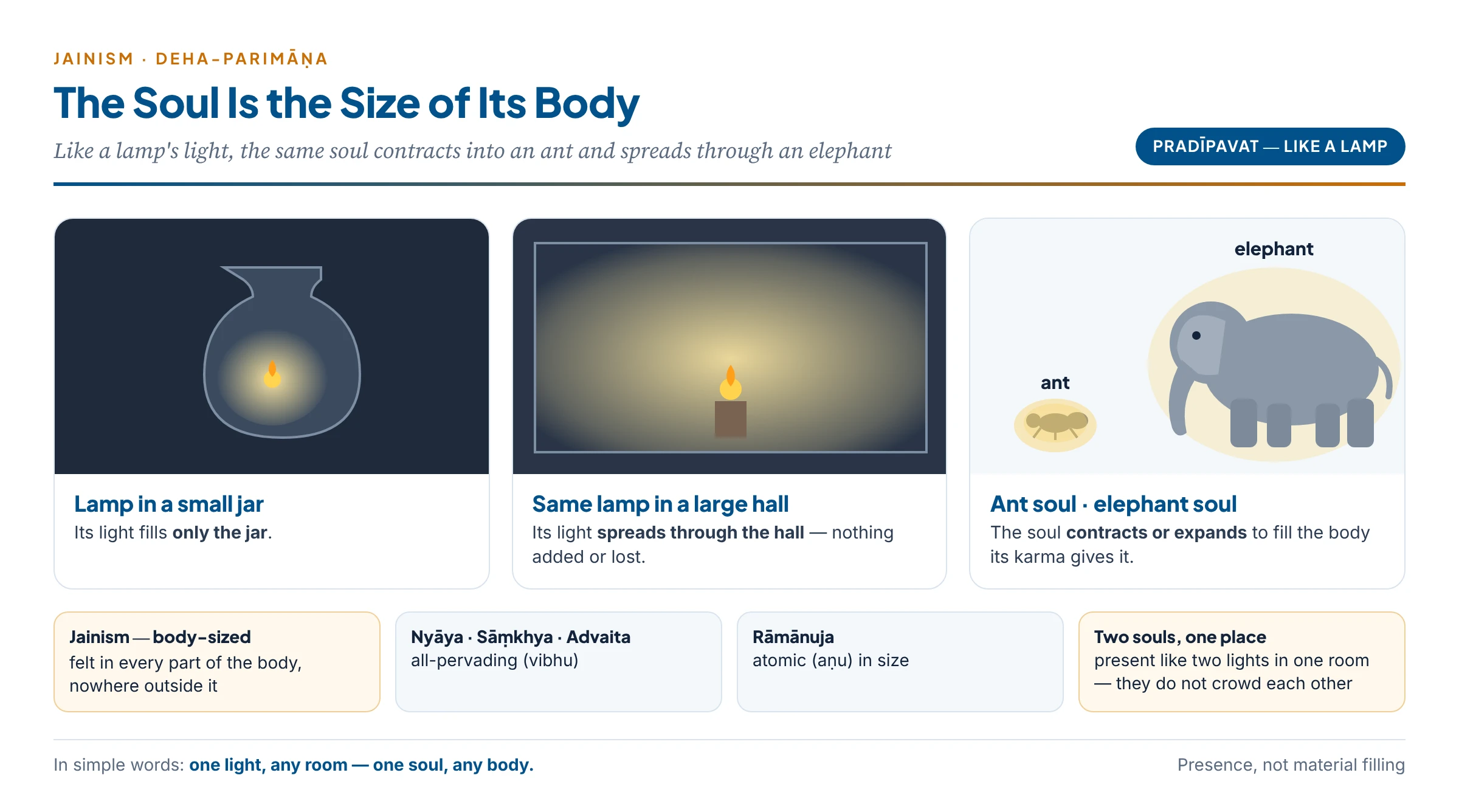
- The doctrine. The soul is formless, yet it takes the size and shape of the body it occupies: the soul of an ant is as big as the ant, the soul of an elephant as big as the elephant. This is deha-parimāṇa-vāda, the doctrine that the soul is co-extensive with the body.
- The lamp analogy (pradīpavat). A lamp placed in a small jar lights only the jar; placed in a large hall, its light spreads through the hall. The soul likewise expands or contracts to fill the body it gets.
- Presence, not filling. A soul “occupies” space only in the sense of being present in different parts of space, not by filling it as matter does. Where one material body is, no other can be; but two souls may be present in the same place, just as two lights can illumine the same room without conflict.
- Why body-sized and not all-pervading?
- Consciousness is found in every part of the living body — a pinprick on the toe or the scalp is felt — so the soul must be present throughout the body.
- The soul directly knows only what happens within its body; consciousness is not present everywhere, so the soul is not infinite (vibhu), as Nyāya, Sāṃkhya and Advaita hold.
- A soul with extension? Students of Western philosophy find this strange, because for Descartes extension belongs only to matter and thought only to mind. But the Jaina soul is first of all a living being; since life and consciousness pervade the living body, the soul must be in space. Plato, and the modern realist Samuel Alexander, also allowed the soul a kind of spatial presence.
In simple words
Pour the same water into a narrow glass and then into a wide bowl: it takes the shape of each, without gaining or losing a drop. Or better, think of the light of one bulb in a cupboard and then in a hall. The Jaina soul is like that light — the same soul, spreading to the size of an elephant or gathering into the size of an ant, depending on the “room” its karma gives it.
3. Classification of Souls
- Liberated (mukta or siddha) — free from all karma; never again embodied; dwell at the top of the universe in perfect knowledge and bliss.
- Bound (baddha or saṃsārin) — still in the cycle of birth and death. These are of two kinds:
- Immobile (sthāvara) — the most imperfect bodies; they live in bodies of earth, water, fire, air and plants and have only one sense, touch (ekendriya). A tree, a drop of water and a flame are inhabited by souls.
- Mobile (trasa) — beings that can move, with two to five senses:
- Two senses (touch, taste): worms.
- Three senses (+ smell): ants.
- Four senses (+ sight): bees, wasps, flies.
- Five senses (+ hearing): beasts, birds, fish, human beings, hell-beings and gods.
- The universe is “literally filled” with souls — in animals, in plants, even in particles of earth. All are potentially equal: every soul, however lowly now, can attain the four infinities. This is the metaphysical basis of Jaina ahiṃsā (see the article on the path to liberation).
| Kind of being | Senses | Examples |
|---|---|---|
| Sthāvara (one-sensed) | Touch | Earth-, water-, fire-, air-bodied beings; plants |
| Two-sensed | Touch, taste | Worms, leeches |
| Three-sensed | + smell | Ants, lice |
| Four-sensed | + sight | Bees, wasps, flies |
| Five-sensed | + hearing | Animals, birds, humans, gods, hell-beings |
4. Proofs for the Existence of the Soul
The Jainas defend the soul especially against the Cārvāka, who reduces consciousness to the body. The classical arguments (set out fully by Guṇaratna) are of two kinds.
- Direct proof.
- The soul is directly experienced in uncontradicted experiences like “I feel pleasure“, “I doubt”, “I remember”.
- When we perceive the quality of a substance, we say we perceive the substance: seeing a rosy colour we say “I see a rose“. Likewise, perceiving pleasure, pain, memory, volition, doubt and knowledge, we perceive the soul to which they belong.
- Indirect proofs (inferences).
- The mover. The body can be moved and controlled at will, like a car; so there must be someone who moves and controls it — the soul.
- The user of instruments. The eyes, ears and other senses are instruments of knowledge; instruments need an agent who uses and co-ordinates them.
- The maker of the body. Things that have a beginning, like cloth, tables and jars, need an efficient cause besides their material. The body too needs a producer, and this organiser is the soul.
- Further arguments found in the Jaina literature.
- The law of karma requires a lasting bearer who acts and later receives the fruit.
- Knowledge arises from the soul; the very fact that we perceive and understand proves a conscious principle.
- Distinct from the body: the body grows, sickens, ages and dies, while the soul continues through these changes.
- Consciousness cannot be explained by matter alone.
- Something permanent must underlie the changing processes of life.
- Scripture (āgama) teaches the eternal conscious soul.
- Replies to the Cārvāka.
- We never perceive consciousness being generated from unconscious elements. The Cārvāka accepts only perception — so how can he believe what perception never shows?
- If the body caused consciousness, consciousness would be present as long as the body is — but it is absent in deep sleep, swoon and the dead body.
- There is no concomitant variation: the growth and decay of the body are not matched by corresponding changes of consciousness.
- If matter becomes conscious only when organised into a living body, then the organiser is needed — and that is the soul.
- “I am stout“, “I am thin” are figurative: the soul speaks of the body as itself because it is intimately interested in it.
- Even the denial “there is no soul in the body” implies knowledge of the soul somewhere: denial presupposes existence elsewhere.
- To say “my self does not exist” is as absurd as saying “my mother is barren“.
5. Pudgala: Matter
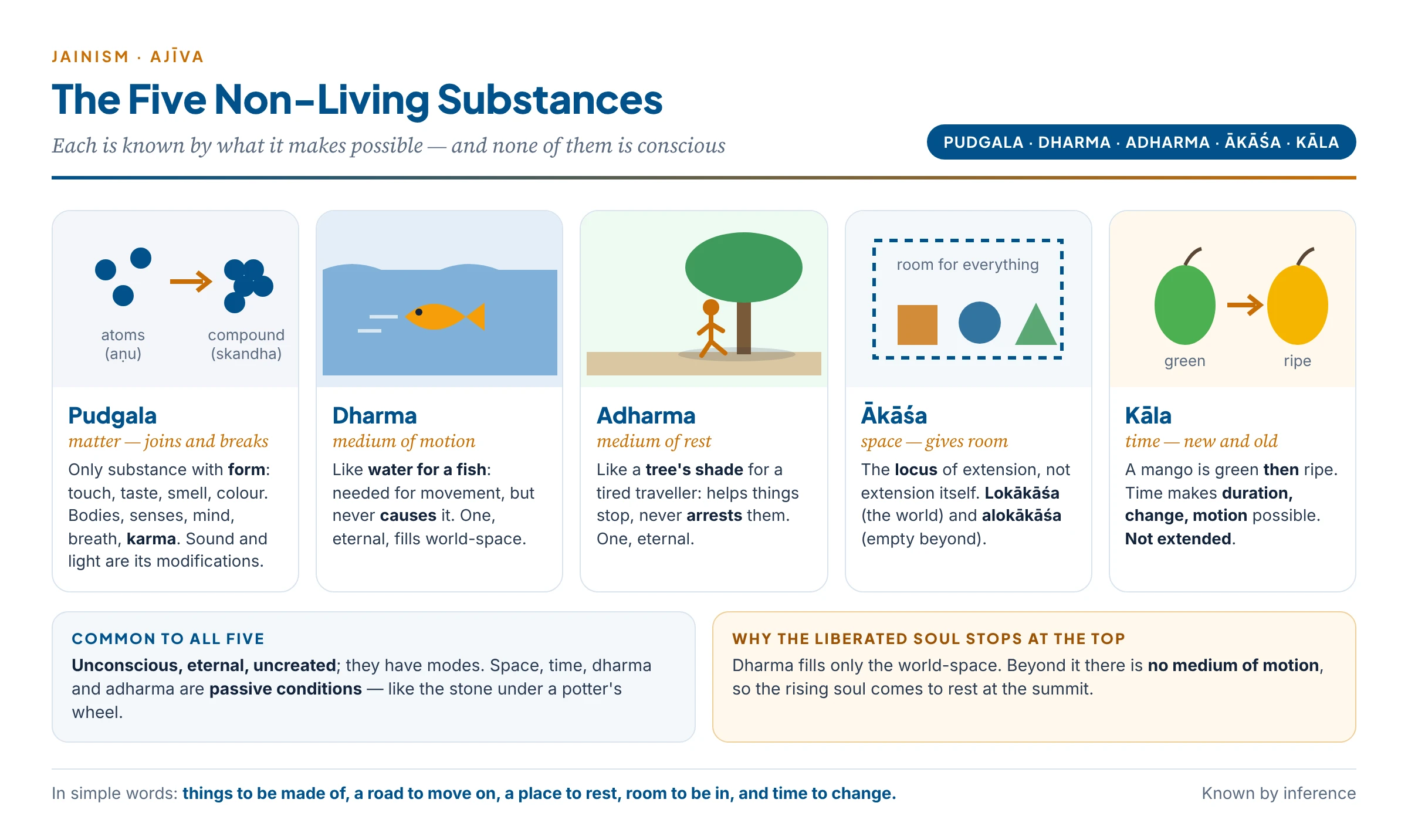
- The word. Pudgala means “that which fills and empties“, i.e. is liable to integration and disintegration (pūrayanti galanti ca). In Buddhism the same word means a person; in Jainism it means matter.
- Atoms and compounds. Matter can combine into larger and larger wholes and break into smaller and smaller parts. The smallest, partless, indivisible unit is the atom (aṇu or paramāṇu); two or more atoms combine into compounds (skandha or saṅghāta). Our bodies and all objects of nature are such compounds; so are the senses, the mind (manas), speech and breath.
- Four qualities. Matter has touch, taste, smell and colour; atoms and compounds both have them.
- Sound is not a quality. Unlike most Indian schools (which make sound the quality of ākāśa), the Jainas hold that sound — along with light, heat, shadow, darkness, union, disunion, fineness, grossness and shape — is a modification (pariṇāma) of matter.
- All atoms are alike. Like the Greek atomists Leucippus and Democritus, and unlike Nyāya–Vaiśeṣika (which has four qualitatively different kinds of atoms for earth, water, fire and air), the Jainas hold that all atoms are qualitatively the same; they differ only by developing different qualities. So the distinction of the elements is secondary, and one element can turn into another.
- Karmic matter. In its subtlest form, matter constitutes karma, which flows into the soul and binds it to the cycle of birth (saṃsāra) — the subject of the article on karma and bondage. Atoms are also said to house souls.
6. Dharma and Adharma: the Media of Motion and Rest
- Technical, not moral, senses. Here dharma and adharma do not mean merit and demerit (for which the Jainas use puṇya and pāpa); they are two substances that make motion and rest possible.
- Dharma — the medium of motion. A fish swims by its own effort, yet it cannot swim without water. Water does not cause the movement; it is a necessary condition of it. Dharma is like that: it helps moving souls and matter to move, but it cannot make a non-moving thing move.
- Adharma — the medium of rest. As the shade of a tree helps a tired traveller to stop and rest, or the earth supports things resting on it, adharma helps things to come to rest. It cannot arrest a moving thing. Without adharma, it is said, objects would keep moving for ever.
- Shared features. Both are eternal, formless, non-moving, passive and imperceptible; both pervade the whole world-space (lokākāśa); both are inferred from motion and rest. As space gives room, dharma lets things move and adharma lets them rest.
- Why they matter. They mark the boundary of the universe: where dharma ends, no motion is possible. This explains why the liberated soul, which rises upward, stops at the summit of the world and does not drift into the empty space beyond.
In simple words
A road lets a cyclist ride, but the road never pedals; a cycle-stand lets a cyclist park, but it never grabs a moving bicycle. Dharma is the road of the universe and adharma its cycle-stand: silent helpers of motion and rest, which do nothing by themselves but without which nothing could go or stop.
7. Ākāśa: Space
- Jaina space is not “ether”. Nyāya–Vaiśeṣika, Sāṃkhya, Vedānta and Mīmāṃsā use ākāśa for ether, the fifth element and carrier of sound. The Jainas use it for space — what gives room to everything.
- Nature. Space is one, infinite, eternal, formless and imperceptible. It is inferred: extended substances can be extended only somewhere, and that somewhere is space.
- Space is the locus of extension, not extension itself. To be extended is the very nature of some substances; space does not make them extended. Yet they need space as a necessary condition: substances occupy, space is occupied. Against Descartes, who identified space with extension, the Jainas side with Locke, for whom space is the place in which extended things exist.
- Two regions.
- Lokākāśa — the space of the world, where souls, matter, dharma, adharma and time are found and motion is possible. At its summit lies siddha-śilā, the abode of the liberated souls.
- Alokākāśa — the empty space beyond, infinite and void, “an abyss of nothing”, where no motion is possible because there is no dharma.
8. Kāla: Time
- What time makes possible. Time is the condition of continuity or duration (vartanā), modification (pariṇāma), movement (kriyā), and of things being new (paratva) and old (aparatva).
- Inferred, not perceived.
- A thing cannot endure without time; duration means existence prolonged through moments.
- Change needs time: a mango can be green and ripe only successively; without time we could not understand how one thing has incompatible characters.
- Movement implies successive states, hence time.
- The distinction of earlier and later, old and new needs time.
- Time alone does not cause these characters; it is their necessary condition.
- Not an astikāya. Time is one and indivisible, the same everywhere, and has no extension in space.
- Real and empirical time.
- Real time (pāramārthika kāla) — formless, eternal, one; it makes duration possible.
- Empirical or conventional time (vyāvahārika kāla, also called samaya) — real time divided into moments, hours, days, months and years, with beginning and end; it makes other changes (but not duration) possible.
9. How the Substances Work Together
- Kinds of cause. A pot has an agent (the potter), an instrument (the wheel) and a material (the clay). Space, time, dharma and adharma are instrumental conditions of an unusually indirect and passive kind — like the stone on which the potter’s wheel rests. Guṇaratna calls them apekṣā-kāraṇa (“conditions that are required” without acting).
- Soul and matter interpenetrate. In embodied life, soul and matter are found together in every part of the living body, “as milk with water” — the basis of bondage.
- From two categories to seven principles. Jīva and ajīva, with āsrava (inflow of karma), bandha (bondage), saṃvara (stoppage), nirjarā (wearing out) and mokṣa (liberation), make the seven principles (tattvas) of Jainism; adding puṇya (merit) and pāpa (demerit) gives nine. The theory of reality thus leads straight into the theory of bondage and liberation.
10. An Uncreated Universe: the Jaina Rejection of God
- No need of a creator. The world was never created: production, destruction and permanence characterise all substances, and things arise and dissolve because of their modes. The six substances are eternal and uncreated.
- Arguments against the Nyāya proof of God. The Naiyāyika argues: every product (like a house) has an agent; the world is a product; so it has an agent — God.
- God is not perceived; the proof rests on inference, which must be sound.
- “The world is a product” is doubtful. It cannot be proved by saying the world has parts — Nyāya itself admits that ākāśa has parts and is eternal, not produced.
- A bodiless agent cannot act. Every producer we know works on material with limbs, as a potter shapes clay. God is said to be bodiless; how can he work on matter?
- Arguments against God’s attributes.
- Omnipotence: if God were all-powerful, he would be the cause of all things — yet we daily see houses, pots and many other things made by people, not by God.
- Unity: it is said there must be one God, for many gods with different plans would produce disorder. But masons build palaces together, and ants and bees build ant-hills and hives in perfect harmony — many agents can work as one.
- Eternal perfection is a meaningless epithet: perfection is the removal of imperfection; a being that was never imperfect cannot meaningfully be called perfect.
- Uniformity: if an eternal God created the world, why is it not uniform — why such diversity and suffering?
- Godhead without God. Jainism denies God, not godhead. Every liberated soul is divine. The Tīrthaṅkaras were mortal beings like us who attained liberation by their own effort; they possess the perfections usually ascribed to God — omniscience included — and serve as beacon lights. Devout Jainas pay daily homage to five kinds of exalted souls, the pañca-parameṣṭhin: the arhats (liberated while living), the siddhas (fully liberated), ācāryas (heads of orders), upādhyāyas (teachers) and sādhus (monks).
- Gods within the cosmos. Jainism does not deny gods (devas) as beings in the heavens; they are embodied souls like us, subject to karma and rebirth.
- Worship without grace. Worship is not a plea for mercy or pardon: the moral law of karma is inexorable. Meditating on the pure qualities of the liberated purifies the mind and strengthens the will for the “uphill journey”. “What man has done, man can do“: Jainism is a religion of self-help, of “the strong and the brave”; hence the liberated one is called Jina (victor) and Vīra (hero).
- Atheistic? Nāstika? If nāstika meant one who denies spirit, morality and the life beyond, only the Cārvāka would be nāstika. Jainism is intensely spiritual and ethical; it is called nāstika only because it rejects the Veda. Denying a creator does not make a system atheistic in the Indian sense — Sāṃkhya and Mīmāṃsā also deny God and are still orthodox.
- Devotion in practice. Strictly, Jaina logic leaves no room for devotion: the fire of asceticism must burn away all desire. In practice, under Brahmanical influence, lay Jainas deified the Tīrthaṅkaras, built temples, worshipped images and offered them the devotion others offer their gods.
Indian Connect — Religion without God
- Buddhism, Sāṃkhya and Mīmāṃsā share the Jaina rejection of a creator; Jainism, like Buddhism, shows that a religion can stand on ethics and liberation rather than on a creator.
- Jainas keep omniscience (for liberated souls) but reject omnipotence and creatorship — so their critique targets the God of Nyāya, not every kind of perfection.
- If “religion” (religare, “to bind back”) requires binding the soul to a transcendent God, Jainism is not a religion; if it requires a path that binds the person to the highest ideal of life, Jainism is fully one.
11. Is the Jaina Theory of Substances Scientific?
The Tattvārtha Sūtra sets out the six substances and seven principles; the question whether this “Tattvārtha” scheme can serve scientific explanation has been asked directly.
- Points of agreement with science.
- Atomism — matter made of indivisible units that combine and separate; all atoms qualitatively alike; elements transmutable into one another.
- Conservation — substance neither created nor destroyed, only its modes change: a striking anticipation of the conservation of mass and energy.
- Life in plants and in microscopic forms — plants as one-sensed living beings, and minute life in air and water (hence the monk’s cloth over the mouth) — confirmed by botany and microbiology.
- Space as the locus of things, and time as the condition of change and motion.
- Relativity of observation — every description from a standpoint.
- Naturalism — the world explained by its own substances and laws, without a creator.
- Points of difficulty.
- Dharma and adharma as invisible media of motion and rest resemble the luminiferous ether of nineteenth-century physics, which experiment did not confirm; modern physics explains motion and rest by laws of motion, not by media.
- Souls in earth, water, fire and air and dormant consciousness in atoms cannot be tested.
- A finite world-space surrounded by empty space, with the liberated at its summit, is cosmology of faith, not observation.
- Karma as matter has never been detected; its working is moral, not physical.
- Four sensory qualities of atoms belong to the level of experience, not to physics.
- Verdict. The Tattvārtha scheme is realist, naturalistic and remarkably modern in its atomism, conservation and recognition of microscopic life; but its soteriological parts — souls, karmic matter, the media of motion and rest, the siddha-śilā — are metaphysical postulates, not scientific explanations.
Critical Evaluation
Objections
- Against deha-parimāṇa (Śaṅkara and others).
- What has size has parts; what has parts can be divided and destroyed — so a body-sized soul would be non-eternal, contradicting the Jainas’ own claim.
- A soul passing from an elephant’s body to an ant’s could not fit; one passing from an ant’s to an elephant’s could not fill it.
- If the soul gains and loses parts as it expands and contracts, it is not one and the same soul.
- At liberation the soul keeps a fixed final size; if the final size is permanent, the earlier sizes should have been permanent too — then there could be no expansion and contraction.
- Interaction. How can a formless conscious soul be really united with unconscious matter “like milk and water”? The analogy is between two material things.
- Nominal plurality. If all souls are qualitatively identical, and all atoms too, their numerical distinctness is merely nominal; why stop short of a deeper unity?
- Unprovable substances. Dharma and adharma look like ad hoc postulates to explain motion and rest.
- Panpsychism. Souls in particles of earth and flames stretch the meaning of “life” and “consciousness”.
- Against the rejection of God. The Naiyāyika replies that the order and design of the world, and the just distribution of karmic fruits, need an intelligent controller; unconscious karma cannot by itself bring the right fruit to the right person at the right time.
Jaina Replies
- Expansion and contraction are modes. The soul’s essence — consciousness and its fixed number of space-points — never changes; only its spread changes, as the same light spreads in a jar or a hall. Nothing is added or lost.
- Presence is not material occupation. The soul’s “size” is the range of its presence, not the bulk of a material object; it is “extended like light”, so the material argument from parts does not apply.
- Experience supports it. Consciousness is felt throughout the body and nowhere outside it; a soul that is all-pervading or atomic cannot explain this as simply.
- Media as conditions. Dharma and adharma are inferred from motion and rest just as space is inferred from extension; they are passive conditions, not mysterious forces.
- Karma is its own law. The automatic working of karmic matter makes a moral dispenser unnecessary — and avoids the problem of why a perfect God would create a suffering world.
Critics and Defenders
Criticism — Critics
- Deha-parimāṇa: size means parts, parts mean destruction; ant-to-elephant puzzle.
- Interaction: a formless soul cannot mix with matter like milk with water.
- Nominal plurality of qualitatively identical souls and atoms.
- Dharma and adharma as untestable media, like the discarded ether.
- Souls in earth and fire: life and consciousness stretched too far.
- Nyāya: design and just fruits of karma need God.
Defence — Defenders and strengths
- Expansion and contraction are modes; the soul’s essence is unchanged.
- Soul is extended like light — presence, not material bulk.
- Explains why consciousness is felt throughout the body and nowhere else.
- Atomism, conservation, microscopic life anticipated modern science.
- A naturalistic, creator-free cosmos; karma works without a judge.
- Potential equality of all souls grounds a universal ethic of non-violence.
Cross-Tradition Comparison
The Soul Compared
| Jaina jīva | Sāṃkhya puruṣa | Nyāya–Vaiśeṣika ātman | Advaita ātman | Leibniz’s monad | Descartes’s mind | |
|---|---|---|---|---|---|---|
| Number | Innumerable | Many | Many | One | Infinitely many | Many minds |
| Consciousness | Essence | Essence (pure witness) | Accidental quality | Is pure consciousness | Perception and appetite | Thinking is its essence |
| Size | Body-sized | All-pervading | All-pervading | All-pervading | Non-spatial | Non-extended |
| Agent? | Yes — knower, doer, enjoyer | No — inactive witness | Yes | Only apparently | Inner activity only | Yes, wills |
| Relation to matter | Really bound by karmic matter | Never really bound | Linked through manas and body | Bondage is ignorance | No real interaction | Interacts through the pineal gland |
Indian Connect — Key takeaways
- The Jaina jīva is closest to Leibniz’s monads: innumerable, qualitatively alike, quantitatively different by degrees of clarity of perception, the whole universe “full of life”. But monads are windowless, while jīvas are really bound by matter.
- Unlike Sāṃkhya, where puruṣa and prakṛti never really meet, Jainism makes the union of spirit and matter real — so liberation is a real separation, not a correction of a mistake.
- Rāmānuja makes the individual self atomic in size; Nyāya, Sāṃkhya and Advaita make it all-pervading; Jainism alone makes it body-sized — the only position that matches where consciousness is actually felt.
- The Jaina view of space as the locus of extension sides with Locke against Descartes; its view of time as the condition of change anticipates the “absolute time” of Newton, and its atomism that of Democritus.
Synthesis (Siddhānta)
- The six substances. The universe consists of jīva and five ajīvas — pudgala, dharma, adharma, ākāśa, kāla — eternal, uncreated, each with its function: knowing, forming bodies, enabling motion, enabling rest, giving room and making change possible. Five are extended (astikāya); time is not.
- The soul. Jīva is consciousness itself, a real knower, agent and enjoyer, potentially omniscient, possessing four infinities; souls are innumerable, qualitatively alike and quantitatively different, and body-sized like light that fills a room.
- Matter. Pudgala is atomic, qualitatively uniform, with touch, taste, smell and colour; sound and light are its modifications; its subtlest form is karma, which binds the soul.
- No creator. The world needs no God; the liberated souls take the place of God as ideals, and Jainism is a religion of self-help.
- Balanced verdict. The Jaina ontology is the most complete realist inventory in Indian philosophy: it gives every feature of experience — life, matter, motion, rest, place, time — a real ground, and its atomism, conservation and recognition of microscopic life were far ahead of their time. Its soft spots are the body-sized soul (hard to reconcile with partlessness and eternity), the interaction of spirit and matter, and the media of motion and rest.
- Contemporary relevance. The idea that every living being — down to plants and microbes — has a soul of equal potential underlies Jaina ecological ethics and today’s arguments for the moral status of animals and ecosystems; the creator-free, law-governed universe fits the naturalism of modern science; and the debate on the soul’s “location” anticipates the modern question of whether consciousness is localised in the body.
“The soul is characterised by consciousness.” — Jaina definition of the jīva
Previous Year Questions
- 2022Discuss the nature of Soul and Bondage according to Jainism.
- 2019State and evaluate the proofs for the existence of God as propounded in Jainism.
- 2016Can the ‘Tattvartha’ theory of Jainism be acceptable for scientific explanations?
- 2015Jain concept of Dravya.
- 2007Write short notes on Nature of Pudgala in Jaina philosophy.
- 2006Write short notes on theory of Substance according to Jainism.
- 2004State and discuss the Jaina Doctrine of jiva.
- 2003When a religion is defined as ‘religare’, is Buddhism or Jainism a religion? What are the criteria for an organisation to be called a religion? Should there be a transcendental reality in a religion? Discuss.