

Jainism: Theory of Reality; Saptabhaṅgīnaya; Bondage and Liberation.
Official Syllabus: Paper I, Section B, Unit 13
The Jainas ask the oldest question in metaphysics: what is real — the permanent or the changing? The Advaitin says only the unchanging Brahman is real and change is appearance; the Buddhist says nothing lasts beyond a moment and permanence is a fiction. The Jaina answer is that both are right and both are wrong. Reality is many-sided (anekānta): every real thing has a permanent essence and changing modes, and so it originates, perishes and endures at the same time (utpāda-vyaya-dhrauvya-yuktaṃ sat). The universe is made of countless independent substances — souls and non-souls — each with infinite characters, most of which no ordinary knower can see. This is Anekāntavāda, the Jaina theory of reality, usually summed up as realistic and relativistic pluralism.
In simple words
Look at a photograph of yourself at five and another at twenty-five. Height, voice, face, ideas — almost everything has changed. Yet you say without hesitation, “both are me.” Something in you stayed, and something in you changed. If you said “only the permanent me is real”, you could not explain growing up; if you said “only the changing me is real”, you could not explain why the child’s promises are still yours. The Jaina says: you are both — permanent as a substance, changing in your modes. That is all anekānta means at its simplest.
Context & Problem
Jainism: Origins and Outlook
- Name. “Jainism” comes from Jina, “the conqueror” — one who has conquered attachment and aversion (rāga and dveṣa), the passions and the karmas, and won liberation. The followers of the Jinas are Jainas.
- Tīrthaṅkaras. The Jainas believe in 24 Tīrthaṅkaras (“ford-makers”, those who build a crossing over the river of rebirth). The first was Ṛṣabhadeva; the 23rd, Pārśvanātha, is a historical figure of the 8th–9th century BCE; the 24th and last, Vardhamāna Mahāvīra (“the great hero”), lived in the 6th century BCE and was a contemporary of the Buddha.
- Mahāvīra is not the “founder”. Jaina teachings existed before him; Mahāvīra gave them a new orientation, and modern Jainism is largely the result of his teaching. For the Jainas the religion is eternal, revealed again and again by innumerable Tīrthaṅkaras.
- Śramaṇa and nāstika. Jainism belongs to the śramaṇa (ascetic, wandering) tradition that arose alongside Buddhism, the Ājīvikas and the materialists, as a reaction against Vedic ritualism and the hierarchical order of Brahmanism. It is nāstika (heterodox) because it rejects the authority of the Veda — not because it denies the soul, morality or the life beyond, which it strongly affirms.
- Two sects. The Digambaras (“sky-clad”) hold that a monk must renounce everything, including clothes; the Śvetāmbaras (“white-clad”) allow monks white robes. Both share the same basic philosophy.
- The key text. The Tattvārtha Sūtra of Umāsvāti (also called Umāsvāmī) is accepted by both sects and gives the classical definitions used below. Later thinkers who shaped the theory of reality and knowledge include Kundakunda, Siddhasena Divākara, Samantabhadra, Akalaṅka, Haribhadra, Hemacandra and Yaśovijaya.
- Outlook. The philosophy of Jainism is common-sense realism and pluralism: the objects we perceive are real, and they are many. Alongside an “infallible respect for life” (ahiṃsā) stands a second, less noticed respect — respect for the opinions of others. Anekāntavāda is the philosophical form of that second respect.
Major Features of Jaina Thought
- Realistic — the world exists independently of our knowing it; it is not an illusion (māyā) and not a projection of mind.
- Pluralistic — there are innumerable souls and innumerable material atoms, each separately and independently real.
- Dualistic — all that exists falls under two everlasting, uncreated, co-existing categories: the living (jīva) and the non-living (ajīva).
- Relativistic — every object has infinite aspects, so every human judgment is true only from a standpoint.
- Without a creator God — the universe was never created; it is eternal. Jainism rejects a supreme, creating God and a universal soul, but admits gods as beings within the cosmos (who are themselves subject to karma), and worships the liberated souls as ideals.
- Ethical in aim — knowledge matters because it serves right conduct and liberation of the soul from matter.
The Problem: Being and Becoming
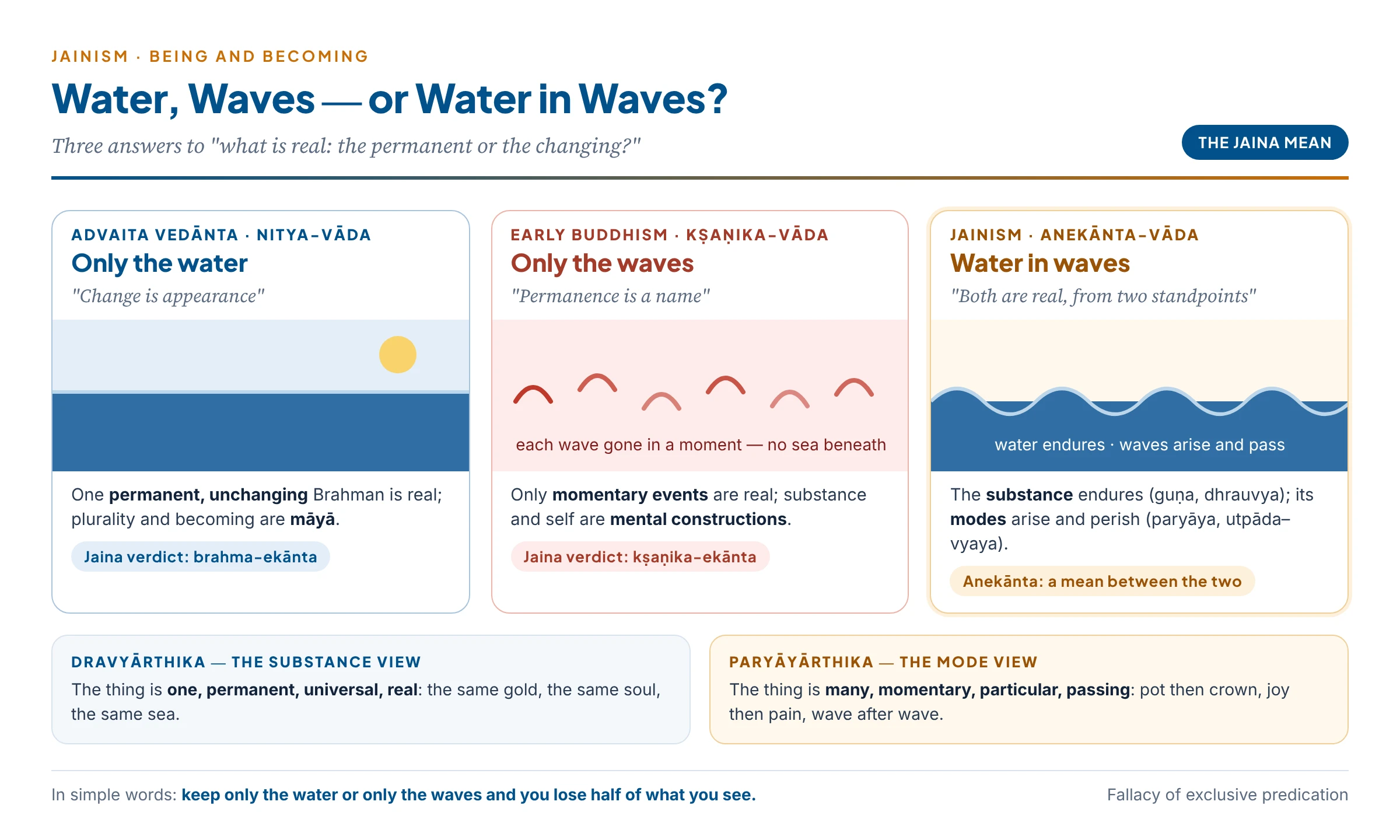
Every school had to explain two facts of experience: things change (the seed becomes a tree, the child an adult), and yet things endure (it is the same tree, the same person). Indian philosophy offered two extreme answers.
| View | What is real | What happens to the other fact | Jaina name for the error |
|---|---|---|---|
| Advaita Vedānta (nitya-vāda) | One permanent, unchanging Brahman | Change, plurality and becoming are appearance (māyā) | Exclusive emphasis on the universal and permanent |
| Early Buddhism (kṣaṇika-vāda) | Momentary, ever-changing events | Permanence and substance are mental constructions | Exclusive emphasis on the momentary particular |
| Nyāya–Vaiśeṣika | Universals and particulars, but as separate reals joined from outside | Their unity becomes a problem | Treating aspects of one thing as separate absolutes |
| Jainism (anekānta-vāda) | Substance in modes: permanent and changing | Both facts are real, each from its own standpoint | — |
The same quarrel runs through Greek philosophy: Parmenides said being is one and changeless, Heraclitus said “everything flows”. The Jaina position is a “mean” between the two Indian extremes — it is often called a theological mean between Brahmanism and early Buddhism: Brahmanism stressed the one, the permanent, the real; early Buddhism the many, the changing; Jainism says both are two sides of the same thing.
Core Doctrine
1. Anekāntavāda: Reality Is Many-Sided
- The word. Aneka = “many, more than one”; anta = “end, side, aspect, attribute”; vāda = “theory”. Anekānta-vāda is the doctrine of manifold aspects, or non-one-sidedness. Its opposite is ekānta-vāda, “one-sidedness” — fixing on a single attribute and calling it the whole truth.
- Other names. It has been translated as non-absolutism, the doctrine of the manyness of reality, relative pluralism (opposed to extreme absolutism), the theory of conditional predication and the theory of the relativity of propositions.
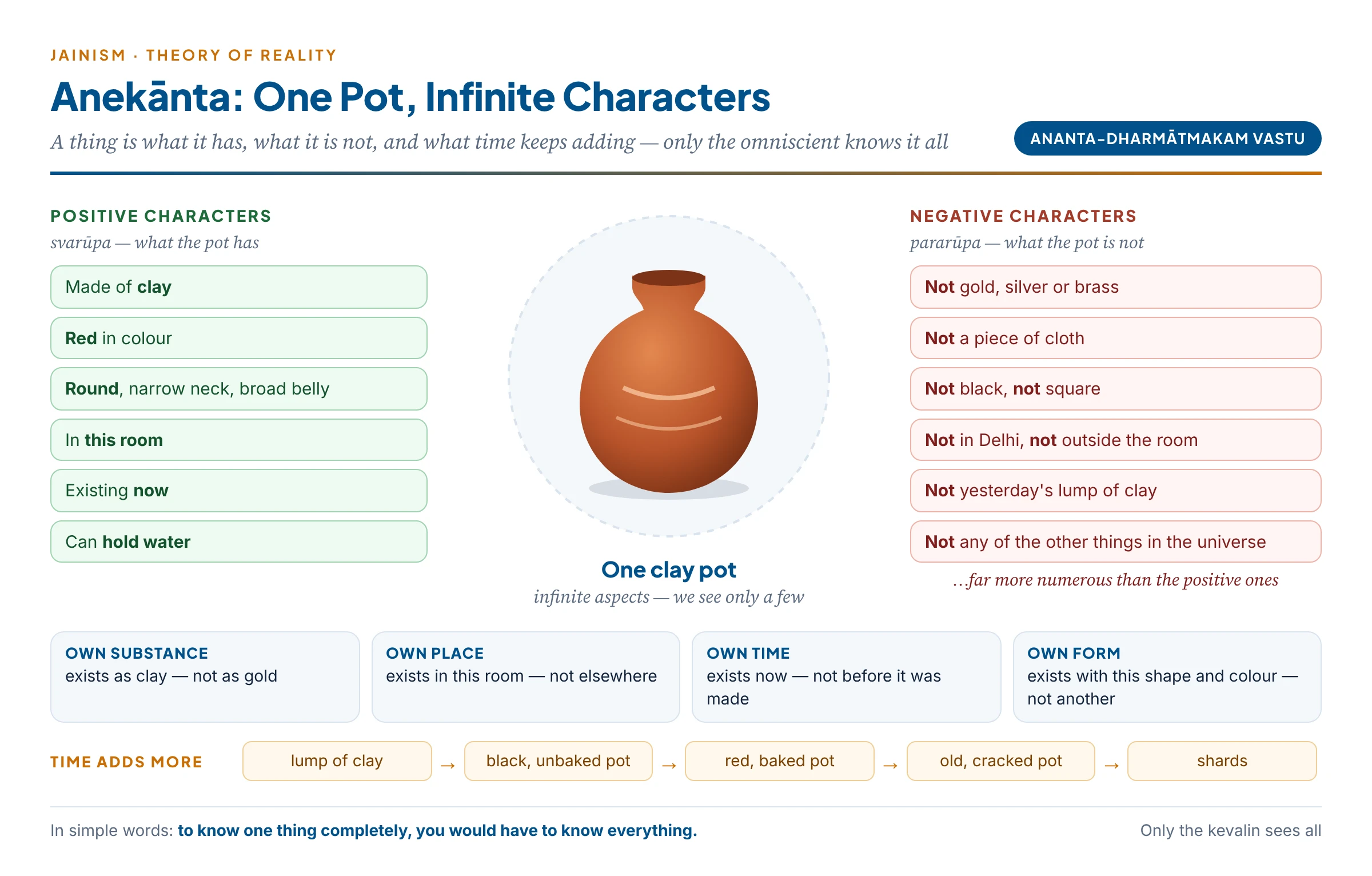
- The formula. Ananta-dharmātmakam vastu — “a real thing has infinite characters” (also anekadharmātmakaṃ vastu, “a thing characterised by many qualities”). The doctrine has three layers:
- Many reals — innumerable souls and innumerable atoms, all independently real.
- Many characters in each real — every soul and every atom has infinite aspects of its own.
- Many standpoints — so any judgment about a thing can be true from one point of view and false from another.
- Positive and negative characters. A thing is what it is by what it has and by what it is not.
- Positive characters (svarūpa) — what belongs to the thing. A board is white and rectangular; a man has a certain size, colour, weight, family, education, job, birthplace, age — and countless relations to other things.
- Negative characters (pararūpa) — what the thing is not: the board is not circular, not black; the man is not a European, not a Chinese, not a Christian, not dishonest, not foolish. Since a thing is distinct from everything else in the universe, its negative characters are far more numerous than its positive ones.
- Time multiplies both: every moment the thing acquires new characters. So a “simple” pot or a “simple” person really has infinite characters (ananta-dharma).
- Own and other’s fourfold frame. Positive existence belongs to a thing in terms of its own substance, place, time and form (sva-dravya, sva-kṣetra, sva-kāla, sva-bhāva); it does not exist in terms of another’s substance, place, time and form (para-dravya, para-kṣetra, para-kāla, para-bhāva). This fourfold frame becomes the backbone of Syādvāda (see the article on Saptabhaṅgīnaya).
- “He who knows one thing fully knows all things.” To know all the characters of one pot you would have to know its difference from every other thing — that is, everything. So complete knowledge of even one object is omniscience (kevala-jñāna), possible only for the liberated soul (kevalin). For practical purposes (vyavahāra), partial knowledge is enough — but we must not mistake it for the whole.
In simple words
Ask five people to describe your friend Riya. Her mother says “my daughter“, her student says “my teacher“, her neighbour says “the cricket fan upstairs”, the doctor says “blood group B+“, the census says “female, 34, Pune“. Each description is true; none is complete; and Riya is also not a dozen other things — not tall, not a Delhiite, not a lawyer. Add the Riya of ten years ago and ten years ahead, and the list never ends. That is what the Jainas mean by “a thing has infinite characters“.
2. Arguments for Anekāntavāda
The Jainas support the many-sidedness of reality by several arguments:
- Many independent reals. There are innumerable material atoms and innumerable souls, each separately real and each with innumerable aspects of its own.
- Daily experience shows a world of innumerable objects, not one undivided being.
- Different knowledge of the same object. The same thing is known differently by different people and in different situations — water feels cool to a hand that was in hot water and warm to a hand that was in cold water. This shows that one object has many aspects.
- Positive and negative characters belong to every object, as shown above.
- Plurality of souls (jīvas) — each knower is a distinct real.
- Unity-in-difference. Viewed as substance, a thing is one, permanent and real; viewed as modes, it is many, changing and passing. Only a many-sided view can hold both.
- Research keeps finding new qualities in familiar objects — evidence that our list of a thing’s characters is never complete.
- The definition of reality (sat) as origination, decay and permanence — three aspects at once.
- The relativity of knowledge — every judgment depends on standpoint.
- The conflict of philosophies — the many rival accounts of ultimate reality are best explained as partial views of a many-sided reality.
- Saptabhaṅgīnaya — the fact that one object admits seven distinct forms of judgment.
3. Sat: Origination, Decay and Permanence
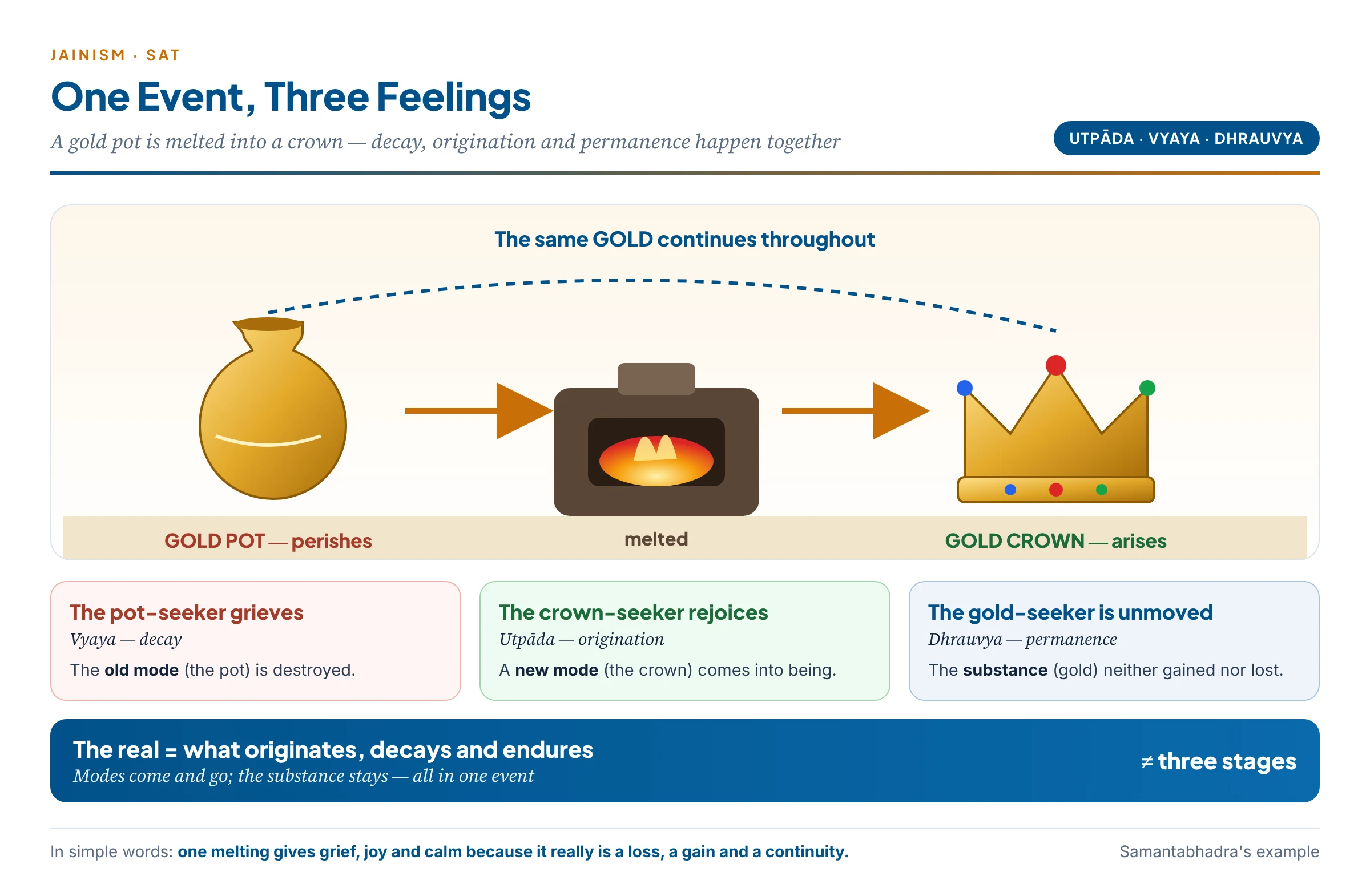
- The definition. Umāsvāti’s Tattvārtha Sūtra defines the real: utpāda-vyaya-dhrauvya-yuktaṃ sat — “the real is that which is endowed with origination (utpāda), decay (vyaya) and permanence (dhrauvya)“.
- Origination — a new mode arises.
- Decay — the old mode passes away.
- Permanence — the substance continues through both.
- All three together. These are not three stages one after another; they are three aspects of every real at every moment. When a lump of clay becomes a pot, the lump perishes and the pot arises in one and the same event, while the clay remains.
- The gold example. A goldsmith melts a gold pot and makes a crown. Three customers are watching. One wanted the pot — he is sad; one wanted the crown — he is happy; one only wanted gold — he is unmoved. One event has produced grief, joy and indifference, because it really contains decay (of the pot), origination (of the crown) and permanence (of the gold). This illustration is given by Samantabhadra.
- Further examples.
- Mango — green, then ripe: the colour-modes change, the mango endures.
- The soul — pleasure gives way to pain, desire to volition, but consciousness, its essence, remains.
- The world — in so far as the essential characters of the ultimate substances abide, the world is permanent; in so far as their modes change, the world changes.
- Milk and curd (also Samantabhadra) — a person under a vow to take only milk will not take curd; one under a vow to take only curd will not take milk; one under a vow to take no cow-product takes neither. Milk turning into curd is therefore at once a loss (of milk), a gain (of curd) and a continuity (of cow-product). “Hence reality is threefold.”
- Substance is the real. Since substance has an unchanging essence, it is permanent; since it has changing modes, it is subject to origination and decay. So all three marks of reality are found in substance: substance is sat.
- Causation. The same logic decides the old Indian debate on cause and effect. From the standpoint of substance, the effect is identical with its material cause (the pot is clay); from the standpoint of modes, the effect is new (the pot shape did not exist in the lump). So the Jaina view of causation is sad-asat-kārya-vāda: the effect both pre-exists and does not pre-exist in the cause, from two standpoints — a middle path between Sāṃkhya’s satkāryavāda and Nyāya’s asatkāryavāda.
4. Dravya, Guṇa and Paryāya: Substance, Attributes and Modes
- Character and its bearer. Ordinary language and philosophy both distinguish characters (dharma) from that which has the characters (dharmī). The bearer is called substance (dravya). The Jainas accept this common view: substance is that which possesses innumerable characters and exists independently.
- The definition. Guṇa-paryāyavad dravyam — “substance is that which possesses attributes (guṇa) and modes (paryāya)” (Tattvārtha Sūtra). The two definitions — by guṇa and paryāya, and by origination-decay-permanence — say the same thing: guṇas explain permanence, paryāyas explain origination and decay.
- Guṇa — essential attribute. A permanent, essential, unchanging character that remains as long as the substance remains; without it the substance would cease to be what it is.
- Consciousness is the guṇa of the soul.
- “Mango-ness” is the essential character of a mango; touch, taste, smell and colour are the guṇas of matter.
- Substance and guṇa are inseparable: the guṇa is the substance’s permanent essence.
- Paryāya — mode. An accidental, changing character that comes and goes, succeeding other modes. It is through modes that a substance changes.
- Desire, volition, pleasure, pain, love, hate are modes of the soul.
- Yellow colour, sweet taste, a particular size are modes of a mango.
- Ring, bangle, necklace are modes of gold.
- Two standpoints on one thing. From the substantial standpoint (dravyārthika-naya) a thing is one, permanent, universal and real; from the modal standpoint (paryāyārthika-naya) it is many, momentary, particular and passing. Neither standpoint alone is the whole truth (the standpoints are explained fully in the article on Nayavāda).
- Realism. Because the Jainas keep a real distinction between qualities and the entity that has them, and between the knower and the known, their substance theory is realistic; because the same substance is permanent from one standpoint and changing from another, it is relativistic; because there are innumerable substances, it is pluralistic.
| Guṇa (attribute) | Paryāya (mode) | |
|---|---|---|
| Nature | Essential | Accidental |
| Duration | Lasts as long as the substance | Comes and goes |
| Explains | Permanence (dhrauvya) | Origination and decay (utpāda, vyaya) |
| Soul | Consciousness | Pleasure, pain, desire, volition |
| Gold | Yellowness, weight | Ring, bangle, crown |
| Standpoint | Dravyārthika | Paryāyārthika |
Common confusion
Is “dharma” here the same as the Jaina substance “dharma” or as “religion”? No. The word has three different uses in Jaina texts. (1) In the theory of reality, dharma simply means a character or property, and dharmī the thing that has it — “the board has the dharma of whiteness”. (2) Among the six substances, Dharma is the medium of motion, and Adharma the medium of rest (see the article on Jīva and Ajīva). (3) In ordinary religious language, dharma means duty, religion or merit; for merit and demerit the Jainas use other words, puṇya and pāpa. Mixing these up — for example, saying “the dharma of water is to flow” and then linking it to the substance Dharma — is a common slip.
5. Against One-Sided Views: the Jaina Critique of Buddhism and Advaita
- The fallacy of exclusive predication. To take one partial view as the whole truth is ekānta-vāda; a judgment that does this is a bad judgment (durnaya or durnīti). The Jainas charge both rivals with it: the Buddhist with “kṣaṇika-ekānta” (only the momentary is real) and the Upaniṣadic monist with “brahma-ekānta” (only the one Brahman is real). In terms of the Jaina standpoints, Advaita absolutises the generic standpoint and Buddhism the momentary one.
- Against the Buddhist test of reality. The Buddhist defines the real as what has causal efficiency (artha-kriyā-kāritva) — the power to produce an effect — and from this deduces momentariness. The Jainas object:
- An illusory snake produces fear, trembling and flight; by this test it would be real. So causal efficiency cannot be the mark of reality.
- Memory, recognition and personal identity become impossible if the soul too is momentary — the one who saw would not be the one who remembers.
- Liberation becomes meaningless, for there is no lasting soul to be liberated.
- Moral life collapses: one momentary person would begin an effort and another would enjoy its fruit. The moral law fails both ways — a person would lose the fruits of his own deeds (kṛta-praṇāśa) and reap the fruits of deeds he never did (akṛtābhyupagama).
- No individual series can be formed from mere momentary states without something continuous to hold them together.
- Neither perception nor inference ever shows us anything that is pure change with no element of continuity.
- Against the changeless absolute. If reality were eternal and changeless, change would be impossible, for how can the eternal change? Then bondage and liberation, effort and progress, all become unreal — yet experience shows them. If reality were momentary, change would again be impossible, for what is it that changes? Hence the Jaina conclusion: without anekānta, pleasure and pain, action and fruit, bondage and liberation, good and evil, one and many, permanence and change cannot be explained.
- The mean. Change is true of a substance in one respect (its modes), permanence in another respect (its essence). The appearance of contradiction vanishes once we remember that each predication is relative, not absolute — which is exactly the teaching of Syādvāda.
In simple words
Think of the sea. One person says, “There is only water; the waves are a passing show.” Another says, “There are only waves, each gone in a moment; ‘the sea’ is just a name.” The Jaina says, “There is water, and it is always waving. The water stays, the waves come and go — and both are perfectly real.”
6. Realistic, Relativistic Pluralism
This three-word label is the standard summary of Jaina metaphysics.
- Realism.
- Metaphysical realism — the infinite number of substances exist independently of our perceiving them.
- Epistemological realism — knowledge discovers its object; it does not create it. Even the relativity of judgment is grounded in the real, relational characters of things, not in the mood of the knower.
- The table is absolutely real; only our knowledge of it is relative. The table exists in itself as an infinitely complex reality; what is partial is our grasp of it.
- Pluralism.
- Quantitative pluralism — innumerable souls (the universe is “literally filled” with them) and innumerable atoms.
- Qualitative pluralism — six kinds of substance: soul (jīva), matter (pudgala), the media of motion and rest (dharma, adharma), space (ākāśa) and time (kāla).
- Dualism within pluralism — the six fall under two co-eternal categories, jīva and ajīva, which “exhaust between them all that exists”.
- Relativism.
- Since every object has infinite aspects and we know only some, every human judgment is relative to a standpoint — the epistemological side of anekānta, called Syādvāda.
- The relativism is of knowledge and judgment, not of truth as such: within its stated conditions a judgment is true beyond doubt, and the omniscient knows the whole.
| Jainism | Cārvāka | Nyāya–Vaiśeṣika | Sāṃkhya | Advaita | |
|---|---|---|---|---|---|
| Realist? | Yes | Yes (matter only) | Yes | Yes (prakṛti, puruṣa) | Empirical world only appearance |
| How many reals | Innumerable souls and atoms; six substance-kinds | Four elements | Many substances, souls, atoms | Many puruṣas, one prakṛti | One Brahman |
| Change | Real (modes) | Real | Real but substances eternal | Real transformation of prakṛti | Appearance (vivarta) |
| Permanence | Real (substance, guṇa) | Elements endure | Eternal substances | Puruṣa unchanging | Brahman alone |
| Knowledge | Relative (syādvāda) except omniscience | Perception only | Absolute, via pramāṇas | Through buddhi | Empirical relative, Brahman-knowledge absolute |
In simple words
A newspaper says “The table exists.” A Jaina editor would add a small word in front: “From a standpoint, the table exists” — it exists as wood, in this room, now, with this shape. The table itself is perfectly real and complete; the small word only reminds us that our sentence captures a few of its countless aspects. Relativism here is about what we say, not about what there is.
7. Jaina and Cārvāka Conceptions of Reality
| Cārvāka | Jaina | |
|---|---|---|
| Means of knowledge | Perception only | Perception, inference, testimony; plus extra-sensory knowledge |
| Basic reals | Four perceptible elements | Six substances: jīva, pudgala, dharma, adharma, ākāśa, kāla |
| Atoms | Rejected (imperceptible) | Accepted (paramāṇu), all qualitatively alike |
| Ākāśa / space | Rejected | A real substance giving room to all |
| Consciousness | A by-product of matter | The essence of an eternal soul |
| Soul | The conscious body | Innumerable eternal souls, even in plants and particles of earth |
| Karma and rebirth | Denied | Karma is subtle matter binding the soul; rebirth real |
| Goal | Pleasure in this life | Liberation of the soul from matter |
| God | Denied | Denied as creator; liberated souls worshipped |
- Both are realist, non-theistic and anti-Vedic; both accept matter as real. But the Jaina system was built partly to supply what materialism lacked — an account of consciousness, morality and liberation — while keeping a realist, uncreated world. Where the Cārvāka is ekānta about perception and matter, the Jaina is anekānta about everything.
8. Anekāntavāda and Syādvāda: Two Sides of One Coin
- Metaphysical side. “Reality has innumerable characters” — Anekāntavāda.
- Epistemological and logical side. “We can know only some aspects, so every judgment is relative and must be qualified by syāt (‘from a standpoint’)” — Syādvāda, worked out as the seven forms of judgment (saptabhaṅgī-naya).
- The bird image. Anekānta is like the body of a bird; its two wings are Nayavāda (the doctrine of standpoints) and Syādvāda (conditional predication). Without the body the wings have nothing to carry; without the wings the body cannot fly.
- Three uses of the doctrine. The Jainas used the doctrine of many aspects for three purposes:
- To show that other schools were committed to one of the possible aspects (ekānta) and so gave an incomplete picture of reality.
- To show tolerance: each rival view has some truth, justified from some standpoint.
- To overcome scepticism and agnosticism: we should not say “we cannot know whether the pen exists”, but “it exists from one standpoint and does not exist from another“. Recognising that knowledge is from standpoints is not scepticism; taking one standpoint as absolute is the real fallacy.
- Intellectual ahiṃsā. Because almost all philosophical, ideological and religious quarrels arise from mistaking a partial truth for the whole, anekānta has been called non-violence in thought (vaicārika ahiṃsā): a refusal to do violence to another’s point of view.
Indian Connect — Anekānta inside Indian thought
- Ṛgveda: “Ekaṃ sad viprā bahudhā vadanti” — “Truth is one; the wise call it by many names.” The Jaina goes further: reality itself, not only its names, is many-sided.
- Kumārila (Mīmāṃsā) and the Bhedābheda Vedāntins also held that a thing is both identical and different from its qualities; Rāmānuja’s “identity-in-difference” is the absolutist cousin of the Jaina “unity-and-difference”.
- Gandhi: “I very much like this doctrine of the manyness of reality. It is this doctrine that has taught me to judge a Musalman from his own standpoint and a Christian from his.”
Critical Evaluation
Objections from Rival Schools
- Śaṅkara (Advaita).
- Applied to philosophy, anekānta suffers from contradiction (virodha) and doubt (saṃśaya), and can reconcile neither with objectivity.
- Contradictory attributes such as being and non-being cannot belong to one thing at the same time, just as observation teaches that a thing cannot be hot and cold at the same moment, or light and darkness be in one place.
- The doctrine glorifies confusion: the Jainas are “certain that everything is uncertain“.
- The goal of philosophy is to identify doubts and remove them, not to multiply them.
- Its followers cannot act on it, since their knowledge is admittedly imperfect.
- Nyāya.
- The Jaina “wants to say one thing at one time and another at another“, ignoring the principle of non-contradiction.
- It makes no sense to say both “jīva and ajīva are related” and “jīva and ajīva are not related” — yet the Jainas hold that the soul is bound to karmic matter (so related) and essentially distinct from it (so not related).
- Vaiśeṣika.
- Anekānta makes moral life and the pursuit of liberation meaningless: a liberated soul would be “liberated from one standpoint and not liberated from another“.
- Taken together with Syādvāda, it leads to paradox and circularity.
- Buddhist.
- Anekānta actually leads to the Buddhist conclusion that “souls do not exist”: two central Jaina doctrines become mutually contradictory.
- The Jainas say the soul is “one collectively and many distributively“; but a changing soul must arise and vanish every moment — which amounts to saying there is no soul.
- The absolutist critique (Advaita and modern Indian interpreters).
- Relativity presupposes an absolute. If all truth is partial, then anekānta itself is only partially true; relativity is intelligible only against an absolute standpoint.
- Identity plus difference, not identity in difference. The Jainas add the permanent and the changing side by side instead of synthesising them into a higher unity; “organic synthesis, not arithmetical addition, is the secret of reality”.
- Nominal plurality. If all souls are qualitatively alike and all atoms are qualitatively alike, their numerical difference is merely nominal — why not a deeper unity?
- No synthesis of spirit and matter. Jīva and pudgala are left as two reals that somehow interpenetrate.
- Radhakrishnan: “The theory of relativity cannot be logically sustained without the hypothesis of an absolute… The Jainas cannot logically support a theory of pluralism.”
Jaina Replies
- Different respects, not the same respect. Contradiction arises only when opposite predicates are asserted of a thing at the same time, in the same respect. The Jaina says the pot exists as clay and does not exist as cloth; it is permanent as substance and changing as mode. No law of thought is broken — the law of non-contradiction is in fact respected, which is why the Jainas say that asserting both simultaneously and in the same respect makes a thing inexpressible.
- Experience demands it. We actually observe things that endure and change; a theory that keeps only one side is refuted by experience. Anekānta is common-sense realism made explicit, not confusion.
- Certainty within a standpoint. Anekānta does not leave us uncertain: from a given standpoint knowledge is definite and free from doubt. What it forbids is absolutising one standpoint.
- The absolute standpoint exists — omniscience. The Jainas accept kevala-jñāna, the complete knowledge of the liberated soul; relativity is the condition of the embodied, ordinary knower, not of truth as such.
- Anekānta applied to itself. Samantabhadra answered the self-reference objection: “anekānta is itself anekānta” — from the standpoint of complete knowledge (pramāṇa) the many-sidedness of reality is definitely true; from a partial standpoint (naya) one aspect may be singled out. So the doctrine is not “partially false” in the way critics claim.
- Liberation is not relative in the critic’s sense. A liberated soul is free from karmic matter — that is definite; what is relative is description: as substance the soul was always pure, as mode it was bound and is now freed.
Critics and Defenders
Criticism — Critics
- Śaṅkara: virodha and saṃśaya; “certain that everything is uncertain”; hot and cold cannot co-exist.
- Nyāya: says one thing at one time and the opposite at another; jīva–ajīva related and unrelated.
- Vaiśeṣika: liberation “from one view only” makes morality pointless.
- Buddhists: a changing soul is no soul; the doctrines contradict each other.
- Absolutists: relativity needs an absolute; identity plus difference, not identity in difference.
- Nominal plurality: qualitatively identical souls and atoms differ only in number.
Defence — Defenders and strengths
- Opposite predicates are asserted in different respects — the law of non-contradiction stands.
- Faithful to experience: things really endure and change.
- Definite knowledge within each standpoint; omniscience as the full view.
- Anekānta of anekānta (Samantabhadra) meets the self-reference charge.
- A balanced middle path between eternalism and momentariness.
- Grounds tolerance, dialogue and “non-violence of thought”.
Cross-Tradition Comparison
Western Parallels to the Jaina Theory of Reality
| Thinker | View of reality | Closest Jaina idea | Key difference |
|---|---|---|---|
| Parmenides / Heraclitus | Only changeless being / only flux | The two extremes Jainism rejects | Jainism holds both together |
| Aristotle | Substance persists; accidents change; matter underlies change | Dravya with guṇa and paryāya | Aristotle’s essence is a form, not “infinite characters” |
| Spinoza | One substance, infinite attributes and modes | Substance–attribute–mode structure | Spinoza: one substance; Jainism: innumerable |
| Leibniz | Infinitely many monads, each mirroring the universe from its own point of view | Plurality of souls; perspectival knowledge | Monads are windowless; Jaina souls are bound by real matter |
| Hegel | Truth is the whole; contradictions are synthesised in the Absolute | Many-sidedness of truth | Hegel synthesises; Jainism places side by side — the absolutist’s complaint |
| William James | A pluralistic universe; truths are many and partial | Pluralism and respect for many views | James’s pragmatism has an idealist tilt; Jainism is realist |
| Whitehead | Reality as process, but with enduring patterns | Utpāda–vyaya–dhrauvya | Whitehead has no permanent substance in the Jaina sense |
| Modern physics | Light behaves as wave and as particle depending on the experiment | Opposite predicates from different standpoints | A scientific, not metaphysical, complementarity |
Indian Connect — Key takeaways
- Aristotle is the closest Western ally: the bronze that persists while the statue’s shape comes and goes is the Jaina gold that persists while pot and crown come and go.
- Leibniz shares the Jaina picture of innumerable spiritual individuals, qualitatively alike and quantitatively different, each seeing the world from its own point of view.
- Hegel and the Vedāntins grant that every finite view is partial — but they demand a synthesis in the Absolute. The Jaina keeps the partial views together and trusts the omniscient to see them whole. The whole debate on “relativism needs absolutism” is a debate between these two strategies.
Synthesis (Siddhānta)
- The thesis. Reality is many-sided (ananta-dharmātmakam vastu): innumerable independent substances, each with infinite positive and negative characters, each originating, decaying and enduring at once (utpāda-vyaya-dhrauvya-yuktaṃ sat). Substance is what has attributes and modes (guṇa-paryāyavad dravyam): attributes explain permanence, modes explain change.
- The method. Every one-sided view — Advaita’s permanence, Buddhism’s momentariness — is a partial truth mistaken for the whole (ekānta). The cure is not to reject them but to place each in its standpoint.
- The label. Jaina metaphysics is realistic (things exist independently of knowing), pluralistic (innumerable souls and atoms, six substances), dualistic in its two categories of jīva and ajīva, and relativistic in knowledge — while admitting an absolute knower, the kevalin.
- Balanced verdict. Anekānta is one of the most faithful-to-experience theories of change in Indian philosophy; it avoids both a frozen absolute and a dissolving flux, and it respects the law of non-contradiction by distinguishing standpoints. Its weakness, pressed by Śaṅkara and later absolutists, is that it places partial truths side by side without showing what unites them, and its own kevala-jñāna quietly admits the absolute it officially avoids. Whether that is a defect or a virtue — humility about any synthesis claimed by an embodied mind — is the live question.
- Contemporary relevance.
- Dialogue in plural societies. Anekānta offers a philosophical basis for inter-faith and inter-cultural dialogue, constitutional secularism as equal respect, and the habit of hearing the other side — the “judge a Musalman from his own standpoint” lesson Gandhi drew from it.
- Science. Complementary descriptions (wave and particle), model-dependent explanations and the provisional nature of scientific theories echo the claim that no single description exhausts a thing.
- Public reasoning. In an age of polarised, one-sided “post-truth” debate, anekānta is a reminder that most disputes are partial truths fighting each other.
- Ecology. The Jaina motto parasparopagraho jīvānām — “living beings support one another” — expresses the same relational view of reality in ethical form.
“The real is that which is endowed with origination, decay and permanence.” — Umāsvāti, Tattvārtha Sūtra
Previous Year Questions
- 2025Is Jaina philosophy pluralistic and realistic? Critically discuss.
- 2022“The doctrine of ‘Relativism‘ of Jain Philosophy cannot be logically sustained without postulating ‘Absolutism’.” Critically examine this view and give reasons in the favour of your answer.
- 2020Explain the differences of conception of Reality between Cārvāka and Jainism.
- 2019How is reality defined by the Jainas? How is this theory of reality reflected in their view on judgements? Discuss.
- 2017“The Jaina metaphysics is relativistic and realistic pluralism.” Discuss.
- 2015Jain concept of Dravya.
- 2012Critically evaluate Jaina doctrine of relative pluralism or Anekantvada.
- 2009Write short notes on Anekantavada.
- 2006Write short notes on theory of Substance according to Jainism.
- 2005Write short notes on Jaina Definition of Dravya.
- 2003Expound anekantvada of Jainism. Is it a consistent theory of reality? Give reasons.
- 1999The Jaina arguments for anekantavada.
- 1998Ekantavada and Anekantavada.