

Cārvāka: Theory of Knowledge; Rejection of Transcendent Entities.
Official Syllabus: Paper I, Section B, Unit 12
Every other system of Indian philosophy builds on some transcendent entities — realities that lie beyond ordinary sense experience: God (Īśvara) as creator and moral governor, an immortal soul (ātman), the unseen force of karma (adṛṣṭa), rebirth, an other world of heaven and hell, final liberation (mokṣa), and the Veda as the authorless source of knowledge about them. The Cārvāka rejects all of them, and for one reason: none of them is ever perceived, and perception is the only means of knowledge. In their place it puts nature (svabhāva) as the explanation of the world, the conscious body as the self, death as the end, and pleasure in this life as the only rational goal. This article sets out how the Cārvāka theory of knowledge bears on its rejection of transcendent entities, the arguments against God, karma, rebirth, heaven and mokṣa, the naturalism that replaces them, the ethics of pleasure that follows, and the place of Lokāyata in Indian thought.
In simple words
A fruit-seller says: “Buy this mango today for ten rupees.” A preacher says: “Give me a hundred rupees today, and you will get a palace in heaven after you die.” The Cārvāka asks: which offer can you check? You can taste the mango. Nobody has ever come back from death to report on the palace. So the Cārvāka keeps the mango and refuses the palace — “a sure shell is better than a doubtful gold coin“. That, in one picture, is its whole attitude to transcendent entities.
Context & Problem
What Are Transcendent Entities?
- Definition. Transcendent (or transcendental) entities are realities that transcend normal sense experience — they cannot be seen, heard, touched, tasted or smelt — yet are accepted as real by most Indian systems.
- The main ones.
- God (Īśvara) — creator of the world, its efficient cause, the moral governor who dispenses the fruits of karma (karma-phala-dātā), the giver of purpose, the saviour by grace.
- The soul (ātman) — eternal, unchanging, immortal, the substratum of consciousness and the bearer of karma.
- Karma and adṛṣṭa — the law that every action bears fruit, and the unseen potency (adṛṣṭa, or apūrva in Mīmāṃsā) that carries it to its result, in this life or a future one.
- Rebirth (punar-janma) and transmigration (saṃsāra).
- The other world (para-loka) — heaven (svarga) and hell (naraka).
- Liberation (mokṣa) — final release from the cycle of birth and suffering.
- Fate (niyati), the cosmic order (ṛta) and dharma as an unseen moral order.
- The Veda as an authorless (apauruṣeya), infallible source of knowledge about all these.
Within the physical world the Cārvāka also rejects imperceptible “categories” such as ākāśa, atoms, universals and absence as a real entity.
- Why the other schools need them. Leaving the Cārvāka aside, all Indian systems are concerned with self (ātman), action (karma) and liberation (mokṣa) — the three cornerstones of Indian thought. All of them, except the Cārvāka, hold that ignorance is the root of bondage and that liberation is the highest goal. Karma, the moral efficacy of action, is perhaps the most typically Indian idea of all. The Cārvāka rejects all three.
The Bearing of Cārvāka Epistemology on This Rejection
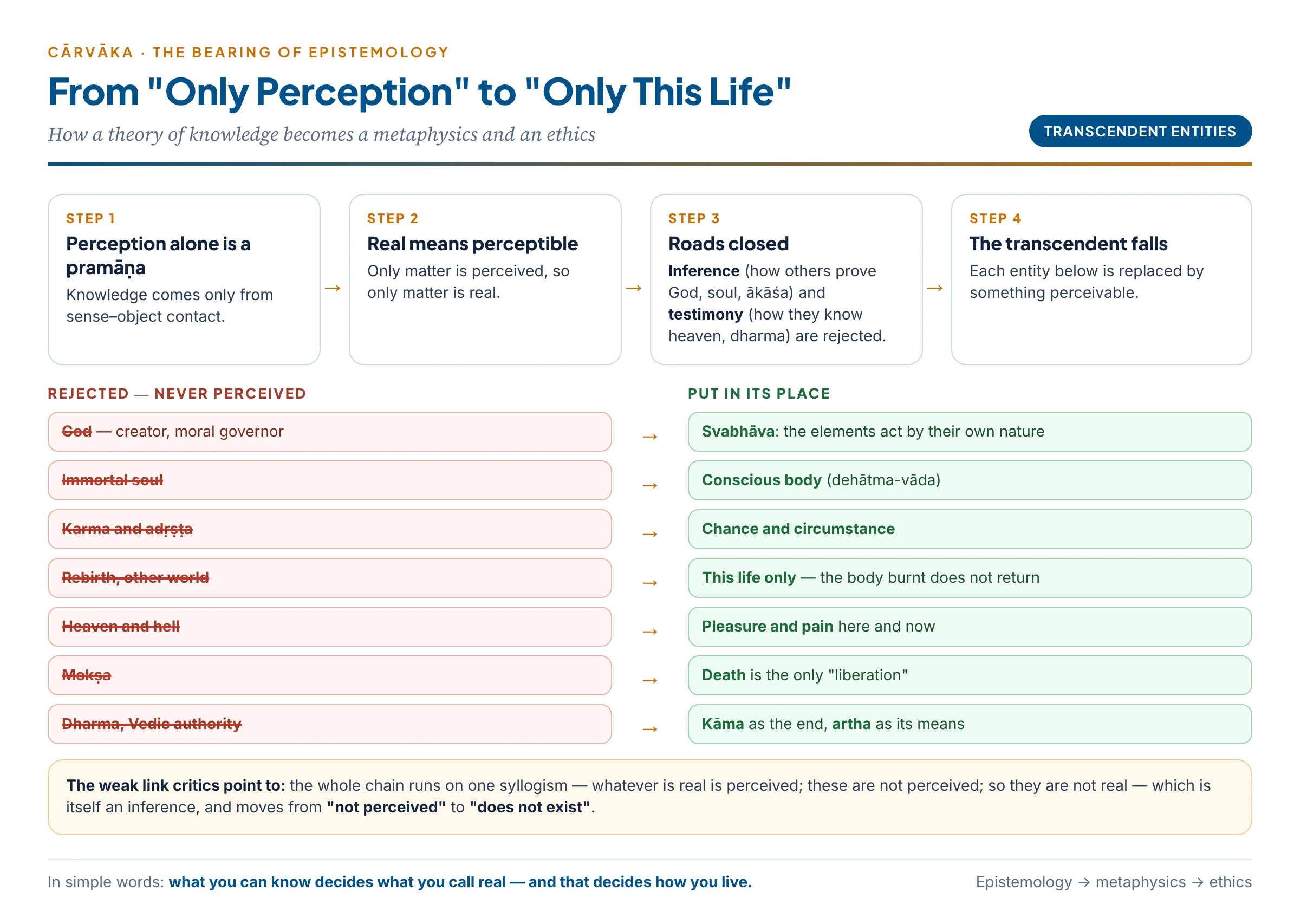
In the Cārvāka system metaphysics is a direct outcome of epistemology. The rejection of transcendent entities follows step by step from the theory that perception is the only pramāṇa.
- Reality = perceptibility. Perception is defined as sense–object contact. Only what can enter into such contact can be known — and only what can be known may be asserted to be real. So: matter is real, because it is perceived; whatever transcends the senses is rejected.
- The roads to the transcendent are closed. Other schools reach God and soul by inference and heaven and dharma by testimony:
- Nyāya infers God from the world as an effect, and the soul from desire, effort and memory;
- Nyāya infers ākāśa from sound;
- Mīmāṃsā knows heaven and dharma from the Veda.
The Cārvāka shows that inference cannot establish its universal rule (vyāpti) and that testimony is only inference about a speaker’s reliability — and the Veda a priestly composition. With inference and testimony gone, no route remains to the transcendent.
- Each entity falls in turn. Soul: never perceived; consciousness is a quality of the living body. God: never perceived; the world is explained by the nature of the elements. Karma, rebirth, heaven, hell, mokṣa: all depend on a soul that survives death, which is never perceived. Ākāśa: not perceived; only four elements are accepted.
- Positive replacements. Svabhāva (nature) instead of God; the conscious body instead of the soul; death instead of mokṣa; pleasure instead of heaven.
- The weak link. Critics point out that the whole rejection rests on a syllogism: “Whatever is real is perceived; transcendent entities are not perceived; therefore they are not real.” This uses inference, and it moves from not perceived to not existent — a step perception itself can never take.
Core Doctrine
1. Svabhāva-vāda: Nature Instead of God
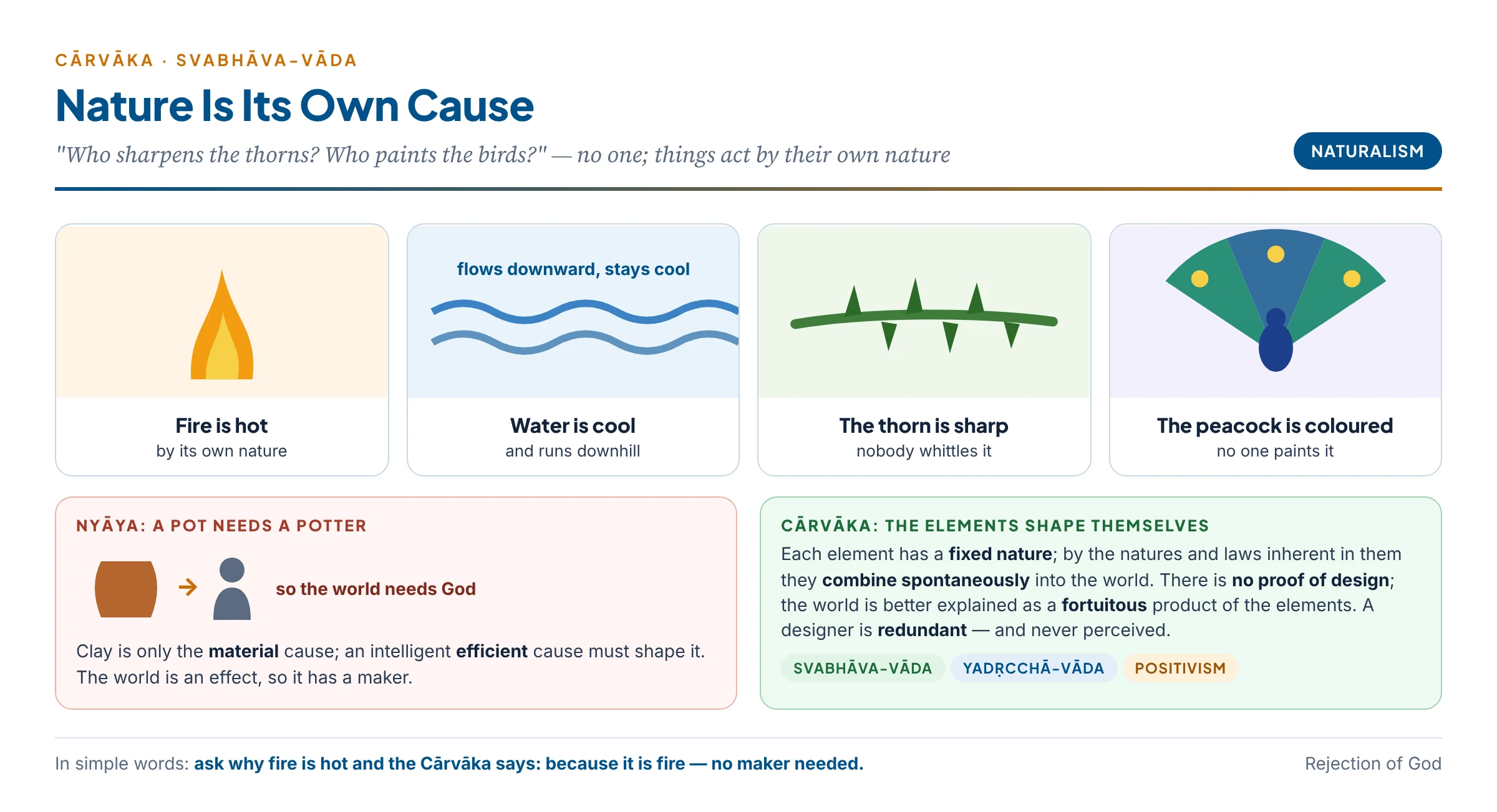
- The doctrine. Svabhāva means “own-nature“. Everything behaves according to its inherent nature: fire is hot, water cool, the thorn sharp; water flows downward, fire leaps upward. No further cause is needed for these facts — and no supernatural cause at all. Nature is its own cause.
- An old verse makes the point: “Who sharpens the thorns? Who paints the many colours of the deer and the birds? All this comes from their own nature; there is no one who wills it.“
- How the world arises. The four elements have fixed natures. By the natures and laws inherent in them, they combine spontaneously, without any external intervention, in different proportions, to form the diversity of the world — and separate again at dissolution. “From this nature the diversity of the world originates, is sustained and is destroyed.”
- Naturalism. Because it explains the world only by nature, this view is called naturalism (svabhāva-vāda).
- Mechanism / accidentalism (yadṛcchā-vāda). Because it denies any conscious purpose behind the world and explains it as a mechanical or fortuitous combination of elements, it is also called mechanism or accidentalism. One later writer describes the Cārvāka as holding that “everything happens without a cause” (ākasmikatva).
- Positivism. Since it believes only in positive facts — observable phenomena and their observed regularities — the Cārvāka theory as a whole may also be called positivism.
- An old idea. The Śvetāśvatara Upaniṣad already lists rival candidates for the cause of the world — time (kāla), own-nature (svabhāva), destiny (niyati), chance (yadṛcchā), the elements — and rejects them in favour of God. So svabhāva-vāda is older than the Cārvāka system; the Cārvāka made it the centre of a materialist worldview.
In simple words
A child asks: “Why is sugar sweet?” You might say, “Because God made it sweet,” or “Because of its past karma.” The Cārvāka answer is simpler: “Because that is what sugar is.” Sweetness is sugar’s own nature, as heat is fire’s and sharpness the thorn’s. Asking who made sugar sweet is like asking who made fire hot — there is no maker to be found, only the thing and its nature.
Common confusion
Does “accidentalism” mean the Cārvāka thought the world is pure chaos? No. The Cārvāka denies a purpose, a designer and a knowable, necessary causal law behind the world — not regularity itself. Fire is regularly hot; water is regularly cool. But these regularities come from the natures of the things themselves, not from God or karma, and we have no guarantee that they hold everywhere and always. “Accidental” means “without design“, not “without order“.
2. The Rejection of God
The Cārvākas are the earliest systematic atheists of India. Their critique of God is not merely theological but epistemological and metaphysical.
Cārvāka arguments:
- No perceptual evidence. God is never perceived. The inferences offered for His existence — from the world as an effect, from the order of nature — all rest on vyāpti, which cannot be established.
- Redundancy. The four elements supply the material of the world, and their own nature shapes it. Nothing is left for a creator to do. “The supposition of a creator is unnecessary.”
- Reply to “a pot needs a potter”. Nyāya argues: even an earthen pot needs, besides clay (its material cause), a potter (its efficient cause) to shape it; the world needs God as its potter. The Cārvāka answers: the elements each have a fixed nature, and by these natures they combine into the world. There is no proof that the objects of the world are products of design; they are better explained as fortuitous products of the elements.
- The problem of evil. If God were all-powerful and all-good, why would suffering, injustice and natural calamities exist? The presence of evil contradicts the idea of a moral creator.
- God as moral governor is unprovable. God is said to dispense the fruits of karma across lives. But past and future lives are never perceived; a governor of what cannot be shown to exist is an empty title.
- Contradictions in scripture. Vedic hymns praise now Indra, now Agni, now Varuṇa as supreme. Such contradictions show human authorship, not divine revelation. And the Veda proves God while God guarantees the Veda — a circle.
- An instrument of exploitation. Belief in God and the other world is a priestly construct to control people through fear of hell and the lure of heaven.
- The only lord is the king. “The king recognised by the world is the supreme lord” (loka-siddho rājā parameśvaraḥ). The only power that really rewards and punishes is the visible ruler.
- Ethics without God. Rejecting God leads to a secular ethics, judged by tangible consequences for human welfare and pleasure, not by unseen divine rewards and punishments.
Criticisms of the Cārvāka atheism:
- Nyāya. The world is an effect — it has parts and is produced — and every effect needs an intelligent efficient cause; so the world needs God (kāryāt). Udayana adds further proofs: atoms need a first mover to combine (āyojanāt); the world needs a support that holds it (dhṛti); words need an original giver of meaning (padāt); the Veda needs an infallible author (pratyayataḥ). These proofs were written expressly to answer atheists, the Cārvāka among them.
- Vedānta. Consciousness cannot arise from inert matter; it must come from Brahman, pure consciousness. Materialism cannot explain self-luminous awareness.
- Ritualists. Without the unseen force that links rites to their results, and without dharma, the moral order collapses and ritual loses its meaning; the Cārvāka is called nihilistic, a danger to social cohesion.
- Modern. An empiricism that rejects whatever is unperceived would also reject atoms, forces and fields, which science cannot do without.
- Atheism was not unique. The Jainas, Buddhists, Sāṃkhyas and Mīmāṃsakas also denied a creator God. What was distinctive in the Cārvāka was rejecting God together with soul, karma and liberation.
Indian Connect — Atheism in Indian philosophy
- Cārvāka — completely atheist: no God, no soul, no karma, no liberation.
- Jaina — no creator God, but the liberated Tīrthaṅkaras are revered as godlike; soul, karma and liberation accepted.
- Buddhist — the Buddha was silent on God (often called agnostic); later Buddhists argued against a creator; karma and nirvāṇa accepted.
- Sāṃkhya — no God needed (prakṛti evolves for the sake of puruṣa); Yoga admits Īśvara as a special puruṣa.
- Mīmāṃsā — the Veda and its rites are enough; God is not needed to give karma its fruit.
- Nyāya–Vaiśeṣika and the theistic Vedānta of Rāmānuja and Madhva — God is central.
The Cārvāka is unique not for denying God, but for denying every spiritual reality along with Him.
3. The Rejection of Karma and Adṛṣṭa
- What karma claims. Every action produces a fruit — pleasure or pain — in this life or a later one, through an unseen potency (adṛṣṭa) that attaches to the agent’s soul. Nyāya makes God the dispenser of these fruits; Mīmāṃsā, Jainism and Buddhism make the law work by itself.
- Cārvāka arguments.
- No necessary relation between action and fruit. Every event is a chance; its result is an accident. There is no law guaranteeing that a given act will produce a given fruit.
- The same act, different results. An action that produces pleasure for one person produces pain for another.
- Results depend on circumstances. The fruits of action depend on environment, conditions and surroundings: people fail despite working hard, and the lazy sometimes prosper.
- Adṛṣṭa is unperceived. An unseen potency carrying merit and demerit across lives is precisely the kind of thing perception never reveals.
- Vice and virtue are scriptural labels. The distinctions between virtue and vice (dharma, adharma), merit and demerit, are made by scripture, whose authority cannot be rationally accepted.
In simple words
Two friends prepare equally hard for an exam. On the morning of the paper one of them catches a high fever and does badly; the other, who spent the last week watching films, gets lucky with the questions and scores well. A believer in karma says the results come from deeds in a past life. The Cārvāka says: look at what you can see — a fever, a lucky question paper. Results depend on circumstances, not on an invisible account book of merit and demerit.
- The chain of rejections. If karma is rejected, rebirth — which exists to work out karma — is rejected too; if rebirth is rejected, the immortality of the soul goes with it. The Cārvāka denies reincarnation, an extra-bodily soul, the efficacy of religious rites, other worlds, fate, and the accumulation of merit and demerit.
- Free will, not fate. Rejecting karma did not make the Cārvāka a fatalist. The Ājīvika school of the same age (Makkhali Gosāla) denied free will and held that everything is fixed by destiny (niyati). The Cārvāka, by contrast, is usually described as a materialism that accepted free will: with no fate and no karmic past, what matters is what one does in this life.
- Criticisms.
- Inequality of birth. Why is one child born healthy and rich and another sick and poor, before either has done anything? Karma offers a moral explanation; the Cārvāka offers only chance — morally unsatisfying to its critics.
- Moral motivation. Without karma, critics argue, there is no reason to be good when no one is watching; the Jaina Guṇaratna warns that the result would be moral anarchy.
- Justice. The wicked who prosper and the good who suffer would never be set right.
4. The Rejection of the Other World, Heaven and Hell
- The ritualist goal. Mīmāṃsā holds that the highest goal is heaven (svarga) — a state of unalloyed bliss attained hereafter by performing the Vedic rites here.
- The Cārvāka reply. This rests on an unproved life after death. “Heaven” and “hell” are inventions of priests whose professional interest lies in coaxing, threatening and making people perform rituals; “enlightened people will always refuse to be duped by them“.
- Heaven and hell redefined. The only hell is pain in this life — “pain arising from thorns and the like is hell” — and the only heaven is pleasure here.
- Ridicule of the rites. The Cārvākas “raise cheap laughter” at customary rites to expose their absurdity:
- The sacrifice. “If a beast slain in the Jyotiṣṭoma sacrifice goes straight to heaven, why does the sacrificer not offer his own father?” — or his old parents, and make heaven sure for them?
- The śrāddha. “If food offered in the śrāddha (funeral rite) satisfies the dead, why should a traveller carry provisions? His family could feed him by making offerings at home.” And “if offerings here satisfy beings in heaven, why not satisfy those standing on the housetop by offering food on the ground floor?”
- The ascetic’s props. “The agnihotra, the three Vedas, the ascetic’s three staves and the smearing of oneself with ashes are the livelihood of those who lack intelligence and manliness.”
- Social duties. The prescribed actions of the castes and stages of life (varṇa, āśrama) produce no real effect beyond this world.
- No one returns. “If he who departs from the body goes to another world, how is it that he does not come back, restless for love of his kindred?”
5. The Rejection of Mokṣa
- What other schools mean by liberation. The total destruction of all suffering; for some it is attained only after death, when the soul is free from the body; for others it can be attained in this life (jīvan-mukti).
- The Cārvāka dilemma.
- If liberation means freedom of the soul from bondage to the body, it is absurd — there is no soul.
- If it means a state free from all pain in this very life, it is impossible — existence in the body is bound up with pleasure and pain together. We can only minimise pain and enjoy as much pleasure as we can.
- So liberation, in the sense of complete cessation of suffering, can only mean death: “death alone is liberation” (maraṇam evāpavargaḥ; “the destruction of the body is liberation”). And no wise person would work towards death as the goal of life.
- Against asceticism. Those who try to reach a state beyond pleasure and pain by rigorously suppressing natural appetites, thinking all pleasure is mixed with pain, “act like fools“. The Cārvāka criticises renunciation and ascetic practices as unnecessary self-torment.
In simple words
Your friend refuses to eat mangoes because “there is a big seed inside, and the skin is bitter.” You would laugh: throw away the seed, peel the skin, eat the fruit! The Cārvāka says the ascetic who rejects all pleasure because pleasure is “mixed with pain” is exactly this friend. Nobody throws away the grain because of the husk, stops eating fish because of bones, stops farming because animals may eat the crop, or stops cooking because beggars may ask for a share.
6. The Ethics That Follows: Hedonism
- The derivation. If the self is the body, pleasure and pain are bodily experiences; if this life is the only life, then the pleasure arising in the body is the only good we can obtain. “We should not throw away the opportunities of enjoying this life in the futile hope of enjoyment hereafter.” This ethics is “only the logical outcome of the materialist metaphysics”.
- The goal. The highest goal is the maximum amount of pleasure in this life, avoiding pain as far as possible. A good life is a life of maximum enjoyment; a good action is one that yields a balance of pleasure over pain; a bad action brings more pain than pleasure. This is hedonism — the theory that pleasure is the highest good.
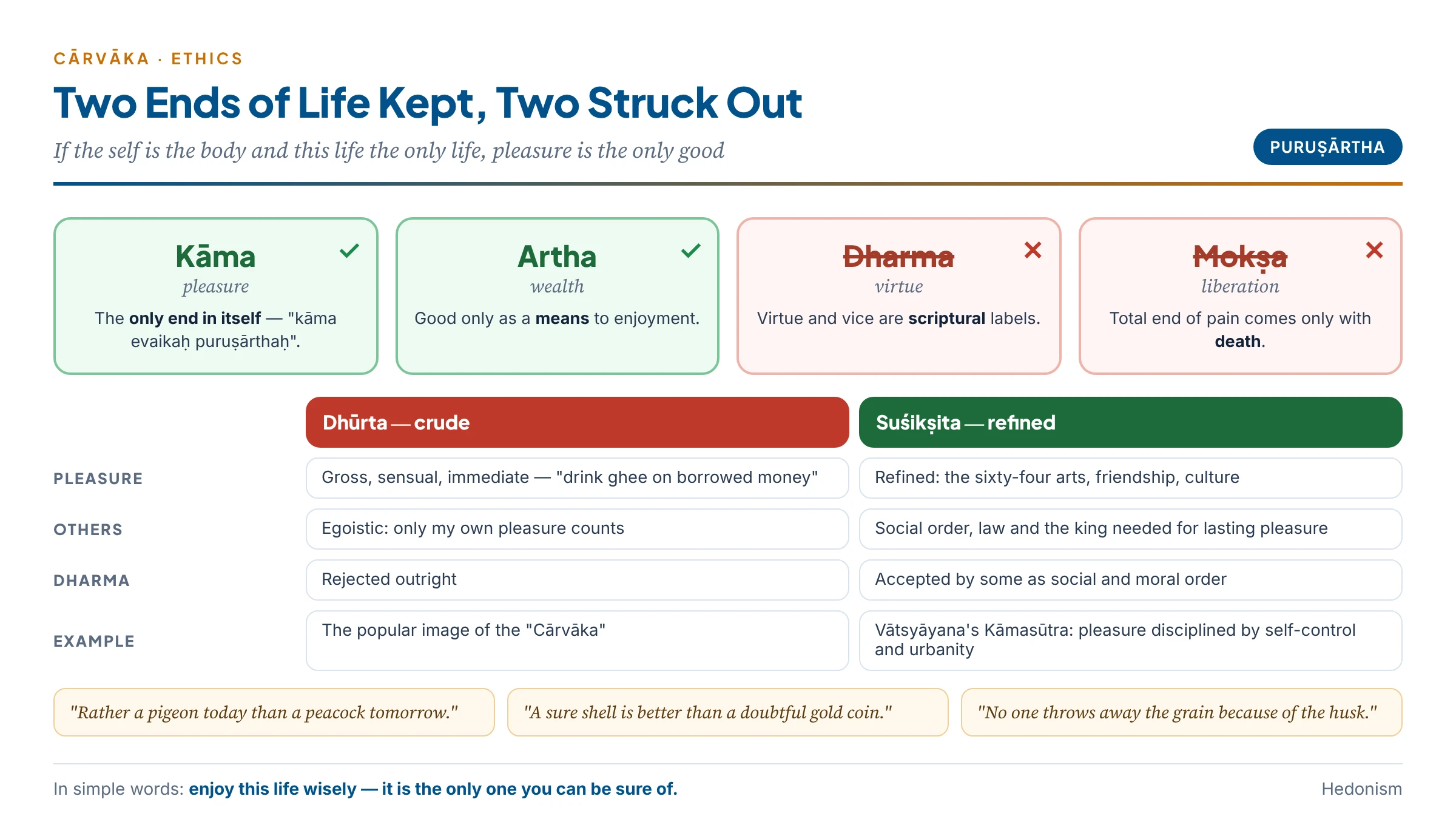
- The four puruṣārthas. Of the four ends of human life — dharma (virtue), artha (wealth), kāma (enjoyment) and mokṣa (liberation) — the Cārvāka keeps two:
- Kāma is the only end in itself (kāma evaikaḥ puruṣārthaḥ).
- Artha is valuable only as a means to enjoyment — to enjoy life one needs wealth, and to earn wealth one needs skill.
- Dharma is rejected — virtue and vice are distinctions made by scripture.
- Mokṣa is rejected — it can only mean death.
- The maxims.
- “While life is yours, live joyously; none can escape death’s searching eye; when once this frame of ours they burn, how shall it ever again return?“
- “As long as you live, live happily; drink ghee even if you must borrow” (yāvaj jīvet sukhaṃ jīvet, ṛṇaṃ kṛtvā ghṛtaṃ pibet).
- “Rather a pigeon today than a peacock tomorrow.“
- “A sure shell (cowrie) is better than a doubtful gold coin.“
- “Who is the fool who would hand over the money in his hand to the keeping of others?“
- Religion reduced. With scripture, virtue and vice, and the afterlife rejected, the Cārvāka opposes religious ceremonies performed to attain heaven, avoid hell or appease the dead. Religion is reduced to morality, and morality to the search for pleasure.
7. Crude and Refined Hedonism
- Crude (dhūrta) hedonism. Egoistic: only one’s own pleasure counts; sensual: the pleasures of food, drink and sex; immediate: enjoy now, even on borrowed money. Others are, at best, instruments of one’s pleasure; there is no obligation to promote the welfare of society.
- Refined (suśikṣita) hedonism. The distinction found in later reports between the cunning (dhūrta) and the cultured (suśikṣita) Cārvākas shows that the materialists were not all of one gross type.
- They pursued refined pleasures — the sixty-four arts (catuḥ-ṣaṣṭi kalāḥ): music, painting, poetry, conversation.
- They saw that society is necessary for lasting pleasure: some Cārvākas regarded the king as God, and political science and economics (daṇḍa-nīti, vārttā) were at some stage counted part of Lokāyata learning.
- Morality, for them, arises from social convention and prudence; social harmony is a condition of sustained pleasure. Their ethics is secular — based on human welfare, judged by consequences.
- Some reports say the refined Cārvākas accepted dharma (social and moral order) as a value, while rejecting mokṣa.
- Vātsyāyana’s Kāmasūtra. The best positive evidence of refined hedonism is the Kāmasūtra of Vātsyāyana, a recognised hedonist. Vātsyāyana believes in God and an afterlife, so he is not a materialist in the strict sense, but he treats dharma and artha as means and kāma as the supreme end of the householder’s life, to be pursued harmoniously with the other two. Pleasure must be refined by self-control (brahmacarya), moral discipline (dharma) and urbane culture (nāgarika-vṛtti); otherwise it sinks to the level of animals. The satisfaction of the senses is necessary for the very life of the body (śarīra-sthiti), like food for hunger — but the senses must be educated through the sixty-four arts. One reading even makes Vātsyāyana place dharma above pleasure, requiring pleasure to conform to dharma.
Common confusion
Is “Cārvāka = eat, drink and be merry” the whole of Cārvāka ethics? No. That slogan describes the crude (dhūrta) Cārvāka, as presented by hostile writers. Opponents themselves record a cultured (suśikṣita) wing that valued the arts, social order and prudence, and the Kāmasūtra shows that a pleasure-centred ethics could be refined and disciplined. Like the Epicureans of Greece, the Cārvākas “have been more hated than understood”.
Criticisms of Cārvāka ethics:
- No ground for altruism or duty. Pure egoistic hedonism gives no reason for self-sacrifice, justice or duty to others; it treats other people as instruments of one’s pleasure. “Egoistic hedonism in its gross form is not compatible with social discipline. Life in society is impossible if man does not sacrifice a part of his pleasures for others.”
- The paradox of hedonism. Chasing immediate pleasure often produces long-term pain — debt, disease, broken relationships. Living moment to moment defeats the goal of maximum pleasure.
- An epistemological contradiction. Maximising pleasure over a lifetime requires planning — predicting the future results of present actions. That is inference, which the crude Cārvāka rejects.
- Qualities of pleasure. Pleasures differ in quality, not only quantity: “the pleasure of the pig is certainly not the same as the pleasure of the philosopher”. (J. S. Mill: “It is better to be a human being dissatisfied than a pig satisfied; better to be Socrates dissatisfied than a fool satisfied.”) Sensual pleasure is “a very faint shadow” of higher joys.
- Reduction of human beings. Making bodily pleasure the only goal ignores the intellectual, aesthetic, moral and spiritual dimensions of life and fails to distinguish human reflection from animal instinct.
- The other schools. Nyāya and Vedānta: hedonism undermines moral responsibility and ignores truth, compassion and self-control. Buddhism and Jainism: ethical life should aim at liberation from suffering, not indulgence — craving is the very cause of suffering.
- Modern critique. Pure sensualism breeds short-termism and neglects communal and environmental ethics — a consumerism that borrows today and pays tomorrow, as the “drink ghee on borrowed money” maxim literally recommends.
What can be said for it:
- It is an honest, this-worldly ethics: it refuses to sacrifice real present well-being for unprovable future rewards.
- It exposes priestly exploitation and costly, meaningless rituals.
- In its refined form it is close to Epicurus, who taught that the wise seek prudent, lasting pleasure — friendship, simple living, freedom from fear of the gods and of death — rather than wild indulgence.
- Its secular, consequence-based morality anticipates utilitarian and humanist ethics.
8. Why Did the Cārvāka Decline?
- Not because it rejected the Veda — the Jainas and Buddhists did too.
- Not because it rejected God — the Jainas, Buddhists, Sāṃkhyas and Mīmāṃsakas also managed without a creator.
- Not because it denied the soul — some Buddhist schools did as well.
- Not because it asserted the reality of matter — all realist schools did.
- Not even because of its hedonism alone — pleasure, in some form, is desired by all.
- The main cause was the Cārvāka’s apparent denial of all values that make life worth living. Life without values is animal life, not human life. Hence the later distinction between crude and refined materialists, and the Kāmasūtra’s insistence that pleasure conform to dharma.
- Other factors. Its texts were lost; it was known only through hostile summaries; Jainism and Buddhism offered ethical and spiritual alternatives that were equally anti-ritualist but morally richer. “Born in discontent, it soon died in serious thought.“
9. The Legacy of Lokāyata
- The only systematic materialist tradition in Indian philosophy — an indigenous rationalist counterpoint to orthodoxy, emphasising empirical verification and worldly welfare over ritualism and speculative metaphysics.
- A critic of priestcraft. It offered a radical critique of the ritualistic practices of Vedic society and the exploitation of the ignorant.
- The touchstone of every system. Every school tried to meet the Cārvāka objections; its value lay directly in supplying fresh problems and indirectly in compelling other thinkers to give up dogmatism and become critical and cautious. It may be credited with saving Indian philosophy from dogmatism, as Hume did for Kant (see the article on the self-refutation charge).
- Legitimising dissent. Its very survival as a recognised darśana — even as the opponent — shows that Indian thought allowed dissent a place in debate.
- Science and the body. By dignifying the physical world and the body, materialist thinking encouraged respect for medicine and natural inquiry; its demand for empirical verification is the golden rule of the scientific method. Its view of the origin of the world and of life — by the natural combination of matter, without a designer — fits well with modern evolutionary and cosmological theories that are materialistic in essence.
- A living voice. In modern India, rationalist and secular movements, and thinkers who wished to recover an indigenous tradition of free thought, have repeatedly turned to Lokāyata as evidence that scepticism and materialism are as Indian as faith.
Critical Evaluation
How Strong Is the Rejection of Transcendent Entities?
- Against the “proofs”. As a critique of arguments for God, soul and the afterlife, the Cārvāka is strong: it shows that these arguments rest on universal rules and testimony that cannot be checked by experience.
- Against the entities themselves. As a proof that they do not exist, it is weak: “not perceived” does not entail “does not exist“. Strictly applied, the Cārvāka method yields agnosticism (“we have no reason to believe”), not atheism (“there is no God”).
- Against values. Its rejection of dharma along with the unseen world leaves ethics with only pleasure — which most critics, and some Cārvākas, found too thin a foundation.
- Self-application. The step from epistemology to metaphysics is itself an inference, so the whole edifice depends on the reasoning the crude Cārvāka rejects.
Critics and Defenders
Criticism — Critics
- Non-perception is not non-existence; the method supports agnosticism, not atheism.
- Nyāya: the world as an effect needs an intelligent maker; atoms need a mover.
- Vedānta: consciousness cannot come from inert matter.
- Karma explains inequality of birth; denying it invites moral anarchy.
- Hedonism gives no ground for duty or altruism; it is short-sighted and self-defeating.
- Rejecting all unperceivables would also reject the theoretical entities of science.
Defence — Defenders and strengths
- The arguments for God, soul and afterlife do rest on uncheckable premises.
- Svabhāva: nature’s own regularities explain the world without a designer — as evolution later showed for living things.
- The problem of evil remains a serious objection to a good and almighty creator.
- Exposes priestly exploitation and costly ritual; demands evidence before belief.
- Refined Cārvāka ethics is prudent, social and secular — close to Epicurus and utilitarianism.
Cross-Tradition Comparison
Critics of the Transcendent, East and West
| Issue | Cārvāka | Epicurus | Hume | Logical positivism (Ayer) | Marx |
|---|---|---|---|---|---|
| God | Does not exist; nature suffices | Gods exist but do not interfere | Design argument weak; evil counts against God | “God exists” is meaningless | Religion is “the opium of the people” |
| Soul / afterlife | Conscious body; death is the end | Soul-atoms scatter; “death is nothing to us” | Self is a bundle; immortality unproved | Unverifiable, meaningless | Consciousness a product of matter and society |
| Miracles, rites | Priestly fraud; ridiculed | Fear of gods causes misery | Testimony for miracles never outweighs experience | Meaningless | Tools of class domination |
| Ethics | Pleasure (crude or refined) | Prudent, tranquil pleasure | Sentiment, utility | Emotivism | Human emancipation |
Indian Connect — Key takeaways
- The Cārvāka is the only Indian school to reject all three cornerstones — ātman, karma and mokṣa — and the only one for which liberation is death.
- Svabhāva-vāda links the Cārvāka to older Upaniṣadic debates about the cause of the world, and contrasts with the Ājīvika fatalism of the same age.
- Its ethics shows that India had its own Epicurus — and, in the Kāmasūtra, its own theory of refined pleasure.
- Every school’s proofs of God (Udayana), self (Nyāya), eternal Veda (Mīmāṃsā) and karma were sharpened by answering the Cārvāka.
Synthesis (Siddhānta)
- The bearing of epistemology. Because perception alone is a pramāṇa, only the perceptible is real; inference and testimony — the only roads to the transcendent — are closed. God, soul, karma, adṛṣṭa, rebirth, the other world, heaven, hell, mokṣa and Vedic authority therefore fall together.
- The replacements. Svabhāva (nature) and yadṛcchā (undesigned combination) instead of God; the conscious body instead of the soul; chance and circumstance instead of karma; pain and pleasure here instead of hell and heaven; death instead of mokṣa; kāma with artha as its means instead of dharma and mokṣa.
- The ethics. Crude egoistic hedonism in its popular image; a refined, social, secular hedonism in its cultured form.
- Balanced verdict. The Cārvāka is a powerful critic of arguments for the transcendent and of the exploitation built on them, but its method can justify agnosticism rather than outright denial, and its ethics, at least in crude form, neglects the values that make life human. Its lasting service was to make every Indian system argue for what it had assumed.
- Contemporary relevance. The Cārvāka spirit lives in the constitutional duty to develop the scientific temper, humanism and the spirit of inquiry and reform (Article 51A(h)); in anti-superstition laws such as Maharashtra’s 2013 Act against human sacrifice and black magic and Karnataka’s 2017 Act against inhuman evil practices; in the freedom of conscience protected by Article 25, which includes the freedom not to believe; in Indian secularism; and, less happily, in modern consumerism — “borrow and enjoy” — whose costs the Cārvāka’s critics foresaw.
“While life is yours, live joyously; none can escape death’s searching eye; when once this frame of ours they burn, how shall it ever again return?” — Cārvāka verse
Previous Year Questions
- 2025Discuss Carvaka’s critique of the belief in the existence of suprasensible entities.
- 2021Comment on the bearing of Carvaka epistemology on the rejection of transcendental entities by them.
- 2020Critically evaluate Carvaka’s rejection of Akasa as one of the elements of reality and examine their criticism of transmigration of Soul.
- 2015Explain the arguments of Carvaka to reject transcendental entities.
- 2014“Limits of knowledge and world are determined by my sense perception“. Discuss this claim of Carvaka.