

Cārvāka: Theory of Knowledge; Rejection of Transcendent Entities.
Official Syllabus: Paper I, Section B, Unit 12
If perception is the only means of knowledge, then only what can be perceived can be asserted to be real — and what the senses reveal is matter. The Cārvāka metaphysics is therefore materialism: the world is made of four perceptible elements — earth, water, fire and air. The fifth element of the other schools, ākāśa (ether, the supposed substance of sound and space), is rejected because it is never perceived, only inferred. Even consciousness, which every other Indian school traced to a non-material soul (ātman), is explained as a product of matter: when the elements combine in the form of a living body, consciousness emerges, as the red colour emerges when betel leaf, areca nut and lime are chewed together (bhūta-caitanya-vāda). The “soul” is nothing but this conscious living body (dehātma-vāda). When the body dies, the person ends; there is no one left to be reborn.
In simple words
Light a candle. There is a flame — bright, warm, flickering, very different from wax and wick. When the wax is used up, the flame goes out. Where does the flame go? Nowhere — it was never a separate thing living inside the candle; it was what the burning candle did. The Cārvāka says consciousness is like that flame: something the living body does. When the body stops, consciousness does not travel to heaven or into another body. It simply goes out.
Context & Problem
From Theory of Knowledge to Theory of Reality
- Materialism is the doctrine that matter is the only reality; mind and consciousness are explained as products of matter. In general outlook, materialism tries to explain the higher by the lower — life and mind by physical stuff — and is opposed to every spiritual interpretation of the universe.
- The Cārvāka derivation.
- Perception is the only pramāṇa.
- Only material objects are perceived.
- So only material objects can be known to be real; whatever is not perceivable is “a figment of the imagination”.
- The surviving aphorisms attributed to Bṛhaspati state the metaphysics in a few lines:
- Pṛthivy-ap-tejo-vāyur iti tattvāni — “earth, water, fire and air are the elements“;
- Tat-samudāye śarīrendriya-viṣaya-saṃjñā — “bodies, senses and objects are names for combinations of these elements“;
- Kiṇvādibhyo mada-śaktivad vijñānam — “consciousness arises from them, like the intoxicating power from fermenting ingredients“;
- Caitanya-viśiṣṭaḥ kāyaḥ puruṣaḥ — “the person is the body qualified by consciousness“.
A further dictum ascribed to Bṛhaspati sums it up: “out of matter comes forth life“.
The Problem: Consciousness
- The one thing that resists. Earth, water, fire and air are unconscious (jaḍa). Yet human beings think, feel, desire and remember. Every other Indian school concluded that consciousness belongs to something non-material — a soul.
- The traditional soul. In most Indian systems the soul is eternal, unchanging, immortal, conscious and independent of the body; it is the substratum of consciousness and the bearer of karma from life to life.
- The Cārvāka challenge. The Cārvāka accepts that consciousness exists — it is directly felt. What it denies is that consciousness belongs to any unperceived, non-material entity. Since consciousness is found only in perceptible living bodies, it must be a quality of the body itself.
| School | What consciousness is | Its bearer |
|---|---|---|
| Cārvāka | A by-product of matter | The living body |
| Nyāya–Vaiśeṣika | An accidental quality of the soul, arising when soul, mind, senses and object meet | An eternal, all-pervading soul |
| Sāṃkhya–Yoga | The very nature of puruṣa, the witness | Many puruṣas, distinct from prakṛti |
| Jaina | The essence of every soul (cetanā-lakṣaṇo jīvaḥ) | Infinite souls (jīva), even in plants and particles of dust |
| Advaita | The self itself — pure, self-luminous consciousness (svayam-prakāśa) | No bearer: consciousness is the self (Brahman) |
| Viśiṣṭādvaita | An attribute of the self (dharma-bhūta-jñāna) | The self as conscious subject, the “I” |
| Yogācāra Buddhism | A stream of momentary cognitions with a storehouse of impressions (ālaya-vijñāna) | No permanent bearer |
Core Doctrine
1. Matter Is the Only Reality: the Four Elements
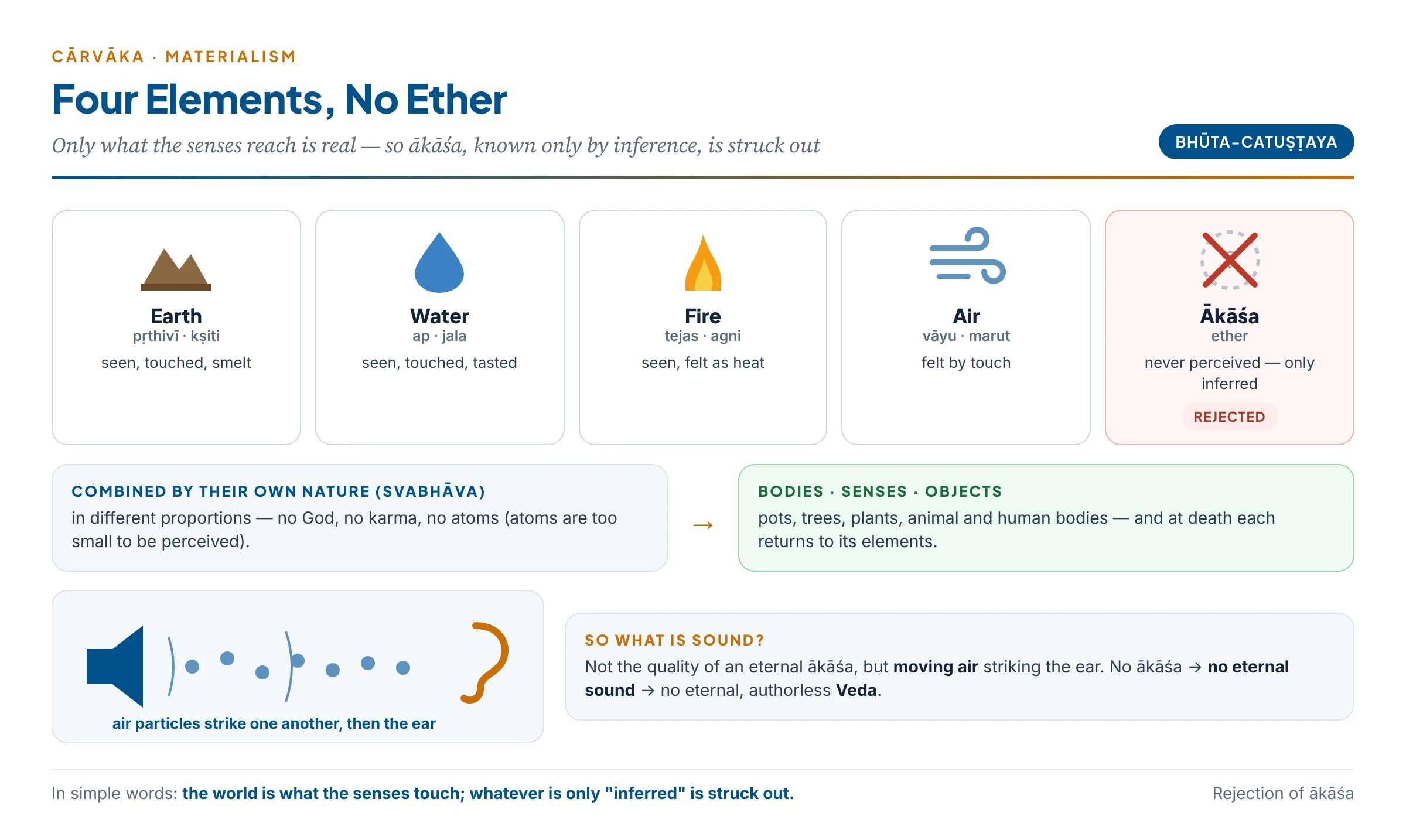
- The four elements (bhūta-catuṣṭaya): earth (pṛthivī or kṣiti), water (ap), fire (tejas or agni) and air (vāyu or marut). All four are perceptible: earth is seen and touched, water tasted, fire seen and felt as heat, air felt as touch.
- Everything is a combination. Pots, trees and mountains, plants and animal bodies, the sense organs and the human body are all combinations of these four elements in different proportions. “Body”, “sense” and “object” are only names for particular combinations.
- Production and dissolution. The elements themselves endure; their combinations are produced and dissolved. At death a living body returns to its elements — earth to earth, water to water, fire to fire, air to air.
- Pluralistic materialism. There are four kinds of matter, not one: the Cārvāka is a pluralist about matter and a monist only in admitting nothing but matter.
- No atoms. Unlike Nyāya–Vaiśeṣika and the Jainas, the Cārvāka does not accept atoms (paramāṇu): atoms are too small to be perceived, and are known only by inference. Its elements are the gross, perceptible elements of experience.
- What makes them combine? Not God, not karma, but their own nature (svabhāva). The elements combine spontaneously, by the natures and laws inherent in them (see the article on rejection of transcendent entities).
2. Why Ākāśa Is Rejected
- What ākāśa is for the other schools.
- Nyāya–Vaiśeṣika: one, eternal, all-pervading substance whose special quality is sound (śabda). It is not perceived; it is inferred: sound is a quality, a quality must reside in a substance, sound is not the quality of earth, water, fire, air, time, space, soul or mind — so it must belong to a fifth physical substance, ākāśa.
- Sāṃkhya: the first of the gross elements, evolving from the subtle element of sound (śabda-tanmātra); without it the ladder from subtle to gross elements and the faculty of hearing cannot be explained.
- Vedānta: the first evolute in the creation of the world (“from the Self arose ākāśa”, says the Upaniṣad).
- Jainism: a real substance that gives room to everything; material things must exist somewhere.
- Mīmāṃsā: the medium of eternal sound and so of the eternal Veda.
Ākāśa was thus posited to explain sound, spatiality and the all-pervasiveness of the soul.
- The Cārvāka reasons for rejecting it.
- It is not perceived. Ākāśa is imperceptible to every sense; even its alleged quality, sound, can be experienced without positing a separate substance. Whatever is not perceived is not accepted.
- It is redundant. Sound and the “room” between things can be explained by the four perceptible elements. Sound is produced by the movement of air particles striking one another and striking the ear; it is propagated through the elements themselves. An extra, unobservable substance explains nothing that the four do not.
- The inference to ākāśa rests on vyāpti. “Every quality needs a substance” and “sound is not the quality of any other substance” are universal rules that cannot be established; the Nyāya proof of ākāśa is an inference, and inference is not a pramāṇa.
- What falls with ākāśa.
- Eternal sound. Without an eternal substratum, sound cannot be eternal; sound exists only when someone produces it. So the Mīmāṃsā doctrine of the eternal, authorless Veda collapses.
- The all-pervading soul. The Nyāya picture of an all-pervading soul has nothing to pervade.
- The Upaniṣadic cosmology that begins creation from ākāśa.
Evaluation of the rejection of ākāśa:
- Strengths.
- Consistency. Given its theory of knowledge, the rejection is the inevitable logical consequence of the Cārvāka’s radical empiricism.
- Scientific insight. Modern physics explains sound as vibrations travelling through material media — air, water, solids — with no sound in a vacuum. The Cārvāka view that sound needs only the perceptible elements is closer to this than the theory of an all-pervading, eternal ākāśa.
- A lesson from science. Nineteenth-century physics also postulated an invisible “ether” filling space — to carry light — and abandoned it when experiments found no trace of it. Unobservable media posited only to make a theory work are often dropped.
- Weaknesses.
- Non-perception is not non-existence. “Ākāśa does not exist because it is not perceived” is itself an inference — and a doubtful one; many things exist that we do not perceive.
- Space is needed. Without space, the Cārvāka cannot explain distance, the room for movement, or the location of extended things — the very functions the Jainas and Nyāya assigned to ākāśa or to space (dik). “Here” and “there” imply a medium in which things are placed.
- Air carries sound but does not produce it, say the Naiyāyikas; the source of the quality remains unexplained.
- Pure empiricism cannot accommodate theoretical entities. Space, time, laws of nature, atoms, electromagnetic fields are not directly perceptible, yet modern science cannot do without them. The Cārvāka criterion, applied strictly, would rule out much of physics.
Common confusion
Did the Cārvākas deny that there is any space between things? Not exactly. What they denied was ākāśa as a fifth, eternal, imperceptible substance — the “carrier of sound” of Nyāya and the “first element” of the Upaniṣads. The gaps and distances we see between things are perceived, and the Cārvāka need not deny them. The difficulty critics press is that the Cārvāka gives no positive account of what space is — and that perceived distance and location seem to presuppose something more than the four elements.
3. Bhūta-caitanya-vāda: Consciousness from Matter
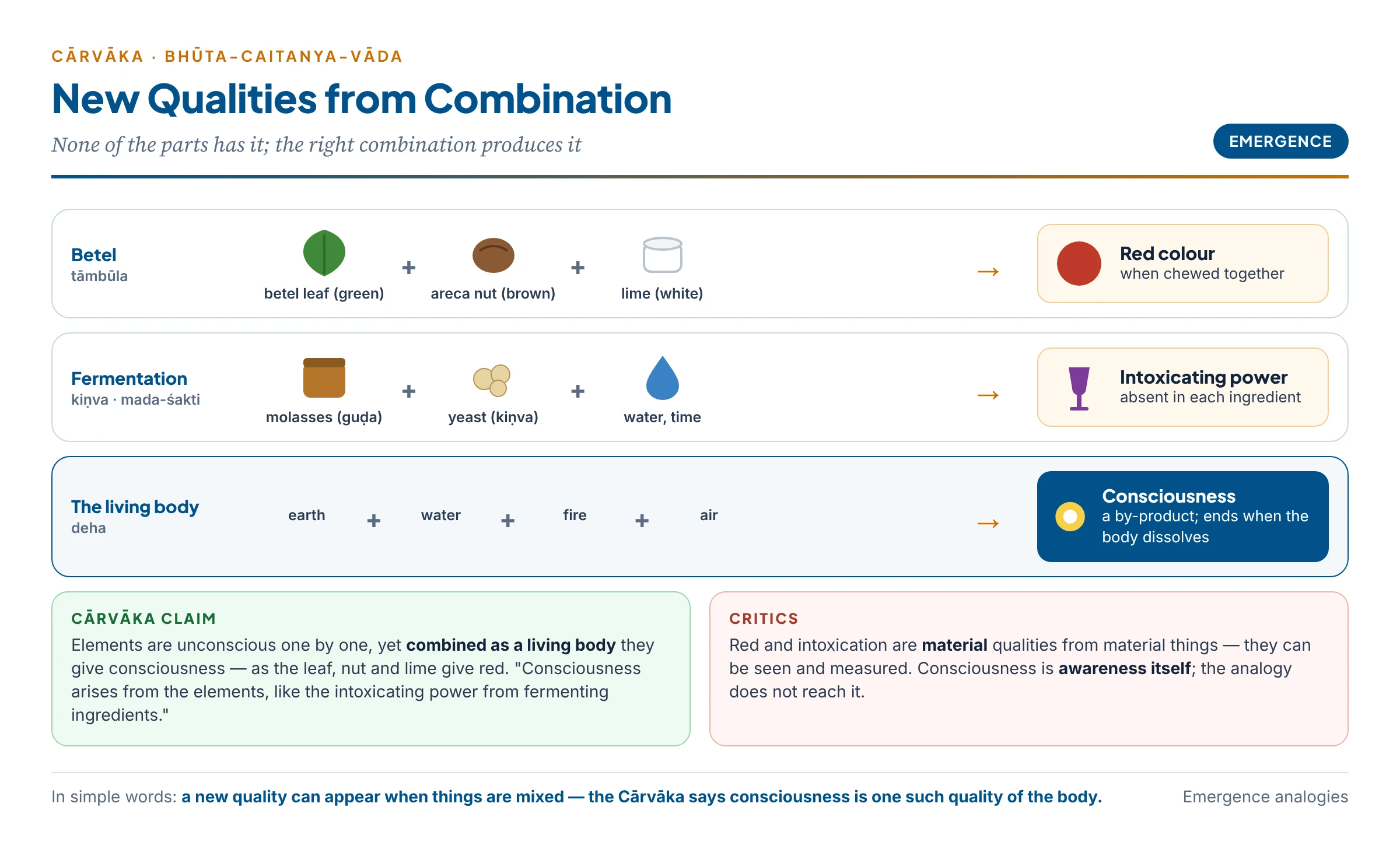
- The doctrine. Bhūta = the elements; caitanya = consciousness. Consciousness is a product of the four elements. It is not present in any element separately, but arises when the elements combine in a particular way and proportion — in the form of a living organism.
- The obvious objection. We never find consciousness in earth, water, fire or air. How can a combination of unconscious things produce something conscious? Most Indian schools held that the qualities of an effect come from the qualities of its cause; nothing comes from nothing.
- The Cārvāka reply: emergence. Qualities absent in every component can appear when the components are combined. Two classical examples:
- Betel (tāmbūla). Betel leaf (green), areca nut (brown) and lime (white) — none of them red — produce a red colour when chewed together.
- Fermentation (kiṇva). Molasses (guḍa), rice and yeast (kiṇva) are not intoxicating separately; allowed to ferment together, they acquire an intoxicating power (mada-śakti).
- New conditions, new qualities. Even one substance placed under new conditions may develop qualities it lacked before — molasses becomes intoxicating only when it ferments.
- The conclusion. “In a similar way it is possible to think that the material elements, combined in a particular way, give rise to the conscious living body.” Consciousness is an epiphenomenon — a by-product of matter — with no evidence of existence independent of the body. The process has been called an “emergent and dialectical evolution“: quantity and arrangement of matter give rise to a new quality.
- A later image. The materialist slogan “the brain secretes thought as the liver secretes bile“, made famous by Western materialists of the 19th century, is often used in Indian textbooks to state the Cārvāka view: consciousness is something a bodily organ produces.
- Why only living, human bodies? The particular combination that produces consciousness occurs only in the living body, and the fullest consciousness only in the human body. That is why we never meet consciousness in stones or in corpses.
In simple words
Take two gases — hydrogen and oxygen. Neither is wet; you could not drink either. Combine them in the right way and you get water — wet, drinkable, able to put out fire. “Wetness” was not in the parts; it emerged from their combination. The Cārvāka (without knowing any chemistry) made the same kind of claim: “consciousness” is not in any element, but it can emerge when the elements combine as a living body.
4. Dehātma-vāda: the Soul Is the Conscious Body
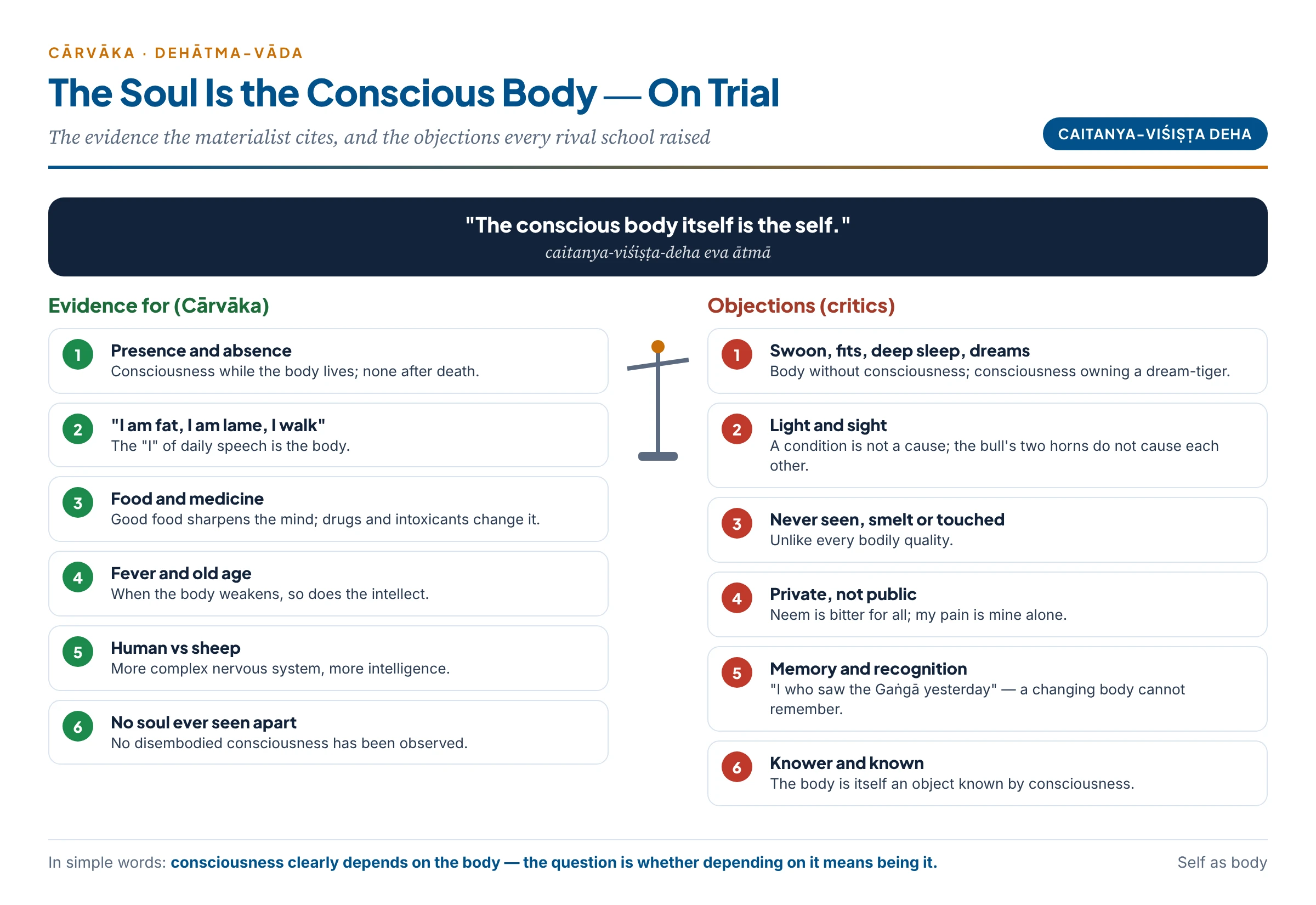
- The doctrine. Deha = body; ātman = self. “The conscious body itself is the self” (caitanya-viśiṣṭa-deha eva ātmā). What people call the “soul” is nothing more than the living body qualified by consciousness. The actions attributed to the soul are actions of the body.
- Two sides of one theory. Bhūta-caitanya-vāda explains how consciousness arises (from matter); dehātma-vāda says what the self is (the conscious body). The two are intimately connected: if consciousness is a product of the body, the conscious body is all there is to the self.
Arguments for dehātma-vāda:
- Presence and absence. As long as the body is alive, consciousness is present; when the body dies, consciousness is absent. Consciousness goes wherever the living body goes, and nowhere else.
- No independent soul is perceived. If the soul were different from the living body, we should be able to perceive it apart from the body. We never do.
- The evidence of language. We say “I am fat“, “I am lean“, “I am fair“, “I am lame“, “I am blind“, “I walk“. If the “I” were different from the body, these statements would be meaningless. The same “I” says “I am happy”: so the subject of happiness is the subject of fatness — the body.
- Nourishment. When the body is nourished by good food and drink, intelligence is nourished too; a healthy body supports a sharp mind.
- Disease. When the body is disordered — by fever or illness — mental powers decline.
- Old age. As a man grows old and his body becomes weak and thin, his intellectual capacity also weakens.
- Substances change consciousness. Intoxicants dull or excite it; medicines prescribed by physicians — such as preparations of brāhmī with ghee — are said to improve intellect. If food and drugs alter consciousness, consciousness depends on the material body.
- Nervous system. The more developed the bodily (nervous) system, the more developed the intelligence: a human being is more intelligent than a sheep because the human nervous system is more complex. Intelligence grows with bodily mechanism.
- Sensation needs the body. Sensation and perception arise only through the bodily organs — no eyes, no sight; no ears, no hearing.
- No disembodied consciousness has ever been observed. Every consciousness anyone has met has been the consciousness of some living body.
- The consequence. The death of the body is the end of the individual. If no soul apart from the body is proved, immortality cannot be proved. All questions about previous lives, after-life, rebirth, and enjoying the fruits of actions in heaven or hell become meaningless. “When the body is reduced to ashes, how can it ever return?” (bhasmībhūtasya dehasya punarāgamanaṃ kutaḥ).
Four materialist views of the self. The Advaita manual Vedāntasāra of Sadānanda records four materialist positions, each identifying the self with a different part of the organism:
- The gross body (sthūla-śarīra) — “I am fat, I am lean” (dehātma-vāda proper);
- The senses (indriya) — “I am blind, I am deaf”: it is the eye that sees, so the senses are the self;
- The vital breath (prāṇa) — “I am hungry, I am thirsty”: life lasts exactly as long as breath, so breath is the self;
- The mind (manas) — “I think, I doubt”: the internal organ is the self.
All four agree on the main point: the self is a product of matter. The materialist Kambalāśvatara, reported by Buddhist logicians, held that consciousness arises from the body together with the vital breaths. Some refined Cārvākas allowed a conscious self distinct from the gross body — but one that lasts only as long as the body and perishes with it.
Common confusion
Do the Cārvākas deny that consciousness exists? No. They accept consciousness as a fact — it is directly experienced. They deny only that it is the property of a separate, non-material, eternal soul. For the Cārvāka, consciousness is real but not independent: a quality of the living body, like the redness of chewed betel or the intoxicating power of fermented molasses. Calling it an “epiphenomenon” means it is a by-product that depends on the body and disappears with it — not that it is unreal.
5. Criticisms of Bhūta-caitanya-vāda and Dehātma-vāda
Every other school attacked this doctrine — Jaina, Buddhist, Nyāya, Sāṃkhya and Vedānta alike.
(a) The analogies fail.
- The red of betel and the intoxicating power of liquor are material qualities produced from material things — they can be seen, tasted, measured. Consciousness is qualitatively different: it is not one more property of matter but the awareness of properties. A material combination can produce a new material quality; it does not follow that it can produce awareness.
- “Being cannot come from non-being” (the Bhagavad-gītā: “the unreal has no existence, the real never ceases to be”). If consciousness is wholly absent from the elements, the combination cannot produce it. The Jaina logician Guṇaratna rejects the “wine causes intoxication, so body causes consciousness” analogy as logically flawed.
(b) Consciousness is not perceived like bodily qualities.
- If consciousness were a property of the body, it should be perceived like the body’s other properties — its colour, size or weight. But consciousness is neither seen, nor smelt, nor heard, nor tasted, nor touched.
- Nobody has ever perceived matter producing consciousness. And the Cārvāka cannot infer that it does, because it rejects inference.
(c) Consciousness is private.
- Material properties are public: the bitterness of neem is bitter for everyone; a body’s weight can be measured by anyone.
- Consciousness is intimately private: my pain is felt only by me; one person’s consciousness cannot be shared by another. (In Western terms, P. F. Strawson observed that experiences, unlike material properties, are non-transferable: my pain could not have been yours.) So consciousness is not an ordinary property of matter.
(d) Body and consciousness come apart.
- If consciousness were an essential property of the living body, it would be inseparable from it. But in swoons, fits, epilepsy and dreamless sleep, the living body exists without consciousness.
- Conversely, in dreams, consciousness exists without the waking body’s activity. When a dreamer wakes, he disowns the dream-body but owns the dream-consciousness: “I saw a tiger in my dream”. The dream-tiger is sublated (shown false) on waking, but the fact that I saw it remains true. Consciousness persists through waking, dream and deep sleep; the body is its instrument, not its cause.
(e) Co-existence is not causation.
- That consciousness is never found without a body proves only that the body is a condition of its manifestation, not its cause. The eye cannot see in darkness: light is a condition of sight, yet light is not the cause of sight. The two horns of a bull always appear together, yet neither causes the other. The body may be an ancillary condition of consciousness, like light for seeing.
In simple words
Switch off a radio and the song stops. Break the radio and you hear nothing. Does that prove the radio makes the song? Not necessarily — the radio may only receive a broadcast that goes on elsewhere. The critic says the body may be like the radio: when it is damaged, consciousness stops showing, but that does not prove the body produces it. The Cārvāka answers: show me the broadcast. Nobody has ever detected a consciousness without a body, so the “broadcasting station” is pure guesswork.
(f) Subject and object.
- The knower cannot be reduced to the known: all objects presuppose a subject to whom they appear. The body is itself an object known by consciousness. If the body produced consciousness, why would the body itself need consciousness in order to be known?
- The subject is the enjoyer (bhoktṛ); the body is enjoyed (bhogya) — the two cannot be identified.
(g) Memory, recognition and personal identity.
- The body changes constantly — from child to youth to old man, its matter replaced again and again. Yet I say: “I who was a child am now old“; “I who saw the Gaṅgā yesterday remember it today“. Memory and recognition (pratyabhijñā) need a persisting subject that experiences and later remembers. A changing heap of matter cannot remember.
- After deep sleep I say “I slept well and knew nothing” — the same “I” persists through sleep. The unity of consciousness that holds together sight, sound and touch in one experience cannot belong to a mere aggregate of parts.
(h) The marks of the self.
- Nyāya lists desire, aversion, effort, pleasure, pain and cognition (icchā, dveṣa, prayatna, sukha, duḥkha, jñāna) as the marks by which the self is known. Inert matter does not wish, hate or strive. These states demand a conscious subject distinct from the body.
- If consciousness belonged to the body, it would belong to each part of the body; but an injured eye stops seeing, not the awareness of pain. The locus of cognition is not any bodily part.
(i) The problem of animals.
- Animals also possess living bodies, but not rational self-consciousness. The Cārvāka replies that the particular combination producing consciousness obtains only in the human body. But then consciousness would be an essential property of the human body, inseparable from it — and point (d) shows it is not. Other critics turn the argument round: animals do have consciousness, of a different level — so “conscious body” does not fix any one kind of self.
(j) Moral and Jaina objections.
- Guṇaratna argues that the soul is distinct from the body because otherwise memory, identity and moral responsibility cannot be explained, and denying karma and rebirth leads to moral anarchy: Jaina discipline — non-violence, restraint — becomes pointless.
- The Jainas add: we directly perceive pleasure, pain and other qualities of the soul in inner experience, just as we perceive an orange through its colour and smell; so the soul is perceived, not merely inferred. And matter could not organise itself into living bodies without a conscious agent to guide it.
(k) The other schools’ positive views.
- Nyāya–Vaiśeṣika: the body is inert (jaḍa); consciousness is an accidental quality of the eternal soul.
- Sāṃkhya–Yoga: consciousness belongs to puruṣa, wholly distinct from prakṛti (matter); the experience of liberation shows a self separate from the body.
- Vedānta: the self is eternal and self-luminous (svayam-prakāśa); the body is temporary.
- Buddhism: though it rejects a permanent self, Buddhism also rejects identifying the self with the body; consciousness is momentary and conditioned, but not reducible to gross matter.
- The epistemic point. If the existence of the soul after death cannot be perceived, its non-existence cannot be perceived either. The Cārvāka conclusion goes beyond its own evidence.
- The modern “hard problem”. Even if every brain process were mapped, philosophers ask why there should be subjective experience at all — why it “feels like something” to see red. Materialism has still not answered this convincingly.
Replies on the Cārvāka’s behalf:
- Modern neuroscience strongly supports the dependence of consciousness on the body: anaesthesia switches consciousness off; brain injury, stroke and dementia change memory and personality; drugs alter mood and perception. Indian law itself recognises brain-stem death as death for the purposes of organ donation.
- Swoon and sleep do not refute the Cārvāka: consciousness depends on a particular state of the body (the healthy, waking brain), not on the body merely being present. Dreams occur in a living, sleeping body — not outside it.
- Emergence is a respectable idea in science: new properties appear in complex systems (life in chemistry, wetness in water). The burden is on the critic to show why consciousness must be an exception.
- Memory does not require an unchanging substance: a river keeps its name and course though its water changes; a continuous bodily process can carry memory traces.
- Economy. Positing an invisible, eternal soul to explain consciousness explains the known by the unknown.
6. Criticism of Transmigration of the Soul
- What transmigration means. Saṃsāra or punar-janma: at death an immortal soul leaves the body and enters another, carrying with it the unseen merit and demerit (adṛṣṭa) of its actions. Almost every Indian school accepted it, to explain moral karma, rebirth and spiritual progress.
- The Cārvāka criticism.
- It presupposes an eternal soul independent of the body. No such soul is ever perceived; the self is the conscious body.
- Consciousness is a material by-product, not the attribute of a travelling spirit; when the combination dissolves, consciousness vanishes.
- Death is destruction (deha-nāśa). Nothing survives the dissolution of the body that could migrate into a new birth. “When once this frame of ours they burn, how shall it ever again return?”
- Adṛṣṭa cannot be carried. The unseen merit and demerit of past lives is imperceptible and therefore unproven; it is a fiction.
- No one returns. “If he who departs from the body goes to another world, how is it that he does not come back again, restless for love of his kindred?” Nobody has ever come back to report the other world.
- No memory of past lives. If we had lived before, we should remember it; we do not.
- Connected doctrines collapse. With transmigration go karma across lives, heaven and hell, and mokṣa as release from the cycle of birth — all are rejected as priestly inventions.
- Evaluation.
- Strength: there is no empirical evidence of a soul passing from body to body; the burden of proof lies on those who assert it.
- Weakness: the absence of perception does not prove absence; forgetting past lives no more disproves them than forgetting early childhood disproves childhood.
- Weakness: karma and rebirth were offered to explain the inequalities of birth — why one child is born healthy and rich, another sick and poor, through no act of its own in this life. The Cārvāka can only answer “nature” or “chance“, which other schools found morally unsatisfying.
7. The Cārvāka and the Buddhist Rejection of the Self
- The common ground. Both are nāstika schools; both reject the Upaniṣadic ātman — an eternal, unchanging, immortal soul. Both are sometimes called “no-soul” doctrines. There the similarity ends.
- Different grounds.
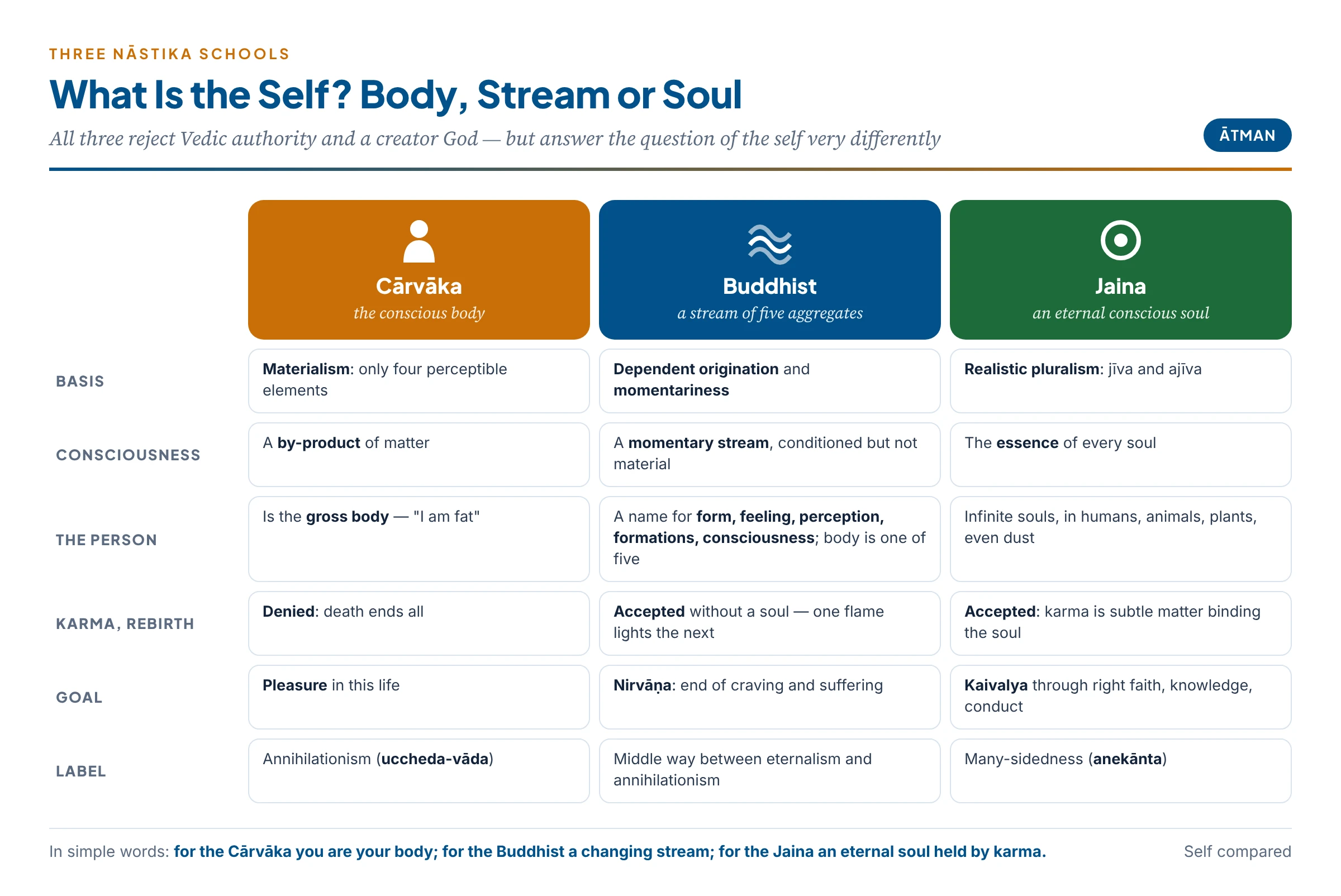
- Cārvāka: materialism — only the four perceptible elements exist; the self is the gross body qualified by consciousness.
- Buddhism: dependent origination (pratītya-samutpāda) and momentariness (kṣaṇika-vāda) — everything, mental and material, is an impermanent flux of conditioned events. Buddhism denies a permanent material substance as much as a permanent spiritual one.
- Different views of consciousness.
- Cārvāka: a quality (guṇa) of the body, produced by the elements.
- Buddhism: a stream of momentary mental states (citta-santāna), like a flowing river or a burning flame — conditioned, but not reducible to matter.
- Different views of the “person”.
- Cārvāka: the person is the body.
- Buddhism: the person is a conventional name for a bundle of five aggregates (pañca-skandha): form/matter (rūpa), feeling (vedanā), perception (saṃjñā), mental formations (saṃskāra) and consciousness (vijñāna). The body is only one of the five — so Buddhism explicitly refuses to identify the self with the body.
- Karma and rebirth.
- Cārvāka: both completely denied; death ends everything.
- Buddhism: both accepted without a soul — rebirth is a causal continuity, like one flame lighting another or a seal impressing wax: the saṃskāras (karmic dispositions) in the stream of consciousness give rise to the next life.
- The goal.
- Cārvāka: pleasure (kāma) in this life.
- Buddhism: nirvāṇa — the end of craving (tṛṣṇā) and clinging (upādāna), and so of suffering. The denial of a self has an ethical and spiritual purpose: to dissolve the ego that craves.
- The middle way. The Buddha described his teaching as a middle path between eternalism (śāśvata-vāda: an eternal soul) and annihilationism (uccheda-vāda: the person is destroyed at death). The Cārvāka — and Ajita Kesakambalī before it — is the classic annihilationist the Buddha rejected. The Buddha also refused to say either “the soul is the body” or “the soul is different from the body”.
| Feature | Cārvāka | Buddhism |
|---|---|---|
| Basic doctrine | Bhūta-caitanya-vāda, dehātma-vāda | Pratītya-samutpāda, anātma-vāda, five aggregates |
| Self is | The gross body qualified by consciousness | A conventional name for a flux of five aggregates |
| Consciousness | Emergent quality of matter | Momentary stream, conditioned but not material |
| Matter | The only permanent reality | Itself momentary and impermanent |
| Karma and rebirth | Denied | Accepted, without a transmigrating soul |
| Death | Annihilation (uccheda) | Continuation of the stream unless nirvāṇa is attained |
| Goal | Pleasure in this life | Nirvāṇa, cessation of suffering |
| Pramāṇas | Perception only | Perception and inference |
8. The Cārvāka and the Jaina Conceptions of Reality
- Common ground. Both are nāstika — they reject the authority of the Veda and a creator God — and both arose in reaction to Brahmanical ritualism. Both are realists and pluralists: the world really exists and contains many real things.
- The differences.
| Feature | Cārvāka | Jaina |
|---|---|---|
| Pramāṇas | Perception only | Perception, inference, testimony |
| Nature of reality | Only what is perceived; matter alone | Infinitely complex: every thing has infinite characteristics (ananta-dharmakaṃ vastu); many-sided (anekānta) |
| Categories | Four gross elements | Two kinds of substance: jīva (conscious) and ajīva (non-conscious) — matter (pudgala), motion (dharma), rest (adharma), space (ākāśa), time (kāla) |
| Atoms and space | Both rejected as imperceptible | Atoms of matter and real space accepted (things must exist somewhere) |
| Permanence and change | Combinations by nature (svabhāva) or chance (yadṛcchā); no eternal principle | Reality is origination, destruction and persistence together (utpāda-vyaya-dhrauvya-yuktaṃ sat); a substance has permanent qualities (guṇa) and changing modes (paryāya) |
| Soul | None; the conscious body | Infinite eternal souls; consciousness is their essence, present in all living beings in varying degrees |
| Karma | Denied | Subtle matter that flows into (āsrava) and binds (bandha) the soul |
| Liberation | Death | Kaivalya: stopping karmic influx (saṃvara), shedding karma (nirjarā) by the three jewels (right faith, knowledge, conduct) — the soul regains infinite knowledge, perception, power and bliss |
| Knowledge of truth | Limited to the senses | Ordinary knowledge is partial and relative (syādvāda); only the omniscient kevalin knows the whole |
- The parable of the blind men and the elephant. The Jainas illustrate many-sidedness with blind men who each touch one part of an elephant — trunk, leg, ear, tail — and each declare the elephant to be a snake, a pillar, a fan or a rope. Each is partly right; none sees the whole. From the Jaina standpoint, the Cārvāka is like a blind man who has touched only the material side of reality and declared it the whole.
- Evaluation. The Jaina view was developed partly to supply what materialism lacked — an account of consciousness, morality and liberation — while keeping a realist, non-theistic world. Critics in turn say the Jaina relativism presupposes an absolute standpoint (the kevalin’s) that it cannot fully justify; the Cārvāka is criticised chiefly for discounting human values in its ethics.
In simple words
Three students describe the same city. The first has only walked its streets and says: “The city is buildings and roads — nothing else.” The second has watched it change for years and says: “There is no fixed city — only a flow of people and events under one name.” The third says: “The city is many-sided: buildings, people, history and spirit — each view is partly true.” The first is the Cārvāka, the second the Buddhist, the third the Jaina.
Critical Evaluation
Critics and Defenders
Criticism — Critics
- Analogies fail: red colour and intoxication are material qualities; consciousness is awareness itself.
- Consciousness is not perceived like bodily qualities, and it is private.
- Body without consciousness (swoon, deep sleep) and consciousness in dreams show they are separable.
- Co-existence is not causation (light and sight; the two horns of a bull).
- Memory, recognition, personal identity and the knower–known distinction need a persisting subject.
- Ākāśa: non-perception is not non-existence; space and theoretical entities are needed.
- Moral anarchy follows if karma, rebirth and responsibility are denied.
Defence — Defenders and strengths
- Neuroscience: anaesthesia, brain injury and drugs show consciousness depends on the body.
- Emergence is a real feature of complex systems; consciousness need not be an exception.
- Dreams and sleep happen in a living body; consciousness depends on its state.
- No disembodied consciousness has ever been observed; the burden of proof is on the soul-theorist.
- Sound needs material media, not an eternal ākāśa — as physics confirms.
- An economical, naturalistic picture, free of unverifiable entities.
Cross-Tradition Comparison
Indian and Western Materialisms
| Thinker / school | Basic stuff | Mind / consciousness | Death |
|---|---|---|---|
| Cārvāka | Four gross elements; no ether, no atoms | Emerges from the elements as a living body | End of the person |
| Democritus | Atoms and the void | Soul made of fine, round, fiery atoms | Soul-atoms scatter |
| Epicurus | Atoms and void | Soul is atoms; dissolves at death | “Death is nothing to us” |
| Hobbes, La Mettrie | Matter in motion | Thought is motion in the body; “man a machine” | Machine stops |
| Marx and Engels | Matter in dialectical development | Consciousness a product of highly organised matter (the brain) and of social life | End of the individual |
| Modern physicalism | Physical entities and fields | Mental states are (or emerge from) brain states | End of brain function |
Indian Connect — Key takeaways
- The betel and fermentation analogies make the Cārvāka an early emergentist: new qualities arise from combinations. Marxist dialectical materialism (“quantity into quality”) later used the same idea.
- Unlike Democritus, the Cārvāka rejects both atoms and empty space — because neither is perceived. Its materialism is empiricist first and physical second.
- The Cārvāka is the annihilationist (uccheda-vāda) against which the Buddha defined his middle way, and the materialist against which Nyāya framed its proofs of the self — so this small school shaped the self-theories of its greatest rivals.
- Strawson’s “person” (Unit 11) agrees with the Cārvāka that one subject has both bodily and conscious predicates, but refuses to reduce the conscious to the bodily.
Synthesis (Siddhānta)
- The metaphysics. Only matter is real: four perceptible elements — earth, water, fire and air — combining by their own nature into bodies, senses and objects. Ākāśa and atoms are rejected as imperceptible; sound is moving air.
- Consciousness. Bhūta-caitanya-vāda: consciousness emerges from the elements combined as a living body, as red colour from betel or intoxicating power from fermenting molasses.
- Self. Dehātma-vāda: the self is the conscious living body, shown by the presence and absence of consciousness with life, by “I am fat”, and by the effect of food, fever, age and drugs on the mind. Death is annihilation; transmigration, karma across lives and the other world are fictions.
- Rivals. Unlike the Buddhist, the Cārvāka reduces the person to the body and denies rebirth; unlike the Jaina, it denies an eternal conscious soul and admits only perceptible matter.
- Balanced verdict. The Cārvāka saw, earlier than anyone, how deeply consciousness depends on the body — a point modern science has confirmed. But dependence is not identity: its analogies explain new material qualities, not awareness; and its inference from “not perceived” to “does not exist” exceeds its own evidence. The hard problem of consciousness — why matter should feel — remains as open for the Cārvāka as for today’s physicalists.
- Contemporary relevance. The debate continues in neuroscience and the philosophy of mind (physicalism, emergentism); in Indian law’s acceptance of brain-stem death for organ donation; in mental-health care that treats mind and brain together; and in questions about artificial intelligence — whether a sufficiently complex combination of non-conscious parts could ever give rise to consciousness, exactly the Cārvāka’s betel-leaf question.
“Consciousness arises from the elements, like the intoxicating power from fermenting ingredients.” — Bārhaspatya-sūtra
Previous Year Questions
- 2024Differentiate between the Cārvāka’s refutation of self as a transcendental category and the Buddhist rejection of ātma.
- 2020Critically evaluate Carvaka’s rejection of Akasa as one of the elements of reality and examine their criticism of transmigration of Soul.
- 2020Explain the differences of conception of Reality between Carvaka and Jainism.
- 2017“The soul is nothing but conscious body.” What are the reasons for Carvaka in holding this view?
- 2011Why do Carvakas reject the concept of Akasa. Discuss.
- 2007Carvaka’s views on the nature of soul.
- 2004Dehatmavada of Carvakas.
- 2001Write short notes on Charvaka theory of consciousness.