

Jainism: Theory of Reality; Saptabhaṅgīnaya; Bondage and Liberation.
Official Syllabus: Paper I, Section B, Unit 13
Every soul, say the Jainas, is by nature perfect — infinite in knowledge, perception, power and bliss. Yet the souls we know are ignorant, weak and suffering, and they are born again and again. Bondage (bandha) is the Jaina name for this fall, and karma is its mechanism. What makes the Jaina account unique in Indian philosophy is that karma is matter: an extremely fine kind of physical stuff (karma-pudgala) that flows into the soul (āsrava) when it acts, and sticks to it (bandha) when it acts with passion. This article explains that theory step by step — the root causes of bondage, the inflow and binding of karma, the famous distinction between bhāva-bandha (bondage in thought) and dravya-bandha (bondage in matter), the eight kinds of karma, the leśyās or “colours” of the soul, and the main criticisms with the Jaina replies.
In simple words
Rub oil on your body and roll on a dusty floor: the dust sticks. Do the same with dry skin and the dust simply falls off. In Jainism, the dust is karmic matter, which is everywhere around us; our activity (moving, speaking, thinking) stirs it up and draws it towards the soul; and our passions — anger, pride, deceit, greed — are the oil that makes it stick. A soul without passions still moves, but nothing clings to it for long.
Context & Problem
What “Bondage” Means
- The common Indian meaning. In Indian philosophy generally, bondage means the liability of the individual to birth and all the suffering that follows from it. Each school explains this differently, in the light of its own idea of the self and the world.
- The Jaina version. The sufferer is the jīva, a living, conscious substance that is inherently perfect. It has infinite potentiality: infinite knowledge, infinite perception (or faith), infinite power and infinite bliss — the four infinities (ananta-catuṣṭaya). It loses nothing of these by bondage; they are only covered.
- The sun and the clouds. “Just as the sun shines forth to illuminate the whole world as soon as the sky is freed of cloud and fog, the soul attains perfection when the obstacles that infect it are removed.” Bondage is the cloud; liberation is the clear sky.
- The obstacles are material. The limitations of any soul come from the material body with which it has identified itself — a body made of particles of matter (pudgala), arranged and organised by the soul’s own past karma.
The Problem Jainism Must Solve
A realist and pluralist system faces a hard question: if the soul is a real conscious substance and matter a real unconscious substance, how can matter bind the soul? Jainism answers boldly: the union is real — not an illusion (as in Advaita) and not a mere appearance (as in Sāṃkhya, where puruṣa is never really bound). Because the union is real, liberation must also be a real separation. The theory of karma explains both.
The Seven Principles: a Map of Bondage and Liberation
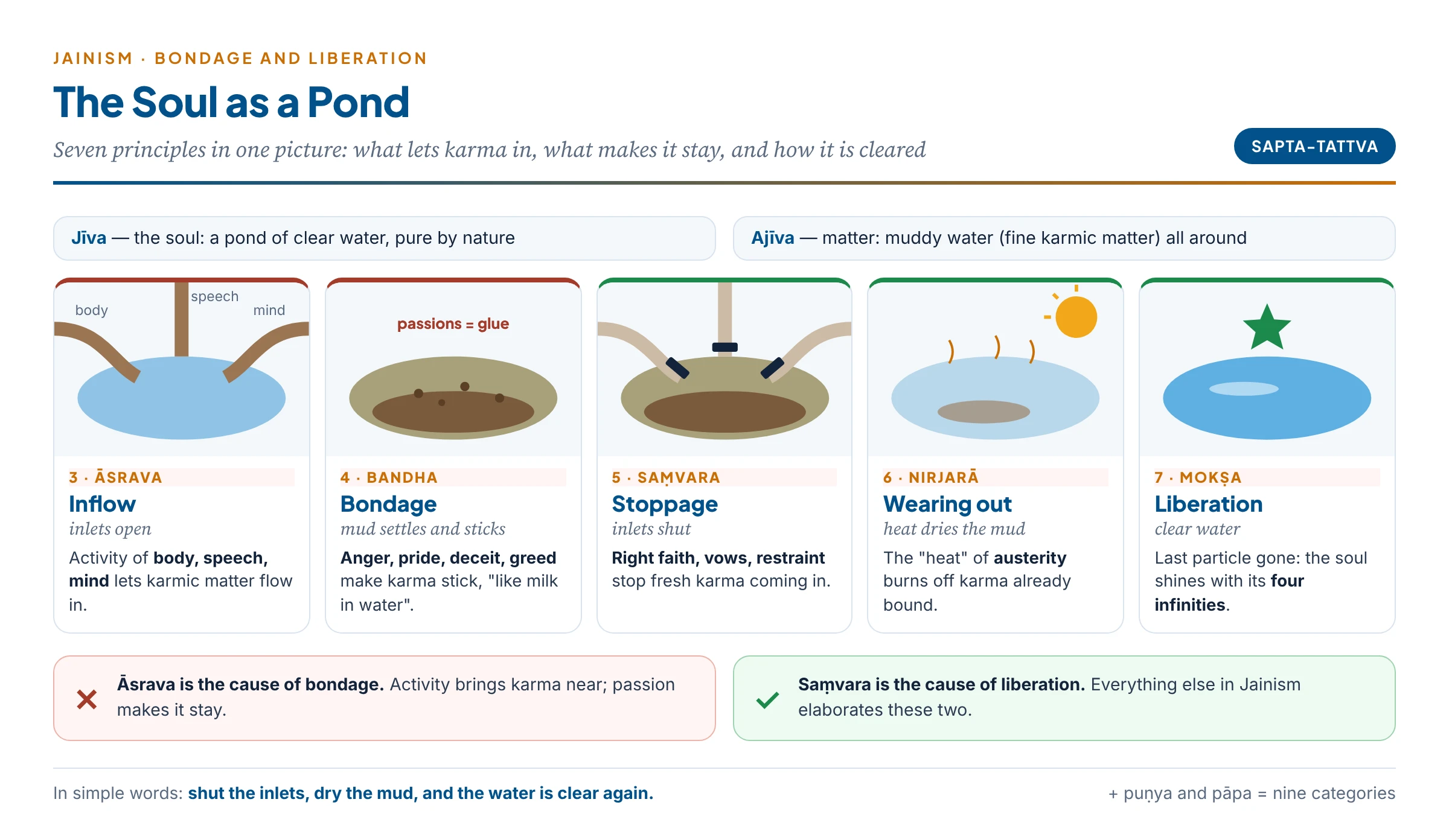
Jaina thought arranges everything around seven principles (sapta-tattva):
- Jīva — the soul.
- Ajīva — the non-soul, above all matter.
- Āsrava — the inflow of karmic matter towards the soul.
- Bandha — the binding of that matter to the soul.
- Saṃvara — the stopping of fresh inflow.
- Nirjarā — the wearing out of karma already bound.
- Mokṣa — liberation, the complete separation of soul from matter.
Adding puṇya (merit) and pāpa (demerit) gives the nine categories (nava-padārtha). The first four principles describe bondage; the last three describe liberation. In a single line: “Āsrava is the cause of bondage, and saṃvara is the cause of liberation; everything else in Jainism is an elaboration of this fundamental teaching.” This is why Jainism is called primarily an ethical teaching whose aim is the perfection of the soul.
Core Doctrine
1. Karma Is Matter
- Unlike every other Indian school. For Buddhism karma is essentially volition (cetanā); for Nyāya–Vaiśeṣika it leaves an unseen quality of the soul (adṛṣṭa); for Mīmāṃsā an unseen potency (apūrva); for Advaita it belongs to the realm of ignorance. Jainism alone holds that karma is not immaterial but made of fine, subtle particles of matter.
- Karmic matter. The universe is filled with a special, extremely fine grade of matter fit to become karma (kārmaṇa-vargaṇā). It is too fine to be perceived by the senses. When drawn into a soul, these particles are called karma-pudgala (“karma-matter”), or simply karma — because the kind and number of particles a soul attracts depend on its own past karma.
- Karma is the link between soul and body. “Karma is the link which unites the soul to the body.” The particular form a jīva takes — god, human, animal, plant — and the kind of body it inhabits are fixed by its karma from past existences.
- The soul builds its own body. “Roughly speaking, a soul acquires the body that it inwardly craves for.” Past thought, speech and action leave blind cravings; these cravings attract matching particles of matter and organise them into the body unconsciously desired. So the soul with its passions is the efficient cause of the body, and matter is its material cause.
- The body is more than flesh. The organism the soul acquires includes the gross body, the senses, the mind (manas), the vital forces and everything else that limits the soul’s powers.
- Nothing is chance. Our past karma fixes the family we are born into and the nature of our body — its colour, stature, shape, longevity and the number and kind of its sense and motor organs.
- Absolute moral causality. Every thought, word and deed bears fruit inevitably and automatically. There is no divine grace and no external judge; one’s destiny is entirely self-made. This gives the doctrine its moral force: personal responsibility is total.
In simple words
Think of a sculptor and his clay. The clay (matter) is the material; the sculptor’s hands and wishes (the soul’s cravings) are the efficient cause. A sculptor who has spent years carving tigers will find his hands shaping a tiger again. The Jaina soul, with the habits of its past lives, keeps “sculpting” for itself the kind of body its cravings have trained it to want.
2. The Root Causes of Bondage
- Beginningless ignorance. Because of beginningless ignorance, the soul loses faith in the truth taught by the Tīrthaṅkaras and becomes vulnerable to passions.
- The four passions (kaṣāya):
- Krodha — anger.
- Māna — pride, conceit.
- Māyā — deceit, crookedness.
- Lobha — greed.
- Why “kaṣāya”? The passions are called kaṣāya — “sticky substances” — because their presence in the soul makes karmic particles stick to it, as dust sticks to a moist cloth or an oiled body.
- Ignorance is the real cause. Passions attract karmic matter, and passions arise from ignorance; so ignorance is the ultimate cause of bondage. Here Jainism agrees with Sāṃkhya, Buddhism and Vedānta. And since ignorance can be removed only by knowledge, right knowledge will be the cause of liberation (see the next article).
- The full list of causes. The Tattvārtha Sūtra lists five conditions of bondage:
- Mithyātva (or mithyā-darśana) — wrong belief, a perverted view of reality.
- Avirati — non-restraint, the absence of vows and self-control.
- Pramāda — carelessness or spiritual negligence.
- Kaṣāya — the passions.
- Yoga — the activity of body, speech and mind.
- A ladder of causes. These causes form a ladder: as the soul climbs the stages of spiritual progress, these causes disappear in this order — wrong belief first, activity last.
Common confusion
Are there four causes of bondage or five? Both lists are found, and neither is wrong. The Tattvārtha Sūtra gives five: wrong belief, non-restraint, carelessness (pramāda), passions and activity. Many other Jaina texts give four — wrong belief, non-restraint, passions and activity — treating carelessness as part of non-restraint and the passions. A related slip is to translate māyā as “delusion”: among the four passions māyā means deceit; “delusion” belongs to the mohanīya karma, which is a different thing.
3. Āsrava: the Inflow of Karma
- Meaning. Āsrava (literally “flowing towards”) is the inflow of karmic matter towards the soul — the state in which karmic particles begin to flow in order to bind it.
- Yoga is the channel. In Jainism yoga means the vibration or activity of the soul through body, speech and mind. Every such activity sets the soul’s space-points vibrating and draws in karmic matter. “Yoga is the channel of āsrava.”
- Classified by channel.
- Kāya-yoga — bodily activity.
- Vāk-yoga — activity of speech.
- Mano-yoga — mental activity.
- Classified by cause: bhāva and dravya.
- Bhāva-āsrava (psychic inflow) — the change in the soul’s state — a passion, an impure thought — that opens the door to karma, before any matter enters.
- Dravya-āsrava (material inflow) — the actual inflow of karmic particles that follows.
- The rule. Bhāva-āsrava leads to dravya-āsrava — the inner change comes first, the material inflow after.
- Classified by moral quality. Good activity (compassion, charity) brings in auspicious karma (puṇya); bad activity (violence, lying) brings inauspicious karma (pāpa). Both are inflows; both, as we shall see, bind.
- Classified by passion.
- Sāmparāyika āsrava — inflow in a soul with passions. The karma sticks, stays for a fixed time and gives fruit: this is the inflow that keeps the cycle of rebirth (saṃparāya) going.
- Īryāpathika āsrava — inflow in a soul free of passions, such as an omniscient being who still walks and speaks. The karma touches and falls away at once, like dust thrown at a dry wall. It causes no real bondage.
- The lesson. Activity alone brings karma near; only passion makes it stay. This is why the Jaina path attacks the passions above everything else.
4. Bandha: Bondage Proper
- Definition. “Because it is accompanied by passions, the soul takes in matter fit to become karma: this is bondage.” Bandha is the state in which karmic particles actually infiltrate the soul and bind it — the assimilation of karma-matter by a soul coloured by passion.
- Interpenetration. Karmic matter unites with the soul by intimate interpenetration, “as water unites with milk” or “as fire unites with a red-hot iron ball“. The particles occupy the same space-points as the soul; they do not merely touch its surface. That is why life and consciousness are found in every part of the living body.
- Not crude. This may sound crude, but the Jaina soul is not without extension: it is co-extensive with the body. In every part of a living body we find both matter and consciousness; so their interpenetration is “as good a fact of experience” as milk mixed with water.
- Suspension, not destruction. The union of spirit and matter does not destroy the natural properties of either; it suspends their functioning in degree, according to the quality and quantity of matter absorbed. The result is a compound personality that partakes of both natures without destroying either — like gold mixed in ore, which is still gold.
- Four aspects of every bondage. Every binding of karma has four dimensions:
- Prakṛti-bandha — the nature or type of the karma (what it will obscure or produce).
- Sthiti-bandha — its duration (how long it will stay before ripening).
- Anubhāga-bandha (or anubhāva) — its intensity (how strongly it will be felt).
- Pradeśa-bandha — its quantity (how many particles are bound).
- Which cause decides what. The activity (yoga) decides the type and quantity of karma; the passions (kaṣāya) decide its duration and intensity. So a careless act done without malice brings in karma that passes quickly; the same act done with hatred binds karma that stays long and bites hard.
- Example. If a person commits violence in anger, karmic matter flows in and attaches to the soul: its type obscures and afflicts, its quantity depends on the violence of the act, and its duration and intensity depend on the fury with which it was done. It later ripens as pain and suffering.
In simple words
Jaina teachers explain the four aspects with a sweet (modaka) made with dry ginger. Its nature is to cure colds — that is prakṛti. It keeps for, say, a week before spoiling — that is sthiti. It may be very sweet or mildly sweet — that is anubhāga. And it may be large or small — that is pradeśa. Every piece of karma, like every sweet, has a kind, a shelf-life, a strength and a size.
5. Bhāva-bandha and Dravya-bandha
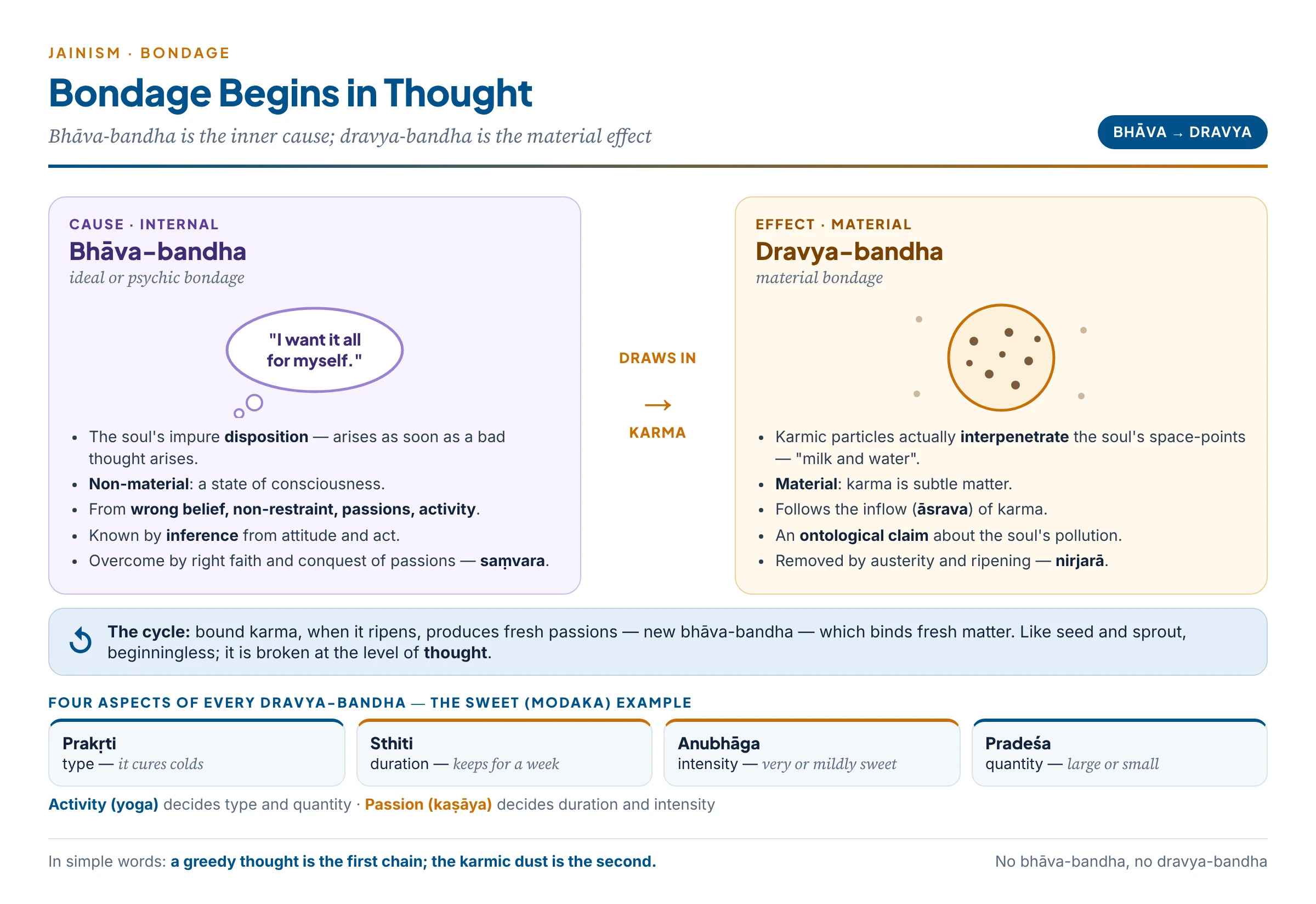
This distinction is the heart of the Jaina psychology of bondage: bondage begins in thought.
- Bhāva-bandha — ideal, internal or psychic bondage.
- It is the soul’s bondage to a bad disposition (bhāva): the impure conscious state — attachment, aversion, delusion — by which karma is bound.
- It “takes place as soon as the soul has a bad disposition”, even before any matter has entered.
- It is non-material, a state of the soul’s own consciousness, volitional, rooted in intention, desire and passion.
- Its components are those of the causes of bondage: wrong belief (mithyātva), non-restraint (avirati), passions (kaṣāya) and activity (yoga) — with carelessness (pramāda) added in the fivefold list.
- Dravya-bandha — material bondage.
- It is the actual association of the soul with karmic matter: the mutual interpenetration of the space-points of the soul and the particles of karma.
- It takes place “when there is an actual influx of karma into the soul”.
- It is material, since karma is matter, and has the four aspects of type, duration, intensity and quantity.
- Cause and effect. Since passion or bad disposition is the internal and primary cause of bondage, and the inflow of matter only its effect, “without bhāva-bandha there can be no dravya-bandha“. Bhāva-bandha is the cause, dravya-bandha the effect.
- How each is known. Bhāva-bandha is inferred from a person’s attitudes and actions; dravya-bandha is an ontological claim — a claim about what really exists — that the soul is actually polluted by karmic particles.
- A self-feeding cycle. The relation also runs the other way. When bound karma ripens, it produces fresh passions in the soul — new bhāva-bandha — which in turn binds fresh matter. Inner state and outer matter feed each other in a beginningless cycle, like seed and sprout. Breaking the cycle at the level of bhāva — by right faith and the conquest of passions — is the only way out.
- Two standpoints. Kundakunda adds a subtle point: from the real standpoint (niścaya-naya) the soul is the agent only of its own conscious states (bhāva); it never directly “makes” material karma. From the practical standpoint (vyavahāra-naya) we say the soul binds and is bound by material karma. The two kinds of bondage are thus also two ways of describing one process.
| Feature | Bhāva-bandha | Dravya-bandha |
|---|---|---|
| Also called | Ideal, internal, psychic bondage | Material, physical bondage |
| What it is | The soul’s impure disposition | The soul’s actual association with karmic matter |
| Nature | Non-material (a state of consciousness) | Material (karma is subtle matter) |
| Arises from | Wrong belief, non-restraint, passions, activity | Bhāva-bandha plus inflow of karmic particles |
| Role | Cause — internal and primary | Effect — external and secondary |
| How known | Inferred from attitudes and actions | An ontological claim about the soul’s pollution |
| Overcome by | Right faith, conquest of passions, vows (saṃvara) | Austerity and the ripening away of karma (nirjarā) |
| Example | A greedy thought | The karmic particles that bind because of that thought |
6. The Eight Kinds of Karma
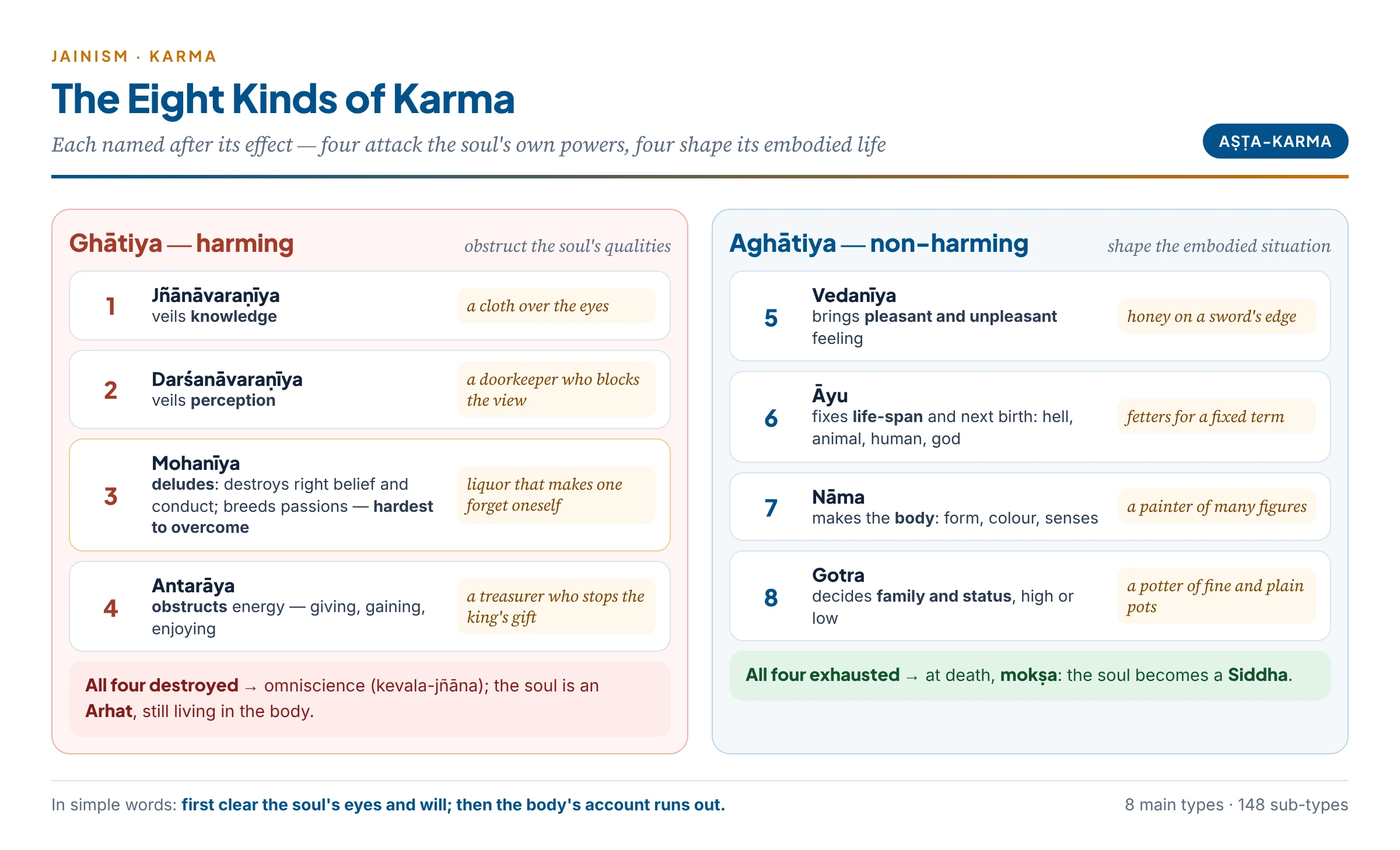
The Jainas name each karma after the effect it produces. Collectively, karma means the sum of all tendencies generated by past life; taken separately, each feature of our condition is due to a particular karma. There are eight main types (mūla-prakṛti), subdivided in the texts into some 148 sub-types. They fall into two groups.
Harming or destructive karmas (ghātiya) — they directly obstruct the soul’s own powers:
- Jñānāvaraṇīya — knowledge-obscuring karma: veils the soul’s power of knowing, like a cloth over the eyes.
- Darśanāvaraṇīya — perception-obscuring karma: veils the soul’s power of perception (also rendered “faith”), like a doorkeeper who will not let you see the king.
- Mohanīya — deluding karma: destroys right belief and right conduct and produces the passions, like liquor that makes one forget oneself. It is the most powerful and most difficult to overcome; once it is destroyed, liberation is assured within a few lives.
- Antarāya — obstructing karma: blocks the soul’s innate energy, hindering giving, gaining, enjoying and acting, like a treasurer who stops the king’s gift from reaching the beggar.
Non-harming or non-destructive karmas (aghātiya) — they do not attack the soul’s qualities directly but shape its embodied situation:
- Vedanīya — feeling-producing karma: brings pleasant and unpleasant experiences, disturbing the soul’s undisturbed bliss, like licking honey from a sword’s edge — sweet, and wounding.
- Āyu (āyuṣ) — life-span karma: fixes the length of life and the next state of existence — hellish, animal, human or divine — like fetters that hold a prisoner for a fixed term.
- Nāma — body-making karma: decides the kind of body and its peculiarities — form, colour, senses, build — like a painter who paints many figures.
- Gotra — status karma: decides the family and social standing, high or low, like a potter who makes both fine and plain pots.
- Order of destruction. When a soul destroys all four harming karmas, it attains omniscience (kevala-jñāna) and is called an Arhat (or Arihant) — but it continues to live in the body. Only when the four non-harming karmas are also exhausted, at the end of that life, does it attain mokṣa.
7. Leśyā: the Colour of the Soul’s Disposition
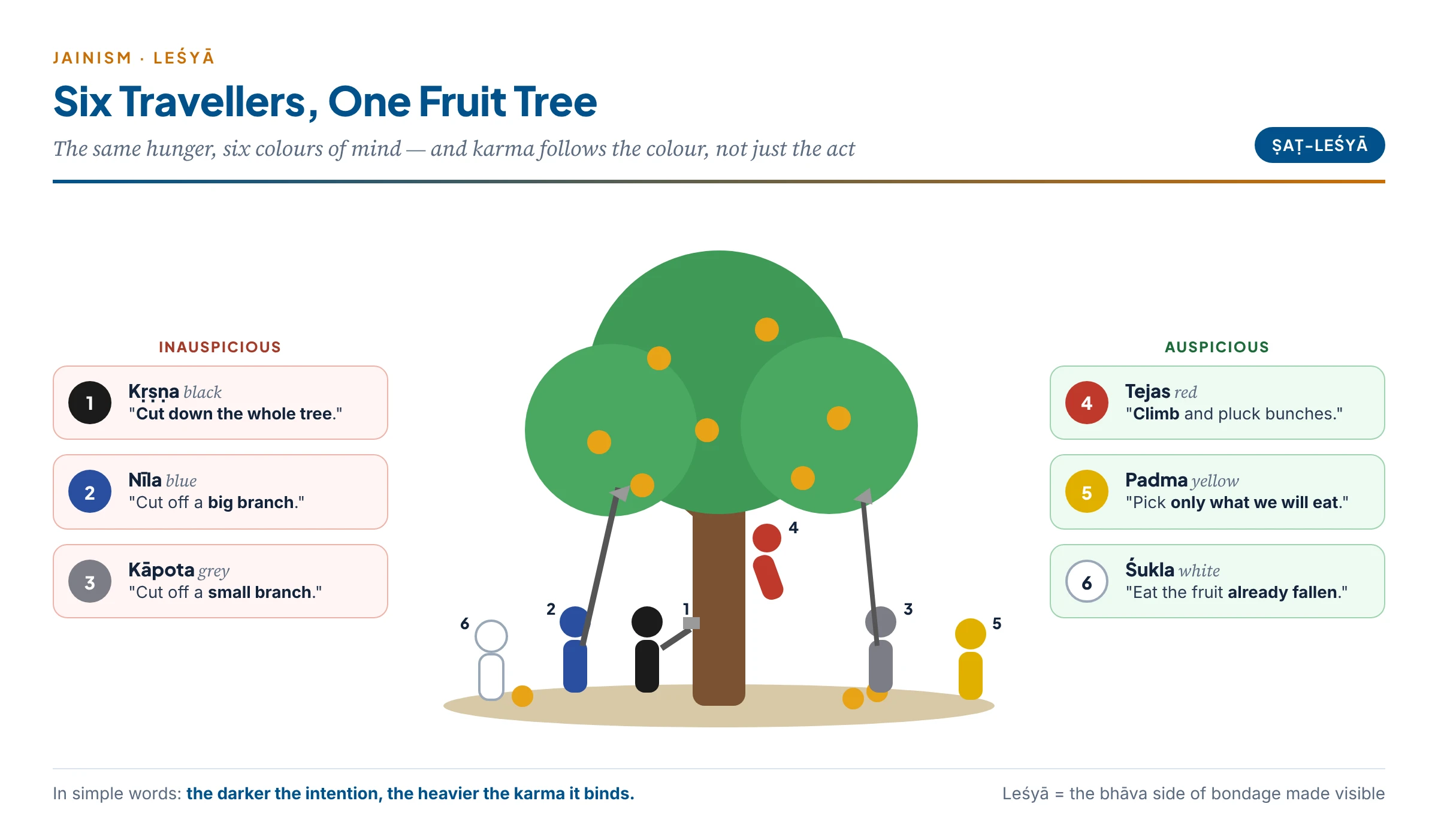
- Meaning. Leśyā is the tint or “colour” that the soul’s dispositions take on through its passions and activity. The texts describe six leśyās, from worst to best: black (kṛṣṇa), blue (nīla), grey (kāpota), red or fiery (tejas), yellow or lotus-coloured (padma) and white (śukla). The first three are inauspicious, the last three auspicious.
- The parable of the fruit tree. Six hungry travellers find a fruit-laden tree.
- The first wants to cut down the whole tree — black leśyā.
- The second, to cut off a big branch — blue.
- The third, to cut off a small branch — grey.
- The fourth, to climb and pluck bunches of fruit — red.
- The fifth, to pick only the fruit he will eat — yellow.
- The sixth, to eat the fruit already fallen on the ground — white.
- Why it matters. The six travellers share the same hunger but show six degrees of violence in the mind. The leśyā doctrine shows that bondage is graded by disposition, not just by outward act: it is the bhāva side of bondage made visible. The cruder the disposition, the darker and heavier the karma it binds.
In simple words
Six people want the same thing — a promotion. One plans to ruin a rival’s career, another to spread rumours, a third to take credit for a team’s work, a fourth to work hard but cut corners, a fifth to work honestly, and a sixth to wait for the opportunity that comes naturally. Same goal, six “colours” of mind. Jainism says the karma each one binds follows the colour of the mind, not just the result.
8. Puṇya and Pāpa: Golden and Iron Chains
- Both bind. Good actions bring auspicious karma (puṇya), which ripens as pleasant birth, health and happiness; bad actions bring inauspicious karma (pāpa), which ripens as suffering. But both are karma, and both keep the soul in saṃsāra.
- Kundakunda’s image. A chain of gold binds a man as firmly as a chain of iron. Merit is better than demerit for life in the world, but the seeker of liberation must finally go beyond both.
- In practice. Puṇya is not rejected on the path: good conduct stops the worst inflows and supports the climb. But the goal is freedom from karma itself, not a better stock of it.
9. The Bound Soul and the Liberated Soul
Souls are qualitatively alike and differ only in the amount of karma covering them. The universe is literally filled with souls, and they fall into two classes.
| Bound soul (baddha, saṃsārin) | Liberated soul (mukta, siddha) | |
|---|---|---|
| Karma | Mixed with karmic matter | Free of every particle of karma |
| Body | Embodied — as god, human, animal, plant, or in earth, water, fire and air | Never embodied again |
| Knowledge | Partial, through senses and mind | Omniscience (kevala-jñāna) |
| The four infinities | Obscured, like the sun behind clouds | Fully manifest |
| Kinds | Mobile (trasa, two to five senses) and immobile (sthāvara, one sense) | One kind — perfect, though still many and distinct |
| Place | Wandering through the world in the cycle of birth | At the summit of the universe (siddha-śilā) |
| Relation to the world | Acts, suffers, is reborn | Has nothing more to do with worldly affairs |
The liberated soul has attained absolute purity, lives in perfection at the top of the universe and has reached nirvāṇa. What its condition is like — and how a soul gets there — is the subject of the next article.
10. Why the Bound Soul Knows Only Partially
- Bondage limits knowledge. The knowledge-obscuring and perception-obscuring karmas cover the soul’s omniscience; the body, senses and mind through which the bound soul knows are themselves products of karma.
- The link with anekānta and syādvāda. A bound knower grasps only a few of the infinite characters of a thing (anekānta), so its judgments are true only from a standpoint (syādvāda). In this sense the relativity of human knowledge is a consequence of bondage, and omniscience is a consequence of liberation. Jaina epistemology and soteriology (the theory of salvation) are two faces of one doctrine.
11. How the Theory of Karma Shapes the Path to Liberation
- Liberation must be physical separation. “If bondage means union of soul with matter, then liberation means separation of matter from soul.” Because karma is matter, freedom cannot be a mere change of understanding, as in Advaita or Sāṃkhya: the karmic matter must actually stop coming and actually go away.
- Two tasks, two principles.
- Stop the inflow — saṃvara, achieved by right faith, vows and self-restraint.
- Remove what is already bound — nirjarā, achieved by austerity and by letting karma ripen and fall away.
- Why austerity. Since karma is a substance with a fixed duration and intensity, it can be burnt off early by the “heat” of austerity (tapas) — hence the strong ascetic tone of Jainism.
- Why non-violence. Since violence binds the heaviest karma, and since every being from a plant to a human has a soul, ahiṃsā becomes the central vow.
- Why self-effort. Since no God dispenses the fruits of karma, no God can pardon them; liberation is won by one’s own effort. The liberated are called Jina (“victor”) — victors over their own passions.
- Why gradual stages. Since the causes of bondage disappear one by one (wrong belief first, activity last), the path is a ladder of spiritual stages. The details belong to the next article.
Critical Evaluation
Objections
- From Vedānta and Nyāya: karma needs a dispenser.
- Karma is unconscious; by itself it cannot bring the right fruit to the right soul at the right time. The fruits must be administered by a conscious agent — God (Īśvara).
- Vedānta therefore called the Jaina insistence on the self-sufficiency of karma, without any Supreme Being, nāstika (heterodox, “atheistic”).
- From the Buddha.
- The habit argument. A person’s karma cannot be fixed by what he does habitually: even a habitual sinner spends most of his time not sinning and only some time actually sinning.
- Unobservable karma. The Jainas aim to destroy unobservable, unverifiable karmic matter, when they should eliminate observable evil mental states — greed, hatred and delusion.
- Austerities. The Buddha said he was happier without the painful austerities that the Jainas practised to burn off karma.
- Fatalism and despair.
- If the course of life is fixed by karma, the theory dampens the spirit: people suffer, believing nothing can be done.
- The picture of a mountain of bad deeds looming over us, with no recourse, leads to fatalism.
- The interaction problem. How can formless consciousness really unite with unconscious matter, “like milk with water”? The analogy is between two material things. Even sympathetic scholars note that the Jaina texts call the relation an “association” — occupying the same space — without clearly explaining how the non-material and the material interact.
- The dilemma of bondage. The absolutist critic presses a sharper point:
- Spirit is pure consciousness, bliss and power; matter is unconscious. How can pure spirit be tinged with ignorance and passion?
- If ignorance and karma are inseparable from the soul, liberation is impossible; if they are external to it, bondage is impossible.
- The Jaina says the union is beginningless. But what is beginningless and real cannot be removed — so liberation should be hopeless.
- Why not admit, with Advaita, that the whole show is due to beginningless ignorance (avidyā), actual but not ultimately real?
- Materialising morality. Treating moral guilt as particles of matter seems to turn ethics into physics.
Jaina Replies
- Karma works automatically. No dispenser is needed: as food and drink, once taken, turn into blood and tissue without anyone directing them, karmic matter ripens of itself. And a God who distributes suffering raises more problems than he solves.
- Beginningless yet removable. The union of soul and karma is like the union of gold and ore in a mine: it has no beginning, yet gold is separated from dross by fire. Or like the chain of seed and sprout: beginningless, yet a roasted seed ends it. Beginninglessness of the series does not make any particular bond eternal — each karma has a fixed duration and falls away.
- Not fatalism. Karma is not fixed and frozen. The Jaina karma theory teaches that bound karma can be transformed into another sub-type, made to ripen early, or have its duration and intensity increased or reduced by present effort. Present effort (puruṣārtha) always counts; the mountain can be worn down.
- The soul is extended. Interaction is not mysterious for the Jaina, because the soul is co-extensive with the body; consciousness and matter are compresent in every living part — a fact of experience.
- Against the habit argument. Karma is bound by each act and each disposition, not by an average of a lifetime’s habits.
- Against “unobservable karma”. Jainism attacks the passions first (bhāva-bandha is the cause); karmic matter is only their effect. On this point it is closer to the Buddha than the Buddha allowed.
- Ethics, not physics. Material karma gives ethics reality: moral acts change the soul as surely as food changes the body. It explains why moral habits are hard to break.
Critics and Defenders
Criticism — Critics
- Vedānta and Nyāya: unconscious karma needs God to dispense its fruits; Jainism is nāstika.
- Buddha: habitual sinner argument; unobservable karma vs observable greed, hatred and delusion; austerities make no one happier.
- Fatalism: a “mountain of bad deeds” dampens effort.
- Interaction: formless spirit cannot mix with matter like milk with water.
- Dilemma: inseparable karma makes liberation impossible; external karma makes bondage impossible; beginningless union cannot end.
- Materialised morality: guilt as particles of dust.
Defence — Defenders and strengths
- Self-operating moral law: like food turning into blood, no dispenser needed.
- Gold and ore, seed and sprout: beginningless yet removable.
- Karma can be transformed, hastened, weakened — effort counts.
- Soul co-extensive with body: interpenetration is experienced.
- Bondage begins in thought — the passions are the primary target.
- Total personal responsibility: no grace, no scapegoat.
Cross-Tradition Comparison
| School | What karma is | What binds the soul | Is bondage real? | Who dispenses fruits? |
|---|---|---|---|---|
| Jainism | Subtle matter that flows into and sticks to the soul | Passions and activity drawing in karmic matter | Yes — a real union with matter | No one — karma works by itself |
| Buddhism | Volition (cetanā) and its traces | Craving and ignorance; no permanent soul to bind | Real as a process, but there is no self | No one — dependent origination |
| Nyāya–Vaiśeṣika | Merit and demerit as unseen qualities of the soul (adṛṣṭa) | False knowledge, desire, aversion | Yes | God (Īśvara) |
| Mīmāṃsā | An unseen potency (apūrva) produced by ritual acts | Desire-driven action | Yes | The potency itself (no God) |
| Sāṃkhya | Impressions in the buddhi (part of prakṛti) | Non-discrimination of puruṣa and prakṛti | No — puruṣa only seems bound | No one |
| Advaita | Belongs to the empirical world of ignorance | Avidyā and superimposition (adhyāsa) | No — bondage is an error | Īśvara (at the empirical level) |
Indian Connect — Key takeaways
- Jainism is the most realistic account of bondage in India: where Sāṃkhya says puruṣa and prakṛti never really meet and Advaita says bondage is an error, Jainism says the soul is really mixed with matter — and must be really cleansed.
- With Sāṃkhya, Buddhism and Vedānta, Jainism makes ignorance the root cause of bondage; it differs in giving that ignorance a material result.
- With Buddhism and Mīmāṃsā, it denies that a God is needed to run the moral order.
- In the West, Spinoza called the life governed by passions “human bondage” and freedom the understanding that masters them; Plato’s Phaedo pictures the soul imprisoned in the body and purified by philosophy. Jainism shares both ideas — bondage by passion, release by purification — but makes the bond literally material.
Synthesis (Siddhānta)
- The doctrine. The soul is inherently perfect; its four infinities are covered by karmic matter. Because of beginningless ignorance, the soul develops wrong belief and passions; its activity of body, speech and mind draws karmic particles in (āsrava); its passions make them stick (bandha). The binding has a type, duration, intensity and quantity; activity fixes the first and last, passion the middle two.
- Bhāva and dravya. Bondage begins in thought (bhāva-bandha) and ends in matter (dravya-bandha); the first is the cause, the second the effect, and ripening karma feeds new passions in a beginningless cycle.
- Eight karmas. Four harming karmas attack knowledge, perception, right belief and energy; four non-harming karmas fix feeling, life-span, body and status. The six leśyās show the colour of the mind that binds them.
- Balanced verdict. The Jaina theory is the most systematic and morally serious account of karma in Indian thought: it explains rebirth, inequality and the persistence of habit without a God, and it puts responsibility wholly on the agent. Its difficulties are the interaction of spirit with matter and the dilemma of a beginningless yet removable bondage — to which the Jaina answers with the gold-and-ore analogy and the flexibility of karma.
- Contemporary relevance.
- Moral responsibility. In a culture of blaming fate, systems or others, the Jaina view that one’s condition is self-made and self-unmade is a powerful ethic of agency.
- Psychology of habit. “Bondage begins in thought” anticipates modern insights that dispositions shape behaviour and that changing a habit means changing the inner state first.
- Ecology of action. The idea that every act leaves a trace — on the agent and the world — fits today’s concern with the footprint of our choices.
- Non-violence. Graded karma for graded violence offers a rational basis for compassion towards animals and the natural world.
“Because it is accompanied by passions, the soul takes in matter fit to become karma: that is bondage.” — Umāsvāti, Tattvārtha Sūtra
Previous Year Questions
- 2024What is the distinction between Bhavabandha and Dravyabandha, according to the Jainas? Discuss.
- 2022How does Jaina view of Karma bear upon their soteriology? Critically discuss.
- 2022Discuss the nature of Soul and Bondage according to Jainism.
- 2020Examine the concept of Karma according to Jainism. How does it bear upon their conception of Liberation?
- 2018How do the Jaina philosophers explain ‘bondage’? What, according to them, is the distinction between ‘liberated soul’ and ‘bound soul’? What do the Jainas think about the condition of the ‘liberated soul’? Discuss.
- 2014Explain the concept of Karma and discuss various types of Karma according to Jaina philosophy.